
Matthew 7:22

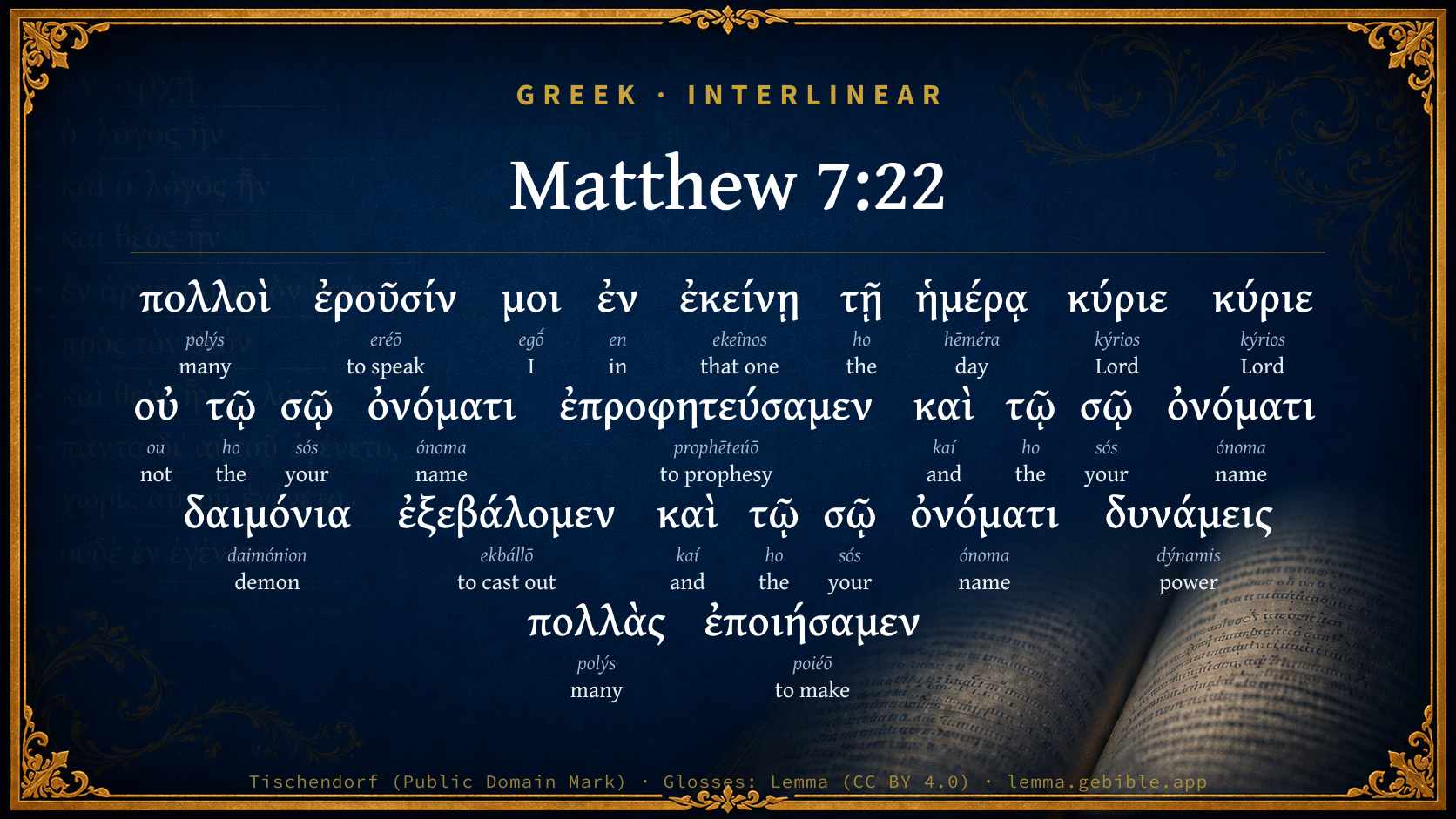
Greek (Tischendorf 8th ed.) Matthew 7:22 appears in the Greek New Testament. The text above is from the Tischendorf 8th edition. Each word links to its Strong’s number and a concise gloss. Click any word for its full Thayer’s Greek Lexicon entry.
Download image
Cite this verse

Matthew 7:22 (World English Bible). Public Domain. Lemma interlinear Bible study tool, https://lemma.gebible.app/v/matthew/7/22.

Show BibTeX & RIS
BibTeX
RIS
English Translation
Many will tell me in that day, 'Lord, Lord, didn't we prophesy in your name, in your name cast out demons, and in your name do many mighty works?'
World English Bible · Public Domain
Highlights
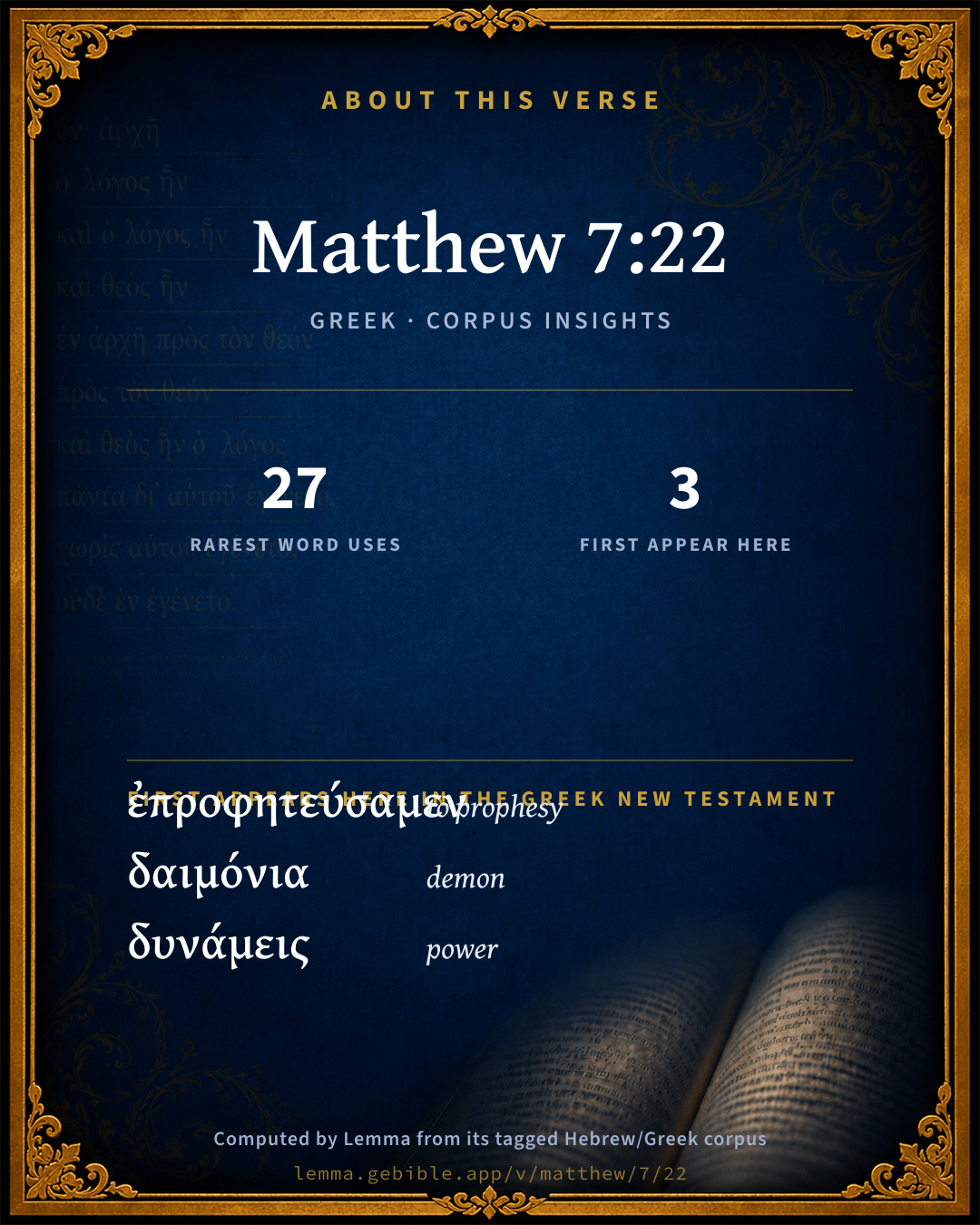
  • 3 first appearances in the Greek New Testament
Full analysis ↓
Download a study sheet

One document with this verse’s original text, its word-by-word gloss line, the meaning frame, cross-references with their text, attributed commentary, and full source and license credits — printable, and it pastes into notes with its structure intact.

This verse Autodidact and up

Study sheet (.html) Plain text (.txt)

A passage Seminary Student

Up to 50 verses in one chapter. A passage sheet keeps up to 6 commentary sources and 12 cross-references per verse, in the order this page ranks them, and says so on the sheet whenever that leaves anything out. Ask for a single verse and you get the Autodidact verse sheet above.

Everything on this page stays free to read, with no account — the sheet is a download of what is already on screen, not access to it.

Want to remove ads? Support Godless Engineer
Compare translations 3

The same verse in 3 English versions, stacked beneath the original-language interlinear above. Click any original word for its lexicon entry.

Each is an independent rendering of the whole verse — the interlinear is not word-aligned to these translations.

Highlighted words mark where these versions differ — a whole-verse word diff, not a word-by-word alignment.

  • World English Bible Public Domain
    Many will tell me in that day, 'Lord, Lord, didn't we prophesy in your name, in your name cast out demons, and in your name do many mighty works?'
  • King James Version Public Domain
    Many will say to me in that day, Lord, Lord, have we not prophesied in thy name? and in thy name have cast out devils? and in thy name done many wonderful works?
  • unfoldingWord Literal Text CC BY-SA 4.0
    Many will say to me in that day, ‘Lord, Lord, did we not prophesy in your name, and in your name cast out demons, and in your name do many mighty deeds?’

unfoldingWord Literal Text — © unfoldingWord, licensed CC BY-SA 4.0. Word-aligned USFM3 via Door43 (git.door43.org/unfoldingWord/en_ult).

Versions to compare (up to 4)

3 of 4 selected

Show all 19 translations

Every available English version of this verse, each an independent rendering of the whole verse.

  • World English Bible Public Domain
    Many will tell me in that day, 'Lord, Lord, didn't we prophesy in your name, in your name cast out demons, and in your name do many mighty works?'
  • Berean Standard Bible Public Domain
    Many will say to Me on that day, ‘Lord, Lord, did we not prophesy in Your name, and in Your name drive out demons and perform many miracles?’
  • Majority Standard Bible Public Domain
    Many will say to Me on that day, ‘Lord, Lord, did we not prophesy in Your name, and in Your name drive out demons and perform many miracles?’
  • King James Version Public Domain
    Many will say to me in that day, Lord, Lord, have we not prophesied in thy name? and in thy name have cast out devils? and in thy name done many wonderful works?
  • American Standard Version (1901) Public Domain
    Many will say to me in that day, Lord, Lord, did we not prophesy by thy name, and by thy name cast out demons, and by thy name do many mighty works?
  • Revised Version (1885) Public Domain
    Many will say to me in that day, Lord, Lord, did we not prophesy by thy name, and by thy name cast out devils, and by thy name do many mighty works?
  • Geneva Bible (1599) Public Domain
    Many will say to me in that day, Lord, Lord, haue we not by thy Name prophecied? and by thy name cast out deuils? and by thy name done many great workes?
  • Douay-Rheims (1899) Public Domain
    Many will say to me in that day: Lord, Lord, have not we prophesied in thy name, and cast out devils in thy name, and done many miracles in thy name?
  • Young's Literal Translation Public Domain
    Many will say to me in that day, Lord, lord, have we not in thy name prophesied? and in thy name cast out demons? and in thy name done many mighty things?
  • Literal Standard Version CC BY-SA 4.0
    Many will say to Me in that day, Lord, Lord, have we not prophesied in Your Name? And in Your Name cast out demons? And in Your Name done many mighty things?
  • Unlocked Literal Bible CC BY-SA 4.0
    Many people will say to me in that day, 'Lord, Lord, did we not prophesy in your name, in your name drive out demons, and in your name do many mighty deeds?'
  • unfoldingWord Literal Text CC BY-SA 4.0
    Many will say to me in that day, ‘Lord, Lord, did we not prophesy in your name, and in your name cast out demons, and in your name do many mighty deeds?’
  • Darby Bible Public Domain
    Many shall say to me in that day, Lord, Lord, have we not prophesied through *thy* name, and through *thy* name cast out demons, and through *thy* name done many works of power?
  • World Messianic Bible Public Domain
    Many will tell me in that day, ‘Lord, Lord, didn’t we prophesy in your name, in your name cast out demons, and in your name do many mighty works?’
  • Webster's Bible Public Domain
    Many will say to me in that day, Lord, Lord, have we not prophesied in thy name? and in thy name have cast out demons? and in thy name done many wonderful works?
  • Free Bible Version CC BY-SA 4.0
    Many will say to me at the Day of Judgment, ‘Lord, Lord, didn't we prophesy in your name and drive out demons in your name, and perform many miracles in your name?’
  • Bible in Basic English Public Domain
    A great number will say to me on that day, Lord, Lord, were we not prophets in your name, and did we not by your name send out evil spirits, and by your name do works of power?
  • Text-Critical English NT CC BY 4.0
    Many will say to me on that day, ‘Lord, Lord, did we not prophesy in yoʋr name, and in yoʋr name cast out demons, and in yoʋr name do many miracles?’
  • Tyndale New Testament (1534) Public Domain
    Many will saye to me in that daye Master master have we not in thy name prophesied? And in thy name have caste oute devyls? And in thy name have done many miracles?

Literal Standard Version (2020), Covenant Press — licensed CC BY-SA 4.0. Text via the HelloAO Bible API (eBible.org). Unlocked Literal Bible (unfoldingWord) — licensed CC BY-SA 4.0. Text via the HelloAO Bible API (eBible.org). unfoldingWord Literal Text — © unfoldingWord, licensed CC BY-SA 4.0. Word-aligned USFM3 via Door43 (git.door43.org/unfoldingWord/en_ult). Free Bible Version, Dr. Jonathan Gallagher — licensed CC BY-SA 4.0. Text via the HelloAO Bible API (eBible.org).

Word by word

More ways to search: Search by grammar → Find every occurrence → Compare this word →

Practice this passage: Drill this verse → Learn its vocabulary →

σῷ
sós
G4674
“your”
Possessive pronoun, 2nd person, Dative, Singular, Masculine
Part of Speech
Possessive pronoun
Person
2nd person
Case
Dative
Number
Singular
Gender
Masculine
Full Thayer's Definition

Origin: from G4771

TDNT: None

1. thy, thine
  1. πολλοὶ polýs G4183 “many” Adjective, Nominative, Plural, Masculine
  2. ἐροῦσίν eréō G2046 “to speak” Verb, Future, Active, Indicative, 3rd person, Plural
  3. μοι egṓ G1473 “I” Personal pronoun, 1st person, Dative, Singular
  4. ἐν en G1722 “in” Preposition
  5. ἐκείνῃ ekeînos G1565 “that one” Demonstrative pronoun, Dative, Singular, Feminine
  6. τῇ ho G3588 “the” Article, Dative, Singular, Feminine
  7. ἡμέρᾳ hēméra G2250 “day” Noun, Dative, Singular, Feminine
  8. κύριε kýrios G2962 “Lord” Noun, Vocative, Singular, Masculine
  9. κύριε kýrios G2962 “Lord” Noun, Vocative, Singular, Masculine
  10. οὐ ou G3756 “not” Particle, Negative
  11. τῷ ho G3588 “the” Article, Dative, Singular, Masculine
  12. ὀνόματι ónoma G3686 “name” Noun, Dative, Singular, Neuter
  13. ἐπροφητεύσαμεν prophēteúō G4395 “to prophesy” Verb, Aorist, Active, Indicative, 1st person, Plural
  14. καὶ kaí G2532 “and” Conjunction
  15. τῷ ho G3588 “the” Article, Dative, Singular, Masculine
  16. σῷ sós G4674 “your” Possessive pronoun, 2nd person, Dative, Singular, Masculine
  17. ὀνόματι ónoma G3686 “name” Noun, Dative, Singular, Neuter
  18. δαιμόνια daimónion G1140 “demon” Noun, Accusative, Plural, Neuter
  19. ἐξεβάλομεν ekbállō G1544 “to cast out” Verb, Aorist, Active, Indicative, 1st person, Plural
  20. καὶ kaí G2532 “and” Conjunction
  21. τῷ ho G3588 “the” Article, Dative, Singular, Masculine
  22. σῷ sós G4674 “your” Possessive pronoun, 2nd person, Dative, Singular, Masculine
  23. ὀνόματι ónoma G3686 “name” Noun, Dative, Singular, Neuter
  24. δυνάμεις dýnamis G1411 “power” Noun, Accusative, Plural, Feminine
  25. πολλὰς polýs G4183 “many” Adjective, Accusative, Plural, Feminine
  26. ἐποιήσαμεν poiéō G4160 “to make” Verb, Aorist, Active, Indicative, 1st person, Plural

About this verse

These counts appear in no published source. They are computed here, from the morphology-tagged text and Lemma’s own curated glosses. What Lemma adds →

27
words
17
distinct lemmas
Gospels
section

First appearance in Scripture

These words make their first canonical appearance in the Greek New Testament here:

  • ἐπροφητεύσαμεν to prophesy G4395
  • δαιμόνια demon G1140
  • δυνάμεις power G1411

Shared distinctive vocabulary

σῷ your G4674 occurs in 24 verses of the Greek New Testament. Also found in:
Repetition

Words recur within this verse:

  • ὀνόματι name G3686 ×3
  • πολλοὶ many G4183 ×2
  • κύριε Lord G2962 ×2
  • τῇ the G3588 ×4
  • σῷ your G4674 ×3
  • καὶ and G2532 ×2

Cross-references

23

Topical passages linked to Matthew 7:22 in the Treasury of Scripture Knowledge — connected by theme and wording, ordered by reader-vote popularity; previews shown in the World English Bible.

  • Luke 13:25–27 When once the master of the house has risen up, and has shut the door, and you begin to stand outside, and to knock at the door, saying, 'Lord, Lord, open to us!' then he will answer and tell you, 'I don't know you or where you come from.'
  • 1 Corinthians 13:1–2 If I speak with the languages of men and of angels, but don't have love, I have become sounding brass, or a clanging cymbal.
  • Malachi 3:17–18 They shall be mine," says Yahweh of Hosts, "my own possession in the day that I make, and I will spare them, as a man spares his own son who serves him.
  • Acts 19:13–15 But some of the itinerant Jews, exorcists, took on themselves to name over those who had the evil spirits the name of the Lord Jesus, saying, "We adjure you by Jesus whom Paul preaches."
  • Hebrews 6:4–6 For concerning those who were once enlightened and tasted of the heavenly gift, and were made partakers of the Holy Spirit,
  • 2 Timothy 1:12 For this cause I suffer also these things. Yet I am not ashamed, for I know him whom I have believed, and I am persuaded that he is able to guard that which I have committed to him against that day.
  • 2 Timothy 4:8 From now on, there is stored up for me the crown of righteousness, which the Lord, the righteous judge, will give to me on that day; and not to me only, but also to all those who have loved his appearing.
  • Numbers 24:4 He says, who hears the words of God, Who sees the vision of the Almighty, Falling down, and having his eyes open:
  • Matthew 25:11 Afterward the other virgins also came, saying, 'Lord, Lord, open to us.'
  • John 11:51 Now he didn't say this of himself, but being high priest that year, he prophesied that Jesus would die for the nation,
  • Isaiah 2:11 The lofty looks of man will be brought low, The haughtiness of men will be bowed down, And Yahweh alone will be exalted in that day.
  • Isaiah 2:17 The loftiness of man shall be bowed down, And the haughtiness of men shall be brought low; And Yahweh alone shall be exalted in that day.
  • Jeremiah 23:13–32 I have seen folly in the prophets of Samaria; they prophesied by Baal, and caused my people Israel to err.
  • Matthew 7:21 Not everyone who says to me, 'Lord, Lord,' will enter into the Kingdom of Heaven; but he who does the will of my Father who is in heaven.
  • Matthew 10:5–8 Jesus sent these twelve out, and charged them, saying, "Don't go among the Gentiles, and don't enter into any city of the Samaritans.
  • Matthew 24:36 But no one knows of that day and hour, not even the angels of heaven, but my Father only.
  • Luke 10:12 I tell you, it will be more tolerable in that day for Sodom than for that city.
  • 1 Thessalonians 5:4 But you, brothers, aren't in darkness, that the day should overtake you like a thief.
  • Matthew 10:15 Most assuredly I tell you, it will be more tolerable for the land of Sodom and Gomorrah in the day of judgment than for that city.
  • 2 Thessalonians 1:10 when he comes to be glorified in his saints, and to be admired among all those who have believed (because our testimony to you was believed) in that day.
  • 2 Timothy 1:18 (the Lord grant to him to find the Lord's mercy in that day); and in how many things he served at Ephesus, you know very well.
  • Numbers 31:8 They killed the kings of Midian with the rest of their slain: Evi, and Rekem, and Zur, and Hur, and Reba, the five kings of Midian: Balaam also the son of Beor they killed with the sword.
  • 1 Kings 22:11–20 Zedekiah the son of Chenaanah made him horns of iron, and said, Thus says Yahweh, With these shall you push the Syrians, until they be consumed.

Cross-references courtesy of OpenBible.info (CC BY 4.0).

Commentary

Notes on Matthew 7:22 from classic Christian and Jewish commentators (each source and its license shown beneath its notes). The classic Christian expositions comment on the surrounding passage and are grouped to its opening verse, so a note may address several verses; the Jewish commentaries on the Tanakh (Rashi and others) are per-verse, so they appear only where the commentator wrote on this verse.

Lemma curates 59 commentaries, every one of them public domain or Creative Commons licensed, each selected and text-cleaned for this edition rather than reprinted as found. About our sources →

Joseph Benson's Commentary

Mat 7:22-23. Many will say to me in that day — Many, both preachers and hearers, both ministers and people, Lord, Lord, have we not prophesied in thy name? — Have we not declared the mysteries of thy kingdom; preached excellent sermons; written edifying books; explained and enforced the doctrines of thy word, even the prophecies thereof, and shown their fulfilment: nay, have we not ourselves foretold future events, and in thy name have cast out devils — From those possessed by them, and done many wonderful works — Even miracles of mercy as well as of judgment? Then will I profess unto them, I never knew you — Though I called you to be my servants, and you professed yourselves such, I never knew you to be such, nor approved of you. So that even the working of the greatest miracles, and the uttering the most undoubted prophecies, is not a sufficient proof that a man possesses saving faith, nor will any thing of that kind avail to prove that we are now accepted of God, or are in the way to meet with acceptance of him at the day of final accounts, without the faith productive of true and universal holiness. Depart from me, ye that work iniquity — For none can enter heaven but those that are saved from their sins on earth. If we die in our sins, where Jesus is we cannot come.

Joseph Benson's Commentary on the Old and New Testaments (1811–1818) — public domain. Text from a community e-Sword module.

Tyndale Open Study Notes

Tyndale Open Resources

7:22 judgment day: The Old Testament concept behind this notion is the “day of the Lord,” when God will come to rescue the faithful and judge the oppressors (Isa 13–14; Joel 2:1-32; Zeph 1:14-16). In Jesus’ teaching, this day is when all will be judged for their response to him (see Matt 10:15; 11:20-24; 12:36; 24:19-50; 25:13, 31-46; Acts 17:31; Rom 2:16). • Neither charismatic gifts nor public accomplishments in Jesus’ name will necessarily bring God’s acceptance; the decisive issue is obedience (Matt 7:21).

Tyndale Open Study Notes — © Tyndale Open Resources, licensed CC BY-SA 4.0. Text via the HelloAO Bible API.

Bengel's Gnomon

Johann Albrecht Bengel

Mat 7:22. Πολλοὶ, many) even of those, perhaps, whom posterity has canonized and commanded to be accounted blessed and saints; many, certainly, of those who have had rare gifts, and have shown at times a good will (see Mar 9:39), who apprehend the power and the wisdom, but not the mercy of God.—ἐροῦσι, shall say) flattering themselves in their own persuasion. Many souls will retain the error, with which they deceive themselves, even up to that day:[344] [A miserable expectation, previously, is theirs: an awful judgment, subsequently!—V. g.] see ch. Mat 25:11. Hence may be illustrated the doctrine of the state after death. In the Judgment all things will at length be made known: see Rom 2:16; 1Co 3:13.—ἐν ἐκεινῇ τῇ ἡμέρᾳ, on that day) that great day, in comparison with which all previous days are nothing.—THY) The emphasis and accent fall upon this word in each of the three clauses: THY, sc. that of the Lord.—προεφητεύσαμεν, we have prophesied) We have openly proclaimed the mysteries of Thy kingdom. Add also: We have written commentaries and exegetical observations on books and passages of the Old and New Testament, we have preached fine sermons, etc.—δαιμόνια, devils) It is not said διαβόλους, because ΔΙΑΒΟΛΟς; is only used in the singular number.[345]

[344] Sc. the day of judgment.—(I. B.)

[345] Sc. with its technical meaning: for διάβολος, in its original sense of accuser, may be used indiscriminately in all three numbers.—(I. B.)

Bengel's Gnomon of the New Testament — English translation (T&T Clark, Edinburgh, 1860) — public domain. Text from a community e-Sword module.

Meyer's Critical & Exegetical Commentary

Heinrich August Wilhelm Meyer

Mat_7:22-23. Ἐν ἐκ. τῇ ἡμέρᾳ] Euth. Zigabenus, ἡμέραν ἑκείνην εἶπε τὴν τῆς κρίσεως, ὡς ἐγνωσμένην καὶ προσδεδοκημένην. Comp. the Jewish phraseology; Schoettgen, Hor. in loco.

τῷ σῷ ὀνόματι] not jussu et auctoritate sua (as the majority of commentators, Fritzsche included), as if it had been ἐν τῷ σῷ ὀνόμ., but by means of Thy name, i.e. through Thy name (Jesus Messiah), having satisfied our religious consciousness, and having become the object of our confession. It was by this, as forming the condition and instrument, that the works in question were accomplished. In the casting out of devils and in performing miracles the name was pronounced, Act_3:6; Act_19:13; comp. on Luk_9:49; Luk_10:17.

Notice the stress laid upon the σῷ, and the threefold repetition of the prominent words τῷ σῷ ὀνόμ., as expressing that by which the individuals in question think to shelter themselves from disapprobation and rejection, and make good their claim to the Messianic kingdom.

προεφητεύς.] not in the special sense of foretelling (Grotius, Fritzsche), but (comp. Mat_7:15) with reference to those who taught under the influence of a prophetic enthusiasm (see note on 1Co_12:10). The distinguishing feature in those men is an impure, often fanatical, boldness in the faith, which, though enabling them to perform outward acts of a marvellous nature, yet fails to exercise any influence upon their own moral lifejust the sort of thing described by Paul in 1Co_13:2, and the manifestations of which are to be met with in every age, especially in times of great religious excitement.

Mat_7:23. ὁμολογ.] aperte, magna potestas hujus dicti, Bengel. The conscious dignity of the future judge of the world.

ὅτι] Recitative. The rendering because, to which a different arrangement of the words by Origen, Chrysostom, Cyprian, and others has given rise (ὅτι … ὑμᾶς after ἀποχωρ.), is less in harmony with the emotion of the passage.

ἔγνων] not probavi (Kuinoel), but novi. Because (etsi nomen meum allegatis, Bengel) I have never known you, have obtained no knowledge of you whatever, which I would have done (Joh_10:14) had ye really been in fellowship with me. Comp. Luk_13:27. The knowledge is the knowledge of experience founded upon the possession of a common life. Similarly 1Co_8:3; 1Co_13:12; Gal_4:9.

ἀποχωρεῖτε, κ.τ.λ.] according to Psa_6:9. Comp. Mat_25:41. οἱ ἐργαζόμ. is used as a substantive; while ἀνομία is the antithesis of δικαιοσύνη, 2Co_6:14, Heb_1:9, as in Mat_13:41, Mat_23:28, Mat_24:12. Notice how in this passage the great utterance of Mat_7:17-18 continues to echo to the last, and to bear the impress of the final judgment; comp. Rom_2:13.

Meyer — Critical and Exegetical Commentary on the New Testament — English translation by Peter Christie, edited by Frederick Crombie (T&T Clark, 1880) — public domain. Text from a community e-Sword module.

Expositor's Greek Testament

ed. W. Robertson Nicoll

Mat 7:22 . ἐν ἐκείνῃ τῇ ἡμέρᾳ , the great dread judgment day of Jehovah expected by all Jews, with more or less solemn awe; a very grave reference. τῷ σῷ ὀνόματι : thrice repeated, the main ground of hope. Past achievements, prophesyings, exorcisms, miracles are recited; but the chief point insisted on is: all was done in Thy name, honouring Thee, as the source of wisdom and power.

The Expositor's Greek Testament, edited by W. Robertson Nicoll (1897–1910) — public domain. Text from a community e-Sword module.

Geneva Bible (1599)

Geneva Bible translators

By Name here, is meant that mighty working power of God, which every man witnesseth that calleth upon him.

Properly powers: Now these excellent works wrought are called Powers, by occasion of these things which they bring to pass, for by them we understand, how mighty the power of God is.

Geneva Bible (1599) marginal notes — public domain. Text via Bolls.life.

Jamieson, Fausset & Brown

Robert Jamieson, A. R. Fausset & David Brown

Many will say to me in that day--What day? It is emphatically unnamed. But it is the day to which He had just referred, when men shall "enter" or not enter "into the kingdom of heaven." (See a similar way of speaking of "that day" in Ti2 1:12; Ti2 4:8).

Lord, Lord--The reiteration denotes surprise. "What, Lord? How is this? Are we to be disowned?"

have we not prophesied--or, "publicly taught." As one of the special gifts of the Spirit in the early Church, it has the sense of "inspired and authoritative teaching," and is ranked next to the apostleship. (See Co1 12:28; Eph 4:11). In this sense it is used here, as appears from what follows.

in thy name--or, "to thy name," and so in the two following clauses--"having reference to Thy name as the sole power in which we did it."

and in thy name have cast out devils? and in thy name done many wonderful works--or, miracles. These are selected as three examples of the highest services rendered to the Christian cause, and through the power of Christ's own name, invoked for that purpose; He Himself, too, responding to the call. And the threefold repetition of the question, each time in the same form, expresses in the liveliest manner the astonishment of the speakers at the view now taken of them.

Jamieson, Fausset & Brown — Commentary Critical and Explanatory on the Whole Bible (1871) — public domain (CC PDM 1.0). Text via the HelloAO Bible API.

Adam Clarke's Commentary

Verse 22. Many will say to me in that day] εκεινη τη ημερα, in that very day, viz. the day of judgment - have we not prophesied, taught, publicly preached, in thy name; acknowledging thee to be the only Saviour, and proclaiming thee as such to others; cast out demons, impure spirits, who had taken possession of the bodies of men; done many miracles, being assisted by supernatural agency to invert even the course of nature, and thus prove the truth of the doctrine we preached?

Adam Clarke's Commentary on the Bible (1810–1826) — public domain. Text from a community e-Sword/MySword module.

Ellicott's Commentary for English Readers

(22) Many will say to me in that day.—No part of the Sermon on the Mount is more marvellous in its claims than this; to those who see in Christ only a human Teacher with a higher morality than Hillel or Seneca, none more utterly incomprehensible. At the commencement of His ministry, in a discourse which, though it is spoken in the tone of authority, gives no prominence to His mission as the Messiah, He yet claims, with the calmness of assured conviction, to be the Judge before whom the faithful and the hypocrites will alike have to give an account. In “that day” (the words, though they would not suggest, as afterwards, the thought of His own advent, would yet carry the minds of men to the “great and dreadful day” of Mal_4:5) the words “Lord, Lord,” would mean more than the expression of human courtesy.

Have we not prophesied in thy name?—Here, also, there is the implied calm assertion of a supernatural power, not resting in Himself alone, but imparted to His followers, and exercised, or at least claimed, by some who did not themselves fulfil the conditions of His kingdom. Here, as everywhere in the New Testament, “prophesying” is more than mere prediction, and includes the whole work of delivering a message to men, as coming directly from God.

A Bible Commentary for English Readers, edited by Charles John Ellicott (1878–1897) — public domain. Text from a community e-Sword module.

The Cambridge Bible for Schools and Colleges

gen. ed. J. J. S. Perowne

22. in that day] The day of judgment. This is a forecast far into the distant future, when it would be worth while to assume Christianity, when hypocrisy would take the form of pretending to be a follower of the now despised Jesus. (See Canon Mozley’s sermon On the reversal of human judgment.)

For the pathetic repetition, Lord, Lord, cp. ch. Mat_23:37; Luk_22:31.

prophesied] i. e. preached. The greatest of preachers dreads such a sentence. 1Co_9:27, “Lest that by any means, when I have preached to others, I myself should be a castaway.”

devils] See note, ch. Mat_4:24.

The Cambridge Bible for Schools and Colleges (gen. ed. J. J. S. Perowne; Cambridge University Press, 1878–1918) — public domain. Text from a community e-Sword module.

John Gill's Exposition

And the rains descended, and the floods came,.... These several metaphors of "rain", "floods", "stream", and "winds", may design the temptations of Satan, the persecutions of the world, the corruptions of a man's own heart, and the errors and false doctrines of men; from all which such a man is safe, who is built upon the rock Christ Jesus; see Isa 32:2 not but that the rain of temptation may descend upon him, with great violence and force, but shall not beat him down; he shall be made able to bear the whole force of it; the gates of hell cannot prevail against him; the floods of persecution may be cast after him, but shall not carry him away; the stream of corruption may run strong against him, yet shall not overset him; and the wind of divers and strange doctrines may blow hard upon him, but not cast him down: some damage he may receive by these several things, but shall not be destroyed; he may be shaken by them, but not so as to be removed off of the foundation, on which he is laid; yea, he may fail from some degree of the steadfastness of his faith, but not so as to fail totally and finally; the reason is, because he is founded on the rock Christ Jesus, which is sure and immoveable: whence it appears that such a man acts the wise and prudent part, and may be truly called "a wise man".

not but that the rain of temptation may descend upon him, with great violence and force, but shall not beat him down; he shall be made able to bear the whole force of it; the gates of hell cannot prevail against him; the floods of persecution may be cast after him, but shall not carry him away; the stream of corruption may run strong against him, yet shall not overset him; and the wind of divers and strange doctrines may blow hard upon him, but not cast him down: some damage he may receive by these several things, but shall not be destroyed; he may be shaken by them, but not so as to be removed off of the foundation, on which he is laid; yea, he may fail from some degree of the steadfastness of his faith, but not so as to fail totally and finally; the reason is, because he is founded on the rock Christ Jesus, which is sure and immoveable: whence it appears that such a man acts the wise and prudent part, and may be truly called "a wise man".

Matthew 7:26

mat 7:26

mat 7:26

mat 7:26And everyone that heareth these sayings of mine,.... Who only externally hears them, but has no understanding of them; do not believe them, nor like and approve of them, but hates and despises them; or if not, depends upon his external hearing of them, and contents himself with a speculative knowledge, without the practice of them,

and doth them not; does not yield the obedience of faith to the doctrines of the Gospel, nor submits to the ordinances of it, but neglects them, and all other duties of religion: or if he does obey, it is only outwardly, not from the heart; nor from a principle of love; nor in faith; nor in the name and strength of Christ; nor for the glory of God, but in order to obtain life for himself: such

shall be likened unto a foolish man, which built his house upon the sand; or, as Luke has it, "without a foundation upon the earth"; upon the surface of the earth, without digging into it for a foundation: and such may be said to build

without a foundation, who pretend to make their peace with God by their own works; who hope for pardon on the foot of the mercy of God, and their own repentance; seek for justification by their own, and not the righteousness of Christ; look for acceptance with God, for the sake of their own worthiness; and who expect salvation in any other way than by Christ: as in each of these articles, they leave out Christ, they may be said to build without a foundation indeed, and to build "upon" the surface of "the earth"; as they do, who build their hope of salvation upon anything that is merely external; as, their riches and grandeur, their wisdom and learning, their natural descent, and religious education, their civility, courteousness, and what is called good nature, their liberality and alms deeds, their morality, common justice and honesty, their legal righteousness, whether moral or ritual, and a round of religious duties; and such may be said to "build upon the sand", on that which will bear no weight, but gives way, and sinks. The salvation of the soul is a weighty thing; and that which is like sand, as is everything of a man's own, can never support it: God has therefore laid the salvation of his people on his own Son; and he must be a "foolish man" that builds on anything short of him.

John Gill's Exposition of the Whole Bible (1746–1763) — public domain (CC PDM 1.0). Text via the HelloAO Bible API.

Trapp's Complete Commentary

John Trapp

22 Many will say to me in that day, Lord, Lord, have we not prophesied in thy name? and in thy name have cast out devils? and in thy name done many wonderful works?

Ver. 22. Many will say to me in that day, &c.] That day of judgment, by an appellative proper called "that day," or at the day of death; for every man’s death’s day is his doom’s day, Heb 9:27; Then they shall come bouncing at heaven’s gates with "Lord, Lord, open unto us," and make no other reckoning but to enter with the first, which shows that a hypocrite may live and die in self-delusion, and miss heaven in the height of his hopes. He hanged them upon nothing (as God hath hanged the earth, Job 26:7); they prove unto him, therefore, as the giving up of the ghost, which is but cold comfort, and serve him no better than Absalom’s mule did her master in his greatest need. "What," saith Job, "is the hope of the hypocrite, though he hath gained much, when God shall take away his soul? will God hear his cry when trouble comes upon him?" Job 27:8-9. Will his crying, Lord, Lord, rescue him in the day of wrath? No, no. God will pour upon him, and not spare, "fire and brimstone, storm and tempest; this shall be the portion of his cup." The just execution of that terrible commination, Rev 3:16, shall certainly crush his heart with everlasting horror, confusion, and woe. Oh that this truth were thoroughly thought on and believed! but men are wondrously apt to deceive themselves in point of salvation. Therefore doth the apostle so often premise, "Be not deceived," When he reckoneth up reprobates, 1Co 6:9; Eph 5:6, &c. Themselves they may deceive, and others, but "God is not mocked." Balaam seems, by his words and wishes, a friend to Israel; yet he is so far from inheriting with them, that he is destroyed by them. This will be the portion of hypocrites from the Lord. If their hearts be not upright with him, he will never give them his hand, no, though they follow him as close as Jehonadab did Jehu, 2Ki 10:15. Their hopes shall fail them when at highest; as Esau’s did, returning from his venison.

Have we not prophesied in thy name?] A man may preach profitably to others, and yet himself be a castaway, 1Co 9:27. Pendleton confirmed Saunders, and afterwards turned tippet himself. Harding, a little before King Edward VI died, was heard openly in his sermons in London to exhort the people with great vehemence after this sort, That if trouble came, they should never shrink from the true doctrine of the gospel which they had received, but take it rather for a trial sent by God to prove them whether they would abide by it or no. All which to be true, saith Mr Fox, they can testify that heard him, and are yet alive; who also foreseeing the plague to come, were then much confirmed by his words. In Queen Mary’s days he turned apostate, and so continued, notwithstanding an excellent letter of the Lady Jane Dudley, written to him while he was prisoner; wherein she stirs him up to "remember the horrible history of Julian of old, and the lamentable case of Spira of late, and so to return to Christ, who now stretcheth out (saith she) his arms to receive you, ready to fall upon your neck and kiss you, and last of all to feast you with the dainties and delicacies of his own precious blood: which undoubtedly, if it might stand with his determinate purpose, he would not let to shed again rather than you should be lost." And so she goes on most sweetly: sed surdo fabulam, she lost her sweet words. As likewise did William Wolsey, the martyr, upon Denton the smith of Wells in Cambridgeshire; and some others, upon Mr West, chaplain to Bishop Ridley, who refusing to die in Christ’s cause with his master, said mass against his conscience. Bishop Latimer, in a sermon before King Edward, tells of one who fell away from the known truth, and became a scorner of it, yet was afterward touched in conscience for the same. Beware of this sin, saith he, for I have known no more but this that repented. Joannes Speiserus, Doctor of Divinity, and preacher at Augsburg in Germany, A.D. 1523, began to teach the truth of the gospel, and did it so effectually, that various common harlots were converted, and betook themselves to a better course of life. (Scultet. Annul. p. 118.) But he afterwards revolted again to the Papists, and came to a miserable end. The like is reported of Brisonettus, Bishop of Melda, a town of France, 10 miles from Paris. And who doubts but Judas the traitor was a great preacher, a caster out of devils, and doer of many great works in Christ’s name, as well as other of the disciples Nicodemus was nothing to him. He (saith one) was a night professor only, but Judas in the sight of all. He was a slow scholar, Judas a forward preacher. Yet at last, when Judas betrayed Christ in the night, Nicodemus faithfully professed him in the day. Therefore will Christ confess him before God, angels, and men, when Judas shall hear, Avaunt, thou worker of iniquity, I know thee not. Neronis (Quantus artifex pereo?) quadrabit in te peritum et periturum. Secleat in labris suada, sed et fibris gratia; quae sola vere flexanima suada, et medulla suadae penetrantissima. Summopere cavendum divino praeconi, ne dicta, factis deficientibus, erubescant. Let not the preacher give himself the lie, by a life unsuitable to his sermons.

And in thy name have done many wonderful works] By a faith of miracles, whereby a man may remove mountains, and yet miscarry, 1Co 13:2. And here such as work wonders may deceive themselves in the main point of their own salvation; how much more may they deceive others in this or that particular point of doctrine? The coming of Antichrist is after the "working of Satan, with all power, and signs, and lying wonders, and with all deceivableness of unrighteousness in them that perish," 2Th 2:9-10. Lying wonders they are called in regard not only of the end, which is to deceive, but of the substance; for the devil cannot do a true miracle, which is ever beside and against nature and second causes; such as whereof there can be no natural reason possibly rendered, no, though it be hidden from us. The devil, I say, cannot do a miracle. He may do magic and cast a mist. St Jerome writes, that a certain damsel was brought to Macarius by her father, who complained that his daughter was by witchcraft turned into a mare. Macarius answered, that he could see no such thing in her, nothing but human shape, and that their eyes, that thought and said so, were blinded by Satan, wherefore turning himself to prayer, he obtained, that the mist might be removed from the parents’ eyes, and then they saw their mistake. The like is reported of Mr Tyndale the martyr, that being at Antwerp among a company of merchants, he hindered, by his presence and prayers, a certain magician, that he could not play his feats; so that he was compelled openly to confess that there was some man there at supper that disturbed and hindered all his doings. So that a man even in the martyrs of these days (saith Mr Fox) cannot lack the miracles of true faith, if they were to be desired. O ye Papists (said Bainham, in the midst of the flame), behold, you look for miracles: here now you may see a miracle; for in this fire I feel no more pain than if I were in a bed of down; it is to me as a bed of roses. But the devil is ashamed (saith Gretser the Jesuit) to confirm Luther’s doctrine with miracles. {a} We could tell him and his fellows, of Myconius recovered out of a desperate disease by Luther’s prayers, which Myconius acknowledged for a miracle to his dying day. And of another young man of Wittenberg that had sold himself to the devil, body and soul, for money, and sealed the obligation with his own blood, but was delivered by Luther’s prayers out of the danger of the devil, who was compelled (saith Mr Fox) at last to throw in the obligation at the window, and bade the young man take it unto him again. But he that now requireth miracles for the confirmation of his faith, is himself a great miracle, saith Austin. {b} Manna ceased when they came into Canaan; as if it would say, Ye need no miracles now you have means. The wonderful preservation of Luther, that man of God, amidst so many potent enemies, the publishing and carrying of his doctrine, in the space of a month, throughout all Germany and some foreign countries, as it were upon angels’ wings, {c} the establishing of the Reformation to be done by so weak and simple means, yea, by casual and cross means, against the force of so puissant and public an adversary, this is that miracle which we are in these times to look for.

{a} Prudet diabolum Lutheri doctrinam miraculis confirmare. Melch. Adam. in Vita Lutheri.

{b} Qui adhue prodigia ut credat, inquirit, magnum est ipse prodigium. Aug.

{c} Evangelium tam celeri volatu ferebatur et quidem spatio menstruo per universam Germaniam, et aliquot regiones exteras, ut ipsi angeli cursores, &c. Melch. Adam. in Vita Myconii.

John Trapp, A Commentary or Exposition upon All the Books of the Old and New Testament (1647–1656) — public domain. Text from a community e-Sword module.

Albert Barnes' Notes on the Bible

In that day - That is, in the last day, the day of judgment; the time when the principles of all pretenders to prophecy and piety shall be tried.

Albert Barnes' Notes on the Bible (1834–1885) — public domain. Text from a community e-Sword/MySword module.

Haydock's Catholic Bible Commentary

Have not we prophesied in thy name? The gift of prophecy, and of doing miracles, many sometimes be granted to bad men, as to Caiphas, and Balaam. (Witham) --- Under the name of prophets, the Hebrews comprised not only such as predicted future events, but also in general all such as gave themselves out for inspired, or who undertook teaching and interpreting the holy Scriptures; and here by prophesying is understood, in a general acceptation, all public functions, predicting futurity, expounding Scripture, instructing the people, preaching, &c. (Bible de Vence)

George Leo Haydock (1774–1849), Haydock's Catholic Family Bible and Commentary, 1859 edition — public domain. Excludes Psalms (Douay-Rheims chapter numbering differs from Protestant) and Deuterocanonical books (Catholic canon only).

Matthew Poole's English Annotations

That by that day is to be understood the day of judgment is generally agreed by interpreters.

We have prophesied in thy name; that is, revealed thy will unto people;

and in thy name, that is, by thy authority and power,

cast out devils, and done many wonderful works, that is, wrought many miraculous operations. In the Old Testament we find Baalam and Saul prophesying, who were both wicked men. Judas was sent out (under the New Testament) both to preach and to work miracles. So as none from gifts, no, not the most eminent and extraordinary gifts, can conclude the goodness of his state, or any special favour with God.

I will profess, that is, I will openly declare to them,

I never knew you, that is, so as to approve you, or take pleasure in you.

Depart from me, ye that work iniquity: see Mat 25:41.

Matthew Poole's English Annotations on the Holy Bible (1683–1685) — public domain. Text from a community e-Sword/MySword module.

Whedon's Commentary on the Bible

Daniel D. Whedon

22. Say to me in that day — What day but the final judgment? Lord, Lord — The officious service of the lips. No high profession, no baptismal ordinance, no Church membership, no ministerial garb, no pulpit popularity, not oven revivals under our labours, are sure tests of our acceptance at the final judgment.

Prophesied — As the whole Gospel is a real prophecy, foretelling the vast futures of the human race — death, judgment, and eternity, so every preacher is a prophet. Here, then, are preachers who plead their ministry in vain in that day. Cast out devils — Their ministry had converted men’s souls, casting out Satan from their hearts. How sad a case is his who saves others while himself he fails to save! Wonderful works — Great revivals of religion! Surely these ought to save the man! Not if his own heart was false. He may have preached truth enough to save his own soul, and God blessed many who obeyed the truth from his false lips; but he obeyed not the truth he preached. He showed the way to heaven, hut went not himself. Among the mighty works he wrought, his own salvation was not one.

Daniel D. Whedon (gen. ed.), Commentary on the Old and New Testaments (1874–1909) — public domain. Text from a community e-Sword module.

The Pulpit Commentary

Matthew only; but cf Luk_13:26, from which the "Western" addition of eating and drinking is probably derived. Many will say to me in that day. The great day. Notice Christ"s claim, so early as this, to be the future Judge of the world. Lord, Lord. (cf. Hos_8:2) In ver. 21 a profession of service, i.e. as regards work; here, as regards wages. Have we not prophesied. Revised Version did, etc.? The thought is not of abiding effect, but merely of historical facts (ou tw sw onomati Eprofhteusamen). in thy name? and in thy name have cast out devils? and in thy name done many wonderful works? Revised Version, by thy name. An important difference, for "in" implies some vital connexion. But in this case the revelation (Mat_6:9, note) of Christ was merely the instrument by which these men proclaimed Divine truths, cast out; demons, and wrought miracles. With him, or even with it, they had no real union. The connexion of "prophesied" with the two other words seems to forbid this being only false prophesying. (ver. 15; cf. especially Jer_27:15 Jer_34:12 Jer_14:14) Rather does the verse teach that spiritual results can be effected by unspiritual men. "Suggested by this and like passages. Augustine has many instructive words and warnings on the nothingness of all gifts, even up to the greatest gift of working nil miracles, if charity be wanting" (Trench, "Sermon on the Mount").

The Pulpit Commentary (1880–1919), ed. H.D.M. Spence-Jones & Joseph S. Exell — public domain. Text from a community e-Sword module.

John Wesley's Explanatory Notes

We have prophesied - We have declared the mysteries of thy kingdom, wrote books; preached excellent sermons: In thy name done many wonderful works - So that even the working of miracles is no proof that a man has saving faith.

John Wesley, Explanatory Notes Upon the Whole Bible (1754–1765) — public domain. Text via the GEBible commentary corpus.

Scofield Reference Notes

C. I. Scofield

Devils

Devils, lit demons. To the reality and personality of demons the N.T. scriptures bear abundant testimony. As to their origin nothing is clearly revealed, but they are not to be confounded with the angels mentioned in 2Pe 2:4; Jud 1:6.

Summary: Demons are spirits Mat 12:43; Mat 12:45 are Satan’s emissaries; Mat 12:26; Mat 12:27; Mat 25:41 and so numerous as to make Satan’s power practically ubiquitous. Mar 5:9. They are capable of entering and controlling both men and beasts Mar 5:8; Mar 5:11-13 and earnestly seek embodiment, without which, apparently, they are powerless for evil.; Mat 12:43; Mat 12:44; Mar 5:10-12. Demon influence and demon possession are discriminated in the N. T. Instances of the latter are; Mat 4:24; Mat 8:16; Mat 8:28; Mat 8:33; Mat 9:32; Mat 12:22; Mar 1:32; Mar 5:15; Mar 5:16; Mar 5:18; Luk 8:35; Act 8:7; Act 16:16. They are unclean, sullen, violent, and malicious; Mat 8:28; Mat 9:23; Mat 10:1; Mat 12:43; Mar 1:23; Mar 5:3-5; Mar 9:17; Mar 9:20; Luk 6:18; Luk 9:39. They know Jesus Christ as Most High God, and recognize His supreme authority; Mat 8:31; Mat 8:32; Mar 1:24; Act 19:15; Jas 2:19. They know their eternal fate to be one of torment; Mat 8:29; Luk 8:31. They inflict physical maladies; Mat 12:22; Mat 17:15-18; Luk 13:16 but mental disease is to be distinguished from the disorder of mind due to demonical control. Demon influence may manifest itself in religion asceticism and formalism 1Ti 4:1-3 degenerating into uncleanness 2Pe 2:10-12. The sign of demon influence in religion is departing from the faith, i.e. the body of revealed truth in the Scriptures. 1Ti 4:1. The demons maintain especially a conflict with believers who would be spiritual.; Eph 6:12; 1Ti 4:1-3. All unbelievers are open to demon possession Eph 2:2. The believer’s resources, prayer and bodily control Mat 17:21 "the whole armour of God" Eph 6:13-18. Exorcism in the name of Jesus Christ Act 16:18 was practised for demon possession. One of the awful features of the apocalyptic judgments in which this age will end is an irruption of demons out the abyss. Rev 9:1-11.

The Scofield Reference Bible (1917 edition), notes by C. I. Scofield — public domain. Text from a community e-Sword module.

Kretzmann's Popular Commentary

Paul E. Kretzmann

Christ’s warning of Judgment:

v. 22. Many will say to me in that day, Lord, Lord, have we not prophesied in Thy name, and in Thy name have cast out devils, and in Thy name done many wonderful works?

v. 23. And then will I profess unto them, I never knew you; depart from Me, ye that work iniquity.

In that day, in the great, dread Day of Judgment, when the thoughts and desires of mind and heart will be revealed, there will be many, a large number, that will make a plea in their behalf. They will point to all kinds of notable deeds that have the appearance of miracles. But whether this be prophecy, or whether it be the casting out of devils, or whether it be some other wonderful work; also whether the miracles were expressly made in His name and ostensibly in His power,—all this will avail them nothing. Though they repeat the phrase "in Thy name," clinging to it as to a forlorn hope that might soften the heart of the Judge, that very expression will prove their undoing. For He, on His part, also has a profession to make. Perhaps they are sincere in thinking that He ought to own them, acknowledge them, but He is of a different opinion. He finds it necessary to expose the hollowness of their confession. Never, during their whole career, while they were deluding themselves and leading others into delusion, while they were using His name in vain in the attempt to promote their gain, has He known them. They have never become His intimates, their hearts were always far from Him, they had no faith. To Him, therefore, all their works prove them to be workers of iniquity, having used His name without right or warrant in carrying out something which He had neither commanded nor sanctioned. Their sentence is brief, but terrible. "Depart from Me," Mat 25:41; be separated forever from the salvation, the glory and beauty which intimacy with Me implies. For in blessed union with Christ all is heaven; in separation from Him there is nothing but damnation.

Paul E. Kretzmann, Popular Commentary of the Bible (1921–1924) — public domain. Text from a community e-Sword module.

The People's New Testament

B. W. Johnson

22. Many will say to me in that day. The great day of the Lord. Lord, Lord, have we not prophesied in thy name? The Lord chooses out of the greatest class of non-doers to show that all such will fail of entrance. They have omitted the one thing needful, a faithful obedience.

B. W. Johnson's The People's New Testament with Notes (1889–1891) — public domain. Electronic text from the Christian Classics Ethereal Library (CCEL) ThML edition.

Cambridge Greek Testament for Schools and Colleges

22. ἐν ἐκείνῃ τῇ ἡμέρᾳ. A well-known Hebraism for ‘the last day.’ This is a forecast far into the distant future, when it would be worth while to assume Christianity, when hypocrisy would take the form of pretending to be a follower of the now despised Jesus. (See Canon Mozley’s sermon, On the reversal of human judgment.)

Κύριε, κύριε. The iteration implies affection and reverence; it was usual in an address to a Rabbi. Here it is the repetition of hypocrisy. The chain of meanings in φάσκειν shows that reiterated assertion brings no impression of truthfulness.

ἐπροφητεύσαμεν, i.e. preached. The greatest of preachers dreads such a sentence. 1Co 9:27, ‘Lest that by any means, when I have preached to others, I myself should be a castaway.’ There is a reference to these words in the so-called second epistle of Clement, § 4: μὴ μόνον οὖν αὐτὸν καλῶμεν Κύριον· οὐ γὰρ τοῦτο σώσει ὑμᾶς· λέγει γὰρ οὐ πᾶς ὁ λέγων μοι, Κύριε Κύριε, σωθήσεται ἀλλὰ ὁ ποιῶν τὴν δικαιοσύνην. See at Mat 7:23.

For the position of the augment see Winer, p. 84, and note; Tisch. and Treg. place the augment before the preposition wherever the word occurs, Lach. excepts Jud 1:14, προεφήτευσεν. With later authors the position in the text is not unusual, and as there is no simple verb φητεύω it must be regarded as regular.

Cambridge Greek Testament for Schools and Colleges (Cambridge University Press, 1896; 21 vols, various authors incl. Carr, Maclear, Plummer, Farrar, Lumby, Moule, M. R. James, Simcox) — public domain. Text from a community e-Sword module.

Alford’s Greek Testament

Henry Alford

22.] ἐν ἐκείνῃ τῇ ἡμέρᾳ perhaps refers to ver. 19: or it may be the expression so common in the Prophets of the great day of the Lord: e.g. Isa 2:20; 25:9, . fr. So the Jews called the great day of judgment “that day,” see Schöttgen, Hor. i. p. 82.

τῷ σῷ ὀνόματι perhaps = ἐν τ. σ. ὀν., jussu et auctoritate tua, but better by thy Name, that name having, as Meyer, filled out our belief and been the object of our confession of faith. The dative in this case is instrumental, cf. Winer, § 31. 7.

ἐπροφητ. preached, not necessarily foretold future events: 1Co 12:10, and note. On δαιμ. ἐξ. see note on ch. 8:32.

Henry Alford, The Greek Testament (1849–1861) — public domain. Text from a community e-Sword module.

International Critical Commentary

22. Many shall say to Me in that day, Lord, Lord, did we not prophesy in Thy name? and in Thy name cast out demons ? and in Thy name do many miracles?] Cf. Luk 12:26.

ἐν ἐκείνῃ τῇ ἡμέρᾳ. For “that day” as a technical eschatological term, see Volz, Jüd. Eschat. p. 188.

(L)

International Critical Commentary — older volumes (1896–1929), various authors — public domain. Text from a community e-Sword module.

Vincent's Word Studies in the New Testament

Marvin R. Vincent

Have we not [ου] . That form of the negative is used which expects an affirmative answer. It therefore pictures both the self - conceit and the self - deception of these persons. "Surely we have prophesied," etc.

Marvin R. Vincent, Word Studies in the New Testament (1887–1900) — public domain. Text from a community e-Sword/MySword module.

Lesson kit

Teaching starters — assembled from the data on this page, not authored interpretation. Every prompt links to the verse data it draws on. Edit before teaching.

Matthew, in the Gospels, opens this verse with 27 words (17 distinct Greek lemmas). Its most distinctive word is sós (“your”). A historical commentator’s framing appears above. Read the whole chapter for the surrounding context.

Discussion questions

  1. How does “your” (sós) shape what this verse is saying?
  2. 3 words make their first appearance in Scripture here. What does this debut establish?
  3. How does Matthew 7:3, which shares the word «your», read alongside this verse?
  4. What does the repetition of “name” (3× in this one verse) do in this verse?
  5. These translations render this verse differently. What is at stake in choosing one wording over another?
  6. Compare how Joseph Benson's Commentary and Tyndale Open Study Notes read this verse. Where do they agree or differ?

Things to notice

  • 3 words make their first canonical appearance in Scripture here.
  • These translations choose different wording for 15 words in this verse.
  • “name” occurs 3× in this single verse.
  • 17 distinct Greek lemmas span 27 words in this verse.

Reading settings

Reading text

Shown beneath each verse's original-language words.

Old Testament
Old Testament edition

Read the OT as the Masoretic Hebrew (MT) or the Greek Septuagint (LXX).

English shown for the Greek Septuagint (in the Hebrew ↔ Greek comparison).

Comparing translations? Open the Compare panel on any verse page to stack up to four side by side.