
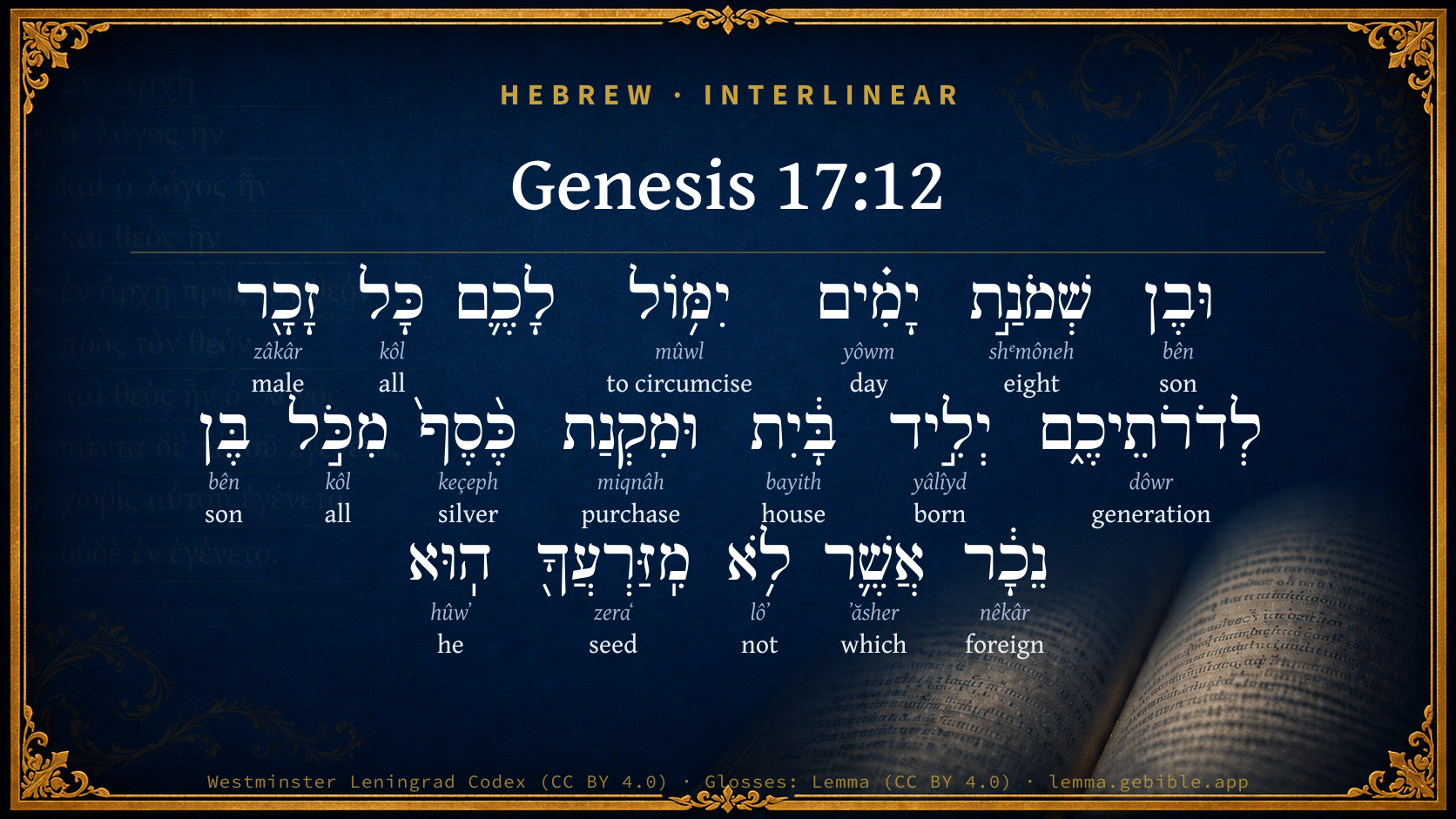
Genesis 17:12

Hebrew (Westminster Leningrad Codex) Genesis 17:12 appears in the Hebrew Old Testament. The text above is from the Westminster Leningrad Codex. Each word links to its Strong’s number, a concise gloss, and parsing drawn from the Open Scriptures Hebrew Bible morphology. Click any word for its full Brown-Driver-Briggs (BDB) entry.
Download image
Cite this verse

Genesis 17:12 (World English Bible). Public Domain. Lemma interlinear Bible study tool, https://lemma.gebible.app/v/genesis/17/12.

Show BibTeX & RIS
BibTeX
RIS
English Translation
He who is eight days old will be circumcised among you, every male throughout your generations, he who is born in the house, or bought with money of any foreigner who is not of your seed.
World English Bible · Public Domain
Highlights
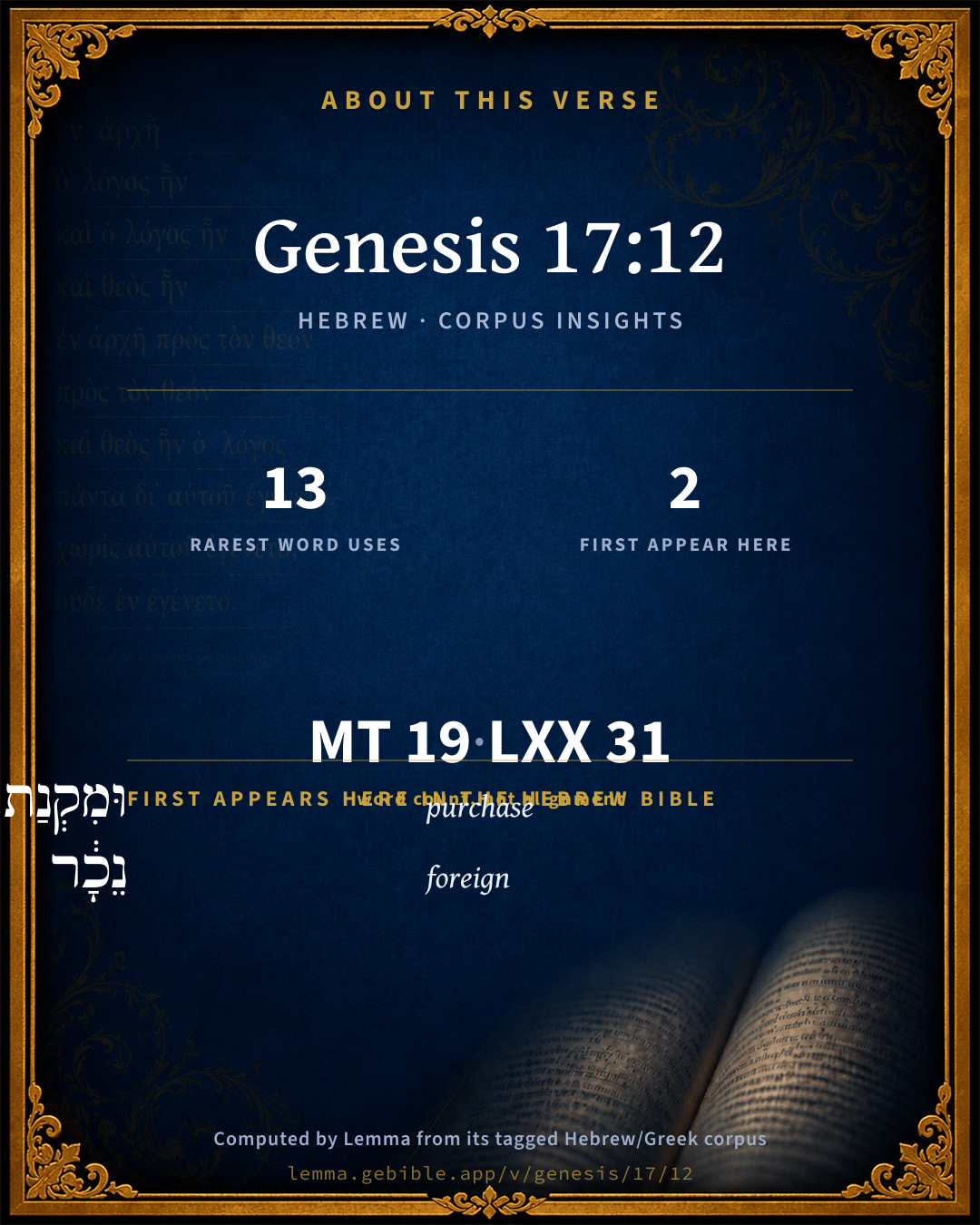
  • 2 first appearances in the Hebrew Bible
Full analysis ↓
Download a study sheet

One document with this verse’s original text, its word-by-word gloss line, the meaning frame, cross-references with their text, attributed commentary, and full source and license credits — printable, and it pastes into notes with its structure intact.

This verse Autodidact and up

Study sheet (.html) Plain text (.txt)

A passage Seminary Student

Up to 50 verses in one chapter. A passage sheet keeps up to 6 commentary sources and 12 cross-references per verse, in the order this page ranks them, and says so on the sheet whenever that leaves anything out. Ask for a single verse and you get the Autodidact verse sheet above.

Everything on this page stays free to read, with no account — the sheet is a download of what is already on screen, not access to it.

Want to remove ads? Support Godless Engineer
Compare translations 3

The same verse in 3 English versions, stacked beneath the original-language interlinear above. Click any original word for its lexicon entry.

Each is an independent rendering of the whole verse — the interlinear is not word-aligned to these translations.

Highlighted words mark where these versions differ — a whole-verse word diff, not a word-by-word alignment.

  • World English Bible Public Domain
    He who is eight days old will be circumcised among you, every male throughout your generations, he who is born in the house, or bought with money of any foreigner who is not of your seed.
  • King James Version Public Domain
    And he that is eight days old shall be circumcised among you, every man child in your generations, he that is born in the house, or bought with money of any stranger, which is not of thy seed.
  • unfoldingWord Literal Text CC BY-SA 4.0
    So a son of eight days must be circumcised, every male among you throughout your generations, the one born in house and the one bought with money from any son of a foreigner, who not your offspring.

unfoldingWord Literal Text — © unfoldingWord, licensed CC BY-SA 4.0. Word-aligned USFM3 via Door43 (git.door43.org/unfoldingWord/en_ult).

Versions to compare (up to 4)

3 of 4 selected

Show all 18 translations

Every available English version of this verse, each an independent rendering of the whole verse.

  • World English Bible Public Domain
    He who is eight days old will be circumcised among you, every male throughout your generations, he who is born in the house, or bought with money of any foreigner who is not of your seed.
  • Berean Standard Bible Public Domain
    Generation after generation, every male must be circumcised when he is eight days old, including those born in your household and those purchased from a foreigner—even those who are not your offspring.
  • Majority Standard Bible Public Domain
    Generation after generation, every male must be circumcised when he is eight days old, including those born in your household and those purchased from a foreigner—even those who are not your offspring.
  • King James Version Public Domain
    And he that is eight days old shall be circumcised among you, every man child in your generations, he that is born in the house, or bought with money of any stranger, which is not of thy seed.
  • American Standard Version (1901) Public Domain
    And he that is eight days old shall be circumcised among you, every male throughout your generations, he that is born in the house, or bought with money of any foreigner that is not of thy seed.
  • Revised Version (1885) Public Domain
    And he that is eight days old shall be circumcised among you, every male throughout your generations, he that is born in the house, or bought with money of any stranger, which is not of thy seed.
  • Geneva Bible (1599) Public Domain
    And euery man childe of eight dayes olde among you, shalbe circumcised in your generations, aswell he that is borne in thine house, as he that is bought with money of any stranger, which is not of thy seede.
  • Douay-Rheims (1899) Public Domain
    An infant of eight days old shall be circumcised among you, every man child in your generations: he that is born in the house, as well as the bought servant shall be circumcised, and whosoever is not of your stock:
  • Young's Literal Translation Public Domain
    `And a son of eight days is circumcised by you; every male to your generations, born in the house, or bought with money from any son of a stranger, who is not of thy seed;
  • Literal Standard Version CC BY-SA 4.0
    And a son of eight days is circumcised by you; every male throughout your generations, born in the house, or bought with money from any son of a stranger, who is not of your seed;
  • Unlocked Literal Bible CC BY-SA 4.0
    Every male among you that is eight days old must be circumcised, throughout your people's generations. This includes him who is born into your household and him who is bought with money from any foreigner who is not one of your descendants.
  • unfoldingWord Literal Text CC BY-SA 4.0
    So a son of eight days must be circumcised, every male among you throughout your generations, the one born in house and the one bought with money from any son of a foreigner, who not your offspring.
  • Darby Bible Public Domain
    And at eight days old shall every male in your generations be circumcised among you -- he who is born in the house, and he who is bought with money, any stranger who is not of thy seed.
  • World Messianic Bible Public Domain
    He who is eight days old shall be circumcised among you, every male throughout your generations, he who is born in the house, or bought with money from any foreigner who is not of your offspring.
  • Webster's Bible Public Domain
    And he that is eight days old shall be circumcised among you, every male-child in your generations, he that is born in the house, or bought with money of any stranger, who is not of thy seed.
  • Free Bible Version CC BY-SA 4.0
    From now and for all generations to come every male among you who is eight days old must be circumcised. This includes not only your sons but also those born in your household or bought from foreigners.
  • Bible in Basic English Public Domain
    Every male among you, from one generation to another, is to undergo circumcision when he is eight days old, with every servant whose birth takes place in your house, or for whom you gave money to someone of another country, and not of your seed.
  • JPS Tanakh (1917) Public Domain
    And he that is eight days old shall be circumcised among you, every male throughout your generations, he that is born in the house, or bought with money of any foreigner, that is not of thy seed.

Literal Standard Version (2020), Covenant Press — licensed CC BY-SA 4.0. Text via the HelloAO Bible API (eBible.org). Unlocked Literal Bible (unfoldingWord) — licensed CC BY-SA 4.0. Text via the HelloAO Bible API (eBible.org). unfoldingWord Literal Text — © unfoldingWord, licensed CC BY-SA 4.0. Word-aligned USFM3 via Door43 (git.door43.org/unfoldingWord/en_ult). Free Bible Version, Dr. Jonathan Gallagher — licensed CC BY-SA 4.0. Text via the HelloAO Bible API (eBible.org).

Word by word

More ways to search: Search by grammar → Find every occurrence → Compare this word →

Practice this passage: Drill this verse → Learn its vocabulary →

יְלִ֣יד
yâlîyd
H3211
“born of”
Noun, Common, Masculine, Singular, Construct
Part of Speech
Noun
Type
Common
Gender
Masculine
Number
Singular
State
Construct
Full BDB Definition

Origin: from H3205

TWOT: 867e

born
  1. וּבֶן bên H1121 “and · son of” Conjunction + Noun, Common, Masculine, Singular, Construct
  2. שְׁמֹנַ֣ת shᵉmôneh H8083 “eight” Adjective, Cardinal number, Masculine, Singular, Construct
  3. יָמִ֗ים yôwm H3117 “days” Noun, Common, Masculine, Plural, Absolute
  4. יִמּ֥וֹל mûwl H4135 “to circumcise” Verb, Niphal, Imperfect, 3rd Person, Masculine, Singular
  5. כָּל kôl H3605 “all of” Noun, Common, Masculine, Singular, Construct
  6. זָכָ֖ר zâkâr H2145 “male” Adjective, Adjective, Masculine, Singular, Absolute
  7. לְדֹרֹתֵיכֶ֑ם dôwr H1755 “to/for · generations · your” Preposition + Noun, Common, Masculine, Plural, Construct + Suffix, Personal, 2nd Person, Masculine, Plural
  8. בָּ֔יִת bayith H1004 “house” Noun, Common, Masculine, Singular, Absolute
  9. וּמִקְנַת miqnâh H4736 “and · purchase of” Conjunction + Noun, Common, Feminine, Singular, Construct
  10. כֶּ֨סֶף֙ keçeph H3701 “silver” Noun, Common, Masculine, Singular, Absolute
  11. מִכֹּ֣ל kôl H3605 “from · all of” Preposition + Noun, Common, Masculine, Singular, Construct
  12. בֶּן bên H1121 “son of” Noun, Common, Masculine, Singular, Construct
  13. נֵכָ֔ר nêkâr H5236 “foreign” Noun, Common, Masculine, Singular, Absolute
  14. אֲשֶׁ֛ר ʼăsher H834 “which” Particle, Relative
  15. לֹ֥א lôʼ H3808 “not” Particle, Negative
  16. מִֽזַּרְעֲךָ֖ zeraʻ H2233 “from · seed · your” Preposition + Noun, Common, Masculine, Singular, Construct + Suffix, Personal, 2nd Person, Masculine, Singular
  17. הֽוּא hûwʼ H1931 “he” Pronoun, Personal, 3rd Person, Masculine, Singular

About this verse

These counts appear in no published source. They are computed here, from the morphology-tagged text and Lemma’s own curated glosses. What Lemma adds →

19
words
16
distinct lemmas
Pentateuch
section

Notable vocabulary

The rarest word here is יְלִ֣יד born H3211 — appearing just 13 times in the whole Hebrew Bible.

First appearance in Scripture

These words make their first canonical appearance in the Hebrew Bible here:

  • וּמִקְנַת purchase H4736
  • נֵכָ֔ר foreign H5236

Shared distinctive vocabulary

יְלִ֣יד born H3211 occurs in 13 verses of the Hebrew Bible. Also found in:

Grammatical profile

  • 1 verb
  • 12 nouns
  • 2 adjectives
  • 1 pronoun
  • 1 preposition
  • 2 particles

Verb forms

  • יִמּ֥וֹל Niphal · Imperfect

Repetition

Words recur within this verse — often emphatic in Hebrew:

Hebrew & Septuagint length

In English translation the verse runs 36 words from the Hebrew and 43 from the Septuagint (LXX English) — closely comparable.

A rough comparison of the two English renderings, which tokenize alike — not a word-level alignment.

Word counts can differ between the Hebrew and the Greek without any difference in meaning — e.g. the Hebrew direct-object marker אֵת has no separate Greek word, and Greek often adds the article ὁ.

In the original languages it is 19 Hebrew tokens and 31 Greek tokens — but the two are counted differently (Hebrew bundles its prefixes and suffixes into one token; the Greek is in lemma form), so that isn’t a like-for-like length.

Cross-references

10

Topical passages linked to Genesis 17:12 in the Treasury of Scripture Knowledge — connected by theme and wording, ordered by reader-vote popularity; previews shown in the World English Bible.

  • Leviticus 12:3 In the eighth day the flesh of his foreskin shall be circumcised.
  • Luke 2:21 When eight days were fulfilled for the circumcision of the child, his name was called Jesus, which was given by the angel before he was conceived in the womb.
  • Exodus 12:48–49 When a stranger shall live as a foreigner with you, and will keep the Passover to Yahweh, let all his males be circumcised, and then let him come near and keep it; and he shall be as one who is born in the land: but no uncircumcised person shall eat of it.
  • Luke 1:59 It happened on the eighth day, that they came to circumcise the child; and they would have called him Zacharias, after the name of the father.
  • Philippians 3:5 circumcised the eighth day, of the stock of Israel, of the tribe of Benjamin, a Hebrew of Hebrews; concerning the law, a Pharisee;
  • Genesis 17:23 Abraham took Ishmael his son, all who were born in his house, and all who were bought with his money; every male among the men of Abraham's house, and circumcised the flesh of their foreskin in the same day, as God had said to him.
  • Genesis 21:4 Abraham circumcised his son, Isaac, when he was eight days old, as God had commanded him.
  • John 7:22–23 Moses has given you circumcision (not that it is of Moses, but of the fathers), and on the Sabbath you circumcise a boy.
  • Acts 7:8 He gave him the covenant of circumcision. So Abraham became the father of Isaac, and circumcised him the eighth day. Isaac became the father of Jacob, and Jacob became the father of the twelve patriarchs.
  • Romans 2:28 For he is not a Jew who is one outwardly, neither is that circumcision which is outward in the flesh;

Cross-references courtesy of OpenBible.info (CC BY 4.0).

Hebrew and Greek witnesses Masoretic Hebrew ↔ Greek Septuagint

The same verse in the two great witnesses to the Old Testament, shown verse-for-verse.

These are two independent witnesses, not word-aligned to each other, and the Septuagint is shown in lemma (dictionary) form.

Hebrew Genesis 17:12 Masoretic · Westminster Leningrad Codex

וּבֶן שְׁמֹנַ֣ת יָמִ֗ים יִמּ֥וֹל לָכֶ֛ם כָּל זָכָ֖ר לְדֹרֹתֵיכֶ֑ם יְלִ֣יד בָּ֔יִת וּמִקְנַת כֶּ֨סֶף֙ מִכֹּ֣ל בֶּן נֵכָ֔ר אֲשֶׁ֛ר לֹ֥א מִֽזַּרְעֲךָ֖ הֽוּא

He who is eight days old will be circumcised among you, every male throughout your generations, he who is born in the house, or bought with money of any foreigner who is not of your seed.

World English Bible · Public Domain

Greek LXX Genesis 17:12 Septuagint · lemma form

καί παιδίον ὀκτώ ἡμέρα περιτέμνω σύ πᾶς ἀρσενικός εἰς ὁ γενεά σύ ὁ οἰκογενής ὁ οἰκία σύ καί ὁ ἀργυρώνητος ἀπό πᾶς υἱός ἀλλότριος ὅς οὐ εἰμί ἐκ ὁ σπέρμα σύ

And the child of eight days old shall be circumcised by you, every male throughout your generations, and the servant born in the house and he that is bought with money, of every son of a stranger, who is not of your seed.

LXX2012 (modern English Septuagint) · Public Domain

Hebrew: Westminster Leningrad Codex (CC BY 4.0). Greek: Septuagint (public domain); English from LXX2012 (modern English Septuagint) (Public Domain). How the Septuagint differs from the Hebrew →

Targum (Aramaic paraphrase)

2

The Targum is the ancient Jewish Aramaic paraphrase of the Hebrew Scriptures — an interpretive translation, not the Hebrew text itself. Onkelos (literal) and Pseudo-Jonathan (expansive) render the Torah, and Jonathan the Prophets. Coverage is partial: where no permissively-licensed English translation exists for a verse, only the Aramaic is shown. This is verse-level text, not a word-by-word alignment to the Hebrew.

  1. Targum Onkelos Torah (Genesis–Deuteronomy)
    וּבַר תְּמַנְיָא יוֹמִין יִתְגְזַר (יִגְזַר) לְכוֹן כָּל דְכוּרָא לְדָרָתֵיכוֹן יְלִידֵי בֵּיתָא וּזְבִינֵי כַּסְפָּא מִכֹּל בַּר עַמְמִין דְלָא מִבְּנָךְ הוּא

    (no public-domain English translation for this verse)

    Targum Onkelos — Aramaic: “Onkelos Genesis” (public domain); “Onkelos Exodus” (public domain); “Onkelos Leviticus” (public domain); “Onkelos Numbers” (public domain); “Onkelos Deuteronomy” (public domain). English: “Sefaria Community Translation” (CC0 1.0 (public-domain dedication)); “J.W. Etheridge. The Targums of Onkelos and Jonathan Ben Uzziel on the Pentateuch. London: Longmans, Green, 1862” (public domain). Text via Sefaria.

  2. Targum Pseudo-Jonathan Torah (Genesis–Deuteronomy)
    וּבַר תְּמַנְיָא יוֹמִין יִגְזוֹר לְכוֹן כָּל דְכוּרָא לְדָרֵיכוֹן מַרְבְּיָינֵי בָּתֵּיכוֹן וּזְבִינֵי כַּסְפֵּיכוֹן מִן כָּל בַּר עַמְמִין דְלָא מִבְּנָךְ הוּא

    And the son of eight days shall be circumcised among you, every male in your generations; from him who is brought up in your house, or bought with your silver, unto every son of the peoples who is not of you.

    Targum Pseudo-Jonathan — Aramaic: “Targum Jonathan on Genesis” (public domain); “Targum Jonathan on Exodus” (public domain); “Targum Jonathan on Leviticus” (public domain); “Targum Jonathan on Numbers” (public domain); “Targum Jonathan on Deuteronomy” (public domain). English: “The Targum of Jonathan ben Uzziel, trans. J. W. Etheridge, London, 1862” (public domain). Text via Sefaria.

Commentary

Notes on Genesis 17:12 from classic Christian and Jewish commentators (each source and its license shown beneath its notes). The classic Christian expositions comment on the surrounding passage and are grouped to its opening verse, so a note may address several verses; the Jewish commentaries on the Tanakh (Rashi and others) are per-verse, so they appear only where the commentator wrote on this verse.

Lemma curates 59 commentaries, every one of them public domain or Creative Commons licensed, each selected and text-cleaned for this edition rather than reprinted as found. About our sources →

Trapp's Complete Commentary

John Trapp

Gen 17:12 And he that is eight days old shall be circumcised among you, every man child in your generations, he that is born in the house, or bought with money of any stranger, which [is] not of thy seed.

Ver. 12. And he that is eight days old.] This warrants our baptizing of infants of both sexes. {See Trapp on "Gen 9:10"} (Great leap of logic here! Editor.)

John Trapp, A Commentary or Exposition upon All the Books of the Old and New Testament (1647–1656) — public domain. Text from a community e-Sword module.

Adam Clarke's Commentary

Verse 12. He that is eight days old] Because previously to this they were considered unclean, Le 12:2-3, and circumcision was ever understood as a consecration of the person to God. Neither calf, lamb, nor kid, was offered to God till it was eight days old for the same reason, Le 22:27.

Adam Clarke's Commentary on the Bible (1810–1826) — public domain. Text from a community e-Sword/MySword module.

John Calvin's Commentaries

12. And he that is eight days old shall be circumcised God now prescribes the eighth day for circumcision; whence it appears that this was a part of that discipline, under which he intended to keep his ancient people; for greater liberty is at this day, permitted in the administration of baptism. Some, however maintain that we must not contend earnestly about the number of days, because the Lord spared the children on account of their tenderness, since it was not without danger to inflict a wound upon those who were newly born. For although he might have provided that circumcision should produce no harm or injury; yet there would be no absurdity in saying, that He has respect to their tender age, in order to prove to the Jews his paternal love towards their children. To others this seems to be too frigid; therefore they seek a spiritual mystery in the number of days. They think that the present life is allegorically signified by the seven days; that God commanded infants to be circumcised on the eighth day, in order to show that though we must give attention to the mortification of the flesh during the whole course of our life, it will not be completed till the end. Augustine also thinks that it had reference to the resurrection of Christ; whereby external circumcision was abolished and the truth of the figure was set forth. It is probable and consonant with reason, that the number seven designated the course of the present life. Therefore the eighth day might seem to be fixed upon by the Lord, to prefigure the beginning of a new life. But because such a reason is never given in Scripture, I dare affirm nothing. Wherefore, let it suffice to maintain what is certain and solid; namely, that God, in this symbol, has so represented the destruction of the old man, as yet to show that he restores men to life.

He that is born in the house, or bought with money When God commands Abraham to circumcise all whom he has under his power, his special love towards holy Abraham is conspicuous in this, that He embraces his whole family in His grace. We know that formerly slaves were scarcely reckoned among the number of men. But God, out of regard to his servant Abraham, adopts them as his own sons: to this mercy nothing whatever can be added. The pride also of the flesh is cast down; because God, without respect of persons, gathers together both freemen and slaves. But in the person of Abraham, he has prescribed it as a law to all his servants, that they should endeavor to bring all who are subject to them, into the same society of faith with themselves. For every family of the pious ought to be a church. Therefore, it we desire to prove our piety, we must labor that every one of us may have his house ordered in obedience to God. And Abraham is not only commanded to dedicate and to offer unto God those born in his house, but whomsoever he might afterwards obtain.

John Calvin's Commentaries (1540-1563) — public domain. Text from the Calvin Translation Society English edition (1840s-50s) via the Christian Classics Ethereal Library (ccel.org). Calvin's coverage is partial (roughly two-thirds of the Bible); uncommented books and verses are honest gaps, never fabricated. The 19th-century editor's footnotes and remarks are omitted so the notes are faithfully Calvin's own voice.

Ellicott's Commentary for English Readers

(12) Eight days old.—That is, just one week after birth, as the day of birth was counted among the eight days.

A Bible Commentary for English Readers, edited by Charles John Ellicott (1878–1897) — public domain. Text from a community e-Sword module.

The Cambridge Bible for Schools and Colleges

gen. ed. J. J. S. Perowne

12. he that is eight days old] The performance of the rite at this early age is distinctive of the Israelite usage. Cf. Gen_21:4; Lev_12:3; Luk_1:59; Luk_2:21; Php_3:5. The operation at this exceedingly early age (see note on Gen_17:25) is probably for the purpose (1) of including all males, (2) of coinciding with the first period of the mother’s uncleanness, Lev_12:2-3, (3) of inflicting the smallest degree of suffering.

every male] The important principle is here laid down that the rite is to be required of every male member of the household. All slaves are to be circumcised, both those “born in the house” (cf. Gen_14:14), and those “bought with money” (cf. Exo_12:44). It was thus that the first principles of charity were interwoven with the foundation of the Chosen People. The privileges of the covenant relation are at once extended beyond the literal seed of Abraham.

The Cambridge Bible for Schools and Colleges (gen. ed. J. J. S. Perowne; Cambridge University Press, 1878–1918) — public domain. Text from a community e-Sword module.

John Gill's Exposition

And he that is eight days old shall be circumcised among you,.... A son or infant of eight days old; it might not be circumcised before, but for some reasons might be deferred longer. The reasons why this rite was ordered to be performed in infancy, according to Maimonides (d), were, because if it had been deferred to riper age it might have been neglected, and never performed; and because at such an age the pain is not so sensibly felt, by reason of the tenderness of the skin, and the weakness of the imagination; as also because the affections of parents are not then so strong as they are when one year, and especially three or four years old; and particularly it was ordered on the eighth day, because all animals, as soon as born, on account of their great humidity, are very weak, and scarce any other than they were in their mother's womb, until the end of seven days, after which they begin to be reckoned among those that perceive the air of this world; and so he remarks the same is to be observed in beasts, that seven days they were to be with their dam, Exo 22:30. According to the Jewish canon (e),"an infant might be circumcised on the eighth, ninth, tenth, eleventh, and twelfth, neither less nor more; (not less than eight days, nor more than twelve (f);) according to the usual custom on the eighth; if he was born between the two evenings, he is circumcised on the ninth; if between the two evenings of the evening of the sabbath, he is circumcised on the tenth; if on a festival day, after the sabbath, he is circumcised on the eleventh; if on the two days of the beginning of the year, he is circumcised on the twelfth: an infant that is sick, they do not circumcise it until it is well.''Which sickness they interpret not of sore eyes, and the like, but of an ague or fever; and when a child on the eighth day is red or yellow, or a woman has lost her children through circumcision, two or three one after another, then it is deferred; and they reckon seven days from a child's recovery from sickness, and then circumcise it (g); but circumcision on the eighth day was always reckoned most valid and authentic, and according to rule; see Gill on Phi 3:5; and the Jews were careful to do it on the eighth day as soon as they could, though only when and while it was day. Their canon or rule runs thus (h),"they do not circumcise until the sun shines out on the eighth day of a child's birth, and all the day is fit for circumcision; but they that are prepared hasten to the commandment, and circumcise immediately in the morning; and indeed circumcision, which is not in its proper time, is never performed but in the day:''for they observe (i), it is said on the eighth day, Lev 12:3; the day, and not the night. And this was to be done to

every man child in your generations; in all succeeding ages until the Messiah came, the end of the law; and when the lease of the land of Canaan, of which this was a seal, would be out; and when the righteousness of faith, it was also a seal of, would come upon the uncircumcised Gentiles:

he that is born in the house, or bought with money of any stranger,

which is not of thy seed; concerning which Maimonides (k) gives these rules,"a servant is born in the power of an Israelite, and another that is taken from Heathens, the master is bound to circumcise them; but he that is born in the house is circumcised on the eighth day; and he that is bought with money is circumcised on the day that he is received, even if he received him on the day he is born, he is circumcised on that day; if he receives a grown servant of Heathens, and the servant is not willing to be circumcised, he bears with him a whole year, but more than that it is forbidden to keep him, seeing he is uncircumcised, but he must send him again to the Heathens.''No man was to be forced to embrace the true religion, or obliged against his will to submit to its ordinances.

(d) Moreh Nevochim, par. 3. c. 49. p. 506. (e) Misn. Sabbat, c. 19. sect. 5. (f) Misn. Eracin, c. 2. sect. 2. (g) Maimon. Hilchot Milah, c. 1. sect. 16, 17, 18. Schulchan Aruch, ib. c. 262. sect. 2. 263. sect. 1, 2. (h) Schulchan Aruch, c. 262. sect. 1. (i) Maimon. Hilchot Milah, c. 1. sect. 8. (k) Ibid sect 3, 6.

John Gill's Exposition of the Whole Bible (1746–1763) — public domain (CC PDM 1.0). Text via the HelloAO Bible API.

Haydock's Catholic Bible Commentary

Days, when he will be able to bear the pain without danger. This might be deferred for a just reason, as it was in the desert, Josue v. 6. In this case people might be saved, as younger children and all females might, by the application of the remedies used in the law of nature, sacrifice, the faith of parents, &c. (Menochius) --- Of your stock, and, being arrived at years of discretion, is desirous of enjoying your privileges. Some think, that slaves had no choice left; but servants, and people who had a mind to live in the country, were not bound to submit to this rite against their will. It is even more probable, that none were under this obligation, except Abraham and his posterity by Isaac. His other children adopted it in part, but not with the exactitude of the Jews. (Calmet)

George Leo Haydock (1774–1849), Haydock's Catholic Family Bible and Commentary, 1859 edition — public domain. Excludes Psalms (Douay-Rheims chapter numbering differs from Protestant) and Deuterocanonical books (Catholic canon only).

Matthew Poole's English Annotations

Eight days; not before that time, because of the child’s weakness and imperfection, and impurity too, Exo 22:30; Lev 12:3, for which reason also beasts were not to be offered to God before the eighth day, Exo 22:30.

Every man-child in your generations, successively, until the Messias come, who shall circumcise your hearts, and change this ordinance for another.

Bought with money of any stranger: these were of two sorts.

1. Children, who being entirely his possession, and having not understanding to discern, nor will to choose or refuse, were to be circumcised.

2. Grown persons, who were not to be compelled to be circumcised, but if they refused it, were not to be permitted to dwell in his family, lest they should infect others, but were to be sold to strangers, as the Hebrew doctors teach. But as for Abraham’s servants here, they were thoroughly instructed in religion, Gen 18:19, and doubtless did willingly embrace it, and submit to this sacrament.

Matthew Poole's English Annotations on the Holy Bible (1683–1685) — public domain. Text from a community e-Sword/MySword module.

Whedon's Commentary on the Bible

Daniel D. Whedon

12. Eight days old — A whole seven days must pass, and on the eighth day the ceremony. Comp. Gen_21:4; Lev_12:3; Luk_1:59; Luk_2:21; Php_3:5. For this, perhaps, a twofold reason may be assigned: the symbolism of the sacred number seven, and the necessity that the child should have sufficient age to endure the operation.

Daniel D. Whedon (gen. ed.), Commentary on the Old and New Testaments (1874–1909) — public domain. Text from a community e-Sword module.

The Pulpit Commentary

And he that is eight days old literally, and the son of eight days (cf. Gen_17:1) shall be circumcised among you (Lev_12:3; Luk_2:21; Php_3:5) every man child The fact that several times the circumcision of the males only is enjoined may point to the legislator"s intention to exclude that rite in the other sex, though it was customary among many ancient nations, but not universal among the Egyptians" (Kalisch). Though not administered to both, the symbol was ordained for the sake of both sexes (Calvin)in your generations, he that is born in the house, or bought with money of any stranger, which is not of thy seed. Not only a proof of the Divine benignity to Abraham in embracing all the members of his household within the pale of the visible Church now constituted, but likewise a hint of the world-wide aspect of the Abrahamic covenant, a first-fruits as it were of the "all the families of the earth" that should be blessed in Abram.

The Pulpit Commentary (1880–1919), ed. H.D.M. Spence-Jones & Joseph S. Exell — public domain. Text from a community e-Sword module.

unfoldingWord translationNotes

Door43 World Missions Community

General Information:

God continues speaking to Abraham.

Every male

"Every human male"

throughout your people's generations

"in every generation"

him who is bought with money

This refers to slaves. This can be stated in active form. AT: "any male that you buy" (See: Active or Passive)

my covenant will be in your flesh

This can be stated in active form. AT: "you will mark my covenant in your flesh" (See: Active or Passive)

for an everlasting covenant

"as a permanent covenant." Because it was marked in flesh, no one could easily erase it.

uncircumcised male who is not circumcised

This can be stated in active form, and you may leave out words that will give wrong meaning in your language. AT: "male whom you have not circumcised" (See: Active or Passive)

Any uncircumcised male ... foreskin will be cut off from his people

Possible meanings are 1) "I will cut off any uncircumcised male ... foreskin from his people" or 2) "I want you to cut off any uncircumcised male ... foreskin from his people."

cut off from his people

Possible meanings are 1) "killed" or 2) "sent away from the community." (See: Euphemism)

He has broken my covenant

"He has not obeyed the rules of my covenant." This is the reason that he would be cut off from his people.

translationWords

circumcise

generation

household

descend

eternity

covenant

cut off

unfoldingWord translationNotes — © Distant Shores Media and the Door43 World Missions Community, licensed CC BY-SA 4.0. Source: git.door43.org/Door43/en_tn.

Rashi

Rabbi Shlomo Yitzchaki (Rashi)

יליד בית HE THAT IS BORN IN THE HOUSE — one to whom a handmaid gave birth in the house.

מקנת כסף HE THAT IS BOUGHT WITH THY MONEY — one whom a person bought after his birth.

Rashi on the Tanakh — English translations: “The Judaica Press complete Tanach with Rashi, translated by A. J. Rosenberg” (CC BY 4.0); “Pentateuch with Rashi's commentary by M. Rosenbaum and A.M. Silbermann, 1929-1934” (public domain); “The Metsudah Tanach series, Lakewood, N.J” (CC BY 4.0); and “The Book of Joshua, Metsudah Publications, 1997” (CC BY 4.0). Text via Sefaria.

Radak

Rabbi David Kimhi (Radak)

ובן שמונת ימים ימול, he is to be circumcised when 8 days old; a passive mode of the root מול. Accordingly, we must understand that the primary duty of performing the circumcision is that of the baby's father.

כל זכר לדורותיכם, this refers to the Israelites.

יליד בית, any member of the family born in the house.

ומקנת כסף אשר לא מזרעך הוא, or a slave purchased by money who is not of your seed. Both those who were born to other slaves owned by you, or even slaves purchased from the outside before eight days old must be circumcised when they reach that age. If such a slave was purchased by a Jew after he was already more than eight days old, you do not wait with performing this commandment. This is also why all of the male members of Avraham's household were circumcised by him at the same time he performed the operation on himself. He did not have any male members of his household who were less than 8 days old. This, at any rate, is the plain meaning of our text. Our sages, (Shabbat 135) reacting to the repetition of the words המול ימול, use this to reason that the Torah spoke of two different dates as being appropriate for the circumcision of gentile slaves. 1) There are some who have to be circumcised immediately; 2) there are others who must be circumcised on the eighth day. If one had purchased a female slave who was pregnant, he son when born must be circumcised forthwith. If the female slave had undergone ritual immersion prior to giving birth to her son he will be circumcised when eight days old like any other Jewish ale baby. If one had purchased a gentile slave (female) who had become pregnant while in the household of her Jewish master, the baby will be circumcised on the eighth day. If one had purchased a female slave with a view of keeping only her baby when born, i.e. not needing to convert his mother, or one had purchased the mother with the express proviso not to convert her by subjecting her to a ritual immersion, the baby born by her is also one that needs immediate circumcision, seeing it is not a Jewish baby as yet.

Radak on the Tanakh — English translations: “Sefaria Community Translation” (CC0 1.0 (public-domain dedication)); “Eliyahu Munk, HaChut Hameshulash” (CC BY 4.0); “Rabbi Mike Feuer, Jerusalem Anthology” (CC BY 4.0); and “R. David Kimhi on the first book of Psalms, Translated by R.G. Finch, London, 1919” (public domain). Text via Sefaria.

Lesson kit

Teaching starters — assembled from the data on this page, not authored interpretation. Every prompt links to the verse data it draws on. Edit before teaching.

Genesis, in the Pentateuch, opens this verse with 19 words (16 distinct Hebrew lemmas). Its most distinctive word is yâlîyd (“born”). A historical commentator’s framing appears above. Read the whole chapter for the surrounding context.

Discussion questions

  1. What does “born” (yâlîyd) contribute to the verse as a whole?
  2. 2 words make their first appearance in Scripture here. What does this debut establish?
  3. How does Genesis 14:14, which shares the word «born», read alongside this verse?
  4. What does the repetition of “son” (2× in this one verse) do in this verse?
  5. These translations render this verse differently. What is at stake in choosing one wording over another?
  6. «יִמּ֥וֹל» is a Niphal Imperfect verb. How does that grammatical form shape the action described?
  7. Compare how Trapp's Complete Commentary and Adam Clarke's Commentary read this verse. Where do they agree or differ?

Things to notice

Reading settings

Reading text

Shown beneath each verse's original-language words.

Old Testament
Old Testament edition

Read the OT as the Masoretic Hebrew (MT) or the Greek Septuagint (LXX).

English shown for the Greek Septuagint (in the Hebrew ↔ Greek comparison).

Comparing translations? Open the Compare panel on any verse page to stack up to four side by side.