Genesis 18:29

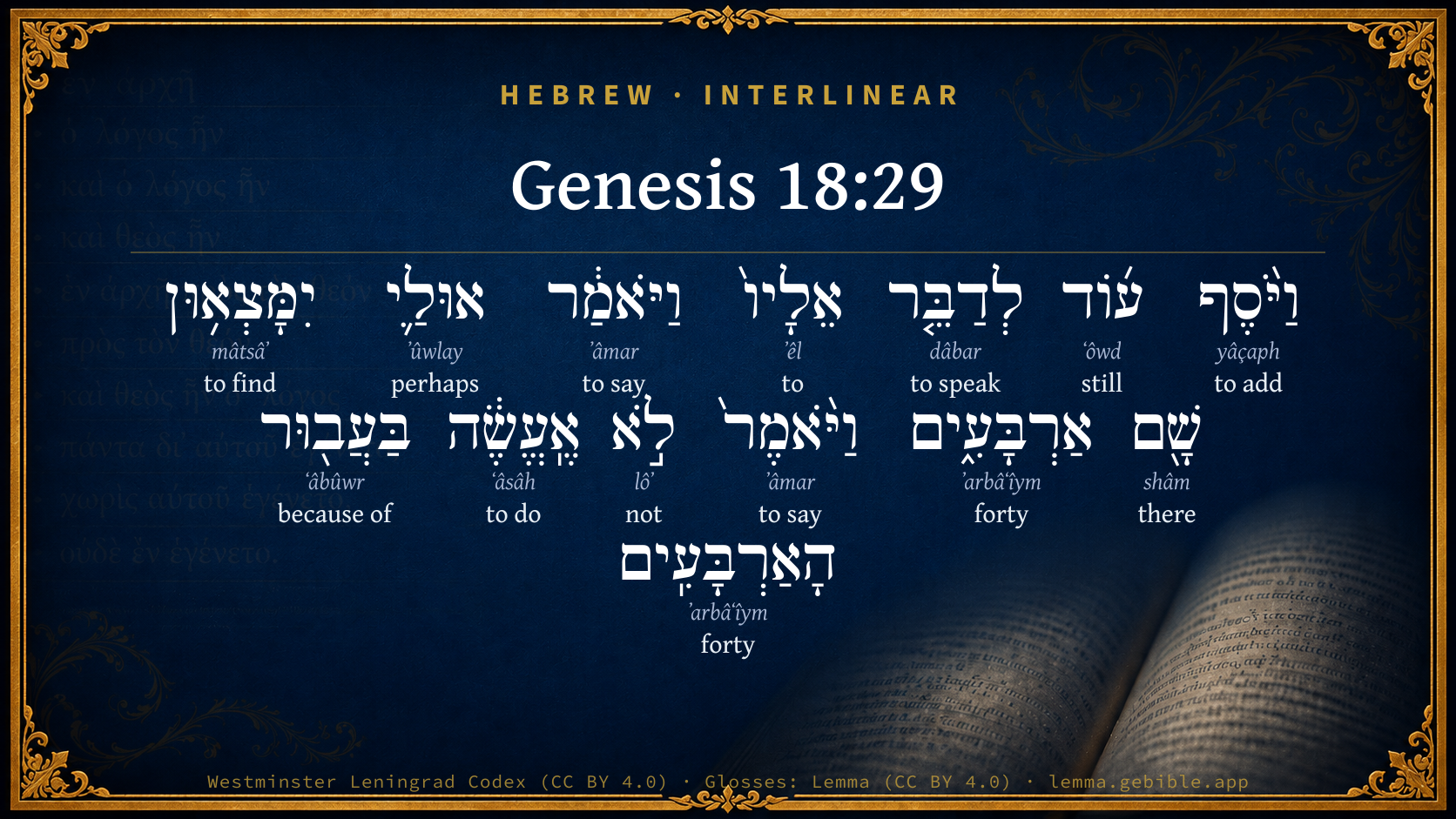
Hebrew (Westminster Leningrad Codex) Genesis 18:29 appears in the Hebrew Old Testament. The text above is from the Westminster Leningrad Codex. Each word links to its Strong’s number, a concise gloss, and parsing drawn from the Open Scriptures Hebrew Bible morphology. Click any word for its full Brown-Driver-Briggs (BDB) entry.
Download image
Cite this verse

Genesis 18:29 (World English Bible). Public Domain. Lemma interlinear Bible study tool, https://lemma.gebible.app/v/genesis/18/29.

Show BibTeX & RIS
BibTeX
RIS
English Translation
He spoke to him yet again, and said, "What if there are forty found there?" He said, "I will not do it for the forty's sake."
World English Bible · Public Domain
Download a study sheet

One document with this verse’s original text, its word-by-word gloss line, the meaning frame, cross-references with their text, attributed commentary, and full source and license credits — printable, and it pastes into notes with its structure intact.

This verse Autodidact and up

Study sheet (.html) Plain text (.txt)

A passage Seminary Student

Up to 50 verses in one chapter. A passage sheet keeps up to 6 commentary sources and 12 cross-references per verse, in the order this page ranks them, and says so on the sheet whenever that leaves anything out. Ask for a single verse and you get the Autodidact verse sheet above.

Everything on this page stays free to read, with no account — the sheet is a download of what is already on screen, not access to it.

Want to remove ads? Support Godless Engineer
Compare translations 3

The same verse in 3 English versions, stacked beneath the original-language interlinear above. Click any original word for its lexicon entry.

Each is an independent rendering of the whole verse — the interlinear is not word-aligned to these translations.

Highlighted words mark where these versions differ — a whole-verse word diff, not a word-by-word alignment.

  • World English Bible Public Domain
    He spoke to him yet again, and said, "What if there are forty found there?" He said, "I will not do it for the forty's sake."
  • King James Version Public Domain
    And he spake unto him yet again, and said, Peradventure there shall be forty found there. And he said, I will not do it for forty's sake.
  • unfoldingWord Literal Text CC BY-SA 4.0
    Then he continued again to speak to him and said, “Suppose forty are found there?” And he said, “I will not do it for the sake of the forty.”

unfoldingWord Literal Text — © unfoldingWord, licensed CC BY-SA 4.0. Word-aligned USFM3 via Door43 (git.door43.org/unfoldingWord/en_ult).

Versions to compare (up to 4)

3 of 4 selected

Show all 18 translations

Every available English version of this verse, each an independent rendering of the whole verse.

  • World English Bible Public Domain
    He spoke to him yet again, and said, "What if there are forty found there?" He said, "I will not do it for the forty's sake."
  • Berean Standard Bible Public Domain
    Once again Abraham spoke to the LORD, “Suppose forty are found there?” He answered, “On account of the forty, I will not do it.”
  • Majority Standard Bible Public Domain
    Once again Abraham spoke to the LORD, “Suppose forty are found there?” He answered, “On account of the forty, I will not do it.”
  • King James Version Public Domain
    And he spake unto him yet again, and said, Peradventure there shall be forty found there. And he said, I will not do it for forty's sake.
  • American Standard Version (1901) Public Domain
    And he spake unto him yet again, and said, Peradventure there shall be forty found there. And he said, I will not do it for the forty's sake.
  • Revised Version (1885) Public Domain
    And he spake unto him yet again, and said, Peradventure there shall be forty found there. And he said, I will not do it for the forty’s sake.
  • Geneva Bible (1599) Public Domain
    And he yet spake to him againe, and saide, What if there shalbe found fourtie there? Then he answered, I will not doe it for fourties sake.
  • Douay-Rheims (1899) Public Domain
    What if there be Ave less than fifty just persons? wilt thou for five and forty destroy the whole city? And he said: I will not destroy it, if I find five and forty.
  • Young's Literal Translation Public Domain
    And he addeth again to speak unto Him and saith, `Peradventure there are found there forty?' and He saith, `I do `it' not, because of the forty.'
  • Literal Standard Version CC BY-SA 4.0
    And he adds again to speak to Him and says, “Perhaps there are found there forty?” And He says, “I do not do [it], because of the forty.”
  • Unlocked Literal Bible CC BY-SA 4.0
    He spoke to him yet again, and said, “What if there are forty found there?” He replied, “I will not do it for the forty's sake.”
  • unfoldingWord Literal Text CC BY-SA 4.0
    Then he continued again to speak to him and said, “Suppose forty are found there?” And he said, “I will not do it for the sake of the forty.”
  • Darby Bible Public Domain
    And he continued yet to speak with him, and said, Perhaps there may be forty found there. And he said, I will not do it for the forty's sake.
  • World Messianic Bible Public Domain
    He spoke to him yet again, and said, “What if there are forty found there?” He said, “I will not do it for the forty’s sake.”
  • Webster's Bible Public Domain
    And he spoke to him yet again, and said, Peradventure there will be forty found there. And he said, I will not do it for forty's sake.
  • Free Bible Version CC BY-SA 4.0
    Abraham spoke up again and he asked the Lord, “What if only forty can be found?” “I won't do it for the sake of the forty,” the Lord replied.
  • Bible in Basic English Public Domain
    And again he said to him, By chance there may be forty there. And he said, I will not do it if there are forty.
  • JPS Tanakh (1917) Public Domain
    And he spoke unto Him yet again, and said: 'Peradventure there shall be forty found there.' And He said: 'I will not do it for the forty's sake.'

Literal Standard Version (2020), Covenant Press — licensed CC BY-SA 4.0. Text via the HelloAO Bible API (eBible.org). Unlocked Literal Bible (unfoldingWord) — licensed CC BY-SA 4.0. Text via the HelloAO Bible API (eBible.org). unfoldingWord Literal Text — © unfoldingWord, licensed CC BY-SA 4.0. Word-aligned USFM3 via Door43 (git.door43.org/unfoldingWord/en_ult). Free Bible Version, Dr. Jonathan Gallagher — licensed CC BY-SA 4.0. Text via the HelloAO Bible API (eBible.org).

Word by word

More ways to search: Search by grammar → Find every occurrence → Compare this word →

Practice this passage: Drill this verse → Learn its vocabulary →

אוּלַ֛י
ʼûwlay
H194
“perhaps”
Adverb
Part of Speech
Adverb
Full BDB Definition

Origin: from H176

TWOT: 46

perhaps, peradventure - if peradventure - unless - suppose
  1. וַיֹּ֨סֶף yâçaph H3254 “and · to add” Conjunction + Verb, Hiphil, Sequential Imperfect, 3rd Person, Masculine, Singular
  2. ע֜וֹד ʻôwd H5750 “still” Adverb
  3. לְדַבֵּ֤ר dâbar H1696 “to speak” Preposition + Verb, Piel, Infinitive Construct
  4. אֵלָיו֙ ʼêl H413 “to · him” Preposition + Suffix, Personal, 3rd Person, Masculine, Singular
  5. וַיֹּאמַ֔ר ʼâmar H559 “and · to say” Conjunction + Verb, Qal, Sequential Imperfect, 3rd Person, Masculine, Singular
  6. יִמָּצְא֥וּן mâtsâʼ H4672 “to find” Verb, Niphal, Imperfect, 3rd Person, Masculine, Plural + Suffix, n
  7. שָׁ֖ם shâm H8033 “there” Adverb
  8. אַרְבָּעִ֑ים ʼarbâʻîym H705 “forty” Adjective, Cardinal number, Both, Plural, Absolute
  9. וַיֹּ֨אמֶר֙ ʼâmar H559 “and · to say” Conjunction + Verb, Qal, Sequential Imperfect, 3rd Person, Masculine, Singular
  10. לֹ֣א lôʼ H3808 “not” Particle, Negative
  11. אֶֽעֱשֶׂ֔ה ʻâsâh H6213 “to do” Verb, Qal, Imperfect, 1st Person, Common, Singular
  12. בַּעֲב֖וּר ʻâbûwr H5668 “in/at · because of of” Preposition + Noun, Common, Masculine, Singular, Construct
  13. הָאַרְבָּעִֽים ʼarbâʻîym H705 “the · forty” Particle, Definite Article + Adjective, Cardinal number, Both, Plural, Absolute

About this verse

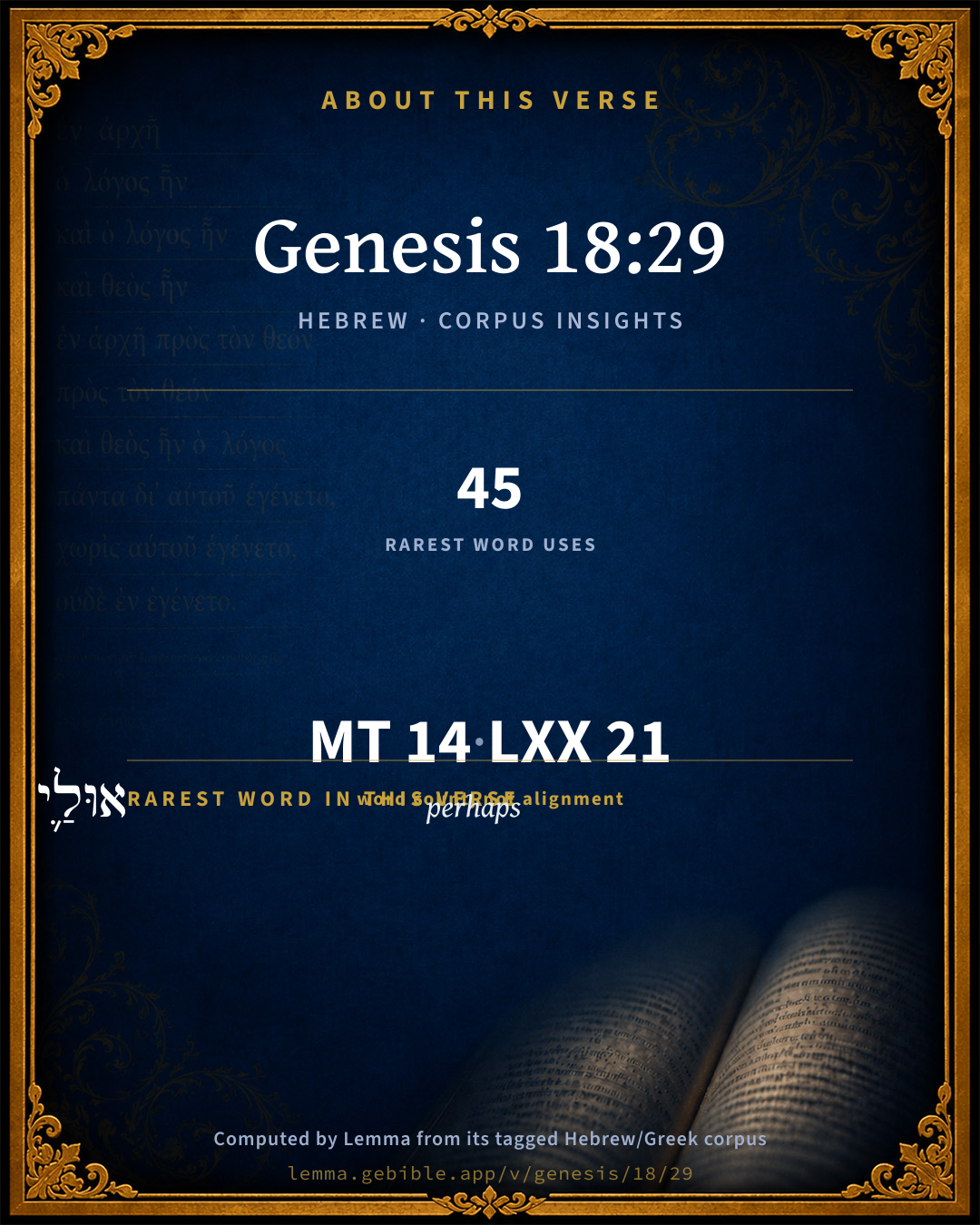
These counts appear in no published source. They are computed here, from the morphology-tagged text and Lemma’s own curated glosses. What Lemma adds →

14
words
12
distinct lemmas
Pentateuch
section

Shared distinctive vocabulary

אוּלַ֛י perhaps H194 occurs in 44 verses of the Hebrew Bible. Also found in:

Grammatical profile

  • 6 verbs
  • 1 noun
  • 2 adjectives
  • 1 preposition
  • 3 adverbs
  • 1 particle

Verb forms

  • וַיֹּ֨סֶף Hiphil · Sequential Imperfect
  • לְדַבֵּ֤ר Piel · Infinitive Construct
  • וַיֹּאמַ֔ר Qal · Sequential Imperfect
  • יִמָּצְא֥וּן Niphal · Imperfect
  • וַיֹּ֨אמֶר֙ Qal · Sequential Imperfect
  • אֶֽעֱשֶׂ֔ה Qal · Imperfect

Repetition

Words recur within this verse — often emphatic in Hebrew:

  • וַיֹּאמַ֔ר to say H559 ×2
  • אַרְבָּעִ֑ים forty H705 ×2

Hebrew & Septuagint length

In English translation the verse runs 26 words from the Hebrew and 30 from the Septuagint (LXX English) — closely comparable.

A rough comparison of the two English renderings, which tokenize alike — not a word-level alignment.

Word counts can differ between the Hebrew and the Greek without any difference in meaning — e.g. the Hebrew direct-object marker אֵת has no separate Greek word, and Greek often adds the article ὁ.

In the original languages it is 14 Hebrew tokens and 21 Greek tokens — but the two are counted differently (Hebrew bundles its prefixes and suffixes into one token; the Greek is in lemma form), so that isn’t a like-for-like length.

Cross-references

2

Topical passages linked to Genesis 18:29 in the Treasury of Scripture Knowledge — connected by theme and wording, ordered by reader-vote popularity; previews shown in the World English Bible.

  • Ephesians 6:18 with all prayer and requests, praying at all times in the Spirit, and being watchful to this end in all perseverance and requests for all the saints:
  • Hebrews 4:16 Let us therefore draw near with boldness to the throne of grace, that we may receive mercy, and may find grace for help in time of need.

Cross-references courtesy of OpenBible.info (CC BY 4.0).

Hebrew and Greek witnesses Masoretic Hebrew ↔ Greek Septuagint

The same verse in the two great witnesses to the Old Testament, shown verse-for-verse.

These are two independent witnesses, not word-aligned to each other, and the Septuagint is shown in lemma (dictionary) form.

Hebrew Genesis 18:29 Masoretic · Westminster Leningrad Codex

וַיֹּ֨סֶף ע֜וֹד לְדַבֵּ֤ר אֵלָיו֙ וַיֹּאמַ֔ר אוּלַ֛י יִמָּצְא֥וּן שָׁ֖ם אַרְבָּעִ֑ים וַיֹּ֨אמֶר֙ לֹ֣א אֶֽעֱשֶׂ֔ה בַּעֲב֖וּר הָאַרְבָּעִֽים

He spoke to him yet again, and said, "What if there are forty found there?" He said, "I will not do it for the forty's sake."

World English Bible · Public Domain

Greek LXX Genesis 18:29 Septuagint · lemma form

καί προςτίθημι ἔτι λαλέω πρός αὐτός καί εἶπον ἐάν δέ εὑρίσκω ἐκεῖ τεσσαράκοντα καί εἶπον οὐ μή ἀποὀλλύω ἕνεκεν ὁ τεσσαράκοντα

And he continued to speak to him still, and said, But if there should be found there forty? And he said, I will not destroy it for the forty's sake.

LXX2012 (modern English Septuagint) · Public Domain

Hebrew: Westminster Leningrad Codex (CC BY 4.0). Greek: Septuagint (public domain); English from LXX2012 (modern English Septuagint) (Public Domain). How the Septuagint differs from the Hebrew →

Targum (Aramaic paraphrase)

2

The Targum is the ancient Jewish Aramaic paraphrase of the Hebrew Scriptures — an interpretive translation, not the Hebrew text itself. Onkelos (literal) and Pseudo-Jonathan (expansive) render the Torah, and Jonathan the Prophets. Coverage is partial: where no permissively-licensed English translation exists for a verse, only the Aramaic is shown. This is verse-level text, not a word-by-word alignment to the Hebrew.

  1. Targum Onkelos Torah (Genesis–Deuteronomy)
    וְאוֹסִף עוֹד לְמַלָּלָא קֳדָמוֹהִי וַאֲמַר מָאִים יִשְׁתַּכְחוּן תַּמָּן אַרְבְּעִין וַאֲמַר לָא אֶעְבְּד גְּמֵרָא בְּדִיל אַרְבְּעִין

    (no public-domain English translation for this verse)

    Targum Onkelos — Aramaic: “Onkelos Genesis” (public domain); “Onkelos Exodus” (public domain); “Onkelos Leviticus” (public domain); “Onkelos Numbers” (public domain); “Onkelos Deuteronomy” (public domain). English: “Sefaria Community Translation” (CC0 1.0 (public-domain dedication)); “J.W. Etheridge. The Targums of Onkelos and Jonathan Ben Uzziel on the Pentateuch. London: Longmans, Green, 1862” (public domain). Text via Sefaria.

  2. Targum Pseudo-Jonathan Torah (Genesis–Deuteronomy)
    וְאוֹסִיף תּוּב לְמַלָלָא קֳדָמוֹי וְאָמַר מָאִים יִשְׁתַּכְּחוּן תַּמָן אַרְבְּעִין עֲשָרָה עֲשָרָה לְכָל קַרְתָּא לְאַרְבַּעַת קוּרְיַין וְזוֹעֵר דְחוֹבָהָא קַלִילִין שְׁבוֹק לָהּ בְּגִין רַחֲמָךְ וַאֲמַר לָא אַעֲבֵיד גְמִירָא בְּגִין זַכְוַת אַרְבְּעִין

    And he added yet to speak before Him, and said, Perhaps there may be forty found there; ten for each city of the four cities, and Zoar, whose guilt is lighter, forgive thou for Thy mercy's sake. And he said, I will not make an end for the sake of the forty innocent ones.

    Targum Pseudo-Jonathan — Aramaic: “Targum Jonathan on Genesis” (public domain); “Targum Jonathan on Exodus” (public domain); “Targum Jonathan on Leviticus” (public domain); “Targum Jonathan on Numbers” (public domain); “Targum Jonathan on Deuteronomy” (public domain). English: “The Targum of Jonathan ben Uzziel, trans. J. W. Etheridge, London, 1862” (public domain). Text via Sefaria.

Commentary

Notes on Genesis 18:29 from classic Christian and Jewish commentators (each source and its license shown beneath its notes). The classic Christian expositions comment on the surrounding passage and are grouped to its opening verse, so a note may address several verses; the Jewish commentaries on the Tanakh (Rashi and others) are per-verse, so they appear only where the commentator wrote on this verse.

Lemma curates 59 commentaries, every one of them public domain or Creative Commons licensed, each selected and text-cleaned for this edition rather than reprinted as found. About our sources →

Trapp's Complete Commentary

John Trapp

Gen 18:29 And he spake unto him yet again, and said, Peradventure there shall be forty found there. And he said, I will not do [it] for forty’s sake.

Ver. 29. And he spake unto him yet again.] Cum in colloquium descendimus cum Deo, replicemus licet, duplicemus, triplicemus, et quadruplicemus .{ a} The bolder we make, the better welcome.

{a} Alsted.

John Trapp, A Commentary or Exposition upon All the Books of the Old and New Testament (1647–1656) — public domain. Text from a community e-Sword module.

John Gill's Exposition

And he spake unto him yet again, and said,.... Being encouraged by such a gracious answer:

Peradventure there shall be forty found there; forty righteous persons; and, from preceding passages, it must be supplied,"wilt thou destroy and not spare the place for their sakes?"

and he said, I will not do it for forty's sake; but spare them for their sake.

John Gill's Exposition of the Whole Bible (1746–1763) — public domain (CC PDM 1.0). Text via the HelloAO Bible API.

The Pulpit Commentary

And he spoke unto him yet again literally, and he added yet to speak to him (cf. Gen_4:2 Gen_8:10, 12 25:1) and said (increasing in his boldness as God abounded in his grace), Peradventure there shall be forty found there. Does Abraham hesitate to add the query, "Wilt thou also?" &c., as if fearing he had at last touched the limit of the Divine condescension. If so, he must have been surprised by the continued gracious response which his supplication received. ;And he said, I will not do it for forty"s sake.

The Pulpit Commentary (1880–1919), ed. H.D.M. Spence-Jones & Joseph S. Exell — public domain. Text from a community e-Sword module.

unfoldingWord translationNotes

Door43 World Missions Community

He spoke to him

"Abraham spoke to Yahweh"

if there are forty found there

This can be translated in active form. You may have to fill in the ellipsis, "righteous people." AT: "if you find forty righteous people there" (See: Active or Passive and Ellipsis)

for the forty's sake

"for the sake of the forty" or "if I find forty there." You may have to fill in the ellipsis, "righteous people." AT: "for the sake of the forty righteous people" or "if I find forty righteous people there" (See: Ellipsis)

He replied

"Yahweh answered"

I will not do it for the forty's sake

"I will not destroy the cities if I find forty righteous people there"

thirty will be found there

This can be translated in active form. You may have to fill in the ellipsis, "righteous people." AT: "you will find thirty righteous people there" (See: Active or Passive and Ellipsis)

Look

The phrase "Look" here draws attention to the surprising information that follows.

I have undertaken to speak

"Pardon me for being so bold as to speak to you" or "Excuse me for daring to speak." See how this is translated in Genesis 18:27.

twenty will be found there

This can be translated in active form. You may have to fill in the ellipsis, "righteous people." AT: "you will find twenty righteous people there" (See: Active or Passive and Ellipsis)

for the twenty's sake

"for the sake of the twenty" or "if I find twenty there." You may have to fill in the ellipsis, "righteous people." AT: "for the sake of the twenty righteous people" or "if I find twenty righteous people there" (See: Ellipsis)

translationWords

lord

unfoldingWord translationNotes — © Distant Shores Media and the Door43 World Missions Community, licensed CC BY-SA 4.0. Source: git.door43.org/Door43/en_tn.

Rashi

Rabbi Shlomo Yitzchaki (Rashi)

. אולי ימצאון שם ארבעים PERADVENTURE THERE SHALL BE FORTY FOUND THERE — then let four cities be saved; so, too, let thirty save three of them and twenty save two of them or ten save one of them.

Rashi on the Tanakh — English translations: “The Judaica Press complete Tanach with Rashi, translated by A. J. Rosenberg” (CC BY 4.0); “Pentateuch with Rashi's commentary by M. Rosenbaum and A.M. Silbermann, 1929-1934” (public domain); “The Metsudah Tanach series, Lakewood, N.J” (CC BY 4.0); and “The Book of Joshua, Metsudah Publications, 1997” (CC BY 4.0). Text via Sefaria.

Radak

Rabbi David Kimhi (Radak)

ויוסף עוד..לא אעשה, I will not utterly destroy the whole region, as G’d had already said in verse 28 when He worded this as לא אשחית. Basically, the same considerations prevail in respect of all these numbers, G’d varying His reply by sometimes phrasing it as לא אשחית and other times as לא אעשה, “I will not do.”

Radak on the Tanakh — English translations: “Sefaria Community Translation” (CC0 1.0 (public-domain dedication)); “Eliyahu Munk, HaChut Hameshulash” (CC BY 4.0); “Rabbi Mike Feuer, Jerusalem Anthology” (CC BY 4.0); and “R. David Kimhi on the first book of Psalms, Translated by R.G. Finch, London, 1919” (public domain). Text via Sefaria.

Lesson kit

Teaching starters — assembled from the data on this page, not authored interpretation. Every prompt links to the verse data it draws on. Edit before teaching.

Genesis, in the Pentateuch, opens this verse with 14 words (12 distinct Hebrew lemmas). Its most distinctive word is ʼûwlay (“perhaps”). A historical commentator’s framing appears above. Read the whole chapter for the surrounding context.

Discussion questions

  1. The word ʼûwlay carries the sense “perhaps.” How does it shape the verse?
  2. Genesis 16:2 shares the word «perhaps» with this verse. How do the two illuminate each other?
  3. “to say” occurs 2× in this one verse. What is the effect of the repetition?
  4. These translations render this verse differently. What is at stake in choosing one wording over another?
  5. The verb «וַיֹּ֨סֶף» is Hiphil Sequential Imperfect. How does its form color the action?
  6. Reading how Trapp's Complete Commentary and John Gill's Exposition read this verse, where do the two commentators agree and where do they part?

Things to notice

Reading settings

Reading text

Shown beneath each verse's original-language words.

Old Testament
Old Testament edition

Read the OT as the Masoretic Hebrew (MT) or the Greek Septuagint (LXX).

English shown for the Greek Septuagint (in the Hebrew ↔ Greek comparison).

Comparing translations? Open the Compare panel on any verse page to stack up to four side by side.