Genesis 16:10

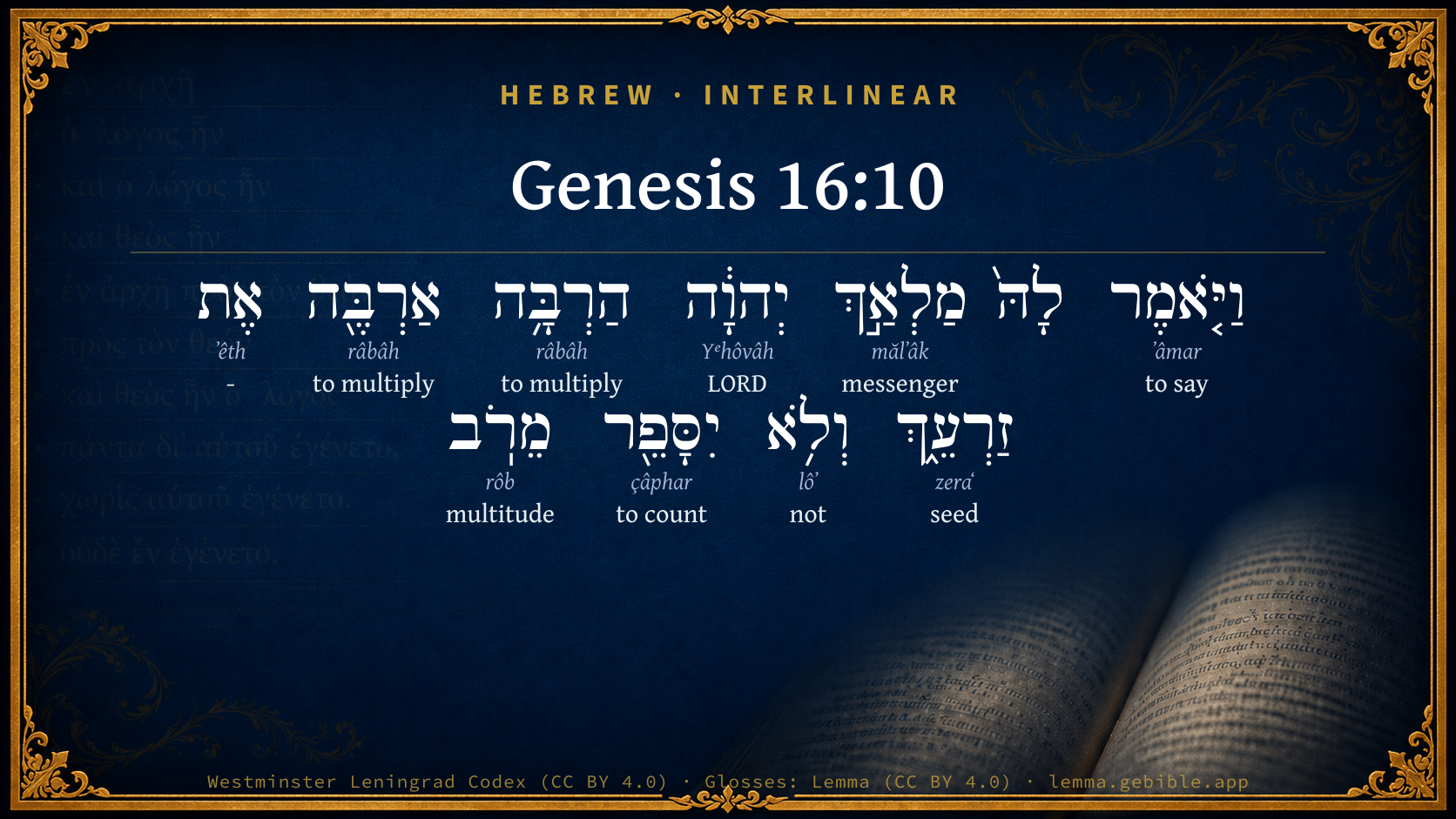
Hebrew (Westminster Leningrad Codex) Genesis 16:10 appears in the Hebrew Old Testament. The text above is from the Westminster Leningrad Codex. Each word links to its Strong’s number, a concise gloss, and parsing drawn from the Open Scriptures Hebrew Bible morphology. Click any word for its full Brown-Driver-Briggs (BDB) entry.
Download image
Cite this verse

Genesis 16:10 (World English Bible). Public Domain. Lemma interlinear Bible study tool, https://lemma.gebible.app/v/genesis/16/10.

Show BibTeX & RIS
BibTeX
RIS
English Translation
The angel of Yahweh said to her, "I will greatly multiply your seed, that they will not be numbered for multitude."
World English Bible · Public Domain
Highlights
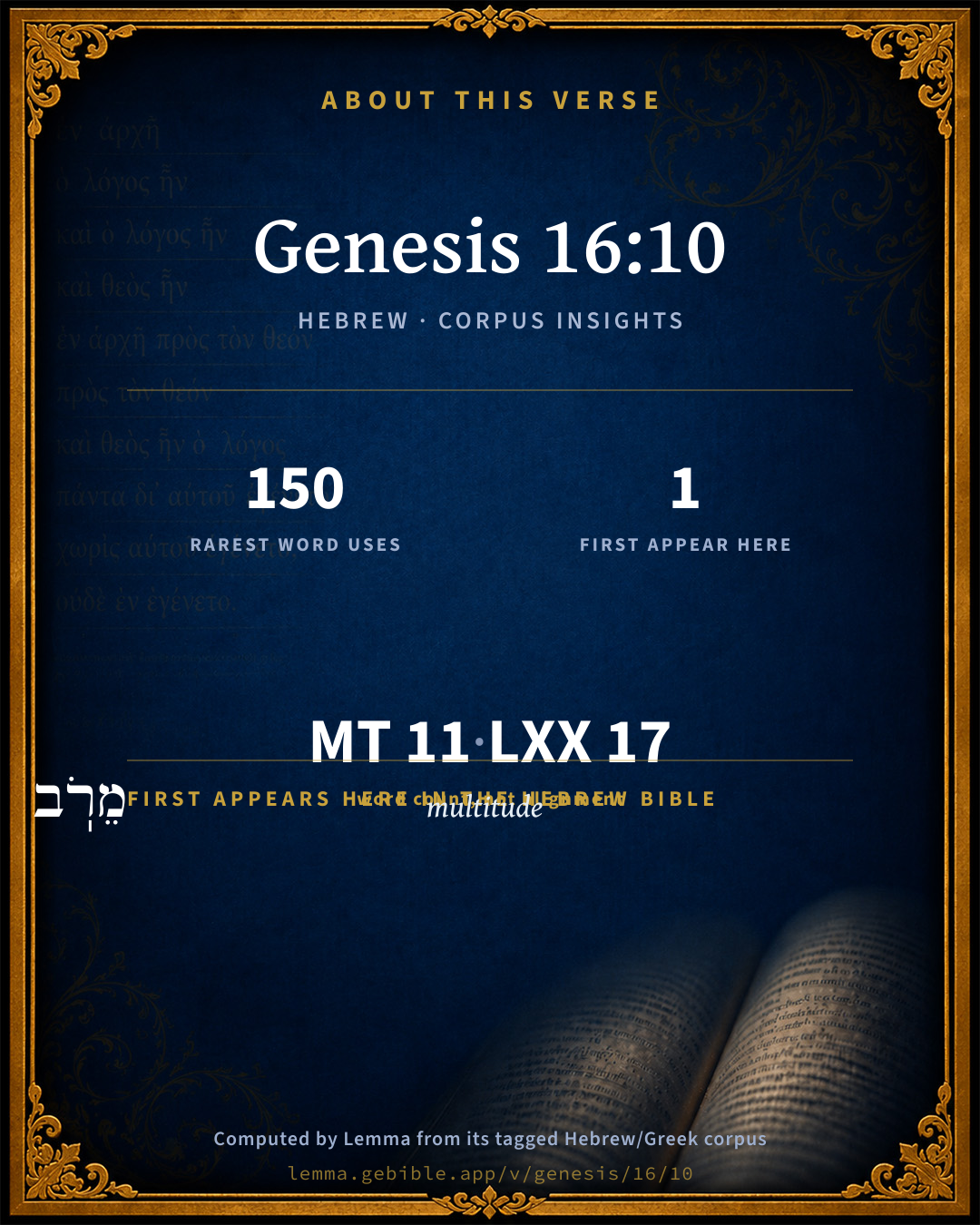
  • 1 first appearance in the Hebrew Bible
Full analysis ↓
Download a study sheet

One document with this verse’s original text, its word-by-word gloss line, the meaning frame, cross-references with their text, attributed commentary, and full source and license credits — printable, and it pastes into notes with its structure intact.

This verse Autodidact and up

Study sheet (.html) Plain text (.txt)

A passage Seminary Student

Up to 50 verses in one chapter. A passage sheet keeps up to 6 commentary sources and 12 cross-references per verse, in the order this page ranks them, and says so on the sheet whenever that leaves anything out. Ask for a single verse and you get the Autodidact verse sheet above.

Everything on this page stays free to read, with no account — the sheet is a download of what is already on screen, not access to it.

Want to remove ads? Support Godless Engineer
Compare translations 3

The same verse in 3 English versions, stacked beneath the original-language interlinear above. Click any original word for its lexicon entry.

Each is an independent rendering of the whole verse — the interlinear is not word-aligned to these translations.

Highlighted words mark where these versions differ — a whole-verse word diff, not a word-by-word alignment.

  • World English Bible Public Domain
    The angel of Yahweh said to her, "I will greatly multiply your seed, that they will not be numbered for multitude."
  • King James Version Public Domain
    And the angel of the LORD said unto her, I will multiply thy seed exceedingly, that it shall not be numbered for multitude.
  • unfoldingWord Literal Text CC BY-SA 4.0
    Then the angel of Yahweh said to her, “I will greatly increase your offspring, so that they cannot be counted, because of their abundance.”

unfoldingWord Literal Text — © unfoldingWord, licensed CC BY-SA 4.0. Word-aligned USFM3 via Door43 (git.door43.org/unfoldingWord/en_ult).

Versions to compare (up to 4)

3 of 4 selected

Show all 18 translations

Every available English version of this verse, each an independent rendering of the whole verse.

  • World English Bible Public Domain
    The angel of Yahweh said to her, "I will greatly multiply your seed, that they will not be numbered for multitude."
  • Berean Standard Bible Public Domain
    Then the angel added, “I will greatly multiply your offspring so that they will be too numerous to count.”
  • Majority Standard Bible Public Domain
    Then the angel added, “I will greatly multiply your offspring so that they will be too numerous to count.”
  • King James Version Public Domain
    And the angel of the LORD said unto her, I will multiply thy seed exceedingly, that it shall not be numbered for multitude.
  • American Standard Version (1901) Public Domain
    And the angel of Jehovah said unto her, I will greatly multiply thy seed, that it shall not be numbered for multitude.
  • Revised Version (1885) Public Domain
    And the angel of the LORD said unto her, I will greatly multiply thy seed, that it shall not be numbered for multitude.
  • Geneva Bible (1599) Public Domain
    Againe the Angel of the Lord saide vnto her, I will so greatly increase thy seede, that it shall not be numbred for multitude.
  • Douay-Rheims (1899) Public Domain
    And again he said: I will multiply thy seed exceedingly, and it shall not be numbered for multitude.
  • Young's Literal Translation Public Domain
    and the messenger of Jehovah saith to her, `Multiplying I multiply thy seed, and it is not numbered from multitude;'
  • Literal Standard Version CC BY-SA 4.0
    and the Messenger of YHWH says to her, “Multiplying I multiply your seed, and it is not numbered from multitude”;
  • Unlocked Literal Bible CC BY-SA 4.0
    Then the angel of Yahweh said to her, “I will greatly multiply your descendants, so that they will be too numerous to count.”
  • unfoldingWord Literal Text CC BY-SA 4.0
    Then the angel of Yahweh said to her, “I will greatly increase your offspring, so that they cannot be counted, because of their abundance.”
  • Darby Bible Public Domain
    And the Angel of Jehovah said to her, I will multiply thy seed exceedingly, that it shall not be numbered for multitude.
  • World Messianic Bible Public Domain
    The LORD’s angel said to her, “I will greatly multiply your offspring, that they will not be counted for multitude.”
  • Webster's Bible Public Domain
    And the angel of the LORD said to her, I will multiply thy seed exceedingly, that it shall not be numbered for multitude.
  • Free Bible Version CC BY-SA 4.0
    Then he continued, “I will give you many, many descendants—in fact they'll be so many they can't be counted.”
  • Bible in Basic English Public Domain
    And the angel of the Lord said, Your seed will be greatly increased so that it may not be numbered.
  • JPS Tanakh (1917) Public Domain
    And the angel of the LORD said unto her: 'I will greatly multiply thy seed, that it shall not be numbered for multitude.

Literal Standard Version (2020), Covenant Press — licensed CC BY-SA 4.0. Text via the HelloAO Bible API (eBible.org). Unlocked Literal Bible (unfoldingWord) — licensed CC BY-SA 4.0. Text via the HelloAO Bible API (eBible.org). unfoldingWord Literal Text — © unfoldingWord, licensed CC BY-SA 4.0. Word-aligned USFM3 via Door43 (git.door43.org/unfoldingWord/en_ult). Free Bible Version, Dr. Jonathan Gallagher — licensed CC BY-SA 4.0. Text via the HelloAO Bible API (eBible.org).

Word by word

More ways to search: Search by grammar → Find every occurrence → Compare this word →

Practice this passage: Drill this verse → Learn its vocabulary →

מֵרֹֽב
rôb
H7230
“from · multitude”
Preposition + Noun, Common, Both, Singular, Absolute
Part of Speech
Preposition + Noun
Type
Common
Gender
Both
Number
Singular
State
Absolute
Full BDB Definition

Origin: from H7231

TWOT: 2099c

multitude, abundance, greatness - multitude - abundance, abundantly - numerous - greatness
  1. וַיֹּ֤אמֶר ʼâmar H559 “and · to say” Conjunction + Verb, Qal, Sequential Imperfect, 3rd Person, Masculine, Singular
  2. מַלְאַ֣ךְ mălʼâk H4397 “messenger of” Noun, Common, Masculine, Singular, Construct
  3. יְהוָ֔ה Yᵉhôvâh H3068 “LORD” Noun, Proper
  4. הַרְבָּ֥ה râbâh H7235 “to multiply” Verb, Hiphil, Infinitive Absolute
  5. אַרְבֶּ֖ה râbâh H7235 “to multiply” Verb, Hiphil, Imperfect, 1st Person, Common, Singular
  6. אֶת ʼêth H853 “-” Particle, Direct Object
  7. זַרְעֵ֑ךְ zeraʻ H2233 “seed · your” Noun, Common, Masculine, Singular, Construct + Suffix, Personal, 2nd Person, Feminine, Singular
  8. וְלֹ֥א lôʼ H3808 “and · not” Conjunction + Particle, Negative
  9. יִסָּפֵ֖ר çâphar H5608 “to count” Verb, Niphal, Imperfect, 3rd Person, Masculine, Singular

About this verse

These counts appear in no published source. They are computed here, from the morphology-tagged text and Lemma’s own curated glosses. What Lemma adds →

11
words
9
distinct lemmas
Pentateuch
section

First appearance in Scripture

This word makes its first canonical appearance in the Hebrew Bible here:

  • מֵרֹֽב multitude H7230

Grammatical profile

  • 4 verbs
  • 4 nouns
  • 1 preposition
  • 2 particles

Verb forms

  • וַיֹּ֤אמֶר Qal · Sequential Imperfect
  • הַרְבָּ֥ה Hiphil · Infinitive Absolute
  • אַרְבֶּ֖ה Hiphil · Imperfect
  • יִסָּפֵ֖ר Niphal · Imperfect

Repetition

A word recurs within this verse — often emphatic in Hebrew:

  • הַרְבָּ֥ה to multiply H7235 ×2

Hebrew & Septuagint length

In English translation the verse runs 21 words from the Hebrew and 23 from the Septuagint (LXX English) — closely comparable.

A rough comparison of the two English renderings, which tokenize alike — not a word-level alignment.

Word counts can differ between the Hebrew and the Greek without any difference in meaning — e.g. the Hebrew direct-object marker אֵת has no separate Greek word, and Greek often adds the article ὁ.

In the original languages it is 11 Hebrew tokens and 17 Greek tokens — but the two are counted differently (Hebrew bundles its prefixes and suffixes into one token; the Greek is in lemma form), so that isn’t a like-for-like length.

Cross-references

23

Topical passages linked to Genesis 16:10 in the Treasury of Scripture Knowledge — connected by theme and wording, ordered by reader-vote popularity; previews shown in the World English Bible.

  • Genesis 17:20 As for Ishmael, I have heard you. Behold, I have blessed him, and will make him fruitful, and will multiply him exceedingly. He will become the father of twelve princes, and I will make him a great nation.
  • Psalms 83:6–7 The tents of Edom and the Ishmaelites; Moab, and the Hagrites;
  • Genesis 21:13 Also of the son of the handmaid will I make a nation, because he is your seed."
  • Genesis 21:18 Get up, lift up the boy, and hold him in your hand. For I will make him a great nation."
  • Genesis 22:15–18 The angel of Yahweh called to Abraham a second time out of the sky,
  • Genesis 25:12–18 Now this is the history of the generations of Ishmael, Abraham's son, whom Hagar the Egyptian, Sarah's handmaid, bore to Abraham.
  • Genesis 21:16 She went and sat down opposite him, a good way off, about a bow shot away. For she said, "Don't let me see the death of the child." She sat over against him, and lifted up her voice, and wept.
  • Genesis 31:11–13 The angel of God said to me in the dream, 'Jacob,' and I said, 'Here I am.'
  • Genesis 32:24–30 Jacob was left alone, and wrestled with a man there until the breaking of the day.
  • Genesis 48:15–16 He blessed Joseph, and said, "The God before whom my fathers Abraham and Isaac did walk, the God who has fed me all my life long to this day,
  • Exodus 3:2–6 The angel of Yahweh appeared to him in a flame of fire out of the midst of a bush. He looked, and behold, the bush burned with fire, and the bush was not consumed.
  • Judges 2:1–3 The angel of Yahweh came up from Gilgal to Bochim. He said, I made you to go up out of Egypt, and have brought you to the land which I swore to your fathers; and I said, I will never break my covenant with you:
  • Judges 6:11 The angel of Yahweh came, and sat under the oak which was in Ophrah, that pertained to Joash the Abiezrite: and his son Gideon was beating out wheat in the winepress, to hide it from the Midianites.
  • Judges 6:16 Yahweh said to him, Surely I will be with you, and you shall strike the Midianites as one man.
  • Judges 6:21–24 Then the angel of Yahweh put forth the end of the staff that was in his hand, and touched the flesh and the unleavened cakes; and there went up fire out of the rock, and consumed the flesh and the unleavened cakes; and the angel of Yahweh departed out of his sight.
  • Judges 13:16–22 The angel of Yahweh said to Manoah, Though you detain me, I won't eat of your bread; and if you will make ready a burnt offering, you must offer it to Yahweh. For Manoah didn't know that he was the angel of Yahweh.
  • Hosea 12:3–5 In the womb he took his brother by the heel; And in his manhood he had power with God.
  • Zechariah 2:8–9 For thus says Yahweh of hosts: 'For honor he has sent me to the nations which plundered you; for he who touches you touches the apple of his eye.
  • Malachi 3:1 "Behold, I send my messenger, and he will prepare the way before me; and the Lord, whom you seek, will suddenly come to his temple; and the messenger of the covenant, whom you desire, behold, he comes!" says Yahweh of hosts.
  • John 1:18 No one has seen God at any time. The one and only Son, who is in the bosom of the Father, he has declared him.
  • Acts 7:30–38 "When forty years were fulfilled, an angel of the Lord appeared to him in the wilderness of Mount Sinai, in a flame of fire in a bush.
  • Isaiah 63:9 In all their affliction he was afflicted, and the angel of his presence saved them: in his love and in his pity he redeemed them; and he bore them, and carried them all the days of old.
  • 1 Timothy 6:16 who alone has immortality, dwelling in unapproachable light; whom no man has seen, nor can see: to whom be honor and eternal power. Amen.

Cross-references courtesy of OpenBible.info (CC BY 4.0).

Hebrew and Greek witnesses Masoretic Hebrew ↔ Greek Septuagint

The same verse in the two great witnesses to the Old Testament, shown verse-for-verse.

These are two independent witnesses, not word-aligned to each other, and the Septuagint is shown in lemma (dictionary) form.

Hebrew Genesis 16:10 Masoretic · Westminster Leningrad Codex

וַיֹּ֤אמֶר לָהּ֙ מַלְאַ֣ךְ יְהוָ֔ה הַרְבָּ֥ה אַרְבֶּ֖ה אֶת זַרְעֵ֑ךְ וְלֹ֥א יִסָּפֵ֖ר מֵרֹֽב

The angel of Yahweh said to her, "I will greatly multiply your seed, that they will not be numbered for multitude."

World English Bible · Public Domain

Greek LXX Genesis 16:10 Septuagint · lemma form

καί εἶπον αὐτός ὁ ἄγγελος κύριος πληθύνω πληθύνω ὁ σπέρμα σύ καί οὐ ἀριθμέω ἀπό ὁ πλῆθος

And the angel of the Lord said to her, I will surely multiply your seed, and it shall not be numbered for multitude.

LXX2012 (modern English Septuagint) · Public Domain

Hebrew: Westminster Leningrad Codex (CC BY 4.0). Greek: Septuagint (public domain); English from LXX2012 (modern English Septuagint) (Public Domain). How the Septuagint differs from the Hebrew →

Targum (Aramaic paraphrase)

2

The Targum is the ancient Jewish Aramaic paraphrase of the Hebrew Scriptures — an interpretive translation, not the Hebrew text itself. Onkelos (literal) and Pseudo-Jonathan (expansive) render the Torah, and Jonathan the Prophets. Coverage is partial: where no permissively-licensed English translation exists for a verse, only the Aramaic is shown. This is verse-level text, not a word-by-word alignment to the Hebrew.

  1. Targum Onkelos Torah (Genesis–Deuteronomy)
    וַאֲמַר לַהּ מַלְאֲכָא דַיְיָ אַסְגָאָה אַסְגֵי יָת בְּנָיְכִי וְלָא יִתִּמְנוּן מִסְגֵי

    (no public-domain English translation for this verse)

    Targum Onkelos — Aramaic: “Onkelos Genesis” (public domain); “Onkelos Exodus” (public domain); “Onkelos Leviticus” (public domain); “Onkelos Numbers” (public domain); “Onkelos Deuteronomy” (public domain). English: “Sefaria Community Translation” (CC0 1.0 (public-domain dedication)); “J.W. Etheridge. The Targums of Onkelos and Jonathan Ben Uzziel on the Pentateuch. London: Longmans, Green, 1862” (public domain). Text via Sefaria.

  2. Targum Pseudo-Jonathan Torah (Genesis–Deuteronomy)
    וַאֲמַר לָהּ מַלְאָכָא דַיְיָ אַסְגָאָה אַסְגֵי יַת בְּנָיְיכִי וְלָא יִתְמְנוּן מִסְגֵי

    And the Angel of the Lord said to her, Multiplying I will multiply thy sons, and they shall not be numbered for multitude.

    Targum Pseudo-Jonathan — Aramaic: “Targum Jonathan on Genesis” (public domain); “Targum Jonathan on Exodus” (public domain); “Targum Jonathan on Leviticus” (public domain); “Targum Jonathan on Numbers” (public domain); “Targum Jonathan on Deuteronomy” (public domain). English: “The Targum of Jonathan ben Uzziel, trans. J. W. Etheridge, London, 1862” (public domain). Text via Sefaria.

Commentary

Notes on Genesis 16:10 from classic Christian and Jewish commentators (each source and its license shown beneath its notes). The classic Christian expositions comment on the surrounding passage and are grouped to its opening verse, so a note may address several verses; the Jewish commentaries on the Tanakh (Rashi and others) are per-verse, so they appear only where the commentator wrote on this verse.

Lemma curates 59 commentaries, every one of them public domain or Creative Commons licensed, each selected and text-cleaned for this edition rather than reprinted as found. About our sources →

Matthew Henry's Commentary

We may suppose that the angel having given Hagar that good counsel (Gen 16:9) to return to her mistress she immediately promised to do so, and was setting her face homeward; and then the angel went on to encourage her with an assurance of the mercy God had in store for her and her seed: for God will meet those with mercy that are returning to their duty. I said, I will confess, and thou forgavest, Psa 32:5. Here is,

I. A prediction concerning her posterity given her for her comfort in her present distress. Notice is taken of her condition: Behold, thou art with child; and therefore this is not a fit place for thee to be in. Note, It is a great comfort to women with child to think that they are under the particular cognizance and care of the divine Providence. God graciously considers their case and suits supports to it. Now, 1. The angel assures her of a safe delivery, and that of a son, which Abram desired. This fright and ramble of hers might have destroyed her hope of an offspring; but God dealt not with her according to her folly: Thou shalt bear a son. She was saved in child-bearing, not only by providence, but by promise. 2. He names her child, which was an honour both to her and it: Call him Ishmael, God will hear; and the reason is, because the Lord has heard; he has, and therefore he will. Note, The experience we have had of God's seasonable kindness to us in distress would encourage us to hope for similar help in similar exigencies, Psa 10:17. He has heard thy affliction, Gen 16:11. Note, Even where there is little cry of devotion, the God of pity sometimes graciously hears the cry of affliction. Tears speak as well as prayers. This speaks comfort to the afflicted, that God not only sees what their afflictions are, but hears what they say. Note, further, Seasonable succours, in a day of affliction, ought always to be remembered with thankfulness to God. Such a time, in such a strait, the Lord heard the voice of my affliction, and helped me. See Deu 26:7; Psa 31:22. 3. He promises her a numerous offspring, (Gen 16:10): I will multiply thy seed exceedingly, Heb. multiplying, I will multiply it, that is, multiply it in every age, so as to perpetuate it. It is supposed that the Turks at this day descend from Ishmael; and they are a great people. This was in pursuance of the promise made to Abram: I will make thy seed as the dust of the earth, Gen 13:16. Note, Many that are children of godly parents have, for their sakes, a very large share of outward common blessings, though, like Ishmael, they are not taken into covenant: many are multiplied that are not sanctified. 4. He gives a character of the child she should bear, which, however it may seem to us, perhaps was not very disagreeable to her (Gen 16:12): He will be a wild man; a wild ass of a man (so the word is), rude, and bold, and fearing no man - untamed, untractable living at large, and impatient of service and restraint. Note, The children of the bondwoman, who are out of covenant with God, are, as they were born, like the wild ass's colt; it is grace that reclaims men, civilizes them, and makes them wise, and good for something. It is foretold, (1.) That he should live in strife, and in a state of war: His hand against every man - this is his sin; and every man's hand against him - this is his punishment. Note, Those that have turbulent spirits have commonly troublesome lives; those that are provoking, vexatious, and injurious to others, must expect to be repaid in their own coin. He that has his hand and tongue against every man shall have every man's hand and tongue against him, and he has no reason to complain of it. And yet, (2.) That he should live in safety, and hold his own against all the world: He shall dwell in the presence of all his brethren; though threatened and insulted by all his neighbours, yet he shall keep his ground, and for Abram's sake, more than his own, shall be able to make his part good with them. Accordingly we read (Gen 25:18), that he died, as he lived, in the presence of all his brethren. Note, Many that are much exposed by their own imprudence are yet strangely preserved by the divine Providence, so much better is God to them than they deserve, when they not only forfeit their lives by sin, but hazard them.

II. Hagar's pious reflection upon this gracious appearance of God to her, Gen 16:13, Gen 16:14. Observe in what she said,

1. Her awful adoration of God's omniscience and providence, with application of it to herself: She called the name of the Lord that spoke unto her, that is, thus she made confession of his name, this she said to his praise, Thou God seest me: this should be, with her, his name for ever, and this his memorial, by which she will know him and remember him while she lives, Thou God seest me. Note, (1.) The God with whom we have to do is a seeing God, and all-seeing God. God is (as the ancients express it) all eye. (2.) We ought to acknowledge this with application to ourselves. He that sees all sees me, as David (Psa 139:1), O Lord, thou hast searched me, and known me. (3.) A believing regard to God, as a God that sees us, will be of great use to us in our returns to him. It is a proper word for a penitent: - [1.] "Thou seest my sin and folly." I have sinned before thee, says the prodigal; in thy sight, says David. [2.] "Thou seest my sorrow and affliction;" this Hagar especially refers to. When we have brought ourselves into distress by our own folly, yet God has not forsaken us. [3.] "Thou seest the sincerity and seriousness of my return and repentance. Thou seest my secret mournings for sin, and secret motions towards thee." [4.] "Thou seest me, if in any instance I depart from thee," Psa 44:20, Psa 44:21. This thought should always restrain us from sin and excite us to duty: Thou God seest me.

2. Her humble admiration of God's favour to her: "Have I here also looked after him that seeth me? Have I here seen the back parts of him that seeth me?" so it might be read, for the word is much the same with that, Exo 33:23. She saw not face to face, but as through a glass darkly, Co1 13:12. Probably she knew not who it was that talked with her, till he was departing (as Jdg 6:21, Jdg 6:22; Jdg 13:21), and then she looked after him, with a reflection like that of the two disciples, Luk 24:31, Luk 24:32. Or, Have I here seen him that sees me? Note, (1.) The communion which holy souls have with God consists in their having an eye of faith towards him, as a God that has an eye of favour towards them. The intercourse is kept up by the eye. (2.) The privilege of our communion with God is to be looked upon with wonder and admiration, [1.] Considering what we are who are admitted to this favour. "Have I? I that am so mean, I that am so vile?" Sa2 7:18. [2.] Considering the place where we are thus favoured - "here also? Not only in Abram's tent and at his altar, but here also, in this wilderness? Here, where I never expected it, where I was out of the way of my duty? Lord, how is it?" Joh 14:22. Some make the answer to this question to be negative, and so look upon it as a penitent reflection; "Have I here also, in my distress and affliction, looked after God? No, I was a careless and unmindful of him as ever I used to be; and yet he has thus visited and regarded me:" for God often anticipates us with his favours, and is found of those that seek him not, Isa 65:1.

III. The name which this gave to the place: Beer-lahai-roi, The well of him that liveth and seeth me, Gen 16:14. It is probable that Hagar put this name upon it; and it was retained long after, in perpetuam rei memoriam - a lasting memorial of this event. This was a place where the God of glory manifested the special cognizance and care he took of a poor woman in distress. Note, 1. He that is all-seeing is ever-living; he lives and sees us. 2. Those that are graciously admitted into communion with God, and receive seasonable comforts from him, should tell others what he has done for their souls, that they also may be encouraged to seek him and trust in him. 3. God's gracious manifestations of himself to us are to be had in everlasting remembrance by us, and should never be forgotten.

Matthew Henry's Commentary on the Whole Bible (1708–1710) — public domain (CC PDM 1.0). Text via the HelloAO Bible API.

Trapp's Complete Commentary

John Trapp

Gen 16:10 And the angel of the LORD said unto her, I will multiply thy seed exceedingly, that it shall not be numbered for multitude.

Ver. 10. I will multiply thy seed.] Thus God contemneth not poor servants; nay, if they be faithful, he will give them "the reward of inheritance," {Col 3:24} even a child’s part, as Hagar and her child had. We read not that she cried to God; but her affliction spake for her; and he is oft - out of his mere "philanthropy" - "found {Tit 3:4} of them that sought him not". {Rom 10:20} He heareth "the young ravens, that cry to him" only by way of implication. {Psa 147:9} "The Lord hath heard thy affliction," saith the angel in the next verse.

John Trapp, A Commentary or Exposition upon All the Books of the Old and New Testament (1647–1656) — public domain. Text from a community e-Sword module.

Joseph Benson's Commentary

Gen 16:10. I will multiply thy seed exceedingly — Hebrews Multiplying I will multiply it; that is, multiply it in every age, so as to perpetuate it. The Hagarenes, Saracens, and various other tribes of Arabs were descended from Ishmael, and they have been, and still are, a great people.

Joseph Benson's Commentary on the Old and New Testaments (1811–1818) — public domain. Text from a community e-Sword module.

Tyndale Open Study Notes

Tyndale Open Resources

16:10-12 Hagar’s son would become the father of a great but wild and hostile nation living in the Arabian Desert as perennial enemies of Israel (cp. 25:18). God blessed Ishmael as Abram’s descendant, but not as the line chosen to carry on the covenant. That blessing was reserved for Abram’s chosen heir.

Tyndale Open Study Notes — © Tyndale Open Resources, licensed CC BY-SA 4.0. Text via the HelloAO Bible API.

Adam Clarke's Commentary

Verse 10. I will multiply thy seed exceedingly] Who says this? The person who is called the Angel of the Lord; and he certainly speaks with all the authority which is proper to God.

Adam Clarke's Commentary on the Bible (1810–1826) — public domain. Text from a community e-Sword/MySword module.

John Calvin's Commentaries

10. I will multiply thy seed exceedingly For the purpose of mitigating the offense, and of alleviating what was severe in the precept, by some consolation, he promises a blessing in the child which she should bear. God might indeed, by his own authority, have strictly enjoined what was right; but in order that Hagar might the more cheerfully do what she knew to be her duty, he allures her, as by blandishments, to obedience. And to this point those promises tend, by which he invites us to voluntary submission. For he would not draw us by servile methods, so that we should obey his commands by constraint; and therefore he mingles mild and paternal invitations with his commands, dealing with us liberally, as with sons. That the angel here promises to do what is peculiar to God alone, involves no absurdity, for it is sufficiently usual with God to invest his ministers whom he sends with his own character, that the authority of their word may appear the greater. I do not, however, disapprove the opinion of most of the ancients; that Christ the Mediator was always present in all the oracles, and that this is the cause why the majesty of God is ascribed to angels. On which subject I have already touched and shall have occasion to say more elsewhere.

John Calvin's Commentaries (1540-1563) — public domain. Text from the Calvin Translation Society English edition (1840s-50s) via the Christian Classics Ethereal Library (ccel.org). Calvin's coverage is partial (roughly two-thirds of the Bible); uncommented books and verses are honest gaps, never fabricated. The 19th-century editor's footnotes and remarks are omitted so the notes are faithfully Calvin's own voice.

Ellicott's Commentary for English Readers

(10) I will multiply thy seed.—We have here the purpose of the Divine manifestation. Abram’s son must not be mixed up with and lost among the debased population of Egypt, but must be the father of a free people; and Hagar will now submit to her lot as a slave, that she may secure liberty for her offspring.

A Bible Commentary for English Readers, edited by Charles John Ellicott (1878–1897) — public domain. Text from a community e-Sword module.

The Cambridge Bible for Schools and Colleges

gen. ed. J. J. S. Perowne

10. I will greatly multiply] The Angel of Jehovah expresses in the 1st person the promise of that which Jehovah will perform; as in Gen_21:18, Gen_22:15-18, Gen_31:13.

The Cambridge Bible for Schools and Colleges (gen. ed. J. J. S. Perowne; Cambridge University Press, 1878–1918) — public domain. Text from a community e-Sword module.

John Gill's Exposition

And the angel of the Lord said unto her,.... The same as before, who, by what follows, appears to be Jehovah himself:

I will multiply thy seed exceedingly; not that she should have many children herself, for that she had more than this one she now went with, is not certain; but that that seed she had conceived should be exceedingly multiplied, and he should have a numerous posterity, as he had twelve princes sprung from him, the heads of Arab nations:

that it shall not be numbered for multitude; such the Turks are at this day, supposed to be the seed of Ishmael, Hagar's son.

John Gill's Exposition of the Whole Bible (1746–1763) — public domain (CC PDM 1.0). Text via the HelloAO Bible API.

The Pulpit Commentary

And the angel of the Lord said unto her (after duty, promise), I will multiply thy seed exceedingly (literally, multiplying I will multiply thy seed; language altogether inappropriate in the lips of a creature), that (literally, and) it shall not be numbered for multitude.

The Pulpit Commentary (1880–1919), ed. H.D.M. Spence-Jones & Joseph S. Exell — public domain. Text from a community e-Sword module.

John Wesley's Explanatory Notes

I will multiply thy seed exceedingly - Hebrew. multiplying I will multiply it, that is, multiply it in every age, so as to perpetuate it. 'Tis supposed that the Turks at this day descended from Ishmael, and they are a great people.

John Wesley, Explanatory Notes Upon the Whole Bible (1754–1765) — public domain. Text via the GEBible commentary corpus.

Radak

Rabbi David Kimhi (Radak)

הרבה ארבה, the angel being G'd's messenger, may speak in the first person as if he were to do what he says, seeing that he delivers G'd's message. It is as if G'd Himself had spoken.

ולא יספר מרב, the words: "and it will not be capable of being counted due to its large number," are to be understood as an exaggeration, poetical license.

Radak on the Tanakh — English translations: “Sefaria Community Translation” (CC0 1.0 (public-domain dedication)); “Eliyahu Munk, HaChut Hameshulash” (CC BY 4.0); “Rabbi Mike Feuer, Jerusalem Anthology” (CC BY 4.0); and “R. David Kimhi on the first book of Psalms, Translated by R.G. Finch, London, 1919” (public domain). Text via Sefaria.

Lesson kit

Teaching starters — assembled from the data on this page, not authored interpretation. Every prompt links to the verse data it draws on. Edit before teaching.

Genesis, in the Pentateuch, opens this verse with 11 words (9 distinct Hebrew lemmas). Its most distinctive word is rôb (“multitude”). A historical commentator’s framing appears above. Read the whole chapter for the surrounding context.

Discussion questions

  1. How does “multitude” (rôb) shape what this verse is saying?
  2. The word “multitude” first appears here in Scripture. What is being introduced at this debut?
  3. Genesis 17:20 shares this passage’s theme. How do the two illuminate each other?
  4. “to multiply” occurs 2× in this one verse. What is the effect of the repetition?
  5. These translations render this verse differently; the difference is in the English rendering, not the original. What questions does that raise?
  6. The verb «וַיֹּ֤אמֶר» is Qal Sequential Imperfect. How does its form color the action?
  7. Reading how Matthew Henry's Commentary and Trapp's Complete Commentary read this verse, where do the two commentators agree and where do they part?

Things to notice

Reading settings

Reading text

Shown beneath each verse's original-language words.

Old Testament
Old Testament edition

Read the OT as the Masoretic Hebrew (MT) or the Greek Septuagint (LXX).

English shown for the Greek Septuagint (in the Hebrew ↔ Greek comparison).

Comparing translations? Open the Compare panel on any verse page to stack up to four side by side.