
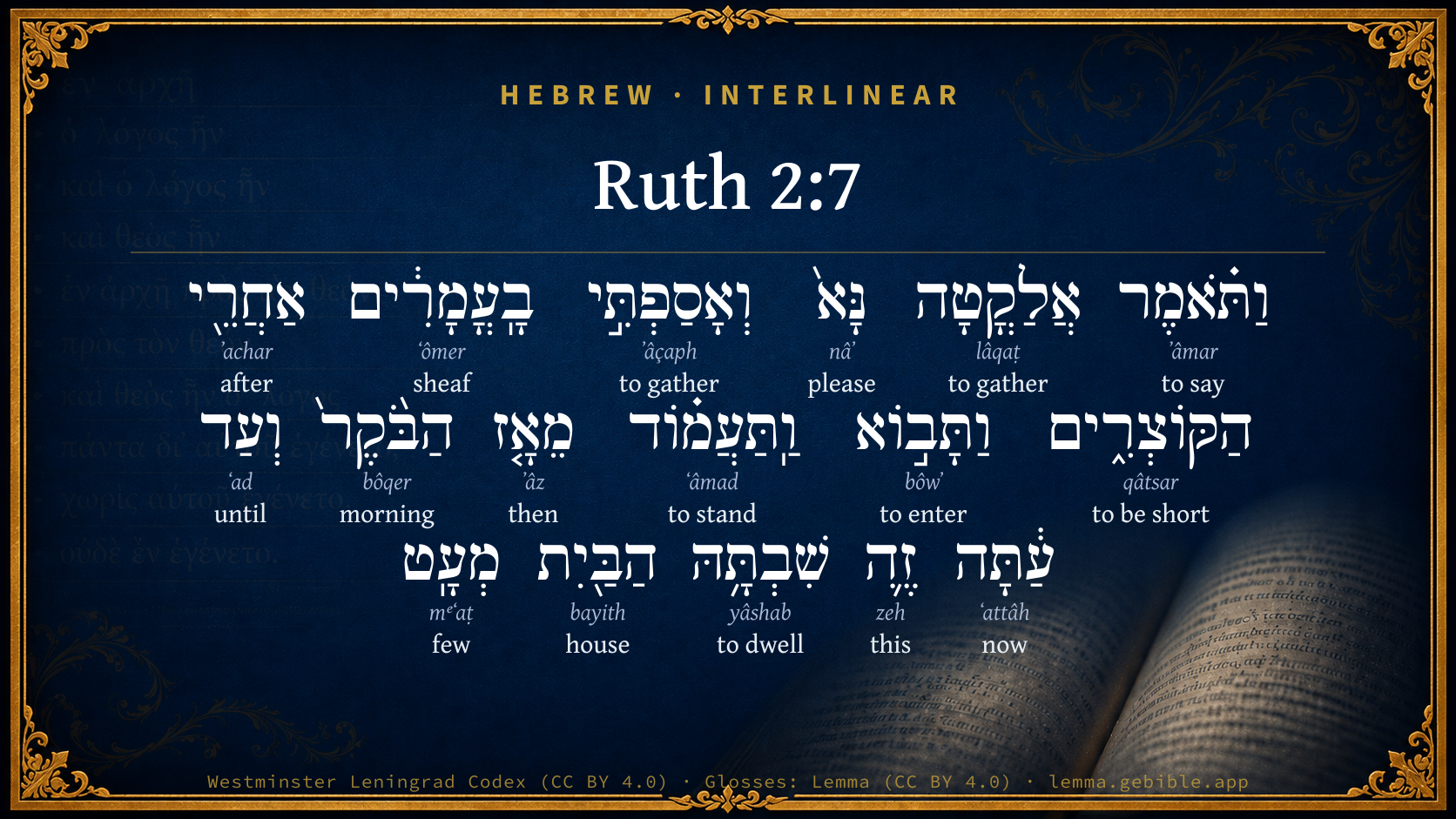
Ruth 2:7

Hebrew (Westminster Leningrad Codex) Ruth 2:7 appears in the Hebrew Old Testament. The text above is from the Westminster Leningrad Codex. Each word links to its Strong’s number, a concise gloss, and parsing drawn from the Open Scriptures Hebrew Bible morphology. Click any word for its full Brown-Driver-Briggs (BDB) entry.
Download image
Cite this verse

Ruth 2:7 (World English Bible). Public Domain. Lemma interlinear Bible study tool, https://lemma.gebible.app/v/ruth/2/7.

Show BibTeX & RIS
BibTeX
RIS
English Translation
She said, Please let me glean and gather after the reapers among the sheaves. So she came, and has continued even from the morning until now, except that she stayed a little in the house.
World English Bible · Public Domain
Download a study sheet

One document with this verse’s original text, its word-by-word gloss line, the meaning frame, cross-references with their text, attributed commentary, and full source and license credits — printable, and it pastes into notes with its structure intact.

This verse Autodidact and up

Study sheet (.html) Plain text (.txt)

A passage Seminary Student

Up to 50 verses in one chapter. A passage sheet keeps up to 6 commentary sources and 12 cross-references per verse, in the order this page ranks them, and says so on the sheet whenever that leaves anything out. Ask for a single verse and you get the Autodidact verse sheet above.

Everything on this page stays free to read, with no account — the sheet is a download of what is already on screen, not access to it.

Want to remove ads? Support Godless Engineer
Compare translations 3

The same verse in 3 English versions, stacked beneath the original-language interlinear above. Click any original word for its lexicon entry.

Each is an independent rendering of the whole verse — the interlinear is not word-aligned to these translations.

Highlighted words mark where these versions differ — a whole-verse word diff, not a word-by-word alignment.

  • World English Bible Public Domain
    She said, Please let me glean and gather after the reapers among the sheaves. So she came, and has continued even from the morning until now, except that she stayed a little in the house.
  • King James Version Public Domain
    And she said, I pray you, let me glean and gather after the reapers among the sheaves: so she came, and hath continued even from the morning until now, that she tarried a little in the house.
  • unfoldingWord Literal Text CC BY-SA 4.0
    And she said, ‘Please let me glean and gather among the bundles of grain after the reapers.’ And she came and has continued from then, in the morning, until now. This is her resting in the house a little.”

unfoldingWord Literal Text — © unfoldingWord, licensed CC BY-SA 4.0. Word-aligned USFM3 via Door43 (git.door43.org/unfoldingWord/en_ult).

Versions to compare (up to 4)

3 of 4 selected

Show all 18 translations

Every available English version of this verse, each an independent rendering of the whole verse.

  • World English Bible Public Domain
    She said, Please let me glean and gather after the reapers among the sheaves. So she came, and has continued even from the morning until now, except that she stayed a little in the house.
  • Berean Standard Bible Public Domain
    She has said, ‘Please let me glean and gather among the sheaves after the harvesters.’ So she came out and has continued from morning until now, except that she rested a short time in the shelter.”
  • Majority Standard Bible Public Domain
    She has said, ‘Please let me glean and gather among the sheaves after the harvesters.’ So she came out and has continued from morning until now, except that she rested a short time in the shelter.”
  • King James Version Public Domain
    And she said, I pray you, let me glean and gather after the reapers among the sheaves: so she came, and hath continued even from the morning until now, that she tarried a little in the house.
  • American Standard Version (1901) Public Domain
    And she said, Let me glean, I pray you, and gather after the reapers among the sheaves. So she came, and hath continued even from the morning until now, save that she tarried a little in the house.
  • Revised Version (1885) Public Domain
    And she said, Let me glean, I pray you, and gather after the reapers among the sheaves: so she came, and hath continued even from the morning until now, save that she tarried a little in the house.
  • Geneva Bible (1599) Public Domain
    And shee saide vnto vs, I pray you, let mee gleane and gather after the reapers among the sheaues: so shee came, and hath continued from that time in the morning vnto now, saue that she taried a litle in the house.
  • Douay-Rheims (1899) Public Domain
    And she desired leave to glean the ears of corn that remain, following the steps of the reapers: and she hath been in the field from morning till now, and hath not gone home for one moment.
  • Young's Literal Translation Public Domain
    and she saith, Let me glean, I pray thee -- and I have gathered among the sheaves after the reapers; and she cometh and remaineth since the morning and till now; she sat in the house a little.
  • Literal Standard Version CC BY-SA 4.0
    and she says, Please let me glean and I have gathered among the sheaves after the reapers; and she comes and remains since the morning and until now; she sat in the house a little [while].”
  • Unlocked Literal Bible CC BY-SA 4.0
    She said to me, 'Please let me glean what remains in the field after the workers harvest the crop.' So she came here and has continued from the morning until now, except that she rested a little in the house.”
  • unfoldingWord Literal Text CC BY-SA 4.0
    And she said, ‘Please let me glean and gather among the bundles of grain after the reapers.’ And she came and has continued from then, in the morning, until now. This is her resting in the house a little.”
  • Darby Bible Public Domain
    and she said, I pray you, let me glean and gather among the sheaves after the reapers. And she came, and has continued from the morning until now: her sitting in the house has been little as yet.
  • World Messianic Bible Public Domain
    She said, ‘Please let me glean and gather after the reapers among the sheaves.’ So she came, and has continued even from the morning until now, except that she rested a little in the house.”
  • Webster's Bible Public Domain
    And she said, I pray you, let me glean and gather after the reapers among the sheaves: so she came, and hath continued even from the morning until now, that she tarried a little in the house.
  • Free Bible Version CC BY-SA 4.0
    “She asked me, ‘Please may I have permission to pick up grain behind the reapers.’ So she came, and she's been working here from morning until now, except for a brief rest in the shelter.”
  • Bible in Basic English Public Domain
    And she said to me, Let me come into the grain-field and take up the grain after the cutters. So she came, and has been here from morning till now, without resting even for a minute.
  • JPS Tanakh (1917) Public Domain
    and she said: Let me glean, I pray you, and gather after the reapers among the sheaves; so she came, and hath continued even from the morning until now, save that she tarried a little in the house.'

Literal Standard Version (2020), Covenant Press — licensed CC BY-SA 4.0. Text via the HelloAO Bible API (eBible.org). Unlocked Literal Bible (unfoldingWord) — licensed CC BY-SA 4.0. Text via the HelloAO Bible API (eBible.org). unfoldingWord Literal Text — © unfoldingWord, licensed CC BY-SA 4.0. Word-aligned USFM3 via Door43 (git.door43.org/unfoldingWord/en_ult). Free Bible Version, Dr. Jonathan Gallagher — licensed CC BY-SA 4.0. Text via the HelloAO Bible API (eBible.org).

Word by word

More ways to search: Search by grammar → Find every occurrence → Compare this word →

Practice this passage: Drill this verse → Learn its vocabulary →

בָֽעֳמָרִ֔ים
ʻômer
H6016
“in/at the · sheaves”
Preposition, Determined + Noun, Common, Masculine, Plural, Absolute
Part of Speech
Preposition + Noun
Type
Common
Gender
Masculine
Number
Plural
State
Absolute
Full BDB Definition

Origin: from H6014

TWOT: 1645b , 1645a

omer - a dry measure of 1/10 ephah (about 2 litres) - sheaf
  1. וַתֹּ֗אמֶר ʼâmar H559 “and · to say” Conjunction + Verb, Qal, Sequential Imperfect, 3rd Person, Feminine, Singular
  2. אֲלַקֳטָה lâqaṭ H3950 “to gather” Verb, Piel, Cohortative, 1st Person, Common, Singular
  3. נָּא֙ nâʼ H4994 “please” Particle, Interjection
  4. וְאָסַפְתִּ֣י ʼâçaph H622 “and · to gather” Conjunction + Verb, Qal, Sequential Perfect, 1st Person, Common, Singular
  5. אַחֲרֵ֖י ʼachar H310 “after” Preposition
  6. הַקּוֹצְרִ֑ים qâtsar H7114 “the · being short” Particle, Definite Article + Verb, Qal, Participle Active, Masculine, Plural, Absolute
  7. וַתָּב֣וֹא bôwʼ H935 “and · to enter” Conjunction + Verb, Qal, Sequential Imperfect, 3rd Person, Feminine, Singular
  8. וַֽתַּעֲמ֗וֹד ʻâmad H5975 “and · to stand” Conjunction + Verb, Qal, Sequential Imperfect, 3rd Person, Feminine, Singular
  9. מֵאָ֤ז ʼâz H227 “from · then” Preposition + Adverb
  10. הַבֹּ֨קֶר֙ bôqer H1242 “the · morning” Particle, Definite Article + Noun, Common, Masculine, Singular, Absolute
  11. וְעַד ʻad H5704 “and · until” Conjunction + Preposition
  12. עַ֔תָּה ʻattâh H6258 “now” Adverb
  13. זֶ֛ה zeh H2088 “this” Pronoun, Demonstrative, Masculine, Singular
  14. שִׁבְתָּ֥הּ yâshab H3427 “to dwell · her” Verb, Qal, Infinitive Construct + Suffix, Personal, 3rd Person, Feminine, Singular
  15. הַבַּ֖יִת bayith H1004 “the · house” Particle, Definite Article + Noun, Common, Masculine, Singular, Absolute
  16. מְעָֽט mᵉʻaṭ H4592 “few” Adjective, Adjective, Masculine, Singular, Absolute

About this verse

These counts appear in no published source. They are computed here, from the morphology-tagged text and Lemma’s own curated glosses. What Lemma adds →

17
words
17
distinct lemmas
Historical
section

Notable vocabulary

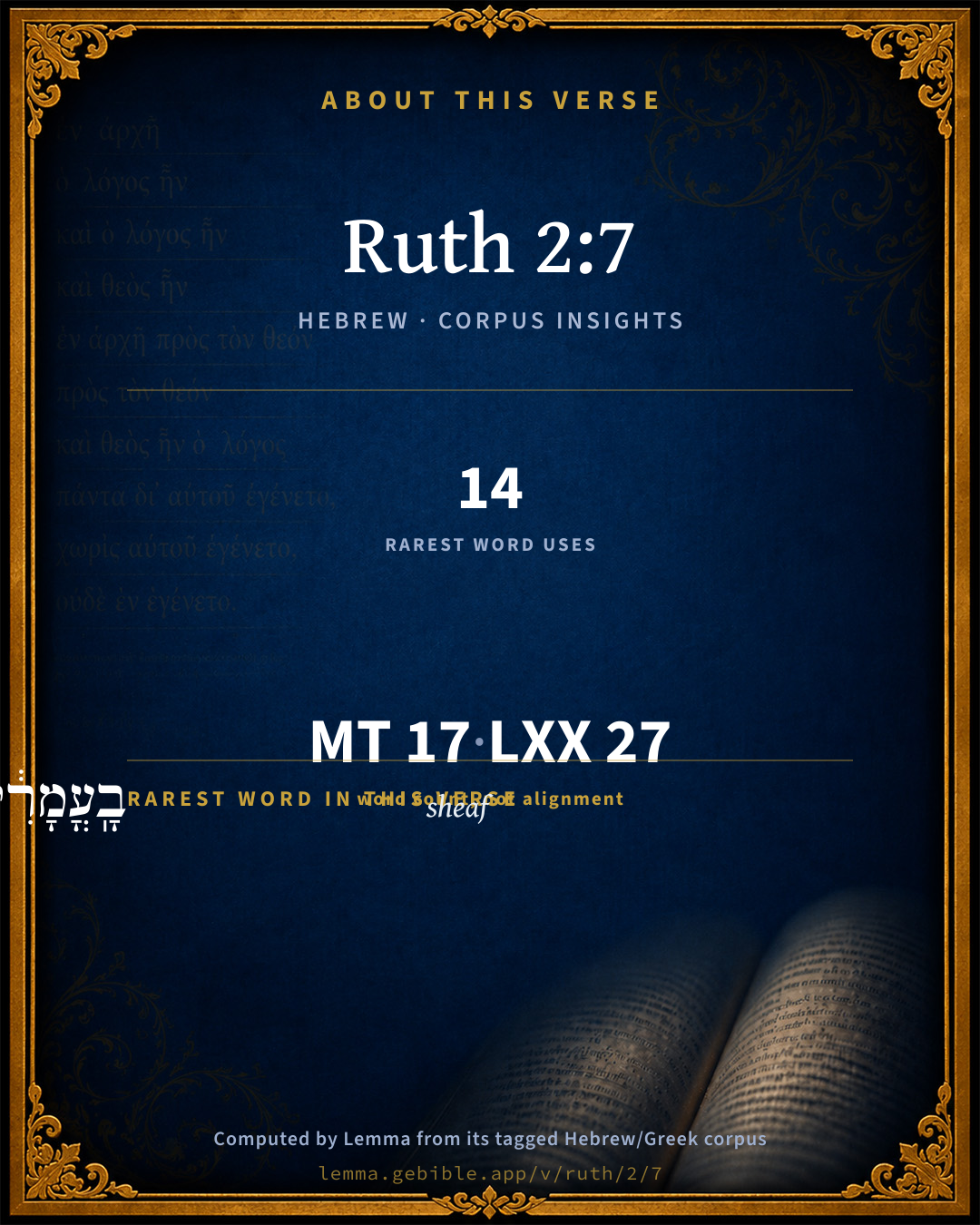
The rarest word here is בָֽעֳמָרִ֔ים sheaf H6016 — appearing just 14 times in the whole Hebrew Bible.

Shared distinctive vocabulary

בָֽעֳמָרִ֔ים sheaf H6016 occurs in 14 verses of the Hebrew Bible. Also found in:

Grammatical profile

  • 7 verbs
  • 3 nouns
  • 1 adjective
  • 1 pronoun
  • 2 prepositions
  • 2 adverbs
  • 1 particle

Verb forms

  • וַתֹּ֗אמֶר Qal · Sequential Imperfect
  • אֲלַקֳטָה Piel · Cohortative
  • וְאָסַפְתִּ֣י Qal · Sequential Perfect
  • הַקּוֹצְרִ֑ים Qal · Participle Active
  • וַתָּב֣וֹא Qal · Sequential Imperfect
  • וַֽתַּעֲמ֗וֹד Qal · Sequential Imperfect
  • שִׁבְתָּ֥הּ Qal · Infinitive Construct

Hebrew & Septuagint length

In English translation the verse runs 35 words from the Hebrew and 35 from the Septuagint (LXX English) — the same length.

A rough comparison of the two English renderings, which tokenize alike — not a word-level alignment.

Word counts can differ between the Hebrew and the Greek without any difference in meaning — e.g. the Hebrew direct-object marker אֵת has no separate Greek word, and Greek often adds the article ὁ.

In the original languages it is 17 Hebrew tokens and 27 Greek tokens — but the two are counted differently (Hebrew bundles its prefixes and suffixes into one token; the Greek is in lemma form), so that isn’t a like-for-like length.

Cross-references

10

Topical passages linked to Ruth 2:7 in the Treasury of Scripture Knowledge — connected by theme and wording, ordered by reader-vote popularity; previews shown in the World English Bible.

  • Proverbs 15:33 The fear of Yahweh teaches wisdom. Before honor is humility.
  • Proverbs 13:4 The soul of the sluggard desires, and has nothing, But the desire of the diligent shall be fully satisfied.
  • Proverbs 18:23 The poor plead for mercy, But the rich answer harshly.
  • Proverbs 22:29 Do you see a man skilled in his work? He will serve kings; He won't serve obscure men.
  • Ephesians 5:21 subjecting yourselves one to another in the fear of Christ.
  • 1 Peter 5:5–6 Likewise, you younger ones, be subject to the elder. Yes, all of you gird yourselves with humility, to subject yourselves to one another; for "God resists the proud, but gives grace to the humble."
  • Ecclesiastes 9:10 Whatever your hand finds to do, do it with your might; for there is no work, nor device, nor knowledge, nor wisdom, in Sheol, where you are going.
  • Galatians 6:9 Let us not be weary in doing good, for we will reap in due season, if we don't give up.
  • Matthew 5:3 "Blessed are the poor in spirit, For theirs is the Kingdom of Heaven.
  • Romans 12:11 not lagging in diligence; fervent in spirit; serving the Lord;

Cross-references courtesy of OpenBible.info (CC BY 4.0).

Hebrew and Greek witnesses Masoretic Hebrew ↔ Greek Septuagint

The same verse in the two great witnesses to the Old Testament, shown verse-for-verse.

These are two independent witnesses, not word-aligned to each other, and the Septuagint is shown in lemma (dictionary) form.

Hebrew Ruth 2:7 Masoretic · Westminster Leningrad Codex

וַתֹּ֗אמֶר אֲלַקֳטָה נָּא֙ וְאָסַפְתִּ֣י בָֽעֳמָרִ֔ים אַחֲרֵ֖י הַקּוֹצְרִ֑ים וַתָּב֣וֹא וַֽתַּעֲמ֗וֹד מֵאָ֤ז הַבֹּ֨קֶר֙ וְעַד עַ֔תָּה זֶ֛ה שִׁבְתָּ֥הּ הַבַּ֖יִת מְעָֽט

She said, Please let me glean and gather after the reapers among the sheaves. So she came, and has continued even from the morning until now, except that she stayed a little in the house.

World English Bible · Public Domain

Greek LXX Ruth 2:7 Septuagint · lemma form

καί εἶπον συνλέγω δή καί συνἄγω ἐν ὁ δράγμα ὄπισθε ὁ θερίζω καί ἔρχομαι καί ἵστημι ἀπό πρωίθεν καί ἕως ἑσπέρα οὐ καταπαύω ἐν ὁ ἀγρός μικρός

And she said, I pray you, let me glean and gather among the sheaves after the reapers: and she came and stood from morning till evening, and rested not even a little in the field.

LXX2012 (modern English Septuagint) · Public Domain

On this verse, The Cambridge Bible for Schools and Colleges discusses the Septuagint’s reading. Read the note in Commentary ↓

Hebrew: Westminster Leningrad Codex (CC BY 4.0). Greek: Septuagint (public domain); English from LXX2012 (modern English Septuagint) (Public Domain). How the Septuagint differs from the Hebrew →

Commentary

Notes on Ruth 2:7 from classic Christian and Jewish commentators (each source and its license shown beneath its notes). The classic Christian expositions comment on the surrounding passage and are grouped to its opening verse, so a note may address several verses; the Jewish commentaries on the Tanakh (Rashi and others) are per-verse, so they appear only where the commentator wrote on this verse.

Lemma curates 59 commentaries, every one of them public domain or Creative Commons licensed, each selected and text-cleaned for this edition rather than reprinted as found. About our sources →

Trapp's Complete Commentary

John Trapp

Rth 2:7 And she said, I pray you, let me glean and gather after the reapers among the sheaves: so she came, and hath continued even from the morning until now, that she tarried a little in the house.

Ver. 7. I pray you, let me glean.] {See Trapp on "Rth 2:2"}

And gather after the reapers.] She thrust not herself in before or among the reapers as an impudent, bold housewife, pretending that now God’s barn door was open, and she might take where she could, &c., but begged leave to follow after them, to gather up the loose ears. This was her honesty, modesty, and humility, to her great commendation.

And hath continued even from the morning.] "Not slothful in business," {Rom 12:11} but assiduous and constant at it. {Ecc 10:18} This is praiseworthy, - in a minister especially, who is bidden to be instant, or to stand over his work, to stand close to it, {2Ti 4:2} {a} to live and die upon it. Oportet Episcopum conscionantem mori, said Bishop Juell.

Until now, that she tarried a little in the house.] For necessary repast and repose, in the heat of the day. Excepa modica sessione eius in tugurio; so Munster rendereth it.

{a} επιστηθι.

John Trapp, A Commentary or Exposition upon All the Books of the Old and New Testament (1647–1656) — public domain. Text from a community e-Sword module.

Joseph Benson's Commentary

Rth 2:7. She said, I pray you, &c. — She did not boldly intrude herself, but modestly ask leave of us. Till now — She is not retired through idleness, for she hath been diligent and constant in her labours. The house — In the little house or tent, which was set up in the fields at these times, and was necessary in those hot countries, where the labourers might retire for a little repose or repast. Being weary with her continued labours, she comes hither to take a little rest.

Joseph Benson's Commentary on the Old and New Testaments (1811–1818) — public domain. Text from a community e-Sword module.

Tyndale Open Study Notes

Tyndale Open Resources

2:7 in the shelter: Many farmers in Israel’s hill country erected shelters beside their fields for use during the harvest. Workers used these shelters for shade during lunch or other break times during the long, hard workday. Such shelters can still be seen in parts of the hill country.

Tyndale Open Study Notes — © Tyndale Open Resources, licensed CC BY-SA 4.0. Text via the HelloAO Bible API.

Geneva Bible (1599)

Geneva Bible translators

Or, certain handfuls.

Geneva Bible (1599) marginal notes — public domain. Text via Bolls.life.

Jamieson, Fausset & Brown

Robert Jamieson, A. R. Fausset & David Brown

she said . . . Let me glean and gather after the reapers among the sheaves--Various modes of reaping are practised in the East. Where the crop is thin and short, it is plucked up by the roots. Sometimes it is cut with the sickle. Whether reaped in the one way or the other, the grain is cast into sheaves loosely thrown together, to be subjected to the process of threshing, which takes place, for the most part, immediately after the reaping. Field labors were begun early in the morning--before the day became oppressively hot.

she tarried a little in the house--that is, the field tent, erected for the occasional rest and refreshment of the laborers.

Jamieson, Fausset & Brown — Commentary Critical and Explanatory on the Whole Bible (1871) — public domain (CC PDM 1.0). Text via the HelloAO Bible API.

Adam Clarke's Commentary

Verse 7. That she tarried a little in the house.] It seems as if the reapers were now resting in their tent, and that Ruth had just gone in with them to take her rest also.

Adam Clarke's Commentary on the Bible (1810–1826) — public domain. Text from a community e-Sword/MySword module.

The Cambridge Bible for Schools and Colleges

gen. ed. J. J. S. Perowne

7. save that she tarried a little in the house] lit. ‘her dwelling in the house is (but) short’: not the house of Boaz, which is out of the question; possibly her own house, in which case the meaning will be ‘she has but recently come to live here.’ It is doubtful, however, whether the words can bear this sense; the text is probably corrupt. The LXX. reads ‘and she hath not rested in the field (even) a little time’; the Vulg., ‘and not even for a moment hath she returned to the house.’ Something can be said for each of these emendations, but neither is quite satisfactory.

The Cambridge Bible for Schools and Colleges (gen. ed. J. J. S. Perowne; Cambridge University Press, 1878–1918) — public domain. Text from a community e-Sword module.

John Gill's Exposition

And she said,.... These are the words of the servant continued, who goes on with the account of Ruth, and her conduct, since she had been in the field:

I pray you let me glean, and gather after the reapers among the sheaves: for though by the law of Israel she had a right, as a poor widow and stranger, to glean, yet as the owner of the field, and his servants, by his appointment, under him, might have power of fixing the time when such might glean, and of judging who were the proper persons to be admitted, Ruth in her great modesty and meekness did not choose to enter on this work without leave:

so she came; into the field and gleaned, having obtained leave:

and hath continued even from the morning until now; had been very diligent and industrious in gathering up the loose ears of corn among the sheaves, as she followed the reapers cutting down and binding up the corn in sheaves; she began pretty early in the morning, and had stuck close to it till that time, which may be supposed to be about noon, or pretty near it, for as yet it was not mealtime, Rut 2:14. The Septuagint version is therefore very wrong, which reads"from the morning until the evening,''for that was not yet come, Rut 2:17 but

she tarried a little in the house; not that she went home to the city, and stayed a little in the house of Naomi her mother, and then returned again, for she went not home until the evening, Rut 2:17, but the meaning of the passage is, that she had been constant and diligent in gleaning all the morning, only a very little time that she was in the house, which was in the field; either a farm house of Boaz adjoining to the field; or rather a cottage or booth, as Aben Ezra interprets it, which was in the field, whither the reapers betook themselves when they ate their meals; or to shelter themselves under the shade of it, as Abendana, from the heat of the sun at noonday; and here Ruth set herself down awhile for a little rest, and ease, and refreshment; and some think she was here when Boaz came, and therefore took the more notice of her.

John Gill's Exposition of the Whole Bible (1746–1763) — public domain (CC PDM 1.0). Text via the HelloAO Bible API.

Albert Barnes' Notes on the Bible

The house - The shed or booth where they took their meals, and were sheltered from the sun in the heat of the day (see Gen 33:17).

Albert Barnes' Notes on the Bible (1834–1885) — public domain. Text from a community e-Sword/MySword module.

Haydock's Catholic Bible Commentary

Moment. Hebrew, "her tarrying in the house is but small, or till now, that she remains a little in the house." She entered the house with the reapers, during the excessive heat of the day, and to avoid the suspicion of taking more than was allowed, during their absence. (Calmet) --- Septuagint, "she hath not discontinued to work in the field even a little." Her diligence and modesty attracted the notice of Booz. (Haydock).

George Leo Haydock (1774–1849), Haydock's Catholic Family Bible and Commentary, 1859 edition — public domain. Excludes Psalms (Douay-Rheims chapter numbering differs from Protestant) and Deuterocanonical books (Catholic canon only).

Matthew Poole's English Annotations

She said, I pray you, let me glean; she did not boldly intrude herself, but modestly ask leave of us.

Hath continued even from the morning until now; she is not retired though idleness, for she hath been diligent and constant in her labours.

In the house; not in Naomi’s house, as many understand it, as may be gathered from Rth 2:18,19, but in the little house or tent, which was set up in the fields at these times, and was necessary in those hot countries, where the labourers or others might retire for a little repose or repast at fit times. Being weary with her continued labours she comes hither to take a little rest.

Matthew Poole's English Annotations on the Holy Bible (1683–1685) — public domain. Text from a community e-Sword/MySword module.

Whedon's Commentary on the Bible

Daniel D. Whedon

7. That she tarried a little in the house — Literally, This her resting in the house is little. That is, This rest which you now see her taking in the tent has been but for a little time, for her toil has been most assiduous from early morning until now.

Daniel D. Whedon (gen. ed.), Commentary on the Old and New Testaments (1874–1909) — public domain. Text from a community e-Sword module.

The Pulpit Commentary

The steward continues his account of Ruth. She had respectfully solicited leave to glean. She said, Let me glean, I pray thee, and gather in bundles after the reapers. The expression, "and gather in bundles," is in Hebrew yTipsaw and is rendered in King James"s version, as also by Coverdale, Tremellius, Castellio, Luther, Michaelis, "and gather among" or "beside the sheaves." But such a request on the part of Ruth would seem to be too bold, the more especially as we find Boaz afterwards giving instructions to the young men to allow her, without molestation, to glean "even between the sheaves" (ver. 15). Hence Pagnin"s free version is to be preferred, and gather bundles" (et congregabo manipulos ). Carpzov pleads for the same interpretation, and translates thus: "Let me, I pray thee, glean, and collect the gleanings into bundles (colligam obsecro spicas, collectasque accumulem in manipules). Montanus too adopts it, and Raabe likewise (und sammele zu Haufen). The steward praises Ruth s industry. And she came, and has remained ever since the morning until just now. She had worked with scarcely any intermission, diligently, from early morning. Drusius says that the following expression, rendered in King James"s version that she tarried a little in the house, occasioned him critical torture (locus hie et diu et acriter me torsit). Coverdale also had been inextricably perplexed. He renders it, And within a litel whyle she wolde have bene gone home agayne." The word house troubled these and many other interpreters, as if the reference were to Naomi s dwelling-house in the town. The reference, however, is evidently to a temporary but, shed, tent, or booth erected in the harvest-field for the siesta of the workers, and the accommodation of the master, when he was visiting by day, or exercising supervision by night. We would translate the clause thus resting at the hut (has been) little." Her siesta in the shade of thebut was trot brief. She felt as if she could not afford a long repose.

"I pray thee let me glean.

In rural life no sight is pleasanter than the hour when the gleaners come in and "gather after the reapers among the sheaves." It bespeaks "something to spare." It is like the "commons" or the grass by the roadside for the poor man"s cattle. We all like the spectacle of plenty; we all like the consciousness that the overflowings of the cup of plenty are to be tasted by others.

I THERE IS WORK FOR THE HUMBLEST TO DO. We may not be permitted to take a leading part even in God"s great harvest-field, but we can all do something. We can glean words of comfort to carry to the bedsides of the sick and the homes of the poor. We can glean in the fields of Scripture lessons for the little ones, and promises for the brokenhearted. Thank God there is a place in the world for gleaners as well as reapers.

II THERE IS WORK TO BE SOUGHT OUT. It is asked for. "I pray thee." How many complain that no one finds a service for them. They are waiters and idlers because no one gives them a commission, or secures them a suitable field. They wait to be sought out, instead of saying, "Here am I, send me." They wait to be besought, instead of beseeching for work. What a glorious day for the Church of Christ everywhere when men seek for the honor of service.

III ALL WORK DEMANDS PERSEVERANCE. How constant Ruth is! "She came, and hath continued from the morning until now." How much spasmodic energy there is; how many ploughs are left mid-furrow; how many begin and do not finish. It is not genius that wins the goal, but plodding earnestness. Ye did run well, glean well; what doth hinder you? W.M.S.

The Pulpit Commentary (1880–1919), ed. H.D.M. Spence-Jones & Joseph S. Exell — public domain. Text from a community e-Sword module.

John Wesley's Explanatory Notes

I pray - She did not boldly intrude herself, but modestly ask leave of us. 'Till now - She is not retired through idleness, for she hath been diligent and constant in her labours. The house - In the little house or tent, which was set up in the fields at these times, and was necessary in those hot countries, where the labourers might retire for a little repose or repast. Being weary with her continued labours, she comes hither to take a little rest.

John Wesley, Explanatory Notes Upon the Whole Bible (1754–1765) — public domain. Text via the GEBible commentary corpus.

Rashi

Rabbi Shlomo Yitzchaki (Rashi)

And she said to herself.

I will now glean the gleaning of the ears.

and gather from among the sheaves the forgotten sheaves.

Rashi on the Tanakh — English translations: “The Judaica Press complete Tanach with Rashi, translated by A. J. Rosenberg” (CC BY 4.0); “Pentateuch with Rashi's commentary by M. Rosenbaum and A.M. Silbermann, 1929-1934” (public domain); “The Metsudah Tanach series, Lakewood, N.J” (CC BY 4.0); and “The Book of Joshua, Metsudah Publications, 1997” (CC BY 4.0). Text via Sefaria.

Ibn Ezra

Rabbi Abraham ibn Ezra

So she came and has continued. That she always busies herself with her own needs and not with anything else, so she would not be suspected because of her beauty.

Scarcely spending any time in the hut. For a short time.

Spending time. That she sat.

The meaning of 'hut'. Like a booth (sukkah).

Ibn Ezra on the Tanakh — English translations: “Sefaria Community Translation” (CC0 1.0 (public-domain dedication)); “Yalkut, Sifsei Chachomim Chumash, Metsudah Publications, 2009” (CC BY 4.0); and “Commentary of Ibn Ezra on Isaiah - trans. by M. Friedlander, 1873” (public domain). Text via Sefaria.

Lesson kit

Teaching starters — assembled from the data on this page, not authored interpretation. Every prompt links to the verse data it draws on. Edit before teaching.

Ruth, in the Historical, opens this verse with 17 words (17 distinct Hebrew lemmas). Its most distinctive word is ʻômer (“sheaf”). A historical commentator’s framing appears above. Read the whole chapter for the surrounding context.

Discussion questions

  1. The word ʻômer carries the sense “sheaf.” How does it shape the verse?
  2. Exodus 16:16 shares the word «sheaf» with this verse. How do the two illuminate each other?
  3. These translations render this verse differently; the difference is in the English rendering, not the original. What questions does that raise?
  4. The verb «וַתֹּ֗אמֶר» is Qal Sequential Imperfect. How does its form color the action?
  5. Reading how Trapp's Complete Commentary and Joseph Benson's Commentary read this verse, where do the two commentators agree and where do they part?

Things to notice

Reading settings

Reading text

Shown beneath each verse's original-language words.

Old Testament
Old Testament edition

Read the OT as the Masoretic Hebrew (MT) or the Greek Septuagint (LXX).

English shown for the Greek Septuagint (in the Hebrew ↔ Greek comparison).

Comparing translations? Open the Compare panel on any verse page to stack up to four side by side.