
Matthew 5:36

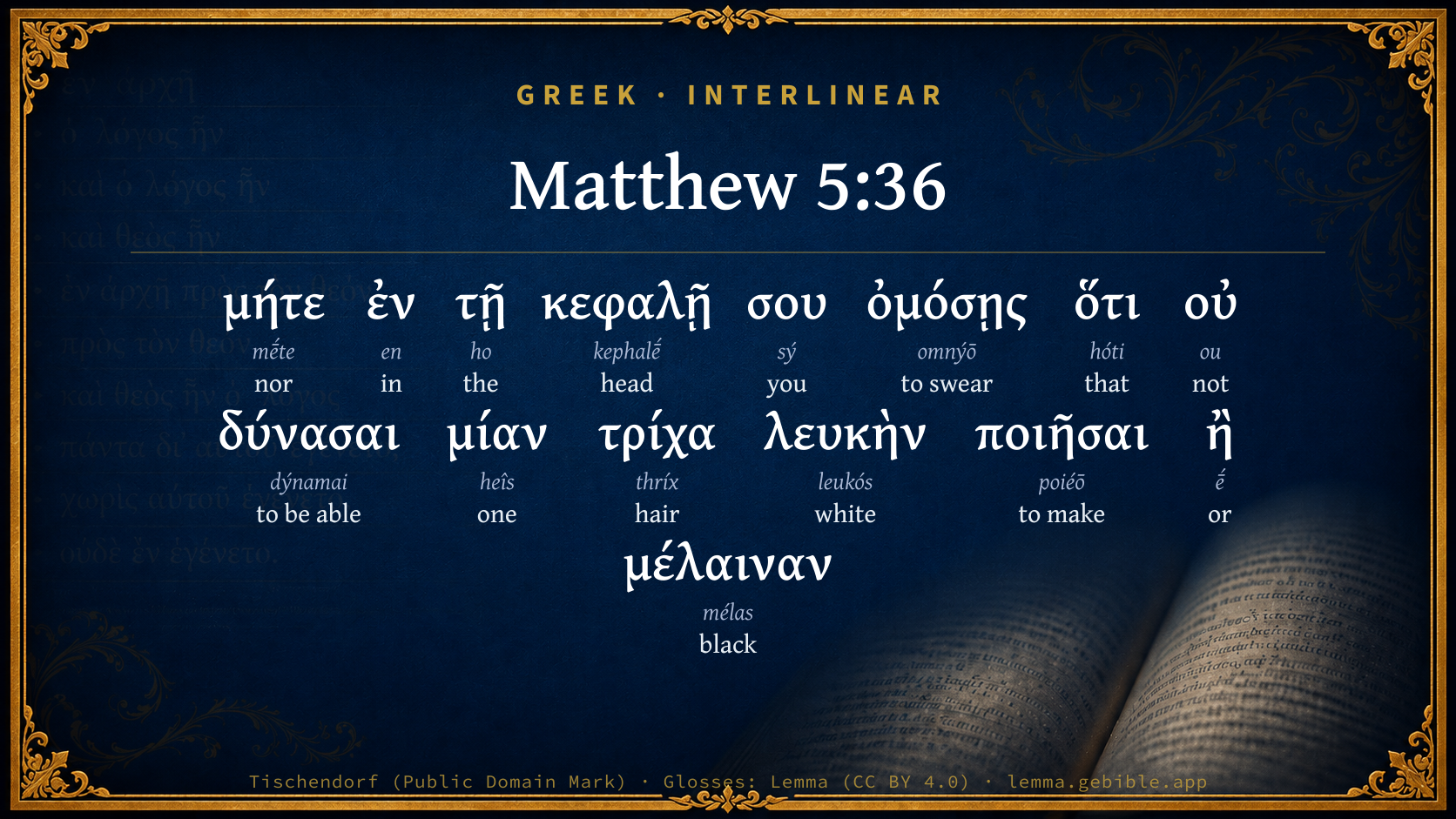
Greek (Tischendorf 8th ed.) Matthew 5:36 appears in the Greek New Testament. The text above is from the Tischendorf 8th edition. Each word links to its Strong’s number and a concise gloss. Click any word for its full Thayer’s Greek Lexicon entry.
Download image
Cite this verse

Matthew 5:36 (World English Bible). Public Domain. Lemma interlinear Bible study tool, https://lemma.gebible.app/v/matthew/5/36.

Show BibTeX & RIS
BibTeX
RIS
English Translation
Neither shall you swear by your head, for you can't make one hair white or black.
World English Bible · Public Domain
Highlights
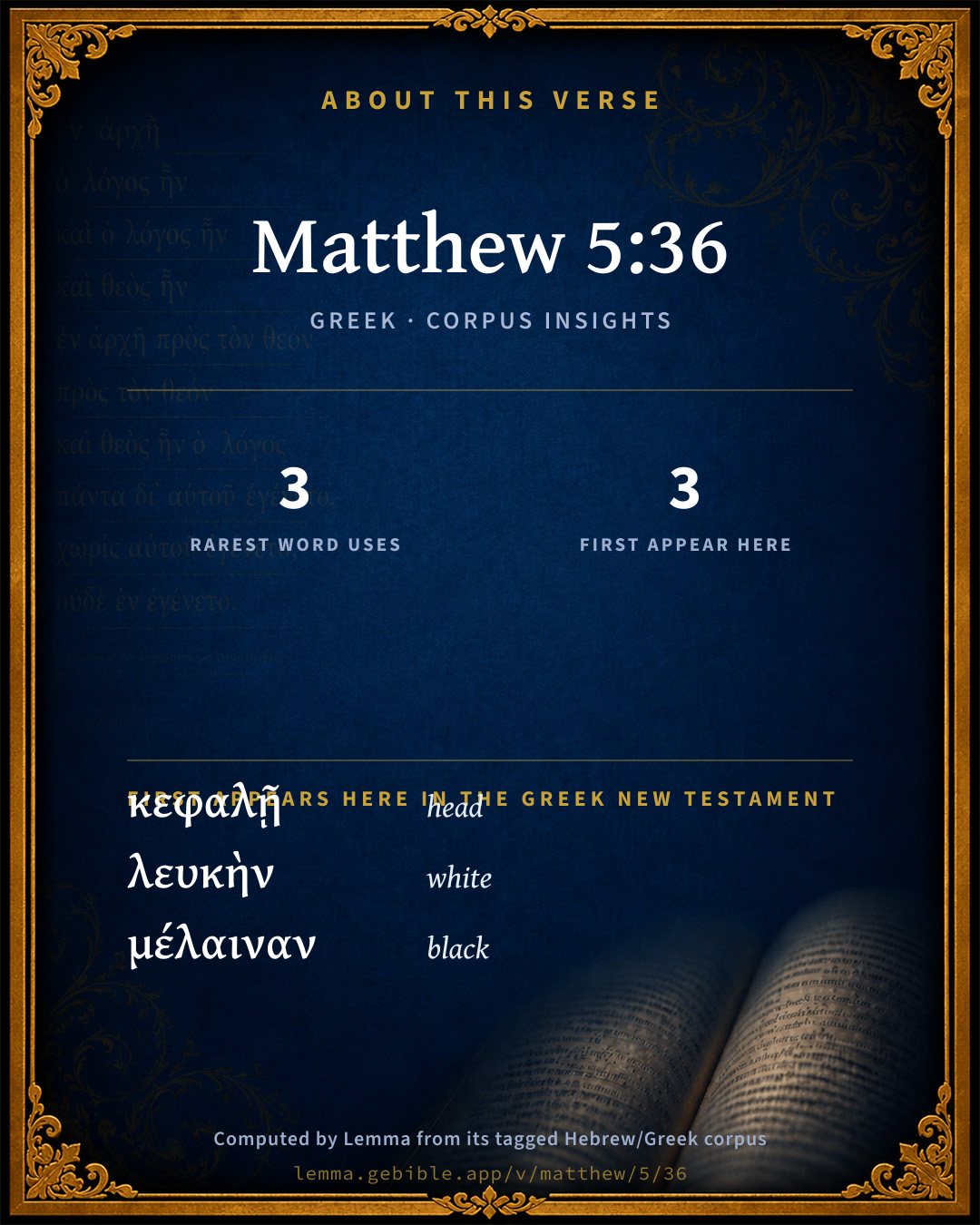
  • 3 first appearances in the Greek New Testament
Full analysis ↓
Download a study sheet

One document with this verse’s original text, its word-by-word gloss line, the meaning frame, cross-references with their text, attributed commentary, and full source and license credits — printable, and it pastes into notes with its structure intact.

This verse Autodidact and up

Study sheet (.html) Plain text (.txt)

A passage Seminary Student

Up to 50 verses in one chapter. A passage sheet keeps up to 6 commentary sources and 12 cross-references per verse, in the order this page ranks them, and says so on the sheet whenever that leaves anything out. Ask for a single verse and you get the Autodidact verse sheet above.

Everything on this page stays free to read, with no account — the sheet is a download of what is already on screen, not access to it.

Want to remove ads? Support Godless Engineer
Compare translations 3

The same verse in 3 English versions, stacked beneath the original-language interlinear above. Click any original word for its lexicon entry.

Each is an independent rendering of the whole verse — the interlinear is not word-aligned to these translations.

Highlighted words mark where these versions differ — a whole-verse word diff, not a word-by-word alignment.

  • World English Bible Public Domain
    Neither shall you swear by your head, for you can't make one hair white or black.
  • King James Version Public Domain
    Neither shalt thou swear by thy head, because thou canst not make one hair white or black.
  • unfoldingWord Literal Text CC BY-SA 4.0
    Neither should you swear by your head, for you are not able to make one hair white or black.

unfoldingWord Literal Text — © unfoldingWord, licensed CC BY-SA 4.0. Word-aligned USFM3 via Door43 (git.door43.org/unfoldingWord/en_ult).

Versions to compare (up to 4)

3 of 4 selected

Show all 19 translations

Every available English version of this verse, each an independent rendering of the whole verse.

  • World English Bible Public Domain
    Neither shall you swear by your head, for you can't make one hair white or black.
  • Berean Standard Bible Public Domain
    Nor should you swear by your head, for you cannot make a single hair white or black.
  • Majority Standard Bible Public Domain
    Nor should you swear by your head, for you cannot make a single hair white or black.
  • King James Version Public Domain
    Neither shalt thou swear by thy head, because thou canst not make one hair white or black.
  • American Standard Version (1901) Public Domain
    Neither shalt thou swear by thy head, for thou canst not make one hair white or black.
  • Revised Version (1885) Public Domain
    Neither shalt thou swear by thy head, for thou canst not make one hair white or black.
  • Geneva Bible (1599) Public Domain
    Neither shalt thou sweare by thine head, because thou canst not make one heare white or blacke.
  • Douay-Rheims (1899) Public Domain
    Neither shalt thou swear by thy head, because thou canst not make one hair white or black.
  • Young's Literal Translation Public Domain
    nor by thy head mayest thou swear, because thou art not able one hair to make white or black;
  • Literal Standard Version CC BY-SA 4.0
    nor may you swear by your head, because you are not able to make one hair white or black;
  • Unlocked Literal Bible CC BY-SA 4.0
    Neither swear by your head, for you cannot make one hair white or black.
  • unfoldingWord Literal Text CC BY-SA 4.0
    Neither should you swear by your head, for you are not able to make one hair white or black.
  • Darby Bible Public Domain
    Neither shalt thou swear by thy head, because thou canst not make one hair white or black.
  • World Messianic Bible Public Domain
    Neither shall you swear by your head, for you can’t make one hair white or black.
  • Webster's Bible Public Domain
    Neither shalt thou swear by thy head, because thou canst not make one hair white or black.
  • Free Bible Version CC BY-SA 4.0
    Don't even swear by your head, because you're not able to make a single hair white or black.
  • Bible in Basic English Public Domain
    You may not take an oath by your head, because you are not able to make one hair white or black.
  • Text-Critical English NT CC BY 4.0
    Neither shall yoʋ swear by yoʋr head, for yoʋ cannot make one hair white or black.
  • Tyndale New Testament (1534) Public Domain
    nether shalt thou sweare by thy heed because thou canst not make one white heer or blacke:

Literal Standard Version (2020), Covenant Press — licensed CC BY-SA 4.0. Text via the HelloAO Bible API (eBible.org). Unlocked Literal Bible (unfoldingWord) — licensed CC BY-SA 4.0. Text via the HelloAO Bible API (eBible.org). unfoldingWord Literal Text — © unfoldingWord, licensed CC BY-SA 4.0. Word-aligned USFM3 via Door43 (git.door43.org/unfoldingWord/en_ult). Free Bible Version, Dr. Jonathan Gallagher — licensed CC BY-SA 4.0. Text via the HelloAO Bible API (eBible.org).

Word by word

More ways to search: Search by grammar → Find every occurrence → Compare this word →

Practice this passage: Drill this verse → Learn its vocabulary →

μέλαιναν
mélas
G3189
“black”
Adjective, Accusative, Singular, Feminine
Part of Speech
Adjective
Case
Accusative
Number
Singular
Gender
Feminine
Full Thayer's Definition

Origin: apparently a root word

TDNT: 13:09,6

1. black 2. black ink
  1. μήτε mḗte G3383 “nor” Conjunction, Negative
  2. ἐν en G1722 “in” Preposition
  3. τῇ ho G3588 “the” Article, Dative, Singular, Feminine
  4. κεφαλῇ kephalḗ G2776 “head” Noun, Dative, Singular, Feminine
  5. σου sý G4771 “you” Personal pronoun, 2nd person, Genitive, Singular
  6. ὀμόσῃς omnýō G3660 “to swear” Verb, Aorist, Active, Subjunctive, 2nd person, Singular
  7. ὅτι hóti G3754 “that” Conjunction
  8. οὐ ou G3756 “not” Particle, Negative
  9. δύνασαι dýnamai G1410 “to be able” Verb, Present, Middle or Passive deponent, Indicative, 2nd person, Singular
  10. μίαν heîs G1520 “one” Adjective, Accusative, Singular, Feminine
  11. τρίχα thríx G2359 “hair” Noun, Accusative, Singular, Feminine
  12. λευκὴν leukós G3022 “white” Adjective, Accusative, Singular, Feminine
  13. ποιῆσαι poiéō G4160 “to make” Verb, Aorist, Active, Infinitive
  14. ἢ ḗ G2228 “or” Particle

About this verse

These counts appear in no published source. They are computed here, from the morphology-tagged text and Lemma’s own curated glosses. What Lemma adds →

15
words
15
distinct lemmas
Gospels
section

Notable vocabulary

The rarest word here is μέλαιναν black G3189 — appearing just 3 times in the whole Greek New Testament.

First appearance in Scripture

These words make their first canonical appearance in the Greek New Testament here:

  • κεφαλῇ head G2776
  • λευκὴν white G3022
  • μέλαιναν black G3189

Shared distinctive vocabulary

μέλαιναν black G3189 occurs in 3 verses of the Greek New Testament. Also found in:
Cross-references

3

Topical passages linked to Matthew 5:36 in the Treasury of Scripture Knowledge — connected by theme and wording, ordered by reader-vote popularity; previews shown in the World English Bible.

  • Luke 12:25 Which of you by being anxious can add a cubit to his height?
  • Matthew 6:27 "Which of you, by being anxious, can add one cubit to the measure of his life?
  • Matthew 23:16–21 "Woe to you, you blind guides, who say, 'Whoever swears by the temple, it is nothing; but whoever swears by the gold of the temple, he is obligated.'

Cross-references courtesy of OpenBible.info (CC BY 4.0).

Commentary

Notes on Matthew 5:36 from classic Christian and Jewish commentators (each source and its license shown beneath its notes). The classic Christian expositions comment on the surrounding passage and are grouped to its opening verse, so a note may address several verses; the Jewish commentaries on the Tanakh (Rashi and others) are per-verse, so they appear only where the commentator wrote on this verse.

Lemma curates 59 commentaries, every one of them public domain or Creative Commons licensed, each selected and text-cleaned for this edition rather than reprinted as found. About our sources →

Bengel's Gnomon

Johann Albrecht Bengel

Mat 5:36. Κεφαλῇ, head) Their sin is still graver who swear by their life or their soul.—μίαν τρίχα λευκὴν ἠ μέλαιναν ποῖησαι, to make one hair [thereof] white or black) The dye of human art is not real whiteness or blackness. Not merely is a single hair, but even the colour of a single hair, beyond the power of man.

Bengel's Gnomon of the New Testament — English translation (T&T Clark, Edinburgh, 1860) — public domain. Text from a community e-Sword module.

Jamieson, Fausset & Brown

Robert Jamieson, A. R. Fausset & David Brown

Neither shalt thou swear by thy head, because thou canst not make one hair white or black--In the other oaths specified, God's name was profaned quite as really as if His name had been uttered, because it was instantly suggested by the mention of His "throne," His "footstool," His "city." But in swearing by our own head and the like, the objection lies in their being "beyond our control," and therefore profanely assumed to have a stability which they have not.

Jamieson, Fausset & Brown — Commentary Critical and Explanatory on the Whole Bible (1871) — public domain (CC PDM 1.0). Text via the HelloAO Bible API.

Adam Clarke's Commentary

Verse 36. Neither shalt thou swear by thy head] For these plain reasons:

1st. God commands thee not to do it.

2dly. Thou hast nothing which is thy own, and thou shouldst not pledge another's property.

3dly. It never did, and never can, answer any good purpose. And

4thly. Being a breach of the law of God, it is the way to everlasting misery.

Adam Clarke's Commentary on the Bible (1810–1826) — public domain. Text from a community e-Sword/MySword module.

Ellicott's Commentary for English Readers

(36) By thy head.—This is apparently chosen as an extreme instance of a common oath in which men found no reference to God. Yet here, too, nothing but an implied reference to Him fits it to be an oath at all. He made us, and not we ourselves, and the hairs of our head are not only numbered, but are subject in all their changes to His laws, and not to our volition.

A Bible Commentary for English Readers, edited by Charles John Ellicott (1878–1897) — public domain. Text from a community e-Sword module.

The Cambridge Bible for Schools and Colleges

gen. ed. J. J. S. Perowne

36. by thy head] A common form of oath in the ancient world: cp. “Per caput hoc juro per quod pater ante solebat.” Verg. Æn.

The Cambridge Bible for Schools and Colleges (gen. ed. J. J. S. Perowne; Cambridge University Press, 1878–1918) — public domain. Text from a community e-Sword module.

John Gill's Exposition

Neither shalt thou swear by thy head,.... This also was a common form of swearing among the Jews: take a few instances.

"If anyone is bound to his friend by an oath, and says to him, vow unto me , "by the life of thy head"; R. Meir says (u), he may retract it; but the wise men say, he cannot.''

Again (w), a certain Rabbi said to Elijah,

"I heard "Bath Kol" (or the voice from heaven) mourning like a dove, and saying, woe to my children; for, because of their sins, I have destroyed my house, and have burnt my temple, and have carried them captive among the nations: and he (Elijah) said unto him , "by thy life, and by the life of thy head", not this time only it says so, but it says so three times every day.''

Once more (x), says R. Simeon ben Antipatras, to R. Joshua,

"I have heard from the mouth of the wise men, that he that vows in the law, and transgresses, is to be beaten with forty stripes: he replies, blessed art thou of God, that thou hast so done, , "by thy life, and by the life of thy head", he that is used to do so is to be beaten.''

This form of swearing is condemned, for this reason,

because thou canst not make one hair white or black: which shows, that a man's head, nor, indeed, one hair of his head, is in his own power, and therefore he ought not to swear by it; as he ought not to swear by heaven, or earth, or Jerusalem, because these were in the possession of God. Some copies read, "canst not make one white hair black".

(u) Misn. Sanhedrim, c. 3. sect 2. (w) T. Bab. Beracot, fol. 3. 1. (x) Derech. Eretz, c. 6. fol. 18. 2.

John Gill's Exposition of the Whole Bible (1746–1763) — public domain (CC PDM 1.0). Text via the HelloAO Bible API.

Trapp's Complete Commentary

John Trapp

36 Neither shalt thou swear by thy head, because thou canst not make one hair white or black.

Ver. 36. Neither shalt thou swear by thy head] That is, by thy health, which is the life of our lives, say some: by thy life, say others, which is a sweet blessing; {a} for a living dog is better than a dead lion; yea, though full of crosses, yet why is living man sorrowful? q.d. it is a mercy that amidst all his crosses he is yet alive. "Joseph is yet alive, I have enough," saith Jacob. They told him of his honour, he speaks of his life. Life is better than honour, and is not therefore to be laid to pawn upon every light occasion, as they that so often use, As I live, and As true as I live: whereof something before.

Because thou canst not make one hair, &c.] God is great in great things, saith St Augustine, and not little in the smallest. ( Magnus in magnis, nec parvus in minimis.) What less than a hair? yet in making a hair white or black, God’s power appeareth. The devil can as little create a hair of the head as he could of old a louse in the land of Egypt, Exo 8:18. There are miracles enough in man’s body to fill a volume. It is the image of God and a little world (μικροκοσμος), an epitome of the visible world, as his soul is of the invisible. The idea or example of the great world, which was in God from all eternity, is, as it were, briefly and summarily exprest by God in man. Hence man is called every creature; "Go preach the gospel to every creature," Mar 16:15, as if there were none to him, none besides him. A philosopher could say, "there is nothing great in earth besides man." And an orator, "the greatest thing in the least room is a good soul in a man’s body." Man, saith the poet, is the masterpiece of the wisest workman; he is, saith the historian, the fairest piece of the chiefest architect; the very miracle of daring nature, saith Trismegist. {b} Galen, a profane physician, after he had described the nature and parts of man’s body, was forced to sing a hymn to that God that he knew not. And St Augustine complaineth, that men can admire the height of the hills, the hugeness of the waves, the compass of the ocean, and the circumvolution of the stars, and yet not once mark nor admire the power and goodness of God shining in their own souls and bodies, as in a mirror. {c} "Fearfully and wonderfully am I made," saith David; "yea, and curiously wrought in the lowest parts of the earth;" that is, in my mother’s womb, Psa 139:13-15. A counsel was called in heaven when man was to be formed: "Let us make man," Gen 1:26. And were not the birth of a child so common, should it happen but once in an age, people would run together to see it, as to a miracle. Pliny wondereth at the gnat, so small a creature, yet making so great a buzzing; and so also at the butterfly. He also maketh mention of one that spent 58 years in searching out the nature of the bee, and could not in all that time attain to the full of it. What a shame is it for us, not to see God in every creature, in ourselves especially, and even the least part of us! There is not a hair upon our heads, white or black, but hath God for the maker and God for the master too. Let those that pride themselves in their hair, think what a heavy account Absalom made to God for that sin. Absolon Marte furens, pensilis arbore, obit. Long hair in women is a token of modesty. But modesty grows short in men, as their hair grows long, saith one. And Seneca, speaking of the curled and crisped youths of his time, telleth us that they had more care of their locks than of their limbs, and had rather the commonwealth should be disturbed than their frizzled tresses disheveled. {d} Pompey was taxed for this neat nicety: Unico digitulo caput scalpit. And of Helen, too curious of her hair at her mother’s funeral, the poet bringeth in one that saith, εστιν η παλαι γυνη: This is old Helen still, no changeling in all this time. The holy women of old dared not adorn themselves with plaited or braided hair, as St Peter testifieth, but trusted in God, and decked themselves with a meek and quiet spirit, 1Pe 3:3-5. And "doth not nature itself teach us," saith St Paul, "that it is a shame to a man to wear long hair?" It is objected, that the apostle intends such hair as is as long as women’s. But it is answered, that Homer useth the same word of the Greeks, calling them καρηκομοωντας Αχαιους, and yet they did not wear their hair as long as women’s. But as it is a shame to wear it, so it is a sin to swear by it, whether long or short, white or black. Neither helps it to say, The matter is but small we swear by. For, first, it is a forsaking of God; and count you that a small matter? Compare Jer 5:7; cf. Jer 2:12-13. Secondly, the more base and vile the thing is a man sweareth by, the greater is the oath, because he ascribeth that to a vile creature which is proper to God only, sc. to know the heart, to be a discerner of secrets, and an avenger, of falsehood. And if a man may not swear by his hair, much less by his faith and loyalty, that are much more precious; and to swear by them so often and ordinary, what doth it argue but that we are low brought and hardly driven? For who but a bankrupt will lay the best jewel in his house to pledge for every trifle? Besides, they are not ours to pledge; for we have plighted them already to God. Lastly, he that pawneth them so often, will easily forfeit them at length, as the pitcher doeth not so often to the well but at last it comes broken home. A man may soon swear away his faith and loyalty and it is a marvel if he that often sweareth doth not too often forswear, and so forfeit all. Swear not therefore at all in this sort. These petty oaths (as they count them) are great faults, and to be refused in our talk as poison in our meat. {e} The dishonour of them redounds to God, though he be not named in them. But of this see more. {See trapp on "Mat 5:35"}

{a} Vita non est vivere, sed valere. Sen. Felix dicitur ab ηλιξ, ηλικια. Becman.

{b} Nihil in terra magnum praeter hominem. Favorinus. Μεγιστον εν ελαχιστω, &c. Isocr. Σοφου τεκτονος καλον ποικιλμα. Eurip. τεχνημα σοφουντος δημιουργου. Xenophon. Τολμηροτατης της φυσεως αγαλμα.

{c} Eunt homines mirari alta montium, ingentes fluctus maris, oceani ambitum, et gyros syderum, et relinquunt seipsos, nec mirantur. Aug.

{d} Rempub. turbari malunt quam comam.

Pulchra coma est pulchro digestaeque ordine frondes.

Sed fructus nullos haec coma pulchra gerit.

{e} Leviter volant, non leviter vulnerant.

John Trapp, A Commentary or Exposition upon All the Books of the Old and New Testament (1647–1656) — public domain. Text from a community e-Sword module.

Albert Barnes' Notes on the Bible

Neither shalt thou swear by thy head - This was a common oath. The Gentiles also used this oath. To swear by the head was the same as to swear by the life; or to say, I will forfeit my life if what I say is not true. God is the Author of the life, and to swear by that, therefore, is the same as to swear by him.

Because thou canst not make one hair white or black - You have no control or right over your own life. You cannot even change one single hair. God has all that control; and it is therefore improper and profane to pledge what is God’s gift and God’s property; and it is the same as swearing by God himself.

Albert Barnes' Notes on the Bible (1834–1885) — public domain. Text from a community e-Sword/MySword module.

Whedon's Commentary on the Bible

Daniel D. Whedon

36. Swear by thy head — ”It is very common among the Orientals,” says Mr. Paxton in his Illustrations, “to swear by the life or head of the king.” Joseph, improperly yielding to the fashion of the country, swore by the life of Pharaoh; and this oath is still used in various parts of the East. According to Mr. Hanway, the most sacred oath among the Persians is by the head of the king; and Thevenot asserts that to swear by the head of the king is, in Persia, more authentic and of greater credit than if they swore by all that is most sacred in heaven and upon the earth. The ordinary phrase, “I will give you my head if it is not so,” is a colloquial form of swearing of the same kind; it pledges the head or the life upon the certainty of the affirmation.

Thou canst not make one hair white or black — Thy life, thy head, thy every hair are all God’s workmanship, and their preservation is his act. To swear, therefore, by life or head, is to swear by the act, power, and person of God. The presumption of the oath reaches the Divine Being.

Daniel D. Whedon (gen. ed.), Commentary on the Old and New Testaments (1874–1909) — public domain. Text from a community e-Sword module.

The Pulpit Commentary

For thou canst not, etc. As each of the other objects included a reference to God, so does also thy head. For even that recalls to mind the power of God, since every hair of it bears the stamp of his handiwork.

The Pulpit Commentary (1880–1919), ed. H.D.M. Spence-Jones & Joseph S. Exell — public domain. Text from a community e-Sword module.

John Wesley's Explanatory Notes

For thou canst not make one hair white or black - Whereby it appears, that this also is not thine but God's.

John Wesley, Explanatory Notes Upon the Whole Bible (1754–1765) — public domain. Text via the GEBible commentary corpus.

The People's New Testament

B. W. Johnson

36. By thy head. Senseless, since the oath could have no meaning. Dr. Thompson (The Land and the Book) says the Orientals are still terribly profane, swearing continually by the head, the beard, the heart, the temple, the church.

B. W. Johnson's The People's New Testament with Notes (1889–1891) — public domain. Electronic text from the Christian Classics Ethereal Library (CCEL) ThML edition.

unfoldingWord translationNotes

Door43 World Missions Community

General Information:

Previously Jesus told his hearers that God's throne, footstool, and earthly home are not theirs to swear by. Here he says that they may not swear even by their own heads.

your ... you

Jesus is talking to a group of people about what they as individuals should and should not do. All occurrences of these words are singular, but you may have to translate them as plural. (See: Forms of You)

swear

This refers to taking an oath. See how you translated this in Matthew 5:34.

let your speech be 'Yes, yes,' or 'No, no.'

"if you mean 'yes,' say 'yes,' and if you mean 'no,' say 'no.'"

translationWords

oath

Satan

unfoldingWord translationNotes — © Distant Shores Media and the Door43 World Missions Community, licensed CC BY-SA 4.0. Source: git.door43.org/Door43/en_tn.

Cambridge Greek Testament for Schools and Colleges

36. ἐν τῇ κεφάλῃ σου. A common form of oath in the ancient world: cp. ‘Per caput hoc juro per quod pater ante solebat.’ Verg. Æn. IX. 300.

Cambridge Greek Testament for Schools and Colleges (Cambridge University Press, 1896; 21 vols, various authors incl. Carr, Maclear, Plummer, Farrar, Lumby, Moule, M. R. James, Simcox) — public domain. Text from a community e-Sword module.

Alford’s Greek Testament

Henry Alford

36. οὐ δύνασαι μίαν τρ. λ. π. ἢ μ.] Thou hast no control over the appearance of grey hairs on thy head—thy head is not thine own;—thou swearest then by a creature of God, whose destinies and changes are in God’s hand; so that every oath is an appeal to God. And, indeed, men generally regard it as such now, even unconsciously.

Henry Alford, The Greek Testament (1849–1861) — public domain. Text from a community e-Sword module.

Lesson kit

Teaching starters — assembled from the data on this page, not authored interpretation. Every prompt links to the verse data it draws on. Edit before teaching.

Matthew, in the Gospels, opens this verse with 15 words (15 distinct Greek lemmas). Its most distinctive word is mélas (“black”). A historical commentator’s framing appears above. Read the whole chapter for the surrounding context.

Discussion questions

  1. What does “black” (mélas) contribute to the verse as a whole?
  2. 3 words here appear for the first time in Scripture. What is being introduced at this debut?
  3. Revelation 6:5 shares the word «black» with this verse. How do the two illuminate each other?
  4. These translations render this verse differently; the difference is in the English rendering, not the original. What questions does that raise?
  5. Reading how Bengel's Gnomon and Jamieson, Fausset & Brown read this verse, where do the two commentators agree and where do they part?

Things to notice

  • 3 words make their first canonical appearance in Scripture here.
  • These translations choose different wording for 7 words in this verse.
  • 15 distinct Greek lemmas span 15 words in this verse.

Reading settings

Reading text

Shown beneath each verse's original-language words.

Old Testament
Old Testament edition

Read the OT as the Masoretic Hebrew (MT) or the Greek Septuagint (LXX).

English shown for the Greek Septuagint (in the Hebrew ↔ Greek comparison).

Comparing translations? Open the Compare panel on any verse page to stack up to four side by side.