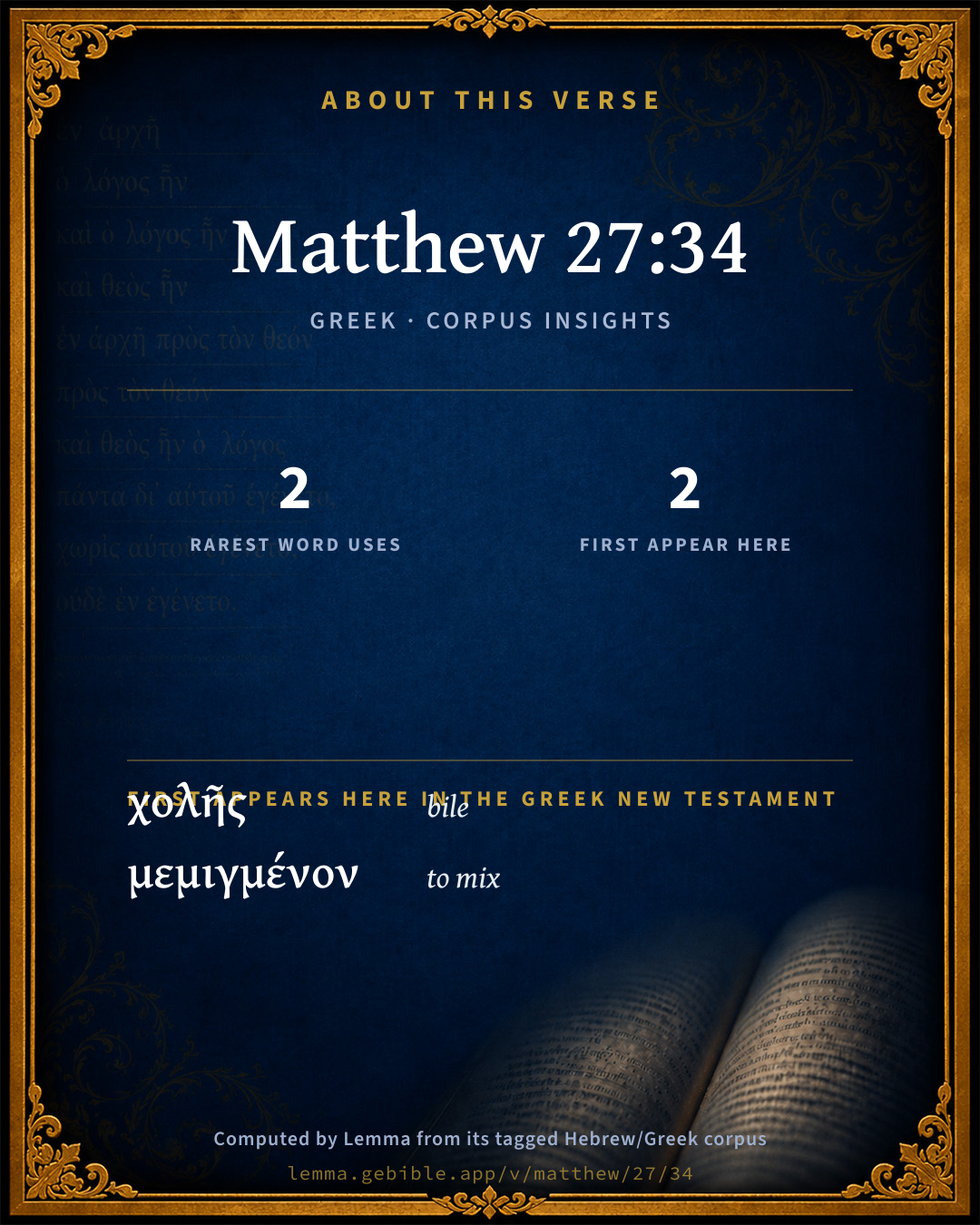
Matthew 27:34

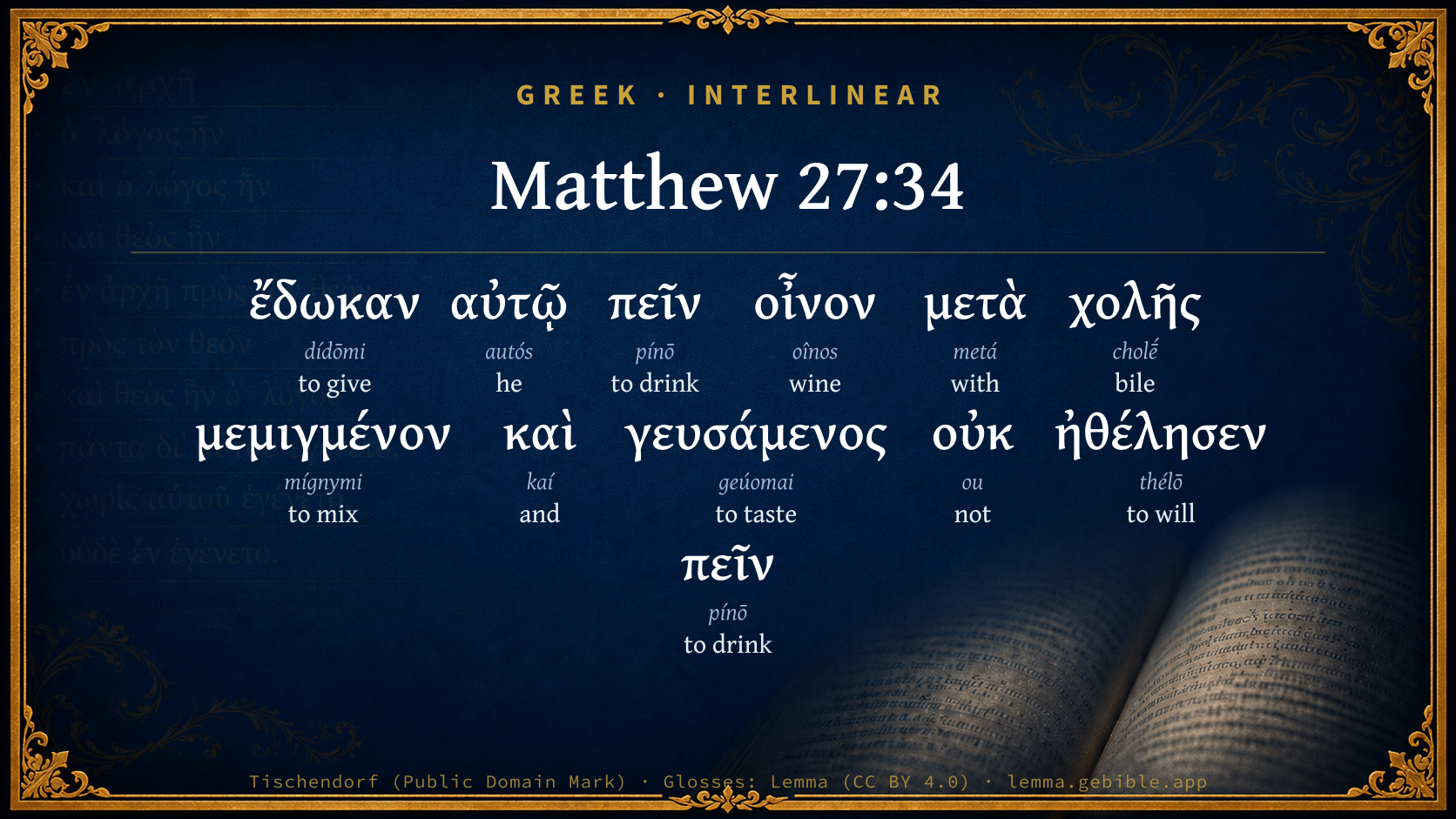
Greek (Tischendorf 8th ed.) Matthew 27:34 appears in the Greek New Testament. The text above is from the Tischendorf 8th edition. Each word links to its Strong’s number and a concise gloss. Click any word for its full Thayer’s Greek Lexicon entry.
Download image
Cite this verse

Matthew 27:34 (World English Bible). Public Domain. Lemma interlinear Bible study tool, https://lemma.gebible.app/v/matthew/27/34.

Show BibTeX & RIS
BibTeX
RIS
English Translation
They gave him sour wine to drink mixed with gall. When he had tasted it, he would not drink.
World English Bible · Public Domain
Highlights
  • 2 first appearances in the Greek New Testament
Full analysis ↓
Download a study sheet

One document with this verse’s original text, its word-by-word gloss line, the meaning frame, cross-references with their text, attributed commentary, and full source and license credits — printable, and it pastes into notes with its structure intact.

This verse Autodidact and up

Study sheet (.html) Plain text (.txt)

A passage Seminary Student

Up to 50 verses in one chapter. A passage sheet keeps up to 6 commentary sources and 12 cross-references per verse, in the order this page ranks them, and says so on the sheet whenever that leaves anything out. Ask for a single verse and you get the Autodidact verse sheet above.

Everything on this page stays free to read, with no account — the sheet is a download of what is already on screen, not access to it.

Want to remove ads? Support Godless Engineer
Compare translations 3

The same verse in 3 English versions, stacked beneath the original-language interlinear above. Click any original word for its lexicon entry.

Each is an independent rendering of the whole verse — the interlinear is not word-aligned to these translations.

Highlighted words mark where these versions differ — a whole-verse word diff, not a word-by-word alignment.

  • World English Bible Public Domain
    They gave him sour wine to drink mixed with gall. When he had tasted it, he would not drink.
  • King James Version Public Domain
    They gave him vinegar to drink mingled with gall: and when he had tasted thereof, he would not drink.
  • unfoldingWord Literal Text CC BY-SA 4.0
    they gave him wine mixed with gall to drink. And having tasted, he was not willing to drink.

unfoldingWord Literal Text — © unfoldingWord, licensed CC BY-SA 4.0. Word-aligned USFM3 via Door43 (git.door43.org/unfoldingWord/en_ult).

Versions to compare (up to 4)

3 of 4 selected

Show all 19 translations

Every available English version of this verse, each an independent rendering of the whole verse.

  • World English Bible Public Domain
    They gave him sour wine to drink mixed with gall. When he had tasted it, he would not drink.
  • Berean Standard Bible Public Domain
    they offered Him wine to drink, mixed with gall; but after tasting it, He refused to drink it.
  • Majority Standard Bible Public Domain
    they offered Him sour wine to drink, mixed with gall; but after tasting it, He refused to drink it.
  • King James Version Public Domain
    They gave him vinegar to drink mingled with gall: and when he had tasted thereof, he would not drink.
  • American Standard Version (1901) Public Domain
    they gave him wine to drink mingled with gall: and when he had tasted it, he would not drink.
  • Revised Version (1885) Public Domain
    they gave him wine to drink mingled with gall: and when he had tasted it, he would not drink.
  • Geneva Bible (1599) Public Domain
    They gaue him vineger to drinke, mingled with gall: and when he had tasted thereof, he would not drinke.
  • Douay-Rheims (1899) Public Domain
    And they gave him wine to drink mingled with gall. And when he had tasted, he would not drink.
  • Young's Literal Translation Public Domain
    they gave him to drink vinegar mixed with gall, and having tasted, he would not drink.
  • Literal Standard Version CC BY-SA 4.0
    they gave Him vinegar mixed with gall to drink, and having tasted, He would not drink.
  • Unlocked Literal Bible CC BY-SA 4.0
    They gave him wine to drink mixed with gall. But when he tasted it, he would not drink.
  • unfoldingWord Literal Text CC BY-SA 4.0
    they gave him wine mixed with gall to drink. And having tasted, he was not willing to drink.
  • Darby Bible Public Domain
    they gave to him to drink vinegar mingled with gall; and having tasted [it], he would not drink.
  • World Messianic Bible Public Domain
    they gave him sour wine to drink mixed with gall. When he had tasted it, he would not drink.
  • Webster's Bible Public Domain
    They gave him vinegar to drink, mingled with gall: and when he had tasted of it, he would not drink.
  • Free Bible Version CC BY-SA 4.0
    they gave him wine mixed with gall. But having tasted it, he refused to drink it.
  • Bible in Basic English Public Domain
    They gave him wine mixed with bitter drink: and after tasting it, he took no more.
  • Text-Critical English NT CC BY 4.0
    they gave Jesus sour wine to drink, mixed with gall. But when he tasted it, he refused to drink it.
  • Tyndale New Testament (1534) Public Domain
    they gave him veneger to drinke mengled with gall. And when he had tasted therof he wolde not drinke.

Literal Standard Version (2020), Covenant Press — licensed CC BY-SA 4.0. Text via the HelloAO Bible API (eBible.org). Unlocked Literal Bible (unfoldingWord) — licensed CC BY-SA 4.0. Text via the HelloAO Bible API (eBible.org). unfoldingWord Literal Text — © unfoldingWord, licensed CC BY-SA 4.0. Word-aligned USFM3 via Door43 (git.door43.org/unfoldingWord/en_ult). Free Bible Version, Dr. Jonathan Gallagher — licensed CC BY-SA 4.0. Text via the HelloAO Bible API (eBible.org).

Word by word

More ways to search: Search by grammar → Find every occurrence → Compare this word →

Practice this passage: Drill this verse → Learn its vocabulary →

χολῆς
cholḗ
G5521
“bile”
Noun, Genitive, Singular, Feminine
Part of Speech
Noun
Case
Genitive
Number
Singular
Gender
Feminine
Full Thayer's Definition

Origin: from an equivalent perhaps akin to the same as G5514 (from the greenish hue)

TDNT: None

1. bile, gall 2. in the OT used of other bitter things a. wormwood b. possibly myrrh
  1. ἔδωκαν dídōmi G1325 “to give” Verb, Aorist, Active, Indicative, 3rd person, Plural
  2. αὐτῷ autós G846 “he” Personal pronoun, Dative, Singular, Masculine
  3. πεῖν pínō G4095 “to drink” Verb, Aorist, Active, Infinitive
  4. οἶνον oînos G3631 “wine” Noun, Accusative, Singular, Masculine
  5. μετὰ metá G3326 “with” Preposition
  6. μεμιγμένον mígnymi G3396 “to mix” Verb, Perfect, Passive, Participle, Accusative, Singular, Masculine
  7. καὶ kaí G2532 “and” Conjunction
  8. γευσάμενος geúomai G1089 “to taste” Verb, Aorist, Middle deponent, Participle, Nominative, Singular, Masculine
  9. οὐκ ou G3756 “not” Particle, Negative
  10. ἠθέλησεν thélō G2309 “to will” Verb, Aorist, Active, Indicative, 3rd person, Singular
  11. πεῖν pínō G4095 “to drink” Verb, Aorist, Active, Infinitive

About this verse

These counts appear in no published source. They are computed here, from the morphology-tagged text and Lemma’s own curated glosses. What Lemma adds →

12
words
11
distinct lemmas
Gospels
section

Notable vocabulary

The rarest word here is χολῆς bile G5521 — appearing just 2 times in the whole Greek New Testament.

First appearance in Scripture

These words make their first canonical appearance in the Greek New Testament here:

  • χολῆς bile G5521
  • μεμιγμένον to mix G3396

Shared distinctive vocabulary

χολῆς bile G5521 occurs in 2 verses of the Greek New Testament. Also found in:

Repetition

A word recurs within this verse:

  • πεῖν to drink G4095 ×2

Cross-references

4

Topical passages linked to Matthew 27:34 in the Treasury of Scripture Knowledge — connected by theme and wording, ordered by reader-vote popularity; previews shown in the World English Bible.

  • Psalms 69:21 They also gave me gall for my food. In my thirst, they gave me vinegar to drink.
  • Mark 15:23 They offered him wine mixed with myrrh to drink, but he didn't take it.
  • Matthew 27:48 Immediately one of them ran, and took a sponge, and filled it with vinegar, and put it on a reed, and gave him a drink.
  • John 19:28–30 After this, Jesus, seeing that all things were now finished, that the Scripture might be fulfilled, said, "I am thirsty."

Cross-references courtesy of OpenBible.info (CC BY 4.0).

Where the printed editions differ

1 variant

Places in this verse where the major printed Greek editions disagree on the wording in a way that affects the translation — a comparison of editions, not a manuscript-by-manuscript collation. The editions are the modern critical texts (Nestlé-Aland 28/27, SBL, Westcott-Hort, Tregelles, Tyndale House) and the traditional texts behind the KJV (the Textus Receptus and the Byzantine/Majority text). It is not a claim about which reading is original.

  1. Different wording
    οἶνον

    “wine”

    In NA28NA27TynSBLWHTreg Not in TRByz

    ὄξος (oxos) 'vinegar' occurs in traditional manuscripts (TR+Byz) instead of οἶνον (oinon) 'wine' in older manuscripts (NA28+NA27+Tyn+SBL+WH+Treg)

Textual data: Translators Amalgamated Greek New Testament (STEPBible TAGNT) · CC BY 4.0.

Commentary

Notes on Matthew 27:34 from classic Christian and Jewish commentators (each source and its license shown beneath its notes). The classic Christian expositions comment on the surrounding passage and are grouped to its opening verse, so a note may address several verses; the Jewish commentaries on the Tanakh (Rashi and others) are per-verse, so they appear only where the commentator wrote on this verse.

Lemma curates 59 commentaries, every one of them public domain or Creative Commons licensed, each selected and text-cleaned for this edition rather than reprinted as found. About our sources →

Adam Clarke's Commentary

Verse 34. They gave him vinegar - mingled with gall] Perhaps χολη, commonly translated gall, signifies no more than bitters of any kind. It was a common custom to administer a stupefying potion compounded of sour wine, which is the same as vinegar, from the French vinaigre, frankincense, and myrrh, to condemned persons, to help to alleviate their sufferings, or so disturb their intellect that they might not be sensible of them. The rabbins say that they put a grain of frankincense into a cup of strong wine; and they ground this on Pr 31:6: Give strong drink unto him that is ready to perish, i.e. who is condemned to death. Some person, out of kindness, appears to have administered this to our blessed Lord; but he, as in all other cases, determining to endure the fulness of pain, refused to take what was thus offered to him, choosing to tread the winepress alone. Instead of οξος, vinegar, several excellent MSS. and versions have οινον, wine; but as sour wine is said to have been a general drink of the common people and Roman soldiers, it being the same as vinegar, it is of little consequence which reading is here adopted. This custom of giving stupefying potions to condemned malefactors is alluded to in Pr 31:6: Give strong drink, שקר shekar, inebriating drink, to him who is ready to PERISH, and wine to him who is BITTER of soul - because he is just going to suffer the punishment of death. And thus the rabbins, as we have seen above, understand it. See Lightfoot and Schoettgen.

Michaelis offers an ingenious exposition of this place: "Immediately after Christ was fastened to the cross, they gave him, according to Mt 27:34, vinegar mingled with gall; but, according to Mark, they offered him wine mingled with myrrh. That St. Mark's account is the right one is probable from this circumstance, that Christ refused to drink what was offered him, as appears from both evangelists. Wine mixed with myrrh was given to malefactors at the place of execution, to intoxicate them, and make them less sensible to pain. Christ, therefore, with great propriety, refused the aid of such remedies. But if vinegar was offered him, which was taken merely to assuage thirst, there could be no reason for his rejecting it. Besides, he tasted it before he rejected it; and therefore he must have found it different from that which, if offered to him, he was ready to receive. To solve this difficulty, we must suppose that the words used in the Hebrew Gospel of St. Matthew were such as agreed with the account given by St. Mark, and at the same time were capable of the construction which was put on them by St. Matthew's Greek translator. Suppose St. Matthew wrote חליא במרירא (chaleea bemireera) which signifies, sweet wine with bitters, or sweet wine and myrrh, as we find it in Mark; and Matthew's translator overlooked the yod י in חליא (chaleea) he took it for חלא (chala) which signifies vinegar; and bitter, he translated by χολη, as it is often used in the Septuagint. Nay, St. Matthew may have written חלא, and have still meant to express sweet wine; if so, the difference only consisted in the points; for the same word which, when pronounced chale, signifies sweet, denotes vinegar, as soon as it is pronounced chala."

With this conjecture Dr. Marsh (Michaelis's translator) is not satisfied; and therefore finds a Chaldee word for οινος wine, which may easily be mistaken for one that denotes οξος vinegar; and likewise a Chaldee word, which signifies σμυρνα, (myrrh,) which may be easily mistaken for one that denotes χολη, (gall.) "Now," says he, "חמר (chamar) or חמרא (chamera) really denotes οινος (wine,) and חמץ (chamets) or חמצא (charnetsa) really denotes οξος (vinegar.) Again, מורא (mura) really signifies σμυρνα (myrrh,) and מררא (murera) really signifies χολη (gall.) If, then, we suppose that the original Chaldee text was חמרא הליט במורא (chamera heleet bemura) wine mingled with myrrh, which is not at all improbable, as it is the reading of the Syriac version, at Mr 15:23, it might easily have been mistaken for חמצא הליט במררא (chametsa haleet bemurera) vinegar mingled with gall." This is a more ingenious conjecture than that of Michaelis. See Marsh's notes to Michaelis, vol. iii., part 2d. p. 127-28. But as that kind of sour wine, which was used by the Roman soldiers and common people, appears to have been termed οινος, and vin aigre is sour wine, it is not difficult to reconcile the two accounts, in what is most material to the facts here recorded.

Adam Clarke's Commentary on the Bible (1810–1826) — public domain. Text from a community e-Sword/MySword module.

Tyndale Open Study Notes

Tyndale Open Resources

27:34 Giving Jesus wine mixed with bitter gall was probably intended for ridicule (see Ps 69:21). It was also a sedative—Jesus probably rejected it in order to suffer fully for our sins (see Isa 53:10). • Gall, otherwise known as wormwood, is a bitter narcotic made from the oil of Artemisia (cp. Mark 15:23).

Tyndale Open Study Notes — © Tyndale Open Resources, licensed CC BY-SA 4.0. Text via the HelloAO Bible API.

Bengel's Gnomon

Johann Albrecht Bengel

Mat 27:34. Ὄξος, vinegar) St Mark (Mar 15:23) calls it, ἐσμυρνισμένον οἶνον, myrrhed wine: the liquor was of a taste between sweet wine and vinegar (cf. the Gnomon on Mat 27:48), seasoned with myrrh from custom, adulterated with gall from malice.—οὐκ ἤθελε πιεῖν, He would not drink) for that behoved to be deferred to the end of His sufferings; see Joh 19:30. And Jesus wished to retain His senses fully undisturbed, even up to His death.[1194]

[1194] Mat 27:35. σταυρώσαντες, having crucified) Christ, in order to be a blessing to us, was made a curse. Who is there would have dared to assert this, had not the Apostle declared it? Gal 3:13. Let the passages also. Gen 3:6, Joh 3:14, 1Pe 2:24, be well weighed.—Harm., p. 563.—διεμερισαντο τὰ ἱμάτια αὐτοῦ, they parted His garments) When the very poorest man dies, he has at least some covering on his body: Jesus had none. Not even are His garments given up to His friends and relatives, but to the soldiers.—Harm., p. 564.

Bengel's Gnomon of the New Testament — English translation (T&T Clark, Edinburgh, 1860) — public domain. Text from a community e-Sword module.

Meyer's Critical & Exegetical Commentary

Heinrich August Wilhelm Meyer

Mat_27:34 The Jews were in the habit of giving the criminal a stupefying drink before nailing him to the cross. Sanhedr. vi. See Wetstein, ad Marc. xv. 23; Doughtaeus, Anal. II. p. 42. This drink consisted of wine (see the critical remarks) mixed with gall, according to Matthew; with myrrh, according to Mark. χολή admits of no other meaning than that of gall, and on no account must it be made to bear the sense of myrrh or wormwood[36] (Beza, Grotius, Paulus, Langen, Steinmeyer, Keim). The tradition about the gall, which unquestionably belongs to a later period, originated in the LXX. rendering of Psa_68:23; people wished to make out that there was maltreatment in the very drink that was offered.

ΓΕΥΣΆΜΕΝΟς] According to Matthew, then, Jesus rejected the potion because the taste of gall made it undrinkable. A later view than that embodied in Mar_15:23, from which passage it would appear that Jesus does not even taste the drink, but declines it altogether, because He has no desire to be stupefied before death.

[36] No doubt the LXX. translate לַעֲנָה, wormwood, by χολή (Pro_5:4; Lam_3:15); but in those passages they took it as meaning literal gall, just as in the case of Psa_69:22, which regulates the sense of our present passage, they also understood gall to be meant, although the word in the original is רֹאשׁ (poison). Comp. Jer_8:14; Deu_29:17. A usage so entirely foreign to the Greek tongue certainly cannot be justified on the ground of one or two passages, like these from the Septuagint. Had bitter spiced wine (Steinmeyer) been what Matthew intended, he would have had no more difficulty in expressing this than Mark himself. But the idea he wished to convey was that of wine along with gall, in fact mixed with it, and this idea he expresses as plain as words can speak it. Comp. Barnab. 7 : σταυρωθεὶς ἐποτίζετο ὂξει καὶ χκολῇ.

Meyer — Critical and Exegetical Commentary on the New Testament — English translation by Peter Christie, edited by Frederick Crombie (T&T Clark, 1880) — public domain. Text from a community e-Sword module.

Expositor's Greek Testament

ed. W. Robertson Nicoll

Mat 27:34 . οἶνον μετὰ χολῆς μ ., wine mingled with gall. Mk. has ἐσμυρνισμένον οἶν ., wine drugged with myrrh, a drink given by a merciful custom before execution to deaden the sense of pain. The wine would be the sour wine or posca used by Roman soldiers. In Mk. Jesus declines the drink, apparently without tasting, desiring to suffer with clear mind. In Mt. He tastes ( γευσάμενος ) and then declines, apparently because unpalatable, suggesting a different motive in the offerers, not mercy but cruelty; maltreatment in the very drink offered. To this view of the proceeding is ascribed the μετὰ χολῆς of Mt.’s text, not without the joint influence of Psa 69:22 (Meyer and Weiss). Harmonists strive to reconcile the two accounts by taking χολή as signifying in Hellenistic usage any bitter liquid ( quamvis amaritiem , Elsner), and therefore among other things myrrh. Pro 5:4 , Lament. Mat 3:15 (Sept [152] ), in which χολή stands for wormwood, לַעֲנָה , are eited in proof of this. Against the idea that Mt’s text has been altered from Mk.’s under the influence of Psa 69:22 , is the retention of οἶνος ( ὄξος in Ps. and in T. R.) and the absence of any reference to the passage in the usual style “that it might be fulfilled,” etc.

[152] Septuagint.

The Expositor's Greek Testament, edited by W. Robertson Nicoll (1897–1910) — public domain. Text from a community e-Sword module.

Geneva Bible (1599)

Geneva Bible translators

Christ found no comfort anywhere, that in him we might be filled with all comfort.

Geneva Bible (1599) marginal notes — public domain. Text via Bolls.life.

Ellicott's Commentary for English Readers

(34) Vinegar to drink mingled with gall.—In Mar_15:23, “wine mingled with myrrh.” The animal secretion known as “gall” is clearly out of the question, and the meaning of the word is determined by its use in the Greek version of the Old Testament, where it stands for the “wormwood” of Pro_5:4, for the poisonous herb joined with “wormwood” in Deu_29:18. It was clearly something at once nauseous and narcotic, given by the merciful to dull the pain of execution, and mixed with the sour wine of the country and with myrrh to make it drinkable. It may have been hemlock, or even poppy-juice, but there are no materials for deciding. It is probable that the offer came from the more pitiful of the women mentioned by St. Luke (Luk_23:27) as following our Lord and lamenting. Such acts were among the received “works of mercy” of the time and place. The “tasting” implied a recognition of the kindly purpose of the act, but a recognition only. In the refusal to do more than taste we trace the resolute purpose to drink the cup which His Father had given Him to the last drop, and not to dull either the sense of suffering nor the clearness of His communion with His Father with the slumberous potion. The same draught was, we may believe, offered to the two criminals who were crucified with Him.

A Bible Commentary for English Readers, edited by Charles John Ellicott (1878–1897) — public domain. Text from a community e-Sword module.

The Cambridge Bible for Schools and Colleges

gen. ed. J. J. S. Perowne

34. vinegar … mingled with gall] “Wine mingled with myrrh” (Mark). Vinegar = “sour wine” (vinaigre), or posca, such as was ordinarily drunk by the Roman soldiers. The potion was a stupefying draught given to criminals to deaden the sense of pain. “Some of the wealthy ladies of Jerusalem charged themselves with this office of mercy.” (Lightfoot, ad loc.) Jesus refuses this alleviation of His sufferings.

The Cambridge Bible for Schools and Colleges (gen. ed. J. J. S. Perowne; Cambridge University Press, 1878–1918) — public domain. Text from a community e-Sword module.

John Gill's Exposition

And they crucified him,.... That is, the soldiers: they laid the cross upon the ground, and stretched Christ upon it; they extended his two arms as far as they could, to the transverse part of it, and nailed his hands unto it: his two feet they fixed by each other on a basis, in the body of the cross, through which they also drove nails; and then raising it up, fixed it in the earth, and left him hanging on it till he expired. This death was not only painful and cruel, but exceedingly shameful and ignominious: it was what was inflicted on the meanest of persons, as servants, whose form Christ had taken; and upon the worst of men, as murderers, cut-throats, thieves, and the vilest of men (r) among whom Christ was now numbered:

and parted his garments, casting lots: for they stripped him of his clothes before they fixed him to the cross, and crucified him naked, as was the custom of the Romans (s); as it was of the Jews to stone and hang persons naked: their canons run thus (t),

"when he is four cubits off of the place of stoning, they strip off his garments; a man they cover before, a woman both behind and before; the words of Judah: but the wise men say, a man is stoned naked, and a woman is not stoned naked: a man, they hang him with his face to the people; a woman, with her face to the tree. R. Eliezer, and the wise men say, a man is hanged, but a woman is not hanged.

On which the Gemara (u) says,

"what is the sense of the Rabbins? the Scripture says, "thou shalt hang him"; him, and not her: and, says R. Eliezer, him, , "without his clothes".

So our Lord was crucified; his clothes were a perquisite of the soldiers; there were four of them, as we learn from Joh 19:23, and they parted them into four parts, and then cast lots whose each part should be; or rather, they divided his garments into four parts, and each took his part; but his vesture, or coat, being seamless, and woven from top to bottom, they did not choose to tear it into pieces, but cast lots for it, who should have it:

that it might be fulfilled which was spoken by the prophet, by David, in Psa 22:18,

they parted my garments among them, and upon my vesture did they cast lots. All this, Beza says, is not in any of the ancient copies; nor is it in the Syriac, Arabic, Persic, and Ethiopic versions, but stands in the Vulgate Latin, and in Munster's Hebrew Gospel,

See Gill on Joh 19:24.

(r) Lipsius de Cruce, l. 1. c. 12. & 13. (s) Lipsius de Cruce, l. 2. c. 7. (t) Misn. Sanhedrin, c. 6. sect. 3, 4. (u) T. Bab. Sanhedrin, fol. 46. 1.

John Gill's Exposition of the Whole Bible (1746–1763) — public domain (CC PDM 1.0). Text via the HelloAO Bible API.

Trapp's Complete Commentary

John Trapp

34 They gave him vinegar to drink mingled with gall: and when he had tasted thereof, he would not drink.

Ver. 34. They gave him vinegar, &c.] Cold comfort to a dying man; but they did it in derision, q.d. Thou art a King, and must have generous wines. Here’s for thee therefore. {See Trapp on "Joh 19:29"} It were happy if this vinegar given our Saviour might melt our adamantine hearts into sorrow.

John Trapp, A Commentary or Exposition upon All the Books of the Old and New Testament (1647–1656) — public domain. Text from a community e-Sword module.

Albert Barnes' Notes on the Bible

They gave him vinegar ... - Mark says that, “they gave him to drink wine mingled with myrrh.” The two evangelists mean the same thing. Vinegar was made of light wine rendered acid, and was the common drink of the Roman soldiers, and this might be called either vinegar or wine in common language. “Myrrh” is a bitter substance produced in Arabia, but is used often to denote anything bitter. The meaning of the name is “bitterness.” See the notes at Mat 2:11. “Gall” is properly a bitter secretion from the liver, but the word is also used to denote anything exceedingly “bitter,” as wormwood, etc. The drink, therefore, was vinegar or sour wine, rendered “bitter” by the infusion of wormwood or some other very bitter substance. The effect of this, it is said, was to stupefy the senses. It was often given to those who were crucified, to render them insensible to the pains of death. Our Lord, knowing this, when he bad tasted it refused to drink. He was unwilling to blunt the pains of dying. The “cup” which his “Father” gave him he rather chose to drink. He came to suffer. His sorrows were necessary for the work of the atonement, and he gave himself up to the unmitigated sufferings of the cross. This was presented to him in the early part of his sufferings, or when he was about to be suspended on the cross. “Afterward,” when he was on the cross and just before his death, vinegar was offered to him “without the myrrh” - the vinegar which the soldiers usually drank - and of this he drank. See Mat 27:49, and Joh 19:28-30. When Matthew and Mark say that he “would not drink,” they refer to a different thing and a different time from John, and there is no contradiction.

Albert Barnes' Notes on the Bible (1834–1885) — public domain. Text from a community e-Sword/MySword module.

Haydock's Catholic Bible Commentary

Wine ... mingled with gall.[4] The Protestants from the ordinary Greek copies, translate vinegar; but the other Greek copies have wine, which St. Jerome and St. Hilary follow. And in St. Mark all copies, without exception, have wine mixed with myrrh: perhaps myrrh, from its bitterness, is here called gall. It is also observed that wine, with a mixture of myrrh, was often given to those that were to die a violent death, to comfort them, or stupefy them. Our Saviour tasted it, but would not drink it. He refused not to taste the bitterness, but would not take what might lessen his torments. (Witham) --- St. Mark says, mingled with myrrh; perhaps it was mixed with both, to render it as bitter as possible. (St. Augustine) --- What St. Mark relates, he took it not, is thus explained: the took it not, so as to drink it; which St. Matthew confirms, by saying: and when he had tasted, he would not drink; (St. Augustine,) so as to receive the support and comfort which a strengthening draft might afford.

===============================

[BIBLIOGRAPHY]

Vinum cum felle mixtum. The ordinary Greek copies have, Greek: oxos meta choles; but several copies have, Greek: oinon: and all of them in St. Mark, Greek: esmurnismenon oinon. Lamy says Greek: oxos is also used for made wines.

George Leo Haydock (1774–1849), Haydock's Catholic Family Bible and Commentary, 1859 edition — public domain. Excludes Psalms (Douay-Rheims chapter numbering differs from Protestant) and Deuterocanonical books (Catholic canon only).

Whedon's Commentary on the Bible

Daniel D. Whedon

34. Vinegar to drink — The fainting prisoner was brought to the place of execution, and the cross was taken from the shoulder of the bearer preparatory to driving the nails into his limbs; and they offer a stupefying potion to him, according to custom, to deaden the sense of pain. Jesus tastes it, as if to accept the insulting mercy; but declines to drink it, as it would obscure the clearness of his faculties. The vinegar mingled with gall is the same as the wine mingled with myrrh, mentioned by Mark; for the wine was so sour as to be truly a vinegar, and the word for gall would stand for anything bitter, as myrrh.

Daniel D. Whedon (gen. ed.), Commentary on the Old and New Testaments (1874–1909) — public domain. Text from a community e-Sword module.

The Pulpit Commentary

Vers. 34-44. The Crucifixion and the mockery. (Mar_15:23-32 Luk 23:32-43Jo Luk_19:18-24)

Vinegar...mingled with gall (colhv). Instead of "vinegar" (oxov) very many manuscripts, followed by Tischendorf, Westcott and Hort, and others, read here, as in Mark, "wine" (oinon). Dederunt ei viaum bibere (Vulgate). Doubtless the two words represent the same fluid, a wine of a sharp and acrid taste. The received reading in our text is supposed to be derived from Psa_69:21, "They gave me gall for my meats, and in my thirst they gave me vinegar to drink." "Gall" here signifies some bitter ingredient (St. Mark calls it "myrrh"), which was infused in the wine to impart a narcotic quality. It was the custom to offer this draught to criminals about to undergo crucifixion, either as an anodyne or to give them adventitious strength to bear their sufferings. The beverage is said to have been prepared by some benevolent ladies in Jerusalem, and to have been owed to a gloss on Pro_31:6, Pro_31:7, "Give strong drink unto him that is ready to perish, and wine unto the bitter in soul; let him drink, and forget his poverty, and remember his misery no more." This was not an additional insult offered to Jesus, as some have opined, but a usual act of kindliness. When he had tasted thereof, he would not (ouk hyele) drink. He accepted the kindly offer so far as to put his lips to the cup, but, recognizing its stupefying qualities, he refused to drink it. He willed to endure all the coming pains without mitigation; he would meet all with the powers of mind and body undarkened; he would have his senses and his self-consciousness unimpaired to the end.

Christ refusing an opiate.

The charitable ladies of Jerusalem are said to have provided some stupefying drug for the use of condemned criminals, in order to alleviate the intolerable torments of death by crucifixion. Apparently it was this drug that some people offered to Jesus; but he refused to take it. The taste of it revealed its benumbing influence, and he would not submit to this.

I CHRIST WOULD NOT SHRINK FROM HIS ALLOTTED SUFFERING. This scene is strangely contrasted with the scene in Gethsemane but a few hours earlier. In the garden Jesus had besought God, with tears and in agony, that if possible the cup of his Passion and death might pass from him. Now he will not take the cup that brings alleviation to his sufferings. How shall we account for this difference of mental attitude? The answer is that Christ knew that it was God"s will that he should suffer. Before he had only prayed that the cup of his sufferings might pass, if it had been God"s will to release him. But he discovered that it was not God"s will. Then there was not a moment"s hesitation. Christ was human in his shrinking from pain and insult and death. But he was strong and absolutely brave in facing whatever he might have to meet in doing or in bearing the will of God. He was no weak, effeminate sufferer, as pictures of the Correggio school represent him. His courage was perfect. Manly and strong in soul, he faced death and its accompanying torments without flinching, when he saw his way led him through those horrors.

II CHRIST HAD A WORK YET TO FINISH. We are thankful for the anodyne which medical science is now able to apply to great suffering. The chloroform that renders the patient unconscious during a surgical operation, and the morphia that relieves acute pain, are welcomed as gifts of God. Surely it cannot be wrong to employ such things. There is no merit in the mere endurance of pain. But in our Lord"s case there was much more to be considered than the suffering of a painful death. He had a testimony to bear. His words from the cross are among the most precious memorials of his earthly ministry. He could not say, "It is finished!" until he was about to bow his head and give up the ghost. Therefore he felt it necessary to preserve his consciousness to the last. Then his suffering was itself a part of his work. The way in which he endured what was laid upon him entered into the very process of his atoning sacrifice. As our great High Priest, he was made perfect through suffering. (Heb_5:8, Heb_5:9) Would he have been the perfect Christ he was if he had left one drop of the bitter cup? If he had taken the opiate which would have allayed his pains at the expense of his consciousness, would he have made the complete atonement for sin? If it is too much to say "Yes" to these questions, at least we may see that his great and awful work could only have been accomplished by the willing and conscious surrender of himself, and this surrender would have been obscured to our view if he had accepted the offered relief. Thus we see how to the very last he would not care for himself, how he gave himself utterly in suffering and death for the world"s redemption. W.F.A.

The Pulpit Commentary (1880–1919), ed. H.D.M. Spence-Jones & Joseph S. Exell — public domain. Text from a community e-Sword module.

John Wesley's Explanatory Notes

They gave him vinegar mingled with gall - Out of derision: which, however nauseous, he received and tasted of. St. Mark mentions also a different mixture which was given him, Wine mingled with myrrh: such as it was customary to give to dying criminals, to make them less sensible of their sufferings: but this our Lord refused to taste, determining to bear the full force of his pains.

John Wesley, Explanatory Notes Upon the Whole Bible (1754–1765) — public domain. Text via the GEBible commentary corpus.

The People's New Testament

B. W. Johnson

34. They gave him wine to drink mingled with gall. A stupefying drink, intended to lessen suffering. He would not drink. The “tasting” implied a recognition of the kindly purpose of the act, but a recognition only. In the refusal to do more than taste, we trace the resolute purpose to drink the cup which his Father had given him to the last drop.

B. W. Johnson's The People's New Testament with Notes (1889–1891) — public domain. Electronic text from the Christian Classics Ethereal Library (CCEL) ThML edition.

Cambridge Greek Testament for Schools and Colleges

34. οἶνον for ὄξος, with the more ancient MSS. A and many uncials have the reading of the textus receptus.

34. οἶνον κ.τ.λ. ‘Wine mingled with myrrh’ (Mark). This was the ‘sour wine,’ or posca, ordinarily drunk by the Roman soldiers. ‘Vinum atque acetum milites nostros solere accipere: uno die vinum, alio die acetum’ (Ulpian, quoted by Wetstein). The potion was a stupefying draught given to criminals to deaden the sense of pain. ‘Some of the wealthy ladies of Jerusalem charged themselves with this office of mercy’ (Lightfoot, ad loc.). Jesus refuses this alleviation of his sufferings.

Cambridge Greek Testament for Schools and Colleges (Cambridge University Press, 1896; 21 vols, various authors incl. Carr, Maclear, Plummer, Farrar, Lumby, Moule, M. R. James, Simcox) — public domain. Text from a community e-Sword module.

Alford’s Greek Testament

Henry Alford

34.] It was customary to give a stupefying drink to criminals on their way to execution: of which our Lord would not partake, having shewn by tasting it, that he was aware of its purpose.

In Mark’s account it is ἐσμυρνισμένος οἶνος—and though οἶνος and ὄξος might mean the same, ἐσμυρνισμένος and μετὰ χολ. μεμιγ. cannot. We may observe here (and if the remark be applied with caution and reverence, it is a most useful one), how Matt. often adopts in his narrative the very words of prophecy, where one or more of the other Evangelists give the matter of fact detail: see above on ch. 26:15, and compare with this verse, Psa 69:21.

Henry Alford, The Greek Testament (1849–1861) — public domain. Text from a community e-Sword module.

International Critical Commentary

(M) 34. And gave Him to drink wine mixed with gall: and He tasted, and would not drink.] Mk. has: “And they were giving Him drugged wine: and He did not take it.”—ἔδωκαν] aor. for Mk.’s imperf., as often.—οἶνον μετὰ χολῆς μεμιγμένον] for Mk.’s ἐσμυρνισμένον οἶνον, probably with reference to Psa 68:22 ἔδωκαν—χολήν, καὶ—ὄξος, and perhaps to avoid Mk.’s rare σμυρνίζειν.—οἶνον] A N al have ὄξος; ff omits. ὄξος is a further assimilation to the LXX.

International Critical Commentary — older volumes (1896–1929), various authors — public domain. Text from a community e-Sword module.

Vincent's Word Studies in the New Testament

Marvin R. Vincent

Wine [οινον] . The older texts read oxov, vinegar. The compound of wine and gall was intended as a stupefying draught.

Marvin R. Vincent, Word Studies in the New Testament (1887–1900) — public domain. Text from a community e-Sword/MySword module.

Lesson kit

Teaching starters — assembled from the data on this page, not authored interpretation. Every prompt links to the verse data it draws on. Edit before teaching.

Matthew, in the Gospels, opens this verse with 12 words (11 distinct Greek lemmas). Its most distinctive word is cholḗ (“bile”). A historical commentator’s framing appears above. Read the whole chapter for the surrounding context.

Discussion questions

  1. How does “bile” (cholḗ) shape what this verse is saying?
  2. 2 words here appear for the first time in Scripture. What is being introduced at this debut?
  3. Acts 8:23 shares the word «bile» with this verse. How do the two illuminate each other?
  4. “to drink” occurs 2× in this one verse. What is the effect of the repetition?
  5. These translations render this verse differently. What is at stake in choosing one wording over another?
  6. Reading how Adam Clarke's Commentary and Tyndale Open Study Notes read this verse, where do the two commentators agree and where do they part?

Things to notice

  • 2 words make their first canonical appearance in Scripture here.
  • These translations choose different wording for 11 words in this verse.
  • “to drink” occurs 2× in this single verse.
  • 11 distinct Greek lemmas span 12 words in this verse.

Reading settings

Reading text

Shown beneath each verse's original-language words.

Old Testament
Old Testament edition

Read the OT as the Masoretic Hebrew (MT) or the Greek Septuagint (LXX).

English shown for the Greek Septuagint (in the Hebrew ↔ Greek comparison).

Comparing translations? Open the Compare panel on any verse page to stack up to four side by side.