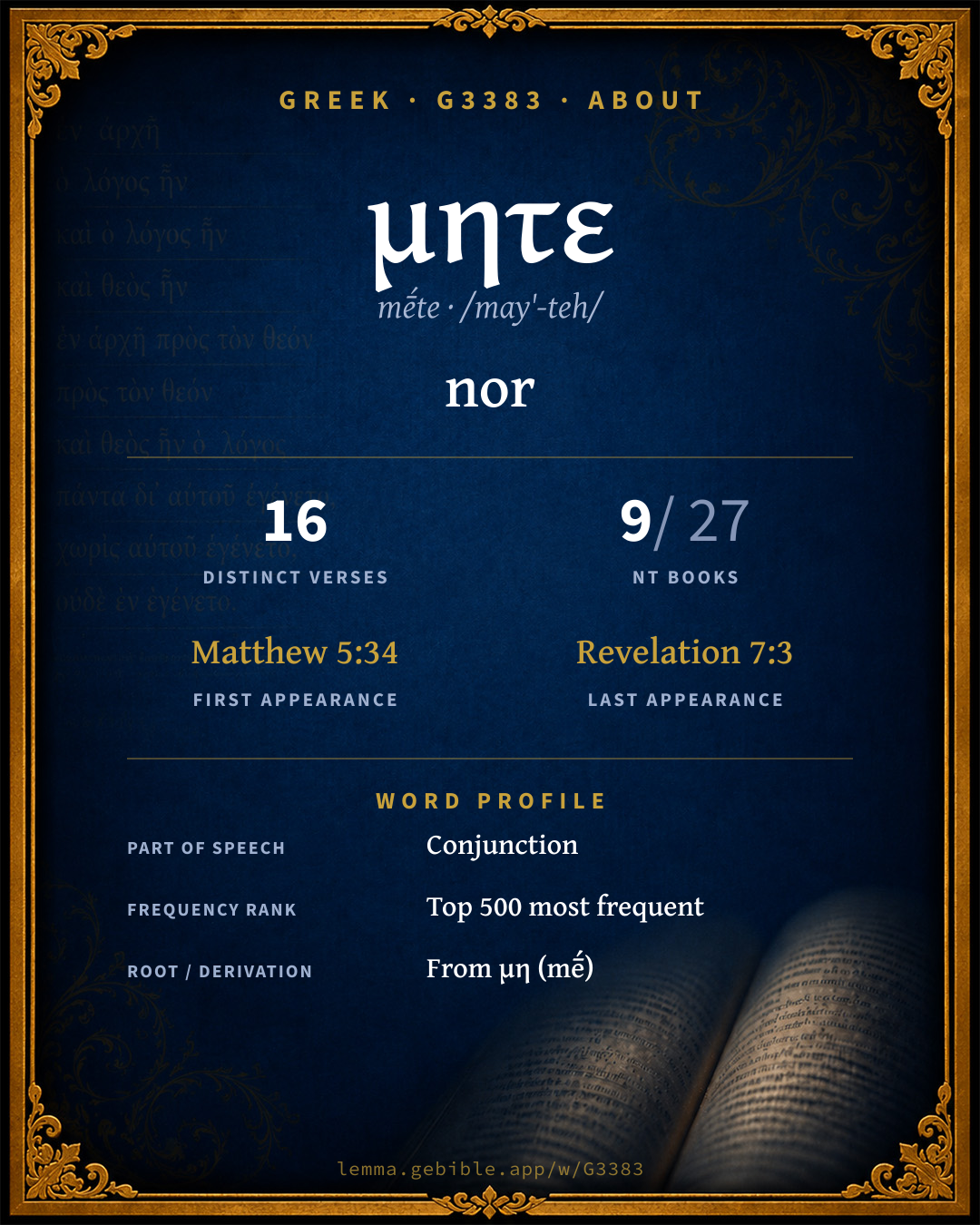
μήτε
nor
Full lexicon entry — Thayer's Greek Lexicon
From Thayer's Greek Lexicon
Where this word appears
Grammar key — what these labels mean
Part of speech
- Conjunction
- A joining word linking words or clauses.
Degree
- Negative
- Marks a negative form.
Every verse where G3383 appears — 16 distinct verses across 9 books. Click any verse to open its interlinear word-by-word view. Verse text shown in the World English Bible for context — . Each verse’s Greek form is shown with its reference; the English is not keyword-highlighted, since the data carries no word-level English alignment. Use “Compare translations” on any verse to read it across multiple English versions. This concordance covers the Greek New Testament; Septuagint (Greek Old Testament) occurrences of this word are not indexed here.
Matthew 4 verses
- Matthew 5:34 μήτε conj neg but I tell you, don't swear at all: neither by heaven, for it is the throne of God;
- Matthew 5:35 μήτε μήτε conj neg conj neg nor by the earth, for it is the footstool of his feet; nor by Jerusalem, for it is the city of the great King.
- Matthew 5:36 μήτε conj neg Neither shall you swear by your head, for you can't make one hair white or black.
- Matthew 11:18 μήτε μήτε conj neg conj neg For John came neither eating nor drinking, and they say, 'He has a demon.'
Mark 1 verse
Luke 1 verse
Acts 4 verses
- Acts 23:8 μήτε μήτε conj neg conj neg For the Sadducees say that there is no resurrection, nor angel, nor spirit; but the Pharisees confess all of these.
- Acts 23:12 μήτε μήτε conj neg conj neg When it was day, some of the Jews banded together, and bound themselves under a curse, saying that they would neither eat nor drink until they had killed Paul.
- Acts 23:21 μήτε μήτε conj neg conj neg Therefore don't yield to them, for more than forty men lie in wait for him, who have bound themselves under a curse neither to eat nor to drink until they have killed him. Now they are ready, looking for the promise from you."
- Acts 27:20 μήτε μήτε conj neg conj neg When neither sun nor stars shone on us for many days, and no small tempest pressed on us, all hope that we would be saved was now taken away.
2 Thessalonians 1 verse
1 Timothy 1 verse
Hebrews 1 verse
James 1 verse
Revelation 2 verses
- Revelation 7:1 μήτε μήτε conj neg conj neg After this, I saw four angels standing at the four corners of the earth, holding the four winds of the earth, so that no wind would blow on the earth, or on the sea, or on any tree.
- Revelation 7:3 μήτε μήτε conj neg conj neg saying, "Don't harm the earth, neither the sea, nor the trees, until we have sealed the bondservants of our God on their foreheads!"
About this entry
At a glance — auto-summarized from this page’s data, not written by a person. Every figure links to its source below. This summary describes the numbers; it doesn’t interpret them.
The Greek conjunction μητε centers on the idea of “nor.” First canonically at Matthew 5:34, it enters the text early. It turns up in 16 verses across 9 books, an uncommon footprint. The word gravitates to Matthew (25%), then Acts and Revelation. It clusters with μη, μηδαμως and μηδε under a shared root. Dig into 16-verse concordance and the renderings breakdown below.
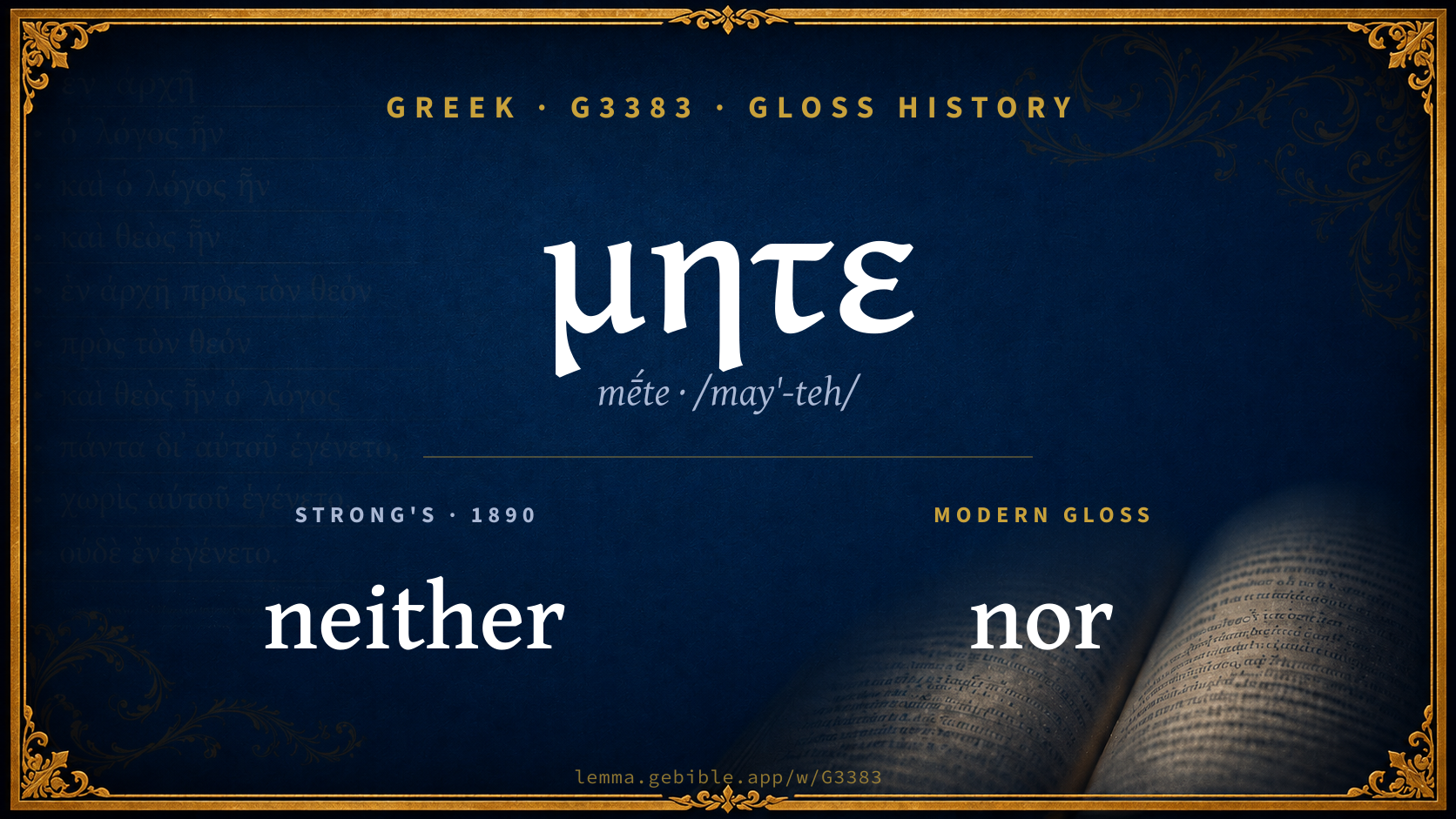
Gloss history
Strong's 1890 vs modern scholarship
About this word
Strong's G3383 catalogs a Greek word from the Greek New Testament.
These counts are not copied from any lexicon or concordance. They are computed here, from the morphology-tagged Greek New Testament. What Lemma adds →
- 16
- distinct verses
- The word appears in 16 distinct verses.
- 9 / 27
- NT books
- The word appears in 9 of 27 New Testament books.
- #424
- by frequency
- Top 500 most frequent Greek words (rank 424 of 5,347 Greek words by occurrence).
View all 16 occurrences in the concordance →
Most concentrated in
- Matthew 4 verses 25%
- Acts 4 verses 25%
- Revelation 2 verses 13%
By section of the New Testament
By traditional corpus
Conventional, traditional groupings — biblical authorship is debated, so this is a traditional corpus grouping, not an authorship claim. Some books belong to more than one corpus (Luke is in both the Gospels and the Lukan corpus, and so on), so these shares overlap and need not total 100%. Each figure is a share of the word’s 16 distinct verses.
- Gospels 6 verses · 38%
- Lukan (Luke–Acts) 5 verses · 31%
- Johannine 2 verses · 13%
- Pauline corpus 2 verses · 13%
- Revelation 2 verses · 13%
- Hebrews 1 verse · 6%
- General (Catholic) Epistles 1 verse · 6%
How translations render this word
Counts come from each version’s own published word-to-Strong’s tagging or interlinear alignment — an approximate guide to how each version renders this word, not a word-level alignment the data otherwise carries. Because each total is that version’s own tagged count, the per-version totals vary from one another and need not match the appearance or distinct-verse counts above. These counts may also differ from a printed concordance because Lemma counts each distinctly tagged rendering and does not collapse phrase taggings into a single head-word total. This is a fixed set of word-tagged versions (KJV, ASV, BSB, ULT) and does not change with the reading translation you choose elsewhere. Each version’s license is shown beside its name below (and on Sources).
- King James Version: Neither 20×, Nor 15×
- American Standard Version: Nor 16×, Neither 13×, Or 4×
- Berean Standard Bible: Nor 6×, No 5×, Not 3×
- unfoldingWord Literal Text: Nor 18×, Neither 11×, Or 5×
King James Version Public Domain
Renders G3383 across 37 tagged occurrences — most commonly:
Plus 2 renderings that appear only once — usually multi-word phrases or single function words the recovered tagging swept in, not distinct renderings.
American Standard Version Public Domain
Renders G3383 across 37 tagged occurrences — most commonly:
Plus 4 renderings that appear only once — usually multi-word phrases or single function words the recovered tagging swept in, not distinct renderings.
Berean Standard Bible Public Domain
Renders G3383 across 16 tagged occurrences — most commonly:
Not rendered by a distinct English word in 18 further occurrences.
unfoldingWord Literal Text CC BY-SA 4.0
Renders G3383 across 34 tagged occurrences — most commonly:
Senses in Thayer's
The 1 sense Thayer's distinguishes for this word, in lexicon order (not ranked by frequency or importance). The full entry — with sub-senses — is in the Lexicon Entry tab.
- and not, neither ... nor, not so
Word origin
Derived from μη (mḗ) (G3361) — not.
Same root — word family
Other Thayer's entries built from the same root as G3383, grouped by Strong’s listed origin. These share a root / origin per the lexicon — not necessarily a shared meaning. Each links to that word’s own entry.
Derives from
Shares the same root
- μηδαμως mēdamōs G3365 by no means
- μηδε mēdé G3366 and not
- μηδεις mēdeís G3367 no one
- μηκετι mēkéti G3371 no longer
- μη ουκ mḕ ouk G3378 not ever
- μηποτε mḗpote G3379 lest
- μηπω mḗpō G3380 not yet
- μηπως mḗpōs G3381 lest
- μητι mḗti G3385 whether
- μητις mḗtis G3387 let no one
- ου ou G3756 not
Compare all same-root words → Showing 4 of 13 — not the complete family. They share a root, not necessarily a meaning.
Septuagint usage
The same Greek word μητε appears 4 times in the Greek Old Testament (Septuagint), across 2 verses in 2 books.
- 4
- LXX occurrences
- Tagged occurrences of this Greek word in the Septuagint.
- 2
- verses
- Distinct Septuagint verses containing this word.
- 2 / 39
- OT books
- The word appears in 2 of the 39 Old Testament books.
Sample Septuagint occurrences
- 1 Kings 3:26 μήτε
- Hosea 4:4 μήτε
Septuagint occurrences (same lexeme)
Every verse where the same Strong’s number (G3383) appears in the Greek Septuagint. Verse text shown in the World English Bible for context; the Greek form is the matched word — the English is not keyword-highlighted.
- 1 Kings 3:26 μήτε Then spoke the woman whose the living child was to the king, for her heart yearned over her son, and she said, Oh, my lord, give her the living child, and in no way kill it. But the other said, It shall be neither mine nor yours; divide it.
- Hosea 4:4 μήτε "Yet let no man bring a charge, neither let any man accuse; For your people are like those who bring charges against a priest.
These are occurrences of the same Greek lexeme (G3383) in the Septuagint — not a translation of any one Hebrew word. The store carries no word-level Hebrew↔Greek alignment, so no Hebrew original is asserted here. Counts come from the recovered LXX Strong's tagging — high-frequency vocabulary is well covered, while rare or late forms may be untagged — so they reflect tagged occurrences and may slightly undercount.