Matthew 15:26

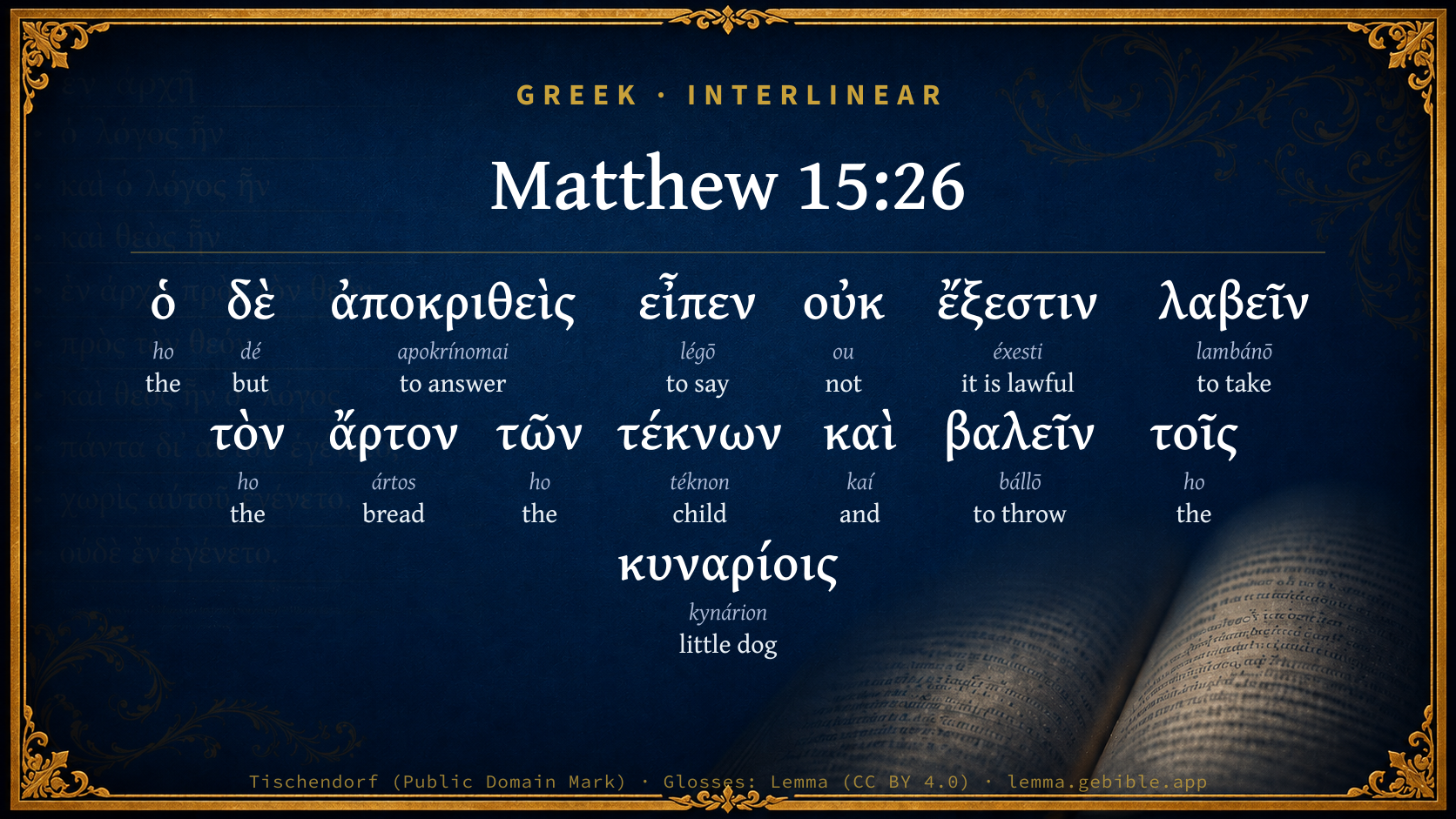
Greek (Tischendorf 8th ed.) Matthew 15:26 appears in the Greek New Testament. The text above is from the Tischendorf 8th edition. Each word links to its Strong’s number and a concise gloss. Click any word for its full Thayer’s Greek Lexicon entry.
Download image
Cite this verse

Matthew 15:26 (World English Bible). Public Domain. Lemma interlinear Bible study tool, https://lemma.gebible.app/v/matthew/15/26.

Show BibTeX & RIS
BibTeX
RIS
English Translation
But he answered, "It is not appropriate to take the children's bread and throw it to the dogs."
World English Bible · Public Domain
Highlights
  • 1 first appearance in the Greek New Testament
Full analysis ↓
Download a study sheet

One document with this verse’s original text, its word-by-word gloss line, the meaning frame, cross-references with their text, attributed commentary, and full source and license credits — printable, and it pastes into notes with its structure intact.

This verse Autodidact and up

Study sheet (.html) Plain text (.txt)

A passage Seminary Student

Up to 50 verses in one chapter. A passage sheet keeps up to 6 commentary sources and 12 cross-references per verse, in the order this page ranks them, and says so on the sheet whenever that leaves anything out. Ask for a single verse and you get the Autodidact verse sheet above.

Everything on this page stays free to read, with no account — the sheet is a download of what is already on screen, not access to it.

Want to remove ads? Support Godless Engineer
Compare translations 3

The same verse in 3 English versions, stacked beneath the original-language interlinear above. Click any original word for its lexicon entry.

Each is an independent rendering of the whole verse — the interlinear is not word-aligned to these translations.

Highlighted words mark where these versions differ — a whole-verse word diff, not a word-by-word alignment.

  • World English Bible Public Domain
    But he answered, "It is not appropriate to take the children's bread and throw it to the dogs."
  • King James Version Public Domain
    But he answered and said, It is not meet to take the children's bread, and to cast it to dogs.
  • unfoldingWord Literal Text CC BY-SA 4.0
    Now he, answering, said, “It is not good to take the bread of the children and to throw to the little dogs.”

unfoldingWord Literal Text — © unfoldingWord, licensed CC BY-SA 4.0. Word-aligned USFM3 via Door43 (git.door43.org/unfoldingWord/en_ult).

Versions to compare (up to 4)

3 of 4 selected

Show all 19 translations

Every available English version of this verse, each an independent rendering of the whole verse.

  • World English Bible Public Domain
    But he answered, "It is not appropriate to take the children's bread and throw it to the dogs."
  • Berean Standard Bible Public Domain
    But Jesus replied, “It is not right to take the children’s bread and toss it to the dogs.”
  • Majority Standard Bible Public Domain
    But Jesus replied, “It is not right to take the children’s bread and toss it to the dogs.”
  • King James Version Public Domain
    But he answered and said, It is not meet to take the children's bread, and to cast it to dogs.
  • American Standard Version (1901) Public Domain
    And he answered and said, It is not meet to take the children's bread and cast it to the dogs.
  • Revised Version (1885) Public Domain
    And he answered and said, It is not meet to take the children’s bread and cast it to the dogs.
  • Geneva Bible (1599) Public Domain
    And he answered, and said, It is not good to take the childrens bread, and to cast it to whelps.
  • Douay-Rheims (1899) Public Domain
    Who answering, said: It is not good to take the bread of the children, and to cast it to the dogs.
  • Young's Literal Translation Public Domain
    and he answering said, `It is not good to take the children's bread, and to cast to the little dogs.'
  • Literal Standard Version CC BY-SA 4.0
    and He answering said, “It is not good to take the children’s bread, and to cast to the little dogs.”
  • Unlocked Literal Bible CC BY-SA 4.0
    He answered and said, “It is not right to take the children's bread and throw it to the little dogs.”
  • unfoldingWord Literal Text CC BY-SA 4.0
    Now he, answering, said, “It is not good to take the bread of the children and to throw to the little dogs.”
  • Darby Bible Public Domain
    But he answering said, It is not well to take the bread of the children and cast it to the dogs.
  • World Messianic Bible Public Domain
    But he answered, “It is not appropriate to take the children’s bread and throw it to the dogs.”
  • Webster's Bible Public Domain
    But he answered and said, It is not meet to take the children's bread, and to cast it to dogs.
  • Free Bible Version CC BY-SA 4.0
    “It's not right to take the children's food and throw it to the dogs, ” Jesus told her.
  • Bible in Basic English Public Domain
    And he made answer and said, It is not right to take the children's bread and give it to the dogs.
  • Text-Critical English NT CC BY 4.0
    He replied, “It is not good to take the children's bread and throw it to the dogs.”
  • Tyndale New Testament (1534) Public Domain
    He answered and sayde: it is not good to take the chyldrens breed and to cast it to whelpes.

Literal Standard Version (2020), Covenant Press — licensed CC BY-SA 4.0. Text via the HelloAO Bible API (eBible.org). Unlocked Literal Bible (unfoldingWord) — licensed CC BY-SA 4.0. Text via the HelloAO Bible API (eBible.org). unfoldingWord Literal Text — © unfoldingWord, licensed CC BY-SA 4.0. Word-aligned USFM3 via Door43 (git.door43.org/unfoldingWord/en_ult). Free Bible Version, Dr. Jonathan Gallagher — licensed CC BY-SA 4.0. Text via the HelloAO Bible API (eBible.org).

Word by word

More ways to search: Search by grammar → Find every occurrence → Compare this word →

Practice this passage: Drill this verse → Learn its vocabulary →

κυναρίοις
kynárion
G2952
“little dog”
Noun, Dative, Plural, Neuter
Part of Speech
Noun
Case
Dative
Number
Plural
Gender
Neuter
Full Thayer's Definition

Origin: from a presumed derivative of G2965

TDNT: 21:24,5

1. a little dog
  1. ὁ ho G3588 “the” Article, Nominative, Singular, Masculine
  2. δὲ dé G1161 “but” Conjunction
  3. ἀποκριθεὶς apokrínomai G611 “to answer” Verb, Aorist, Passive deponent, Participle, Nominative, Singular, Masculine
  4. εἶπεν légō G3004 “to say” Verb, Aorist, Active, Indicative, 3rd person, Singular
  5. οὐκ ou G3756 “not” Particle, Negative
  6. ἔξεστιν éxesti G1832 “it is lawful” Verb, Present, Active, Indicative, 3rd person, Singular
  7. λαβεῖν lambánō G2983 “to take” Verb, Aorist, Active, Infinitive
  8. τὸν ho G3588 “the” Article, Accusative, Singular, Masculine
  9. ἄρτον ártos G740 “bread” Noun, Accusative, Singular, Masculine
  10. τῶν ho G3588 “the” Article, Genitive, Plural, Neuter
  11. τέκνων téknon G5043 “child” Noun, Genitive, Plural, Neuter
  12. καὶ kaí G2532 “and” Conjunction
  13. βαλεῖν bállō G906 “to throw” Verb, Aorist, Active, Infinitive
  14. τοῖς ho G3588 “the” Article, Dative, Plural, Neuter

About this verse

These counts appear in no published source. They are computed here, from the morphology-tagged text and Lemma’s own curated glosses. What Lemma adds →

15
words
12
distinct lemmas
Gospels
section

Notable vocabulary

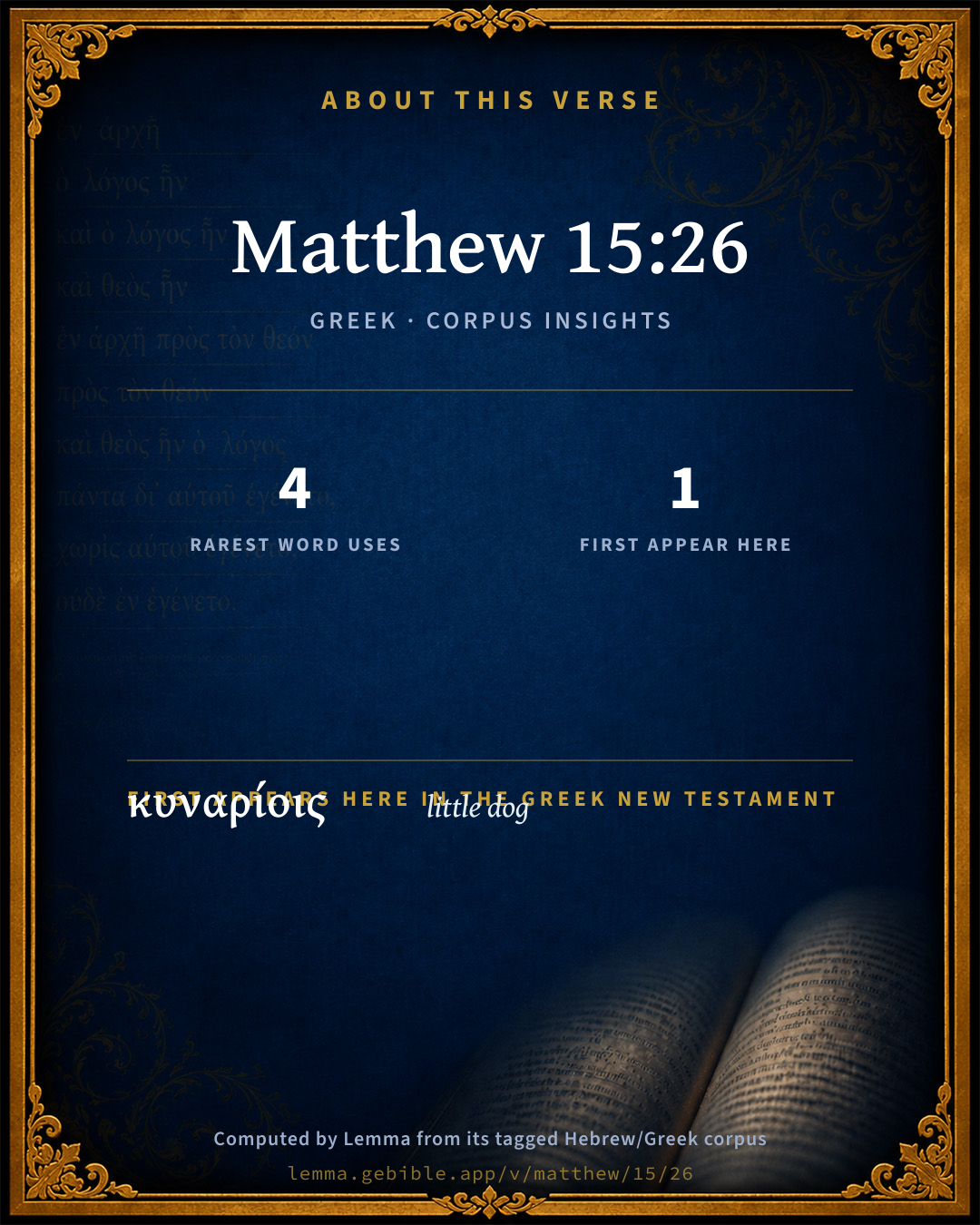
The rarest word here is κυναρίοις little dog G2952 — appearing just 4 times in the whole Greek New Testament.

First appearance in Scripture

This word makes its first canonical appearance in the Greek New Testament here:

  • κυναρίοις little dog G2952

Shared distinctive vocabulary

κυναρίοις little dog G2952 occurs in 4 verses of the Greek New Testament. Also found in:

Repetition

A word recurs within this verse:

Cross-references

8

Topical passages linked to Matthew 15:26 in the Treasury of Scripture Knowledge — connected by theme and wording, ordered by reader-vote popularity; previews shown in the World English Bible.

  • Mark 7:27–28 But Jesus said to her, "Let the children be filled first, for it is not appropriate to take the children's bread and throw it to the dogs."
  • Matthew 7:6 "Don't give that which is holy to the dogs, neither throw your pearls before the pigs, lest perhaps they trample them under their feet, and turn and tear you to pieces.
  • Philippians 3:2 Beware of the dogs, beware of the evil workers, beware of the false circumcision.
  • Ephesians 2:12 that you were at that time separate from Christ, alienated from the commonwealth of Israel, and strangers from the covenants of the promise, having no hope and without God in the world.
  • Galatians 2:15 "We, being Jews by nature, and not Gentile sinners,
  • Acts 22:21–22 "He said to me, 'Depart, for I will send you out far from here to the Gentiles.'"
  • Romans 9:4 who are Israelites; whose is the adoption, the glory, the covenants, the giving of the law, the service, and the promises;
  • Revelation 22:15 Outside are the dogs, the sorcerers, the sexually immoral, the murderers, the idolaters, and everyone who loves and practices falsehood.

Cross-references courtesy of OpenBible.info (CC BY 4.0).

Commentary

Notes on Matthew 15:26 from classic Christian and Jewish commentators (each source and its license shown beneath its notes). The classic Christian expositions comment on the surrounding passage and are grouped to its opening verse, so a note may address several verses; the Jewish commentaries on the Tanakh (Rashi and others) are per-verse, so they appear only where the commentator wrote on this verse.

Lemma curates 59 commentaries, every one of them public domain or Creative Commons licensed, each selected and text-cleaned for this edition rather than reprinted as found. About our sources →

Tyndale Open Study Notes

Tyndale Open Resources

15:26 Jews often referred to pagans as dogs, which are ceremonially unclean (Lev 11:27). Jesus was speaking to the woman of her spiritual condition as a Gentile—as unclean and separated from God (cp. Matt 7:6).

Tyndale Open Study Notes — © Tyndale Open Resources, licensed CC BY-SA 4.0. Text via the HelloAO Bible API.

Bengel's Gnomon

Johann Albrecht Bengel

Mat 15:26. Τῶν τέκνων, the children’s) Our Lord spoke severely to the Jews themselves, but honourably of them [to those without]; see Joh 4:22. Thus we, concerning the Evangelic Church. κυναρίοις, to little dogs[697]) who are not worthy to receive it. But yet ΚΥΝΆΡΙΟΝ, the word employed by our Lord, is a diminutive, and Jesus thereby gives a handle to the woman to take hold of Him. Midrasch Tillim.[698] says, “The nations of the world are like dogs.”

[697] Diminutives are used as terms of endearment. Therefore κυναρίοις probably here means the household dogs—pet dogs.—ED.

[698] i.e. “Allegorical Commentary on the Psalms,” a Rabbinical work of high repute among the Jews.—(I. B.)

Even the third effort was seeming likely to be abortive. Yet she did not give over.—V. g.

Bengel's Gnomon of the New Testament — English translation (T&T Clark, Edinburgh, 1860) — public domain. Text from a community e-Sword module.

Meyer's Critical & Exegetical Commentary

Heinrich August Wilhelm Meyer

Mat_15:26. It is not allowable (see critical notes) to take (sumere, circumstantial way of putting it, not: to take away) the bread belonging to the children and cast it to the dogs,a general proposition for the purpose of expressing the thought: I must not allow the Gentiles to participate in my blessings, belonging as they do only to the people of Israel (the children of God, Rom_9:4). Jesus speaks ex communi gentis loquela potius quam ex sensu suo (Lightfoot); for it was the practice among the Jews to designate heathens (and subsequently, Christians also) as dogs; see Lightfoot and Wetstein, likewise Eisenmenger, entdeckt. Judenth. I. p. 713 ff. For the diminutive, see note on Mat_15:27. In this passage it is intended to mitigate the harshness of the expression.

Meyer — Critical and Exegetical Commentary on the New Testament — English translation by Peter Christie, edited by Frederick Crombie (T&T Clark, 1880) — public domain. Text from a community e-Sword module.

Expositor's Greek Testament

ed. W. Robertson Nicoll

Mat 15:26 . οὐκ ἔστιν καλὸν , etc.: seemingly a hard word, but not so hard as it seems. First, it is not a simple monosyllabic negative, leaving no room for parley, but an argument inviting further discussion. Next, it is playful, humorous, bantering in tone, a parable to be taken cum grano . Third, its harshest word, κυναρίοις , contains a loophole. κυνάρια does not compare Gentiles to the dogs without, in the street, but to the household dogs belonging to the family, which got their portion though not the children’s.

The Expositor's Greek Testament, edited by W. Robertson Nicoll (1897–1910) — public domain. Text from a community e-Sword module.

Adam Clarke's Commentary

Verse 26. The children's bread] The salvation provided for the Jews, who were termed the children of the kingdom. And cast it to the κυναριοις, little dogs - to the curs; such the Gentiles were reputed by the Jewish people, and our Lord uses that form of speech which was common among his countrymen. What terrible repulses! and yet she still perseveres!

Adam Clarke's Commentary on the Bible (1810–1826) — public domain. Text from a community e-Sword/MySword module.

Ellicott's Commentary for English Readers

(26) To cast it to dogs.—The word used was diminutive in its form, and as such pointed not to the wild, unclean beasts that haunt the streets of an Eastern city (Psa_59:6), but to the tamer animals that were bred in the house, and kept as pets. The history of Tobias and his dog, in the Apocrypha, furnishes the one example in Biblical literature of this friendly relation between the dog and his master (Tob_5:16).

The answer has, even taking this into account, a somewhat harsh sound, but it did not go beyond the language with which the woman must have been familiar, and it was probably but a common proverb, like our “Charity begins at home,” indicating the line of demarcation which gave a priority to the claims of the family of Israel to those of strangers. We may well believe that there was no intentional scorn in it, though it emphasized an actual distinction.

A Bible Commentary for English Readers, edited by Charles John Ellicott (1878–1897) — public domain. Text from a community e-Sword module.

The Cambridge Bible for Schools and Colleges

gen. ed. J. J. S. Perowne

26. to take the children’s bread, and to cast it to dogs] The “children” are the Jews; the “dogs” are the Gentiles. This was the name applied by the Jews to all outside the chosen race, the dog being in the East a symbol of impurity. St Paul, regarding the Christian Church as the true Israel, terms the Judaizing teachers “dogs,” Php_3:2. Christ’s words, as reported by St Mark (ch. Mar_7:27), contain a gleam of hope, “Let the children first be filled.”

The Cambridge Bible for Schools and Colleges (gen. ed. J. J. S. Perowne; Cambridge University Press, 1878–1918) — public domain. Text from a community e-Sword module.

John Gill's Exposition

But he answered, and said,.... To the woman, as the Persic version reads it, and the sense requires:

it is not meet to take the children's bread, and to cast it to dogs; which he said, to try her faith the more, and make it the more illustrious; and that not so much from his own sense of things, as in the language of the Jewish people, and which she might not be a stranger to. By "the children", are meant the Jews, to whom the adoption belonged; who, as a nation and people, were the children of God in a large sense; being distinguished by many blessings and favours, which others had not, and being under the more peculiar care and notice of God; not that all of them were the children of God by special grace: by "the bread"; which belonged to them, is meant the external ministry of the word, and the miracles of Christ wrought among them: and particularly such outward favours which related to the good of the bodies of men, by healing their diseases, and dispossessing them of devils: and by "the dogs" are designed the Gentiles, so called by the Jews in a way of contempt, because of their ignorance, idolatry, and impurity. Christ here speaks not his own mind, as if he reproached the Gentiles, and held them in scorn and contempt, but uses the common dialect of the people; and which, this woman, living upon the borders of the Israelitish nation, was acquainted with; so that it was not so shocking and surprising, or quite so discouraging, as it would otherwise have been. The Jewish doctors say (k), that the idolatrous Gentiles are not called men, that they are comparable to the beasts or the field (l), to oxen, rams, goats (m), and asses (n): the foetus in the bowels of a Canaanitish servant, they say (o),

"ymd hmhb yemb dlwk, "is like the foetus in the bowels of a beast".''

Take the following passage, as an illustration of this, and as a further proof of the Jews calling the Gentiles dogs (p).

"A king provides a dinner for the children of his house; whilst they do his will they eat their meat with the king, and he gives to the dogs the part of bones to gnaw; but when the children of the house do not do the king's pleasure, he gives the dogs the dinner, and the bones to them: even so: while the Israelites do the will of their Lord, they eat at the king's table, and the feast is provided for them, and they of their own will give the bones to the Gentiles; but when they do not do the will of their Lord, lo! the feast is "for the dogs", and the bones are their's.''

And a little after,

""thou preparest a table before me"; this is the feast of the king; "in the presence of mine enemies"; , "these are the dogs" that sit before the table, looking for their part of the bones.''

In which may be clearly discerned the distinction between children and dogs, and the application of the one to the Jews, and the other to the Gentiles, and the different food that belongs to each: and hence it is easy to see from whom Christ borrowed this expression, and with what view he made use of it.

(k) T. Bab. Bava Metzia, fol. 114. 2. Zohar in Exod. fol. 35. 4. Tzeror Hammor, fol. 1. 4. (l) Zohar in Gen. fol. 31. 1. & 34. 1. 2. (m) Jarchi in Gen. 15. 10. (n) T. Bab. Kiddushin, fol. 68. 1. (o) lb. fol. 69. 1. (p) Zohar in Exod. fol. 63. 1, 2. Vid. Tzeror Hammor, fol. 147. 4.

John Gill's Exposition of the Whole Bible (1746–1763) — public domain (CC PDM 1.0). Text via the HelloAO Bible API.

Trapp's Complete Commentary

John Trapp

26 But he answered and said, It is not meet to take the children’s bread, and to cast it to dogs.

Ver. 26. And to cast it to dogs] To whelps, saith St Mark. {a} So he calls her bitch, her daughter whelp. This might have easily damped and discouraged her. But she was that well-resolved Christian, whose part Luther saith it is to believe things invisible, {b} to hope for things deferred, and to love God when he shows himself most angry with him, and most opposite to him. Our Saviour was no sooner gone from this Canaanitess, but he heals the deaf and dumb man (though far weaker in faith than her) at first word, Mar 7:33; Mat 15:30, the Galileans no sooner laid their sick and lame friends at his feet, but he cured them without any more ado. He is "a God of judgment," Isa 30:18, and knows how and when to deal forth his favours. He lays heaviest burdens on the strongest backs and proportions our afflictions to our abilities, holding us off for deliverance till he finds us fit for it, and giving us hearts to wait and want it till his time is come.

{a} κυναριοις, catellis, ut maiore contemptu loqui videretur. Beza.

{b} Credere invisibilia, sperare dilata, et amare Deum se ostendentem contrarium. Luth.

John Trapp, A Commentary or Exposition upon All the Books of the Old and New Testament (1647–1656) — public domain. Text from a community e-Sword module.

Haydock's Catholic Bible Commentary

And to cast it to the dogs; i.e. to Gentiles, sometimes so called by the Jews. (Witham) --- The diminutive word Greek: Kunarios, or whelp, is used in both these verses in the Septuagint. Our Lord crosses the wishes of the Chanaanæan, not that he intended to reject her, but that he might bring to light the hidden and secret treasure of her virtue. Let us admire not only the greatness of her faith, but likewise the profoundness of her humility; for when our Saviour called the Jews children, so far from being envious or another’s praise, she readily answers, and gives them the title of lords; and when Christ likened her to a dog, she presently acknowledges the meanness of her condition. (St. John Chrysostom, hom. liii.) He refused at first to listen to her petition, says the same saint, to instruct us with what faith, humility, and perseverance we ought to pray. To make his servants more sensible of his mercy, and more eager to obtain it, he often appears to pay no attention to their prayers, till he had exercised them in the virtues of humility and patience. Ask, and you shall receive; knock, and it shall be opened to you. (Haydock)

George Leo Haydock (1774–1849), Haydock's Catholic Family Bible and Commentary, 1859 edition — public domain. Excludes Psalms (Douay-Rheims chapter numbering differs from Protestant) and Deuterocanonical books (Catholic canon only).

Matthew Poole's English Annotations

Mark saith, Mar 7:27, Jesus said unto her, Let the children first be filled; for it is not meet, &c. By the children here he means the Jews, by the dogs he means the heathen. The Jews are called the children of the kingdom. Israel is called God’s son, his firstborn, Exo 4:22. The apostle, Rom 9:4, saith, to them belonged the the adoption. By bread here our Saviour means the publication of the gospel, and the miracles by which the truth of the doctrine of it was confirmed; by dogs he means the heathen, whom the Jews did count as dogs, no members of the household of God: it was a term of contempt, 2Sa 3:8; 2Sa 16:9; 2Ki 8:13. When our Saviour saith,

It is not meet he means it is not just, nor equal.

Objection: How came it then that the gospel was ever carried to the Gentiles?

Mark expounds our Saviour’s meaning, or rather gives us an account of our Saviour’s words, more perfectly: Let the children first be filled; for it is not meet, &c. The Jews are God’s children, a people whom he chose out of all the nations of the earth, to whom he gave many privileges; it is his will the gospel should be first preached to them, and then to the Gentiles. Gentiles are as dogs, of whom God hath not taken such a care; but they shall have their time. Only it is not consonant to my Father’s will that the gospel, and the miracles by which it is confirmed, should be exhibited unto you Gentiles, till it hath been fully preached to the Jews, and they be first filled with the sound, and with the confirmations of it.

Matthew Poole's English Annotations on the Holy Bible (1683–1685) — public domain. Text from a community e-Sword/MySword module.

Whedon's Commentary on the Bible

Daniel D. Whedon

26. It is not meet — Not fitting. It is not in the order which God has established. Children’s bread… dogs — The original is little dogs; so that with the contempt, there is a tenderness in the epithet. Yet our Lord begins to recognize in her a Gentile that may prove an Israelite indeed if fully tested. He therefore puts her in a most humble place, to see if she has an humble, though a Gentile heart.

Daniel D. Whedon (gen. ed.), Commentary on the Old and New Testaments (1874–1909) — public domain. Text from a community e-Sword module.

The Pulpit Commentary

But he answered and said. At length Jesus spoke directly to her; but his words were rough in sound, still enforcing the previous repulse. It is not meet; ouk esti kalon : non est bonum (Vulgate). Another reading of less authority is oboe exestin , "it is not lawful." The question is rather of fairness and expediency than of lawfulness. To take the children"s bread. "The children" are the chosen people, "the children of the kingdom", (Mat_8:12) who held this high position by election, however individuals might forfeit it by an unworthy use of privileges. "Bread" is meant to signify the graces and favours bestowed by God in Christ. To cast it. A humiliating term; not to give it, as you would to your children, but to throw it away as valueless, fit only for animals. Dogs (kunarioiv). A contemptuous diminutive, rendered by Wickliffe, "whelpies," or, as we might say, "curs." This was the term applied by the Jews to the Gentiles, even as Turks nowadays talk of "dogs of Christians," and as in later times, by a curious inversion, the Jews themselves were generally saluted with the opprobrious name of "dogs." Some have seen a term of endearment in the diminutive "little dogs," as though Christ desired to soften the harshness of the expression by referring, not to the prowling, unowned animals that act as scavengers in Oriental towns, but to the petted inmates of the master"s house. But Scripture gives no warrant for thinking that the Hebrews ever kept dogs as friends and companions, in our modern fashion; and our Lord adopts the language of his countrymen, to put the woman in her right position, as one with whom Jews could have no fellowship. To take the blessings from the Church of Israel in order to give them to aliens was to throw them away on unworthy recipients.

The Pulpit Commentary (1880–1919), ed. H.D.M. Spence-Jones & Joseph S. Exell — public domain. Text from a community e-Sword module.

Burkitt's Expository Notes on the New Testament

William Burkitt

Observe here, the seeming severity of Christ to this poor woman; he calls her not a woman but a dog: and as it were spurns her from his feet with an harsh repulse. Did ever so severe a word drop from those mild lips? What shall we say? Is the lamb of God turned a lion? That a woman in distress, imploring pity, yea, a good woman, and an humble supplicant, should be thus rated out of Christ’s presence for a dog!

Learn hence, that Christ puts the strongest faith of his own children upon the severest trials; the trial had never been so sharp, if her faith had not been so strong. Usually, where God gives much grace, he tries grace much.

William Burkitt's Expository Notes on the New Testament (1700–1703) — public domain. Text from a community e-Sword module.

The People's New Testament

B. W. Johnson

26. It is not meet to take the children's bread. She knew that, in comparing the Jews to the children of God's family, and the heathen to the dogs without, he simply used the customary language of a Jew. He would bring out fully the greatness of her faith. The gospel was offered first to the Jews and then to all.

B. W. Johnson's The People's New Testament with Notes (1889–1891) — public domain. Electronic text from the Christian Classics Ethereal Library (CCEL) ThML edition.

Cambridge Greek Testament for Schools and Colleges

26. τὸν ἄρτον τῶν τέκνων κ.τ.λ. The τέκνα are the Jews; the κυνάρια are the Gentiles. This was the name applied by the Jews to all outside the chosen race, the dog being in the East a symbol of impurity. St Paul, regarding the Christian Church as the true Israel, terms the Judaizing teachers τοὺς κύνας, Php 3:2. The same religious hostility, and the same names of scorn, still exist in the East between Mussulman and Christian populations. Christ’s words, as reported by St Mark (Mar 7:27), contain a gleam of hope, ἄφες πρῶτον χορτασθῆναι τὰ τέκνα.

Cambridge Greek Testament for Schools and Colleges (Cambridge University Press, 1896; 21 vols, various authors incl. Carr, Maclear, Plummer, Farrar, Lumby, Moule, M. R. James, Simcox) — public domain. Text from a community e-Sword module.

Alford’s Greek Testament

Henry Alford

26. κυναρίοις] No further contempt is indicated by the diminutive, still less any allusion to the daughter of the woman: the word is commonly used of tame dogs, as diminutives frequently express familiarity. So in Xen. Cyr. viii. 4. 20, εἰ δὲ μεγάλην γαμεῖς, ἤν ποτε βούλῃ αὐτὴν ὀρθὴν φιλῆσαι, προσάλλεσθαί σε δεήσει ὡς τὰ κυνάρια.

Henry Alford, The Greek Testament (1849–1861) — public domain. Text from a community e-Sword module.

International Critical Commentary

26. And He answered and said, It is not good to take the children’s bread, and to cast it to the dogs.] Mk. has: “And He was saying to her, Let first the children be fed: for,” etc.—κυνάρια] house-dogs. Mk. is fond of diminutives, which Mt. sometimes retains; but cf. v. 25 θυγάτριον, for which Mt. θυγάτηρ.

(M)

International Critical Commentary — older volumes (1896–1929), various authors — public domain. Text from a community e-Sword module.

Vincent's Word Studies in the New Testament

Marvin R. Vincent

Children 's [των τεκνων] . Bengel observes that while Christ spoke severely to the Jews, he spoke honorably of them to those without. Compare Joh 4:22.

Dogs [κυναριοις] . Diminutive : little dogs. In ver. 27, Wyc. renders the little whelps, and Tynd., in both verses, whelps. The picture is of a family meal, with the pet house - dogs running round the table.

Their masters. The children are the masters of the little dogs. Compare Mr 7:28, "the children 's crumbs."

Marvin R. Vincent, Word Studies in the New Testament (1887–1900) — public domain. Text from a community e-Sword/MySword module.

Lesson kit

Teaching starters — assembled from the data on this page, not authored interpretation. Every prompt links to the verse data it draws on. Edit before teaching.

Matthew, in the Gospels, opens this verse with 15 words (12 distinct Greek lemmas). Its most distinctive word is kynárion (“little dog”). A historical commentator’s framing appears above. Read the whole chapter for the surrounding context.

Discussion questions

  1. What does “little dog” (kynárion) contribute to the verse as a whole?
  2. The word “little dog” first appears here in Scripture. What is being introduced at this debut?
  3. Matthew 15:27 shares the word «little dog» with this verse. How do the two illuminate each other?
  4. “the” occurs 4× in this one verse. What is the effect of the repetition?
  5. The translations on this page render this verse differently — a whole-verse word diff, not a word-by-word alignment. What might account for the different wordings?
  6. Reading how Tyndale Open Study Notes and Bengel's Gnomon read this verse, where do the two commentators agree and where do they part?

Things to notice

  • 1 word makes its first canonical appearance in Scripture here.
  • These translations choose different wording for 12 words in this verse.
  • “the” occurs 4× in this single verse.
  • 12 distinct Greek lemmas span 15 words in this verse.

Reading settings

Reading text

Shown beneath each verse's original-language words.

Old Testament
Old Testament edition

Read the OT as the Masoretic Hebrew (MT) or the Greek Septuagint (LXX).

English shown for the Greek Septuagint (in the Hebrew ↔ Greek comparison).

Comparing translations? Open the Compare panel on any verse page to stack up to four side by side.