
Mark 4:38

Greek (Tischendorf 8th ed.) Mark 4:38 appears in the Greek New Testament. The text above is from the Tischendorf 8th edition. Each word links to its Strong’s number and a concise gloss. Click any word for its full Thayer’s Greek Lexicon entry.
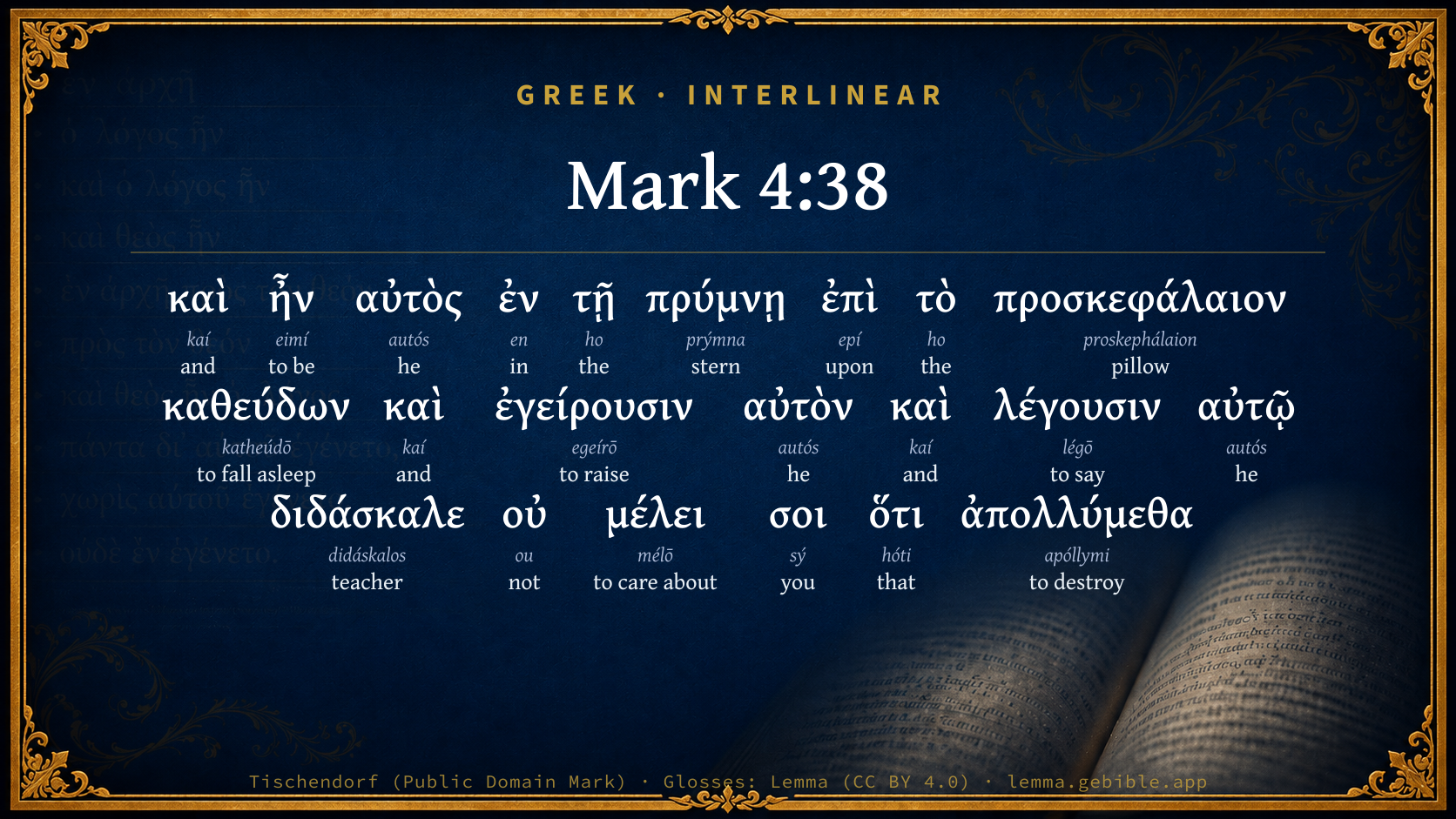
Download image
Cite this verse

Mark 4:38 (World English Bible). Public Domain. Lemma interlinear Bible study tool, https://lemma.gebible.app/v/mark/4/38.

Show BibTeX & RIS
BibTeX
RIS
English Translation
He himself was in the stern, asleep on the cushion, and they woke him up, and told him, "Teacher, don't you care that we are dying?"
World English Bible · Public Domain
Highlights
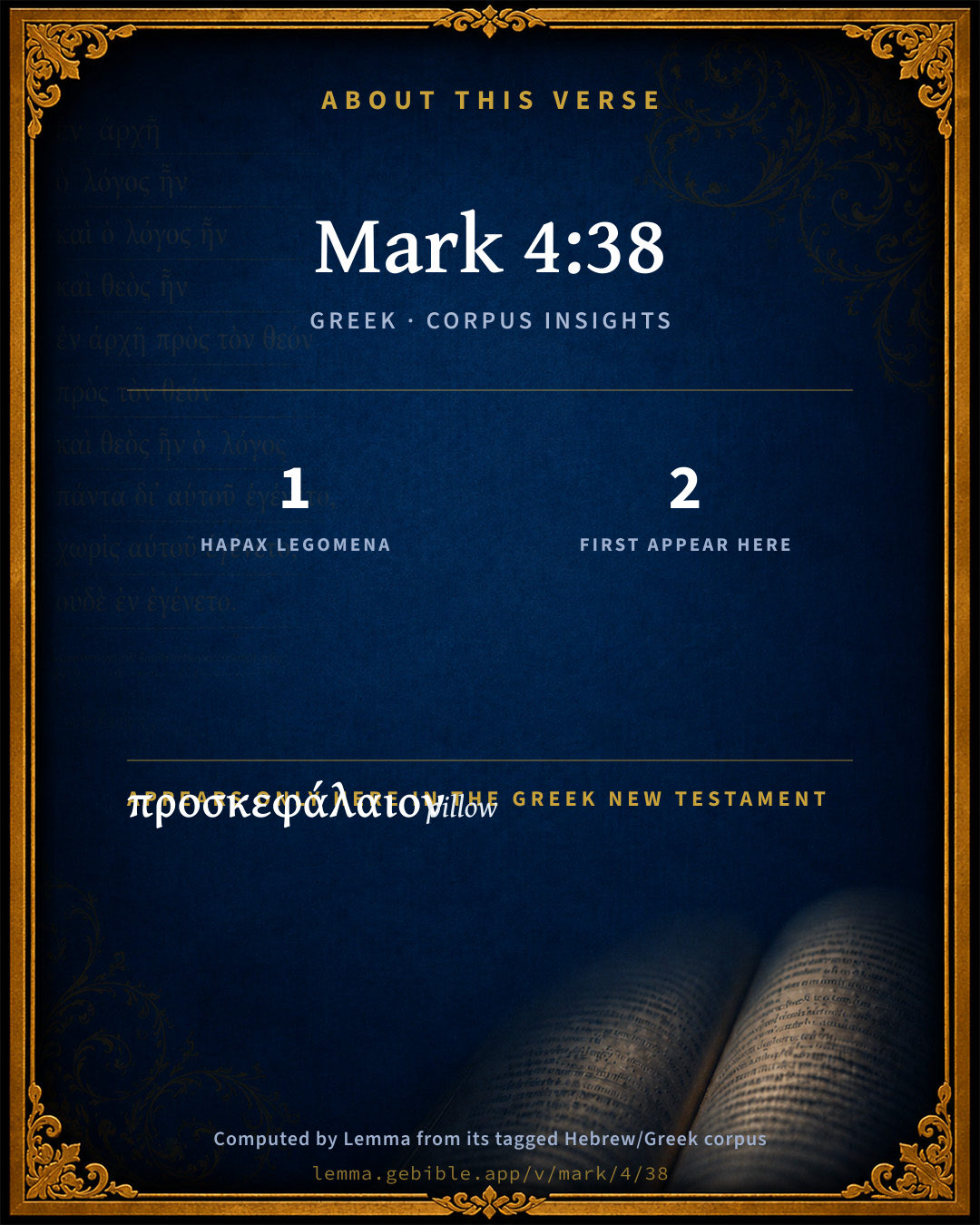
  • 1 hapax legomenon — only here in the Greek New Testament
  • 2 first appearances in the Greek New Testament
Full analysis ↓
Download a study sheet

One document with this verse’s original text, its word-by-word gloss line, the meaning frame, cross-references with their text, attributed commentary, and full source and license credits — printable, and it pastes into notes with its structure intact.

This verse Autodidact and up

Study sheet (.html) Plain text (.txt)

A passage Seminary Student

Up to 50 verses in one chapter. A passage sheet keeps up to 6 commentary sources and 12 cross-references per verse, in the order this page ranks them, and says so on the sheet whenever that leaves anything out. Ask for a single verse and you get the Autodidact verse sheet above.

Everything on this page stays free to read, with no account — the sheet is a download of what is already on screen, not access to it.

Want to remove ads? Support Godless Engineer
Compare translations 3

The same verse in 3 English versions, stacked beneath the original-language interlinear above. Click any original word for its lexicon entry.

Each is an independent rendering of the whole verse — the interlinear is not word-aligned to these translations.

Highlighted words mark where these versions differ — a whole-verse word diff, not a word-by-word alignment.

  • World English Bible Public Domain
    He himself was in the stern, asleep on the cushion, and they woke him up, and told him, "Teacher, don't you care that we are dying?"
  • King James Version Public Domain
    And he was in the hinder part of the ship, asleep on a pillow: and they awake him, and say unto him, Master, carest thou not that we perish?
  • unfoldingWord Literal Text CC BY-SA 4.0
    And he himself was in the stern, sleeping on the cushion. And they wake him up and say to him, “Teacher, is it not a concern to you that we are perishing?”

unfoldingWord Literal Text — © unfoldingWord, licensed CC BY-SA 4.0. Word-aligned USFM3 via Door43 (git.door43.org/unfoldingWord/en_ult).

Versions to compare (up to 4)

3 of 4 selected

Show all 19 translations

Every available English version of this verse, each an independent rendering of the whole verse.

  • World English Bible Public Domain
    He himself was in the stern, asleep on the cushion, and they woke him up, and told him, "Teacher, don't you care that we are dying?"
  • Berean Standard Bible Public Domain
    But Jesus was in the stern, sleeping on the cushion. So they woke Him and said, “Teacher, don’t You care that we are perishing?”
  • Majority Standard Bible Public Domain
    But Jesus was in the stern, sleeping on the cushion. So they woke Him and said, “Teacher, don’t You care that we are perishing?”
  • King James Version Public Domain
    And he was in the hinder part of the ship, asleep on a pillow: and they awake him, and say unto him, Master, carest thou not that we perish?
  • American Standard Version (1901) Public Domain
    And he himself was in the stern, asleep on the cushion: and they awake him, and say unto him, Teacher, carest thou not that we perish?
  • Revised Version (1885) Public Domain
    And he himself was in the stern, asleep on the cushion: and they awake him, and say unto him, Master, carest thou not that we perish?
  • Geneva Bible (1599) Public Domain
    And he was in the sterne asleepe on a pillow: and they awoke him, and saide to him, Master, carest thou not that we perish?
  • Douay-Rheims (1899) Public Domain
    And he was in the hinder part of the ship, sleeping upon a pillow; and they awake him, and say to him: Master, doth it not concern thee that we perish?
  • Young's Literal Translation Public Domain
    and he himself was upon the stern, upon the pillow sleeping, and they wake him up, and say to him, `Teacher, art thou not caring that we perish?'
  • Literal Standard Version CC BY-SA 4.0
    and He Himself was on the stern, sleeping on the pillow, and they wake Him up, and say to Him, “Teacher, are You not caring that we perish?”
  • Unlocked Literal Bible CC BY-SA 4.0
    But Jesus himself was in the stern, asleep on a cushion. They woke him up, saying, “Teacher, do you not care that we are about to die?”
  • unfoldingWord Literal Text CC BY-SA 4.0
    And he himself was in the stern, sleeping on the cushion. And they wake him up and say to him, “Teacher, is it not a concern to you that we are perishing?”
  • Darby Bible Public Domain
    And *he* was in the stern sleeping on the cushion. And they awake him up and say to him, Teacher, dost thou not care that we are perishing?
  • World Messianic Bible Public Domain
    He himself was in the stern, asleep on the cushion; and they woke him up and asked him, “Rabbi, don’t you care that we are dying?”
  • Webster's Bible Public Domain
    And he was in the hinder part of the boat, asleep on a pillow: and they awake him, and say to him, Master, carest thou not that we perish?
  • Free Bible Version CC BY-SA 4.0
    Jesus was asleep in the stern, resting his head on a cushion. The disciples woke him up, shouting at him, “Teacher, don't you care that we're about to drown?”
  • Bible in Basic English Public Domain
    And he himself was in the back of the boat, sleeping on the cushion: and they, awaking him, said, Master, is it nothing to you that we are in danger of destruction?
  • Text-Critical English NT CC BY 4.0
    But Jesus was in the stern, asleep on a cushion. So they woke him up and said to him, “Teacher, do yoʋ not care that we are perishing?”
  • Tyndale New Testament (1534) Public Domain
    And he was in the sterne a slepe on a pelowe. And they awoke him and sayde to him: Master carest thou not that we perisshe?

Literal Standard Version (2020), Covenant Press — licensed CC BY-SA 4.0. Text via the HelloAO Bible API (eBible.org). Unlocked Literal Bible (unfoldingWord) — licensed CC BY-SA 4.0. Text via the HelloAO Bible API (eBible.org). unfoldingWord Literal Text — © unfoldingWord, licensed CC BY-SA 4.0. Word-aligned USFM3 via Door43 (git.door43.org/unfoldingWord/en_ult). Free Bible Version, Dr. Jonathan Gallagher — licensed CC BY-SA 4.0. Text via the HelloAO Bible API (eBible.org).

Word by word

More ways to search: Search by grammar → Find every occurrence → Compare this word →

Practice this passage: Drill this verse → Learn its vocabulary →

προσκεφάλαιον
proskephálaion
G4344
“pillow”
Noun, Accusative, Singular, Neuter
Part of Speech
Noun
Case
Accusative
Number
Singular
Gender
Neuter
Full Thayer's Definition

Origin: neuter of a presumed compound of G4314 and G2776

TDNT: None

1. a pillow, cushion
  1. καὶ kaí G2532 “and” Conjunction
  2. ἦν eimí G1510 “to be” Verb, Imperfect, Active, Indicative, 3rd person, Singular
  3. αὐτὸς autós G846 “he” Personal pronoun, Nominative, Singular, Masculine
  4. ἐν en G1722 “in” Preposition
  5. τῇ ho G3588 “the” Article, Dative, Singular, Feminine
  6. πρύμνῃ prýmna G4403 “stern” Noun, Dative, Singular, Feminine
  7. ἐπὶ epí G1909 “upon” Preposition
  8. τὸ ho G3588 “the” Article, Accusative, Singular, Neuter
  9. καθεύδων katheúdō G2518 “to fall asleep” Verb, Present, Active, Participle, Nominative, Singular, Masculine
  10. καὶ kaí G2532 “and” Conjunction
  11. ἐγείρουσιν egeírō G1453 “to raise” Verb, Present, Active, Indicative, 3rd person, Plural
  12. αὐτὸν autós G846 “he” Personal pronoun, Accusative, Singular, Masculine
  13. καὶ kaí G2532 “and” Conjunction
  14. λέγουσιν légō G3004 “to say” Verb, Present, Active, Indicative, 3rd person, Plural
  15. αὐτῷ autós G846 “he” Personal pronoun, Dative, Singular, Masculine
  16. διδάσκαλε didáskalos G1320 “teacher” Noun, Vocative, Singular, Masculine
  17. οὐ ou G3756 “not” Particle, Negative
  18. μέλει mélō G3199 “to care about” Verb, Present, Active, Indicative, 3rd person, Singular
  19. σοι sý G4771 “you” Personal pronoun, 2nd person, Dative, Singular
  20. ὅτι hóti G3754 “that” Conjunction
  21. ἀπολλύμεθα apóllymi G622 “to destroy” Verb, Present, Middle, Indicative, 1st person, Plural

About this verse

These counts appear in no published source. They are computed here, from the morphology-tagged text and Lemma’s own curated glosses. What Lemma adds →

22
words
17
distinct lemmas
Gospels
section

Notable vocabulary

1 hapax legomenon — a word that appears only here in the entire Greek New Testament:

  • προσκεφάλαιον pillow G4344

First appearance in Scripture

These words make their first canonical appearance in the Greek New Testament here:

  • πρύμνῃ stern G4403
  • προσκεφάλαιον pillow G4344

Shared distinctive vocabulary

πρύμνῃ stern G4403 occurs in 3 verses of the Greek New Testament. Also found in:
Repetition

Words recur within this verse:

Cross-references

19

Topical passages linked to Mark 4:38 in the Treasury of Scripture Knowledge — connected by theme and wording, ordered by reader-vote popularity; previews shown in the World English Bible.

  • 1 Peter 5:7 casting all your worries on him, because he cares for you.
  • Hebrews 4:15 For we don't have a high priest who can't be touched with the feeling of our infirmities, but one who has been in all points tempted like we are, yet without sin.
  • Isaiah 54:6–8 For Yahweh has called you as a wife forsaken and grieved in spirit, even a wife of youth, when she is cast off, says your God.
  • Matthew 8:25 They came to him, and woke him up, saying, "Save us, Lord! We are dying!"
  • Luke 8:24 They came to him, and awoke him, saying, "Master, master, we are dying!" He awoke, and rebuked the wind and the raging of the water, and they ceased, and it was calm.
  • Isaiah 40:27–28 Why say you, Jacob, and speak, Israel, My way is hid from Yahweh, and the justice [due] to me is passed away from my God?
  • Isaiah 51:9–10 Awake, awake, put on strength, arm of Yahweh; awake, as in the days of old, the generations of ancient times. Isn't it you who did cut Rahab in pieces, who pierced the monster?
  • 1 Kings 18:27–29 It happened at noon, that Elijah mocked them, and said, Cry aloud; for he is a god: either he is musing, or he is gone aside, or he is on a journey, or peradventure he sleeps and must be awakened.
  • Job 8:5–6 If you want to seek God diligently, Make your supplication to the Almighty.
  • Psalms 77:7–10 "Will the Lord reject us forever? Will he be favorable no more?
  • Isaiah 49:14–16 But Zion said, Yahweh has forsaken me, and the Lord has forgotten me.
  • Isaiah 64:12 Will you refrain yourself for these things, Yahweh? will you hold your peace, and afflict us very sore?
  • Psalms 10:1–2 Why do you stand far off, Yahweh? Why do you hide yourself in times of trouble?
  • Psalms 22:1–2 My God, my God, why have you forsaken me? Why are you so far from helping me, and from the words of my groaning?
  • Psalms 44:23–24 Wake up! Why do you sleep, Lord? Arise! Don't reject us forever.
  • Isaiah 63:15 Look down from heaven, and see from the habitation of your holiness and of your glory: where are your zeal and your mighty acts? the yearning of your heart and your compassion is restrained toward me.
  • John 4:6 Jacob's well was there. Jesus therefore, being tired from his journey, sat down by the well. It was about the sixth hour.
  • Hebrews 2:17 Therefore he was obligated in all things to be made like his brothers, that he might become a merciful and faithful high priest in things pertaining to God, to make atonement for the sins of the people.
  • Lamentations 3:8 Yes, when I cry, and call for help, he shuts out my prayer.

Cross-references courtesy of OpenBible.info (CC BY 4.0).

Commentary

Notes on Mark 4:38 from classic Christian and Jewish commentators (each source and its license shown beneath its notes). The classic Christian expositions comment on the surrounding passage and are grouped to its opening verse, so a note may address several verses; the Jewish commentaries on the Tanakh (Rashi and others) are per-verse, so they appear only where the commentator wrote on this verse.

Lemma curates 59 commentaries, every one of them public domain or Creative Commons licensed, each selected and text-cleaned for this edition rather than reprinted as found. About our sources →

MacLaren's Expositions of Holy Scripture

Alexander MacLaren

Mark

THE STORM STILLED

THE TOILING CHRIST

Mar 4:36, Mar 4:38.

Among the many loftier characteristics belonging to Christ’s life and work, there is a very homely one which is often lost sight of; and that is, the amount of hard physical exertion, prolonged even to fatigue and exhaustion, which He endured.

Christ is our pattern in a great many other things more impressive and more striking; and He is our pattern in this, that ‘in the sweat of His brow’ He did His work, and knew not only what it was to suffer, but what it was to toil for man’s salvation. And, perhaps, if we thought a little more than we do of such a prosaic characteristic of His life as that, it might invest it with some more reality for us, besides teaching us other large and important lessons.

I have thrown together these two clauses for our text now, simply for the sake of that one feature which they both portray so strikingly.

‘They took Him even as He was in the ship.’ Now many expositors suppose that in the very form of that phrase there is suggested the extreme of weariness and exhaustion which He suffered, after the hard day’s toil. Whether that be so or no, the swiftness of the move to the little boat, although there was nothing in the nature of danger or of imperative duty to hurry Him away, and His going on board without a moment’s preparation, leaving the crowd on the beach, seem most naturally accounted for by supposing that He had come to the last point of physical endurance, and that His frame, worn out by the hard day’s work, needed one thing-rest.

And so, the next that we see of Him is that, as soon as He gets into the ship He falls fast asleep on the wooden pillow-a hard bed for His head!-in the stern of the little fishing boat, and there He lies so tired-let us put it into plain prose and strip away the false veil of big words with which we invest that nature-so tired that the storm does not awake Him; and they have to come to Him, and lay their hands upon Him, and say to Him, ‘Master, carest Thou not that we perish?’ before compassion again beat back fatigue, and quickened Him for fresh exertions.

This, then, is the one lesson which I wish to consider now, and there are three points which I deal with in pursuance of my task. I wish to point out a little more in detail the signs that we have in the Gospels of this characteristic of Christ’s work-the toilsomeness of His service; then to consider, secondly, the motives which He Himself tells us impelled to such service; and then, finally, the worth which that toil bears for us.

I. First, then, let me point out some of the significant hints which the gospel records give us of the toilsomeness of Christ’s service.

Now we are principally indebted for these to this Gospel by Mark, which ancient tradition has set forth as being especially and eminently the ‘Gospel of the Servant of God,’ therein showing a very accurate conception of its distinguishing characteristics. Just as Matthew’s Gospel is the Gospel of the King, regal in tone from beginning to end; just as Luke’s is the Gospel of the Man, human and universal in its tone; just as John’s is the Gospel of the Eternal Word, so Mark’s is the Gospel of the Servant. The inscription written over it all might be, ‘Lo, I come to do Thy will, O God.’ ‘Behold my Servant whom I uphold.’

And if you will take this briefest of all the Gospels, and read it over from that point of view, you will be surprised to discover what a multitude of minute traits make up the general impression, and what a unity is thereby breathed into the narrative.

For instance, did you ever observe the peculiar beginning of this Gospel? There are here none of the references to the prophecies of the King, no tracing of His birth through the royal stock to the great progenitor of the nation, no adoration by the Eastern sages, which we find in Matthew, no miraculous birth nor growing childhood as in Luke, no profound unveiling of the union of the Word with God before the world was, as in John; but the narrative begins with His baptism, and passes at once to the story of His work. The same ruling idea accounts for the uniform omission of the title ‘Lord’ which in Mark’s Gospel is never applied to Christ until after the resurrection. There is only one apparent exception, and there good authorities pronounce the word to be spurious. Even in reports of conversations which are also given in the other Gospels, and where ‘Lord’ occurs, Mark, of set purpose, omits it, as if its presence would disturb the unity of the impression which he desires to leave. You will find the investigation of the omissions in this Gospel full of interest, and remarkably tending to confirm the accuracy of the view which regards it as the Gospel of the Servant.

Notice then these traits of His service which it brings out.

The first of them I would suggest is-how distinctly it gives the impression of swift, strenuous work. The narrative is brief and condensed. We feel, all through these earlier chapters, at all events, the presence of the pressing crowd coming to Him and desiring to be healed, and but a word can be spared for each incident as the story hurries on, trying to keep pace with His rapid service of quick-springing compassion and undelaying help. There is one word which is reiterated over and over again in these earlier chapters, remarkably conveying this impression of haste and strenuous work; Mark’s favourite word is ‘straightway,’ ‘immediately,’ ‘forthwith,’ ‘anon,’ which are all translations of one expression. You will find, if you glance over the first, second, or third chapters at your leisure, that it comes in at every turn. Take these instances which strike one’s eye at the moment. ‘Straightway they forsook their nets’; ‘Straightway He entered into the synagogue’; ‘Immediately His fame spread abroad throughout all the region’; ‘Forthwith they entered into the house of Simon’s mother’; ‘Anon, they tell Him of her’; ‘Immediately the fever left her.’ And so it goes on through the whole story, a picture of a constant succession of rapid acts of mercy and love. The story seems, as it were, to pant with haste to keep up with Him as He moves among men, swift as a sunbeam, and continuous in the outflow of His love as are these unceasing rays.

Again, we see in Christ’s service, toil prolonged to the point of actual physical exhaustion. The narrative before us is the most striking instance of that which we meet with. It had been a long wearying day of work. According to this chapter, the whole of the profound parables concerning the kingdom of God had immediately preceded the embarkation. But even these, with their explanation, had been but a part of that day’s labours. For, in Matthew’s account of them, we are told that they were spoken on the same day as that on which His mother and brethren came desiring to speak with Him,-or, as we elsewhere read, with hostile intentions to lay hold on Him as mad and needing restraint. And that event, which we may well believe touched deep and painful chords of feeling in His human heart, and excited emotions more exhausting than much physical effort, occurred in the midst of an earnest and prolonged debate with emissaries from Jerusalem, in the course of which He spoke the solemn words concerning blasphemy against the Holy Ghost, and Satan casting out Satan, and poured forth some of His most terrible warnings, and some of His most beseeching entreaties. No wonder that, after such a day, the hard pillow of the boat was a soft resting-place for His wearied head; no wonder that, as the evening quiet settled down on the mountain-girdled lake, and the purple shadows of the hills stretched athwart the water, He slept; no wonder that the storm which followed the sunset did not wake Him; and beautiful, that wearied as He was, the disciples’ cry at once rouses Him, and the fatigue which shows His manhood gives place to the divine energy which says unto the sea, ‘Peace! be still.’ The lips which, a moment before, had been parted in the soft breathing of wearied sleep, now open to utter the omnipotent word-so wonderfully does He blend the human and the divine, ‘the form of a servant’ and the nature of God.

We see, in Christ, toil that puts aside the claims of physical wants. Twice in this Gospel we read of this ‘The multitude cometh together again, so that they could not so much as eat bread.’ ‘There were many coming, and they had no leisure so much as to eat.’

We see in Christ’s service a love which is at every man’s beck and call, a toil cheerfully rendered at the most unreasonable and unseasonable times. As I said a moment or two ago, this Gospel makes one feel, as none other of these narratives do, the pressure of that ever-present multitude, the whirling excitement that eddied round the calm centre. It tells us, for instance, more than once, how Christ, wearied with His toil, feeling in body and in spirit the need of rest and still communion, withdrew Himself from the crowd. He once departed alone that He might seek God in prayer; once He went with His wearied disciples apart into a desert place to rest awhile. On both occasions the retirement is broken in upon before it is well begun. The sigh of relief in the momentary rest is scarcely drawn, and the burden laid down for an instant, when it has to be lifted again. His solitary prayer is interrupted by the disciples, with ‘All men seek for Thee,’ and, without a murmur or a pause, He buckles to His work again, and says, ‘Let us go into the next towns that I may preach there also; for therefore am I sent.’

When He would carry His wearied disciples with Him for a brief breathing time to the other side of the sea, and get away from the thronging crowd, ‘the people saw Him departing, and ran afoot out of all cities,’ and, making their way round the head of the lake, were all there at the landing place before Him. Instead of seclusion and repose He found the same throng and bustle. Here they were, most of them from mere curiosity, some of them no doubt with deeper feelings; here they were, with their diseased and their demoniacs, and as soon as His foot touches the shore He is in the midst of it all again. And He meets it, not with impatience at this rude intrusion on His privacy, not with refusals to help. Only one emotion filled His heart. He forgot all about weariness, and hunger, and retirement, and ‘He was moved with compassion towards them, because they were as sheep not having a shepherd, and He began to teach them many things.’ Such a picture may well shame our languid, self-indulgent service, may stir us to imitation and to grateful praise.

There is only one other point which I touch upon for a moment, as showing the toil of Christ, and that is drawn from another Gospel. Did you ever notice the large space occupied in Matthew’s Gospel by the record of the last day of His public ministry, and how much of all that we know of His mission and message, and the future of the world and of all men, we owe to the teaching of these four-and-twenty hours? Let me put together, in a word, what happened on that day.

It included the conversation with the chief priests and elders about the baptism of John, the parable of the householder that planted a vineyard and digged a winepress, the parables of the kingdom of heaven, the controversy with the Herodians about the tribute money, the conversation with the Sadducees about the resurrection, with the Pharisee about the great commandment in the law, the silencing of the Pharisees by pointing to the 110th Psalm, the warning to the multitude against the scribes and Pharisees who were hypocrites, protracted and prolonged up to that wail of disappointed love, ‘Behold! your house is left unto you desolate.’ And, as though that had not been enough for one day, when He is going home from the Temple to find, for a night, in that quiet little home of Bethany, the rest that He wants, as He rests wearily on the slopes of Olivet, the disciples come to Him, ‘Tell us, when shall these things be? and what shall be the sign of Thy coming?’ and there follows all that wonderful prophecy of the destruction of Jerusalem and the end of the world, the parable of the fig tree, the warning not to suffer the thief to come, and the promise of reward for the faithful and wise servant, the parable of the ten virgins, and in all probability the parable of the king with the five talents; and the words, that might be written in letters of fire, that tell us the final course of all things, and the judgment of life eternal and death everlasting! All this was the work of ‘one of the days of the Son of Man.’ Of Him it was prophesied long ago, ‘For Jerusalem’s sake I will not rest’; and His life on earth, as well as His life in heaven, fulfils the prediction-the one by the toilsomeness of His service, the other by the unceasing energy of His exalted power. He toiled unwearied here, He works unresting there.

II. In the second place, let me ask you to notice how we get from our Lord’s own words a glimpse into the springs of this wonderful activity.

There are three points which distinctly come out in various places in the Gospels as His motives for such unresting sedulousness and continuance of toil. The first is conveyed by such words as these: ‘I must work the works of Him that sent Me.’ ‘Let us preach to other cities, also: for therefore am I sent.’ ‘Wist ye not that I must be about My Father’s business?’ ‘My meat is to do the will of Him that sent Me, and to finish His work.’ All these express one thought. Christ lived and toiled, and bore weariness and exhaustion, and counted every moment as worthy to be garnered up and precious, as to be filled with deeds of love and kindness, because wherever He went, and to whatsoever He set His hand, He had the one consciousness of a great task laid upon Him by a loving Father whom He loved, and whom, therefore, it was His joy and His blessedness to serve.

And, remember that this motive made the life homogeneous-of a piece. In all the variety of service, one spirit was expressed, and, therefore, the service was one. No matter whether He were speaking words of grace or of rebuke, or working works of power and love, or simply looking a look of kindness on some outcast, or taking a little child in His arms, or stilling with the same arms outstretched the wild uproar of the storm-it was all the same. To Him life was all one. There was nothing great, nothing small; nothing so insignificant that it could be done negligently; nothing so hard that it surpassed His power. The one motive made all duties equal; obedience to the Father called forth His whole energy at every moment. To Him life was not divided into a set of tasks of varying importance, some of which could be accomplished with a finger’s touch, and some of which demanded a dead lift and strain of all the muscles. But whatsoever His hand found to do He did with His might and that because He felt, be it great or little, that it all came, if I may so say, into the day’s work, and all was equally great because the Father that sent Him had laid it upon Him.

There is one thing that makes life mighty in its veriest trifles, worthy in its smallest deeds, that delivers it from monotony, that delivers it from insignificance. All will be great, and nothing will be overpowering, when, living in communion with Jesus Christ, we say as He says, ‘My meat is to do the will of Him that sent Me.’

And then, still further, another of the secret springs that move His unwearied activity, His heroism of toil, is the thought expressed in such words as these:-’While I am in the world I am the light of the world.’ ‘I must work the works of Him that sent Me while it is day; the night cometh when no man can work.’

Jesus Christ manifested on earth performs indeed a work-the mightiest which He came to do-which was done precisely then when the night did come-namely, the work of His death, which is the atonement and ‘propitiation for the sins of the world.’ And, further, the ‘night, when no man can work,’ was not the end of His activity for us; for He carries on His work of intercession and rule, His work of bestowing the gifts purchased by His blood, amidst the glories of heaven; and that perpetual application and dispensing of the blessed issues of His death He has Himself represented as greater than the works, to which His death put a period, in which He healed the bodies and spoke to the hearts of those who heard, and lived a perfect life here upon this sinful earth. But yet even He recognised the brief hour of sunny life as being an hour that must be filled with service, and recognised the fact that there was a task that He could only do when He lived the life of a man upon earth. And so, if I might so say, He was a miser of the moments, and carefully husbanding and garnering up every capacity and every opportunity. He toiled with the toil of a man who has a task before him, that must be done before the clock strikes six, and who sees the hands move over the dial, and by every glance that he casts at it is stimulated to intenser service and to harder toil. Christ felt that impulse to service which we all ought to feel-’The night cometh; let me fill the day with work.’

And then there is a final motive which I need barely touch. He was impelled to His sedulous service not only by loving, filial obedience to the divine law, and by the consciousness of a limited and defined period into which all the activity of one specific kind must be condensed, but also by the motive expressed in such words as these, in which this Gospel is remarkably rich, ‘And Jesus, moved with compassion, put forth His hand and touched him.’ Thus, along with that supreme consecration, along with that swift ardour that will fill the brief hours ere nightfall with service, there was the constant pity of that beating heart that moved the diligent hand. Christ, if I may so say, could not help working as hard as He did, so long as there were so many men round about Him that needed His sympathy and His aid.

III. So much then for the motives; and now a word finally as to the worth of this toil for us.

I do not stay to elucidate one consideration that might be suggested, viz., how precious a proof it is of Christ’s humanity. We find it easier to bring home His true manhood to our thoughts, when we remember that He, like us, knew the pressure of physical fatigue. Not only was it a human spirit that wept and rejoiced, that was moved with compassion, and sometimes with indignation, but it was a human body, bone of our bone, and flesh of our flesh, that, wearied with walking in the burning sun, sat on the margin of the well; that was worn out and needed to sleep; that knew hunger, as is testified by His sending the disciples to buy meat; that was thirsty, as is testified by His saying, ‘Give Me to drink.’ The true corporeal manhood of Jesus Christ, and the fact that that manhood is the tabernacle of God-without these two facts the morality and the teaching of Christianity swing loose in vacuo, and have no holdfast in history, nor any leverage by which they can move men’s hearts! But, when we know that the common necessities of fatigue, and hunger, and thirst belonged to Him, then we gratefully and reverently say, ‘Forasmuch as the children were partakers of flesh and blood, he also Himself took part of the same.’

This fact of Christ’s toil is of worth to us in other ways.

Is not that hard work of Jesus Christ a lesson for us, brethren, in our daily tasks and toils-a lesson which, if it were learnt and practised, would make a difference not only on the intensity but upon the spirit with which we labour? A great deal of fine talk is indulged in about the dignity of labour and the like. Labour is a curse until communion with God in it, which is possible through Jesus Christ, makes it a blessing and a joy. Christ, in the sweat of His brow, won our salvation; and our work only becomes great when it is work done in, and for, and by Him.

And what do we learn from His example? We learn these things: the plain lesson, first,-task all your capacity and use every minute in doing the duty that is plainly set before you to do. Christian virtues are sometimes thought to be unreal and unworldly things. I was going to say the root of them, certainly the indispensable accompaniment for them all, is the plain, prosaic, most unromantic virtue of hard work.

And beyond that, what do we learn? The lesson that most toilers in England want. There is no need to preach to the most of us to work any harder, in one department of work at any rate; but there is great need to remind us of what it was that at once stirred Jesus Christ into energy and kept Him calm in the midst of labour-and that was that everything was equally and directly referred to His Father’s will. People talk nowadays about ‘missions.’ The only thing worth giving that name to is the ‘mission’ which He gives us, who sends us into the world not to do our own will, but to do the will of Him that sent us. There is a fatal monotony in all our lives-a terrible amount of hard drudgery in them all. We have to set ourselves morning after morning to tasks that look to be utterly insignificant and disproportionate to the power that we bring to bear upon them, so that men are like elephants picking up pins with their trunks; and yet we may make all our commonplace drudgery great, and wondrous, and fair, and full of help and profit to our souls, if, over it all-our shops, our desks, our ledgers, our studies, our kitchens, and our nurseries-we write, ‘My meat is to do the will of Him that sent me.’ We may bring the greatest principles to bear upon the smallest duties.

What more do we learn from Christ’s toil? The possible harmony of communion and service. His labour did not break His fellowship with God. He was ever in the ‘secret place of the Most High,’ even while He was in the midst of crowds. He has taught us that it is possible to be in the ‘house of the Lord’ all the days of our lives, and by His ensample, as by His granted Spirit, encourages us to aim at so serving that we shall never cease to behold, and so beholding that we shall never cease to serve our Father. The life of contemplation and the life of practice, so hard to harmonise in our experience, perfectly meet in Christ.

What more do we learn from our Lord’s toils? The cheerful constant postponement of our own ease, wishes, or pleasure to the call of the Father’s voice, or to the echo of it in the sighing of such as be sorrowful. I have already referred to the instances of His putting aside His need for rest, and His desire for still fellowship with God, at the call of whoever needed Him. It was the same always. If a Nicodemus comes by night, if a despairing father forces his way into the house of feasting, if another suppliant finds Him in a house, where He would have remained hid, if they come running to Him in the way, or drop down their sick before Him through the very roof-it is all the same. He never thinks of Himself, but gladly addresses Himself to heal and bless. How such an example followed would change our lives and amaze and shake the world!-’I come, not to do Mine own will.’ ‘Even Christ pleased not Himself.’

But that toil is not only a pattern for our lives; it is an appeal to our grateful hearts. Surely a toiling Christ is as marvellous as a dying Christ. And the immensity and the purity and the depth of His love are shown no less by this, that He labours to accomplish it, than by this, that He dies to complete it. He will not give blessings which depend upon mere will, and can be bestowed as a king might fling a largess to a beggar without effort, and with scarce a thought, but blessings which He Himself has to agonise and to energise, and to lead a life of obedience, and to die a death of shame, in order to procure. ‘I will not offer burnt-offering to God of that which doth cost me nothing,’ says the grateful heart. But in so saying it is but following in the track of the loving Christ, who will not give unto man that which cost Him nothing, and who works, as well as dies, in order that we may be saved.

And, O brethren! think of the contrast between what Christ has done to save us, and what we do to secure and appropriate that salvation! He toiled all His days, buying our peace with His life, going down into the mine and bringing up the jewels at the cost of His own precious blood. And you and I stand with folded arms, too apathetic to take the rich treasures that are freely given to us of God! He has done everything, that we may have nothing to do, and we will not even put out our slack hands to clasp the grace purchased by His blood, and commended by His toil! ‘Therefore we ought to give the more earnest heed to the things which we have heard, lest at any time we should let them slip.’

Alexander MacLaren, Expositions of Holy Scripture (1904–1910) — public domain. Text from a community e-Sword module.

Tyndale Open Study Notes

Tyndale Open Resources

4:38 Jesus was probably asleep under the stern, using a bag of ballast sand as a pillow. In 1986, a boat dating from Jesus’ time was discovered in the mud near the northwest shore of the Sea of Galilee. It is 26½ feet long, 7½ feet wide, and 4½ feet deep, with an elevated stern. It could hold up to fifteen people.

Tyndale Open Study Notes — © Tyndale Open Resources, licensed CC BY-SA 4.0. Text via the HelloAO Bible API.

Bengel's Gnomon

Johann Albrecht Bengel

Mar 4:38. Πρύμνῃ, the stern) where the helm is.—τὸ προσκεφάλαιον, the pillow) This was a part of the ship, as one may infer from the article; it was of wood, as Theophylactus observes. See Heupel. on this passage.—οὐ μέλει σοι, it is not the case, is it? that thou hast no care) The Lord is not moved to anger at their praying in a rather unseasonable [importunate] manner.

Bengel's Gnomon of the New Testament — English translation (T&T Clark, Edinburgh, 1860) — public domain. Text from a community e-Sword module.

Expositor's Greek Testament

ed. W. Robertson Nicoll

Mar 4:38 . τὸ προσκεφάλαιον , the pillow, a part of the ship, as indicated by the article (Bengel); no soft luxurious pillow, probably of wood (Theophy., Euthy.); “the leathern cushion of the steersman” (Maclear, Camb. N. T.); the low bench at the stern on which the steersman sometimes sits, and the captain sometimes rests his head to sleep (Van Lennep, Bible Lands , p. 62).

The Expositor's Greek Testament, edited by W. Robertson Nicoll (1897–1910) — public domain. Text from a community e-Sword module.

Adam Clarke's Commentary

Verse 38. On a pillow] προσκεφαλαιον probably means a little bed, or hammock, such as are common in small vessels. I have seen several in small packets, or passage boats, not a great deal larger than a bolster.

Adam Clarke's Commentary on the Bible (1810–1826) — public domain. Text from a community e-Sword/MySword module.

Ellicott's Commentary for English Readers

(38) Asleep on a pillow.—Better, on the pillow—the cushion commonly to be found in the boat’s stern.

Carest thou not that we perish?—St. Mark alone gives this touch of despairing expostulation, in which we trace the specific want of faith which was afterwards reproved.

A Bible Commentary for English Readers, edited by Charles John Ellicott (1878–1897) — public domain. Text from a community e-Sword module.

The Cambridge Bible for Schools and Colleges

gen. ed. J. J. S. Perowne

38. a pillow] The word only occurs here. It was probably the leather cushion of the steersman. These details we learn only from St Mark.

Master] The double “Master,” “Master” of St Luke (Luk_8:24) gives vividness to their haste and terror. The exclamation recorded by St Mark sounds more like rebuke, as though He was unmindful of their safety.

The Cambridge Bible for Schools and Colleges (gen. ed. J. J. S. Perowne; Cambridge University Press, 1878–1918) — public domain. Text from a community e-Sword module.

Trapp's Complete Commentary

John Trapp

38 And he was in the hinder part of the ship, asleep on a pillow: and they awake him, and say unto him, Master, carest thou not that we perish?

Ver. 38. Asleep on a pillow] Neither did the noise of the sea, nor the hurry of the seamen labouring for life, awake Christ, till his own time was come. Despair not, if help be not at hand at first, as we desire: but awake Christ, as here, and Isa 51:9. God hath a mighty arm, but it may be asleep; the Church therefore cries three times in a verse, "Awake."

John Trapp, A Commentary or Exposition upon All the Books of the Old and New Testament (1647–1656) — public domain. Text from a community e-Sword module.

The Pulpit Commentary

And he was in the hinder part of the ship, asleep on a pillow; more literally, he himself was in the stern (hn auto th prumnh) asleep on the cushion (epi to proskefalaion kayeudwn). He had changed his posture. He was weary with the labour of addressing the great multitude. He had sought the momentary rest which the crossing of the lake offered to him. He was resting his head upon the low bench which served both for a seat and for a pillow. But while he slept as man, he was watchful as God. "Behold, he that keepeth Israel neither slumbers nor sleeps." Master, carest thou not that we perish? This question savours of impatience, if not of irreverence. Who so likely to have put it as St. Peter? Nor would he be likely afterwards to forget that he had put it. Hence, probably, its appearance in St. Mark"s Gospel.

Vers. 38, 40. Human and Divine remonstrances.

Christ and his disciples chide one another, yet gently and affectionately. Representative positions

I AS SUGGESTING THE OPPOSITE STANDPOINTS FROM WHICH PRACTICAL DIFFICULTIES OF THE RELIGIOUS LIFE MAY BE REGARDED.

II As FURNISHING THEIR SOLUTION. M.

The Pulpit Commentary (1880–1919), ed. H.D.M. Spence-Jones & Joseph S. Exell — public domain. Text from a community e-Sword module.

John Wesley's Explanatory Notes

On the pillow - So we translate it, for want of a proper English expression, for that particular part of the vessel near the rudder, on which he lay.

John Wesley, Explanatory Notes Upon the Whole Bible (1754–1765) — public domain. Text via the GEBible commentary corpus.

Kretzmann's Popular Commentary

Paul E. Kretzmann

The miracle:

v. 38. And He was in the hinder part of the ship, asleep on a pillow. And they awake Him and say unto Him, Master, carest Thou not that we perish?

v. 39. And He arose, and rebuked the wind, and said unto the sea, Peace, be still! And the wind ceased, and there was a great calm.

v. 40. And He said unto them, Why are ye so fearful? How is it that ye have no faith?

v. 41. And they feared exceedingly, and said one to another, What manner of man is this, that even the wind and the sea obey Him?

In the midst of all this turmoil Jesus, true man as He was, tired out from the day’s hard work, was soundly asleep, lying in the stern of the boat, with His head on the low bench or railing known as the "pillow," used by the helmsman to rest on when the ship follows the helm without difficulty. But with His humanity thus visibly portrayed, there was combined the divinity of Him that rules all, in whose hand all the powers of nature are held securely: the storm did not bother Him in the least. But the disciples soon gave up what seemed to them an unequal struggle. They roused Him from His sleep and said to Him: Teacher, does it cause Thee no worry that we are being destroyed? They include Him in their prayer, but are chiefly concerned about their own welfare. Whether this was a cry of fear or an actual reproach, at any rate they showed little faith in crying thus. Jesus told them so even before He arose, Mat 18:26. But then He had compassion with their weakness. He suddenly got up, He rebuked the wind and said to the sea: Be quiet, hold your peace. And at His word the miracle was performed before their wondering eyes. The wind did not merely die down slowly, it ceased abruptly; and at once there was a great quietness, all the more noticeable after the rushing turmoil of a few minutes before. The boat was. now gently parting the mirror-like surface of the calm sea. But then the Lord took the opportunity of reproving His disciples very earnestly: How fearful are you in this manner! How is it that you have no faith? Their trust in the Lord, their confidence in His almighty power, was still very weak and uncertain. More than a dozen times Mark mentions this weakness. Undoubtedly the chagrin and deep humility of Peter caused him to dwell upon this point so often in his account of the days and the Gospel of Jesus. The impression of the miracle on the disciples was profound. They feared a great fear; they felt utterly insignificant in the presence of this man that had given them evidence of such superhuman power. They said one to another: Who, then, is this man that wind and sea yield obedience to Him? Each of the two was a wild, lawless element; and yet He controls them as easily as though such an experience were an every-day occurrence with Him! Note the pictorial vividness of Mark’s narrative: Evening, the sudden departure, the convoy of ships, the violence of the storm, the ship all but sinking, the image of Him that slept on the ship’s pillow, the reproach of the distressed men that Jesus cared not, the words of rebuke to the wind, the strong reproof of the disciples, their great fear, and its effect.

The evangelist here pictures Jesus, the Lord of the universe, who commands the sea, and it gives Him unquestioning obedience. The man Jesus is the almighty God. With His human voice He restored peace in the uproar of the elements. His human nature possesses also the divine glory and majesty! Jesus is an almighty man, was an almighty man even when He was here on earth in the midst of His humiliation. From that little nutshell of a boat, even while He was asleep, He governed heaven and earth, land and sea. Only His divine majesty was covered by the form of a servant. And as He did then, so He does now: He uses His divine power, His omnipotence, in the interest, in the service of men, especially of His disciples, of His believers. That is the comfort of this story.

Summary.Jesus tells the parable of the fourfold s

oil, expounding it to His disciples, also that of the seed that is cast into the ground, of the grain of mustard-seed, and others, and makes a journey across the sea, in the course of which He stills the tempest.

Paul E. Kretzmann, Popular Commentary of the Bible (1921–1924) — public domain. Text from a community e-Sword module.

unfoldingWord translationNotes

Door43 World Missions Community

Jesus himself

Here "himself" emphasizes that Jesus was alone in the stern. AT: "Jesus himself was alone" (See: Reflexive Pronouns)

the stern

This is at the very back of the boat. "the stern of the boat"

They woke him up

The word "they" refers to the disciples. Compare a similar idea in the next verse, verse 39, "He got up." "He" refers to Jesus.

do you not care that we are about to die?

The disciples asked this question to convey their fear. This question can be written as a statement. AT: "you need to pay attention to what is happening; we are all about to die!" (See: Rhetorical Question)

we are about to die

The word "we" includes the disciples and Jesus. (See: Inclusive "We")

Peace! Be still!

These two phrases are similar and used to emphasize what Jesus wanted the wind and the sea to do. (See: Doublet)

a great calm

"a great stillness over the sea" or "a great calm over the sea"

translationWords

Jesus

rebuke

peace

unfoldingWord translationNotes — © Distant Shores Media and the Door43 World Missions Community, licensed CC BY-SA 4.0. Source: git.door43.org/Door43/en_tn.

Cambridge Greek Testament for Schools and Colleges

38. καὶ αὐτός. And He Himself, as distinct from the anxious crew. Cf. Mar 6:47, Mar 8:29; καὶ αὐτὸς is very freq. in Lk.

ἐν τῇ πρύμνῃ ἐπὶ τὸ προσκεφάλαιον. This graphic detail is peculiar to Mk. In the stern He was less in the way of the crew, and “the head-rest” indicates the usual furniture (Mar 4:21), or the only one in the boat. A.V. again ignores the article. He was wearied with much teaching, and all three mention that He fell asleep; καθεύδων comes with effect at the end of the sentence—fast asleep. Nowhere else is His sleeping mentioned; but He needed sleep, as He needed food. His humanity was in all respects real.

ἐγείρουσιν αὐτόν. They awake Him (Act 12:7).

Διδάσκαλε. Mt. has Κύριε, LK. his favourite Ἐπιστάτα. Only once in Mk (Mar 7:28) is Christ addressed as Κύριε. It is freq. in the other Gospels.

οὐ μέλει σοι. Cf. Wis 12:13; 1Pe 5:7. This reproachful question is omitted by Mt., who substitutes σῶσον, and by Lk., who substitutes a second Ἐπιστάτα. Both Mt. and Lk. are disposed to omit what seems to tell against the Twelve; see on Mar 4:13. Cf. Nate dea, potes hoc sub casu ducere somnos? Virg. Aen. iv. 560. Bede compares the helpless dismay of the disciples at the death of Christ. In neither case did their belief that He was the Messiah convince them that disaster was impossible. All three have ἀπολλύμεθα, we are perishing.

Cambridge Greek Testament for Schools and Colleges (Cambridge University Press, 1896; 21 vols, various authors incl. Carr, Maclear, Plummer, Farrar, Lumby, Moule, M. R. James, Simcox) — public domain. Text from a community e-Sword module.

Alford’s Greek Testament

Henry Alford

38. τὸ προσκ.] the cushion or seat at the stern, used by our Lord as a pillow. Pollux, Onom. (cited by Kuin., h. l.), proves from Cratinus that the word is put for the cushion used by rowers.

Henry Alford, The Greek Testament (1849–1861) — public domain. Text from a community e-Sword module.

International Critical Commentary

38. καὶ αὐτὸς ἦν ἐν τῇ πρύμνῃ—And he was in the stern. The pronoun is emphatic.

ἐν τῇ πρύμνῃ, instead of ἐπὶ, Tisch. Treg. WH. RV. אABCDL Δ etc.

This sleep is noticeable, because it shows the fatigue of Jesus after his day’s work, and his unconsciousness of the violent storm. Διδάσκαλε—Teacher, not Master, by which the word is persistently mistranslated in the EV. The title used by the disciples was probably Rabbi. οὐ μέλει σοι; carest thou not? This question implies that they thought of Jesus as waking sufficiently to know what was going on, but going off to sleep again regardless of their fate.

International Critical Commentary — older volumes (1896–1929), various authors — public domain. Text from a community e-Sword module.

Vincent's Word Studies in the New Testament

Marvin R. Vincent

A pillow [το προσκεφαλαιον] . The definite article indicates a well - known part of the boat 's equipment - the coarse leathern cushion at the stern for the steersman. The Anglo - Saxon version has bolster.

Marvin R. Vincent, Word Studies in the New Testament (1887–1900) — public domain. Text from a community e-Sword/MySword module.

Lesson kit

Teaching starters — assembled from the data on this page, not authored interpretation. Every prompt links to the verse data it draws on. Edit before teaching.

Mark, in the Gospels, opens this verse with 22 words (17 distinct Greek lemmas). Its most distinctive word is proskephálaion (“pillow”). A historical commentator’s framing appears above. Read the whole chapter for the surrounding context.

Discussion questions

  1. What does “pillow” (proskephálaion) contribute to the verse as a whole?
  2. This verse holds 1 word here found nowhere else in the Greek New Testament. What might the rare word draw attention to?
  3. 2 words here appear for the first time in Scripture. What is being introduced at this debut?
  4. Acts 27:29 shares the word «stern» with this verse. How do the two illuminate each other?
  5. “and” occurs 3× in this one verse. What is the effect of the repetition?
  6. These translations render this verse differently. What is at stake in choosing one wording over another?
  7. Reading how MacLaren's Expositions of Holy Scripture and Tyndale Open Study Notes read this verse, where do the two commentators agree and where do they part?

Things to notice

  • 1 word in this verse appears nowhere else in the Greek New Testament.
  • 2 words make their first canonical appearance in Scripture here.
  • These translations choose different wording for 25 words in this verse.
  • “and” occurs 3× in this single verse.
  • 17 distinct Greek lemmas span 22 words in this verse.

Reading settings

Reading text

Shown beneath each verse's original-language words.

Old Testament
Old Testament edition

Read the OT as the Masoretic Hebrew (MT) or the Greek Septuagint (LXX).

English shown for the Greek Septuagint (in the Hebrew ↔ Greek comparison).

Comparing translations? Open the Compare panel on any verse page to stack up to four side by side.