Judges 1:18

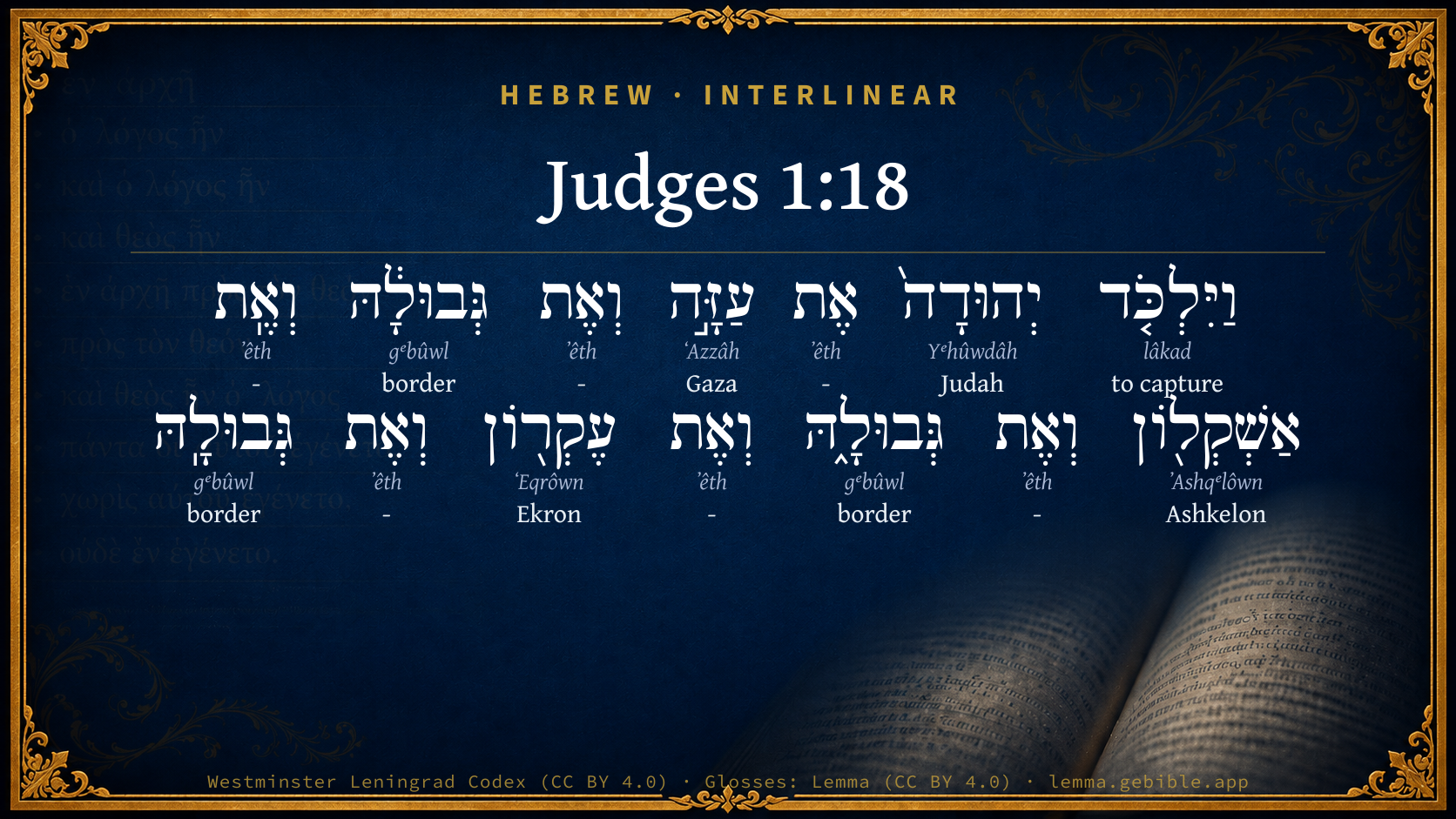
Hebrew (Westminster Leningrad Codex) Judges 1:18 appears in the Hebrew Old Testament. The text above is from the Westminster Leningrad Codex. Each word links to its Strong’s number, a concise gloss, and parsing drawn from the Open Scriptures Hebrew Bible morphology. Click any word for its full Brown-Driver-Briggs (BDB) entry.
Download image
Cite this verse

Judges 1:18 (World English Bible). Public Domain. Lemma interlinear Bible study tool, https://lemma.gebible.app/v/judges/1/18.

Show BibTeX & RIS
BibTeX
RIS
English Translation
Also Judah took Gaza with the border of it, and Ashkelon with the border of it, and Ekron with the border of it.
World English Bible · Public Domain
Highlights
  • 1 first appearance in the Hebrew Bible
Full analysis ↓
Download a study sheet

One document with this verse’s original text, its word-by-word gloss line, the meaning frame, cross-references with their text, attributed commentary, and full source and license credits — printable, and it pastes into notes with its structure intact.

This verse Autodidact and up

Study sheet (.html) Plain text (.txt)

A passage Seminary Student

Up to 50 verses in one chapter. A passage sheet keeps up to 6 commentary sources and 12 cross-references per verse, in the order this page ranks them, and says so on the sheet whenever that leaves anything out. Ask for a single verse and you get the Autodidact verse sheet above.

Everything on this page stays free to read, with no account — the sheet is a download of what is already on screen, not access to it.

Want to remove ads? Support Godless Engineer
Compare translations 3

The same verse in 3 English versions, stacked beneath the original-language interlinear above. Click any original word for its lexicon entry.

Each is an independent rendering of the whole verse — the interlinear is not word-aligned to these translations.

Highlighted words mark where these versions differ — a whole-verse word diff, not a word-by-word alignment.

  • World English Bible Public Domain
    Also Judah took Gaza with the border of it, and Ashkelon with the border of it, and Ekron with the border of it.
  • King James Version Public Domain
    Also Judah took Gaza with the coast thereof, and Askelon with the coast thereof, and Ekron with the coast thereof.
  • unfoldingWord Literal Text CC BY-SA 4.0
    And Judah captured Gaza and the territory of it and Ashkelon and the territory of it and Ekron and the territory of it.

unfoldingWord Literal Text — © unfoldingWord, licensed CC BY-SA 4.0. Word-aligned USFM3 via Door43 (git.door43.org/unfoldingWord/en_ult).

Versions to compare (up to 4)

3 of 4 selected

Show all 18 translations

Every available English version of this verse, each an independent rendering of the whole verse.

  • World English Bible Public Domain
    Also Judah took Gaza with the border of it, and Ashkelon with the border of it, and Ekron with the border of it.
  • Berean Standard Bible Public Domain
    And Judah also captured Gaza, Ashkelon, and Ekron—each with its territory.
  • Majority Standard Bible Public Domain
    And Judah also captured Gaza, Ashkelon, and Ekron—each with its territory.
  • King James Version Public Domain
    Also Judah took Gaza with the coast thereof, and Askelon with the coast thereof, and Ekron with the coast thereof.
  • American Standard Version (1901) Public Domain
    Also Judah took Gaza with the border thereof, and Ashkelon with the border thereof, and Ekron with the border thereof.
  • Revised Version (1885) Public Domain
    Also Judah took Gaza with the border thereof, and Ashkelon with the border thereof, and Ekron with the border thereof.
  • Geneva Bible (1599) Public Domain
    Also Iudah tooke Azzah with the coasts thereof, and Askelon with the coasts thereof, and Ekron with the coastes thereof.
  • Douay-Rheims (1899) Public Domain
    And Juda took Gaza with its confines, and Ascalon and Accaron with their confines.
  • Young's Literal Translation Public Domain
    And Judah captureth Gaza and its border, and Askelon and its border, and Ekron and its border;
  • Literal Standard Version CC BY-SA 4.0
    And Judah captures Gaza and its border, and Askelon and its border, and Ekron and its border;
  • Unlocked Literal Bible CC BY-SA 4.0
    The people of Judah also captured Gaza and the land around it, Ashkelon and the land around it, and Ekron and the land around it.
  • unfoldingWord Literal Text CC BY-SA 4.0
    And Judah captured Gaza and the territory of it and Ashkelon and the territory of it and Ekron and the territory of it.
  • Darby Bible Public Domain
    Judah also took Gaza with its territory, and Ash'kelon with its territory, and Ekron with its territory.
  • World Messianic Bible Public Domain
    Also Judah took Gaza with its border, and Ashkelon with its border, and Ekron with its border.
  • Webster's Bible Public Domain
    Also Judah took Gaza with its border, and Askelon with its border, and Ekron with its border.
  • Free Bible Version CC BY-SA 4.0
    Judah also captured the towns of Gaza, Ashkelon, and Ekron, each with its surrounding territory.
  • Bible in Basic English Public Domain
    Then Judah took Gaza and its limit, and Ashkelon and its limit, and Ekron and its limit.
  • JPS Tanakh (1917) Public Domain
    Also Judah took Gaza with the border thereof, and Ashkelon with the border thereof, and Ekron with the border thereof.

Literal Standard Version (2020), Covenant Press — licensed CC BY-SA 4.0. Text via the HelloAO Bible API (eBible.org). Unlocked Literal Bible (unfoldingWord) — licensed CC BY-SA 4.0. Text via the HelloAO Bible API (eBible.org). unfoldingWord Literal Text — © unfoldingWord, licensed CC BY-SA 4.0. Word-aligned USFM3 via Door43 (git.door43.org/unfoldingWord/en_ult). Free Bible Version, Dr. Jonathan Gallagher — licensed CC BY-SA 4.0. Text via the HelloAO Bible API (eBible.org).

Word by word

More ways to search: Search by grammar → Find every occurrence → Compare this word →

Practice this passage: Drill this verse → Learn its vocabulary →

אַשְׁקְל֖וֹן
ʼAshqᵉlôwn
H831
“Ashkelon”
Noun, Proper
Part of Speech
Noun
Type
Proper
Full BDB Definition

Origin: probably from H8254 in the sense of weighing-place (i.e. mart)

TWOT: None

Askelon or Ashkelon = "the fire of infamy: I shall be weighed" - a maritime city of the Philistines, southwest of Jerusalem
  1. וַיִּלְכֹּ֤ד lâkad H3920 “and · to capture” Conjunction + Verb, Qal, Sequential Imperfect, 3rd Person, Masculine, Singular
  2. יְהוּדָה֙ Yᵉhûwdâh H3063 “Judah” Noun, Proper
  3. אֶת ʼêth H853 “-” Particle, Direct Object
  4. עַזָּ֣ה ʻAzzâh H5804 “Gaza” Noun, Proper
  5. וְאֶת ʼêth H853 “and · -” Conjunction + Particle, Direct Object
  6. גְּבוּלָ֔הּ gᵉbûwl H1366 “border · her” Noun, Common, Masculine, Singular, Construct + Suffix, Personal, 3rd Person, Feminine, Singular
  7. וְאֶֽת ʼêth H853 “and · -” Conjunction + Particle, Direct Object
  8. וְאֶת ʼêth H853 “and · -” Conjunction + Particle, Direct Object
  9. גְּבוּלָ֑הּ gᵉbûwl H1366 “border · her” Noun, Common, Masculine, Singular, Construct + Suffix, Personal, 3rd Person, Feminine, Singular
  10. וְאֶת ʼêth H853 “and · -” Conjunction + Particle, Direct Object
  11. עֶקְר֖וֹן ʻEqrôwn H6138 “Ekron” Noun, Proper
  12. וְאֶת ʼêth H853 “and · -” Conjunction + Particle, Direct Object
  13. גְּבוּלָֽהּ gᵉbûwl H1366 “border · her” Noun, Common, Masculine, Singular, Construct + Suffix, Personal, 3rd Person, Feminine, Singular

About this verse

These counts appear in no published source. They are computed here, from the morphology-tagged text and Lemma’s own curated glosses. What Lemma adds →

14
words
7
distinct lemmas
Historical
section

Notable vocabulary

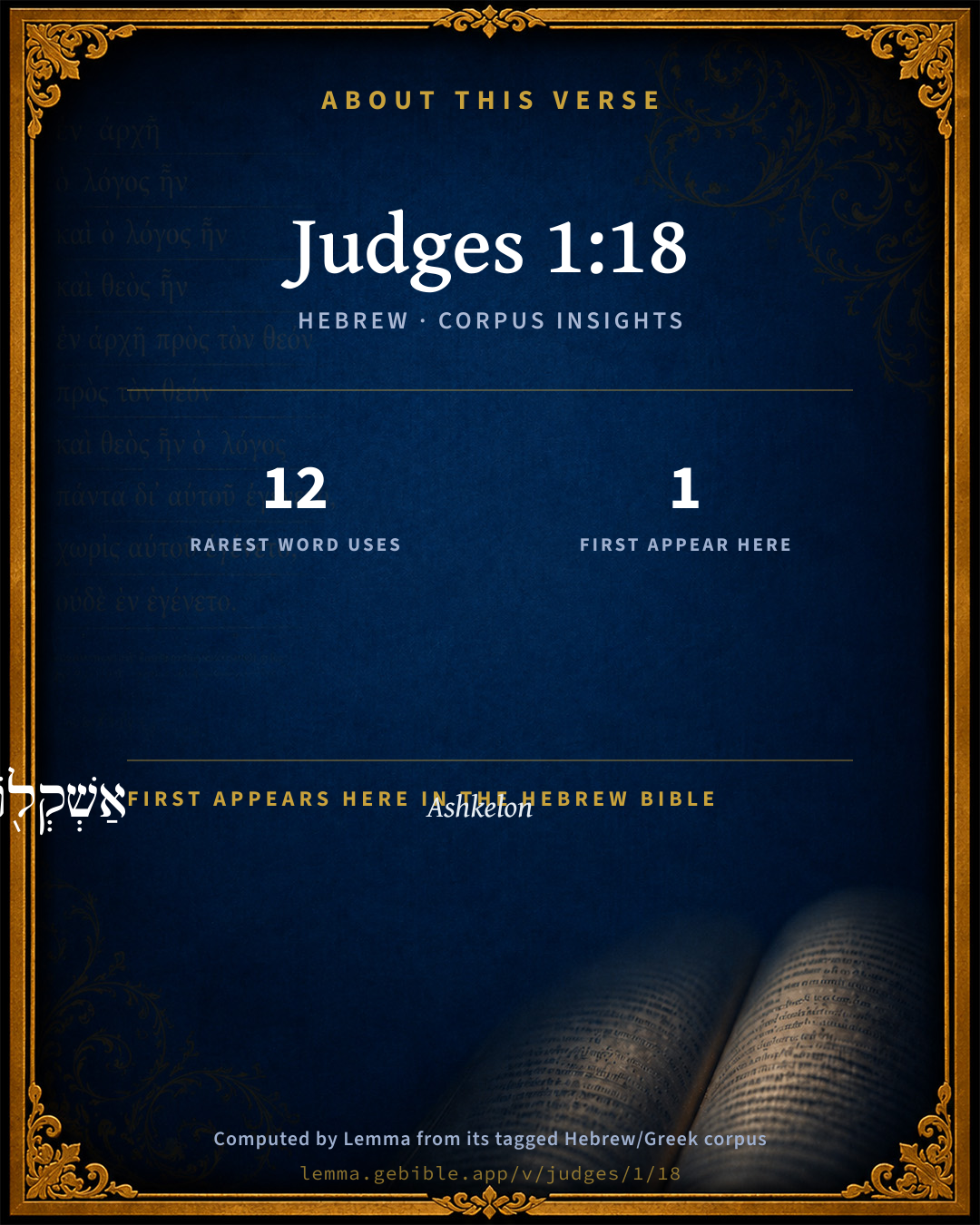
The rarest word here is אַשְׁקְל֖וֹן Ashkelon H831 — appearing just 12 times in the whole Hebrew Bible.

First appearance in Scripture

This word makes its first canonical appearance in the Hebrew Bible here:

  • אַשְׁקְל֖וֹן Ashkelon H831

Shared distinctive vocabulary

אַשְׁקְל֖וֹן Ashkelon H831 occurs in 11 verses of the Hebrew Bible. Also found in:

Grammatical profile

  • 1 verb
  • 7 nouns
  • 6 particles

Verb forms

  • וַיִּלְכֹּ֤ד Qal · Sequential Imperfect

Repetition

A word recurs within this verse — often emphatic in Hebrew:

  • גְּבוּלָ֔הּ border H1366 ×3

Hebrew & Septuagint length

In English translation the verse runs 23 words from the Hebrew and 26 from the Septuagint (LXX English) — closely comparable.

A rough comparison of the two English renderings, which tokenize alike — not a word-level alignment.

Word counts can differ between the Hebrew and the Greek without any difference in meaning — e.g. the Hebrew direct-object marker אֵת has no separate Greek word, and Greek often adds the article ὁ.

Cross-references

8

Topical passages linked to Judges 1:18 in the Treasury of Scripture Knowledge — connected by theme and wording, ordered by reader-vote popularity; previews shown in the World English Bible.

  • Joshua 11:22 There was none of the Anakim left in the land of the children of Israel: only in Gaza, in Gath, and in Ashdod, did some remain.
  • Judges 3:3 [namely], the five lords of the Philistines, and all the Canaanites, and the Sidonians, and the Hivites who lived on Mount Lebanon, from Mount Baal Hermon to the entrance of Hamath.
  • Exodus 23:31 I will set your border from the Red Sea even to the sea of the Philistines, and from the wilderness to the River; for I will deliver the inhabitants of the land into your hand, and you shall drive them out before you.
  • Joshua 13:3 from the Shihor, which is before Egypt, even to the border of Ekron northward, [which] is reckoned to the Canaanites; the five lords of the Philistines; the Gazites, and the Ashdodites, the Ashkelonites, the Gittites, and the Ekronites; also the Avvim,
  • Joshua 15:45–47 Ekron, with its towns and its villages;
  • Judges 16:1–2 Samson went to Gaza, and saw there a prostitute, and went in to her.
  • Judges 16:21 The Philistines laid hold on him, and put out his eyes; and they brought him down to Gaza, and bound him with fetters of brass; and he did grind in the prison-house.
  • 1 Samuel 6:17 These are the golden tumors which the Philistines returned for a trespass-offering to Yahweh: for Ashdod one, for Gaza one, for Ashkelon one, for Gath one, for Ekron one;

Cross-references courtesy of OpenBible.info (CC BY 4.0).

Hebrew and Greek witnesses Masoretic Hebrew ↔ Greek Septuagint

The same verse in the two great witnesses to the Old Testament, shown verse-for-verse.

These are two independent witnesses, not word-aligned to each other, and the Septuagint is shown in lemma (dictionary) form.

Hebrew Judges 1:18 Masoretic · Westminster Leningrad Codex

וַיִּלְכֹּ֤ד יְהוּדָה֙ אֶת עַזָּ֣ה וְאֶת גְּבוּלָ֔הּ וְאֶֽת אַשְׁקְל֖וֹן וְאֶת גְּבוּלָ֑הּ וְאֶת עֶקְר֖וֹן וְאֶת גְּבוּלָֽהּ

Also Judah took Gaza with the border of it, and Ashkelon with the border of it, and Ekron with the border of it.

World English Bible · Public Domain

Greek LXX Judges 1:18 Septuagint · lemma form

καί οὐ κληρονομέω ἰούδας ὁ γάζα οὐδέ ὁ ὅριον αὐτός οὐδέ ὁ ἀσκαλών οὐδέ ὁ ὅριον αὐτός οὐδέ ὁ ακκαρων οὐδέ ὁ ὅριον αὐτός οὐδέ ὁ ἄζωτος οὐδέ ὁ περισπόριον αὐτός

But Judas did not inherit Gaza nor her coasts, nor Ascalon nor her coasts, nor Accaron nor her coasts, nor Azotus nor the lands around it.

LXX2012 (modern English Septuagint) · Public Domain

On this verse, Adam Clarke's Commentary discusses the Septuagint’s reading. Read the note in Commentary ↓

Hebrew: Westminster Leningrad Codex (CC BY 4.0). Greek: Septuagint (public domain); English from LXX2012 (modern English Septuagint) (Public Domain). How the Septuagint differs from the Hebrew →

Targum (Aramaic paraphrase)

1

The Targum is the ancient Jewish Aramaic paraphrase of the Hebrew Scriptures — an interpretive translation, not the Hebrew text itself. Onkelos (literal) and Pseudo-Jonathan (expansive) render the Torah, and Jonathan the Prophets. Coverage is partial: where no permissively-licensed English translation exists for a verse, only the Aramaic is shown. This is verse-level text, not a word-by-word alignment to the Hebrew.

  1. Targum Jonathan Prophets (Joshua–Malachi)
    וּכְבַשׁ יְהוּדָה יַת עַזָה וְיַת תְּחוּמָא וְיַת אַשְׁקְלוֹן וְיַת תְּחוּמָא וְיַת עֶקְרוֹן וְיַת תְּחוּמָא:

    (no public-domain English translation for this verse)

    Targum Jonathan — Aramaic: “Mikraot Gedolot” (public domain). English: “Sefaria Community Translation” (CC0 1.0 (public-domain dedication)); “London "Chaldee Paraphrase," 1871” (public domain). Text via Sefaria.

Commentary

Notes on Judges 1:18 from classic Christian and Jewish commentators (each source and its license shown beneath its notes). The classic Christian expositions comment on the surrounding passage and are grouped to its opening verse, so a note may address several verses; the Jewish commentaries on the Tanakh (Rashi and others) are per-verse, so they appear only where the commentator wrote on this verse.

Lemma curates 59 commentaries, every one of them public domain or Creative Commons licensed, each selected and text-cleaned for this edition rather than reprinted as found. About our sources →

Trapp's Complete Commentary

John Trapp

Jdg 1:18 Also Judah took Gaza with the coast thereof, and Askelon with the coast thereof, and Ekron with the coast thereof.

Ver. 18. Also Judah took Gaza with the coast thereof.] But lost them again to the Philistines -

“ Non minor est virtus, quam quaerere, parta tueri. ”

18 How that they told you there should be mockers in the last time, who should walk after their own ungodly lusts.

Ver. 18. Mockers] Who fleer {a} when they should fear. {See Trapp on "2Pe 3:3"}

Who should walk after their ungodly lusts] Gr. the lusts of ungodliness, whereby the heart is turned away from God and godliness.

{a} To laugh mockingly or scornfully; to smile or grin contemptuously; hence, to gibe, jeer, sneer. ŒD

John Trapp, A Commentary or Exposition upon All the Books of the Old and New Testament (1647–1656) — public domain. Text from a community e-Sword module.

Joseph Benson's Commentary

Jdg 1:18. Judah also took Gaza, Askelon, and Ekron — These three cities were in the country of the Philistines, upon the sea-coast, and the Israelites did not hold them long before the Philistines recovered them again. For as the Israelites contented themselves with taking these cities, and making the people tributary without destroying them, it was not difficult for them to regain their liberty.

Joseph Benson's Commentary on the Old and New Testaments (1811–1818) — public domain. Text from a community e-Sword module.

Geneva Bible (1599)

Geneva Bible translators

These cities and others were afterward possessed of the Philistines, 1 Sam. 6:17.

Geneva Bible (1599) marginal notes — public domain. Text via Bolls.life.

Adam Clarke's Commentary

Verse 18. Judah took Gaza - and Askelon - and Ekron] There is a most remarkable variation here in the Septuagint; I shall set down the verse: Και ουκ εκληρονομησεν Ιουδας την Γαζαν, ουδε τα ὁρια αυτης· ουδε την Ασκαλωνα, ουδε τα ὁρια αυτης· και την Ακκαρων, ουδε τα ὁρια αυτης· την Αζωτον, ουδε τα περισπορια αυτης· και ην Κυριος μετα Ιουδα. "But Judah DID NOT possess Gaza, NOR the coast thereof; neither Askelon, nor the coasts thereof, neither Ekron, nor the coasts thereof; neither Azotus, nor its adjacent places: and the Lord was with Judah." This is the reading of the Vatican and other copies of the Septuagint: but the Alexandrian MS., and the text of the Complutensian and Antwerp Polyglots, agree more nearly with the Hebrew text. St. Augustine and Procopius read the same as, the Vatican MS.; and Josephus expressly says that the Israelites took only Askelon and Azotus, but did not take Gaza nor Ekron; and the whole history shows that these cities were not in the possession of the Israelites, but of the Philistines; and if the Israelites did take them at this time, as the Hebrew text states, they certainly lost them in a very short time after.

Adam Clarke's Commentary on the Bible (1810–1826) — public domain. Text from a community e-Sword/MySword module.

Ellicott's Commentary for English Readers

(18) Took Gaza . . . Askelon . . . Ekron.—Three of the five Philistian lordships, to which the LXX. add Ashdod (Azotus). In Jos_13:3 these five townships are mentioned as still unconquered, and here the LXX. put in a negative—“Judah did not inherit Gaza, nor,” &c. St. Augustine had the same reading. It is, however, possible that “not” may have been conjecturally added because of the apparent discrepancy between this passage and Jdg_3:8; or, again, “did not inherit” may be a sort of explanatory gloss on the “took.” Josephus (Antt. v. 2, § 4) says that Askelon and Ashdod were taken in the war, but that Gaza and Ekron escaped, because their situation in the plains enabled them to use their chariots; yet in 3, § 1, he says that the Canaanites re-conquered Askelon and Ekron. In any case, the conquest was very transitory. (See Jos_11:22; Jdg_3:3; Jdg_3:13 seq.)

A Bible Commentary for English Readers, edited by Charles John Ellicott (1878–1897) — public domain. Text from a community e-Sword module.

The Cambridge Bible for Schools and Colleges

gen. ed. J. J. S. Perowne

18. The statement that Judah captured three out of the five chief cities of the Philistines cannot be reconciled with any ancient tradition; it contradicts the next verse and Jdg_3:3, Jos_13:2 f.; it represents the unhistorical theory of the conquest which is found in Jdg_1:4; Jdg_1:8-9, and like them must be regarded as the work of a late redaction. The LXX reads ‘and Judah did not dispossess’ (a different word from ‘took’), and other versions insert the negative; this seems to get over the difficulty; but the LXX version here has little critical value. The expression ‘with the border thereof,’ instead of ‘and the daughters thereof’ (Jdg_1:27), betrays a different hand.

The Cambridge Bible for Schools and Colleges (gen. ed. J. J. S. Perowne; Cambridge University Press, 1878–1918) — public domain. Text from a community e-Sword module.

John Gill's Exposition

Also Judah took Gaza, with the coast thereof,.... Which by lot fell to that tribe, Jos 15:47; it was not till now subdued:

and Ashkelon with the coast thereof; which, according to our countryman Sandys (q), was ten miles from Gaza:

and Ekron with the coast thereof; this also is the lot that fell to Judah, but was afterwards given to the tribe of Dan, Jos 15:45; for whom Judah now fought and took it; but in a short time all these places were retaken, and possessed by the Philistines, and were three of their five principalities which they ever after retained, see Jdg 3:3.

(q) Travels, p. 118. Ed. 5.

John Gill's Exposition of the Whole Bible (1746–1763) — public domain (CC PDM 1.0). Text via the HelloAO Bible API.

Albert Barnes' Notes on the Bible

It is remarkable that Ashdod is not here mentioned, as it is in Jos 15:46-47, in conjunction with Gaza and Ekron; but that Askelon, which is not in the list of the cities of Judah at all, is named in its stead. (See Jos 13:3 note.) It is a curious fact that when Rameses III took Askelon it was occupied, not by Philistines, but apparently by Hebrews. Rameses began to reign in 1269 B.C., and reigned 25 years. At any time between 1269 and 1244 B.C. such occupation of Askelon by Hebrews agrees with the Book of Judges.

Albert Barnes' Notes on the Bible (1834–1885) — public domain. Text from a community e-Sword/MySword module.

Haydock's Catholic Bible Commentary

Gaza, &c. These were three of the principal cities of the Philistines, famous both in sacred and profane history. They were taken at this time by the Israelites; but as they took no care to put garrisons in them, the Philistines soon recovered them again, (Challoner) or perhaps the villages and territory were only seized by Juda; the cities being too well defended. Josue had not attacked them, Josue xii. 3. Josephus says that only Ascalon and Azotus, in the plain, fell into the hands of the Israelites; and the Roman Septuagint reads with a negation, (Calmet) which is inserted by Grabe in his edition as an interpolation, or as a peculiarity of the Alexandrian manuscripts, "and Juda did (not) possess Gaza with its dependencies, and Ascalon....and Accaron....and Azotus, with its fields around." (Haydock) --- The situation of Gaza, Ascalon and Accaron in the plain, would seem to secure them from being captured, ver. 19. St. Augustine and Procopius admit the negation. But the original and all the versions reject it, so that the children of Juda must have had possession of these cities at least for a short time. (Calmet) See chap. xv., and xvi., and 1 Kings vi. 17. (Menochius)

George Leo Haydock (1774–1849), Haydock's Catholic Family Bible and Commentary, 1859 edition — public domain. Excludes Psalms (Douay-Rheims chapter numbering differs from Protestant) and Deuterocanonical books (Catholic canon only).

Matthew Poole's English Annotations

The principal cities of the Philistines.

Quest. How could this be, when among the people left to try Israel, are the five lords of the Philistines, Jdg 3:3.

Answ. It is only said that they took the cities, and probably contented themselves with making them tributary; but it is not said that they slew the people, as they ought to have done, and as it is said of the other cities here, Jdg 1:5,8,17,25. And the people being thus spared, did by God’s just judgement recover their strength, and expel the Jews out of their cities, as we find afterwards. It is further observable, that Ekron here taken was one of Dan’s cities, Jos 19:43, and it was attempted and taken here by Judah and Simeon, partly out of love to their brother Dan, and partly to secure their new conquests, and other adjoining territories, from such potent neighbours.

Matthew Poole's English Annotations on the Holy Bible (1683–1685) — public domain. Text from a community e-Sword/MySword module.

Whedon's Commentary on the Bible

Daniel D. Whedon

18. Gaza — See note on Jos_10:41. For Ashkelon and Ekron see on Jos_13:3. Since these cities lay in the great Philistine plain, some have thought this verse contradicts the verse following, in which it is said that Judah was unable to drive out the inhabitants of the valley. Accordingly the Septuagint reads: “Judah did not inherit Gaza and her borders, nor Ashkelon and her borders, nor Ekron and her borders, nor Azotus and her suburbs.” But this emendation is unnecessary, for to take these cities and their coasts by storm (לכד) is not inconsistent with a failure to drive out all the inhabitants of the valley, and take permanent possession of their coasts.

Daniel D. Whedon (gen. ed.), Commentary on the Old and New Testaments (1874–1909) — public domain. Text from a community e-Sword module.

The Pulpit Commentary

Gaza, etc. Gaza, Askelon, and Ekron, were all cities of the Philistines. But though Judah took these cities, it seems he was not able permanently to expel the inhabitants.

The Pulpit Commentary (1880–1919), ed. H.D.M. Spence-Jones & Joseph S. Exell — public domain. Text from a community e-Sword module.

John Wesley's Explanatory Notes

Judah took - It is only said, they took the cities, and probably contented themselves with making them tributary; but it is not said that they slew the people, as they ought to have done; and as it is said of the other cities here. And the people being thus spared, did by God's just judgment recover their strength, and expel the Jews out of their cities. It is farther observable, that Ekron here taken, was one of Dan's cities, ver. 43, and it was taken here by Judah and Simeon, partly out of love for their brother Daniel, and partly to secure their new conquests, and other adjoining territories, from such potent neighbours.

John Wesley, Explanatory Notes Upon the Whole Bible (1754–1765) — public domain. Text via the GEBible commentary corpus.

unfoldingWord translationNotes

Door43 World Missions Community

Yahweh was with the people of Judah

Here "was with" means that Yahweh helped the people of Judah. (See: Idiom)

plains

a very large area of level, treeless ground

translationWords

people group

Judah

Gaza

Ashkelon

Ekron

Yahweh

chariot

unfoldingWord translationNotes — © Distant Shores Media and the Door43 World Missions Community, licensed CC BY-SA 4.0. Source: git.door43.org/Door43/en_tn.

Lesson kit

Teaching starters — assembled from the data on this page, not authored interpretation. Every prompt links to the verse data it draws on. Edit before teaching.

Judges, in the Historical, opens this verse with 14 words (7 distinct Hebrew lemmas). Its most distinctive word is ʼAshqᵉlôwn (“Ashkelon”). A historical commentator’s framing appears above. Read the whole chapter for the surrounding context.

Discussion questions

  1. How does “Ashkelon” (ʼAshqᵉlôwn) shape what this verse is saying?
  2. The word “Ashkelon” first appears here in Scripture. What is being introduced at this debut?
  3. Judges 14:19 shares the word «Ashkelon» with this verse. How do the two illuminate each other?
  4. “border” occurs 3× in this one verse. What is the effect of the repetition?
  5. These translations render this verse differently. What is at stake in choosing one wording over another?
  6. The verb «וַיִּלְכֹּ֤ד» is Qal Sequential Imperfect. How does its form color the action?
  7. Reading how Trapp's Complete Commentary and Joseph Benson's Commentary read this verse, where do the two commentators agree and where do they part?

Things to notice

  • 1 word makes its first canonical appearance in Scripture here.
  • These translations choose different wording for 9 words in this verse.
  • “border” occurs 3× in this single verse.
  • 7 distinct Hebrew lemmas span 14 words in this verse.

Reading settings

Reading text

Shown beneath each verse's original-language words.

Old Testament
Old Testament edition

Read the OT as the Masoretic Hebrew (MT) or the Greek Septuagint (LXX).

English shown for the Greek Septuagint (in the Hebrew ↔ Greek comparison).

Comparing translations? Open the Compare panel on any verse page to stack up to four side by side.