
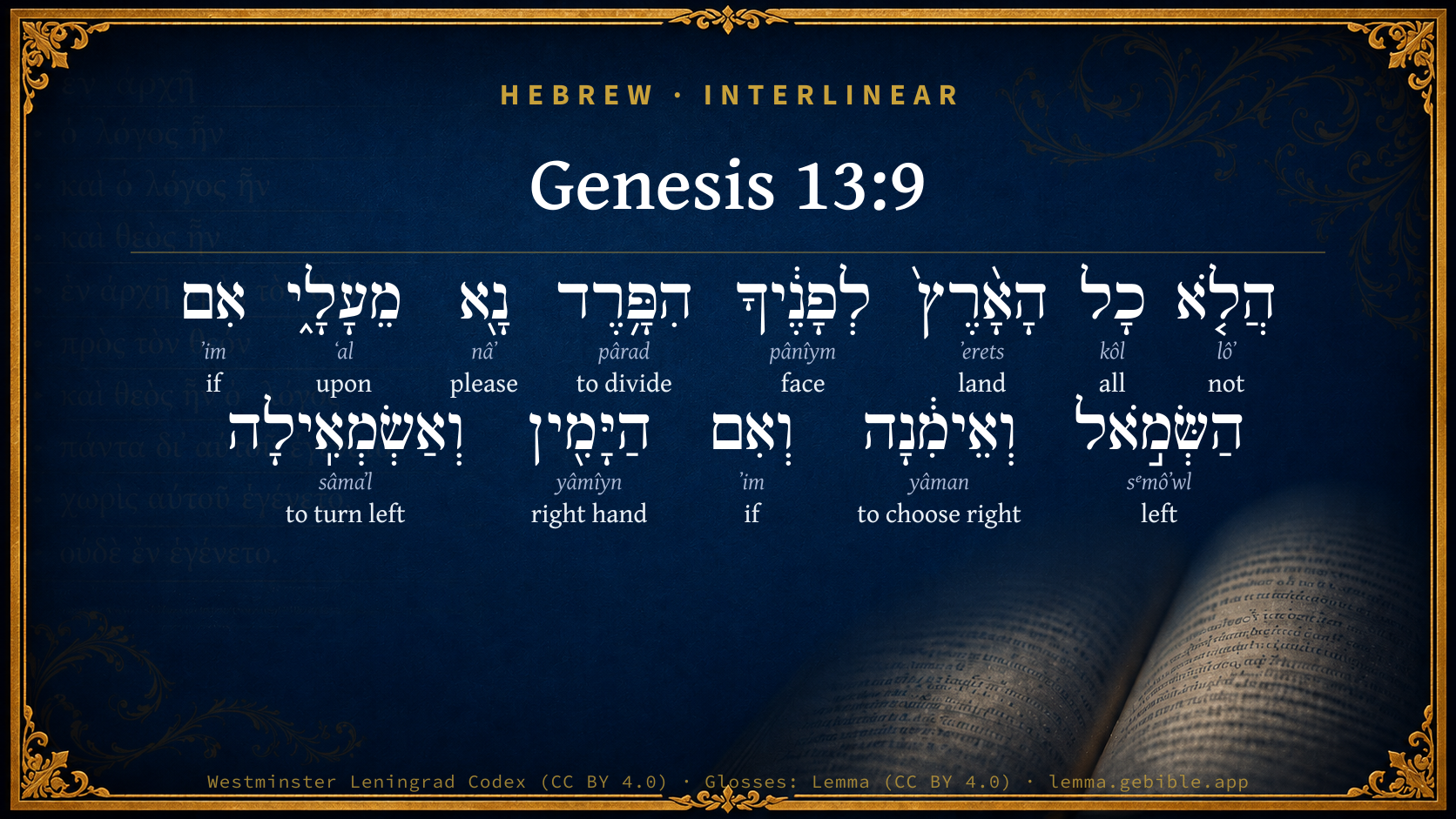
Genesis 13:9

Hebrew (Westminster Leningrad Codex) Genesis 13:9 appears in the Hebrew Old Testament. The text above is from the Westminster Leningrad Codex. Each word links to its Strong’s number, a concise gloss, and parsing drawn from the Open Scriptures Hebrew Bible morphology. Click any word for its full Brown-Driver-Briggs (BDB) entry.
Download image
Cite this verse

Genesis 13:9 (World English Bible). Public Domain. Lemma interlinear Bible study tool, https://lemma.gebible.app/v/genesis/13/9.

Show BibTeX & RIS
BibTeX
RIS
English Translation
Isn't the whole land before you? Please separate yourself from me. If you go to the left hand, then I will go to the right. Or if you go to the right hand, then I will go to the left."
World English Bible · Public Domain
Highlights
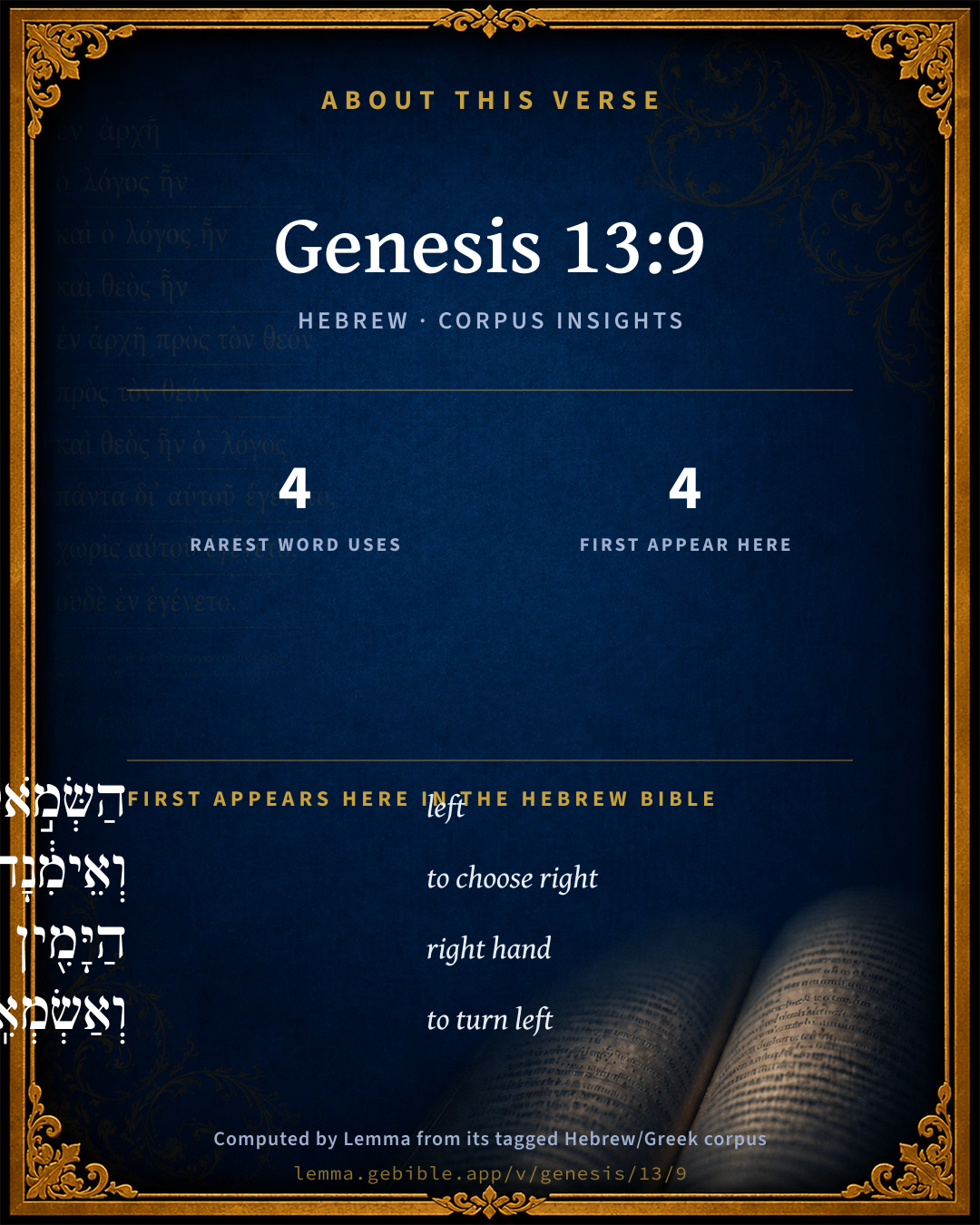
  • 4 first appearances in the Hebrew Bible
Full analysis ↓
Download a study sheet

One document with this verse’s original text, its word-by-word gloss line, the meaning frame, cross-references with their text, attributed commentary, and full source and license credits — printable, and it pastes into notes with its structure intact.

This verse Autodidact and up

Study sheet (.html) Plain text (.txt)

A passage Seminary Student

Up to 50 verses in one chapter. A passage sheet keeps up to 6 commentary sources and 12 cross-references per verse, in the order this page ranks them, and says so on the sheet whenever that leaves anything out. Ask for a single verse and you get the Autodidact verse sheet above.

Everything on this page stays free to read, with no account — the sheet is a download of what is already on screen, not access to it.

Want to remove ads? Support Godless Engineer
Compare translations 3

The same verse in 3 English versions, stacked beneath the original-language interlinear above. Click any original word for its lexicon entry.

Each is an independent rendering of the whole verse — the interlinear is not word-aligned to these translations.

Highlighted words mark where these versions differ — a whole-verse word diff, not a word-by-word alignment.

  • World English Bible Public Domain
    Isn't the whole land before you? Please separate yourself from me. If you go to the left hand, then I will go to the right. Or if you go to the right hand, then I will go to the left."
  • King James Version Public Domain
    Is not the whole land before thee? separate thyself, I pray thee, from me: if thou wilt take the left hand, then I will go to the right; or if thou depart to the right hand, then I will go to the left.
  • unfoldingWord Literal Text CC BY-SA 4.0
    Is not the whole land before you? Please separate from me. If the left, then I will go right, or if the right, then I will go left.”

unfoldingWord Literal Text — © unfoldingWord, licensed CC BY-SA 4.0. Word-aligned USFM3 via Door43 (git.door43.org/unfoldingWord/en_ult).

Versions to compare (up to 4)

3 of 4 selected

Show all 18 translations

Every available English version of this verse, each an independent rendering of the whole verse.

  • World English Bible Public Domain
    Isn't the whole land before you? Please separate yourself from me. If you go to the left hand, then I will go to the right. Or if you go to the right hand, then I will go to the left."
  • Berean Standard Bible Public Domain
    Is not the whole land before you? Now separate yourself from me. If you go to the left, I will go to the right; if you go to the right, I will go to the left.”
  • Majority Standard Bible Public Domain
    Is not the whole land before you? Now separate yourself from me. If you go to the left, I will go to the right; if you go to the right, I will go to the left.”
  • King James Version Public Domain
    Is not the whole land before thee? separate thyself, I pray thee, from me: if thou wilt take the left hand, then I will go to the right; or if thou depart to the right hand, then I will go to the left.
  • American Standard Version (1901) Public Domain
    Is not the whole land before thee? separate thyself, I pray thee, from me. If `thou wilt take' the left hand, then I will go to the right. Or if `thou take' the right hand, then I will go to the left.
  • Revised Version (1885) Public Domain
    Is not the whole land before thee? separate thyself, I pray thee, from me: if thou wilt take the left hand, then I will go to the right; or if thou take the right hand, then I will go to the left.
  • Geneva Bible (1599) Public Domain
    Is not the whole land before thee? depart I pray thee from me: if thou wilt take the left hand, then I will goe to the right: or if thou goe to the right hand, then I will take the left.
  • Douay-Rheims (1899) Public Domain
    Behold the whole land is before thee: depart from me I pray thee: if thou wilt go to the left hand, I will take the right: if thou choose the right hand, I will pass to the left.
  • Young's Literal Translation Public Domain
    Is not all the land before thee? be parted, I pray thee, from me; if to the left, then I to the right; and if to the right, then I to the left.'
  • Literal Standard Version CC BY-SA 4.0
    Is not all the land before you? Please be parted from me; if to the left, then I to the right; and if to the right, then I to the left.”
  • Unlocked Literal Bible CC BY-SA 4.0
    Is not the whole land before you? Go ahead and separate yourself from me. If you go to the left, then I will go to the right. Or if you go to the right, then I will go to the left.”
  • unfoldingWord Literal Text CC BY-SA 4.0
    Is not the whole land before you? Please separate from me. If the left, then I will go right, or if the right, then I will go left.”
  • Darby Bible Public Domain
    Is not the whole land before thee? Separate thyself, I pray thee, from me: if to the left, then I will take the right; and if to the right, then I will take the left.
  • World Messianic Bible Public Domain
    Isn’t the whole land before you? Please separate yourself from me. If you go to the left hand, then I will go to the right. Or if you go to the right hand, then I will go to the left.”
  • Webster's Bible Public Domain
    Is not the whole land before thee? Separate thyself, I pray thee, from me: if thou wilt take the left hand, then I will go to the right; or if thou wilt depart to the right hand, then I will go to the left.
  • Free Bible Version CC BY-SA 4.0
    You see all this land that's available right in front of you? We have to split up. If you choose to go to the left, I'll go to the right. If you choose to go to the right, I'll go to the left.”
  • Bible in Basic English Public Domain
    Is not all the land before you? then let us go our separate ways: if you go to the left, I will go to the right; or if you take the right, I will go to the left.
  • JPS Tanakh (1917) Public Domain
    Is not the whole land before thee? separate thyself, I pray thee, from me; if thou wilt take the left hand, then I will go to the right; or if thou take the right hand, then I will go to the left.'

Literal Standard Version (2020), Covenant Press — licensed CC BY-SA 4.0. Text via the HelloAO Bible API (eBible.org). Unlocked Literal Bible (unfoldingWord) — licensed CC BY-SA 4.0. Text via the HelloAO Bible API (eBible.org). unfoldingWord Literal Text — © unfoldingWord, licensed CC BY-SA 4.0. Word-aligned USFM3 via Door43 (git.door43.org/unfoldingWord/en_ult). Free Bible Version, Dr. Jonathan Gallagher — licensed CC BY-SA 4.0. Text via the HelloAO Bible API (eBible.org).

Word by word

More ways to search: Search by grammar → Find every occurrence → Compare this word →

Practice this passage: Drill this verse → Learn its vocabulary →

וְאֵימִ֔נָה
yâman
H3231
“and · to choose right”
Conjunction + Verb, Hiphil, Cohortative, 1st Person, Common, Singular
Part of Speech
Conjunction + Verb
Stem
Hiphil
Form
Cohortative
Person
1st Person
Gender
Common
Number
Singular
Full BDB Definition

Origin: a primitive root

TWOT: 872c

(Hiphil) to choose the right, go to the right, use the right hand, be right handed
  1. הֲלֹ֤א lôʼ H3808 “not” Particle, Interrogative + Particle, Negative
  2. כָל kôl H3605 “all of” Noun, Common, Masculine, Singular, Construct
  3. הָאָ֨רֶץ֙ ʼerets H776 “the · land” Particle, Definite Article + Noun, Common, Both, Singular, Absolute
  4. לְפָנֶ֔יךָ pânîym H6440 “to/for · face(s) · your” Preposition + Noun, Common, Both, Plural, Construct + Suffix, Personal, 2nd Person, Masculine, Singular
  5. הִפָּ֥רֶד pârad H6504 “divide” Verb, Niphal, Imperative, 2nd Person, Masculine, Singular
  6. נָ֖א nâʼ H4994 “please” Particle, Exhortation
  7. מֵעָלָ֑י ʻal H5921 “from · upon · me” Preposition + Preposition + Suffix, Personal, 1st Person, Common, Singular
  8. אִם ʼim H518 “if” Conjunction
  9. הַשְּׂמֹ֣אל sᵉmôʼwl H8040 “the · left” Particle, Definite Article + Noun, Common, Masculine, Singular, Absolute
  10. וְאִם ʼim H518 “and · if” Conjunction + Conjunction
  11. הַיָּמִ֖ין yâmîyn H3225 “the · right hand” Particle, Definite Article + Noun, Common, Feminine, Singular, Absolute
  12. וְאַשְׂמְאִֽילָה sâmaʼl H8041 “and · to turn left” Conjunction + Verb, Hiphil, Cohortative, 1st Person, Common, Singular

About this verse

These counts appear in no published source. They are computed here, from the morphology-tagged text and Lemma’s own curated glosses. What Lemma adds →

13
words
12
distinct lemmas
Pentateuch
section

Notable vocabulary

The rarest word here is וְאֵימִ֔נָה to choose right H3231 — appearing just 4 times in the whole Hebrew Bible.

First appearance in Scripture

These words make their first canonical appearance in the Hebrew Bible here:

  • הַשְּׂמֹ֣אל left H8040
  • וְאֵימִ֔נָה to choose right H3231
  • הַיָּמִ֖ין right hand H3225
  • וְאַשְׂמְאִֽילָה to turn left H8041

Shared distinctive vocabulary

וְאֵימִ֔נָה to choose right H3231 occurs in 4 verses of the Hebrew Bible. Also found in:

Grammatical profile

  • 3 verbs
  • 5 nouns
  • 1 preposition
  • 2 conjunctions
  • 2 particles

Verb forms

  • הִפָּ֥רֶד Niphal · Imperative
  • וְאֵימִ֔נָה Hiphil · Cohortative
  • וְאַשְׂמְאִֽילָה Hiphil · Cohortative

Repetition

A word recurs within this verse — often emphatic in Hebrew:

  • אִם if H518 ×2

Hebrew & Septuagint length

In English translation the verse runs 40 words from the Hebrew and 37 from the Septuagint (LXX English) — closely comparable.

A rough comparison of the two English renderings, which tokenize alike — not a word-level alignment.

Word counts can differ between the Hebrew and the Greek without any difference in meaning — e.g. the Hebrew direct-object marker אֵת has no separate Greek word, and Greek often adds the article ὁ.

Cross-references

8

Topical passages linked to Genesis 13:9 in the Treasury of Scripture Knowledge — connected by theme and wording, ordered by reader-vote popularity; previews shown in the World English Bible.

  • Genesis 20:15 Abimelech said, "Behold, my land is before you. Dwell where it pleases you."
  • Genesis 34:10 You shall dwell with us: and the land will be before you. Live and trade in it, and get possessions in it."
  • Hebrews 12:14 Follow after peace with all men, and the sanctification without which no man will see the Lord,
  • 1 Peter 3:8–12 Finally, be all like-minded, compassionate, loving as brothers, tenderhearted, courteous,
  • Psalms 120:7 I am for peace, But when I speak, they are for war.
  • Romans 12:18 If it is possible, as much as it is up to you, be at peace with all men.
  • 1 Corinthians 6:7 Therefore it is already altogether a defect in you, that you have lawsuits one with another. Why not rather be wronged? Why not rather be defrauded?
  • James 3:13–18 Who is wise and understanding among you? Let him show by his good conduct that his deeds are done in gentleness of wisdom.

Cross-references courtesy of OpenBible.info (CC BY 4.0).

Hebrew and Greek witnesses Masoretic Hebrew ↔ Greek Septuagint

The same verse in the two great witnesses to the Old Testament, shown verse-for-verse.

These are two independent witnesses, not word-aligned to each other, and the Septuagint is shown in lemma (dictionary) form.

Hebrew Genesis 13:9 Masoretic · Westminster Leningrad Codex

הֲלֹ֤א כָל הָאָ֨רֶץ֙ לְפָנֶ֔יךָ הִפָּ֥רֶד נָ֖א מֵעָלָ֑י אִם הַשְּׂמֹ֣אל וְאֵימִ֔נָה וְאִם הַיָּמִ֖ין וְאַשְׂמְאִֽילָה

Isn't the whole land before you? Please separate yourself from me. If you go to the left hand, then I will go to the right. Or if you go to the right hand, then I will go to the left."

World English Bible · Public Domain

Greek LXX Genesis 13:9 Septuagint · lemma form

οὐ ἰδού πᾶς ὁ γῆ ἐναντίον σύ εἰμί διαχωρίζω ἀπό ἐγώ εἰ σύ εἰς ἀριστερός ἐγώ εἰς δεξιός εἰ δέ σύ εἰς δεξιός ἐγώ εἰς ἀριστερός

Behold! is not the whole land before you? Separate yourself from me; if you go to the left, I will go to the right, and if you go to the right, I will go to the left.

LXX2012 (modern English Septuagint) · Public Domain

Hebrew: Westminster Leningrad Codex (CC BY 4.0). Greek: Septuagint (public domain); English from LXX2012 (modern English Septuagint) (Public Domain). How the Septuagint differs from the Hebrew →

Targum (Aramaic paraphrase)

2

The Targum is the ancient Jewish Aramaic paraphrase of the Hebrew Scriptures — an interpretive translation, not the Hebrew text itself. Onkelos (literal) and Pseudo-Jonathan (expansive) render the Torah, and Jonathan the Prophets. Coverage is partial: where no permissively-licensed English translation exists for a verse, only the Aramaic is shown. This is verse-level text, not a word-by-word alignment to the Hebrew.

  1. Targum Onkelos Torah (Genesis–Deuteronomy)
    הֲלָא כָל אַרְעָא קֳדָמָךְ אִתְפָּרַשׁ כְּעַן מִלְוָתִי אִם אַתְּ לְצִפּוּנָא וַאֲנָא לְדָרוֹמָא וְאִם אַתְּ לְדָרוֹמָא וַאֲנָא לְצִפּוּנָא

    Is not all the land before thee? Separate now from me: if thou to the north, I to the south; and if thou to the south, I to the north.

    Targum Onkelos — Aramaic: “Onkelos Genesis” (public domain); “Onkelos Exodus” (public domain); “Onkelos Leviticus” (public domain); “Onkelos Numbers” (public domain); “Onkelos Deuteronomy” (public domain). English: “Sefaria Community Translation” (CC0 1.0 (public-domain dedication)); “J.W. Etheridge. The Targums of Onkelos and Jonathan Ben Uzziel on the Pentateuch. London: Longmans, Green, 1862” (public domain). Text via Sefaria.

  2. Targum Pseudo-Jonathan Torah (Genesis–Deuteronomy)
    הֲלָא כָל אַרְעָא קֳדָמָךְ אִתְפָּרַשׁ כְּדוּן מִינִי אִם אַנְתְּ לְצִיפוּנָא וַאֲנָא לְדָרוֹמָא אִם אַנְתְּ לְדָרוֹמָא וַאֲנָא לְצִיפּוּנָא

    Is not all the land before thee? Separate then from me. If thou to the north, I to the south: if thou to the south, I to the north.

    Targum Pseudo-Jonathan — Aramaic: “Targum Jonathan on Genesis” (public domain); “Targum Jonathan on Exodus” (public domain); “Targum Jonathan on Leviticus” (public domain); “Targum Jonathan on Numbers” (public domain); “Targum Jonathan on Deuteronomy” (public domain). English: “The Targum of Jonathan ben Uzziel, trans. J. W. Etheridge, London, 1862” (public domain). Text via Sefaria.

Commentary

Notes on Genesis 13:9 from classic Christian and Jewish commentators (each source and its license shown beneath its notes). The classic Christian expositions comment on the surrounding passage and are grouped to its opening verse, so a note may address several verses; the Jewish commentaries on the Tanakh (Rashi and others) are per-verse, so they appear only where the commentator wrote on this verse.

Lemma curates 59 commentaries, every one of them public domain or Creative Commons licensed, each selected and text-cleaned for this edition rather than reprinted as found. About our sources →

Trapp's Complete Commentary

John Trapp

Gen 13:9 [Is] not the whole land before thee? separate thyself, I pray thee, from me: if [thou wilt take] the left hand, then I will go to the right; or if [thou depart] to the right hand, then I will go to the left.

Ver. 9. Is not the whole land before thee?] Abram chooseth rather to take wrong, than to strive for his right, which he here parts with for peace’s sake. They that do otherwise, though they think they do bravely, and get the better of their adversary, yet (if St Paul may judge) they sit down by the loss. For he purposely disgraceth their contentious courses, in standing for their utmost right, without respect to peace and quietness, by a word (ηττημα) that signifieth disgrace, or loss of victory: - "Now therefore there is utterly a fault," or a defect of true manhood, "amongst you, because ye go to law one with another; why do ye not rather take wrong? why do ye not rather suffer yourselves to be defrauded?" {1Co 6:7} Aristotle {a} by the dim light of nature, could see and say, that it is better to suffer wrong than do it. It was a brave speech of Calvin: "Though Luther call me devil, yet I will honour him as a servant of God." And when a fierce friar, in dispute with Beza and his colleagues, called them foxes, apes, asses, &c., Beza answered no more but this, Nos non magis credere, quam Transubstantionem. In rixa is inferior est, qui victor est , saith Basil. And Demosthenes when he was reproached by one, thought it sufficient to say, Nolim tecum in hoc genus certaminis descendere, in quo qui vincitur ipso victore est melior .

Separate thyself, I pray thee, from me.] Sometimes, and between some natures, separation one from another better nourisheth friendship than nearer familiarity. {b} There are, that can never agree together.

If thou wilt take the right hand, &c.] As who should say; We will not be far apart, though we cannot be together; but still helpful one to the other, as the right hand is to the left. {c}

{a} Aδικεισθαι η αδικειν, Ethic.

{b} Interdum disiunctio melius alit amicitiam ,& c. - Bucholc.

{c} Pererius.

John Trapp, A Commentary or Exposition upon All the Books of the Old and New Testament (1647–1656) — public domain. Text from a community e-Sword module.

The Biblical Illustrator

Joseph S. Exell

Gen_13:9

Is not the whole land before thee?

--

The goodly land in prospect

In many respects the earthly Canaan was typical of the heavenly. The heavenly Canaan is--

I. A LAND OF PROMISE (1Jn_2:25; Rev_21:7; Rev_22:14).

II. A LAND OF LIFE (1Jn_3:15; Rev_21:4).

III. A LAND OF LIGHT (Rev_22:5).

IV. A LAND OF PLENTY (Rev_7:16; Rev_22:2).

V. A LAND OF FELICITY AND JOY. This joy will be complete; perfect, full, everlasting (Psa_16:11; Isa_35:10). Application:

1. Have I a title clear to heaven?

2. The way to eternal life open to all.

3. Jesus Christ is the way, the living way, the only way.

4. As human life is so uncertain, all should strive at once to make a full preparation, and seek to get that meekness requisite for the inheritance of the saints in light. (H. Dingley.)

Abrams proposal to Lot

I. THIS PROPOSAL SHOWS THAT A GOOD MAN LOVES PEACE RATHER THAN WEALTH.

1. Because strife hardens the heart.

2. Because strife destroys a mans happiness.

3. Because strife hinders ones spiritual progress.

II. THAT A GOOD MAN HAS CONFIDENCE IN THE RULER OF THE UNIVERSE.

1. Abraham had confidence in Gods wisdom.

2. He had confidence in Gods love.

III. THAT A GOOD MAN HAS HIGHER INTERESTS THAN WORLDLY PROSPERITY. (Homilist.)

A peaceable spirit

I. HOW DESIRABLE A THING IT IS TO LIVE IN PEACE WITH OTHERS. We are commanded to live at peace. Contention undermines the welfare of all.

II. THERE ARE ALWAYS SOME MEANS OF MAINTAINING PEACE. Unselfish yielding of rightful claims. A friendly separation need be no schism. (F. Hastings.)

Magnanimity of Abraham

1. How different he might have acted. The whole land was his. He was most powerful and wealthy. He might have decided without consulting Lot, and simply have announced his decision. How many would have stood on their dignity, and vindicated their rights.

2. See what he did. Took his nephew to a rising ground, whence the whole land might be seen. Offered him the first choice. Was willing to abide by Lots decision, and take what he left.

3. This was the result of a peaceful spirit and a firm faith in God. (J. C. Gray.)

The excellence of a peaceable disposition, exemplified in the conduct of Abraham towards Lot

I. WE PROPOSE TO CONSIDER THE FACTS RECORDED. The conduct of these two good men, on the occasion to which the text refers, had certainly many shades of difference. In the one, the religious principle was in lively and adapted operation, it governed the passions, and its effects engage our approbation; in the other, that principle seems to have lain dormant, while feelings of jealousy or ambition appear for a time to have controlled the heart; their fruit however was disappointment and sorrow. We feel no difficulty in knowing which to condemn and which to censure; but if the conduct of Abraham be deemed so worthy of admiration, let us imitate; if the conduct of Lot be deemed improper, let us avoid following his example. Such should be our aim and our practice in reading the excellences or the defects of men.

II. LET US DEDUCE SOME PRACTICAL INFERENCES FOR THE PURPOSE OF PERSONAL APPLICATION.

1. We may learn how honourable and happy it is to be a promoter of peace.

2. Let us cultivate the dispositions necessary to be exercised in preserving or promoting peace; particularly that meekness which is careful not to take offence, and which is as mindful not to give offence.

3. We may learn the danger of judging merely from appearances, and of preferring what is great or splendid in circumstances, to those situations in life which are friendly to religious improvement. This Lot does not seem sufficiently to have regarded.

4. We may ascertain with what confidence we may commit our temporal interests to the care and goodness of providence, while we are walking in the path of holy obedience. If true religion guide us, it will be found that her ways are pleasantness and peace. Those who honour God He will honour. (Essex Remembrancer.)

Abrahams disinterestedness

Many good reasons might have been given by Abraham for claiming the first right of choice for himself. For one thing, he was the older man, and naturally might have expected that Lot would defer to him. For another thing, he might have reminded Lot that it was not he who had accompanied Lot, but Lot who had accompanied him, when together they had left their Chaldean home, and might have insisted that, simply on that ground, it was Lots place to yield the preference to him. But no! he gave up all such claims of priority, and in a manner at once chivalrous and disinterested said, Is not the whole land before thee? Now, when we ask how Abraham came to act in this way, we see at once that his conduct was the outgrowth of his faith in God. For observe, in this very connection, indeed in the very middle of this history, it is said, The Canaanite and the Perizzite dwelt then in the land. Now these were idolatrous and selfish tribes. They were at that very moment filling up the measure of their iniquity on account of which the land was taken from them and given to Abraham. It would never do, therefore, for the worshippers of the true God to quarrel before them. That would only give them occasion to blaspheme Jehovahs name, and so bring His worship into contempt. Therefore, out of regard to the honour of the Lord, Abraham was ready to sacrifice his worldly interest rather than do anything which would tend to compromise the religion he professed. Moreover, the Lord had promised to provide for him. Ever since he had left the far land of Ur, he had looked upon himself as the ward of God, and he was quite sure that God would take care of him. So, without either hesitation or misgiving, he made this proposal to his nephew, and as a proof that he had not miscalculated, we are told in the concluding verses of the chapter that God appeared unto him, renewed the promise of the land of Canaan, and guided him to the plain of Mamre, near to that city of Hebron which today bears in its name El-Khulil--the friend--the memorial of his connection with its neighbourhood. But now, rising from this old history and looking over the face of modern society, what envying, strifes, wraths, back-bitings, whisperings, swellings, tumults, might be prevented in households, neighbourhoods, churches, nations, by acting on the principles which animated Abraham here? There, for instance, are two men in the same business, and there is not enough for both; but the one happens to have more capital than the other and so he commences to undersell him by putting down his prices to a figure that is absolutely dishonest, and then, when he has closed his neighbour up, and secured all the trade for himself, he begins to reimburse himself at his leisure. In the good old days of the fathers, the maxim used to be, Live and let live, but now, in the selfishness of competition, men trample each other down, and virtually say, Die, that I may live. Or look at it in another sphere: there are two railway companies, each connecting the same great centres of commerce with each other. There is enough probably for both, if they were only to be mutually considerate. But so far from that, each wishes to have the larger share; and so they run each other down and down, until shareholders are ruined, and employees are ground to the lowest farthing; and then! such scenes as were lately witnessed in the land come to alarm and appall. Nor is this evil confined to commerce. To the disgrace of our Christianity, there is the same suicidal rivalry among churches. Is it so, that neither business can thrive nor churches be advanced without selfishness that tramples others down? What is your faith in God worth if you can believe that? (W. M. Taylor, D. D.)

Abrams generosity

Abram met the danger as promptly and resolutely as the brave Hollanders, in days gone by, threw up their dykes against the encroaching sea. But how did he meet it? We might expect him to say, Why this strife? Rebuke thy servants--they must yield to mine--I am the elder--and to me the land is promised. Would this have stopped the strife? It ought, certainly; all the right and authority were on his side, but the assertion of right does not always win the side that is in the wrong, and Abram chose a surer dyke to stop the threatening torrent. Did what he did say stop it? Yes, but not in the way we might have hoped. If Lot had said, Nay, dear uncle, I cannot forestall thee--choose thou first,--that would have been a complete victory. But when we yield up a right for the sake of peace, we must not expect to be met with corresponding generosity; we must be prepared to be taken at our word, as Abram was. (E. Stock.)

Magnanimity

An instance of the practical effectiveness of Mr. Shermans preaching is narrated thus. In one of his Monday evening lectures to teachers, the subject was the parting of Abraham and Lot: in the course of which he spoke of the magnanimity of Abraham, and as a contrast to it, said that he had just visited a family belonging to the congregation that was rent by discord about the ownership of an old iron bedstead. It happened that amongst his hearers was a man who had not been in Surrey chapel for years. He was greatly amused by the illustration. As he left the chapel, he called on an old friend, and told him that he was at the very time arranging the distribution of some property left by a relative, amongst which there was an old bedstead, which had been matter of dispute: but the effect of the address upon him was such that the bedstead difficulty was soon amicably settled. (Old Testament Anecdotes.)

Of such as have been great lovers and promoters of peace

There are no greater instances of the folly and wicked disposition of mankind, than that their favourites have been clad in steel; the destroyers of cities, the suckers of human blood, and such as have imprinted the deepest fears upon the face of the universe, are the men it has crowned with laurels, and flattered with the misbecoming titles of heroes and gods: while the sons of peace are remitted to the cold entertainment of their own virtues. Still there have ever been some who have found so many heavenly beauties in the face of peace, that they have been contented to love that sweet virgin for her own sake, and to court her without the consideration of any additional dowry.

1. The inhabitants of the island of Borneo, not far from the Molluccas, live in such detestation of war, and are so great lovers of peace, that they hold their king in no other veneration than that of a god, so long as he studies to preserve them in peace; but if he discover inclinations to war, they never rest till he is fallen in battle under the arms of his enemies. So soon as he is slain they set upon the enemy with all imaginable fierceness, as men that fight for their liberty, and such a king as will be a greater lover of peace. Nor was there ever any king known amongst them that was the persuader and author of a war, but he was deserted by them, and suffered to fall under the sword of the enemy.

2. At Tez, in Africa, they have neither lawyers nor advocates; but if there be any controversies amongst them, both parties, plaintiff and defendant, come to their Alfakins, or chief judge, and at once, without any further appeals or pitiful delays, the cause is heard and ended.

3. It is said of the sister of Edward III, the wife of David king of Scots, that she was familiarly called Jane Make-peace, both for her zeal and success therein.

4. The Lord Treasurer Burleigh used to say that he overcame envy and evil will more by patience and peaceableness, than by pertinaey and stubbornness; and he so managed his private affairs, that he never sued any man, nor did any man ever sue him, but he lived and died universally respected and beloved.

5. It is recorded of Servius Sulpitius, an heathen lawyer, that he respected equity and peace in all that he did, and always sought rather to settle differences than to multiply suits of law.

6. Numa Pompilius instituted the priests or heralds called Feciales, whose office was to preserve peace between the Romans and neighbouring nations; and if any quarrel arose, they were to pacify them by reason, and not suffer them to come to violence till all hope of peace was past; and if these feciales did not consent to the wars neither king nor people had it in their power to undertake them.

The folly of strife

An old writer tells of two brothers who went out to take a walls in the night, and one of them looked up to the sky and said, I wish I had a pasture field as large as the night heaven. And the other brother looked up into the sky and said, I wish I had as many oxen as there are stars in the sky. Well, said the first, how would you feed so many oxen? Said the second, I would turn them into your pasture. What! whether I would or not. Yes, whether you would or not. And there at once arose a quarrel, and when the quarrel ended, one had slain the other. Not less foolish have been many of the quarrels of modern times. One of the six things God hates is he that soweth discord among brethren.

Strife among brethren

I read a story the other day of an elder of a Scotch kirk, who at the elders meeting had angrily disputed with his minister, until he almost broke his heart. The night after he had a dream, which so impressed him, that his wife said to him in the morning, Ye look very sad, Jan; what is the matter with ye? And well I am, said he, for I have dreamed that I had hard words with our minister, and he went home and died, and soon after I died too; and I dreamed that I went up to heaven, and when I got to the gate, out came the minister, and put out his hands to welcome me, saying, Come along, Jan, theres nae strife up here, Im so glad to see ye. So the elder went down to the ministers house to beg his pardon, and found in very truth that he was dead. He was so smitten by the blow, that within two weeks he followed his pastor to the skies; and I should not wonder but what his minister did meet him, and say, Come along, Jan, theres nae strife up here. Brethren, why should there be strife below? Let us love each other, and by the fact that we are co-heirs of that blessed inheritance, let us dwell together as partakers of a common life, and soon to be partakers of a common heaven. (C. H. Spurgeon.)

The Biblical Illustrator, edited by Joseph S. Exell (c. 1880s–1900s) — public domain. Text from a community e-Sword module.

Geneva Bible (1599)

Geneva Bible translators

Abram resigneth his own right to buy peace.

Geneva Bible (1599) marginal notes — public domain. Text via Bolls.life.

Adam Clarke's Commentary

Verse 9. Is not the whole land before thee.] As the patriarch or head of the family, Abram, by prescriptive right, might have chosen his own portion first, and appointed Lot his; but intent upon peace, and feeling pure and parental affection for his nephew, he permitted him to make his choice first.

Adam Clarke's Commentary on the Bible (1810–1826) — public domain. Text from a community e-Sword/MySword module.

John Calvin's Commentaries

9. Is not the whole land before thee ? Here is that moderation of which I have spoken; namely, that Abram for the sake of appeasing strifes voluntarily sacrifices his own right. For as ambition and the desire of victory is the mother of all contentions; so when every one meekly and moderately departs, in some degree, from his just claim, the best remedy is found for the removal of all cause of bitterness. Abram might indeed, with an honorable pretext, have more pertinaciously defended the right which he relinquished, but he shrinks from nothing for the sake of restoring peace: and therefore he leaves the option to his nephew.

John Calvin's Commentaries (1540-1563) — public domain. Text from the Calvin Translation Society English edition (1840s-50s) via the Christian Classics Ethereal Library (ccel.org). Calvin's coverage is partial (roughly two-thirds of the Bible); uncommented books and verses are honest gaps, never fabricated. The 19th-century editor's footnotes and remarks are omitted so the notes are faithfully Calvin's own voice.

The Cambridge Bible for Schools and Colleges

gen. ed. J. J. S. Perowne

9. the whole land, &c.] Abram’s offer is made with the elaborate profuseness and courtesy characteristic of an Oriental bargain: cf. Gen_23:11-16; 2Sa_24:21-24.

The Cambridge Bible for Schools and Colleges (gen. ed. J. J. S. Perowne; Cambridge University Press, 1878–1918) — public domain. Text from a community e-Sword module.

John Gill's Exposition

Is not the whole land before thee?.... Signifying, that though there were not room and convenience for them both in that part of the country in which they were, yet there were in other parts; and though the land was given to Abram, he did not desire Lot to depart out of it; nay, he sets it all before him to choose what part he would dwell in, which was great condescension in him:

separate thyself, I pray thee, from me; not that he was weary of his company and fellowship with him, but, as things were circumstanced, a separation was necessary for the subsistence of their herds and flocks, and for the peace and comfort of their respective families; nor did he desire him to go out of the land, or be so far from him, that he could be of no advantage to him; but though separate, yet so near him as to give him help and assistance, as there might be occasion for it, and as there was some time after, which appears from the history of the following chapter.

If thou wilt take the left hand, then I will go to the right; or if thou depart to the right hand, then I will go to the left; or as the Targums of Onkelos and Jonathan are,"if thou wilt go to the north, I will go to the south, or if thou wilt go to the south, I will go to the north:''for when a man stands with his face to the east, the principal part, the north is on his left hand, and the south on his right; and this was an usual way of speaking in the eastern countries; but they were not, as Grotius observes, Aristotelians, who make the east the right hand, and the west the left. This was an instance of the peaceable disposition of Abram, and of his humility and condescension to give his nephew leave, who was in all respects inferior to him, to make his choice, to go which way he would, and take what part of the country he pleased.

John Gill's Exposition of the Whole Bible (1746–1763) — public domain (CC PDM 1.0). Text via the HelloAO Bible API.

Matthew Poole's English Annotations

Is not the whole land before thee? i.e. open to thy view, and free to choose which part thou pleasest, as thou canst agree with the owners: I give thee full power to choose before me. See a like phrase, Gen 20:15; 34:10,21; 47:6.

Thou wilt take: this and the following supplement are easily gathered both from the words of this and Gen 13:11, and from the nature of the thing. And the Hebrew language being a concise or short language, such supplements are frequently necessary, and very usual. Compare 2Ch 10:11, with 1Ki 12:11; 2Sa 23:8, with 1Ch 11:11.

Matthew Poole's English Annotations on the Holy Bible (1683–1685) — public domain. Text from a community e-Sword/MySword module.

The Pulpit Commentary

Is not the whole land before thee? The Bethel plateau commands an extensive view of Palestine (vide on ver. 10). Separate thyself, I pray thee, from me. Thus giving Lot the choice of the country. If thou wilt take the left hand (literally, if to the left hand (sc. thou wilt go), the Hebrew term being in the accusative after a verb of motion (Kalisch, p. 344)then I will go to the right; or if thou depart to the right hand, then I will go to the left.

Ver. 9.

The magnanimity of Abram.

I WHEN IT WAS EVOKED.

1. On returning to the land of Canaan. Departing into Egypt, the better nature of the patriarch became obscured and enfeebled, and he himself became the subject of timorous emotions, the deviser of guileful machinations, and the perpetrator of unworthy actions; retracing his erring footsteps to the holy soil, he seems as it were immediately to have recovered the nobility and grandeur of soul which he had lost in the land of Ham. When saints wander into sinful ways they inflict a hurt upon their spirits from which they cannot recover till they seek the good old paths. Sublime deeds of spiritual heroism are not to be expected at the hands of believers who con form to the world. The true champions of the faith, who by their personal behavior can illustrate its godlike character, are only to be found among those who walk as strangers and pilgrims on the earth, and do not stray from God"s commandments.

1. After having committed a great sin. The recoil which Abram"s spirit must have experienced when, in the light of God s merciful interposition, he came to perceive the heinous nature of the transgression into which his fears had betrayed him in Egypt, had doubtless something to do with the lofty elevation of soul to which he soon afterwards climbed upon the heights of Bethel. So oftentimes a saint, through grace, is profited by his backslidings. The memory of the matter of Uriah had its influence in ripening the piety of David, and the recollection of the judgment-hall of

2. Pilate assisted Peter to a height of spiritual fortitude he might not otherwise have attained.

3. After an experience of rich mercy. After all, God"s kindnesses to Abram and Sarai were the principal instrumentalities that quickened the better nature of the patriarch; and so it is generally in proportion as we meditate upon and partake of Divine mercy that our hearts are ennobled and enabled. It is the love of God in Christ that constrains a saint to holy and unselfish deeds.

II HOW IT WAS OCCASIONED.

1. By the danger of collision between himself and Lot. The strife which had arisen between his nephew"s herdsmen and his own was liable, unless promptly extinguished, to communicate its bad contagion to himself and Lot. But the patriarch, with that insight which belongs to simple minds, discerned a method of avoiding so unseemly a calamity, and, with that self-forgetful heroism which ever characterizes noble souls, had the fortitude and magnanimity to put it into execution. It indicates an advanced stage of Christian maturity when what might prove temptations to sin are, by spiritual discernment and unshrinking self-sacrifice, transformed into occasions for holy acting and suffering.

2. By the necessity of separation which had come on him and Lot, which necessity was owing

(1) To their increasing wealth. If the present history shows that good men may become rich, and sometimes in dubious ways, it also reveals that wealth has its dangers. The character of Lot was demonstrably injured by prosperity;" while if Abram escaped corruption through wealth, that wealth was indirectly the power which deprived him of his kinsman. It is a poor bargain when one grows rich at the expense Of his better nature, as did Lot; or even, like Abram, at the expense of affection. Better remain poor and keep friends than become rich and lose friends!

(2) To the quarrels of their servants. Though possibly occasioned by devotion to their masters" interests, the contention of the herdsmen was wrong. Not even for the sake of employers should workmen and dependents become involved in strife. And still less should masters and mistresses become entangled in the wranglings of employees and domestics. Better part than fight!

III BY WHAT IT WAS PRECEDED.

1. By a solemn act of devotion. Suitable at all seasons, prayer is specially needful and becoming in times of danger and trial like those in which the patriarch was situated. Nothing is better calculated to soothe the troubled heart, to allay irritation, to prevent strife, to enable the assaulted spirit to resist temptation, to grace the soul for arduous duty and magnanimous self-renunciation, than communion with God. Had Abram"s discernment of the growing danger to which he and Lot were exposed, and Abram"s contemplation of the necessity of yielding Lot the choice of the land their influence in taking him back to Bethel with its altar?

2. By an earnest deprecation of the rising strife. If the Spirit s fruits will not flourish in the stagnant marsh of a dead soul, neither will they in the breast of an angry Christian. A peaceful mind and a quiet heart are indispensable pre-requisites to grace"s motions. Heavenly virtue cannot prosper in an atmosphere of wrath and contention. But where saints cultivate a gentle and forgiving spirit it is not uncommon to find them strengthened to perform deeds of holy valor. The conciliatory disposition of the elder of the two travelers was an admirable preparation for, almost a foreshadowing of, the magnanimous act that followed; as the perpetuation of the strife or the indulgence of anger on the part of Abram would have rendered it impossible.

IV IN WHAT IT WAS DISPLAYED.

1. A sublime act of self-renunciation.

(1) In preferring Lot"s interests to his own, though Lot was the younger, and a dependent on himself, and in a manner only in the land by sufferance; in this exemplifying the very spirit which Christ and his apostles afterwards enjoined upon New Testament believers (Mat_20:26; \ 2:3) and

(2) in renouncing Canaan for the sake of peace, which was practically what he did when he gave Lot the choice of the land, the greatness of which act of self-abnegation appears when it is remembered that already God had given him the land, so that he, and not Lot, was entitled to elect to what quarter he should turn, and that this concession of his rights was intended to disarm Lot"s hostility., and preserve the unity of the Spirit in the bonds of peace.

2. A signal illustration of self-resignation, in which, when he beheld the meanness of Lot, and saw the best portion of the soil abstracted from him, there was neither a display of feeling towards his nephew nor the uprising of a pang of discontentment and regret at the result, but the most humble and self-satisfied acquiescence in what he knew to be the allotment of Heaven.

Learn

1. That soul-wealth is greater than material prosperity.

2. That a man becomes spiritually rich in proportion as he practices self-renunciation.

3. That the higher one rises in true spiritual greatness, the less is he affected by the loss of earth"s goods.

The Pulpit Commentary (1880–1919), ed. H.D.M. Spence-Jones & Joseph S. Exell — public domain. Text from a community e-Sword module.

Rashi

Rabbi Shlomo Yitzchaki (Rashi)

אם השמאל ואימינה IF THOU WILT TAKE THE LEFT HAND, THAN I WILL GO TO THE RIGHT —Wherever you settle down I will not go far from you and I will stand by you as a shield and as a helper. Ultimately, indeed, he (Lot) was really in need of him, as it is said, (Genesis 14:14) “And Abram heard that his brother was taken captive etc.”

ואימינה I WILL GO TO THE RIGHT — The word means “I will direct myself towards the right”, just as ואשמאילה means “I will direct myself towards the left.” If you say that it should be punctuated וְאַיְמִינָה (the regular Hiphil form) I answer that in another place also we find this form, (2 Samuel 14:19) אם יש לְהֵמִין “none can turn to the right hand”, where the punctuation is not לְהַיְמִין.

Rashi on the Tanakh — English translations: “The Judaica Press complete Tanach with Rashi, translated by A. J. Rosenberg” (CC BY 4.0); “Pentateuch with Rashi's commentary by M. Rosenbaum and A.M. Silbermann, 1929-1934” (public domain); “The Metsudah Tanach series, Lakewood, N.J” (CC BY 4.0); and “The Book of Joshua, Metsudah Publications, 1997” (CC BY 4.0). Text via Sefaria.

Radak

Rabbi David Kimhi (Radak)

הלא כל הארץ לפניך, you have the same options as I have, as no one will object to the area which we will choose to graze our herds on. G’d’s assistance will be at your side on my account, and on account of the fact that you had joined me on my search for the true Creator in order to come closer to Him.

הפרד נאת, from me; seeing that you are in this country on my account and not vice versa, it is up to you to move away. It is not my duty to move away from you and abandon this land to you. Avram considered himself as the principal and his nephew as a mere follower, so that the choice of who would go where was his. He added, that seeing he was a generous person, all the more so when the other person involved was his brother, he therefore offered the choice to Lot.

אם השמאל ואימינה ואם הימין ואשמאילה, what he meant was “if you will move north I will be south of you, whereas if you move south, I will be north of you, in the very location that I am now, which was in the south of the country as we know from 12,9 and 13,3.

ואם הימין, if you prefer to remain here, i.e. in the south, I will be forced to move north from here.

Radak on the Tanakh — English translations: “Sefaria Community Translation” (CC0 1.0 (public-domain dedication)); “Eliyahu Munk, HaChut Hameshulash” (CC BY 4.0); “Rabbi Mike Feuer, Jerusalem Anthology” (CC BY 4.0); and “R. David Kimhi on the first book of Psalms, Translated by R.G. Finch, London, 1919” (public domain). Text via Sefaria.

Lesson kit

Teaching starters — assembled from the data on this page, not authored interpretation. Every prompt links to the verse data it draws on. Edit before teaching.

Genesis, in the Pentateuch, opens this verse with 13 words (12 distinct Hebrew lemmas). Its most distinctive word is yâman (“to choose right”). A historical commentator’s framing appears above. Read the whole chapter for the surrounding context.

Discussion questions

  1. The word yâman carries the sense “to choose right.” How does it shape the verse?
  2. 4 words make their first appearance in Scripture here. What does this debut establish?
  3. How does 2 Samuel 14:19, which shares the word «to choose right», read alongside this verse?
  4. What does the repetition of “if” (2× in this one verse) do in this verse?
  5. These translations render this verse differently; the difference is in the English rendering, not the original. What questions does that raise?
  6. «הִפָּ֥רֶד» is a Niphal Imperative verb. How does that grammatical form shape the action described?
  7. Compare how Trapp's Complete Commentary and The Biblical Illustrator read this verse. Where do they agree or differ?

Things to notice

  • 4 words make their first canonical appearance in Scripture here.
  • These translations choose different wording for 10 words in this verse.
  • “if” occurs 2× in this single verse.
  • 12 distinct Hebrew lemmas span 13 words in this verse.

Reading settings

Reading text

Shown beneath each verse's original-language words.

Old Testament
Old Testament edition

Read the OT as the Masoretic Hebrew (MT) or the Greek Septuagint (LXX).

English shown for the Greek Septuagint (in the Hebrew ↔ Greek comparison).

Comparing translations? Open the Compare panel on any verse page to stack up to four side by side.