
Matthew 5:18

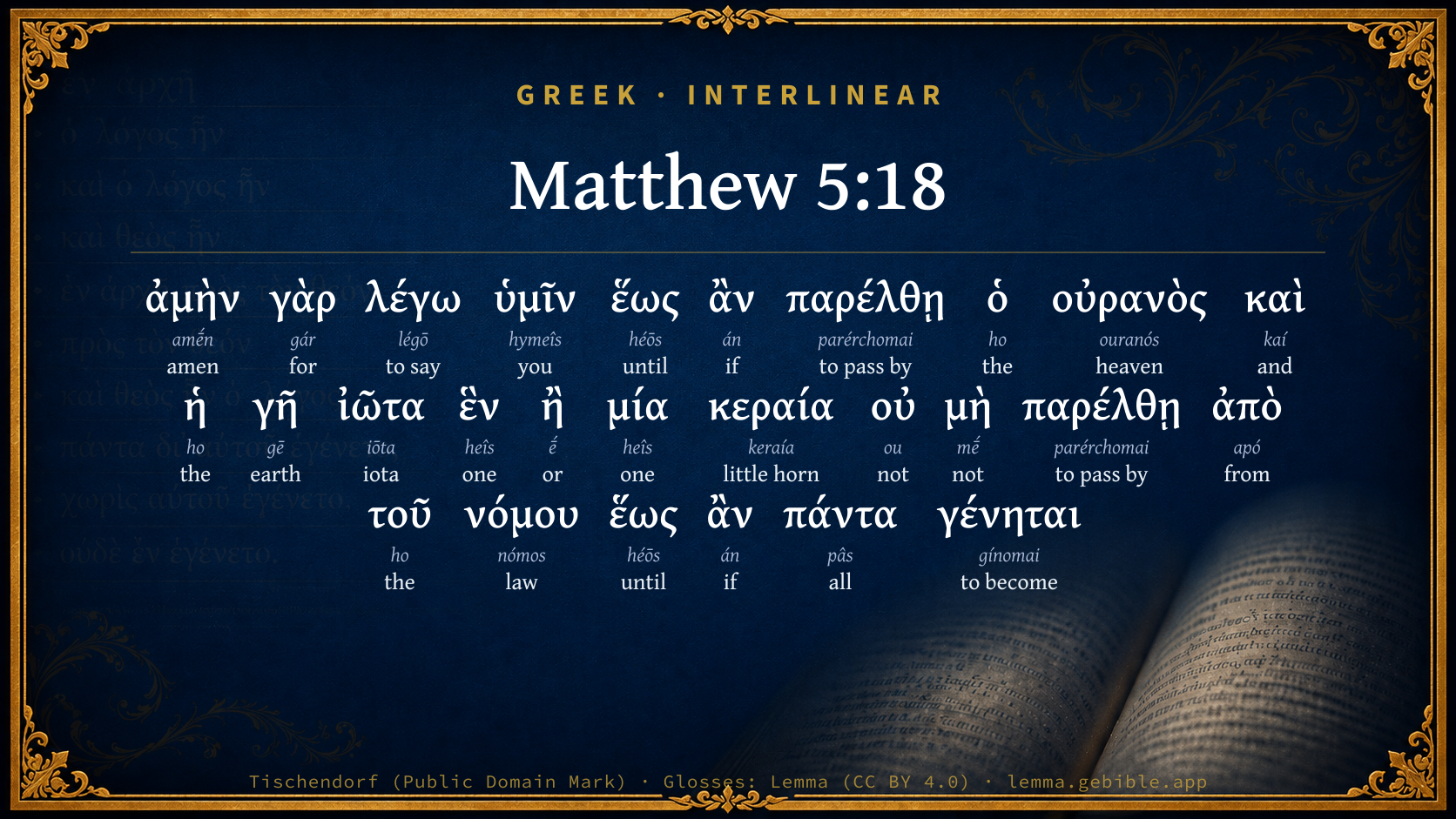
Greek (Tischendorf 8th ed.) Matthew 5:18 appears in the Greek New Testament. The text above is from the Tischendorf 8th edition. Each word links to its Strong’s number and a concise gloss. Click any word for its full Thayer’s Greek Lexicon entry.
Download image
Cite this verse

Matthew 5:18 (World English Bible). Public Domain. Lemma interlinear Bible study tool, https://lemma.gebible.app/v/matthew/5/18.

Show BibTeX & RIS
BibTeX
RIS
English Translation
For most assuredly, I tell you, until heaven and earth pass away, not even one smallest letter or one tiny pen stroke shall in any way pass away from the law, until all things are accomplished.
World English Bible · Public Domain
Highlights
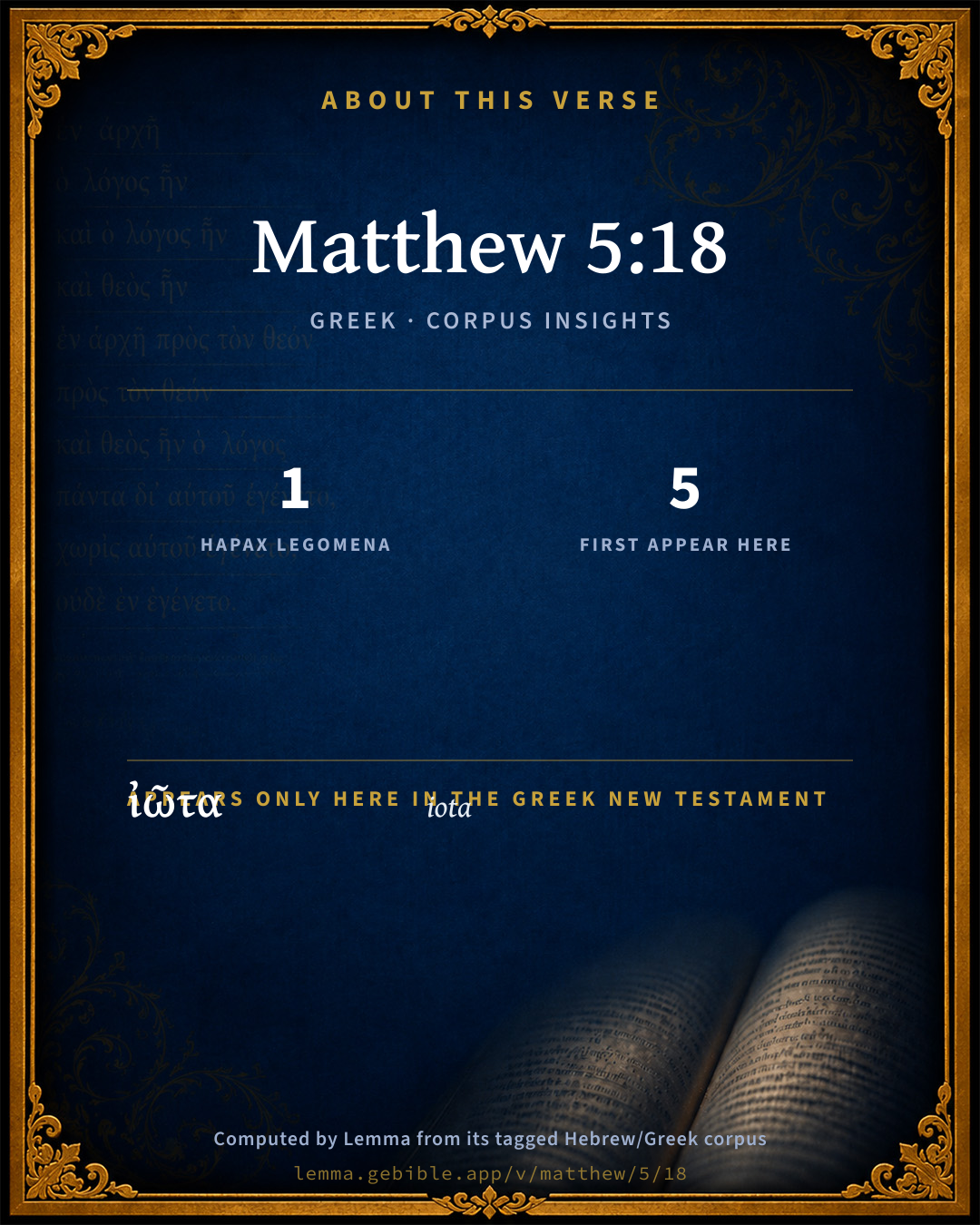
  • 1 hapax legomenon — only here in the Greek New Testament
  • 5 first appearances in the Greek New Testament
Full analysis ↓
Download a study sheet

One document with this verse’s original text, its word-by-word gloss line, the meaning frame, cross-references with their text, attributed commentary, and full source and license credits — printable, and it pastes into notes with its structure intact.

This verse Autodidact and up

Study sheet (.html) Plain text (.txt)

A passage Seminary Student

Up to 50 verses in one chapter. A passage sheet keeps up to 6 commentary sources and 12 cross-references per verse, in the order this page ranks them, and says so on the sheet whenever that leaves anything out. Ask for a single verse and you get the Autodidact verse sheet above.

Everything on this page stays free to read, with no account — the sheet is a download of what is already on screen, not access to it.

Want to remove ads? Support Godless Engineer
Compare translations 3

The same verse in 3 English versions, stacked beneath the original-language interlinear above. Click any original word for its lexicon entry.

Each is an independent rendering of the whole verse — the interlinear is not word-aligned to these translations.

Highlighted words mark where these versions differ — a whole-verse word diff, not a word-by-word alignment.

  • World English Bible Public Domain
    For most assuredly, I tell you, until heaven and earth pass away, not even one smallest letter or one tiny pen stroke shall in any way pass away from the law, until all things are accomplished.
  • King James Version Public Domain
    For verily I say unto you, Till heaven and earth pass, one jot or one tittle shall in no wise pass from the law, till all be fulfilled.
  • unfoldingWord Literal Text CC BY-SA 4.0
    For truly I say to you, until the heaven and the earth passes away, one jot or one tittle will certainly not pass away from the law until all things are accomplished.

unfoldingWord Literal Text — © unfoldingWord, licensed CC BY-SA 4.0. Word-aligned USFM3 via Door43 (git.door43.org/unfoldingWord/en_ult).

Versions to compare (up to 4)

3 of 4 selected

Show all 19 translations

Every available English version of this verse, each an independent rendering of the whole verse.

  • World English Bible Public Domain
    For most assuredly, I tell you, until heaven and earth pass away, not even one smallest letter or one tiny pen stroke shall in any way pass away from the law, until all things are accomplished.
  • Berean Standard Bible Public Domain
    For I tell you truly, until heaven and earth pass away, not a single jot, not a stroke of a pen, will disappear from the Law until everything is accomplished.
  • Majority Standard Bible Public Domain
    For I tell you truly, until heaven and earth pass away, not a single jot, not a stroke of a pen, will disappear from the Law until everything is accomplished.
  • King James Version Public Domain
    For verily I say unto you, Till heaven and earth pass, one jot or one tittle shall in no wise pass from the law, till all be fulfilled.
  • American Standard Version (1901) Public Domain
    For verily I say unto you, Till heaven and earth pass away, one jot or one tittle shall in no wise pass away from the law, till all things be accomplished.
  • Revised Version (1885) Public Domain
    For verily I say unto you, Till heaven and earth pass away, one jot or one tittle shall in no wise pass away from the law, till all things be accomplished.
  • Geneva Bible (1599) Public Domain
    For truely I say vnto you, Till heauen, and earth perish, one iote or one title of the Law shall not scape, till all things be fulfilled.
  • Douay-Rheims (1899) Public Domain
    For amen I say unto you, till heaven and earth pass, one jot, or one tittle shall not pass of the law, till all be fulfilled.
  • Young's Literal Translation Public Domain
    for, verily I say to you, till that the heaven and the earth may pass away, one iota or one tittle may not pass away from the law, till that all may come to pass.
  • Literal Standard Version CC BY-SA 4.0
    for truly I say to you, until the heaven and the earth may pass away, one iota or one tittle may not pass away from the Law, until all may come to pass.
  • Unlocked Literal Bible CC BY-SA 4.0
    For truly I say to you that until heaven and earth pass away, not one jot or one tittle shall in any way pass away from the law, until all things have been accomplished.
  • unfoldingWord Literal Text CC BY-SA 4.0
    For truly I say to you, until the heaven and the earth passes away, one jot or one tittle will certainly not pass away from the law until all things are accomplished.
  • Darby Bible Public Domain
    For verily I say unto you, Until the heaven and the earth pass away, one iota or one tittle shall in no wise pass from the law till all come to pass.
  • World Messianic Bible Public Domain
    For most certainly, I tell you, until heaven and earth pass away, not even one smallest letter or one tiny pen stroke shall in any way pass away from the Torah, until all things are accomplished.
  • Webster's Bible Public Domain
    For verily I say to you, Till heaven and earth shall pass away, one jot or one tittle shall in no wise pass from the law, till all be fulfilled.
  • Free Bible Version CC BY-SA 4.0
    I assure you, until heaven and earth come to an end, not a single letter, not a single dot of the law will come to an end before everything is fulfilled.
  • Bible in Basic English Public Domain
    Truly I say to you, Till heaven and earth come to an end, not the smallest letter or part of a letter will in any way be taken from the law, till all things are done.
  • Text-Critical English NT CC BY 4.0
    For truly I say to you, until heaven and earth pass away, not one letter or stroke of a letter will by any means pass from the law until all is accomplished.
  • Tyndale New Testament (1534) Public Domain
    For truely I saye vnto you till heven and erth perisshe one iott or one tytle of the lawe shall not scape tyll all be fulfilled.

Literal Standard Version (2020), Covenant Press — licensed CC BY-SA 4.0. Text via the HelloAO Bible API (eBible.org). Unlocked Literal Bible (unfoldingWord) — licensed CC BY-SA 4.0. Text via the HelloAO Bible API (eBible.org). unfoldingWord Literal Text — © unfoldingWord, licensed CC BY-SA 4.0. Word-aligned USFM3 via Door43 (git.door43.org/unfoldingWord/en_ult). Free Bible Version, Dr. Jonathan Gallagher — licensed CC BY-SA 4.0. Text via the HelloAO Bible API (eBible.org).

Word by word

More ways to search: Search by grammar → Find every occurrence → Compare this word →

Practice this passage: Drill this verse → Learn its vocabulary →

ἰῶτα
iōta
G2503
“iota”
Noun, Letter (indeclinable)
Part of Speech
Noun · Letter (indeclinable)
Full Thayer's Definition

Origin: of hebrew origin [the tenth letter of the hebrew alphabet]

TDNT: None

1. the Hebrew letter `, the smallest of them all a. hence equivalent to the minutest part
  1. ἀμὴν amḗn G281 “amen” Hebrew transliteration
  2. γὰρ gár G1063 “for” Conjunction
  3. λέγω légō G3004 “to say” Verb, Present, Active, Indicative, 1st person, Singular
  4. ὑμῖν hymeîs G5210 “you” Personal pronoun, 2nd person, Dative, Plural
  5. ἕως héōs G2193 “until” Adverb
  6. ἂν án G302 “if” Particle
  7. παρέλθῃ parérchomai G3928 “to pass by” Verb, Aorist, Active, Subjunctive, 3rd person, Singular
  8. ὁ ho G3588 “the” Article, Nominative, Singular, Masculine
  9. οὐρανὸς ouranós G3772 “heaven” Noun, Nominative, Singular, Masculine
  10. καὶ kaí G2532 “and” Conjunction
  11. ἡ ho G3588 “the” Article, Nominative, Singular, Feminine
  12. γῆ gē G1093 “earth” Noun, Nominative, Singular, Feminine
  13. ἓν heîs G1520 “one” Adjective, Nominative, Singular, Neuter
  14. ἢ ḗ G2228 “or” Particle
  15. μία heîs G1520 “one” Adjective, Nominative, Singular, Feminine
  16. κεραία keraía G2762 “little horn” Noun, Nominative, Singular, Feminine
  17. οὐ ou G3756 “not” Particle, Negative
  18. μὴ mḗ G3361 “not” Particle, Negative
  19. παρέλθῃ parérchomai G3928 “to pass by” Verb, Aorist, Active, Subjunctive, 3rd person, Singular
  20. ἀπὸ apó G575 “from” Preposition
  21. τοῦ ho G3588 “the” Article, Genitive, Singular, Masculine
  22. νόμου nómos G3551 “law” Noun, Genitive, Singular, Masculine
  23. ἕως héōs G2193 “until” Adverb
  24. ἂν án G302 “if” Particle
  25. πάντα pâs G3956 “all” Adjective, Nominative, Plural, Neuter
  26. γένηται gínomai G1096 “to become” Verb, Aorist, Middle deponent, Subjunctive, 3rd person, Singular

About this verse

These counts appear in no published source. They are computed here, from the morphology-tagged text and Lemma’s own curated glosses. What Lemma adds →

27
words
21
distinct lemmas
Gospels
section

Notable vocabulary

1 hapax legomenon — a word that appears only here in the entire Greek New Testament:

First appearance in Scripture

These words make their first canonical appearance in the Greek New Testament here:

  • ἀμὴν amen G281
  • παρέλθῃ to pass by G3928
  • ἰῶτα iota G2503
  • ἓν one G1520
  • κεραία little horn G2762

Shared distinctive vocabulary

κεραία little horn G2762 occurs in 2 verses of the Greek New Testament. Also found in:
Repetition

Words recur within this verse:

Cross-references

79

Topical passages linked to Matthew 5:18 in the Treasury of Scripture Knowledge — connected by theme and wording, ordered by reader-vote popularity; previews shown in the World English Bible.

  • Luke 16:17 But it is easier for heaven and earth to pass away, than for one tiny stroke of a pen in the law to fall.
  • Isaiah 40:8 The grass withers, the flower fades; but the word of our God shall stand forever.
  • Psalms 119:89–90 Yahweh, your word is settled in heaven forever.
  • 1 Peter 1:25 But the Lord's word endures forever." This is the word of good news which was preached to you.
  • Matthew 24:34–35 Most assuredly I tell you, this generation will not pass away, until all these things are accomplished.
  • Isaiah 51:6 Lift up your eyes to the heavens, and look on the earth beneath; for the heavens shall vanish away like smoke, and the earth shall wax old like a garment; and those who dwell therein shall die in like manner: but my salvation shall be forever, and my righteousness shall not be abolished.
  • Mark 13:30 Most assuredly I say to you, this generation will not pass away until all these things happen.
  • Psalms 102:26 They will perish, but you will endure. Yes, all of them will wear out like a garment. You will change them like a cloak, and they will be changed.
  • Revelation 20:11 I saw a great white throne, and him who sat on it, from whose face the earth and the heaven fled away. There was found no place for them.
  • John 5:19 Jesus therefore answered them, "Most assuredly, I tell you, the Son can do nothing of himself, but what he sees the Father doing. For whatever things he does, these the Son also does likewise.
  • Psalms 119:152 Of old I have known from your testimonies, That you have founded them forever.
  • Matthew 5:26 Most assuredly I tell you, you shall by no means get out of there, until you have paid the last penny.
  • Matthew 10:23 But when they persecute you in this city, flee into the next, for most assuredly I tell you, you will not have gone through the cities of Israel, until the Son of Man has come.
  • Matthew 13:17 For most assuredly I tell you that many prophets and righteous men desired to see the things which you see, and didn't see them; and to hear the things which you hear, and didn't hear them.
  • Matthew 16:28 Most assuredly I tell you, there are some standing here who will in no way taste of death, until they see the Son of Man coming in his Kingdom."
  • Matthew 17:20 He said to them, "Because of your unbelief. For most assuredly I tell you, if you have faith as a grain of mustard seed, you will tell this mountain, 'Move from here to there,' and it will move; and nothing will be impossible for you.
  • Matthew 18:3 and said, "Most assuredly I tell you, unless you turn, and become as little children, you will in no way enter into the Kingdom of Heaven.
  • Matthew 19:28 Jesus said to them, "Most assuredly I tell you that you who have followed me, in the regeneration when the Son of Man will sit on the throne of his glory, you also will sit on twelve thrones, judging the twelve tribes of Israel.
  • Luke 12:37 Blessed are those servants, whom the lord will find watching when he comes. Most assuredly I tell you, that he will dress himself, and make them recline, and will come and serve them.
  • Luke 18:17 Most assuredly, I tell you, whoever doesn't receive the Kingdom of God like a little child, he will in no way enter into it."
  • John 5:24–25 "Most assuredly I tell you, he who hears my word, and believes him who sent me, has eternal life, and doesn't come into judgment, but has passed out of death into life.
  • Matthew 6:2 Therefore when you do merciful deeds, don't sound a trumpet before yourself, as the hypocrites do in the synagogues and in the streets, that they may get glory from men. Most assuredly I tell you, they have received their reward.
  • Matthew 6:16 "Moreover when you fast, don't be like the hypocrites, with sad faces. For they disfigure their faces, that they may be seen by men to be fasting. Most assuredly I tell you, they have received their reward.
  • Matthew 8:10 When Jesus heard it, he marveled, and said to those who followed, "Most assuredly I tell you, I haven't found so great a faith, not even in Israel.
  • Matthew 10:15 Most assuredly I tell you, it will be more tolerable for the land of Sodom and Gomorrah in the day of judgment than for that city.
  • Matthew 10:42 Whoever gives one of these little ones just a cup of cold water to drink in the name of a disciple, most assuredly I tell you he will in no way lose his reward."
  • Matthew 11:11 Most assuredly I tell you, among those who are born of women there has not arisen anyone greater than John the Baptizer; yet he who is least in the Kingdom of Heaven is greater than he.
  • Mark 14:9 Most assuredly I tell you, wherever this Gospel may be preached throughout the whole world, that which this woman has done will also be spoken of for a memorial of her."
  • Mark 14:18 As they sat and were eating, Jesus said, "Most assuredly I tell you, one of you will betray me -- he who eats with me."
  • Mark 14:25 Most assuredly I tell you, I will no more drink of the fruit of the vine, until that day when I drink it anew in the Kingdom of God."
  • Mark 14:30 Jesus said to him, "Most assuredly I tell you, that you today, even this night, before the rooster crows twice, you will deny me three times."
  • Luke 11:51 from the blood of Abel to the blood of Zachariah, who perished between the altar and the sanctuary.' Yes, I tell you, it will be required of this generation.
  • Luke 13:35 Behold, your house is left to you desolate. I tell you, you will not see me, until you say, 'Blessed is he who comes in the name of the Lord!'"
  • Luke 18:29 He said to them, "Most assuredly I tell you, there is no one who has left house, or wife, or brothers, or parents, or children, for the Kingdom of God's sake,
  • Luke 21:32–33 Most assuredly I tell you, this generation will not pass away until all things are accomplished.
  • Luke 23:43 Jesus said to him, "Assuredly I tell you, today you will be with me in Paradise."
  • John 1:51 He said to him, "Most assuredly, I tell you, hereafter you will see heaven opened, and the angels of God ascending and descending on the Son of Man."
  • John 3:3 Jesus answered him, "Most assuredly, I tell you, unless one is born anew, he can't see the Kingdom of God."
  • John 3:5 Jesus answered, "Most assuredly I tell you, unless one is born of water and spirit, he can't enter into the Kingdom of God!
  • John 3:11 Most assuredly I tell you, we speak that which we know, and testify of that which we have seen, and you don't receive our witness.
  • John 6:26 Jesus answered them, "Most assuredly I tell you, you seek me, not because you saw signs, but because you ate of the loaves, and were filled.
  • John 6:32 Jesus therefore said to them, "Most assuredly, I tell you, it wasn't Moses who gave you the bread out of heaven, but my Father gives you the true bread out of heaven.
  • John 6:47 Most assuredly, I tell you, he who believes in me has eternal life.
  • John 6:53 Jesus therefore said to them, "Most assuredly I tell you, unless you eat the flesh of the Son of Man and drink his blood, you don't have life in yourselves.
  • John 8:34 Jesus answered them, "Most assuredly I tell you, everyone who commits sin is the bondservant of sin.
  • John 8:51 Most assuredly, I tell you, if a person keeps my word, he will never see death."
  • John 8:58 Jesus said to them, "Most assuredly, I tell you, before Abraham came into existence, I AM."
  • John 10:7 Jesus therefore said to them again, "Most assuredly, I tell you, I am the sheep's door.
  • John 12:24 Most assuredly I tell you, unless a grain of wheat falls into the earth and dies, it remains by itself alone. But if it dies, it bears much fruit.
  • John 13:16 Most assuredly I tell you, a servant is not greater than his lord, neither one who is sent greater than he who sent him.
  • John 13:38 Jesus answered him, "Will you lay down your life for me? Most assuredly I tell you, the rooster won't crow until you have denied me three times.
  • John 16:20 Most assuredly I tell you, that you will weep and lament, but the world will rejoice. You will be sorrowful, but your sorrow will be turned into joy.
  • John 16:23 "In that day you will ask me no questions. Most assuredly I tell you, whatever you may ask of the Father in my name, he will give it to you.
  • John 21:18 Most assuredly I tell you, when you were young, you dressed yourself, and walked where you wanted to. But when you are old, you will stretch out your hands, and another will dress you, and carry you where you don't want to go."
  • Hebrews 1:11–12 They will perish, but you continue. They all will grow old like a garment does.
  • 2 Peter 3:10–13 But the day of the Lord will come as a thief in the night; in which the heavens will pass away with a great noise, and the elements will be dissolved with fervent heat, and the earth and the works that are in it will be burned up.
  • Matthew 18:18 Most assuredly I tell you, whatever things you will bind on earth will be bound in heaven, and whatever things you will release on earth will be released in heaven.
  • Matthew 19:23 Jesus said to his disciples, "Most assuredly I say to you, a rich man will enter into the Kingdom of Heaven with difficulty.
  • Matthew 21:21 Jesus answered them, "Most assuredly I tell you, if you have faith, and don't doubt, you will not only do what is done to the fig tree, but even if you told this mountain, 'Be taken up and cast into the sea,' it would be done.
  • Matthew 21:31 Which of the two did the will of his father?" They said to him, "The first." Jesus said to them, "Most assuredly I tell you that the tax collectors and the prostitutes are entering into the Kingdom of God before you.
  • Matthew 23:36 Most assuredly I tell you, all these things will come upon this generation.
  • Matthew 24:2 But he answered them, "Don't you see all of these things? Most assuredly I tell you, there will not be left here one stone on another, that will not be thrown down."
  • Matthew 24:47 Most assuredly I tell you that he will set him over all that he has.
  • Matthew 25:12 But he answered, 'Most assuredly I tell you, I don't know you.'
  • Matthew 25:40 "The King will answer them, 'Most assuredly I tell you, inasmuch as you did it to one of the least of these my brothers, you did it to me.'
  • Matthew 25:45 "Then he will answer them, saying, 'Most assuredly I tell you, inasmuch as you didn't do it to one of the least of these, you didn't do it to me.'
  • Matthew 26:13–14 Most assuredly I tell you, wherever this Gospel is preached in the whole world, what this woman has done will also be spoken of as a memorial of her."
  • Mark 3:28 Most assuredly I tell you, all of the children of men's sins will be forgiven them, including their blasphemies with which they may blaspheme;
  • Mark 6:11 Whoever will not receive you nor hear you, as you depart from there, shake off the dust that is under your feet for a testimony against them. Assuredly, I tell you, it will be more tolerable for Sodom and Gomorrah in the day of judgment than for that city!"
  • Mark 8:12 He sighed deeply in his spirit, and said, "Why does this generation seek a sign? Most assuredly I tell you, no sign will be given to this generation."
  • Mark 9:1 He said to them, "Most assuredly I tell you, there are some standing here who will in no way taste death until they see the Kingdom of God come with power."
  • Mark 9:41 For whoever will give you a cup of water to drink in my name, because you are Christ's, most assuredly I tell you, he will in no way lose his reward.
  • Mark 10:15 Most assuredly I tell you, whoever will not receive the Kingdom of God like a little child, he will in no way enter into it."
  • Mark 10:29 Jesus said, "Most assuredly I tell you, there is no one who has left house, or brothers, or sisters, or father, or mother, or wife, or children, or land, for my sake, and for the Gospel's sake,
  • Mark 11:23 For most assuredly I tell you, whoever may tell this mountain, 'Be taken up and cast into the sea,' and doesn't doubt in his heart, but believes that what he says is happening; he shall have whatever he says.
  • Mark 12:43 He called his disciples to himself, and said to them, "Most assuredly I tell you, this poor widow gave more than all those who are giving into the treasury,
  • John 10:1 "Most assuredly, I tell you, one who doesn't enter by the door into the sheep fold, but climbs up some other way, the same is a thief and a robber.
  • John 13:20–21 Most assuredly I tell you, he who receives whomever I send, receives me; and he who receives me, receives him who sent me."
  • John 14:12 Most assuredly I tell you, he who believes in me, the works that I do, he will do also; and greater works than these will he do; because I am going to my Father.

Cross-references courtesy of OpenBible.info (CC BY 4.0).

Commentary

Notes on Matthew 5:18 from classic Christian and Jewish commentators (each source and its license shown beneath its notes). The classic Christian expositions comment on the surrounding passage and are grouped to its opening verse, so a note may address several verses; the Jewish commentaries on the Tanakh (Rashi and others) are per-verse, so they appear only where the commentator wrote on this verse.

Lemma curates 59 commentaries, every one of them public domain or Creative Commons licensed, each selected and text-cleaned for this edition rather than reprinted as found. About our sources →

Joseph Benson's Commentary

Mat 5:18. For verily I say unto you — This expression, whereby our Lord often prefaces what he is about to say, always imports the great importance, as well as certain truth of it. Till heaven and earth pass away — Till the whole visible frame of nature be disjointed and dissolved, one jot or one tittle — “The word ιωτα, which we render jot, undoubtedly answers to the Hebrew letter י, jod, whence the English word here seems to be derived, and which, being the least letter of the alphabet, might properly be used proverbially on this occasion. Κεραια, which we render tittle, properly signifies one of those little ornamental curvatures or flourishes, which, when Hebrew is elegantly written, are generally used at the beginning and end of a letter, and sometimes at the corners too. I think it might well have been rendered, not the least letter, or stroke, &c., and so much the rather, as jot and tittle, in English, signify the same.” — Doddridge. Shall in no wise pass from, the law — Or, from the prophets, till all be fulfilled — Till all things which the law requires, or the prophets foretel, shall be effected. This seems to be the literal translation of the original words, εως αν παντα γενηται: for the law has its effect when its sanctions are executed, as well as when its precepts are obeyed. And the predictions of the prophets have their proper effect and confirmation, when they are accomplished. Some, however, understand the words as meaning, till the end, or, consummation of all things shall come, or, till the heavens and the earth shall pass away, or be destroyed. The meaning of our Lord’s words, according to this interpretation, is, that there is nothing in the universe so stable as the truths contained in the moral law, and nothing so certain as the fulfilment of the predictions of the prophets: the heavens may fall, and the whole frame of nature be unhinged, nay, every part of it may be dissolved; but the rules of righteousness, and the declarations of the divine word, with their sanctions, shall remain immutable and eternal: for the word of the Lord endureth for ever, 1Pe 1:25. Our Lord therefore proceeds, in the two next verses, to command his disciples, on the severest penalties, to enforce, both by their doctrine and example, the strict observation of all the moral precepts contained in the sacred writings, and that in their utmost extent.

Joseph Benson's Commentary on the Old and New Testaments (1811–1818) — public domain. Text from a community e-Sword module.

Bengel's Gnomon

Johann Albrecht Bengel

Mat 5:18. Ἀμὴν, Amen, verily) Jesus alone employed this word at the commencement of His addresses, to give them greater force and solemnity. No apostle did so. Wagenseil,[185] in his Sota, p. 379, says, that this word had sometimes with the Jews the force of an oath. And wherever חי אני (I, living) occurs in the Hebrew, the Chaldee Paraphrast has אנא קים, I, constant: and קים, to confirm, etc., is found there passim for נשבע, to swear. See Louis le Dieu on this passage; and Kimchi interprets אמן, amen, itself by קיום, stability.[186]

[185] John Christopher Wagenseil was born at Nuremberg in 1633, and educated at the University of Altdorf, where he was appointed Professor of History in 1667, and of Oriental Languages about 1675. He died in 1705. The full title of the work referred to in the text is, Sota, hoc est liber Mixlenicus de uxore adulterii suspecta, una cum libri ex Jacob excerptis Gemarז, versione Latina et commentario perpetuo, in quo multa sacrarum literarum ac Hebrזorum Scriptorum loca explicantur.—(I. B.)

[186] Firmitas, stabilitas, duratio.—BUXTORF.—(I. B.)

In the New Testament, however, it is not, strictly speaking, an oath: for it corresponds with ναὶ, yea, and ἀληθῶς, truly; cf. Luk 11:51; Luk 21:3, with Mat 23:36, and Mar 12:43. It is, however, a most grave asseveration, exclusively suitable to Him who asseverates by Himself and His own truth, and from the dignity of the Speaker, is equivalent to an oath, especially when it is uttered twice, sc. “verily, verily:” see note to Joh 1:51. The Hebrew word is preserved in all languages.[187]—λέγω ὑμῖν, I say unto you) This formula, frequent and peculiar to the Lord, possesses the highest authority, and denotes frequently a matter declared by Him, which, for special reasons, is neither written expressly in the Old Testament, nor can be clearly proved from any other source, but is first produced by Himself from the secret treasuries of wisdom and knowledge, so that the assent of the hearers may rest on His sole affirmation, and the dull in heart may be deprived of all excuse for the future. The prophets were wont to say in the third person, נאם,[188] saith the Lord; the apostles, It is written; but Christ, in the first person, I say unto you; see Mat 5:20; Mat 5:22; Mat 5:26; Mat 5:28; Mat 5:32; Mat 5:34; Mat 5:39; Mat 5:44, ch. Mat 6:2; Joh 3:3; Joh 14:12; Joh 14:25, etc. Cf. notes on Joh 4:21; Joh 14:25. St Paul, when again and again compelled to speak in the first person, takes especial care not to trench on the Divine prerogative. See Rom 12:3; 1Co 7:6. Faith is the correlative of this, “I say unto you” and by this formula is, suitably to that time (pro modo illius temporis), placed, as it were, as the foundation on the very threshold of the New Testament. Christ seldom quotes passages of Scripture, and not except for some special reason: He befittingly rests on His own authority.—ἝΩς ἌΝ ΠΑΡΈΛΘῌ, until pass away) The verb, παρέλθῃ, leaves undetermined the manner of the end of the world.—ὁ οὐρανὸς καὶ ἡ γῆ, Heaven and earth) The whole system of nature.—ἸῶΤΑ, jot) iota, yod. Yod, the smallest and most elementary letter in the Hebrew alphabet, and one in which Keri and Kethib[189] very frequently differ, so that it almost appears to be indiscriminately absent or redundant. In the course of the Hebrew Scriptures, 66,420 yods are numbered. The Greeks frequently write the iota below, or omit it altogether.—ΚΕΡΑΊΑ, a tittle) An appendage to a portion of a letter, a mark by which one letter is distinguished from another, as á, Beth (B), from ë, Kaph (K), or ø, Resh (R), from ã, Daleth (D), or one sound from another, as a vowel point or an accent; in short, anything which in any way belongs to the signification of the Divine will, or assists to declare that signification as revealed in the law.—οὐ μὴ, a double negative) Οὐ ΜῊ always has a subjunctive, and its emphasis ought not to be stretched too far; cf. Mat 5:20; Mat 5:26.—Οὐ ΜῊ ΠΑΡῈΛΘῌ, shall not pass away) From hence may be inferred the entireness of Scripture; for, unless the Scripture were entire, it could not be entirely fulfilled.—ἀπὸ τοῦ νόμου, from the law) Understand and supply, “or from the prophets.” The smallest portion of the law is contrasted with the whole world.—ἕως ἅν, κ.τ.λ., until, etc.) For righteousness shall dwell in new Heavens and a new Earth. See 2Pe 3:13.—πάντα, all particulars) sc. of the law. Observe the contrast between this and ΜΊΑΝ, one, in the next verse.[190]—γένηται, be fulfilled) They have been fulfilled, and they are being fulfilled by Jesus Christ, [not only in Himself, but] even in Christians: they had not been fulfilled before His coming.

[187] And it (the Hebr. amen) ought to be retained in translation, as in the end, so also in the beginning of sentences. The same principle holds good of other Hebrew words.—Not. Crit.

[188] “נאם … to mutter, to murmur, to speak in a low voice; specially used of the voice of God, by which oracles were revealed to the prophets. By far the most frequent use is of the part. pass. constr. in this phrase, נְאֻם יְיָ נְאֻם יְהוֹה, צְבָאוֹת. ‘The voice of Jehovah (is);’ or (so) hath Jehovah revealed. This the prophets themselves were accustomed either to insert in the discourse, like the Lat. ait, inquit Dominus, Amo 6:8; Amo 6:14; Amo 9:12-13, or to add at the end of a sentence.”—Gesenius.—(I. B.)

[189] QERI AND KETHIBH.

[190] In the original, “Antitheton, unum, in v. seq.” I have endeavoured in this, as in other instances, to give such a rendering as shall convey Bengel’s meaning to the general reader.—(I. B.)

“The margin of the Hebrew Bible exhibits a number of various readings of an early date, called קְרִי (to be read), because, in the view of the Jewish critics, they are to be preferred to the reading of the text, called כְּתִיב (written). Those critics have therefore attached the vowel signs, appropriate to the marginal reading, to the consonants of the corresponding word in the text; e.g. in Jer 42:6, the text exhibits אֲנַוְּ, the margin אנחנו קרי. Here the vowels in the text belong to the word in the margin, which is to be pronounced אֲנַחְנוּ; but in reading the text אנו, the proper vowels must be supplied, making אֲנוּ. A small circle or asterisk over the word in the text always directs to the marginal reading.”—Gesenius, Heb. Gr. Sect. 17.—(I. B.)

Bengel's Gnomon of the New Testament — English translation (T&T Clark, Edinburgh, 1860) — public domain. Text from a community e-Sword module.

Meyer's Critical & Exegetical Commentary

Heinrich August Wilhelm Meyer

Mat_5:18. Ἀμὴν γὰρ λέγω ὑμῖν] for verily (ἀμήν = ἀληθῶς, Luk_9:27), that is, agreeably to the truth, do I tell you. What He now says serves as a confirmation of what preceded. This form of assurance, so frequently in the mouth of Christ, the bearer of divine truth, is not found in any apostle.

ἕως ἂν παρέλθῃ, κ.τ.λ.] until heaven and earth shall have passed away. These words of Jesus do not indicate a terminus, after which the law shall no longer exist (Paulus, Meander, Lechler, Schleiermacher, Planck, Weizsäcker, and others), but He says: onwards to the destruction of the world the law will not lose its validity in the slightest point, by which popular expression (Luk_16:17; Job_14:12) the duration of the law after the final catastrophe of the world is neither taught nor excluded. That the law, however, fulfilled as to its ideal nature, will endure in the new world, is clear from 1Co_13:3 (ἀγάπη); 1Pe_1:25; 2Pe_3:3 (δικαιοσύνη). The unending authority of the law is also taught by Bar_4:1; Tob_1:6; Philo, vit. Mos. 2. p. 656; Joseph, c. Ap. ii. 38, and the Rabbins. See Bereschith R. x. 1, omni rei suus finis, coelo et terrae suus finis, una excepta re, cui non suus finis, haec est lex. Schemoth R. vi., nulla litera aboletur a lege in aeternum. Midrash Cohel. f. 71, 4, (lex) perpetuo manebit in secula seculorum. The passage in 1Co_15:28 is not opposed to our explanation; for if God is all in all, the fulfilled law of God yet stands in its absolute authority.

ἕως ἂν πάντα γένηται] not: until all the prophecies are fulfilled, that would then be down to the Parousia (Wetstein, J. E. Meyer, comp. Ewald); nor even till all is carried out theocratically which I have to perform (Paulus), or what lies shut up in the divine decree (Köstlin), or even until the event shall occur by means of which the observance of the law becomes impossible, and it falls away of itself (Schleiermacher); but, in keeping with the context, until all which the law requires shall he accomplished (Mat_6:10), nothing any longer left unobserved. This sentence is not co-ordinate to the first ἕως, but subordinate (Kühner, ad Xen. Mem. i. 2. 36): So long as the world stands shall no iota[401] of the law pass away till all its prescriptions shall be realized. All the requirements of the law shall be fulfilled; but before this fulfilment of all shall have begun,[402] not a single iota of the law shall fall till the end of the world. Fritzsche: till all (only in thought) is accomplished. He assumes, accordingly, agreeably to the analogous use of conditional sentences (Heindorf and Stallbaum, ad Plat. Phaed. p. 67 E; Kühner, II. 2, p. 988 f.), a double protasis: (1) ἕως ἂν παρέλθῃ, κ.τ.λ., and (2) ἝΩς … ΓΈΝΗΤΑΙ. But the parallel passages, Mat_24:34, Luk_21:32, are already opposed to this; and after the concrete and lively ἝΩς ἊΝ ΠΑΡΈΛΘῌ Ὁ ΟὐΡΑΝῸς Κ. Ἡ Γῆ, this general and indefinite ἝΩς ἊΝ ΠΆΝΤΑ ΓΈΝΗΤΑΙ would be only a vague and lumbering addition. As correlative to ἝΝ and ΜΊΑ, ΠΆΝΤΑ can only mean all portions of the law, without, however, any definite point of time requiring to be thought of, in which all the commands of the law will be carried out, according to which, then, the duration of the present condition of the world would be conformed. This thought is rendered impossible by the nearness of the Parousia, according to Mat_24:29; Mat_24:34, as well as by the growth of the tares until the Parousia, according to Mat_13:30. The thought is rather, the law will not lose its binding obligation, which reaches on to the final realization of all its prescriptions, so long as heaven and earth remain.

Observe, moreover, that the expression in our passage is different from Mat_24:35, where the permanency of the λόγοι of Christ after the end of the world is directly and definitely affirmed, but that in this continued duration of the ΛΌΓΟΙ of Christ the duration of the law also is implied, i.e. according to its complete meaning (in answer to Lechler, p. 797); comp. on Luk_16:17. The δικαιοσύνη of the new heavens and of the new earth will be no other than what is here taught, Delitzsch. So completely one with the idea of the law does Jesus in His spiritual greatness know His moral task to be, not severed from the latter, but placed in its midst.

[401] Ἰῶτα, the smallest letter, and κεραία, horn, a little stroke of writing (Plut. Mor. p. 1100 A, 1011 D), especially also in single letters (Origen, ad Psalms 33), by which, for example, the following letters are distinguished, כ and ב, ר and ד, ה and ח. See Lightfoot, Schoettgen, and Wetstein. Both expressions denote the smallest portions of the law; see ver. 19.

[402] In this is contained the perpetually abiding obligation of the law; for that condition of things, in which no part of the law remains unfulfilled, in which, consequently, all is accomplished, will never occur until the end of the world. Of the πάντα, moreover, nothing is to be excluded which the law Contains, not even the ritualistic portions, which are to be morally fulfilled in their ideal meaning, as e.g. the Levitical prescription regarding purification by moral purification, the sacrificial laws by moral self-sacrifice (comp. Rom_12:1), and so on, so that in the connection of the whole, in accordance with the idea of πλήρωσις, not even the smallest element will perish, but retains its importance and its integral moral connection with the whole. Comp. Tholuck; Gess, Christi Pers. und Werk, I. p. 292; and before him, Calvin on ver. 17.

Meyer — Critical and Exegetical Commentary on the New Testament — English translation by Peter Christie, edited by Frederick Crombie (T&T Clark, 1880) — public domain. Text from a community e-Sword module.

Expositor's Greek Testament

ed. W. Robertson Nicoll

Mat 5:18-19 . These verses wear on first view a Judaistic look, and have been regarded as an interpolation, or set down to the credit of an over-conservative evangelist. But they may be reconciled with Mat 5:17 , as above interpreted. Jesus expresses here in the strongest manner His conviction that the whole O. T. is a Divine revelation, and that therefore every minutest precept has religious significance which must be recognised in the ideal fulfilment. Ἀμὴν , formula of solemn asseveration, often used by Jesus, never by apostles, found doubled only in fourth Gospel. ἕως ἂν παρέλθῃ , etc.: not intended to fix a period after which the law will pass away, but a strong way of saying never (so Tholuck and Weiss). ἰῶτα , the smallest letter in the Hebrew alphabet. κεραία , the little projecting point in some of the letters, e.g. , of the base line in Beth ; both representing the minutiae in the Mosaic legislation. Christ, though totally opposed to the spirit of the scribes, would not allow them to have a monopoly of zeal for the commandments great and small. It was important in a polemical interest to make this clear. οὐ μὴ π ., elliptical = do not fear lest. Vide Kühner, Gram., § 516, 9; also Goodwin’s Syntax, Appendix ii. ἕως ἄν π . γεν ., a second protasis introduced with ἕως explanatory of the first ἕως ἂν παρέλθῃ ; vide Goodwin, § 510; not saying the same thing, but a kindred: eternal, lasting, till adequately fulfilled; the latter the more exact statement of Christ’s thought.

The Expositor's Greek Testament, edited by W. Robertson Nicoll (1897–1910) — public domain. Text from a community e-Sword module.

Jamieson, Fausset & Brown

Robert Jamieson, A. R. Fausset & David Brown

For verily I say unto you--Here, for the first time, does that august expression occur in our Lord's recorded teaching, with which we have grown so familiar as hardly to reflect on its full import. It is the expression manifestly, of supreme legislative authority; and as the subject in connection with which it is uttered is the Moral Law, no higher claim to an authority strictly divine could be advanced. For when we observe how jealously Jehovah asserts it as His exclusive prerogative to give law to men (Lev 18:1-5; Lev 19:37; Lev 26:1-4, Lev 26:13-16, &c.), such language as this of our Lord will appear totally unsuitable, and indeed abhorrent, from any creature lips. When the Baptist's words--"I say unto you" (Mat 3:9) --are compared with those of his Master here, the difference of the two cases will be at once apparent.

Till heaven and earth pass--Though even the Old Testament announces the ultimate "perdition of the heavens and the earth," in contrast with the immutability of Jehovah (Psa 102:24-27), the prevalent representation of the heavens and the earth in Scripture, when employed as a popular figure, is that of their stability (Psa 119:89-91; Ecc 1:4; Jer 33:25-26). It is the enduring stability, then, of the great truths and principles, moral and spiritual, of the Old Testament revelation which our Lord thus expresses.

one jot--the smallest of the Hebrew letters.

one tittle--one of those little strokes by which alone some of the Hebrew letters are distinguished from others like them.

shall in no wise pass from the law, till all be fulfilled--The meaning is that "not so much as the smallest loss of authority or vitality shall ever come over the law." The expression, "till all be fulfilled," is much the same in meaning as "it shall be had in undiminished and enduring honor, from its greatest to its least requirements." Again, this general way of viewing our Lord's words here seems far preferable to that doctrinal understanding of them which would require us to determine the different kinds of "fulfilment" which the moral and the ceremonial parts of it were to have.

Jamieson, Fausset & Brown — Commentary Critical and Explanatory on the Whole Bible (1871) — public domain (CC PDM 1.0). Text via the HelloAO Bible API.

Adam Clarke's Commentary

Verse 18. For verily I say unto you, Till heaven] In the very commencement of his ministry, Jesus Christ teaches the instability of all visible things. "The heaven which you see, and which is so glorious, and the earth which you inhabit and love, shall pass away; for the things which are seen are temporal, προσκαιρα, are for a time; but the things which are not seen are eternal αιωνια, ever-during," 2Co 4:18. And the WORD of the Lord endureth for ever.

One jot or one tittle] One yod, (י), the smallest letter in the Hebrew alphabet. One tittle or point, κεραια, either meaning those points which serve for vowels in this language, if they then existed; or the seraphs, or points of certain letters, such as ר resh, or ד daleth, ה he, or ח cheth (as the change of any of these into the other would make a most essential alteration in the sense, or, as the rabbins say, destroy the world.) Or our Lord may refer to the little ornaments which certain letters assume on their tops, which cause them to appear like small branches. The following letters only can assume coronal apices, ץ tsaddi - ג gimel - ז zain - נ nun - ט teth - ע ayin - ש shin. These, with the coronal apices, often appear in MSS.

That this saying, one jot or one tittle, is a proverbial mode of expression among the Jews, and that it expressed the meaning given to it above, is amply proved by the extracts in Lightfoot and Schoettgen. The reader will not be displeased to find a few of them here, if he can bear with the allegorical and strongly figurative language of the rabbins.

"The book of Deuteronomy came and prostrated itself before the Lord, and said: 'O Lord of the world, thou hast written in me thy law; but now, a Testament defective in some parts is defective in all. Behold, Solomon endeavours to root the letter yod out of me.' (In this text, De 17:5. לא ירבה נשים lo yirbeh, nashim, he shall not multiply wives.) The holy blessed God answered, 'Solomon and a thousand such as he shall perish, but the least word shall not perish out of thee.'"

In Shir Hashirim Rabba, are these words: "Should all the inhabitants of the earth gather together, in order to whiten one feather of a crow, they could not succeed: so, if all the inhabitants of the earth should unite to abolish one י yod, which is the smallest letter in the whole law, they should not be able to effect it."

In Vayikra Rabba, s. 19, it is said: "Should any person in the words of De 6:4, Hear, O Israel, the Lord our God is אחד achad, ONE Lord, change the ד daleth into a ר resh, he would ruin the world." [Because, in that case, the word אחר achar, would signify a strange or false God.]

"Should any one, in the words of Ex 34:14, Thou shalt worship no OTHER, אחר achar, God, change ר resh into ד daleth, he would ruin the world." [Because the command would then run, Thou shalt not worship the ONLY or true God.]

"Should any one in the words of Le 22:32, Neither shall ye PROFANE תחללו techelelu, my holy name, change ח cheth into ה he, he would ruin the world." [Because the sense of the commandment would then be, Neither shall ye PRAISE my holy name.]

"Should any one, in the words of Ps 150:6, Let every thing that hath breath PRAISE, תהלל tehalel, the Lord, change ה he into ח cheth, he would ruin the world." [Because the command would then run, Let every thing that hath breath PROFANE the Lord.]

"Should any one, in the words of Jer 5:10, They lied AGAINST the Lord, ביהוה beihovah, change ב beth into כ caph, he would ruin the world." [For then the words would run, They lied LIKE the Lord.]

"Should any one, in the words of Hosea, Ho 5:7, They have dealt treacherously, ביהוה beihovah, AGAINST the Lord, change ב beth into כ caph, he would ruin the world." [For then the words would run, They have dealt treacherously LIKE the Lord.]

"Should any one, in the words of 1Sa 2:2, There is none holy AS the Lord, change כ caph into ב beth, he would ruin the world." [For then the words would mean, There is no holiness IN the Lord.]

These examples fully prove that the μιακεραια of our Lord, refers to the apices, points, or corners, that distinguish ב beth from כ caph; ח cheth from ה he; and ר resh from ד daleth. For the reader will at once perceive, how easily a כ caph may be turned into a ב beth; a ה he into a ח cheth; and a ר resh into a ד daleth: and he will also see of what infinite consequence it is to write and print such letters correctly.

Till all be fulfilled.] Or, accomplished. Though all earth and hell should join together to hinder the accomplishment of the great designs of the Most High, yet it shall all be in vain - even the sense of a single letter shall not be lost. The words of God, which point out his designs, are as unchangeable as his nature itself. Every sinner, who perseveres in his iniquity, shall surely be punished with separation from God and the glory of his power; and every soul that turns to God, through Christ, shall as surely be saved, as that Jesus himself hath died.

Adam Clarke's Commentary on the Bible (1810–1826) — public domain. Text from a community e-Sword/MySword module.

Ellicott's Commentary for English Readers

(18) Verily.—The first occurrence in the Gospel of the word so common in our Lord’s teaching seems the right place for dwelling on its meaning. It is the familiar Amen of the Church’s worship—the word which had been used in the same way in that of the wilderness (Num_5:22; Deu_27:15) and of the Temple (Psa_41:13; Psa_72:19, et al). Coming from the Hebrew root for “fixed, steadfast, true,” it was used for solemn affirmation or solemn prayer. “So is it,” or “so be it.” For the most part, the Greek LXX. translates it; but in 1Ch_16:36, and Neh_5:13, it appears in its Hebrew form. From the worship of the synagogue it passed into that of the Christian Church, and by the time the Gospels were written had become so familiar that it was used without hesitation by all the Evangelists, sometimes singly, sometimes (uniformly in St. John) with the emphasis of reduplication.

Till heaven and earth pass.—The formula was probably one in common use by our Lord to express the unchangeableness of the divine word. It was afterwards used, we must remember, by our Lord, with even augmented force, in reference to His own words (Mat_24:35; Mar_13:31; Luk_21:33).

One jot or one tittle.—The “jot” is the Greek iota (0, the Hebrew yod (’), the smallest of all the letters of the alphabet. The “tittle” was one of the smaller strokes, or twists of other letters, such, e.g., as distinguished ד (D) from ר (R), or כ (K) from ב (B). Jewish Rabbis used to caution their scholars against so writing as to cause one letter to be mistaken for another, and to give examples of passages from the Law in which such a mistake would turn a divine truth into nonsense or blasphemy. The yod in its turn was equally important. It distinguished Joshua from Hoshea, Sarai from Sarah. The Jews had indeed a strange legend that its insertion in the former name was given as a compensation for its exclusion from the latter. The meaning is obvious enough,” Nothing truly belonging to the Law, however seemingly trivial, shall drift away and be forgotten until it has done all that it was meant to do.”

Till all be fulfilled.—Literally, Till all things have come to pass. The words in the English version suggest an identity with the “fulfil” of Mat_5:17, which is not found in the Greek. The same formula is used in the Greek of Mat_24:34. The “all things” in both cases are the great facts of our Lord’s life, death, resurrection, and the establishment of the kingdom of God. So taken, we find that the words do not assert, as at first they seem to do, the perpetual obligation even of the details of the Law, but the limit up to which the obligation was to last; and they are therefore not inconsistent with the words which speak of the system of the Law as a whole as “decaying and waxing old, and ready to vanish away” (Heb_8:13). The two “untils” have each of them their significance. Each “jot” or “tittle “must first complete its work; then, and not till then, will it pass away.

A Bible Commentary for English Readers, edited by Charles John Ellicott (1878–1897) — public domain. Text from a community e-Sword module.

The Cambridge Bible for Schools and Colleges

gen. ed. J. J. S. Perowne

18. verily …] The Hebr. Amen is retained in the Greek text. This particle is used (a) to confirm the truth of what has been said. (b) To affirm the truth of what is about to be said. The second (b) is a Syriac use, and therefore more usual in the N.T. than in the O.T. where the use is nearly limited to (a).

one jot …] “yod” (י) the smallest of the Hebr. characters, generally a silent letter, rather the adjunct of a letter than an independent letter. Still a critical interpretation might turn on the presence or absence of yod in a word. The controversy as to the meaning of Shiloh, Gen_49:10, is an instance of this. The letter yod makes the difference between Sarai and Sarah. It is the first letter in Jehovah and in the Hebrew form of Jesus or Joshua.

tittle] The English word means a “point,” from Anglo-Saxon thyd-an to prick, connected with “thistle.” The Greek word means lit. a horn. Here the extremity of a letter, a little point, in which one letter differs from another.

fulfilled] The Greek word is different from that which has the same rendering in Mat_5:17.

The Cambridge Bible for Schools and Colleges (gen. ed. J. J. S. Perowne; Cambridge University Press, 1878–1918) — public domain. Text from a community e-Sword module.

John Gill's Exposition

For verily I say unto you,.... Or "I Amen say unto you", which is one of the names of Christ; see Rev 3:14 or the word "Amen" is only used by Christ as an asseveration of what he was about to say; and which, for greater confirmation, is usually doubled in the Evangelist John, "Amen, Amen", or "verily, verily". The word is used by the Jews (w) for an oath; they swore by it; and it is a rule with them, that whoever answers "Amen" after an oath, it is all one as if he had pronounced the oath itself. The thing so strongly affirmed in this solemn manner is,

till heaven and earth pass, one jot or one tittle shall in no wise pass from the law, till all be fulfilled. The "or jot", in the Greek language, answers to "jod" in the Hebrew, the least of all the letters in the alphabet; hence a little city is called by this name, and this reason is given for it, (x) , "because that jod is the least among letters". We read also of Rabbi Jod (y), perhaps so called because , he was little, as the author of Juchasin observes (z). This shows in what language the law was written; not in the Samaritan language, for the jod in that is a large letter, but in the Hebrew, in which it is very small; and particularly is written in a very diminutive character, in Deu 32:18 "by one tittle" some think is meant one of those ducts, dashes, or corners of letters, which distinguish one letter from another, that are much alike; others have thought that one of the pricks or vowel points is intended; others, one of those little strokes in the tops of letters, which the Jews call (a) "crowns" and "spikes", is here meant, in which they imagined great mysteries were contained; and there were some persons among them, who made it their business to search into the meaning of every letter, and of everyone of these little horns, or pricks, that were upon the top of them. So says R. Meir (b),

"in the time of the prophets there were such who very diligently searched every letter in the law, and explained every letter by itself; and do not wonder at this that they should expound every letter by itself, for they commented , upon everyone of the tops of each letter.''

Such an expounder was Akiba ben Joseph (c). To which custom Christ is here supposed to have respect: however, certain it is that he speaks very much in the language, and agreeably to the mind of the Jewish doctors; and some things in their writings will serve to illustrate this passage,

"If, (say they (d),) all the nations of the world were gathered together, "to root one word out of the law", they could not do it; which you may learn from Solomon, who sought to root "one letter out of the law", the letter "jod", in Deu 17:16 but the holy blessed God said, Solomon shall cease, and an hundred such as he (in the Talmud (e) it is a thousand such as he) , "but, jod shall not cease from thee (the law) for ever".''

And elsewhere the same expression is used (f), and it is added,

"ljbm ynya Kmm huwqw, "but a tittle from thee shall not perish."''

The design of Christ, in conformity to the language of the Jews, is to declare, that no part of the law, not one of the least commandments in it, as he explains himself in the next verse, should be unaccomplished; but all should be fulfilled before "heaven and earth pass" away, as they will, with a great noise and fervent heat, as to their present form and condition; or sooner shall they pass away, than the least part of the law shall: which expresses the perpetuity of the law, and the impossibility of its passing away, and the superior excellency of it to the heavens and the earth. It is a saying of one of the Jewish doctors (g), that

"the whole world is not equal even to one word out of the law,''

in which it is said, there is not one letter deficient or superfluous.

(w) T. Hieros. Kiddushin, fol. 60. 4. Misn. Bava Kama, c. 9. sect. 7, 8. T. Bab. Shebuot, fol. 36. 1. Debarim Rabba, fol. 242. 2. Maimon Hilch. Shebuot, c. 2. sect. 1. (x) T. Bab. Taanith, fol. 21. 2. & Gloss. in ib. (y) T. Bab. Taanith, fol. 22. 2. (z) Fol. 93. 2. (a) T. Bab. Menachot, fol. 29. 2. (b) In Semitis fidei, fol. 104. 4. & 105. 1. apud Capell. in loc. (c) T. Bab. Menachot, fol. 29. 2. (d) Vajikra Rabba, fol. 160. 3. Shirhashirim Rabba, fol 20. 2. (e) T. Hieros. Sanhedrim, fol. 20. 3. (f) Shemot Rabba, fol. 96. 1. (g) T. Hieros. Peah, fol. 15. 4.

John Gill's Exposition of the Whole Bible (1746–1763) — public domain (CC PDM 1.0). Text via the HelloAO Bible API.

Trapp's Complete Commentary

John Trapp

18 For verily I say unto you, Till heaven and earth pass, one jot or one tittle shall in no wise pass from the law, till all be fulfilled.

Ver. 18. For verily I say unto you] This is his ordinary asseveration, which he useth in matters of weight only. For a vain protestation comes to as much, for aught I know, saith a worthy divine, as a vain oath. (Capel on Temptation.)

Till heaven and earth pass] And pass they must. The visible heavens being defiled with our sins that are even glued unto them (εκολληθησαν. Quasi bitumine ferruminata), as Babylon’s sins are said to be, Rev 18:5, shall be purged with the fire of the last day, as the vessels of the sanctuary were that held the sin offering. "The earth also, and all the works that are therein, shall be burnt up," 2Pe 3:10. And this the heathens had heard of, and hammered at, that the world should at length be consumed with fire, as Ovid hath it ( Esse quoque in fatis meminit, &c., Metam., lib. i.), and Lucretius disputeth it according to the natural causes. But Ludolfus of the life of Christ doth better, when he tells us that of those two destructions of the world, the former was by water, for the heat of their lust, and the latter shall be by fire, for the coldness of their love. Aqua, propter ardorem libidihis; igni, propter teporem charitatis, ii. 87.

One jot] Which is the least letter in the alphabet. Irenaeus calls it a half-letter; and Luther rendereth this text, Ne minima quidem litera, not so much as the least letter. The Jews fain that jod was added to the beginning of a masculine name, as in Jacob, Israel, &c., because it was taken from the end of a feminine, Sarai; solicitous lest the law shouldt lose one iota. ( Nescit Scripturae vel breve iota sacrae. Prov.) But what meant the Popish glossator to say, that the writings of the Fathers are authentic, et tenenda omnia usque ad ultimum iota? Shall the Fathers be put in equal balance with the Holy Scriptures?

Or one tittle] Not a hair-stroke, an accent on the top of a Hebrew letter, the bending or bowing thereof, as a little bit on the top of a horn. The Masorites have summed up all the letters in the Bible, to show that one hair of that sacred head is not perished.

Shall in no wise pass from the law] The ceremonial law was "a shadow of good things to come," saith the apostle, Heb 10:1. This good thing was Christ. When the sun is behind, the shadow is before; when the sun is before, the shadow is behind. So was it in Christ to them of old (saith one). This sun was behind, and therefore the law or shadow was before. To us under the gospel, the sun is before, and so now the ceremonies of the law (those shadows) are behind, yea, vanished away. Before the passion of Christ (wherein they all determined) the ceremonies of the law were neither dead nor deadly: nec mortiferae, nec mortuae, saith Aquinas. After the passion, till such time as the gospel was preached up and down by the apostles, though dead, yet (for the time) they were not deadly. Non mortiferae, utcunque mortuae. But since that they are not only dead, but deadly to them that use them, as the Jews to this day Et mortuae, et mortiferae. As for the moral law, it is eternal, and abideth for ever in heaven. saith David, Psa 119:89. And albeit some special duties of certain commandments shall cease when we come to heaven, yet the substance of every one remaineth. We live by the same law (in effect) as the saints above do; and do God’s will on earth as they in heaven. God himself cannot dispense with the breach of those laws that be moral in themselves (because he hateth sin by nature, not by precept only); such are all the ten commandments but the fourth. The fourth commandment (say divines) is moral by precept, not by nature; and so, the Lord of the saboath may dispense with the literal breach of the sabbath. Of all the moral law, it is the opinion of some of our best divines (Zanchius, Prideaux), that since the coming of Christ it bindeth us not, out of any foregoing institution, as delivered to Moses in the mount; but as it is agreeable to the law of nature, which is common to Jews and Gentiles; and as it was explained and confirmed by our Saviour Christ in the Gospel. To conclude, the ministerials of this law shall pass away together with this life; the substantials shall pass into our glorified natures and shine therein, as in a mirror for ever.

John Trapp, A Commentary or Exposition upon All the Books of the Old and New Testament (1647–1656) — public domain. Text from a community e-Sword module.

Albert Barnes' Notes on the Bible

Verily - Truly, certainly. A word of strong affirmation.

Till heaven and earth pass - This expression denotes that the law never would be destroyed until it should be all fulfilled. It is the same as saying everything else may change; the very earth and heaven may pass away, but the law of God shall not be destroyed until its whole design has been accomplished.

One jot - The word “jot,” or yod (י y), is the name of the Hebrew letter I, the smallest letter in the Hebrew alphabet.

One tittle - The word used here, in the Greek, means literally a little horn, then a point, an extremity. Several of the Hebrew letters were written with small points or apices, as in the Hebrew letter, shin (שׁ sh), or the Hebrew letter, sin (שׂ s), which serve to distinguish one letter from another. To change a small point of one letter, therefore, might vary the meaning of a word, and destroy the sense. The name “little horn” was given to these points probably from the manner in which they were written, resembling a little horn. Professor Hackett says of a manuscript which he saw a Jew transcribing: “One peculiarity, that struck me at once as I cast my eye over the parchment, was the horn-like appearance attached to some of the letters. I had seen the same mark, before this, in Hebrew manuscripts, but never where it was so prominent as here. The sign in question, as connected with the Hebrew Letter Lamedh (ל L) in particular, had almost the appearance of an intentional imitation of a ram’s head. It was to that appendage of the Hebrew letters that the Saviour referred when he said, “‘Not one jot or little horn’ (as the Greek term signifies, which our version renders ‘tittle,’) ‘shall pass from the law until all be fulfilled.’” - Illustrations of Scripture, p. 234. Hence, the Jews were exceedingly cautious in writing these letters, and considered the smallest change or omission a reason for destroying the whole manuscript when they were transcribing the Old Testament. The expression, “one jot or tittle,” became proverbial, and means that the smallest part of the law should not be destroyed.

The laws of the Jews are commonly divided into moral, ceremonial, and judicial. The moral laws are such as grow out of the nature of things, and which cannot, therefore, be changed - such as the duty of loving God and his creatures. These cannot be abolished, as it can never be made right to hate God, or to hate our fellow-men. Of this kind are the ten commandments, and these our Saviour has neither abolished nor superseded. The ceremonial laws are such as are appointed to meet certain states of society, or to regulate the religious rites and ceremonies of a people. These can be changed when circumstances are changed, and yet the moral law be untouched. A general in an army may command his soldiers to appear sometimes in a red coat and sometimes in blue or in yellow. This would be a ceremonial law, and might be changed as he pleased. The duty of obeying him, and of being faithful to his country, could not be changed.

This is a moral law. A parent might permit his children to have 50 different dresses at different times, and love them equally in all. The dress is a mere matter of ceremony, and may be changed. The child, in all these garments, is bound to love and obey his father. This is a moral law, and cannot be changed. So the laws of the Jews. Those designed to regulate mere matters of ceremony and rites of worship might be changed. Those requiring love and obedience to God and love to people could not be changed, and Christ did not attempt it, Mat 19:19; Mat 22:37-39; Luk 10:27; Rom 13:9. A third species of law was the judicial, or those laws regulating courts of justice which are contained in the Old Testament. These were of the nature of the ceremonial law, and might also be changed at pleasure. The judicial law of the Hebrews was adapted to their own civil society. When the form of their polity was changed this was of course no longer binding. The ceremonial law was fulfilled by the coming of Christ: the shadow was lost in the substance, and ceased to be binding. The moral law was confirmed and unchanged.

Albert Barnes' Notes on the Bible (1834–1885) — public domain. Text from a community e-Sword/MySword module.

Haydock's Catholic Bible Commentary

Amen. That is, assuredly, of a truth. This Hebrew word Amen, is here retained by the example and authority of all the four evangelists, who have retained it. It is used by our Lord as a strong asseveration, and affirmation of the truth. (Challoner) --- Not one jot (or not one jota), nor one tittle, i.e. not the least letter, nor stroke of a letter; that is, not the least moral precept. Besides every type and figure of the former law, now by my coming shall be fulfilled. (Witham) --- Greek: Amen, is retained in the Hebrew, Greek, Syriac, and Armenian languages, aw well as in all vulgar idioms. It is a term of asseveration, and equivalent to an oath; and in many places, to make the asseveration still stronger, it is repeated. St. Luke very accurately translates it into Greek: nai. St. Paul and St. John unite them Greek: nai and Greek: amen. (Haydock)

George Leo Haydock (1774–1849), Haydock's Catholic Family Bible and Commentary, 1859 edition — public domain. Excludes Psalms (Douay-Rheims chapter numbering differs from Protestant) and Deuterocanonical books (Catholic canon only).

Matthew Poole's English Annotations

Amen I say unto you, so it is in the Greek, a phrase, as some observe never used but by God and Christ himself; who is the Amen, the faithful and true witness, Rev 3:14, though the servants of God have sometimes used it, as an adverb of wishing. It is by most concluded a form of an oath, God by it swearing by his truth and faithfulness.

Till heaven and earth pass, & c.; that is, the law is the certain and unchangeable will of God concerning reasonable creatures, and it shall never be altered in the least tittle, nor ever be abolished; you may therefore be secure that I come into the world upon no such errand.

Matthew Poole's English Annotations on the Holy Bible (1683–1685) — public domain. Text from a community e-Sword/MySword module.

Whedon's Commentary on the Bible

Daniel D. Whedon

18. For verily — Very emphatic is our Lord in removing all thought that he annuls, instead of fulfilling, the law. He repeats his I am come; he adds a verily I say unto you, and asserts the infinite value of every point of the law. Verily is the same in the original as our word Amen, and it was a solemn so let it be. As the Hebrews used it for a solemn confirmatory close, the Christian Church has retained it for the same purpose.

Heaven and earth — As Stier remarks, the heaven here is not the heavens of Mat_5:12; as the earth here is not the earth promised in Mat_5:5. Heaven and earth as they now are, are transitory. They shall pass away.

One jot or one tittle — Our Lord proceeds to show that, so far from destroying or dishonouring the law, he would magnify it even beyond their Pharisaic teachers, who divided its precepts into the weightier and lighter classes, the former of which must be kept, while the latter might be slighted. He taught, on the contrary, that the slightest point of God’s law is of limitless obligation and imperishable completion. The jot was the yod, (י,) the smallest letter in the Hebrew alphabet. The tittle was the term for the point by which very similar Hebrew letters (as for instance, Resh ר and Daleth ד) were distinguished from each other. As many Hebrew words and letters were very similar, a slight change would often very greatly vary the sense. So the Jewish writers had many curious remarks; such as the following, which we quote from Clarke on the passage:

“In Vayikra Rabba, s. 19, it is said: Should any person, in the words of Deu_6:4, Hear, O Israel, the Lord our God is אחד achad, ONE Lord, change the ד daleth into a ר resh, he would ruin the world.” [Because, in that case, the word אחר achar, would signify a strange or false God.] “‘Should any one, in the words of Exo_34:14, Thou shalt worship no OTHER, אחרachar, God, change ר resh into ד daleth, he would ruin the world.’ [Because the command would then run, Thou shalt not worship the ONLY or true God.] “‘Should any one, in the words of Lev_22:32, Neither shall ye PROFANE, תחללו techalelu, my holy name, change חcheth into הhe, he would ruin the world.’ [Because the sense of the commandment would then be, Neither shall ye PRAISE my holy name.]”

Our Lord here, of course, uses the names of the Jewish characters figuratively, to indicate the smallest point in the moral force of the law. Till all be fulfilled — There is twice a till in this verse, rendering the meaning slightly obscure. The sense briefly is, Not the slightest principle of the law shall fail of accomplishment while the world stands.

Daniel D. Whedon (gen. ed.), Commentary on the Old and New Testaments (1874–1909) — public domain. Text from a community e-Sword module.

The Pulpit Commentary

Cf. Luk_16:17, "But it is easier for heaven and earth to pass away, than for one tittle of the Law to fail" (Revised Version). The words are so similar that the two evangelists probably record the same utterance, the difference in the form of the sentence pointing rather to an oral than a written common source. St. Luke places it in an attack on the Pharisees, who had scoffed at our Lord for his parable of the dishonest steward. Verily; amhn (ma, literally, "established," "sure"). It has hardly been sufficiently noticed by commentators that the New Testament usage of the word "Amen" often slightly differs from that found in the Old Testament. "Amen" in the Old Testament always involves the personal acceptance of the statement to which it refers ("so be it"), whether this be a statement upon oath, (Num_5:22, perhaps) or a statement of penalties incurred under certain circumstances; (Num_5:22, probably; Deu_27:15-26 Neh_5:13) or a statement expressing a pious hope uttered either by another; (1Ki_1:36 Jer_28:6 Jer_11:5; of. Neh_8:6; cf. also in 1Co_14:16) or by one"s self. (Psa_41:13) Hence the LXX either leaves it untranslated or, with but one exception, translates it by genoito . In Hellenistic Greek, however, it became often used as little more than a mere asseveration ("verily"). The earliest trace of this usage is found Jer_28:6, where the LXX renders ma by alhywv (Aquila much better pistyhtw , though generally elsewhere pepistwmenwv), and it is frequent in the New Testament, cf. especially Luk_9:27, legw de umin alhywv , with parallels, amhgw umin . (cf. also Luk_12:44 with Mat_24:47, and Luk_21:3 with Mar_12:43) Yet this usage of "Amen" in Hellenistic Greek does not seem to have ever spread into Hebrew or Aramaic. W. H. Lowe ("Fragm. Pesach.," p. 70) says, and apparently truly, "The Jews never used "amen in the sense of "verily." They say tmab, beemeth", "in truth," atwnmyh, hemanutha, "Faith!" or omnam, "verily. If so, the fact is interesting, for it implies that, notwithstanding the usage of "Amen" in Greek, our Lord himself, as speaking Aramaic, probably did not use it in the mere sense of strong asseveration, but rather always with its connotation of his entire concurrence in the statement he was making. In his mouth, that is to say, it always emphasized the thought of his personal acceptance of the statement with its legitimate issue. Observe that it makes no difference (cf. Jer_28:6) whether the "Amen" comes at the beginning or at the end of his utterance. N.B. Nai (Luk_11:51; cf. Mat_23:36) may be taken as intermediate between alhywv and amhn. Alhywv states a truth; nai assents with the intellect; amhn , in at least Hebrew and Aramaic usage, accepts it with all its consequences. (cf. 2Co_1:19, 2Co_1:20) Till heaven and earth pass ; Revised Version, pass away (parelyh); and so in the next clause. The same almost archaic sense of "pass" recurs in Psa_148:6, Authorized Version (Revised Version, "pass away"). Observe that our Lord does not say that the Law will then pass away. He says, not till then; i.e. he affirms, as in Luk_16:17, that it is easier for heaven and earth to pass away than for the Law. For, in fact, as being constantly fulfilled in its ideal and therefore permanent character, it must necessarily remain in the new world; cf. 1Pe_1:25 (the everlasting duration of the word of the Lord); 1Co_13:13 (love); 2Pe_3:13 (righteousness); cf. Meyer. The belief in the permanence of the Law which the Jews had (vide references in Meyer, and especially Weber, "Altsynag. Theol.," 84) here finds its true satisfaction. "The least element of holiness which the Law contains has more reality and durability than the whole visible universe" (Godet on Luke). Comp. also Mar_13:31, "My words shall not pass away a claim only seen in its full three when put beside these words about the Law. One jot. The permanence of even every yod (y, j), though the smallest letter of the Hebrew alphabet, is not infrequently referred to by Jewish writers (cf. e.g. in Lightfoot, "Hor. Hebr.;" Edersheim, "Life," 1.537). Observe:

(1) The mention of yod, evidently because of its small size, is one proof of the fact that the Hebrew characters in use in our Lord"s time were much more similar to the usual form under which we know them (Quadrate schrift) than to the form found on the Moabite Stone (Phoenician), where the god is no smaller than other letters (vide Euting"s very complete table of forms of the Hebrew alphabet in Chwolsen, "Corp. Inscript. Hebr.," 1882; vide pp. 404-415 of the same work for Chwolson"s much-controverted theory of the gradual development of the Quadrat-sehrift, roughly from the time of Ezra till the eighth or ninth century A.D., out of old Aramaic forms slightly removed from Phoenician; and for the early history of the Hebrew alphabet generally, see the introduction to Driver"s "Samuel.

(2) We may, perhaps, see in our Lord"s reference to yod and a "tittle" an indication that even already scrupulous care was taken of the text. The objection to this, derived from the non-literal quotations in the New Testament is due to a misunderstanding of Jewish methods of quotation. Or one tittle. So Wickliffe and Tyndale downwards; "apparently a diminutive of tit, small" (Aid. Wright, "Bible WordBook"); keraia (kerea , Westcott and Heft, vide Appendix, p. 151), probably "a horn," then anything projecting like a horn. Used by the early Greek grammarians, like apex by the Latin, to designate:

(1) A little projection in a letter, especially the top, the apex; Nicander, "the top and bottom are each called keraia" (keraia legetai to akron kai escaton ; gloss, keraia grammatov akron ); cf. Plutarch, "disputing about syllables and keraiwn (logomacein peri sullabwn kai keraiwn);" vide Wetstein.

(2) Accents. So Thayer"s Grimm; cf. Sophocles" "Lex." (1870) s.v. keraia , "Apex, a mark over a letter, as in 5 (Philon., 2:536. 27);" but Philo in this passage only refers to keraian ekasthn , without defining it. This double use of the Greek word forbids absolute certainty as to what our Lord was referring to, especially as the Hebrew word (xwq, literally, "thorn") of which keraia is a translation has itself a double sense, viz.:

(1) The end of a letter, especially the "thorn-like" small upward stroke of yod. So most interpreters since Origen (in Wetstein), who says that the Hebrew letters eaph (k) and beth (b) differ only by a short keraia . They also quote the well-known Jewish examples (e.g. in Wetstein) of the effect of negligence in writing similar letters; e.g. if one writes resh (r) for daleth (d), "one" (Deu_6:4) becomes "another;" if heth (j) for he (h), "praise" (Ps 150) becomes "profane." It must be noticed that the extremities of such Hebrew letters as we possess, which were actually written in our Lord"s time on earth, are much more "thorn" "horn like than those of our printed texts. I cannot, however, find xwq actually used in this sense of other letters than yod.

(2) Some distinguishing mark over a letter to indicate care in writing and reading it, or to remind readers of some interpretation or rule attached as a peg to it or to the word of which it forms a part. It was much later, indeed, that such marks became very elaborate, but it is probable that the rudiments of them were known in our Lord"s time (for such cf. Weber, "Altsynag. Theol.," 2 a, and the article on Akiba in "Dict. of Christian Biogr."). If it be objected that our Lord could hardly refer to these marks of traditional explanation as of such permanence, the answer is that in so far as these expressed legitimate issues (vide infra, ver. 21) of the Mosaic Law, he could place them on the same level as that Law itself. Till all; Revised Version, till all things; i.e. all things in the Law all the requirements of the Law, in contrast to the one "jot" or "tittle" just mentioned. Till all be fulfilled; Revised Version, be accomplished (genhtai). The clause is probably epexegetical of "till heaven and earth pass away." Nothing in the Law shall pass away till heaven and earth pass away, when, with a new heaven and earth, all the contents of the Law will be completely realized (cf. Nosgen) so that even then nothing in the Law shall pass away (vide infra). On the contrary, every part of it, moral or ceremonial (Weiss), shall then, by being fully understood and obeyed in its true meaning, enter on its full and complete existence (genhta).

The Pulpit Commentary (1880–1919), ed. H.D.M. Spence-Jones & Joseph S. Exell — public domain. Text from a community e-Sword module.

John Wesley's Explanatory Notes

Till all things shall be effected - Which it either requires or foretells. For the law has its effect, when the rewards are given, and the punishments annexed to it inflicted, as well as when its precepts are obeyed. Luke xvi, 17; xxi, 33.

John Wesley, Explanatory Notes Upon the Whole Bible (1754–1765) — public domain. Text via the GEBible commentary corpus.

Kretzmann's Popular Commentary

Paul E. Kretzmann

Note the emphasis of His assertion:

v. 18. For verily I say unto you, Till heaven and. earth pass, one jot or one tittle shall in no wise pass from the Law till all be fulfilled.

With a solemn oath Christ here affirms that the Law shall be retained also in the Church of the New Testament in the unabridged exercise of its strength. The whole Old Testament is a divine revelation, and so its minutest precept has religious significance which should find recognition and proper understanding in the New. So long as the earth shall stand, the sacredness of the Scripture of olden times shall remain so absolutely unimpaired that not even an iota, the smallest letter of the Hebrew alphabet, nor a tittle, the slight projecting point on some of its letters, shall fall to the ground. There is here a gleam of Gospel glory in the midst of the proclamation of the Law, implying a fulfillment which was to be made, and was in fact made, in and through the person of Jesus Christ.

Paul E. Kretzmann, Popular Commentary of the Bible (1921–1924) — public domain. Text from a community e-Sword module.

Burkitt's Expository Notes on the New Testament

William Burkitt

Another reason is here given by our Saviour why he had no intention to abrogate or abolish the law; and that is drawn from the duration and perpetuity, the unchangeableness and immutability of the law: sooner shall heaven and earth be abolished, than the authority and obligation of the moral law be dissolved.

Learn, 1. That the law of God is an eternal and unchangeable rule of life and manners, and is to stand in force as long as the world stands, and the frame of heaven and earth endures.

Learn, 2. That Christianity is not contrary to the laws by which mankind had formerly been obliged. Christ commands nothing which they had commanded, but has perfected the law, and set it higher than any of the most studied doctors did think themselves formerly obliged by it.

To suppose that Christ has added to the moral precepts of the first table, is to suppose that he has added to perfection; for that required the Jew to love God with all his heart, soul, and strength: which is the same that Christ required of us Christians here.

Nor has Christ added to the duties of the second table, since that requires us to love our neighbours as ourselves, which St. Paul tells us, Rom 13:9 is the fulfilling of the law.

William Burkitt's Expository Notes on the New Testament (1700–1703) — public domain. Text from a community e-Sword module.

The People's New Testament

B. W. Johnson

18. One jot or tittle. Jot means the smallest letter of the Hebrew alphabet, while tittle refers to a simple turn by which one letter is distinguished from another. The expression, “jot or tittle,” was proverbial for the smallest part. Till all be fulfilled. “Till,” says Dr. Schaff, “implies that after the great events of Christ's life, and the establishment of his kingdom, the old dispensation, as a dispensation of the letter and yoke of bondage, as a system of types and shadows, will pass away, and has passed away (Eph. 2:15; Col. 2:14; Heb. 8:13); while the spirit and substance of the law, i. e., love to God and man, will last forever.”

B. W. Johnson's The People's New Testament with Notes (1889–1891) — public domain. Electronic text from the Christian Classics Ethereal Library (CCEL) ThML edition.

Cambridge Greek Testament for Schools and Colleges

18. ἀμήν. Strictly a verbal adjective, ‘firm,’ ‘true,’ from Hebr. aman to ‘support,’ ‘confirm’; thus used, Rev 3:14, ὁ ἀμὴν ὁ μάρτυς ὁ πιστὸς καὶ ἀληθινός. (2) An adverb of affirmation preceding or concluding a statement or prayer. The familiar use of the word in the Christian liturgy is derived from the service of the synagogue.

ἰῶτα. ‘yod’ (י) the smallest of the Hebr. characters, generally a silent letter, rather the adjunct of a letter than an independent letter. Still a critical interpretation might turn on the presence or absence of in a word. The controversy as to the meaning of Shiloh, Gen 49:10, is an instance of this. The letter makes the difference between Sarai and Sarah. It is the first letter in Jehovah and in the Hebrew form of Jesus or Joshua.

κεραία, lit. ‘a horn.’ Here the extremity of a letter, a little point or a turn, in which one letter differs from another, as e.g. כ [ or c] differs from ב [ or b], or as ד [ or d] differs from ר [ or r]. The Rabbinical writers point out that a confusion between the first two would change the sense of ‘none holy as the Lord’ (1Sa 2:2) to ‘nought is holy in the Lord’; and a confusion between the second pair of letters would change ‘one Lord’ (Deu 6:4) to ‘false Lord.’ Schöttgen loc. The Greek grammarians used the word for ‘a mark over a letter,’ as ᾱ.

Cambridge Greek Testament for Schools and Colleges (Cambridge University Press, 1896; 21 vols, various authors incl. Carr, Maclear, Plummer, Farrar, Lumby, Moule, M. R. James, Simcox) — public domain. Text from a community e-Sword module.

Alford’s Greek Testament

Henry Alford

18. ἀμήν] = ἀληθῶς in St. Luke, 9:27; 12:44; 21:3. See reff. The double ἕως αν renders the dependence of the members of the sentence rather difficult. The two expressions seem to be strictly parallel: ἕως ἂν παρ. ὁ οὐρ. κ. ἡ γῆ, and ἕως ἂν πάντα γέν. According to this view these latter words will mean, ‘till the end of all things.’ But the other interpretation, ‘till all (that is written in the law) shall have been fulfilled’ (as in the English version), is no doubt admissible, in which case the sense will stand thus:—While heaven and earth last (ἕως ἂν ὁ κόσμος διαμένῃ, Euthym.) one jot or one tittle shall not pass away from the law without all being fulfilled. Tholuck remarks on παρέρχεσθαι, “It denotes, as παραδραμεῖν, παραφέρεσθαι, παράγειν, ‘to pass by,’ ‘to pass out of view’ (see Wetst. in loc.): cf. Aristid. i. 216: παρῆλθον ὥσπερ μῦθοι, and the phrase παρέρχεταί μέ τι, ‘something escapes my memory.’ Cf. in the Heb., עָבַר Psa 37:36: Nah 1:12: Job 34:20. Cf. the passing away of the heaven, ch. 24:39: 2Pe 3:10: Rev 21:1;—παράγεται, 1Jn 2:17;—the intrans. παράγει, 1Co 7:31.”

ἰῶτα is the Hebrew (י) Jod, the smallest letter in the alphabet: κεραῖαι are the little turns of the strokes by which one letter differs from another similar to it. Origen on Psa_33 (cited by Wetstein) says—τῶν στοιχείων παρʼ Ἑβραίοις, λέγω δὲ τοῦ χὰφ καὶ τοῦ βήθ (כ and ב) πολλὴν ὁμοιότητα σωζόντων, ὡς κατὰ μηδὲν ἀλλήλων διαλλάττειν ἢ βραχείᾳ κεραίᾳ μόνῃ. The Rabbinical writings have many sayings similar in sentiment to this, but spoken of the literal written law. (See Lightfoot, Hor. Heb. in loc.)

It is important to observe in these days how the Lord here includes the O.T. and all its unfolding of the divine purposes regarding Himself, in His teaching of the citizens of the kingdom of heaven. I say this, because it is always in contempt and setting aside of the O.T. that rationalism has begun. First, its historical truth—then its theocratic dispensation and the types and prophecies connected with it, are swept away; so that Christ came to fulfil nothing, and becomes only a teacher or a martyr: and thus the way is paved for a similar rejection of the N.T.;—beginning with the narratives of the birth and infancy, as theocratic myths—advancing to the denial of His miracles—then attacking the truthfulness of His own sayings which are grounded on the O.T. as a revelation from God—and so finally leaving us nothing in the Scriptures but, as a German writer of this school has expressed it, ‘a mythology not so attractive as that of Greece.’ That this is the course which unbelief has run in Germany, should be a pregnant warning to the decriers of the O.T. among ourselves. It should be a maxim for every expositor and every student, that Scripture is a whole, and stands or falls together. That this is now beginning to be deeply felt in Germany, we have cheering testimonies in the later editions of their best Commentators, and in the valuable work of Stier on the discourses of our Lord. (Since however these words were first written, we have had lamentable proof in England, that their warnings were not unneeded. The course of unbelief which induced the publication of the volume entitled “Essays and Reviews,” was, in character and progress, exactly that above described: and owing to the injudicious treatment which multiplied tenfold the circulation of that otherwise contemptible work, its fallacies are now in the hands and mouths of thousands, who, from the low standard of intelligent Scriptural knowledge among us, will never have the means of answering them.)

Henry Alford, The Greek Testament (1849–1861) — public domain. Text from a community e-Sword module.

International Critical Commentary

(L) 18. Cf. Luk 16:17.—ἀμήν] For this word as characteristic of Christ’s diction, cf. Dalman, Words, 226 ff.—ἕως ἂν παρέλθῃ ὁ οὐρανὸς καὶ ἡ γῆ] a hyperbolical expression signifying “never”; cf. the passages from Philo and Bereshith R. quoted on v. 17; cf. also 24:35.—ἰῶτα] Yod = y, is the smallest letter to the Hebrew Square Alphabet. Bab. Sanh. 107a “If the yod which I took from Sarai (in changing it to Sarah) stood and complained many years until Joshua came and I added it to him,” etc. κεραία] The κεραῖαι are presumably the small strokes that distinguish from one another otherwise similar letters of the Hebrew Alphabet. For examples of similar letters which may be confused and pervert the sense of a passage, see Vayyikra R. 19 (Wünsche, 124).—οὐ μὴ παρέλθῃ] For the construction, see Moulton, pp. 190-92. It is rare in the N.T. (except in words of Christ) and in the Papyri.

ἕως ἂν πάντα γένηται] (1) Until all things (in the law) happen, i.e. receive their fulfilment”; (2) parallel to and synonymous with ἕως ἂν παρέλθῃ, κ.τ.λ., “until the end of the world.” The similarity to Philo, Vit. Mos. ii. 136: ἕως ἂν ἥλιος καὶ σελήνη καὶ ὁ σύμπας οὐρανός τε καὶ κόσμος ᾖ, rather favours this meaning.

International Critical Commentary — older volumes (1896–1929), various authors — public domain. Text from a community e-Sword module.

Vincent's Word Studies in the New Testament

Marvin R. Vincent

Jot, tittle [ιωτα, κεραια] . Jot is for jod, the smallest letter in the Hebrew alphabet. Tittle is the little bend or point which serves to distinguish certain Hebrew letters of similar appearance. Jewish tradition mentions the letter jod as being irremovable; adding that, if all men in the world were gathered to abolish the least letter in the law, they would not succeed. The guilt of changing those little hooks which distinguish between certain Hebrew letters is declared to be so great that, if such a thing were done, the world would be destroyed.

Marvin R. Vincent, Word Studies in the New Testament (1887–1900) — public domain. Text from a community e-Sword/MySword module.

Lesson kit

Teaching starters — assembled from the data on this page, not authored interpretation. Every prompt links to the verse data it draws on. Edit before teaching.

Matthew, in the Gospels, opens this verse with 27 words (21 distinct Greek lemmas). Its most distinctive word is iōta (“iota”). A historical commentator’s framing appears above. Read the whole chapter for the surrounding context.

Discussion questions

  1. How does “iota” (iōta) shape what this verse is saying?
  2. This verse holds 1 word here found nowhere else in the Greek New Testament. What might the rare word draw attention to?
  3. 5 words here appear for the first time in Scripture. What is being introduced at this debut?
  4. Luke 16:17 shares the word «little horn» with this verse. How do the two illuminate each other?
  5. “until” occurs 2× in this one verse. What is the effect of the repetition?
  6. These translations render this verse differently. What is at stake in choosing one wording over another?
  7. Reading how Joseph Benson's Commentary and Bengel's Gnomon read this verse, where do the two commentators agree and where do they part?

Things to notice

  • 1 word in this verse appears nowhere else in the Greek New Testament.
  • 5 words make their first canonical appearance in Scripture here.
  • These translations choose different wording for 27 words in this verse.
  • “until” occurs 2× in this single verse.
  • 21 distinct Greek lemmas span 27 words in this verse.

Reading settings

Reading text

Shown beneath each verse's original-language words.

Old Testament
Old Testament edition

Read the OT as the Masoretic Hebrew (MT) or the Greek Septuagint (LXX).

English shown for the Greek Septuagint (in the Hebrew ↔ Greek comparison).

Comparing translations? Open the Compare panel on any verse page to stack up to four side by side.