Matthew 27:6

Greek (Tischendorf 8th ed.) Matthew 27:6 appears in the Greek New Testament. The text above is from the Tischendorf 8th edition. Each word links to its Strong’s number and a concise gloss. Click any word for its full Thayer’s Greek Lexicon entry.
Download image
Cite this verse

Matthew 27:6 (World English Bible). Public Domain. Lemma interlinear Bible study tool, https://lemma.gebible.app/v/matthew/27/6.

Show BibTeX & RIS
BibTeX
RIS
English Translation
The chief priests took the pieces of silver, and said, "It's not lawful to put them into the treasury, since it is the price of blood."
World English Bible · Public Domain
Highlights
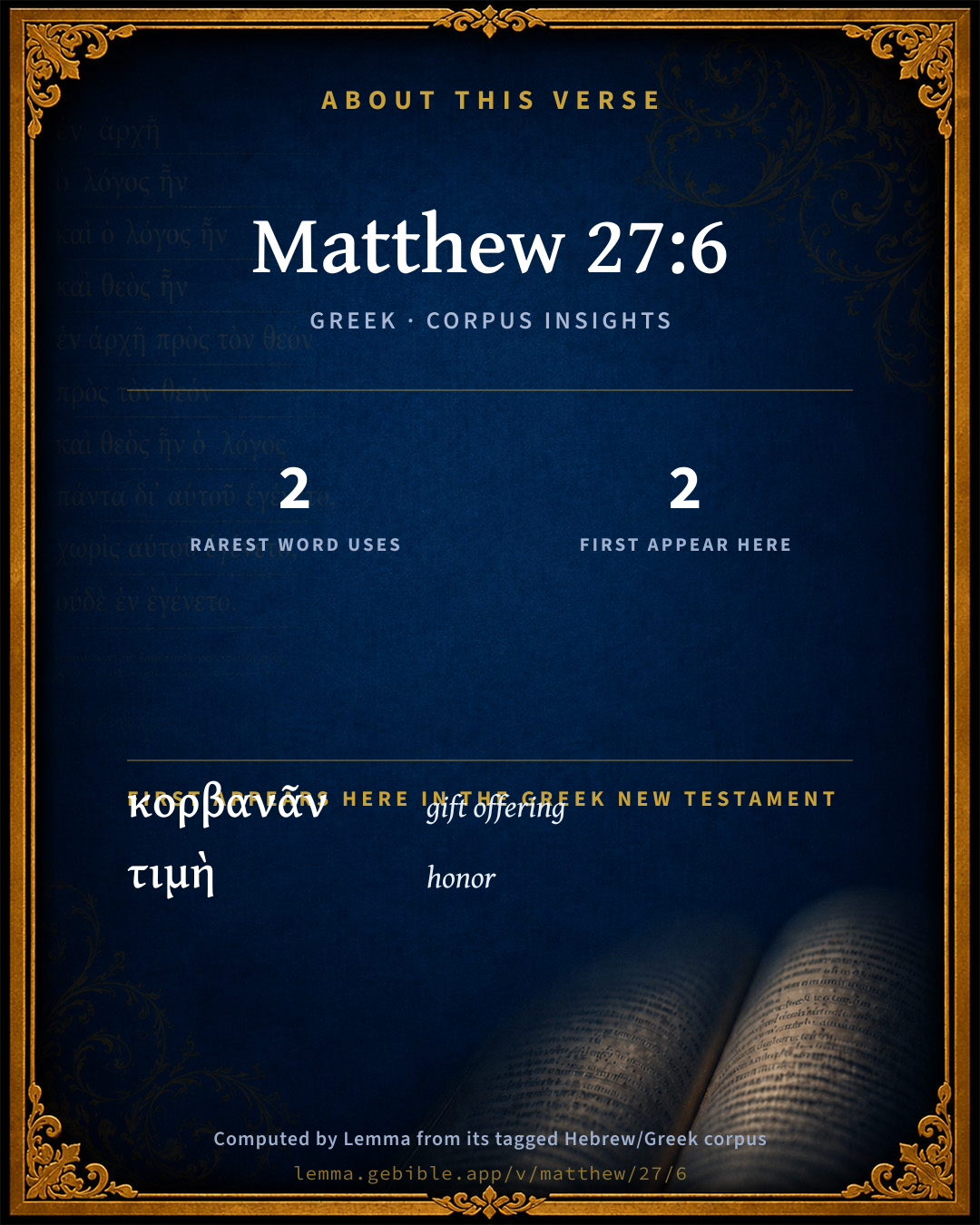
  • 2 first appearances in the Greek New Testament
Full analysis ↓
Download a study sheet

One document with this verse’s original text, its word-by-word gloss line, the meaning frame, cross-references with their text, attributed commentary, and full source and license credits — printable, and it pastes into notes with its structure intact.

This verse Autodidact and up

Study sheet (.html) Plain text (.txt)

A passage Seminary Student

Up to 50 verses in one chapter. A passage sheet keeps up to 6 commentary sources and 12 cross-references per verse, in the order this page ranks them, and says so on the sheet whenever that leaves anything out. Ask for a single verse and you get the Autodidact verse sheet above.

Everything on this page stays free to read, with no account — the sheet is a download of what is already on screen, not access to it.

Want to remove ads? Support Godless Engineer
Compare translations 3

The same verse in 3 English versions, stacked beneath the original-language interlinear above. Click any original word for its lexicon entry.

Each is an independent rendering of the whole verse — the interlinear is not word-aligned to these translations.

Highlighted words mark where these versions differ — a whole-verse word diff, not a word-by-word alignment.

  • World English Bible Public Domain
    The chief priests took the pieces of silver, and said, "It's not lawful to put them into the treasury, since it is the price of blood."
  • King James Version Public Domain
    And the chief priests took the silver pieces, and said, It is not lawful for to put them into the treasury, because it is the price of blood.
  • unfoldingWord Literal Text CC BY-SA 4.0
    Now the chief priests, having taken the pieces of silver, said, “It is not lawful to put them into the treasury, because it is the price of blood.”

unfoldingWord Literal Text — © unfoldingWord, licensed CC BY-SA 4.0. Word-aligned USFM3 via Door43 (git.door43.org/unfoldingWord/en_ult).

Versions to compare (up to 4)

3 of 4 selected

Show all 19 translations

Every available English version of this verse, each an independent rendering of the whole verse.

  • World English Bible Public Domain
    The chief priests took the pieces of silver, and said, "It's not lawful to put them into the treasury, since it is the price of blood."
  • Berean Standard Bible Public Domain
    The chief priests picked up the pieces of silver and said, “It is unlawful to put this into the treasury, since it is blood money.”
  • Majority Standard Bible Public Domain
    The chief priests picked up the pieces of silver and said, “It is unlawful to put this into the treasury, since it is blood money.”
  • King James Version Public Domain
    And the chief priests took the silver pieces, and said, It is not lawful for to put them into the treasury, because it is the price of blood.
  • American Standard Version (1901) Public Domain
    And the chief priests took the pieces of silver, and said, It is not lawful to put them into the treasury, since it is the price of blood.
  • Revised Version (1885) Public Domain
    And the chief priests took the pieces of silver, and said, It is not lawful to put them into the treasury, since it is the price of blood.
  • Geneva Bible (1599) Public Domain
    And the chiefe Priestes tooke the siluer pieces, and sayde, It is not lawfull for vs to put them into the treasure, because it is the price of bloud.
  • Douay-Rheims (1899) Public Domain
    But the chief priests having taken the pieces of silver, said: It is not lawful to put them into the corbona, because it is the price of blood.
  • Young's Literal Translation Public Domain
    And the chief priests having taken the silverlings, said, `It is not lawful to put them to the treasury, seeing it is the price of blood;'
  • Literal Standard Version CC BY-SA 4.0
    And the chief priests having taken the pieces of silver, said, “It is not lawful to put them into the treasury, seeing it is the price of blood”;
  • Unlocked Literal Bible CC BY-SA 4.0
    The chief priests took the pieces of silver and said, “It is not lawful to put this into the treasury, because it is the price of blood.”
  • unfoldingWord Literal Text CC BY-SA 4.0
    Now the chief priests, having taken the pieces of silver, said, “It is not lawful to put them into the treasury, because it is the price of blood.”
  • Darby Bible Public Domain
    And the chief priests took the pieces of silver and said, It is not lawful to cast them into the Corban, since it is [the] price of blood.
  • World Messianic Bible Public Domain
    The chief priests took the pieces of silver and said, “It’s not lawful to put them into the treasury, since it is the price of blood.”
  • Webster's Bible Public Domain
    And the chief priests took the silver pieces, and said, It is not lawful to put them into the treasury, because it is the price of blood.
  • Free Bible Version CC BY-SA 4.0
    The chief priests took the silver coins and said, “This is blood money, so it's not lawful to put this in the Temple treasury.”
  • Bible in Basic English Public Domain
    And the chief priests took the silver and said, It is not right to put it in the Temple store for it is the price of blood.
  • Text-Critical English NT CC BY 4.0
    The chief priests took the pieces of silver and said, “It is not lawful to put them into the temple treasury, since they are a price paid for blood.”
  • Tyndale New Testament (1534) Public Domain
    And the chefe prestes toke the sylver plattes and sayd: it is not lawfull for to put them in to the treasury because it is the pryce of bloud.

Literal Standard Version (2020), Covenant Press — licensed CC BY-SA 4.0. Text via the HelloAO Bible API (eBible.org). Unlocked Literal Bible (unfoldingWord) — licensed CC BY-SA 4.0. Text via the HelloAO Bible API (eBible.org). unfoldingWord Literal Text — © unfoldingWord, licensed CC BY-SA 4.0. Word-aligned USFM3 via Door43 (git.door43.org/unfoldingWord/en_ult). Free Bible Version, Dr. Jonathan Gallagher — licensed CC BY-SA 4.0. Text via the HelloAO Bible API (eBible.org).

Word by word

More ways to search: Search by grammar → Find every occurrence → Compare this word →

Practice this passage: Drill this verse → Learn its vocabulary →

κορβανᾶν
korbân
G2878
“gift offering”
Noun, Accusative, Singular, Masculine
Part of Speech
Noun
Case
Accusative
Number
Singular
Gender
Masculine
Full Thayer's Definition

Origin: of hebrew and Aramaic origin respectively G7133

TDNT: 17:20,5

1. a gift offered (or to be offered) to God 2. the sacred treasury
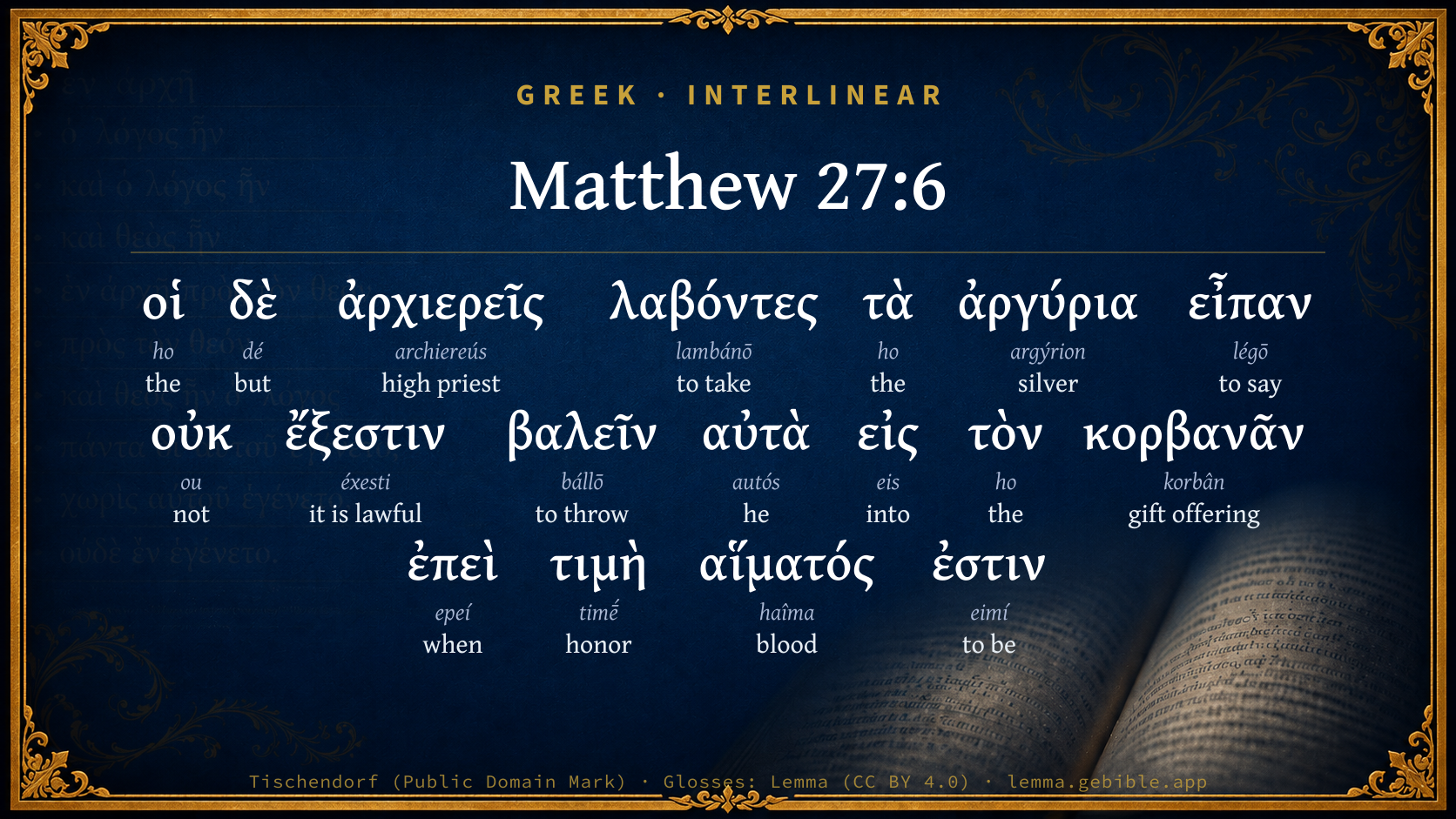
  1. οἱ ho G3588 “the” Article, Nominative, Plural, Masculine
  2. δὲ dé G1161 “but” Conjunction
  3. ἀρχιερεῖς archiereús G749 “high priest” Noun, Nominative, Plural, Masculine
  4. λαβόντες lambánō G2983 “to take” Verb, Aorist, Active, Participle, Nominative, Plural, Masculine
  5. τὰ ho G3588 “the” Article, Accusative, Plural, Neuter
  6. ἀργύρια argýrion G694 “silver” Noun, Accusative, Plural, Neuter
  7. εἶπαν légō G3004 “to say” Verb, Aorist, Active, Indicative, 3rd person, Plural
  8. οὐκ ou G3756 “not” Particle, Negative
  9. ἔξεστιν éxesti G1832 “it is lawful” Verb, Present, Active, Indicative, 3rd person, Singular
  10. βαλεῖν bállō G906 “to throw” Verb, Aorist, Active, Infinitive
  11. αὐτὰ autós G846 “he” Personal pronoun, Accusative, Plural, Neuter
  12. εἰς eis G1519 “into” Preposition
  13. τὸν ho G3588 “the” Article, Accusative, Singular, Masculine
  14. ἐπεὶ epeí G1893 “when” Conjunction
  15. τιμὴ timḗ G5092 “honor” Noun, Nominative, Singular, Feminine
  16. αἵματός haîma G129 “blood” Noun, Genitive, Singular, Neuter
  17. ἐστιν eimí G1510 “to be” Verb, Present, Active, Indicative, 3rd person, Singular

About this verse

These counts appear in no published source. They are computed here, from the morphology-tagged text and Lemma’s own curated glosses. What Lemma adds →

18
words
16
distinct lemmas
Gospels
section

Notable vocabulary

The rarest word here is κορβανᾶν gift offering G2878 — appearing just 2 times in the whole Greek New Testament.

First appearance in Scripture

These words make their first canonical appearance in the Greek New Testament here:

  • κορβανᾶν gift offering G2878
  • τιμὴ honor G5092

Shared distinctive vocabulary

κορβανᾶν gift offering G2878 occurs in 2 verses of the Greek New Testament. Also found in:

Repetition

A word recurs within this verse:

Cross-references

5

Topical passages linked to Matthew 27:6 in the Treasury of Scripture Knowledge — connected by theme and wording, ordered by reader-vote popularity; previews shown in the World English Bible.

  • Deuteronomy 23:18 You shall not bring the hire of a prostitute, or the wages of a dog, into the house of Yahweh your God for any vow: for even both these are an abomination to Yahweh your God.
  • Luke 6:7–9 The scribes and the Pharisees watched him, to see whether he would heal on the Sabbath, that they might find an accusation against him.
  • Isaiah 61:8 For I, Yahweh, love justice, I hate robbery with iniquity; and I will give them their recompense in truth, and I will make an everlasting covenant with them.
  • Matthew 23:24 You blind guides, who strain out a gnat, and swallow a camel!
  • John 18:28 They led Jesus therefore from Caiaphas into the Praetorium. It was early, and they themselves didn't enter into the Praetorium, that they might not be defiled, but might eat the Passover.

Cross-references courtesy of OpenBible.info (CC BY 4.0).

Commentary

Notes on Matthew 27:6 from classic Christian and Jewish commentators (each source and its license shown beneath its notes). The classic Christian expositions comment on the surrounding passage and are grouped to its opening verse, so a note may address several verses; the Jewish commentaries on the Tanakh (Rashi and others) are per-verse, so they appear only where the commentator wrote on this verse.

Lemma curates 59 commentaries, every one of them public domain or Creative Commons licensed, each selected and text-cleaned for this edition rather than reprinted as found. About our sources →

Joseph Benson's Commentary

Mat 27:6-8. And the chief priests took the silver pieces — They refused to receive them from Judas, for fear, perhaps, of taking thereby the whole guilt of the murder of Christ upon themselves, which they wished Judas to bear with them; but the money being thrown down in some place belonging to the temple, in the precincts of which it is probable they held their council, they took it up; but were at first at a loss to know what use to make of it. It is not lawful, said they, to put them (the pieces of silver) into the treasury: because it is the price of blood — Yes, of innocent blood: and was it lawful to purchase that? We see these priests and rulers had a conscience too! but what kind of a conscience! A conscience that strained out a gnat and swallowed a camel! They scrupled deviating from a ceremonial direction of Moses, while they were knowingly and wilfully transgressing, in the most flagrant instance possible, the eternal and unchangeable laws of justice and mercy! were adjudging to an ignominious and painful death the Holy One of God! These “arch hypocrites,” says Baxter, “make conscience of ceremony, and make no conscience of perjury, persecution, and murdering the innocent! Blood they thirst for, and will give money to procure it, but the price of blood must not be consecrated!” They scruple not to give money to procure the shedding of blood, but scruple the putting that money into the treasury! they are afraid to defile the treasury, but not afraid to pollute their souls. The word κορβαναν, here rendered treasury, occurs in no other passage in the Scriptures. Josephus makes use of it, and interprets it, τον ιερον θησαυρον, the sacred treasure. It is formed from κορβαν, originally Hebrew, which also occurs but once in the Greek form, namely, Mar 7:11, and signifies that which is given, or devoted to God. The unlawfulness of putting the thirty shekels into this repository arose from this single circumstance, that it contained the treasure consecrated to God; and the priests judged that such an offering, as this price of blood, would have been as much an abomination to the Lord, as the hire of a whore, or the price of a dog, which were expressly forbidden to be brought into the house of God for any vow, or offering, Deu 23:18. They took counsel and bought the potter’s field — Well known, it seems, by that name; to bury strangers in — Foreigners, heathen, especially, of whom there then were great numbers at Jerusalem. To purchase this field with the money, they thought would be putting it to a pious use; so holy and charitable would they be! Perhaps they thought to atone for what they had done by this public good act of providing a burying-place for strangers, though not at their own charge! Thus, in the dark times of Popery, people were made to believe that building churches, and endowing monasteries, would make amends for immoralities. Thirty pieces of silver may seem but a small price for a field so near to Jerusalem as this was. Probably the potters, by digging earth out of it for their ware, had made it useless either for tillage or pasture. Wherefore that field was called, The field of blood — Because it was bought with the money Judas received for betraying his Master’s life. Providence seems to have set this name upon the field to perpetuate the memory of the transaction. Jerome, who had been upon the spot, tells us that they still showed this field in his time: that it lay south of mount Zion, and that they buried there the poorest and meanest of the people. The historian’s mentioning the purchase of the potter’s field with the money for which Judas betrayed his Master, being an appeal to a very public transaction, puts the truth of this part of the history beyond all manner of exception.

Joseph Benson's Commentary on the Old and New Testaments (1811–1818) — public domain. Text from a community e-Sword module.

Meyer's Critical & Exegetical Commentary

Heinrich August Wilhelm Meyer

Mat_27:6 Οὐκ ἔξεστι] argumento ducto ex Deu_23:18, Sanhedr. f. 112, Wetstein.

τιμὴ αἵματος] the price of blood, which is supposed to have been shed.

κορβ.] τὸν ἱερὸν θησαυρόν, καλεῖται δὲ κορβανᾶς, Josephus, Bell. ii. 9. 4.

Meyer — Critical and Exegetical Commentary on the New Testament — English translation by Peter Christie, edited by Frederick Crombie (T&T Clark, 1880) — public domain. Text from a community e-Sword module.

Expositor's Greek Testament

ed. W. Robertson Nicoll

Mat 27:6 . κορβανᾶν , the treasury, referred to by this name by Joseph. (B. J. ii. 9, 4). τιμὴ αἵματός ἐστι : exclusion of blood money from the treasury, an extension of the law against the wages of harlotry (Deu 23:18 ).

The Expositor's Greek Testament, edited by W. Robertson Nicoll (1897–1910) — public domain. Text from a community e-Sword module.

Geneva Bible (1599)

Geneva Bible translators

The treasury of the Temple.

Of life and death.

Geneva Bible (1599) marginal notes — public domain. Text via Bolls.life.

Jamieson, Fausset & Brown

Robert Jamieson, A. R. Fausset & David Brown

And the chief priests took the silver pieces, and said, It is not lawful for to put them into the treasury--"the Corban," or chest containing the money dedicated to sacred purposes (see on Mat 15:5).

because it is the price of blood--How scrupulous now! But those punctilious scruples made them unconsciously fulfil the Scripture.

Jamieson, Fausset & Brown — Commentary Critical and Explanatory on the Whole Bible (1871) — public domain (CC PDM 1.0). Text via the HelloAO Bible API.

Adam Clarke's Commentary

Verse 6. The treasury] κορβαναν - the place whither the people brought their free-will offerings for the service of the temple, so called from the Hebrew קרבן korban, AN OFFERING, from קרב karab, he drew nigh, because the person who brought the gift came nigh to that place where God manifested his glory between the cherubim, over the mercy-seat in the most holy place. It is from this idea that the phrase to draw nigh to God is taken, which is so frequently used in the sacred writings.

Because it is the price of blood.] "What hypocrites, as one justly exclaims, to adjudge an innocent man to death, and break the eternal laws of justice and mercy without scruple, and to be, at the same time, so very nice in their attention to a ceremonial direction of the law of Moses! Thus it is that the devil often deludes many, even among the priests, by a false and superstitious tenderness or conscience in things indifferent, while calumny, envy, oppression of the innocent, and a conformity to the world, give them no manner of trouble or disturbance." See Quesnel.

Adam Clarke's Commentary on the Bible (1810–1826) — public domain. Text from a community e-Sword/MySword module.

Ellicott's Commentary for English Readers

(6) It is not lawful for to put them into the treasury.—The Greek for the last word is the Corban, or sacred treasure-chest of the Temple, into which no foreign coins were admitted, and from which the Law (Deu_23:18) excluded the unclean offerings of the price of shame, which entered largely into the ritual of many heathen nations. By parity of reasoning, the priests seem to have thought that the blood-money which was thus returned was excluded also.

A Bible Commentary for English Readers, edited by Charles John Ellicott (1878–1897) — public domain. Text from a community e-Sword module.

The Cambridge Bible for Schools and Colleges

gen. ed. J. J. S. Perowne

6. into the treasury] “Into the Corban” in the original. For the prohibition cp. Deu_23:18.

The Cambridge Bible for Schools and Colleges (gen. ed. J. J. S. Perowne; Cambridge University Press, 1878–1918) — public domain. Text from a community e-Sword module.

John Gill's Exposition

And the chief priests took the silver pieces,.... Off of the ground, after Judas was gone, no other daring to meddle with them; for in any other it would have been deemed sacrilege; and they being the proper persons to take care and dispose of money brought into the temple: and if not, their covetous disposition would have moved them to take up the money:

and said, one to another, it is not lawful to put them into the treasury, or "Corban"; as the Vulgate Latin and Ethiopic versions leave the word untranslated: and which is the place where the offerings for the repair and service of the temple were put, and is the same into which Christ beheld the people casting their money, Mar 12:41. Josephus (u) observes, that

"there was, with the Jews, an holy treasure, which is called "Corbonas";''

and this is the , "the chamber of the Korban", of which the Jews make mention (w): the reason the high priests give why it was not lawful to put this money into the treasury, or into any of the chests in the "Corban" chamber, was,

because it is the price of blood. Thus they strained at a gnat, and swallowed a camel. It is highly probable, that they took this selfsame money out of the treasury to buy this blood with, and yet scruple to put it in, having bought it: and besides, they made no hesitation about seeking for, and shedding this innocent blood, and yet boggle at putting this money into the "Corban", because it was the price of it; proceeding upon the same reason as the law in Deu 23:18 does, pretending much religion, and great veneration for holy pieces and things, when they made no conscience of committing the most flagitious crimes.

(u) De Bello Jud. l. 2. c. 9. sect. 3. (w) Misn. Middot, c. 1. sect, 1.

John Gill's Exposition of the Whole Bible (1746–1763) — public domain (CC PDM 1.0). Text via the HelloAO Bible API.

Trapp's Complete Commentary

John Trapp

6 And the chief priests took the silver pieces, and said, It is not lawful for to put them into the treasury, because it is the price of blood.

Ver. 6. It is not lawful, &c.] They would not suffer the price of blood to lie in a chest; but the blood itself they could well enough suffer to lie in their consciences. So our modern Pharisees (the Popish prelates) will not be present when the martyrs are condemned to death, but have a hypocritical form of interceding for them to the secular powers, whereas they themselves have delivered them up to the judges to be executed, Quos suis praeiudiciis damnarunt, as one speaketh, having first degraded, excommunicated, and adjudged them worthy of death.

John Trapp, A Commentary or Exposition upon All the Books of the Old and New Testament (1647–1656) — public domain. Text from a community e-Sword module.

Albert Barnes' Notes on the Bible

It is not lawful ... - It was forbidden Deu 23:18 to take what was esteemed as an abomination and to offer it to God. The price of blood - that is, of the life of a man - they justly considered as an improper and unlawful offering.

The treasury - The “treasury” was kept in the court of the women. See plan of the temple, Mat 21:12. It was composed of a number of small “chests” placed in different parts of the “courts” to receive the voluntary offerings of the people, as well as the half shekel required of every Jew. The original word rendered here as “treasury” contains the notion of an “offering to God.” What was given there was considered as an offering made to him.

The price of blood - The life is in the “blood.” See the notes at Rom 3:25. The word “blood” here means the same as “life.” The price of blood means the price by which the life of a man has been purchased. This was an acknowledgment that in their view Jesus was innocent. They had bought him, not condemned him justly. It is remarkable that they were so scrupulous now about so small a matter, comparatively, as putting this money in the treasury, when they had no remorse about “murdering an innocent” man, and crucifying him who had given full evidence that he was the Messiah. People are often very scrupulous in “small” matters, who stick not at great crimes.

Albert Barnes' Notes on the Bible (1834–1885) — public domain. Text from a community e-Sword/MySword module.

Haydock's Catholic Bible Commentary

Corbona. A place in the temple, where the people put in their gifts or offerings. (Challoner)

George Leo Haydock (1774–1849), Haydock's Catholic Family Bible and Commentary, 1859 edition — public domain. Excludes Psalms (Douay-Rheims chapter numbering differs from Protestant) and Deuterocanonical books (Catholic canon only).

Matthew Poole's English Annotations

God, Deu 23:18, had forbidden to bring the price of a whore, or a dog, into the temple; this they had interpreted of all filthy gain: upon which they thus determine, that it was not lawful for them to put the money they had given Judas, for so sordid a service as that of betraying his Master, into the chest, or place which they had, where they kept the monies given for the repairs of the temple; and in this they were right enough, perhaps, but in this they showed themselves stupidly blind hypocrites, that they saw not it was much less lawful for them, who had hired him to this sordid action, to be employed in the service of the temple, for, Isa 52:11, those that bear the vessels of the Lord ought to be holy. Thus, to justify our Saviour’s words, they strain at a gnat, and swallow a camel.

Matthew Poole's English Annotations on the Holy Bible (1683–1685) — public domain. Text from a community e-Sword/MySword module.

Whedon's Commentary on the Bible

Daniel D. Whedon

6. The price of blood — The true confession that they had bought Jesus for death. The money made abominable by certain crimes, was by law excluded from the treasury of God. Deuteronomy xxiii, 18. Many retain a sort of ecclesiastical conscience while committing the grossest immoralities.

Daniel D. Whedon (gen. ed.), Commentary on the Old and New Testaments (1874–1909) — public domain. Text from a community e-Sword module.

The Pulpit Commentary

Took the silver pieces. They picked up the coins which Judas had flung away on the marble pavement of the court, but were perplexed to determine what they should do with them. It is not lawful. These men, who had felt no doubt or hesitation in compassing the death of an innocent Man by the foulest treachery and perversion of justice, have, or hypocritically professed to have, religious scruples about the disposal of this blood money thus thrown on their hands. While they calmly outraged all moral feeling, they punctiliously observed certain outward ceremonial decencies. "They strain at a gnat, and swallow a camel." The treasury (to). The temple treasury, supplied by the offerings (corbans) of the pious for the expenses of Divine worship. It is most probable that these scrupulous priests had taken from this treasury the silver which they now deemed it sinful to replace. The price of blood. The wages of murder. It was inferred from Deu_23:18 that no money unlawfully gained, or derived from an impure source, might be used in purchasing things for God"s service. Under Jewish Law such money must be restored to the donor; if circumstances rendered this impossible, or the offerer insisted on giving it, it was to be expended for some public object, the original owner being considered, by a legal fiction, to be its possessor still, and that which was paid for by the money being deemed as his gift to the community. (comp. Act_1:18, "This man purchased a field with the reward of iniquity

The Pulpit Commentary (1880–1919), ed. H.D.M. Spence-Jones & Joseph S. Exell — public domain. Text from a community e-Sword module.

Kretzmann's Popular Commentary

Paul E. Kretzmann

The purchase of the field of blood:

v. 6. And the chief priests took the silver pieces and said, It is not lawful for to put them into the treasury, because it is the price of blood.

v. 7. And they took counsel, and bought with them the potter’s field, to bury strangers in.

v. 8. Wherefore that field was called The Field of Blood, unto this day.

v. 9. Then was fulfilled that which was spoken by Jeremy the prophet, saying, And they took the thirty pieces of silver, the price of Him that was valued, whom they of the children of Israel did value;

v. 10. and gave them for the potter’s field, as the Lord appointed me

The evangelist here draws a picture of hypocrisy in its most repulsive form. The remorse of Judas over the betraying of innocent blood makes absolutely no impression upon them, but the possible infraction of a rule drawn from Deu 23:18 fills their hearts with consternation. In sanctimonious horror they hold up their hands to ward off a threatening calamity: It will never do to lay this blood-money (which they themselves had paid for that purpose) into the holy treasury. And so the pious frauds hold a solemn meeting and decide to invest the money in a cemetery for strangers, an old clay-pit being available for that purpose. Matthew refers to a prophecy which was here fulfilled in a most remarkable way, naming the more important prophet as his source, Jer 18:2-3; Jer 32:6-15; Zec 11:13. They took the thirty pieces of silver, the price of Him who was valued at that sum, or the price of the inestimably Valuable One, whom they bought from the children of Israel, paying the money for the field of the potter, according to the command of the Lord. The two prophecies are here blended in a wonderful way, affording a further proof for the inspiration of both the gospel and the books of the prophets, since the Lord states His eternal truth according to His will. For many years after the events here recorded, the cemetery thus purchased was simply known as the Field of Blood, a fine monument to the chief priests and the betrayal of the Holy One of God.

Paul E. Kretzmann, Popular Commentary of the Bible (1921–1924) — public domain. Text from a community e-Sword module.

Burkitt's Expository Notes on the New Testament

William Burkitt

Observe here, 1. The niceness and scrupulosity of these hypocrites; they made no scruple to give money to shed blood, but they scruple the putting that money into the treasury which was the price of blood. They are afraid to defile their treasury, but are not afraid to pollute their souls. Thus hypocrites strain at a gnat, and swallow a camel; scruple a ceremony, but make no conscience of murder and perjury.

Observe, 2. The use which they put this mount to, which Judas brought them; they bought with it a field to bury strangers in. Thus Christ, who was himself a stranger in a borrowed grave, by the price of his blood (being thirty pieces of silver) conferred graves on many strangers.

Observe, lastly, how the wisdom of God ordered it, that hereby a scrupture prophecy might be fulfilled, Zec 11:13. "They weighed for my price thirty pieces of silver, and I took and cast them unto the potter."

Whence learn, that all the indignities and abasing suffering which the Lord Jesus under went, were not only fore-ordained by God, but also fore told by the holy prophets; his being scourged, buffeted, spit upon, and here his being sold for thirty pieces of silver.

William Burkitt's Expository Notes on the New Testament (1700–1703) — public domain. Text from a community e-Sword module.

The People's New Testament

B. W. Johnson

6. It is not lawful to put it in the treasury. These men were not too scrupulous to send the innocent to death, to shed the blood of the innocent, but were too scrupulous to put blood money into the treasury. They could pay blood money, but could not take it back.

B. W. Johnson's The People's New Testament with Notes (1889–1891) — public domain. Electronic text from the Christian Classics Ethereal Library (CCEL) ThML edition.

unfoldingWord translationNotes

Door43 World Missions Community

It is not lawful to put this

"Our laws do not allow us to put this"

put this

"put this silver"

the treasury

This is the place they kept the money they used to provide for things needed for the temple and the priests. (See: Assumed Knowledge and Implicit Information)

price of blood

This is an idiom that means money paid to a person who helped kill someone. AT: "money paid for a man to die" (See: Idiom)

potter's field

This was a field that was bought to bury strangers who died in Jerusalem.

that field has been called

This can be stated in active form. AT: "people call that field" (See: Active or Passive)

to this day

This means to the time that Matthew is writing this book.

translationWords

chief priests

silver

lawful

blood

bury

unfoldingWord translationNotes — © Distant Shores Media and the Door43 World Missions Community, licensed CC BY-SA 4.0. Source: git.door43.org/Door43/en_tn.

Cambridge Greek Testament for Schools and Colleges

6. εἰς τὸν κορβανᾶν. For the prohibition cp. Deu 23:18.

Cambridge Greek Testament for Schools and Colleges (Cambridge University Press, 1896; 21 vols, various authors incl. Carr, Maclear, Plummer, Farrar, Lumby, Moule, M. R. James, Simcox) — public domain. Text from a community e-Sword module.

Alford’s Greek Testament

Henry Alford

6.] They said this probably by analogy from Deu 23:18. τιμ. αἵμ., the price given for shedding of blood, the wages of a murderer.

Henry Alford, The Greek Testament (1849–1861) — public domain. Text from a community e-Sword module.

International Critical Commentary

(P) 6. And the chief priests took the silver, and said, It is not lawful to put them into the cot-ban, for it is the price of blood.] κορβανᾶς is an Aramaism. It is used in Jos. Wars, ii. 175, for the money hoarded in the Temple (τὸν ἱερὸν θησαυρόν, καλεῖται δὲ κορβωνᾶς). This was collectively “the offering” par excellence. But the term is not so used in Rabbinic writings.

International Critical Commentary — older volumes (1896–1929), various authors — public domain. Text from a community e-Sword module.

Vincent's Word Studies in the New Testament

Marvin R. Vincent

It is not lawful. In such cases the Jewish law provided that the money was to be restored to the donor; and if he insisted on giving it, that he should be induced to spend it for something for the public weal. This explains the apparent discrepancy between Matthew's account and that in the book of Acts (i. 18). By a fiction of the law the money was still considered to be Judas ', and to have been applied by him to the purchase of the potter 's field.

Scarlet [κοκκινην] . From kokkov, cochineal, which grew in several parts of Greece. Garments of this color would seem to have been rare among the orientals. Herodotus relates that the admiration of Darius, then an officer in the army, was excited by the scarlet cloak of a Samian exile, who, on his offering to purchase it, presented it to him, and was afterward richly rewarded when Darius came to the throne (iii. 139).

Marvin R. Vincent, Word Studies in the New Testament (1887–1900) — public domain. Text from a community e-Sword/MySword module.

Lesson kit

Teaching starters — assembled from the data on this page, not authored interpretation. Every prompt links to the verse data it draws on. Edit before teaching.

Matthew, in the Gospels, opens this verse with 18 words (16 distinct Greek lemmas). Its most distinctive word is korbân (“gift offering”). A historical commentator’s framing appears above. Read the whole chapter for the surrounding context.

Discussion questions

  1. The word korbân carries the sense “gift offering.” How does it shape the verse?
  2. 2 words make their first appearance in Scripture here. What does this debut establish?
  3. How does Mark 7:11, which shares the word «gift offering», read alongside this verse?
  4. What does the repetition of “the” (3× in this one verse) do in this verse?
  5. These translations render this verse differently; the difference is in the English rendering, not the original. What questions does that raise?
  6. Compare how Joseph Benson's Commentary and Meyer's Critical & Exegetical Commentary read this verse. Where do they agree or differ?

Things to notice

  • 2 words make their first canonical appearance in Scripture here.
  • These translations choose different wording for 7 words in this verse.
  • “the” occurs 3× in this single verse.
  • 16 distinct Greek lemmas span 18 words in this verse.

Reading settings

Reading text

Shown beneath each verse's original-language words.

Old Testament
Old Testament edition

Read the OT as the Masoretic Hebrew (MT) or the Greek Septuagint (LXX).

English shown for the Greek Septuagint (in the Hebrew ↔ Greek comparison).

Comparing translations? Open the Compare panel on any verse page to stack up to four side by side.