
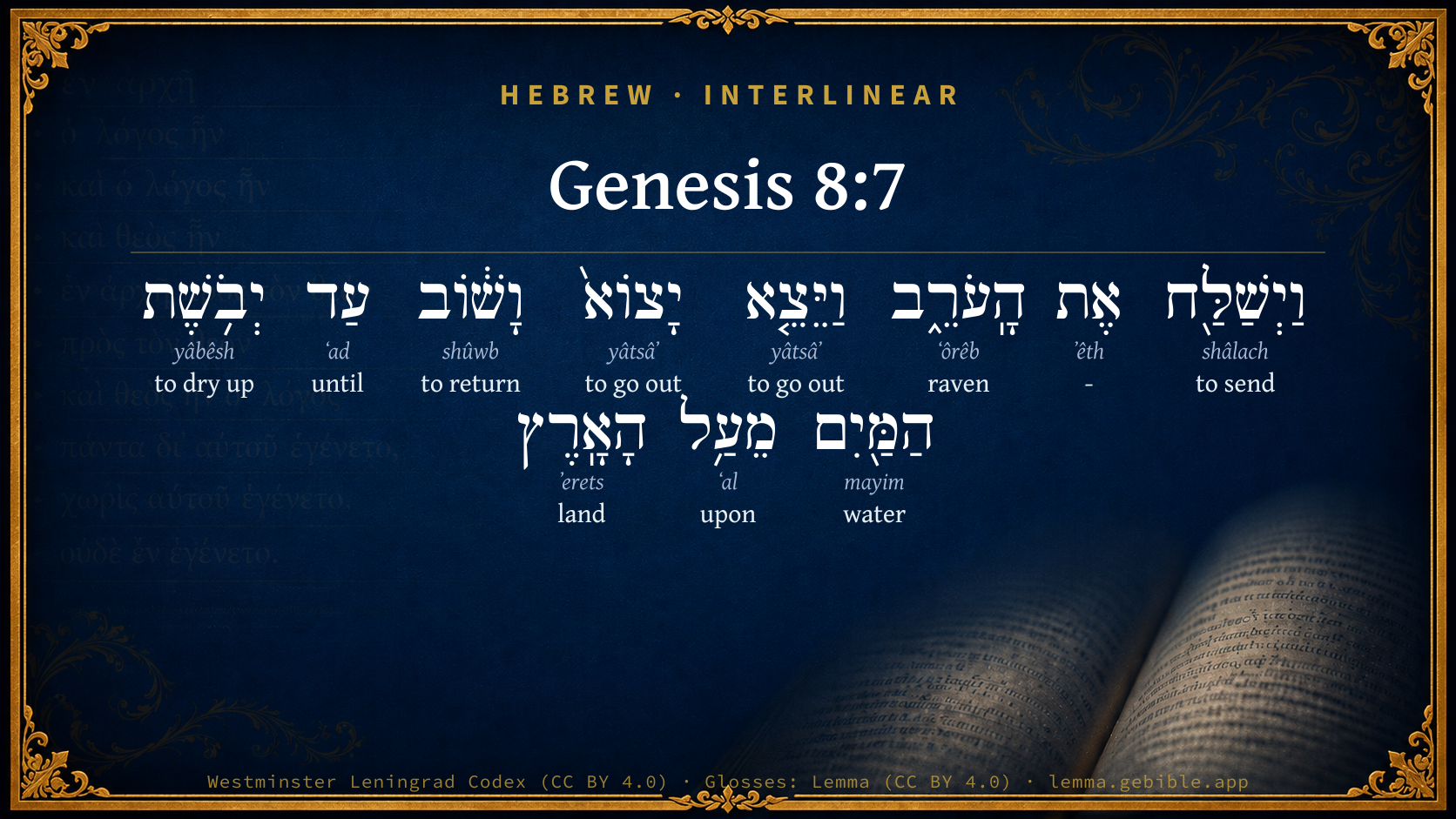
Genesis 8:7

Hebrew (Westminster Leningrad Codex) Genesis 8:7 appears in the Hebrew Old Testament. The text above is from the Westminster Leningrad Codex. Each word links to its Strong’s number, a concise gloss, and parsing drawn from the Open Scriptures Hebrew Bible morphology. Click any word for its full Brown-Driver-Briggs (BDB) entry.
Download image
Cite this verse

Genesis 8:7 (World English Bible). Public Domain. Lemma interlinear Bible study tool, https://lemma.gebible.app/v/genesis/8/7.

Show BibTeX & RIS
BibTeX
RIS
English Translation
and he sent forth a raven. It went back and forth, until the waters were dried up from off the earth.
World English Bible · Public Domain
Highlights
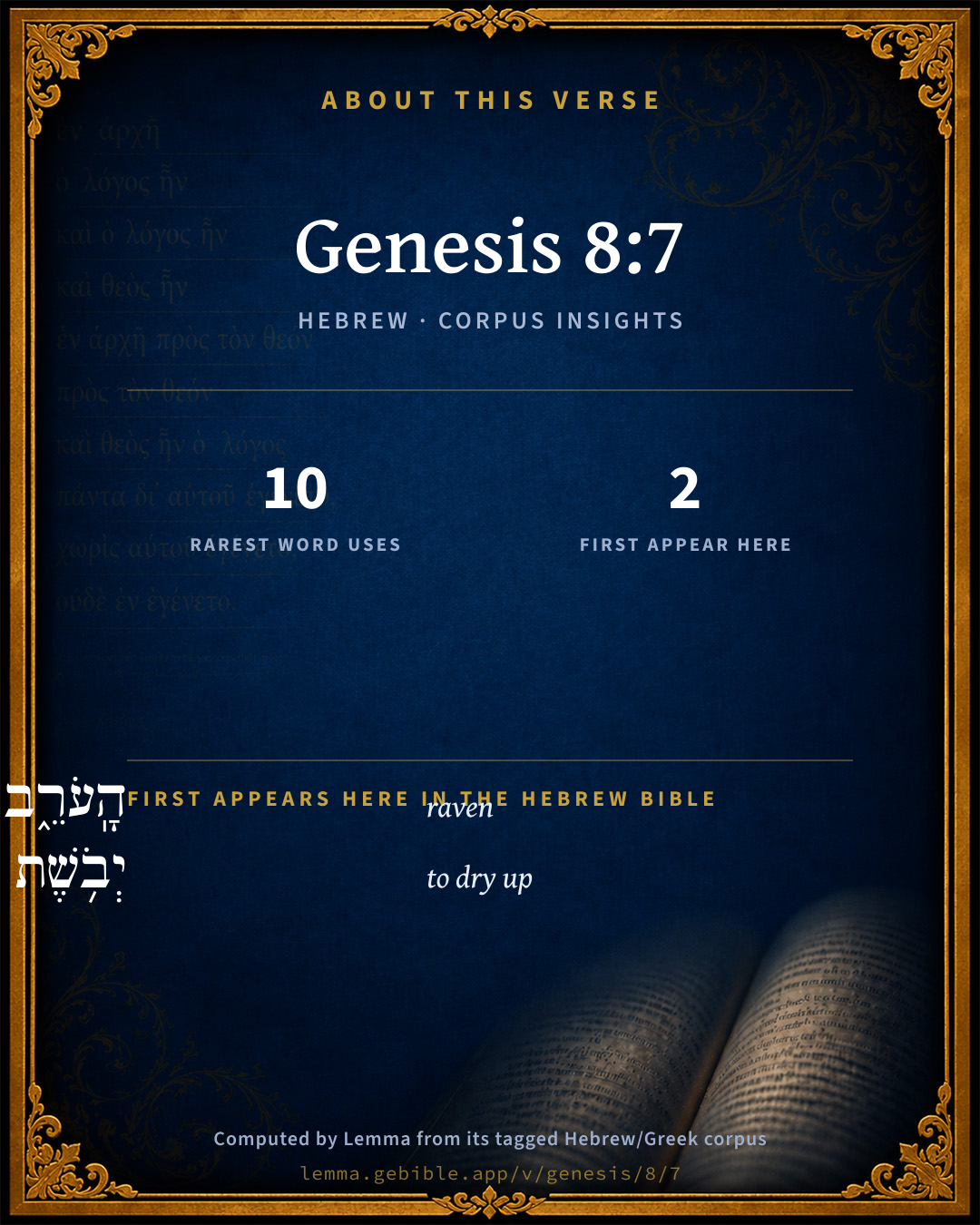
  • 2 first appearances in the Hebrew Bible
Full analysis ↓
Download a study sheet

One document with this verse’s original text, its word-by-word gloss line, the meaning frame, cross-references with their text, attributed commentary, and full source and license credits — printable, and it pastes into notes with its structure intact.

This verse Autodidact and up

Study sheet (.html) Plain text (.txt)

A passage Seminary Student

Up to 50 verses in one chapter. A passage sheet keeps up to 6 commentary sources and 12 cross-references per verse, in the order this page ranks them, and says so on the sheet whenever that leaves anything out. Ask for a single verse and you get the Autodidact verse sheet above.

Everything on this page stays free to read, with no account — the sheet is a download of what is already on screen, not access to it.

Want to remove ads? Support Godless Engineer
Compare translations 3

The same verse in 3 English versions, stacked beneath the original-language interlinear above. Click any original word for its lexicon entry.

Each is an independent rendering of the whole verse — the interlinear is not word-aligned to these translations.

Highlighted words mark where these versions differ — a whole-verse word diff, not a word-by-word alignment.

  • World English Bible Public Domain
    and he sent forth a raven. It went back and forth, until the waters were dried up from off the earth.
  • King James Version Public Domain
    And he sent forth a raven, which went forth to and fro, until the waters were dried up from off the earth.
  • unfoldingWord Literal Text CC BY-SA 4.0
    and he sent out the raven, and it kept flying out and returning until the waters dried up from the earth.

unfoldingWord Literal Text — © unfoldingWord, licensed CC BY-SA 4.0. Word-aligned USFM3 via Door43 (git.door43.org/unfoldingWord/en_ult).

Versions to compare (up to 4)

3 of 4 selected

Show all 18 translations

Every available English version of this verse, each an independent rendering of the whole verse.

  • World English Bible Public Domain
    and he sent forth a raven. It went back and forth, until the waters were dried up from off the earth.
  • Berean Standard Bible Public Domain
    and sent out a raven. It kept flying back and forth until the waters had dried up from the earth.
  • Majority Standard Bible Public Domain
    and sent out a raven. It kept flying back and forth until the waters had dried up from the earth.
  • King James Version Public Domain
    And he sent forth a raven, which went forth to and fro, until the waters were dried up from off the earth.
  • American Standard Version (1901) Public Domain
    and he sent forth a raven, and it went forth to and fro, until the waters were dried up from off the earth.
  • Revised Version (1885) Public Domain
    and he sent forth a raven, and it went forth to and fro, until the waters were dried up from off the earth.
  • Geneva Bible (1599) Public Domain
    And sent forth a rauen, which went out going forth and returning, vntill the waters were dried vp vpon the earth.
  • Douay-Rheims (1899) Public Domain
    Which went forth and did not return, till the waters were dried up upon the earth.
  • Young's Literal Translation Public Domain
    and he sendeth forth the raven, and it goeth out, going out and turning back till the drying of the waters from off the earth.
  • Literal Standard Version CC BY-SA 4.0
    and he sends forth the raven, and it goes out, going out and turning back until the drying of the waters from off the earth.
  • Unlocked Literal Bible CC BY-SA 4.0
    He sent out a raven and it flew back and forth until the waters were dried up from the earth.
  • unfoldingWord Literal Text CC BY-SA 4.0
    and he sent out the raven, and it kept flying out and returning until the waters dried up from the earth.
  • Darby Bible Public Domain
    And he sent out the raven, which went forth going to and fro, until the waters were dried from the earth.
  • World Messianic Bible Public Domain
    and he sent out a raven. It went back and forth, until the waters were dried up from the earth.
  • Webster's Bible Public Domain
    And he sent forth a raven, which went forth to and fro, till the waters were dried from off the earth.
  • Free Bible Version CC BY-SA 4.0
    and sent a raven out. It flew back and forth until the water on the earth had dried up.
  • Bible in Basic English Public Domain
    Noah sent out a raven, which went this way and that till the waters were gone from the earth.
  • JPS Tanakh (1917) Public Domain
    And he sent forth a raven, and it went forth to and fro, until the waters were dried up from off the earth.

Literal Standard Version (2020), Covenant Press — licensed CC BY-SA 4.0. Text via the HelloAO Bible API (eBible.org). Unlocked Literal Bible (unfoldingWord) — licensed CC BY-SA 4.0. Text via the HelloAO Bible API (eBible.org). unfoldingWord Literal Text — © unfoldingWord, licensed CC BY-SA 4.0. Word-aligned USFM3 via Door43 (git.door43.org/unfoldingWord/en_ult). Free Bible Version, Dr. Jonathan Gallagher — licensed CC BY-SA 4.0. Text via the HelloAO Bible API (eBible.org).

Word by word

More ways to search: Search by grammar → Find every occurrence → Compare this word →

Practice this passage: Drill this verse → Learn its vocabulary →

הָֽעֹרֵ֑ב
ʻôrêb
H6158
“the · raven”
Particle, Definite Article + Noun, Common, Masculine, Singular, Absolute
Part of Speech
Particle + Noun
Type
Common
Gender
Masculine
Number
Singular
State
Absolute
Full BDB Definition

Origin: from H6150

TWOT: 1690a

raven
  1. וַיְשַׁלַּ֖ח shâlach H7971 “and · to send” Conjunction + Verb, Piel, Sequential Imperfect, 3rd Person, Masculine, Singular
  2. אֶת ʼêth H853 “-” Particle, Direct Object
  3. וַיֵּצֵ֤א yâtsâʼ H3318 “and · to go out” Conjunction + Verb, Qal, Sequential Imperfect, 3rd Person, Masculine, Singular
  4. יָצוֹא֙ yâtsâʼ H3318 “to go out” Verb, Qal, Infinitive Absolute
  5. וָשׁ֔וֹב shûwb H7725 “and · to return” Conjunction + Verb, Qal, Infinitive Absolute
  6. עַד ʻad H5704 “until” Preposition
  7. יְבֹ֥שֶׁת yâbêsh H3001 “to dry up” Verb, Qal, Infinitive Construct
  8. הַמַּ֖יִם mayim H4325 “the · water(s)” Particle, Definite Article + Noun, Common, Masculine, Plural, Absolute
  9. מֵעַ֥ל ʻal H5921 “from · upon” Preposition + Preposition
  10. הָאָֽרֶץ ʼerets H776 “the · land” Particle, Definite Article + Noun, Common, Both, Singular, Absolute

About this verse

These counts appear in no published source. They are computed here, from the morphology-tagged text and Lemma’s own curated glosses. What Lemma adds →

11
words
10
distinct lemmas
Pentateuch
section

Notable vocabulary

The rarest word here is הָֽעֹרֵ֑ב raven H6158 — appearing just 10 times in the whole Hebrew Bible.

First appearance in Scripture

These words make their first canonical appearance in the Hebrew Bible here:

  • הָֽעֹרֵ֑ב raven H6158
  • יְבֹ֥שֶׁת to dry up H3001

Shared distinctive vocabulary

הָֽעֹרֵ֑ב raven H6158 occurs in 10 verses of the Hebrew Bible. Also found in:

Grammatical profile

  • 5 verbs
  • 3 nouns
  • 2 prepositions
  • 1 particle

Verb forms

  • וַיְשַׁלַּ֖ח Piel · Sequential Imperfect
  • וַיֵּצֵ֤א Qal · Sequential Imperfect
  • יָצוֹא֙ Qal · Infinitive Absolute
  • וָשׁ֔וֹב Qal · Infinitive Absolute
  • יְבֹ֥שֶׁת Qal · Infinitive Construct

Repetition

A word recurs within this verse — often emphatic in Hebrew:

  • וַיֵּצֵ֤א to go out H3318 ×2

Hebrew & Septuagint length

In English translation the verse runs 21 words from the Hebrew and 22 from the Septuagint (LXX English) — closely comparable.

A rough comparison of the two English renderings, which tokenize alike — not a word-level alignment.

Word counts can differ between the Hebrew and the Greek without any difference in meaning — e.g. the Hebrew direct-object marker אֵת has no separate Greek word, and Greek often adds the article ὁ.

Cross-references

5

Topical passages linked to Genesis 8:7 in the Treasury of Scripture Knowledge — connected by theme and wording, ordered by reader-vote popularity; previews shown in the World English Bible.

  • 1 Kings 17:4 It shall be, that you shall drink of the brook; and I have commanded the ravens to feed you there.
  • 1 Kings 17:6 The ravens brought him bread and flesh in the morning, and bread and flesh in the evening; and he drank of the brook.
  • Job 38:41 Who provides for the raven his prey, When his young ones cry to God, And wander for lack of food?
  • Psalms 147:9 He provides food for the cattle, And for the young ravens when they call.
  • Leviticus 11:15 any kind of raven,

Cross-references courtesy of OpenBible.info (CC BY 4.0).

Hebrew and Greek witnesses Masoretic Hebrew ↔ Greek Septuagint

The same verse in the two great witnesses to the Old Testament, shown verse-for-verse.

These are two independent witnesses, not word-aligned to each other, and the Septuagint is shown in lemma (dictionary) form.

Hebrew Genesis 8:7 Masoretic · Westminster Leningrad Codex

וַיְשַׁלַּ֖ח אֶת הָֽעֹרֵ֑ב וַיֵּצֵ֤א יָצוֹא֙ וָשׁ֔וֹב עַד יְבֹ֥שֶׁת הַמַּ֖יִם מֵעַ֥ל הָאָֽרֶץ

and he sent forth a raven. It went back and forth, until the waters were dried up from off the earth.

World English Bible · Public Domain

Greek LXX Genesis 8:7 Septuagint · lemma form

καί ἀποστέλλω ὁ κόραξ ὁ ὁράω εἰ κοπάζω ὁ ὕδωρ καί ἐκἔρχομαι οὐ ὑποστρέφω ἕως ὁ ξηραίνω ὁ ὕδωρ ἀπό ὁ γῆ

And he sent forth a raven; and it went forth and returned not until the water was dried from off the earth.

LXX2012 (modern English Septuagint) · Public Domain

On this verse, The Cambridge Bible for Schools and Colleges discusses the Septuagint’s reading. Read the note in Commentary ↓

Hebrew: Westminster Leningrad Codex (CC BY 4.0). Greek: Septuagint (public domain); English from LXX2012 (modern English Septuagint) (Public Domain). How the Septuagint differs from the Hebrew →

Targum (Aramaic paraphrase)

2

The Targum is the ancient Jewish Aramaic paraphrase of the Hebrew Scriptures — an interpretive translation, not the Hebrew text itself. Onkelos (literal) and Pseudo-Jonathan (expansive) render the Torah, and Jonathan the Prophets. Coverage is partial: where no permissively-licensed English translation exists for a verse, only the Aramaic is shown. This is verse-level text, not a word-by-word alignment to the Hebrew.

  1. Targum Onkelos Torah (Genesis–Deuteronomy)
    וְשַׁלַּח יָת עוֹרְבָא וּנְפַק מִפַּק וְתַיִּב עַד דְּיַבִּישׁוּ מַיָּא מֵעַל אַרְעָא

    And he sent forth a raven, and going he went out, and returned until the waters were dried upon the earth.

    Targum Onkelos — Aramaic: “Onkelos Genesis” (public domain); “Onkelos Exodus” (public domain); “Onkelos Leviticus” (public domain); “Onkelos Numbers” (public domain); “Onkelos Deuteronomy” (public domain). English: “Sefaria Community Translation” (CC0 1.0 (public-domain dedication)); “J.W. Etheridge. The Targums of Onkelos and Jonathan Ben Uzziel on the Pentateuch. London: Longmans, Green, 1862” (public domain). Text via Sefaria.

  2. Targum Pseudo-Jonathan Torah (Genesis–Deuteronomy)
    וְשָׁדַר יַת עוֹרְבָא וּנְפַק מֵיפַק וְתָאֵיב עַד דִיבִיאִישׁוּ מַיָא מֵעִילוֹי אַרְעָא

    And he sent out a raven; and it went forth, going forth and returning, until the waters had dried from the earth.

    Targum Pseudo-Jonathan — Aramaic: “Targum Jonathan on Genesis” (public domain); “Targum Jonathan on Exodus” (public domain); “Targum Jonathan on Leviticus” (public domain); “Targum Jonathan on Numbers” (public domain); “Targum Jonathan on Deuteronomy” (public domain). English: “The Targum of Jonathan ben Uzziel, trans. J. W. Etheridge, London, 1862” (public domain). Text via Sefaria.

Commentary

Notes on Genesis 8:7 from classic Christian and Jewish commentators (each source and its license shown beneath its notes). The classic Christian expositions comment on the surrounding passage and are grouped to its opening verse, so a note may address several verses; the Jewish commentaries on the Tanakh (Rashi and others) are per-verse, so they appear only where the commentator wrote on this verse.

Lemma curates 59 commentaries, every one of them public domain or Creative Commons licensed, each selected and text-cleaned for this edition rather than reprinted as found. About our sources →

Trapp's Complete Commentary

John Trapp

Gen 8:7 And he sent forth a raven, which went forth to and fro, until the waters were dried up from off the earth.

Ver. 7. And he sent forth a raven.] Which when it is made tame, though it delights in dead carcasses, whereof Noah knew the earth was now full, yet doth not easily forget its station, but returns thereto, when nature is satisfied.

Which went forth to and fro.] Fluttered about the ark, but kept out of it. Manet foris cum voce corvina, qui non habet simplicitatem columbinam. (August.)

John Trapp, A Commentary or Exposition upon All the Books of the Old and New Testament (1647–1656) — public domain. Text from a community e-Sword module.

Joseph Benson's Commentary

Gen 8:7-12. Noah sent forth a raven — Through the window of the ark; which went forth — As the Hebrew phrase is, going forth and returning; that is, flying about, but returning to the ark for rest; probably not in it, but upon it. This gave Noah little satisfaction: therefore, he sent forth a dove — Which returned the first time with no good news, but probably wet and dirty; but the second time she brought an olive-leaf in her bill, which appeared to be fresh plucked off; a plain indication that now the trees began to appear above water. Note here, that Noah sent forth the dove a second time, seven days after the first time, and the third time was after seven days too: and probably the first sending of her out was seven days after the sending forth of the raven. The olive-branch is an emblem of peace.

Joseph Benson's Commentary on the Old and New Testaments (1811–1818) — public domain. Text from a community e-Sword module.

Tyndale Open Study Notes

Tyndale Open Resources

8:7 The raven is the largest member of the crow family, and was among Noah’s unclean animals (Lev 11:15; Deut 14:14). As a scavenger and carrion eater, it was able to sustain itself without returning to the boat.

Tyndale Open Study Notes — © Tyndale Open Resources, licensed CC BY-SA 4.0. Text via the HelloAO Bible API.

Jamieson, Fausset & Brown

Robert Jamieson, A. R. Fausset & David Brown

And he sent forth a raven--The smell of carrion would allure it to remain if the earth were in a habitable state. But it kept hovering about the spot, and, being a solitary bird, probably perched on the covering.

Jamieson, Fausset & Brown — Commentary Critical and Explanatory on the Whole Bible (1871) — public domain (CC PDM 1.0). Text via the HelloAO Bible API.

Adam Clarke's Commentary

Verse 7. He sent forth a raven, which went forth to and fro] It is generally supposed that the raven flew off, and was seen no more, but this meaning the Hebrew text will not bear; ויצא יצוא ושוב vaiyetse yatso vashob, and it went forth, going forth and returning. From which it is evident that she did return, but was not taken into the ark. She made frequent excursions, and continued on the wing as long as she could, having picked up such aliment as she found floating on the waters; and then, to rest herself, regained the ark, where she might perch, though she was not admitted. Indeed this must be allowed, as it is impossible she could have continued twenty one days upon the wing, which she must have done had she not returned. But the text itself is sufficiently determinate.

Adam Clarke's Commentary on the Bible (1810–1826) — public domain. Text from a community e-Sword/MySword module.

The Cambridge Bible for Schools and Colleges

gen. ed. J. J. S. Perowne

7. a raven] The Heb. and LXX give the definite article, “the raven,” which some have explained as the only male raven in the ark. But the article is idiomatically generic; cf. Gen_8:8, Gesenius, Heb. Gr. 126, § 4. The Israelite story records the sending, first of a raven, and then, on two successive occasions, of a dove. The Babylonian account records the sending first of a dove, which returned; then of a swallow, which returned; and lastly of a raven, which turned not back.

Noah, stranded with the ark on the highest point, is unable to see anything around or below him.

went forth to and fro] Presumably it was preying upon floating carcases. The “to and fro” suggests the picture of its flitting backwards and forwards, near the ark.

The Cambridge Bible for Schools and Colleges (gen. ed. J. J. S. Perowne; Cambridge University Press, 1878–1918) — public domain. Text from a community e-Sword module.

John Gill's Exposition

And he sent forth a raven,.... That by it he might make his observation, how high or low the waters were upon the earth; and the rather he sent out the raven, a bird of prey, which feeds on carrion, that if the earth had been dry, the smell of the dead carcasses would have invited it to go far off from the ark, and not return; but if not, he would see it again:

which went forth to and fro, until the waters were dried up from the earth; or, "and it went forth, going forth and returning" (l); it went forth out of the ark, and returned, but might not go into it, but went forth again, and then returned; and thus it continued going backwards and forwards, until the waters were dried up, when it returned no more: the Septuagint version is, "and it returned not"; and so some Jewish writers (m) say, it found the carcass of a man on the top of the mountains, and sat upon it for food, and returned not: hence came the fable of Apollo's sending a raven to fetch water, while he was sacrificing, which lighting on a large corn field, yet green, and being willing to enjoy some grains of it, waited till it was ripe, and neglected its orders (n); and hence is the proverb, "corvus nuntius". Some make this creature to be an emblem of the law, first sent forth, but brought no good tidings of the waters of God's wrath being assuaged, but worketh wrath, and is the ministration of condemnation and death: rather it is an emblem of unregenerate men, who are, like it, black through original sin and actual transgressions; are unclean and polluted in all the powers and faculties of their souls; are hateful, hating one another, and live in carnal and sensual lusts pleasures.

(l) "et exiit egrediende et redeundo", Pagninus, Montanus, Schmidt. (m) Pirke Eliezer, c. 23. (n) Aelian. Var. Hist. l. 1. c. 47.

John Gill's Exposition of the Whole Bible (1746–1763) — public domain (CC PDM 1.0). Text via the HelloAO Bible API.

Haydock's Catholic Bible Commentary

Did not return. The negotiation Not, is not to be found in any Hebrew copy now extant; though it is still retained by the Septuagint, and several Latin manuscripts, according to the testimony of Liranus. If we add here, therefore, to the Hebrew text, we must translate it with St. Jerome, thus; It went forth, going and returning, (Egredicbatur exiens et revertens,) sometimes repairing to the mountains, where it found carcasses to feed on, and at other times returning not unto the ark, but to rest upon the top of it. (Estius) (Challoner) --- Or receded farther from it; as the Hebrew may be explained, agreeably to the Vulgate, Septuagint, Syriac, &c. which admit the negation. (Calmet) --- Till, as long as the waters covered the earth, not that it returned to the ark afterwards. (Menochius)

George Leo Haydock (1774–1849), Haydock's Catholic Family Bible and Commentary, 1859 edition — public domain. Excludes Psalms (Douay-Rheims chapter numbering differs from Protestant) and Deuterocanonical books (Catholic canon only).

Matthew Poole's English Annotations

He sent forth a raven; a fit messenger for that purpose, because it smells dead carcasses at a great distance, and flies far, and then returneth to its former habitation with something in its bill.

To and fro; Heb. going and returning; i.e. went forth hither and thither; now forward, then backward; sometimes going from the ark, and sometimes returning to the ark, though never entering into it again. Not as if she returned afterwards; the phrase implies that she never returned. And so the word until is often used, as 2Sa 6:23, Michal had no child until the day of her death, i.e. never had a child. See also Psa 110:1; Mat 1:25.

Matthew Poole's English Annotations on the Holy Bible (1683–1685) — public domain. Text from a community e-Sword/MySword module.

Whedon's Commentary on the Bible

Daniel D. Whedon

7. A raven — Hebrews, the raven; the well known: historic from this event.

To and fro — Hebrews, it went going and returning; that is, going away from the ark and returning to it, settling upon but not entering into it. The raven may have found abundant sustenance from the floating caresses, so that it needed not to return to the ark for food. This black bird of death, finding a congenial home in the watery sepulchre of the antediluvian world, is a symbol of judgment and wrath.

Daniel D. Whedon (gen. ed.), Commentary on the Old and New Testaments (1874–1909) — public domain. Text from a community e-Sword module.

John Wesley's Explanatory Notes

Noah sent forth a raven through the window of the ark, which went forth, as the Hebrew phrase is, going forth and returning, that is, flying about, but returning to the ark for rest; probably not in it, but upon it. This gave Noah little satisfaction: therefore,

John Wesley, Explanatory Notes Upon the Whole Bible (1754–1765) — public domain. Text via the GEBible commentary corpus.

Scofield Reference Notes

C. I. Scofield

raven

The raven and the dove have been thought to stand for the believer’s two natures: the "old man" satisfied with a world under judgment; the "new man" finding satisfaction only in the things of the new creation.

The Scofield Reference Bible (1917 edition), notes by C. I. Scofield — public domain. Text from a community e-Sword module.

Rashi

Rabbi Shlomo Yitzchaki (Rashi)

יצא ושוב WENT FORTH TO AND FRO — It (the raven) flew in circles round and round the Ark and did not go on its errand for it suspected that he (Noah) intended to injure its mate, just as we learn in the Agada of Chelek (Sanhedrin 108b).

עד יבשת המים UNTIL THE WATERS WERE DRIED UP—The real sense of the verse is what it plainly implies (until the waters of the Flood were dried up); but the Midrashic explanation (Genesis Rabbah 33:5) is: The raven went to and fro in the world being kept in readiness for another errand during the time when the rain was withheld and the waters dried up in the days of Elijah, as it is said, (1 Kings 17:6) “And the ravens brought him bread and flesh”.

Rashi on the Tanakh — English translations: “The Judaica Press complete Tanach with Rashi, translated by A. J. Rosenberg” (CC BY 4.0); “Pentateuch with Rashi's commentary by M. Rosenbaum and A.M. Silbermann, 1929-1934” (public domain); “The Metsudah Tanach series, Lakewood, N.J” (CC BY 4.0); and “The Book of Joshua, Metsudah Publications, 1997” (CC BY 4.0). Text via Sefaria.

Radak

Rabbi David Kimhi (Radak)

וישלח, why did Noach send out the raven? He had said to himself that the raven is a flesh eating bird and will most likely find remains of dead animals to feed on. [our author understands the word עורב as referring to what is better known as the “black raven,” a type of vulture (corvus cornix) which feeds on carcasses. Ed.] If the bird would return with such remains in its beak, Noach would know that the waters had receded somewhat. The raven returned without anything in its beak, so that Noach did not learn anything new about the state of the waters. The raven returned to its nest, leaving from time to time to see if the situation outside the ark enabled it to survive on the outside. It carried on in this fashion until the surface of the earth had dried out. In Bereshit Rabbah 33,5 the sages view the fact that the raven was chosen as the experiment by Noach in a different light. The blackness of that bird is paraphrased in Psalms 105,28 where the psalmist writes שלח חשך ויחשיך, “he sent darkness and it became dark.” [a figure of speech, meaning that if one pins one’s hopes on something black, one is likely to receive darkness in return, i.e. not achieve one’s objective. Ed.] Seeing that this mission of the raven had proved totally unproductive, after waiting seven days, Noach sent out a pigeon. A pigeon is known to have a well developed sense of imagination and direction, finding its way back after having flown over a route only once or twice. It knows that it was dispatched for a purpose, i.e. to receive some information in return for having been dispatched [we know of carrier pigeons in our time, but if there had been such already in the days of Noach is highly speculative. Ed.] Moreover, it is in the character of pigeons to be attached to their home base, so that they can be depended on to return to their nest. When we have been told in Shabbat 49 that the wings of the pigeon protect it, the meaning is that seeing that the pigeons are being raised as carrier pigeons, transporting messages attached to its wings, the fact that their owners need them alive is their insurance against being slaughtered prematurely. Noach, in sending out the pigeon, was therefore convinced that the bird would return to the ark even if there were places on earth in the meantime where it could make its nest. ולא..ותשב אליו אל התבה, the Torah describes the return of the pigeon both as a return to Noach, i.e. אליו, and as a return to the ark, i.e. אל התבה. Why was the return of the pigeon described in such detail? It is first described as a return to Noach, seeing that the fact that it did not bring back any bit of vegetation indicated that it had been unable to find any, i.e. had not performed its mission and brought Noach information. Secondly, it did not re-enter the ark as the raven had done. It remained perched on the roof of the ark. It was unhappy at not having brought back some kind of message to Noach. This is why Noach stretched out his hand and brought it back into the ark. The amount of time that elapsed between the dispatch of the raven, and the dispatch of the pigeon, was seven days. How did we arrive at this information? ויחל עוד שבעת ימים אחרים, the addition of the word אחרים, “others,” proves that there had already been a waiting period of seven days

Radak on the Tanakh — English translations: “Sefaria Community Translation” (CC0 1.0 (public-domain dedication)); “Eliyahu Munk, HaChut Hameshulash” (CC BY 4.0); “Rabbi Mike Feuer, Jerusalem Anthology” (CC BY 4.0); and “R. David Kimhi on the first book of Psalms, Translated by R.G. Finch, London, 1919” (public domain). Text via Sefaria.

Lesson kit

Teaching starters — assembled from the data on this page, not authored interpretation. Every prompt links to the verse data it draws on. Edit before teaching.

Genesis, in the Pentateuch, opens this verse with 11 words (10 distinct Hebrew lemmas). Its most distinctive word is ʻôrêb (“raven”). A historical commentator’s framing appears above. Read the whole chapter for the surrounding context.

Discussion questions

  1. The word ʻôrêb carries the sense “raven.” How does it shape the verse?
  2. 2 words make their first appearance in Scripture here. What does this debut establish?
  3. How does Leviticus 11:15, which shares the word «raven», read alongside this verse?
  4. What does the repetition of “to go out” (2× in this one verse) do in this verse?
  5. These translations render this verse differently. What is at stake in choosing one wording over another?
  6. «וַיְשַׁלַּ֖ח» is a Piel Sequential Imperfect verb. How does that grammatical form shape the action described?
  7. Compare how Trapp's Complete Commentary and Joseph Benson's Commentary read this verse. Where do they agree or differ?

Things to notice

  • 2 words make their first canonical appearance in Scripture here.
  • These translations choose different wording for 10 words in this verse.
  • “to go out” occurs 2× in this single verse.
  • 10 distinct Hebrew lemmas span 11 words in this verse.

Reading settings

Reading text

Shown beneath each verse's original-language words.

Old Testament
Old Testament edition

Read the OT as the Masoretic Hebrew (MT) or the Greek Septuagint (LXX).

English shown for the Greek Septuagint (in the Hebrew ↔ Greek comparison).

Comparing translations? Open the Compare panel on any verse page to stack up to four side by side.