
Matthew 19:8

Greek (Tischendorf 8th ed.) Matthew 19:8 appears in the Greek New Testament. The text above is from the Tischendorf 8th edition. Each word links to its Strong’s number and a concise gloss. Click any word for its full Thayer’s Greek Lexicon entry.
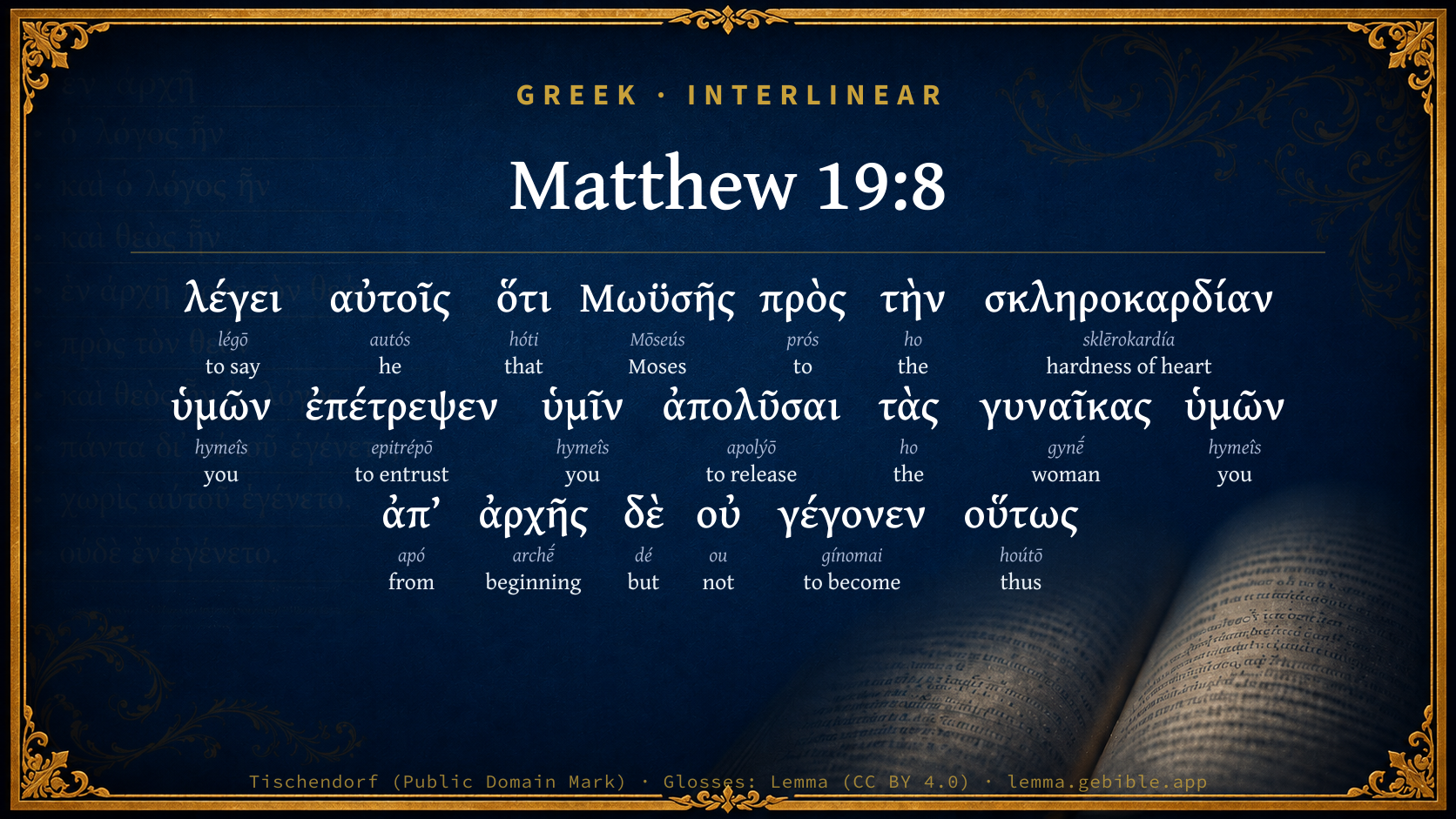
Download image
Cite this verse

Matthew 19:8 (World English Bible). Public Domain. Lemma interlinear Bible study tool, https://lemma.gebible.app/v/matthew/19/8.

Show BibTeX & RIS
BibTeX
RIS
English Translation
He said to them, "Moses, because of the hardness of your hearts, allowed you to divorce your wives, but from the beginning it has not been so.
World English Bible · Public Domain
Highlights
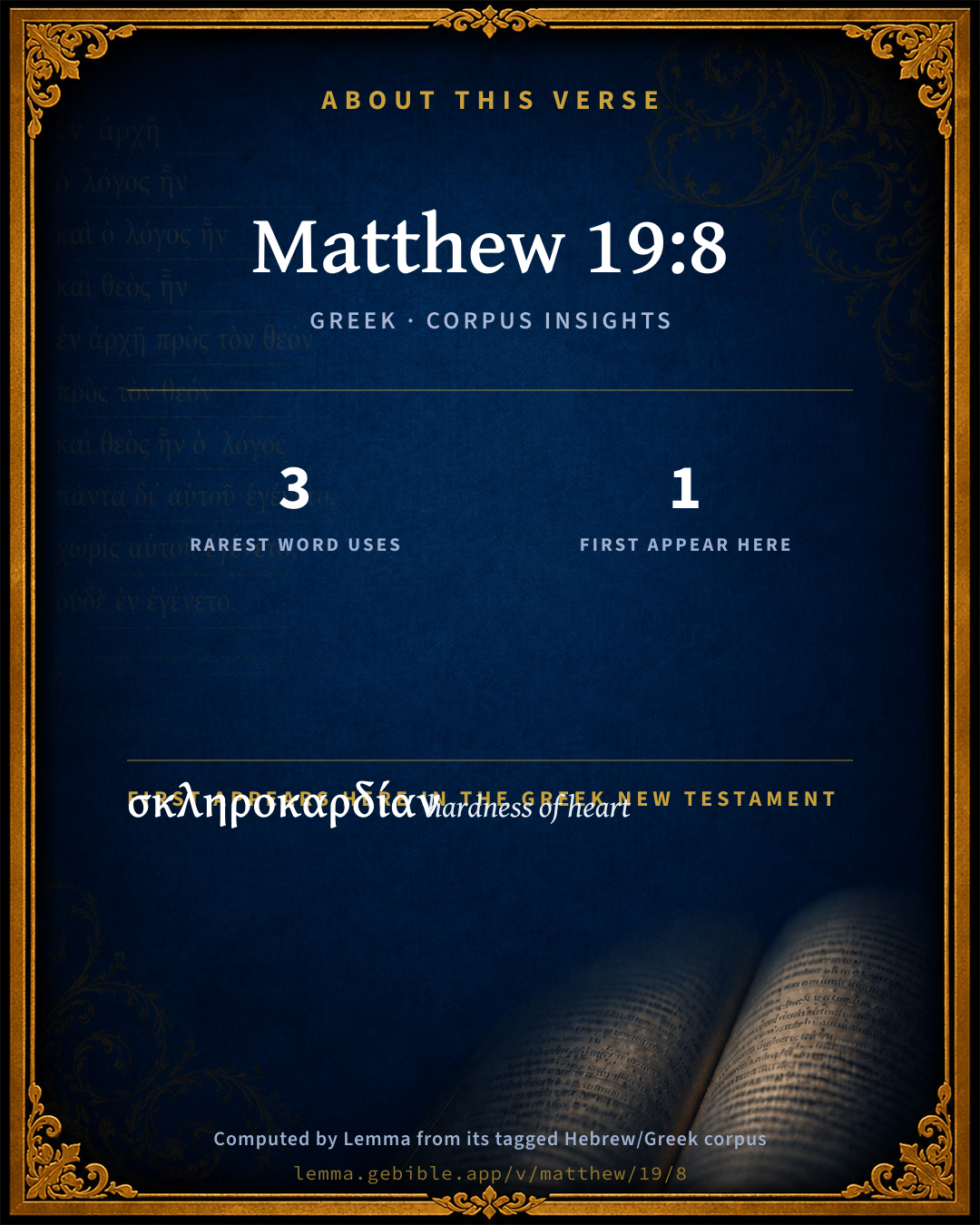
  • 1 first appearance in the Greek New Testament
Full analysis ↓
Download a study sheet

One document with this verse’s original text, its word-by-word gloss line, the meaning frame, cross-references with their text, attributed commentary, and full source and license credits — printable, and it pastes into notes with its structure intact.

This verse Autodidact and up

Study sheet (.html) Plain text (.txt)

A passage Seminary Student

Up to 50 verses in one chapter. A passage sheet keeps up to 6 commentary sources and 12 cross-references per verse, in the order this page ranks them, and says so on the sheet whenever that leaves anything out. Ask for a single verse and you get the Autodidact verse sheet above.

Everything on this page stays free to read, with no account — the sheet is a download of what is already on screen, not access to it.

Want to remove ads? Support Godless Engineer
Compare translations 3

The same verse in 3 English versions, stacked beneath the original-language interlinear above. Click any original word for its lexicon entry.

Each is an independent rendering of the whole verse — the interlinear is not word-aligned to these translations.

Highlighted words mark where these versions differ — a whole-verse word diff, not a word-by-word alignment.

  • World English Bible Public Domain
    He said to them, "Moses, because of the hardness of your hearts, allowed you to divorce your wives, but from the beginning it has not been so.
  • King James Version Public Domain
    He saith unto them, Moses because of the hardness of your hearts suffered you to put away your wives: but from the beginning it was not so.
  • unfoldingWord Literal Text CC BY-SA 4.0
    He says to them, “Because of your hardness of heart, Moses allowed you to divorce your wives, but from the beginning it was not that way.

unfoldingWord Literal Text — © unfoldingWord, licensed CC BY-SA 4.0. Word-aligned USFM3 via Door43 (git.door43.org/unfoldingWord/en_ult).

Versions to compare (up to 4)

3 of 4 selected

Show all 19 translations

Every available English version of this verse, each an independent rendering of the whole verse.

  • World English Bible Public Domain
    He said to them, "Moses, because of the hardness of your hearts, allowed you to divorce your wives, but from the beginning it has not been so.
  • Berean Standard Bible Public Domain
    Jesus replied, “Moses permitted you to divorce your wives because of your hardness of heart; but it was not this way from the beginning.
  • Majority Standard Bible Public Domain
    Jesus replied, “Moses permitted you to divorce your wives because of your hardness of heart. But it was not this way from the beginning.
  • King James Version Public Domain
    He saith unto them, Moses because of the hardness of your hearts suffered you to put away your wives: but from the beginning it was not so.
  • American Standard Version (1901) Public Domain
    He saith unto them, Moses for your hardness of heart suffered you to put away your wives: but from the beginning it hath not been so.
  • Revised Version (1885) Public Domain
    He saith unto them, Moses for your hardness of heart suffered you to put away your wives: but from the beginning it hath not been so.
  • Geneva Bible (1599) Public Domain
    He sayd vnto them, Moses, because of the hardnesse of your heart, suffered you to put away your wiues: but from the beginning it was not so.
  • Douay-Rheims (1899) Public Domain
    He saith to them: Because Moses by reason of the hardness of your heart permitted you to put away your wives: but from the beginning it was not so.
  • Young's Literal Translation Public Domain
    He saith to them -- `Moses for your stiffness of heart did suffer you to put away your wives, but from the beginning it hath not been so.
  • Literal Standard Version CC BY-SA 4.0
    He says to them, “Moses for your stiffness of heart permitted you to put away your wives, but from the beginning it has not been so.
  • Unlocked Literal Bible CC BY-SA 4.0
    He said to them, “For your hardness of heart, Moses allowed you to divorce your wives, but from the beginning it was not that way.
  • unfoldingWord Literal Text CC BY-SA 4.0
    He says to them, “Because of your hardness of heart, Moses allowed you to divorce your wives, but from the beginning it was not that way.
  • Darby Bible Public Domain
    He says to them, Moses, in view of your hardheartedness, allowed you to put away your wives; but from the beginning it was not thus.
  • World Messianic Bible Public Domain
    He said to them, “Moses, because of the hardness of your hearts, allowed you to divorce your wives, but from the beginning it has not been so.
  • Webster's Bible Public Domain
    He saith to them, Moses, because of the hardness of your hearts, suffered you to put away your wives: but from the beginning it was not so.
  • Free Bible Version CC BY-SA 4.0
    “Because of your hard-hearted attitude Moses permitted you to divorce your wives, but it wasn't like that in the beginning,” Jesus replied.
  • Bible in Basic English Public Domain
    He says to them, Moses, because of your hard hearts, let you put away your wives: but it has not been so from the first.
  • Text-Critical English NT CC BY 4.0
    He said to them, “Because of your hardness of heart Moses allowed you to divorce your wives, but from the beginning it was not so.
  • Tyndale New Testament (1534) Public Domain
    He sayde vnto them: Moses because of the hardnes of youre hertes suffred you to put awaye youre wyfes: But from the beginnynge it was not so.

Literal Standard Version (2020), Covenant Press — licensed CC BY-SA 4.0. Text via the HelloAO Bible API (eBible.org). Unlocked Literal Bible (unfoldingWord) — licensed CC BY-SA 4.0. Text via the HelloAO Bible API (eBible.org). unfoldingWord Literal Text — © unfoldingWord, licensed CC BY-SA 4.0. Word-aligned USFM3 via Door43 (git.door43.org/unfoldingWord/en_ult). Free Bible Version, Dr. Jonathan Gallagher — licensed CC BY-SA 4.0. Text via the HelloAO Bible API (eBible.org).

Word by word

More ways to search: Search by grammar → Find every occurrence → Compare this word →

Practice this passage: Drill this verse → Learn its vocabulary →

σκληροκαρδίαν
sklērokardía
G4641
“hardness of heart”
Noun, Accusative, Singular, Feminine
Part of Speech
Noun
Case
Accusative
Number
Singular
Gender
Feminine
Full Thayer's Definition

Origin: from a compound of G4642 and G2588

TDNT: 13:13,4

1. hardness of heart
  1. λέγει légō G3004 “to say” Verb, Present, Active, Indicative, 3rd person, Singular
  2. αὐτοῖς autós G846 “he” Personal pronoun, Dative, Plural, Masculine
  3. ὅτι hóti G3754 “that” Conjunction
  4. Μωϋσῆς Mōseús G3475 “Moses” Noun, Nominative, Singular, Masculine
  5. πρὸς prós G4314 “to” Preposition
  6. τὴν ho G3588 “the” Article, Accusative, Singular, Feminine
  7. ὑμῶν hymeîs G5210 “you” Personal pronoun, 2nd person, Genitive, Plural
  8. ἐπέτρεψεν epitrépō G2010 “to entrust” Verb, Aorist, Active, Indicative, 3rd person, Singular
  9. ὑμῖν hymeîs G5210 “you” Personal pronoun, 2nd person, Dative, Plural
  10. ἀπολῦσαι apolýō G630 “to release” Verb, Aorist, Active, Infinitive
  11. τὰς ho G3588 “the” Article, Accusative, Plural, Feminine
  12. γυναῖκας gynḗ G1135 “woman” Noun, Accusative, Plural, Feminine
  13. ὑμῶν hymeîs G5210 “you” Personal pronoun, 2nd person, Genitive, Plural
  14. ἀπ’ apó G575 “from” Preposition
  15. ἀρχῆς archḗ G746 “beginning” Noun, Genitive, Singular, Feminine
  16. δὲ dé G1161 “but” Conjunction
  17. οὐ ou G3756 “not” Particle, Negative
  18. γέγονεν gínomai G1096 “to become” Verb, Perfect, Active, Indicative, 3rd person, Singular
  19. οὕτως hoútō G3779 “thus” Adverb

About this verse

These counts appear in no published source. They are computed here, from the morphology-tagged text and Lemma’s own curated glosses. What Lemma adds →

20
words
17
distinct lemmas
Gospels
section

Notable vocabulary

The rarest word here is σκληροκαρδίαν hardness of heart G4641 — appearing just 3 times in the whole Greek New Testament.

First appearance in Scripture

This word makes its first canonical appearance in the Greek New Testament here:

  • σκληροκαρδίαν hardness of heart G4641

Shared distinctive vocabulary

σκληροκαρδίαν hardness of heart G4641 occurs in 3 verses of the Greek New Testament. Also found in:
Repetition

Words recur within this verse:

Cross-references

5

Topical passages linked to Matthew 19:8 in the Treasury of Scripture Knowledge — connected by theme and wording, ordered by reader-vote popularity; previews shown in the World English Bible.

  • Malachi 2:13–14 This again you do: you cover the altar of Yahweh with tears, with weeping, and with sighing, because he doesn't regard the offering any more, neither receives it with good will at your hand.
  • Genesis 2:24 Therefore a man will leave his father and his mother, and will join with his wife, and they will be one flesh.
  • Zechariah 7:12 Yes, they made their hearts as hard as flint, lest they might hear the law, and the words which Yahweh of Hosts had sent by his Spirit by the former prophets. Therefore great wrath came from Yahweh of Hosts.
  • Mark 10:5 But Jesus said to them, "For your hardness of heart, he wrote you this commandment.
  • Jeremiah 6:16 Thus says Yahweh, Stand you in the ways and see, and ask for the old paths, where is the good way; and walk therein, and you shall find rest for your souls: but they said, We will not walk [therein].

Cross-references courtesy of OpenBible.info (CC BY 4.0).

Commentary

Notes on Matthew 19:8 from classic Christian and Jewish commentators (each source and its license shown beneath its notes). The classic Christian expositions comment on the surrounding passage and are grouped to its opening verse, so a note may address several verses; the Jewish commentaries on the Tanakh (Rashi and others) are per-verse, so they appear only where the commentator wrote on this verse.

Lemma curates 59 commentaries, every one of them public domain or Creative Commons licensed, each selected and text-cleaned for this edition rather than reprinted as found. About our sources →

Bengel's Gnomon

Johann Albrecht Bengel

Mat 19:8. Πρὸς, for, because of[859])—ἐπέτρεψεν, permitted) not ἐνετείλατο, enjoined, except in that sense in which St Mark (Mar 10:3) employs the word.—ἀπʼ ἀρχῆς, in the beginning) The origin of wedlock was recorded also by the same Moses, from whom our Lord demonstrates the matter.

[859] Τὴν σκληροκρδίαν, the hardness of heart) So great is the perversity of the human mind, that there are not a few things by which it ought to be put to the blush, as the jews ought to have been in the case of the writing of divorcement, but which it abuses to a preposterous clearing (justification) of itself.—V. g.

Bengel's Gnomon of the New Testament — English translation (T&T Clark, Edinburgh, 1860) — public domain. Text from a community e-Sword module.

Meyer's Critical & Exegetical Commentary

Heinrich August Wilhelm Meyer

Mat_19:8. Πρός] out of regard to, with (wise) consideration so as to avert greater evil.

σκληροκαρδίαν] stubbornness of heart (Mar_16:14; Rom_2:5; Act_7:51; Sir_16:10; Deu_10:16), which will not be persuaded to self-reflection, gentleness, patience, forbearance, etc.; κατὰ διαφόρους αἰτίας μισούντων τὰς γαμετὰς, καὶ μὴ καταλλαττομένων αὐταῖς. Ἐνομοθέτησε γὰρ ἀπολύειν ταύτας, ἵνα μὴ φονεύωνται, Euthymius Zigabenus.

οὐ γέγονεν οὕτω] non ita factum est, namely, that a man should have permission to put away his wife. The above primitive institution of God is accordingly not abrogated by Moses, who, on account of the moral obduracy of the people, is rather to be understood as only granting a dispensation in the form of a letter of divorce, that the woman might be protected against the rude severity of the man.

Meyer — Critical and Exegetical Commentary on the New Testament — English translation by Peter Christie, edited by Frederick Crombie (T&T Clark, 1880) — public domain. Text from a community e-Sword module.

Expositor's Greek Testament

ed. W. Robertson Nicoll

Mat 19:8 . πρὸς τ ., with reference to. σκληροκαρδίαν : a word found here and in several places in O. T. (Sept [110] ), not in profane writers; points to a state of heart which cannot submit to the restraints of a high and holy law, literally uncircumcisedness of heart (Deu 10:16 ; Jer 4:4 ). ἐπέτρεψεν , permitted, not enjoined. Moses is respectfully spoken of as one who would gladly have welcomed a better state of things; no blame imputed except to the people who compelled or welcomed such imperfect legislation ( ὑμῶν twice in Mat 19:8 ). ἀπʼ ἀρχῆς , etc.: the state of things which made the Mosaic rule necessary was a declension from the primitive ideal.

[110] Septuagint.

The Expositor's Greek Testament, edited by W. Robertson Nicoll (1897–1910) — public domain. Text from a community e-Sword module.

Geneva Bible (1599)

Geneva Bible translators

Being occasioned by reason of the hardness of your hearts.

By a political law, not by the moral law: for this law is a perpetual law of God’s justice, the other boweth and bendeth as the carpenter’s Bevel.

Geneva Bible (1599) marginal notes — public domain. Text via Bolls.life.

Jamieson, Fausset & Brown

Robert Jamieson, A. R. Fausset & David Brown

He saith unto them, Moses--as a civil lawgiver.

because of--or "having respect to."

the hardness of your hearts--looking to your low moral state, and your inability to endure the strictness of the original law.

suffered you to put away your wives--tolerated a relaxation of the strictness of the marriage bond--not as approving of it, but to prevent still greater evils.

But from the beginning it was not so--This is repeated, in order to impress upon His audience the temporary and purely civil character of this Mosaic relaxation.

Jamieson, Fausset & Brown — Commentary Critical and Explanatory on the Whole Bible (1871) — public domain (CC PDM 1.0). Text via the HelloAO Bible API.

Adam Clarke's Commentary

Verse 8. Moses, because of the hardness of your hearts] It is dangerous to tolerate the least evil, though prudence itself may require it: because toleration, in this case, raises itself insensibly into permission, and permission soon sets up for command. Moses perceived that if divorce were not permitted, in many cases, the women would be exposed to great hardships through the cruelty of their husbands: for so the word σκληροκαρδια, is understood in this place by some learned men.

From the beginning it was not so] The Jews named the books of the law from the first word in each. Genesis they always term Bereshith, בראשית, which is the first word in it, and signifies, In the beginning. It is probable that our Lord speaks in this way here, In Bereshith it was not so, intimating that the account given in Genesis is widely different. There was no divorce between Eve and Adam; nor did he or his family practise polygamy. But our Lord, by the beginning, may mean the original intention or design.

Adam Clarke's Commentary on the Bible (1810–1826) — public domain. Text from a community e-Sword/MySword module.

Ellicott's Commentary for English Readers

(8) Moses because of the hardness of your hearts.—The force of the answer lies (1) in emphasized substitution of “suffered” for “commanded.” The scribes of the school of Hillel had almost turned divorce into a duty, even when there was no ground for it but incompatibility of temper or other lesser fault, as if Deu_24:1 had enjoined the writing of divorcement in such cases. (2) In the grounds assigned for the permission. Our Lord’s position in the controversy between the two schools was analogous to that in which those who are true at once to principles and facts not seldom find themselves. He agreed, as we have seen, with the ideal of marriage maintained by the followers of Shammai. He accepted as a legitimate interpretation of the Law that of the followers of Hillel. But He proclaimed, with an authority greater than that of Moses, that his legislation on this point was a step backwards when compared with the primary law of nature, which had been “from the beginning,” and only so far a step forward because the people had fallen into a yet lower state, in which the observance of the higher law was practically impossible. But for the possibility of divorce the wife would have been the victim of the husband’s tyranny; and law, which has to deal with facts, was compelled to choose the least of two evils. Two important consequences, it will be obvious, flow from the reasoning thus enforced: (1) that the “hardness of heart” which made this concession necessary may be admitted as at least a partial explanation of whatever else in the Law of Moses strikes us as deviating from the standard of eternal righteousness embodied in the law of Christ—as, e.g., the tolerance of polygamy and slavery, and the severity of punishment for seeming trivial faults; (2) that the principle is one of wider application than the particular instance, and that where a nation calling itself Christian has sunk so low as to exhibit the “hardness of heart” of Jews or heathens, there also a concessive legislation may be forced upon the State even while the churches assert their witness of the higher truth.

A Bible Commentary for English Readers, edited by Charles John Ellicott (1878–1897) — public domain. Text from a community e-Sword module.

The Cambridge Bible for Schools and Colleges

gen. ed. J. J. S. Perowne

8. because of the hardness of your hearts] Literally, having respect to, with a view to the hardness of your hearts towards God. So the law was relatively good, not absolutely. A great principle. Even now all are not capable of the higher religious life or of the deepest truths. Some interpret “hardness of heart,” of the cruelty of men towards their wives.

The Cambridge Bible for Schools and Colleges (gen. ed. J. J. S. Perowne; Cambridge University Press, 1878–1918) — public domain. Text from a community e-Sword module.

John Gill's Exposition

He saith unto them,.... In answer to their objection;

Moses, because of the hardness of your hearts, suffered you to put away your wives: in which may be observed, that, though it was by direction that Moses, in his system of laws, allowed of divorces; yet not God, but he is said to do it, because it was a branch of the political and judicial laws, by which the people of the Jews were governed under Moses, and whilst the Mosaic economy continued, and did not concern other people, and other times; and therefore it is said "you" and "your" wives, you Jews, and you only, and not the Gentiles. And so the Jews say (m), that the Gentiles have no divorces: for thus they represent God, saying;

"in Israel I have granted divorces, I have not granted divorces among the nations of the world. R. Chananiah, in the name of R. Phineas, observed, that in every other section it is written, the Lord of hosts, but here it is written, the God of Israel; to teach thee, that the holy, blessed God does not join his name to divorces, but in Israel only. R. Chayah Rabbah says, , "the Gentiles have no divorces."''

Besides, this was a direct positive command to the Jews, as the Pharisees suggest in their objection; it was only a sufferance, a permission in some cases, and not in everyone; and that because of the hardness of their hearts; they being such a stubborn and inflexible people, that when they were once displeased there was no reconciling them; and so malicious and revengeful, that if this had not been granted, would have used their wives, that displeased them, in a most cruel, and barbarous manner, if not have murdered them: so that this grant was made, not to indulge their lusts, but to prevent greater evils; and not so much as a privilege and liberty to the men, as in favour of the women; who, when they could not live peaceably and comfortably with a man, might be dismissed and marry another:

but from the beginning it was not so; from the beginning of time, or of the creation, or of the world, or at the first institution of marriage, and in the first ages of the world, there was no such permission, nor any such practice. This was not the declared will of God at first, nor was it ever done by any good men before the times of Moses; we never read that Adam, or Seth, or Noah, or Abraham, put away their wives, upon any consideration; though in the latter there might have been some appearance of reason for so doing, on account of sterility, but this he did not; nor Isaac, nor Jacob, nor any of the "patriarchs".

(m) T. Hieros. Kiddushin, fol. 58. 3.

John Gill's Exposition of the Whole Bible (1746–1763) — public domain (CC PDM 1.0). Text via the HelloAO Bible API.

Trapp's Complete Commentary

John Trapp

8 He saith unto them, Moses because of the hardness of your hearts suffered you to put away your wives: but from the beginning it was not so.

Ver. 8. Moses, because of the hardness of your hearts] Ob duricordiam vestram, saith Tertullian. For the relief of the wife, questionless, was this permitted by Moses, not as a prophet, but as a lawgiver; so he suffered them to exercise usury upon strangers. And, at this day, they are, by the states where they live, permitted to strain up their usury to eighteen in the hundred (18%) upon the Christians. And so they are used, as the friars, to suck from the meanest, and to be sucked by the greatest. But what saith our statute? Forasmuch as all usury, being forbidden by the law of God, is a sin and detestable, &c. And what saith our homily book? Verily so many as increase themselves by usury-they have their goods of the devil’s gift, &c. And what saith blind nature? Aristotle in one page condemneth both τοκιστην and κυβευτην, the usurer and the gambler. And Agis, the Athenian general, set fire upon all the usurer’s books and bonds in the marketplace than which fire Agesilaus was wont to say, he never saw a fairer. But to return to the text: Moses noteth the hatred of a man’s wife to be the cause of much mischief, Deu 22:13-14. Hence a divorce was allowed in that case, Deu 24:3, lest the husband’s hatred should work the wife’s ruth or ruin, in case he should be compelled to keep her. He might put her away, therefore, but not without a double blur to himself. 1. By his writing of divorce, he should give testimony to her honesty, and that she was put away merely for his hard-heartedness toward her. 2. If she were again put away by a second husband, the first might not take her to wife again, as having once for ever judged himself unworthy of her further fellowship. Husbands should be gentle to their wives, because of their weakness: glasses are not hardly handled; a small knock soon breaks them. But there are a number of Nabals, a brood of Chaldeans, a bitter and furious nation, that have little growing in their furrows but wormwood; they have a true gall of bitterness in them, Col 3:20, whereas the very heathens, at their weddings, pulled the gall out of all their good cheer, and cast it away; teaching thereby the married couples what to do (την χολην εξελοντες, ερριψαν. Plut.). And God Almighty professeth that he hates putting away; threatening also to cut off such unkind husbands as by their harshness caused their wives, when they should have been cheerful in God’s services, to cover the altar of the Lord with tears, with weeping and with crying out, so that he regarded not the offering any more, Mal 2:13. Picus est imago ingrati mariti, the saith Melancthon. The piannet (magpie) is an emblem of an unkind husband, for in autumn he casts off his mate, lest he should be forced to keep her in winter: afterwards, in the spring, he allures her to him again, and makes much of her. The Athenians were wont to put away their wives upon discontent, or hope of greater portions. Solon, their lawgiver (who permitted it), being asked whether he had given the best laws to the Athenians? answered, The best that they could handle.

John Trapp, A Commentary or Exposition upon All the Books of the Old and New Testament (1647–1656) — public domain. Text from a community e-Sword module.

Albert Barnes' Notes on the Bible

He saith unto them ... - Jesus admits that this was allowed, but still he contends that this was not the original design of marriage. It was only a temporary expedient growing out of a special state of things, and not designed to be perpetual. It was on account of the hardness of their hearts. Moses found the custom in use. He found a hard-hearted and rebellious people. In this state of things he did not deem it prudent to forbid a practice so universal; but it might be regulated; and, instead of suffering the husband to divorce his wife in a passion, he required him, in order that he might take time to consider the matter, and thus make it probable that divorces would be less frequent, to give her a writing; to sit down deliberately to look at the matter, and probably, also, to bring the case before some scribe or learned man, to write a divorce in the legal form. Thus doing, there might be an opportunity for the matter to be reconciled, and the man to be persuaded not to divorce his wife. This, says our Saviour, was a permission growing out of a particular state of things, and designed to remedy a prevailing evil; but at first it was not so. God intended that marriage should be between one man and one woman, and that they were only to be separated, in the case specified, by him who had formed the union.

Hardness of your hearts - He speaks here of his hearers as a part of the nation. The hardness of you Jews; as when we say, we fought with England and gained our independence; that is, we, the American people, though it was done by our fathers. He does not mean to say, therefore, that this was done on account of the people whom he addressed, but of the national hardness of heart - the stubbornness of the Jewish people as a people.

Albert Barnes' Notes on the Bible (1834–1885) — public domain. Text from a community e-Sword/MySword module.

Haydock's Catholic Bible Commentary

Moses, because of the hardness of your hearts, permitted you, &c. Whether this was permitted in the old law, so that the man who was divorced from his wife could marry another woman, is disputed. Some think this second marriage was still unlawful for the man or woman so separated to marry another. (Witham) --- The latter part of this verse, of St. Paul, (Romans vii. 3,) and the constant tradition of the Church, shew that the exception only refers to separation, but not to the marrying another during the life of the parties. In this place Christ restores the original condition of the marriage state, and henceforth will have it to be a perfect figure of the hypostatic union of his divine person with our human nature, as also of his nuptial union with his Church, and consequently that it should be indissoluble. (Tirinus)

George Leo Haydock (1774–1849), Haydock's Catholic Family Bible and Commentary, 1859 edition — public domain. Excludes Psalms (Douay-Rheims chapter numbering differs from Protestant) and Deuterocanonical books (Catholic canon only).

Whedon's Commentary on the Bible

Daniel D. Whedon

8. Because of the hardness of your hearts — Because the rigidness of the moral law, if enforced by civil law, would be by you made an occasion of still greater wrong. You would have murdered your wives to be rid of them. Suffered you — He did not command you. And he who availed himself of the permission was none the less guilty of sin. He was not indeed amenable to Moses, but he was still amenable to God.

Daniel D. Whedon (gen. ed.), Commentary on the Old and New Testaments (1874–1909) — public domain. Text from a community e-Sword module.

The Pulpit Commentary

Moses because of (prov , with a view to, to meet) the hardness of your hearts; your obstinacy, perverseness. You were not honest and pure enough to obey the primitive law. There was danger that you would ill treat your wives in order to get rid of them, or even murder them. The lesser evil was regular divorce. But the enactment is really a shame and reproach to you, and was occasioned by grave defects in your character and conduct. And it is not true to say that Moses commanded; he only suffered you to put away your wives. This was a temporary permission to meet your then circumstances. Divorce had been practised commonly and long; it was traditional; it was seen among all other Oriental peoples. Moses could not hope at once to eradicate the inveterate evil; he could only modify, mitigate, and regulate its practice. The rules which he introduced were intended, not to facilitate divorce, but to lead men better to realize the proper idea of marriage. And Christ was introducing a better law, a higher morality, for which Mosaic legislation paved the way. (comp. Rom_5:20 Rom_8:3 Heb_9:10) From the beginning. The original institution of marriage contained no idea of divorce; it was no mere civil contract, made by man and dissoluble by man, but a union of God"s own formation, with which no human power could interfere. However novel this view might seem, it was God"s own design from the first. The first instance of polygamy occurs in Gen_4:19, and is connected with murder and revenge.

The Pulpit Commentary (1880–1919), ed. H.D.M. Spence-Jones & Joseph S. Exell — public domain. Text from a community e-Sword module.

Scofield Reference Notes

C. I. Scofield

Moses

Thus confirming the Mosaic authorship of Deut.

The Scofield Reference Bible (1917 edition), notes by C. I. Scofield — public domain. Text from a community e-Sword module.

Cambridge Greek Testament for Schools and Colleges

8. πρὸς τὴν σκληροκαρδίαν ὑμῶν. Having respect to, with a view to the hardness of your hearts towards God. So the law was relatively good, not absolutely. A great principle. Even now all are not capable of the higher religious life or of the deepest truths. Some interpret ‘hardness of heart,’ of the cruelty of men towards their wives.

ἐπέτρεψεν, ‘allowed,’ a correction of ἐνετείλατο, Mat 19:7. Moses did not enjoin, but merely permitted a bill of divorce.

οὐ γέγονεν. Not ‘was not so,’ A.V., but ‘hath not been so’ continuously from the beginning to the present time. It is not an original and continuous tradition.

Cambridge Greek Testament for Schools and Colleges (Cambridge University Press, 1896; 21 vols, various authors incl. Carr, Maclear, Plummer, Farrar, Lumby, Moule, M. R. James, Simcox) — public domain. Text from a community e-Sword module.

International Critical Commentary

8. He saith to them, that Moses for the hardness of your heart allowed you to put away your wives, but from the beginning it hath not been1 so.] That is to say, the toleration of divorce by the law is a departure from the high standard of morality presupposed in the creation of a single pair. Divorce is a bad custom which has grown up amongst a degenerate people, and the Mosaic law tolerated it as an accommodation to a low level of moral custom. Mk. has: “And Jesus said, For the hardness of your heart he wrote for you this commandment.”

International Critical Commentary — older volumes (1896–1929), various authors — public domain. Text from a community e-Sword module.

Vincent's Word Studies in the New Testament

Marvin R. Vincent

Because of [προς] . Rev., for : having regard to.

It was not so [ου γεγονεν ουτως] . The A. V. is commonly understood to mean, it was not so in the beginning. But that is not Christ 's meaning. The verb is in the perfect tense (denoting the continuance of past action or its results down to the present). He means : Notwithstanding Moses ' permission, the case has not been so from the beginning until now. The original ordinance has never been abrogated nor superseded, but continues in force.

Marvin R. Vincent, Word Studies in the New Testament (1887–1900) — public domain. Text from a community e-Sword/MySword module.

Lesson kit

Teaching starters — assembled from the data on this page, not authored interpretation. Every prompt links to the verse data it draws on. Edit before teaching.

Matthew, in the Gospels, opens this verse with 20 words (17 distinct Greek lemmas). Its most distinctive word is sklērokardía (“hardness of heart”). A historical commentator’s framing appears above. Read the whole chapter for the surrounding context.

Discussion questions

  1. What does “hardness of heart” (sklērokardía) contribute to the verse as a whole?
  2. The word “hardness of heart” first appears here in Scripture. What is being introduced at this debut?
  3. Mark 10:5 shares the word «hardness of heart» with this verse. How do the two illuminate each other?
  4. “you” occurs 3× in this one verse. What is the effect of the repetition?
  5. These translations render this verse differently. What is at stake in choosing one wording over another?
  6. Reading how Bengel's Gnomon and Meyer's Critical & Exegetical Commentary read this verse, where do the two commentators agree and where do they part?

Things to notice

  • 1 word makes its first canonical appearance in Scripture here.
  • These translations choose different wording for 12 words in this verse.
  • “you” occurs 3× in this single verse.
  • 17 distinct Greek lemmas span 20 words in this verse.

Reading settings

Reading text

Shown beneath each verse's original-language words.

Old Testament
Old Testament edition

Read the OT as the Masoretic Hebrew (MT) or the Greek Septuagint (LXX).

English shown for the Greek Septuagint (in the Hebrew ↔ Greek comparison).

Comparing translations? Open the Compare panel on any verse page to stack up to four side by side.