Matthew 19:11

Greek (Tischendorf 8th ed.) Matthew 19:11 appears in the Greek New Testament. The text above is from the Tischendorf 8th edition. Each word links to its Strong’s number and a concise gloss. Click any word for its full Thayer’s Greek Lexicon entry.
Download image
Cite this verse

Matthew 19:11 (World English Bible). Public Domain. Lemma interlinear Bible study tool, https://lemma.gebible.app/v/matthew/19/11.

Show BibTeX & RIS
BibTeX
RIS
English Translation
But he said to them, "Not all men can receive this saying, but those to whom it is given.
World English Bible · Public Domain
Download a study sheet

One document with this verse’s original text, its word-by-word gloss line, the meaning frame, cross-references with their text, attributed commentary, and full source and license credits — printable, and it pastes into notes with its structure intact.

This verse Autodidact and up

Study sheet (.html) Plain text (.txt)

A passage Seminary Student

Up to 50 verses in one chapter. A passage sheet keeps up to 6 commentary sources and 12 cross-references per verse, in the order this page ranks them, and says so on the sheet whenever that leaves anything out. Ask for a single verse and you get the Autodidact verse sheet above.

Everything on this page stays free to read, with no account — the sheet is a download of what is already on screen, not access to it.

Want to remove ads? Support Godless Engineer
Compare translations 3

The same verse in 3 English versions, stacked beneath the original-language interlinear above. Click any original word for its lexicon entry.

Each is an independent rendering of the whole verse — the interlinear is not word-aligned to these translations.

Highlighted words mark where these versions differ — a whole-verse word diff, not a word-by-word alignment.

  • World English Bible Public Domain
    But he said to them, "Not all men can receive this saying, but those to whom it is given.
  • King James Version Public Domain
    But he said unto them, All men cannot receive this saying, save they to whom it is given.
  • unfoldingWord Literal Text CC BY-SA 4.0
    But he said to them, “Not all receive this word, but to whom it has been given.

unfoldingWord Literal Text — © unfoldingWord, licensed CC BY-SA 4.0. Word-aligned USFM3 via Door43 (git.door43.org/unfoldingWord/en_ult).

Versions to compare (up to 4)

3 of 4 selected

Show all 19 translations

Every available English version of this verse, each an independent rendering of the whole verse.

  • World English Bible Public Domain
    But he said to them, "Not all men can receive this saying, but those to whom it is given.
  • Berean Standard Bible Public Domain
    “Not everyone can accept this word,” He replied, “but only those to whom it has been given.
  • Majority Standard Bible Public Domain
    “Not everyone can accept this word,” He replied, “but only those to whom it has been given.
  • King James Version Public Domain
    But he said unto them, All men cannot receive this saying, save they to whom it is given.
  • American Standard Version (1901) Public Domain
    But he said unto them, Not all men can receive this saying, but they to whom it is given.
  • Revised Version (1885) Public Domain
    But he said unto them, All men cannot receive this saying, but they to whom it is given.
  • Geneva Bible (1599) Public Domain
    But he sayd vnto them, All men cannot receiue this thing, saue they to whom it is giuen.
  • Douay-Rheims (1899) Public Domain
    Who said to them: All men take not this word, but they to whom it is given.
  • Young's Literal Translation Public Domain
    And he said to them, `All do not receive this word, but those to whom it hath been given;
  • Literal Standard Version CC BY-SA 4.0
    And He said to them, “All do not receive this word, but those to whom it has been given;
  • Unlocked Literal Bible CC BY-SA 4.0
    But Jesus said to them, “Not everyone can accept this teaching, but only those who are allowed to accept it.
  • unfoldingWord Literal Text CC BY-SA 4.0
    But he said to them, “Not all receive this word, but to whom it has been given.
  • Darby Bible Public Domain
    And he said to them, All cannot receive this word, but those to whom it has been given;
  • World Messianic Bible Public Domain
    But he said to them, “Not all men can receive this saying, but those to whom it is given.
  • Webster's Bible Public Domain
    But he said to them, All men cannot receive this saying, save they to whom it is given.
  • Free Bible Version CC BY-SA 4.0
    “Not everyone can accept this instruction, only those it's given to,” Jesus told them.
  • Bible in Basic English Public Domain
    But he said to them, Not all men are able to take in this saying, but only those to whom it is given.
  • Text-Critical English NT CC BY 4.0
    But Jesus said to them, “Not all men can accept this statement, but only those to whom it is given.
  • Tyndale New Testament (1534) Public Domain
    He sayde vnto them: all me can not awaye with that sayinge save they to whom it is geven.

Literal Standard Version (2020), Covenant Press — licensed CC BY-SA 4.0. Text via the HelloAO Bible API (eBible.org). Unlocked Literal Bible (unfoldingWord) — licensed CC BY-SA 4.0. Text via the HelloAO Bible API (eBible.org). unfoldingWord Literal Text — © unfoldingWord, licensed CC BY-SA 4.0. Word-aligned USFM3 via Door43 (git.door43.org/unfoldingWord/en_ult). Free Bible Version, Dr. Jonathan Gallagher — licensed CC BY-SA 4.0. Text via the HelloAO Bible API (eBible.org).

Word by word

More ways to search: Search by grammar → Find every occurrence → Compare this word →

Practice this passage: Drill this verse → Learn its vocabulary →

χωροῦσιν
chōréō
G5562
“to make room”
Verb, Present, Active, Indicative, 3rd person, Plural
Part of Speech
Verb
Tense
Present
Voice
Active
Mood
Indicative
Person
3rd person
Number
Plural
Full Thayer's Definition

Origin: from G5561

TDNT: None

1. to leave space (which may be filled or occupied by another), to make room, give place, yield a. to retire b. metaph. to betake one's self, turn one's self 2. to go forward, advance, proceed, succeed 3. to have space or room for receiving or holding something
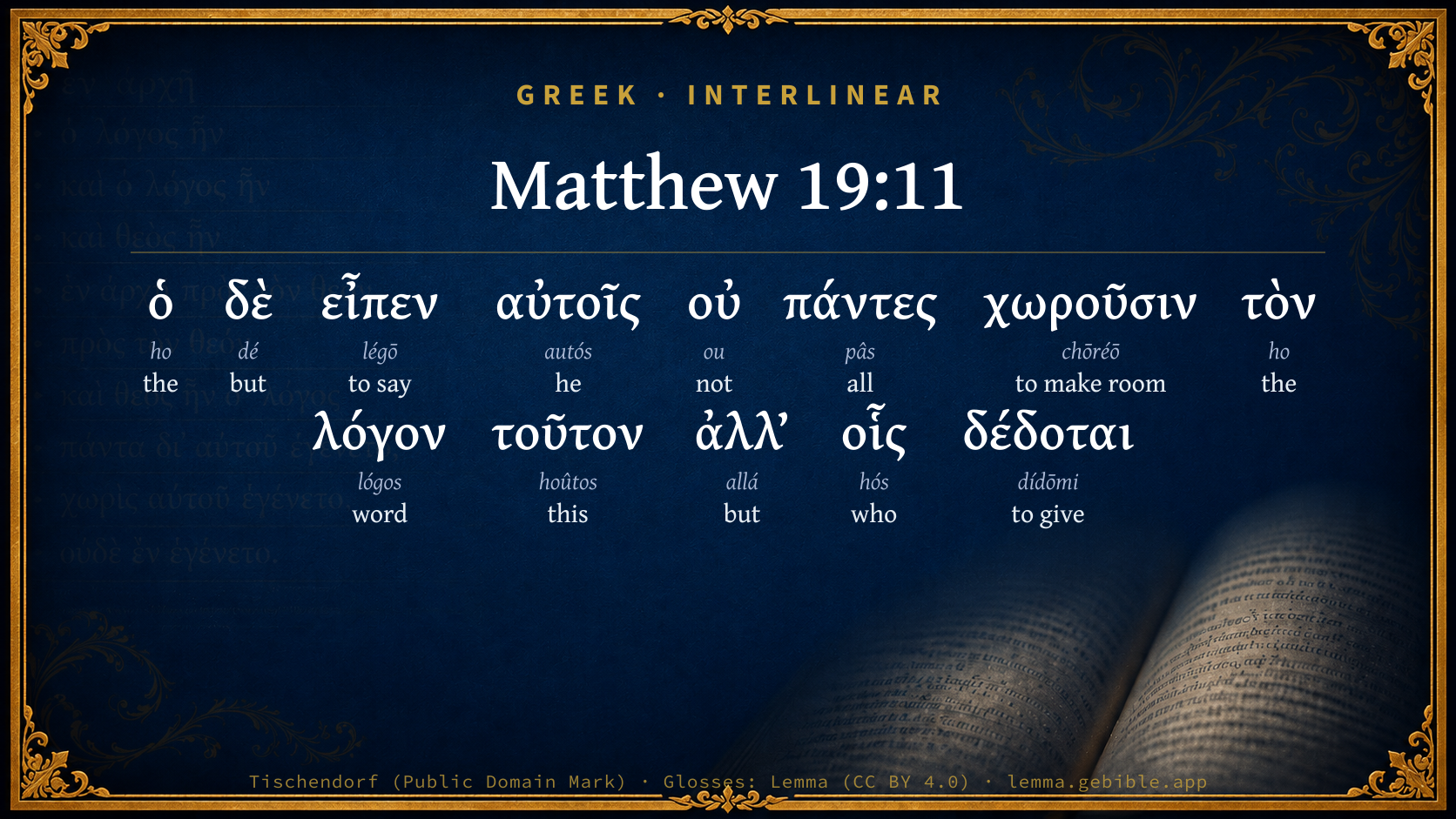
  1. ὁ ho G3588 “the” Article, Nominative, Singular, Masculine
  2. δὲ dé G1161 “but” Conjunction
  3. εἶπεν légō G3004 “to say” Verb, Aorist, Active, Indicative, 3rd person, Singular
  4. αὐτοῖς autós G846 “he” Personal pronoun, Dative, Plural, Masculine
  5. οὐ ou G3756 “not” Particle, Negative
  6. πάντες pâs G3956 “all” Adjective, Nominative, Plural, Masculine
  7. τὸν ho G3588 “the” Article, Accusative, Singular, Masculine
  8. λόγον lógos G3056 “word” Noun, Accusative, Singular, Masculine
  9. τοῦτον hoûtos G3778 “this” Demonstrative pronoun, Accusative, Singular, Masculine
  10. ἀλλ’ allá G235 “but” Conjunction
  11. οἷς hós G3739 “who” Relative pronoun, Dative, Plural, Masculine
  12. δέδοται dídōmi G1325 “to give” Verb, Perfect, Passive, Indicative, 3rd person, Singular

About this verse

These counts appear in no published source. They are computed here, from the morphology-tagged text and Lemma’s own curated glosses. What Lemma adds →

13
words
12
distinct lemmas
Gospels
section

Notable vocabulary

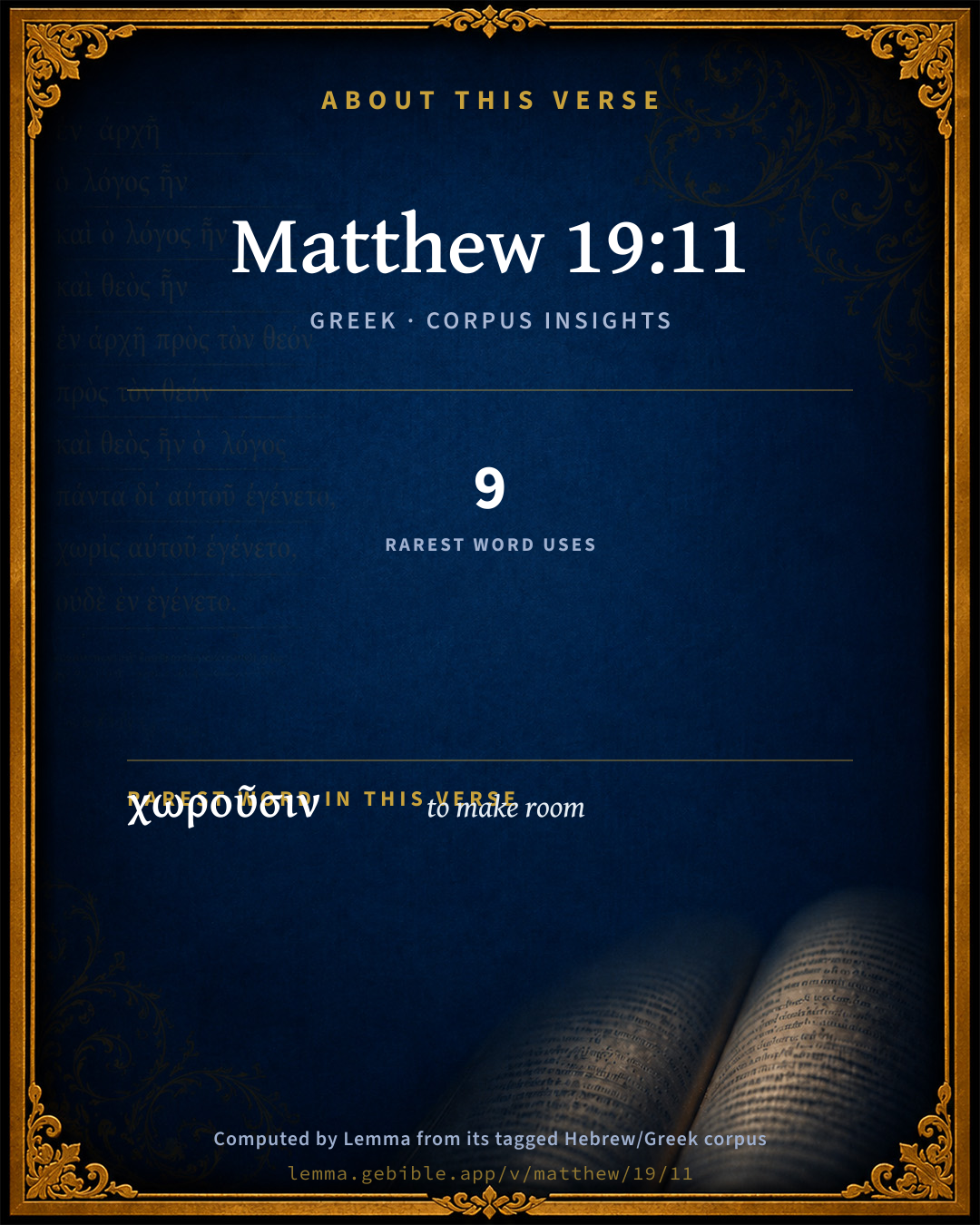
The rarest word here is χωροῦσιν to make room G5562 — appearing just 9 times in the whole Greek New Testament.

Shared distinctive vocabulary

χωροῦσιν to make room G5562 occurs in 8 verses of the Greek New Testament. Also found in:

Repetition

A word recurs within this verse:

Cross-references

5

Topical passages linked to Matthew 19:11 in the Treasury of Scripture Knowledge — connected by theme and wording, ordered by reader-vote popularity; previews shown in the World English Bible.

  • 1 Corinthians 7:17 Only, as the Lord has distributed to each man, as God has called each, so let him walk. So I command in all the assemblies.
  • Matthew 13:11 He answered them, "To you it is given to know the mysteries of the Kingdom of Heaven, but it is not given to them.
  • 1 Corinthians 7:2 But, because of sexual immoralities, let each man have his own wife, and let each woman have her own husband.
  • 1 Corinthians 7:7–9 Yet I wish that all men were like me. However each man has his own gift from God, one of this kind, and another of that kind.
  • 1 Corinthians 7:35 This I say for your own profit; not that I may ensnare you, but for that which is appropriate, and that you may attend to the Lord without distraction.

Cross-references courtesy of OpenBible.info (CC BY 4.0).

Commentary

Notes on Matthew 19:11 from classic Christian and Jewish commentators (each source and its license shown beneath its notes). The classic Christian expositions comment on the surrounding passage and are grouped to its opening verse, so a note may address several verses; the Jewish commentaries on the Tanakh (Rashi and others) are per-verse, so they appear only where the commentator wrote on this verse.

Lemma curates 59 commentaries, every one of them public domain or Creative Commons licensed, each selected and text-cleaned for this edition rather than reprinted as found. About our sources →

Tyndale Open Study Notes

Tyndale Open Resources

19:11 This statement refers to the disciples’ comment (19:10).

Tyndale Open Study Notes — © Tyndale Open Resources, licensed CC BY-SA 4.0. Text via the HelloAO Bible API.

Bengel's Gnomon

Johann Albrecht Bengel

Mat 19:11. Ὁ δὲ εἶπεν αὐτοῖς, κ.τ.λ., But He said unto them, etc.) To that universal, but less well-founded reason for not contracting matrimony, grounded on the inconvenience which the disciples inferred must arise from its indissolubility, our Lord opposes the legitimate, particular, and only good reason, viz. the being an eunuch,—i.e. the being exempted by any exceptional cause from the universal law of contracting matrimony.—οὐ πάντες, not all) Our Lord opposes these words to the universal proposition of His disciples (sc. οὐ συμφέρει γαμῆσαι, i.e. it is not expedient to marry), and they are equivalent to “none.”—Cf. Rom 3:9, οὐ πάντες, not at all [English version, “No, in no wise.”] The important exception is added.—ἀλλʼ οἷς δέδοται, save those to whom it is given.—τοῦτον, this) This pronoun refers also to what follows. Cf. the Epiphonema,[861] in Mat 19:12, sc. Ὁ ΔΥΝΆΜΕΝΟς, Κ.Τ.Λ., He that is able, etc.; and γὰρ, for, is added at the commencement of the same verse.[862]

[861] EPIPHONEMA is an exclamation subjoined to the narration, or demonstration of an important subject. See Gnomon on Rom 1:15 in VOC αὕτω. It is a rhetorical term employed by Quinctilian. See in Append., explanation of Technical terms.—(I. B.)

[862] As in Mat 1:18, where Tischend. and Rec. Text have μνηστευθείσης γὰρ τῆς μητρὸς, etc. (Lachm. omits γὰρ with BZ Vulg., Iren., etc.): the γὰρ, as here, beginning the Discussion (Tractatio) which answers to the Statement of Subject (Propositio or Thesis) immediately preceding.—ED.

Bengel's Gnomon of the New Testament — English translation (T&T Clark, Edinburgh, 1860) — public domain. Text from a community e-Sword module.

Meyer's Critical & Exegetical Commentary

Heinrich August Wilhelm Meyer

Mat_19:11-12. The disciples have just said: οὐ συμφέρει γαμῆσαι. But to this saying must τὸν λόγον τοῦτον be referred, not to the statement concerning the indissoluble nature of marriage, as though Jesus meant to say that this was to be insisted on only in the case of those who had been endowed with the donum continentiae (Hofmann, Schriftbew. II. 2, p. 410 f.); which would be to contradict His argument in favour of non-dissolution taken from the objective nature of marriage, no less than His absolute declaration in Mat_5:32, as well as to render nugatory, for all practical purposes, the primitive moral law of non-dissolution, by making it dependent on a subjective condition. Besides, the illustration of the eunuchs is only applicable to continence generally, not to a mere abstaining from the sin of adultery. No. Jesus wishes to furnish His disciples with the necessary explanation regarding their οὐ συμφέρει γαμῆσαι, and for this end He by no means questions their λόγος, but simply observes that: it is a proposition which all do not accept, i.e. which all cannot see their way to adopt as a maxim, but only such as God has endowed with special moral capabilities. Then, in Mat_19:12, He explains who are meant by the οἷς δέδοται, namely, such as have become eunuchs; by these, however, He does not understand literal eunuchs, whether born such or made such by men, but those who, for the sake of the Messiahs kingdom, have made themselves such so far as their moral dispositions are concerned, i.e. who have suppressed all sexual desire as effectually as though they were actual eunuchs, in order that they might devote themselves entirely to the (approaching) Messianic kingdom as their highest interest and aim (to labour in promoting it, comp. 1Co_7:32; 1Co_7:34). Finally, He further recommends this ethical self-castration, this voluntary chastity (Luther), when He exclaims: Whosoever is able to accept (to adopt) it (that which I have just stated), let him accept it! Chrysostom well observes: He says this, προθυμοτέρους τε ποιῶν τῷ δεῖξαι ὑπέρογκον ὂν τὸ κατόρθωμα, καὶ οὐκ ἀφιεῖς εἰς ἀνάγκην νόμου τὸ πρᾶγμα κλεισθῆναι. Comp. 1Co_7:1 f. The χερεῖν, Mat_19:11 f., means simply to receive, and to be understood as referring to a spiritual reception, a receiving in the heart (2Co_7:2); and those endowed with the power so to receive it have, in consequence of such endowment, not only the inclination to be continent, but at the same time the moral force of will necessary to give effect to it, while those who are not so endowed aut nolunt, aut non implent quod volunt, Augustine. The more common interpretation, praestare posse (negat autem Jesus, te, nisi divinitus concessis viribus tam insigni abstinentiae, qua a matrimonio abhorreas, parem esse, Fritzsche), might be traced to the rendering capere, but it is precluded by the fact that the object of the verb is a λόγος (a saying). Others take it in the sense of: to understand, with reference, therefore, to the power of apprehension on the part of the intellect (Maldonatus, Calovius, Strauss, Bretschneider, Baumgarten-Crusius, Ewald; similarly Bengel, de Wette, Bleek, who, however, arbitrarily take τὸν λόγ. τοῦτ. as pointing forward to Mat_19:12). So Plut. Cat. min. 64; Ael. V. H. iii. 9; Phocyl. 86: οὐ χωρεῖ μεγάλην διδαχὴν ἀδίδακτος; Philo, de mundo Matthew 1151: ἀνθρώπινος λογισμὸς οὐ χωρεῖ. But the difficulty with respect to what the disciples have said, and what Jesus says in Mat_19:12, is not connected with the apprehension of its meaning, but with its ethical appropriation, which, moreover, Jesus does not absolutely demand, but leaves it, as is also done by Paul, 1 Corinthians 7., to each mans ability, and that according as he happens to be endowed with the gift of continence as a donum singulare. Consequently, the celibate of the clerical order, as such, acts in direct opposition to this utterance of the Master, especially as the εὐνουχίζειν ἑαυτόν cannot be acted on by any one with the certainty of its lasting. Comp. Apol. Conf. A., p. 240 f.: non placet Christo immunda continentia. As showing how voluntary celibacy was by no means universal, and was exceptional even among the apostles themselves, see 1Co_9:5.

The metaphorical use of εὐνούχισαν ἑαυτούς to denote entire absence from sexual indulgence, likewise occurs in Sohar Ex. f. 37, c. 135; Levit. f. 34, c. 136 b; Schoettgen, p. 159.

It is well known that from a misunderstanding of the meaning of this passage Origen was led to castrate himself. On the correctness of this tradition (in answer to Schnitzer and Bauer), see Engelhardt in the Stud. u. Krit. 1838, p. 157; Redepenning, Origenes, I. p. 444 ff.

That Jesus was not here contemplating any Essenian abstinence (Strauss, Gfrörer, Philo, II. p. 310 f., Hilgenfeld), is already manifest from the high estimate in which marriage is always held by Him, and from His regard for children. The celibacy which a certain class of Essenes observed was founded on the fact that they regarded marriage as impure.

Meyer — Critical and Exegetical Commentary on the New Testament — English translation by Peter Christie, edited by Frederick Crombie (T&T Clark, 1880) — public domain. Text from a community e-Sword module.

Expositor's Greek Testament

ed. W. Robertson Nicoll

Mat 19:11 . ὁ δὲ εἶπεν . Jesus catches up the remark of the disciples, and attaches to it a deeper sense than they thought of. Their idea was that marriage was not worth having if a man must put up with all the faults and caprices of a woman, without possibility of escape, except by gross misconduct. He thinks of the celibate state as in certain cases desirable or preferable, irrespective of the drawbacks of married life, and taking it even at the best. τὸν λόγον thus will mean: what you have said, the suggestion that the unmarried condition is preferable. χωροῦσι = capere , receive, intellectually and morally, for in such a case the two are inseparable. No man can understand as a matter of theory the preferableness of celibacy under certain circumstances, unless he be capable morally of appreciating the force of the circumstances. ἀλλʼ οἶς δέδοται : this phrase points chiefly to the moral capacity. It is not a question of intelligence, nor of a merely natural power of continence, but of attaining to such a spiritual state that the reasons for remaining free from married ties shall prevail over all forces urging on to marriage. Jesus lifts the whole subject up out of the low region of mere personal taste, pleasure, or convenience, into the high region of the Kingdom of God and its claims.

The Expositor's Greek Testament, edited by W. Robertson Nicoll (1897–1910) — public domain. Text from a community e-Sword module.

Geneva Bible (1599)

Geneva Bible translators

The gift of continency is peculiar, and therefore no man can set a Law to himself of perpetual continency.

Receive and admit, as by translation we say, that a straight and narrow place is not able to receive many things.

Geneva Bible (1599) marginal notes — public domain. Text via Bolls.life.

Jamieson, Fausset & Brown

Robert Jamieson, A. R. Fausset & David Brown

But he said unto them, All men cannot receive this saying, save they to whom it is given--that is, "That the unmarried state is better, is a saying not for everyone, and indeed only for such as it is divinely intended for." But who are these? they would naturally ask; and this our Lord proceeds to tell them in three particulars.

Jamieson, Fausset & Brown — Commentary Critical and Explanatory on the Whole Bible (1871) — public domain (CC PDM 1.0). Text via the HelloAO Bible API.

Adam Clarke's Commentary

Verse 11. All - cannot receive this saying] A very wise answer, and well suited to the present circumstances of the disciples. Neither of the states is condemned. If thou marry, thou dost well-this is according to the order, will, and commandment of God. But if thou do not marry, (because of the present necessity, persecution, worldly embarrassments, or bodily infirmity,) thou dost better. See 1Co 7:25.

Adam Clarke's Commentary on the Bible (1810–1826) — public domain. Text from a community e-Sword/MySword module.

Ellicott's Commentary for English Readers

(11) All men cannot receive this saying.—As the words stand, “this saying” might refer either to the rule which our Lord had laid down on the subject of divorce, or to the comment of the disciples on that rule. What follows, however, determines the reference to the latter. Looking at marriage from a simply selfish point of view, and therefore with an entirely inadequate estimate of its duties on the one hand, and on the other of the temptations incident to the unmarried life when chosen on such grounds, they had come rashly to the conclusion that, if our Lord’s rule held good, it was not good, not expedient, to “marry.” He declares that judgment to be false. There were but few who were capable of acting safely on that conclusion. For those who were not so capable, and the next verse tells us who they were, marriage, with all its risks, was the truer, healthier, safer state. Alike in its brighter or sadder sides, in seeming success or seeming failure, it brought to men the discipline they needed.

A Bible Commentary for English Readers, edited by Charles John Ellicott (1878–1897) — public domain. Text from a community e-Sword module.

The Cambridge Bible for Schools and Colleges

gen. ed. J. J. S. Perowne

11. this saying] viz. that it is not good to marry.

The Cambridge Bible for Schools and Colleges (gen. ed. J. J. S. Perowne; Cambridge University Press, 1878–1918) — public domain. Text from a community e-Sword module.

John Gill's Exposition

But he said unto them,.... With respect to the inference or conclusion, the disciples formed from what he had asserted:

all men cannot receive this saying; of their's, that it is not good to marry, but it is more proper and expedient to live a single life! every man, as the Syriac version renders it, is not , "sufficient", or "fit", for this thing; everyone has not the gift of continency, and indeed very few; and therefore it is expedient for such to marry; for what the disciples said, though it might be true in part, yet not in the whole; and though the saying might be proper and pertinent enough to some persons, yet not to all, and indeed to none,

save they to whom it is given; to receive such a saying, to live unmarried with content, having the gift of chastity; for this is not of nature, but of grace: it is the gift of God.

John Gill's Exposition of the Whole Bible (1746–1763) — public domain (CC PDM 1.0). Text via the HelloAO Bible API.

Trapp's Complete Commentary

John Trapp

11 But he said unto them, All men cannot receive this saying, save they to whom it is given.

Ver. 11. All men cannot receive this saying] Nor may we simply pray for the gift of continence, but with submission, since it is not simply necessary to salvation, but only of expedience: inasmuch as he that can keep himself unmarried, hath little else to care for but how he may please the Lord, and attend upon his work without distraction, sitting close at it (as the Greek word signifies) and not taken off by other business. {a} An instance whereof was clearly to be seen in George Prince of Anhault, whose family is said to have been ecclesia, academia, curia, a church, a university, and a court; whose sanctity and chastity in the single estate to his dying day was such, that Melancthon publicly delivered it of him, that he was the man, that of any then alive, might most certainly expect the promised reward of eternal life. {b} But this is not every man’s happiness; and where it is, the pride of virginity is no less foul a sin than impurity, saith Augustine. And Paphnutius, a single man, and a confessor in the primitive Church, said that the marriage bed undefiled was true chastity. {c} Those Popish votaries, that boasted so much of the gift of continence in themselves, and exacted it of others, have (for a punishment of their arrogance and violence) been often given up to notorious filthiness, as the Cardinal of Cremona, after his stout replying in the Council of London against priests’ marriage, was shamefully taken, the night following, with a notable whore. Lanfrancus, Archbishop of Canterbury, a great enemy to priests’ marriage, for all his gay show of monkish virginity and single life, had a son called Paulus Monachus Cadoneusis, whom he so gladly preferred to be Abbot of St Alban’s. Dr Weston (Prolocutor in the Disputation at Oxford against Cranmer, Latimer, and Ridley, who also passed sentence upon them, inveighing against Cranmer, for that he had been sometime a married man), was not long after taken in adultery, and for the same was by Cardinal Pole put from his spiritual livings.

Save they to whom it is given] Maldonatus the Jesuit saith, it is given to any one that is but willing to have it, and asketh it of God; and that, because marriage is given to all that are willing to it. But this Isa 1:1-31. False, for our Saviour excepts eunuchs. 2. Inconsequent, because the gift of marriage proceeds from a principle of nature, but continence from a special indulgence, 1Co 7:7; which they that have not are required to marry for a remedy. And yet Papists most injuriously forbid some to marry at any time, as their clergy, all at some times; and that, not as a precept of convenience, but necessity and holiness.

{a} 1Co 7:35. ευπαρεδρον, απερισπαστως.

{b} Ex Bucholcero Melancthonis auditore hoc habeo. Scultet.

{c} Congressum cum legitima uxore castitatem esse dicebat. Hist. lib. i. cap. 11.

John Trapp, A Commentary or Exposition upon All the Books of the Old and New Testament (1647–1656) — public domain. Text from a community e-Sword module.

Albert Barnes' Notes on the Bible

All men cannot receive this saying - The minds of people are not prepared for this. This saying evidently means what the disciples had just said that it was good for a man not to marry. It might be good in certain circumstances - in times of persecution and trial, or for the sake of laboring in the cause of religion without the care and burden of a family. It might be good for many to live, as some of the apostles did, without marriage, but it was not given to all people, 1Co 7:1, 1Co 7:7,1Co 7:9. To be married, or unmarried, might be lawful, according to circumstances, 1Co 7:26.

Albert Barnes' Notes on the Bible (1834–1885) — public domain. Text from a community e-Sword/MySword module.

Haydock's Catholic Bible Commentary

All receive not this word.[3] To translate all cannot take, or cannot receive this word, is neither conformable to the Latin nor Greek text. To be able to live singly, and chastely, is given to every one that asketh, and prayeth for the grace of God to enable him to live so. (Witham) --- Jesus Christ take occasion from the remark of the Pharisees to praise holy virginity, which he represents as a great and good gift of heaven; and such it has ever been considered in the eye of true and genuine religion. Hence it appears that besides commandments, there are evangelical counsels, to the observance of which it is both lawful and meritorious for a Christian to devote himself, especially for the purpose of employing himself with greater liberty and less encumbrance in the service of his God. --- Our Lord does not approve of the conclusion his disciple drew from his doctrine on the indissolubility of marriage, lest he should seem to condemn matrimony both good and necessary; neither does he reprove them for it, lest he should seem to prefer it before the state of continency. His answer therefore prudently avoids both difficulties, by seeming to grant, on the one hand, that it was more expedient not to marry, because chastity is a great gift of God; (1 Corinthians vii.) and plainly shewing on the other, that only few can have this privilege, because all do not receive this word, i.e. all are not called to this state. (Jansenius) --- All cannot receive it, because all do not wish it. The reward is held out to all. Let him who seeks for glory, not think of the labour. None would overcome, if all were afraid of engaging in the conflict. If some fail, are we to be less careful in our pursuit of virtue? Is the soldier terrified, because his comrade fights and falls by his side? (St. John Chrysostom) --- He that can receive it, let him receive it. He that can fight, let him fight, overcome and triumph. It is the voice of the Lord animating his soldiers to victory. (St. Jerome)

===============================

[BIBLIOGRAPHY]

Non omnes capiunt, Greek: ou pantes chorousi. Maldonat will needs have Greek: chorein, to signify intelligere, as it does sometimes. But St. Jerome on this place, unusquisque consideret vires suas, &c. And St. John Chrysostom (hom. lxiii.) ut singulare esse certamen perdiscas. St. Jerome adds, Sed his datum est, qui petierunt; qui voluerunt; qui ut acciperent, laboraverunt. And St. John Chrysostom, His enim datum est, qui sponte id eligunt. Greek: dedotai gar ekeinois tois boulomenois. Ed. Sav. p. 397.

George Leo Haydock (1774–1849), Haydock's Catholic Family Bible and Commentary, 1859 edition — public domain. Excludes Psalms (Douay-Rheims chapter numbering differs from Protestant) and Deuterocanonical books (Catholic canon only).

Matthew Poole's English Annotations

Our Saviour, knowing the sinful custom and practice of the Jewish nation now for many years, and giving some allowance for that, and his disciples’ infirmities; so he doth not answer them severely, as what they said might deserve, but reproves them gently. What he saith amounts to thus much: You do not consider what you say.

All men, without sinning against God, cannot abstain from marriage. An ability to live chastely without the use of marriage is a peculiar gift of God, and your saying hath no place in persons to whom God hath not given that gift, for it is better to marry than to burn. There are some whom God by nature hath made unfit for marriage. There are others whom men (wickedly) make unfit for it, that they may gratify their own jealousy. (Thus several courtiers were made eunuchs, and so entrusted with the care of princes’ wives and concubines). And there are some who have made themselves eunuchs, not castrating themselves, (that is wickedness), but abstaining from marriage, and yet living chastely, (having mortified their lusts, and brought under their body), that they might be less encumbered with the cares of the world, and be more free for the work of the ministry, or be able more to give up themselves to a holy life and spiritual conversation. But God, who by his ordinance of marriage designed to people and continue the world, hath given to persons different tempers and constitutions; so as possibly the most of men and women cannot without making use of marriage govern their lusts. As to these, marriage is not a matter of choice and deliberation, and they may and ought to use it as an appointment of God, for the ends for which he hath instituted it. If there be any who can receive this saying, who can without marriage bridle his lust, and so live in a solute and single state as not to sin against God by any extravagance of lusts, and impure desires and affections, and desire, and shall do so, that he may be more spiritual, and serve God with less distraction, and be a more fit instrument to promote the kingdom of God in the world, let him do it.

Matthew Poole's English Annotations on the Holy Bible (1683–1685) — public domain. Text from a community e-Sword/MySword module.

Whedon's Commentary on the Bible

Daniel D. Whedon

11. Receive this saying — Namely, the saying that it is not good to marry under so strict a law. The marriage law is both a divine and a natural institute. It was founded by God at the creation, and it is secured by the very elements of man’s nature. If there be any exception to the universality of the matrimonial necessity and duty, it is with a rare few. Given — Given by natural constitution, by misfortune, or by specially divine duty and qualification.

Daniel D. Whedon (gen. ed.), Commentary on the Old and New Testaments (1874–1909) — public domain. Text from a community e-Sword module.

The Pulpit Commentary

Our Lord makes a gentle reply to this observation of the disciples concerning the inexpediency of marriage under some circumstances. You say true, he seems to mean, but all men cannot receive this saying; i.e. their words, "It is not good to marry." But he endorses these words in a different signification from theirs. Their objection to marry arose from the impossibility of putting away a wife for any cause. Christ passes over these ignoble scruples, and enunciates the only principle which should lead a man to abstain from marriage. They to whom it is given. They to whom are given the call and the grace to abstain from marriage. These persons" practice forms an exception to the general view of the propriety and blessedness of the marriage state.

Varieties in receptiveness.

"All men cannot receive this saying." It is not quite clear to what the term "this saying" refers. It may be the rule laid down by our Lord in ver. 9. It may be the exclamation of the disciples in ver. 10. It may be that our Lord refers generally to marriage, and intends to say that the question of entering into the marriage state is one which each man must settle for himself, according to natural capacity, material circumstances, and cultured disposition. It is one thing to give good and wise counsels; it is quite another thing to receive them and. act upon them. It is easy to say, "It is good to marry;" but it is not everybody who can receive the saying.

I RECEPTIVENESS DEPENDS ON NATURAL DISPOSITION. There is, in this, a marked distinction between men and women. As a rule, by nature, women are receptive, and not critical; men are critical, and not receptive. Sometimes we find the womanly receptiveness in man; but it is a sign of a weak disposition. Strong men only receive on compulsion. Receptiveness may hinder rather than help education; and it prevents activity. He who is satisfied to receive makes little effort to attain. True education deals with natural receptivity, and is anxious about its effective limitation. It makes teaching easy, but too easy. He who can only receive becomes only a crammed storehouse.

II RECEPTIVENESS DEPENDS ON MORAL DISCIPLINE. While the receptiveness which we have as an element of our natural disposition may prove a perilous weakness, the receptiveness which we gain by self-discipline becomes an effective power in our life. It is a qualifying receptiveness. It is related to the will. It is held in control. The man who is not subject to influence, who cannot be persuaded, who is as a hard field path into which no seed can sink, is a manifestly undisciplined man, self-centred, self-satisfied a man who can learn nothing, and grow no better. R.T.

The Pulpit Commentary (1880–1919), ed. H.D.M. Spence-Jones & Joseph S. Exell — public domain. Text from a community e-Sword module.

John Wesley's Explanatory Notes

But he said to them - This is not universally true; it does not hold, with regard to all men, but with regard to those only to whom is given this excellent gift of God. Now this is given to three sorts of persons to some by natural constitution, without their choice: to others by violence, against their choice; and to others by grace with their choice: who steadily withstand their natural inclinations, that they may wait upon God without distraction.

John Wesley, Explanatory Notes Upon the Whole Bible (1754–1765) — public domain. Text via the GEBible commentary corpus.

Burkitt's Expository Notes on the New Testament

William Burkitt

As if our Lord had said, "You my disciples do not consider what you say. All men without sinning against God cannot abstain from marriage, but those only to whom God had given the gift of continency, and grace of chastity. Some indeed by nature, or natural impotency are unfit for marriage. Others wickedly are made unfit by castration; others by religious mortification, bring under their bodies that being free from the incumbrances that attend a marriage state, they may give up themselves the better to the exercises of a holy life."

Learn, 1. That Almighty God has given us diverse persons, different tempers, and constitutions: some can subdue their impure desires and affections without the remedy of marriage, others cannot.

2. That continency or ability to live chastely, without the use of marriage, is the special gift of God; not common to all, but bestowed only upon some. A gift it is, worthy of our fervent prayers, worthy of our best endeavours.

3. That a vow of chastity is not in our power; to quench a natural affection requires a supernatural gift. All have not received it: that is, all men cannot live single, and abstain from matrimony.

From whence it follows, That men and women are not by monastical vows to be obliged to live a single life, which some cannot perform without sin.

Note farther, When Christ says, that some have made themselves eunuchs for the kingdom of heaven’s sake: the meaning is, That some have abstained from matrimony that they might be more expedite in preaching the gospel, if ministers; or more prompt, fit and ready to regard only the things of the Lord, if private Christians.

William Burkitt's Expository Notes on the New Testament (1700–1703) — public domain. Text from a community e-Sword module.

The People's New Testament

B. W. Johnson

11. To whom it is given. Only those can receive and live up to this rule who are enlightened by Christianity. The less Christianity, the lower the ideal of marriage. This is the rule everywhere.

B. W. Johnson's The People's New Testament with Notes (1889–1891) — public domain. Electronic text from the Christian Classics Ethereal Library (CCEL) ThML edition.

Cambridge Greek Testament for Schools and Colleges

11. χωρεῖν is to have or make room for, so (1) to contain: ὥστε μηκέτι χωρεῖν μηδὲ τὰ πρὸς τὴν θύραν, Mar 2:2; ὑδρίαι χωροῦσαι ἀνὰ μετρητὰς δύο ἢ τρεῖς, Joh 2:6; ὁ κρητὴρ χωρεῖ ἀμφορέας ἑξακοσίους, Hdt. I. 151; (2) to receive (in love): χωρήσατε ἡμᾶς, 2Co 7:2; (3) to receive intellectually, ‘comprehend,’ or ‘accept;’ (4) the Homeric meaning ‘to withdraw,’ i.e. to make room for another, is not found in the N.T.; (5) the ordinary classical force, ‘to advance,’ i.e. to make room for oneself, ‘to go,’ is found ch. Mat 15:17 and 2Pe 3:9, εἰς μετάνοιαν χωρῆσαι, and Joh 8:37, ὁ λόγος ὁ ἐμὸς οὐ χωρεῖ ἐν ὑμῖν, ‘makes no progress in you.’

It is better to refer τὸν λόγον τοῦτον to the last words of the disciples, οὐ συμφέρει γαμῆσαι, than to the whole preceding argument. The general sense will then be: ‘Not all, but only those to whom it hath been given, make room for (i.e. accept and act upon) this saying.’

Cambridge Greek Testament for Schools and Colleges (Cambridge University Press, 1896; 21 vols, various authors incl. Carr, Maclear, Plummer, Farrar, Lumby, Moule, M. R. James, Simcox) — public domain. Text from a community e-Sword module.

International Critical Commentary

(E) 11. And He said to them, All do not receive this saying, but those to whom it has been given.] That is, “what you say about the expediency of abstaining from marriage has some truth in it. But it is not practicable for all men, but only for some for whom providence has so destined it, e.g. physical eunuchs, and those who abstain from marriage in order to obey a religious call. If a man feels himself called to do so, let him.” It is clear that if the passage be so interpreted, the disciples instead of receiving an explanation and solution of their difficulty that marriage without facility for divorce would be a burden, receive what amounts to a commendation of abstention from marriage for the kingdom’s sake. In other words, whilst vv. 1-9 are calculated to heighten the conception of marriage, vv. 10-12 are clearly intended to increase respect for those who renounce marriage. This can hardly be an original connection. V. 12 is probably added here by the editor simply because it is concerned in a negative way with the subject of marriage, which has been the subject of vv. 1-9.

If v. 11 be a historical saying of Christ, it looks very much as though it were originally connected with the exposition of Christ’s about divorce as given in Mk., and not with this teaching as modified by Mt. For the saying of the disciples, that if Christ’s exposition of the question of divorce were to hold good, marriage would be a burden better left alone, seems to arise naturally enough from the strict teaching that divorce is not permissible, whilst it is very unexpected in the mouths of Christ’s disciples as a protest against the doctrine that divorce should be limited to cases of adultery. Could not Christ’s disciples endure what the disciples of Shammai submitted to?

It might be possible to interpret the passage in a different direction by referring τὸν λόγον τοῦτον not to the question of the disciples, but to the statement by the Lord of the indissoluble character of the marriage bond, vv. 1-9. “Not all can receive this estimation in their understanding and carry it into practice in their life, but those to whom it has been given by the divine grace. But these can receive it; for just as there are physical eunuchs, so there are spiritual eunuchs, who, knowing marriage to be a sacred and indissoluble bond, abstain from it for the purpose of dedicating their lives to the kingdom.” But the logical consequence of “not all receive this saying (vv. 1-9) but those to whom it has been given,” is not for there are some who abstain from marriage, but for there are some who recognise the sacred nature of the bond, and live married lives without recourse to divorce. The whole section in Mt. suffers from inconsistency of thought due to literary revision and compilation. (εἰ) μὴ ἐπὶ πορνείᾳ is inconsistent with v. 6, and whilst this verse, and the whole paragraph, 1-9, exalts marriage as an institution of the Creator; v. 12, without depreciating it, emphasises the duty of renouncing it under certain circumstances.—χωρεῖν] “to contain,” then of the mind “to contain,” “receive,” “hold”: the saying is too sweeping to be universally received and practised.—τὸν λόγον τοῦτον] (see above) either the dictum that it is better not to marry, or less probably the exposition of Christ that marriage is a permanent bond, and should be unbroken by divorce, vv. 4-8.—οἶς δέδοται] See on 13:11. ὑμῖν δέδοται are those who have received spiritual insight, which enables them to receive and practise the high standard involved in “this saying.”

International Critical Commentary — older volumes (1896–1929), various authors — public domain. Text from a community e-Sword module.

Lesson kit

Teaching starters — assembled from the data on this page, not authored interpretation. Every prompt links to the verse data it draws on. Edit before teaching.

Matthew, in the Gospels, opens this verse with 13 words (12 distinct Greek lemmas). Its most distinctive word is chōréō (“to make room”). A historical commentator’s framing appears above. Read the whole chapter for the surrounding context.

Discussion questions

  1. How does “to make room” (chōréō) shape what this verse is saying?
  2. Matthew 15:17 shares the word «to make room» with this verse. How do the two illuminate each other?
  3. “the” occurs 2× in this one verse. What is the effect of the repetition?
  4. These translations render this verse differently; the difference is in the English rendering, not the original. What questions does that raise?
  5. Reading how Tyndale Open Study Notes and Bengel's Gnomon read this verse, where do the two commentators agree and where do they part?

Things to notice

Reading settings

Reading text

Shown beneath each verse's original-language words.

Old Testament
Old Testament edition

Read the OT as the Masoretic Hebrew (MT) or the Greek Septuagint (LXX).

English shown for the Greek Septuagint (in the Hebrew ↔ Greek comparison).

Comparing translations? Open the Compare panel on any verse page to stack up to four side by side.