
Matthew 24:21

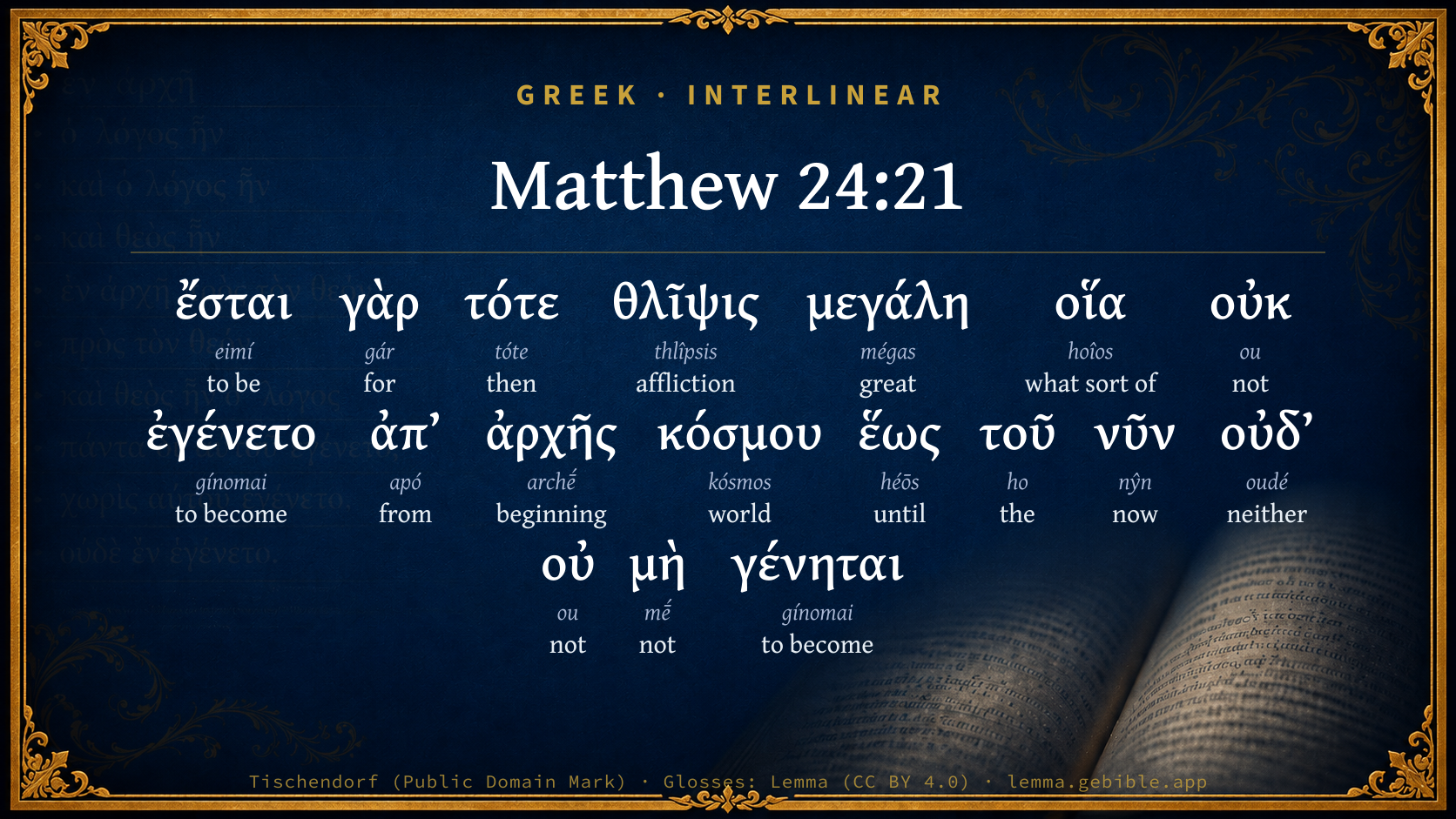
Greek (Tischendorf 8th ed.) Matthew 24:21 appears in the Greek New Testament. The text above is from the Tischendorf 8th edition. Each word links to its Strong’s number and a concise gloss. Click any word for its full Thayer’s Greek Lexicon entry.
Download image
Cite this verse

Matthew 24:21 (World English Bible). Public Domain. Lemma interlinear Bible study tool, https://lemma.gebible.app/v/matthew/24/21.

Show BibTeX & RIS
BibTeX
RIS
English Translation
for then there will be great oppression, such as has not been from the beginning of the world until now, no, nor ever will be.
World English Bible · Public Domain
Highlights
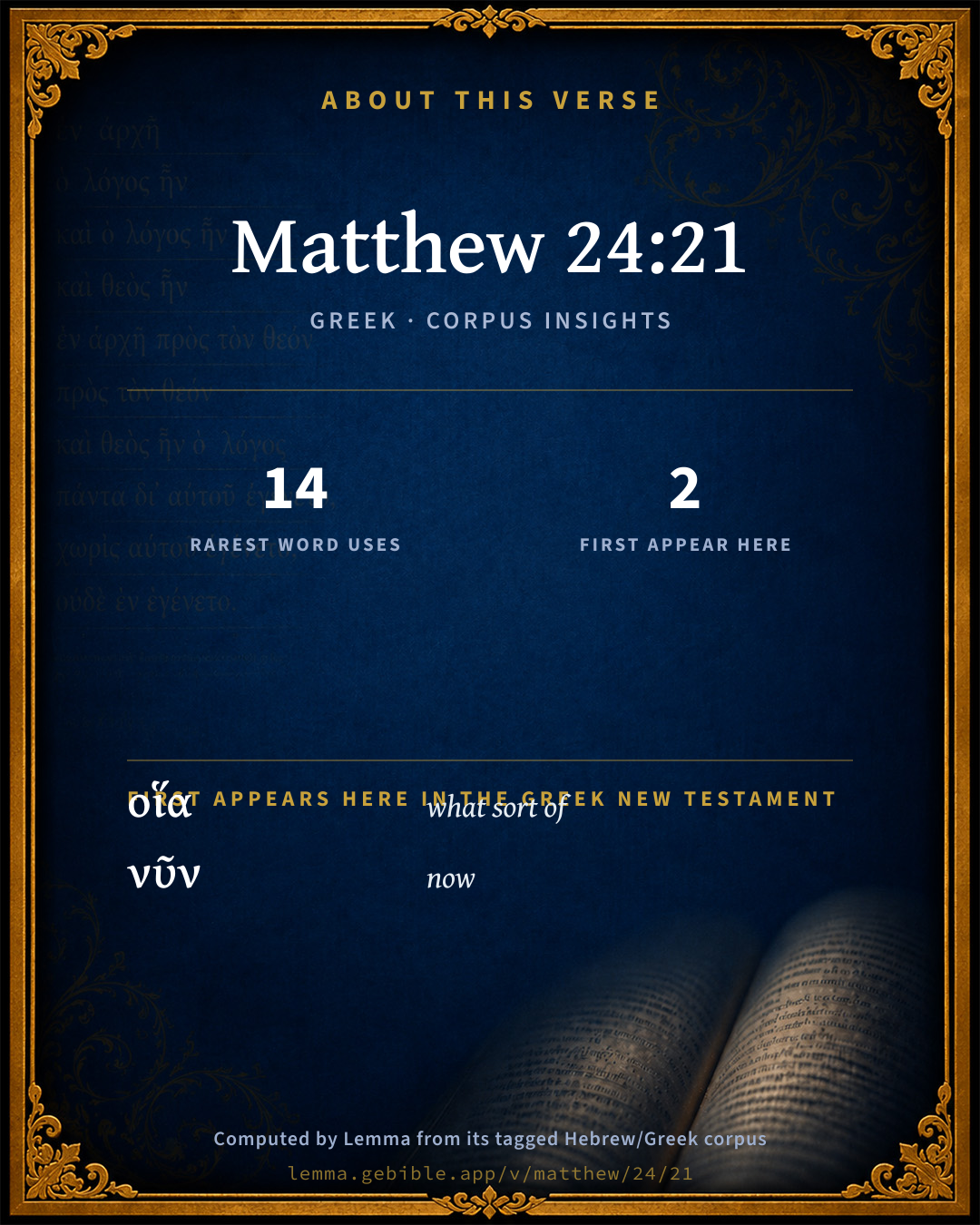
  • 2 first appearances in the Greek New Testament
Full analysis ↓
Download a study sheet

One document with this verse’s original text, its word-by-word gloss line, the meaning frame, cross-references with their text, attributed commentary, and full source and license credits — printable, and it pastes into notes with its structure intact.

This verse Autodidact and up

Study sheet (.html) Plain text (.txt)

A passage Seminary Student

Up to 50 verses in one chapter. A passage sheet keeps up to 6 commentary sources and 12 cross-references per verse, in the order this page ranks them, and says so on the sheet whenever that leaves anything out. Ask for a single verse and you get the Autodidact verse sheet above.

Everything on this page stays free to read, with no account — the sheet is a download of what is already on screen, not access to it.

Want to remove ads? Support Godless Engineer
Compare translations 3

The same verse in 3 English versions, stacked beneath the original-language interlinear above. Click any original word for its lexicon entry.

Each is an independent rendering of the whole verse — the interlinear is not word-aligned to these translations.

Highlighted words mark where these versions differ — a whole-verse word diff, not a word-by-word alignment.

  • World English Bible Public Domain
    for then there will be great oppression, such as has not been from the beginning of the world until now, no, nor ever will be.
  • King James Version Public Domain
    For then shall be great tribulation, such as was not since the beginning of the world to this time, no, nor ever shall be.
  • unfoldingWord Literal Text CC BY-SA 4.0
    For then will be great tribulation, such as has not happened from the beginning of the world until now, nor will ever happen.

unfoldingWord Literal Text — © unfoldingWord, licensed CC BY-SA 4.0. Word-aligned USFM3 via Door43 (git.door43.org/unfoldingWord/en_ult).

Versions to compare (up to 4)

3 of 4 selected

Show all 19 translations

Every available English version of this verse, each an independent rendering of the whole verse.

  • World English Bible Public Domain
    for then there will be great oppression, such as has not been from the beginning of the world until now, no, nor ever will be.
  • Berean Standard Bible Public Domain
    For at that time there will be great tribulation, unmatched from the beginning of the world until now, and never to be seen again.
  • Majority Standard Bible Public Domain
    For at that time there will be great tribulation, unmatched from the beginning of the world until now, and never to be seen again.
  • King James Version Public Domain
    For then shall be great tribulation, such as was not since the beginning of the world to this time, no, nor ever shall be.
  • American Standard Version (1901) Public Domain
    for then shall be great tribulation, such as hath not been from the beginning of the world until now, no, nor ever shall be.
  • Revised Version (1885) Public Domain
    for then shall be great tribulation, such as hath not been from the beginning of the world until now, no, nor ever shall be.
  • Geneva Bible (1599) Public Domain
    For then shall be great tribulation, such as was not from the beginning of the worlde to this time, nor shalbe.
  • Douay-Rheims (1899) Public Domain
    For there shall be then great tribulation, such as hath not been from the beginning of the world until now, neither shall be.
  • Young's Literal Translation Public Domain
    for there shall be then great tribulation, such as was not from the beginning of the world till now, no, nor may be.
  • Literal Standard Version CC BY-SA 4.0
    for there will then be great tribulation, such as was not from the beginning of the world until now, no, nor may be.
  • Unlocked Literal Bible CC BY-SA 4.0
    For there will be great tribulation, such as has not been from the beginning of the world until now, no, nor ever will be again.
  • unfoldingWord Literal Text CC BY-SA 4.0
    For then will be great tribulation, such as has not happened from the beginning of the world until now, nor will ever happen.
  • Darby Bible Public Domain
    for then shall there be great tribulation, such as has not been from [the] beginning of [the] world until now, nor ever shall be;
  • World Messianic Bible Public Domain
    for then there will be great suffering, such as has not been from the beginning of the world until now, no, nor ever will be.
  • Webster's Bible Public Domain
    For then shall be great tribulation, such as hath not been since the beginning of the world to this time, no, nor ever shall be.
  • Free Bible Version CC BY-SA 4.0
    For at that time there will be terrible persecution—more terrible than anything that has happened from the beginning of the world up till now, and won't ever happen again.
  • Bible in Basic English Public Domain
    Because in those days there will be great sorrow, such as there has not been from the start of the world till now, or ever will be.
  • Text-Critical English NT CC BY 4.0
    For at that time there will be a great tribulation unlike any other from the beginning of the world until now, and it will never be equaled again.
  • Tyndale New Testament (1534) Public Domain
    For then shalbe greate tribulacion suche as was not from the beginninge of the worlde to this tyme ner shalbe.

Literal Standard Version (2020), Covenant Press — licensed CC BY-SA 4.0. Text via the HelloAO Bible API (eBible.org). Unlocked Literal Bible (unfoldingWord) — licensed CC BY-SA 4.0. Text via the HelloAO Bible API (eBible.org). unfoldingWord Literal Text — © unfoldingWord, licensed CC BY-SA 4.0. Word-aligned USFM3 via Door43 (git.door43.org/unfoldingWord/en_ult). Free Bible Version, Dr. Jonathan Gallagher — licensed CC BY-SA 4.0. Text via the HelloAO Bible API (eBible.org).

Word by word

More ways to search: Search by grammar → Find every occurrence → Compare this word →

Practice this passage: Drill this verse → Learn its vocabulary →

οἵα
hoîos
G3634
“what sort of”
Relative pronoun, Nominative, Singular, Feminine
Part of Speech
Relative pronoun
Case
Nominative
Number
Singular
Gender
Feminine
Full Thayer's Definition

Origin: probably akin to G3588 , G3739 , and G3745

TDNT: None

1. what sort of, what manner of, such as
  1. ἔσται eimí G1510 “to be” Verb, Future, Middle deponent, Indicative, 3rd person, Singular
  2. γὰρ gár G1063 “for” Conjunction
  3. τότε tóte G5119 “then” Adverb
  4. θλῖψις thlîpsis G2347 “affliction” Noun, Nominative, Singular, Feminine
  5. μεγάλη mégas G3173 “great” Adjective, Nominative, Singular, Feminine
  6. οὐκ ou G3756 “not” Particle, Negative
  7. ἐγένετο gínomai G1096 “to become” Verb, Aorist, Middle deponent, Indicative, 3rd person, Singular
  8. ἀπ’ apó G575 “from” Preposition
  9. ἀρχῆς archḗ G746 “beginning” Noun, Genitive, Singular, Feminine
  10. κόσμου kósmos G2889 “world” Noun, Genitive, Singular, Masculine
  11. ἕως héōs G2193 “until” Adverb
  12. τοῦ ho G3588 “the” Article, Genitive, Singular, Masculine
  13. νῦν nŷn G3568 “now” Adverb
  14. οὐδ’ oudé G3761 “neither” Conjunction, Negative
  15. οὐ ou G3756 “not” Particle, Negative
  16. μὴ mḗ G3361 “not” Particle, Negative
  17. γένηται gínomai G1096 “to become” Verb, Aorist, Middle deponent, Subjunctive, 3rd person, Singular

About this verse

These counts appear in no published source. They are computed here, from the morphology-tagged text and Lemma’s own curated glosses. What Lemma adds →

18
words
16
distinct lemmas
Gospels
section

Notable vocabulary

The rarest word here is οἵα what sort of G3634 — appearing just 14 times in the whole Greek New Testament.

First appearance in Scripture

These words make their first canonical appearance in the Greek New Testament here:

Shared distinctive vocabulary

οἵα what sort of G3634 occurs in 11 verses of the Greek New Testament. Also found in:
Repetition

Words recur within this verse:

  • ἐγένετο to become G1096 ×2
  • οὐκ not G3756 ×2

Cross-references

16

Topical passages linked to Matthew 24:21 in the Treasury of Scripture Knowledge — connected by theme and wording, ordered by reader-vote popularity; previews shown in the World English Bible.

  • Daniel 12:1 "At that time shall Michael stand up, the great prince who stands for the children of your people; and there shall be a time of trouble, such as never was since there was a nation even to that same time: and at that time your people shall be delivered, everyone who shall be found written in the book.
  • Joel 2:2 A day of darkness and gloominess, A day of clouds and thick darkness. As the dawn spreading on the mountains, A great and strong people; There has never been the like, Neither will there be any more after them, Even to the years of many generations.
  • Malachi 4:1 "For, behold, the day comes, it burns as a furnace; and all the proud, and all who work wickedness, will be stubble; and the day that comes will burn them up," says Yahweh of Hosts, "that it shall leave them neither root nor branch.
  • Zechariah 14:2–3 For I will gather all nations against Jerusalem to battle; and the city will be taken, the houses rifled, and the women ravished. half of the city will go out into captivity, and the rest of the people will not be cut off from the city.
  • Isaiah 66:15–16 For, behold, Yahweh will come with fire, and his chariots shall be like the whirlwind; to render his anger with fierceness, and his rebuke with flames of fire.
  • Matthew 24:29 But immediately after the oppression of those days, the sun will be darkened, the moon will not give its light, the stars will fall from the sky, and the powers of the heavens will be shaken;
  • Luke 19:43–44 For the days will come on you, when your enemies will throw up a barricade against you, surround you, hem you in on every side,
  • Luke 21:24 They will fall by the edge of the sword, and will be led captive into all the nations. Jerusalem will be trampled down by the Gentiles, until the times of the Gentiles are fulfilled.
  • Isaiah 65:12–16 I will destine you to the sword, and you shall all bow down to the slaughter; because when I called, you did not answer; when I spoke, you did not hear; but you did that which was evil in my eyes, and chose that in which I didn't delight.
  • Daniel 9:26 After the sixty-two weeks the Anointed One shall be cut off, and shall have nothing: and the people of the prince who shall come shall destroy the city and the sanctuary; and the end of it shall be with a flood, and even to the end shall be war; desolations are determined.
  • Joel 1:2 Hear this, you elders, And listen, all you inhabitants of the land. Has this ever happened in your days, Or in the days of your fathers?
  • 1 Thessalonians 2:16 forbidding us to speak to the Gentiles that they may be saved; to fill up their sins always. But wrath has come on them to the uttermost.
  • Hebrews 10:26–29 For if we sin willfully after we have received the knowledge of the truth, there remains no more a sacrifice for sins,
  • Psalms 69:22–28 Let their table before them become a snare. May it become a retribution and a trap.
  • Zechariah 11:8–9 I cut off the three shepherds in one month; for my soul was weary of them, and their soul also loathed me.
  • Mark 13:9 But watch yourselves, for they will deliver you up to councils. You will be beaten in synagogues. You will stand before rulers and kings for my sake, for a testimony to them.

Cross-references courtesy of OpenBible.info (CC BY 4.0).

Commentary

Notes on Matthew 24:21 from classic Christian and Jewish commentators (each source and its license shown beneath its notes). The classic Christian expositions comment on the surrounding passage and are grouped to its opening verse, so a note may address several verses; the Jewish commentaries on the Tanakh (Rashi and others) are per-verse, so they appear only where the commentator wrote on this verse.

Lemma curates 59 commentaries, every one of them public domain or Creative Commons licensed, each selected and text-cleaned for this edition rather than reprinted as found. About our sources →

Tyndale Open Study Notes

Tyndale Open Resources

24:21 greater anguish: Similar language is found in Neh 9:37; Jer 11:16; Dan 12:1; Joel 2:1-17. The blatant savagery of the times has been documented by Josephus (see War 5.10.2-3).

Tyndale Open Study Notes — © Tyndale Open Resources, licensed CC BY-SA 4.0. Text via the HelloAO Bible API.

Bengel's Gnomon

Johann Albrecht Bengel

Mat 24:21. Ἀπʼ ἀρχῆς κόσμου, from the beginning of the world) in the time of the Deluge, etc.

Bengel's Gnomon of the New Testament — English translation (T&T Clark, Edinburgh, 1860) — public domain. Text from a community e-Sword module.

Meyer's Critical & Exegetical Commentary

Heinrich August Wilhelm Meyer

Mat_24:21. Those hindrances to flight are all the more to be deprecated that the troubles are to be unparalleled, and therefore a rapid flight will be a matter of the most urgent necessity.

ἕως τοῦ νῦν] usque ad hoc tempus, Rom_8:22. Κόσμου is not to be supplied here (Fritzsche). See, on the other hand, Mar_13:19; 1Ma_2:33; Plat. Parm. p. 152 C, Ep. xiii. p. 361 E. On the threefold negative οὐδὲ οὐ μή, see Bornemann in the Stud. u. Krit. 1843, p. 109 f. For the expression generally, Plat. Tim. p. 38 A: οὐδὲ γενέσθαι ποτὲ οὐδὲ γεγονέναι νῦν οὐδʼ εἰσαῦθις ἔσεσθαι; Stallbaum, ad Rep. p. 492 E.

Meyer — Critical and Exegetical Commentary on the New Testament — English translation by Peter Christie, edited by Frederick Crombie (T&T Clark, 1880) — public domain. Text from a community e-Sword module.

Expositor's Greek Testament

ed. W. Robertson Nicoll

Mat 24:21-22 . he extremity of the distress .

Mat 24:21 represents it as unparalleled before or after, n terms recalling those of Dan 12:1 ; Mat 24:22 as intolerable but for the shortness of the agony. ἐκολοβώθησαν (from κολοβός , κόλος , mutilated) literally to cut off, e.g. , hands or feet, as in 2Sa 4:12 ; here figuratively to cut short the time: nisi breviati fuissent (Vulgate). The aorist here, as in next clause ( ἐσώθη ), is used proleptically, as if the future were past, in accordance with the genius of prophecy. οὐκ ἂν , etc.: the οὐκ must be joined to the verb, and the meaning is: all flesh would be not saved ; joined to πᾶσα the sense would be not all flesh, i.e. , only some, would be saved. ἐσώθη refers to escape from physical death; in Mat 24:13 the reference is to salvation in a higher sense. This is one of the reasons why this part of the discourse is regarded as not genuine. But surely Jesus cared for the safety both of body and soul ( vide Mat 10:22 ; Mat 10:30 ). The epistle of Barnabas (iv.) contains a passage about shortening of the days, ascribed to Enoch. Weizsäcker ( Untersuchungen , p. 125) presses this into the service of the Jewish apocalypse hypothesis. διὰ δὲ τ . ἐκλεκτοὺς : the use of this term is not foreign to the vocabulary of Jesus ( vide Mat 22:14 ), yet it sounds strange to our ears as a designation for Christians. It occurs often in the Book of Enoch, especially in the Similitudes. The Book begins: “The words of the blessing of Enoch, wherewith he blessed the elect and righteous who will be living in the day of tribulation when all the wicked and godless are removed” ( vide Charles, The Book of Enoch , p. 58). The idea attaching to the word here seems to be: those selected for deliverance in a time of general destruction = the preserved. And the thought expressed in the clause is that the preserved are to be preservers. Out of regard to their intercessions away amid the mountains, the days of horror will be shortened. A thought worthy of Jesus.

The Expositor's Greek Testament, edited by W. Robertson Nicoll (1897–1910) — public domain. Text from a community e-Sword module.

Adam Clarke's Commentary

Verse 21. For then shall be great tribulation] No history can furnish us with a parallel to the calamities and miseries of the Jews:-rapine, murder, famine, and pestilence within: fire and sword, and all the horrors of war, without. Our Lord wept at the foresight of these calamities; and it is almost impossible for any humane person to read the relation of them in Josephus without weeping also. St. Luke, Lu 21:22, calls these the days of vengeance, that all things which were written might be fulfilled. 1. These were the days in which all the calamities predicted by Moses, Joel, Daniel, and other prophets, as well as those predicted by our Saviour, met in one common centre, and were fulfilled in the most terrible manner on that generation. 2. These were the days of vengeance in another sense, as if God's judgments had certain periods and revolutions; for it is remarkable that the temple was burned by the Romans in the same month, and on the same day of the month, on which it had been burned by the Babylonians. See Josephus, WAR, b. vi. c. 4.

Adam Clarke's Commentary on the Bible (1810–1826) — public domain. Text from a community e-Sword/MySword module.

Ellicott's Commentary for English Readers

(21) Such as was not since the beginning . . .—The words come from Dan_12:1. One who reads the narrative of Josephus will hardly hesitate to adopt his language, “that all miseries that had been known from the beginning of the world fell short” of those of the siege of the Holy City (Wars, v. 13, §§ 4, 5). Other sieges may have witnessed, before and since, scenes of physical wretchedness equally appalling, but nothing that history records offers anything parallel to the alternations of fanatic hope and frenzied despair that attended the breaking up of the faith and polity of Israel.

A Bible Commentary for English Readers, edited by Charles John Ellicott (1878–1897) — public domain. Text from a community e-Sword module.

The Cambridge Bible for Schools and Colleges

gen. ed. J. J. S. Perowne

21. great tribulation] “Jerusalem, a city that had been liable to so many miseries during the siege, that had it enjoyed as much happiness from its first foundation, it would certainly have been the envy of the world.” Josephus, B. J. vii. 6. 5.

No words can describe the unequalled horrors of this siege. It was the Passover season, and Jews from all parts were crowded within the walls. Three factions, at desperate feud with each other, were posted on the heights of Sion and on the Temple Mount. These only united to fling themselves at intervals upon the Roman entrenchments, and then resumed their hate. The Temple-courts swam with the blood of civil discord, which was literally mingled with the blood of the sacrifices. Jewish prisoners were crucified by hundreds in view of their friends, while within the city the wretched inhabitants were reduced by famine to the most loathsome of food and to deeds of unspeakable cruelty. Jerusalem was taken on the 10th August, a. d. 70. 1,100,000 Jews perished in the siege, 100,000 were sold into slavery. With the fall of Jerusalem Israel ceased to exist as a nation. It was truly the end of an æon.

The Cambridge Bible for Schools and Colleges (gen. ed. J. J. S. Perowne; Cambridge University Press, 1878–1918) — public domain. Text from a community e-Sword module.

John Gill's Exposition

For then shall be great tribulation,.... This is urged as a reason for their speedy flight; since the calamity that would come upon those who should remain in the city, what through the sword, famine, pestilence, murders, robberies, &c. would

be such as was not since the beginning of the world, to this time, no, nor ever shall be. The burning of Sodom and Gomorrha, the bondage of the children of Israel in Egypt, their captivity in Babylon, and all their distresses and afflictions in the times of the Maccabees, are nothing to be compared with the calamities which befell the Jews in the siege and destruction of Jerusalem. Great desolations have been made in the besieging and at the taking of many famous cities, as Troy, Babylon, Carthage, &c. but none of them are to be mentioned with the deplorable case of this city. Whoever reads Josephus's account will be fully convinced of this; and readily join with him, who was an eyewitness of it, when he says (m), that

"never did any city suffer such things, nor was there ever any generation that more abounded in malice or wickedness.''

And indeed, all this came upon them for their impenitence and infidelity, and for their rejection and murdering of the Son of God; for as never any before, or since, committed the sin they did, or ever will, so there never did, or will, the same calamity befall a nation, as did them.

(m) De Bello Jud. l. 6. c. 11.

John Gill's Exposition of the Whole Bible (1746–1763) — public domain (CC PDM 1.0). Text via the HelloAO Bible API.

Trapp's Complete Commentary

John Trapp

21 For then shall be great tribulation, such as was not since the beginning of the world to this time, no, nor ever shall be.

Ver. 21. Tribulation, such as was not, &c.] Those very days "shall be affliction;" so Mark hath it, Mar 13:19, εσονται αι ημεραι εκειναι θλιψις. As if the very time were nothing else but affliction itself. He who can read the history of it without tears hath hardly the heart of a man in him. Besides those many that perished within the walls, Josephus tells us of 1,100,000 of them slain by the Romans, and 97,000 carried captive. Oh, see the severity of God and tremble! Rom 11:22. Alterius perditio tua sit cautio. Scipio wept when he saw Carthage on fire. And when Saguntum was taken, the Romans were as much affected as if Hannibal fuisset ad portas, the enemy had been beating upon the walls of the Capitol.

John Trapp, A Commentary or Exposition upon All the Books of the Old and New Testament (1647–1656) — public domain. Text from a community e-Sword module.

Albert Barnes' Notes on the Bible

There shall be great tribulation - The word “tribulation” means calamity or “suffering.” Luke Luk 21:24 has specified in what this tribulation would consist: “They shall fall by the edge of the sword, and shall be led away captive into all nations, and Jerusalem shall be trodden down of the Gentiles, until the times of the Gentiles shall be fulfilled.” That is, until the time allotted for the Gentiles “to do it” shall be fully accomplished, or as long as God is pleased to suffer them to do it.

The first thing mentioned by Luke is, that they should fall “by the edge of the sword” - that is, would be slain in war, as the sword was then principally used in war. This was most strikingly fulfilled. Josephus, in describing it, uses almost the very words of our Saviour. “All the calamities, says he, which had befallen any nation from the beginning of the world” were but small in comparison with those of the Jews. - Jewish Wars, b. i. preface, section 4.

He has given the following account of one part of the massacre when the city was taken: “And now, rushing into the city, they slew whomsoever they found, without distinction, and burned the houses and all the people who had fled into them; and when they entered for the sake of plunder, they found whole families of dead persons, and houses full of carcasses destroyed by famine, then they came out with their hands empty. And though they thus pitied the dead, they had not the same emotion for the living, but killed all they met, whereby they filled the lanes with dead bodies. “The whole city ran with blood,” insomuch that many things which were burning were extinguished by the blood.” - “Jewish Wars,” b. 6 chapter 8, section 5; chapter 9, section 2, 3. He adds that in the siege of Jerusalem not fewer than “eleven hundred thousand” perished (Jewish Wars, b. 6 chapter 9, section 3) - a number almost half as great as are in the whole city of London. In the adjacent provinces no fewer than “two hundred and fifty thousand” are reckoned to have been slain; making in all whose deaths were ascertained the almost incredible number of “one million three hundred and fifty thousand” who were put to death.

These were not, indeed, all slain with the sword. Many were crucified. “Many hundreds,” says Josephus (“Jewish Wars,” b. v. chapter 11, section 1), “were first whipped, then tormented with various kinds of tortures, and finally crucified; the Roman soldiers nailing them (out of the wrath and hatred they bore to the Jews), one after one way and another after another, to crosses, “by way of jest,” until at length the multitude became so great that room was lacking for crosses, and crosses for the bodies.” So terribly was their imprecation fulfilled - “his blood be on us and on our children,” Mat 27:25. If it be asked how it was possible for so many people to be slain in a single city, it is to be remembered that the siege of Jerusalem commenced during the time of the Passover, when all the males of the Jews were required to be there, and when it is estimated that more than “three million” were usually assembled. See Josephus, Jewish Wars, b. 6 chapter 9, section 3, 4.

A horrible instance of the distress of Jerusalem is related by Josephus. The famine during the siege became so great that they ate what the most sordid animals refused to touch. A woman of distinguished rank, having been plundered by the soldiers, in hunger, rage, and despair, killed and roasted her own babe, and had eaten one half of it before the deed was discovered. - Jewish Wars, b. 6 chapter 3, section 3, 4. This cruel and dreadful act was also in fulfillment of prophecy, Deu 28:53, Deu 28:56-57.

Another thing added by Luke Luk 21:24, was, that “they should be led away captive into all nations.” Josephus informs us that the captives taken during the whole war amounted to “ninety-seven thousand.” The tall and handsome young men Titus reserved for triumph; of the rest, many were distributed through the Roman provinces to be destroyed by wild beasts in theaters; many were sent to the works in Egypt; many, especially those under seventeen years of age, were sold for slaves. - Jewish Wars, b. vi. chapter 9, section 2, 3.

Albert Barnes' Notes on the Bible (1834–1885) — public domain. Text from a community e-Sword/MySword module.

Whedon's Commentary on the Bible

Daniel D. Whedon

21. Great tribulation, such as was not since the beginning of the world — That is, in Jewish history. Yet the statement of Josephus would warrant a stronger interpretation than this. “Our city,” says he, “of all those subjugated to the Romans, was raised to the highest felicity, and was thrust down again to the lowest depth of misery. For if the misfortunes of all from the beginning of the world were compared with those of the Jews, they would appear much inferior in the comparison.”

It is important to note that this term “tribulation” covers, according to this verse, not merely the incipient parts of the downfall, but its height and close also. The “tribulation” which was the severest part of human history, must have been the severest part of the whole series of woes, and that was the late and latest stages. It is also evident from the fact that the Roman eagles are already in the temple in the fifteenth verse, and the consequences of that decisive event are the subject of the verses following, including this twenty-first verse and farther. The tribulation is then a term embracing the whole process of the downfall and desolation of Jerusalem.

Daniel D. Whedon (gen. ed.), Commentary on the Old and New Testaments (1874–1909) — public domain. Text from a community e-Sword module.

The Pulpit Commentary

Nor then. Jesus gives the reason why this precipitate flight (vers. 16-20) was rendered necessary at the moment spoken of in ver. 15. Great tribulation. The miseries suffered in the siege of Jerusalem were stupendous To the skilful and fierce attacks of the Romans from without were added from within dire famine and pestilence, dissensions, violence, and continual bloodshed and murder. Josephus estimates the number of those who fell in the siege and capture of Jerusalem at 1, 000, 000, the usual population being largely increased by the influx of pilgrims attending the Feast of the Passover, and by thousands of fugitives who had flocked in from the country (Josephus. "Bell. Jud:," 6:9, 3). He adds that 97, 000 were carried away captive during and after the war. Such as was not...nor ever shall be. (Dan_12:1) This is not mere hyperbole, but sober fact. Josephus ("Bell. Jud.," Pro 4) himself bears similar testimony: "Of all the cities under the dominion of Rome, ours was once the most happy, and afterwards the most utterly miserable. For the misfortunes of all the nations upon earth that have ever happened, if they are compared with the calamities to which the Jews were exposed, will, in my opinion, fall far short." Chrysostom sums up the matter thus: "Whence came there thus upon them wrath from God intolerable, and more sore than all that had befallen aforetime, not in Judaea only, but in any part of the world? Is it not quite clear that it was for the deed of the cross and for this rejection? Mark, I pray thee, the exceeding greatness of the ills, when not only compared with the time before, they appear more grievous, but also with all the time to come. For not in all the world, neither in all time that is past, and that is to come, shall any one be able to say such ills have been. And very naturally; for neither had any man perpetrated, not of these that ever have been, nor those to come hereafter, a deed so wicked and horrible" ("Hom.," in loc. ). The "affliction" spoken of refers not only to bodily sufferings, but to that anguish of mind occasioned by acute apprehension and. expectation of danger, such as was felt in the days before the Flood, and at the time of the oppression of Antiochus Epiphanes.

The Pulpit Commentary (1880–1919), ed. H.D.M. Spence-Jones & Joseph S. Exell — public domain. Text from a community e-Sword module.

John Wesley's Explanatory Notes

Then shall be great tribulation - Have not many things spoken in the chapter, as well as in Mark xiii, , Luke xxi, . a farther and much more extensive meaning than has been yet fulfilled?

John Wesley, Explanatory Notes Upon the Whole Bible (1754–1765) — public domain. Text via the GEBible commentary corpus.

Burkitt's Expository Notes on the New Testament

William Burkitt

The doleful miseries and dreadful calamities which were coming upon the Jews in general, and upon Jerusalem in particular, are here foretold by our Saviour, partly from the Roman army without, and partly from the seditions and factions of the zealots within, who committed such outrages and slaughters, that there were no less than an hundred thousand slain, and ninety-seven thousand carried away captive, and made prisoners. They that bought our Saviour for thirty pence, were now themselves sold thirty for a penny. Now did the temple itself become a sacrifice, a whole burnt-offering, and was consumed to ashes.

Yet observe, Christ promises that these calamitous days shall be shortened for the elect’s sake. God had a remnant, which he determined should survive this destruction, to be an holy seed; and accordingly the providence of God so ordered, that the city was taken in six months, and the whole country depopulated in eighteen.

Whence observe, How the Lord intermixes some mercy with the extremest misery that doth befall a people for their sin. On this side hell, no sinners can say that they feel the strokes of justice to the utmost, or that they have judgment without mercy.

William Burkitt's Expository Notes on the New Testament (1700–1703) — public domain. Text from a community e-Sword module.

The People's New Testament

B. W. Johnson

21. Great tribulation. The account given by Josephus, the Jewish historian who witnessed and recorded the war, is almost an echo of the predictions of Christ. Women ate their own children from starvation; the Jews within the city fought each other as well as the Roman army; on August 10, a.d. 70, the city was stormed and there was a universal massacre; 1,100,00 persons perished, and 100,000 survivors were sold into slavery.

B. W. Johnson's The People's New Testament with Notes (1889–1891) — public domain. Electronic text from the Christian Classics Ethereal Library (CCEL) ThML edition.

Cambridge Greek Testament for Schools and Colleges

21. θλῖψις μεγάλη. ‘Jerusalem, a city that had been liable to so many miseries during the siege, that had it enjoyed as much happiness from its first foundation, it would certainly have been the envy of the world.’ Josephus, B. J. VI. 8. 5.

No words can describe the unequalled horrors of this siege. It was the Passover season, and Jews from all parts were crowded within the walls. Three factions, at desperate feud with each other, were posted on the heights of Sion and on the Temple Mount. These only united to fling themselves at intervals upon the Roman entrenchments, and then resumed their hate. The Temple-courts swam with the blood of civil discord, which was literally mingled with the blood of the sacrifices. Jewish prisoners were crucified by hundreds in view of their friends, while within the city the wretched inhabitants were reduced by famine to the most loathsome of food and to deeds of unspeakable cruelty. Jerusalem was taken on the 10th August, A.D. 70. 1,100,000 Jews perished in the siege, 100,000 were sold into slavery. With the fall of Jerusalem, Israel ceased to exist as a nation. It was truly the end of an æon.

οὐδʼ οὐ μὴ γένηται. Note the triple negative. The regular construction would be οὐδὲ μὴ γένηται, οὐ being redundant. The form of the sentence is not strictly logical, but θλίψις μεγάλη is excluded from the predication of οὐ μὴ γένηται. When the last great tribulation does come it will prove to be unparalleled.

Cambridge Greek Testament for Schools and Colleges (Cambridge University Press, 1896; 21 vols, various authors incl. Carr, Maclear, Plummer, Farrar, Lumby, Moule, M. R. James, Simcox) — public domain. Text from a community e-Sword module.

International Critical Commentary

(M) 21. For there shall be then great affliction, such as hath not happened from the beginning of the world until now, nor shall happen.] Mk. has: “For those days shall be affliction such as there hath not happened like it from the beginning of the creation which God created until now, and shall not happen.” Mt. omits Mk.’s redundant τοιαύτη and ἣν ἔκτισεν ὁ θεός, cf. on 8:16, and substitutes τότε ἔσται for Mk.’s Semitic ἔσονται αἱ ἡμέραι ἐκεῖμαι. For the idea of the last days as a period of unprecedented tribulation, Cf. Dan 12:1 ἐκείνη ἡ ἡμέρα θλίψεως οἵα οὐκ ἐγενήθη ἀφʼ οὖ ἐγενήθησαν ἕως τῆς ἡμέρας ἐκείνης: Ass. Mos. 8:1 “And there will come upon them a second visitation, and wrath such as has not befallen them from the beginning until that time”; cf. Jer 30:7, Jer 30:1 Mac 9:27.—γέγονεν. For the perfect cf. Dan 12:1 Th.

International Critical Commentary — older volumes (1896–1929), various authors — public domain. Text from a community e-Sword module.

Lesson kit

Teaching starters — assembled from the data on this page, not authored interpretation. Every prompt links to the verse data it draws on. Edit before teaching.

Matthew, in the Gospels, opens this verse with 18 words (16 distinct Greek lemmas). Its most distinctive word is hoîos (“what sort of”). A historical commentator’s framing appears above. Read the whole chapter for the surrounding context.

Discussion questions

  1. How does “what sort of” (hoîos) shape what this verse is saying?
  2. 2 words make their first appearance in Scripture here. What does this debut establish?
  3. How does Mark 9:3, which shares the word «what sort of», read alongside this verse?
  4. What does the repetition of “to become” (2× in this one verse) do in this verse?
  5. These translations render this verse differently. What is at stake in choosing one wording over another?
  6. Compare how Tyndale Open Study Notes and Bengel's Gnomon read this verse. Where do they agree or differ?

Things to notice

  • 2 words make their first canonical appearance in Scripture here.
  • These translations choose different wording for 13 words in this verse.
  • “to become” occurs 2× in this single verse.
  • 16 distinct Greek lemmas span 18 words in this verse.

Reading settings

Reading text

Shown beneath each verse's original-language words.

Old Testament
Old Testament edition

Read the OT as the Masoretic Hebrew (MT) or the Greek Septuagint (LXX).

English shown for the Greek Septuagint (in the Hebrew ↔ Greek comparison).

Comparing translations? Open the Compare panel on any verse page to stack up to four side by side.