Mark 2:27

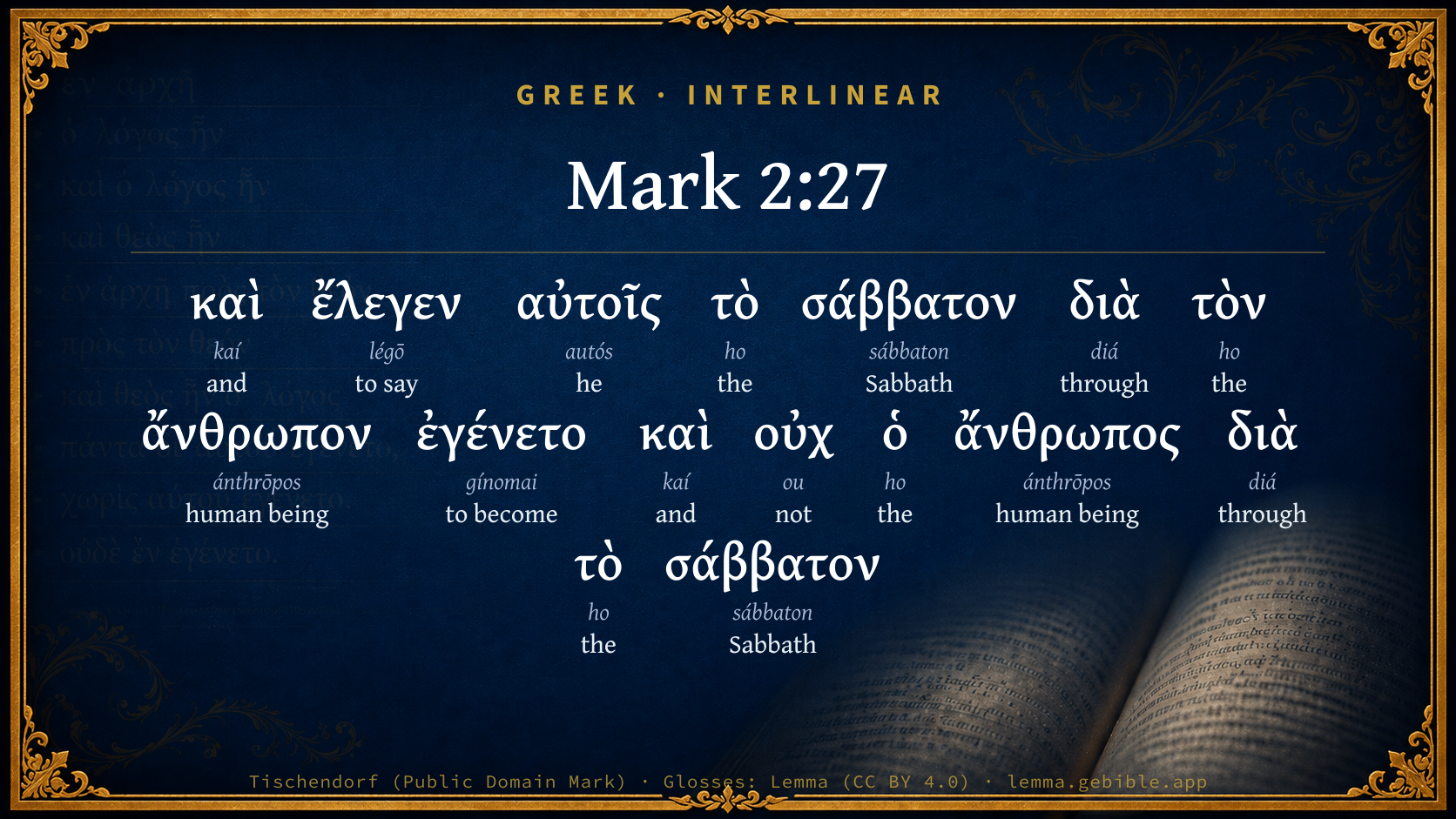
Greek (Tischendorf 8th ed.) Mark 2:27 appears in the Greek New Testament. The text above is from the Tischendorf 8th edition. Each word links to its Strong’s number and a concise gloss. Click any word for its full Thayer’s Greek Lexicon entry.
Download image
Cite this verse

Mark 2:27 (World English Bible). Public Domain. Lemma interlinear Bible study tool, https://lemma.gebible.app/v/mark/2/27.

Show BibTeX & RIS
BibTeX
RIS
English Translation
He said to them, "The Sabbath was made for man, not man for the Sabbath.
World English Bible · Public Domain
Download a study sheet

One document with this verse’s original text, its word-by-word gloss line, the meaning frame, cross-references with their text, attributed commentary, and full source and license credits — printable, and it pastes into notes with its structure intact.

This verse Autodidact and up

Study sheet (.html) Plain text (.txt)

A passage Seminary Student

Up to 50 verses in one chapter. A passage sheet keeps up to 6 commentary sources and 12 cross-references per verse, in the order this page ranks them, and says so on the sheet whenever that leaves anything out. Ask for a single verse and you get the Autodidact verse sheet above.

Everything on this page stays free to read, with no account — the sheet is a download of what is already on screen, not access to it.

Want to remove ads? Support Godless Engineer
Compare translations 3

The same verse in 3 English versions, stacked beneath the original-language interlinear above. Click any original word for its lexicon entry.

Each is an independent rendering of the whole verse — the interlinear is not word-aligned to these translations.

Highlighted words mark where these versions differ — a whole-verse word diff, not a word-by-word alignment.

  • World English Bible Public Domain
    He said to them, "The Sabbath was made for man, not man for the Sabbath.
  • King James Version Public Domain
    And he said unto them, The sabbath was made for man, and not man for the sabbath:
  • unfoldingWord Literal Text CC BY-SA 4.0
    And he was saying to them, “The Sabbath was made for man, and not man for the Sabbath.

unfoldingWord Literal Text — © unfoldingWord, licensed CC BY-SA 4.0. Word-aligned USFM3 via Door43 (git.door43.org/unfoldingWord/en_ult).

Versions to compare (up to 4)

3 of 4 selected

Show all 19 translations

Every available English version of this verse, each an independent rendering of the whole verse.

  • World English Bible Public Domain
    He said to them, "The Sabbath was made for man, not man for the Sabbath.
  • Berean Standard Bible Public Domain
    Then Jesus declared, “The Sabbath was made for man, not man for the Sabbath.
  • Majority Standard Bible Public Domain
    Then Jesus declared, “The Sabbath was made for man, not man for the Sabbath.
  • King James Version Public Domain
    And he said unto them, The sabbath was made for man, and not man for the sabbath:
  • American Standard Version (1901) Public Domain
    And he said unto them, The sabbath was made for man, and not man for the sabbath:
  • Revised Version (1885) Public Domain
    And he said unto them, The sabbath was made for man, and not man for the sabbath:
  • Geneva Bible (1599) Public Domain
    And hee sayde to them, The Sabbath was made for man, and not man for the Sabbath.
  • Douay-Rheims (1899) Public Domain
    And he said to them: The sabbath was made for man, and not man for the sabbath.
  • Young's Literal Translation Public Domain
    And he said to them, `The sabbath for man was made, not man for the sabbath,
  • Literal Standard Version CC BY-SA 4.0
    And He said to them, “The Sabbath was made for man, not man for the Sabbath,
  • Unlocked Literal Bible CC BY-SA 4.0
    Jesus said, “The Sabbath was made for mankind, not mankind for the Sabbath.
  • unfoldingWord Literal Text CC BY-SA 4.0
    And he was saying to them, “The Sabbath was made for man, and not man for the Sabbath.
  • Darby Bible Public Domain
    And he said to them, The sabbath was made on account of man, not man on account of the sabbath;
  • World Messianic Bible Public Domain
    He said to them, “The Sabbath was made for man, not man for the Sabbath.
  • Webster's Bible Public Domain
    And he said to them, The sabbath was made for man, and not man for the sabbath:
  • Free Bible Version CC BY-SA 4.0
    “The Sabbath was made for your benefit, not for you to benefit the Sabbath,” he told them.
  • Bible in Basic English Public Domain
    And he said to them, The Sabbath was made for man, and not man for the Sabbath;
  • Text-Critical English NT CC BY 4.0
    Then he said to them, “The Sabbath was made for man, not man for the Sabbath.
  • Tyndale New Testament (1534) Public Domain
    And he sayde to them: the Saboth daye was made for man and not man for the Saboth daye.

Literal Standard Version (2020), Covenant Press — licensed CC BY-SA 4.0. Text via the HelloAO Bible API (eBible.org). Unlocked Literal Bible (unfoldingWord) — licensed CC BY-SA 4.0. Text via the HelloAO Bible API (eBible.org). unfoldingWord Literal Text — © unfoldingWord, licensed CC BY-SA 4.0. Word-aligned USFM3 via Door43 (git.door43.org/unfoldingWord/en_ult). Free Bible Version, Dr. Jonathan Gallagher — licensed CC BY-SA 4.0. Text via the HelloAO Bible API (eBible.org).

Word by word

More ways to search: Search by grammar → Find every occurrence → Compare this word →

Practice this passage: Drill this verse → Learn its vocabulary →

σάββατον
sábbaton
G4521
“Sabbath”
Noun, Nominative, Singular, Neuter
Part of Speech
Noun
Case
Nominative
Number
Singular
Gender
Neuter
Full Thayer's Definition

Origin: of hebrew origin H7676

TDNT: 07:02,0

1. the seventh day of each week which was a sacred festival on which the Israelites were required to abstain from all work a. the institution of the sabbath, the law for keeping holy every seventh day of the week b. a single sabbath, sabbath day 2. seven days, a week
  1. καὶ kaí G2532 “and” Conjunction
  2. ἔλεγεν légō G3004 “to say” Verb, Imperfect, Active, Indicative, 3rd person, Singular
  3. αὐτοῖς autós G846 “he” Personal pronoun, Dative, Plural, Masculine
  4. τὸ ho G3588 “the” Article, Nominative, Singular, Neuter
  5. διὰ diá G1223 “through” Preposition
  6. τὸν ho G3588 “the” Article, Accusative, Singular, Masculine
  7. ἄνθρωπον ánthrōpos G444 “human being” Noun, Accusative, Singular, Masculine
  8. ἐγένετο gínomai G1096 “to become” Verb, Aorist, Middle deponent, Indicative, 3rd person, Singular
  9. καὶ kaí G2532 “and” Conjunction
  10. οὐχ ou G3756 “not” Particle, Negative
  11. ὁ ho G3588 “the” Article, Nominative, Singular, Masculine
  12. ἄνθρωπος ánthrōpos G444 “human being” Noun, Nominative, Singular, Masculine
  13. διὰ diá G1223 “through” Preposition
  14. τὸ ho G3588 “the” Article, Accusative, Singular, Neuter
  15. σάββατον sábbaton G4521 “Sabbath” Noun, Accusative, Singular, Neuter

About this verse

These counts appear in no published source. They are computed here, from the morphology-tagged text and Lemma’s own curated glosses. What Lemma adds →

16
words
9
distinct lemmas
Gospels
section

Repetition

Words recur within this verse:

  • σάββατον Sabbath G4521 ×2
  • διὰ through G1223 ×2
  • ἄνθρωπον human being G444 ×2
  • τὸ the G3588 ×4
  • καὶ and G2532 ×2

Cross-references

11

Topical passages linked to Mark 2:27 in the Treasury of Scripture Knowledge — connected by theme and wording, ordered by reader-vote popularity; previews shown in the World English Bible.

  • Colossians 2:16 Let no man therefore judge you in eating, or in drinking, or with respect to a feast day or a new moon or a Sabbath day,
  • Luke 6:9 Then Jesus said to them, "I will ask you something: Is it lawful on the Sabbath to do good, or to do harm? To save a life, or to kill?"
  • Deuteronomy 5:14 but the seventh day is a Sabbath to Yahweh your God: [in it] you shall not do any work, you, nor your son, nor your daughter, nor your man-servant, nor your maid-servant, nor your ox, nor your donkey, nor any of your cattle, nor your stranger who is within your gates; that your man-servant and your maid-servant may rest as well as you.
  • Ezekiel 20:12 Moreover also I gave them my Sabbaths, to be a sign between me and them, that they might know that I am Yahweh who sanctifies them.
  • Isaiah 58:13 If you turn away your foot from the Sabbath, from doing your pleasure on my holy day; and call the Sabbath a delight, [and] the holy of Yahweh honorable; and shall honor it, not doing your own ways, nor finding your own pleasure, nor speaking [your own] words:
  • Exodus 23:12 "Six days you shall do your work, and on the seventh day you shall rest, that your ox and your donkey may have rest, and the son of your handmaid, and the alien may be refreshed.
  • Ezekiel 20:20 and make my Sabbaths holy; and they shall be a sign between me and you, that you may know that I am Yahweh your God.
  • John 7:23 If a boy receives circumcision on the Sabbath, that the law of Moses may not be broken, are you angry with me, because I made a man every bit whole on the Sabbath?
  • Nehemiah 9:13–14 You came down also on Mount Sinai, and spoke with them from heaven, and gave them right ordinances and true laws, good statutes and commandments,
  • 1 Corinthians 3:21–22 Therefore let no one boast in men. For all things are yours,
  • 2 Corinthians 4:15 For all things are for your sakes, that the grace, being multiplied through the many, may cause the thanksgiving to abound to the glory of God.

Cross-references courtesy of OpenBible.info (CC BY 4.0).

Commentary

Notes on Mark 2:27 from classic Christian and Jewish commentators (each source and its license shown beneath its notes). The classic Christian expositions comment on the surrounding passage and are grouped to its opening verse, so a note may address several verses; the Jewish commentaries on the Tanakh (Rashi and others) are per-verse, so they appear only where the commentator wrote on this verse.

Lemma curates 59 commentaries, every one of them public domain or Creative Commons licensed, each selected and text-cleaned for this edition rather than reprinted as found. About our sources →

The Biblical Illustrator

Joseph S. Exell

Mar_2:27-28

And He said unto them, the Sabbath was made for man.

The Sabbath and its Lord

The Sabbath was made for man-not for the Jews only-not a mere ceremonial observance for the time; but of universal obligation; made for man when man was made.

I. The Sabbath was made for man as a working man. It is a simple fact in medical science, that the human frame is not made so as to bear up under constant labour without rest. He can no more do it than he can live under water; it is contrary to nature; and the consequence will be premature decay; the frame will break down and wear out before its time. This is a simple fact in science. Besides, labour is Gods appointment, His wholesome and needful law. But did He mean us to bear the drudgery of ceaseless toil? How wretched, how degrading, how brutalizing! And God has not appointed it: Six days shalt thou labour. But on this head I need say no more; those admirable Essays by Working Men, which ought to be in everybodys hands, and which so vividly portray the experience of those who have kept the Sabbath, exhaust this part of the subject.

II. The Sabbath was made for man, as a social being. What is Gods great instrument for promoting the temporal good of His creatures? It is the family tie. What is the great stimulant to exertion? What the great safeguard, what the great cordial of life-speaking of mere human things, I mean? It is to be found in the word home. My experience as a gaol chaplain convinces me that the great cause of crime arises from the breach of the fourth and fifth commandments. Let but the family tie be rent asunder, and society falls to pieces. And how can this be maintained without a Sabbath? The observation of an omnibus conductor the other day sets this in a striking light: Sir, I am at work every Sunday, all the day, as well as on week days, and I hardly know the face of my own children. Then what must become of those children? And why should they be deprived of a fathers care, and he of his childrens love? And how has God provided against such a danger? The Sabbath was made for man. Then the various members of the family, scattered through the week, are once more united; the mutual feelings of affection are elicited; they are excited to seek each others welfare, and to value each others good opinion and esteem; and, short of the power of Gods grace, there is no bond half so strong, no security half so certain, that they will fill up their places as good members of society. I constantly meet with those who are lost to every other feeling of shame but this.

III. The Sabbath was made for man, as a spiritual being. Earthly things must not engross all the time and thought of man. God interposes, The seventh day is the Sabbath of the Lord thy God.

IV. But it is not enough to offer man the blessing-it is made imperative; it is confirmed by the sanction which is added, The Son of Man is Lord also of the Sabbath. Jesus is the Lord of the Sabbath, the Proprietor of it, the Owner of it, the Master of it. It is His. It was made for man, but never given to man. The six days were given to man-the seventh never was. He is the Lord of it. It is at His disposal, not at yours, nor any mans, nor any body of men, however great or powerful. Will a man rob God? Yes. If he apply to his own purposes that which does not belong to him, what is it? Robbery. You have no right over anothers Sabbaths; you have no right over your own. It is the Lords day. It is for Him to say how the day shall be spent; and man has no more the right to alienate that day from the service of God to his own service than he has to appropriate his neighbours property or despoil him of his honour for his own behoof. The Sabbath is not mans, but the Lords, and you cant repeal that law, no more than you can change the laws of motion or reverse the force of gravity. You may arrest it for a time, but it will prevail at last; the laws of God execute themselves, you cannot make them inoperative and null.

V. The Son of Man is the Lord of the Sabbath-the judge to punish the breach of it. Nothing is more certain than that this is one of the sins which He especially requires at the hands of men. We know it from His dealings with Israel; Jeremiah is full of such declarations; so are many of the other prophets; to refer only to one, Eze_20:13; Eze_20:16; Eze_20:21; Eze_20:24. He is the Lord-the Judge-to vindicate His own law. And why? First, Sabbath breaking is a deliberate sin. And then Sabbath breaking is (if I may coin such an expression) a fundamental sin. It goes to the root of all godliness; an habitual Sabbath breaker cannot have any true religion. It opens the door of his heart wide to Satan.

VI. The Son of Man is Lord of the Sabbath-to direct the mode of its observance. It is the Lords day-the Lord who died for us. He claims it, to be devoted to His service and consecrated to His honour.

VII. And is it not the Lords day?-the day on which He specially manifests Himself to His people; when He invites them to draw water with joy out of the wells of salvation. (J. Cohen, M. A.)

The Sabbath a necessity

It was made for man, as man; as a thing necessary, suited, essential for him. Just as the atmosphere was made for man to breathe, just as the earth was made for him to cultivate, just as the seasons were made for him-just as these and such-like things were taken into account, when man was put upon the earth, as necessary to fit it for mans abode physically, so the Sabbath was made for man, as a necessary requisite for man morally-and that, when man was unfallen, a holy being, like unto the angels. And if indispensable for mans moral and spiritual health then, can it be less indispensable now? And in His mercy God spared it to us. It has survived the fall-a remnant of paradise lost, and the best help to paradise regained. (J. Cohen, M. A.)

The working man a self sovereign on the Sabbath

Now, I say to this large class of men, the Sabbath comes as a boon from God. It is like an island in a stormy sea. There is a way in which poor men, for the most part, own themselves. The man whose horse and dray are imperatively at the command of his employer, on whose favour he depends, who says to him on Monday, Go, and he goes, and that from daylight to dark-it being the same on Tuesday, on Wednesday, on every day of the week, so that the man cannot go out of Brooklyn without permission of his employer, cannot go to this or that exhibition unless his employer gives his consent-that man has sold out his industry, which carries his person with it, and for six days in the week he is restricted by the will of another; but when the seventh day comes round he says, Thank God, I have nobody to ask today. I am free to come and go. I can rise up or lie down as I please. That is the only day that the poor man has out of the seven in which he has absolute ownership of his body and soul in the thronging industries of modern civilized society. And yet it is this very class of men who are being taught to throw stones at the Sabbath day. It is precisely the same thing over again which occurred when Moses appeared as the deliverer of his people against the Egyptians, and sought to reconcile the quarrel which had arisen between the two peoples. They turned against him and said, Who art thou? And he had to run for his life. The Sabbath comes to men who are tied hand and foot, and need emancipation; and upon this beneficent day of rest for them they turn and say, It is the priests day; it is the churchs bondage; and we are not going to be tied up to any Sunday. Tied up! It is the only day on which your hands are untied. It is the only day on which the poor man is sovereign. (H. W. Beecher.)

The Sabbath a poetic gift to the mechanical agent

Well, how is it about the poor man? His brain is not taxed. He is almost a mechanical agent. That part of a mans brain which has cognisance of the lower functions only is overtaxed, and the rest which is wanted in his case is the transfer of excitement from the lower part of the brain to the higher-to the realm of the moral and spiritual elements. It is needful that a man who is instructed should rise up into the crystal dome of his house. Ordinarily he is working on the ground floor; but there comes a day in which, if he improves the means that are within his reach, a man can cease to be altogether a mechanical agent, can cease to think of physical qualities or things, and rise into the realm of ideas, into the realm of social amenities, into the realm of refined and purified affections, into the great mysterious, poetic realms of the spirit. And is there any class that need that more than poor labouring men? (H. W. Beecher.)

The Sabbath helpful to self-respect

On such a day as this it is no small means of grace for millions of men in this world to have a chance to wash them selves clean. You smile; but washing is one of the most important ordinances of God to this human family. It is said that cleanliness is next to godliness; not to men that are godly, but to men that are on their way toward godliness. When Kaffirs are converted, they are called shirt men, because when the grace of God enters their heart a shirt goes over their bodies for the first time. Wellington said he found that in his army the men who had the self-respect which is indicated by carefully clothing themselves, were the best men he had. In a report on labour made to the British Parliament by one of the largest employers of men, it was said that a workman who on Sunday did not wash himself and dress in his best could not be depended upon. (H. W. Beecher.)

Stealing the Lords day

If you give six days to worldly success, and then voluntarily take the seventh day, which God demands for His worship and especial service, and give that to worldly amusements, then you are wrong; you are so wrong that you could not be any more wrong. If I say my child is sick: I think by taking it to the beach it could be helped, but I cannot take it except on the Sabbath day, and therefore I will have to let it die, then I make a miserable misinterpretation of the text in one direction. But if you say, Come, let us go down for some fine sport; let us examine the picturesque bathing dresses; let us have a jolly time with our friends, then you misinterpret my text in the other direction. The fact is that nine out of ten of you-yes, I will go further than that and say that ninety-nine out of a hundred of you-I think I will go one step farther and say that nine hundred and ninety-nine out of a thousand of you, can go on other days and other nights, instead of the Christian Sabbath. Your work, your business engagement ends at six oclock; that is true with the most of you. In a flash you get to the seashore: in a flash you get back. You can be in your home at six oclock and ten oclock the same evening, and in the interregnum have spent three hours in looking at moonlight on the sea. Now, if God gives you during the week opportunity for recreation, is it not mean for you to take Sunday? If I am a poor man, and I come into your store, and beg some socks for my children, and you say, Yes, Ill give you six pairs of socks, and while you are binding them up in a bundle I steal the seventh pair, you say, That is mean. If you, the father, have seven oranges, and you give to your child six of them, and he steals the seventh, that is mean. But that is what everyone does who, after the Lord gives him six days, steals the seventh. (Dr. Talmage.)

The secularization of the Sabbath inimical to the spiritual welfare of mankind

I also oppose this secularization of the Christian Sabbath because it is war on the spiritual warfare of everybody. Have you a body? Yes. A mind? Yes. A soul? Yes. Do you propose to give them a chance? Yes. Do you believe that all these Sunday night concerts will prepare a single man for the song of the one hundred and forty and four thousand? Have you any idea that all the fifty-two Sundays of secular amusements, operatic singing, concerts, and theatres would prepare in a thousand years one man for heaven? Do you not think that the immortal soul is worth at least one-seventh as much as our perishable body? Here is a jeweller who has three gems-a carnelian, an amethyst, a diamond. He has to cut and set them. Upon which does he put the most care? The diamond. Now, the carnelian is the body, the amethyst is the mind, the diamond is the soul. You give opportunity to these other faculties of your nature, but how many of you give no opportunity to that which is worth as much more than all other interests as a thousand million dollars are more than one cent? (Dr. Talmage.)

The Lords right in the Sabbath above that of the people

We hear a great deal about the peoples rights in selecting their own amusements on Sunday. I would not invade the peoples rights, but it seems to me that the Lord has some rights. You are at the head of your family; you have a right to govern the family. The Governor is at the head of the State; he governs the State. The President is at the head of the nation; he governs the nation. The Lord God is at the head of the universe, and He has a right to lay down an enactment: Remember the Sabbath day, to keep it holy. Whether popular or unpopular, I now declare that the people have no rights except those which the Lord God Almighty gives them. (Dr. Talmage.)

The Lords Day

I. We must consider the Lords day as a gift, rather than a command. So it will come to us in the light of a privilege. No laws are given by Christ or by His apostles concerning the forms of observance. We shall become perplexed if we attempt to rest our case upon simple legal enactment. Our safety in such discussions consists in our fastening attention upon the gracious and benevolent character of the Divine institution. God gives us this one day of the week as His peculiar offering for our bodily and spiritual need; He does not order it nor claim it for any necessities of His own.

II. We must consider the Lords day as a freedom, rather than a restriction. So it will seem to us a gracious respite.

III. This leads us on to say that Christians should consider the Lords day as a rest rather than a dissipation. So it will become a recuperation to us from its chance of a change. The original idea of the Sabbath was rest; the word signifies rest; the fourth commandment gives as the basis of the law the fact that God rested and so hallowed the rest day. We come up to the end of the week worn and excited. Most of us know what the poet Cowper meant when he wrote to his friend John Newton: The meshes of that fine network the brain are composed of such mere spiders threads in me, that when a long thought finds its way into them, it buzzes, and twangs, and bustles about, at such a rate as seems to threaten the whole structure. At these times we need tranquil hours for change of occupation, as well as for genial and agreeable entertainment. Dr. Addison Alexander used to say he found his recreation in change of toil. He would go from the study of languages to the study of mathematics. He would turn from writing commentaries to writing sermons. He would discuss theology, and refresh himself after his dry work by composing little poems for children. We all ought to know and recognize this principle. What we need for Sunday rest is not so much sleep as something to do different from what we do during the week; and what we should shun the most is this wear and tear of a crowded excursion. A real rest is found in variety of labour, inside of exhaustion and fatigue. Quiet does not mean stupid slumber on the Lords day, or on any other. The best relief from worldly cares is discovered oftenest in the gentle industries of religious work.

IV. We must consider the Lords day as a benediction rather than a fret. Thus we shall rebut the charge of bigotry. It is sometimes claimed that Sabbath laws exasperate men who make no claim to religion, and this is a free country. It has to be admitted that there are always some people who grow exasperated whenever the subject of law is mentioned. But liberty is not licence, nor is freedom lawlessness. This one day in seven is no less a blessing because some men do not think so; it is not a fret because they are fretted. Even decent people have some rights. God does not engage to commune with His children, and then expect them to allow the interview to be disturbed by the rollicking riot of a beer garden, or the band of target-shooting parades.

V. We must consider the Lords day as a help rather than an institution. (C. S. Robinson, D. D.)

Son of Man is Lord of the Sabbath

Nothing can show the Divine nature of our Lord more clearly than that He is above such a law of God, so that He should modify it, relax it, change it at His pleasure. He exercised but a small part of this authority when He freed His disciples from the yoke of its burdensome pharisaic observance. He exercised His lordship over the day far more royally when He by His Spirit made the day of His resurrection the weekly religious festival of His Church. By this He gave it altogether a new character. Henceforth it is a day, not of mere rest, but of renewed life, the life of His own resurrection; and so its characteristic ordinance is not the slaying of beasts, but the life-giving celebration of the sacrament of His own risen body. (M. F. Sadler.)

The Sabbath was made for man

I. As a periodical reprieve from the curse of labour.

II. As a stated season for attention to religious truths and interests.

III. As a day of holy convocation for the purpose of worship and instruction.

IV. As an emblem and an earnest of the saints everlasting rest. (G. Brooks.)

The Son of Man Lord of the Sabbath

I. It was instituted by Him.

II. It is kept on a day which is fixed by His authority.

III. It is intended to commemorate His resurrection.

IV. It ought to be observed with a special regard to His will, and word, and work. (G. Brooks.)

The Sabbath for man as a complex creature

The question has been revived in our own generation: In what spirit is that day which has superseded the Sabbath to be kept, especially by the working classes? This, no less than the other, was made for man. Now man, it must be remembered, is a complex creature. He has a tripartite nature, consisting of body, soul, and spirit; and it is necessary to provide for him as such, not ignoring either his physical, or his social, or his religious needs. All must be kept in view. It is a manifest duty to furnish the masses with the means of bodily recreation, and to draw them from their squalid homes into the pure air which will invigorate the frame. It is no less a duty to elevate their tastes, to offer them, as far as possible, variety of scene, and that relief from the monotony of labour which the rich man finds in his club or library; but all must be subordinated to the paramount duty of worship. That is due from every creature to the Great Creator. It is that, moreover, in which he may find his highest enjoyment. No scheme, therefore, which ignores this claim can possibly carry out the principle here laid down by Christ. (H. M. Luckock, D. D.)

Man cannot do without the Sabbath

A distinguished merchant, who for twenty years did a vast amount of business, remarked to Dr. Edwards, Had it not been for the weekly day of rest, I have no doubt I should have been a maniac long ago. This was mentioned in a company of merchants, when one remarked, That is the case exactly with a poor friend of mine. He was one of our greatest importers. He used to say Sunday was the best day in the week to plan successful voyages; showing that his mind had no Sabbath. He has been in the insane hospital for years, and will probably die there. Many men are there, or in the maniacs grave, because they allowed themselves no Sabbath. They broke a law of nature, and of natures God, and found the way of the transgressor is hard.

The Sabbath a service to the State

The keeping one day in seven holy, as a time of relaxation and refreshment as well as for public worship, is of admirable service to a state, considered merely as a civil institution. (Sir W. Blackstone.)

The Sabbath for mans happiness

The usages and ordinances of religion ought to be regulated according to their end, which is the honour of God and the advantage of men. It is the property of the religion of the true God, to contain nothing in it but what is beneficial to man. Hereby God plainly shows that it is neither out of indigence, nor interest, that He requires men to worship and obey Him, but only out of goodness, and on purpose to make them happy. God prohibited work on the Sabbath day, for fear lest servants should be oppressed by the hard-heartedness of their masters, and to the end that men might not be hindered from attending upon God and their own salvation. (Quesnel.)

The Sabbath law fibred in the nature of man

For as the old masters put their colours upon the fresh, damp plaster of the wall until, hardening together, picture and plaster were one in their witness to the future of the glories of the past, so fibred in the need and future of man is the law of the Sabbath. (Monday Club Sermons.)

The Sabbath a physical necessity

The testimony is cumulative, from experience and careful scientific experiment, that in all departments of continuous work-as mines, factories, railroads, mechanic arts, telegraphy, and commercial pursuits-the rest of the night does not restore the vitality lost in the day. The New York Central engineers, who petitioned for their Sundays on the ground that they could do more and better work in six than in seven days, have clearer heads and firmer hands, and that under pressure of constant service age came on prematurely, put on record their own experience. In a paper before the British Association it was stated by an employer of labour that he could work a horse eight miles a day for six days better than he could six miles a day for seven days; so that by not working on Sunday he saved 12 per cent. (Monday Club Sermons.)

Man needs the rest of the Sabbath in addition to the rest of night

In the same line of witness is the testimony of medical and scientific experts, that the rest of the night does not restore the powers of mind and body to the same vitality they had twenty-four hours before, and that the natural forces run steadily lower and lower from Monday morning until Saturday night, until these powers can be lifted back to their normal vitality and place only by the relaxation and rest of the seventh day. It is a curious scientific fact that Proudhon, the great socialistic philosopher of France, attempted to work out mathematically the relative ratio of work to rest, which should secure the greatest efficiency and the largest product. Biased by no religious claim, but rather avowedly hostile to such influence, he found that six days of work and one day of rest was the only right proportion: that is, to shorten the present working week by one day made the rest too much for the labour, while adding a single day to the labouring week made the rest too small for complete recuperation. Humboldt, years before, arrived at the same mathematical conclusion: and when France, loyal to her decimal system, put the tenth day in the place of the seventh, she found that the working man took two holidays instead of one, and thereby entailed a loss upon the industrial production of the empire. Therefore Chevalier rightly said: Let us observe Sunday in the name of hygiene, if not in the name of religion. For Sunday is the best friend of the working man-his defence against decay, disease, and premature death. And every railroad corporation, every steamship line, every factory bell which calls to Sunday labour, every lax law and every lax practice-these are the enemies of the working man, aye, every poor man! The rich can rest when they will; but the poor man cannot, save as his day of rest is conserved by the law of the land and of God. (Monday Club Sermons.)

The Sabbath is a social necessity

What are the great working factors of society? Why, we say, the family, the church, and the school-law and order. Put neglect upon any of these great fountains and the stream grows muddy and shallow, and yet no agency is more potent in conserving these social factors than the Sabbath. It acts as a brake upon the rush and roar of traffic and self-interest, which for six days engross the mind and busy the hand. It bids men stop and breathe, think of God and cultivate the social amenities of life, and thereby makes them better neighbours and better citizens. (Monday Club Sermons.)

The Sabbath necessary to the weary man

Wherever mind and body are taxed and exhausted by toil-and it is meant in the laws of our being that they shall everywhere be employed-there the Sabbath is destined to come as a day of rest. The ship, indeed, will glide along at sea, for its course cannot be arrested; and the Sabbath of the mariner may often be different from that of a dweller in a palace or a cottage, and different from that which the seaman feels that he needs. The sun and the stars will hold on their way, and the grass will grow, and the flower open its petals to the light, and the streams will roll to the ocean; for there is need that the laws of nature should be uniform, and the fibres of plants, and suns, and planets, and streams experience no exhaustion, and He who directs them all fainteth not, nor is weary; but man is weary and needs rest. (A. Barnes, D. D.)

The Sabbath necessary for the higher being of man

Man, with these relations, and these high powers to cultivate, the Sabbath meets as a day of leisure, that he may show on such a day of rest that he is distinguished from beasts of burden, and creatures governed by instinct, and those incapable of moral feeling, and those destined to no higher being, and those not knowing how to aspire to fellowship with God. The bird, indeed, will build its nest on the Sabbath, and the beaver its dam, and the bee its cell, and the lion will hunt its prey; for they have no higher nature than is indicated by these things. But man has a higher nature than the fowls of the air and the beasts of the forest, and the world would have been sadly disjoined and incomplete, if there had been no arrangements to develop it. The Sabbath is among those arrangements. It is, indeed, a simple thing merely to command a man to rest one day in seven; but most of the great results which we see depend on very simple arrangements. The law which controls the falling pebble is a simple law; but all these worlds are kept by it in their places. The law which you see developed in a prism, bending the different rays in a beam of light, is a simple law; but all the beauty of the green lawn, of variegated flowers, of the clouds at evening, of the lips, the cheek, the eye, and all that we admire on the canvass when the pencil of Rubens or Raphael touches it, is to be traced to these simple laws. It is one of the ways in which nature works to bring out most wonderful results from the operation of the simplest laws. (A. Barnes, D. D.)

Exertion demands rest

This is true, as we all know, of the muscular system, voluntary and involuntary. In breathing, in winking of the eyes, in the beating of the heart, there is a system of alternate action and repose, each brief indeed in their existence, but indispensable to the healthy action of the muscles, and to the continuance of life. Each one of these organs, too, though they seem to be constantly in motion, will have the rest which nature demands, or disease and death will be the result. The same is true of our voluntary muscles. He that should endeavour to labour at the same thing constantly, he that should attempt to run or walk without relaxation, he that should exercise the same class of muscles in writing, in the practice of music, in climbing, or in holding the limb in a fixed position, would soon be sensible that he was violating a law of nature, and would be compelled by a fearful penalty to pay the forfeit. Nay, in doing these very things, in running, or leaping, or climbing, or in the most rapid execution of a piece of music, nature has provided by antagonist muscles that the great law demanding repose shall not be disregarded. A long-continued and uninterrupted tension of any one of the muscles of the frame would soon bring us into conflict with one of the universal laws of our being; and we should be reminded of the existence of those laws in such a way that we should feel that they must be observed. Yet the operation of this law of our nature is not enough. We need other modes of rest than those which can be obtained by the intermitted action of a muscle which is soon to be resumed. We need longer repose; we need an entire relaxation of the system; we need such a condition that every muscle and nerve shall be laid down, shall be relaxed, shall be composed to rest, and shall be left in an undisturbed position for hours together, where there shall be no danger of its being summoned into action. Nature has provided for this too, and this law must be obeyed: for a few hours only can we be employed on our farms, or in our merchandise, and then the sun refuses us light any longer, and night spreads her sable curtains over all things, and the affairs of a busy world come to a pause. Darkness broods on the path of man, comes into his counting house and his dwelling, meets him in his travels, interrupts his busiest employments, wraps the world in silence; and he himself sympathizes with the universal stillness of nature, and sinks down into a state of unconsciousness. The heart continues, indeed, still to beat, but more gently than under the excitements of political strife, of avarice and revenge; the lungs heave, though more gently than in the hurry and excitement of the chase, or in the anxious effort for gold. But the eyelid heavy will not suffer the eye to look out on the world, and even its involuntary action entirely ceases, and it sinks to repose. The ear, as if tired of hearing so many jarring and discordant sounds, hears nothing; the eye, as if wearied with seeing, sees nothing; the agitated bosom is as calm as it was in the slumberings of infancy: the stretched and weary muscle is relaxed, the nerve is released from its office of conveying the intimations of the will to the distant members of the exhausted frame. The storm may howl without, or the ocean roll high its billows, or perhaps even the thunder of battle may be near, but nature will have repose. Napoleon, at Leipsic, exhausted by fatigue, reposed at the foot of a tree even when the destiny of his empire depended on the issue of the battle; and not even the roaring storm at sea can prevent compliance with this necessary law. (A. Barnes, D. D.)

The mighty mind and the vigorous frame of Napoleon once enabled him to pass four days and nights in the exciting scenes of an active campaign without sleep, and then he fell asleep on his horse. The keenest torture which man has ever invented has been a device to drive sleep from the eyes, and to fix the body in such a position that it cannot find repose; and even this must fail, for the sufferer will find repose on the rack or in death. The same law, demanding rest, exists also in relation to the mind, and is as imperious in regard to the intellectual and moral powers, in order to their permanent and healthful action, as to the muscles of the body. No man can long pursue an intellectual effort without repose. He who attempts to hold his mind long to one train of close thinking, he who pursues far an abstruse proposition, and he who is wrought up into a high state of excitement, must have relaxation and repose. If he does not yield to this law, his mind is unstrung, the mental faculties are thrown from their balance, and the frenzied powers, perhaps yet mighty, move with tremendous but irregular force, like an engine without balance wheel or governor, and the man of high intellectual rowers, like Lear, becomes a raving maniac. So with our moral feelings. The intensest zeal will not always be on fire, the keenest sorrow will find intermission, and even love does not always glow with the same ardour in the soul. This law, contemplating our welfare, cannot be violated without incurring a fearful penalty. (A. Barnes, D. D.)

The Sabbath breaks the monotony of life

The mind is not in a condition for its best development when it is under an unbroken influence of any kind, however good in itself. It is not made for one thing, but for many things; not for the contemplation of one object, but of many objects. Life is not all one thing; it is broken up into many interests, many hopes, many anxieties, many modifications of sorrow and joy. On the earth it is not all night or all day, all sunshine or all shade, all hill or all vale, all spring or all winter. No man is made exclusively for any one pursuit, or for the exercise of one class of affections or feelings only, or to touch on society, like a globe on a plain, only on one point. Now look one moment, for illustration, at the effect of unbroken and uninterrupted worldliness on a mans mind. The man referred to may develop, in the highest degree, the powers of mind which constitute the successful merchant; he may have a far-reaching sagacity in business; he may never send out a vessel on an unsuccessful adventure; he may possess the powers of calculation in the highest degree; he may become rich, and build him a palace, and be clothed in fine linen and purple; but what is he then? Is he a man in the proper sense of the word man? There is but one single class of his faculties which has ever been developed, and he is not a man: he is but a calculating machine, though the powers of his nature may have been carried as far as possible in that direction. But what is he as a social being? Beyond the circle of the most limited range of topics he has no thoughts, no words. What is he as an intellectual being? Except in one limited department of the intellectual economy, his mind has never been cultivated at all. What is he as a man of sensibility, of refinement, of cultivated tastes? Not one of these things has been cultivated, and in none of them, unless by accident, has he any of the qualities of a man. He is acquainted with the world for commercial purposes only; he knows its geography, its ports of entry, its consuls, its custom house laws; but he knows not the world as an abode of suffering and of wrong, and, I may add, as dressed up in exquisite beauty by its Maker. Man, in the costume of China or India, he knows as a trafficker: man, as made in the image of God, and as a moral being, he knows not in any costume or land. This unbroken influence on the mind the Sabbath is adapted, without perilling anything good, to break up. (A. Barnes, D. D.)

The Sabbath need not be a day of gloom

There is enough to be accomplished in every soul by duties appropriate to the day, to rescue every moment from tedium and ennui. If it were as pleasant to man to cultivate his heart as it is his intellectual powers; if he felt it to be as momentous to prepare for the life to come, as for the present world; if he delighted in the service of his Maker, as he does in the society of his friends below-the difficulty would not be that it would be impossible to fill up the day, but that the hours on the Sabbath had taken a more rapid flight than on other days, and that the shades of the evening came around us when our work was but half done. Let this one thought be borne with you to your homes, if no other, that the appropriate work of the Sabbath is the heart, all about the heart, all that can bear upon it, all that van make it better; and, I am persuaded, you will see no want of appropriate employment for one day in seven. See what there is in your heart permanently abiding there that demands correction. See what an accumulation of bad influences there may be during the toils and turmoils of the week, that may require removal. See how in the business of the world, in domestic cares, in professional studies or duties, the heart may be neglected, and there may arise a sad disproportion between the growth of the intellect and the proper affections of the soul. See how, in the gaieties and vanities of life, the pursuits of pleasure, the love of flattery and applause, there may have been a steady growth of bad propensities through the week, not, for one moment, broken or checked. See how there may have bees a silent but steady growth of avarice, pride, or ambition, all through the week, riveting the fetters of slavery on the soul, and bringing you into perpetual and ignoble bondage. See the tendency of all these things to harden the heart, to chill the affections, to stifle the voice of conscience, and to melee the mind grovelling and worldly. See what an unnatural growth the intellect of man sometimes attains to, while all the finer feelings of his nature, like fragrant shrubs and beautiful flowers under the dense foliage of a far-spreading oak, are overshadowed and stinted. And then see what in nature and in grace is open for the cultivation of the heart-the worship of God adapted to assimilate the soul to the Creator, the Bible full of precepts and promises bearing directly on the heart. (A. Barnes, D. D.)

I. The day designed. The Sabbath was made for man by Him who also made man.

II. The day perverted. It is so, and variously, by different people.

1. These Pharisees made it everything, and regarded the day more than man, and his need (to supply which it was first given).

2. Others pervert it by regarding it as a day for mere physical rest and recreation, as if man were a mere animal. Such are secularists and materialists, etc.

3. Others, again, pervert the day who make it a day for study, as if man were a purely intellectual being. Such would open museums.

III. The day changed. Learn-

1. Rightly to understand the Sabbath as meeting a human need.

2. To honour the Lord of the Sabbath by preserving His day from innovation, and by services of religion and mercy. It is lawful to do good on the Sabbath day.

3. A practical reverence for the Lord of the day is the best way to keep the day from being stolen from us. (C. Gray.)

A world without a Sabbath:-A world without a Sabbath would be like a man without a smile, like a summer without flowers, and like a homestead without a garden. It is the joyous day of the whole week. (H. W. Beecher.)

.

The Biblical Illustrator, edited by Joseph S. Exell (c. 1880s–1900s) — public domain. Text from a community e-Sword module.

Tyndale Open Study Notes

Tyndale Open Resources

2:27-28 Since Jesus is the Lord of humanity (1 Cor 15:25-28; Eph 1:20-22; Phil 2:9-11) and since the Sabbath was made to meet the needs of people, he is Lord . . . over the Sabbath. As with Jesus’ authority to forgive sins (Mark 2:7), this was a claim to divine authority.

Tyndale Open Study Notes — © Tyndale Open Resources, licensed CC BY-SA 4.0. Text via the HelloAO Bible API.

Bengel's Gnomon

Johann Albrecht Bengel

Mar 2:27 Ἔλεγεν He was saying) Again beginning to address them; comp. Mar 4:21; Mar 4:24; Mar 4:26; Mar 4:30; Mar 7:20; Mar 9:1; Luk 4:24; Luk 5:36; Luk 6:5; Luk 15:11; John 1:52.—διὰ, for the sake of) An axiom. So almost similarly 2Ma 5:19: οὐ διὰ τὸν τοπον τὸ ἔθνος, ἀλλὰ διὰ τὸ ἔθνος τὸν τόπον ὁ Κύριος ἐξελέξατο—ἐγένετο, was made) The origin and end of things is to be kept in view. The blessing of the Sabbath, Gen 2:3, has regard to man.

Bengel's Gnomon of the New Testament — English translation (T&T Clark, Edinburgh, 1860) — public domain. Text from a community e-Sword module.

Expositor's Greek Testament

ed. W. Robertson Nicoll

Mar 2:27 . καὶ ἔλεγεν , etc., and He said to them; this phrase is employed to introduce a saying of Jesus containing a great principle. The principle is that the Sabbath is only a means towards an end man’s highest good. Strange that Mk. should have been allowed to have a monopoly of this great word! For this saying alone, and the parable of gradual growth (Mar 4:26-29 ), his Gospel was worth preserving.

The Expositor's Greek Testament, edited by W. Robertson Nicoll (1897–1910) — public domain. Text from a community e-Sword module.

Cambridge Greek Testament for Schools and Colleges

27. καὶ ἔλεγεν αὐτοῖς. This introductory formula may indicate that the cornfield incident is over, and that Mk is appending to it, as a sort of moral, a principle on which Christ used to insist. The formula is superfluous, if Mar 2:26-27 were spoken as a continuous utterance.

Τὸ σάββατον διὰ τὸν ἄνθρωπον ἐγένετο. Neither Mt. nor Lk. has any parallel to this. Mt. may have omitted it as “a hard saying” for Jewish Christian (Hawkins, Hor. Syn.2 p. 122). Mt. substitutes the argument that the priests in the Temple were allowed to violate the Sabbath, on which day their work was not lessened, but increased; an argument which does not lead on to what follows in Mar 2:28 as Mar 2:27 does. And he again quotes Hos 6:6. We owe the preservation of this wide-embracing principle, “The Sabbath for man, not man for the Sabbath,” to Mk, who may have seen its value for Gentile readers. The rigid observance of the Sabbath by Jewish Christians might sometimes hinder the conversion of heathen hearers. Cf. Eze 20:12, “I gave them My Sabbaths.” The Sabbath is a boon, not a burden, as the Rabbis sometimes saw; “The Sabbath is handed over to you; not, ye are handed over to the Sabbath” (Edersheim, Life and Times, 11. p. 58). Charity comes before ritual. Cf. οὐκ ἐκτίσθη ἀνὴρ διὰ τὴν γυναῖκα, ἀλλὰ γυνὴ διὰ τὸν ἄνδρα (1Co 11:9): and Οὐ διὰ τὸν τόπον τὸ ἔθνος, ἀλλὰ διὰ τὸ ἔθνος τὸν τόπον ὁ κύριος ἐξελέξατο (2Ma 5:19). A few cursives, with Syr-Sin. and Syr-Pesh., read ἐκτίσθη here for ἐγένετο.

διὰ τὸν ἄνθρωπον. Not merely for the Jew. A periodic day of rest is a boon for the whole human race. When the observance of Sunday was abolished during the French Revolution, it was found necessary to make every tenth day a holiday. Syr-Sin. omits καὶ οὐχ … σάββατον.

Cambridge Greek Testament for Schools and Colleges (Cambridge University Press, 1896; 21 vols, various authors incl. Carr, Maclear, Plummer, Farrar, Lumby, Moule, M. R. James, Simcox) — public domain. Text from a community e-Sword module.

Adam Clarke's Commentary

Verse 27. The Sabbath was made for man] That he might have the seventh part of his whole time to devote to the purposes of bodily rest and spiritual exercises. And in these respects it is of infinite use to mankind. Where no Sabbath is observed, there disease, poverty, and profligacy, generally prevail. Had we no Sabbath, we should soon have no religion. This whole verse is wanting in the Codex Bezae, and in five of the Itala.

Adam Clarke's Commentary on the Bible (1810–1826) — public domain. Text from a community e-Sword/MySword module.

John Gill's Exposition

Therefore the son of man is Lord also of the sabbath. Meaning himself, who had a power not only to dispense with it, but to abrogate it as he did, with the rest of the rituals of the ceremonial law; See Gill on Mat 12:8. So that it did not become them to find fault with what his disciples did, with his leave and approbation.

Next: Mark Chapter 3

John Gill's Exposition of the Whole Bible (1746–1763) — public domain (CC PDM 1.0). Text via the HelloAO Bible API.

Trapp's Complete Commentary

John Trapp

27 And he said unto them, The sabbath was made for man, and not man for the sabbath:

Ver. 27. The sabbath was made for man] That is, for man’s safety and advantage. As he would be undone without it, he would grow wild, and forget God; so, if it stand in the way of his safety, it is not to be observed, as if an enemy then assault us, we may fight with him. Pompey could never have taken Jerusalem, but that the religious Jews refused to defend themselves on the sabbath; which when he observed, he then on that day most fiercely assaulted them, and took their city. (Dio Cassius.)

John Trapp, A Commentary or Exposition upon All the Books of the Old and New Testament (1647–1656) — public domain. Text from a community e-Sword module.

Whedon's Commentary on the Bible

Daniel D. Whedon

27. Made for man — Man was first created, and then the Sabbath was given to subserve his highest good — physical, social, spiritual, intellectual, and eternal. That mode of keeping the Sabbath which most conduces to this intention is the true mode.

How beneficent is the Sabbath under this construction of its obligations! It is one of the best of God’s gifts to man. He who would destroy its enjoyment is therein the enemy of his race.

How profound and comprehensive is the maxim which our Lord utters in regard to the relations of the Sabbath to man! It is full of the benevolent wisdom of his Gospel.

And if the Sabbath be made for man it is not made for the Jew alone. It is founded on the necessities of the race, and must be intended for the race. If it be made for man, it is not made for one age or for one generation or one dispensation alone, but for all ages and dispensations of men. Hence the Sabbath is perpetual. Whether it be on the same day of the week or not, is comparatively, in this view, unimportant. That the week is perpetuated under the Christian dispensation may be shown from Rev_1:10, where the “Lord’s day” is a weekly institution. That the Sabbath of the week is continued appears from the same consideration.

Daniel D. Whedon (gen. ed.), Commentary on the Old and New Testaments (1874–1909) — public domain. Text from a community e-Sword module.

The Pulpit Commentary

The sabbath was instituted for the benefit of man, that he might refresh and renew his body, fatigued and worn by six days" labour, with the restful calm of the seventh; and that he might have leisure to apply his mind to the things which concern his everlasting salvation; to consider and meditate upon the Law of God; and rouse himself, by the remembrance of the Divine greatness and goodness, to true repentance, to gratitude, and to love. The force of the argument is this: The sabbath was made on account of man, not man on account of the sabbath. The sabbath, great and important as that institution is, is subordinate to man. If, then, the absolute rest of the sabbath becomes hurtful to man, a new departure must be taken, and some amount of labour must be undergone, that man may be benefited. Therefore was Christ justified in permitting to his disciples a little labour in plucking these ears of corn on the sabbath day, in order that they may appease their hunger. For it is better that the rest of the sabbath should be disturbed, though but a little, than that any one of those for whose sake the sabbath was instituted should perish.

The Pulpit Commentary (1880–1919), ed. H.D.M. Spence-Jones & Joseph S. Exell — public domain. Text from a community e-Sword module.

John Wesley's Explanatory Notes

The Sabbath was made for man - And therefore must give way to man's necessity.

John Wesley, Explanatory Notes Upon the Whole Bible (1754–1765) — public domain. Text via the GEBible commentary corpus.

The People's New Testament

B. W. Johnson

27. The sabbath was made for man. The Sabbath rest; that is, a rest of one day in seven was made for man, not for Jews only. This implies that it is to be a universal institution; that the good of man requires it, and that it is not an arbitrary enactment, but a wise and benevolent provision for the welfare of the race. Experience shows that men are happiest, most moral, most prosperous and healthiest where it is devoutly observed.

B. W. Johnson's The People's New Testament with Notes (1889–1891) — public domain. Electronic text from the Christian Classics Ethereal Library (CCEL) ThML edition.

unfoldingWord translationNotes

Door43 World Missions Community

The Sabbath was made for mankind

Jesus makes clear why God established the Sabbath. This can be stated in active form. AT: "God made the Sabbath for mankind" (See: Active or Passive)

mankind

"man" or "people" or "the needs of people." This word here refers to both men and women. (See: When Masculine Words Include Women)

not mankind for the Sabbath

The words "was made" are understood from the previous phrase. They can be repeated here. AT: "mankind was not made for the Sabbath" or "God did not make mankind for the Sabbath" (See: Ellipsis)

translationWords

Jesus

Sabbath

Son of Man

lord

unfoldingWord translationNotes — © Distant Shores Media and the Door43 World Missions Community, licensed CC BY-SA 4.0. Source: git.door43.org/Door43/en_tn.

Alford’s Greek Testament

Henry Alford

27.] τὸ σάβ … διὰ τὸ ς. is peculiar to Mark, and highly important. The Sabbath was an ordinance for man; for man’s rest, both actually and typically, as setting forth the rest which remains for God’s people (Heb 4:9). But He who is now speaking has taken on Himself Manhood, the whole nature of Man; and is rightful lord over creation as granted to man, and of all that is made for man, and therefore of the Sabbath. The whole dispensation of time is created for man, for Christ as He is man, and is in his absolute power. There is a remarkable parallel, in more than the mere mode of expression, in 2 Mace. 5:19: οὐ διὰ τὸν τόπον τὸ ἔθνος, ἀλλὰ διὰ τὸ ἔθνος τὸν τόπον ὁ κύριος ἐξελέξατο.

Henry Alford, The Greek Testament (1849–1861) — public domain. Text from a community e-Sword module.

International Critical Commentary

27. τὸ σάββατον διὰ τὸν ἄνθρωπον—the Sabbath was made on account of man, not man on account of the Sabbath. This is introduced to show the supremacy of man over the Sabbath. The statement that the Son of Man is Lord of the Sabbath follows directly from this. If the law antedates man, having its seat in God, as the moral law does, it becomes a part of the moral constitution of things, resident in God, to which man is subservient. But if it is something devised by God for the uses of man, then the subserviency belongs to the law, and man can adapt it to his uses, and set it aside, or modify it, whenever it interferes with his good. The law of the Sabbath, if not moral, is either natural or positive. Regarded as natural law, the principle involved is that of rest, and this places it in the same category as the law of day and night. As positive, it is a matter simply of enactment, and not of principle. And in both aspects it is liable to exceptions. It is only moral law which is lord of man, and so inviolable.

International Critical Commentary — older volumes (1896–1929), various authors — public domain. Text from a community e-Sword module.

Vincent's Word Studies in the New Testament

Marvin R. Vincent

For man [δια] . On account of, or for the sake of. This saying is given by Mark only.

Marvin R. Vincent, Word Studies in the New Testament (1887–1900) — public domain. Text from a community e-Sword/MySword module.

Lesson kit

Teaching starters — assembled from the data on this page, not authored interpretation. Every prompt links to the verse data it draws on. Edit before teaching.

Mark, in the Gospels, opens this verse with 16 words (9 distinct Greek lemmas). Its most distinctive word is sábbaton (“Sabbath”). A historical commentator’s framing appears above. Read the whole chapter for the surrounding context.

Discussion questions

  1. The word sábbaton carries the sense “Sabbath.” How does it shape the verse?
  2. Colossians 2:16 shares this passage’s theme. How do the two illuminate each other?
  3. “Sabbath” occurs 2× in this one verse. What is the effect of the repetition?
  4. These translations render this verse differently. What is at stake in choosing one wording over another?
  5. Reading how The Biblical Illustrator and Tyndale Open Study Notes read this verse, where do the two commentators agree and where do they part?

Things to notice

  • These translations choose different wording for 2 words in this verse.
  • “Sabbath” occurs 2× in this single verse.
  • 9 distinct Greek lemmas span 16 words in this verse.

Reading settings

Reading text

Shown beneath each verse's original-language words.

Old Testament
Old Testament edition

Read the OT as the Masoretic Hebrew (MT) or the Greek Septuagint (LXX).

English shown for the Greek Septuagint (in the Hebrew ↔ Greek comparison).

Comparing translations? Open the Compare panel on any verse page to stack up to four side by side.