Matthew 4:7

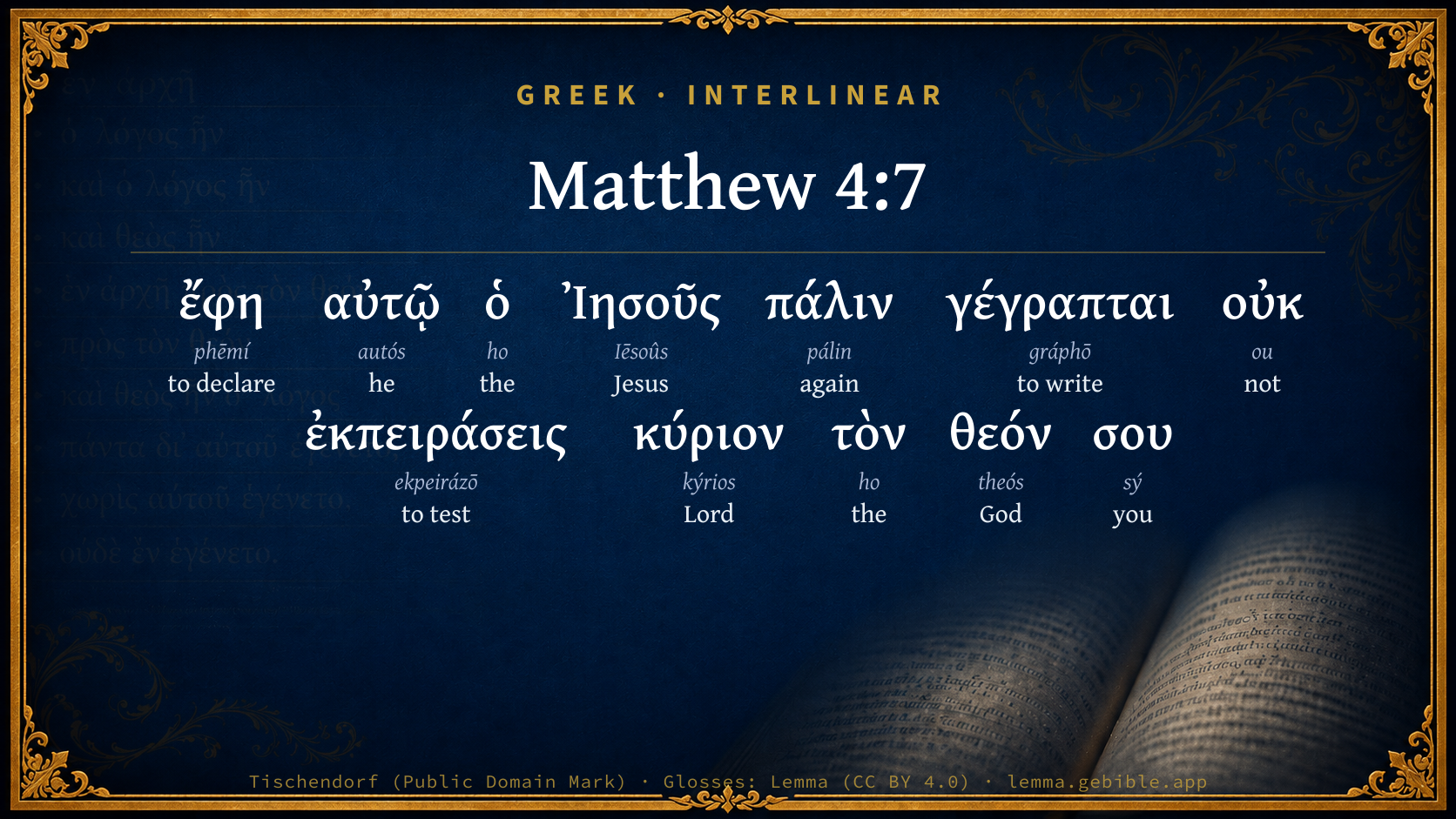
Greek (Tischendorf 8th ed.) Matthew 4:7 appears in the Greek New Testament. The text above is from the Tischendorf 8th edition. Each word links to its Strong’s number and a concise gloss. Click any word for its full Thayer’s Greek Lexicon entry.
Download image
Cite this verse

Matthew 4:7 (World English Bible). Public Domain. Lemma interlinear Bible study tool, https://lemma.gebible.app/v/matthew/4/7.

Show BibTeX & RIS
BibTeX
RIS
English Translation
Jesus said to him, "Again, it is written, 'You shall not test the Lord, your God.'"
World English Bible · Public Domain
Highlights
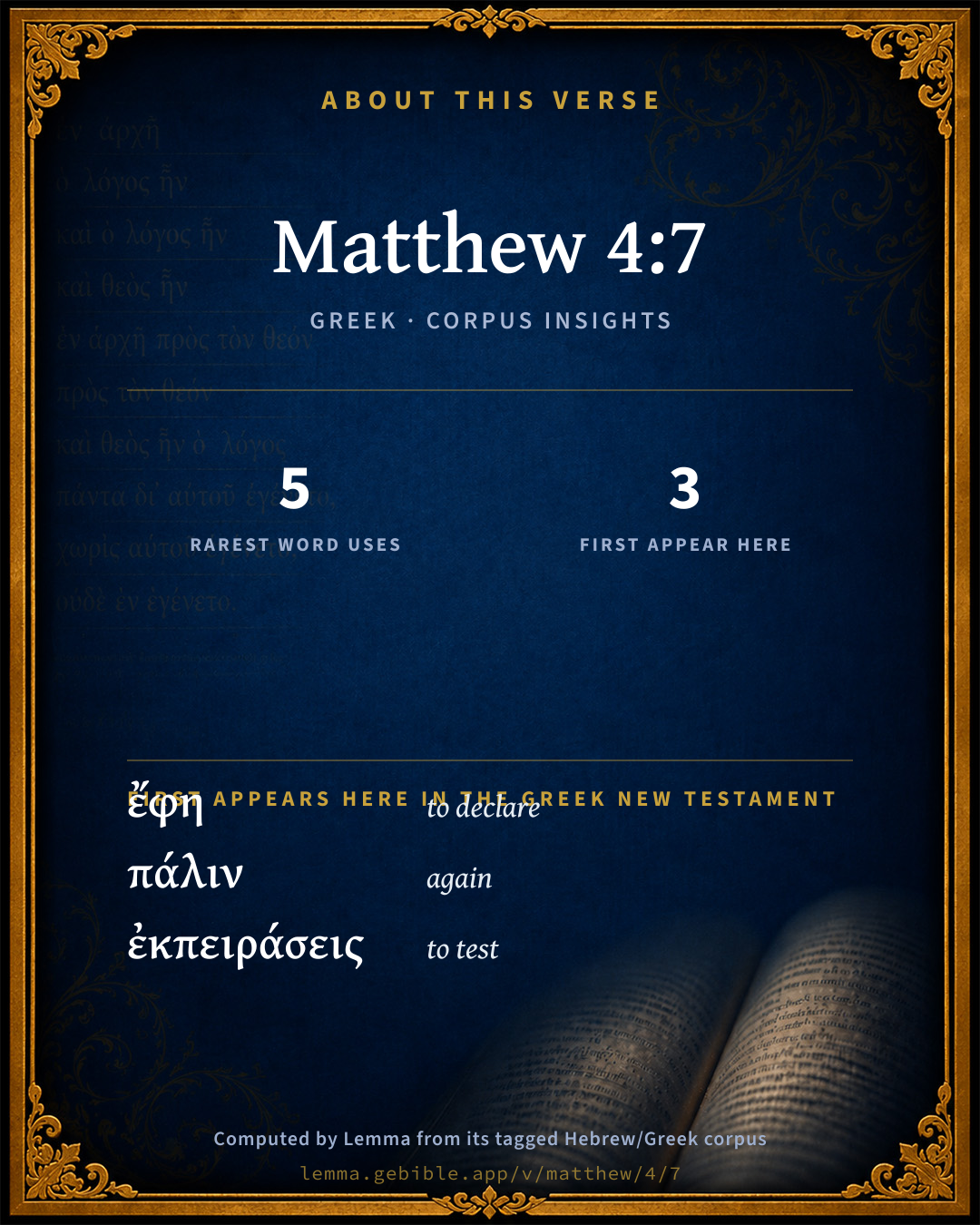
  • 3 first appearances in the Greek New Testament
Full analysis ↓
Download a study sheet

One document with this verse’s original text, its word-by-word gloss line, the meaning frame, cross-references with their text, attributed commentary, and full source and license credits — printable, and it pastes into notes with its structure intact.

This verse Autodidact and up

Study sheet (.html) Plain text (.txt)

A passage Seminary Student

Up to 50 verses in one chapter. A passage sheet keeps up to 6 commentary sources and 12 cross-references per verse, in the order this page ranks them, and says so on the sheet whenever that leaves anything out. Ask for a single verse and you get the Autodidact verse sheet above.

Everything on this page stays free to read, with no account — the sheet is a download of what is already on screen, not access to it.

Want to remove ads? Support Godless Engineer
Compare translations 3

The same verse in 3 English versions, stacked beneath the original-language interlinear above. Click any original word for its lexicon entry.

Each is an independent rendering of the whole verse — the interlinear is not word-aligned to these translations.

Highlighted words mark where these versions differ — a whole-verse word diff, not a word-by-word alignment.

  • World English Bible Public Domain
    Jesus said to him, "Again, it is written, 'You shall not test the Lord, your God.'"
  • King James Version Public Domain
    Jesus said unto him, It is written again, Thou shalt not tempt the Lord thy God.
  • unfoldingWord Literal Text CC BY-SA 4.0
    Jesus said to him, “Again it is written, ‘You will not test the Lord your God.’”

unfoldingWord Literal Text — © unfoldingWord, licensed CC BY-SA 4.0. Word-aligned USFM3 via Door43 (git.door43.org/unfoldingWord/en_ult).

Versions to compare (up to 4)

3 of 4 selected

Show all 19 translations

Every available English version of this verse, each an independent rendering of the whole verse.

  • World English Bible Public Domain
    Jesus said to him, "Again, it is written, 'You shall not test the Lord, your God.'"
  • Berean Standard Bible Public Domain
    Jesus replied, “It is also written: ‘Do not put the Lord your God to the test.’”
  • Majority Standard Bible Public Domain
    Jesus replied, “It is also written: ‘Do not put the Lord your God to the test.’”
  • King James Version Public Domain
    Jesus said unto him, It is written again, Thou shalt not tempt the Lord thy God.
  • American Standard Version (1901) Public Domain
    Jesus said unto him, Again it is written, Thou shalt not make trial of the Lord thy God.
  • Revised Version (1885) Public Domain
    Jesus said unto him, Again it is written, Thou shalt not tempt the Lord thy God.
  • Geneva Bible (1599) Public Domain
    Iesus saide vnto him, It is written againe, Thou shalt not tempt the Lord thy God.
  • Douay-Rheims (1899) Public Domain
    Jesus said to him: It is written again: Thou shalt not tempt the Lord thy God.
  • Young's Literal Translation Public Domain
    Jesus said to him again, `It hath been written, Thou shalt not tempt the Lord thy God.'
  • Literal Standard Version CC BY-SA 4.0
    Jesus said to him again, “It has been written: You will not tempt the LORD your God.”
  • Unlocked Literal Bible CC BY-SA 4.0
    Jesus said to him, “Again it is written, 'You must not test the Lord your God.'”
  • unfoldingWord Literal Text CC BY-SA 4.0
    Jesus said to him, “Again it is written, ‘You will not test the Lord your God.’”
  • Darby Bible Public Domain
    Jesus said to him, It is again written, Thou shalt not tempt [the] Lord thy God.
  • World Messianic Bible Public Domain
    Yeshua said to him, “Again, it is written, ‘You shall not test the Lord, your God.’”
  • Webster's Bible Public Domain
    Jesus said to him, It is written again, Thou shalt not tempt the Lord thy God.
  • Free Bible Version CC BY-SA 4.0
    Jesus answered, “As Scripture also says, ‘You shall not tempt the Lord your God.’”
  • Bible in Basic English Public Domain
    Jesus said to him, Again it is in the Writings, You may not put the Lord your God to the test.
  • Text-Critical English NT CC BY 4.0
    Jesus said to him, “Again it is written, ‘Yoʋ shall not put the Lord yoʋr God to the test.’ ”
  • Tyndale New Testament (1534) Public Domain
    And Iesus sayde to hym it ys wrytten also: Thou shalt not tempte thy Lorde God.

Literal Standard Version (2020), Covenant Press — licensed CC BY-SA 4.0. Text via the HelloAO Bible API (eBible.org). Unlocked Literal Bible (unfoldingWord) — licensed CC BY-SA 4.0. Text via the HelloAO Bible API (eBible.org). unfoldingWord Literal Text — © unfoldingWord, licensed CC BY-SA 4.0. Word-aligned USFM3 via Door43 (git.door43.org/unfoldingWord/en_ult). Free Bible Version, Dr. Jonathan Gallagher — licensed CC BY-SA 4.0. Text via the HelloAO Bible API (eBible.org).

Word by word

More ways to search: Search by grammar → Find every occurrence → Compare this word →

Practice this passage: Drill this verse → Learn its vocabulary →

About this verse

These counts appear in no published source. They are computed here, from the morphology-tagged text and Lemma’s own curated glosses. What Lemma adds →

12
words
11
distinct lemmas
Gospels
section

Notable vocabulary

The rarest word here is ἐκπειράσεις to test G1598 — appearing just 5 times in the whole Greek New Testament.

First appearance in Scripture

These words make their first canonical appearance in the Greek New Testament here:

  • ἔφη to declare G5346
  • πάλιν again G3825
  • ἐκπειράσεις to test G1598

Shared distinctive vocabulary

ἐκπειράσεις to test G1598 occurs in 4 verses of the Greek New Testament. Also found in:

Repetition

A word recurs within this verse:

Cross-references

19

Topical passages linked to Matthew 4:7 in the Treasury of Scripture Knowledge — connected by theme and wording, ordered by reader-vote popularity; previews shown in the World English Bible.

  • Deuteronomy 6:16 You shall not tempt Yahweh your God, as you tempted him in Massah.
  • 1 Corinthians 10:9 Neither let us test the Lord, as some of them tested, and perished by the serpents.
  • Psalms 78:18 They tempted God in their heart By asking food according to their desire.
  • Psalms 78:41 They turned again and tempted God, And provoked the Holy One of Israel.
  • Hebrews 3:9 Where your fathers tested me by proving me, And saw my works for forty years.
  • Exodus 17:2 Therefore the people quarreled with Moses, and said, "Give us water to drink." Moses said to them, "Why do you quarrel with me? Why do you test Yahweh?"
  • Exodus 17:7 He called the name of the place Massah, and Meribah, because the children of Israel quarreled, and because they tested Yahweh, saying, "Is Yahweh among us, or not?"
  • Acts 5:9 But Peter asked her, "How is it that you have agreed together to tempt the Spirit of the Lord? Behold, the feet of those who have buried your husband are at the door, and they will carry you out."
  • Psalms 78:56 Yet they tempted and rebelled against the Most High God, And didn't keep his testimonies;
  • Psalms 106:14 But gave in to craving in the desert, And tested God in the wasteland.
  • Numbers 14:22 because all those men who have seen my glory, and my signs, which I worked in Egypt and in the wilderness, yet have tempted me these ten times, and have not listened to my voice;
  • Psalms 95:9 When your fathers tempted me, Tested me, and saw my work.
  • Malachi 3:15 Now we call the proud happy; yes, those who work wickedness are built up; yes, they tempt God, and escape.'
  • Isaiah 8:20 To the law and to the testimony! if they don't speak according to this word, surely there is no morning for them.
  • Matthew 4:4 But he answered, "It is written, 'Man shall not live by bread alone, but by every word that proceeds out of the mouth of God.'"
  • Matthew 4:10 Then Jesus said to him, "Get behind me, Satan! For it is written, 'You shall worship the Lord your God, and him only shall you serve.'"
  • Matthew 21:16 and said to him, "Do you hear what these are saying?" Jesus said to them, "Yes. Did you never read, 'Out of the mouth of babes and nursing babies you have perfected praise?'"
  • Matthew 21:42 Jesus said to them, "Did you never read in the Scriptures, 'The stone which the builders rejected, The same was made the head of the corner. This was from the Lord. It is marvelous in our eyes?'
  • Matthew 22:31–32 But concerning the resurrection of the dead, haven't you read that which was spoken to you by God, saying,

Cross-references courtesy of OpenBible.info (CC BY 4.0).

Commentary

Notes on Matthew 4:7 from classic Christian and Jewish commentators (each source and its license shown beneath its notes). The classic Christian expositions comment on the surrounding passage and are grouped to its opening verse, so a note may address several verses; the Jewish commentaries on the Tanakh (Rashi and others) are per-verse, so they appear only where the commentator wrote on this verse.

Lemma curates 59 commentaries, every one of them public domain or Creative Commons licensed, each selected and text-cleaned for this edition rather than reprinted as found. About our sources →

The Biblical Illustrator

Joseph S. Exell

Mat_4:7

Not tempt the Lord thy God.

I. The essential difference between faith and presumption.

II. The possibilities of presumption.

1. When we undertake to settle questions which axe beyond our range.

2. When we look for bodily health without obeying the laws of nature.

3. When we expect sufficient means without sufficient labour and moderation in enjoyment.

4. When we hope for admission into the kingdom of God, and postpone earnest application for entrance.

5. When we expect steadfastness and growth, while we neglect the sources of spiritual strength.

III. Its heavy penalties. (W. Clarkson, B. A.)

Proving

God is different from tempting Him. (Wiseman.)

The Biblical Illustrator, edited by Joseph S. Exell (c. 1880s–1900s) — public domain. Text from a community e-Sword module.

Tyndale Open Study Notes

Tyndale Open Resources

4:7 The Scriptures also say: Countering the devil’s appeal to Scripture, Jesus invoked a deeper scriptural principle of honoring God, which the devil ignored.

Tyndale Open Study Notes — © Tyndale Open Resources, licensed CC BY-SA 4.0. Text via the HelloAO Bible API.

Bengel's Gnomon

Johann Albrecht Bengel

Mat 4:7. Πάλιν γέγραπταί, it is written again) Although Satan retorted the phrase, “It is written,” Jesus does not suffer it to be forcibly taken from Him as something trite, but employs it three times. Scripture is to be interpreted and reconciled by Scripture.—οὐκ ἐκπειράσεις, κ.τ.λ.) thou shall not tempt, etc.—Thus the LXX. in Deu 6:16. According to the usage of those interpreters, ἐκπειράζειν is not a word of stronger signification than πειράζειν.—Jesus, however, means, “It is not Mine to provoke God by tempting Him.”—Κύριον, the Lord) This is put as a proper name.

Bengel's Gnomon of the New Testament — English translation (T&T Clark, Edinburgh, 1860) — public domain. Text from a community e-Sword module.

Meyer's Critical & Exegetical Commentary

Heinrich August Wilhelm Meyer

Mat_4:7. Πάλιν] rursus, never signifies in the N. T., not even in 2Co_10:7, Gal_5:3, 1Jn_2:8, at quoque, e diverso, a meaning which it frequently has in classic writers (Ellendt, Lex. Soph. II. p. 485), as Erasmus, Er. Schmid, Schleusner, B. Crusius, have interpreted it; but here means, on the other hand, looking back to the γέγραπται of the devil in Mat_4:6, and introducing another passage of Scripture as something which again has been written; comp. Mat_5:33. Bengel well says: Scriptura per scripturam interpretanda et concilianda.

οὐκ ἐκπειράσεις] future, as in Mat_1:21; the compound strengthens the meaning; comp. on 1Co_10:9.

The meaning is: Do not let it be a question whether God will save thee from dangers on which thou hast entered uncalled.

Flacius: Si habuisset expressum mandatum dei, non fuisset tentatio. Deu_6:16 (LXX.), comp. Exo_17:2.

Meyer — Critical and Exegetical Commentary on the New Testament — English translation by Peter Christie, edited by Frederick Crombie (T&T Clark, 1880) — public domain. Text from a community e-Sword module.

Geneva Bible (1599)

Geneva Bible translators

Word for word, Thou shalt not go on still in tempting.

Geneva Bible (1599) marginal notes — public domain. Text via Bolls.life.

Jamieson, Fausset & Brown

Robert Jamieson, A. R. Fausset & David Brown

Jesus said unto him, It is written again-- (Deu 6:16), as if he should say, "True, it is so written, and on that promise I implicitly rely; but in using it there is another Scripture which must not be forgotten."

Thou shalt not tempt the Lord thy God--"Preservation in danger is divinely pledged: shall I then create danger, either to put the promised security skeptically to the proof, or wantonly to demand a display of it? That were 'to tempt the Lord my God,' which, being expressly forbidden, would forfeit the right to expect preservation."

Jamieson, Fausset & Brown — Commentary Critical and Explanatory on the Whole Bible (1871) — public domain (CC PDM 1.0). Text via the HelloAO Bible API.

Adam Clarke's Commentary

Verse 7. Thou shalt not tempt] To expose myself to any danger naturally destructive, with the vain presumption that God will protect and defend me from the ruinous consequences of my imprudent conduct, is to tempt God.

Adam Clarke's Commentary on the Bible (1810–1826) — public domain. Text from a community e-Sword/MySword module.

Ellicott's Commentary for English Readers

(7) It is written again.—The words are, as already stated, from the chapter that contains one of the passages written on the phylacteries, that were probably used by our Lord Himself. As the words stand in Deu_6:16, their general meaning is specialised by an historical reference, “Ye shall not tempt the Lord thy God, as ye tempted Him in Massah.” In the history thus referred to, the sin of the people had been that they questioned the presence of God with them until they saw a supernatural proof of it. They asked, “Is Jehovah among us, or not?” and that question sprang from unbelief. To have demanded a like proof of His Father’s care now would have identified the Son of Man with a like spirit of distrust, and the history of that temptation was therefore a sufficient answer to this. Here, too, a light is thrown on the future teaching of the Christ. The lessons of the wilderness taught Him (the word may seem bold, but it is justified by Heb_5:8) to commit Himself absolutely to His Father’s will. We find almost an echo of what is recorded here in the words which tell us that He forbore to pray for the twelve legions of angels which the Father would have sent him (Mat_26:53).

A Bible Commentary for English Readers, edited by Charles John Ellicott (1878–1897) — public domain. Text from a community e-Sword module.

The Cambridge Bible for Schools and Colleges

gen. ed. J. J. S. Perowne

7. Thou shalt not tempt the Lord thy God] Deu_6:16. The verse ends “as ye tempted him in Massah.” The reference to Massah (Num_20:7-12) shews the true meaning of the Saviour’s answer. Moses and Aaron displayed distrust in God when they tried to draw to themselves the glory of the miracle instead of “sanctifying the Lord.” Jesus will not glorify Himself in the eyes of the Jews by a conspicuous miracle. His work as the Son of Man is to glorify the Father’s name through obedience. Cp. Joh_12:28.

The Cambridge Bible for Schools and Colleges (gen. ed. J. J. S. Perowne; Cambridge University Press, 1878–1918) — public domain. Text from a community e-Sword module.

John Gill's Exposition

Again, the devil taketh him up into an exceeding high mountain,.... That is, he took him off from the pinnacle of the temple, and carried him through the air, to one of the mountains which were round about Jerusalem; or to some very high mountain at a greater distance; but what mountain is not certain; nor can it be known; nor is it of any moment; it has been said (g) to be Mount Lebanon: here he

sheweth him all the kingdoms of the world, and glory of them. By "all the kingdoms of the world" are meant, not only the Roman empire, as Dr. Lightfoot thinks, though that was, to he sure, the greatest in the world at that time; but all the kingdoms in the whole world, which subsisted in any form, whether within, or independent of the Roman empire; or whether greater or lesser: and by "the glory of them", is meant, the riches, pomp, power, and grandeur of them. Now the view which Satan gave Christ of all this, was not by a representation of them in a picture, or in a map, or in any geographical tables, as (h) some have thought; since to do this there was no need to take him up into a mountain, and that an exceeding high one; for this might have been done in a valley, as well as in a mountain: and yet it could not be a true and real sight of these things he gave him; for there is no mountain in the world, from whence can be beheld anyone kingdom, much less all the kingdoms of the world; and still less the riches, glory, pomp, and power of them: but this was a fictitious, delusive representation, which Satan was permitted to make; to cover which, and that it might be thought to be real, he took Christ into an high mountain; where he proposed an object externally to his sight, and internally to his imagination, which represented, in appearance, the whole world, and all its glory. Xiphilinus (i) reports of Severus, that he dreamed, he was had by a certain person, to a place where he could look all around him, and from thence he beheld , "all the earth, and also all the sea"; which was all in imagination. Satan thought to have imposed on Christ this way, but failed in his attempt. Luke says, this was done

in a moment of time, in the twinkling of an eye; as these two phrases are joined together, Co1 15:52 or "in a point of time". The word used by Luk 4:5 sometimes signifies a mathematical point, which Zeno says (k) is the end of the line, and the least mark; to which the allusion may be here, and designs the smallest part of time that can be conceived of. Antoninus the emperor uses the word, as here, for a point of time; and says (l), that the time of human life, and the whole present time, is but a point. Would you know what a moment, or point of time is, according to the calculation of the Jewish doctors, take the account as follows; though in it they differ: a moment, say they (m), is the fifty six thousandth, elsewhere (n), the fifty eight thousandth, and in another place (o), the fifty three thousandth and eight hundredth and forty eighth, or, according to another account (p), eighty eighth part of an hour. If this could be thought to be a true and exact account of a moment, or point of time, it was a very short space of time indeed, in which the devil showed to Christ the kingdoms of this world, and their glory; but this is not more surprising than his vanity, pride, and impudence, in the following verse.

(g) Vid. Fabricii Bibliograph. Antiq. c. 5. p. 137. (h) Vid. Fabricium, ibid. & Grotium in loc. (i) Apud Fabricium, ib. (k) Vid. Laertium in Vit. Zenou. (l) De seipso, l. 2. c. 17. & l. 6. c. 36. (m) T. Hieros. Beracot, fol. 2. 4. (n) T. Bab Beracot. fol. 7. 1. (o) Avoda Zara, fol. 4. 1. (p) T. Bab. Beracot, fol. 7. 1.

John Gill's Exposition of the Whole Bible (1746–1763) — public domain (CC PDM 1.0). Text via the HelloAO Bible API.

Trapp's Complete Commentary

John Trapp

7 Jesus said unto him, It is written again, Thou shalt not tempt the Lord thy God.

Ver. 7. Jesus answered and said, It is written again] Christ rejects not the Holy Scriptures, although perversely alleged and abused by Satan, but openeth them, by laying one place to another. So did those holy Levites in Neh 8:7, and St Paul in Act 9:22. συμβιβαζων, Collatis testimoniis demonstrans. Parallel texts, like glasses set one against another, cast a mutual light. And, as the lapidary brighteneth his hard diamond with the dust shaved from itself; so must we clear hard Scriptures by others that are more plain and perspicuous.

Thou shalt not tempt the Lord thy God] Trust him we must, tempt him we may not. Now God is tempted, either when men are too much addicted to the means, as Thomas; or when they reject them, as Ahaz, who refused a sign and ran to unlawful means, hiding all under this, I will not tempt God, Isa 7:12. Heathens could say, Admota manu invocanda est Minerva, and they noted him for a foolish carter, that when his cart stuck fast, cried to his god, and moved his lips, but not his hands to help himself. "If thou callest for knowledge," saith Solomon, "and criest for understanding"-there is prayer to God; "if thou seekest her as silver, and searcheth for her as for hidden treasures"-there is man’s endeavour in the diligent use of the means; "then shalt thou understand the fear of the Lord, and find the knowledge of God"-there is the happy success, Pro 2:3-5. Ora et labora Ask and work, was an emperor’s motto. (Reusneri Symb.) St Augustine sets it down as a vanity of his youth, that he prayed God to help him against some special sins whereunto he was strongly addicted, but should have been full sorry that God should have heard him, because he was loth to part with them. How much better was that prayer Sir Thomas Moore, Domine Deus, fac me in iis com sequendis operam collocare, pro quibus obtinendis soleo ad te orare; " Lord God, make me to bestow pains in getting those things, for obtaining whereof I use to pray unto thee."

John Trapp, A Commentary or Exposition upon All the Books of the Old and New Testament (1647–1656) — public domain. Text from a community e-Sword module.

Albert Barnes' Notes on the Bible

Jesus said unto him, It is written again - Again the Saviour replied to Satan by a text of Scripture - a passage which expressly forbade an act like this.

Thou shall not tempt the Lord thy God - This is quoted literally from Deu 6:16. The meaning is, thou shalt not try him; or, thou shalt not, by throwing thyself into voluntary and uncommanded dangers, appeal to God for protection, or trifle with the promises made to those who are thrown into danger by his providence. It is true, indeed, that God aids those of his people who are placed by him in trial or danger; but it is not true that the promise was meant to extend to those who wantonly provoke him and trifle with the promised help. Thus, Satan, artfully using and perverting Scripture, was met and repelled by Scripture rightly applied.

Albert Barnes' Notes on the Bible (1834–1885) — public domain. Text from a community e-Sword/MySword module.

Matthew Poole's English Annotations

This is written Deu 6:16. To make an undue and unwarrantable trial of God, is to tempt God, whether the trial respecteth his power or his goodness; thus the word is used, Num 14:22; Psa 78:18; Isa 7:12; Mat 16:1. By this answer Christ lets the devil know that he abused Scripture in his quotation of it; such as casting of himself down, when he had a plain way to go down by the stairs, would not have been an act of faith, but presumption; not a trusting God upon his word, but a tempting of God, expressly contrary to his command, Deu 6:16.

Matthew Poole's English Annotations on the Holy Bible (1683–1685) — public domain. Text from a community e-Sword/MySword module.

Whedon's Commentary on the Bible

Daniel D. Whedon

7. It is written again — One text should limit, modify, and explain another. Promises are not to be wantonly presumed upon. They are to be interpreted in the spirit of the divine Promiser. The promise of God to keep us presumes that we soberly and truly desire to be kept.

It would be well for those who maintain the infallible perseverance of all saints to ponder this point. They quote God’s promises to keep and preserve the converted man in every case, omitting to note that all such promises of God are conditional. He will keep us, under proviso that we rationally and voluntarily will to be in his holy keeping. Tempt — Or put to the test. To assume to draw at will upon the fund of his Father’s omnipotence, to perform a capricious experiment, would be a presumptuous tempting and insulting God.

The first temptation, as we showed, (in Mat_4:3,) appealed to the animal appetites. This second rises to the higher sentiment, the love of show — the gratification of admiration. All those who are carried away from God by the love of pomp, the gratification of mental taste, the pleasures of imagination, the gaieties of fashion, the enthusiasm for fame, and are induced to pervert for these objects powers given by God for rightful use, fall by this temptation. They tempt God by expending the powers he has given for ostentatious, wanton, selfish, and destructive purposes. The first temptation was animal, the second aesthetical.

Daniel D. Whedon (gen. ed.), Commentary on the Old and New Testaments (1874–1909) — public domain. Text from a community e-Sword module.

The Pulpit Commentary

It is written again; i.e. in addition, not to our Lord"s previous quotation (ver. 4), in which case we should expect to lind palin in ver. 10, but to the devil"s appeal to Scripture. Bengel, "Scriptura per Scripturam interpretanda et concilianda" (cf. Art. XX, "Neither may it the Church so expound one place of Scripture that it be repugnant to another"). Thou shalt not tempt. (Deu_6:16, verbally from the LXX, and equivalent to the Hebrew, except that the Hebrew verb is in the plural) In Deuteronomy the sentence continues, "as ye tempted him in Massah;" i.e. ye shall not test the reality of his presence and the greatness of his power as ye did (Exo_17:1-7) at Rephidim. The act proposed to our Lord would have been precisely parallel to that sin of old. (cf. Judith"s words to the people of Bethulia that, by fixing a limit of days for God to deliver them, they in reality tempted God epeirasate ton RAPC Jdt 8:12: cf. also Psa_78:41) "In this refusal of Christ"s are implicitly condemned all who run before they are sent, who thrust themselves into perils to which they are not called; all who would fain be reformers, but whom God has not raised up and equipped for the work of reformation; and who therefore for the most part bring themselves and their cause together to shame, dishonour, and defeat; with all those who presumptuously draw drafts on the faithfulness of God, which they have no scriptural warrant to justify them in believing that He will honour" (Trench, "Studies," p. 43).

The Pulpit Commentary (1880–1919), ed. H.D.M. Spence-Jones & Joseph S. Exell — public domain. Text from a community e-Sword module.

John Wesley's Explanatory Notes

Thou shalt not tempt the Lord thy God - By requiring farther evidence of what he hath already made sufficiently plain. Deut. vi, 16.

John Wesley, Explanatory Notes Upon the Whole Bible (1754–1765) — public domain. Text via the GEBible commentary corpus.

Kretzmann's Popular Commentary

Paul E. Kretzmann

This is implied in the answer of the Lord. Note that He does not even take the trouble of rebuking Satan for misquoting Scriptures:

v. 7. Jesus said unto him, It is written again, Thou shalt not tempt the Lord, thy God.

He offers, not a contradiction, but a qualification, to emphasize the necessity of explaining Scripture through Scripture. A significant fact: Jesus quotes the passage to which He refers, Deu 6:16, in the singular, thus making application of its truth to Himself in this instance. The leap from the pinnacle just then would not only have meant seeking escape from the cross at the cost of duty, but it would have been a bold challenge of Providence upon false understanding of the Bible, and so sinful in itself. The Lord’s method of handling the situation must be that of every Christian. "Now, this is such a temptation as no one understands unless he has tried it. For just as the first drives to despair, so this one drives to presumption and to such works as surely do not have God’s word and command. There a Christian should choose the golden mean that he neither despair nor be bold, but remain simply with the Word in true trust and faith. Then shall the good angels be with him; otherwise not."

Paul E. Kretzmann, Popular Commentary of the Bible (1921–1924) — public domain. Text from a community e-Sword module.

Burkitt's Expository Notes on the New Testament

William Burkitt

Observe here, Though the devil had wrested and abused scripture, yet still Christ alleges scripture. The abuse of the holy scriptures by heretics and seducers is no argument against the use of them. We must not throw away our Bibles because the devil quotes scripture: but as Christ here compares scripture with scripture, so should we, in order to find out the true sense and meaning of it; for scripture is the best interpreter of itself; scripture is nost clearly expounded by scripture . This Satan knew full well, and therefore dares not make any further reply.

William Burkitt's Expository Notes on the New Testament (1700–1703) — public domain. Text from a community e-Sword module.

The People's New Testament

B. W. Johnson

7. Thou shalt not tempt the Lord thy God. Again the Savior replies in the words of Scripture, this time quoting from Deut. 6:16. There is no argument, but a simple reply that shows what is asked is forbidden.

B. W. Johnson's The People's New Testament with Notes (1889–1891) — public domain. Electronic text from the Christian Classics Ethereal Library (CCEL) ThML edition.

unfoldingWord translationNotes

Door43 World Missions Community

General Information:

In verse 7, Jesus rebukes Satan with another quotation from Deuteronomy.

Again it is written

It is understood that Jesus is quoting scripture again. This can be stated in active form. AT: "Again, I will tell you what Moses wrote in the scriptures" (See: Active or Passive and Ellipsis)

You must not test

Here "you" refers to anyone. AT: "One should not test" or "No person should test"

Again, the devil

"Next, the devil"

He said to him

"The devil said to Jesus"

All these things I will give you

"I will give you all these things." The tempter is emphasizing here that he will give "all these things," not just some of them.

fall down

"put your face near the ground." This was a common action to show that a person was worshiping. (See: Symbolic Action)

translationWords

test

lord

kingdom

splendor

worship

unfoldingWord translationNotes — © Distant Shores Media and the Door43 World Missions Community, licensed CC BY-SA 4.0. Source: git.door43.org/Door43/en_tn.

Cambridge Greek Testament for Schools and Colleges

7. οὐκ ἐκπειράσεις κύριον τὸν θεόν σου. Deu 6:16. The verse ends ‘as ye tempted him in Massah.’ The reference to Massah (Num 20:7-12) shows the true meaning of the Saviour’s answer. Moses and Aaron displayed distrust in God when they tried to draw to themselves the glory of the miracle instead of ‘sanctifying the Lord.’ Jesus will not glorify Himself in the eyes of the Jews by a conspicuous miracle. His work as the Son of Man is to glorify the Father’s name through obedience. Cp. Joh 12:28.

Cambridge Greek Testament for Schools and Colleges (Cambridge University Press, 1896; 21 vols, various authors incl. Carr, Maclear, Plummer, Farrar, Lumby, Moule, M. R. James, Simcox) — public domain. Text from a community e-Sword module.

Alford’s Greek Testament

Henry Alford

7. πάλιν] not ‘contra,’ which it never simply means, not even in Gal 5:3: 1Jn 2:8: but ‘rursus’ or ‘iterum,’ as the versions rightly render it. The addition of a second Scripture qualifies and interprets the first; but does not refute it.

Henry Alford, The Greek Testament (1849–1861) — public domain. Text from a community e-Sword module.

International Critical Commentary

7. Jesus said to him, Again it is written, Thou shalt not tempt the Lord thy God.] Lk. has: “And Jesus answered and said to him that, It has been said,” etc. The quotation is from Deu 6:16 in the words of the LXX.

(X)

International Critical Commentary — older volumes (1896–1929), various authors — public domain. Text from a community e-Sword module.

Vincent's Word Studies in the New Testament

Marvin R. Vincent

Again [παλιν] . Emphatic, meaning on the other hand, with reference to Satan 's it is written (ver. 6); as if he had said, "the promise which you quote most be explained by another passage of scripture." Archbishop Trech aptly remarks, "In that 'It is written again' of Christ, lies a great lesson, quite independent of that particular scripture which, on this occasion, he quotes, or of the use to which he turns it. There lies in it the secret of our safety and defence against all distorted use of isolated passages in holy scripture. Only as we enter into the unity of scripture, as it balances, completes, and explains itself, are we warned against error and delusion, excess or defect on this side or the other. Thus the retort, 'It is written again, ' must be of continual application; for indeed what very often are heresies but one - sided, exaggerated truths, truths rent away indeed from the body and complex of the truth, without the balance of the counter - truth, which should have kept them in their due place, co - ordinated with other truths or subordinated to them; and so, because all such checks are wanting, not truth any more, but error."

Marvin R. Vincent, Word Studies in the New Testament (1887–1900) — public domain. Text from a community e-Sword/MySword module.

Lesson kit

Teaching starters — assembled from the data on this page, not authored interpretation. Every prompt links to the verse data it draws on. Edit before teaching.

Matthew, in the Gospels, opens this verse with 12 words (11 distinct Greek lemmas). Its most distinctive word is ekpeirázō (“to test”). A historical commentator’s framing appears above. Read the whole chapter for the surrounding context.

Discussion questions

  1. What does “to test” (ekpeirázō) contribute to the verse as a whole?
  2. 3 words make their first appearance in Scripture here. What does this debut establish?
  3. How does Luke 4:12, which shares the word «to test», read alongside this verse?
  4. What does the repetition of “the” (2× in this one verse) do in this verse?
  5. These translations render this verse differently; the difference is in the English rendering, not the original. What questions does that raise?
  6. Compare how The Biblical Illustrator and Tyndale Open Study Notes read this verse. Where do they agree or differ?

Things to notice

  • 3 words make their first canonical appearance in Scripture here.
  • These translations choose different wording for 5 words in this verse.
  • “the” occurs 2× in this single verse.
  • 11 distinct Greek lemmas span 12 words in this verse.

Reading settings

Reading text

Shown beneath each verse's original-language words.

Old Testament
Old Testament edition

Read the OT as the Masoretic Hebrew (MT) or the Greek Septuagint (LXX).

English shown for the Greek Septuagint (in the Hebrew ↔ Greek comparison).

Comparing translations? Open the Compare panel on any verse page to stack up to four side by side.