
Matthew 24:35

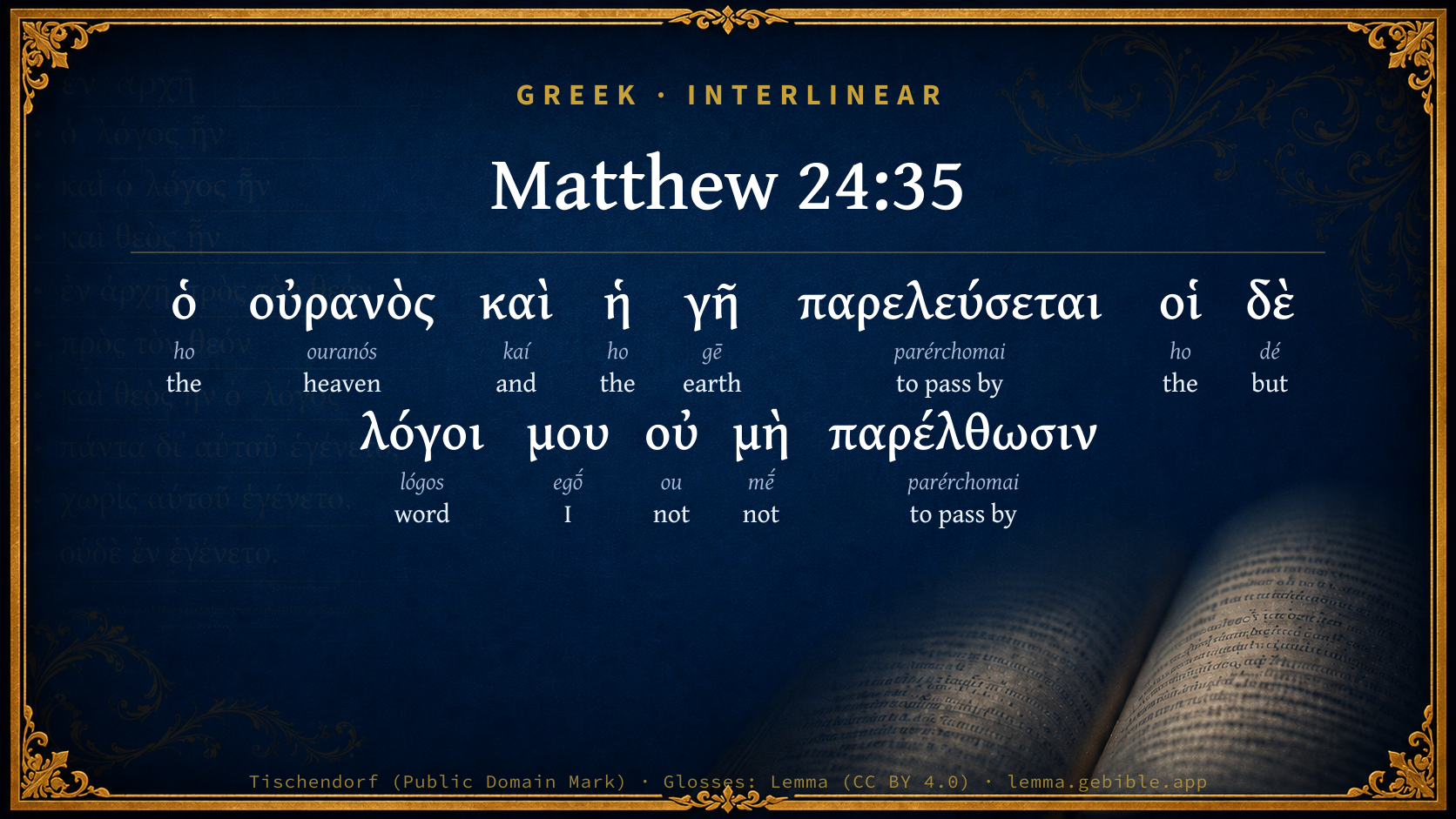
Greek (Tischendorf 8th ed.) Matthew 24:35 appears in the Greek New Testament. The text above is from the Tischendorf 8th edition. Each word links to its Strong’s number and a concise gloss. Click any word for its full Thayer’s Greek Lexicon entry.
Download image
Cite this verse

Matthew 24:35 (World English Bible). Public Domain. Lemma interlinear Bible study tool, https://lemma.gebible.app/v/matthew/24/35.

Show BibTeX & RIS
BibTeX
RIS
English Translation
Heaven and earth will pass away, but my words will not pass away.
World English Bible · Public Domain
Download a study sheet

One document with this verse’s original text, its word-by-word gloss line, the meaning frame, cross-references with their text, attributed commentary, and full source and license credits — printable, and it pastes into notes with its structure intact.

This verse Autodidact and up

Study sheet (.html) Plain text (.txt)

A passage Seminary Student

Up to 50 verses in one chapter. A passage sheet keeps up to 6 commentary sources and 12 cross-references per verse, in the order this page ranks them, and says so on the sheet whenever that leaves anything out. Ask for a single verse and you get the Autodidact verse sheet above.

Everything on this page stays free to read, with no account — the sheet is a download of what is already on screen, not access to it.

Want to remove ads? Support Godless Engineer
Compare translations 3

The same verse in 3 English versions, stacked beneath the original-language interlinear above. Click any original word for its lexicon entry.

Each is an independent rendering of the whole verse — the interlinear is not word-aligned to these translations.

Highlighted words mark where these versions differ — a whole-verse word diff, not a word-by-word alignment.

  • World English Bible Public Domain
    Heaven and earth will pass away, but my words will not pass away.
  • King James Version Public Domain
    Heaven and earth shall pass away, but my words shall not pass away.
  • unfoldingWord Literal Text CC BY-SA 4.0
    The heaven and the earth will pass away, but my words will certainly not pass away.

unfoldingWord Literal Text — © unfoldingWord, licensed CC BY-SA 4.0. Word-aligned USFM3 via Door43 (git.door43.org/unfoldingWord/en_ult).

Versions to compare (up to 4)

3 of 4 selected

Show all 19 translations

Every available English version of this verse, each an independent rendering of the whole verse.

  • World English Bible Public Domain
    Heaven and earth will pass away, but my words will not pass away.
  • Berean Standard Bible Public Domain
    Heaven and earth will pass away, but My words will never pass away.
  • Majority Standard Bible Public Domain
    Heaven and earth will pass away, but My words will never pass away.
  • King James Version Public Domain
    Heaven and earth shall pass away, but my words shall not pass away.
  • American Standard Version (1901) Public Domain
    Heaven and earth shall pass away, but my words shall not pass away.
  • Revised Version (1885) Public Domain
    Heaven and earth shall pass away, but my words shall not pass away.
  • Geneva Bible (1599) Public Domain
    Heauen and earth shall passe away: but my wordes shall not passe away.
  • Douay-Rheims (1899) Public Domain
    Heaven and earth shall pass, but my words shall not pass.
  • Young's Literal Translation Public Domain
    The heaven and the earth shall pass away, but my words shall not pass away.
  • Literal Standard Version CC BY-SA 4.0
    The heaven and the earth will pass away, but My words will not pass away.
  • Unlocked Literal Bible CC BY-SA 4.0
    Heaven and the earth will pass away, but my words will never pass away.
  • unfoldingWord Literal Text CC BY-SA 4.0
    The heaven and the earth will pass away, but my words will certainly not pass away.
  • Darby Bible Public Domain
    The heaven and the earth shall pass away, but my words shall in no wise pass away.
  • World Messianic Bible Public Domain
    Heaven and earth will pass away, but my words will not pass away.
  • Webster's Bible Public Domain
    Heaven and earth shall pass away, but my words shall not pass away.
  • Free Bible Version CC BY-SA 4.0
    Heaven and earth may pass away, but my words won't pass away.
  • Bible in Basic English Public Domain
    Heaven and earth will come to an end, but my words will not come to an end.
  • Text-Critical English NT CC BY 4.0
    Heaven and earth will pass away, but my words will certainly not pass away.
  • Tyndale New Testament (1534) Public Domain
    Heven and erth shall perisshe: but my wordes shall abyde.

Literal Standard Version (2020), Covenant Press — licensed CC BY-SA 4.0. Text via the HelloAO Bible API (eBible.org). Unlocked Literal Bible (unfoldingWord) — licensed CC BY-SA 4.0. Text via the HelloAO Bible API (eBible.org). unfoldingWord Literal Text — © unfoldingWord, licensed CC BY-SA 4.0. Word-aligned USFM3 via Door43 (git.door43.org/unfoldingWord/en_ult). Free Bible Version, Dr. Jonathan Gallagher — licensed CC BY-SA 4.0. Text via the HelloAO Bible API (eBible.org).

Word by word

More ways to search: Search by grammar → Find every occurrence → Compare this word →

Practice this passage: Drill this verse → Learn its vocabulary →

παρελεύσεται
parérchomai
G3928
“to pass by”
Verb, Future, Middle deponent, Indicative, 3rd person, Singular
Part of Speech
Verb
Tense
Future
Voice
Middle deponent
Mood
Indicative
Person
3rd person
Number
Singular
Full Thayer's Definition

Origin: from G3844 and G2064

TDNT: 13:21,3

1. to go past, pass by a. of persons moving forward 1. to pass by b. of time 1. an act continuing for a time c. metaph. 1. to pass away, perish 2. to pass by (pass over), that is, to neglect, omit, (transgress) 3. to be led by, to be carried past, be averted 2. to come near, come forward, arrive
  1. ὁ ho G3588 “the” Article, Nominative, Singular, Masculine
  2. οὐρανὸς ouranós G3772 “heaven” Noun, Nominative, Singular, Masculine
  3. καὶ kaí G2532 “and” Conjunction
  4. ἡ ho G3588 “the” Article, Nominative, Singular, Feminine
  5. γῆ gē G1093 “earth” Noun, Nominative, Singular, Feminine
  6. οἱ ho G3588 “the” Article, Nominative, Plural, Masculine
  7. δὲ dé G1161 “but” Conjunction
  8. λόγοι lógos G3056 “word” Noun, Nominative, Plural, Masculine
  9. μου egṓ G1473 “I” Personal pronoun, 1st person, Genitive, Singular
  10. οὐ ou G3756 “not” Particle, Negative
  11. μὴ mḗ G3361 “not” Particle, Negative
  12. παρέλθωσιν parérchomai G3928 “to pass by” Verb, Aorist, Active, Subjunctive, 3rd person, Plural

About this verse

These counts appear in no published source. They are computed here, from the morphology-tagged text and Lemma’s own curated glosses. What Lemma adds →

13
words
10
distinct lemmas
Gospels
section

Shared distinctive vocabulary

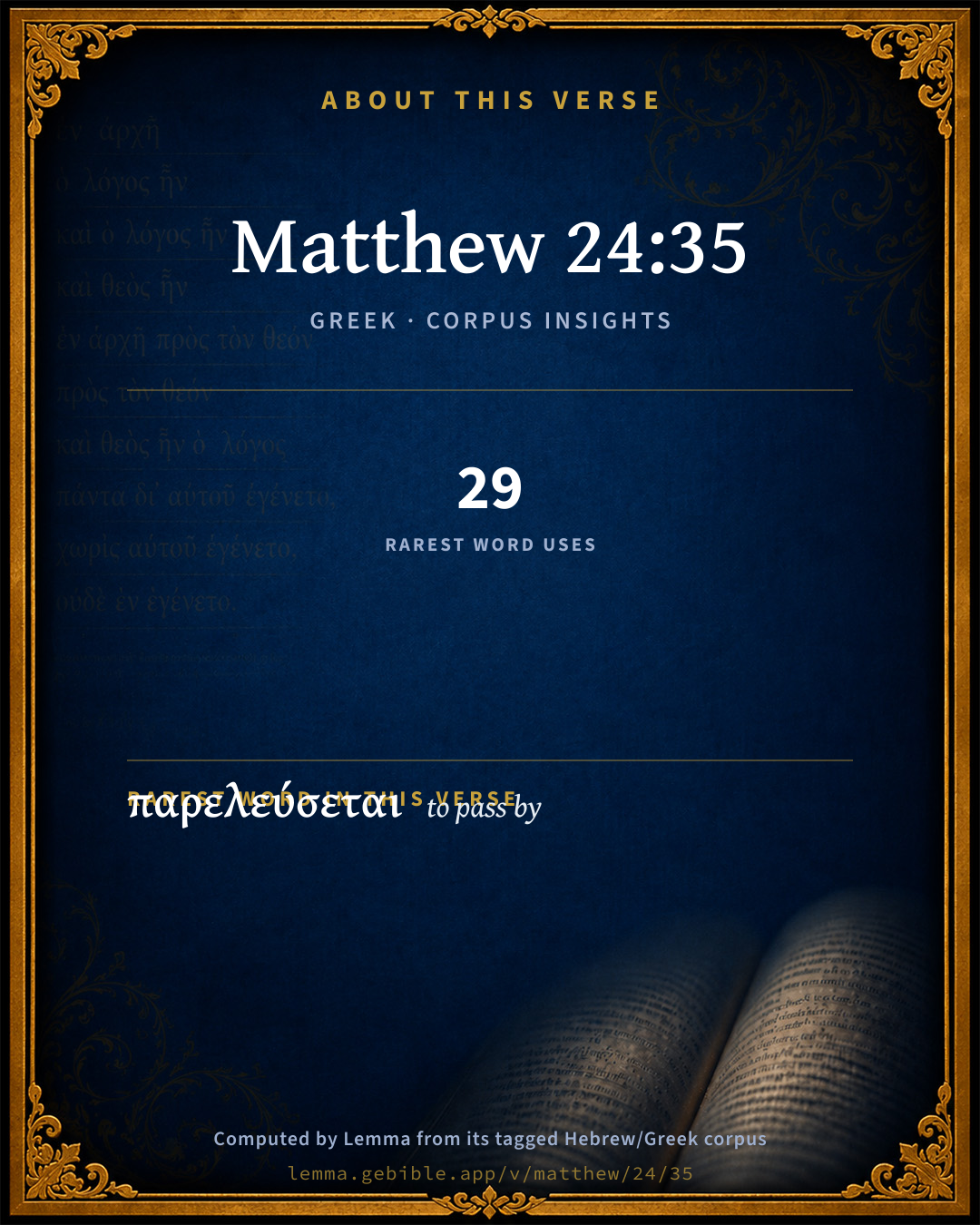
παρελεύσεται to pass by G3928 occurs in 25 verses of the Greek New Testament. Also found in:
Repetition

Words recur within this verse:

  • παρελεύσεται to pass by G3928 ×2
  • ὁ the G3588 ×3

Cross-references

19

Topical passages linked to Matthew 24:35 in the Treasury of Scripture Knowledge — connected by theme and wording, ordered by reader-vote popularity; previews shown in the World English Bible.

  • Isaiah 40:8 The grass withers, the flower fades; but the word of our God shall stand forever.
  • 1 Peter 1:25 But the Lord's word endures forever." This is the word of good news which was preached to you.
  • Numbers 23:19 God is not a man, that he should lie, Neither the son of man, that he should repent: Has he said, and will he not do it? Or has he spoken, and will he not make it good?
  • Isaiah 55:11 so shall my word be that goes forth out of my mouth: it shall not return to me void, but it shall accomplish that which I please, and it shall prosper in the thing whereto I sent it.
  • Matthew 5:18 For most assuredly, I tell you, until heaven and earth pass away, not even one smallest letter or one tiny pen stroke shall in any way pass away from the law, until all things are accomplished.
  • Proverbs 30:5 "Every word of God is flawless. He is a shield to those who take refuge in him.
  • Isaiah 51:6 Lift up your eyes to the heavens, and look on the earth beneath; for the heavens shall vanish away like smoke, and the earth shall wax old like a garment; and those who dwell therein shall die in like manner: but my salvation shall be forever, and my righteousness shall not be abolished.
  • Isaiah 54:10 For the mountains may depart, and the hills be removed; but my loving kindness shall not depart from you, neither shall my covenant of peace be removed, says Yahweh who has mercy on you.
  • Psalms 89:34 I will not break my covenant, Nor alter what my lips have uttered.
  • Titus 1:2 in hope of eternal life, which God, who can't lie, promised before eternal times;
  • Psalms 102:26 They will perish, but you will endure. Yes, all of them will wear out like a garment. You will change them like a cloak, and they will be changed.
  • 2 Peter 3:7–12 But the heavens that now are, and the earth, by the same word have been stored up for fire, being reserved against the day of judgment and destruction of ungodly men.
  • Hebrews 1:11–12 They will perish, but you continue. They all will grow old like a garment does.
  • Psalms 19:7 Yahweh's law is perfect, restoring the soul. Yahweh's testimony is sure, making wise the simple.
  • Jeremiah 31:35–36 Thus says Yahweh, who gives the sun for a light by day, and the ordinances of the moon and of the stars for a light by night, who stirs up the sea, so that the waves of it roar; Yahweh of hosts is his name:
  • Revelation 3:14 "To the angel of the assembly in Laodicea write: "The Amen, the Faithful and True Witness, the Head of God's creation, says these things:
  • Revelation 6:14 The sky was removed like a scroll when it is rolled up. Every mountain and island were moved out of their places.
  • Revelation 20:11 I saw a great white throne, and him who sat on it, from whose face the earth and the heaven fled away. There was found no place for them.
  • Isaiah 34:4 All the host of the sky shall be dissolved, and the heavens shall be rolled together as a scroll; and all their host shall fade away, as the leaf fades from off the vine, and as a fading [leaf] from the fig tree.

Cross-references courtesy of OpenBible.info (CC BY 4.0).

Commentary

Notes on Matthew 24:35 from classic Christian and Jewish commentators (each source and its license shown beneath its notes). The classic Christian expositions comment on the surrounding passage and are grouped to its opening verse, so a note may address several verses; the Jewish commentaries on the Tanakh (Rashi and others) are per-verse, so they appear only where the commentator wrote on this verse.

Lemma curates 59 commentaries, every one of them public domain or Creative Commons licensed, each selected and text-cleaned for this edition rather than reprinted as found. About our sources →

The Biblical Illustrator

Joseph S. Exell

Mat_24:35

But My words shall not pass away.

The words of Christ

The characteristics of our Lords words.

1. The authority which speaks in them.

2. Their elevation.

3. Their awful depth. (Canon Liddon.)

The permanency of Christs teaching

1. The words of Christ are abiding because of their special inspiration. His words cannot die by reason of the living power that is in them.

2. The teachings of Jesus have a great and an enduring task to perform. The gospel has the power of an endless life which the work before it demands. Great things and great ends require great and large preparation. The Niagara Falls is one, if not the greatest, of the wonders of the world; but the river St. Lawrence was twenty-seven thousand years making the deep cutting in the rock which forms the cataract. The great task before the gospel, of bringing the light of truth to every heart, must be accomplished. The efforts of the Church must not be relaxed until this end has been attained. Whatever changes are woven into the nature of things the continuation of gospel teaching is inevitable. The grass withereth, the flower fadeth; but the word of our God shall stand for ever.

3. As the gospel has survived the revolutions of more than eighteen centuries, so it will survive those yet to come.

4. The impression which the words of Jesus make on the souls of the redeemed is another proof that they shall not pass away. When the world has passed away, these words will abide in the hearts of men who have believed in Christ. Every portion of the gospel we learn and feel and practice will remain with us for ever. (The Weekly Pulpit.)

The transient and the permanent

Heaven and earth shall pass away.

I. It needs some thoughtfulness to apprehend the transient character of these great objects of our interest.

1. The forms of life and activity with which we are familiar pass away. The morning light, buds, seasons, living creatures, soon die.

2. If we extend our vision and take within its sweep not only the life of the individual, but the course of the ages, and the history of the world. These pass away.

II. And yet in all this there is permanence. The form passes, but the material remains. Perhaps even the material may be our name for the unknown nothing, and there remains only the law, only the type, only the order, which unceasingly lives. Thus the form of the living thing disappears, but life remains; and that vegetable life which we saw so busy and so plentiful in forms of flower and leaf and tree, shall next year bring forth new flowers and put out fresh leaves; and when the trees that to-day stand erect, monarchs of the forest, shall, fallen prone, be slowly turning into the fuel of future ages, that same life shall yet be lifting up new pillars of the forest, tall and stately, beautiful and strong, over which new generations of branches and leaves shall wave beneath the sunshine and be swayed by the breezes of the future years. And so is it with the life of the animal and man. This animal, this man, may perish, but man remain. And the human race has not vanished. Babylon, Egypt, and ancient Greece and Rome have disappeared, but man remains, in his essential nature unchanged. The moods of the sensitive nature pass away and follow each other like the shadows on the mountain-side when the fleecy clouds are floating oer the sky on a summer noon. And yet there is something that remains. There is the subject of these sensations; there is that element which is always present in these conscious states which knows itself and them, and the differences between each state, and the resemblances and the differences between itself and them, and the combination of all into one homogeneous whole. There is something permanent, something that lasts. You cannot destroy, you cannot waste it, you cannot, indeed, change it. It is itself-itself always-eternal, I believe, as the eternal God. Or we might illustrate it again in relation to thoughts, to ideas, to concepts; to those class cognitions of the mind which result from the comparison and the abstract classification of states of sensation, of memory, of judgment. We thus gain ideas-the good, the beautiful, the true, the evil, the human, the Divine. The individual states, the individual acts, the individual persons who, by these acts, produce these states-all these may vanish. They may be only a memory; or even grow in memory dim, and at last fade away from the last reminiscence of the soul; but the ideas we have formed-that abstract beauty, goodness, humanity, or divineness-these remain. Their light will play about other forms; their relations dwell within the caverns of our nature and fill them with music, or make them hideous with discord.

III. Thus the words of Christ seem only to be the following, accompaniment of what we saw on all sides of our quest-that there is a permanent, and that there is a transient. He goes down to the very base of the nature, and declares that a man must be born from above if he is to see the kingdom of God. The spiritual only can behold the things of that kingdom, which are wholly spiritual. The worship of God is to be in spirit and in truth. His own very words are to be interpreted in the sphere of the spiritual and the true, and the work He came to do for men was not to make their lot here easy or hard, not to spread lifes path with flowers or with thorns; it had no respect to these mere circumstances and conditions of outer life. But it went to the very centre of being, to the inner personality of the man. And, as Christ Himself gave up all that He had that was external, material, physical, letting it all go in death, and living only in His living union with the eternal God, so must man live only in that living personality, letting all else die with Christ, and even when living, not living except as Christ lived in him. (L. D. Bevan, D. D.)

The immutability of the words of Christ

I. The permanence and immutability of the gospel are proofs of the perfection of its plan.

II. The immortality of the words of Christ is proof of their perfect adaptability to the constitution and course of nature.

III. Is proof of their perfect consonance with absolute truth.

IV. Is proof of their identity with the ultimate basis of life.

V. Two lessons.

1. He that formulated this immutable scheme and must be Divine.

2. Upon these words of Christ we have an assured and stable basis upon which to build for eternity. (E. S. P.)

The enduring word

I. What word is this?

1. My Word. Who spoke this word? Jesus Christ the Saviour. Must not He be God who could fling upon the winds such a prophecy as this, and be sure of its everlasting success? It is not the word of Jeremiah, John, etc. They were the instruments, but Christs word is nevertheless audible in all.

2. What are some of the marks and characteristics of Christs word?

Given in the Bible.

1. Authoritative. We hear men saying, We want an authority: here it is.

2. True.

3. Spirit and life.

4. Never man spake like this man.

II. What does Christ say? of His word? It shall not pass away. Empires, etc., have passed away, but the word of Christ still survives; it speaks with undiluted emphasis; it spreads with uninterrupted speed. All things that threatened to extinguish it have only aided it. Those things that once seemed to rise like mountain obstructions to its march are day by day dissolving like wreaths of snow in the sunshine, in contrast to the advancing and triumphant word of the Lord. And when the new heaven and the new earth shall come, Christs word shall not cease. The only change will be, all its promises will be enjoyments, etc. Comfort for the believer. Of the least promise that you choose to select you may say, Heaven and earth, etc. Encouragement to the seeker, worker, minister, etc. (J. Cumming, D. D.)

The immutability of the Divine Word

1. The certainty of Divine truth.

2. The words of Christ considered in their necessary imperishableness.

3. The words of Christ shall never pass away, because they form the last of that series of communications given by God to a lost world.

4. Because they are founded on eternal truth, and on the fixed counsels of the immutable God.

5. Because of their connection with His own final glory as Mediator.

6. These are the words preached unto you. (D. Moore, M. A.)

The Biblical Illustrator, edited by Joseph S. Exell (c. 1880s–1900s) — public domain. Text from a community e-Sword module.

Tyndale Open Study Notes

Tyndale Open Resources

24:35 Jesus’ words are as sure as God’s own (see 5:18; Isa 40:8; 55:11; 59:21).

Tyndale Open Study Notes — © Tyndale Open Resources, licensed CC BY-SA 4.0. Text via the HelloAO Bible API.

Bengel's Gnomon

Johann Albrecht Bengel

Mat 24:35. Ὁ οὐρανὸς, heaven) The motion of which is otherwise regulated by the most unerring laws.—ἡ γῆ, the earth) which is otherwise most firmly founded.—λόγοι Μου, My words) The plural number is employed; cf. πάντα, all, Mat 24:34, which is likewise plural.—οὐ μὴ παρέλθωσι, shall not pass away) q.d. My words shall correspond exactly with the event; although it does not appear so to men immediately. Heaven and earth will give place to the new heaven and new earth, which are described by My words. The firmness of the law is illustrated in a similar manner in ch. Mat 5:18.

Bengel's Gnomon of the New Testament — English translation (T&T Clark, Edinburgh, 1860) — public domain. Text from a community e-Sword module.

Meyer's Critical & Exegetical Commentary

Heinrich August Wilhelm Meyer

Mat_24:35. With the preceding πάντα ταῦτα γένηται will commence the passing away of the fabric of the world as it now exists (2Pe_3:7-8); but what I say (generally, though with special reference to the prophetic utterances before us) will certainly not pass away, will abide as imperishable truth (v. 18). The utterance which fails of its accomplishment is conceived of as something that perishes (Addit. Est_7:2), that ceases to exist. Comp. ἐκπίπτειν, Rom_9:6.

Meyer — Critical and Exegetical Commentary on the New Testament — English translation by Peter Christie, edited by Frederick Crombie (T&T Clark, 1880) — public domain. Text from a community e-Sword module.

Expositor's Greek Testament

ed. W. Robertson Nicoll

Mat 24:35 . eclaration similar to that in chap. Mat 5:18 concerning the validity of the law.

The Expositor's Greek Testament, edited by W. Robertson Nicoll (1897–1910) — public domain. Text from a community e-Sword module.

Geneva Bible (1599)

Geneva Bible translators

The Lord doth now begin the judgment, which he will make an end of in the latter day.

Geneva Bible (1599) marginal notes — public domain. Text via Bolls.life.

Ellicott's Commentary for English Readers

(35) Heaven and earth.—The tone is that of One who speaks with supreme authority, foreseeing, on the one hand, death and seeming failure, but on the other, the ultimate victory, not of truth only in the abstract, but of His own word as the truth. The parallelism of the words with those of Psa_102:26, Isa_40:8, gives them their full significance. The Son of Man claims for His own words the eternity which belongs to the words of Jehovah. (Comp. 1Pe_1:24-25.) The whole history of Christendom witnesses to the fulfilment of the prophetic claim. Amid all its changes and confusions, its errors and its sins, the words of Christ have not passed away, but retain their pre-eminence as the last and fullest revelation of the Father.

A Bible Commentary for English Readers, edited by Charles John Ellicott (1878–1897) — public domain. Text from a community e-Sword module.

The Cambridge Bible for Schools and Colleges

gen. ed. J. J. S. Perowne

35. This verse was originally omitted in the Sinaitic MS., but is inserted by a later hand.

The Cambridge Bible for Schools and Colleges (gen. ed. J. J. S. Perowne; Cambridge University Press, 1878–1918) — public domain. Text from a community e-Sword module.

John Gill's Exposition

But of that day and hour knoweth no man,.... Which is to be understood, not of the second coming of Christ, the end of the world, and the last judgment; but of the coming of the son of man, to take vengeance on the Jews, and of their destruction; for the words manifestly regard the date of the several things going before, which only can be applied to that catastrophe, and dreadful desolation: now, though the destruction itself was spoken of by Moses and the prophets, was foretold by Christ, and the believing Jews had some discerning of its near approach; see Heb 10:25 yet the exact and precise time was not known: it might have been: calculated to a year by Daniel's weeks, but not to the day and hour; and therefore our Lord does not say of the year, but of the day and hour no man knows; though the one week, or seven years, being separated from the rest, throws that account into some perplexity; and which perhaps is on purpose done, to conceal the precise time of Jerusalem's destruction: nor need it be wondered at, notwithstanding all the hints given, that the fatal day should not be exactly known beforehand; when those who have lived since, and were eyewitnesses of it, are not agreed on what day of the month it was; for, as Dr. Lightfoot (i) observes, Josephus (k) says,

"that the temple perished the "tenth" day of "Lous", a day fatal to the temple, as having been on that day consumed in flames, by the king of Babylon.

And yet Rabbi Jochanan ben Zaccai, who was also at the destruction of it, as well as Josephus, with all the Jewish writers, say it was on the "ninth of Ab"; for of this day they (l) say, five things happened upon it:

"On the "ninth of Ab" it was decreed concerning our fathers, that they should not enter into the land (of Canaan), the first and second temple were destroyed, Bither was taken, and the city ploughed up.

Though the words of R. Jochanan, cited by the doctor, refer to the first, and not to the second temple, and should have been rendered thus:

"If I had been in the generation (which fixed the fast for the destruction of the first temple), I would not have fixed it but on the tenth (of Ab); for, adds he, the greatest part of the temple was burnt on that day; but the Rabbins rather regarded the beginning of the punishment (m).

And so the fasting of Rabbi, and R. Joshua ben Levi, on the "ninth" and "tenth" days, were on account of the first temple; for they were under the same difficulty about the one, as the other:

no, not the angels of heaven; who dwell there, always behold the face of God, stand in his presence ready to do his will, and are made acquainted with many of his designs, and are employed in the executing of them, and yet know not the time of God's vengeance on the Jews; to this agrees the sense that is given of the day of vengeance in Isa 63:4 it is asked (n),

"what is the meaning of these words, "the day of vengeance is in my heart?" Says R. Jochanan, to my heart I have revealed it, to the members I have not revealed it: says R. Simeon ben Lakish, to my heart I have revealed it, , "to the ministering angels I have not revealed it".

The Ethiopic version adds here, "nor the son", and so the Cambridge copy of Beza's; which seems to be transcribed from Mar 13:32 where that phrase stands; and must be understood of Christ as the son of man, and not as the Son of God; for as such, he lay in the bosom of the Father, and knew all his purposes and designs; for these were purposed in him: he knew from the beginning who would betray him, and who would believe in him; he knew what would befall the rejecters of him, and when that would come to pass; as he must know also the day of the last judgment, since it is appointed by God, and he is ordained to execute it: but the sense is, that as he, as man and mediator, came not to destroy, but to save; so it was not any part of his work, as such, to know, nor had he it in commission to make known the time of Jerusalem's ruin:

but my Father only; to the exclusion of all creatures, angels and men; but not to the exclusion of Christ as God, who, as such, is omniscient; nor of the Holy Spirit, who is acquainted with the deep things of God, the secrets of his heart, and this among others,

(i) In Mark xiii. 32. (k) De Bello Jud. l. 6. c. 26. (l) Misu. Taanith, c. 4. sect. 7. T. Hieros. Taanioth, fol. 68. 3. & Maimon. Hilch. Taanioth, c. 5. sect. 2. (m) T. Bab, Taanith, fol. 29. 1. (n) T. Bab. Sanhedrin, fol. 99. 1.

John Gill's Exposition of the Whole Bible (1746–1763) — public domain (CC PDM 1.0). Text via the HelloAO Bible API.

Trapp's Complete Commentary

John Trapp

35 Heaven and earth shall pass away, but my words shall not pass away.

Ver. 35. Heaven and earth shall pass, &c.] What God hath written he hath written. His word is established in heaven, saith David, Psa 119:89; it endureth for ever, saith Peter, 1Pe 1:25; it remaineth firm as Mount Sion, and shall stand inviolable when heaven shall pass away with a great noise, and the earth with its works shall be burnt up, 2Pe 3:10, to the terror and confusion of those profane scoffers who deridingly demand, "Where is the promise of his coming?" &c. Mat 24:4; that say, "Let him make speed and hasten his work, that we may see it," Isa 5:19; "Woe to you that thus desire the day of the Lord. To what end is it for you? The day of the Lord is darkness, and not light," Amo 5:18. The great day of the Lord is near, it is near and hasteth greatly. It is a day of wrath, a day of trouble and distress, a day of wasteness and desolation, a day of darkness and gloominess, a day of clouds and thick darkness, to them "that are settled on their lees, and that say in their heart, The Lord will not do good, neither will he do evil," Zep 1:12-15.

John Trapp, A Commentary or Exposition upon All the Books of the Old and New Testament (1647–1656) — public domain. Text from a community e-Sword module.

Albert Barnes' Notes on the Bible

Heaven and earth shall pass away ... - You may sooner expect to see the heaven and earth pass away and return to nothing, than my words to fail.

Albert Barnes' Notes on the Bible (1834–1885) — public domain. Text from a community e-Sword/MySword module.

Haydock's Catholic Bible Commentary

Shall pass away: because they shall be charged at the end of the world into a new heaven and new earth. (Challoner)

George Leo Haydock (1774–1849), Haydock's Catholic Family Bible and Commentary, 1859 edition — public domain. Excludes Psalms (Douay-Rheims chapter numbering differs from Protestant) and Deuterocanonical books (Catholic canon only).

Whedon's Commentary on the Bible

Daniel D. Whedon

35. My words shall not pass — That is, his predictions of the catastrophe so early as in that generation. Not only would the temple, Jerusalem, the Jewish state pass away, but even heaven and earth would pass rather than his prediction fail.

Daniel D. Whedon (gen. ed.), Commentary on the Old and New Testaments (1874–1909) — public domain. Text from a community e-Sword module.

The Pulpit Commentary

Christ adds a solemn assurance that his words have in them a vitality and endurance which the mightiest works of nature do not possess. The facts and truths embodied in his words are sure and steadfast, and what he has promised or predicted shall inevitably be fulfilled. This verse is omitted by a but it is most probably genuine, as it undoubtedly has its place in the other two synoptists. (comp. 1Pe_1:24, 1Pe_1:25)

The Pulpit Commentary (1880–1919), ed. H.D.M. Spence-Jones & Joseph S. Exell — public domain. Text from a community e-Sword module.

International Critical Commentary

(M) 35. Heaven and earth shall pass away, but My words shall not pass away.]—οὐ μὴ παρέλθωσιν] for Mk.’s οὐ παρελεύσονται. Cf. on v. 18, and Moulton, 190-192.

International Critical Commentary — older volumes (1896–1929), various authors — public domain. Text from a community e-Sword module.

Lesson kit

Teaching starters — assembled from the data on this page, not authored interpretation. Every prompt links to the verse data it draws on. Edit before teaching.

Matthew, in the Gospels, opens this verse with 13 words (10 distinct Greek lemmas). Its most distinctive word is parérchomai (“to pass by”). A historical commentator’s framing appears above. Read the whole chapter for the surrounding context.

Discussion questions

  1. What does “to pass by” (parérchomai) contribute to the verse as a whole?
  2. Matthew 5:18 shares the word «to pass by» with this verse. How do the two illuminate each other?
  3. “to pass by” occurs 2× in this one verse. What is the effect of the repetition?
  4. These translations render this verse differently; the difference is in the English rendering, not the original. What questions does that raise?
  5. Reading how The Biblical Illustrator and Tyndale Open Study Notes read this verse, where do the two commentators agree and where do they part?

Things to notice

  • These translations choose different wording for 3 words in this verse.
  • “to pass by” occurs 2× in this single verse.
  • 10 distinct Greek lemmas span 13 words in this verse.

Reading settings

Reading text

Shown beneath each verse's original-language words.

Old Testament
Old Testament edition

Read the OT as the Masoretic Hebrew (MT) or the Greek Septuagint (LXX).

English shown for the Greek Septuagint (in the Hebrew ↔ Greek comparison).

Comparing translations? Open the Compare panel on any verse page to stack up to four side by side.