Matthew 15:2

Greek (Tischendorf 8th ed.) Matthew 15:2 appears in the Greek New Testament. The text above is from the Tischendorf 8th edition. Each word links to its Strong’s number and a concise gloss. Click any word for its full Thayer’s Greek Lexicon entry.
Download image
Cite this verse

Matthew 15:2 (World English Bible). Public Domain. Lemma interlinear Bible study tool, https://lemma.gebible.app/v/matthew/15/2.

Show BibTeX & RIS
BibTeX
RIS
English Translation
"Why do your disciples disobey the tradition of the elders? For they don't wash their hands when they eat bread."
World English Bible · Public Domain
Highlights
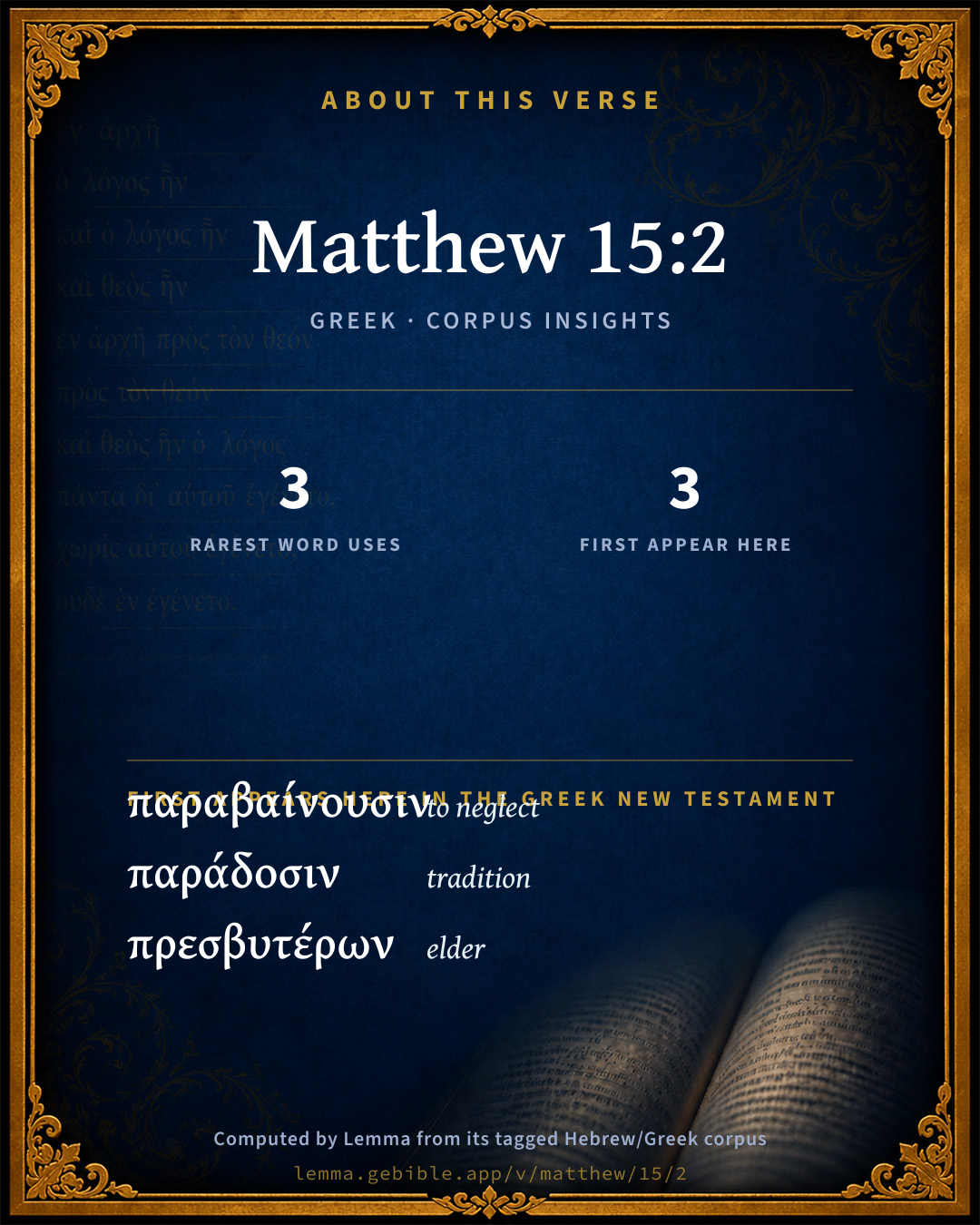
  • 3 first appearances in the Greek New Testament
Full analysis ↓
Download a study sheet

One document with this verse’s original text, its word-by-word gloss line, the meaning frame, cross-references with their text, attributed commentary, and full source and license credits — printable, and it pastes into notes with its structure intact.

This verse Autodidact and up

Study sheet (.html) Plain text (.txt)

A passage Seminary Student

Up to 50 verses in one chapter. A passage sheet keeps up to 6 commentary sources and 12 cross-references per verse, in the order this page ranks them, and says so on the sheet whenever that leaves anything out. Ask for a single verse and you get the Autodidact verse sheet above.

Everything on this page stays free to read, with no account — the sheet is a download of what is already on screen, not access to it.

Want to remove ads? Support Godless Engineer
Compare translations 3

The same verse in 3 English versions, stacked beneath the original-language interlinear above. Click any original word for its lexicon entry.

Each is an independent rendering of the whole verse — the interlinear is not word-aligned to these translations.

Highlighted words mark where these versions differ — a whole-verse word diff, not a word-by-word alignment.

  • World English Bible Public Domain
    "Why do your disciples disobey the tradition of the elders? For they don't wash their hands when they eat bread."
  • King James Version Public Domain
    Why do thy disciples transgress the tradition of the elders? for they wash not their hands when they eat bread.
  • unfoldingWord Literal Text CC BY-SA 4.0
    “Why do your disciples transgress the tradition of the elders? For they do not wash their hands when they eat bread.”

unfoldingWord Literal Text — © unfoldingWord, licensed CC BY-SA 4.0. Word-aligned USFM3 via Door43 (git.door43.org/unfoldingWord/en_ult).

Versions to compare (up to 4)

3 of 4 selected

Show all 19 translations

Every available English version of this verse, each an independent rendering of the whole verse.

  • World English Bible Public Domain
    "Why do your disciples disobey the tradition of the elders? For they don't wash their hands when they eat bread."
  • Berean Standard Bible Public Domain
    “Why do Your disciples break the tradition of the elders? They do not wash their hands before they eat.”
  • Majority Standard Bible Public Domain
    “Why do Your disciples break the tradition of the elders? They do not wash their hands before they eat.”
  • King James Version Public Domain
    Why do thy disciples transgress the tradition of the elders? for they wash not their hands when they eat bread.
  • American Standard Version (1901) Public Domain
    Why do thy disciples transgress the tradition of the elders? for they wash not their hands when they eat bread.
  • Revised Version (1885) Public Domain
    Why do thy disciples transgress the tradition of the elders? for they wash not their hands when they eat bread.
  • Geneva Bible (1599) Public Domain
    Why do thy disciples transgresse the tradition of the Elders? for they wash not their hands when they eate bread.
  • Douay-Rheims (1899) Public Domain
    Why do thy disciples trangress the tradition of the ancients? For they wash not their hands when they eat bread.
  • Young's Literal Translation Public Domain
    `Wherefore do thy disciples transgress the tradition of the elders? for they do not wash their hands when they may eat bread.'
  • Literal Standard Version CC BY-SA 4.0
    “Why do Your disciples transgress the tradition of the elders? For they do not wash their hands when they may eat bread.”
  • Unlocked Literal Bible CC BY-SA 4.0
    “Why do your disciples violate the traditions of the elders? For they do not wash their hands when they eat.”
  • unfoldingWord Literal Text CC BY-SA 4.0
    “Why do your disciples transgress the tradition of the elders? For they do not wash their hands when they eat bread.”
  • Darby Bible Public Domain
    Why do thy disciples transgress what has been delivered by the ancients? for they do not wash their hands when they eat bread.
  • World Messianic Bible Public Domain
    “Why do your disciples disobey the tradition of the elders? For they don’t wash their hands when they eat bread.”
  • Webster's Bible Public Domain
    Why do thy disciples transgress the tradition of the elders? for they wash not their hands when they eat bread.
  • Free Bible Version CC BY-SA 4.0
    “Why do your disciples break the tradition of our forefathers by not washing their hands before they eat a meal?”
  • Bible in Basic English Public Domain
    Why do your disciples go against the teaching of the fathers? for they take food with unwashed hands.
  • Text-Critical English NT CC BY 4.0
    “Why do yoʋr disciples break the tradition of the elders? For they do not wash their hands when they eat bread.”
  • Tyndale New Testament (1534) Public Domain
    why do thy disciples transgresse the tradicions of the elders? for they wesshe not their hondes when they eate breed.

Literal Standard Version (2020), Covenant Press — licensed CC BY-SA 4.0. Text via the HelloAO Bible API (eBible.org). Unlocked Literal Bible (unfoldingWord) — licensed CC BY-SA 4.0. Text via the HelloAO Bible API (eBible.org). unfoldingWord Literal Text — © unfoldingWord, licensed CC BY-SA 4.0. Word-aligned USFM3 via Door43 (git.door43.org/unfoldingWord/en_ult). Free Bible Version, Dr. Jonathan Gallagher — licensed CC BY-SA 4.0. Text via the HelloAO Bible API (eBible.org).

Word by word

More ways to search: Search by grammar → Find every occurrence → Compare this word →

Practice this passage: Drill this verse → Learn its vocabulary →

παραβαίνουσιν
parabaínō
G3845
“to neglect”
Verb, Present, Active, Indicative, 3rd person, Plural
Part of Speech
Verb
Tense
Present
Voice
Active
Mood
Indicative
Person
3rd person
Number
Plural
Full Thayer's Definition

Origin: from G3844 and the base of G939

TDNT: 17:16,8

1. to go by the side of 2. to go past or pass over without touching a thing 3. to overstep, neglect, violate, transgress 4. so to go past as to turn aside from a. to depart, leave, be turned from 5. one who abandons his trust
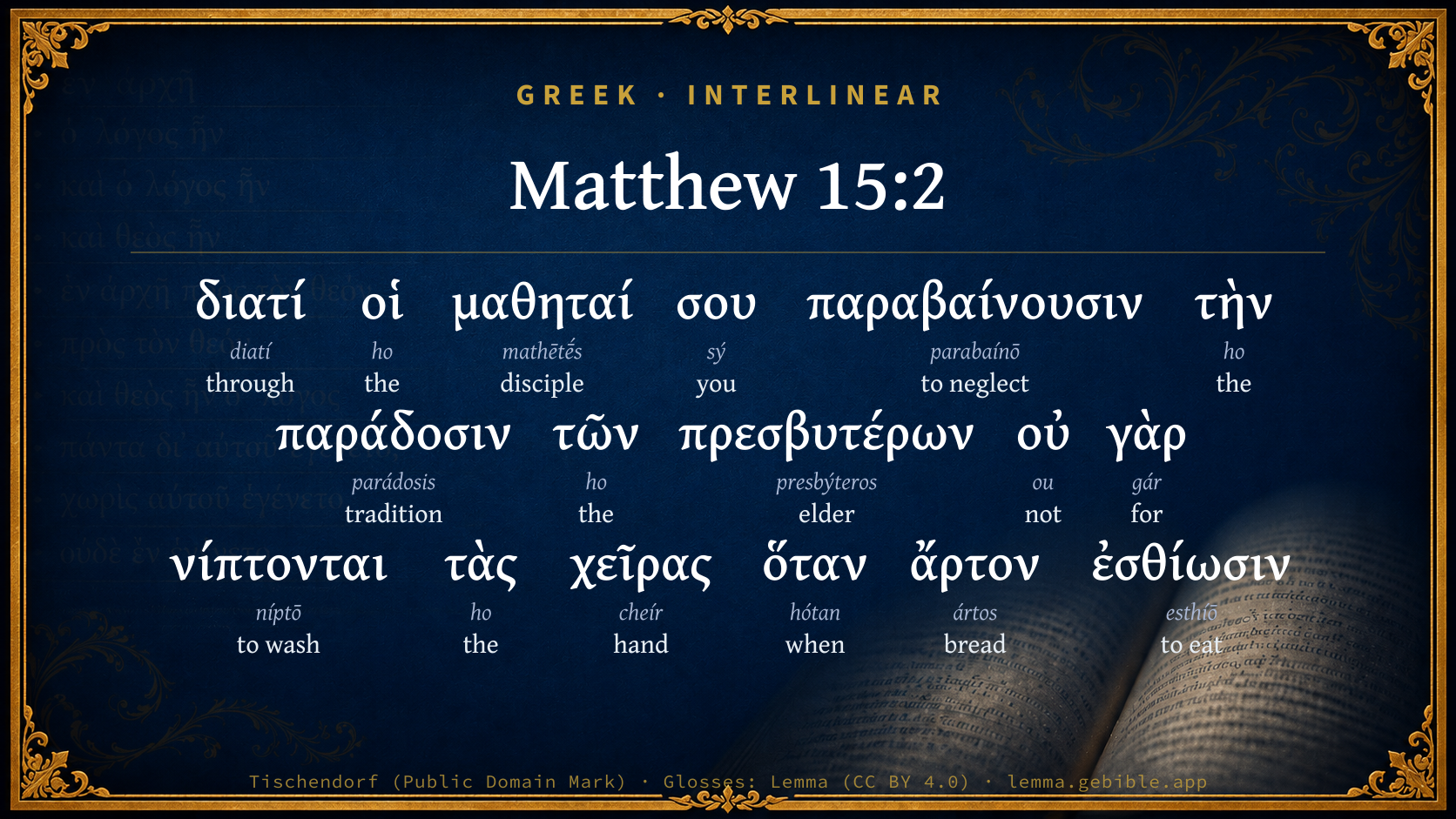
  1. διατί diatí G1302 “through” Particle, Interrogative
  2. οἱ ho G3588 “the” Article, Nominative, Plural, Masculine
  3. μαθηταί mathētḗs G3101 “disciple” Noun, Nominative, Plural, Masculine
  4. σου sý G4771 “you” Personal pronoun, 2nd person, Genitive, Singular
  5. τὴν ho G3588 “the” Article, Accusative, Singular, Feminine
  6. παράδοσιν parádosis G3862 “tradition” Noun, Accusative, Singular, Feminine
  7. τῶν ho G3588 “the” Article, Genitive, Plural, Masculine
  8. πρεσβυτέρων presbýteros G4245 “elder” Adjective, Genitive, Plural, Masculine, Comparative
  9. οὐ ou G3756 “not” Particle, Negative
  10. γὰρ gár G1063 “for” Conjunction
  11. νίπτονται níptō G3538 “to wash” Verb, Present, Middle, Indicative, 3rd person, Plural
  12. τὰς ho G3588 “the” Article, Accusative, Plural, Feminine
  13. χεῖρας cheír G5495 “hand” Noun, Accusative, Plural, Feminine
  14. ὅταν hótan G3752 “when” Conjunction
  15. ἄρτον ártos G740 “bread” Noun, Accusative, Singular, Masculine
  16. ἐσθίωσιν esthíō G2068 “to eat” Verb, Present, Active, Subjunctive, 3rd person, Plural

About this verse

These counts appear in no published source. They are computed here, from the morphology-tagged text and Lemma’s own curated glosses. What Lemma adds →

17
words
14
distinct lemmas
Gospels
section

Notable vocabulary

The rarest word here is παραβαίνουσιν to neglect G3845 — appearing just 3 times in the whole Greek New Testament.

First appearance in Scripture

These words make their first canonical appearance in the Greek New Testament here:

  • παραβαίνουσιν to neglect G3845
  • παράδοσιν tradition G3862
  • πρεσβυτέρων elder G4245

Shared distinctive vocabulary

παραβαίνουσιν to neglect G3845 occurs in 3 verses of the Greek New Testament. Also found in:

Repetition

A word recurs within this verse:

Cross-references

6

Topical passages linked to Matthew 15:2 in the Treasury of Scripture Knowledge — connected by theme and wording, ordered by reader-vote popularity; previews shown in the World English Bible.

  • Mark 7:2 Now when they saw some of his disciples eating bread with defiled, that is, unwashed, hands, they found fault.
  • Luke 11:38 When the Pharisee saw it, he marveled that he had not first washed himself before dinner.
  • Colossians 2:8 Be careful that you don't let anyone rob you through his philosophy and vain deceit, after the tradition of men, after the elements of the world, and not after Christ.
  • Colossians 2:20–23 If you died with Christ from the elements of the world, why, as though living in the world, do you subject yourselves to ordinances,
  • Mark 7:5 The Pharisees and the scribes asked him, "Why don't your disciples walk according to the tradition of the elders, but eat their bread with unwashed hands?"
  • 1 Peter 1:18 knowing that you were redeemed, not with corruptible things, with silver or gold, from the useless way of life handed down from your fathers,

Cross-references courtesy of OpenBible.info (CC BY 4.0).

Commentary

Notes on Matthew 15:2 from classic Christian and Jewish commentators (each source and its license shown beneath its notes). The classic Christian expositions comment on the surrounding passage and are grouped to its opening verse, so a note may address several verses; the Jewish commentaries on the Tanakh (Rashi and others) are per-verse, so they appear only where the commentator wrote on this verse.

Lemma curates 59 commentaries, every one of them public domain or Creative Commons licensed, each selected and text-cleaned for this edition rather than reprinted as found. About our sources →

Tyndale Open Study Notes

Tyndale Open Resources

15:2 The Jewish teachers’ age-old tradition sought to apply the written Torah to common circumstances in the ordinary course of life. This tradition was memorized and passed on orally from teacher to student (cp. 1 Cor 11:23; 15:1-5). • To ignore the tradition of . . . hand washing (see Mark 7:2-4; Luke 11:38) was considered disobedient to the Torah and unfaithful to God’s will for Israel (cp. Matt 23:25-26).

Tyndale Open Study Notes — © Tyndale Open Resources, licensed CC BY-SA 4.0. Text via the HelloAO Bible API.

Bengel's Gnomon

Johann Albrecht Bengel

Mat 15:2. Τῶν πρεσβυτέρων, of the ancients) The word πρεσβύτερος sometimes denotes a dignity or office; sometimes it is opposed to youth; sometimes, as in this place, to later generations.—ἄρτον, bread) The Jews eat other kinds of food without washing their hands more readily than bread. See Wall’s[677] Critical Notes, p. 47.

[677] WILLIAM WALL, D. D., sometime Vicar of Shoreham, a learned divine of the English Church; born 1645 or 1646; died 1727–8. The work here alluded to is entitled—

“Brief Critical Notes, especially on the various readings of the New Testament Books; with a Preface concerning the Texts cited from the Old Testament, as also concerning the use of the Septuagint Translation. 8vo. London, 1730.”—(I. B.)

Bengel's Gnomon of the New Testament — English translation (T&T Clark, Edinburgh, 1860) — public domain. Text from a community e-Sword module.

Meyer's Critical & Exegetical Commentary

Heinrich August Wilhelm Meyer

Mat_15:2. Παράδοσις] ἄγραφος διδασκαλία, Hesychius. The Jews, founding upon Deu_4:14; Deu_17:10, for the most part attached greater importance to this tradition than to the written law. Hence, Berachoth f. 3. 2 : הכיבים דברי סופרים מדברי תורה. Comp. Schoettgen. They laid special stress upon the traditional precept, founded on Lev_15:11, which required that the hands should be washed before every meal (ὅταν ἄρτον ἐσθίωσιν, a rendering of the Hebrew אָכַל לֶחֶם). See Lightfoot, Schoettgen, and Wetstein. Jesus and His disciples ignored this παράδοσις as such.

τῶν πρεσβυτ.] which had been handed down from the men of olden time (their forefathers). It is not the scribes that are meant (Fritzsche), nor the elders of the nation (Bleek, Schegg), but comp. Heb_11:2. It is the wise men of ancient times that are in view. Observe, moreover, the studied precision and peremptory tone of the question, which has something of an official air about it. The growing hostility begins to show itself in an open and decided manner.

Meyer — Critical and Exegetical Commentary on the New Testament — English translation by Peter Christie, edited by Frederick Crombie (T&T Clark, 1880) — public domain. Text from a community e-Sword module.

Expositor's Greek Testament

ed. W. Robertson Nicoll

Mat 15:2 . διατί οἱ μαθ . σου παραβ .: no instance of offence specified in this case, as in Mat 9:10 and Mat 12:1 . The zealots must have been making inquiries or playing the spy into the private habits of the disciple circle, seeking for grounds of fault-finding ( cf. Mar 7:2 ). παραβαίνουσι : strong word (Mk.’s milder), putting breach of Rabbinical rules on a level with breaking the greatest moral laws, as if the former were of equal importance with the latter. That they were, was deliberately maintained by the scribes ( vide Lightfoot). τὴν παράδοσιν τ . π .: not merely the opinion, dogma, placitum , of the elders (Grotius), but opinion expressed ex cathedra , custom originated with authority by the ancients. The “elders” here are not the living rulers of the people, but the past bearers of religious authority, the more remote the more venerable. The “tradition” was unwritten ( ἄγραφος διδασκαλία , Hesych.), the “law upon the lip” reaching back, like the written law (so it was pretended), to Moses. Baseless assertion, but believed; therefore to attack the παράδοσις is a Herculean, dangerous task. The assailants regard the act imputed as an unheard-of monstrous impiety. That is why they make a general charge before specifying the particular form under which the offence is committed, so giving the latter as serious an aspect as possible. οὐ γὰρ νίπτονται , etc.: granting the fact it did not necessarily mean deliberate disregard of the tradition. It might be an occasional carelessness on the part of some of the disciples ( τινὰς , Mar 7:2 ) which even the offenders would not care to defend. A time-server might easily have evaded discussion by putting the matter on this ground. The Pharisees eagerly put the worst construction on the act, and Jesus was incapable of time-serving insincerity; thus conflict was inevitable. νίπτεσθαι , the proper word before meat, ἀπονίπτεσθαι , after, Elsner, citing Athenaeus, lib. ix., cap. 18. ἄρτον ἐσθίωσιν , Hebrew idiom for taking food. The neglect charged was not that of ordinary cleanliness, but of the technical rules for securing ceremonial cleanness. These were innumerable and ridiculously minute. Lightfoot, referring to certain Rabbinical tracts, says: “lege, si vacat, et si per taedium et nauseam potes”.

The Expositor's Greek Testament, edited by W. Robertson Nicoll (1897–1910) — public domain. Text from a community e-Sword module.

Geneva Bible (1599)

Geneva Bible translators

Which they received of their ancestors from hand to hand, or their elders allowed, which were the governors of the Church.

Geneva Bible (1599) marginal notes — public domain. Text via Bolls.life.

Jamieson, Fausset & Brown

Robert Jamieson, A. R. Fausset & David Brown

Why do thy disciples transgress the tradition of the elders? for they wash not their hands when they eat bread.

Jamieson, Fausset & Brown — Commentary Critical and Explanatory on the Whole Bible (1871) — public domain (CC PDM 1.0). Text via the HelloAO Bible API.

Adam Clarke's Commentary

Verse 2. Elders] Rulers and magistrates among the Jews.

For they wash not their hands] What frivolous nonsense! These Pharisees had nothing which their malice could fasten on in the conduct or doctrine of our blessed Lord and his disciples, and therefore they must dispute about washing of hands! All sorts of Pharisees are troublesome people in religious society; and the reason is, they take more pleasure in blaming others than in amending themselves.

The tradition of the elders] The word παραδοσις, tradition, has occupied a most distinguished place, both in the Jewish and Christian Church. Man is ever fond of mending the work of his Maker; and hence he has been led to put his finishing hand even to Divine revelation! This supplementary matter has been called παραδοσις, from παραδιδομαι, to deliver from hand to hand - to transmit; and hence the Latin term, tradition, from trado, to deliver, especially from one to another; - to hand down. Among the Jews TRADITION signifies what is also called the oral law, which they distinguish from the written law: this last contains the Mosaic precepts, as found in the Pentateuch: the former, the traditions of the elders, i.e. traditions, or doctrines, that had been successively handed down from Moses through every generation, but not committed to writing. The Jews feign that, when GOD gave Moses the written law, he gave him also the oral law, which is the interpretation of the former. This law, Moses at first delivered to Aaron then to his sons Eleazar and Ithamar; and, after these to the seventy-two elders, who were six of the most eminent men chosen out of each of the twelve tribes. These seventy-two, with Moses and Aaron, delivered it again to all the heads of the people, and afterwards to the congregation at large. They say also that, before Moses died, he delivered this oral law, or system of traditions, to JOSHUA, and Joshua to the ELDERS which succeeded him-THEY to the Prophets, and the PROPHETS to each other, till it came to JEREMIAH, who delivered it to BARUCH his scribe, who repeated it to EZRA, who delivered it to the men of the great synagogue, the last of whom was SIMON the Just. By Simon the Just it was delivered to ANTIGONUS of Socho; by him to JOSE the son of Jochanan; by him to JOSE, the son of Joezer; by him to NATHAN the Arbelite, and Joshua the son of Perachiah; and by them to JUDAH the son of Tabbai, and Simeon, the son of Shatah; and by them to SHEMAIAH and ABTALION; and by them to HILLEL; and by Hillel to SIMEON his son, the same who took Christ in his arms when brought to the temple to be presented to the Lord: by SIMEON it was delivered to GAMALIEL his son, the preceptor of St. Paul, who delivered it to SIMEON his son, and he to Rab. JUDAH HAKKODESH his son, who compiled and digested it into the book which is called the MISHNA; to explain which the two Talmuds, called the Jerusalem and Babylyonish Talmuds, were compiled, which are also called the Gemera or complement, because by these the oral law or Mishnah is fully explained. The Jerusalem Talmud was completed about A. D. 300; and the Babylonish Talmud about the beginning of the sixth century. This Talmud was printed at Amsterdam in 12 vols. folio. These contain the whole of the traditions of the elders, and have so explained, or rather frittered away, the words of God, that our Lord might well say, Ye have made the word of God of no effect by your traditions. In what estimation these are held by the Jews, the following examples will prove: "The words of the scribes are lovely beyond the words of the law: for the words of the law are weighty and light, but the words of the scribes are all weighty." Hierus. Berac. fol. 3.

"He that shall say, There are no phylacteries, though he thus transgress the words of the law, he is not guilty; but he that shall say, There are five Totaphot, thus adding to the words of the scribes, he is guilty."

"A prophet and an elder, to what are they likened! To a king sending two of his servants into a province; of one he writes thus: Unless he show you my seal, believe him not; for thus it is written of the prophet: He shall show thee a sign; but of the elders thus: According to the law which they shall teach thee, for I will confirm their words." - See Prideaux. Con. vol. ii. p. 465, and Lightfoot's Hor. Talmud.

They wash not their hands] On washing of hands, before and after meat, the Jews laid great stress: they considered eating with unwashed hands to be no ordinary crime; and therefore, to induce men to do it, they feigned that an evil spirit, called Shibta שיבתא, who sits on the hands by night, has a right to sit on the food of him who eats without washing his hands, and make it hurtful to him! They consider the person who undervalues this rite to be no better than a heathen, and consequently excommunicate him. See many examples of this doctrine in Schoettgen and Lightfoot.

Adam Clarke's Commentary on the Bible (1810–1826) — public domain. Text from a community e-Sword/MySword module.

Ellicott's Commentary for English Readers

(2) They wash not their hands when they eat bread.—St. Mark (Mar_7:3-4), writing for Gentiles, explains the nature of the tradition more fully. What the Pharisees insisted on was not cleanliness as such, but the avoidance of ceremonial pollution. They shrank not from dirt, but from defilement. If they had been in the market, they might have come in contact with the heathen or the publican. If they ate or drank out of a metal or earthenware cup, the last lip that touched it might have been that of a heathen, and therefore that too needed purification. The pride which led them to stand aloof from the rest of mankind showed itself in this, as in all their other traditions. Indifference to their rules in peasants and fishermen, as such—as belonging to the crowd whom they scorned as the brute “people of the earth”—they could afford to tolerate. What shocked them was to see the disciples of One who claimed to be a Prophet or a Rabbi indulging in that indifference. According to their traditions, the act of which they complained stood on the same level as sexual impurity, and exposed those who were guilty of it to the excommunication of the Sanhedrin, or great Council.

A Bible Commentary for English Readers, edited by Charles John Ellicott (1878–1897) — public domain. Text from a community e-Sword module.

The Cambridge Bible for Schools and Colleges

gen. ed. J. J. S. Perowne

2. the tradition of the elders] The elders, or presbyters, were the Jewish teachers, or scribes, such as Hillel and Shammai. The traditions were the rules or observances of the unwritten law, which they enjoined on their disciples. Many of these were frivolous; some actually subversive of God’s law; and yet one Rabbinical saying was, “The words of the law are weighty and light, but all the words of the scribes are weighty.”

when] Rather, whenever.

The Cambridge Bible for Schools and Colleges (gen. ed. J. J. S. Perowne; Cambridge University Press, 1878–1918) — public domain. Text from a community e-Sword module.

John Gill's Exposition

Why do thy disciples transgress the tradition of the elders?.... Having observed, for some little time, the conduct of Christ and his disciples, they thought proper to take no notice of him as yet, but of them; and of them, not as transgressing any command of God, but of men; not being able to charge them with any breach of the law of God: and could they have done this with any show of truth, yet they might choose rather to accuse them of breaking the rules of the elders; by whom they mean, not the elders of the present sanhedrim, but Hillell and Shammai; the two heads of their famous schools, and other ancient doctors; from whom were delivered by one to another, certain rules and laws of their own devising, which had no foundation in the word of God; and of these the Scribes and Pharisees were more tenacious, than of the Scriptures; and indeed they preferred them before them: most extravagant are their praises and commendations of these unwritten traditions; thus they say (d),

"Know then, that "the words of the Scribes" are more lovely than the words of the law: for, says R. Tarphon, if a man does not read, he only transgresses an affirmative; but if he transgresses the words of the school of Hillell, he is guilty of death, because he hath broke down a hedge, and a serpent shall bite him. It is a tradition of R. Ishmael, the words of the law have in them both prohibition and permission; some of them are light, and some heavy, but "the words of the Scribes" are all of them heavy--Mynqz , "weightier are the words of the elders", than the words of the prophets.''

And elsewhere (e), this advice is given;

"My son, attend to "the words of the Scribes", more than to the words of the law; for in the words of the law, are affirmatives and negatives; but the words of the Scribes , "everyone that transgresses the words of the Scribes", is guilty of death.''

This is what they charge the disciples with here, and could they have had their wills, would have put them to death for it: the particular tradition, they accuse them with the breach of, follows,

for they wash not their hands when they eat bread; common bread, an ordinary meal; for, for eating of holy things, more than bare washing was required, even an immersion of them in water; but the hands were to be washed before eating common food, whether they were known to be defiled or not: "bread" is particularly mentioned, as including all sorts of food, and as distinct from fruit; for, for eating of common fruit, there was no need of washing of hands; he that washed his hands for eating fruit, was reckoned an ostentatious man (f), who were the first authors of this tradition, it is not certain; it is said (g), that

"Hillell and Shammai decreed , "concerning the purification of the hands"; R. Jose ben R. Bon, in the name of R. Levi, says, so was the tradition before, but they forgot it; and these two stood up, and agreed with the minds of the former ones.''

"However, it is a certain point, that the washing of the hands, and the dipping of them, are , "from the words of the Scribes" (h).''

The breach of this rule was reckoned equal to the most flagitious crimes (i): R. Jose says,

"whoever eats bread without washing of hands, is as if he lay with a whore: and, says R. Eleazer, whoever despiseth washing of hands, shall be rooted out of the world.''

And elsewhere it is said by them (k), that

"he that blesseth (food) with defiled hands, is guilty of death.''

And again (l),

"whoever does not wash his hands as is fitting, although he is punished above, he shall be punished below.''

And to fright people into an observance of this tradition, they talk of Shibta, a sort of an evil spirit, that hurts such as eat without washing their hands: they say, he sits upon their hands, and upon their bread, and leaves something behind, which is very dangerous (m); and it is recorded (n), to the praise of R. Akiba, that he chose rather to die, than to transgress this tradition; for being in prison, and in want of water, what little he had, he washed his hands with it, instead of drinking it. Eleazar ben Chanac was excommunicated for despising the tradition concerning washing of hands; and when he died, the sanhedrim sent and put a great stone upon his coffin, to show, that he that died in his excommunication, the sanhedrim stoned his coffin (o): but of this; see Gill on Mar 7:3.

(d) T. Hieros. Beracot, fol. 3. 2. (e) T. Bab. Erubim, fol. 21. 2. T. Bab. Beracot, fol. 4. 2. (f) Misn. Chagiga, c. 2. sect. 5, 6. Maimon. Praefat. ad Tract. Yadaim, & Hilch. Beracot, c. 6. sect. 3. (g) T. Hieros. Sabbat, fol. 3. 4. (h) Maimon Hilch. Mikvaot, c. 11. sect. 1. (i) T. Bab. Sota, fol. 4. 2. (k) Zohar in Deut. fol. 107. 3. (l) lb. in Gen. fol. 60. 2. (m) Gloss. in. T. Bab. Yoma, fol. 77. 2. Taanith, fol. 20. 2. & Cholin, fol. 107. 2. (n) T. B. Erubim, fol. 2l. 2. (o) T. Bab. Beracot, fol. 19. l.

John Gill's Exposition of the Whole Bible (1746–1763) — public domain (CC PDM 1.0). Text via the HelloAO Bible API.

Trapp's Complete Commentary

John Trapp

2 Why do thy disciples transgress the tradition of the elders? for they wash not their hands when they eat bread.

Ver. 2. Transgress the tradition of the elders] They cried up aloud traditions and the authority of antiquity. Similem hodie dicam Papistae nobis scribunt. For as the philosophers fled and hid themselves in the heretics, as one saith, so did the Scribes and Pharisees in the Popish doctors. Non tam ovum ovo simile; one egg or apple is not so like another as Pharisees and Papists. The Pharisees deemed it as great a sin to eat with unwashen hands as to commit fornication. Similiarly, the Papists count it worse to deface an idol than to kill a man, to eat flesh or eggs on a fasting day than to commit incest, and for a priest to have one wife than ten harlots. Παραδοσις, say some, is the number of the Beast, 666. Pareus in loc.

John Trapp, A Commentary or Exposition upon All the Books of the Old and New Testament (1647–1656) — public domain. Text from a community e-Sword module.

Haydock's Catholic Bible Commentary

Why do thy disciples transgress the tradition. The Pharisees had various traditions delivered down from their ancestors, called Greek: deuterseis, of which some were works of supererogation, others were contrary to the law. (Estius) --- It is a great proof of malice in the Pharisees, and of irreproachable character in our Lord, that they should be reduce to notice triffles, no ways connected with either piety or religion. ... They moreover betrayed their superstition, by insisting on the observance of these outward ceremonies, as essential parts of piety, which were not commanded by any law, (were certainly of no divine origin) and which, at most, were duties of civility, or emblems of interior purity. (Jansenius) --- The tradition of the ancients? They do not say the written law, which did not prescribe these washings of hands, cups, pots, beds, &c. These traditions came only from the doctors of their law, who are called elders, which is a name of dignity, as was that of senator among the Romans, and so, in English, are the names of major, alderman, &c. See Acts v. 6. &c. (Witham)

George Leo Haydock (1774–1849), Haydock's Catholic Family Bible and Commentary, 1859 edition — public domain. Excludes Psalms (Douay-Rheims chapter numbering differs from Protestant) and Deuterocanonical books (Catholic canon only).

Whedon's Commentary on the Bible

Daniel D. Whedon

2. Tradition of the elders — That is, of the ancient commentators, the teachers of the Mosaic law. The written law of Moses is contained in the Old Testament. But besides, the Jews had oral law, which they pretended was handed down from Moses by verbal tradition. At the time of our Saviour this was not reduced to writing. But it was afterward compiled in The Talmud, now extant; of which the two parts are called the Mishna, or Text, and the Gemara, or Commentary.

Extravagant were the praises lavished by the Pharisees upon these Traditions. “The written word is water, said they; but the interpretation, and that which is added to it, is wine.” “If the scribes say the right is left, hear them.” Thus the foundations of morality were undermined. Wash not their hands — The Pharisees select for debate a point with which morality has very little to do, and the law of God nothing. But the washings here mentioned were very positively insisted upon by the Jewish doctors. The Talmud says: “He who eats bread with unwashen hands is as bad as if he were to commit fornication.” The Rabbi Akiba was once imprisoned, and only water sufficient to drink allowed him. But he chose rather to die of thirst than to eat anything with unwashen hands. How enormous, then, to their view, must have been this crime of our Lord’s disciples! They wash not their hands! They had better break any command in the decalogue. And though the Jews open this quarrel with the disciples, it is plain they intend a blow at the Master himself. A subject for a decisive issue is now laid open.

Daniel D. Whedon (gen. ed.), Commentary on the Old and New Testaments (1874–1909) — public domain. Text from a community e-Sword module.

The Pulpit Commentary

Thy disciples. They had watched our Lord and his followers partaking of some meal, and doubtless Christ had acted in the same manner as his disciples. Open houses and food partaken of in public allowed this close observation without any infringement of Eastern courtesy. They come to Christ with the insidious question, because they consider him answerable for his disciples" doings. (comp. Mat_9:14 Mat_12:2) They imply that his teaching has led to thee transgression on which they animadvert. Doubtless the apostles, from Christ"s instruction and example, were learning to free themselves from the endless rules and restrictions which were no help to religion, and to attend more to the great realities of vital piety and holiness. The omission of the outward acts, rabbinically enjoined, was readily marked and censured. The tradition. This formed a vast collection of additions, explanations, etc., of the original Law, partly, as was affirmed, delivered orally by Moses, and handed down from generation to generation; and partly accumulated by successive expounders. St. Paul refers to this when he speaks of himself before his conversion as being "exceedingly jealous for the tradition or my fathers". (Gal_1:14) From it, in the course of time. was formed the Talmud, with its text (Mishna) and its commentary (Gemara). It was not put into writing till after our Lord"s time (hence called agrafov didaskalia), but was taught authoritatively by accredited teachers who, while retaining the letter of the Law abrogated its spirit, nullifying the broad line of God"s commandments by enforcing minute observances and puerile restrictions which were a burden and impediment to purity and devotion, rather than an aid and encouragement. The elders (twn presbuterwn); the ancients. The older expositors and rabbis, whose commentaries had been orally handed down.. Such traditions were regarded with more respect than the letter of Scripture, and the latter had to give way when it seemed to be antagonistic to the former. Wash not their hands when they eat bread. To eat bread means to take food of any kind. The fear of legal defilement led to a multitude of rabbinical rules of the most vexatious and troublesome nature, the infringement of any of which endangered a man"s ceremonial purity. (see Mar_7:3, 4) These frivolous regulations had been built upon the plain Mosaical enactments of Leviticus 11, etc. St. Matthew, writing for those who were well acquainted with these glosses, enters into no details; St. Mark is more explicit. It is to be remarked that the Pharisees were extending and enforcing these traditions just when the Law was to be superseded by something more spiritual and doing so in spite of the interdiction "Ye shall not add unto the word which I command you". (Deu_4:2)

HOMILIES BY W.F. ADENEY Vers. 2, 3. The mischief of tradition.

I TRADITION COMES FROM AN INEXPERIENCED ANTIQUITY. The Pharisees and scribes showed reverence for it because it descended from the elders; but these elders were only men. It is common to attach the greatest weight to the oldest opinion. Yet it is not correct to look for wisdom in antiquity; because, as Bacon reminds us, we are the ancients, and they who lived before us belonged to the childhood of the race. Under the Divine education of man wisdom should be growing with the ages. We look back with amazement on a multitude of fantastic notions cherished by our forefathers which have become ridiculous in our eyes. There is one thought, however, to be set off against this. Ideas that have stood the test of time win a certain guarantee of their solidity in comparison with raw notions suddenly springing from the imagination of a new thinker. But that is only the case when those ideas are being constantly tested by experience and criticism; and it does not apply after tradition has become petrified and has attained the rank of a venerated idol

II TRADITION IS MARKED BY HUMAN IMPERFECTION. The enemies of Christ greeted the elders with reverence; but our Lord replied by calling attention to a greater authority. They had honoured the elders, but they had dishonoured God. The tradition of the elders may deserve some reverence, but it cannot be compared with the commandment of God. Yet it was being preferred to that commandment. Tradition sometimes claims to be of Divine origin, handed down in the Church from the time of the apostles in a line of authorized teachers. If its claim could be proved, of course it would have an apostolic authority; but even then how could it be of superior value to the immediate utterances of the apostles recorded in the Scriptures? We have no warrant for believing, as the Gnostics taught, that an esoteric teaching of supreme importance has been thus handed down. The extravagant pretensions of Romanism, founded on the authority of tradition, which the Council of Trent declared to be of equal value with that of Scripture, warn us against the danger of trusting similar claims again.

III TRADITION MAY BECOME AN EXCUSE FOR UNFAITHFULNESS TO DIVINE REVELATION. Thus it was with the Jews. The revelation they treated with contempt was that of the moral law. Parental claims were eluded on the plea of traditional usages. Nothing short of horrible hypocrisy was here practised. The plea that what was due to a needy parent could not be given because it had been already consecrated to God was quite false, inasmuch as the pretended consecration did not prevent the unnatural son from enjoying it himself. Thus tradition was a means of relaxing moral claims. The tendency to trust in tradition in the Christian Church has been sometimes associated with a casuistical treatment of simple obligations. The reason of this seems to be that while God"s commandments are "exceeding broad", (Psa_119:96) man"s additions to them are dreadfully narrow. Thus tradition slides down to petty contrivances, and wastes its resources in miserable scruples. Christ would warn us to escape from the lowering and narrowing influence of this system of man"s invention, by turning to the large, living, eternal, spiritual truth of the kingdom as he has revealed it to us. W.F.A.

The Pulpit Commentary (1880–1919), ed. H.D.M. Spence-Jones & Joseph S. Exell — public domain. Text from a community e-Sword module.

John Wesley's Explanatory Notes

The elders - The chief doctors or, teachers among the Jews.

John Wesley, Explanatory Notes Upon the Whole Bible (1754–1765) — public domain. Text via the GEBible commentary corpus.

The People's New Testament

B. W. Johnson

2. Why do thy disciples transgress? Not the law of Moses, but the tradition of the elders, which had as much authority with the Pharisees as the written law. The tradition of the elders. Purported to be precepts never written in the Scriptures, but handed down from the times of Moses and the elders by oral means. These precepts were spoken of the “law upon the lip,” and have been embodied in the Talmud. They were additions to the written word. See Gal. 1:14. For they wash not their hands. The orthodox Jews insisted on washing the hands before eating, not to remove the filth, but lest they might have touched something ceremonially unclean. This commandment was purely traditional, but so rigidly did they insist upon observing it that the Rabbi Akiba, imprisoned by the Romans and with scarcely water to sustain life, preferred to use all provided for his ceremonial ablutions, and to die of thirst.

B. W. Johnson's The People's New Testament with Notes (1889–1891) — public domain. Electronic text from the Christian Classics Ethereal Library (CCEL) ThML edition.

Cambridge Greek Testament for Schools and Colleges

2. τὴν παράδοσιν τῶν πρεσβυτέρων. The elders, or presbyters, were the Jewish teachers, or scribes, such as Hillel and Shammai. The traditions were the rules or observances of the unwritten law, which they enjoined on their disciples. Many of these were frivolous; some actually subversive of God’s law; yet such was the estimation in which these ‘traditions’ were held that, according to one Rabbinical saying, ‘the words of the scribes are lovely, above the words of the law; for the words of the law are weighty and light but the words of the scribes are all weighty.’

Cambridge Greek Testament for Schools and Colleges (Cambridge University Press, 1896; 21 vols, various authors incl. Carr, Maclear, Plummer, Farrar, Lumby, Moule, M. R. James, Simcox) — public domain. Text from a community e-Sword module.

Alford’s Greek Testament

Henry Alford

2.] The Jews attached more importance to the traditionary exposition than to the Scripture text itself. They compared the written word to water; the traditionary exposition to the wine which must be mingled with it.

The duty of washing before meat is not inculcated in the law, but only in the traditions of the Scribes. So rigidly did the Jews observe it, that Rabbi Akiba, being imprisoned, and having water scarcely sufficient to sustain life given him, preferred dying of thirst to eating without washing his hands.

πρεσβύτεροι are not the elders, but the ancients. See ref. Heb.

Henry Alford, The Greek Testament (1849–1861) — public domain. Text from a community e-Sword module.

International Critical Commentary

2. The editor here omits Mk.’s long archæological note, vv. 2-4.

(M) Why do Thy disciples transgress the tradition of the elders? For they wash not their hands when they are eating bread.] Mk. has: “Why do Thy disciples not walk according to the tradition of the elders, but eat bread with common hands.”—παραβαίνουσι] for Mk.’s more technical οὐ περιπατοῦσιν κατά.—οὐ γὰρ νίπτονται, κ.τ.λ.] Mk. has: ἀλλὰ κοιναῖς χερσὶν ἐσθίουσιν τὸν ἄρτον. Mt. avoids Mk.’s technical κοιναῖς χερσίν.

(M)

2. τὴν παράδοσιν] S1 S2 have “the commandments,” assimilating to v. 3 τὴν ἐντολὴν τοῦ θεοῦ.

International Critical Commentary — older volumes (1896–1929), various authors — public domain. Text from a community e-Sword module.

Vincent's Word Studies in the New Testament

Marvin R. Vincent

Wash not their hands. Washing before meals was along regarded as a commandment; washing after meals only as a duty. By and by the more rigorous actually washed between the courses, although this was declared to be purely voluntary. The distinctive designation for washing after meals was the lifting of the hands; while for washing before meat a term was used which meant, literally, to rub. If "holy," i e., sacrificial food was to be partaken of, a complete immersion of the hands, and not a mere "uplifting" was prescribed. As the purifications were so frequent, and care had to be taken that the water had not been used for other purposes, or something fallen into it that might discolor or defile it, large vessels or jars were generally kept for the purpose (see Joh 2:6). It was the practice to draw water out of these with a kind of ladle or bucket - very often of glass - which must hold at least one and a half egg - shells (compare draw out now, Joh 2:8). The water was poured on both hands, which must be free of anything covering them, such as gravel, mortar, etc. The hands were lifted up so as to make the water run to the wrist, in order to insure that the whole hand was washed, and that the water polluted by the hand did not again run down the fingers. Similarly, each hand was rubbed with the other (the fist,) provided the hand that rubbed had been affused; otherwise, the rubbing might be done against the head, or even against a wall. But there was one point on which special stress was laid. In the "first affusion," which was all that originally was required when the hands were not levitically "defiled," the water had to run down to the wrist. If the water remained short of the wrist, the hands were not clean. See on Mr 7:3 (Edersheim, " Life and Times of Jesus ").

Marvin R. Vincent, Word Studies in the New Testament (1887–1900) — public domain. Text from a community e-Sword/MySword module.

Lesson kit

Teaching starters — assembled from the data on this page, not authored interpretation. Every prompt links to the verse data it draws on. Edit before teaching.

Matthew, in the Gospels, opens this verse with 17 words (14 distinct Greek lemmas). Its most distinctive word is parabaínō (“to neglect”). A historical commentator’s framing appears above. Read the whole chapter for the surrounding context.

Discussion questions

  1. What does “to neglect” (parabaínō) contribute to the verse as a whole?
  2. 3 words here appear for the first time in Scripture. What is being introduced at this debut?
  3. Matthew 15:3 shares the word «to neglect» with this verse. How do the two illuminate each other?
  4. “the” occurs 4× in this one verse. What is the effect of the repetition?
  5. These translations render this verse differently; the difference is in the English rendering, not the original. What questions does that raise?
  6. Reading how Tyndale Open Study Notes and Bengel's Gnomon read this verse, where do the two commentators agree and where do they part?

Things to notice

  • 3 words make their first canonical appearance in Scripture here.
  • These translations choose different wording for 3 words in this verse.
  • “the” occurs 4× in this single verse.
  • 14 distinct Greek lemmas span 17 words in this verse.

Reading settings

Reading text

Shown beneath each verse's original-language words.

Old Testament
Old Testament edition

Read the OT as the Masoretic Hebrew (MT) or the Greek Septuagint (LXX).

English shown for the Greek Septuagint (in the Hebrew ↔ Greek comparison).

Comparing translations? Open the Compare panel on any verse page to stack up to four side by side.