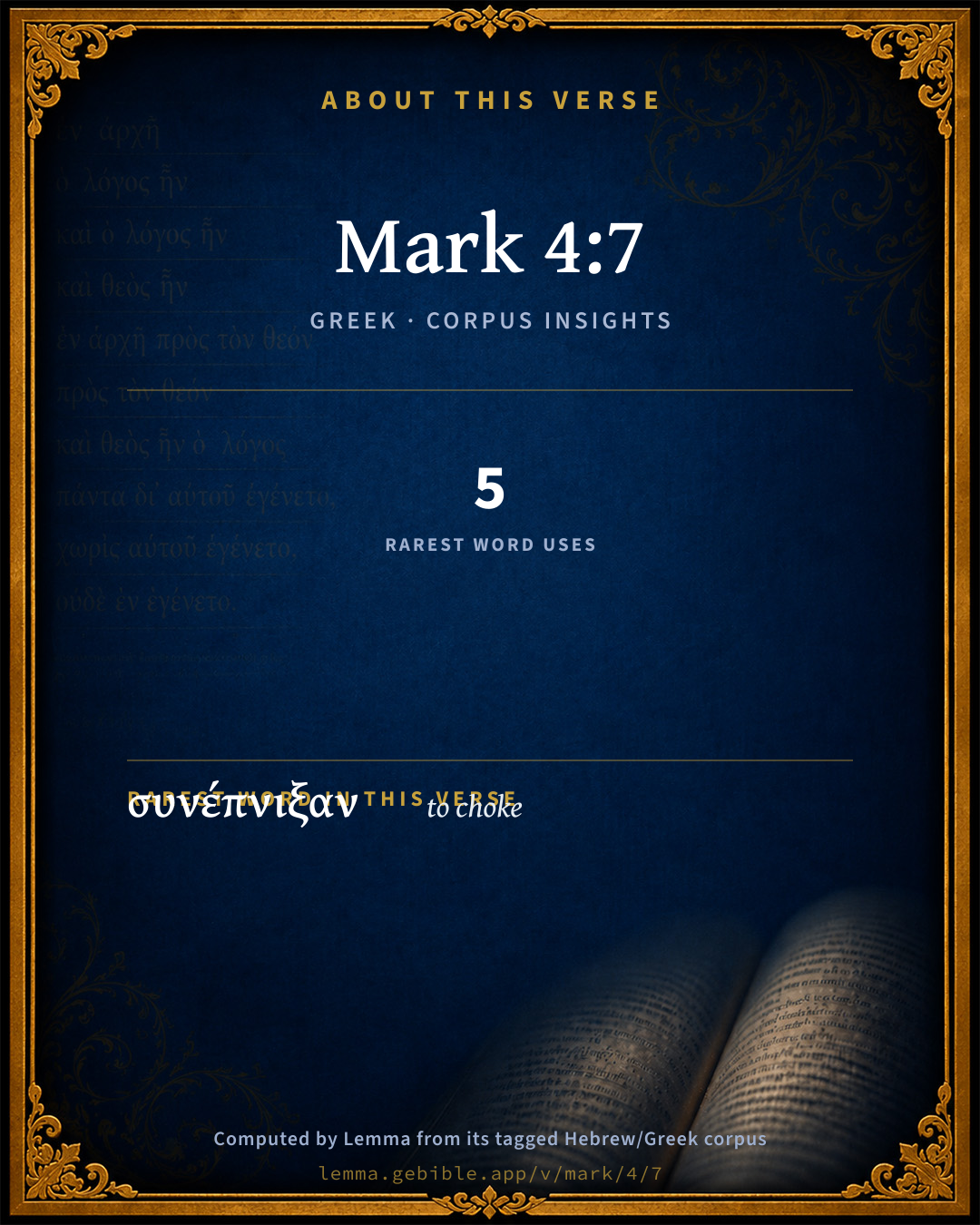
Mark 4:7

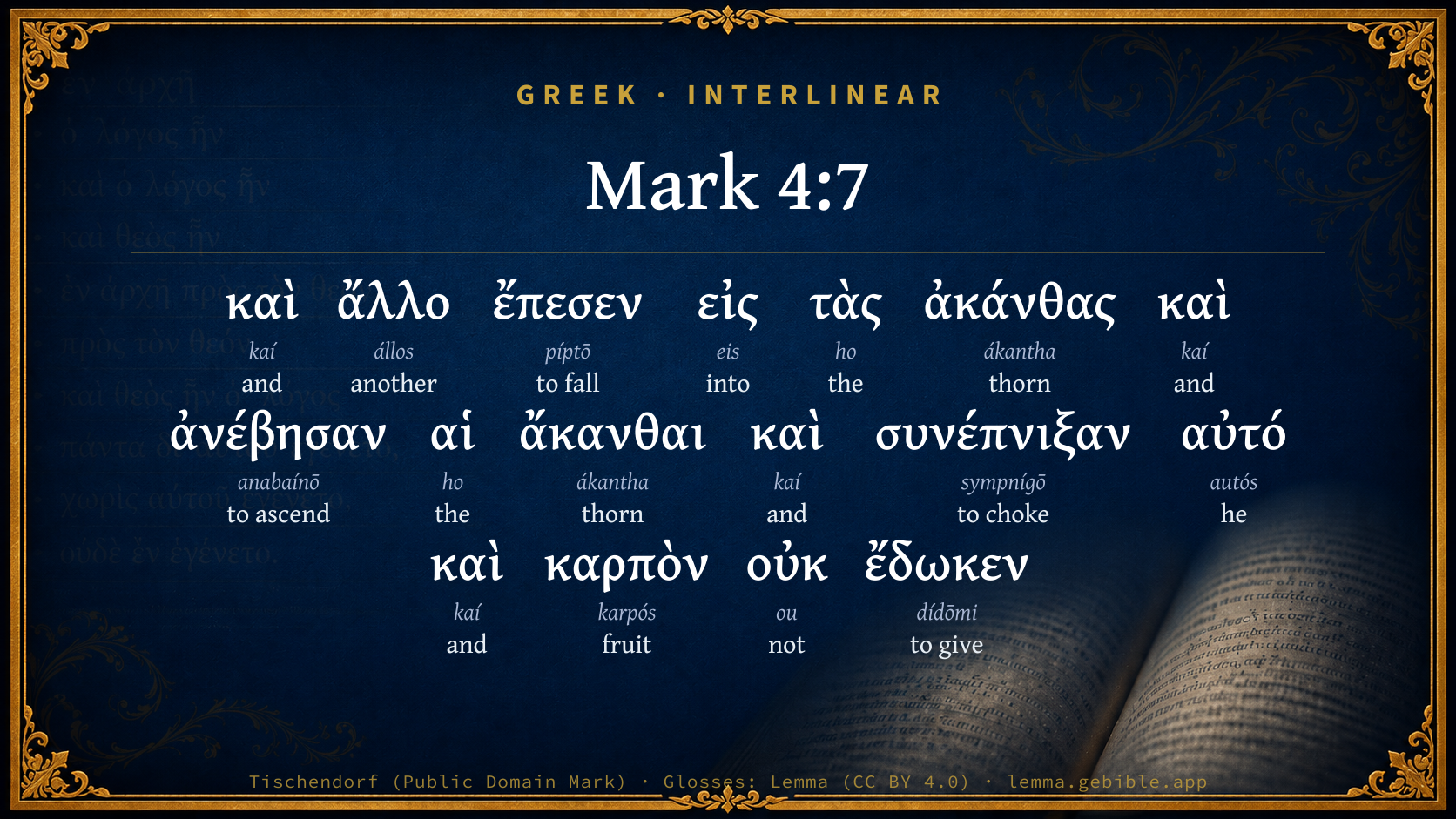
Greek (Tischendorf 8th ed.) Mark 4:7 appears in the Greek New Testament. The text above is from the Tischendorf 8th edition. Each word links to its Strong’s number and a concise gloss. Click any word for its full Thayer’s Greek Lexicon entry.
Download image
Cite this verse

Mark 4:7 (World English Bible). Public Domain. Lemma interlinear Bible study tool, https://lemma.gebible.app/v/mark/4/7.

Show BibTeX & RIS
BibTeX
RIS
English Translation
Others fell among the thorns, and the thorns grew up, and choked it, and it yielded no fruit.
World English Bible · Public Domain
Download a study sheet

One document with this verse’s original text, its word-by-word gloss line, the meaning frame, cross-references with their text, attributed commentary, and full source and license credits — printable, and it pastes into notes with its structure intact.

This verse Autodidact and up

Study sheet (.html) Plain text (.txt)

A passage Seminary Student

Up to 50 verses in one chapter. A passage sheet keeps up to 6 commentary sources and 12 cross-references per verse, in the order this page ranks them, and says so on the sheet whenever that leaves anything out. Ask for a single verse and you get the Autodidact verse sheet above.

Everything on this page stays free to read, with no account — the sheet is a download of what is already on screen, not access to it.

Want to remove ads? Support Godless Engineer
Compare translations 3

The same verse in 3 English versions, stacked beneath the original-language interlinear above. Click any original word for its lexicon entry.

Each is an independent rendering of the whole verse — the interlinear is not word-aligned to these translations.

Highlighted words mark where these versions differ — a whole-verse word diff, not a word-by-word alignment.

  • World English Bible Public Domain
    Others fell among the thorns, and the thorns grew up, and choked it, and it yielded no fruit.
  • King James Version Public Domain
    And some fell among thorns, and the thorns grew up, and choked it, and it yielded no fruit.
  • unfoldingWord Literal Text CC BY-SA 4.0
    And other fell into the thorns, and the thorns grew up and choked it, and it did not give fruit.

unfoldingWord Literal Text — © unfoldingWord, licensed CC BY-SA 4.0. Word-aligned USFM3 via Door43 (git.door43.org/unfoldingWord/en_ult).

Versions to compare (up to 4)

3 of 4 selected

Show all 19 translations

Every available English version of this verse, each an independent rendering of the whole verse.

  • World English Bible Public Domain
    Others fell among the thorns, and the thorns grew up, and choked it, and it yielded no fruit.
  • Berean Standard Bible Public Domain
    Other seed fell among thorns, which grew up and choked the seedlings, and they yielded no crop.
  • Majority Standard Bible Public Domain
    Other seed fell among thorns, which grew up and choked the seedlings, and they yielded no crop.
  • King James Version Public Domain
    And some fell among thorns, and the thorns grew up, and choked it, and it yielded no fruit.
  • American Standard Version (1901) Public Domain
    And other fell among the thorns, and the thorns grew up, and choked it, and it yielded no fruit.
  • Revised Version (1885) Public Domain
    And other fell among the thorns, and the thorns grew up, and choked it, and it yielded no fruit.
  • Geneva Bible (1599) Public Domain
    And some fell among the thornes, and the thornes grewe vp, and choked it, so that it gaue no fruite.
  • Douay-Rheims (1899) Public Domain
    And some fell among thorns; and the thorns grew up, and choked it, and it yielded no fruit.
  • Young's Literal Translation Public Domain
    and other fell toward the thorns, and the thorns did come up, and choke it, and fruit it gave not;
  • Literal Standard Version CC BY-SA 4.0
    and other fell toward the thorns, and the thorns came up and choked it, and it gave no fruit;
  • Unlocked Literal Bible CC BY-SA 4.0
    Other seed fell among the thorn plants. The thorn plants grew up and choked it, and it did not produce a crop.
  • unfoldingWord Literal Text CC BY-SA 4.0
    And other fell into the thorns, and the thorns grew up and choked it, and it did not give fruit.
  • Darby Bible Public Domain
    And another fell among the thorns, and the thorns grew up and choked it, and it yielded no fruit.
  • World Messianic Bible Public Domain
    Others fell among the thorns, and the thorns grew up and choked it, and it yielded no fruit.
  • Webster's Bible Public Domain
    And some fell among thorns, and the thorns grew up, and choked it, and it yielded no fruit.
  • Free Bible Version CC BY-SA 4.0
    Other seeds fell among thorns. The thorns grew up and choked the sprouting seeds, so they produced nothing.
  • Bible in Basic English Public Domain
    And some went among the thorns, and the thorns came up, and it had no room for growth and gave no fruit.
  • Text-Critical English NT CC BY 4.0
    Other seed fell among the thorns, and the thorns grew up and choked it, and it produced no fruit.
  • Tyndale New Testament (1534) Public Domain
    And some fell amonge the thornes and the thornes grewe vp and choked it so that it gave no frute.

Literal Standard Version (2020), Covenant Press — licensed CC BY-SA 4.0. Text via the HelloAO Bible API (eBible.org). Unlocked Literal Bible (unfoldingWord) — licensed CC BY-SA 4.0. Text via the HelloAO Bible API (eBible.org). unfoldingWord Literal Text — © unfoldingWord, licensed CC BY-SA 4.0. Word-aligned USFM3 via Door43 (git.door43.org/unfoldingWord/en_ult). Free Bible Version, Dr. Jonathan Gallagher — licensed CC BY-SA 4.0. Text via the HelloAO Bible API (eBible.org).

Word by word

More ways to search: Search by grammar → Find every occurrence → Compare this word →

Practice this passage: Drill this verse → Learn its vocabulary →

συνέπνιξαν
sympnígō
G4846
“to choke”
Verb, Aorist, Active, Indicative, 3rd person, Plural
Part of Speech
Verb
Tense
Aorist
Voice
Active
Mood
Indicative
Person
3rd person
Number
Plural
Full Thayer's Definition

Origin: from G4862 and G4155

TDNT: 13:35,9

1. to choke utterly a. metaph. the seed of the divine word sown in the mind b. to press round or throng one so as almost to suffocate him
  1. καὶ kaí G2532 “and” Conjunction
  2. ἄλλο állos G243 “another” Adjective, Nominative, Singular, Neuter
  3. ἔπεσεν píptō G4098 “to fall” Verb, Aorist, Active, Indicative, 3rd person, Singular
  4. εἰς eis G1519 “into” Preposition
  5. τὰς ho G3588 “the” Article, Accusative, Plural, Feminine
  6. ἀκάνθας ákantha G173 “thorn” Noun, Accusative, Plural, Feminine
  7. καὶ kaí G2532 “and” Conjunction
  8. ἀνέβησαν anabaínō G305 “to ascend” Verb, Aorist, Active, Indicative, 3rd person, Plural
  9. αἱ ho G3588 “the” Article, Nominative, Plural, Feminine
  10. ἄκανθαι ákantha G173 “thorn” Noun, Nominative, Plural, Feminine
  11. καὶ kaí G2532 “and” Conjunction
  12. αὐτό autós G846 “he” Personal pronoun, Accusative, Singular, Neuter
  13. καὶ kaí G2532 “and” Conjunction
  14. καρπὸν karpós G2590 “fruit” Noun, Accusative, Singular, Masculine
  15. οὐκ ou G3756 “not” Particle, Negative
  16. ἔδωκεν dídōmi G1325 “to give” Verb, Aorist, Active, Indicative, 3rd person, Singular

About this verse

These counts appear in no published source. They are computed here, from the morphology-tagged text and Lemma’s own curated glosses. What Lemma adds →

17
words
12
distinct lemmas
Gospels
section

Notable vocabulary

The rarest word here is συνέπνιξαν to choke G4846 — appearing just 5 times in the whole Greek New Testament.

Shared distinctive vocabulary

συνέπνιξαν to choke G4846 occurs in 5 verses of the Greek New Testament. Also found in:

Repetition

Words recur within this verse:

  • ἀκάνθας thorn G173 ×2
  • καὶ and G2532 ×4
  • τὰς the G3588 ×2

Cross-references

11

Topical passages linked to Mark 4:7 in the Treasury of Scripture Knowledge — connected by theme and wording, ordered by reader-vote popularity; previews shown in the World English Bible.

  • Jeremiah 4:3 For thus says Yahweh to the men of Judah and to Jerusalem, Break up your fallow ground, and don't sow among thorns.
  • Luke 8:14 That which fell among the thorns, these are those who have heard, and as they go on their way they are choked with cares, riches, and pleasures of life, and bring no fruit to maturity.
  • Genesis 3:17–18 To Adam he said, "Because you have listened to your wife's voice, and have eaten of the tree, of which I commanded you, saying, 'You shall not eat of it,' cursed is the ground for your sake. In toil you will eat of it all the days of your life.
  • 1 John 2:15–16 Don't love the world, neither the things that are in the world. If anyone loves the world, the Father's love isn't in him.
  • Matthew 13:7 Others fell among thorns. The thorns grew up and choked them:
  • Matthew 13:22 What was sown among the thorns, this is he who hears the word, but the cares of this age and the deceitfulness of riches choke the word, and he becomes unfruitful.
  • Mark 4:18–19 Others are those who are sown among the thorns. These are those who have heard the word,
  • Luke 8:7 Other fell amid the thorns, and the thorns grew with it, and choked it.
  • Luke 12:15 He said to them, "Beware! Keep yourselves from covetousness, for a man's life doesn't consist of the abundance of the things which he possesses."
  • Luke 21:34 "So be careful, or your hearts will be loaded down with carousing, drunkenness, and cares of this life, and that day will come on you suddenly.
  • 1 Timothy 6:9–10 But those who are determined to be rich fall into a temptation and a snare and many foolish and harmful lusts, such as drown men in ruin and destruction.

Cross-references courtesy of OpenBible.info (CC BY 4.0).

Commentary

Notes on Mark 4:7 from classic Christian and Jewish commentators (each source and its license shown beneath its notes). The classic Christian expositions comment on the surrounding passage and are grouped to its opening verse, so a note may address several verses; the Jewish commentaries on the Tanakh (Rashi and others) are per-verse, so they appear only where the commentator wrote on this verse.

Lemma curates 59 commentaries, every one of them public domain or Creative Commons licensed, each selected and text-cleaned for this edition rather than reprinted as found. About our sources →

The Biblical Illustrator

Joseph S. Exell

Mar_4:7; Mar_4:18-19

And some fell among thorns, and the thorns grew up and choked it.

The character of worldly-minded hearers considered

1. The treatment the Word meets with from these persons. They hear and receive it.

2. How this salutary operation on his heart is obstructed and defeated.

3. What is the event? These thorns choke the Word.

I. What these things are which obstruct the due operation of Gods word on the hearts of these men?

1. The cares of the world. By the cares of the world He means criminal anxieties about secular concerns.

(1) They relate to subsistence. By this we mean the necessaries of life; man cannot be indifferent to these, but must not distrust the providence of God.

(2) They relate to competence. This is a relative term, and has respect to capacity and desire. But such as is suited to desires not regulated by religion and reason, is an equivocal competence; all care about it is criminal. A prince requires more than his subject; desires directed to this object are commendable. But even though the object be right, the care about it may exceed, and unduly engross our attention and time.

(5) They relate to affluence. This also right; but pride, ambition, and the gratification of vain passions must be offensive to God. Thus these cares, like thorns in the soil, will stifle every generous sentiment.

2. The deceitfulness of riches. Men are prone to reason mistakenly about riches. Riches are, in a sense, themselves deceitful. They assume an appearance different from their real nature and use, and so the unwary observer is imposed upon. Consider the false reasonings of a depraved heart:

(1) As to wealth itself. Riches may be a blessing. The value of them is chiefly to be estimated by their use. Here men mistake it. Money will purchase delicate food, fine mansions, but will it set him beyond the reach of pain, contempt?

(2) Of the mode of acquiring wealth men reason very mistakenly. They too often ignore the providence of God, so He blasts their schemes.

(3) Men reason deceitfully concerning the term of enjoying the wealth they acquire.

3. The pleasures of this life, or the lusts of other things. Here we need not be very particular, for as riches are the means of procuring pleasures, and most generally coveted with that view, the same folly and criminality we have charged to the account of the avaricious is, with a little variation of circumstances, to be imputed likewise to the sensualist. Pleasure indeed, abstractedly considered, is a real good; the desire of it is congenial with our nature, and cannot be eradicated without the destruction of our very existence. This is not therefore what our Lord condemns. He well knew that there ale passions and appetites proper to men as men, that the moderate gratification of them is necessary to their happiness, and of consequence that the desire of such gratification is not sinful. But the pleasure He prohibits is that which results from the indulgence of irregular desires, I mean such as are directed to wrong objects, and such as are excessive in their degree.

II. To show how they obstruct the due operation of Gods word on the heart.

1. As to these of the first description, the careful. It involves distrust of the faithfulness and goodness of Divine providence.

2. As to the avaricious. How vain such desires, expectations, and exertions. Will you suffer such noxious weeds to grow in your heart? Wisdom will give you riches and honour.

3. As to the voluptuous. It precipitates into extravagances which often prove fatal to character. There is no profiting by the Word we hear, without duly weighing and considering it.

There are three things necessary to this:

1. Leisure. Ground choked with briers and thorns affords not room for the seed cast upon it to expand and grow. In like manner, he whose attention is wholly taken up with secular affairs has not leisure for consideration. Say, you who are oppressed with the cares, or absorbed in the pleasures of life, whether this is not the fact? What is it first catches your imagination when you awake in the morning? What is it engrosses your attention all the day? What is it goes with you to your bed, and follows you through the restless hours of night? What is it you are constantly thinking of at home, abroad, and in the house of God? It is the world. Oh sad! not a day, not an hour, scarce a moment in reserve, for a meditation on God, your soul, and an eternal world! And can religion exist where it is never thought of, or gain ground in a heart where it is but now and then adverted to? As well might a man expect to live without sustenance, or get strong without digesting his food. That then, which deprives men of time for consideration, is essentially injurious to religion.

2. Composure. By composure, I mean that calmness or self-possession, whereby we are enabled to attend soberly and without interruption to the business we are about. Consideration implies this in it; for how is it possible that a man should duly consider a subject, whether civil or religious, coolly reason upon it, and thoroughly enter into the spirit of it, if his mind is all the while occupied with a thousand other things, foreign to the matter before him? In order, therefore, to our doing justice to any question of importance, we must rid our minds of all impertinent thoughts, be self-collected, and fix our attention steadily to the point. How difficult this is I need not say. Studious people feel the difficulty; and in regard of religion, the best of men are sensible of their weakness in this respect, and deeply lament it. But where the world gains the ascendant, this difficulty is increased, and, in some instances, becomes almost insuperable. Let me here describe to you, in a few words, the almost incessant hurry and confusion of their minds, who answer to the three characters in our text of the careful, the covetous, and the voluptuous.

So you will clearly see, how impossible it is for persons thus circumstanced to pay the attention to religious subjects which is necessary in order to their being profited by them.

1. The case of him who is swallowed up with the anxious cares of life is truly lamentable. It is not riches the unhappy man aims at, but a competence, or perhaps a mere subsistence. The dread of being reduced, with his family, to extreme poverty, harrows up his very soul. The horrid spectres of contempt, famine, and a prison, haunt his imagination. And how incapable is a man, thus circumstanced, of coolly thinking on the great things of religion! Does he attempt in his retirement to fix his attention to some Divine subject? he instantly fails in the attempt, cares like a wild deluge rush in upon his soul, and break all the measures he had taken to obtain a little respite from his trouble.

2. The like effect hath an eager desire after riches to disqualify men for consideration. When on his knees he is still in the world: when he is worshipping God in his family he is still pursuing his gain. His closet is an accounting house and his church an exchange.

3. How an eager attention to worldly pleasures must have the like effect, to render the mind incapable of serious consideration. Scenes of splendour and sensual delight are before the eyes of men of this character. How is it possible for a mind thus hurried, dissipated, intoxicated with vain amusements, to cultivate religion? They not only deprive men of time, composure for serious consideration-

3. But of all inclination to it. But what I mean, is to show that an eager attention to the things of this life confirms the habit of inconsideration, and tends, where there is an aptitude to meditation, to weaken and deprave it. A mind wholly occupied with the objects of sense, is not only estranged from the great realities of religion, but averse to them. As it has neither leisure nor calmness for sublime contemplations, so it has no taste or relish for them. The carnal mind is enmity against God. And the more carnal it grows by incessant commerce with the world, the more does that prejudice and enmity increase. What violence are such men obliged to put upon themselves, if at any time, by some extraordinary circumstance, they are prevailed on to think of the concerns of their souls! The business is not only awkward, as they are unaccustomed to it, but it is exceeding irksome and painful. Now if a hearty inclination to any business is necessary to capacity to pursue it with success, whatever tends to abate that inclination, or to confirm the opposite aversion, is essentially injurious to such business. In like manner, cares, riches, and pleasures of the world choke the Word.

III. The bad event of such undue commerce with the world. The unhappy man not having leisure, calmness, or inclination to attend to the Word.

1. He understands not the Word of the kingdom. He has a speculative acquaintance with the truths of religion; it cannot be experimental.

2. He does not believe it. He who believes the gospel to the salvation of his soul must enter into the spirit of it. But how can this be the case with a man whose heart is possessed by the god of this world?

3. Not rightly understanding or believing the Word of the kingdom, he is not obedient to it.

4. What is the final issue of all? Why, the man himself, as well as the seed, is choked (Luk_8:14).

Exhortation:

1. Let the professors of religion have no more to do with the world than duty clearly requires. Be not conformed to this world; but be ye transformed by the renewing of your mind. Come out from among them, and be ye separate, and touch not the unclean thing. Have no fellowship with the unfruitful works of darkness.

2. If thorns before we are aware get in, let us instantly root them out. Exert all the power of Christian resolution.

3. Receive the good seed. It is not enough that the ground is cleared of noxious weeds, if it be not sown with the proper grain. Neither is it sufficient to guard against the corrupt maxims, customs, and manners of the world, if our hearts are not impregnated with Divine truth.

4. And lastly, look to God for His blessing. Paul may plant, and Apollos water; but it is God that giveth the increase. We may hear, read, meditate, reflect, watch, and use many good endeavours; but if no regard be had to a superior influence, all will be vain. (S. Stennett, D. D.)

The Word choked

Robert Burns-who had times of serious reflection, in one of which, as recorded by his own pen, he beautifully compares himself, in the review of his past life, to a lonely man walking amid the ruins of a noble temple, where pillars stand dismantled of their capitals, and elaborate works of purest marble lie on the ground, overgrown by tall, foul, rank weeds-was once brought, as I have heard, under deep convictions. He was in great alarm. The seed of the Word had begun to grow. He sought counsel from one called a minister of the gospel. Alas, that in that crisis of his history he should have trusted the helm to the hands of such a pilot! This so-called minister laughed at the poets fears-bade him dance them away at balls, drown them in bowls of wine, fly from these phantoms to the arms of pleasure. Fatal, too pleasant advice! He followed it; and the lusts of other things entering in, choked the word. (T. Guthrie.)

The insinuating destruction of truth in the soul

In the gardens of Hampton Court you will see many trees entirely vanquished and well-nigh strangled by huge coils of ivy, which are wound about them like the snakes around the unhappy Laocoon; there is no untwisting the folds, they are too giant-like, and fast fixed, and every hour the rootlets of the climber are sucking the life out of the unhappy tree. Yet there was a day when the ivy was a tiny aspirant, only asking a little aid in climbing; had it been denied then the tree had never become its victim, but by degrees the humble weakling grew in strength and arrogance, and at last it assumed the mastery, and the tall tree became the prey of the creeping, insinuating destroyer. The moral is too obvious. Sorrowfully do we remember many noble characters which have been ruined little by little by insinuating habits. Covetousness, drink, the love of pleasure, and pride, have often been the ivy that has wrought the ruin. (The Sword and Trowel.)

The cares of wealth

An emperor once said to his courtiers: You gaze on my purple robe and golden crown, but did you know what cares are under it, you would not take it up from the ground to have it. (Brooks.)

Gold a destroyer

When Arates threw his gold into the sea, he cried out, I will destroy you, lest you should destroy me. (Secker.)

Prosperity favourable to deception

The snow covers many a dunghill, and so doth prosperity many a rotten heart. It is easy to wade in a warm bath and every bird can sing on a sunshiny day. (Brooks.)

Remedies against immoderate care for temporal things

1. Consider the nature of these things: they are vain, transitory, perishing; and they only minister to our earthly life which will end we know not how soon.

2. By all our care we cannot help or profit ourselves, without Gods blessing on the means we use.

3. It is a heathenish practice thus to vex and trouble ourselves with immoderate cares for earthly things: not fit for Christians, who profess faith in Gods Providence.

4. We are commanded to cast our cares upon God; and He has promised to care for us, and to provide for us all things necessary for this life, as well as for that which is to come, if we depend on Him by faith (Psa_55:2; 1Pe_5:7).

5. Consider how God provides for other creatures, of less value and worth than ourselves, without their care.

6. Immoderate cares for this life oppress the heart and mind exceedingly, taking them up so that they cannot be free to meditate on spiritual and heavenly things: hindering men also from daily preparing themselves for death and judgment (Luk_21:34).

7. Let our chief care be for heavenly and spiritual things, which concern Gods glory and the salvation of our souls. This will moderate and slake our care for temporal things. (G. Petter.)

The difficulty of worldly prosperity

Great skill is required to the governing of a plentiful and prosperous estate, so as it may be safe and comfortable to the owner, and beneficial to others. Every corporal may know how to order some few files; but to marshal many troops in a regiment, many regiments in a whole body of an army, requires the skill of an experienced general. (Hall.)

Prosperity a trial

Life is a time for the getting of character, and for the trial and perfecting of it. The world is a moral furnace, in which God searches and tests us. One man He tries by adversity, another by prosperity. And the latter is the severer of the two.

1. A prosperous man has little time to spare for religion. Every effort is needed to ensure the continued success of his worldly enterprises. Accordingly, his spiritual life droops and withers.

2. From want of cultivation his taste for spiritual things abates.

3. Pride is apt to increase.

4. Self-indulgence creeps in, and the lower appetites obtain mastery in the heart.

5. The result is a thoroughly worldly life-a life occupied wholly with transitory things, a life in which religion has no part. These are some of the chief dangers which appertain to a state of prosperity. Beware of them in time. They encroach very gradually; and before you are aware of it, you may be swallowed up. (A. Raleigh, D. D.)

Ill effects of prosperity

Generally speaking, the sunshine of too much worldly favour weakens and relaxes our spiritual nerves; as weather, too intensely hot, relaxes those of the body. A degree of seasonable opposition, like a fine dry frost, strengthens and invigorates and braces up. (A. M. Toplady.)

Prosperity causes men to forget God

Prosperity most usually makes us proud, insolent, forgetful of God, and of all duties we owe unto Him. It chokes and extinguishes, or at least cools and abates, the heat and vigour of all virtue in us. And as the ivy, whilst it embraces the oak, sucks the sap from the root, and in time makes it rot and perish; so worldly prosperity kills us with kindness whilst it sucks from us the sap of Gods graces, and so makes our spiritual growth and strength to decay and languish. Neither do men ever almost suffer an eclipse of their virtues and good parts, but when they are in the full of worldly prosperity. (Downame.)

Worldliness defined

It is the spirit of a life, not the objects with which the life is conversant. It is not the flesh, nor the eye, nor life which are forbidden, but the lust of these. It is not this earth nor the men who inhabit it, nor the sphere of our legitimate activity, that we may not love; but it is the way in which the love is given which constitutes worldliness. (F. W. Robertson.)

Worldliness is the spirit of childhood carried on into manhood

The child lives in the present hour; today to him is everything. The holiday promised at a distant interval is no holiday at all-it must be either now or never. Natural in the child, and therefore pardonable, this spirit when carried on into manhood is worldliness. (F. W. Robertson.)

The deceitfulness of riches: Heathen testimony to this

When Cyrus received intelligence that the Lydians had revolted from him, he told a friend, with much emotion, that he had almost determined to make them all slaves. His friend expostulated, begging him to pardon them. But, he added, that they may no more rebel or be troublesome to you, command them to lay aside their arms, to wear long vests and buskins, that is, to vie with each other in the elegance and richness of their dress. Order them to drink, and sing, and play, and you will soon see their spirits broken, and themselves changed to the effeminacy of women, so that they will no more rebel, nor give you any further uneasiness. The advice was followed, and the result proved how politic it was. While the advice is such as no good man could consistently follow, the incident shows the deteriorating influence of luxury in a very striking light.

The lusts of other things

The love of pleasure, of amusements, and sensual gratifications, and even the cultivation of refined tastes; all which have a tendency to engross the mind, and induce it quietly to take up with a world which yields it so much satisfaction. (M. F. Sadler.)

Entering in:

Very suggestive expression; teaching us that these cares of the world, and deceitfulness of riches, may not be present or sensibly felt when the Word first springs up in the heart; but, when opportunity offers, they may make their appearance, and grow far faster and more vigorously than the true religious life, and ultimately destroy it. (M. F. Sadler.)

The Biblical Illustrator, edited by Joseph S. Exell (c. 1880s–1900s) — public domain. Text from a community e-Sword module.

The Cambridge Bible for Schools and Colleges

gen. ed. J. J. S. Perowne

7. thorns] The “Nâbk” of the Arabs, which grows abundantly in Syria and Palestine, and of which the Crown of Thorns was probably woven.

and choked it] or as Wyclif translates it “pornes stieded up, and strangliden it.” The seed and the thorns grew together, but the thorns gradually out-topped it, drew the moisture from the roots, and shut out the air and light, so that it pined and dwindled, and “yielded no fruit.”

The Cambridge Bible for Schools and Colleges (gen. ed. J. J. S. Perowne; Cambridge University Press, 1878–1918) — public domain. Text from a community e-Sword module.

John Gill's Exposition

And other fell on good ground,.... The word was preached to some whose hearts were disposed by the Spirit and grace of God to receive it; and their understandings were enlightened by it; and they had a savoury and comfortable experience of the truths of it, it coming with power to them; it was a good word to them, and through the grace of God they became good by it; a good work of grace was wrought upon their souls, and they were filled with all goodness and righteousness:

and did yield fruit that sprang up, and increased; they not only appeared, and made an outward profession of the word, and brought forth a little show of fruit, which comes to nothing, as in others; but they were filled with the fruits of righteousness, and increased with the increase of God, and grew in grace, and in the knowledge of Christ Jesus, and continued to bring forth fruit to the end of their lives:

and brought forth some thirty, and some sixty, and some an hundred; that is, so many fold: in some the word of God produced larger and greater effects; the grace of God was more in exercise in some, than in others, and some were more fruitful and useful; yet in all of them there was true grace, and a measure of it; some degree of lively exercise, and some usefulness.

John Gill's Exposition of the Whole Bible (1746–1763) — public domain (CC PDM 1.0). Text via the HelloAO Bible API.

Trapp's Complete Commentary

John Trapp

7 And some fell among thorns, and the thorns grew up, and choked it, and it yielded no fruit.

Ver. 7. {See Trapp on "Mat 13:5"}

John Trapp, A Commentary or Exposition upon All the Books of the Old and New Testament (1647–1656) — public domain. Text from a community e-Sword module.

The Pulpit Commentary

Vers. 7, 18, 19. The Word choked in the heart.

Thorns make a good hedge but a bad crop. The soil here described was in itself rich, good soil. But it could not grow both thorns and wheat, and, when occupied by the one, failed to yield the other.

I WHAT ARE THE THORNS THAT OVERGROW THE SOIL? Thorns, thistles, brambles, briers, are signs of neglect. They are the emblems of the primeval curse, for the garden was by our first parents exchanged for the thorny wilderness. In our parable the thorns are explained to represent:

1. The cares of this world. " Cares, whether of State or business, of letters or science, of family or calling, may occupy the mind which has received the truth of God, to such an extent as to hinder that truth from growing up. "Care, when it once hath entered in the breast, Will have the whole possession ere it rest.

Cares are distractions, and, even when concerning lawful things, if unchecked, are detrimental and disastrous. This is the special temptation of the poor and hardworking. Well are we directed to be "careful for nothing," etc., and "to take no thought for the morrow," etc.

2. The deceitfulness of riches" is depicted under the figure of the thorns. The possession of wealth may be a curse to the rich, and the search the race after riches may be a curse to the avaricious and worldly. The unwary are deceived; for riches promise what they cannot give, and they sometimes draw away the heart from the treasure in heaven, which alone can truly enrich and satisfy for ever. How many, trusting in riches, have failed of the kingdom!

3. The lusts of other things" have much of mischief laid to their charge. Pleasure is a fair and fragrant flower, but it may hide a thorn. It may be manifestly sinful, it may be doubtful, it may be innocent but unduly absorbing, and in any such case it may choke the Word. How many are the things which men put in the place of religion! They are left unnamed, that we may supply them from our own knowledge of our own hearts and their manifold and varied snares. To desire aught earthly overmuch is to desire things heavenly too little.

II HOW DO THESE THORNS CHOKE THE SEED? In two ways:

1. By taking up the room which the Word requires. They occupy the short and fleeting period of time allotted for our probation. The leisure for pondering and practically obeying the truth never comes. Time flies: the soul dies. They absorb attention and engage the heart. The words of the world must be listened to, and Christ must wait until "a more convenient season which never comes. But if the world must have our ears, must claim our hands, Christ should have our heart. Alas! men plan and toil, prosper and grow rich, respected, powerful, famous; and in doing so neglect the Word. Little know they of the mind of Paul, "To me to live is Christ.

2. By counteracting the influence of the truth. In the former case (the rocky ground) it was persecution; in this case it is the allurements of the world which prove injurious to the soul. Cares and lusts are thorns which must be choked or they choke. So thorn and corn grow side by side with a fair show. But gradually the evil gains the victory, and goodness perishes. What experienced sower has not seen and mourned over the process? Warnings are in vain. The thorns grow apace; the soul becomes insensible to all the claims of Christ, to all the appeals of the gospel. So the Word is unfruitful as before. "Stones mar the root; Thorns spoil the fruit.

What poor produce there is comes to no maturity, no perfection. Labour is wasted, promise is blasted, hope is clouded, all is lost!

APPLICATION. None who receive the Word of life are free from the danger here described. Search and find out the hindrances to vigor and fruitfulness in the spiritual life. Root them all up, that the Word may live and grow and yield abundance. Look for fruit; God looks for it as the only proof of life. Else, when the Lord comes and finds no fruit, the thorns will indeed be burned, but the ground will be exposed as fruitless and worthless, and "nigh unto cursing."

The Pulpit Commentary (1880–1919), ed. H.D.M. Spence-Jones & Joseph S. Exell — public domain. Text from a community e-Sword module.

Cambridge Greek Testament for Schools and Colleges

7. ἀνέβησαν αἱ ἄκανθαι. The thorns were as yet hardly above the surface; but they were more vigorous.

συνέπνιξαν. Vulg. suffocaverunt; Wic. “strangliden.” The συν-expresses intensity; see on Mar 3:5. Mt. and Lk. have ἀπέπνιξαν, “choked off.”

καὶ καρπὸν οὐκ ἔδωκεν. Hardly necessary after συνέπνιξαν, and omitted by Mt. and Lk. See on καὶ τότε, Mar 3:27.

Cambridge Greek Testament for Schools and Colleges (Cambridge University Press, 1896; 21 vols, various authors incl. Carr, Maclear, Plummer, Farrar, Lumby, Moule, M. R. James, Simcox) — public domain. Text from a community e-Sword module.

International Critical Commentary

7. εἰς τὰς ἀκάνθας—i.e. among the seeds of thorns or briers, which afterwards came up, ἀνέβησαν, and choked the grain.

International Critical Commentary — older volumes (1896–1929), various authors — public domain. Text from a community e-Sword module.

Vincent's Word Studies in the New Testament

Marvin R. Vincent

Choked [συνεπνιξαν] . The preposition, sun = com (together), carries the idea of com - pression. It yielded no fruit. Added by Mark.

Marvin R. Vincent, Word Studies in the New Testament (1887–1900) — public domain. Text from a community e-Sword/MySword module.

Lesson kit

Teaching starters — assembled from the data on this page, not authored interpretation. Every prompt links to the verse data it draws on. Edit before teaching.

Mark, in the Gospels, opens this verse with 17 words (12 distinct Greek lemmas). Its most distinctive word is sympnígō (“to choke”). A historical commentator’s framing appears above. Read the whole chapter for the surrounding context.

Discussion questions

  1. What does “to choke” (sympnígō) contribute to the verse as a whole?
  2. Matthew 13:22 shares the word «to choke» with this verse. How do the two illuminate each other?
  3. “thorn” occurs 2× in this one verse. What is the effect of the repetition?
  4. These translations render this verse differently. What is at stake in choosing one wording over another?
  5. Reading how The Biblical Illustrator and The Cambridge Bible for Schools and Colleges read this verse, where do the two commentators agree and where do they part?

Things to notice

  • These translations choose different wording for 8 words in this verse.
  • “thorn” occurs 2× in this single verse.
  • 12 distinct Greek lemmas span 17 words in this verse.

Reading settings

Reading text

Shown beneath each verse's original-language words.

Old Testament
Old Testament edition

Read the OT as the Masoretic Hebrew (MT) or the Greek Septuagint (LXX).

English shown for the Greek Septuagint (in the Hebrew ↔ Greek comparison).

Comparing translations? Open the Compare panel on any verse page to stack up to four side by side.