
Genesis 4:15

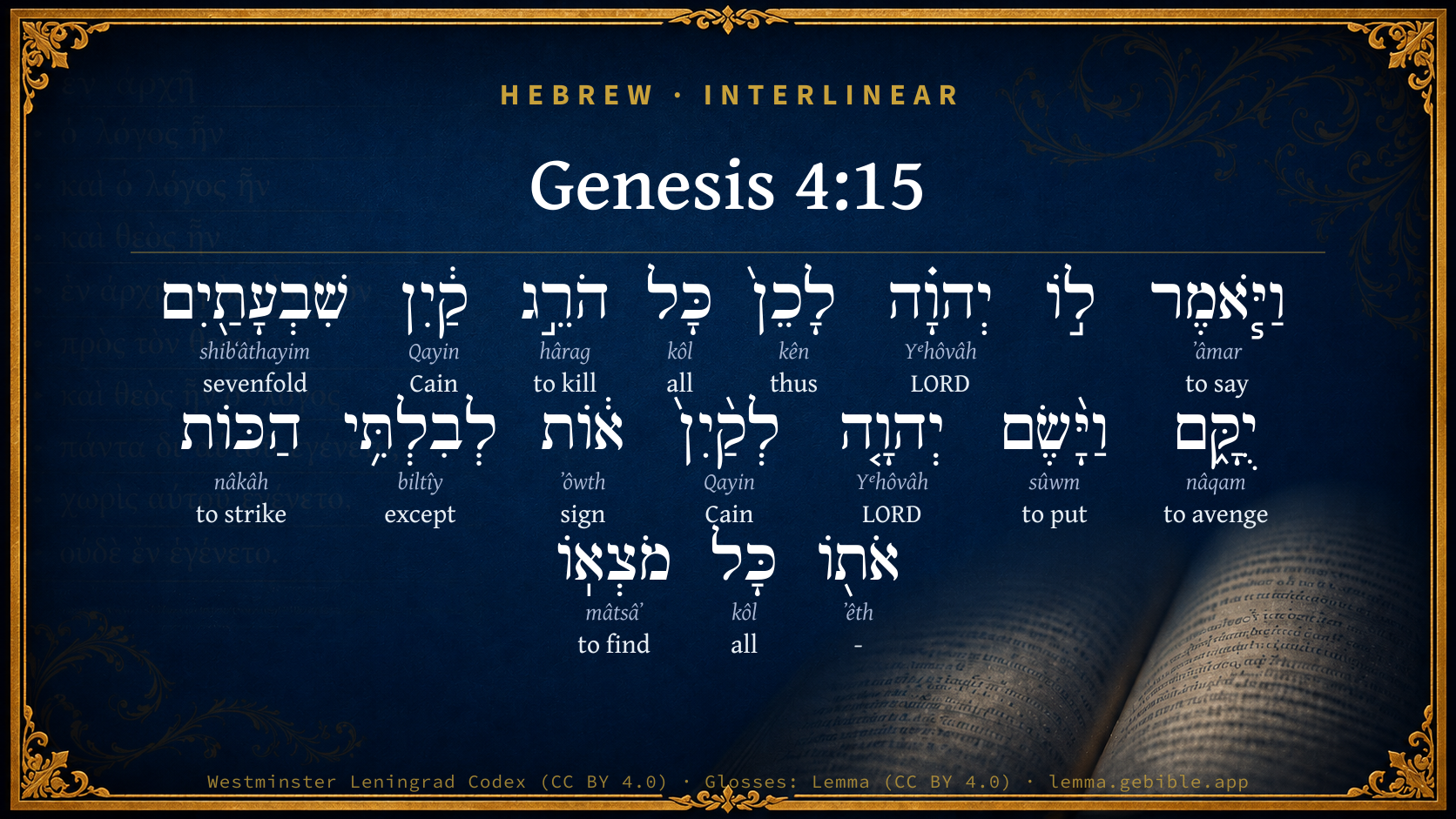
Hebrew (Westminster Leningrad Codex) Genesis 4:15 appears in the Hebrew Old Testament. The text above is from the Westminster Leningrad Codex. Each word links to its Strong’s number, a concise gloss, and parsing drawn from the Open Scriptures Hebrew Bible morphology. Click any word for its full Brown-Driver-Briggs (BDB) entry.
Download image
Cite this verse

Genesis 4:15 (World English Bible). Public Domain. Lemma interlinear Bible study tool, https://lemma.gebible.app/v/genesis/4/15.

Show BibTeX & RIS
BibTeX
RIS
English Translation
Yahweh said to him, "Therefore whoever slays Cain, vengeance will be taken on him sevenfold." Yahweh appointed a sign for Cain, lest any finding him should strike him.
World English Bible · Public Domain
Highlights
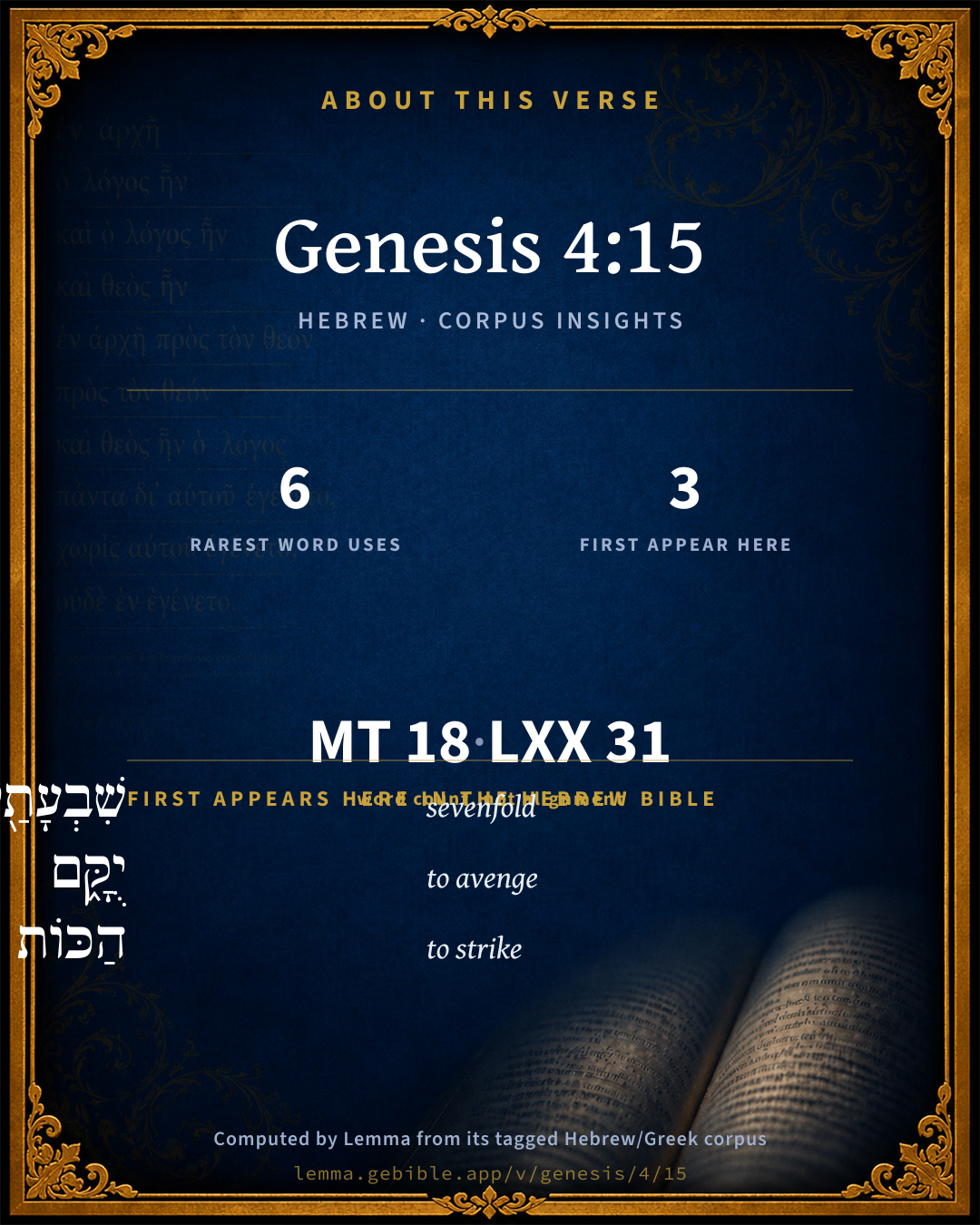
  • 3 first appearances in the Hebrew Bible
Full analysis ↓
Download a study sheet

One document with this verse’s original text, its word-by-word gloss line, the meaning frame, cross-references with their text, attributed commentary, and full source and license credits — printable, and it pastes into notes with its structure intact.

This verse Autodidact and up

Study sheet (.html) Plain text (.txt)

A passage Seminary Student

Up to 50 verses in one chapter. A passage sheet keeps up to 6 commentary sources and 12 cross-references per verse, in the order this page ranks them, and says so on the sheet whenever that leaves anything out. Ask for a single verse and you get the Autodidact verse sheet above.

Everything on this page stays free to read, with no account — the sheet is a download of what is already on screen, not access to it.

Want to remove ads? Support Godless Engineer
Compare translations 3

The same verse in 3 English versions, stacked beneath the original-language interlinear above. Click any original word for its lexicon entry.

Each is an independent rendering of the whole verse — the interlinear is not word-aligned to these translations.

Highlighted words mark where these versions differ — a whole-verse word diff, not a word-by-word alignment.

  • World English Bible Public Domain
    Yahweh said to him, "Therefore whoever slays Cain, vengeance will be taken on him sevenfold." Yahweh appointed a sign for Cain, lest any finding him should strike him.
  • King James Version Public Domain
    And the LORD said unto him, Therefore whosoever slayeth Cain, vengeance shall be taken on him sevenfold. And the LORD set a mark upon Cain, lest any finding him should kill him.
  • unfoldingWord Literal Text CC BY-SA 4.0
    Then Yahweh said to him, “For that, anyone who kills Cain will suffer vengeance seven times over!” Then Yahweh put a mark on Cain so that everyone who found him would not strike him.

unfoldingWord Literal Text — © unfoldingWord, licensed CC BY-SA 4.0. Word-aligned USFM3 via Door43 (git.door43.org/unfoldingWord/en_ult).

Versions to compare (up to 4)

3 of 4 selected

Show all 18 translations

Every available English version of this verse, each an independent rendering of the whole verse.

  • World English Bible Public Domain
    Yahweh said to him, "Therefore whoever slays Cain, vengeance will be taken on him sevenfold." Yahweh appointed a sign for Cain, lest any finding him should strike him.
  • Berean Standard Bible Public Domain
    “Not so!” replied the LORD. “If anyone slays Cain, then Cain will be avenged sevenfold.” And the LORD placed a mark on Cain, so that no one who found him would kill him.
  • Majority Standard Bible Public Domain
    “Not so!” replied the LORD. “If anyone slays Cain, then Cain will be avenged sevenfold.” And the LORD placed a mark on Cain, so that no one who found him would kill him.
  • King James Version Public Domain
    And the LORD said unto him, Therefore whosoever slayeth Cain, vengeance shall be taken on him sevenfold. And the LORD set a mark upon Cain, lest any finding him should kill him.
  • American Standard Version (1901) Public Domain
    And Jehovah said unto him, Therefore whosoever slayeth Cain, vengeance shall be taken on him sevenfold. And Jehovah appointed a sign for Cain, lest any finding him should smite him.
  • Revised Version (1885) Public Domain
    And the LORD said unto him, Therefore whosoever slayeth Cain, vengeance shall be taken on him sevenfold. And the LORD appointed a sign for Cain, lest any finding him should smite him.
  • Geneva Bible (1599) Public Domain
    Then the Lord said vnto him, Doubtlesse whosoeuer slayeth Kain, he shalbe punished seue folde. And the Lord set a marke vpon Kain, lest any man finding him should kill him.
  • Douay-Rheims (1899) Public Domain
    And the Lord said to him: No, it shall not be so: but whosoever shall kill Cain, shall be punished sevenfold. And the Lord set a mark upon Cain, that whosoever found him should not kill him.
  • Young's Literal Translation Public Domain
    And Jehovah saith to him, `Therefore -- of any slayer of Cain sevenfold it is required;' and Jehovah setteth to Cain a token that none finding him doth slay him.
  • Literal Standard Version CC BY-SA 4.0
    And YHWH says to him, “Therefore, of any slayer of Cain it is required sevenfold”; and YHWH sets to Cain a token that none finding him will slay him.
  • Unlocked Literal Bible CC BY-SA 4.0
    Yahweh said to him, “If anyone kills Cain, vengeance will be taken on him sevenfold.” Then Yahweh put a mark on Cain, so that if anyone found him, that person would not attack him.
  • unfoldingWord Literal Text CC BY-SA 4.0
    Then Yahweh said to him, “For that, anyone who kills Cain will suffer vengeance seven times over!” Then Yahweh put a mark on Cain so that everyone who found him would not strike him.
  • Darby Bible Public Domain
    And Jehovah said to him, Therefore, whoever slayeth Cain, it shall be revenged sevenfold. And Jehovah set a mark on Cain, lest any finding him should smite him.
  • World Messianic Bible Public Domain
    The LORD said to him, “Therefore whoever slays Cain, vengeance will be taken on him sevenfold.” The LORD appointed a sign for Cain, so that anyone finding him would not strike him.
  • Webster's Bible Public Domain
    And the LORD said to him, Therefore whoever slayeth Cain, vengeance shall be taken on him seven-fold. And the LORD set a mark upon Cain, lest any finding him should kill him.
  • Free Bible Version CC BY-SA 4.0
    But the Lord replied, “No, Cain. Anyone who kills you will be punished seven times over.” The Lord placed a mark on Cain so that no one who came across him would kill him.
  • Bible in Basic English Public Domain
    And the Lord said, Truly, if Cain is put to death, seven lives will be taken for his. And the Lord put a mark on Cain so that no one might put him to death.
  • JPS Tanakh (1917) Public Domain
    And the LORD said unto him: 'Therefore whosoever slayeth Cain, vengeance shall be taken on him sevenfold.' And the LORD set a sign for Cain, lest any finding him should smite him.

Literal Standard Version (2020), Covenant Press — licensed CC BY-SA 4.0. Text via the HelloAO Bible API (eBible.org). Unlocked Literal Bible (unfoldingWord) — licensed CC BY-SA 4.0. Text via the HelloAO Bible API (eBible.org). unfoldingWord Literal Text — © unfoldingWord, licensed CC BY-SA 4.0. Word-aligned USFM3 via Door43 (git.door43.org/unfoldingWord/en_ult). Free Bible Version, Dr. Jonathan Gallagher — licensed CC BY-SA 4.0. Text via the HelloAO Bible API (eBible.org).

Word by word

More ways to search: Search by grammar → Find every occurrence → Compare this word →

Practice this passage: Drill this verse → Learn its vocabulary →

שִׁבְעָתַ֖יִם
shibʻâthayim
H7659
“sevenfold”
Noun, Common, Feminine, Dual, Absolute
Part of Speech
Noun
Type
Common
Gender
Feminine
Number
Dual
State
Absolute
Full BDB Definition

Origin: dual (adverbially) of H7651

TWOT: 2318c

sevenfold, seven times - sevenfold, seven times as much - seven times
  1. וַיֹּ֧אמֶר ʼâmar H559 “and · to say” Conjunction + Verb, Qal, Sequential Imperfect, 3rd Person, Masculine, Singular
  2. יְהוָ֗ה Yᵉhôvâh H3068 “LORD” Noun, Proper
  3. לָכֵן֙ kên H3651 “to/for · thus” Preposition + Adverb
  4. כָּל kôl H3605 “all of” Noun, Common, Masculine, Singular, Construct
  5. הֹרֵ֣ג hârag H2026 “killing” Verb, Qal, Participle Active, Masculine, Singular, Construct
  6. קַ֔יִן Qayin H7014 “Cain” Noun, Proper
  7. יֻקָּ֑ם nâqam H5358 “to avenge” Verb, Hophal, Imperfect, 3rd Person, Masculine, Singular
  8. וַיָּ֨שֶׂם sûwm H7760 “and · to put” Conjunction + Verb, Qal, Sequential Imperfect, 3rd Person, Masculine, Singular
  9. יְהוָ֤ה Yᵉhôvâh H3068 “LORD” Noun, Proper
  10. לְקַ֨יִן֙ Qayin H7014 “to/for · Cain” Preposition + Noun, Proper
  11. א֔וֹת ʼôwth H226 “sign” Noun, Common, Both, Singular, Absolute
  12. לְבִלְתִּ֥י biltîy H1115 “to/for · except” Preposition + Conjunction
  13. הַכּוֹת nâkâh H5221 “to strike” Verb, Hiphil, Infinitive Construct
  14. אֹת֖וֹ ʼêth H853 “- · him” Particle, Direct Object + Suffix, Personal, 3rd Person, Masculine, Singular
  15. כָּל kôl H3605 “all of” Noun, Common, Masculine, Singular, Construct
  16. מֹצְאֽוֹ mâtsâʼ H4672 “finding · him” Verb, Qal, Participle Active, Masculine, Singular, Construct + Suffix, Personal, 3rd Person, Masculine, Singular

About this verse

These counts appear in no published source. They are computed here, from the morphology-tagged text and Lemma’s own curated glosses. What Lemma adds →

18
words
14
distinct lemmas
Pentateuch
section

Notable vocabulary

The rarest word here is שִׁבְעָתַ֖יִם sevenfold H7659 — appearing just 6 times in the whole Hebrew Bible.

First appearance in Scripture

These words make their first canonical appearance in the Hebrew Bible here:

  • שִׁבְעָתַ֖יִם sevenfold H7659
  • יֻקָּ֑ם to avenge H5358
  • הַכּוֹת to strike H5221

Shared distinctive vocabulary

שִׁבְעָתַ֖יִם sevenfold H7659 occurs in 6 verses of the Hebrew Bible. Also found in:

Grammatical profile

  • 6 verbs
  • 8 nouns
  • 1 preposition
  • 1 conjunction
  • 1 adverb
  • 1 particle

Verb forms

  • וַיֹּ֧אמֶר Qal · Sequential Imperfect
  • הֹרֵ֣ג Qal · Participle Active
  • יֻקָּ֑ם Hophal · Imperfect
  • וַיָּ֨שֶׂם Qal · Sequential Imperfect
  • הַכּוֹת Hiphil · Infinitive Construct
  • מֹצְאֽוֹ Qal · Participle Active

Repetition

Words recur within this verse — often emphatic in Hebrew:

  • יְהוָ֗ה LORD H3068 ×2
  • כָּל all H3605 ×2
  • קַ֔יִן Cain H7014 ×2

Hebrew & Septuagint length

In English translation the verse runs 28 words from the Hebrew and 36 from the Septuagint (LXX English) — closely comparable.

A rough comparison of the two English renderings, which tokenize alike — not a word-level alignment.

Word counts can differ between the Hebrew and the Greek without any difference in meaning — e.g. the Hebrew direct-object marker אֵת has no separate Greek word, and Greek often adds the article ὁ.

In the original languages it is 18 Hebrew tokens and 31 Greek tokens — but the two are counted differently (Hebrew bundles its prefixes and suffixes into one token; the Greek is in lemma form), so that isn’t a like-for-like length.

Cross-references

15

Topical passages linked to Genesis 4:15 in the Treasury of Scripture Knowledge — connected by theme and wording, ordered by reader-vote popularity; previews shown in the World English Bible.

  • Ezekiel 9:4 Yahweh said to him, Go through the midst of the city, through the midst of Jerusalem, and set a mark on the foreheads of the men that sigh and that cry over all the abominations that are done in the midst of it.
  • Psalms 79:12 Pay back to our neighbors seven times into their bosom Their reproach with which they have reproached you, Lord.
  • Genesis 4:24 If Cain will be avenged seven times, Truly Lamech seventy-seven times."
  • Ezekiel 9:6 kill utterly the old man, the young man and the virgin, and little children and women; but don't come near any man on whom is the mark: and begin at my sanctuary. Then they began at the old men that were before the house.
  • Revelation 14:9 Another angel, a third, followed them, saying with a great voice, "If anyone worships the beast and his image, and receives a mark on his forehead, or on his hand,
  • Revelation 14:11 The smoke of their torment goes up forever and ever. They have no rest day and night, those who worship the beast and his image, and whoever receives the mark of his name.
  • Leviticus 26:18 "'If you in spite of these things will not listen to me, then I will chastise you seven times more for your sins.
  • Leviticus 26:21 "'If you walk contrary to me, and won't listen to me, then I will bring seven times more plagues on you according to your sins.
  • Leviticus 26:24 then I will also walk contrary to you; and I will strike you, even I, seven times for your sins.
  • Leviticus 26:28 then I will walk contrary to you in wrath; and I also will chastise you seven times for your sins.
  • 1 Kings 16:7 Moreover by the prophet Jehu the son of Hanani came the word of Yahweh against Baasha, and against his house, both because of all the evil that he did in the sight of Yahweh, to provoke him to anger with the work of his hands, in being like the house of Jeroboam, and because he struck him.
  • Psalms 59:11 Don't kill them, or my people may forget. Scatter them by your power, and bring them down, Lord our shield.
  • Hosea 1:4 Yahweh said to him, "Call his name Jezreel; for yet a little while, and I will avenge the blood of Jezreel on the house of Jehu, and will cause the kingdom of the house of Israel to cease.
  • Matthew 26:52 Then Jesus said to him, "Put your sword back into its place, for all those who take the sword will die by the sword.
  • Proverbs 6:31 But if he is found, he shall restore seven times. He shall give all the wealth of his house.

Cross-references courtesy of OpenBible.info (CC BY 4.0).

Hebrew and Greek witnesses Masoretic Hebrew ↔ Greek Septuagint

The same verse in the two great witnesses to the Old Testament, shown verse-for-verse.

These are two independent witnesses, not word-aligned to each other, and the Septuagint is shown in lemma (dictionary) form.

Hebrew Genesis 4:15 Masoretic · Westminster Leningrad Codex

וַיֹּ֧אמֶר ל֣וֹ יְהוָ֗ה לָכֵן֙ כָּל הֹרֵ֣ג קַ֔יִן שִׁבְעָתַ֖יִם יֻקָּ֑ם וַיָּ֨שֶׂם יְהוָ֤ה לְקַ֨יִן֙ א֔וֹת לְבִלְתִּ֥י הַכּוֹת אֹת֖וֹ כָּל מֹצְאֽוֹ

Yahweh said to him, "Therefore whoever slays Cain, vengeance will be taken on him sevenfold." Yahweh appointed a sign for Cain, lest any finding him should strike him.

World English Bible · Public Domain

Greek LXX Genesis 4:15 Septuagint · lemma form

καί εἶπον αὐτός κύριος ὁ θεός οὐ οὕτως πᾶς ὁ ἀποκτείνω καιν ἑπτά ἐκδικέω παραλύω καί τίθημι κύριος ὁ θεός σημεῖον ὁ καιν ὁ μή ἀνααἱρέω αὐτός πᾶς ὁ εὑρίσκω αὐτός

And the Lord God said to him, Not so, any one that slays Cain shall suffer sevenfold vengeance; and the Lord God set a mark upon Cain that no one that found him might kill him.

LXX2012 (modern English Septuagint) · Public Domain

On this verse, Adam Clarke's Commentary discusses the Septuagint’s reading. Read the note in Commentary ↓

Hebrew: Westminster Leningrad Codex (CC BY 4.0). Greek: Septuagint (public domain); English from LXX2012 (modern English Septuagint) (Public Domain). How the Septuagint differs from the Hebrew →

Targum (Aramaic paraphrase)

2

The Targum is the ancient Jewish Aramaic paraphrase of the Hebrew Scriptures — an interpretive translation, not the Hebrew text itself. Onkelos (literal) and Pseudo-Jonathan (expansive) render the Torah, and Jonathan the Prophets. Coverage is partial: where no permissively-licensed English translation exists for a verse, only the Aramaic is shown. This is verse-level text, not a word-by-word alignment to the Hebrew.

  1. Targum Onkelos Torah (Genesis–Deuteronomy)
    וַאֲמַר לֵהּ יְיָ בְּכֵן כָּלּ קָטִיל קַיִן לְשַׁבְעָא דָּרִין יִתְפְּרַע מִנֵּהּ וְשַׁוִּי יְיָ לְקַיִן אָתָא בְּדִיל דְּלָא לְמִקְטַל יָתֵהּ כָּל דִיִשְׁכְּחֻנֵהּ

    (no public-domain English translation for this verse)

    Targum Onkelos — Aramaic: “Onkelos Genesis” (public domain); “Onkelos Exodus” (public domain); “Onkelos Leviticus” (public domain); “Onkelos Numbers” (public domain); “Onkelos Deuteronomy” (public domain). English: “Sefaria Community Translation” (CC0 1.0 (public-domain dedication)); “J.W. Etheridge. The Targums of Onkelos and Jonathan Ben Uzziel on the Pentateuch. London: Longmans, Green, 1862” (public domain). Text via Sefaria.

  2. Targum Pseudo-Jonathan Torah (Genesis–Deuteronomy)
    וַאֲמַר לֵיהּ יְיָ הָא בְּכֵן כָּל דְקָטִיל קַיִן לְשִׁבְעָא דָרִין יִתְפְּרַע מִנֵיהּ וְרָשַׁם יְיָ עַל אַפֵּי דְקַיִן אָתָא מִן שְׁמָא רַבָּא וְיַקִירָא בְּגִין דְלָא לְמִקְטוֹל יָתֵיהּ כָּל דְיִשְׁכְּחוּנֵיהּ בְּאִסְתַּכְּלוּתֵיהּ בֵּיהּ

    And the Lord said to him, Behold now, any one who killeth Kain, unto seven generations vengeance shall be taken of him. And the Lord sealed upon the face of Kain the mark of the Name great and honourable, that any one who might find him should not kill him when he saw it upon him.

    Targum Pseudo-Jonathan — Aramaic: “Targum Jonathan on Genesis” (public domain); “Targum Jonathan on Exodus” (public domain); “Targum Jonathan on Leviticus” (public domain); “Targum Jonathan on Numbers” (public domain); “Targum Jonathan on Deuteronomy” (public domain). English: “The Targum of Jonathan ben Uzziel, trans. J. W. Etheridge, London, 1862” (public domain). Text via Sefaria.

Commentary

Notes on Genesis 4:15 from classic Christian and Jewish commentators (each source and its license shown beneath its notes). The classic Christian expositions comment on the surrounding passage and are grouped to its opening verse, so a note may address several verses; the Jewish commentaries on the Tanakh (Rashi and others) are per-verse, so they appear only where the commentator wrote on this verse.

Lemma curates 59 commentaries, every one of them public domain or Creative Commons licensed, each selected and text-cleaned for this edition rather than reprinted as found. About our sources →

Trapp's Complete Commentary

John Trapp

Gen 4:15 And the LORD said unto him, Therefore whosoever slayeth Cain, vengeance shall be taken on him sevenfold. And the LORD set a mark upon Cain, lest any finding him should kill him.

Ver. 15. The Lord set a mark, &c.] Some say it was the letter Tau; others, some letter of Jehovah: probably it was the perpetual trembling of his hands, and whole body, the very sight whereof made people pity him, till at length he was slain, say some, by his nephew Lamech. Cedrenus {a} tells us, if we may believe him, that Cain took his death by the fall of a house in the year of the world 931, the next year after the death of his father Adam. But however he died, sure it is, he had but an ill life of it. He was marked, says Philo, {b} but to his misery; he might not be killed by any, that he might everyday is dying, having a hell in his conscience, and standing in fear of every man he met with. He that would not hearken to God, so sweetly inciting and enticing him to do well, ({Gen 4:7} has now Pavor and Pallor for his gods, as Lanctantius {c} reports of Tullius Hostilius, who had profanely derided the devotions of his predecessor Numa, as here Cain had done his brother Abel’s.

{a} Totum Cedreni opus est stabulum quisquiliarum , &c. - Scalig.

{b} Ne semel morte defungeretur, sed ut aetatem totam moriendo exigeret . - Philo.

{c} Lanctan. Instit.

John Trapp, A Commentary or Exposition upon All the Books of the Old and New Testament (1647–1656) — public domain. Text from a community e-Sword module.

The Biblical Illustrator

Joseph S. Exell

Gen_4:15

The Lord set a mark upon Cain.

The mark upon Cain

What this mark was we cannot tell. It might be his name affixed by the pen of the lightning in red characters upon his brow, or it might simply be the stain of his brothers blood left by his own fingers, which he had raised up while yet wet and reeking to cover his forehead, rendered miraculously indelible; or it might be some general aspect of grief and guilt, which told too plainly that he had become the first murderer; or, perhaps, it was written on his brow, Kill not this man, murderer as he is, lest thou thyself be punished. (G. Gilfillan.)

A sign given to Cain

Render--Gave a sign to Cain. It is difficult to conceive of any visible mark which should warn men not to touch Cain, and a mark which should merely identify him would of course be rather a danger than a benefit. An interesting parallel occurs in the Laws of Men, which enjoin branding as a punishment of certain crimes:--

Let them wander over the earth

Branded with indelible marks,

They shall be abandoned by father and mother,

Treated by none with affection:

Received by none with respect.

(M. Dods, D. D.)

Cains preservation by God

But why is God so anxious to preserve Cain from death, and to give him the assurance of this security? Some reasons are obvious, besides those which run us up directly to the sovereignty of God.

1. Gods desire is to manifest the riches of His grace, and the extent of His forbearance, and that He has no pleasure in the death of the wicked, but wishes by His long suffering to lead him to repentance.

2. Death would not have answered Gods end at all. It was needful that Cain should be preserved alive as an awful monument of sin, a warning against the shedding of mans blood.

3. Cain was spared, too, because of this partial repentance. God accepted Ahabs repentance (1Ki_21:29), poor and hollow as it was; so does He Cains; for He is gracious and merciful, looking for the first and faintest sign of a sinners turning to Himself, willing to meet him at once without upbraiding, and putting the best possible construction on all he says and does. To what length is not the grace of our God able to gel Sin abounds, but grace superabounds. How desirous is Jehovah not to curse, but to bless; not to smite, but to heal; not to destroy, but to save. (H. Bonar, D. D.)

Gods mode of dealing with Cain

This passage unfolds to us a mode of dealing with the first murderer which is at first sight somewhat difficult to be understood. But we are to bear in mind that the sentence of death has been already pronounced upon man, and therefore stood over Adam and all his posterity, Cain among the rest. To pronounce the same sentence therefore upon him for a new crime would have been weak and unmeaning. Besides, the great crime of crimes was disobedience to the Divine will, and any particular form of crime added to that was comparatively unimportant. Wrong done to a creature even of the deepest dye was not to be compared in point of guilt with wrong done to the Creator. The grave element in the criminality of every social wrong is its practical disregard of the authority of the Most High. Moreover, every other sin to the end of time is but the development of that first act of disobedience to the mandate of heaven by which man fell, and accordingly every penalty is summed up in that death which is the judicial consequence of the first act of rebellion against heaven. We are also to best in mind that God still held the sword of justice in His own immediate hands, and had not delegated His authority to any human tribunal. No man was, therefore, clothed with any right from heaven to call Cain to account for the crime he had committed. To fall upon him with the high hand in a wilful act of private revenge, would be taking the law into ones own hands, and therefore a misdemeanour against the majesty of heaven, which the Judge of all could not allow to pass unpunished. It is plain that no man has an inherent right to inflict the sanction of a broken law on the transgressor. This right originally belongs only to the Creator, and derivatively only to those whom He has entrusted with the dispensation of civil government according to established laws. (Prof. J. G. Murphy.)

Gods dealings with Cain

We may ask, with some degree of surprise, why God granted this uncommon indulgence to a murderer, who had insidiously killed his own brother? Did not God Himself give the distinct precept: He who sheddeth mans blood, by man shall his blood be shed? Why was it necessary to take such anxious precautions to save a life forfeited according to human and Divine rights? We hesitate to speak with decision where the text is entirely silent. But we may venture the supposition that, if Cains blood was to be shed by man, it would also have been by the hand of a brother, for no other man existed; the firstborn of Adams strength, and the pride of his mother, would have perished by a cold law of retaliation; the avenging of the crime would, in the result, have been as horrible as the crime itself; and the human family, just called into being, would have perpetrated self-destruction in its first generations. It was thus necessary that God should Himself exercise the duty of punishment, and dispense a chastisement commensurate with the unnatural and fatal offence. A long, laborious life in exile, with the fear of sanguinary retribution perpetually impending, was deemed equivalent to death; and the lamentations of Cain, when he heard the verdict of his flight, prove the bitterness of his pangs. And this is the other side of a profound Biblical idea which we have above pointed out. As the early death of Abel was no curse, so was the long life of Cain no blessing. He was permitted to protract an existence, veiled by the gloom of the past, and uncheered by any hope of the future. No earthly boon, not even long life, the greatest of all, is, in itself, either a pledge of happiness, or a mark of the Divine favour. (M. M.Kalisch, Ph. D.)

Marks on conscience

Whatever was the mark which Cain carried upon his person after that murderous deed, there is no doubt that the mark on his conscience was more deep, more tormenting, more irremovable. Men who sin in these days often carry a mark upon them by which others know them to be sinners; but could you read the inner man you would see stronger marks there, by which they themselves know and feel that they are sinners more sensibly than you see it. (John Bate.)

Marks of crime

We may find, in this part of our narrative, the important practical and philosophical truth, that the traces of crime are indelibly visible in the person of the criminal; the human form divine is degraded and corrupted by vice; it loses that sublime dignity with which a pure and noble soul never fails to impress it; the shy look, the uncertain step, the sinister reserve, the lurking passion, these and many other symptoms of the highest interest for the physiognomist, mark the outcast of society, and make the man conspicuous upon whose conscience weighs the burden of an enormous misdeed. (M. M. Kalisch, Ph. D.)

The Biblical Illustrator, edited by Joseph S. Exell (c. 1880s–1900s) — public domain. Text from a community e-Sword module.

Joseph Benson's Commentary

Gen 4:15. Whosoever slayeth Cain, &c. — God having said, in Cain’s case, Vengeance is mine, I will repay, it had been a daring usurpation for any man to take the sword out of God’s hand. And the Lord set a mark upon Cain — To distinguish him from the rest of mankind. What the mark was, God has not told us: therefore the conjectures of men are vain.

Joseph Benson's Commentary on the Old and New Testaments (1811–1818) — public domain. Text from a community e-Sword module.

Tyndale Open Study Notes

Tyndale Open Resources

4:15 Sevenfold punishment was the full weight of justice. Cain complained that his punishment was too great, but the full sentence that would fall on anyone who committed Cain’s crime against him shows how gracious the Lord was to Cain. Cain deserved death (see 9:5-6). • The mark graciously provided protection following Cain’s judgment (cp. 3:21).

Tyndale Open Study Notes — © Tyndale Open Resources, licensed CC BY-SA 4.0. Text via the HelloAO Bible API.

Geneva Bible (1599)

Geneva Bible translators

Not for the love he bare to Cain, but to suppress murder.

Which was some visible sign of God’s judgment, that others should fear thereby.

Geneva Bible (1599) marginal notes — public domain. Text via Bolls.life.

Jamieson, Fausset & Brown

Robert Jamieson, A. R. Fausset & David Brown

whosoever slayeth Cain--By a special act of divine forbearance, the life of Cain was to be spared in the then small state of the human race.

set a mark--not any visible mark or brand on his forehead, but some sign or token of assurance that his life would be preserved. This sign is thought by the best writers to have been a wild ferocity of aspect that rendered him an object of universal horror and avoidance.

Jamieson, Fausset & Brown — Commentary Critical and Explanatory on the Whole Bible (1871) — public domain (CC PDM 1.0). Text via the HelloAO Bible API.

Adam Clarke's Commentary

Verse 15. The Lord set a mark upon Cain] What this mark was, has given rise to a number of frivolously curious conjectures. Dr. Shuckford collects the most remarkable. Some say he was paralytic; this seems to have arisen from the version of the Septuagint, Στενων και τρεμων εση, Groaning and trembling shalt thou be. The Targum of Jonathan ben Uzziel says the sign was from the great and precious name, probably one of the letters of the word [UNKNOWN] Yehovah. The author of an Arabic Catena in the Bodleian Library says, "A sword could not pierce him; fire could not burn him; water could not drown him; the air could not blast him; nor could thunder or lightning strike him." The author of Bereshith Rabba, a comment on Genesis, says the mark was a circle of the sun rising upon him. Abravanel says the sign was Abel's dog, which constantly accompanied him. Some of the doctors in the Talmud say that it was the letter ת tau marked on his forehead, which signified his contrition, as it is the first letter in the word תשובה teshubah, repentance. Rabbi Joseph, wiser than all the rest, says it was a long horn growing out of his forehead!

Dr. Shuckford farther observes that the Hebrew word אית oth, which we translate a mark, signifies a sign or token. Thus, Ge 9:13, the bow was to be לאית leoth, for a sign or token that the world should not be destroyed; therefore the words, And the Lord set a mark upon Cain, should be translated, And the Lord appointed to Cain a token or sign, to convince him that no person should be permitted to slay him. To have marked him would have been the most likely way to have brought all the evils he dreaded upon him; therefore the Lord gave him some miraculous sign or token that he should not be slain, to the end that he should not despair, but, having time to repent, might return to a gracious God and find mercy. Notwithstanding the allusion which I suppose St. Paul to have made to the punishment of Cain, some think that he did repent and find mercy. I can only say this was possible. Most people who read this account wonder why Cain should dread being killed, when it does not appear to them that there were any inhabitants on the earth at that time besides himself and his parents. To correct this mistake, let it be observed that the death of Abel took place in the one hundred and twenty-eighth or one hundred and twenty-ninth year of the world. Now, "supposing Adam and Eve to have had no other sons than Cain and Abel in the year of the world one hundred and twenty-eight, yet as they had daughters married to these sons, their descendants would make a considerable figure on the earth. Supposing them to have been married in the nineteenth year of the world, they might easily have had each eight children, some males and some females, in the twenty-fifth year. In the fiftieth year there might proceed from them in a direct line sixty-four persons; in the seventy-fourth year there would be five hundred and twelve; in the ninety-eighth year, four thousand and ninety-six; in the one hundred and twenty-second they would amount to thirty-two thousand seven hundred and sixty-eight: if to these we add the other children descended from Cain and Abel, their children, and their children's children, we shall have, in the aforesaid one hundred and twenty-eight years four hundred and twenty-one thousand one hundred and sixty-four men capable of generation, without reckoning the women either old or young, or such as are under the age of seventeen." See Dodd.

But this calculation may be disputed, because there is no evidence that the antediluvian patriarchs began to have children before they were sixty-five years of age. Now, supposing that Adam at one hundred and thirty years of age had one hundred and thirty children, which is quite possible, and each of these a child at sixty-five years of age, and one in each successive year, the whole, in the one hundred and thirtieth year of the world, would amount to one thousand two hundred and nineteen persons; a number sufficient to found several villages, and to excite the apprehensions under which Cain appeared at this time to labour.

Adam Clarke's Commentary on the Bible (1810–1826) — public domain. Text from a community e-Sword/MySword module.

John Calvin's Commentaries

15. Therefore, whosoever slayeth Cain. They who think that it was Cain’s wish to perish immediately by one death, in order that he might not be agitated by continual dangers, and that the prolongation of his life was granted him only as a punishment, have no reason, that I can see, for thus speaking. But far more absurd is the manner in which many of the Jews mutilate this sentence. First, they imagine, in this clause, the use of the figure ἀποσιώπησις, according to which something not expressed is understood; then they begin a new sentence, ‘He shall be punished sevenfold,’ which they refer to Cain. Still, however, they do not agree together about the sense. Some trifle respecting Lamech, as we shall soon declare. Others expound the passage of the deluge, which happened in the seventh generation. But that is frivolous, since the latter was not a private punishment of one family only, but a common punishment of the human race. But this sentence ought to be read continuously, thus, ‘Whosoever killeth Cain, shall on this account, be punished sevenfold.’ And the causal particle לכן (lekon,) indicates that God would take care to prevent any one from easily breaking in upon him to destroy him; not because God would institute a privilege in favor of the murderer, or would hearken to his prayers but because he would consult for posterity, in order to the preservation of human life. The order of nature had been awfully violated; what might be expected to happen in future, when the wickedness and audacity of man should increase, unless the fury of others had been restrained by a violent hand? For we know what pestilent and deadly poison Satan presents to us in evil examples, if a remedy be not speedily applied. Therefore, the Lord declares, if any will imitate Cain, not only shall they have no excuse in his example, but shall be more grievously tormented; because they ought, in his person, to perceive how detestable is their wickedness in the sight of God. Wherefore, they are greatly deceived who suppose that the anger of God is mitigated when men can plead custom as an excuse for sinning; whereas it is from that cause the more inflamed.

And the Lord set a mark. I have lately said, that nothing was granted to Cain for the sake of favoring him; but for the sake of opposing, in future, cruelty and unjust violence. And therefore, Moses now says, that a mark was set upon Cain, which should strike terror into all; because they might see, as in a mirror, the tremendous judgment of God against bloody men. As Scripture does not describe what kind of mark it was, commentators have conjectured, that his body became tremulous. It may suffice for us, that there was some visible token which should repress in the spectators the desire and the audacity to inflict injury.

John Calvin's Commentaries (1540-1563) — public domain. Text from the Calvin Translation Society English edition (1840s-50s) via the Christian Classics Ethereal Library (ccel.org). Calvin's coverage is partial (roughly two-thirds of the Bible); uncommented books and verses are honest gaps, never fabricated. The 19th-century editor's footnotes and remarks are omitted so the notes are faithfully Calvin's own voice.

Ellicott's Commentary for English Readers

(15) The Lord said unto him, Therefore.—Most of the versions have Not so, which requires only a slight and probable change of the Hebrew text.

Sevenfold.—Cain’s punishment was severe, because his crime was the result of bad and violent passions, but his life was not taken because the act was not premeditated. Murder was more than he had meant. But as any one killing him would mean murder, therefore the vengeance would be sevenfold: that is, complete, seven being the number of perfection. Others, however, consider that Cain’s life was under a religious safeguard, seven being the sacred number of creation. In this we have the germ of the merciful law which set cities of refuge apart for the involuntary manslayer.

The Lord set a mark upon Cain.—This rendering suggests an utterly false idea. Cain was not branded nor marked in any way. What the Hebrew says is, “And Jehovah set,” that is, appointed, “unto Cain a sign, that no one finding him should slay him.” In a similar manner God appointed the rainbow as a sign unto Noah that mankind should never again be destroyed by a flood. Probably the sign here was also some natural phenomenon, the regular recurrence of which would assure Cain of his security, and so pacify his excited feelings.

A Bible Commentary for English Readers, edited by Charles John Ellicott (1878–1897) — public domain. Text from a community e-Sword module.

The Cambridge Bible for Schools and Colleges

gen. ed. J. J. S. Perowne

15. Therefore] i.e. on account of Cain’s entreaty, Jehovah’s mercy is shewn to the first murderer. Cain has no friend: Jehovah, by an act of benevolence and authority, will protect him, and undertake his cause even in the desert.

A slight variation in text accounts for LXX οὐχ οὕτως, Lat. Nequa-quam ita fiet.

vengeance … sevenfold] i.e. if Cain were killed, seven deaths would be exacted in retaliation; the murderer and six of his family would forfeit their lives, cf. 2Sa_21:8. The words of Jehovah are noticeable, because (1) they emphasize the corporate responsibility of family life, which so often meets us in the O.T.; and (2) they recognize, but regulate, blood-revenge, as a disciplinary primaeval custom of Semitic life. This Oriental custom, while recognized in the O.T. as part of Israelite institutions, is continually being restricted by the operation of the spirit of love, gradually revealed by prophet and by law, in the religion of Jehovah.

the Lord appointed a sign for Cain] The popular expression “the brand of Cain,” in the sense of “the sign of a murderer,” arises from a complete misunderstanding of this passage. The object of the sign was to protect Cain. It was a warning that should prevent the avenger of blood from slaying him. Even in the desert Jehovah would be Cain’s champion. We have no means of knowing what the sign was. The words imply that some visible mark, or badge, was set upon Cain’s person. If so, it may have some analogy to the totem mark of savage tribes. “There seems little doubt, that the sign which Jahveh gave to Cain … was a tattoo mark, probably on his forehead (cf. Eze_9:4; Eze_9:6), to show all men that Cain was under His protection, and thus to save his life. In all probability the mark was the ‘sign of Jahveh,’ the tav (Eze_9:4; Eze_9:6)—which was once doubtless worn quite openly by His devotees, and only afterwards degenerated into a superstition.” (Gordon, Early Traditions of Genesis, p. 211.)

The Cambridge Bible for Schools and Colleges (gen. ed. J. J. S. Perowne; Cambridge University Press, 1878–1918) — public domain. Text from a community e-Sword module.

John Gill's Exposition

And Cain went out from the presence of the Lord,.... Either from the place where the Lord was talking with him; or from the place where his glorious Majesty usually resided, where was some visible token of his presence, some stream of light and glory which showed him to be there, and which was at the east of the garden of Eden; from whence Cain was obliged to go, not being suffered to appear any more before God, or among his worshippers: there was a place near Tripoli in Syria, near where Mount Lebanon ends, called , "the face of God", made mention of by Polybius (e), and Strabo (f): and was near those parts where some place the garden of Eden; and it is possible might have its name from some tradition that this was the place where the face of God was seen, or his presence enjoyed by our first parents after their ejection from Eden, and from whence Cain went forth:

and dwelt in the land of Nod; so called, not before he went there, but from his wandering up and down in it; continuing in no one place in it, as well as his mind was restless and uneasy; Jarchi mentions another reason of its name, that in every place where he went the earth shook under him, and men said, Depart from him, this is he that slew his brother:

on the east of Eden; further east from the place where his father Adam and his other children dwelt; not being allowed to continue any longer with them, or converse with them, after he had been guilty of so horrid a crime.

(e) Hist. l. 5. p. 260. (f) Geograph. l. 16. p. 519.

John Gill's Exposition of the Whole Bible (1746–1763) — public domain (CC PDM 1.0). Text via the HelloAO Bible API.

Haydock's Catholic Bible Commentary

Set a mark, &c. The more common opinion of the interpreters of holy writ, supposes this mark to have been a trembling of the body; or a horror and consternation in his countenance. (Challoner) --- God gave this first murderer a reprieve, allowing him time for repentance; but he neglected it, and died a reprobate; having been, during life, the head of an apostate church, and of the city of the devil, which has ever since opposed the city of God, and the society of the faithful. Though all his posterity were drowned in the deluge, some were soon found, even in the family of Noe, who stood up for the wretched pre-eminence in wickedness and rebellion, against the truth. See St. Augustine; Worthington; &c. (Haydock)

George Leo Haydock (1774–1849), Haydock's Catholic Family Bible and Commentary, 1859 edition — public domain. Excludes Psalms (Douay-Rheims chapter numbering differs from Protestant) and Deuterocanonical books (Catholic canon only).

Matthew Poole's English Annotations

Therefore; or, assuredly, as the word signifies, Jer 2:32; 5:2; Zec 11:17; that thou mayst see how I hate murder, and how impartially I shall punish all murderers; and that thou mayst be unhappily free from this fear, that thou mayst live for an example to mankind, for a terror to thyself and others.

Sevenfold, i.e. abundantly; he shall be plagued with many and grievous punishments, as the phrase is used, Lev 26:28; Psa 12:7; 79:12, and in many other places.

A mark upon Cain. What this was, whether a trembling of his body, or a ghastliness of his countenance, or what other visible token of the Divine displeasure, God hath not revealed, nor doth it concern us to know.

Matthew Poole's English Annotations on the Holy Bible (1683–1685) — public domain. Text from a community e-Sword/MySword module.

Whedon's Commentary on the Bible

Daniel D. Whedon

15. Therefore — Because there was just reason for such fear of the blood-avenger, and in order to save Cain from such death, the Lord uttered what follows in the text.

Vengeance… sevenfold — Judgment and penalty of the most extreme character, passing down, perhaps, to children’s children through many generations. God takes the punishment of Cain into his own hands, not because he was not deserving of death, but because in that early time it were better to preserve Cain a living monument of the curse of blood-guiltiness.

Set a mark upon Cain — Some sign by which he would be everywhere known as the cursed man, and which also might serve as a token to him that he should not fall by the avenger of blood. But the exact nature of the mark no one now knows, and conjectures are worthless.

Daniel D. Whedon (gen. ed.), Commentary on the Old and New Testaments (1874–1909) — public domain. Text from a community e-Sword module.

The Pulpit Commentary

The condemned fratricide"s apprehensions were allayed by a special act of grace. And the Lord said unto him, Therefore (the LXX, Symm., Theodotion, Vulgate, Syriac, Dathius, translate Not so oujc outwv, nequaquam, reading wke aol instead of kel;) whosoever slayeth Cain, vengeance shall be taken on him sevenfold. Ie. fully, sevenfold vengeance complete vengeance (cf. Lev_26:28) In the case of Cain"s murderer there was to be no such mitigation of the penalty as in the case of Cain himself; on the contrary, he would be visited more severely than Cain, as being guilty not alone of homicide, but of transgressing the Divine commandment which said that Cain was to live (Willet). As to why this special privilege was granted to Cain, it was not because the early death of the pious Abel was in reality no punishment, but the highest boon (Kalisch), nor because banishment from God s presence was the greatest possible punishment, "having in itself the significance of a social human death" (Lange), nor because it was needful to spare life for the increase of posterity (Rosenm but perhaps

1. To show that Vengeance is mine; I will repay, saith the Lord.

2. To prove the riches of the Divine clemency to sinful men.

3. To serve as a warning against the crime of murder. To this probably there is a reference in the concluding clause. And the Lord set a mark upon gave a sign to (LXX)Cain, lest any finding him should kill him. Commentators are divided as to whether this was a visible sign to repress avengers (the Rabbis, Luther, Calvin, Piscator, &c.), or an inward assurance to Cain himself that he should not be destroyed (Aben Ezra, Dathe, Rosenm Gesemus, Tuch, Kalisch, Delitzsch). In support of the former it is urged that an external badge would be more likely to repel assailants; while in favor of the latter it is pleaded that of seventy-six times in which oth occurs in the Old Testament, in seventy-five it is translated sign. If there was a visible mark upon the fugitive, it is impossible to say what it was; that it was a shaking (LXX), or a continual fleeing from place to place (Lyra), or a horn in the head (Rabbis), a peculiar kind of dress (Clericus), are mere conceits. But, whatever it was, it was not a sign of Cain"s forgiveness (Josephus), only a pledge of God"s protection; Cf. the Divine prophetic sentence against the Jewish Cain. (Psa_59:11)

The Pulpit Commentary (1880–1919), ed. H.D.M. Spence-Jones & Joseph S. Exell — public domain. Text from a community e-Sword module.

John Wesley's Explanatory Notes

Whosoever slayeth Cain vengeance shall be taken on him seven- fold - God having said in Cain's case Vengeance is mine, I will repay; it had been a daring usurpation for any man to take the sword out of God's hand. And the Lord set a mark upon Cain - To distinguish him from the rest of mankind. What the mark was, God has not told us: therefore the conjectures of men are vain.

John Wesley, Explanatory Notes Upon the Whole Bible (1754–1765) — public domain. Text via the GEBible commentary corpus.

Keil & Delitzsch

C. F. Keil & F. Delitzsch

Although Cain expressed not penitence, but fear of punishment, God displayed His long-suffering and gave him the promise, "Therefore (לכן not in the sense of כן לא, but because it was the case, and there was reason for his complaint) whosoever slayeth Cain, vengeance shall be taken on him sevenfold." קין כּל־הרג, is cas. absolut. as in Gen 9:6; and הקּם avenged, i.e., resented, punished, as Exo 21:20-21. The mark which God put upon Cain is not to be regarded as a mark upon his body, as the Rabbins and others supposed, but as a certain sign which protected him from vengeance, though of what kind it is impossible to determine. God granted him continuance of life, not because banishment from the place of God's presence was the greatest possible punishment, or because the preservation of the human race required at that time that the lives of individuals should be spared, - for God afterwards destroyed the whole human race, with the exception of one family, - but partly because the tares were to grow with the wheat, and sin develop itself to its utmost extent, partly also because from the very first God determined to take punishment into His own hands, and protect human life from the passion and wilfulness of human vengeance.

Keil & Delitzsch — Biblical Commentary on the Old Testament (1861–1891) — public domain (CC PDM 1.0). Text via the HelloAO Bible API. (Old Testament only.)

Scofield Reference Notes

C. I. Scofield

mark

i.e. for Cain’s protection. The law of Gen 9:6 was not yet enacted.

The Scofield Reference Bible (1917 edition), notes by C. I. Scofield — public domain. Text from a community e-Sword module.

Rashi

Rabbi Shlomo Yitzchaki (Rashi)

לכן כל הרג קין VERILY, WHOSOEVER SLAYETH CAIN — This is one of the verses where the construction is elliptical (literally, which abbreviate their statements), which give only a suggestion and do not fully explain. “Verily, whosoever slayeth Cain” express a threat, suggesting the consequence — “thus shall be done to him”, “thus and thus shall be his punishment”, without explicitly explaining what the punishment would be.

שבעתים יקם VENGEANCE SHALL BE TAKEN SEVENFOLD — God says, I do not wish to take vengeance on Cain now, but at the end of seven generations I will execute my vengeance upon him, that Lamech, one of his descendants, will arise and slay him. The end of this verse which states, “vengeance shall be taken in the seventh generation” — which is the vengeance taken on Cain for Abel — teaches us that the first part of the verse is a threat made in order that no creature might injure him. A similar elliptical expression is the following: (2 Samuel 5:8) “And David said, whosoever smiteth the Jebusites and getteth up to the gutter” — but it does not explicitly state what would be done to that person. Scripture, however, here speaks by a suggestion only, meaning, whosoever smiteth the Jebusites and getteth up to the gutter and approacheth the gate and conquereth it and the blind etc. … slaying also them (the blind and the lame) because they said, “there are the blind and the lame: David cannot come into the house” — he who smiteth these, I shall make him chief and captain. Here (in the Book of Samuel) it abridges the narrative, but in Chronicles (1 Chronicles 11:6) it explicitly states, “he shall become chief and captain.”

וישם ה' לקין אות AND THE LORD SET A SIGN FOR CAIN — He inscribed on his forehead a letter of His Divine Name (Pirkei DeRabbi Eliezer 21). Other editions of Rashi add the following: another interpretation of “Whoever will find me will slay me”: this refers to cattle and beasts, since there were then no human beings in the world of whom he might be afraid except his father and mother, and, of course, he did not fear that they would slay him. He, therefore, said, “Until now the fear of me was upon all animals — as it is written”, (Genesis 9:2) “And the fear of you shall be upon all beasts of the field” etc. — now, however, because of my sin the animals will no longer fear me and will kill me. God immediately set a sign for Cain, viz., he again made the animals be in fear of him.

Rashi on the Tanakh — English translations: “The Judaica Press complete Tanach with Rashi, translated by A. J. Rosenberg” (CC BY 4.0); “Pentateuch with Rashi's commentary by M. Rosenbaum and A.M. Silbermann, 1929-1934” (public domain); “The Metsudah Tanach series, Lakewood, N.J” (CC BY 4.0); and “The Book of Joshua, Metsudah Publications, 1997” (CC BY 4.0). Text via Sefaria.

Ramban (Nachmanides)

Rabbi Moshe ben Nachman (Ramban / Nachmanides)

Now because Scripture says, And the Eternal appointed a sign for Cain, and it does not say, “and G-d gave him a sign,” or “made him a sign,” it indicates that He appointed for him a steady sign which would always be with him. Perhaps it indicates that as he wandered from place to place he had a sign from G-d indicating the way in which he should walk, and by that he knew that no misfortune would overtake him on that road.In Bereshith Rabbah the Rabbis similarly stated, “Rabbi Aba said: ‘He gave him a dog.’” Since he feared the beasts, He gave him one of them to walk before him, and wherever the dog turned to go, Cain knew that G-d commanded him to go there and that he would not be killed by any living creature. Now the Sages singled out a contemptible sign [a dog] as was befitting him, but the intent is that there was with him a perpetual sign showing him the way to go for such is indicated in the word vayasem (and He appointed).

Ramban (Nachmanides) on the Tanakh — English translation: “Commentary on the Torah by Ramban (Nachmanides). Translated and annotated by Charles B. Chavel. New York, Shilo Pub. House, 1971-1976” (CC BY 4.0). Text via Sefaria.

Radak

Rabbi David Kimhi (Radak)

ויאמר לו ה' לכן כל הורג קין שבעתים יוקם, I have decreed that anyone killing Kayin will be punished twice sevenfold for that deed, irrespective of whether the killer is man or beast. The number “seven” mentioned here is not to be understood literally, but is a figure of speech for multiples of one. The number is used in a similar sense in Leviticus 26,21 where it also does not mean that G’d will punish the Jewish people sevenfold for each of their sins, but He warns them that their punishment will be very severe. In Proverbs 24,16 שבע יפול הצדיק וקם, the meaning is also not that the righteous will fall down seven times and rise again, but that even if a righteous person falls on bad times repeatedly, being righteous, he will recover. These many ways in which a killer of Kayin would be avenged could be that his killer will be afflicted with numerous sicknesses, diseases, not with just one. They would afflict him successively, until he will succumb to the last such disease. According to Torah Shleymah on our chapter item #114 G’d told Kayin that in consideration of the fact that he now displayed fear of and reverence for G’d, he would have his lifespan extended for seven generations. Onkelos explains the expression שבעתים as receiving punishment spread over seven generations. Just as Kayin’s eventual death was suspended for 7 generations, so he who killed him would experience a similar fate. Eventually, Lemech killed Kayin. He was the sixth generation after Kayin, but the seventh counting from Adam.

וישם ה' לקין אות, He gave him a sign in his heart, i.e. He fortified his self-confidence which had been shattered. G’d made the various beasts and men who would be born after him be in awe of him so that they would not attack him. We will come back to allegorical material pertaining to this verse when we explain verse 23.

Radak on the Tanakh — English translations: “Sefaria Community Translation” (CC0 1.0 (public-domain dedication)); “Eliyahu Munk, HaChut Hameshulash” (CC BY 4.0); “Rabbi Mike Feuer, Jerusalem Anthology” (CC BY 4.0); and “R. David Kimhi on the first book of Psalms, Translated by R.G. Finch, London, 1919” (public domain). Text via Sefaria.

Lesson kit

Teaching starters — assembled from the data on this page, not authored interpretation. Every prompt links to the verse data it draws on. Edit before teaching.

Genesis, in the Pentateuch, opens this verse with 18 words (14 distinct Hebrew lemmas). Its most distinctive word is shibʻâthayim (“sevenfold”). A historical commentator’s framing appears above. Read the whole chapter for the surrounding context.

Discussion questions

  1. How does “sevenfold” (shibʻâthayim) shape what this verse is saying?
  2. 3 words here appear for the first time in Scripture. What is being introduced at this debut?
  3. Genesis 4:24 shares the word «sevenfold» with this verse. How do the two illuminate each other?
  4. “LORD” occurs 2× in this one verse. What is the effect of the repetition?
  5. These translations render this verse differently; the difference is in the English rendering, not the original. What questions does that raise?
  6. The verb «וַיֹּ֧אמֶר» is Qal Sequential Imperfect. How does its form color the action?
  7. Reading how Trapp's Complete Commentary and The Biblical Illustrator read this verse, where do the two commentators agree and where do they part?

Things to notice

Reading settings

Reading text

Shown beneath each verse's original-language words.

Old Testament
Old Testament edition

Read the OT as the Masoretic Hebrew (MT) or the Greek Septuagint (LXX).

English shown for the Greek Septuagint (in the Hebrew ↔ Greek comparison).

Comparing translations? Open the Compare panel on any verse page to stack up to four side by side.