Matthew 18:3

Greek (Tischendorf 8th ed.) Matthew 18:3 appears in the Greek New Testament. The text above is from the Tischendorf 8th edition. Each word links to its Strong’s number and a concise gloss. Click any word for its full Thayer’s Greek Lexicon entry.
Download image
Cite this verse

Matthew 18:3 (World English Bible). Public Domain. Lemma interlinear Bible study tool, https://lemma.gebible.app/v/matthew/18/3.

Show BibTeX & RIS
BibTeX
RIS
English Translation
and said, "Most assuredly I tell you, unless you turn, and become as little children, you will in no way enter into the Kingdom of Heaven.
World English Bible · Public Domain
Download a study sheet

One document with this verse’s original text, its word-by-word gloss line, the meaning frame, cross-references with their text, attributed commentary, and full source and license credits — printable, and it pastes into notes with its structure intact.

This verse Autodidact and up

Study sheet (.html) Plain text (.txt)

A passage Seminary Student

Up to 50 verses in one chapter. A passage sheet keeps up to 6 commentary sources and 12 cross-references per verse, in the order this page ranks them, and says so on the sheet whenever that leaves anything out. Ask for a single verse and you get the Autodidact verse sheet above.

Everything on this page stays free to read, with no account — the sheet is a download of what is already on screen, not access to it.

Want to remove ads? Support Godless Engineer
Compare translations 3

The same verse in 3 English versions, stacked beneath the original-language interlinear above. Click any original word for its lexicon entry.

Each is an independent rendering of the whole verse — the interlinear is not word-aligned to these translations.

Highlighted words mark where these versions differ — a whole-verse word diff, not a word-by-word alignment.

  • World English Bible Public Domain
    and said, "Most assuredly I tell you, unless you turn, and become as little children, you will in no way enter into the Kingdom of Heaven.
  • King James Version Public Domain
    And said, Verily I say unto you, Except ye be converted, and become as little children, ye shall not enter into the kingdom of heaven.
  • unfoldingWord Literal Text CC BY-SA 4.0
    and said, “Truly I say to you, unless you turn and become like little children, you will certainly not enter into the kingdom of the heavens.

unfoldingWord Literal Text — © unfoldingWord, licensed CC BY-SA 4.0. Word-aligned USFM3 via Door43 (git.door43.org/unfoldingWord/en_ult).

Versions to compare (up to 4)

3 of 4 selected

Show all 19 translations

Every available English version of this verse, each an independent rendering of the whole verse.

  • World English Bible Public Domain
    and said, "Most assuredly I tell you, unless you turn, and become as little children, you will in no way enter into the Kingdom of Heaven.
  • Berean Standard Bible Public Domain
    “Truly I tell you,” He said, “unless you change and become like little children, you will never enter the kingdom of heaven.
  • Majority Standard Bible Public Domain
    “Truly I tell you,” He said, “unless you change and become like little children, you will never enter the kingdom of heaven.
  • King James Version Public Domain
    And said, Verily I say unto you, Except ye be converted, and become as little children, ye shall not enter into the kingdom of heaven.
  • American Standard Version (1901) Public Domain
    and said, Verily I say unto you, Except ye turn, and become as little children, ye shall in no wise enter into the kingdom of heaven.
  • Revised Version (1885) Public Domain
    and said, Verily I say unto you, Except ye turn, and become as little children, ye shall in no wise enter into the kingdom of heaven.
  • Geneva Bible (1599) Public Domain
    And sayd, Verely I say vnto you, except ye be conuerted, and become as litle children, ye shall not enter into the kingdome of heauen.
  • Douay-Rheims (1899) Public Domain
    And said: Amen I say to you, unless you be converted, and become as little children, you shall not enter into the kingdom of heaven.
  • Young's Literal Translation Public Domain
    and said, `Verily I say to you, if ye may not be turned and become as the children, ye may not enter into the reign of the heavens;
  • Literal Standard Version CC BY-SA 4.0
    and said, “Truly I say to you, if you may not be turned and become as the children, you may not enter into the kingdom of the heavens;
  • Unlocked Literal Bible CC BY-SA 4.0
    and said, “Truly I say to you, unless you turn and become like little children, you will in no way enter the kingdom of heaven.
  • unfoldingWord Literal Text CC BY-SA 4.0
    and said, “Truly I say to you, unless you turn and become like little children, you will certainly not enter into the kingdom of the heavens.
  • Darby Bible Public Domain
    and said, Verily I say to you, Unless ye are converted and become as little children, ye will not at all enter into the kingdom of the heavens.
  • World Messianic Bible Public Domain
    and said, “Most certainly I tell you, unless you turn and become as little children, you will in no way enter into the Kingdom of Heaven.
  • Webster's Bible Public Domain
    And said, Verily I say to you, Except ye be converted, and become as little children, ye shall not enter into the kingdom of heaven.
  • Free Bible Version CC BY-SA 4.0
    “I tell you the truth, unless you change the way you think and become like little children, you won't ever enter the kingdom of heaven,” he told them.
  • Bible in Basic English Public Domain
    And said, Truly, I say to you, If you do not have a change of heart and become like little children, you will not go into the kingdom of heaven.
  • Text-Critical English NT CC BY 4.0
    and said, “Truly I say to you, unless you change and become like little children, you will certainly not enter the kingdom of heaven.
  • Tyndale New Testament (1534) Public Domain
    and sayd. Verely I say vnto you: except ye tourne and become as chyldren ye cannot enter into the kyngdom of heven.

Literal Standard Version (2020), Covenant Press — licensed CC BY-SA 4.0. Text via the HelloAO Bible API (eBible.org). Unlocked Literal Bible (unfoldingWord) — licensed CC BY-SA 4.0. Text via the HelloAO Bible API (eBible.org). unfoldingWord Literal Text — © unfoldingWord, licensed CC BY-SA 4.0. Word-aligned USFM3 via Door43 (git.door43.org/unfoldingWord/en_ult). Free Bible Version, Dr. Jonathan Gallagher — licensed CC BY-SA 4.0. Text via the HelloAO Bible API (eBible.org).

Word by word

More ways to search: Search by grammar → Find every occurrence → Compare this word →

Practice this passage: Drill this verse → Learn its vocabulary →

στραφῆτε
stréphō
G4762
“to turn”
Verb, Aorist, Passive, Subjunctive, 2nd person, Plural
Part of Speech
Verb
Tense
Aorist
Voice
Passive
Mood
Subjunctive
Person
2nd person
Number
Plural
Full Thayer's Definition

Origin: strengthened from the base of G5157

TDNT: 18:54,1

1. to turn, turn around 2. to turn one's self (i.e. to turn the back to one a. of one who no longer cares for another) b. metaph. to turn one's self from one's course of conduct, i.e. to change one's mind
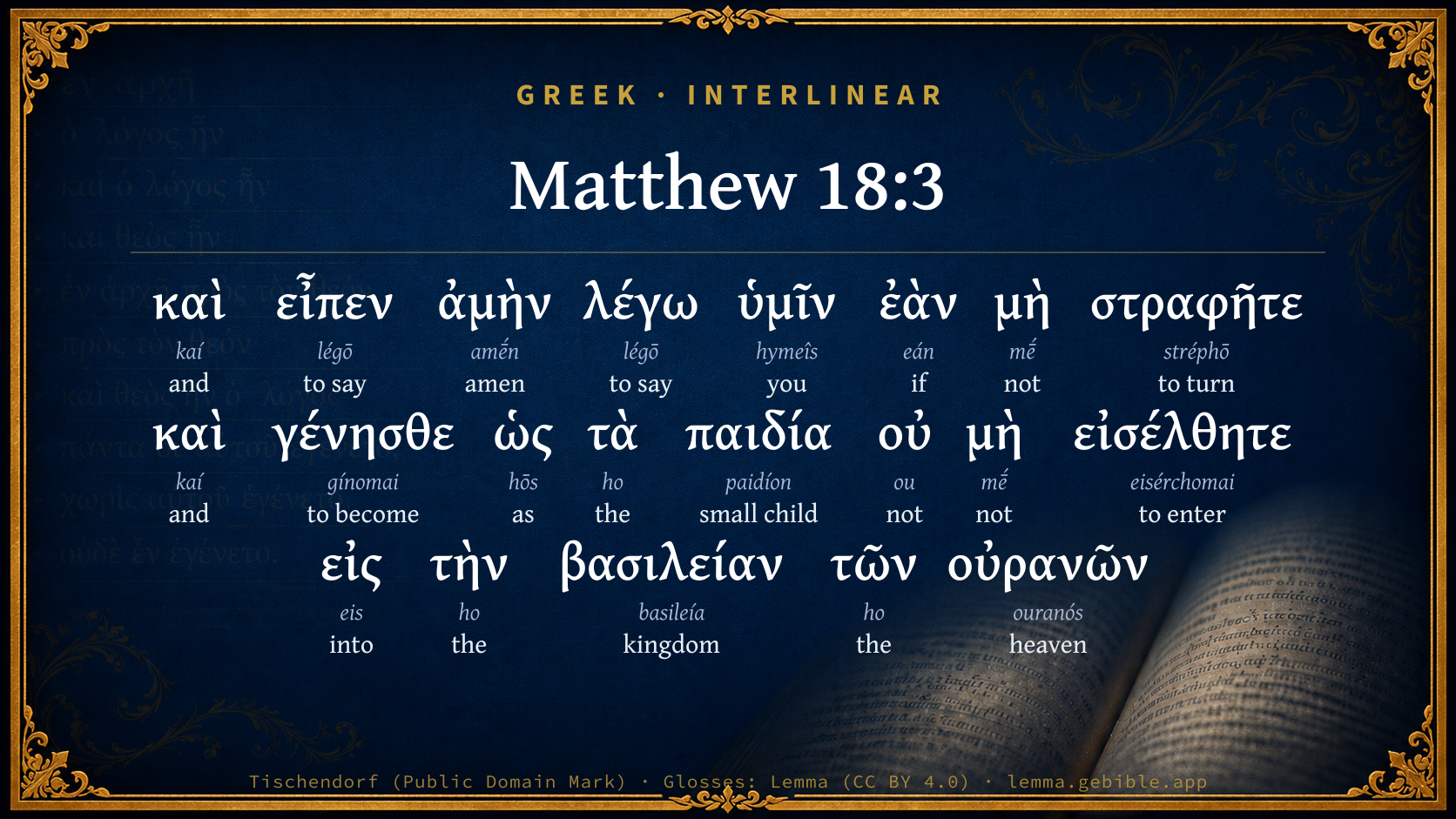
  1. καὶ kaí G2532 “and” Conjunction
  2. εἶπεν légō G3004 “to say” Verb, Aorist, Active, Indicative, 3rd person, Singular
  3. ἀμὴν amḗn G281 “amen” Hebrew transliteration
  4. λέγω légō G3004 “to say” Verb, Present, Active, Indicative, 1st person, Singular
  5. ὑμῖν hymeîs G5210 “you” Personal pronoun, 2nd person, Dative, Plural
  6. ἐὰν eán G1437 “if” Conditional
  7. μὴ mḗ G3361 “not” Particle, Negative
  8. καὶ kaí G2532 “and” Conjunction
  9. γένησθε gínomai G1096 “to become” Verb, Aorist, Middle deponent, Subjunctive, 2nd person, Plural
  10. ὡς hōs G5613 “as” Adverb
  11. τὰ ho G3588 “the” Article, Nominative, Plural, Neuter
  12. παιδία paidíon G3813 “small child” Noun, Nominative, Plural, Neuter
  13. οὐ ou G3756 “not” Particle, Negative
  14. μὴ mḗ G3361 “not” Particle, Negative
  15. εἰσέλθητε eisérchomai G1525 “to enter” Verb, Aorist, Active, Subjunctive, 2nd person, Plural
  16. εἰς eis G1519 “into” Preposition
  17. τὴν ho G3588 “the” Article, Accusative, Singular, Feminine
  18. βασιλείαν basileía G932 “kingdom” Noun, Accusative, Singular, Feminine
  19. τῶν ho G3588 “the” Article, Genitive, Plural, Masculine
  20. οὐρανῶν ouranós G3772 “heaven” Noun, Genitive, Plural, Masculine

About this verse

These counts appear in no published source. They are computed here, from the morphology-tagged text and Lemma’s own curated glosses. What Lemma adds →

21
words
16
distinct lemmas
Gospels
section

Notable vocabulary

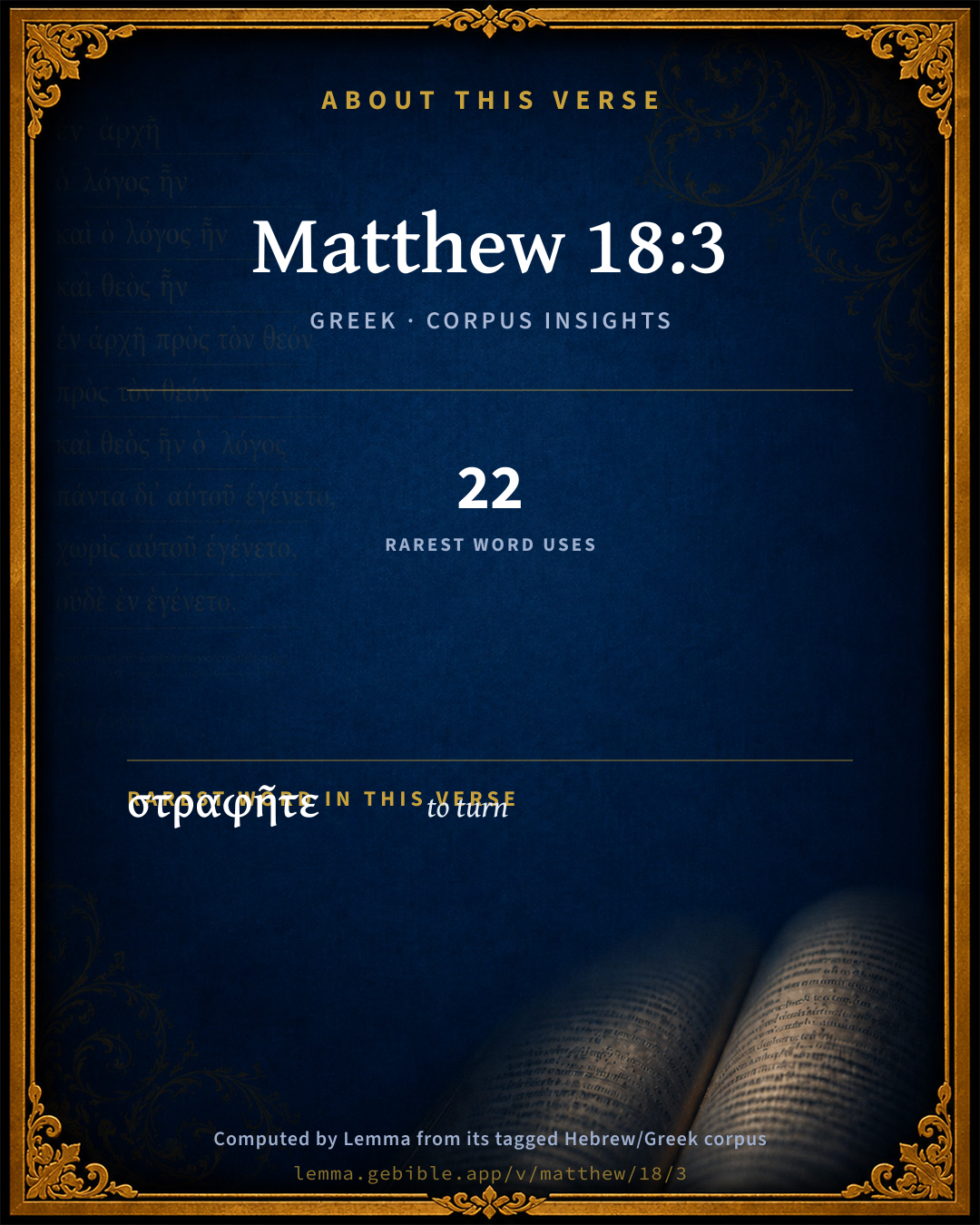
The rarest word here is στραφῆτε to turn G4762 — appearing just 22 times in the whole Greek New Testament.

Shared distinctive vocabulary

στραφῆτε to turn G4762 occurs in 22 verses of the Greek New Testament. Also found in:

Repetition

Words recur within this verse:

Cross-references

26

Topical passages linked to Matthew 18:3 in the Treasury of Scripture Knowledge — connected by theme and wording, ordered by reader-vote popularity; previews shown in the World English Bible.

  • Mark 10:14–15 But when Jesus saw it, he was moved with indignation, and said to them, "Allow the little children to come to me! Don't forbid them, for the Kingdom of God belongs to such as these.
  • 1 Peter 2:2 as newborn babes, long for the pure milk of the Word, that you may grow thereby,
  • Matthew 19:14 But Jesus said, "Allow the little children, and don't forbid them to come to me; for to such belongs the Kingdom of Heaven."
  • Luke 18:16–17 Jesus summoned them, saying, "Allow the little children to come to me, and don't hinder them, for the Kingdom of God belongs to such as these.
  • 1 Corinthians 14:20 Brothers, don't be children in thoughts, yet in malice be babies, but in thoughts be mature.
  • Psalms 131:2 Surely I have stilled and quieted my soul, Like a weaned child with his mother, Like a weaned child is my soul within me.
  • John 3:5 Jesus answered, "Most assuredly I tell you, unless one is born of water and spirit, he can't enter into the Kingdom of God!
  • John 3:3 Jesus answered him, "Most assuredly, I tell you, unless one is born anew, he can't see the Kingdom of God."
  • Psalms 51:10–13 Create in me a clean heart, O God. Renew a right spirit within me.
  • Luke 13:24 "Strive to enter in by the narrow door, for many, I tell you, will seek to enter in, and will not be able.
  • Acts 3:19 "Repent therefore, and turn again, that your sins may be blotted out, so that there may come times of refreshing from the presence of the Lord,
  • Matthew 5:20 For I tell you that unless your righteousness exceeds that of the scribes and Pharisees, there is no way you will enter into the Kingdom of Heaven.
  • Luke 22:32 but I prayed for you, that your faith wouldn't fail. You, when once you have turned again, establish your brothers."
  • John 1:51 He said to him, "Most assuredly, I tell you, hereafter you will see heaven opened, and the angels of God ascending and descending on the Son of Man."
  • Acts 28:27 For this people's heart has grown callous. Their ears are dull of hearing. Their eyes they have closed. Lest they should see with their eyes, Hear with their ears, Understand with their heart, And would turn again, And I would heal them.'
  • Mark 4:12 that 'seeing they may see, and not perceive; and hearing they may hear, and not understand; lest perhaps they should turn again, and their sins should be forgiven them.'"
  • James 5:19–20 Brothers, if any among you wanders from the truth, and someone turns him back,
  • Matthew 13:15 For this people's heart has grown callous, Their ears are dull of hearing, They have closed their eyes; Or else perhaps they might perceive with their eyes, Hear with their ears, Understand with their heart, And should turn again; And I would heal them.'
  • 2 Peter 1:11 For thus will be richly supplied to you the entrance into the eternal Kingdom of our Lord and Savior, Jesus Christ.
  • Matthew 6:5 "When you pray, you shall not be as the hypocrites, for they love to stand and pray in the synagogues and in the corners of the streets, that they may be seen by men. Most assuredly, I tell you, they have received their reward.
  • Matthew 19:23 Jesus said to his disciples, "Most assuredly I say to you, a rich man will enter into the Kingdom of Heaven with difficulty.
  • Acts 14:22 confirming the souls of the disciples, exhorting them to continue in the faith, and that through many afflictions we must enter into the Kingdom of God.
  • Matthew 6:16 "Moreover when you fast, don't be like the hypocrites, with sad faces. For they disfigure their faces, that they may be seen by men to be fasting. Most assuredly I tell you, they have received their reward.
  • Matthew 6:2 Therefore when you do merciful deeds, don't sound a trumpet before yourself, as the hypocrites do in the synagogues and in the streets, that they may get glory from men. Most assuredly I tell you, they have received their reward.
  • Isaiah 6:10 Make the heart of this people fat; Make their ears heavy, and shut their eyes; Lest they see with their eyes, And hear with their ears, And understand with their heart, And turn again, and be healed."
  • Matthew 5:18 For most assuredly, I tell you, until heaven and earth pass away, not even one smallest letter or one tiny pen stroke shall in any way pass away from the law, until all things are accomplished.

Cross-references courtesy of OpenBible.info (CC BY 4.0).

Commentary

Notes on Matthew 18:3 from classic Christian and Jewish commentators (each source and its license shown beneath its notes). The classic Christian expositions comment on the surrounding passage and are grouped to its opening verse, so a note may address several verses; the Jewish commentaries on the Tanakh (Rashi and others) are per-verse, so they appear only where the commentator wrote on this verse.

Lemma curates 59 commentaries, every one of them public domain or Creative Commons licensed, each selected and text-cleaned for this edition rather than reprinted as found. About our sources →

The Biblical Illustrator

Joseph S. Exell

Mat_18:3-5

And Jesus called a little child unto Him.

Christian humility

The question of the disciples brings them very distinctly before us, and makes them very real to us, as men like unto ourselves. Nothing can be more artless, and evidently truthful, than their representation in these Gospels of their own thoughts and conduct. How beautifully does Jesus rebuke all this. What a profound and original idea of greatness does this unfold!

I. The commendation of humility. That humility is not set forth as the sole condition of the heavenly estate, The Saviours words do not limit the entire range of Christian character to this one quality. It is its secret fountain. What humility is not.

1. Humility is not a weak and timid quality. It must be distinguished from a grovelling spirit. We should think something of our humanity, and not cast it under mens feet. Servants to all; servile to none.

2. It is not to be confounded with that morbid self-abasement which grows out of certain religious views. We may well be humble when we see the infinite love against which we have sinned.

3. Genuine humility is not incompatible with a consciousness of merit; for a secret persuasion of power is the spring of noble enterprise.

The consciousness of possessing something is essential to the sense of deficiency which makes us truly humble.

1. Now see how humility lies at the base of all true greatness. We instinctively associate humility with greatness. We always suspect ostentation.

2. The weakness which pride covers, but does not obviate, in the matter of dress and show. It is a great thing for a man to know and feel that he is a man; it is a great thing for him to understand where he is, and to profess what he is. Humility is the spring of all intellectual greatness; also of religious. The man who is convinced that he is perfect, the farthest from being perfect. God be merciful to me, a sinner, is the spring of all real acquisition in religious things. The childs humility is unconscious; mans humility is reached by experience.

3. The child-like relation in all who in any degree enter into the sphere of Christian faith and feeling. Christ would bring all men to filial dependence upon God. There is no humility without love and confidence; subjection to a tyrant is not humility; but the reverence which I give to a father. (E. H. Chapin, D. D.)

Greatness determined by use, not extent

When you take the loftiest standards in comparison, who is filling a great sphere in Gods universe? What king, what president, what statesman, what man of pride and renown, is filling a great sphere? But the moment you come down and take the ordinary earthly standards, the true test of any mans condition is the uses to which he puts it-and to which the Almighty Himself puts it. The uses of a thing make it great, not its extent. The uses of the wayside spring, that refreshes the travellers march; or the flower that grows at the foot of awful ice-peaks and battlemented crags, unfolding all the summer long its beautiful parable of Providence and love-who can limit the usefulness of that? and who can say that it is nothing, because its sphere is little? (E. H. Chapin, D. D.)

Humility the spring of intellectual greatness

The humbler men are, the greater they are. What are the proudest triumphs of our day, intellectually speaking? They are in little things. The great men of our day do not construct cosmologies; do not sit down and build up great theories of the universe. We laugh at such things; we suspect their soundness at once. When a man comes to us and tells us that he has a new theory of creation, we begin to think whether he had not better have a theory of his own sanity. The things which occupy the greatest minds of our day are the little sparks of electricity, the little wayside shells, the blossoms, the infusoriae myriad-fold that hang in a single drop of water. Down in the little lowly things men find the great secret of the world; away down they begin to find the spring and sources of things, and the profoundest books of science are founded on these little ordinary, unobserved affairs. Humility is the spring of all intellectual greatness. (E. H. Chapin, D. D.)

The unconscious humility of a child combined with the experience of a man

But we have-and let us thank God that we have-something better than childhoods innocence, if we have lived truly and Christ-like. We have strength to overcome evil which the child must learn; we have a power to trample sin underneath us that the child must undergo much to gain; we have not the innocence of Eden, but by Gods help and Christs example we may have the victory of Gethsemane. It is a great thing to have the humbleness of a child. But it is to be joined with the consciousness and the effort of the man. (E. H. Chapin, D. D.)

The spiritual worth of childhood

But, moreover, there is testimony in Christianity, not only for the love of God to the child, but to the spiritual worth of the child. The child illustrates the value of the soul as Christ brings it before us here. Now, observe, there is no materialistic theory that would be consistent with the way in which Christ treats the child, because, on the materialistic theory, everything grows upward, grows wider and better. But the doctrine of the text is not the doctrine of development; we must go back to childhood again; we dont develop humility. We may develop physical strength; we may develop intellectual splendour; we may develop imagination or reason, but we do not develop humility. In that the child has the advantage of us. If it were merely material, why should not the child have less humility than the man? No; we come back to the childs condition, in some respects; and that illustrates the childs share of our common spiritual nature, And here is the reason why we find the element of greatness set forth as it is by Jesus Christ. Greatness is in spiritual power; it is not an outward attainment that the man can attain and the child can not. It is not any outside clothing; it is not in crowns; it is not in the worlds fame; it is a spiritual quality, and the child has that spiritual quality which is the condition of all greatness. (E. H. Chapin, D. D.)

The nature and necessity of conversion

I. The nature of conversion. A change of character (Psa_51:13; Act_13:19; Jam_5:20) implies-

1. A change of mind.

2. A change of heart.

3. Followed by a change of conduct. Regulated by the word of God.

II. The effect of conversion. Its subjects become as little children, not, indeed, in every respect-ignorance, idleness, etc. But.

1. In the affectionate dispositions of their hearts towards each other.

2. In simplicity and sincerity.

3. In humility and lowliness of mind.

III. The necessity of conversion.

1. What we are to understand by the kingdom of heaven.

2. The necessity of conversion in order to enter into this kingdom. The unconverted have no right to, and no meetness for, this kingdom. Were it possible for them to enter they would still be unhappy. (R. Treffrey.)

The necessity of conversion

I. The nature of the kingdom of Christ, and what is implied in entering into it.

1. The kingdom of Christ is, His reign in and over mankind. It must be considered in two states and periods-

(1) In a state of imperfection, warfare, and suffering on earth.

(2) In a state of perfection, triumph and joy in heaven.

2. We enter this kingdom by becoming members of Christs true Church-militant, triumphant.

II. The nature of this conversion, or in what sense we must be converted and made like little children, in order to our entering into this kingdom.

1. It implies being turned from self to Christ; from the world, and sin, etc.

2. It implies being inwardly changed, understanding enlightened, etc.

3. Conversion makes us like little children-sincere, humble, etc.

4. The works of conversion. Light in the understanding; love to the godly; obedience to all Gods commands; hatred to, and victory overall known sin; avoiding temptation, etc.

III. The absolute necessity of this conversion. Unconverted persons are unfit for heaven. (Joseph Benson.)

Conversion

The occasion of this remark was like the manifestation of a desire for preeminence.

I. The nature of conversion.

II. The evidence of it is the disposition of a child.

1. A disposition which is the opposite of an ambitious spirit.

2. A child is confiding. It trusts its parents.

3. A child is submissive.

III. Why this change is necessary. Because the disposition of a child is the only one that agrees with our relation to God. This will apply-

1. To our ignorance.

2. To our weakness.

3. To our guilt and pollution.

IV. The blessedness of this disposition.

1. The peace it gives.

2. The security it affords. God cares for us.

3. It places us in our normal relation to God.

4. It secures our admission into the kingdom of God, of which Christ is the head and centre. (C. Hodge, D. D.)

This teaches us all

I. The necessity of humility in order to salvation.

II. That even converted souls have need of a daily conversion.

III. How abominable in the eyes of God ambition and pride are in any, especially in ministers of the gospel.

IV. That in the Church the way to be great is to be humble.

V. That true humility consists in a mean opinion of ourselves, not minding high things, not being wise in our own conceits, in honour preferring one another. (M. Pool.)

Conversion

Let us see what turn is necessary before we can be Christians.

I. It is evident that we are all too much men and women, else it would not have been said, Turn and be children.

1. We as men fancy ourselves independent and self-sufficient; we must get back to simplicities, self-renunciation, to a babyhood of trust.

2. To be a little child is to be in a state to receive. Be a little child in the lowest form and receive discipline.

3. This image does not convey the idea of a perfectly new being, but of an old being begun again, that it may do better.

4. There is another beautiful trait of childhood, purity. (J. Vaughan, M. A.)

Conversion; its nature, effects, and importance

I. Its nature.

II. The evidences of conversion.

1. A child is inquisitive.

2. Teachable in his disposition.

3. A child believes the testimony of his parents.

III. Its necessity. (J. Williams, M. A.)

Conversion

I. The temper that distinguishes the subjects of divine grace. AS little children. Not like them in ignorance, not in fickleness, not in waywardness. Little children are teachable and ready of belief; are devoid of malignity; are characterized by humility.

II. The way in which we are to attain it. We must be converted and become as little children.

1. The temper we are required to possess is not in us naturally, but is the consequence of a Divine change.

2. The change is to be judged of by its effect.

III. The importance of possessing this temper. Ye shall not enter, etc. This exclusion-

1. The most awful.

2. The most unavoidable. Without holiness man shall see the Lord.

3. The most universal.

4. What a difference there is between the opinion of the world and the judgment of God. (W. Jay.)

I. Childlikeness is the test of greatness in the kingdom of heaven. Resemblance to children, not in ignorance or in fickleness, but-

1. In a teachable spirit (Act_9:6; Act_10:33; Act_16:30).

2. In a consciousness of weakness (2Co_12:9; Php_4:13).

3. In a dependent spirit (Mat_6:31; Php_4:18-19).

4. In freedom from ambition (Rom_12:16).

5. In a forgiving temper (1Co_14:20; Eph_4:32).

II. The degree of childlikeness is the measure of greatness.

1. Because it raises its possessor in the scale of our excellence.

2. Because it qualifies its possessor for higher usefulness.

3. Because it assimilates its possessor more nearly to the Redeemer.

4. Because it secures for its possessor a more exalted position in the heavenly world.

(1) The necessity of conversion.

(2) The beauty of humility.

(3) The attraction of heaven. (Various.)

Humility

1. Some are naturally more humble than others; there is a natural humility.

2. Still lower than this, there is a humility of word, love, and manner, which is a mere worldly ornament to be put off and on.

How shall we cultivate humility?

1. Be sure that you are loved. We are all inclined to be proud to those whom we think do not like us.

2. Realize yourself the object of great mercy.

3. Seek to be reverent in worship, for if humble before God you will be before men.

4. Always try to re-live the life of childhood, to think and feel as when you were a child.

5. Deal often with your real self in some of the humbling parts of your history.

6. Exercise inward discipline to meet the first buddings of pride.

7. Do acts of humility.

8. God always empties before He fills; He will humble before He will use a person.

9. It is a great thing to have much intercourse with little children. (J. Vaughan, M. A.)

A lesson of humility

The question of the disciples reveals the appearance and the nature of the kingdom of heaven. To these disciples it was the most natural question in the world.

I. The ambition to be greatest is a very common weakness in our nature. But there are very many considerations which wonderfully qualify this desire to be first.

1. It is a thing of great responsibility.

2. You may be first and be very miserable.

3. It is utterly inconsistent with the religion of Jesus Christ.

II. How our Lord taught the lesson of humility to his disciples. He not only spoke about it to them, but He showed it to them. What is the ground of comparison between that beautiful boy and a true disciple-a disciple in the right spirit?

1. The per-fact non-resistance of a child. Christ called the child, and the child came, etc. There was no resistance. The very reverse of this was the case with the disciples. Give instances. They did not, like the little child, yield and come the moment the Master called. They resisted the Spirit of Christ; the darkness in them opposed the light that came from Him. There is very much in the best of us that resists Christ.

2. Perfect trust and the absence of all fear. It was so with this child. To be a Christian is to trust Christ perfectly, and to cast all fear to the wind. In our darkness and ignorance, etc. In our sin and weakness. In our trials and perplexities. And when death comes.

3. Humility. Observe what Christian humility is-Coming when Christ calls, etc., without endeavouring to appear to be anything that we are not. Conclusion. The dignity and glory of true humility. (Thomas Jones.)

The nature of humility

It is not at all the thing that people suppose it to be. Take Christs exposition of it. The child humbles himself. How did the child humble himself? He came when Christ called, he suffered himself to be embraced, and he stood where Christ put him, without pretending to be anything more than he was, an honest, fine, healthy-looking boy. Christ calls that humility. People think that going and moping about the world and saying, I am very imperfect, is humility. Protect me from such humility. Some of the proudest creatures I ever met in the world were the most humble, if that be humility-people who complained about themselves; but if you were ever to say to them, Yes, sir, or Yes, madam, I know you really are bad, they would turn round and say, Who told you so? What do you know about me? That is not Christian humility. Humility is that of the boy coming when Christ called, suffering himself to be embraced, standing there as long as Christ wanted him to stand, without endeavouring to appear to be anything that he was not. That is Christian humility. There is a real charm in this child, if you will only think of it, in his unconsciousness. He never thought he was doing anything praiseworthy; it never entered into his little head that there was anything beautiful in his little actions. That is the essence of the thing. He came quickly when the Master called, he looked happy in His arms, he stood where Christ put him, and he never thought for one moment that there was any praise due to him for that. He was moved to confidence; the instincts of the boy were moved by the tenderness of Christs voice and the expression of His face. The little man went under his natural instincts and never thought for a moment that there was any virtue or beauty in his actions. What; is that? That is Christian humility-to yield ourselves to Christ, to serve Him, to serve our brothers and our sisters, going about doing good, beautiful as lamps in the darkness, sweet and fragrant as the breeze from the south. Go and do this, live this beautiful life, yet never showing that we are conscious of its beauty, never letting it escape the lip that we know we are doing anything grand. What is the most beautiful thing in the world? A man or a woman living a high Christian life-without ever letting it escape the lip or the expression that they consider there is anything beautiful or grand in it. It is the unconsciousness of the child that constitutes the highest climax of the Christian life. To be great, to be greatest in the kingdom of heaven is to excel in that direction. I have looked lately at some large fruit trees covered with fruit; and a rich fruit tree is a very beautiful object; it has a massive trunk and far-stretching boughs; the foliage is rich, the dew of the morning is wet upon its leaves, and the sun plays in the little crystal drops, and the branches bending under their fruit barely move in the very gentle movement of the wind. There are very few things in nature more beautiful than a tree like that, and a man of sensibility, a man with a right state of heart, looking upon such a thing cannot but admire it. But if (which of course it is folly to suppose) that tree for one moment could be self-conscious, if it had the power of speech for one instant and let out the secret that it thought itself very beautiful, it would be a different thing to us the moment it had spoken. It is the unconsciousness, the absence of the knowledge of self, that is one charm of the vegetable world. So in character. It is very difficult to be this, my brethren; it is very difficult for me to stand here Sunday after Sunday and speak to you without revealing some little bit of vanity, some little bit of self-consciousness; but if I have not got it I cannot show it. Two great preachers in Wales met at a public meeting. It was usual then, I am sorry to say, as it is now, for men of different denominations to justify their appearing before each other. One of them was a very eloquent man, one of the greatest preachers in the Principality, and he said he had left his party zeal at home before he started. Another as great as he got up and said, Well, I thank God I had none to leave, and I came here just as I was at home. Let a man be free from vanity and self-consciousness, and it will not appear. This is Christian humility as taught by the Savior. (Thomas Jones.)

The desire to be great natural

Now this ambition to be the greatest is a very common weakness in our nature,-to be great, to be first, to be the greatest anywhere, however small the little kingdom may be, to be the first minister in the kingdom, or, if you can, to be the king of the little kingdom. Better reign anywhere than serve in high positions. To have power, to see our own thoughts carried out, to make men, and things, and circumstances, do as we like,-it is very delightful, exceedingly fascinating, and it has a great charm for our minds, believe somewhat of it is natural, and I do not think it is altogether sinful. The natural is not sinful. Whatever God has put in us is right. A lad has fine powers and God has put ambition into the lad to use his powers, so that if he is at school he desires to take the first place. Do not blame him; it is quite natural; the ambition is in him. But, on the other hand, I must say what is true about this. There are very many considerations which wonderfully qualify this desire to be first. (Thomas Jones.)

The responsibility of greatness overlooked

To be first in the world is a thing of great responsibility. To be first is very pleasant. Yes but it has a burden of responsibility. To be the first poet-the fierce rays of criticism beat upon you; to be the first preacher, the first minister-it is a most solemn responsibility. Nothing is expected of a delicate flower but that it should be beautiful and just give a little fragrance. Everybody is satisfied with the flower if it will do these two things. But a large tree upon which nature has expended years of time and care, and made the trunk massive, and the boughs wide, and the foliage thick and rich, a tree that nature has taken years of trouble with, much is expected front that Oh, delicate flower, if thou art beautiful and hast a little fragrance nobody wilt blame thee; but a great, massive tree, everybody will blame thee and thy foliage, and thy massiveness, except thou bringest forth much fruit. Like the delicate flower is the man with one talent, the humble Christian man, doing his duty walking humbly with God. I think myself that is the finest life in the whole world, incomparably the most blessed life in the world-not to be rich not to b,-very poor, to have a little home of your own, surrounded by those you love and by whom you are loved, unobserved by the world around, like the delicate flower, just being beautiful and giving forth fragrance. The world never critise you, never says anything about you: you pass on doing your duty, you lay your throbbing head down in death, you shall rest and go home and be with God, and the report of your doings shall be read in another world than this. The responsibility of being first is very great, and the criticism upon those who are first is very fierce. Plant the sapling in the valley, it shall have shelter,-put the same sapling on the mountain top, and the fury of every element shall be expended upon it. There are men in England, authors, statesmen, and preachers, upon whom every element, good, bad, and indifferent, at the command of criticism comes in all its fury expending its strength upon them. I would not be one of them for any earthly consideration. I would not be first in England for the possession of a noblemans estate. To be in such a position, especially as Tennyson says, in the fierce light of the throne, is to he in a position of solemn responsibility. My friend, if God has not called you to be very prominent you have reason to thank God that He has consented you should live a quiet, reverent, honest, generous, Christian life uncriticised, unpraised, and unabused. (Thomas Jones.)

Child-like non-resistance

There is very much in the best of us that resists Christ. We are not like that little child. Christ calls (it is all the better for you if I am not speaking truth), but there is no answer; Christ commands, but we do not obey; Christ stands at the door, and we do not open; He has been there long, He is there now, and will be there to-morrow and many of you keep Him out. The comparison in the Bible to express this want of child-likeness, this want of non-resistance, is a rock. The rain comes, the rock is not softened; the winds blow, the rock makes no response; the sun shines, the rock is not made fertile; summer comes, autumn comes, winter comes, spring comes-spring, summer, autumn, winter find and leave the rock the same cold hard, insensate thing as it ever was. I do not know you, but I am describing exactly the state of many hearts even in the Church of God. The gospel comes like rain showers upon the rock, but it has not softened you; breezes from the eternal mountains blow upon you-they are not vivifying; Gods eternal love shines upon you-it has not changed you; life with its wonderful lessons comes-you grow very little better. Do you not know men in the circle of your acquaintance who are not at all better than they were ten years ago? Success came-they were no better; disappointment came; the marriage morning came, they were the same . the funeral day-they were the same. All the elements of the gospel, all the influence of the Divine Spirit, all the wonderful events of life, all its friendships, all its love, left them where they were. They resist God, they resist His influences. Brethren, I ought to be a better man, having enjoyed the friendship of many of you for many years; I should be unworthy of that friendship, if I were not wiser and better, and more humble and more reverent. You ought, as day after day carries you nearer to eternity, to resist God less. Oh, my friends, be as little children; lean to Christ, resist not the Holy Spirit of God. (Thomas Jones.)

The mission and ministry of infants in the family and in the world

I. Some of the doctrinal lessons taught us by the mission of infants.

1. By mans original transgression temporal death ensued to infants as a part of the race.

2. Universal atonement.

3. Their immortality.

4. Their resurrection.

II. Some of the practical, lessons.

1. The duty of parental watchfulness and tender care over the helplessness of infancy.

2. The duty of self-sacrifice is taught by the mission of infants.

3. The solemn responsibility of a most important trust.

4. The duty of resignation to the work of God, in the dispensations of His Providence.

5. The ministry of infants in the family is intended to teach patience.

6. It teaches the highest Christian virtues, such as innocency, dependence.

7. Gods providential care over childhood.

8. That the path of true greatness lies through the vale of humility. (J. E. Edwards, D. D.)

Gods care of little children

A poor little boy was found standing in the streets by a kind-hearted man. The child was lean and thinly clad, bearing the marks of hunger and poverty. What are you doing here? inquired the man. The boy replied: I am waiting for God to come. What do you mean? inquired the man, touched by the novelty of his reply. The poor little boy responded: Mother and father, and nay little brother died, and nay mother said God would come and take care of me. Wont He come? … Yes, replied the man, I have come. Mother never told me a lie, said the little boy; I knew you would come; but you have been so long on the way.

Childhood educates man on the best side of his nature

It is probable that every one of the traits of higher manhood in adults springs from the drill and the training which little children require and inspire. I doubt whether preceptual teaching could ever have brought into this world any considerable degree of disinterested affection. I doubt if self-denial and heroism in that direction could ever have been propagated in this world as a matter of duty. Conscience never brings forth love. Intellectual reasoning never produces rich and warm caresses. It is the economy of Gods providence to set men and women together in the household, and give them little children, and draw them toward these little children by the instinct of love dinstinct in the early day, and companionable love in a later day, and out of this love to develope all the character, forethought, and industry which are necessary for the good of these children. There are men who are very selfish toward their neighbours, very selfish in their business, very selfish in their pleasures; there are men who, as citizens, are not true to the laws under which they live, not true to commonwealth, but who, if you go into their households, and see how they deal with their children, seem to have an entirely different nature. They lay aside their selfishness. The pride and greediness which characterize them out-of-doors are gone when they are indoors. Indeed, the faults which they exhibit outside are often faults which they take on for the sake of being able to take care of the little children that are inside. (H. W. Beecher.)

Christ in a child

There is an old story, a kind of Sunday fairy tale, which you may sometimes have seen represented in pictures and statues in ancient churches, of a great heathen giant who wished to find out some master that he should think worthy of his services-some one stronger than himself. He went about the world, but could find no one stronger. And, besides this, he was anxious to pray to God, but did not know how to do it. At last he met with a good old man by the side of a deep river, where poor wayfaring people wanted to get across and had no one to help them. And the good old man said to the giant, Here is a place where you can be of some use, and if you do not know how to pray, you will, at any rate, know how to work, and perhaps God will give you what you ask, and perhaps also you will at last find a master stronger than you. So the giant went and sat by the river-side, and many a time he carried poor wayfarers across. One night he heard a little child crying to be carried over; so he put the child on his shoulder and strode across the stream. Presently the wind blew, the rain fell, and as the river beat against his knees, he felt the weight of the little child almost more than he could bear, and he looked up with his great patient eyes, and he saw that it was a child glorious and shining, and the child said, Thou art labouring under this heavy burden because thou art carrying one who bears the sins of all the world. And then, as the story goes on, the giant felt that it was the child Jesus, and when he reached the other side of the river, he fell down before Him. Now he had found some one stronger than he was, some one so good, so worthy of loving, as to be a master whom he could serve. (Dean Stanley.)

Nature of countersign

Converting grace makes persons become like little children; both like those just born, and those who are a little grown.

I. Converts resemble little children newly born.

1. Children enter the world with much difficulty and hazard. So Gods children have a difficult entrance into a state of grace.

2. An infant has always a principle of life and motion; so converts have a principle of spiritual life infused into their souls.

3. The child bears the image of the father; so converts bear a likeness to God; they have His image.

4. A child comes weeping into the world; so Gods children are crying children.

5. There is a natural instinct in children, as soon as born, to seek the mothers breast; so a gracious soul, when newly converted, desires the sincere milk of the word, that he may grow thereby.

6. Converts resemble little children in their weakness and dependence.

7. There is a resemblance between little children and converts in their harmlessness.

II. Converts represent children a little grown.

1. In their guileless disposition. Little children are generally plain and downright, what they seem to be, and do not dissemble.

2. They are of a gall-less disposition; they may be angry, but bear no malice.

3. They are submissive to correction.

4. They are full of jealousies and fears.

5. They are very affectionate.

6. They are very inquisitive.

7. They are generally tractable.

8. They do all for their parents, and acknowledge them in all they have; so the child of God does nothing for himself but for Gods glory.

9. Converts resemble little children in their growth.

10. They are mostly of an humble and condescending disposition. Application-

(1) If converting grace makes persons become like little children, then conversion is no half work;

(2) If true conversion makes men become like little children, then there is reason to fear few people go to heaven. (Oliver Heywood.)

Marks of a true conversion

I. What are we to understand by our Lords saying? The words imply-

1. That before you or I can have any well-grounded, scriptural hope, of being happy in a future state, there must be some great, some notable and amazing change pass upon our souls.

2. That little children are not perfectly innocent, but in a comparative and rational sense.

3. That, as to ambition and lust after the world, we must in this sense become as little children; we must be as loose to the world, comparatively speaking, as a little child.

4. That we must be sensible of our weakness, as a little child.

5. That, as little children look upon themselves to be ignorant creatures, so those that are converted, do look upon themselves as ignorant too.

6. That, as a little child is looked upon as a harmless creature, and generally speaks true, so, if we are converted, we shall be guileless as well as harmless. (George Whitefield.)

Humility aids spiritual vision

He that is in the low pits and caves of the earth, sees the stars in the firmament, when they who are on the tops of the mountains discern them not. He that is most humble, sees most of heaven, and shall have most of it; for the lower the ebb, the higher the tide; and the lower the foundation of virtue is laid, the higher shall the roof of glory be over-laid. (John Trapp.)

The Biblical Illustrator, edited by Joseph S. Exell (c. 1880s–1900s) — public domain. Text from a community e-Sword module.

Joseph Benson's Commentary

Mat 18:3-4. And said, Verily I say unto you — What I say is an undoubted and most important truth, a truth which you ought not only firmly to believe but seriously to lay to heart: except ye be converted — Turned from these worldly and carnal views and desires; and become like little children — “Free from pride, covetousness, and ambition, and resemble them in humility, sincerity, docility, and disengagement of affection from the things of the present life, which excite the ambition of grown men,” ye shall be so far from becoming the greatest in my kingdom, that ye shall not so much as enter into it. Observe well, reader, the first step toward entering into the kingdom of grace is to become as little children: lowly in heart, knowing ourselves utterly ignorant and helpless, and hanging wholly on our Father who is in heaven, for a supply of all our wants. We may further assert, (though it is doubtful whether this text implies so much,) except we be turned from darkness to light, and from the power of Satan to God: except we be entirely, inwardly changed, and renewed in the image of God, we cannot enter into the kingdom of glory. Thus must every man be converted in this life, or he can never enter into life eternal. Whosoever therefore shall humble himself — He that has the greatest measure of humility, joined with the sister graces of resignation, patience, meekness, gentleness, and long-suffering, shall be the greatest in Christ’s kingdom: whosoever rests satisfied with the place, station, and office which God assigns him, whatever it may be, and meekly receives all the divine instructions, and complies with them, though contrary to his own inclinations, and prefers others in honour to himself, — such a person is really great in the kingdom of heaven, or of God.

Joseph Benson's Commentary on the Old and New Testaments (1811–1818) — public domain. Text from a community e-Sword module.

Tyndale Open Study Notes

Tyndale Open Resources

18:3 Like little children means to be humble (18:4). The disciples had been intent on status and ambition.

Tyndale Open Study Notes — © Tyndale Open Resources, licensed CC BY-SA 4.0. Text via the HelloAO Bible API.

Bengel's Gnomon

Johann Albrecht Bengel

Mat 18:3. Καὶ εἶπεν, and said) By asking who is the greatest? each of the disciples might offend himself, his fellow-disciples, and the child in question. The Saviour’s words (Mat 18:3-20) meet all these offences, and declare His own and His Father’s anxiety for the salvation of souls. We perceive hence the connection between the different portions of His speech.—ὡς τὰ παιδία, as little children) They must possess a wonderful degree of humility, simplicity, and faith to be proposed as an example to adults. Scripture exhibits everywhere favour towards little children.—οὐ μὴ εἰσέλθητε, ye shall not enter) So far from being the greatest, ye shall not even enter therein. He does not say, “ye shall not remain,” but, “ye shall not enter,” so as to repress their arrogance the more.

Bengel's Gnomon of the New Testament — English translation (T&T Clark, Edinburgh, 1860) — public domain. Text from a community e-Sword module.

Meyer's Critical & Exegetical Commentary

Heinrich August Wilhelm Meyer

Mat_18:3. Εἴ τις ἀπέχεται τῶν προαιρετικῶν παθῶν, γίνεται ὡς τὰ παιδία, κτώμενος διʼ ἀσκήσεως, ἅπερ ἔχουσι τὰ παιδία ἐξ ἀφελείας, Euthymius Zigabenus.

To turn round (στραφῆτε, representing the μετάνοια under the idea of turning round upon a road), and to acquire a moral disposition similar to the nature of little childrensuch is the condition, without complying with which you will assuredly not (οὐ μή) enter, far less be able to obtain a high position in, the Messianic kingdom about to be established. The same truth is presented under a kindred figure and in a wider sense in Joh_3:3; Joh_3:5 ff.; the divine agent in this moral change, in which child-like qualities assume the character of manly virtues, is the Holy Spirit; comp. Luk_11:13; Luk_9:55.

Meyer — Critical and Exegetical Commentary on the New Testament — English translation by Peter Christie, edited by Frederick Crombie (T&T Clark, 1880) — public domain. Text from a community e-Sword module.

Expositor's Greek Testament

ed. W. Robertson Nicoll

Mat 18:3 . ἐὰν μὴ στραφῆτε : unless ye turn round so as to go in an opposite direction. “Conversion” needed and demanded, even in the case of these men who have left all to follow Jesus! How many who pass for converted, regenerate persons have need to be converted over again, more radically! Chrys. remarks: “We are not able to reach even the faults of the Twelve; we ask not who is the greatest in the Kingdom of Heaven, but who is the greater in the Kingdom of Earth: the richer the more powerful” (Hom. lviii.). The remark is not true to the spirit of Christ. In His eyes vanity and ambition in the sphere of religion were graver offences than the sins of the worldly. His tone at this time is markedly severe, as much so as when He denounced the vices of the Pharisees. It was indeed Pharisaism in the bud He had to deal with. Resch suggests that στραφῆτε here simply represents the idea of becoming again children, corresponding to the Hebrew idiom which uses שׁוּב = πάλιν ( Aussercanonische Paralleltexte zu Mt. and Mk. , p. 213). ὡς τὰ παιδία , like the children, in unpretentiousness. A king’s child has no more thought of greatness than a beggar’s. οὐ μὴ εἰσέλθητε , ye shall not enter the kingdom, not to speak of being great there. Just what He said to the Pharisees ( vide on chap. Mat 5:17-20 ).

The Expositor's Greek Testament, edited by W. Robertson Nicoll (1897–1910) — public domain. Text from a community e-Sword module.

Geneva Bible (1599)

Geneva Bible translators

A kind of speech taken from the Hebrews, and it is as much as, repent.

Geneva Bible (1599) marginal notes — public domain. Text via Bolls.life.

Adam Clarke's Commentary

Verse 3. Except ye be converted] Unless ye be saved from those prejudices which are at present so baneful to your nation, (seeking a temporal and not a spiritual kingdom,) unless ye be clothed with the spirit of humility, ye cannot enter into the spirit, design, and privileges of my spiritual and eternal kingdom. The name of this kingdom should put you in mind of its nature. -

1. The KING is heavenly;

2. His SUBJECTS are heavenly-minded;

3. Their COUNTRY is heavenly, for they are strangers and pilgrims upon earth;

4. The GOVERNMENT of this kingdom is wholly spiritual and divine.

See on Mt 3:2.

And become as little children] i.e. Be as truly without worldly ambition, and the lust of power, as little children are, who act among themselves as if all were equal. The following saying from the Boostan of the poet Saady is very appropriate. "The hearts of infants being free from avarice, what care they for a handful of silver more than for a handful of dust?"

Adam Clarke's Commentary on the Bible (1810–1826) — public domain. Text from a community e-Sword/MySword module.

Ellicott's Commentary for English Readers

(3) Except ye be converted.—The English word expresses the force of the Greek, but the “conversion” spoken of was not used in the definite, half-technical sense of later religious experiences. What was needed was that they should “turn” from their self-seeking ambition, and regain, in this respect, the relative blamelessness of children.

Ye shall not enter into the kingdom of heaven.—The force of the words as spoken to the Twelve can hardly be exaggerated. They were disputing about precedence in the kingdom, and in that very dispute they were showing that they were not truly in it. It was essentially spiritual, and its first condition was abnegation of self. Even the chief of the Apostles was self-excluded when he gloried in his primacy. The words at least help us to understand the more mysterious language of Joh_3:3; Joh_3:5, as to the “new birth” of water and the Spirit, which one, at least, of the disputants must, in all likelihood, have heard.

A Bible Commentary for English Readers, edited by Charles John Ellicott (1878–1897) — public domain. Text from a community e-Sword module.

The Cambridge Bible for Schools and Colleges

gen. ed. J. J. S. Perowne

3. be converted] Literally, be turned. The Greek word is used in a literal sense, except here and Act_7:39; Act_7:42.

shall not enter] much less be great therein.

The Cambridge Bible for Schools and Colleges (gen. ed. J. J. S. Perowne; Cambridge University Press, 1878–1918) — public domain. Text from a community e-Sword module.

John Gill's Exposition

And said, verily I say unto you,.... You may take it for a certain truth, and what may be depended upon, that

except ye be converted or turned; from that gross notion of a temporal kingdom, and of enjoying great grandeur, and outward felicity in this world; and from all your vain views of honour, wealth, and riches,

and become as little children: the Arabic renders it, "as this child"; that is, unless ye learn to entertain an humble, and modest opinion of yourselves, are not envious at one another, and drop all contentions about primacy and pre-eminence, and all your ambitious views of one being greater than another, in a vainly expected temporal kingdom; things which are not to be found in little children, though not free from sin in other respects,

ye shall not enter into the kingdom of heaven: ye shall be so far from being one greater than another in it, that you shall not enter into it at all; meaning his visible, spiritual kingdom, which should take place, and appear after his resurrection, upon his ascension to heaven, and pouring forth of the Spirit: and it is to be observed, that the apostles carried these carnal views, contentions, and sentiments, till that time, and then were turned from them, and dropped them; for, upon the extraordinary effusion of the Holy Spirit, they were cleared of these worldly principles, and understood the spiritual nature of Christ's kingdom; which they then entered into, and took their place in, and filled it up with great success, without envying one another; having received the same commission from their Lord, and Master: so that these words are a sort of prophecy of what should be, as well as designed as a rebuke to them for their present ambition and contentions.

John Gill's Exposition of the Whole Bible (1746–1763) — public domain (CC PDM 1.0). Text via the HelloAO Bible API.

Trapp's Complete Commentary

John Trapp

3 And said, Verily I say unto you, Except ye be converted, and become as little children, ye shall not enter into the kingdom of heaven.

Ver. 3. Except ye be converted] i.e. Except ye turn over a new leaf, and cast away these fond conceits and crotchets, {a} these golden dreams of an earthly kingdom, and your high preferments therein, which like bullets of lead fastened to the eyelids of your minds, make you that you cannot look upwards.

And become as little children] In simplicity, humility, innocence, ignoscence, &c., not in childishness, peevishness, pragmaticalness, talkativeness, open heartedness, &c. Non praecipitur Apostolis ut habeant aetatem parvulorum, sed ut innocentiam, &c. (Jerome.) How absurd was that Anabaptist Aurifaber, who understanding this text Nicodemically, as one saith, stirreth up people wherever he came to carry themselves childishly, if ever they would have heaven. (Scultet. Annal.) Upon whose persuasion you might have seen ridiculous imitations of boys and girls; women especially, skipping up and down, clapping their hands together, sitting naked on the ground, tickling, toying, apishly imitating one while Christ, another while antichrist, &c., pretending this text for their authority. So did Massaeus the Franciscan, who is famous among his fellow friars, for that, at the command of his superior, St Francis, he wallowed on the ground as a little one, and showed all, in obedience to this text, as Sedulius testifieth, Ridiculum caput, a laughable person! Many such like examples may be met with in the legends of the Fathers, of such as were voluntaries in humility (as the apostle styles them), or rather in hypocrisy, Col 2:18, θελων εν ταπεινοφροσυνη. For, huius virtutis postea homines Christiani adeo studiosi et aemuli fuere, ut tota in hypocrisin vere abierit, saith Aretius, here. Humility in many of the ancients degenerated into hypocrisy.

Ye shall not enter into the kingdom of heaven] One sin allowed excludes out of the kingdom, be it but ambition or some such inward evil, such as the world takes no notice of, makes no matter of. Inward bleeding killeth many times, and God by killing Jezebel’s children with death (i.e. throwing them to hell) will make all the Churches know that he searcheth the inwards, Rev 2:23.

{a} A whimsical fancy; a perverse conceit; a peculiar notion on some point (usually considered unimportant) held by an individual in opposition to common opinion. ŒD

John Trapp, A Commentary or Exposition upon All the Books of the Old and New Testament (1647–1656) — public domain. Text from a community e-Sword module.

Haydock's Catholic Bible Commentary

You shall not enter, &c. i.e. you shall have no place in my kingdom of glory, in heaven, where none shall find admittance but they that are truly humble. (Witham) --- Our Lord in this and the next chapter teaches us, 1st, To sit down in the lowest place; 2nd, to bear patiently with our neighbor; 3rd, not to scandalize a weak brother; 4th, mildly to correct him when faulty; and 5thly, to forgive him when repentant.

George Leo Haydock (1774–1849), Haydock's Catholic Family Bible and Commentary, 1859 edition — public domain. Excludes Psalms (Douay-Rheims chapter numbering differs from Protestant) and Deuterocanonical books (Catholic canon only).

Whedon's Commentary on the Bible

Daniel D. Whedon

3. Be converted, and become as little children — Conversion generally implies our being turned, by the influence of truth and the Divine Spirit, with the consenting act of our own will, from our course as sinners to the ways of religion. But here, perhaps, it more specially signifies the being brought to renounce the disposition to seek pre-eminence or power over our fellows, especially in the Church. This was now the besetting sin of the disciples, of which it was their momentous duty to repent, and, by the aid of divine grace, be turned or converted. In this work God does the converting; man does the repenting and the turning to the new course. Justification is simply the pardon of our sins through the merit of Christ. Thereby we are treated by God as if we were just, or innocent of sin past. Regeneration, or the being born again, is the bestowment of those new feelings of love to God and his cause, by which we become in heart and soul children of God; and we are thence adopted into his family. Sanctification is the power and disposition, more or less complete, to live free from sin, to overcome temptation, and to dwell in the uninterrupted enjoyment of God’s smile. Become as little children — Our Lord selects a child at the age when conscious artifice and the desire of superiority are not yet developed, and the lesson was doubtless illustrated by the docility with which the child came. The feeling of dependence on the parent is as yet complete. It has no plans of ambition, no thought of being superior to another. Now grace must take our full-grown nature and lay these turbulent passions as completely at rest as in the bosom of that serene child.

Shall not enter the kingdom — So far from keeping the keys of the kingdom of heaven you shall not enter it yourselves. Ye shall not enter that kingdom below, and by consequence shall fail of the kingdom above.

Daniel D. Whedon (gen. ed.), Commentary on the Old and New Testaments (1874–1909) — public domain. Text from a community e-Sword module.

The Pulpit Commentary

Except ye be converted (strafhte); i.e. turned from proud, ambitious thoughts of worldly dignity. There is no question here about what is popularly known as conversion the change from habitual sin to holiness. The conversion here spoken of is confined to a change in the present state of mind to a new direction given to the thoughts and wishes. The apostles had shown rivalry, jealousy, ambition: they must turn away from such failings, and learn a different lesson. Become as little children. Christ points to little children as the model to which the members of his kingdom must assimilate themselves. The special attributes of children which he would recommend are humility, unworldliness, simplicity, teachableness, the direct contraries of self-seeking, worldliness, distrust, conceit. Ye shall not enter. In the sermon on the mount Christ had said, "Blessed are the poor in spirit: for theirs is the kingdom of heaven". (Mat_5:3) To all who are not such the gate opens not. That virtue which was unknown to pagan antiquity, the opposite character to which was upholden as the acme of excellence, Christ here asserts to be the only passport to his ideal Church on earth or its eternal development in heaven. Not the self-esteeming, proud man (megaloqucov) of Aristotle"s worship ("Eth. Nic.," 4:3), but the humble (tapeinov), the lowly, the self-depreciating, is the man who can realize his position in the spiritual world, and shall be admitted to its blessings and benefits. St. Paul has summarized the ideal character of the members of the kingdom in 1Co 13, especially 1Co_13:4, 1Co_13:5, 1Co_13:7.

HOMILIES BY R. TUCK Ver. 3. Christ"s type of the truly great.

We treat this as an abstract question. What is true greatness? Who is the truly great man? But the disciples asked a practical question, bearing immediate relation to their temporal expectations. They, and their conversations, can never be understood unless we keep in mind their earthly ideas of their Lord"s mission. Judas, with the grasping disposition, was anticipating his chances in the new kingdom; and even James and John were scheming to secure a promise of the right and left hand places in the new court. Over the expected offices in the new kingdom those disciples quarrelled, until at last they brought their dispute to Jesus, for him to decide it by his authority. When they asked, "Who is the greatest in the kingdom of heaven?" they meant, "Who is to have the principal office in the new Davidic kingdom which thou art about to set up?" Their question was childish; it would have been framed very differently if it had been childlike. As Christ corrected false notions, we h)ok at those false notions first.

I MEN"S IDEAS OF GREATNESS. "The things that men deem glorious were of no account with Christ. He did not measure a man"s eminence by the height of the pedestal on which he stood, nor by the stars that shone on his breast; he had no admiration for purple and gold, for the flash of jewels, for lofty titles, or any of the thousand things that dazzle the eye and impose on the carnal heart." "Does true greatness belong to the lion hearted, to the righteous, to the martyr, to the ascetic, to the saint? Is Thomas on the way to it, with his strong, logical intellect that will take nothing on credit without evidence and his sturdy fidelity of purpose?;" Greatness must associate either with

(1) class;

(2) office;

(3) wealth;

(4) intellect;

(5) genius; or

(6) success, in order to be appreciated by men.

II CHRIST"S IDEA OF GREATNESS. Here our Lord is not dealing with all greatness; only with that greatness which is relative to the ideas then in the minds of disciples. Their greatness meant "being served," guilefully watching for the attention conceived to be their due; self-assertion. His greatness meant "serving", guilelessly watching for the opportunity of doing something kind; meekness that is the opposite of self-assertion. Of this a chill is the type. A man ought not to be in everything like a child. Experience of life makes it impossible for hint to be a child. What was needed by the disciples, and what is needed by us, is that "they should turn from their self-seeking ambition, and regain, in this respect, the relative blamelessness of children. R.T.

The Pulpit Commentary (1880–1919), ed. H.D.M. Spence-Jones & Joseph S. Exell — public domain. Text from a community e-Sword module.

John Wesley's Explanatory Notes

Except ye be converted - The first step toward entering into the kingdom of grace, is to become as little children: lowly in heart, knowing yourselves utterly ignorant and helpless, and hanging wholly on your Father who is in heaven, for a supply of all your wants. We may further assert, (though it is doubtful whether this text implies so much, ) except ye be turned from darkness to light, and from the power of Satan to God:, except ye be entirely, inwardly changed, renewed in the image of God, ye cannot enter into the kingdom of glory. Thus must every man be converted in this life, or he can never enter into life eternal. Ye shall in no wise enter - So far from being great in it. Matt. xix, 14.

John Wesley, Explanatory Notes Upon the Whole Bible (1754–1765) — public domain. Text via the GEBible commentary corpus.

The People's New Testament

B. W. Johnson

3. Except ye be converted. The Revision translates, “Except ye turn,” which is correct. The Greek word translated in the Common Version “be converted,” is found in the New Testament in the active voice in every instance but one, and means to turn. It means something that the subject is to do, not something that is to be done for him. Become as little children. Humble, teachable and free from selfish ambition, like little children. Shall not enter into the kingdom of heaven. Instead of discussing who should be greatest in the kingdom of heaven, they had better inquire whether they were going to get in at all.

B. W. Johnson's The People's New Testament with Notes (1889–1891) — public domain. Electronic text from the Christian Classics Ethereal Library (CCEL) ThML edition.

Cambridge Greek Testament for Schools and Colleges

3. στραφῆτε, ‘be converted;’ cp. Joh 12:40, ἵνα μὴ … στραφῶσιν καὶ ἰάσομαι αὐτούς.

οὐ μὴ εἰσέλθητε, ‘shall not enter,’ much less be great therein.

Cambridge Greek Testament for Schools and Colleges (Cambridge University Press, 1896; 21 vols, various authors incl. Carr, Maclear, Plummer, Farrar, Lumby, Moule, M. R. James, Simcox) — public domain. Text from a community e-Sword module.

Alford’s Greek Testament

Henry Alford

3.] στραφῆτε = μετανοῆτε: it also conveys the idea of turning back from the course previously begun, viz. that of ambitious rivalry. Without this they should not only not be pre-eminent in, but not even admitted into, the Christian state—the Kingdom of Heaven.

Henry Alford, The Greek Testament (1849–1861) — public domain. Text from a community e-Sword module.

International Critical Commentary

3. Verily I say to you, Except ye turn and become as children, ye shall not enter into the kingdom of the heavens.] That is to say, “in asking who shall be the greater, you have entered upon a path which will not lead you to this end. The very question shows that you do not understand what greatness is. You must turn back and recover the childlike temper which is untempted to self-advancement. You must become again as children, i.e. unassuming. Otherwise, so far from being great in the kingdom, you will never even enter it.” This verse anticipates Mar 10:15.

(L)

International Critical Commentary — older volumes (1896–1929), various authors — public domain. Text from a community e-Sword module.

Vincent's Word Studies in the New Testament

Marvin R. Vincent

Be converted [στραφητε] . The word converted has acquired a conventional religious sense which is fundamentally truthful, but the essential quality of which will be more apparent if we render literally, as Rev., except ye turn. The picture is that of turning round in a road and facing the other way.

Shall not enter [ου μη εισελθητε] . But the double negative is very forcible, and is given in Rev. in noise. So far from being greatest in the kingdom of heaven, ye shall not so much as enter.

Marvin R. Vincent, Word Studies in the New Testament (1887–1900) — public domain. Text from a community e-Sword/MySword module.

Lesson kit

Teaching starters — assembled from the data on this page, not authored interpretation. Every prompt links to the verse data it draws on. Edit before teaching.

Matthew, in the Gospels, opens this verse with 21 words (16 distinct Greek lemmas). Its most distinctive word is stréphō (“to turn”). A historical commentator’s framing appears above. Read the whole chapter for the surrounding context.

Discussion questions

  1. How does “to turn” (stréphō) shape what this verse is saying?
  2. Matthew 5:39 shares the word «to turn» with this verse. How do the two illuminate each other?
  3. “to say” occurs 2× in this one verse. What is the effect of the repetition?
  4. These translations render this verse differently. What is at stake in choosing one wording over another?
  5. Reading how The Biblical Illustrator and Joseph Benson's Commentary read this verse, where do the two commentators agree and where do they part?

Things to notice

Reading settings

Reading text

Shown beneath each verse's original-language words.

Old Testament
Old Testament edition

Read the OT as the Masoretic Hebrew (MT) or the Greek Septuagint (LXX).

English shown for the Greek Septuagint (in the Hebrew ↔ Greek comparison).

Comparing translations? Open the Compare panel on any verse page to stack up to four side by side.