
Matthew 13:58

Greek (Tischendorf 8th ed.) Matthew 13:58 appears in the Greek New Testament. The text above is from the Tischendorf 8th edition. Each word links to its Strong’s number and a concise gloss. Click any word for its full Thayer’s Greek Lexicon entry.
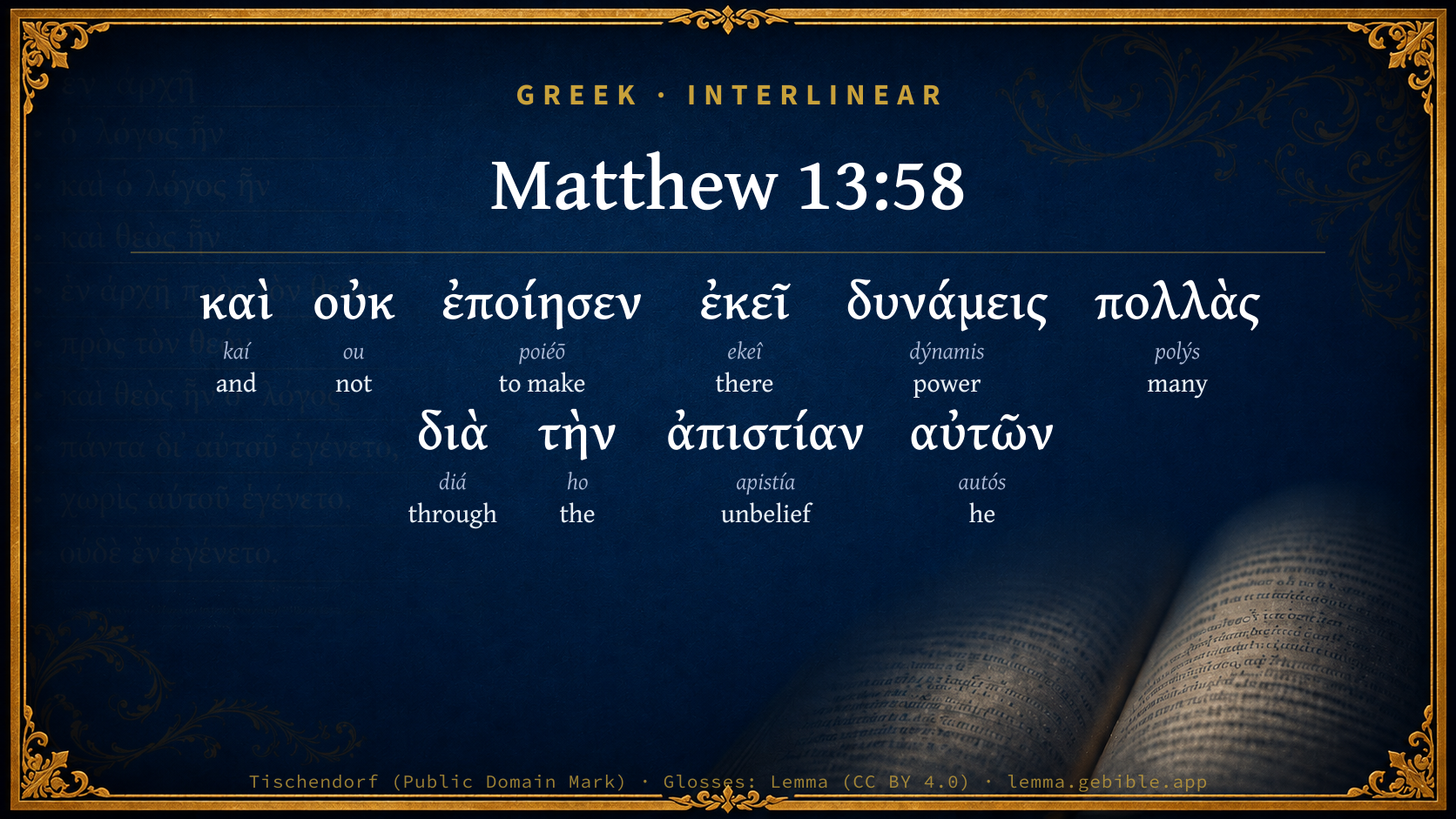
Download image
Cite this verse

Matthew 13:58 (World English Bible). Public Domain. Lemma interlinear Bible study tool, https://lemma.gebible.app/v/matthew/13/58.

Show BibTeX & RIS
BibTeX
RIS
English Translation
He didn't do many mighty works there because of their unbelief.
World English Bible · Public Domain
Highlights
  • 1 first appearance in the Greek New Testament
Full analysis ↓
Download a study sheet

One document with this verse’s original text, its word-by-word gloss line, the meaning frame, cross-references with their text, attributed commentary, and full source and license credits — printable, and it pastes into notes with its structure intact.

This verse Autodidact and up

Study sheet (.html) Plain text (.txt)

A passage Seminary Student

Up to 50 verses in one chapter. A passage sheet keeps up to 6 commentary sources and 12 cross-references per verse, in the order this page ranks them, and says so on the sheet whenever that leaves anything out. Ask for a single verse and you get the Autodidact verse sheet above.

Everything on this page stays free to read, with no account — the sheet is a download of what is already on screen, not access to it.

Want to remove ads? Support Godless Engineer
Compare translations 3

The same verse in 3 English versions, stacked beneath the original-language interlinear above. Click any original word for its lexicon entry.

Each is an independent rendering of the whole verse — the interlinear is not word-aligned to these translations.

Highlighted words mark where these versions differ — a whole-verse word diff, not a word-by-word alignment.

  • World English Bible Public Domain
    He didn't do many mighty works there because of their unbelief.
  • King James Version Public Domain
    And he did not many mighty works there because of their unbelief.
  • unfoldingWord Literal Text CC BY-SA 4.0
    And he did not do many miracles there, because of their unbelief.

unfoldingWord Literal Text — © unfoldingWord, licensed CC BY-SA 4.0. Word-aligned USFM3 via Door43 (git.door43.org/unfoldingWord/en_ult).

Versions to compare (up to 4)

3 of 4 selected

Show all 19 translations

Every available English version of this verse, each an independent rendering of the whole verse.

  • World English Bible Public Domain
    He didn't do many mighty works there because of their unbelief.
  • Berean Standard Bible Public Domain
    And He did not do many miracles there, because of their unbelief.
  • Majority Standard Bible Public Domain
    And He did not do many miracles there, because of their unbelief.
  • King James Version Public Domain
    And he did not many mighty works there because of their unbelief.
  • American Standard Version (1901) Public Domain
    And he did not many mighty works there because of their unbelief.
  • Revised Version (1885) Public Domain
    And he did not many mighty works there because of their unbelief.
  • Geneva Bible (1599) Public Domain
    And he did not many great woorkes there, for their vnbeliefes sake.
  • Douay-Rheims (1899) Public Domain
    And he wrought not many miracles there, because of their unbelief.
  • Young's Literal Translation Public Domain
    and he did not there many mighty works, because of their unbelief.
  • Literal Standard Version CC BY-SA 4.0
    and He did not do many mighty works there, because of their unbelief.
  • Unlocked Literal Bible CC BY-SA 4.0
    He did not do many miracles there because of their unbelief.
  • unfoldingWord Literal Text CC BY-SA 4.0
    And he did not do many miracles there, because of their unbelief.
  • Darby Bible Public Domain
    And he did not there many works of power, because of their unbelief.
  • World Messianic Bible Public Domain
    He didn’t do many mighty works there because of their unbelief.
  • Webster's Bible Public Domain
    And he did not many mighty works there, because of their unbelief.
  • Free Bible Version CC BY-SA 4.0
    Since they failed to trust in him, he did not do many miracles there.
  • Bible in Basic English Public Domain
    And the works of power which he did there were small in number because they had no faith.
  • Text-Critical English NT CC BY 4.0
    And he did not do many miracles there because of their unbelief.
  • Tyndale New Testament (1534) Public Domain
    And he dyd not many miracles there for there vnbelefes sake.

Literal Standard Version (2020), Covenant Press — licensed CC BY-SA 4.0. Text via the HelloAO Bible API (eBible.org). Unlocked Literal Bible (unfoldingWord) — licensed CC BY-SA 4.0. Text via the HelloAO Bible API (eBible.org). unfoldingWord Literal Text — © unfoldingWord, licensed CC BY-SA 4.0. Word-aligned USFM3 via Door43 (git.door43.org/unfoldingWord/en_ult). Free Bible Version, Dr. Jonathan Gallagher — licensed CC BY-SA 4.0. Text via the HelloAO Bible API (eBible.org).

Word by word

More ways to search: Search by grammar → Find every occurrence → Compare this word →

Practice this passage: Drill this verse → Learn its vocabulary →

About this verse

These counts appear in no published source. They are computed here, from the morphology-tagged text and Lemma’s own curated glosses. What Lemma adds →

10
words
10
distinct lemmas
Gospels
section

Notable vocabulary

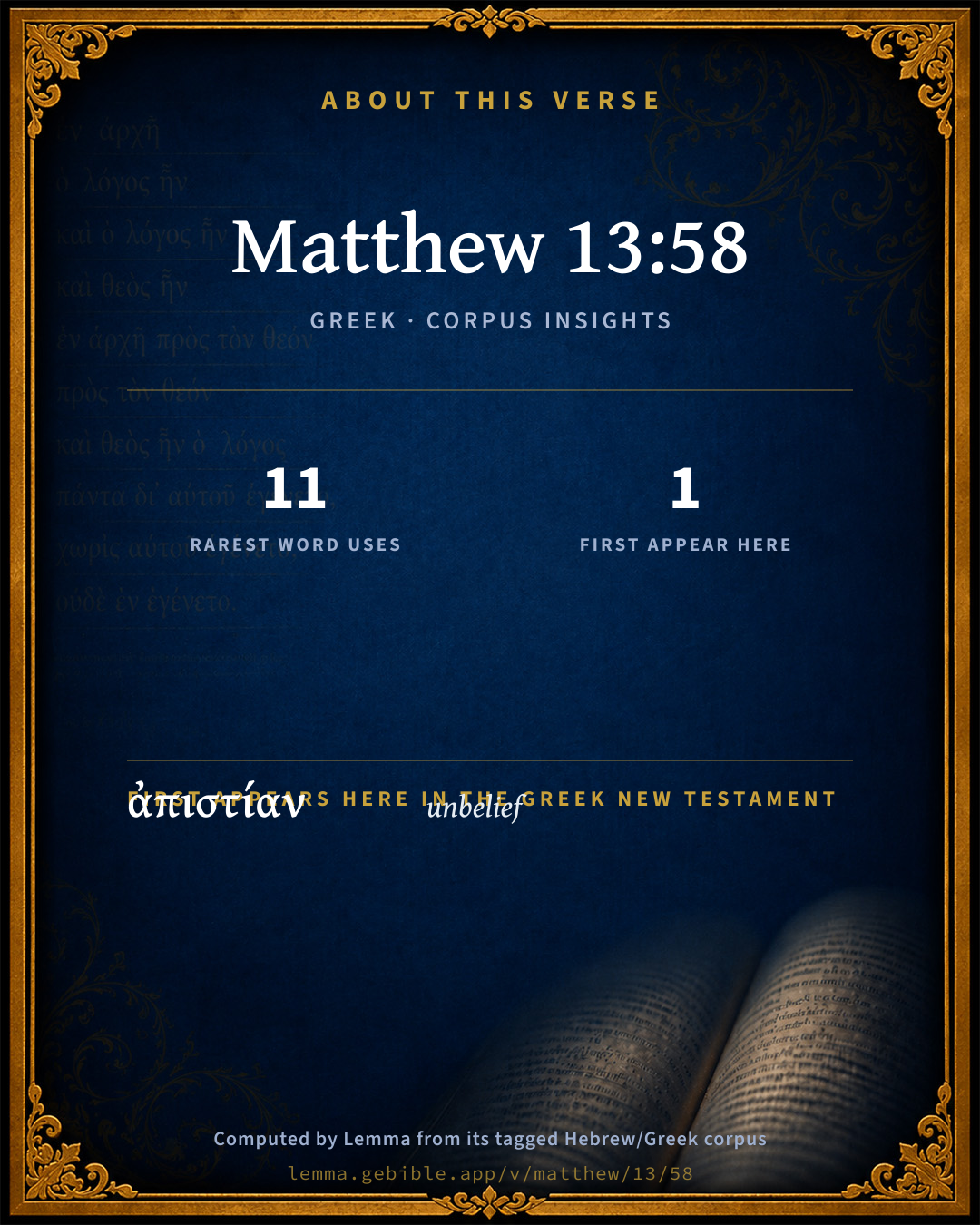
The rarest word here is ἀπιστίαν unbelief G570 — appearing just 11 times in the whole Greek New Testament.

First appearance in Scripture

This word makes its first canonical appearance in the Greek New Testament here:

  • ἀπιστίαν unbelief G570

Shared distinctive vocabulary

ἀπιστίαν unbelief G570 occurs in 11 verses of the Greek New Testament. Also found in:
Cross-references

4

Topical passages linked to Matthew 13:58 in the Treasury of Scripture Knowledge — connected by theme and wording, ordered by reader-vote popularity; previews shown in the World English Bible.

  • Mark 6:5–6 He could do no mighty work there, except that he laid his hands on a few sick people, and healed them.
  • Romans 11:20 True; by their unbelief they were broken off, and you stand by your faith. Don't be conceited, but fear;
  • Hebrews 3:12–19 Beware, brothers, lest perhaps there be in any one of you an evil heart of unbelief, in falling away from the living God;
  • Luke 4:25–29 But truly I tell you, there were many widows in Israel in the days of Elijah, when the sky was shut up three years and six months, when a great famine came over all the land.

Cross-references courtesy of OpenBible.info (CC BY 4.0).

Commentary

Notes on Matthew 13:58 from classic Christian and Jewish commentators (each source and its license shown beneath its notes). The classic Christian expositions comment on the surrounding passage and are grouped to its opening verse, so a note may address several verses; the Jewish commentaries on the Tanakh (Rashi and others) are per-verse, so they appear only where the commentator wrote on this verse.

Lemma curates 59 commentaries, every one of them public domain or Creative Commons licensed, each selected and text-cleaned for this edition rather than reprinted as found. About our sources →

The Biblical Illustrator

Joseph S. Exell

Mat_13:58

Because of their unbelief.

Unbelief

An empty vessel capable of holding water, if tightly corked, none can enter it, though water is poured upon it in great abundance; nay, it may be thrown into the sea, and still remain empty. So it is with our hearts; unbelief closes them, so that the water of life cannot fill them, however abundantly it may be poured upon and around us. Could not do many mighty works, etc. Unbelief hinders grace. This sin not only locks up the heart of a sinner, but also binds up the hands of a Saviour. (Burkitt.)

The imperfection of the religion of modern society has its root in the obscure perception of Divine truth. If is only a clear-sighted faith which can grasp the truths of revealed religion, and show to us the relation in which we stand to God. If it does not bring into clear view the obligations and duties which it imposes, and the privileges and graces which it imparts, the life of holiness and devotion will not be seen … . We may trace our imperfect Christian characters, our defective morality, and our almost godless civilization, to a want of faith in our Lords doctrines and in His view of life, and our relations to Him and to eternity. It is faith primarily, which will alone bring us into union with Himself, and enable us to see and realize our relations to God as our Creator, Redeemer, and Sanctifier. (R. B. Fairbairn, D. D.)

The Biblical Illustrator, edited by Joseph S. Exell (c. 1880s–1900s) — public domain. Text from a community e-Sword module.

Joseph Benson's Commentary

Mat 13:58. And he did not, (Mark says, he could not do,) many mighty works, because of their unbelief — On which words it has been justly observed, that they are not to be understood so strictly as if the power of Christ was here disarmed; but only, that as they brought but few sick people to him for a cure, he did not judge it proper to obtrude his miracles upon them. On the same principle it is, that faith, in some cases, though not in all, is made the condition of receiving a cure. And Christ saw it proper to make it so here, as well he might, considering what they must undoubtedly have heard of him from other places, and what they had confessed themselves but just before, of mighty works being wrought by his hands; which shows, indeed, that their unbelief did not so much consist in a doubt of his miraculous power, as of his divine mission, which, to any unprejudiced person’s mind, that power so abundantly proved. “The reasons,” says Mr. Wesley, “why many mighty works are not wrought now, is not, that the faith is every where planted; but that unbelief everywhere prevails.”

Joseph Benson's Commentary on the Old and New Testaments (1811–1818) — public domain. Text from a community e-Sword module.

Tyndale Open Study Notes

Tyndale Open Resources

13:58 Faith is required both to understand Jesus’ message (13:10-17) and to experience his miracles.

Tyndale Open Study Notes — © Tyndale Open Resources, licensed CC BY-SA 4.0. Text via the HelloAO Bible API.

Bengel's Gnomon

Johann Albrecht Bengel

Mat 13:58. Ἀπιστίαν, unbelief) The reason why many miracles are not performed at present, is not so much planted Christianity, as reigning infidelity.[653]

[653] In the original, “non tam est fides plantata quam infidelitas regnans; i.e. it is not so much that Christianity, having been already planted, does not require the aid of miracles, as that the wide prevalence of unbelief prevents their being performed.—(I. B.)

Bengel's Gnomon of the New Testament — English translation (T&T Clark, Edinburgh, 1860) — public domain. Text from a community e-Sword module.

Meyer's Critical & Exegetical Commentary

Heinrich August Wilhelm Meyer

Mat_13:58. Ἐποίησεν] In Mar_6:5, put more definitely thus: ἠδύνατο ποιῆσαι. This does not include the idea of unsuccessful attempts, but what is meant is, that the unwillingness of the people to acknowledge the greatness of His person (Mat_13:55) compelled Jesus, partly on moral (because of their unworthiness) and partly also on psychical grounds (because the condition of faith was wanting), to make but a limited use of His miraculous power.

Meyer — Critical and Exegetical Commentary on the New Testament — English translation by Peter Christie, edited by Frederick Crombie (T&T Clark, 1880) — public domain. Text from a community e-Sword module.

Expositor's Greek Testament

ed. W. Robertson Nicoll

Mat 13:58 . ere also editorial discretion is at work. Mark states that Jesus was not able to work miracles in Nazareth, and that He marvelled at their unbelief. Matthew changes this into a statement that He did few miracles there because of their unbelief, and passes over the marvelling in silence.

The Expositor's Greek Testament, edited by W. Robertson Nicoll (1897–1910) — public domain. Text from a community e-Sword module.

Jamieson, Fausset & Brown

Robert Jamieson, A. R. Fausset & David Brown

And he did not many mighty works there, because of their unbelief--"save that He laid His hands on a few sick folk, and healed them" (Mar 6:5). See on Luk 4:16-30.

Next: Matthew Chapter 14

Jamieson, Fausset & Brown — Commentary Critical and Explanatory on the Whole Bible (1871) — public domain (CC PDM 1.0). Text via the HelloAO Bible API.

Adam Clarke's Commentary

Verse 58. And he did not many mighty works there because of their unbelief] δυναμεις, miracles. So the word is used, Mt 7:22; Mt 11:20; Ac 19:11; 1Co 12:28; Ga 3:5; Heb 2:4. The Septuagint translates נפלאות אל niphleoth el, the miraculous works of God, by δυναμιν κυριε.

Unbelief and contempt drive Christ out of the heart, as they did out of his own country. Faith seems to put the almighty power of God into the hands of men; whereas unbelief appears, to tie up even the hands of the Almighty. A man, generally speaking, can do but little good among his relatives, because it is difficult for them to look with the eyes of faith upon one whom they have been accustomed to behold with the eyes of the flesh. - QUESNEL.

A DISSERTATION ON THE NATURE AND USE OF PARABOLICAL WRITINGS.

See the notes at the beginning of this chapter. Mt 13:1

Adam Clarke's Commentary on the Bible (1810–1826) — public domain. Text from a community e-Sword/MySword module.

Ellicott's Commentary for English Readers

(58) He did not many mighty works there.—In St. Mark the language is stronger, “He could do no mighty works there.” The wonder-working power was not absolute and unconditioned, but depended on the faith of those who came to Him. Without that, the will and the power were alike thwarted. St. Mark adds, with more precision, that He “laid His hands upon a few sick folk, and healed them.”

A Bible Commentary for English Readers, edited by Charles John Ellicott (1878–1897) — public domain. Text from a community e-Sword module.

Trapp's Complete Commentary

John Trapp

58 And he did not many mighty works there because of their unbelief.

Ver. 58. He did not many mighty works] Mark saith he could not do much for them. Christ, that could do all things by his absolute power, could hardly do anything by his actual power (could not, because he would not) for unbelievers. Note here that this journey of his to Nazareth must be distinguished from that set down Luk 4:16, though the same things are said of both: his countrymen, we see, were no changelings, but continued as bad as before, not a jot the better for that former visit.

Because of their unbelief] A sin of that venomous nature, that it transfuseth, as it were, a dead palsy into the hands of omnipotence. This infectious sorceress can make things exceeding good to prove exceeding evil.

John Trapp, A Commentary or Exposition upon All the Books of the Old and New Testament (1647–1656) — public domain. Text from a community e-Sword module.

Albert Barnes' Notes on the Bible

Did not many mighty works - Miracles. This implies that he performed some miracles. Mark tells us what they were: “He laid his hands upon a few sick folk and healed them,” Mar 6:5.

Because of their unbelief - That is, it would have been useless to the great purposes of his mission to have worked miracles there. We are not to suppose that his power was limited by the belief or unbelief of people; but they were so “prejudiced,” so set against him, that they were not in a condition to “judge of evidence” and to be convinced. They would have charged it to derangement, or sorcery, or the agency of the devil. Compare Joh 10:20. It would have been of no use, therefore, in proving to them that he was from God, to have worked miracles. He did, therefore, only those things which were the proper work of benevolence, and which could not easily be charged on the devil. He gave “sufficient” proof of his mission, and left them in their chosen unbelief without excuse. It is also true, in spiritual things, that the unbelief of a people prevents the influences of the Holy Spirit from being sent down to bless them. God requires faith. He hears only the prayers of faith. And when there is little true belief, and prayer is cold and formal, there the people sleep in spiritual death and are unblessed.

Albert Barnes' Notes on the Bible (1834–1885) — public domain. Text from a community e-Sword/MySword module.

Matthew Poole's English Annotations

Mark saith, Mar 6:4-6, But Jesus said unto them, A prophet is not without honour, but in his own country, and among his own kin, and in his own house. And he could there do no mighty work, save that he laid his hands upon a few sick folk, and healed them. And he marvelled because of their unbelief. And he went round about the villages teaching. Our Lord here gives another more external reason of their being scandalized at him; that is, his being so familiar with them, and conversing so long with them: familiarity ordinarily breeding contempt: to this purpose he applies to them a proverbial speech, That

a prophet is not without honour, save in his own country. Men are ready to undervalue, slight, and disesteem those they have been brought up and ordinarily conversed with and amongst.

He did not many mighty works there (Mark telleth us he did some, but not many)

because of their unbelief: he saw them a people whose hearts, through the just judgment of God, were locked and shut up under unbelief, and therefore it was to no purpose to do more miracles before them, upon whom they would have no effect; nor did this consist with what he knew of the counsels of God with reference unto them. So as he left them, and went preaching about the villages or country towns in Galilee.

Matthew Poole's English Annotations on the Holy Bible (1683–1685) — public domain. Text from a community e-Sword/MySword module.

Whedon's Commentary on the Bible

Daniel D. Whedon

58. Did not many… works — It would be a waste of divine power to perform miracles that would be disregarded and condemned by anticipation. Besides, it is probable that they abstained from affording him any opportunity for performing miracles of power and mercy, such as alone lay within the bounds of our Lord’s mission. So that both morally and physically they rendered the performance of mighty works a thing out of the question. The evangelist Mark says strongly, “he could there do no mighty work;” because of course he could not do a useless and unsuitable deed. So man’s faithlessness may bind the Lord’s arm from performing miracles of mercy. A faithless Church restrains the convicting and converting Spirit. Unbelief defeats omnipotence. The same evangelist, Mark, vividly represents the woman with the issue of blood drawing the miraculous virtue forth from Jesus by the touch of her finger, put forth in faith. So that as faith divinely compels the virtue forth, so unbelief compels the virtue back into the Lord’s person.

Daniel D. Whedon (gen. ed.), Commentary on the Old and New Testaments (1874–1909) — public domain. Text from a community e-Sword module.

The Pulpit Commentary

And he did not many mighty works there because of their unbelief. Our account is abbreviated from Mark"s. Notice there, "He could not do... and he marvelled because of their unbelief." Our Lord was hindered, not by lack of power, but by lack of those moral conditions which would alone have made his miracles really tend to the spiritual advantage of the inhabitants of Nazareth. (cf. Mat_12:38) Because of their unbelief; i.e. complete (apistia); but in the ease of the failure of the disciples to perform a miracle, only comparative. (oligopistia , Mat_17:20)

The Pulpit Commentary (1880–1919), ed. H.D.M. Spence-Jones & Joseph S. Exell — public domain. Text from a community e-Sword module.

John Wesley's Explanatory Notes

He wrought not many mighty works, because of their unbelief - And the reason why many mighty works are not wrought now, is not, that the faith is not everywhere planted; but, that unbelief every where prevails.

John Wesley, Explanatory Notes Upon the Whole Bible (1754–1765) — public domain. Text via the GEBible commentary corpus.

Burkitt's Expository Notes on the New Testament

William Burkitt

This sin not only locks up the heart of a sinner, but also binds up the hands of a Saviour. Unbelief obstructed Christ’s miraculous works when on earth, and it obstructs his gracious works now in heaven.

Ah! cursed unbelief! which shuts up, O sinner, thy heart, and shuts out thy Saviour, and will effectually shut thee out of heaven, and not only procure damnation, but no damnation like it!

Christ was unable because they were unwilling; his impotency was occasioned by their infidelity; he did not, because he would not; and that he would not, proceeded from a defect in their faith, not from any deficiency in Christ’s power; their unbelief bound his hands, and hindered the execution of his power.

William Burkitt's Expository Notes on the New Testament (1700–1703) — public domain. Text from a community e-Sword module.

The People's New Testament

B. W. Johnson

58. Wrought not many mighty works, etc. Faith was the usual condition of his miracles. Where there is persistent, obstinate unbelief, Christ works no mighty moral works now.

B. W. Johnson's The People's New Testament with Notes (1889–1891) — public domain. Electronic text from the Christian Classics Ethereal Library (CCEL) ThML edition.

Alford’s Greek Testament

Henry Alford

58.] οὐκ ἐποίησεν = οὐκ ἠδύνατο ποιῆσαι, Mar 6:5, where see note. On the identity, or not, of this preaching at Nazareth with that related much earlier by Luk 4:16 sq., see note there.

Henry Alford, The Greek Testament (1849–1861) — public domain. Text from a community e-Sword module.

International Critical Commentary

(M) 58. And He did not do there many miracles because of their unbelief.] Mk. has: “And He could not do there any miracle, save that He laid His hands on a few sick folk, and healed them. And He marvelled because of their unbelief.” For the omission of ἐδύνατο and of ἐθαύμασεν, see Introduction, p. xxxi.

International Critical Commentary — older volumes (1896–1929), various authors — public domain. Text from a community e-Sword module.

Lesson kit

Teaching starters — assembled from the data on this page, not authored interpretation. Every prompt links to the verse data it draws on. Edit before teaching.

Matthew, in the Gospels, opens this verse with 10 words (10 distinct Greek lemmas). Its most distinctive word is apistía (“unbelief”). A historical commentator’s framing appears above. Read the whole chapter for the surrounding context.

Discussion questions

  1. The word apistía carries the sense “unbelief.” How does it shape the verse?
  2. This is the first place “unbelief” appears in Scripture (first appears here). What does its debut here establish?
  3. How does Mark 6:6, which shares the word «unbelief», read alongside this verse?
  4. These translations render this verse differently; the difference is in the English rendering, not the original. What questions does that raise?
  5. Compare how The Biblical Illustrator and Joseph Benson's Commentary read this verse. Where do they agree or differ?

Things to notice

  • 1 word makes its first canonical appearance in Scripture here.
  • These translations choose different wording for 6 words in this verse.
  • 10 distinct Greek lemmas span 10 words in this verse.

Reading settings

Reading text

Shown beneath each verse's original-language words.

Old Testament
Old Testament edition

Read the OT as the Masoretic Hebrew (MT) or the Greek Septuagint (LXX).

English shown for the Greek Septuagint (in the Hebrew ↔ Greek comparison).

Comparing translations? Open the Compare panel on any verse page to stack up to four side by side.