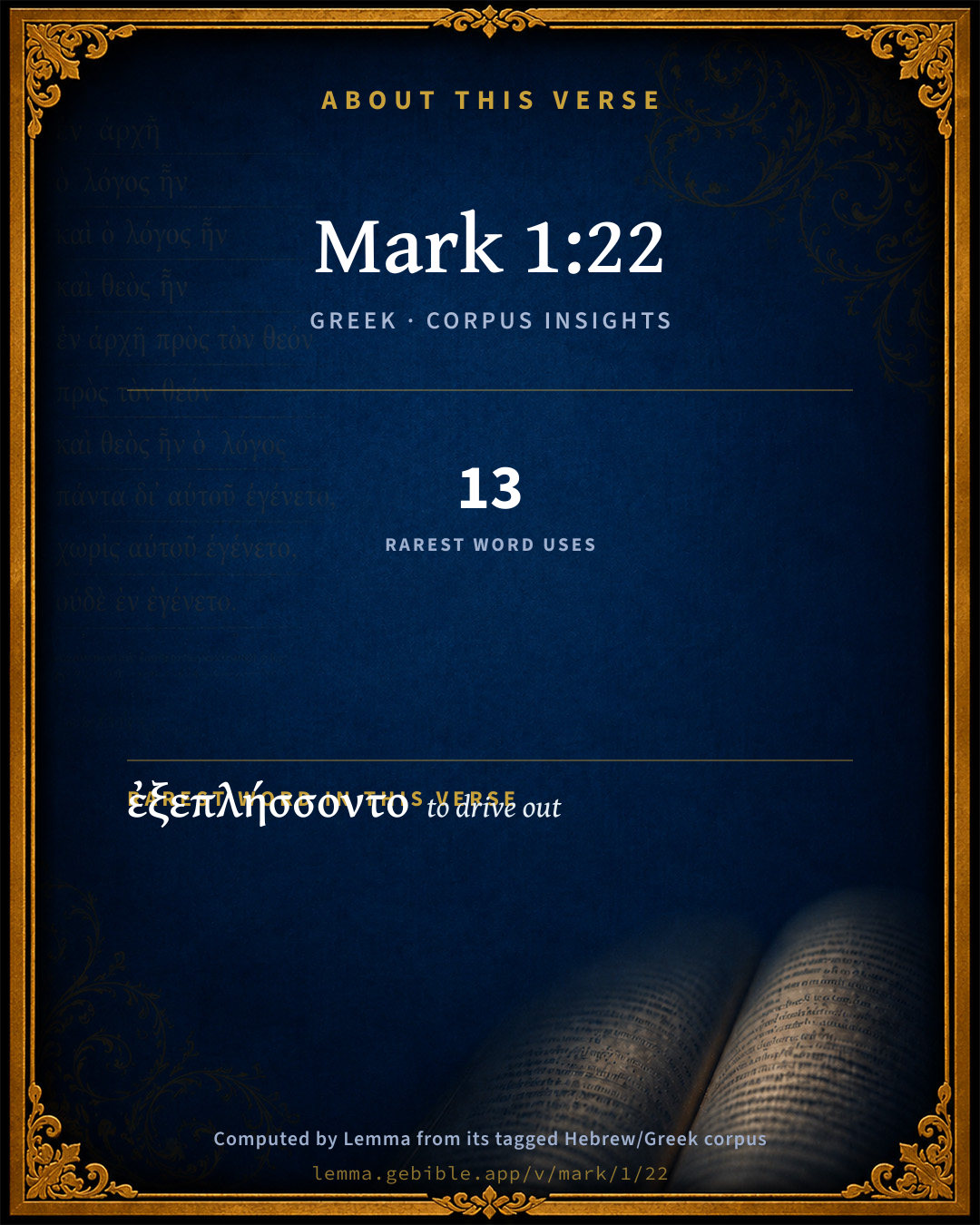
Mark 1:22

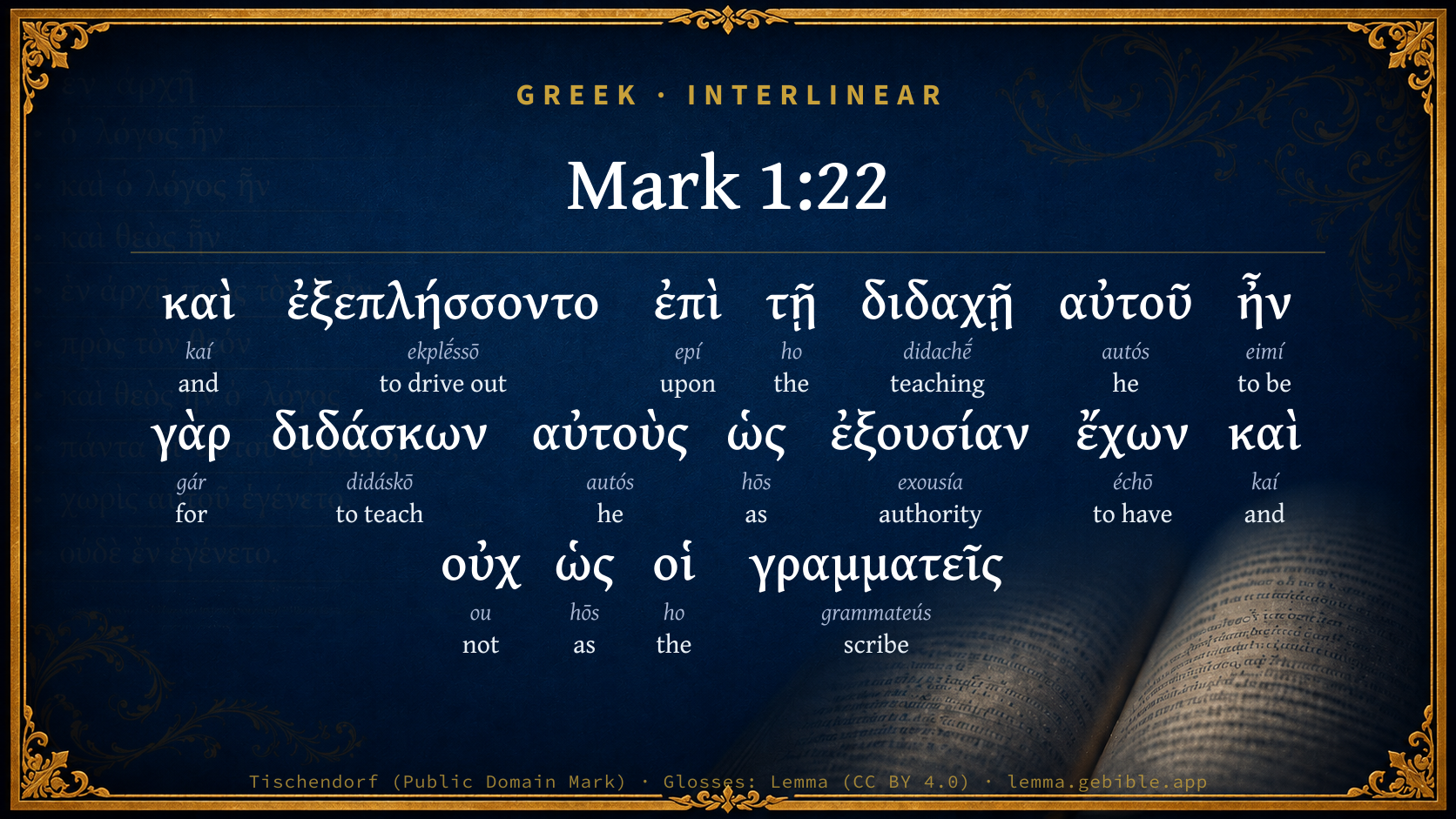
Greek (Tischendorf 8th ed.) Mark 1:22 appears in the Greek New Testament. The text above is from the Tischendorf 8th edition. Each word links to its Strong’s number and a concise gloss. Click any word for its full Thayer’s Greek Lexicon entry.
Download image
Cite this verse

Mark 1:22 (World English Bible). Public Domain. Lemma interlinear Bible study tool, https://lemma.gebible.app/v/mark/1/22.

Show BibTeX & RIS
BibTeX
RIS
English Translation
They were astonished at his teaching, for he taught them as having authority, and not as the scribes.
World English Bible · Public Domain
Download a study sheet

One document with this verse’s original text, its word-by-word gloss line, the meaning frame, cross-references with their text, attributed commentary, and full source and license credits — printable, and it pastes into notes with its structure intact.

This verse Autodidact and up

Study sheet (.html) Plain text (.txt)

A passage Seminary Student

Up to 50 verses in one chapter. A passage sheet keeps up to 6 commentary sources and 12 cross-references per verse, in the order this page ranks them, and says so on the sheet whenever that leaves anything out. Ask for a single verse and you get the Autodidact verse sheet above.

Everything on this page stays free to read, with no account — the sheet is a download of what is already on screen, not access to it.

Want to remove ads? Support Godless Engineer
Compare translations 3

The same verse in 3 English versions, stacked beneath the original-language interlinear above. Click any original word for its lexicon entry.

Each is an independent rendering of the whole verse — the interlinear is not word-aligned to these translations.

Highlighted words mark where these versions differ — a whole-verse word diff, not a word-by-word alignment.

  • World English Bible Public Domain
    They were astonished at his teaching, for he taught them as having authority, and not as the scribes.
  • King James Version Public Domain
    And they were astonished at his doctrine: for he taught them as one that had authority, and not as the scribes.
  • unfoldingWord Literal Text CC BY-SA 4.0
    And they were astonished at his teaching, for he was teaching them as having authority and not as the scribes.

unfoldingWord Literal Text — © unfoldingWord, licensed CC BY-SA 4.0. Word-aligned USFM3 via Door43 (git.door43.org/unfoldingWord/en_ult).

Versions to compare (up to 4)

3 of 4 selected

Show all 19 translations

Every available English version of this verse, each an independent rendering of the whole verse.

  • World English Bible Public Domain
    They were astonished at his teaching, for he taught them as having authority, and not as the scribes.
  • Berean Standard Bible Public Domain
    The people were astonished at His teaching, because He taught as one who had authority, and not as the scribes.
  • Majority Standard Bible Public Domain
    The people were astonished at His teaching, because He taught as one who had authority, and not as the scribes.
  • King James Version Public Domain
    And they were astonished at his doctrine: for he taught them as one that had authority, and not as the scribes.
  • American Standard Version (1901) Public Domain
    And they were astonished at his teaching: For he taught them as having authority, and not as the scribes.
  • Revised Version (1885) Public Domain
    And they were astonished at his teaching: for he taught them as having authority, and not as the scribes.
  • Geneva Bible (1599) Public Domain
    And they were astonied at his doctrine, for he taught them as one that had authoritie, and not as the Scribes.
  • Douay-Rheims (1899) Public Domain
    And they were astonished at his doctrine. For he was teaching them as one having power, and not as the scribes.
  • Young's Literal Translation Public Domain
    and they were astonished at his teaching, for he was teaching them as having authority, and not as the scribes.
  • Literal Standard Version CC BY-SA 4.0
    and they were astonished at His teaching, for He was teaching them as having authority, and not as the scribes.
  • Unlocked Literal Bible CC BY-SA 4.0
    They were astonished at his teaching, for he was teaching them as someone who has authority and not as the scribes.
  • unfoldingWord Literal Text CC BY-SA 4.0
    And they were astonished at his teaching, for he was teaching them as having authority and not as the scribes.
  • Darby Bible Public Domain
    And they were astonished at his doctrine, for he taught them as having authority, and not as the scribes.
  • World Messianic Bible Public Domain
    They were astonished at his teaching, for he taught them as having authority, and not as the scribes.
  • Webster's Bible Public Domain
    And they were astonished at his doctrine: for he taught them as one that had authority, and not as the scribes.
  • Free Bible Version CC BY-SA 4.0
    The people were amazed at his teaching, for he spoke with authority, unlike the religious teachers.
  • Bible in Basic English Public Domain
    And they were full of wonder at his teaching, because he gave it as one having authority, and not like the scribes.
  • Text-Critical English NT CC BY 4.0
    The people were astonished at his teaching, because he was teaching them as one who had authority, and not as the scribes.
  • Tyndale New Testament (1534) Public Domain
    And they merveled at his learninge. For he taught them as one that had power with him and not as the Scribes.

Literal Standard Version (2020), Covenant Press — licensed CC BY-SA 4.0. Text via the HelloAO Bible API (eBible.org). Unlocked Literal Bible (unfoldingWord) — licensed CC BY-SA 4.0. Text via the HelloAO Bible API (eBible.org). unfoldingWord Literal Text — © unfoldingWord, licensed CC BY-SA 4.0. Word-aligned USFM3 via Door43 (git.door43.org/unfoldingWord/en_ult). Free Bible Version, Dr. Jonathan Gallagher — licensed CC BY-SA 4.0. Text via the HelloAO Bible API (eBible.org).

Word by word

More ways to search: Search by grammar → Find every occurrence → Compare this word →

Practice this passage: Drill this verse → Learn its vocabulary →

ἐξεπλήσσοντο
ekplḗssō
G1605
“to drive out”
Verb, Imperfect, Passive, Indicative, 3rd person, Plural
Part of Speech
Verb
Tense
Imperfect
Voice
Passive
Mood
Indicative
Person
3rd person
Number
Plural
Full Thayer's Definition

Origin: from G1537 and G4141

TDNT: None

1. to strike out, expel by a blow, drive out or away 2. to cast off by a blow, to drive out a. commonly, to strike one out of self-possession, to strike with panic, shock, astonish 3. to be struck with amazement, astonished, amazed
  1. καὶ kaí G2532 “and” Conjunction
  2. ἐπὶ epí G1909 “upon” Preposition
  3. τῇ ho G3588 “the” Article, Dative, Singular, Feminine
  4. διδαχῇ didachḗ G1322 “teaching” Noun, Dative, Singular, Feminine
  5. αὐτοῦ autós G846 “he” Personal pronoun, Genitive, Singular, Masculine
  6. ἦν eimí G1510 “to be” Verb, Imperfect, Active, Indicative, 3rd person, Singular
  7. γὰρ gár G1063 “for” Conjunction
  8. διδάσκων didáskō G1321 “to teach” Verb, Present, Active, Participle, Nominative, Singular, Masculine
  9. αὐτοὺς autós G846 “he” Personal pronoun, Accusative, Plural, Masculine
  10. ὡς hōs G5613 “as” Adverb
  11. ἐξουσίαν exousía G1849 “authority” Noun, Accusative, Singular, Feminine
  12. ἔχων échō G2192 “to have” Verb, Present, Active, Participle, Nominative, Singular, Masculine
  13. καὶ kaí G2532 “and” Conjunction
  14. οὐχ ou G3756 “not” Particle, Negative
  15. ὡς hōs G5613 “as” Adverb
  16. οἱ ho G3588 “the” Article, Nominative, Plural, Masculine
  17. γραμματεῖς grammateús G1122 “scribe” Noun, Nominative, Plural, Masculine

About this verse

These counts appear in no published source. They are computed here, from the morphology-tagged text and Lemma’s own curated glosses. What Lemma adds →

18
words
14
distinct lemmas
Gospels
section

Notable vocabulary

The rarest word here is ἐξεπλήσσοντο to drive out G1605 — appearing just 13 times in the whole Greek New Testament.

Shared distinctive vocabulary

ἐξεπλήσσοντο to drive out G1605 occurs in 13 verses of the Greek New Testament. Also found in:

Repetition

Words recur within this verse:

Cross-references

12

Topical passages linked to Mark 1:22 in the Treasury of Scripture Knowledge — connected by theme and wording, ordered by reader-vote popularity; previews shown in the World English Bible.

  • Matthew 7:28–29 It happened, when Jesus had finished saying these things, that the multitudes were astonished at his teaching,
  • Matthew 13:54 Coming into his own country, he taught them in their synagogue, so that they were astonished, and said, "Where did this man get this wisdom, and these mighty works?
  • Luke 4:32 and they were astonished at his teaching, for his word was with authority.
  • Jeremiah 23:29 Isn't my word like fire? says Yahweh; and like a hammer that breaks the rock in pieces?
  • Luke 21:15 for I will give you a mouth and wisdom which all your adversaries will not be able to withstand or to contradict.
  • John 7:46 The officers answered, "No man ever spoke like this man!"
  • Acts 6:10 They weren't able to withstand the wisdom and the Spirit by which he spoke.
  • Acts 9:21–22 All who heard him were amazed, and said, "Isn't this he who in Jerusalem made havoc of those who called on this name? And he had come here intending to bring them bound before the chief priests!"
  • 2 Corinthians 4:2 But we have renounced the hidden things of shame, not walking in craftiness, nor handling the word of God deceitfully; but by the manifestation of the truth commending ourselves to every man's conscience in the sight of God.
  • Hebrews 4:12–13 For the word of God is living, and active, and sharper than any two-edged sword, and piercing even to the dividing of soul and spirit, of both joints and marrow, and is able to discern the thoughts and intentions of the heart.
  • Matthew 23:16–24 "Woe to you, you blind guides, who say, 'Whoever swears by the temple, it is nothing; but whoever swears by the gold of the temple, he is obligated.'
  • Mark 7:3–13 (For the Pharisees, and all the Jews, don't eat unless they wash their hands and forearms, holding to the tradition of the elders.

Cross-references courtesy of OpenBible.info (CC BY 4.0).

Commentary

Notes on Mark 1:22 from classic Christian and Jewish commentators (each source and its license shown beneath its notes). The classic Christian expositions comment on the surrounding passage and are grouped to its opening verse, so a note may address several verses; the Jewish commentaries on the Tanakh (Rashi and others) are per-verse, so they appear only where the commentator wrote on this verse.

Lemma curates 59 commentaries, every one of them public domain or Creative Commons licensed, each selected and text-cleaned for this edition rather than reprinted as found. About our sources →

The Biblical Illustrator

Joseph S. Exell

Mar_1:22

For He taught them as one that had authority.

Conviction of Christs authority through His servants teaching

Francis Junius the younger was a considerable scholar, but by no means prejudiced in favour of the Scriptures, as appears by his own account, which is as follows:-My father, who was frequently reading the New Testament, and had long observed with grief the progress I had made in infidelity, had put that book in my way in his library, in order to attract my attention, if it might please God to bless his design, though without giving me the least intimation of it. Here, therefore, I unwittingly opened the New Testament, thus providentially laid before me. At the very first view, as I was deeply engaged in other thoughts, that grand chapter of the evangelist and apostle presented itself to me (Joh_1:1-51): In the beginning was the Word, etc. I read part of the chapter and was so affected that I instantly became struck with the divinity of the argument, and the majesty and authority of the composition, as infinitely surpassing the highest flights of human eloquence. My body shuddered, my mind was in amazement, and I was so agitated the whole day that I scarcely knew who I was. Thou didst remember me, O Lord my God, according to Thy boundless mercy, and didst bring back the lost sheep to Thy flock. From that day God wrought so mightily in me by the power of His Spirit, that I began to have less relish for all other studies and pursuits, and bent myself with greater ardour and attention to everything which had a relation to God.

An earnest Preacher and an astonished congregation

I. The earnest preacher.

1. He recognized the Sabbath as the time for worship.

2. He recognized instruction as the best method of preaching.

3. He discarded all formality.

II. As astonished congregation. Astonished at His doctrine.

1. Because it was new to them.

2. Because they instinctively felt it to be true. (Joseph S. Exell, M. A.)

The authority of Christ

I. Let us ask how Christs authority was asserted and claimed.

1. By the tone of His teaching.

2. By His ministerial acts, e.g., the cleansing of the temple. This assumption of rightful power led to the inquiry of the chief priests and elders-By what authority, etc. He was the Lord of the temple because He was Son of God.

3. By His miracles. With authority and power commandeth He the unclean spirits, and they obey Him.

4. By the exercise of the Divine prerogative of pardoning sin, e.g., in the cure of the paralytic.

II. Consider upon what Christs authority is based. Christs authority is not based upon force, or craft, or popular regard; but upon right and upon conscience. When questioned, He answered inquiry by inquiry, and boldly declared, Neither tell I you by what authority I do these things.

1. His words are authoritative because they are true.

2. His commands, because they are righteous.

3. He wields the personal authority of peerless love. In all, His authority is Divine, as He is.

III. Inquire over whom and over what Christs authority extends.

1. Nature knew it.

2. Satan confessed it.

3. Angels recognized it, ministered to His wants, and stood ready to rescue and to honour Him.

4. Men felt it.

IV. Remark the advantages which follow the acknowledgment of Christs authority.

1. For the individual, the fulfilment of his true being, the harmony of obedience with liberty.

2. For the human race, its one only sure and Divine hope-In the name of Jesus every knee shall bow.

V. Observe how Christs authority affects all hearers of the gospel. The message of heaven is, indeed, an invitation and a premise. But it is also a command. (J. R. Thompson, M. A.)

The teaching of Christ

I. The subjects He taught.

1. He taught the doctrines of religion.

2. He taught the nature and necessity of experimental religion.

3. He taught the necessity of practical religion.

He stated that obedience was the only evidence of true discipleship, etc.

II. How He taught these things.

1. With direct plainness.

2. He was a faithful and earnest teacher (Mat_23:1-39).

3. He was an affectionate and tender teacher. He did not break the bruised reed, etc.

4. He was a diligent and persevering teacher.

5. He embodied all His instructions in His own blessed example.

Application:

1. True Christians are Christs disciples. They hear Him. This is both a duty and a privilege.

2. Whosoever will not hear Him must perish-How shall we escape, etc. (J. Burns, D. D.)

Christ the model of the Christian ministry

I. His doctrine.

1. View His doctrine of God.

2. His doctrine of man.

(1) Responsibility.

(2) Mans corrupt and sinful state.

II. His manner was in perfect harmony with the matter of His instruction.

1. The leading characteristic of our Saviours manner as a public teacher was earnestness.

2. The earnestness of Christ was evinced in the simplicity of His teachings.

3. The earnestness of Jesus was further evinced by the consistency of His life with His doctrine.

4. The earnestness of Jesus was still further manifested in the decision and boldness of His manner.

5. His tenderness. (J. A. Copp.)

The authority of our Lords teaching

I. Authority of goodness. Invitations. Beatitudes.

II. Authority of greatness. Claims universal audience. Superiority to Jonah, Solomon, and all the great names of the Jewish Church. Teaching declarative and dogmatic.

III. Authority of solemnity. His peculiar formula. His denunciations of woe.

IV. Legislative authority. Revises the Mosaic code. Asserts His superiority to law. Repeals existing economy. Controls laws of nature Himself, and confers the power on others. I say unto you, His new commandment. Not only enacts laws, but ensures obedience. Conclusion: His teaching exempt from all supposable circumstances unfavourable to authoritative teaching. Taught with the perfect conviction of the truth of His doctrine. His example enforced it. Cordial sympathy with it. Knew the ultimate principles on which His doctrines rested. And the supreme value of the truth He taught. The purity of His motives. The ultimate triumph of His doctrine. All this must have clothed His teaching, especially when contrasted with the prevailing mode of Jewish instruction, with commanding power. His disciples should be distinguished by reverence and docility. These dispositions to be sought and found at the throne of grace. (J. Harris, D. D.)

Christs authority largely derived from His moral atmosphere

The weight and impressiveness of a mans words largely depend ripen his air, his atmosphere, the mysterious efflux, exhalation, aerial development of his personality, the moral aroma of his character. This subtle influence can only be felt, and cannot be defined. Enter the assembly when young Summerfield is speaking, and there is upon you a power which it is the highest luxury and dearest blessing to feel. There is incense here, and the smell of sacrifice. It fills the entire space from the rafters downwards to the floor; nay, it pierces the walls and issues from the doors. And what shall we imagine concerning the atmosphere of that wonderful Being, who spoke as never man spake? It was not His look, nor His declamation, nor His fine periods; it was not even His prodigious weight of matter; but it was the sacred exhalation of His quality, the aroma, the auroral glory of His person. This is what invested Him with unimpeachable authority, lent to His words spirit and life, and gave to His doctrine its astonishing power. He took the human nature to exhale an atmosphere of God that should fill and finally renew the creation, bathing all climes, and times, and ages with its dateless, ineradicable power. (H. Bushnell, D. D.)

Ministerial authority

I. Men will teach well only as they teach under Christ.

II. Authority is impossible apart from association with the Master.

III. Authority of love must come from intensity of conviction.

IV. Hearers know the voice of authority.

V. The Christian teacher is to show his supremacy over all other teachers. (J. Parker, D. D.)

The Biblical Illustrator, edited by Joseph S. Exell (c. 1880s–1900s) — public domain. Text from a community e-Sword module.

Tyndale Open Study Notes

Tyndale Open Resources

1:22 The teachers of religious law were professional scribes—scholars who taught, copied, and interpreted Jewish law for the people. They were primarily associated with the Pharisees. The scribes’ authority was derived from quoting other scribes (cp. Matt 5:21-48). Jesus’ teaching caused amazement because he spoke and acted with real authority (see Mark 1:27; 5:20; 6:2; 7:37; 10:24-32; 11:18; 15:5).

Tyndale Open Study Notes — © Tyndale Open Resources, licensed CC BY-SA 4.0. Text via the HelloAO Bible API.

Bengel's Gnomon

Johann Albrecht Bengel

Mar 1:22. Ἐξουσίαν, authority) comp. Mar 1:27. [Matthew observes the same fact in his ch. Mar 7:28. General truths of this kind are related by one Evangelist in one place and connection, and by another in another and different connection. So the people are compared to “sheep left without a shepherd,” in Mat 9:36, but at a subsequent time in Mar 6:34. Mark, however, in this passage, refers to the sermon on the mount; whence it is evident that the healing of the mother-in-law of Peter, which Mark transposes, followed the sermon on the mount, as we find the order of events in Matthew.—Harm., p. 235.]

Bengel's Gnomon of the New Testament — English translation (T&T Clark, Edinburgh, 1860) — public domain. Text from a community e-Sword module.

Meyer's Critical & Exegetical Commentary

Heinrich August Wilhelm Meyer

Mar_1:22. Comp. Mat_7:28 f., where the notice of Mark is reproduced unaltered, but placed after the sermon on the Mount; and Luk_4:32, where the second part of the observation is generalized and divested of the contrast. It is very far-fetched, however, in Hilgenfeld, who in Mar_1:22 sees a sure indication of dependence on Matthew, to find in the fact, that Mark already here makes Capernaum appear as the scene of the ministry of Jesus just as in Mar_1:29, the Petrine character of the Gospel. See, on the other hand, Baur in the theol. Jahrb. 1853, p. 56 ff.

As to ἦν διδάσκ. and ὡς ἐξουσ. ἔχων, see on Mat_7:28 f.

Meyer — Critical and Exegetical Commentary on the New Testament — English translation by Peter Christie, edited by Frederick Crombie (T&T Clark, 1880) — public domain. Text from a community e-Sword module.

Expositor's Greek Testament

ed. W. Robertson Nicoll

Mar 1:22 . ἐξεπλήσσοντο : they were amazed; a strong word, several times in Mk. (Mat 7:28 ). ὡς ἐξουσίαν ἔχων , etc.: a similar remark in Mat 7:29 (see notes there) appended to Sermon on Mount. Mk. gives no discourse, but only notes the impression made. “A poor substitute for the beautiful Sermon on the Mount” (Schanz). Doubtless, but let us be thankful for what we do get: a record of the impression made by Christ’s very first appearance in the synagogue, witnessing to a striking individuality . Mk. omits much, and is in many ways a meagre Gospel, but it makes a distinctive contribution to the evangelic history in showing by a few realistic touches (this one of them) the remarkable personality of Jesus .

The Expositor's Greek Testament, edited by W. Robertson Nicoll (1897–1910) — public domain. Text from a community e-Sword module.

Jamieson, Fausset & Brown

Robert Jamieson, A. R. Fausset & David Brown

And they were astonished at his doctrine--or "teaching"--referring quite as much to the manner as the matter of it.

for he taught them as one that had authority, and not as the scribes--See on Mat 7:28-29.

Jamieson, Fausset & Brown — Commentary Critical and Explanatory on the Whole Bible (1871) — public domain (CC PDM 1.0). Text via the HelloAO Bible API.

Adam Clarke's Commentary

Verse 22. As one that had authority] From God, to do what he was doing; and to teach a pure and beneficent system of truth.

And not as the scribes.] Who had no such authority, and whose teaching was not accompanied by the power of God to the souls of the people:

1. because the matter of the teaching did not come from God; and

2. because the teachers themselves were not commissioned by the Most High. See Clarke on Mt 7:28.

Adam Clarke's Commentary on the Bible (1810–1826) — public domain. Text from a community e-Sword/MySword module.

Ellicott's Commentary for English Readers

(22) And they were astonished.—The verbal agreement with Mat_7:28 (where see Note) suggests the thought that St. Mark had heard or read that passage. For “doctrine” read teaching. Stress is laid, as in Mat_7:28, on the manner rather than the thing taught.

A Bible Commentary for English Readers, edited by Charles John Ellicott (1878–1897) — public domain. Text from a community e-Sword module.

The Cambridge Bible for Schools and Colleges

gen. ed. J. J. S. Perowne

22. not as the scribes] The Scribes, Sopherîm, first came into prominence in the time of Ezra. Their duty was to copy, read, study, explain, and “fence round” the Law with “the tradition of the Elders” (Mat_15:2). The Scribes proper only lasted till the death of Simon “the Just,” b. c. 300. In the New Testament they are sometimes called “lawyers” (Mat_22:35), or “Doctors of the Law” (Luk_5:17). Their teaching was preeminently second-hand. They simply repeated the decisions of previous Rabbis. But our Lord’s teaching was absolute and independent. His formula was not “It hath been said,” but “I say unto you.”

The Cambridge Bible for Schools and Colleges (gen. ed. J. J. S. Perowne; Cambridge University Press, 1878–1918) — public domain. Text from a community e-Sword module.

John Gill's Exposition

And they were astonished at his doctrine,.... The nature and importance of it, it being what they had not been used to hear; only at best the doctrine of the law, and sometimes only the traditions of the elders, or an allegorical and traditional sense of the Scriptures, and things very trifling and unedifying: and also they were amazed at the manner of his preaching, which was with so much gracefulness, gravity, and majesty, and was attended with so much evidence and power:

for he taught them as one having authority, and not as the Scribes; or "their Scribes", as the Syriac, Persic, and Ethiopic versions read. He did not go about to establish what he said by the authority of the Rabbins, as the Scribes did; saying, Hillell says so, or Shammai says thus, or such a doctor says thus and thus; but he spoke as from himself, as one sent of God, that had an authority from him, and was independent of man; and this was what they had not observed in others, and wonder at it; See Gill on Mat 7:28. See Gill on Mat 7:29.

John Gill's Exposition of the Whole Bible (1746–1763) — public domain (CC PDM 1.0). Text via the HelloAO Bible API.

Trapp's Complete Commentary

John Trapp

22 And they were astonished at his doctrine: for he taught them as one that had authority, and not as the scribes.

Ver. 22. And they were astonished] If it could be said of Dr Whittaker, that no man ever saw him without reverence, or heard him without wonder, how much more of Christ, since grace was "poured into his lips?" Psa 45:2.

As one that had authority] Seest thou a preacher deliver the word with singular authority (as Paul, "We believe, therefore we speak"), esteem him very highly for the work’s sake. The Corinthians are checked, for that they were unruly, and would reign without Paul, 1Co 4:8. Zedekiah is blamed, 2Ch 36:12, because he humbled not himself before Jeremiah, a poor prophet, speaking to him from the Lord.

And not as the Scribes] Frigidly and jejunely (meagrely, insipidly). Didst thou believe thyself, thou wouldst never plead thy client’s cause so coldly and carelessly, said Cicero to his adversary.

John Trapp, A Commentary or Exposition upon All the Books of the Old and New Testament (1647–1656) — public domain. Text from a community e-Sword module.

Whedon's Commentary on the Bible

Daniel D. Whedon

22. As one that had authority — See Mat_7:29; Luk_4:32.

Daniel D. Whedon (gen. ed.), Commentary on the Old and New Testaments (1874–1909) — public domain. Text from a community e-Sword module.

The Pulpit Commentary

They were astonished at his teaching (exeplhssonto epi th didach). The verb in the Greek is a very strong and expressive one; it is a very suitable word to express the first impressions of utter amaze-sent produced by our Lord"s "teaching." There were several things which caused his teaching (didach) to differ from that of the scribes. There was no lack of self-assertion in their teaching; but their words did not carry weight. Their teaching was based chiefly on tradition; it dwelt much on the "mint and anise and cummin" of religion, but neglected "judgment and mercy and faith." Christ"s teaching, on the contrary, was eminently spiritual. And then he practiced what he taught. Not so the scribes.

Thus far St. Mark"s narrative bears the character of brevity and conciseness, suitable to an introduction. From this point his record is rich in detail and in graphic description.

"Having authority.

St. Mark"s Gospel has been characterized as the Gospel for the Romans, as the Gospel of Power, as the Gospel of the Resurrection. The symbol denoting this second evangelist is the lion. There has always been a feeling that the dignity and majesty, the might and victory, of Emmanuel are in an especial manner set before the reader in this one of the four Gospels. Certainly the first chapter strikes the key-note of this strain. Jesus appears as the mysterious Lord, who with authority summons fishermen to forsake their nets and follow him; who teaches with authority in the synagogues, and awakens the amazement of his hearers; who with authority commands the unclean spirits, and they obey him; whose authority rebukes the fever and heals the leprosy; who by the magnetism of his power and love gathers the people from every quarter into his gracious presence, to hear his authoritative voice, and to receive a thousand blessings from his beneficent and powerful hands. In one word, he appears before us, at the very outset of his ministry, as "One that had authority.

I How CHRIST"S AUTHORITY WAS ASSERTED. That we may understand that Christ claims authority, we must refer to the gospel narrative, in which his words are recorded, his character delineated, and his ministry related. Does he assert authority? Is he such a Being that his claims demand attention? Was his authority for a season only, or was it intended to subsist through all time and in eternity? Was his an authority local in its range, or universal as the presence of mankind on earth? That Christ possessed and exercised authority during his earthly ministry admits of no dispute or question. Satan himself confessed it; for Jesus spurned his assumptions, resisted his temptations, and sent him who claimed the lordship of the earth defeated and uncrowned from his holy and authoritative presence. Angels recognized it; for they came to minister to his wants, and stood in countless legions ready, at a word, to rescue and to honor him. Demons felt it, and quailed beneath his glance, did homage to his supremacy, and fled at his rebuke. Nature knew it; and the winds were hushed and the sea was calmed at his authoritative word, bread multiplied in his hand, and water at his bidding turned to wine, trees withered at his breath, the very grave gave up its dead at his command, and the gentle air floated his gracious form to heaven. His enemies were conscious of his superiority; for they were abashed and silenced by his reasoning, they fell backward at his look. Men generally acknowledged him to be other and higher than themselves; Never man," said the officers sent to apprehend him man spake like this man;" Pilate and Pilate"s wife were under the mysterious spell of his Divine authority; and the Roman centurion was constrained to exclaim, Truly this was the Son of God!" His friends were sensible that he was to them more than a friend; at his summons they forsook their callings and their homes, they attempted impossibilities with confidence, they consecrated their powers and they hazarded their lives for the mission to which he called them. But he had greater witness than that of man. The works which he performed, they testified to him. The seal of God was set upon his actions. The voice of God honored the Holy One and Just; heaven itself was opened, and from the excellent glory came the attestation and the approval of the Most High, "This is my beloved Son, in whom I am well pleased!" and there was added the demand which sanctions the authority of Emmanuel over universal man, "Hear ye him!" The Jews sometimes felt that Jesus of Nazareth was laying claim to a special and unrivalled authority. His bold and thorough cleansing of the temple is a case in point. How came he to take upon himself so remarkable a function as this? Who was he that he should do what none of the great officials ventured upon? We cannot wonder that "the chief priests and the elders of the people came unto him as he was teaching, and said, By what authority doest thou these things, and who gave thee this authority?" The only explanation was that Jesus was lord of the temple because he was the Son of God. And this lordship he asserted when he predicted the destruction of the material sanctuary, and when he, using it as a symbol of his body, foretold the rebuilding of the temple of God in three short days. Another case in point is his assumption of the Divine prerogative of pardoning sin. When Jesus publicly assured the believing paralytic that his sins were forgiven, this language aroused the indignation of the scribes and Pharisees. "This man blasphemeth! Who can forgive sins but God only?" The only reply of our Saviour to these insinuations was the performance of a miracle, that, as he phrased it," they might know that the Son of man had power on earth to forgive sins.

II Upon WHAT IS CHRIST"S AUTHORITY BASED? It is not all authority which the enlightened and the free, the honorable and the just, can regard with reverence. Much that bears the name may fairly be treated as usurpation. And even just authority may deserve only a partial reverence; it may be admitted, but admitted with reserve. Authority is of different kinds, for it rests on different bases. The authority of the tyrant over his subjects, of the conqueror over the vanquished, rests on force and fear the authority of the priest over the devotee rests on superstition and assumption; but the authority of the teacher over the scholar is the authority of wisdom, and that of the potent over the child is the authority of care and love. There is authority which is natural, and authority which is conventional. Some authority it is virtue to recognize; other authority it is baseness and dishonor not to resist. Authority is excellent and admirable when there is a right to command, when there is an obligation to submit and to obey. To understand aright the authority of the Lord Jesus, we must divest our minds of their habitual notions of civil authority. Government is not only right, it is necessary, it is ordained of God. But it has regard only to human actions. It is not the business of the civil ruler to influence men"s beliefs upon science, or philosophy, or religion, but to induce them to industry, independence, order, and peaceableness. And the sanctions governors employ are not so much moral as external and physical. Fine, imprisonment, death, these are their weapons. Occasionally rewards, in the shape of distinctions and honors, may be added, but the system is mainly one of penalty. A submission to Christ"s authority is nothing if it is not willing, cheerful, cordial. Too often human authority is asserted with harshness, is acknowledged with slavishness. None of our Redeemer"s subjects bow the knee whilst the heart is unyielded, offer the homage of the voice whilst the spirit is in rebellion. Men may do this under some influences; but let them not be deceived; it is the authority of men to which they bow, not that of Christ! By virtue of what quality, of what possession, had Jesus Christ authority? For us there is one great and all-sufficient answer He was the Son of God. It was upon this ground that he based his own claims. "I and my Father," said he, "are one." "Say ye of him whom the Father hath sanctified and sent into the world, Thou blasphemest! because! said, I am the Son of God? "The works which My Father hath given me to do, bear witness of me that the Father hath sent me." In fact, Christ so often and so plainly asserted his unique authority that he came to refuse any further explanations or formal claims. He answered inquiry by inquiry, and boldly declared, "Neither tell I you by what authority I do these things." Truth has authority over man"s understanding, and Christ"s words, his declarations and revelations, have the authority of truth. He claimed to have told them the truth which he had heard of God. Our nature is framed to recognize and to rest in truth; and, since Christ is "the Truth," he is exactly adapted to our mental necessities and desires, to afford them full and final satisfaction. Christ wields the authority attaching to a holy and benevolent character. The human heart always renders homage to goodness, though there may be motives which prevent that homage being manifested and expressed. We instinctively honor and reverence those whom we feel to be better than ourselves. Now, in the case of our Saviour, it was Divine, incarnate goodness which appeared before men and moved among them. A perfect man, he went about doing good; and, both by his pure and gentle character, and by his unselfish, compassionate life, he commanded the reverence and constrained the allegiance of men. An authority this far nobler and worthier than that derived from a splendid retinue and a glittering throne, a mighty army and a sounding name. The conscience of the Christian acknowledges the claims of the sinless Emmanuel. The heart confesses the unrivalled authority of his tender pity, his unselfish love. Power, apart from righteousness, enkindles resentment and arouses resistance. But goodness and benevolence, with the resources of Omnipotence at their command, summon our hearts to a willing surrender and our lives to a glad obedience. Our will, our whole nature, acknowledge the authority of the Saviours law. When he was upon earth his disciples obeyed unquestioningly the mandates they could not always understand, and undertook with alacrity service for which they felt themselves utterly unqualified. And each awakened and enlightened hearer of the gospel gives utterance to his foremost and earnest desire in the words of the trembling rabbi of Tarsus, "Lord, what wilt thou have me to do?" When once we know ourselves and him, we feel that none other has the right to our loyalty, our love, our devotion. When we hear his voice, it carries with it its own authority to our heart.

III OVER WHOM CHRIST"S AUTHORITY EXTENDS. The answer to this question is suggested by what has been already said regarding the instruments, so to speak, of the dominion of Jesus Christ. If truth and righteousness, love and sacrifice spiritual influence, in a word be the source of his authority, we feel at once that his reign is not primarily and chiefly one over actions and observances. It is far more deep-seated and efficient, far more adapted to the moral nature of man and the moral authority of God. Christ"s authority is over the spiritual nature of man, and it is supported by spiritual sanctions. Not so much what men do, as what they are, and why they act, and how they feel, is of interest to the Lord of hearts. His appeal is to what is intellectual, to what is moral, in man. It is not his aim to induce men to wear one uniform, to utter one cry, but rather to share one spirit his own, to live one life that of God. He designs to bring every thought into captivity unto obedience to Jesus Christ, Yet it is important to remember that, constituted as man is, it is impossible that he should acknowledge an authority over his conscience and heart which will have no sway over the actions and habits of his life. The individual life will be cast into the mould of Christ"s mind and will. Society will own practically the rightful and controlling sway of Jesus. "All power is given unto him.

IV THE ADVANTAGES WHICH CHRIST"S AUTHORITY SECURES. Is it to be desired that the authority of the Saviour should be generally and indeed universally acknowledged? What are the fruits of obedience? what the influences of his reign? Are they such that we may look forward with hope and prayer to the submission and subjection of mankind to him whom we "call Master and Lord"? When the authority of the Saviour has been acknowledged by the soul, and when he is habitually exercising this authority over the whole nature, the results are most blessed. Happiness is not in wilfulness and unbridled licence, but in subjection to a Law, holy, approved, and willingly accepted. This is true liberty, when the soul finds an authority it can bow before and obey with the harmony of all its faculties, Christ"s is the perfect law of liberty, and where this prevails and reigns there is peace and joy; for there freedom and obedience are one, yoked together by spiritual and most welcome bonds. The widespread and universal acknowledgment of the Redeemer"s authority is the one hope for the world"s future. To thoughtful man can look forward to a universal empire of force, to the prevalence of a supreme military authority. What, then, is to put an end to wars and fightings amongst men? They are not for ever to afflict and curse the world. It is only in the reign of righteousness and benevolence that the dreams of poets shall be realized, the forecastings of prophets fulfilled, and the prayers of saints shall be answered. "In the Name of Jesus every knee shall bow, and every tongue shall confess that he is Lord, to the glory of God the Father.

V HOW THIS AUTHORITY OF CHRIST AFFECTS THOSE WHO HEAR THE GOSPEL, To some the authority of the Redeemer may be an unwelcome theme. They would rather hear of his grace than of his dominion. Yet it is well to see and feel that each is essential to the other in a perfect and Divine Saviour. Instruction, to be satisfactory, must be authoritative. Consolation comes most effectually from him who wields the. scepter of dominion, and who is able to rebuke and to master all our foes and to sanctify all our trials. Many hearers of the gospel in these days think little of the rightful and supreme authority of the Lord Christ. Preachers and writers of religious books are accustomed, to lay great stress upon the love of the Redeemer, and to spend their energies in inducing sinful, weak, needy hearts to respond to Christ"s love, and to accept his salvation. And this is quite right. But it is not right to overlook the just claim of Christ upon the faith and obedience of men, to keep out of sight the truth that men have no right to disbelieve and disobey the Son of God. No doubt it is for our interest and our happiness to be Christians. It is also our sin and our shame if we are not Christians. There have been parents among the poor who have thought that they were doing the teachers in Sunday schools a favor in sending their children to receive religious instruction; and this notion has arisen from the extreme and benevolent desire of teachers to bring the young into their classes. And in like manner it seems that there are many persons who think that they are quite at liberty to receive the Saviour or to reject him; that if they welcome the gospel and seek the fellowship of a Christian Church they will be bestowing an important favor upon those who present to them the invitations of the gospel. But, as the child renders no favor in doing his father"s will, as the poor man renders no favor in accepting the bounty of his benefactor, as the subject renders no favor in obeying his country"s laws, so the sinner, in listening to the gospel, obeying its summons and submitting to the Son of God, is far from rendering a favor. He is receiving a gift in his abject poverty; he is passing from the prison doors into light and liberty; he is acknowledging the just authority of an omnipotent Friend a Saviour, not only gracious, but supreme, Divine!

The Pulpit Commentary (1880–1919), ed. H.D.M. Spence-Jones & Joseph S. Exell — public domain. Text from a community e-Sword module.

The People's New Testament

B. W. Johnson

22. They were astonished at his doctrine. See note on Matt. 7:28. Scribes. For account of scribes see notes on Matt. 5:20.

B. W. Johnson's The People's New Testament with Notes (1889–1891) — public domain. Electronic text from the Christian Classics Ethereal Library (CCEL) ThML edition.

Cambridge Greek Testament for Schools and Colleges

22. ἐξεπλήσσοντο. They began to be amazed, or they continued to be amazed. Amazement was a common result of Christ’s teaching and acts (Mar 5:20, Mar 6:2; Mar 6:6, Mar 7:37, Mar 10:26, Mar 11:18). What amazed people in His teaching was its authoritative tone. Jewish teachers quoted Scripture, or tradition, or the sayings of some famous Rabbi, as the authority for what they taught; “It is written,” or “It has been said.” Jesus taught as One who needed no such justification, and He sometimes corrected, not only traditions, but even the accepted expositions of the Law; But I say unto you (Mat 5:22; Mat 5:28; Mat 5:32; Mat 5:34; Mat 5:39; Mat 5:44). Hort, Judaistic Christianity, p. 33.

ἦν γὰρ διδάσκων. See on Mar 1:6. The periphrastic tense covers more than the previous imperf.; ἐδίδασκεν refers to His teaching on this occasion, ἦν διδ. to the general tone of His teaching; His way was to teach. Cf. Mar 2:6; Mar 2:18.

ὡς ἐξουσίαν ἔχων. Adverbial, stating the manner of the action, viz. “authoritatively.” We may treat the participle as used substantively and expand, “He taught as one who has authority teaches”; but the words are intelligible without such expansion, as in ὡς οὐκ ἀέρα δέρων (1Co 9:26; cf. 1Co 7:25; 1Pe 2:16). Burton, § 446. Ἐξουσία is legitimate power derived from a source which is competent to confer it. The source of Christ’s ἐξουσία was His Father (Mat 28:18; Luk 22:29; Joh 3:35; Joh 13:3; Joh 17:2), and from the outset stress is laid on it.

οἱ γραμματεῖς. Those who were learned in τὰ γράμματα, the professional exponents of Scripture. For the history of the term see Deissmann, Bible Studies, p. 110; cf. 1Es 8:3; 2Ma 6:18. The scribes in 1Ma 5:42, and perhaps in Mar 7:12, are a different class of officials. In N.T., “the Scribes,” Sopherim, are the professors of exegesis, and most of them were Pharisees or held similar views. They are the Clerical party.

Cambridge Greek Testament for Schools and Colleges (Cambridge University Press, 1896; 21 vols, various authors incl. Carr, Maclear, Plummer, Farrar, Lumby, Moule, M. R. James, Simcox) — public domain. Text from a community e-Sword module.

Alford’s Greek Testament

Henry Alford

22.] A formula occurring entire at the end of the Sermon on the Mount, Mat 7:28, and the first clause of it,—and, in substance, the second also,—in the corresponding place to this in Luk 4:32.

Henry Alford, The Greek Testament (1849–1861) — public domain. Text from a community e-Sword module.

International Critical Commentary

22. Καὶ ἐξεπλήσσοντο—And they were astonished. A strong descriptive word for amazement, meaning strictly to strike a person out of his senses by some strong feeling, such as fear, wonder, or even joy. διδαχῇ—teaching (RV.) not doctrine (AV.). The reason given for their astonishment concerned the manner of his teaching, not its substance. ἐδίδασκεν—he was teaching, not he taught (EV.). ὡς ἐξουσίαν ἔχων—as having authority (RV.). What this authority was, the contrast with the Scribes indicates. They had, and constantly cited, external authority for their teaching. They said, Rabbi—says this. His authority then, which they did not have, was internal, proceeding from vision. The difficulty with the Scribes, and with men of their class, is that they carry external authority into the realm of intuitive truth.

οἱ γραμματεῖς—the Scribes.1 These were the men with whom Jesus had his chief controversy. They were the authors of the tradition, which he claimed made void the word of God. 7:9, 13. The Pharisees were the party of adherents to this traditional law, whom they gathered about themselves. Their function was that of interpreters and expounders of the law, and especially the decision of difficult cases under its different commands. They sought in this way to apply such a general law as the Sabbath, e.g. to all possible cases that could arise under it, in such a way as to safeguard it against possible violation. They were ignorant of the modern historical interpretation, and of Jesus’ spiritual exposition, and they systematized the allegorical method. To this body of casuistry and essentially false interpretation they gave an authority equal to that of Scripture, and even superior to it. The consequence was that they built up a system, in which the spiritual element of the O.T. was minimized, and the external, formal, positive element was emphasized. See Schürer on Scribism, II. 1, 25.

International Critical Commentary — older volumes (1896–1929), various authors — public domain. Text from a community e-Sword module.

Vincent's Word Studies in the New Testament

Marvin R. Vincent

He taught (ἦν διδάσκων)

The finite verb with the participle denoting something continuous: was teaching.

Marvin R. Vincent, Word Studies in the New Testament (1887–1900) — public domain. Text from a community e-Sword/MySword module.

Lesson kit

Teaching starters — assembled from the data on this page, not authored interpretation. Every prompt links to the verse data it draws on. Edit before teaching.

Mark, in the Gospels, opens this verse with 18 words (14 distinct Greek lemmas). Its most distinctive word is ekplḗssō (“to drive out”). A historical commentator’s framing appears above. Read the whole chapter for the surrounding context.

Discussion questions

  1. The word ekplḗssō carries the sense “to drive out.” How does it shape the verse?
  2. Matthew 7:28 shares the word «to drive out» with this verse. How do the two illuminate each other?
  3. “and” occurs 2× in this one verse. What is the effect of the repetition?
  4. These translations render this verse differently; the difference is in the English rendering, not the original. What questions does that raise?
  5. Reading how The Biblical Illustrator and Tyndale Open Study Notes read this verse, where do the two commentators agree and where do they part?

Things to notice

Reading settings

Reading text

Shown beneath each verse's original-language words.

Old Testament
Old Testament edition

Read the OT as the Masoretic Hebrew (MT) or the Greek Septuagint (LXX).

English shown for the Greek Septuagint (in the Hebrew ↔ Greek comparison).

Comparing translations? Open the Compare panel on any verse page to stack up to four side by side.