
Matthew 5:37

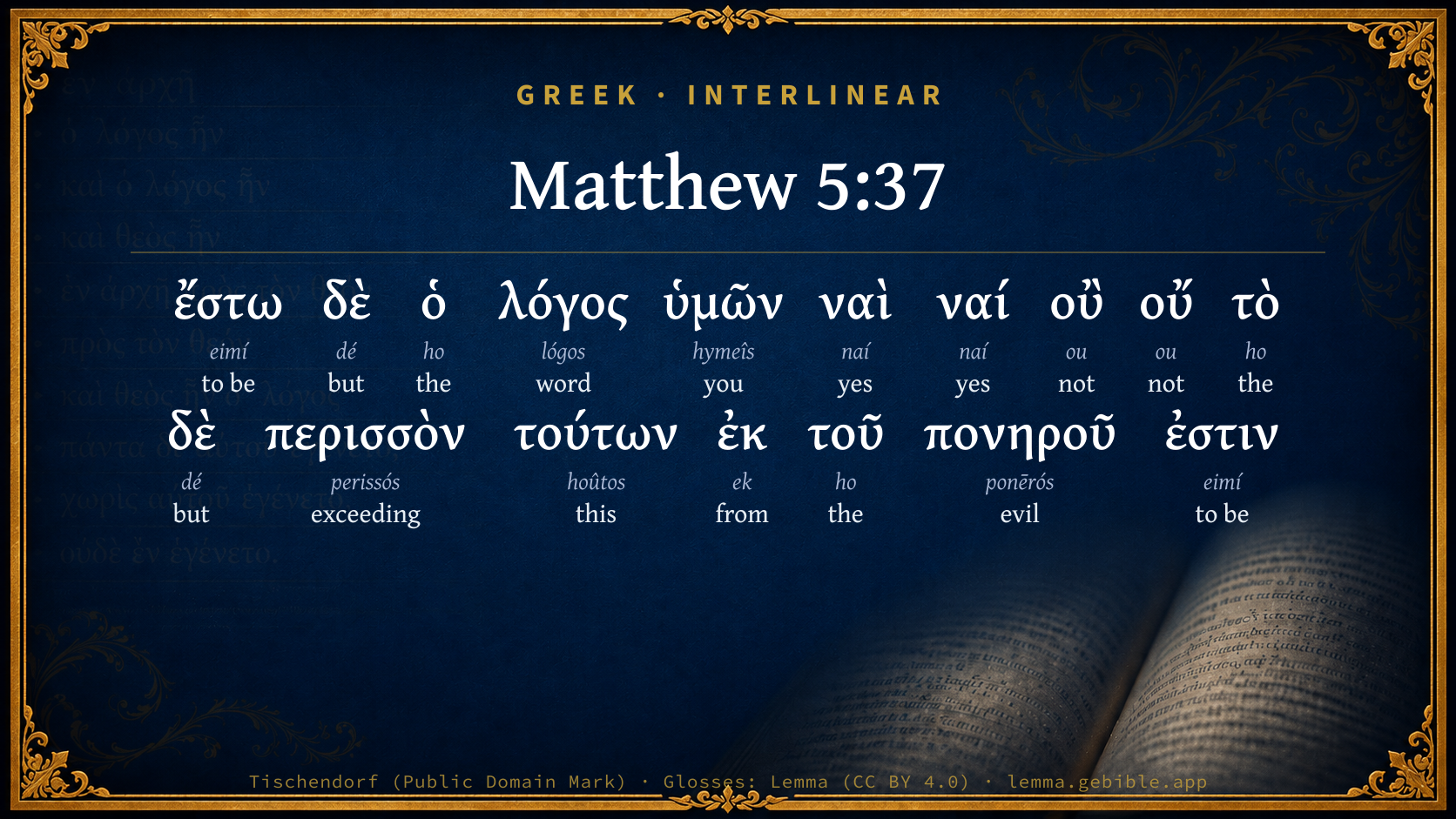
Greek (Tischendorf 8th ed.) Matthew 5:37 appears in the Greek New Testament. The text above is from the Tischendorf 8th edition. Each word links to its Strong’s number and a concise gloss. Click any word for its full Thayer’s Greek Lexicon entry.
Download image
Cite this verse

Matthew 5:37 (World English Bible). Public Domain. Lemma interlinear Bible study tool, https://lemma.gebible.app/v/matthew/5/37.

Show BibTeX & RIS
BibTeX
RIS
English Translation
But let your 'Yes' be 'Yes' and your 'No' be 'no.' Whatever is more than these is of the evil one.
World English Bible · Public Domain
Highlights
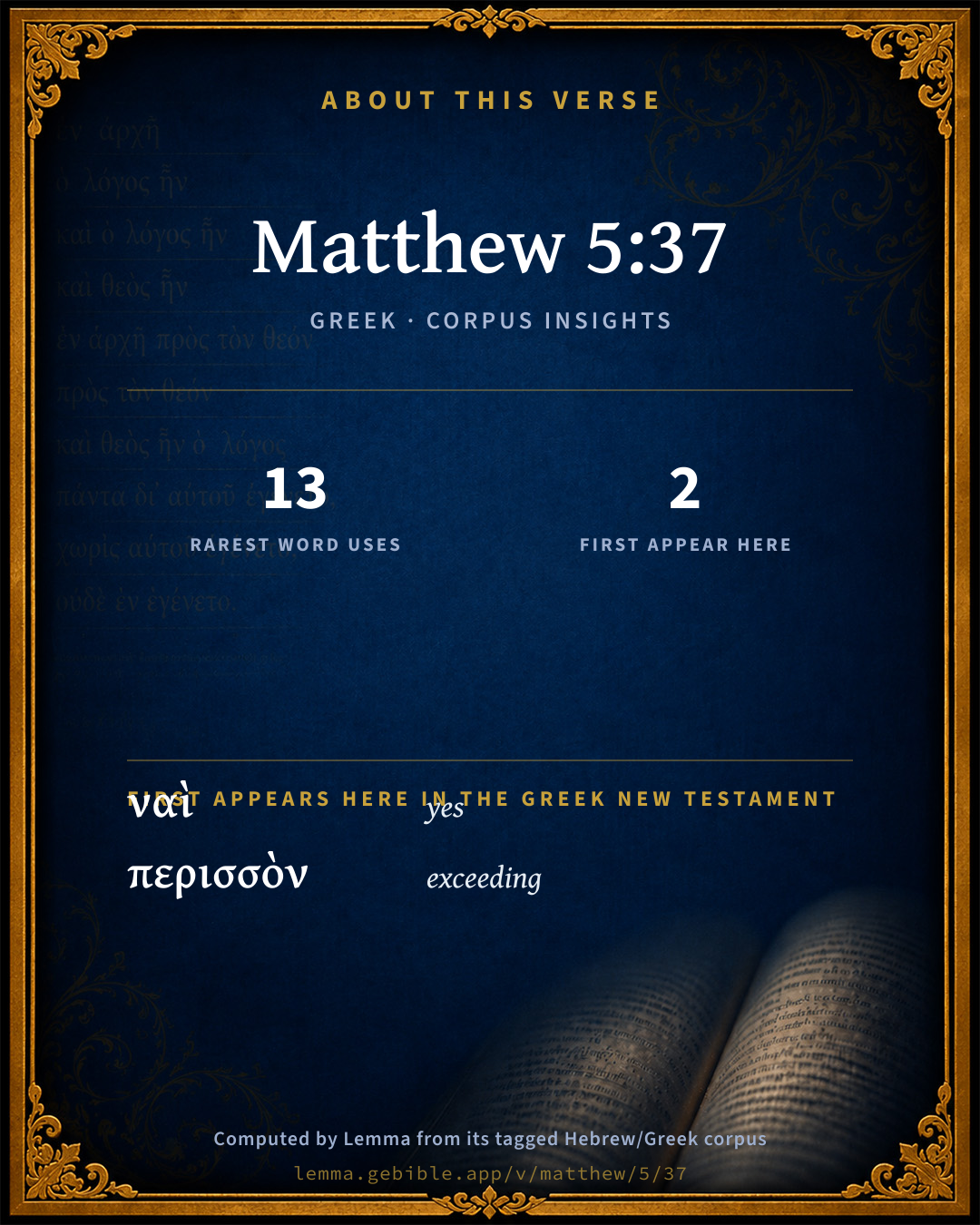
  • 2 first appearances in the Greek New Testament
Full analysis ↓
Download a study sheet

One document with this verse’s original text, its word-by-word gloss line, the meaning frame, cross-references with their text, attributed commentary, and full source and license credits — printable, and it pastes into notes with its structure intact.

This verse Autodidact and up

Study sheet (.html) Plain text (.txt)

A passage Seminary Student

Up to 50 verses in one chapter. A passage sheet keeps up to 6 commentary sources and 12 cross-references per verse, in the order this page ranks them, and says so on the sheet whenever that leaves anything out. Ask for a single verse and you get the Autodidact verse sheet above.

Everything on this page stays free to read, with no account — the sheet is a download of what is already on screen, not access to it.

Want to remove ads? Support Godless Engineer
Compare translations 3

The same verse in 3 English versions, stacked beneath the original-language interlinear above. Click any original word for its lexicon entry.

Each is an independent rendering of the whole verse — the interlinear is not word-aligned to these translations.

Highlighted words mark where these versions differ — a whole-verse word diff, not a word-by-word alignment.

  • World English Bible Public Domain
    But let your 'Yes' be 'Yes' and your 'No' be 'no.' Whatever is more than these is of the evil one.
  • King James Version Public Domain
    But let your communication be, Yea, yea; Nay, nay: for whatsoever is more than these cometh of evil.
  • unfoldingWord Literal Text CC BY-SA 4.0
    But let your word be ‘Yes, yes,’ ‘No, no.’ But anything greater than this is from the evil one.

unfoldingWord Literal Text — © unfoldingWord, licensed CC BY-SA 4.0. Word-aligned USFM3 via Door43 (git.door43.org/unfoldingWord/en_ult).

Versions to compare (up to 4)

3 of 4 selected

Show all 19 translations

Every available English version of this verse, each an independent rendering of the whole verse.

  • World English Bible Public Domain
    But let your 'Yes' be 'Yes' and your 'No' be 'no.' Whatever is more than these is of the evil one.
  • Berean Standard Bible Public Domain
    Simply let your ‘Yes’ be ‘Yes,’ and your ‘No,’ ‘No.’ Anything more comes from the evil one.
  • Majority Standard Bible Public Domain
    Simply let your ‘Yes’ be ‘Yes,’ and your ‘No,’ ‘No.’ Anything more comes from the evil one.
  • King James Version Public Domain
    But let your communication be, Yea, yea; Nay, nay: for whatsoever is more than these cometh of evil.
  • American Standard Version (1901) Public Domain
    But let your speech be, Yea, yea; Nay, nay: and whatsoever is more than these is of the evil `one'.
  • Revised Version (1885) Public Domain
    But let your speech be, Yea, yea; Nay, nay: and whatsoever is more than these is of the evil one.
  • Geneva Bible (1599) Public Domain
    But let your communication be Yea, yea: Nay, nay. For whatsoeuer is more then these, commeth of euill.
  • Douay-Rheims (1899) Public Domain
    But let your speech be yea, yea: no, no: and that which is over and above these, is of evil.
  • Young's Literal Translation Public Domain
    but let your word be, Yes, Yes, No, No, and that which is more than these is of the evil.
  • Literal Standard Version CC BY-SA 4.0
    but let your word be, Yes, Yes, No, No, and that which is more than these is of the evil [one].
  • Unlocked Literal Bible CC BY-SA 4.0
    But let your speech be 'Yes, yes,' or 'No, no.' Anything that is more than this is from the evil one.
  • unfoldingWord Literal Text CC BY-SA 4.0
    But let your word be ‘Yes, yes,’ ‘No, no.’ But anything greater than this is from the evil one.
  • Darby Bible Public Domain
    But let your word be Yea, yea; Nay, nay; but what is more than these is from evil.
  • World Messianic Bible Public Domain
    But let your ‘Yes’ be ‘Yes’ and your ‘No’ be ‘No.’ Whatever is more than these is of the evil one.
  • Webster's Bible Public Domain
    But let your communication be, Yea, yea, Nay, nay: for whatever is more than these cometh of evil.
  • Free Bible Version CC BY-SA 4.0
    Simply say yes or no—more than this comes from the evil one.
  • Bible in Basic English Public Domain
    But let your words be simply, Yes or No: and whatever is more than these is of the Evil One.
  • Text-Critical English NT CC BY 4.0
    But let your ‘Yes’ be ‘Yes’ and your ‘No’ be ‘No’; for whatever is more than these is from the evil one.
  • Tyndale New Testament (1534) Public Domain
    But your communicacion shalbe ye ye: nay nay. For whatsoeuer is more then that cometh of yvell.

Literal Standard Version (2020), Covenant Press — licensed CC BY-SA 4.0. Text via the HelloAO Bible API (eBible.org). Unlocked Literal Bible (unfoldingWord) — licensed CC BY-SA 4.0. Text via the HelloAO Bible API (eBible.org). unfoldingWord Literal Text — © unfoldingWord, licensed CC BY-SA 4.0. Word-aligned USFM3 via Door43 (git.door43.org/unfoldingWord/en_ult). Free Bible Version, Dr. Jonathan Gallagher — licensed CC BY-SA 4.0. Text via the HelloAO Bible API (eBible.org).

Word by word

More ways to search: Search by grammar → Find every occurrence → Compare this word →

Practice this passage: Drill this verse → Learn its vocabulary →

περισσὸν
perissós
G4053
“exceeding”
Adjective, Nominative, Singular, Neuter
Part of Speech
Adjective
Case
Nominative
Number
Singular
Gender
Neuter
Full Thayer's Definition

Origin: from G4012 (in the sense of beyond)

TDNT: 07:01,8

1. exceeding some number or measure or rank or need a. over and above, more than is necessary, superadded 1. exceeding abundantly, supremely 2. something further, more, much more than all, more plainly b. superior, extraordinary, surpassing, uncommon 1. pre-eminence, superiority, advantage, more eminent, more remarkable, more excellent
  1. ἔστω eimí G1510 “to be” Verb, Present, Active, Imperative, 3rd person, Singular
  2. δὲ dé G1161 “but” Conjunction
  3. ὁ ho G3588 “the” Article, Nominative, Singular, Masculine
  4. λόγος lógos G3056 “word” Noun, Nominative, Singular, Masculine
  5. ὑμῶν hymeîs G5210 “you” Personal pronoun, 2nd person, Genitive, Plural
  6. ναὶ naí G3483 “yes” Particle
  7. ναί naí G3483 “yes” Particle
  8. οὒ ou G3756 “not” Particle, Negative
  9. οὔ ou G3756 “not” Particle, Negative
  10. τὸ ho G3588 “the” Article, Nominative, Singular, Neuter
  11. δὲ dé G1161 “but” Conjunction
  12. τούτων hoûtos G3778 “this” Demonstrative pronoun, Genitive, Plural, Masculine
  13. ἐκ ek G1537 “from” Preposition
  14. τοῦ ho G3588 “the” Article, Genitive, Singular, Masculine
  15. πονηροῦ ponērós G4190 “evil” Adjective, Genitive, Singular, Masculine
  16. ἐστιν eimí G1510 “to be” Verb, Present, Active, Indicative, 3rd person, Singular

About this verse

These counts appear in no published source. They are computed here, from the morphology-tagged text and Lemma’s own curated glosses. What Lemma adds →

17
words
11
distinct lemmas
Gospels
section

Notable vocabulary

The rarest word here is περισσὸν exceeding G4053 — appearing just 13 times in the whole Greek New Testament.

First appearance in Scripture

These words make their first canonical appearance in the Greek New Testament here:

  • ναὶ yes G3483
  • περισσὸν exceeding G4053

Shared distinctive vocabulary

περισσὸν exceeding G4053 occurs in 12 verses of the Greek New Testament. Also found in:
Repetition

Words recur within this verse:

Cross-references

12

Topical passages linked to Matthew 5:37 in the Treasury of Scripture Knowledge — connected by theme and wording, ordered by reader-vote popularity; previews shown in the World English Bible.

  • James 5:12 But above all things, my brothers, don't swear, neither by heaven, nor by the earth, nor by any other oath; but let your "yes" be "yes," and your "no," "no;" so that you don't fall into hypocrisy.
  • Colossians 4:6 Let your speech always be with grace, seasoned with salt, that you may know how you ought to answer each one.
  • Colossians 3:9 Don't lie to one another, seeing that you have put off the old man with his doings,
  • 2 Corinthians 1:17–20 When I therefore was thus determined, did I show fickleness? Or the things that I purpose, do I purpose according to the flesh, that with me there should be the "Yes, yes" and the "No, no?"
  • John 8:44 You are of your Father, the devil, and you want to do the desires of your father. He was a murderer from the beginning, and doesn't stand in the truth, because there is no truth in him. When he speaks a lie, he speaks on his own; for he is a liar, and the father of it.
  • Ephesians 4:25 Therefore, putting away falsehood, speak truth each one with his neighbor. For we are members one of another.
  • 2 Thessalonians 3:3 But the Lord is faithful, who will establish you, and guard you from the evil one.
  • Matthew 13:19 When anyone hears the word of the Kingdom, and doesn't understand it, the evil one comes, and snatches away that which has been sown in his heart. This is what was sown by the roadside.
  • Matthew 6:13 Bring us not into temptation, but deliver us from the evil one. For yours is the Kingdom, the power, and the glory forever. Amen.'
  • Matthew 13:38 the field is the world; and the good seed, these are the children of the Kingdom; and the darnel are the children of the evil one.
  • 1 John 5:18 We know that whoever is born of God doesn't sin, but he who was born of God keeps himself, and the evil one doesn't touch him.
  • 1 John 2:13 I write to you, fathers, because you know him who is from the beginning. I write to you, young men, because you have overcome the evil one. I write to you, little children, because you know the Father.

Cross-references courtesy of OpenBible.info (CC BY 4.0).

Commentary

Notes on Matthew 5:37 from classic Christian and Jewish commentators (each source and its license shown beneath its notes). The classic Christian expositions comment on the surrounding passage and are grouped to its opening verse, so a note may address several verses; the Jewish commentaries on the Tanakh (Rashi and others) are per-verse, so they appear only where the commentator wrote on this verse.

Lemma curates 59 commentaries, every one of them public domain or Creative Commons licensed, each selected and text-cleaned for this edition rather than reprinted as found. About our sources →

Bengel's Gnomon

Johann Albrecht Bengel

Mat 5:37. Ὁ λόγος ὑμῶν, your conversation) your daily ordinary speech. ναὶ, ναὶ. οὓ, οὓ, yea, yea; nay, nay) Let “yea,” or, “it is, be employed to affirm what is true,—“Nay,” or, “it is not,” to deny what is false.[221] Cf. Gnomon on 2Co 1:17-18, and Jas 5:12.—περισσὸν, exceeding, that which exceeds) Excess is faulty.—ἐκ τοῦ πονηροῦ, of evil); the word is here in the neuter gender, [and signifies evil in the abstract]: see Mat 5:39.

[221] Lit. Let the “It is” of fact be also the “It is” in your words: let the “It is not” of fact be also the “It is not” in your words.—ED.

Bengel's Gnomon of the New Testament — English translation (T&T Clark, Edinburgh, 1860) — public domain. Text from a community e-Sword module.

Meyer's Critical & Exegetical Commentary

Heinrich August Wilhelm Meyer

Mat_5:37. Let your manner of asseveration be affirmation or negation, without an oath. The repetition of the ναί and οὔ is intended to make prominent the earnest and decisive nature of the assurance.[417] Similar examples of חְן חְן and לֹא לֹא in the Rabbins, in Lightfoot, and Schoettgen, p. 41. Comp. the ΝΑῚ ΚΑῚ Οὒ ΠΥΘΑΓΟΡΙΚΌΝ in Ausonius, Idyll. 17 : Si consentitur, mora nulla intervenit est est; Si controversum, dissensio subjiciet non. As a matter of course, by this representation other asseverationsmade, however, without an oathare not excluded.

τὸ δὲ περισς. τουτ.] whatever is more than yea and nay (τούτων), that is swearing.

ἘΚ ΤΟῦ ΠΟΝΗΡΟῦ] Euth. Zigabenus: ἘΚ ΤΟῦ ΔΙΑΒΌΛΟΥ: auctorem habet diabolum. So Chrysostom, Theophylact, Beza, Zwingli, Castalio, Piscator, Wetstein, and others; also Fritzsche, Keim. Comp. Joh_8:44; 1Jn_3:8; 1Jn_3:12. Others (Luther, Calovius, Bengel, Rosenmüller, Kuinoel, Paulus, Tholuck, de Wette, Baumgarten Crusius, Ewald, Bleek, and others) take ΤΟῦ ΠΟΝΗΡΟῦ as neuter, so that it would have to be explained: is in the category of evil, is sinful. Comp. the use of ἘΚ ΤΟῦ ἘΜΦΑΝΟῦς, ἘΚ ΤΟῦ ΕὐΠΡΕΠΟῦς, etc., Matthiae, p. 1334. But how insipid and devoid of meaning is the closing thought if this be the meaning! how energetic if Ὁ ΠΟΝΗΡΌς, Mat_13:19; Mat_13:38, is intended! And by this energetic rejection of the oath amongst the ideal people of God, to whom the completed law applies, there is no opposition to the Old Testament sacredness of an oath. But if under the completed law the mere yea and nay are to have the weight and reliability of an oath, then this highest moral standard and ordinance of truthfulness would be again taken away and perverted by him who nevertheless should swear; while the yea and nay would again be deprived of the guarantee of truthfulness, which, like all opposition to the truth, would be diabolical (Joh_8:44). The oath by God could not be rejected by Jesus, in and by itself, as ἘΚ ΤΟῦ ΠΟΝΗΡΟῦ, for it certainly rests upon the divine law; but (in answer to Keim) it has, upon the standpoint of the ΠΛΉΡΩΣΙς of the law, given way to the yea and nay, therefore its re-establishment would only be a desertion of these higher stages, a falling away from the moral ΤΕΛΕΙΌΤΗς, up to which Christ means to fulfil the law. This could not proceed from God, but only from the enemy of His will and kingdom. In a similar way, as Theophylact rightly saw, circumcision in the O. T. is ordained of God, and is worthy of honour; but to uphold its validity in Christianity to the injury of faith, and of righteousness by faith, is sinful, devilish; 2Co_11:3; 2Co_11:14. So also with sacrifices, festival days, prohibition of meats, and so on.

[417] In answer to Bezas erroneous explanation, let your affirmative discourse be yea, and your negative, nay; and, in answer to Grotius (comp. also Erasmus), who takes the second ναί and οὔ to refer to the act which corresponds to the assurance, so that the meaning would be: fidem a nobis praestari debere in promissis etiam injuratis, see Fritzsche on the passage. According to Hilgenfeld, the original text is said to have been, in accordance with the quotations in Justin (Apol. i. 16, p. 63) and the Clementines (Rom. 3:55, 19:2): ἔστω δὲ ὑμῶν τὸ ναὶ ναὶ, καὶ τὸ οὒ οὔ. Comp. Jam_5:12; 2Co_1:17. Matthew would appear again to introduce an assurance like an oath. Keim also deems the form of statement as given by Matthew to be less correct.

Meyer — Critical and Exegetical Commentary on the New Testament — English translation by Peter Christie, edited by Frederick Crombie (T&T Clark, 1880) — public domain. Text from a community e-Sword module.

Geneva Bible (1599)

Geneva Bible translators

Whatsoever you vouch, vouch it barely, and whatsoever you deny, deny it barely without any more words.

From an evil conscience, or from the devil.

Geneva Bible (1599) marginal notes — public domain. Text via Bolls.life.

Jamieson, Fausset & Brown

Robert Jamieson, A. R. Fausset & David Brown

But let your communication--"your word," in ordinary intercourse, be,

Yea, yea; Nay, nay--Let a simple Yes and No suffice in affirming the truth or the untruth of anything. (See Jam 5:12; Co2 1:17-18).

for whatsoever is more than these cometh of evil--not "of the evil one"; though an equally correct rendering of the words, and one which some expositors prefer. It is true that all evil in our world is originally of the devil, that it forms a kingdom at the head of which he sits, and that, in every manifestation of it he has an active part. But any reference to this here seems unnatural, and the allusion to this passage in the Epistle of James (Jam 5:12) seems to show that this is not the sense of it: "Let your yea be yea; and your nay, nay; lest ye fall into condemnation." The untruthfulness of our corrupt nature shows itself not only in the tendency to deviate from the strict truth, but in the disposition to suspect others of doing the same; and as this is not diminished, but rather aggravated, by the habit of confirming what we say by an oath, we thus run the risk of having all reverence for God's holy name, and even for strict truth, destroyed in our hearts, and so "fall into condemnation." The practice of going beyond Yes and No in affirmations and denials--as if our word for it were not enough, and we expected others to question it--springs from that vicious root of untruthfulness which is only aggravated by the very effort to clear ourselves of the suspicion of it. And just as swearing to the truth of what we say begets the disposition it is designed to remove, so the love and reign of truth in the breasts of Christ's disciples reveals itself so plainly even to those who themselves cannot be trusted, that their simple Yes and No come soon to be more relied on than the most solemn asseverations of others. Thus does the grace of our Lord Jesus Christ, like a tree cast into the bitter waters of human corruption, heal and sweeten them.

Same Subject--Retaliation (Mat 5:38-42). We have here the converse of the preceding lessons. They were negative: these are positive.

Jamieson, Fausset & Brown — Commentary Critical and Explanatory on the Whole Bible (1871) — public domain (CC PDM 1.0). Text via the HelloAO Bible API.

Adam Clarke's Commentary

Verse 37. Let your communication be, Yea, yea; Nay, nay] That is, a positive affirmation, or negation, according to your knowledge of the matter concerning which you are called to testify. Do not equivocate; mean what you assert, and adhere to your assertion. Hear what a heathen says on this subject: -

Εχθρος γαρ μοι κεινος ὁμως αιδαο πυλησιν,

Ος χ'ετερον μεν κευθει ενι φρεσιν, αλλο δε βαζει.

Hom. Il. ix. 312.

"He whose words agree not with his private thoughts is as detestable to me as the gates of hell." See on Jos 2: at the end.

See the subject of swearing particularly considered in the note at the conclusion of De 6.

Whatsoever is more than these] That is, more than a bare affirmation or negation, according to the requirements of Eternal Truth, cometh of evil; or, is of the wicked one - εκ του πονηρου εστιν, i.e. the devil, the father of superfluities and lies. One of Selden's MSS. and Gregory Nyssen, a commentator of the fourth century, have εκ του διαβολου εστιν, is of the devil.

That the Jews were notoriously guilty of common swearing, for which our Lord particularly reprehends them, and warns his disciples against, and that they swore by heaven, by earth, by Jerusalem, by their head, c., the following extracts, made by Dr. Lightfoot from their own writings, amply testify: -

"It was customary and usual among them to swear by the creatures. 'If any swear by heaven, by earth, by the sun, c., although the mind of the swearer be, under these words, to swear by HIM who created them, yet this is not an oath. Or, if any swear by some of the prophets, or by some of the books of the Scripture, although the sense of the swearer be to swear by HIM that sent that prophet, or that gave that book, nevertheless, this is not an oath. MAIMONIDES.'

"If any adjure another by heaven or earth, he is not guilty. TALMUD.

"They swore by HEAVEN, השמים כן הוא hashsha mayim, ken hu, 'By heaven, so it is.' BAB. BERAC.

"They swore by the TEMPLE. 'When turtles and young pigeons were sometimes sold at Jerusalem for a penny of gold, Rabban Simeon ben Gamaliel said, המעו הוה By this habitation (that is, by this TEMPLE) I will not rest this night, unless they be sold for a penny of silver.' CHERITUTH, cap. i.

"R. Zechariah ben Ketsab said, המעו הוה 'By this TEMPLE, the hand of the woman departed not out of my hand.' -

R. Jochanan said, היכלא 'By the TEMPLE, it is in our hand, &c.' KETUBOTH and BAB. KIDUSHIN.

"Bava ben Buta swore by the TEMPLE in the end of the tract Cherithuth, and Rabban Simeon ben Gamaliel in the beginning, וזה מנהג כישראל And so was the custom in Israel. - Note this, so was the custom. JUCAS. fol. 56.

"They swore by the city Jerusalem. R. Judah saith, 'He that saith, By JERUSALEM, saith nothing, unless with an intent purpose he shall vow towards Jerusalem.' Where also, after two lines coming between those forms of swearing and vowing, are added, ירושלם לירושלם בירושלם היכל להיכל בהיכל 'Jerusalem, For Jerusalem, By Jerusalem. - The Temple, For the temple, By the temple. - The Altar, For the altar, By the altar. - The Lamb, For the Lamb, By the Lamb. - The Chambers of the Temple, For the chambers of the temple, By the chambers of the temple. - The Word, For the Word, By the Word. - The Sacrifices on Fire, For the sacrifices on fire, By the sacrifices on fire. - The Dishes, For the dishes, By the dishes. - By all these things, that I will do this to you.' TOSAPHT. ad. NEDARIM.

"They swore by their own HEADS. 'One is bound to swear to his neighbour, and he saith, ריד לי כתיי ראשך Vow (or swear) to me by the life of thy head, &c. SANHEDR. cap. 3.

"One of the holiest of their precepts relative to swearing was this: 'Be not much in oaths, although one should swear concerning things that are true for in much swearing it is impossible not to profane.' Tract. DEMAI." - See Lightfoot's Works, vol. ii. p. 149.

They did not pretend to forbid ALL common swearing, but only what they term MUCH. A Jew might swear, but he must not be too abundant in the practice. Against such permission, our Lord opposes his Swear NOT AT ALL! He who uses any oath, except what he is solemnly called by the magistrate to make, so far from being a Christian, he does not deserve the reputation, either of decency or common sense. In some of our old elementary books for children, we have this good maxim: "Never swear: for he that swears will lie and he that lies will steal; and, if so, what bad things will he not do!" READING MADE EASY.

Adam Clarke's Commentary on the Bible (1810–1826) — public domain. Text from a community e-Sword/MySword module.

Ellicott's Commentary for English Readers

(37) Let your communication.—One of the few instances in which our translators seem to have preferred a somewhat pedantic Latin word for the more literal and homely English speech. (Comp. Luk_24:17.)

Yea, yea.—St. James reproduces the precept in Jas_5:12 of his Epistle, but the phrase is found in the Talmud, and was probably proverbial. In all common speech a man’s words should be as good as his oath. Yes should mean yes, and No should mean no, even though there be no oath to strengthen it.

Cometh of evil.—The Greek may (as in the Lord’s Prayer, “Deliver us from evil”) be either neuter, “from evil in the abstract,” or masculine, “from the evil one.” With some hesitation, and guided chiefly by Mat_13:19-38, I accept the latter as the more probable. These devices of fantastic oaths come not from Him who is the Truth, but from him who “when he speaketh a lie, speaketh of his own” (Joh_8:44).

A Bible Commentary for English Readers, edited by Charles John Ellicott (1878–1897) — public domain. Text from a community e-Sword module.

John Gill's Exposition

But let your communication be yea, yea,.... That is, let your speech, in your common conversation, and daily business of life, when ye answer to anything in the affirmative, be "yea"; and when ye answer to anything in the negative, "nay": and for the stronger asseveration of the matter, when it is necessary, double these words; but let no oaths be joined unto them: this is enough; a righteous man's yea, is yea, and his no, is no; his word is sufficient. Hence it appears, that our Lord is here speaking of rash swearing, and such as was used in common conversation, and is justly condemned by him. The Jews have no reason to reject this advice of Christ, who often use and recommend the same modes of expression. They endeavour to raise the esteem of their doctors and wise men, by saying, that their words, both in doctrines and dealings with men, are "yea, yea" (y). One of their (z) commentators on the word "saying", in, Exo 20:1 makes this observation;

"hence we learn, that they used to answer, "concerning yea, yea, and concerning nay, nay".''

This way of speaking, they looked upon equivalent to an oath; yea, they affirm it was one.

"Says R. Eliezer (a), , "nay is an oath; yea is an oath", absolutely; "nay" is an oath, as it is written, Gen 9:11 and Isa 54:9. But that "yea" is an oath, how does it appear? It is concluded from hence, that "nay" is an oath; saith Rabba, there are that say "nay, nay", twice; and there are that say "yea, yea", twice; as it is written, Gen 9:11 and from hence, that "nay" is twice, "yea" is also twice said.''

The gloss upon it is,

"he that says either "nay, nay", twice, or "yea, yea", twice; lo! it is "as an after oath", which confirms his words.''

For whatsoever is more than these, cometh of evil: that is, whatever exceeds this way of speaking and conversation, in the common affairs of life, is either from the devil, who is the evil one, by way of eminency; or from the evil heart of man, from the pride, malice, envy, &c. that are in it.

(y) T. Bab. Moed Katon, fol. 20. 1. Maimon. Hilch. Dayot. c. 5. sect. 13. (z) R. Sol. Jarchi, in Exod. xx. 1. (a) T. Bab. Shebuot, fol. 36. 1. Vid. Maimon. Hilch. Shebuot, c. 2. sect. 1.

John Gill's Exposition of the Whole Bible (1746–1763) — public domain (CC PDM 1.0). Text via the HelloAO Bible API.

Trapp's Complete Commentary

John Trapp

37 But let your communication be, Yea, yea; Nay, nay: for whatsoever is more than these cometh of evil.

Ver. 37. But let your communication be, Yea, yea; Nay, nay] That is, as St Basil interpreteth it, yea in speech and yea in heart; nay in speech and nay in heart: or thus, let your common communication be plain, true, and sincere, that your bare word may be taken, without any further asseveration. Not but that asseverations may be lawfully used, as verily, truly, indeed, &c. Sed, parcius ista tamen, not frequently or slightly, but advisedly and seriously, as our Saviour. {a} If thou be a creditable person and hast made faith of thy fidelity, with Quod dixi, dixi, thy word will be taken. Or if it will not, that credit is dearly bought that is gotten by sin. Christ must be obeyed, though no man will believe us. But a good man’s oath is needless, a bad man’s bootless; for he that feareth not an oath, neither will he scruple a lie, but credit will follow honesty. {b} While therefore the communication is ours (as Christ here speaketh), that is, in our own power and of our own accord, "let our yea be yea, and nay, nay;" and let it appear that ordinarily and in common conversation our word is as soon to be taken as our oath. But when for the glory of God and clearing of the truth, an oath is required of us, then it is not our communication, but another’s. And in this case, for the manifestation or confirmation of a needful but doubtful truth, an oath may be safely and boldly taken, for an end of controversies and satisfaction of neighbours, Heb 6:16; yea, we may lay it up among our best services, and expect a blessing upon it (if rightly taken, according to Jer 4:2) as well as upon hearing or reading, because it is an ordinance of God, Deu 10:20; Isa 65:16, &c. Some of the ancients, I confess, as Jerome, Theophylact, Chrysostom, were in the error, that the Lord did only permit swearing in the Old Testament (as he did divorcement that he approved not), and that in this text our Saviour did quite take it away. But Christ came not to destroy the law, but to fulfil it. God’s holy name is still to be sanctified by taking a religious oath, upon just occasion, sc. when either the magistrate imposeth it, or when some private person will not believe a necessary truth without an oath, and we cannot otherwise demonstrate it. Thus Jacob sware to Laban, Boaz to Ruth, Jonathan to David. And if it be lawful in private between two or more to admit God as a judge, why may he not as well be called as a witness? provided ever, that this be done warily and sparingly, using it not as food, but as physic, to help the truth in necessity. Our King Henry VI was never heard to swear an oath; his greatest asseveration being, Forsooth, forsooth, verily, verily. I myself have used, saith Latimer, in mine earnest matters, to say, Yea, St Mary, which indeed is naught. Among the very heathens, Ex animi sui sententia, In very deed, was instead of an oath.

For whatsoever is more cometh of evil] That is, of the devil. {c} That which St Matthew calleth the wicked one, Mat 13:38; (the self-same word with that in this text), St Mark calleth Satan, and St Luke the devil. Now can any good come out of such a Nazareth? Swearing is the devil’s drivel, and swearers the devil’s drudges, acted and agitated by that foul fiend: and though they be not always drunk when they swear, yet they are not their own men. "For know ye not," saith that great apostle, "that his servants ye are to whom ye obey?" His work swearers do (as those Jews did in the Gospel, Joh 8:34), and his wages they shall receive, for they fall hereby into hypocrisy, as some copies have it (μη εις υποκρισιν), Jas 5:12, while they daily pray, But deliver us from that evil one, and yet entertain him by this sin: or rather, as other copies in our translation have it, they fall into condemnation. And at the last day, when the Master of the harvest shall gather out of his kingdom all such botches and scandals (τα ακανδαλα), Mat 13:41; Mat 13:50, he will say to the reapers, "Gather ye first the tares, and bind them in bundles" (swearers with swearers, drunkards with drunkards, &c., sinners of a kind with their fellow sinners), "and cast them into the fire, there shall be weeping and gnashing of teeth." Good, therefore, is the counsel of St James, "Above all things, my brethren, swear not;" whatever ye do, look to that: it is a senseless sin, and that which maketh the tongue to become, not a city, not a country, but a world of iniquity, Jas 3:6. It is the devil’s hook without a bait, as having neither profit nor pleasure (many times) to draw to it, and that is no small aggravation. The devils fell without a tempter, and are therefore left without a Saviour. Other sinners usually kill not till provoked, steal not till forced, whore not till enticed. But what hath God done to these monstrous men, that they should thus fly in his face, chop (as much as they may) his heart in pieces, and upon every small occasion shoot such chain shot, as if they would make the windows of heaven to shake and totter? When Naboth was said to have blasphemed, Jezebel proclaimed a fast. When our Saviour was accused of that sin, the high priest rent his garments. When Rabshakeh had done it indeed, Hezekiah fell to his prayers, and humbled himself before God. Did these do thus for others, and wilt not thou do as much for thyself? God hath against thee, and is coming out armed with plagues and power. Oh, meet him upon the way, with entreaties of peace, as Abigail did David; as Jacob did Esau: quench his flames with floods of tears. Learn of Shimei (when he had reproached David, and knew himself obnoxious) to be with God with the first, as he was with the king, 2Sa 19:18-20; and as Joseph’s brethren supplicated him for grace, whom they had reviled and misused, Gen 50:17, do you the like. This do or you are undone for ever. This do, and do it seriously, and God must either forswear himself, or forgive thee thy swearing, if thou forego it.

{a} Gemina potius affirmatione et negatione utamur, quam Dei nomen usurpemus.

{b} Non ideo negare volo, ne peream, sed ideo mentiri nolo ne peccem; dixit femina quaedam in equuleo, apud Jerome.

{c} ’ Ο πονηρος, that troublesome one, the troubler of the saints: qui negotium nobis facessit, a πενομαι πονος, πονηρος, malignus.

John Trapp, A Commentary or Exposition upon All the Books of the Old and New Testament (1647–1656) — public domain. Text from a community e-Sword module.

Albert Barnes' Notes on the Bible

But let your communication - Your word; what you say.

Be, Yea - Yes. This does not mean that we should always use the word “yea,” for it might as well have been translated “yes”; but it means that we should simply affirm or declare that a thing is so.

More than these - More than these affirmations.

Cometh of evil - Is evil. Proceeds from some evil disposition or purpose. And from this we may learn:

1. That profane swearing is always the evidence of a depraved heart. To trifle with the name of God, or with any of his works, is itself most decided proof of depravity.

2. That no man is believed any sooner in common conversation because he swears to a thing. When we hear a man swear to a thing, it is pretty good evidence that he knows what he is saying to be false, and we should be on our guard. He that will break the third commandment will not hesitate to break the ninth also. And this explains the fact that profane swearers are seldom believed. The man who is always believed is he whose character is beyond suspicion in all things, who obeys all the laws of God, and whose simple declaration, therefore, is enough. A man that is truly a Christian, and leads a Christian life, does not need oaths and profaneness to make him believed.

3. It is no mark of a gentleman to swear. The most worthless and vile. the refuse of mankind, the drunkard and the prostitute, swear as well as the best dressed and educated gentleman. No particular endowments are requisite to give finish to the art of cursing. The basest and meanest of mankind swear with as much tact and skill as the most refined, and he that wishes to degrade himself to the very lowest level of pollution and shame should learn to be a common swearer. Any person has talents enough to learn to curse God and his fellowmen, and to pray - for every man who swears prays - that God would sink him and others into hell. No profane person knows but that God will hear his prayer, and send him to the regions of woe.

4. Profaneness does no one any good. Nobody is the richer, or wiser, or happier for it. It helps no one’s morals or manners. It commends no one to any society. The profane man must be, of course, shut out from female society, and no refined conversation can consist with it. It is disgusting to the refined; abominable to the good; insulting to those with whom we associate; degrading to the mind; unprofitable, needless, and injurious in society; and awful in the sight of God.

5. God will not hold the profane swearer guiltless. Wantonly to profane His name, to call His vengeance down, to curse Him on His throne, to invoke damnation, is perhaps of all offences the most awful. And there is not in the universe more cause of amazement at His forbearance, than that God does not rise in vengeance, and smite the profane swearer at once to hell. Verily, in a world like this, where His name is profaned every day, and hour, and moment by thousands, God shows that He is slow to anger, and that His mercy is without bounds!

Albert Barnes' Notes on the Bible (1834–1885) — public domain. Text from a community e-Sword/MySword module.

Matthew Poole's English Annotations

St. James saith much the same, Jam 5:12. Let your ordinary discourse in the world be mere affirmations or denials of things in terms or phrases of the same import with yea and nay, though you do not always use those terms. Let forms of swearing be preserved for special times, when the providence of God calls to you for them to determine strife, and make some weighty matters which you assert credible unto others who will not take your bare assertions. Have such a reverence for the name of God, as not to use it for every trifle; and let not my ordinance for the end of strife be made of no use by your common use of the name of God; for in ordinary discourse and common talk, whatsoever is more than bare affirmations and denials, cometh of an evil heart, or from the devil, or from the corruption of other men’s hearts. Some would make the communication mentioned here to be understood as if it were conversation; Let your ways of dealing with men be fitting, without fraud and guile; and so think our Saviour here strikes at the root and cause of so much idle and vain swearing, viz. the common falsehood, frauds, and cozenages of men in their dealings; but it seemeth hard so to interpret λογος in this place, our Saviour especially being speaking concerning words and forms of speech.

Matthew Poole's English Annotations on the Holy Bible (1683–1685) — public domain. Text from a community e-Sword/MySword module.

Whedon's Commentary on the Bible

Daniel D. Whedon

37. Yea, yea; Nay, nay — That is, use in conversation only these simple affimatives and negatives, enforced by no violent adjurations.

Cometh of evil — The oath arises from men’s want of conversational veracity, or from an undue excitement of feeling. If men were not false in their simple affirmations no oath would be needed. Hence it is well said the man is the surety of the oath, not the oath of the man. Hence it is only where there is much falsehood that the oaths are needed; so that lying and swearing are twin vices. The habit of oaths also cherishes excited and violent feeling. It is averse to that calm, self-reliant firmness which both Christianity and dignified character require, and which can depend on its own simple affirmation for all the demands of life.

Men are often excited to more violent passion by the very profanity which is produced by passion. Our own violent expression increases our own violent feeling and character. And thus, lying, swearing, and violence are associate vices.

That the oath before the magistrate is not prohibited is plain, for our Lord himself answered under the oath imposed upon him by Caiaphas. (Mat_26:63-64.) As magistracy is instituted by God, so the invocation of his presence has the solemnity of worship, not the irreverence of profanity. The oath, then, is the tie of society and not its dissolution.

And it is to preserve the purity of the authoritative oath that the licentious oath is forbidden.

So also the solemn appeal to God made by the pious man has none of the irreverence of profanity, but, again, a prayer-like solemnity. So St. Paul, (Gal_1:20 :) “Behold, before God, I lie not;” and, (2Co_1:23 :) “I call God for a record upon my soul.” (4.) Christian law of conciliation.

The Mosaic law laid down the rule of punishment by the magistrate, to inflict the evil upon the wrong doer, which the wrong doer had committed against a complainant. Exo_21:22. It was life for life, eye for eye, tooth for tooth. This is, no doubt, for the magistrate, the abstract principle of retribution, which must ever be retained in criminal law. But the Jews introduced this principle of retaliation into private life. Each man became judge for himself when and how far it should be inflicted. Thereby the principle of revenge was cultivated, and all conciliation became dishonourable.

Christ enjoins here a different method of dealing with an assailant. Instead of resenting every affront, and retorting every blow aimed, to disarm him by skilful generosity. Our Saviour expresses the principle by symbolic specimens; that is, by strong external instances. But these outward acts are to be understood as mere symbols to express the internal disposition, and mere examples to illustrate the general rule.

Judgment must always be exercised as to when and in what individual cases these laws of conciliation will apply. Certainly they will not apply where it is clear that no conciliation will follow. Our Lord here prescribes a method for an end, which cannot be used where the end could not be attained, and where the method would only produce useless submission to increasing aggression. The law of self-defence then comes in, to be exercised either under the magistrate, or, if necessary, in our own persons.

Daniel D. Whedon (gen. ed.), Commentary on the Old and New Testaments (1874–1909) — public domain. Text from a community e-Sword module.

The Pulpit Commentary

Your communication. Similarly, the Authorized Version in Eph_4:29, in archaic usage for "talk." Yea, yea; Nay, nay. Christ permits as far as the repetition of the asseveration. The adoption here by a few authorities of the phrase in Jam_5:12 ("Let your yea be yea; and your nay, nay," to na nai k.t.l..) is unsuitable; for here the question is not of truthfulness, but of fervency in asseveration. Whatsoever is more than these; "that which is over and above these" (Rheims). There is a superfluity (perisson) in more fervent asseverations, which has its origin ek tou ponhroi . Cometh of evil. So the Revised Version margin, "as in ver. 39; 6:13." Revised Version, is of the evil one. (vide Mat_6:13, note; and of. 1Jn_3:12)

The Pulpit Commentary (1880–1919), ed. H.D.M. Spence-Jones & Joseph S. Exell — public domain. Text from a community e-Sword module.

John Wesley's Explanatory Notes

Let your conversation be yea, yea; nay, nay - That is, in your common discourse, barely affirm or deny.

John Wesley, Explanatory Notes Upon the Whole Bible (1754–1765) — public domain. Text via the GEBible commentary corpus.

Burkitt's Expository Notes on the New Testament

William Burkitt

Here our Lord prescribes a proper mean and remedy for shunning the occasion and danger of rash swearing; and that is, by using and accustoming ourselves in conversation to a true simplicity and constant plainness of speech; either affirming or denying, according to the nature of the thing; letting oaths alone till we are called to them upon great occasions, for ending strife between man and man.

Learn, That the great end of speech being to communicate the sense of our minds to each other, we ought to use such plainness and simplicity in speaking, that we may believe one another without oaths, or more solemn and religious asseverations.

William Burkitt's Expository Notes on the New Testament (1700–1703) — public domain. Text from a community e-Sword module.

The People's New Testament

B. W. Johnson

37. Let your speech be, Yea, yea. All foolish appeals are forbidden. A simple statement is all Christ permits. All beyond is evil, “and cometh of evil.” Indeed, it makes one doubt the truth of him who has to confirm every assertion by an oath.

B. W. Johnson's The People's New Testament with Notes (1889–1891) — public domain. Electronic text from the Christian Classics Ethereal Library (CCEL) ThML edition.

Cambridge Greek Testament for Schools and Colleges

37. ἐκ τοῦ πονηροῦ. (1) ‘of evil’, (2) or perhaps better ‘from the evil one.’

Cambridge Greek Testament for Schools and Colleges (Cambridge University Press, 1896; 21 vols, various authors incl. Carr, Maclear, Plummer, Farrar, Lumby, Moule, M. R. James, Simcox) — public domain. Text from a community e-Sword module.

Alford’s Greek Testament

Henry Alford

37. ναὶ ναὶ οὒ οὔ] The similar place, ref. James, admirably illustrates this—ἤτω ὑμῶν τὸ ναὶ ναὶ καὶ τὸ οὒ οὔ—let these words only be used, and they in simplicity and unreservedness.

ἐκ τοῦ πονηροῦ] See ref. The gender is ambiguous, as it may constructionally be in the Lord’s prayer, ch. 6:13, but see note there. It is quite immaterial to the sense, in which gender we understand it; for the evil of man’s corrupt nature is in Scripture spoken of as the work of ὁ πονηρός, and is itself τὸ πονηρόν. See Joh 8:44: 1Jn 3:8.

Henry Alford, The Greek Testament (1849–1861) — public domain. Text from a community e-Sword module.

Lesson kit

Teaching starters — assembled from the data on this page, not authored interpretation. Every prompt links to the verse data it draws on. Edit before teaching.

Matthew, in the Gospels, opens this verse with 17 words (11 distinct Greek lemmas). Its most distinctive word is perissós (“exceeding”). A historical commentator’s framing appears above. Read the whole chapter for the surrounding context.

Discussion questions

  1. The word perissós carries the sense “exceeding.” How does it shape the verse?
  2. 2 words make their first appearance in Scripture here. What does this debut establish?
  3. How does Matthew 5:47, which shares the word «exceeding», read alongside this verse?
  4. What does the repetition of “to be” (2× in this one verse) do in this verse?
  5. The translations on this page render this verse differently — a whole-verse word diff, not a word-by-word alignment. What might account for the different wordings?
  6. Compare how Bengel's Gnomon and Meyer's Critical & Exegetical Commentary read this verse. Where do they agree or differ?

Things to notice

  • 2 words make their first canonical appearance in Scripture here.
  • These translations choose different wording for 12 words in this verse.
  • “to be” occurs 2× in this single verse.
  • 11 distinct Greek lemmas span 17 words in this verse.

Reading settings

Reading text

Shown beneath each verse's original-language words.

Old Testament
Old Testament edition

Read the OT as the Masoretic Hebrew (MT) or the Greek Septuagint (LXX).

English shown for the Greek Septuagint (in the Hebrew ↔ Greek comparison).

Comparing translations? Open the Compare panel on any verse page to stack up to four side by side.