Genesis 8:22

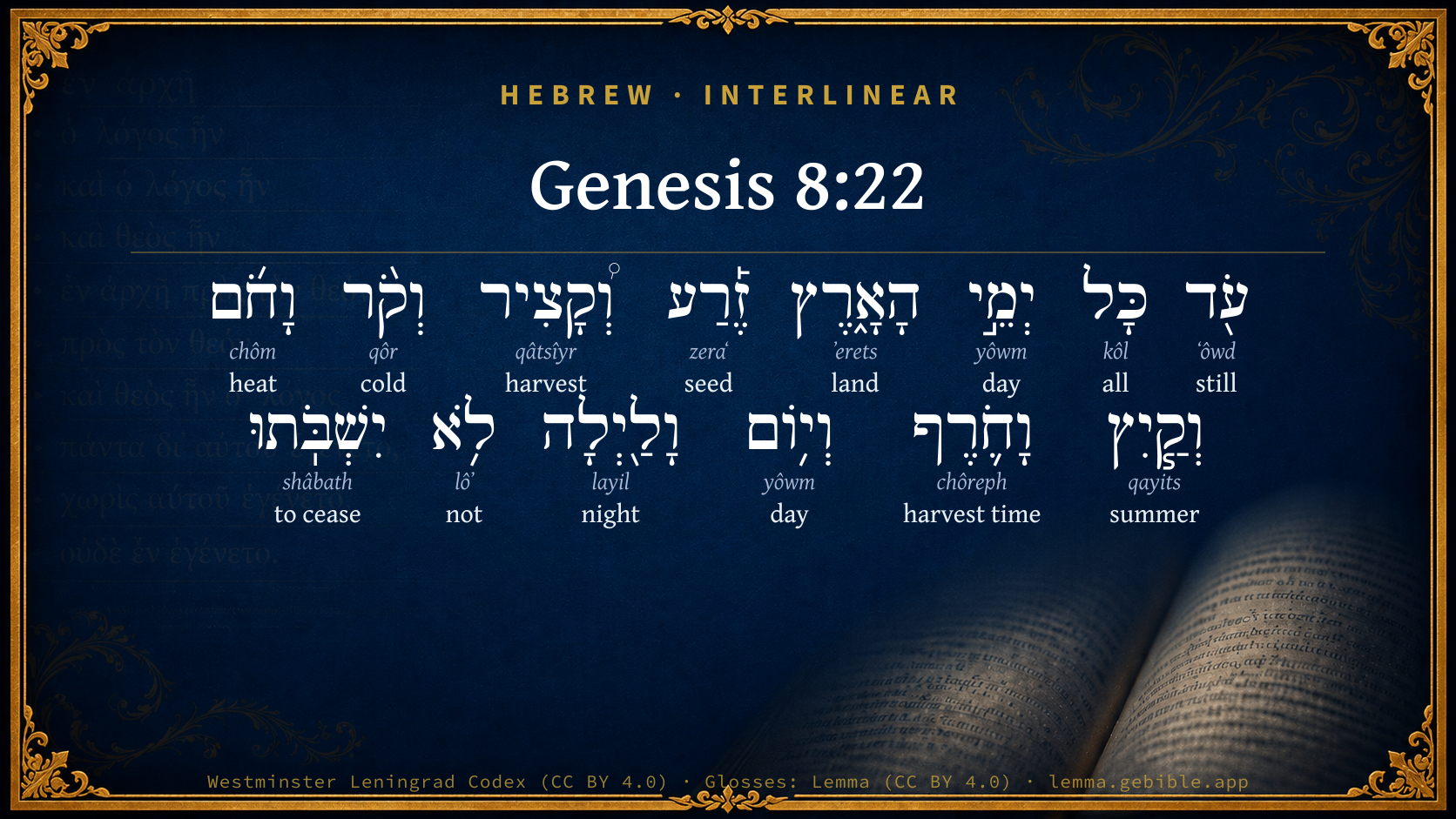
Hebrew (Westminster Leningrad Codex) Genesis 8:22 appears in the Hebrew Old Testament. The text above is from the Westminster Leningrad Codex. Each word links to its Strong’s number, a concise gloss, and parsing drawn from the Open Scriptures Hebrew Bible morphology. Click any word for its full Brown-Driver-Briggs (BDB) entry.
Download image
Cite this verse

Genesis 8:22 (World English Bible). Public Domain. Lemma interlinear Bible study tool, https://lemma.gebible.app/v/genesis/8/22.

Show BibTeX & RIS
BibTeX
RIS
English Translation
While the earth remains, seed time and harvest, and cold and heat, and summer and winter, and day and night shall not cease."
World English Bible · Public Domain
Highlights
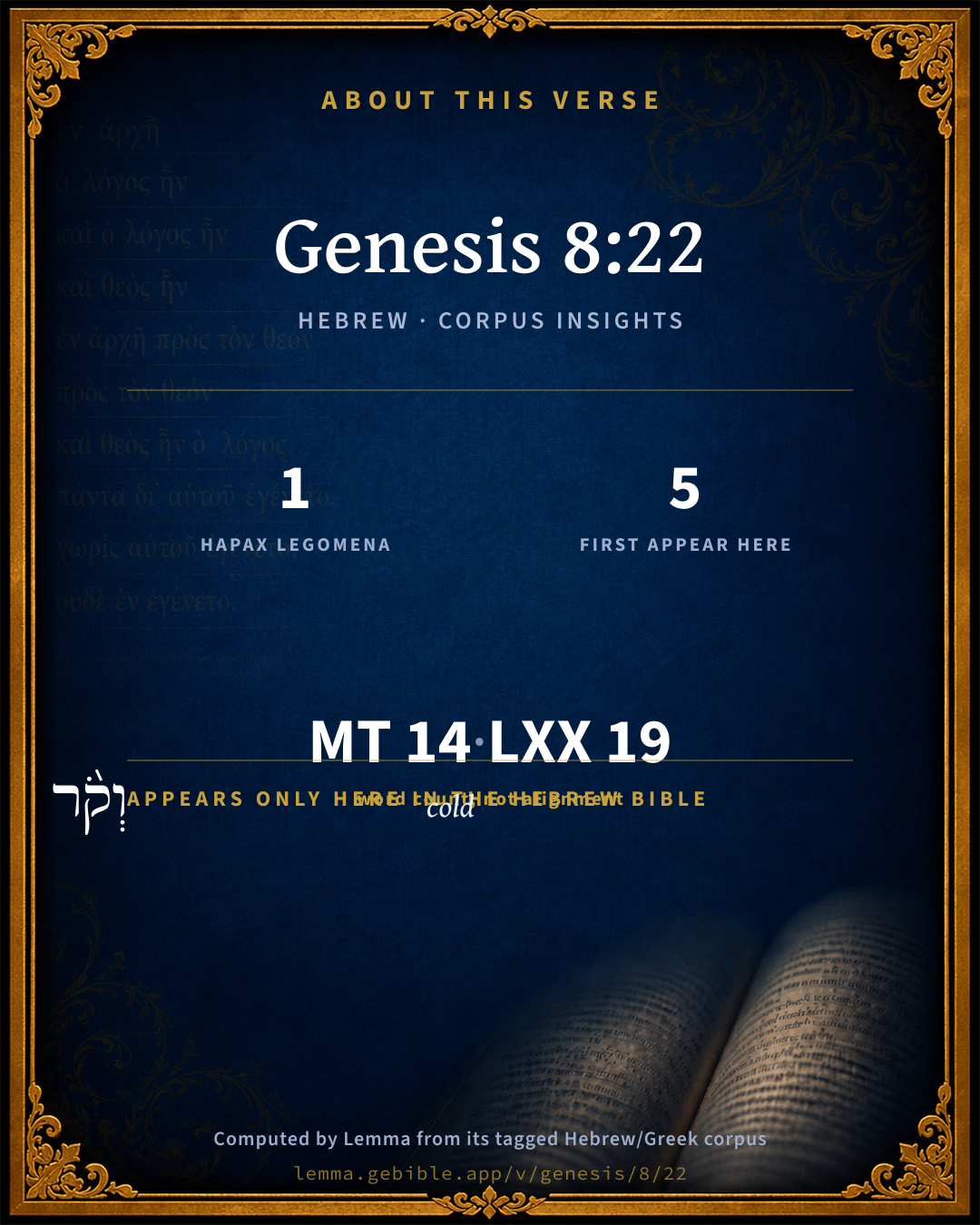
  • 1 hapax legomenon — only here in the Hebrew Bible
  • 5 first appearances in the Hebrew Bible
Full analysis ↓
Download a study sheet

One document with this verse’s original text, its word-by-word gloss line, the meaning frame, cross-references with their text, attributed commentary, and full source and license credits — printable, and it pastes into notes with its structure intact.

This verse Autodidact and up

Study sheet (.html) Plain text (.txt)

A passage Seminary Student

Up to 50 verses in one chapter. A passage sheet keeps up to 6 commentary sources and 12 cross-references per verse, in the order this page ranks them, and says so on the sheet whenever that leaves anything out. Ask for a single verse and you get the Autodidact verse sheet above.

Everything on this page stays free to read, with no account — the sheet is a download of what is already on screen, not access to it.

Want to remove ads? Support Godless Engineer
Compare translations 3

The same verse in 3 English versions, stacked beneath the original-language interlinear above. Click any original word for its lexicon entry.

Each is an independent rendering of the whole verse — the interlinear is not word-aligned to these translations.

Highlighted words mark where these versions differ — a whole-verse word diff, not a word-by-word alignment.

  • World English Bible Public Domain
    While the earth remains, seed time and harvest, and cold and heat, and summer and winter, and day and night shall not cease."
  • King James Version Public Domain
    While the earth remaineth, seedtime and harvest, and cold and heat, and summer and winter, and day and night shall not cease.
  • unfoldingWord Literal Text CC BY-SA 4.0
    While all of the days of the earth continue, seed time and harvest, and cold and heat, and summer and winter, and day and night shall not cease.”

unfoldingWord Literal Text — © unfoldingWord, licensed CC BY-SA 4.0. Word-aligned USFM3 via Door43 (git.door43.org/unfoldingWord/en_ult).

Versions to compare (up to 4)

3 of 4 selected

Show all 18 translations

Every available English version of this verse, each an independent rendering of the whole verse.

  • World English Bible Public Domain
    While the earth remains, seed time and harvest, and cold and heat, and summer and winter, and day and night shall not cease."
  • Berean Standard Bible Public Domain
    As long as the earth endures, seedtime and harvest, cold and heat, summer and winter, day and night shall never cease.”
  • Majority Standard Bible Public Domain
    As long as the earth endures, seedtime and harvest, cold and heat, summer and winter, day and night shall never cease.”
  • King James Version Public Domain
    While the earth remaineth, seedtime and harvest, and cold and heat, and summer and winter, and day and night shall not cease.
  • American Standard Version (1901) Public Domain
    While the earth remaineth, seedtime and harvest, and cold and heat, and summer and winter, and day and night shall not cease.
  • Revised Version (1885) Public Domain
    While the earth remaineth, seedtime and harvest, and cold and heat, and summer and winter, and day and night shall not cease.
  • Geneva Bible (1599) Public Domain
    Hereafter seede time and haruest, and colde and heate, and sommer and winter, and day and night shall not cease, so long as ye earth remaineth.
  • Douay-Rheims (1899) Public Domain
    All the days of the earth, seedtime and harvest, cold and heat, summer and winter, night and day, shall not cease.
  • Young's Literal Translation Public Domain
    during all days of the earth, seed-time and harvest, and cold and heat, and summer and winter, and day and night, do not cease.'
  • Literal Standard Version CC BY-SA 4.0
    during all [the] days of the earth, seed-time and harvest, and cold and heat, and summer and winter, and day and night never cease.”
  • Unlocked Literal Bible CC BY-SA 4.0
    While the earth remains, seed time and harvest, cold and heat, summer and winter, and day and night will not cease.”
  • unfoldingWord Literal Text CC BY-SA 4.0
    While all of the days of the earth continue, seed time and harvest, and cold and heat, and summer and winter, and day and night shall not cease.”
  • Darby Bible Public Domain
    Henceforth, all the days of the earth, seed [time] and harvest, and cold and heat, and summer and winter, and day and night, shall not cease.
  • World Messianic Bible Public Domain
    While the earth remains, seed time and harvest, and cold and heat, and summer and winter, and day and night will not cease.”
  • Webster's Bible Public Domain
    While the earth remaineth, seed-time and harvest, and cold and heat, and summer and winter, and day and night shall not cease.
  • Free Bible Version CC BY-SA 4.0
    As long as the earth exists, seedtime and harvest, cold and heat, summer and winter, day and night, will never come to an end.”
  • Bible in Basic English Public Domain
    While the earth goes on, seed time and the getting in of the grain, cold and heat, summer and winter, day and night, will not come to an end.
  • JPS Tanakh (1917) Public Domain
    While the earth remaineth, seedtime and harvest, and cold and heat, and summer and winter, and day and night shall not cease.'

Literal Standard Version (2020), Covenant Press — licensed CC BY-SA 4.0. Text via the HelloAO Bible API (eBible.org). Unlocked Literal Bible (unfoldingWord) — licensed CC BY-SA 4.0. Text via the HelloAO Bible API (eBible.org). unfoldingWord Literal Text — © unfoldingWord, licensed CC BY-SA 4.0. Word-aligned USFM3 via Door43 (git.door43.org/unfoldingWord/en_ult). Free Bible Version, Dr. Jonathan Gallagher — licensed CC BY-SA 4.0. Text via the HelloAO Bible API (eBible.org).

Word by word

More ways to search: Search by grammar → Find every occurrence → Compare this word →

Practice this passage: Drill this verse → Learn its vocabulary →

וְקֹ֨ר
qôr
H7120
“and · cold”
Conjunction + Noun, Common, Masculine, Singular, Absolute
Part of Speech
Conjunction + Noun
Type
Common
Gender
Masculine
Number
Singular
State
Absolute
Full BDB Definition

Origin: from the same as H7119

TWOT: 2077b

cold
  1. עֹ֖ד ʻôwd H5750 “still” Adverb
  2. כָּל kôl H3605 “all of” Noun, Common, Masculine, Singular, Construct
  3. יְמֵ֣י yôwm H3117 “days of” Noun, Common, Masculine, Plural, Construct
  4. הָאָ֑רֶץ ʼerets H776 “the · land” Particle, Definite Article + Noun, Common, Both, Singular, Absolute
  5. זֶ֡רַע zeraʻ H2233 “seed” Noun, Common, Masculine, Singular, Absolute
  6. וְ֠קָצִיר qâtsîyr H7105 “and · harvest” Conjunction + Noun, Common, Masculine, Singular, Absolute
  7. וָחֹ֜ם chôm H2527 “and · heat” Conjunction + Noun, Common, Masculine, Singular, Absolute
  8. וְקַ֧יִץ qayits H7019 “and · summer” Conjunction + Noun, Common, Masculine, Singular, Absolute
  9. וָחֹ֛רֶף chôreph H2779 “and · harvest time” Conjunction + Noun, Common, Masculine, Singular, Absolute
  10. וְי֥וֹם yôwm H3117 “and · day” Conjunction + Noun, Common, Masculine, Singular, Absolute
  11. וָלַ֖יְלָה layil H3915 “and · night” Conjunction + Noun, Common, Masculine, Singular, Absolute
  12. לֹ֥א lôʼ H3808 “not” Particle, Negative
  13. יִשְׁבֹּֽתוּ shâbath H7673 “to cease” Verb, Qal, Imperfect, 3rd Person, Masculine, Plural

About this verse

These counts appear in no published source. They are computed here, from the morphology-tagged text and Lemma’s own curated glosses. What Lemma adds →

14
words
13
distinct lemmas
Pentateuch
section

Notable vocabulary

1 hapax legomenon — a word that appears only here in the entire Hebrew Bible:

  • וְקֹ֨ר cold H7120

First appearance in Scripture

These words make their first canonical appearance in the Hebrew Bible here:

  • וְ֠קָצִיר harvest H7105
  • וְקֹ֨ר cold H7120
  • וָחֹ֜ם heat H2527
  • וְקַ֧יִץ summer H7019
  • וָחֹ֛רֶף harvest time H2779

Shared distinctive vocabulary

וָחֹ֛רֶף harvest time H2779 occurs in 7 verses of the Hebrew Bible. Also found in:

Grammatical profile

  • 1 verb
  • 11 nouns
  • 1 adverb
  • 1 particle

Verb forms

  • יִשְׁבֹּֽתוּ Qal · Imperfect

Repetition

A word recurs within this verse — often emphatic in Hebrew:

  • יְמֵ֣י day H3117 ×2

Hebrew & Septuagint length

In English translation the verse runs 23 words from the Hebrew and 22 from the Septuagint (LXX English) — closely comparable.

A rough comparison of the two English renderings, which tokenize alike — not a word-level alignment.

Word counts can differ between the Hebrew and the Greek without any difference in meaning — e.g. the Hebrew direct-object marker אֵת has no separate Greek word, and Greek often adds the article ὁ.

In the original languages it is 14 Hebrew tokens and 19 Greek tokens — but the two are counted differently (Hebrew bundles its prefixes and suffixes into one token; the Greek is in lemma form), so that isn’t a like-for-like length.

Cross-references

9

Topical passages linked to Genesis 8:22 in the Treasury of Scripture Knowledge — connected by theme and wording, ordered by reader-vote popularity; previews shown in the World English Bible.

  • James 5:7 Be patient therefore, brothers, until the coming of the Lord. Behold, the farmer waits for the precious fruit of the earth, being patient over it, until it receives the early and late rain.
  • Psalms 74:16–17 The day is yours, the night is also yours. You have prepared the light and the sun.
  • Jeremiah 5:24 Neither say they in their heart, Let us now fear Yahweh our God, who gives rain, both the former and the latter, in its season; who preserves to us the appointed weeks of the harvest.
  • Jeremiah 31:35 Thus says Yahweh, who gives the sun for a light by day, and the ordinances of the moon and of the stars for a light by night, who stirs up the sea, so that the waves of it roar; Yahweh of hosts is his name:
  • Song of Solomon 2:11–12 For, behold, the winter is past. The rain is over and gone.
  • Jeremiah 33:20–26 Thus says Yahweh: If you can break my covenant of the day, and my covenant of the night, so that there shall not be day and night in their season;
  • Exodus 34:21 Six days you shall work, but on the seventh day you shall rest: in plowing time and in harvest you shall rest.
  • Isaiah 54:8–9 In overflowing wrath I hid my face from you for a moment; but with everlasting loving kindness will I have mercy on you, says Yahweh your Redeemer.
  • Genesis 45:6 For these two years the famine has been in the land, and there are yet five years, in which there will be neither plowing nor harvest.

Cross-references courtesy of OpenBible.info (CC BY 4.0).

Hebrew and Greek witnesses Masoretic Hebrew ↔ Greek Septuagint

The same verse in the two great witnesses to the Old Testament, shown verse-for-verse.

These are two independent witnesses, not word-aligned to each other, and the Septuagint is shown in lemma (dictionary) form.

Hebrew Genesis 8:22 Masoretic · Westminster Leningrad Codex

עֹ֖ד כָּל יְמֵ֣י הָאָ֑רֶץ זֶ֡רַע וְ֠קָצִיר וְקֹ֨ר וָחֹ֜ם וְקַ֧יִץ וָחֹ֛רֶף וְי֥וֹם וָלַ֖יְלָה לֹ֥א יִשְׁבֹּֽתוּ

While the earth remains, seed time and harvest, and cold and heat, and summer and winter, and day and night shall not cease."

World English Bible · Public Domain

Greek LXX Genesis 8:22 Septuagint · lemma form

πᾶς ὁ ἡμέρα ὁ γῆ σπέρμα καί θερισμός ψῦχος καί καῦμα θέρος καί ἔαρ ἡμέρα καί νύξ οὐ καταπαύω

All the days of the earth, seed and harvest, cold and heat, summer and spring, shall not cease by day or night.

LXX2012 (modern English Septuagint) · Public Domain

On this verse, The Pulpit Commentary discusses the Septuagint’s reading. Read the note in Commentary ↓

Hebrew: Westminster Leningrad Codex (CC BY 4.0). Greek: Septuagint (public domain); English from LXX2012 (modern English Septuagint) (Public Domain). How the Septuagint differs from the Hebrew →

Targum (Aramaic paraphrase)

2

The Targum is the ancient Jewish Aramaic paraphrase of the Hebrew Scriptures — an interpretive translation, not the Hebrew text itself. Onkelos (literal) and Pseudo-Jonathan (expansive) render the Torah, and Jonathan the Prophets. Coverage is partial: where no permissively-licensed English translation exists for a verse, only the Aramaic is shown. This is verse-level text, not a word-by-word alignment to the Hebrew.

  1. Targum Onkelos Torah (Genesis–Deuteronomy)
    עוֹד כָּל יוֹמֵי אַרְעָא זְרוֹעָא וַחֲצָדָא וְקוֹרָא וְחוֹמָא וְקַיְטָא וְסִתְוָא וִימָם וְלֵילְיָא לָא יִבְטְּלוּן

    Yet all the days of the earth, seed‑time and harvest, and cold and heat, and summer and winter, and day and night, shall not cease.

    Targum Onkelos — Aramaic: “Onkelos Genesis” (public domain); “Onkelos Exodus” (public domain); “Onkelos Leviticus” (public domain); “Onkelos Numbers” (public domain); “Onkelos Deuteronomy” (public domain). English: “Sefaria Community Translation” (CC0 1.0 (public-domain dedication)); “J.W. Etheridge. The Targums of Onkelos and Jonathan Ben Uzziel on the Pentateuch. London: Longmans, Green, 1862” (public domain). Text via Sefaria.

  2. Targum Pseudo-Jonathan Torah (Genesis–Deuteronomy)
    עוֹד כָּל יוֹמֵי אַרְעָא דְרוֹעָא בִּתְקוּפַת תִּשְׁרֵי וַחֲצָדָא בִּתְקוּפַת נִיסָן וְקוֹרָא בִּתְקוּפַת טֵבַת וְחוֹמָא בִּתְקוּפַת תַּמוּז וְקַיְטָא וְסִתְוָא וִימָמֵי וְלֵילֵי לָא יִתְבַּטְלוּן

    Until all the days of the earth, sowing in the season of Tishri, and harvest in the season of Nisan, and coldness in the season of Tebeth, and warmth in the season of Tammuz, and summer and winter, and days and nights shall not fail.

    Targum Pseudo-Jonathan — Aramaic: “Targum Jonathan on Genesis” (public domain); “Targum Jonathan on Exodus” (public domain); “Targum Jonathan on Leviticus” (public domain); “Targum Jonathan on Numbers” (public domain); “Targum Jonathan on Deuteronomy” (public domain). English: “The Targum of Jonathan ben Uzziel, trans. J. W. Etheridge, London, 1862” (public domain). Text via Sefaria.

Commentary

Notes on Genesis 8:22 from classic Christian and Jewish commentators (each source and its license shown beneath its notes). The classic Christian expositions comment on the surrounding passage and are grouped to its opening verse, so a note may address several verses; the Jewish commentaries on the Tanakh (Rashi and others) are per-verse, so they appear only where the commentator wrote on this verse.

Lemma curates 59 commentaries, every one of them public domain or Creative Commons licensed, each selected and text-cleaned for this edition rather than reprinted as found. About our sources →

Trapp's Complete Commentary

John Trapp

Gen 8:22 While the earth remaineth, seedtime and harvest, and cold and heat, and summer and winter, and day and night shall not cease.

Ver. 27. While the earth remaineth.] Heb., All the days of the earth. The earth then (though Solomon in some sense says it endureth for ever) hath its set and certain number of days appointed it by God. For "the earth also and the works therein shall be burnt up". {2Pe 3:10} And this the heathen had heard of, and hammered at; as Lucretius, who disputes the matter out of natural causes. So doth Cicero, De Nat. Deorum , lib. i. 2. And Ovid, Metamorph . i.: Esse quoque in fatis meminit ,& c. There he hath also a large relation of the general flood in Deucalion’s days: so he calleth Noah. Lucian {a} hath the like in his book, De Dea Syriae . And Plutarch speaketh of the sending forth of the dove, and of her return unto Deucalion into the ark. "But we have a more sure word of prophecy."

Cold and heat, and summer and winter, &c.] Lopez de Gomara saith that the kings of Mexico, when they are consecrated, use to take their oath after this manner: - I swear that the sun, during my life, shall hold on his course, and keep his wonted glory and brightness, and that the clouds shall send down rain, the river shall run, and the earth bring forth all manner of fruit, &c. But "can any of the vanities of the heathen give rain?" &c. {Jer 14:22}

{a} Dialog. De Industr. Animal.

John Trapp, A Commentary or Exposition upon All the Books of the Old and New Testament (1647–1656) — public domain. Text from a community e-Sword module.

The Biblical Illustrator

Joseph S. Exell

Gen_8:22

While the earth remaineth, seed time, and harvest, and cold and heat, and summer and winter, and day and night shall not cease.

The sermon of the seasons

I. In the text there is A SOLEMN HINT OF WARNING. While the earth remaineth.

1. It is implied that the earth will not always remain.

2. The time when the earth shall no longer remain is not mentioned. The uncertainty of the end of all things is intended to keep us continually on the watch.

3. Let me further remark that the day when the remaining of the earth shall cease cannot be very far off; for according to the Hebrew, which you have in the margin of your Bibles, the text runs thus: As yet all the days of the earth, seed time and harvest shall not cease. The while of the earths remaining is counted by days; not even months or years are mentioned, much less centuries.

II. Thus, then, there is a hint of warning in our text; but secondly, there is A SENTENCE OF PROMISE, rich and full of meaning: While the earth remaineth, seed time and harvest, cold and heat, winter and summer, and day and night shall not cease. It is a promise concerning temporal things, but yet it breathes a spiritual air, and hath about it the smell of a field that the Lord hath blessed.

1. This promise has been kept. It is long since it was written, it is longer still since it was resolved upon in the mind of God; but it has never failed. There have been times when cold has threatened to bind the whole year in the chains of frost; but genial warmth has pushed it aside. The ordinances of heaven have continued with us as with our fathers.

2. So long-continued is the fulfilment of this promise, and even this race of unbelievers has come to believe in it. We look for the seasons as a matter of course. Why do we not believe Gods other promises?

3. Brethren, we have come not only to believe this promise as to the seasons and to make quite sure about it, but we practically act upon our faith. The farmers have sown their autumn wheat, and many of them are longing for an opportunity to sow their spring wheat; but what is sowing but a burial of good store? Why do husbandmen hide their grain in the earth? Because they feel sure that seed time will in due time be followed by harvest. Why do we not act in an equally practical style in reference to the rest of Gods promises? True faith makes the promises of God to be of full effect by viewing them as true and putting them to the test.

4. If a man did not act upon the declaration of God in our text, he would be counted foolish. Equally mad are they who treat other promises of God as if they were idle words; no more worthy of notice than the prophecies of a charlatan.

5. Let me close this point by noticing that, whether men believe this or not it will stand true. A man says there will be no winter, and provides no garments; he will shiver in the northern blast all the same when December covers the earth with snow.

III. There is also in the text, I think, A SUGGESTION OF ANALOGIES. Reading these words, not as a philosophical prediction, but as a part of the Word of God, I see in them a moral, spiritual, and mystical meaning.

1. While the earth remaineth there will be changes in the spiritual world. While the earth remaineth, seed time and harvest, and cold and heat, and summer and winter, and day and night shall not cease. No one of these states continues; it comes and goes. The seasons are a perpetual procession, an endless chain, an ever-moving wheel. Such is this life: such are the feelings of spiritual life with most men: such is the history of the Church of God. It will be so while the earth remaineth, and we remain partakers of the earth.

2. Yet there will be an order in it all. Cold and heat, and summer and winter, and day and night, do not come in a giddy dance or tumultuous hurly burly; but they make up the fair and beautiful year. Chance has no part in these affairs. So in the spiritual kingdom, in the life of the believer, and in the history of the Church of God, all things are made to work for good, and the spiritual is being educated into the heavenly.

3. Great rules will stand while the earth abideth, in the spiritual as well as in the natural world. For instance, there will be seed time and harvest, effort and result, labour and success.

IV. Last of all, I want you to regard my text as A TOKEN FOR THE ASSURANCE OF OUR FAITH. While the earth remaineth, seed time and harvest, and cold and heat, and summer and winter, and day and night shall not cease. And they do not. In this fact we are bidden to see the seal and token of the covenant. (C. H. Spurgeon.)

The harvest

I. A TESTIMONY FOR GODS FAITHFULNESS. The return of harvest speaks to you in language not to be mistaken. Hold fast the profession of your faith without wavering; for He is faithful that has promised. My covenant will I not break, saith the Lord; nor alter the thing that has gone out of My lips. But, you will say perhaps, it is not Gods faithfulness I question--I doubt His mercy. The Word of the Lord, that shall stand; but Hismercy is in the heavens. It reacheth not to me. And why not? What but mercy, infinite mercy, so prevailed with the Almighty that He should promise seed time and harvest so long as the earth endureth!

II. THE HARVEST IS A FIGURE OF THE CONSUMMATION OF ALL THINGS.

1. The end of the world is as sure as the harvest.

2. As in harvest the reaper casts aside the weed, so every false professor will be cast into outer darkness, while the righteous will shine forth as the sun in the kingdom of their Father. Whoso hath ears to hear, let him hear.

3. Again, it is in harvest we receive of that we have sown; and it is in harvest we see the end of the husbandmans labour--why he hath so long waited for the early and latter rain. And so in the end of the world. Then is it that we shall see the purposes for which the world was made, and wherefore it has been sustained so long. Then we shall see the long suffering of God, and wherefore He hath borne with us so long. (W. M.Mungeain, B. A.)

The duty of thanksgiving for the harvest

I. WHEN WAS THIS PROMISE GIVEN? Immediately after the deluge. In wrath God remembered mercy.

II. WHAT WOULD HAVE BEEN THE PROBABLE RESULT, IF GOD HAD GIVEN US JUDGMENT AND NOT MERCY? If the covenant with the seasons had been suspended, all happiness and comfort must have been instantly paralysed, and all animal life extinguished; existence would no longer have been possible, and your palaces, mansions, and cottages would have been mere sepulchres, full of dead mens bones.

III. But thirdly, let us inquire WHETHER A TIME IS NOT COMING WHEN SEED TIME AND HARVEST, HEAT AND COLD, SUMMER AND WINTER, DAY AND NIGHT, WILL CEASE? Yes, the covenant in the text is limited in time, it holds good only whilst the earth remaineth. Let this consideration lead us to seek an interest in the better covenant, founded on better promises, and which lasts for eternity; and let us rest our hopes on that firm foundation. (H. Clissold, M. A.)

Lessons from the harvest

1. Every harvest teaches the fact of Gods wise providence.

2. Every harvest teaches the fact of Gods definite purpose. One vast magnificent purpose has kept everything in exact order during all these years of Divine fidelity.

3. God expects every one of His creatures to be as faithful to a purpose as He Himself has been. (C. S. Robinson, D. D.)

Gods goodness in nature

Once there was a peasant in Switzerland at work in his garden very early in the spring. A lady passing said, I fear the plants which have come forward rapidly will yet be destroyed by frost. Mark the wisdom of the peasant:--God has been our Father a great while, was his reply. What faith that reply exhibited in the olden promise, While the earth remaineth, etc.

Cold needful

A minister going to church one Lords Day morning, when the weather was extremely cold and stormy, was overtaken by, one of his neighbours, who, shivering, said to him, Its very cold, sir. Oh! replied the minister, God is as good as His Word still. The other started at his remark, not apprehending his drift, or what he referred to; and asked him what he meant. Mean! replied he, why, He promised above three thousand years ago, and He still makes His Word good, that while the earth remaineth, seed time and harvest, and cold and heat, shall not cease.

Spiritual winter

1. Spiritual winter is an ordination of God. The true spiritual analogue of winter is not spiritual death, not even feeble spiritual life. There is an orderly change in the soul. Unseen, yet very really, Gods Spirit is at work, altering influences, changing modes. He introduces a new state of spiritual experiences, seeking to accomplish varied objects, and summoning to new modes of improving His presence.

2. The objects of spiritual winter are:

(1)--To confirm and strengthen faith.

(2) To act as a check upon excesses.

(3) To help in the training of the Christian character and the

Christian Church.

3. How are we to improve spiritual winter?

(1) By learning a lesson of mutual Christian tolerance.

(2) By treasuring up the clear vision and calm judgment which the winter of the soul is fitted to impart, for the improvement of the season when fervour shall be renewed and emotion once more excited. (A. Mackennal, D. D.)

The moral significance of winter

The seasonable changes to which our earth is subject are of vast importance to man. They serve--

1. To impress us with the fact of the brevity of life.

2. To keep the soul in constant action.

3. To revive the recollections of old truths. What are the truths that nature reproduces in winter?

I. THE EVANESCENT FORMS OF EARTHLY LIFE. Individuals, families, and nations have their seasons--their spring, summer, autumn, winter.

II. THE STERN ASPECTS OF NATURES GOD. Winter significantly hints that the Absolute cannot be trifled with--that He curses as well as blesses, destroys as well as saves.

III. THE RETRIBUTIVE LAW OF THE CREATION. Winter brings on men the penalties for not rightly attending to the other seasons.

IV. THE PROBABLE RESUSCITATION OF BURIED EXISTENCE. The life of the world in winter is not gone out, it is only sleeping..

1. The resuscitation of Christian truth.

2. The resuscitation of conscience.

3. The resuscitation of the human body. (Homilist.)

Autumn tide

1. Something ought, by the time we have arrived at autumn, to have been got ready to give to man. Have you done it? What fruit have you borne in life for your brother men; how much wheat will God find in you when He comes to reap your fields? We have read the answer that should be given in the harvest time every year. Few sights are fairer than that seen autumn after autumn round many an English homestead, when, as evening falls, the wains stand laden among the golden stubble, and the gleaners are scattered over the misty field; when men and women cluster round the gathered sheaves, and rejoice in the loving kindness of the earth; where, in the dewy air, the shouts of happy people ring, and over all the broad moon shines down to bless with its yellow light the same old recurring scene it has looked on and loved for so many thousand years. It is the picture of a fruitful human life when its autumn tide has come; and blessed are they of whom men can feel the same as when they share in a harvest home--of whom they can say, He has reached his autumn, we reap his golden produce, and we thank him in our hearts; and in whose own spirit glimmers fair the moonlight of peace in the evening of life, the peace that is born of work completed, the humble, happy knowledge that can say, Men will feed on my thoughts, my work shall nourish them, and God in whose strength I have lived, will garner all for me. There is no blessedness in life to be compared with that; it is the true, unselfish joy of harvest.

2. There is a second aspect of autumn that follows upon the harvest. A fortnight ago I went into Epping Forest in the morning. The wind blew keen and strong through a cloudless sky: but a faint, fine mist was on the ground. The air was full of leaves that fluttered to their rest on the red earth and the dark green pools scattered through the wood. The grass was silver-sown with frosted dew, and the birds sang cheerily but quietly. Things were just touched with the breath of decay; one knew that the time of mirth, that even the harvest time was gone away; but the light was too fresh and the sky too bright for sadness. There was an inspiration of work in the air--of quiet, hopeful work--though the ingathering of the year was over. And looking through the thin red foliage of the trees, beyond the skirt of the wood, I saw the rest of the autumn work of man--two dark-brown fields of rich earth, the upturned ridges just touched with the bright footprints of the frost, and in one, looming large through the light mist, two horses drew the plough, and tossed a darker ridge to light, and in the other a sower was sowing corn. And I thought, as I beheld, that our autumn life is not only production, but preparation; not only harvests, but ploughing and sowing. It is not enough to have produced a harvest: we must make ready for a new harvest for men and for ourselves, and more for men than for ourselves. To do so for ourselves alone were selfish, and would defeat its end, for work with that motive has from the very beginning the seed of corruption in it, and the harvest it may reach will be cankered. To begin with ones self is to end in fruitlessness. Begin, on the contrary, your work of sowing with the motive of Christ: I do this for the love of men; and you will then find that, without knowing it, and because you did not know or think about it, you have ploughed and sown in the noblest way for yourself. In the new spring time of Gods paradise, where only summers fulness, but never autumns decay is known, you will fulfil your being, and not one aspiration shall fail of its completion, not one failure but shall be repaired, not one yearning for truth but shall be satisfied, not one effort made here to bring forth a harvest, to plough the land of the world, to sow the seed of good and truth, but shall find at last a noble scope, and expand itself into an infinite sphere of labour. These are the hopes of autumn.

3. There is yet another aspect of autumn, and it is the aspect of decay. The evening falls, the damp air is chill, the mist rises, and the leafless trees are hooded in its ghostly garment. Our feet brush in the avenues through the thick floor of sodden leaves, and through the places we remember green and bright as paradise a low wind sighs in sorrow for the past. (Stopford A. Brooke, M. A.)

The doctrine of the harvest

I. THAT THERE IS A CERTAINTY OF A REGULAR RETURN OF THE NATURAL HARVEST, RESTING UPON THE UNCHANGEABLE PURPOSE OF GOD.

1. The harvest is a time of poetry, rich in meaning, full of beauty, and set to music by God Himself, the poetry of nature smiling in her loveliness and ripe fruition, accompanied by the music of the breeze, as it rustles among the golden ears of bearded grain, and enlivened by sounds of human gladness.

2. Harvest is a time of joy. Then is seen the fruit of long and arduous toil, the fulfilment of ardent hopes and doubtful promises.

3. It is not only the result of work and the triumph of work, but it needs work to secure its golden spoils. Labour is the price of securing as well as of cultivating the fruits of the soil? What more joyous occupation than gathering the fruits of the soil? Man is here a worker with God.

4. Harvest is a time for thankfulness. Whose is the earth we till? Gods. Whose the seed we sow? Gods. Whose the influences of the sunshine, rain, and air? Gods. Whose are the appointed laws by which the seed develops into the plant, and by which the plant bears the precious grain? Gods. Whose gift is the intelligence that wields the reaper and drives the team afield? Gods. All come from God.

II. THE NATURAL HARVEST REPRESENTS OTHER HARVESTS IN WHICH MEN HAVE A PART. Nature is a picture lesson for man to learn, and there are realities in the world of mind and man corresponding to her images.

1. There is a seed time and harvest in the history of man, analogous to that established by God in nature. Look over the record of the ages and do you not find that the exertions, the struggles, the sacrifices of the men in one age have produced results for the benefit of later generations? Who sowed the harvest of civilization which we are now reaping? Was it not the sages and the poets of ancient Greece, the lawyers and rulers of ancient Rome; the prophets and apostles, the martyrs and evangelists of the Jewish and of the early Christian Church? These were the men that sowed the seeds of law, of learning, of morality, and of religion; and we today, in conjunction with other Christian people, are reaping in our Christian civilization, with all its faults and deficiencies, still great and glorious, the fruit of all their toils, the rich results of their laborious exertions. To bygone ages, to bygone men, how much, then, do we owe! Ah! you cannot separate the ages. One sows, another reaps, and the world of man is richer.

2. There are seed time and harvest for every individual life. The young especially ought to remember that they are now to make those preparations without which age will bear but little fruit. Now is the season to deposit the store of knowledge in their memories as into genial soil, there to take root and germinate into blissful fruit, so that when future years come they may reap the harvest of ripened wisdom and be enriched with the results of work which has gone before, and looking into their minds, as into rich storehouses, they may view the accumulated thoughts, facts, and principles, which form the abundant harvest of their minds. Nor is it with knowledge and wisdom in secular affairs that the individual seed time and harvest should be solely concerned. The spirit requires cultivation. Seed time and harvest is also going on at the same time in the sphere of Christian experience. No sooner do we know the Saviour than we begin to reap the fruits of believing; every gain to our Christian knowledge, or effort of the Christian life, procures for us a greater benefit. We reap as we go on sowing and cultivating our immortal nature--sowing truth, love, and holiness, we reap present satisfaction, delight, and peace, and prepare the way for grander and richer harvests on high. And even in heaven the cultivation of our powers of love and wisdom will go on forever, and bring us increasing harvests of progress in all that is excellent and godlike--world without end.

3. But there is, strictly speaking, a spiritual harvest. And this spiritual harvest has a double aspect--as it respects the righteous, as it respects the wicked. Have you never seen the drunkard, the sensualist, the debauchee, sowing to the lusts of his flesh, nourishing, cultivating, pampering his passions and the brute-like instincts of his nature, and reaping in like kind, creating evil and degraded habits for himself, brutalizing and polluting his thoughts and his imagination, destroying his strength, and health, and manly beauty, and ruining his immortal soul? He is reaping what he sows. Have you never seen, on the other hand, the noble Christian, sowing to the higher life of the spirit, sowing love and kindness to all around him, to come back to him in a harvest of gratitude and affection; sowing intelligence and wisdom to be paid to him in happy thoughts, beautiful fancies, and glorious aspirations; sowing piety, and adoration, and devotion to God, and reaping here the peace that passeth understanding, joy in the Holy Ghost, sweet communion with God, and in the world to come, life everlasting. Let us be thankful for natures kindly law, the regular return of seed time and harvest, the ordinance of our covenant Jehovah, our loving Father in heaven. (E. E. Bayliss.)

The revolving seasons

This promise still holds good. It has never yet failed. It cannot fail, for it is the Word of God.

1. Common things are too often taken as matters of course. The Source and Author of them all is forgotten.

2. God not only orders all these things, maintaining them in constant succession, as He said He would, but He orders them in the best and wisest manner. He takes in at a glance the wants of all His creatures, foresees all the consequences, both near and far off, of what He does, and sends His dealings accordingly. A labouring man used to say, when he heard people complaining of the weather--It is such weather as God sends, and therefore it pleases me.

3. But all this concerns the present life only. May we not learn something from the text concerning the life to come? The very words carry our thoughts on to the future state. While the earth remaineth. This promise, then, sure as it is, is only for a time--while the earth remaineth; and the earth will not remain forever as it now is. A great change will come--a new heaven and a new earth. Then at length seed time and harvest will be no longer distinguished.

4. Not only the promise of the text, but every other promise that God has made, will be fulfilled. (F. Bourdillon, M. A.)

Lesson from Gods covenant faithfulness

One vast, magnificent purpose has kept everything in exact order during all these years of Divine fidelity. And the single point you need to observe most closely is this: He has expected every one of His creatures to be as faithful to a purpose as He has been. Take one of the most insignificant flowers in the meadow for an illustration. Let a naturalist tell you of the private history it has wrought out since the spring opened. Let him show you how the leaves were held out on either side, like palms of two hands, just to catch the falling showers in their hollow; how they drew in unreckoned moisture by a million ducts unseen, transmitting it hastily into their great laboratory; how they distilled it and mingled and separated it and saturated it with sunshine and with mould, until it was ready to be lodged upon the spot where it was needed as an increment of growth; how they laboured on thus for months, till the day arrived for a supreme effort to give forth a blossom; and then how they borrowed this little substance from the soil, and received that little substance from the atmosphere, and commissioned fluid messengers to go down to the roots for help; how they mysteriously wrought with exquisite skill the delicate tissues into new forms of beauty, until at last the petals and pistils came forward into life, and the field grew brilliant with a fresh flower. That entire meadow could go on repeating the lesson. Let us remember that each small spear and leaflet, when it found that its parent stalk no longer had need of it--indeed, would be better if it would put itself out of the way--quietly sacrificed itself for the general good, dropped off the stem to let sunshine come unhindered. So the seed--that one great, precious thing, the seed--had its chance to be fashioned and ripened to fulness and grace. You may learn thus very easily, by inquiring at each door of existence of Science, who is keeper of them all, that God has given for every one of His creations its fixed work in the orderly round of effort, as well as in the narrower circles of reciprocal duties. (G. S.Robinson, D. D.)

.

The Biblical Illustrator, edited by Joseph S. Exell (c. 1880s–1900s) — public domain. Text from a community e-Sword module.

Joseph Benson's Commentary

Gen 8:22. While the earth remaineth — Here it is plainly intimated that the earth is not to remain always: it, and all the works therein, must be burned up. But as long as it doth remain, God here promises the course of nature shall not be discontinued; but God’s providence will carefully preserve the regular succession of times and seasons. Seed-time and harvest shall not cease — To this we owe it that the world stands, and the wheel of nature keeps its track. See here how changeable the times are, and yet how unchangeable! 1st, The course of nature always changing. As it is with the times, so it is with the events of time; they are subject to vicissitudes, day and night, summer and winter, counterchanged. In heaven and hell it is not so; but on earth God hath set the one over against the other. 2d, Yet, never changed; it is constant in this inconstancy; these seasons have never ceased, nor shall cease while the sun continues such a steady measurer of time, and the moon such a faithful witness in heaven. This is God’s covenant of the day and of the night, the stability of which is mentioned for the confirming our faith in the covenant of grace, which is no less inviolable, Jer 33:20. We see God’s promises to the creatures made good, and thence may infer that his promises to believers shall be made good also.

Joseph Benson's Commentary on the Old and New Testaments (1811–1818) — public domain. Text from a community e-Sword module.

Tyndale Open Study Notes

Tyndale Open Resources

8:22 God’s promise to sustain the rhythm of the seasons reaffirmed the created order (1:14; see also Jer 33:20; Zech 14:7).

Tyndale Open Study Notes — © Tyndale Open Resources, licensed CC BY-SA 4.0. Text via the HelloAO Bible API.

Geneva Bible (1599)

Geneva Bible translators

The order of nature destroyed by the flood, is restored by God’s promise.

Geneva Bible (1599) marginal notes — public domain. Text via Bolls.life.

Jamieson, Fausset & Brown

Robert Jamieson, A. R. Fausset & David Brown

While the earth remaineth--The consummation, as intimated in Pe2 3:7, does not frustrate a promise which held good only during the continuance of that system. There will be no flood between this and that day, when the earth therein shall be burnt up [CHALMERS].

Next: Genesis Chapter 9

Jamieson, Fausset & Brown — Commentary Critical and Explanatory on the Whole Bible (1871) — public domain (CC PDM 1.0). Text via the HelloAO Bible API.

Adam Clarke's Commentary

Verse 22. While the earth remaineth, seed-time and harvest, c.] There is something very expressive in the original, עד כל ימי הארץ od col yemey haarets, until all the DAYS of the earth for God does not reckon its duration by centuries, and the words themselves afford a strong presumption that the earth shall not have an endless duration.

Seed-time and harvest. - It is very probable that the seasons, which were distinctly marked immediately after the deluge, are mentioned in this place; but it is difficult to ascertain them. Most European nations divide the year into four distinct parts, called quarters or seasons; but there are six divisions in the text, and probably all intended to describe the seasons in one of these postdiluvian years, particularly in that part of the globe, Armenia, where Noah was when God gave him, and mankind through him, this gracious promise. From the Targum of Jonathan on this verse we learn that in Palestine their seed-time was in September, at the autumnal equinox; their harvest in March, at the vernal equinox; that their winter began in December, at the solstice; and their summer at the solstice in June.

The Copts begin their autumn on the 15th of September, and extend it to the 15th of December. Their winter on the 15th of December, and extend it to the 15th of March. Their spring on the 15th of March, and extend it to the 15th of June. Their summer on the 15th of June, and extend it to the 15th of September, assigning to each season three complete months. Calmet.

There are certainly regions of the earth to which neither this nor our own mode of division can apply: there are some where summer and winter appear to divide the whole year, and others where, besides summer, winter, autumn, and spring, there are distinct seasons that may be denominated the hot season, the cold season, the rainy season, c., c.

This is a very merciful promise to the inhabitants of the earth. There may be a variety in the seasons, but no season essentially necessary to vegetation shall utterly fail. The times which are of greatest consequence to the preservation of man are distinctly noted there shall be both seed-time and harvest - a proper time to deposit the different grain in the earth, and a proper time to reap the produce of this seed.

Thus ends the account of the general deluge, its cause, circumstances, and consequences. An account that seems to say to us, Behold the goodness and severity of God! Both his justice and long-suffering are particularly marked in this astonishing event. His justice, in the punishment of the incorrigibly wicked, and his mercy, in giving them so fair and full a warning, and in waiting so long to extend his grace to all who might seek him. Such a convincing proof has the destruction of the world by water given of the Divine justice, such convincing testimony of the truth of the sacred writings, that not only every part of the earth gives testimony of this extraordinary revolution, but also every nation of the universe has preserved records or traditions of this awful display of the justice of God.

A multitude of testimonies, collected from the most authentic sources in the heathen world, I had intended for insertion in this place, but want of room obliges me to lay them aside. But the state of the earth itself is a sufficient proof. Every part of it bears unequivocal evidence of disruption and violence. From the hand of the God of order it never could have proceeded in its present state. In every part we see marks of the crimes of men, and of the justice of God. And shall not the living lay this to heart? Surely God is not mocked that which a man soweth he shall reap. He who soweth to the flesh shall of it reap destruction; and though the plague of water shall no more destroy the earth, yet an equal if not sorer punishment awaits the world of the ungodly, in the threatened destruction by fire.

In ancient times almost every thing was typical, and no doubt the ark among the rest; but of what and in what way farther than revelation guides, it is both difficult and unsafe to say. It has been considered a type of our blessed Lord; and hence it has been observed, that "as all those who were out of the ark perished by the flood, so those who take not refuge in the meritorious atonement of Christ Jesus must perish everlastingly." Of all those who, having the opportunity of hearing the Gospel, refuse to accept of the sacrifice it offers them, this saying is true; but the parallel is not good. Myriads of those who perished during the flood probably repented, implored mercy, and found forgiveness; for God ever delights to save, and Jesus was the Lamb slain from the foundation of the world. And though, generally, the people continued in carnal security and sensual gratifications till the flood came, there is much reason to believe that those who during the forty days' rain would naturally flee to the high lands and tops of the highest mountains, would earnestly implore that mercy which has never been denied, even to the most profligate, when under deep humiliation of heart they have returned to God. And who can say that this was not done by multitudes while they beheld the increasing flood; or that God, in this last extremity, had rendered it impossible?

St. Peter, 1Pe 3:21, makes the ark a figure of baptism, and intimates that we are saved by this, as the eight souls were saved by the ark. But let us not mistake the apostle by supposing that the mere ceremony itself saves any person; he tells us that the salvation conveyed through this sacred rite is not the putting away the filth of the flesh, but the answer of a good conscience toward God; i.e. remission of sins and regeneration by the Holy Spirit, which are signified by this baptism. A good conscience never existed where remission of sins had not taken place; and every person knows that it is God's prerogative to forgive sins, and that no ordinance can confer it, though ordinances may be the means to convey it when piously and believingly used.

Adam Clarke's Commentary on the Bible (1810–1826) — public domain. Text from a community e-Sword/MySword module.

John Calvin's Commentaries

22. While the earth remaineth By these words the world is again completely restored. For so great was the confusion and disorder which had overspread the earth, that there was a necessity for some renovation. On which account, Peter speaks of the old world as having perished in the deluge, (2 Peter 3:6.) Moreover, the deluge had been an interruption of the order of nature. For the revolutions of the sun and moon had ceased: there was no distinction of winter and summer. Wherefore, the Lord here declares it to be his pleasure, that all things should recover their vigor, and be restored to their functions. The Jews erroneously divide their year into six parts; whereas Moses, by placing the summer in opposition to the winter, thus divides the whole year in a popular manner into two parts. And it is not to be doubted, that by cold and heat he designates the periods already referred to. Under the words, “seed-time,” and “harvest,” he marks those advantages which flow to men from the moderated temperature of the atmosphere. If it is objected that this equable temperament is not every year perceived; the answer is ready, that the order of the world is indeed disturbed by our vices, so that many of its movements are irregular: often the sun withholds its proper heat, — snow or hail follow in the place of dew, — the air is agitated by various tempests; but although the world is not so regulated as to produce perpetual uniformity of seasons, yet we perceive the order of nature so far to prevail, that winter and summer annually recur, that there is a constant succession of days and nights, and that the earth brings forth its fruits in summer and autumn. Moreover, by the expression, ‘all the days of the earth,’ he means, ‘as long as the earth shall last.’

John Calvin's Commentaries (1540-1563) — public domain. Text from the Calvin Translation Society English edition (1840s-50s) via the Christian Classics Ethereal Library (ccel.org). Calvin's coverage is partial (roughly two-thirds of the Bible); uncommented books and verses are honest gaps, never fabricated. The 19th-century editor's footnotes and remarks are omitted so the notes are faithfully Calvin's own voice.

Ellicott's Commentary for English Readers

(22) While the earth remaineth . . . —The traditional interpretation of this verse among the Jews represents the year as divided into six seasons. But this is untenable; for in Palestine itself there are two seed times, the winter crops being put into the ground in October and November, and the summer crops in January and February. Really the verse describes those great alternations upon which the well-being of the earth depends, whether considered absolutely, as of light and darkness, cold and heat, or with reference to man’s labours, as of sowing and harvesting; or relatively with respect to vegetation, winter being earth’s time of rest, and summer that of its activity.

As regards these promises, Delitsch considers that they probably came to Noah as strong inward convictions in answer to his prayers during the sacrifice.

A Bible Commentary for English Readers, edited by Charles John Ellicott (1878–1897) — public domain. Text from a community e-Sword module.

The Cambridge Bible for Schools and Colleges

gen. ed. J. J. S. Perowne

22. While the earth remaineth] Observe the poetical character of this verse. The four pairs of words are recorded with an impressive and rhythmical dignity.

The Cambridge Bible for Schools and Colleges (gen. ed. J. J. S. Perowne; Cambridge University Press, 1878–1918) — public domain. Text from a community e-Sword module.

Haydock's Catholic Bible Commentary

Seed-time, according to the Targum of Jonathan, is the equinox of September; harvest, that of March; winter and summer denote the solstice of December and of June. But the Hebrews probably divided the year into summer and winter; or perhaps they might also admit the season of spring, with the Egyptians and the ancient Greeks, who represented the seasons by the three hours, daughters of Jupiter. (Calmet)

George Leo Haydock (1774–1849), Haydock's Catholic Family Bible and Commentary, 1859 edition — public domain. Excludes Psalms (Douay-Rheims chapter numbering differs from Protestant) and Deuterocanonical books (Catholic canon only).

Matthew Poole's English Annotations

While the earth remaineth, viz. in this estate; for though it seems probable that the substance of the earth will abide for ever, after the dissolution of the world by fire; yet that will be in another manner, and for other purposes, and then there will be no need of

seed-time, or

harvest, & c.

Day and night. This distinction in a manner ceased in the ark, the heavens being covered, and all its lights eclipsed by such thick and black clouds, as never were before nor since.

Matthew Poole's English Annotations on the Holy Bible (1683–1685) — public domain. Text from a community e-Sword/MySword module.

Whedon's Commentary on the Bible

Daniel D. Whedon

22. While the earth remaineth — Some (as Delitzsch) understand this promise to teach that the present alternation of the seasons did not take place in the antediluvian world; but the language does not warrant such an inference. A great convulsion had interrupted the regular order of nature, so that there had been no seedtime nor harvest through the whole inhabited world. Here it is promised that the great natural changes shall be orderly and uniform all the days of the earth. (Hebrews) The six agricultural seasons, as known among the Hebrews and the Arabs, are here mentioned. Yet we are not to think of them as dividing up the year among themselves after the manner of our four seasons. The words rendered seedtime and harvest have reference to the sowing and the reaping of grains, while the words rendered summer and winter have reference primarily to the cutting and gathering of fruits, and more exactly correspond to our summer and autumn. Of course the times of sowing, reaping, and gathering vary according to latitude and zone. The year is also divided, with regard to temperature, into cold and heat. The promise, then, is universal for mankind, and declares that the earth’s annual changes, with regard both to productions and temperature, shall be regular and perpetual. There are included, also, in this promise, the regular alternations of light and darkness, although these were not interrupted by the flood. Man craves these changes in his present state, for they are essential to his happiness and development, but will not be so with man renewed and restored, who “needs no candle, neither light of the sun,” and John says of the New Jerusalem, “there shall be no night there.” Rev_21:25.

Daniel D. Whedon (gen. ed.), Commentary on the Old and New Testaments (1874–1909) — public domain. Text from a community e-Sword module.

The Pulpit Commentary

While the earth remaineth. Literally, as yet, all the days of the earth, i.e. henceforth, so long as the earth continues, dO expressing the ideas of repetition and continuance (vide ver. 12). Seed-time and harvest, from roots signifying to scatter, e.g. seed, and to cut off, specially grain; sperma kai qerismov (LXX)and cold and heat, yucov kai kauma (LXX)and summer and winter. Properly the cutting off of fruits, from a root meaning to cut off, hence summer; and the time when fruits are plucked, hence autumn (including winter); the import of the root being to gather, to pluck off; qerov kai ear (LXX). The first term of each pair denotes the first half of the year, and the second term of each pair the second half. And day and night (cf. Gen_1:5) shall not cease. Hebrew, lo yish-bothu, shall not sabbatise, or keep a day of rest; i.e. they shall continue ever in operation and succession. This Divine promise to conserve the orderly constitution and course of nature is elsewhere styled "God"s covenant of the day and of the night" (cf. Jer_33:20, Jer_33:25)

TRADITIONS OF THE DELUGE.

1. The Babylonian.

(1) From the Chaldean monuments. As deciphered from the eleventh tablet of the Izdubar series, the story of the Flood is briefly this: Izdubar, whom George Smith identifies with Nimrod, the founder of Babylonia, is informed by Hasisadra, whom the same authority believes to represent Noah, of a Divine commandment which he had received to construct a ship after a specified pattern, in which to save himself and "the seed of all life," because the city Surippak wherein he dwelt was to be destroyed. After first attempting to excuse himself, as he explains to Izdubar, on the ground that "young and old will deride him," Hasisadra builds the ship, and causes to go up into it "all my male servants and my female the ants, the beast of the field, the animal of the field, the sons of the people, all of them," while the god Shamas makes a flood, causing it to rain heavily. The flood destroys all life from the face of the earth Six days and nights the storm rages; on the seventh it grows calm. Twelve measures above the sea rises the land. The ship is stopped by a mountain in the country of Nizir. After seven days Hasisadra sends forth a dove, "which went and turned, and a resting-place it did not find, and it returned;" then a swallow, and finally a raven. On the decrease of the waters he sends forth the animals, and builds an altar on the peak of the mountain, and pours out a libation ("Chaldean Genesis," Genesis 16.; "Records of the Past," vol. 7:133-141).

(2) From Berosus. The god Kronos appeared to Xisuthrus, the tenth Mug of Babylon, in a vision, and warned him of an approaching deluge upon the fifteenth day of the month Desius, by which mankind would be destroyed. Among other things the god instructed him to build a vessel for the preservation of himself and friends, and specimens of the different animals. Obeying the Divine admonition, he built a vessel five stadia in length and two in breadth, and conveyed into it his wife, children, and friends. After the flood had been upon the earth he three times sent out birds from the vessel, which returned to him the second time with mud upon their feet, and the third time returned to him no more. Find. ing that the vessel had grounded on a mountain, Xisuthrus disembarked with his wife and children, and, having constructed an altar, offered sacrifices to the gods, in reward for which he was raized immediately to heaven ("Chaldean Genesis," Genesis 3.; Kalisch, p. 202; "Encyclopedia Britannica," art. Deluge, ninth edition).

1. The Egyptian. Though commonly alleged to be entirely unknown in the Nile valley, it is certain that the germs of the Deluge story are to be discovered even there. According to the Egyptian historian Manetho, quoted by Eusebius, Thoth, the first Hermes, erected certain pillars with inscriptions, which, after the Deluge, were transcribed into books. Plato also states in the Timaeus (chap. 5.) that a certain Egyptian priest informed Solon that the gods, when wishing to purify the earth, were accustomed to overwhelm it by a deluge, from which the herdsmen and shepherds saved themselves on the tops of the mountains. Josephus ("Ant.," I 3:9) certifies

2. that Hieronymus the Egyptian refers to the Flood. A conception altogether analogous to that of Genesis is likewise to be found in a myth belonging to the archaic period of Seti I, which represents Ra, the Creator, as being disgusted with the insolence of mankind, and resolving to exterminate them (vide Inscription of the Destruction of Mankind, "Records of the Past," vol. 6. p. 103). In short, the Egyptians believed not that there was no deluge, but that there had been several The absence of any indications of this belief in the recovered literature of ancient Egypt is not sufficient to set aside the above concurrent testimonies to its existence (Kitto, "Bible Illustrations," vol. 1. p. 150; Rawlinson"s "Historical Illustrations of O. T.;" "Encycl. Britan.," art. Deluge, ninth edition).

3. The Indian. Through the theft of the sacred Vedas by the giant Hayagrivah, the human race became fearfully degenerate, with the exception of seven saints and the good King Satyavrata, to whom the Divine spirit Vishnu appeared in the form of a fish, in. forming him of his purpose to destroy the earth by a flood, and at the same time to send a ship miraculously constructed for the preservation of himself and the seven holy ones, along with their wives, and one pair of each of all the irrational animals. After seven days the rain descended, when Satyavrata, confiding in the promises of the god, saw a huge ship drawing near, into which he entered as directed. Then the god appeared in the form of a fish a million miles long, with an immense horn, to which the king made the ship fast, and, drawing it for many years (a night of Brahma), at length landed it upon the highest peak of Mount Himavau. When the flood abated the god arose, struck the demon Hayagrivah, recovered the sacred books, instructed Satyavrata in all heavenly sciences, and appointed him the seventh Mann, from whom the second population of the earth descended in a supernatural manner, whence man is styled Manudsha (born of Mann). Vide Kalisch, p. 203; Auberlen"s "Divine Revelation," p. 169 (Clark"s "For. Theol. Lib.").

1. The Grecian. It is sufficient here to refer to the well-known story of Deucalion and Pyrrha, first given in Pindar, and afterwards related by Apollodorus, Plutarch, Lucian, and Ovid, whose account bears so close a resemblance to the Biblical narrative as to suggest the probability of access to Hebrew or Syrian sources of information. The previous corruption of manners and morals, the eminent piety of Deucalion, the determination "genus mortals sub undisperdere," the construction of a boat by Divine direction, the bursting of the storm, the rising of the waters, the universal ocean in which "jamque mare et tellus nullum discrimen habebant," the

2. subsidence of the flood, the landing of the boat on Parnassus with its double peak, the consultation of the Deity per sacras sortes," and the answer of the god as to how the earth was to be re-peopled "ossaque post tergum magnae jactare parentis," are detailed with such graphic power as makes them read like amplified reports of the record in Genesis." Indeed, by Philo, Deucalion was distinctly regarded as Noah. Cf. Ovid, "Metamorph.," lib. 1. f. 7.; "Kalisch on Genesis," p. 203; Kitto"s "Bible Illustrations," p. 150 (Porter"s edition); "Lange on Genesis," p. 294, note by Tayler Lewis; Smith"s "Dictionary of the Bible," art. Noah.

3. The American. Traditions of the Flood appear to be even more numerous in the New World than the Old. The Esquimatux in the North, the Red Indians, the Mexicans and the Brazilians in the central parts of America, and the Peruvians in the South have all their peculiar versions of the Deluge story. Chasewee, the ancestor of the Dog. rib Indians, on the Mackensie river, according to Franklin, escaped in a canoe from a flood which overflowed the earth, taking with him all manner of four-footed beasts and birds. The Astees, the Mixtees, the Zapotess, and other nations inhabiting Mexico all have, according to Humboldt, their Noahs, Xisuthrus, or Manus (called Coxcox, Teocipactli, or Tezpi), who saves himself by a raft, or in a ship, which lands upon the summit of Colhuacan, the Ararat of the Mexicans. The legends of the Tamanacks relate that a man and woman saved themselves from the Deluge, and repeopled the earth by casting behind them the fruits of the Mauritia palm tree (Kalisch, p. 205; Auberlen"s "Divine Revelation," p. 171; Smith"s "Dictionary," art. Noah).

What, then, is the conclusion to be drawn from this universal diffusion of the Deluge story? The theory of Schirren and Gerland, as stated by the writer of the article Deluge in the "Encyclopedia Britannica," is that the Deluge stories were originally other-myths, descriptive of the phenomena of the sky, which have been transferred from the celestial regions to the earth; but, as Kalisch justly observes, "the harmony between all these accounts is an undeniable guarantee that the tradition is no idle invention;" or, as is forcibly stated by Rawlinson, of a tradition existing among all the great races into which ethnologists have divided mankind, the Shemites, the Hamites, the Aryans, the Turanians, one rational account can be given, viz., that it embodies the recollection of a fact in which all mankind was concerned."

The Pulpit Commentary (1880–1919), ed. H.D.M. Spence-Jones & Joseph S. Exell — public domain. Text from a community e-Sword module.

Rashi

Rabbi Shlomo Yitzchaki (Rashi)

עוד כל ימי הארץ וגו' לא ישבתו WHILE THE EARTH REMAINETH … SHALL NOT CEASE — Of these six seasons each consists of two months, as we have learned (Bava Metzia 106b): Half of Tishri, Marcheshvan and half of Kislev is seedtime; half of Kislev, Tebeth and half of Shebat is the cold-season.

קור COLD-SEASON is more severe than חורף winter.

חורף WINTER is the time of sowing barley and pulse which are quick (חריף) to ripen. It is half of Shebat, Adar and half of Nisan.

קציר HARVEST — Half of Nisan, Eyar, and half of Sivan.

קיץ SUMMER — Half of Sivan, Tammuz and half of Ab. This is the time of fig-gathering, the time when they lay them out to dry in the fields. and its name is קיץ “summer-fruittime”, as (2 Samuel 16:2) “And the bread and the summer-fruit (קיץ) for the young men to eat”.

חום HEAT — This is the end of the hot season, half of Ab, Elul and half of Tishri, when the world is excessively hot, as we have learned in Treatise Yoma 29a: “The end of the summer is worse than the summer itself”.

ויום ולילה לא ישבתו DAY AND NIGHT SHALL NOT CEASE — From this we may infer that they (day and night) ceased during the period of the Flood, for the planetary system did not function, so that there was no distinction between day and night (Genesis Rabbah 34:11).

לא ישבתו SHALL NOT CEASE — None of these shall cease to take their natural course.

Rashi on the Tanakh — English translations: “The Judaica Press complete Tanach with Rashi, translated by A. J. Rosenberg” (CC BY 4.0); “Pentateuch with Rashi's commentary by M. Rosenbaum and A.M. Silbermann, 1929-1934” (public domain); “The Metsudah Tanach series, Lakewood, N.J” (CC BY 4.0); and “The Book of Joshua, Metsudah Publications, 1997” (CC BY 4.0). Text via Sefaria.

Radak

Rabbi David Kimhi (Radak)

עוד כל ימי הארץ, Rabbi Avraham Ibn Ezra writes that the formulation of כל ימי הארץ here is proof that the duration of this earth is finite, in fact that G’d had already set a time limit to its existence.

זרע וקציר, the year is divided into basically 2 periods, the time to plant and the time to harvest. In the immediately following words the year is divided into 4 seasons. Still later the Torah speaks of the alternating periods of day and night. The meaning of all this is that during the four seasons the relative length of day and night constantly change, summer and winter being indicated by the relative longer periods of daylight and darkness, depending on the part of earth on which one lives, whereas even in higher latitudes when there is no true summer or in the equatorial zones when there is no true cold season, the relative length of days and nights are a guide to the season, i.e. whether it is time to sow, etc. Regardless of which season, the combined total of darkness and daylight always amounts to the same number of hours, minutes, etc, i.e. a day has 24 hours of 60 minutes each..

לא ישבתו, the fact that G’d promises that such regularity will not cease in the future, is proof that during the deluge the pattern of day and night and seasonal change had not been as it is now. Noach may not even have been able to tell if it was day or night while he was in the ark, or at least while the rain was still descending during the first 40 days. According to Bereshit Rabbah 34,11 in the view of Rabbi Yochanan, none of the celestial bodies performed their normal functions during the entire year that Noach was in the ark. Rabbi Yonathan said to Rabbi Yochanan that the celestial bodies did perform their functions, but that Noach was unable to derive any advantage from this, as he could not be guided by what he could not see. Rabbi Eliezer and Rabbi Yehushua, disagreed on another aspect of the meaning of our verse, Rabbi Eliezer claiming that the word לא ישבתו have to be understood as being in the past tense, i.e. the functions of the celestial bodies had not been suspended at all, whereas Rabbi Yehoshua understood the words לא ישבתו as referring only to the future. Rabbi Shimon ben Eleazar, specifying further, claimed that the second half of the month of Tishrey, the whole month of Marcheshvan, and the first half of the month of Kislev are devoted to sowing and planting, whereas the second half of Kislev, the whole month of Tevet and half the month of Shevat are considered winter. The second half of the month of Shevat, the whole month of Adar, and the first half of Nissan are called “cold.” [i.e. what the Torah described as קר. Ed.] This is followed by two months of spring, by two months of summer, and two months of “heat.” referred to in our verse as חם.

Radak on the Tanakh — English translations: “Sefaria Community Translation” (CC0 1.0 (public-domain dedication)); “Eliyahu Munk, HaChut Hameshulash” (CC BY 4.0); “Rabbi Mike Feuer, Jerusalem Anthology” (CC BY 4.0); and “R. David Kimhi on the first book of Psalms, Translated by R.G. Finch, London, 1919” (public domain). Text via Sefaria.

Lesson kit

Teaching starters — assembled from the data on this page, not authored interpretation. Every prompt links to the verse data it draws on. Edit before teaching.

Genesis, in the Pentateuch, opens this verse with 14 words (13 distinct Hebrew lemmas). Its most distinctive word is qôr (“cold”). A historical commentator’s framing appears above. Read the whole chapter for the surrounding context.

Discussion questions

  1. How does “cold” (qôr) shape what this verse is saying?
  2. This verse holds 1 word here found nowhere else in the Hebrew Bible. What might the rare word draw attention to?
  3. 5 words here appear for the first time in Scripture. What is being introduced at this debut?
  4. Job 29:4 shares the word «harvest time» with this verse. How do the two illuminate each other?
  5. “day” occurs 2× in this one verse. What is the effect of the repetition?
  6. The translations on this page render this verse differently — a whole-verse word diff, not a word-by-word alignment. What might account for the different wordings?
  7. The verb «יִשְׁבֹּֽתוּ» is Qal Imperfect. How does its form color the action?
  8. Reading how Trapp's Complete Commentary and The Biblical Illustrator read this verse, where do the two commentators agree and where do they part?

Things to notice

  • 1 word in this verse appears nowhere else in the Hebrew Bible.
  • 5 words make their first canonical appearance in Scripture here.
  • This verse counts 14 Hebrew ↔ 19 Greek words.
  • These translations choose different wording for 8 words in this verse.
  • “day” occurs 2× in this single verse.

Reading settings

Reading text

Shown beneath each verse's original-language words.

Old Testament
Old Testament edition

Read the OT as the Masoretic Hebrew (MT) or the Greek Septuagint (LXX).

English shown for the Greek Septuagint (in the Hebrew ↔ Greek comparison).

Comparing translations? Open the Compare panel on any verse page to stack up to four side by side.