Matthew 16:4

Greek (Tischendorf 8th ed.) Matthew 16:4 appears in the Greek New Testament. The text above is from the Tischendorf 8th edition. Each word links to its Strong’s number and a concise gloss. Click any word for its full Thayer’s Greek Lexicon entry.
Download image
Cite this verse

Matthew 16:4 (World English Bible). Public Domain. Lemma interlinear Bible study tool, https://lemma.gebible.app/v/matthew/16/4.

Show BibTeX & RIS
BibTeX
RIS
English Translation
An evil and adulterous generation seeks after a sign, and there will be no sign given to it, except the sign of the prophet Jonah." He left them, and departed.
World English Bible · Public Domain
Download a study sheet

One document with this verse’s original text, its word-by-word gloss line, the meaning frame, cross-references with their text, attributed commentary, and full source and license credits — printable, and it pastes into notes with its structure intact.

This verse Autodidact and up

Study sheet (.html) Plain text (.txt)

A passage Seminary Student

Up to 50 verses in one chapter. A passage sheet keeps up to 6 commentary sources and 12 cross-references per verse, in the order this page ranks them, and says so on the sheet whenever that leaves anything out. Ask for a single verse and you get the Autodidact verse sheet above.

Everything on this page stays free to read, with no account — the sheet is a download of what is already on screen, not access to it.

Want to remove ads? Support Godless Engineer
Compare translations 3

The same verse in 3 English versions, stacked beneath the original-language interlinear above. Click any original word for its lexicon entry.

Each is an independent rendering of the whole verse — the interlinear is not word-aligned to these translations.

Highlighted words mark where these versions differ — a whole-verse word diff, not a word-by-word alignment.

  • World English Bible Public Domain
    An evil and adulterous generation seeks after a sign, and there will be no sign given to it, except the sign of the prophet Jonah." He left them, and departed.
  • King James Version Public Domain
    A wicked and adulterous generation seeketh after a sign; and there shall no sign be given unto it, but the sign of the prophet Jonas. And he left them, and departed.
  • unfoldingWord Literal Text CC BY-SA 4.0
    An evil and adulterous generation seeks a sign, but a sign will not be given to it except the sign of Jonah.” And having left them, he went away.

unfoldingWord Literal Text — © unfoldingWord, licensed CC BY-SA 4.0. Word-aligned USFM3 via Door43 (git.door43.org/unfoldingWord/en_ult).

Versions to compare (up to 4)

3 of 4 selected

Show all 19 translations

Every available English version of this verse, each an independent rendering of the whole verse.

  • World English Bible Public Domain
    An evil and adulterous generation seeks after a sign, and there will be no sign given to it, except the sign of the prophet Jonah." He left them, and departed.
  • Berean Standard Bible Public Domain
    A wicked and adulterous generation demands a sign, but none will be given it except the sign of Jonah.” Then He left them and went away.
  • Majority Standard Bible Public Domain
    A wicked and adulterous generation demands a sign, but none will be given it except the sign of the prophet Jonah.” Then He left them and went away.
  • King James Version Public Domain
    A wicked and adulterous generation seeketh after a sign; and there shall no sign be given unto it, but the sign of the prophet Jonas. And he left them, and departed.
  • American Standard Version (1901) Public Domain
    An evil and adulterous generation seeketh after a sign; and there shall no sign be given unto it, but the sign of Jonah. And he left them, and departed.
  • Revised Version (1885) Public Domain
    An evil and adulterous generation seeketh after a sign; and there shall no sign be given unto it, but the sign of Jonah. And he left them, and departed.
  • Geneva Bible (1599) Public Domain
    The wicked generation, and adulterous seeketh a signe, but there shall no signe be giuen it, but that signe of the Prophet Ionas: so hee left them, and departed.
  • Douay-Rheims (1899) Public Domain
    A wicked and adulterous generation seeketh after a sign: and a sign shall not be given it, but the sign of Jonas the prophet. And he left them, and went away.
  • Young's Literal Translation Public Domain
    `A generation evil and adulterous doth seek a sign, and a sign shall not be given to it, except the sign of Jonah the prophet;' and having left them he went away.
  • Literal Standard Version CC BY-SA 4.0
    An evil and adulterous generation seeks a sign, and a sign will not be given to it, except the sign of Jonah the prophet”; and having left them He went away.
  • Unlocked Literal Bible CC BY-SA 4.0
    An evil and adulterous generation seeks for a sign, but no sign will be given to it except the sign of Jonah.” Then Jesus left them and went away.
  • unfoldingWord Literal Text CC BY-SA 4.0
    An evil and adulterous generation seeks a sign, but a sign will not be given to it except the sign of Jonah.” And having left them, he went away.
  • Darby Bible Public Domain
    A wicked and adulterous generation seeks after a sign, and a sign shall not be given to it save the sign of Jonas. And he left them and went away.
  • World Messianic Bible Public Domain
    An evil and adulterous generation seeks after a sign, and there will be no sign given to it, except the sign of the prophet Jonah.” He left them and departed.
  • Webster's Bible Public Domain
    A wicked and adulterous generation seeketh for a sign; and there shall no sign been to it, but the sign of the prophet Jonah. And he left them, and departed.
  • Free Bible Version CC BY-SA 4.0
    An evil and adulterous generation are the ones who look for a miraculous sign, and no sign will be given to them except the sign of Jonah.” He left them and went away.
  • Bible in Basic English Public Domain
    An evil and false generation is searching after a sign; and no sign will be given to it but the sign of Jonah. And he went away from them.
  • Text-Critical English NT CC BY 4.0
    An evil and adulterous generation asks for a sign, but no sign will be given to it except the sign of the prophet Jonah.” Then he left them and went away.
  • Tyndale New Testament (1534) Public Domain
    The frowarde nacion and advoutrous seketh a signe and there shall non other signe be geven vnto them but the signe of the prophet Ionas. So lefte he them and departed.

Literal Standard Version (2020), Covenant Press — licensed CC BY-SA 4.0. Text via the HelloAO Bible API (eBible.org). Unlocked Literal Bible (unfoldingWord) — licensed CC BY-SA 4.0. Text via the HelloAO Bible API (eBible.org). unfoldingWord Literal Text — © unfoldingWord, licensed CC BY-SA 4.0. Word-aligned USFM3 via Door43 (git.door43.org/unfoldingWord/en_ult). Free Bible Version, Dr. Jonathan Gallagher — licensed CC BY-SA 4.0. Text via the HelloAO Bible API (eBible.org).

Word by word

More ways to search: Search by grammar → Find every occurrence → Compare this word →

Practice this passage: Drill this verse → Learn its vocabulary →

μοιχαλὶς
moichalís
G3428
“adulteress”
Noun, Nominative, Singular, Feminine
Part of Speech
Noun
Case
Nominative
Number
Singular
Gender
Feminine
Full Thayer's Definition

Origin: a prolonged form of the feminine of G3432

TDNT: 16:09,6

1. an adulteress 2. as the intimate alliance of God with the people of Israel was likened to a marriage, those who relapse into idolatry are said to commit adultery or play the harlot a. fig. equiv. to faithless to God, unclean, apostate
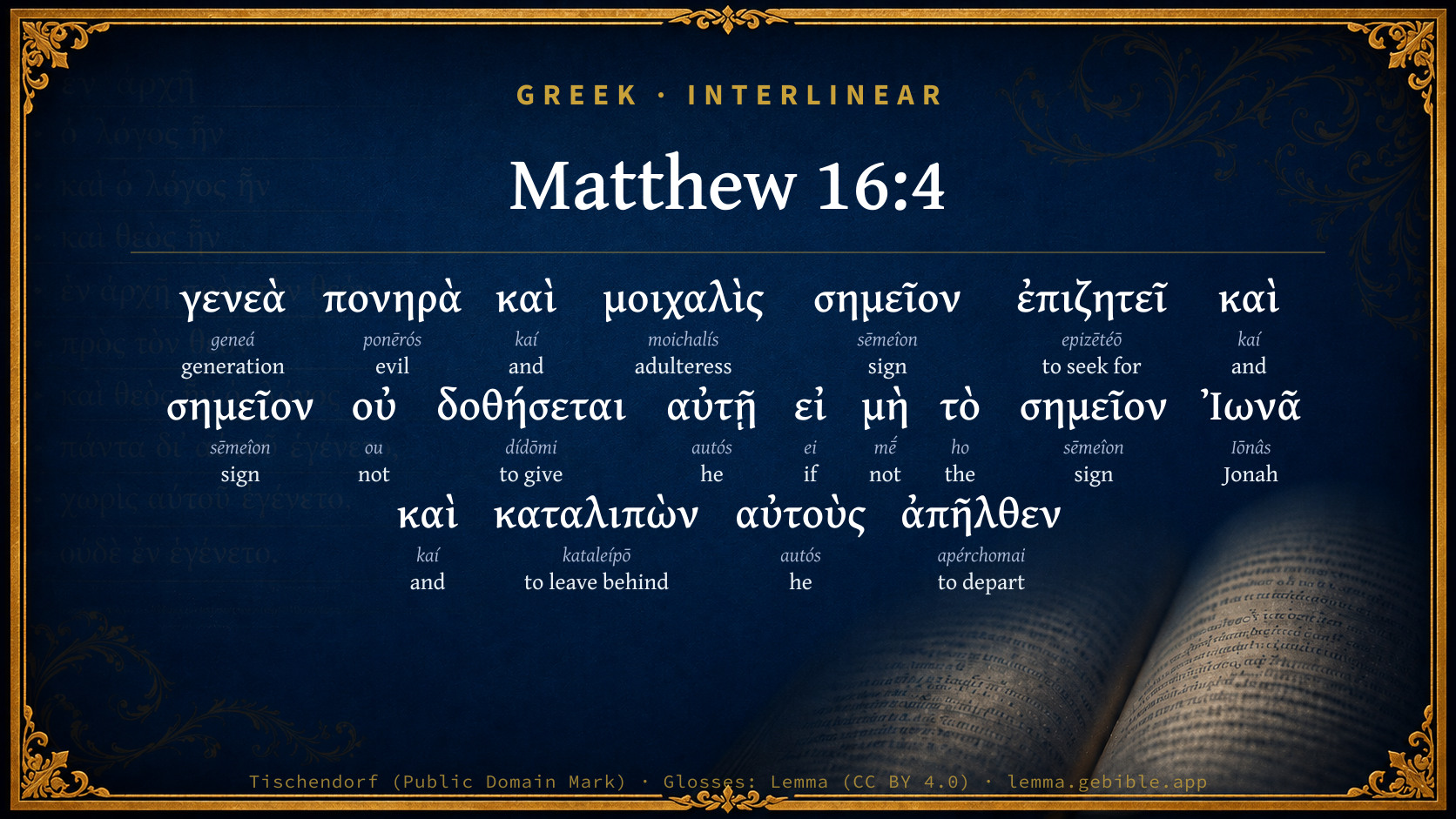
  1. γενεὰ geneá G1074 “generation” Noun, Nominative, Singular, Feminine
  2. πονηρὰ ponērós G4190 “evil” Adjective, Nominative, Singular, Feminine
  3. καὶ kaí G2532 “and” Conjunction
  4. σημεῖον sēmeîon G4592 “sign” Noun, Accusative, Singular, Neuter
  5. ἐπιζητεῖ epizētéō G1934 “to seek for” Verb, Present, Active, Indicative, 3rd person, Singular
  6. καὶ kaí G2532 “and” Conjunction
  7. σημεῖον sēmeîon G4592 “sign” Noun, Nominative, Singular, Neuter
  8. οὐ ou G3756 “not” Particle, Negative
  9. δοθήσεται dídōmi G1325 “to give” Verb, Future, Passive, Indicative, 3rd person, Singular
  10. αὐτῇ autós G846 “he” Personal pronoun, Dative, Singular, Feminine
  11. εἰ ei G1487 “if” Conditional
  12. μὴ mḗ G3361 “not” Particle, Negative
  13. τὸ ho G3588 “the” Article, Nominative, Singular, Neuter
  14. σημεῖον sēmeîon G4592 “sign” Noun, Nominative, Singular, Neuter
  15. Ἰωνᾶ Iōnâs G2495 “Jonah” Noun, Genitive, Singular, Masculine
  16. καὶ kaí G2532 “and” Conjunction
  17. καταλιπὼν kataleípō G2641 “to leave behind” Verb, Aorist, Active, Participle, Nominative, Singular, Masculine
  18. αὐτοὺς autós G846 “he” Personal pronoun, Accusative, Plural, Masculine
  19. ἀπῆλθεν apérchomai G565 “to depart” Verb, Aorist, Active, Indicative, 3rd person, Singular

About this verse

These counts appear in no published source. They are computed here, from the morphology-tagged text and Lemma’s own curated glosses. What Lemma adds →

20
words
15
distinct lemmas
Gospels
section

Notable vocabulary

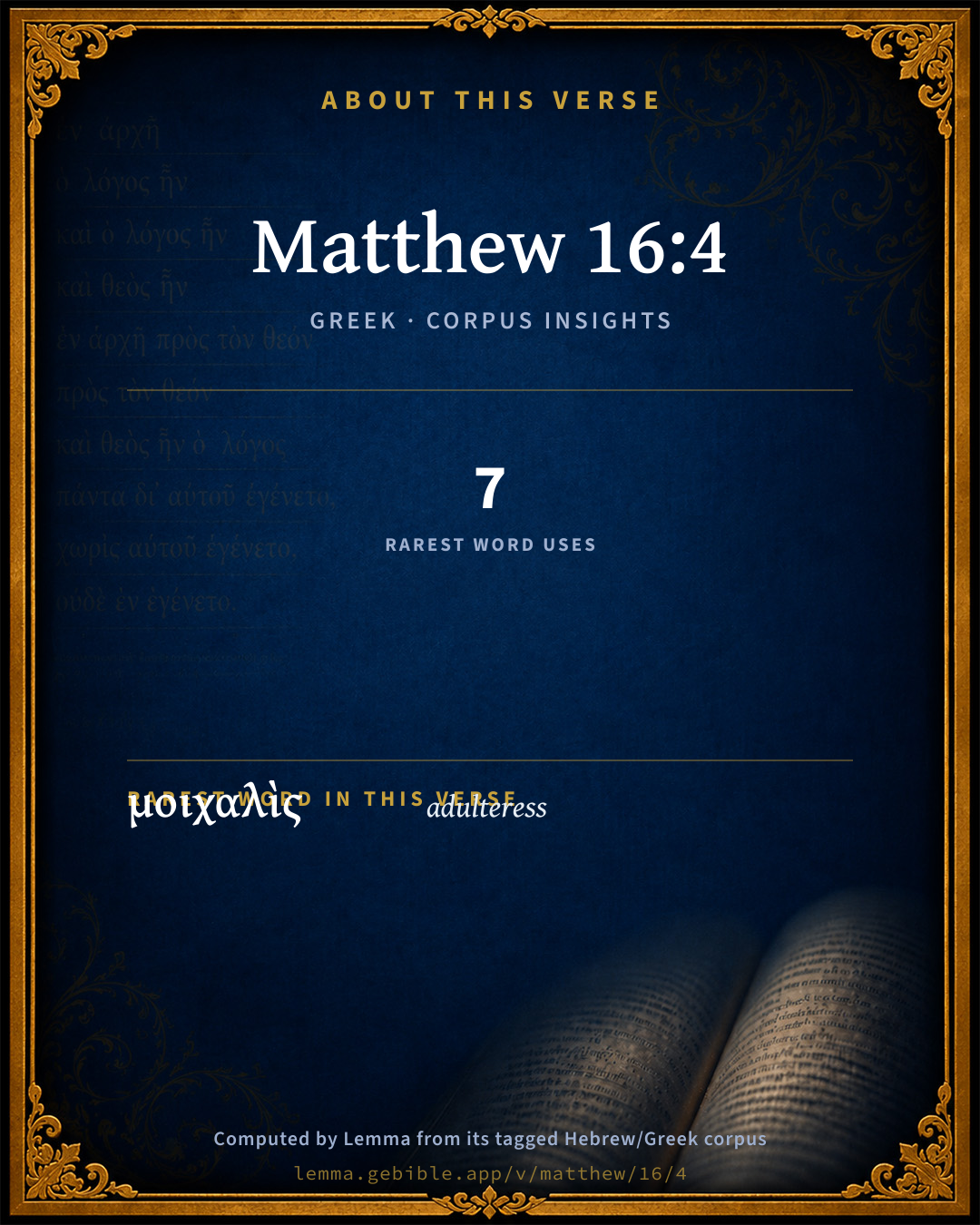
The rarest word here is μοιχαλὶς adulteress G3428 — appearing just 7 times in the whole Greek New Testament.

Shared distinctive vocabulary

μοιχαλὶς adulteress G3428 occurs in 6 verses of the Greek New Testament. Also found in:

Repetition

Words recur within this verse:

  • σημεῖον sign G4592 ×3
  • καὶ and G2532 ×3
  • αὐτῇ he G846 ×2

Cross-references

12

Topical passages linked to Matthew 16:4 in the Treasury of Scripture Knowledge — connected by theme and wording, ordered by reader-vote popularity; previews shown in the World English Bible.

  • Luke 11:29–30 When the multitudes were gathering together to him, he began to say, "This is an evil generation. It seeks after a sign. No sign will be given to it but the sign of Jonah, the prophet.
  • Matthew 12:39–40 But he answered them, "An evil and adulterous generation seeks after a sign, but no sign will be given it but the sign of Jonah the prophet.
  • Jonah 1:17 Yahweh prepared a great fish to swallow up Jonah, and Jonah was in the belly of the fish three days and three nights.
  • Mark 8:12 He sighed deeply in his spirit, and said, "Why does this generation seek a sign? Most assuredly I tell you, no sign will be given to this generation."
  • Mark 8:38 For whoever will be ashamed of me and of my words in this adulterous and sinful generation, the Son of Man also will be ashamed of him, when he comes in the glory of his Father with the holy angels."
  • Matthew 15:14 Leave them alone. They are blind guides of the blind. If the blind guide the blind, both will fall into a pit."
  • Genesis 6:3 Yahweh said, "My Spirit will not strive with man forever, because he also is flesh; yet will his days be one hundred twenty years."
  • Mark 5:17–18 They began to beg him to depart from their region.
  • Hosea 4:17 Ephraim is joined to idols. Leave him alone!
  • Hosea 9:12 Though they bring up their children, Yet I will bereave them, so that not a man shall be left. Indeed, woe also to them when I depart from them!
  • Acts 18:6 When they opposed him and blasphemed, he shook out his clothing and said to them, "Your blood be on your own heads! I am clean. From now on, I will go to the Gentiles!"
  • Acts 2:40 With many other words he testified, and exhorted them, saying, "Save yourselves from this crooked generation!"

Cross-references courtesy of OpenBible.info (CC BY 4.0).

Where the printed editions differ

1 variant

Places in this verse where the major printed Greek editions disagree on the wording in a way that affects the translation — a comparison of editions, not a manuscript-by-manuscript collation. The editions are the modern critical texts (Nestlé-Aland 28/27, SBL, Westcott-Hort, Tregelles, Tyndale House) and the traditional texts behind the KJV (the Textus Receptus and the Byzantine/Majority text). It is not a claim about which reading is original.

  1. Extra text
    τοῦ προφήτου.

    “<the> prophet.”

    In TRByz Not in NA28NA27TynSBLWHTreg

    τοῦ προφήτου. (tou prophētou) ' prophet.' is only in traditional manuscripts (TR+Byz)

Textual data: Translators Amalgamated Greek New Testament (STEPBible TAGNT) · CC BY 4.0.

Commentary

Notes on Matthew 16:4 from classic Christian and Jewish commentators (each source and its license shown beneath its notes). The classic Christian expositions comment on the surrounding passage and are grouped to its opening verse, so a note may address several verses; the Jewish commentaries on the Tanakh (Rashi and others) are per-verse, so they appear only where the commentator wrote on this verse.

Lemma curates 59 commentaries, every one of them public domain or Creative Commons licensed, each selected and text-cleaned for this edition rather than reprinted as found. About our sources →

Joseph Benson's Commentary

Mat 16:4. A wicked and adulterous generation — As if he had said, Ye would seek no further sign, did not your wickedness, and your love of the world, which is spiritual adultery, blind your understanding. There shall no sign be given, but — of the Prophet Jonas — Or the miracle of Christ’s own resurrection, a sign greater than any of those showed by the ancient prophets and messengers of God, and consequently a sign which proved Jesus to be superior unto them all. This sign our Lord had explained on a former occasion. See on Mat 12:40.

Joseph Benson's Commentary on the Old and New Testaments (1811–1818) — public domain. Text from a community e-Sword module.

Godbey's Commentary on the New Testament

William B. Godbey

PHARISAIC LEAVEN

Mat 16:4-12; Mar 8:13-21. “Leaving them, embarking again in a ship, He departed to the other side.” This voyage was from Magdala, on the northwest coast, over to the region of Bethsaida Julias, on the northeast coast. “And they forgot to take bread, and had but one loaf with them in the ship. And He admonished them, saying, See, beware of the leaven of the Pharisees and the leaven of Herod.” Mat 16:6. “And Jesus said to them, See and beware of the leaven of the Pharisees and the Sadducees. And they were reasoning among themselves, saying, It is because, we did not take bread. Jesus, knowing, said to them, Why are ye reasoning among yourselves? O ye of little faith, because you did not take bread? Do you not yet understand? Do you not remember the five loaves and the five thousand, and how many baskets you took up? Nor the seven loaves and the four thousand, and how many baskets ye took up? How do you not understand that I did not speak to you concerning bread, To beware of the leaven of the Pharisees and Sadducees. Then they understood that He did not tell them to beware of the leaven of bread, but of the doctrine of the Pharisees and Sadducees.” Leaven here and elsewhere, so frequently mentioned in the Bible, Old and New, is always true to its lexical meaning, zurne, “fermentation, corruption,” . . . making everything sour, having wonderful power of interpenetration, so that it literally permeates every atom of the mass into which it is introduced; in that respect pertinently illustrating the kingdom of heaven, as our Savior gives us a parable, setting forth the secret and incessant work of the Holy Ghost in the heart and the spread of the gospel throughout the whole world, using the simile of “leaven,” as He represents the omnipotence and independency of God by the “unjust judge, who neither feared God nor regarded man.” The leaven here, as you see, means the false, corrupt, dead religion of the Pharisees and Sadducees, and the debauched politics of the Herodians, in harmony with its lexical meaning and constant Scriptural use, as Paul calls Christ the “Unleaven Bread of sincerity and truth” (1Co 5:7), exhorting us to become like Him, by getting rid of all leaven — i.e., all corruption, and everything that would make our religion sour; as we are warned by Wesley against sour godliness, which is Satan’s counterfeit sanctification. In this discourse, which our Savior preached to His disciples in the ship, we see that He warns them against the leaven of the Pharisees, Sadducees, and Herodians. O how pertinent this admonitory exhortation comes this day to all Christendom! Now what is the leaven of the Pharisees? You are well apprised that they, as Paul tells us, were the “straightest sect” i.e., the orthodox denomination of the Jewish Church — so rigidly contending for every tenet of the Mosaic and prophetic doctrines, and so very punctilious in their pursuit of every ramification of not only Biblical, but even traditionary, teaching; conspicuously punctilious in keeping all of the commandments. Now this was not the leaven; for leaven means corruption, and this was right. Well what was their leaven? Our Savior defines it didache, from didasko, “to teach;” hence it means teaching. Well, what was their teaching? Why, they taught the people that salvation was obtained by keeping the commandments and conforming to the law.

Hence, you see, Jesus warns us against the dead orthodoxy of the Pharisees. You may be straight as a crowbar, and still as dead and cold as a crowbar. You may be as orthodox as Wesley, Knox, and Bunyan, and still dead as a hammer and cold as an iceberg, only waiting to warm in hell. What was the leaven of the Sadducees? They did not believe all the Scriptures, and were not orthodox like the Pharisees, yet, you see, Jesus puts them in the same black catalogue, having the same trouble; i.e., they were spiritually dead, and neither of them had salvation. Now, what is the leaven of the Herodians? The Herodian family had long been the rulers of that country, through Roman patronage, the old king, who was on the throne of Judea when Jesus was born, having reigned thirty-eight years, and died while the infant Christ was in Egypt, being the last king of the Jews, according to prophecy; was an especial favorite of Caesar’s, who honored him with the title of king. Subsequently to his death, his sons had been kings and proconsuls of Judea, Galilee, Perea, Iturea, and Trachonitis, all being invested with their offices by the Roman emperor. Hence, the Herodians were a political party, in favor of Roman rule in that country. Though the Pharisees and Sadducees were in open hostility to all the sympathizers with Roman rule, and longing to regain their independence, yet in their malignant opposition to Jesus, they actually unite with the Herodians. Now how does this warning to beware of the Herodian leaven apply to us? The Roman Government was an awful military despotism, full of political intrigue and corruption. O how pertinent for the people of God at the present day to beware of the corrupt politics which inundate the country with intrigue, peculation, perjury, and an overflowing sea of vice and fraud, actually threatening the very stability of the Republic!

Now I think we understand our Savior’s salutary admonition to His disciples, aboard the ship crossing the sea of Galilee. Shall not all of us, who are sailing over time’s stormy sea on the good old Ship of Zion, heed this warning of our Prophet? Now what is it? Hear, and govern yourselves accordingly. Beware of dead orthodoxy, whether in Methodism, Baptistism, Presbyterianism, or Quakerism. Orthodoxy can never keep you out of hell. You must, with all your orthodoxy, have matter of fact, experimental, personal regeneration and sanctification; i.e., spiritual life and holiness. Beware of dead heterodoxy, like the Sadducees; and beware of politics — do not talk them, but talk about Jesus. Do not read political papers, but read your Bible and holiness literature. Go quietly to the polls, and vote on the Lord’s side of every question, knowing no politics, but “seeing Jesus only.”

William B. Godbey, Commentary on the New Testament (1896–1900) — public domain. Text from a community e-Sword module.

Bengel's Gnomon

Johann Albrecht Bengel

Mat 16:4. Γενεὰ, nation[714]) Itself the sign of its own time: for such it was to be in the time of the Messiah; see ch. Mat 11:6.—πονηρὰ, wicked) and perverse.—μοιχαλις, adulterous) accustomed to break the marriage vow, which it ought to have preserved inviolate to God.—σημεῖον, καὶ σημεῖον, κ.τ.λ., a sign, and [no] sign, etc.) A weighty repetition. They prescribe the kind of miracles just as if there were no other kind; therefore[715] all kinds of miracles are denied to them. The miracles which our Lord performed afterwards, were done not for the sake of such as these, but for that of the poor[716] and the sick.[717]—τὸ σημεῖον Ἰωνᾶ, the sign of Jonah) that was not from heaven, but from the middle of the earth. Jonah returning from the whale proved his mission to the Ninevites; thus by the resurrection of Jesus, whom they had not before believed, a proof was given to the Jews, that He was the Messiah. He silently intimates, moreover, that after the three days spent in the middle of the earth, there should be plenty of signs from heaven, which were performed by His ascension into heaven, and shall be performed at the destruction of the heavens; cf. ch. Mat 24:30, Act 2:19. Nay more, not even then was it true that were there no signs from heaven; see ch. Mat 3:16.—καὶ καταλιπὼν αὐτοὺς ἀπῆλθε, and He left them and departed) Just severity; see Tit 3:10. Our Lord never left the people in this manner.

[714] E. V. generation.—(I. B.)

[715] Being weary of those miracles, which in great numbers they had seen heretofore; and, therefore, once and again demanding signs from heaven.—Harm., p. 345.

[716] “Popelli,” “the lower classes,” of conventional phraseology.—(I. B.)

[717] And of these miracles, Matthew mentions subsequently scarce one; Mark mentions only that upon the blind man of Bethsaida, ch. Mat 8:22. But as regards teaching, Jesus continued it without intermission.—Harm., p. 346.

Bengel's Gnomon of the New Testament — English translation (T&T Clark, Edinburgh, 1860) — public domain. Text from a community e-Sword module.

Expositor's Greek Testament

ed. W. Robertson Nicoll

Mat 16:4 . ide chap. Mat 12:39 .

The Expositor's Greek Testament, edited by W. Robertson Nicoll (1897–1910) — public domain. Text from a community e-Sword module.

Cambridge Greek Testament for Schools and Colleges

39–16:4. JESUS AT MAGDALA, OR MAGADAN, IS TEMPTED TO GIVE A SIGN

Mar 8:10-12; Luk 12:54-57

4. μοιχαλίς. See ch. Mat 12:39.

τὸ σημεῖον Ἰωνᾶ. See ch. Mat 12:39-41, where the same word occurs in the same connection. An estranged people cannot see signs. The words in Mar 8:12 are ‘there shall no sign be given unto this generation,’ i.e. no such sign as they demanded.

Cambridge Greek Testament for Schools and Colleges (Cambridge University Press, 1896; 21 vols, various authors incl. Carr, Maclear, Plummer, Farrar, Lumby, Moule, M. R. James, Simcox) — public domain. Text from a community e-Sword module.

Geneva Bible (1599)

Geneva Bible translators

The article showeth the notableness of the deed.

Geneva Bible (1599) marginal notes — public domain. Text via Bolls.life.

Adam Clarke's Commentary

Verse 4. Wicked and adulterous generation] The Jewish people are represented in the Sacred Writings as married to the Most High; but, like a disloyal wife, forsaking their true husband, and uniting themselves to Satan and sin. Seeketh after a sign, σημειον επιζητει, seeketh sign upon sign, or, still another sign. Our blessed Lord had already wrought miracles sufficient to demonstrate both his Divine mission and his divinity; only one was farther necessary to take away the scandal of his cross and death, to fulfil the Scriptures, and to establish the Christian religion; and that was, his resurrection from the dead, which, he here states, was typified in the case of Jonah.

Adam Clarke's Commentary on the Bible (1810–1826) — public domain. Text from a community e-Sword/MySword module.

Ellicott's Commentary for English Readers

(4) The sign of the prophet Jonas.—See Note on Mat_12:39. As given by St. Mark, the answer was a more absolute refusal, “No sign” (i.e., none of the kind that was demanded) “shall be given to this generation.”

A Bible Commentary for English Readers, edited by Charles John Ellicott (1878–1897) — public domain. Text from a community e-Sword module.

The Cambridge Bible for Schools and Colleges

gen. ed. J. J. S. Perowne

4. adulterous] See ch. Mat_12:39.

the sign of the prophet Jonas] See ch. Mat_12:39-41. The words in Mar_8:12 are “there shall no sign be given unto this generation,” i. e. no such sign as they demanded.

The Cambridge Bible for Schools and Colleges (gen. ed. J. J. S. Perowne; Cambridge University Press, 1878–1918) — public domain. Text from a community e-Sword module.

John Gill's Exposition

A wicked and adulterous generation,.... He says the same things here, as he did to the Pharisees on a like occasion, in Mat 12:39.

And he left them; as persons hardened, perverse, and incurable, and as unworthy to be conversed with:

and departed: to the ship which brought him thither, and went in it to the other side of the sea of Galilee; see Mar 8:13.

John Gill's Exposition of the Whole Bible (1746–1763) — public domain (CC PDM 1.0). Text via the HelloAO Bible API.

Trapp's Complete Commentary

John Trapp

4 A wicked and adulterous generation seeketh after a sign; and there shall no sign be given unto it, but the sign of the prophet Jonas. And he left them, and departed.

Ver. 4. A wicked and adulterous generation] {See Trapp on "Mat 12:39"} The same wedge serves the same knot. They shall have no new answer from Christ, till they have made better use of the old. Let them return to thee, not thou to them, Jer 15:19.

And he left them, and departed] Because he saw his sweet words were even spilt upon them. Frustra lavantur Aethiopes et certatur cum hypocritis: none are more obstinate and obdurate.

John Trapp, A Commentary or Exposition upon All the Books of the Old and New Testament (1647–1656) — public domain. Text from a community e-Sword module.

Haydock's Catholic Bible Commentary

You know then how to discern the face of the sky, &c. Jesus Christ does not condemn every observation made upon the weather, from external appearances in the heavens. He only upbraids the Jews for so closely examining these signs, and neglecting at the same time to notice the many signs and predictions which so plainly manifested him to be the promised Messias. (Denis the Carthusian) --- The reasoning of Jesus Christ is this: you know how to judge of the weather from observation, and cannot you then know the certain signs so often promised, and now completed in my coming? The signs of this event were, the taking away the sceptre from the tribe of Juda. (Genesis xxxix. 10.) The completion of the 70 weeks of years of Daniel ix. 25, amounting to 490 years, which were now on the eve of being completed. The miracles of Jesus Christ, as the curing of the blind, the lame, the deaf and dumb, foretold by Isaias xxxv. 5. and lxi. 1. To which may be added the apparition of angels to the shepherds at Bethlehem, the miraculous star which appeared to the magi, the testimony of his heavenly Father, the descent of the Holy Ghost in the form of a dove. Besides, the testimony of the Baptist, and so many miracles of every kind wrought to establish this truth, most certainly, clearly, and infallibly demonstrate, that the long expected Messias had already come, and that this Jesus was the Messias. (Tirinus)

George Leo Haydock (1774–1849), Haydock's Catholic Family Bible and Commentary, 1859 edition — public domain. Excludes Psalms (Douay-Rheims chapter numbering differs from Protestant) and Deuterocanonical books (Catholic canon only).

Matthew Poole's English Annotations

We meet with the same answer given to the Pharisees, Mat 12:39. You pretend yourselves to be the children of Abraham, but you are bastards rather than his children; he saw my day afar off and rejoiced, you will not believe though you see me amongst you, and at your doors; he believed without any sign, you will not believe though I have showed you many signs. You shall have no such sign as you would have; the sign of the prophet Jonah is enough. But in our Lord’s former reference of them to the prophet Jonah, he instanced in one particular, viz. his being three days and three nights in the belly of the whale; here he seemeth more generally to refer to Jonah as a type of him in more respects, which indeed he was. Chemnitius reckons them up thus:

1. Jonah was thrown into the sea by the mariners, to whom he had entrusted himself: Christ was delivered to death by the Jews, to whom he was specially promised.

2. Jonah was willingly thrown into the sea: Christ laid down his life, and man took it not from him.

3. Jonah by being cast into the sea saved those in the ship: Christ by his death saved the children of men.

4. Jonah after he had been in the whale’s belly three days was cast up on dry land: Christ after three days rose again from the dead.

5. The Ninevites, though upon the preaching of Jonah they made a show of repentance, yet returning to their former sins were soon after destroyed; so were the Jews within forty years after Christ’s ascension.

So as Jonah was many ways an eminent sign and type of Christ. Our Lord having referred them to study this sign, would entertain no more discourse with them, but leaves, and departeth from them. Mark saith, Mar 8:13, that he entering into the ship again, departed to the other side, (the ship which brought him to Dalmanutha, or Magdala), and went into the coasts of Galilee again.

Matthew Poole's English Annotations on the Holy Bible (1683–1685) — public domain. Text from a community e-Sword/MySword module.

Whedon's Commentary on the Bible

Daniel D. Whedon

4. Sign of the prophet Jonas — Our Lord here briefly refers them to his previous illustration of their request. Briefly, because they doubtless knew its farther exposition as previously given. Departed — Our Lord knew that their temper was now of the hostile and treacherous kind; and as he went to Tyre and Sidon to avoid their treachery in chapter 15, and thence to Decapolis to elude Herod, so now he evades these men by a rapid departure. Indeed, his movements through these two or three chapters are rapid, and distant from the seat of government, as if aware that the eye of the authorities of Herod Antipas was upon him. This debate took place at Magdala or thereabouts. Mat_15:39. It is implied by the word departed that he left that place and again crossed the lake to the east side; and his next named locality is Bethsaida Julias. Note on Mat_16:13.

Daniel D. Whedon (gen. ed.), Commentary on the Old and New Testaments (1874–1909) — public domain. Text from a community e-Sword module.

The Pulpit Commentary

A wicked and adulterous generation... Jonas. These words our Lord had already uttered on a former occasion, (Mat_12:39) but he does not here explain them, as he did before (see Introduction, Under similar circumstances he repeats himself, but he wastes not time in useless discussions with perverse opponents who will not see the truth. Of his death and resurrection, whereof Jonah was a type, they knew and understood nothing. Perhaps they thought of Jonah only as a prophet against the heathen city Nineveh, and a preacher of repentance, and were disposed to resent the allusion as an affront to their vaunted righteousness. He left them. Took ship for Magedan, and crossed the lake to the northeast shore, in the neighbourhood of Bethsaida Julias. He, as it were, despaired of their improvement, and left them in righteous anger at their obduracy. "A man that is heretical after a first and second admonition refuse; knowing that such a one is perverted and sinneth, being self-condemned". (Tit_3:10, Tit_3:11) Jesus never taught publicly or worked miracles again on this spot.

HOMILIES BY W.F. ADENEY Ver. 4. The cry for a sign.

It strikes us as somewhat remarkable that the contemporaries of our Lord should be inquiring a sign; for was not his work teeming with signs and wonders? Plainly the demand of the sceptical people, and the response with which Christ met it, give us another view of miracles and their relation to the evidences of Christianity from that commonly held by apologists.

I MEN DESIRE A CONVINCING SIGN OF THE TRUTH OF CHRISTIANITY. This desire is not in itself wrong or unreasonable. To believe without sufficient evidence is a symptom of weakness, and such a faith is only a superstition. It is not a mark of pride, but a simple consequence of loyalty to truth, that we should seek for good grounds on which to establish our convictions. If this were all that the people demanded, our Lord could not have met the cry for a sign with the auger which we see he displayed against it. But it is evident that the Jews were not satisfied with the signs Christ offered. They wanted a "sign from heaven some flaring portent that would compel conviction. Is there not a tendency in the present day to look away from the only sources of truth that are available, and to demand impossible grounds of conviction?

II THE DEMAND FOR A SIGN MAY SPRING FROM AN UNWORTHY CHARACTER. It is most unjust to accuse doubters of exceptional wickedness. Many people have no doubts simply because they dare not face truth. They would be sceptics if they were not cowards. On the other hand, it cannot be maintained that scepticism is in itself an indication of sanctity. Now, Jesus tells us that the pure in heart are they who shall see God. But all men doubters included have lost the vision of God by their sin. Thus the whole faculty of discerning the spiritual has become dim. Further, an age of self-indulgence must be an age of aggravated spiritual blindness.

III CHRIST WILL NOT SATISFY THE UNWORTHY DEMAND FOR A SIGN,

1. He cannot. With all reverence this must be affirmed. No portent can prove a spiritual truth to one who has not spiritual sight. You might as well expect the blare of a trumpet to reveal the beauty of a landscape to a blind man.

2. He would not if he could. Forced faith has no moral worth. Truth revealed to unprepared hearts is but as pearls cast before swine. Abraham refuses the prayer of Dives that Lazarus, risen from the dead, should be sent to his brothers, telling the miserable man that no good would come of such an errand.

IV CHRIST GIVES THE SIGN THAT IS REALLY NEEDED. He never disappoints the honest seeker after truth, although he does not always lead to truth by the expected path. The only truth of value is that which touches our hearts and consciences, and this is not thrust upon us by sheer authority, with threats of punishment if we will not accept it blindfold. That insolent and tyrannic ecclesiastical method is quite abhorrent to "the sweet reasonableness" of Jesus. His way is to bring a genuine proof to the awakened soul, and he compares this to the sign of Jonah. The preaching of Jonah convinced by reaching the consciences of the Ninevites. Christ"s teaching, his life above all, his death and resurrection speak to our consciences. When these are responsive, they can perceive the weight of his claims. W.F.A.

HOMILIES BY R. TUCK Ver. 4. The sign of Jonas.

There are many indications of the persistency with which our Lord was worried and hindered by a hostile party from among the Pharisees. They were ever trying new devices for entangling him. They hoped to nonplus him; or to get him to try something in which he would fail, or to say something which they could turn into an accusation. On this occasion the Pharisaic party united with the Galilaean Sadducees (who may be the same as the Herodians) in what seemed a clever scheme. They were to plead that such miracles as he wrought could not prove his Divine claim, because they were all susceptible of natural explanations. They were to say that, if he meant them to believe in him, he must do some really wonderful firing make thunder in a clear sky, as Samuel did, (1Sa_12:18) or bring fire from heaven, as Elijah did. (1Ki_18:38) Of course, they intended the people to hear them put this test, and they would make use of his refusal as proof of his inability. Our Lord did refuse. He understood the temper and needs of his time far better than they did; and if they wanted manifest signs from heaven, the people did not; or if they did, such signs were not really best for them. What would most help to awaken men was the mystery of his death and resurrection. That was the true sign of his spiritual being and mission. These Pharisees might take that sign. It was foreshadowed in the story of Jonah. It was all they would get. They must do the best they could with it.

I THE SIGN OF JONAS WAS INTENDED TO PUZZLE. Those who knew nothing of the spiritual nature of Christ, or of his redemption by suffering and sacrifice, could make nothing of this sign. It is a good way in which to treat malicious questioners, to answer them by giving them something to puzzle over, a "hard nut to crack." Can we imagine how these Pharisees, who were so clever at "splitting hairs" in argument, discussed this "sign of Jonas"? The people must have smiled when they saw them so answered and so discomfited.

II THE SIGN OF JONAS WAS INTENDED TO SUGGEST. For us it suggests what was then the special burden on the mind of Christ. He was anticipating the time of his suffering and death. For them the sign seemed to say, "Your prejudiced opposition to me will grow until it consummates in securing my death. You will throw me overboard, as Jonas was thrown over. But you will be baffled even then. Like Jonas, I shall rise again.

III THE SIGN OF JONAS WAS INTENDED TO TEACH. Only one point in the story is recalled by Christ. The only likeness between Jonas and Christ is that "rising again." The sign of the Divine origin, Divine mission, and Divine nature of Christ is his resurrection from the dead. R.T.

The Pulpit Commentary (1880–1919), ed. H.D.M. Spence-Jones & Joseph S. Exell — public domain. Text from a community e-Sword module.

John Wesley's Explanatory Notes

A wicked and adulterous generation - Ye would seek no further sign, did not your wickedness, your love of the world, which is spiritual adultery, blind your understanding.

John Wesley, Explanatory Notes Upon the Whole Bible (1754–1765) — public domain. Text via the GEBible commentary corpus.

Kretzmann's Popular Commentary

Paul E. Kretzmann

The refusal:

v. 4. A wicked and adulterous generation seeketh after a sign, and there shall no sign be given unto it but the sign of the Prophet Jonas. And He left them and departed.

As in the previous case, Mat 12:38-39, Christ does not mince matters. He calls them an evil and adulterous brood, one whose hearts have turned from justice, righteousness, and goodness, and from the worship of the true God to vain imaginations, meaningless traditions, a proud self-righteousness. They are eager in their demand for a sign, but when the greatest sign of all, the resurrection of Christ after the type of the Prophet Jonas, will be set before them, they will harden their hearts. Even so the present generation in the world is wise in the matters of this world, but the signs of the times it cannot discern. That the Gospel of Jesus Christ the Savior is the only agency that will set their hearts and minds aright is hidden from their eyes. The Lord realized the hopelessness of further argument in the case of these deceitful enemies. He pronounced judgment upon them by turning His back to them and abruptly departing, a very effective and, often, the only advisable way to deal with enemies of this type.

Paul E. Kretzmann, Popular Commentary of the Bible (1921–1924) — public domain. Text from a community e-Sword module.

The People's New Testament

B. W. Johnson

4. No sign shall be given unto it but the sign of the prophet Jonah. See note on Matt. 12:40.

B. W. Johnson's The People's New Testament with Notes (1889–1891) — public domain. Electronic text from the Christian Classics Ethereal Library (CCEL) ThML edition.

Alford’s Greek Testament

Henry Alford

4.] See note on ch. 12:39.

Henry Alford, The Greek Testament (1849–1861) — public domain. Text from a community e-Sword module.

International Critical Commentary

4. An evil and adulterous generation seeks for a sign; and a sign shall not be given to it, save the sign of Jonah.] Mk. has: “Why does this generation seek (ζητεῖ) a sign? Verily I say to you, A sign shall not be given to this generation.” Mt. assimilates to 12:39.

4. And leaving them, He went away.] Mk. has: “And leaving (ἀφείς) them, again having embarked, He went away to the other side.” Mt. transfers εἰς τὸ πέραν to the next verse.

International Critical Commentary — older volumes (1896–1929), various authors — public domain. Text from a community e-Sword module.

Lesson kit

Teaching starters — assembled from the data on this page, not authored interpretation. Every prompt links to the verse data it draws on. Edit before teaching.

Matthew, in the Gospels, opens this verse with 20 words (15 distinct Greek lemmas). Its most distinctive word is moichalís (“adulteress”). A historical commentator’s framing appears above. Read the whole chapter for the surrounding context.

Discussion questions

  1. What does “adulteress” (moichalís) contribute to the verse as a whole?
  2. How does Matthew 12:39, which shares the word «adulteress», read alongside this verse?
  3. What does the repetition of “sign” (3× in this one verse) do in this verse?
  4. These translations render this verse differently. What is at stake in choosing one wording over another?
  5. Compare how Joseph Benson's Commentary and Godbey's Commentary on the New Testament read this verse. Where do they agree or differ?

Things to notice

Reading settings

Reading text

Shown beneath each verse's original-language words.

Old Testament
Old Testament edition

Read the OT as the Masoretic Hebrew (MT) or the Greek Septuagint (LXX).

English shown for the Greek Septuagint (in the Hebrew ↔ Greek comparison).

Comparing translations? Open the Compare panel on any verse page to stack up to four side by side.