

Mark 3:27
Greek (Tischendorf 8th ed.) Mark 3:27 appears in the Greek New Testament. The text above is from the Tischendorf 8th edition. Each word links to its Strong’s number and a concise gloss. Click any word for its full Thayer’s Greek Lexicon entry.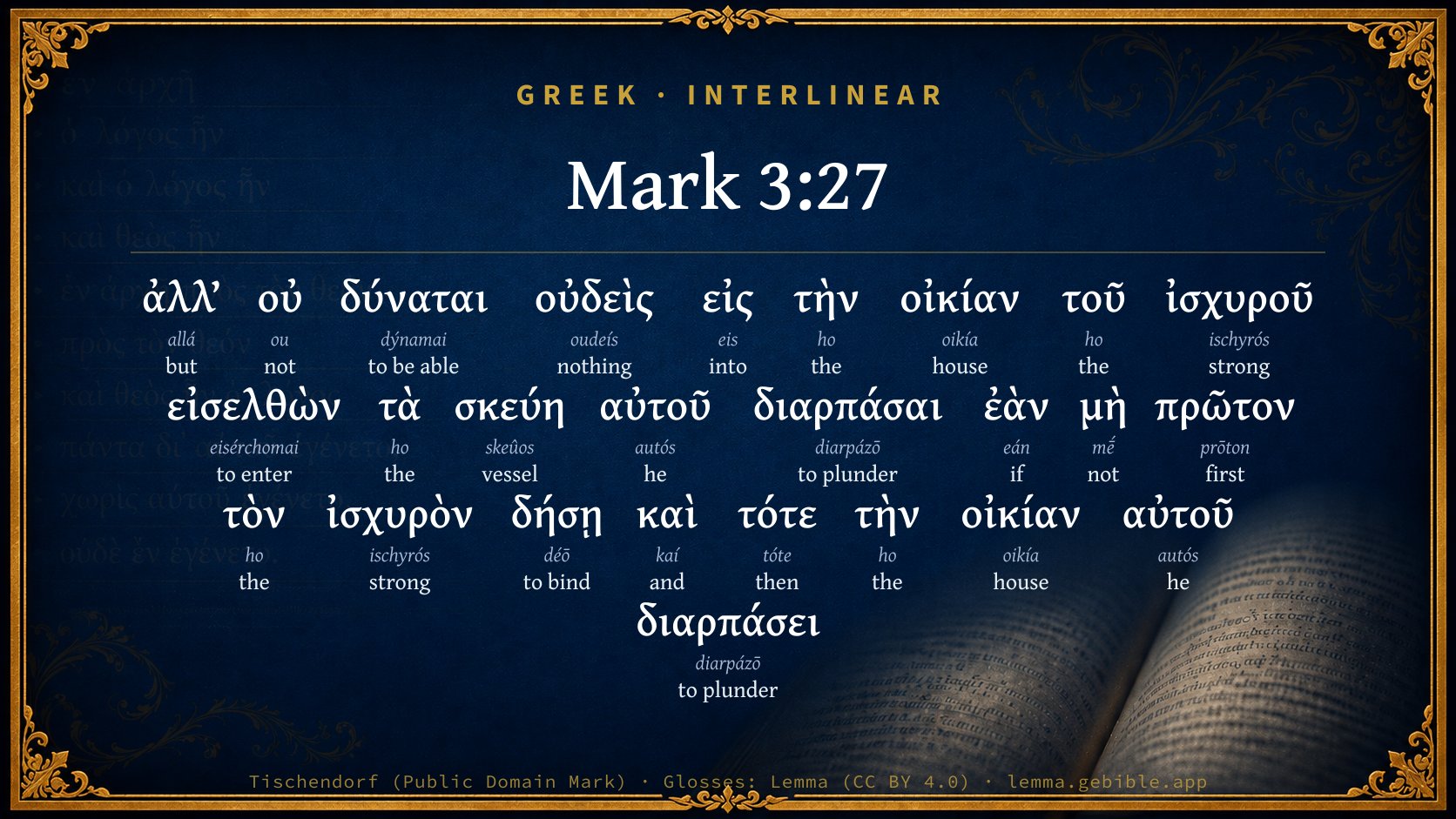
But no one can enter into the house of the strong man to plunder, unless he first binds the strong man; and then he will plunder his house.
Download a study sheet
One document with this verse’s original text, its word-by-word gloss line, the meaning frame, cross-references with their text, attributed commentary, and full source and license credits — printable, and it pastes into notes with its structure intact.
This verse Autodidact and up
A passage Seminary Student
Up to 50 verses in one chapter. A passage sheet keeps up to 6 commentary sources and 12 cross-references per verse, in the order this page ranks them, and says so on the sheet whenever that leaves anything out. Ask for a single verse and you get the Autodidact verse sheet above.
Everything on this page stays free to read, with no account — the sheet is a download of what is already on screen, not access to it.
Compare translations 3
The same verse in 3 English versions, stacked beneath the original-language interlinear above. Click any original word for its lexicon entry.
Each is an independent rendering of the whole verse — the interlinear is not word-aligned to these translations.
Highlighted words mark where these versions differ — a whole-verse word diff, not a word-by-word alignment.
-
World English Bible Public Domain
But no one can enter into the house of the strong man to plunder, unless he first binds the strong man; and then he will plunder his house.
-
King James Version Public Domain
No man can enter into a strong man's house, and spoil his goods, except he will first bind the strong man; and then he will spoil his house.
-
unfoldingWord Literal Text CC BY-SA 4.0
But no one is able, having entered into the house of the strong man, to steal his possessions if he has not first bound the strong man, and then he will plunder his house.
unfoldingWord Literal Text — © unfoldingWord, licensed CC BY-SA 4.0. Word-aligned USFM3 via Door43 (git.door43.org/unfoldingWord/en_ult).
Show all 19 translations
Every available English version of this verse, each an independent rendering of the whole verse.
-
World English Bible Public Domain
But no one can enter into the house of the strong man to plunder, unless he first binds the strong man; and then he will plunder his house.
-
Berean Standard Bible Public Domain
Indeed, no one can enter a strong man’s house to steal his possessions unless he first ties up the strong man. Then he can plunder his house.
-
Majority Standard Bible Public Domain
No one can enter a strong man’s house to steal his possessions unless he first ties up the strong man. Then he can plunder his house.
-
King James Version Public Domain
No man can enter into a strong man's house, and spoil his goods, except he will first bind the strong man; and then he will spoil his house.
-
American Standard Version (1901) Public Domain
But no one can enter into the house of the strong `man', and spoil his goods, except he first bind the strong `man'; and then he will spoil his house.
-
Revised Version (1885) Public Domain
But no one can enter into the house of the strong man, and spoil his goods, except he first bind the strong man; and then he will spoil his house.
-
Geneva Bible (1599) Public Domain
No man can enter into a strong mans house, and take away his goods, except hee first binde that strong man, and then spoyle his house.
-
Douay-Rheims (1899) Public Domain
No man can enter into the house of a strong man and rob him of his goods, unless he first bind the strong man, and then shall he plunder his house.
-
Young's Literal Translation Public Domain
`No one is able the vessels of the strong man -- having entered into his house -- to spoil, if first he may not bind the strong man, and then his house he will spoil.
-
Literal Standard Version CC BY-SA 4.0
No one is able to spoil the vessels of the strong man, having entered into his house, if first he may not bind the strong man, and then he will spoil his house.
-
Unlocked Literal Bible CC BY-SA 4.0
But no one can enter into the house of a strong man and steal his belongings without tying up the strong man first, and then he will plunder his house.
-
unfoldingWord Literal Text CC BY-SA 4.0
But no one is able, having entered into the house of the strong man, to steal his possessions if he has not first bound the strong man, and then he will plunder his house.
-
Darby Bible Public Domain
But no one can, having entered into his house, plunder the goods of the strong [man] unless he first bind the strong [man], and then he will plunder his house.
-
World Messianic Bible Public Domain
But no one can enter into the house of the strong man to plunder unless he first binds the strong man; then he will plunder his house.
-
Webster's Bible Public Domain
No man can enter into a strong man's house, and seize his goods, except he will first bind the strong man; and then he will plunder his house.
-
Free Bible Version CC BY-SA 4.0
Clearly, if someone breaks into the house of a strong man and tries to take his things, he won't get far in his theft unless he ties up the strong man first.”
-
Bible in Basic English Public Domain
But no one is able to go into the house of the strong man and take his goods, without first putting cords round the strong man, and then he will take his goods.
-
Text-Critical English NT CC BY 4.0
No one can enter the house of a strong man and plunder his goods unless he first binds the strong man. Then he can plunder his house.
-
Tyndale New Testament (1534) Public Domain
No man can entre into a stronge mans housse and take awaye hys gooddes excepte he fyrst bynde that stronge man and then spoyle hys housse.
Literal Standard Version (2020), Covenant Press — licensed CC BY-SA 4.0. Text via the HelloAO Bible API (eBible.org). Unlocked Literal Bible (unfoldingWord) — licensed CC BY-SA 4.0. Text via the HelloAO Bible API (eBible.org). unfoldingWord Literal Text — © unfoldingWord, licensed CC BY-SA 4.0. Word-aligned USFM3 via Door43 (git.door43.org/unfoldingWord/en_ult). Free Bible Version, Dr. Jonathan Gallagher — licensed CC BY-SA 4.0. Text via the HelloAO Bible API (eBible.org).
Word by word
More ways to search: Search by grammar → Find every occurrence → Compare this word →
Practice this passage: Drill this verse → Learn its vocabulary →
- Appears 3× in the Greek New Testament
- First appears at Matthew 12:29
- Part of Speech
- Verb
- Tense
- Aorist
- Voice
- Active
- Mood
- Infinitive
Full Thayer's Definition
- ἀλλ’ allá G235 “but” Conjunction
- οὐ ou G3756 “not” Particle, Negative
- δύναται dýnamai G1410 “to be able” Verb, Present, Middle or Passive deponent, Indicative, 3rd person, Singular
- οὐδεὶς oudeís G3762 “nothing” Adjective, Nominative, Singular, Masculine, Negative
- εἰς eis G1519 “into” Preposition
- τὴν ho G3588 “the” Article, Accusative, Singular, Feminine
- οἰκίαν oikía G3614 “house” Noun, Accusative, Singular, Feminine
- τοῦ ho G3588 “the” Article, Genitive, Singular, Masculine
- ἰσχυροῦ ischyrós G2478 “strong” Adjective, Genitive, Singular, Masculine
- εἰσελθὼν eisérchomai G1525 “to enter” Verb, Aorist, Active, Participle, Nominative, Singular, Masculine
- τὰ ho G3588 “the” Article, Accusative, Plural, Neuter
- σκεύη skeûos G4632 “vessel” Noun, Accusative, Plural, Neuter
- αὐτοῦ autós G846 “he” Personal pronoun, Genitive, Singular, Masculine
- διαρπάσαι diarpázō G1283 “to plunder” Verb, Aorist, Active, Infinitive
- ἐὰν eán G1437 “if” Conditional
- μὴ mḗ G3361 “not” Particle, Negative
- πρῶτον prōton G4412 “first” Adverb, Superlative
- τὸν ho G3588 “the” Article, Accusative, Singular, Masculine
- ἰσχυρὸν ischyrós G2478 “strong” Adjective, Accusative, Singular, Masculine
- δήσῃ déō G1210 “to bind” Verb, Aorist, Active, Subjunctive, 3rd person, Singular
- καὶ kaí G2532 “and” Conjunction
- τότε tóte G5119 “then” Adverb
- τὴν ho G3588 “the” Article, Accusative, Singular, Feminine
- οἰκίαν oikía G3614 “house” Noun, Accusative, Singular, Feminine
- αὐτοῦ autós G846 “he” Personal pronoun, Genitive, Singular, Masculine
- διαρπάσει diarpázō G1283 “to plunder” Verb, Future, Active, Indicative, 3rd person, Singular
About this verse
These counts appear in no published source. They are computed here, from the morphology-tagged text and Lemma’s own curated glosses. What Lemma adds →
- 26
- words
- 18
- distinct lemmas
- Gospels
- section
Cross-references
17Topical passages linked to Mark 3:27 in the Treasury of Scripture Knowledge — connected by theme and wording, ordered by reader-vote popularity; previews shown in the World English Bible.
- Isaiah 49:24–26 Shall the prey be taken from the mighty, or the lawful captives be delivered?
- Matthew 12:29 Or how can one enter into the house of the strong man, and plunder his goods, unless he first bind the strong man? Then he will plunder his house.
- Luke 11:21–23 "When the strong man, fully armed, guards his own dwelling, his goods are safe.
- Ephesians 6:10–13 Finally, be strong in the Lord, and in the strength of his might.
- Revelation 20:1–3 I saw an angel coming down out of heaven, having the key of the abyss and a great chain in his hand.
- Isaiah 53:12 Therefore will I divide him a portion with the great, and he shall divide the spoil with the strong; because he poured out his soul to death, and was numbered with the transgressors: yet he bore the sin of many, and made intercession for the transgressors.
- 1 John 4:4 You are of God, little children, and have overcome them; because greater is he who is in you than he who is in the world.
- Isaiah 27:1 In that day Yahweh with his hard and great and strong sword will punish leviathan the swift serpent, and leviathan the crooked serpent; and he will kill the monster that is in the sea.
- Colossians 2:15 having stripped the principalities and the powers, he made a show of them openly, triumphing over them in it.
- Isaiah 61:1 The Spirit of the Lord Yahweh is on me; because Yahweh has anointed me to preach good news to the humble; he has sent me to bind up the broken-hearted, to proclaim liberty to the captives, and the opening [of the prison] to those who are bound;
- Luke 10:17–20 The seventy returned with joy, saying, "Lord, even the demons are subject to us in your name!"
- John 12:31 Now is the judgment of this world. Now the prince of this world will be cast out.
- Romans 16:20 And the God of peace will quickly crush Satan under your feet. The grace of our Lord Jesus Christ be with you.
- 1 John 3:8 He who sins is of the devil, for the devil has been sinning from the beginning. To this end the Son of God was revealed, that he might destroy the works of the devil.
- Revelation 12:7–9 There was war in the sky. Michael and his angels made war on the dragon. The dragon and his angels made war.
- Genesis 3:15 I will put enmity between you and the woman, and between your offspring and her offspring. He will bruise your head, and you will bruise his heel."
- Hebrews 2:14 Since then the children have shared in flesh and blood, he also himself in like manner partook of the same, that through death he might bring to nothing him who had the power of death, that is, the devil,
Cross-references courtesy of OpenBible.info (CC BY 4.0).
Where the printed editions differ
1 variantPlaces in this verse where the major printed Greek editions disagree on the wording in a way that affects the translation — a comparison of editions, not a manuscript-by-manuscript collation. The editions are the modern critical texts (Nestlé-Aland 28/27, SBL, Westcott-Hort, Tregelles, Tyndale House) and the traditional texts behind the KJV (the Textus Receptus and the Byzantine/Majority text). It is not a claim about which reading is original.
-
Extra text
ἀλλ᾽
“But”
In NA28NA27TynSBLWHTreg Not in TRByzἀλλ᾽ (all᾽) 'But' is only in older manuscripts (NA28+NA27+Tyn+SBL+WH+Treg)
Textual data: Translators Amalgamated Greek New Testament (STEPBible TAGNT) · CC BY 4.0.
Lesson kit
Teaching starters — assembled from the data on this page, not authored interpretation. Every prompt links to the verse data it draws on. Edit before teaching.
Mark, in the Gospels, opens this verse with 26 words (18 distinct Greek lemmas). Its most distinctive word is diarpázō (“to plunder”). A historical commentator’s framing appears above. Read the whole chapter for the surrounding context.
Discussion questions
- The word diarpázō carries the sense “to plunder.” How does it shape the verse?
- How does Matthew 12:29, which shares the word «to plunder», read alongside this verse?
- What does the repetition of “house” (2× in this one verse) do in this verse?
- These translations render this verse differently. What is at stake in choosing one wording over another?
- Compare how The Biblical Illustrator and Tyndale Open Study Notes read this verse. Where do they agree or differ?
Things to notice
- These translations choose different wording for 18 words in this verse.
- “house” occurs 2× in this single verse.
- 18 distinct Greek lemmas span 26 words in this verse.
Commentary
Notes on Mark 3:27 from classic Christian and Jewish commentators (each source and its license shown beneath its notes). The classic Christian expositions comment on the surrounding passage and are grouped to its opening verse, so a note may address several verses; the Jewish commentaries on the Tanakh (Rashi and others) are per-verse, so they appear only where the commentator wrote on this verse.
Lemma curates 59 commentaries, every one of them public domain or Creative Commons licensed, each selected and text-cleaned for this edition rather than reprinted as found. About our sources →
The Biblical Illustrator
Joseph S. Exell
The Biblical Illustrator, edited by Joseph S. Exell (c. 1880s–1900s) — public domain. Text from a community e-Sword module.
Tyndale Open Study Notes
Tyndale Open Resources
Tyndale Open Study Notes — © Tyndale Open Resources, licensed CC BY-SA 4.0. Text via the HelloAO Bible API.
Bengel's Gnomon
Johann Albrecht Bengel
Bengel's Gnomon of the New Testament — English translation (T&T Clark, Edinburgh, 1860) — public domain. Text from a community e-Sword module.
Expositor's Greek Testament
ed. W. Robertson Nicoll
The Expositor's Greek Testament, edited by W. Robertson Nicoll (1897–1910) — public domain. Text from a community e-Sword module.
Adam Clarke's Commentary
Adam Clarke's Commentary on the Bible (1810–1826) — public domain. Text from a community e-Sword/MySword module.
The Cambridge Bible for Schools and Colleges
gen. ed. J. J. S. Perowne
The Cambridge Bible for Schools and Colleges (gen. ed. J. J. S. Perowne; Cambridge University Press, 1878–1918) — public domain. Text from a community e-Sword module.
John Gill's Exposition
John Gill's Exposition of the Whole Bible (1746–1763) — public domain (CC PDM 1.0). Text via the HelloAO Bible API.
Trapp's Complete Commentary
John Trapp
John Trapp, A Commentary or Exposition upon All the Books of the Old and New Testament (1647–1656) — public domain. Text from a community e-Sword module.
Cambridge Greek Testament for Schools and Colleges
Cambridge Greek Testament for Schools and Colleges (Cambridge University Press, 1896; 21 vols, various authors incl. Carr, Maclear, Plummer, Farrar, Lumby, Moule, M. R. James, Simcox) — public domain. Text from a community e-Sword module.
International Critical Commentary
International Critical Commentary — older volumes (1896–1929), various authors — public domain. Text from a community e-Sword module.
Vincent's Word Studies in the New Testament
Marvin R. Vincent
Marvin R. Vincent, Word Studies in the New Testament (1887–1900) — public domain. Text from a community e-Sword/MySword module.