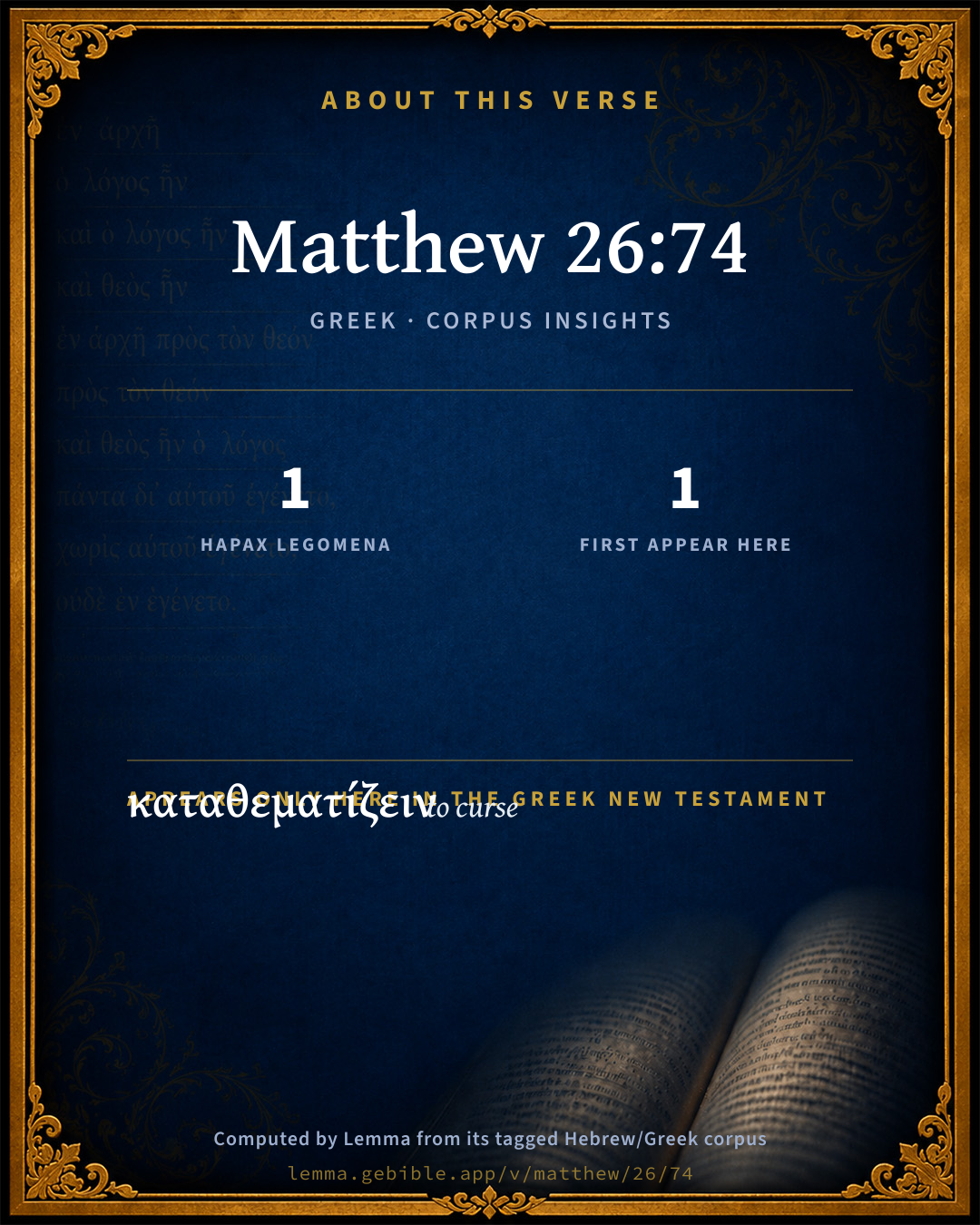
Matthew 26:74

Greek (Tischendorf 8th ed.) Matthew 26:74 appears in the Greek New Testament. The text above is from the Tischendorf 8th edition. Each word links to its Strong’s number and a concise gloss. Click any word for its full Thayer’s Greek Lexicon entry.
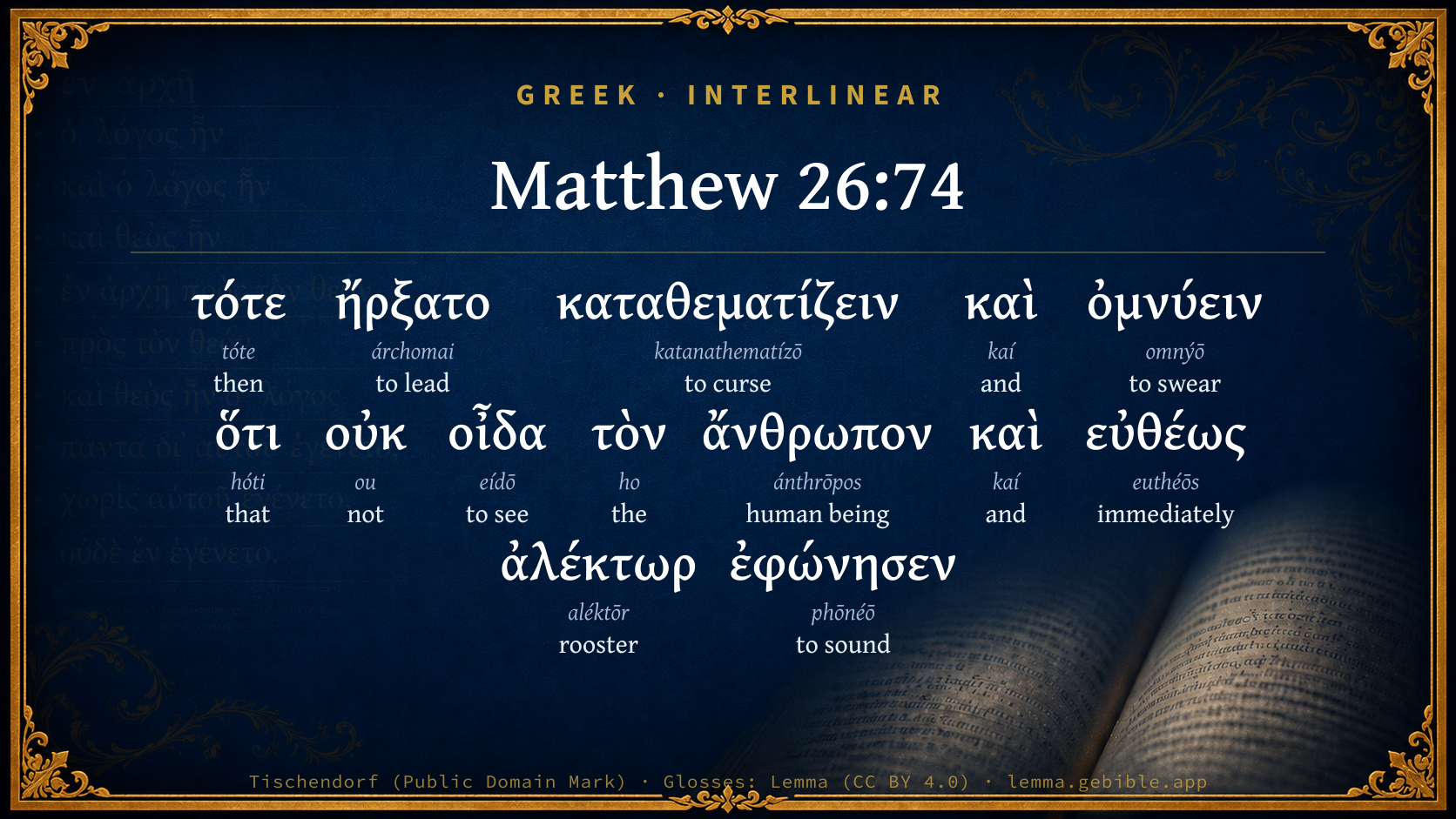
Download image
Cite this verse

Matthew 26:74 (World English Bible). Public Domain. Lemma interlinear Bible study tool, https://lemma.gebible.app/v/matthew/26/74.

Show BibTeX & RIS
BibTeX
RIS
English Translation
Then he began to curse and to swear, "I don't know the man!" Immediately the rooster crowed.
World English Bible · Public Domain
Highlights
  • 1 hapax legomenon — only here in the Greek New Testament
  • 1 first appearance in the Greek New Testament
Full analysis ↓
Download a study sheet

One document with this verse’s original text, its word-by-word gloss line, the meaning frame, cross-references with their text, attributed commentary, and full source and license credits — printable, and it pastes into notes with its structure intact.

This verse Autodidact and up

Study sheet (.html) Plain text (.txt)

A passage Seminary Student

Up to 50 verses in one chapter. A passage sheet keeps up to 6 commentary sources and 12 cross-references per verse, in the order this page ranks them, and says so on the sheet whenever that leaves anything out. Ask for a single verse and you get the Autodidact verse sheet above.

Everything on this page stays free to read, with no account — the sheet is a download of what is already on screen, not access to it.

Want to remove ads? Support Godless Engineer
Compare translations 3

The same verse in 3 English versions, stacked beneath the original-language interlinear above. Click any original word for its lexicon entry.

Each is an independent rendering of the whole verse — the interlinear is not word-aligned to these translations.

Highlighted words mark where these versions differ — a whole-verse word diff, not a word-by-word alignment.

  • World English Bible Public Domain
    Then he began to curse and to swear, "I don't know the man!" Immediately the rooster crowed.
  • King James Version Public Domain
    Then began he to curse and to swear, saying, I know not the man. And immediately the cock crew.
  • unfoldingWord Literal Text CC BY-SA 4.0
    Then he began to curse and to swear, “I do not know the man!” And immediately a rooster crowed.

unfoldingWord Literal Text — © unfoldingWord, licensed CC BY-SA 4.0. Word-aligned USFM3 via Door43 (git.door43.org/unfoldingWord/en_ult).

Versions to compare (up to 4)

3 of 4 selected

Show all 19 translations

Every available English version of this verse, each an independent rendering of the whole verse.

  • World English Bible Public Domain
    Then he began to curse and to swear, "I don't know the man!" Immediately the rooster crowed.
  • Berean Standard Bible Public Domain
    At that he began to curse and swear to them, “I do not know the man!” And immediately a rooster crowed.
  • Majority Standard Bible Public Domain
    At that he began to curse and swear to them, “I do not know the man!” And immediately a rooster crowed.
  • King James Version Public Domain
    Then began he to curse and to swear, saying, I know not the man. And immediately the cock crew.
  • American Standard Version (1901) Public Domain
    Then began he to curse and to swear, I know not the man. And straightway the cock crew.
  • Revised Version (1885) Public Domain
    Then began he to curse and to swear, I know not the man. And straightway the cock crew.
  • Geneva Bible (1599) Public Domain
    Then began hee to curse himselfe, and to sweare, saying, I knowe not the man. And immediately the cocke crewe.
  • Douay-Rheims (1899) Public Domain
    Then he began to curse and to swear that he knew not the man. And immediately the cock crew.
  • Young's Literal Translation Public Domain
    Then began he to anathematise, and to swear -- `I have not known the man;' and immediately did a cock crow,
  • Literal Standard Version CC BY-SA 4.0
    Then he began to curse, and to swear, “I have not known the Man”; and immediately a rooster crowed,
  • Unlocked Literal Bible CC BY-SA 4.0
    Then he began to curse and swear, “I do not know the man,” and immediately a rooster crowed.
  • unfoldingWord Literal Text CC BY-SA 4.0
    Then he began to curse and to swear, “I do not know the man!” And immediately a rooster crowed.
  • Darby Bible Public Domain
    Then he began to curse and to swear, I know not the man. And immediately [the] cock crew.
  • World Messianic Bible Public Domain
    Then he began to curse and to swear, “I don’t know the man!” Immediately the rooster crowed.
  • Webster's Bible Public Domain
    Then began he to curse and to swear, saying, I know not the man. And immediately the cock crowed.
  • Free Bible Version CC BY-SA 4.0
    Then he started to swear: “Curses on me if I'm a liar! I don't know the man!” Immediately the cock crowed.
  • Bible in Basic English Public Domain
    Then with curses and oaths he said, I have no knowledge of the man. And straight away there came the cry of a cock.
  • Text-Critical English NT CC BY 4.0
    Then he began to invoke curses and to swear, saying, “I do not know the man.” And immediately a rooster crowed.
  • Tyndale New Testament (1534) Public Domain
    Then beganne he to course and to sweare that he knewe not the man. And immedyatly the cocke krewe.

Literal Standard Version (2020), Covenant Press — licensed CC BY-SA 4.0. Text via the HelloAO Bible API (eBible.org). Unlocked Literal Bible (unfoldingWord) — licensed CC BY-SA 4.0. Text via the HelloAO Bible API (eBible.org). unfoldingWord Literal Text — © unfoldingWord, licensed CC BY-SA 4.0. Word-aligned USFM3 via Door43 (git.door43.org/unfoldingWord/en_ult). Free Bible Version, Dr. Jonathan Gallagher — licensed CC BY-SA 4.0. Text via the HelloAO Bible API (eBible.org).

Word by word

More ways to search: Search by grammar → Find every occurrence → Compare this word →

Practice this passage: Drill this verse → Learn its vocabulary →

About this verse

These counts appear in no published source. They are computed here, from the morphology-tagged text and Lemma’s own curated glosses. What Lemma adds →

14
words
13
distinct lemmas
Gospels
section

Notable vocabulary

1 hapax legomenon — a word that appears only here in the entire Greek New Testament:

  • καταθεματίζειν to curse G2653

First appearance in Scripture

This word makes its first canonical appearance in the Greek New Testament here:

  • καταθεματίζειν to curse G2653

Shared distinctive vocabulary

ἀλέκτωρ rooster G220 occurs in 11 verses of the Greek New Testament. Also found in:

Repetition

A word recurs within this verse:

Cross-references

16

Topical passages linked to Matthew 26:74 in the Treasury of Scripture Knowledge — connected by theme and wording, ordered by reader-vote popularity; previews shown in the World English Bible.

  • Revelation 3:19 As many as I love, I reprove and chasten. Be zealous therefore, and repent.
  • Matthew 10:28 Don't be afraid of those who kill the body, but are not able to kill the soul. Rather, fear him who is able to destroy both soul and body in Gehenna.
  • Mark 14:71–72 But he began to curse, and to swear, "I don't know this man of whom you speak!"
  • John 18:27 Peter therefore denied it again, and immediately the rooster crowed.
  • Acts 23:12–14 When it was day, some of the Jews banded together, and bound themselves under a curse, saying that they would neither eat nor drink until they had killed Paul.
  • 1 Corinthians 16:22 If any man doesn't love the Lord Jesus Christ, let him be accursed. Come, Lord!
  • Judges 21:18 However we may not give them wives of our daughters, for the children of Israel had sworn, saying, Cursed be he who gives a wife to Benjamin.
  • 1 Samuel 14:24–28 The men of Israel were distressed that day; for Saul had adjured the people, saying, Cursed be the man who eats any food until it be evening, and I be avenged on my enemies. So none of the people tasted food.
  • Matthew 10:32–33 Everyone therefore who confesses me before men, him I will also confess before my Father who is in heaven.
  • Matthew 27:25 All the people answered, "May his blood be on us, and on our children!"
  • Mark 14:30 Jesus said to him, "Most assuredly I tell you, that you today, even this night, before the rooster crows twice, you will deny me three times."
  • Mark 14:68 But he denied it, saying, "I neither know, nor understand what you are saying." He went out on the porch, and the rooster crowed.
  • Luke 22:60 But Peter said, "Man, I don't know what you are talking about!" Immediately, while he was still speaking, a rooster crowed.
  • John 21:15–17 So when they had eaten their breakfast, Jesus said to Simon Peter, "Simon, son of Jonah, do you love me more than these?" He said to him, "Yes, Lord; you know that I have affection for you." He said to him, "Feed my lambs."
  • Romans 9:3 For I could wish that I myself were accursed from Christ for my brothers' sake, my relatives according to the flesh,
  • Judges 17:2 He said to his mother, The eleven hundred [pieces] of silver that were taken from you, about which you did utter a curse, and did also speak it in my ears, behold, the silver is with me; I took it. His mother said, Blessed be my son of Yahweh.

Cross-references courtesy of OpenBible.info (CC BY 4.0).

Commentary

Notes on Matthew 26:74 from classic Christian and Jewish commentators (each source and its license shown beneath its notes). The classic Christian expositions comment on the surrounding passage and are grouped to its opening verse, so a note may address several verses; the Jewish commentaries on the Tanakh (Rashi and others) are per-verse, so they appear only where the commentator wrote on this verse.

Lemma curates 59 commentaries, every one of them public domain or Creative Commons licensed, each selected and text-cleaned for this edition rather than reprinted as found. About our sources →

Bengel's Gnomon

Johann Albrecht Bengel

Mat 26:74. Ἤρξατο, κ.τ.λ., he began, etc.) Hitherto He had not gone so far: now he altogether lost command of himself.—καταθεματίζειν,[1166] to curse) others read καταναθεματίζειν:[1167] that double compound, however, is nowhere to be met with: whereas Irenaeus (Book I., ch. 13, § 2) has καταθεματίσαντες [the participle first aorist active of καταθεματίζω]. Justin Martyr also says, “κατάθεμα τὸ συνθέσθαι τοῖς ἀναθεματίζουσι,” “it is a cursed thing to be joined with them that curse.” And again he joins together ἀναθεματισμὸς [an universally recognised word] and καταθεματισμὸς [a derivative of καταθεματίζω]. Œcumenius, on Act 23:12, says, “κατʼ ἐπίτασιν εἴρηται τὸ ἀνάθεμα ὡς καὶ τὸ κατάθεμα· συγκατατίθεται γὰρ τῷ ὄντι τῷ ἐναντίῳ καὶ συγκαταδικάζεται,” i.e., “The word ἀνάθεμα is used with an intensive force, as also the word κατάθεμα [from which καταθεματίζω is derived]: for it is placed together with that which is opposed, and is condemned together with it.” The word κατάθεμα is always taken in an evil sense as in Rev 22:3; whereas ἀνάθεμα is also used in a good sense.—τὸν ἄνθρωπον, the man) compare however ch. Mat 16:16.—εὐθέως, immediately) An important circumstance (magna circumstantia).—ἐφώνησε, crowed) Sins committed in the early morning are heinous.

[1166] In his App. Crit., Bengel says in loc., καταθεματίζειν. Comp. Al. Aug. 1, 2, 4; Byz. Cant. Gehl. Mosc. Steph. omn. Wo. 1, 2: et quindecim et riginti quinque alii, Orig. ut videtur (καταναθεματίζειν) Er. et Al. vid. Gnom.—(I. B.)

[1167] Such is the reading of E. M.—(I. B.)

Καταθεματίζειν is supported by the oldest uncial MSS. ABCD Vulg. has ‘detestari;’ abc, “devotare se;” which latter probably is the rendering of καταναθεματίζειν of the Rec. Text, as this word expresses more strongly than καταθεματίζειν, extremis diris aliquem devovere; “to make himself anathema.”—ED.

Bengel's Gnomon of the New Testament — English translation (T&T Clark, Edinburgh, 1860) — public domain. Text from a community e-Sword module.

Meyer's Critical & Exegetical Commentary

Heinrich August Wilhelm Meyer

Mat_26:74. Τότε ἤρξατο] for previously he had not resorted as yet to the καταθεματίζειν, but had contented himself with the simple ὀμνύειν (Mat_26:72, μεθʼ ὅρκου). Whereas before he had only sworn, he now takes to cursing as well. Nunc gubernaculum animae plane amisit, Bengel. The imprecations were intended to fall upon himself (should he be found, that is, to be telling an untruth). For the word καταθεματίζω, which was in all probability a vulgar corruption, comp. Rev_22:3; Iren. Haer. i. 13. 2, 16. 3; Oecolampadius, ad Act. xxiii. 12.

ὅτι] recitantis, as in Mat_26:72.

ἀλέκτωρ] a cock. There are Rabbinical statements (see the passages in Wetstein) to the effect that it was not allowable to keep animals of this sort in Jerusalem; but as there are other Rabbinical passages again which assert the opposite of this (see Lightfoot, p. 483), it is unnecessary to have recourse (Reland, Wolf) to the supposition that the bird in question may have belonged to a Gentile, may even have been about Pilates house, or some house outside the city.

Meyer — Critical and Exegetical Commentary on the New Testament — English translation by Peter Christie, edited by Frederick Crombie (T&T Clark, 1880) — public domain. Text from a community e-Sword module.

Expositor's Greek Testament

ed. W. Robertson Nicoll

Mat 26:74 . καταθεματίζειν (here only, καταναθ . in T. R., probably belonging to vulgar speech, Meyer), to call down curses on himself, sign of irritation and desperation; has lost self-control completely. καὶ εὐθὺς : just after this passionate outburst a cock crew . “Magna circumstantia,” Beng.

The Expositor's Greek Testament, edited by W. Robertson Nicoll (1897–1910) — public domain. Text from a community e-Sword module.

Geneva Bible (1599)

Geneva Bible translators

He swore and cursed himself.

Geneva Bible (1599) marginal notes — public domain. Text via Bolls.life.

Adam Clarke's Commentary

Verse 74. Then began he to curse and to swear] Rather, Then he began positively to affirm - καταθεματιζειν, from κατα intensive, and τιθημι, I lay down, place, affirm. But the common reading is καταναθεματιζειν, which signifies to wish curses on himself. The former reading is supported by almost every MS. of value, and is, beyond dispute, the true reading, and has been received by Griesbach into the text. The business is bad enough, but the common reading makes it worse. In Mt 26:72, Peter is said to deny with an oath; here, he positively affirms and swears, probably by the name of God, for this is the import of the word ομνυειν. This makes the fourth and final gradation in the climax of Peter's fall. From these awful beginnings it is not unfair to conclude that Peter might have gone almost as far as Judas himself, had not the traitorous business been effected before. Yet all this evil sprung simply from the fear of man. How many denials of Christ and his truth have sprung since, from the same cause!

The cock crew] This animal becomes, in the hand of God, the instrument of awaking the fallen apostle, at last, to a sense of his fall, danger, and duty. When abandoned of God, the smallest thing may become the occasion of a fall; and, when in the hand of God, the smallest matter may become the instrument of our restoration. Let us never think lightly of what are termed little sins: the smallest one has the seed of eternal ruin in it. Let us never think contemptibly of the feeblest means of grace: each may have the seed of eternal salvation in it. Let us ever remember that the great Apostle Peter fell through fear of a servant maid, and rose through the crowing of a cock.

Adam Clarke's Commentary on the Bible (1810–1826) — public domain. Text from a community e-Sword/MySword module.

Ellicott's Commentary for English Readers

(74) To curse and to swear.—We may infer from the two words that he used some common formula of execration, such as, e.g., “God do so to me and more also” (1Ki_19:2; 1Ki_20:10), as well as the oath-formula, “By Heaven,” or “By the Temple.”

Immediately the cock crew.—St. Mark alone records the first cock-crow. The Greek has no article; “a cock crew.” We find from Mar_13:35 that “cock-crowing” had become a familiar phrase, as with us, for the earliest hour of dawn.

A Bible Commentary for English Readers, edited by Charles John Ellicott (1878–1897) — public domain. Text from a community e-Sword module.

John Gill's Exposition

And Peter remembered the words of Jesus,.... Forgetfulness of God, of his works, of his words, and of his law, of his revealed mind and will, is often the cause of sin; and a remembrance of things is necessary to the recovery of a fallen or backsliding professor; as, of what he is fallen from, of the love and kindness of God formerly shown to him, of his evil ways and works he is fallen into, and of the words and truths of Christ he has been very indifferent unto and lukewarm about:

which said unto him, before the cock crow, or is done crowing,

thou shalt deny me thrice; which he was put in mind of on hearing the cock crow. So by one means, or another, sometimes by some remarkable providence, and sometimes by the ministry of the word, God is pleased to alarm and awaken sleepy professors, backsliding believers, and remind them of their condition and duty, and restore them by repentance, as he did Peter:

and he went out; of the high priest's palace, either through fear, lest he should be seen weeping, and be suspected; or rather through shame, not being able to continue where his Lord was, when he had so shamefully denied him; as also to leave the company he had got into, being sensible he was wrong in mingling himself with such, and thereby exposed himself to these temptations; as well as to vent his grief in tears privately:

and wept bitterly; being thoroughly sensible what an evil and bitter thing the sin was, he had been guilty of: his repentance sprung from Christ's looking upon him, and from his looking to Jesus, and was truly evangelical: it was a sorrow after a godly sort, and was increased by the discoveries of Christ's love unto him; and was attended with faith in him, and views of pardon through him: the Persic version adds, "and his sin is forgiven"; which, though not in the text, yet is a truth; for Peter's repentance was not like Cain's, nor Esau's, nor Judas's; it was not the repentance of one in despair, but was a repentance unto life and salvation, which needed not to be repented of.

Next: Matthew Chapter 27

John Gill's Exposition of the Whole Bible (1746–1763) — public domain (CC PDM 1.0). Text via the HelloAO Bible API.

Trapp's Complete Commentary

John Trapp

74 Then began he to curse and to swear, saying, I know not the man. And immediately the cock crew.

Ver. 74. Then began he to curse and swear] This he had learned belike of the ruffianly soldiers, with whom, usually, execrations are but expletives, and horrible oaths interjections of speech. But though Israel play the harlot, yet why should Judah offend? come not ye to Gilgal, neither go ye up to Bethaven, nor swear "The Lord liveth," Hos 4:15. David swore once such an oath, and it was enough of that once, 1Sa 25:22. But Peter swears and forswears again and again, and that after warning; as Aaron went down and did that in the valley which he heard forbidden in the Mount, and then excuseth it by his fear of the people. That cowardly passion is the mother of many sins, of lying especially, Zep 3:13, and swearing too, to save the life. But better die than lie: and better bear than swear. We may not break the hedge of any commandment to avoid any piece of foul way, but go in a right line to God. Quas non oportet mortes praeeligere, quod non supplicium potius ferre, imo in quam profundam inferni abyssum non intrare, quam contra conscientiam attestari? saith holy Zuinglius in his third Epistle. What should not a man suffer, rather than sin? Peter sinned to some purpose, if it were, as some have thought, that he not only cursed himself, if he knew Christ, but also cursed Jesus Christ, that so he might appear to be none of his disciples.

And immediately the cock crew] Gallicinium complevit Christi vaticinium. The cock proved a preacher to Peter. Despise not the minister though never so mean; it is the foolishness of preaching that must bring men to heaven. Cocks call men out of their beds, and there hence have their name in the Greek tongue, {a} They constantly keep the law of crowing at those set times that nature hath enjoined them; they cry loud and thick against a storm. So do faithful ministers, when gotten upon their battlements; they clap their own sides first, and then constantly call up others. They cry aloud, and spare not, but lift up their voice like a trumpet, to tell Judah of their sins, &c. The roaring lion of hell trembleth at their note: and the world’s Sybarites cannot bear their disturbances, and therefore wish them banished. But wisdom is justified of her children, and though fierce before, and untamable, yet now "a little child shall lead them," Isa 11:6.

{a} αλικτωρ, quod nos excitet e lecto.

John Trapp, A Commentary or Exposition upon All the Books of the Old and New Testament (1647–1656) — public domain. Text from a community e-Sword module.

Albert Barnes' Notes on the Bible

Then began he to curse ... - Peter was now irritated beyond endurance. He could no longer resist the evidence that he was known. It had been repeatedly charged on him. His language had betrayed him, and there was a positive witness who had seen him. He felt it necessary, therefore, to be still more decided, and he accordingly added to the sin of denying his Lord the deep aggravation of profane cursing and swearing, affirming what he must have known was false, that he knew not the man. Immediately then the cock crew - that is, the second crowing, or not far from three in the morning.

Albert Barnes' Notes on the Bible (1834–1885) — public domain. Text from a community e-Sword/MySword module.

Whedon's Commentary on the Bible

Daniel D. Whedon

74. Curse and to swear — No doubt he first swore, to show that he belonged not to the prophet of Nazareth; but now a real and insane rage seems to have complete mastery, and Satan is sifting him like wheat. But it was in this very depth of abandonment that the voice of convicting mercy reached him. It was the time for the monitory cock to crow for Peter, and he crew.

At this moment of gross denial and profanity Peter was in a state of mortal sin and condemnation. He had fallen from grace; and death, in his present impenitent condition, would have consigned him to remediless woe.

Luke tells us that “the Lord turned and looked upon Peter,” and that Peter thereupon reflected upon his Lord’s warning. Probably our Lord cast this glance as he was led from Annas to Caiaphas. Or at this third denial the door of the apartment where Jesus and Annas were may have been opened upon the court, and Peter may have painfully found himself denying and swearing under his Lord’s glance. That glance doubtless was turned full upon him with a significance that called Peter to his recollections. It does not appear that Peter came into the examination room or was present with his Lord.

Daniel D. Whedon (gen. ed.), Commentary on the Old and New Testaments (1874–1909) — public domain. Text from a community e-Sword module.

The Pulpit Commentary

To curse and to swear. Peter fortifies this, his third denial, by imprecating curses on himself (katayematizein) if he spake not the truth, and again (ver. 72) confirming his assertion by a solemn oath. There is a certain gradation in his denials: he first simply asserts; he then asserts with an oath; lastly, he adds curses to his oath. "One temptation unresisted seldom fails to be followed by another; a second and greater infidelity is the punishment of the first, and often the cause of a third. Peter joins perjury to infidelity. Deplorable progress of infidelity and blindness in an apostle in so short a time, only out of fear of some under servants, and in respect of a Master whom he had acknowledged very God. He might possibly have proceeded even as far as Judas, had God left him any longer to himself" (Quesnel). Immediately the cock crew. This was the second crowing; (Mar_14:72) the first had been heard at the first denial. (Mar_14:68)

The Pulpit Commentary (1880–1919), ed. H.D.M. Spence-Jones & Joseph S. Exell — public domain. Text from a community e-Sword module.

John Wesley's Explanatory Notes

Then began he to curse and to swear - Having now quite lost the reins, the government of himself.

John Wesley, Explanatory Notes Upon the Whole Bible (1754–1765) — public domain. Text via the GEBible commentary corpus.

The People's New Testament

B. W. Johnson

74. He began to curse and to swear. Peter's third denial. He not only, with an oath, repeats what he had said in the second, but he affirms it with imprecations of divine wrath on himself if he spake not the truth. The gradations of guilt in the denials of Peter: (1) Ambiguous evasion; (2) distinct denial with a false oath; (3) awful abjuration with solemn imprecations on himself. Immediately the cock crew. This was at the opening of the fourth or morning watch, at about three o'clock. The cock often crows about midnight, or not long after; and again always about the third hour after midnight, or three o'clock. This shows that the second trial of Jesus took place before the dawn.

B. W. Johnson's The People's New Testament with Notes (1889–1891) — public domain. Electronic text from the Christian Classics Ethereal Library (CCEL) ThML edition.

Cambridge Greek Testament for Schools and Colleges

74. καταθεματίζειν for καταναθεματίζειν of textus receptus with preponderating authority. The second word is scarcely supported.

74. καταθεματίζειν. See critical notes supra. Cp. Rev 22:3, where κατάθεμα is restored for κατανάθεμα. No other instance is cited either of noun or verb. They appear to be used as synonymous with ἀνάθεμα, ‘an accursed thing,’ and ἀναθεματίζειν, ‘to devote to destruction,’ ‘to curse.’ Two explanations may be given: (1) the meanings of ἀνὰ and κατὰ in composition so often coincide that an interchange of the two prepositions in noun- or verb-forms is quite explicable; (2) the original forms may have been κατανάθεμα, καταναθεματίζειν, and have fallen by usage to κατάθεμα, καταθεματίζειν, the Greek language shrinking from the union of κατὰ and ἀνὰ in composition, of which the instances are extremely rare.

Cambridge Greek Testament for Schools and Colleges (Cambridge University Press, 1896; 21 vols, various authors incl. Carr, Maclear, Plummer, Farrar, Lumby, Moule, M. R. James, Simcox) — public domain. Text from a community e-Sword module.

Alford’s Greek Testament

Henry Alford

74.] καταθεματ. is a corrupted form, belonging probably to the class of vulgarisms. κατάθεμα occurs Rev 22:3. ‘Nunc gubernaculum animæ plane amisit,’ says Bengel.

Henry Alford, The Greek Testament (1849–1861) — public domain. Text from a community e-Sword module.

International Critical Commentary

(M) 74. Then he began to imprecate, and to swear that, I know not the man. And immediately the cock crew.] Mk. has: “And he began to imprecate, and to swear that, I know not this man of whom you speak. And immediately the cock crew a second time.”—τότε] see. on 2:7.—καταθεματίζειν] only here for Mk.’s ἀναθεματίζειν, which occurs three times to Act_23. With either word the meaning is “to invoke a curse on himself if his statement were not true.”—καὶ εὐθύς] Mk. adds ἐκ δευτέρου (om. א L); cf. δίς in v. 30 (om. א C* D) and v. 72 (om. א C* D).

International Critical Commentary — older volumes (1896–1929), various authors — public domain. Text from a community e-Sword module.

Vincent's Word Studies in the New Testament

Marvin R. Vincent

To curse [καταθεματιζειν] . A new development of profanity. Hitherto he had merely sworn. Now he adds imprecation; invoking curses on himself if the case be not as he says.

Marvin R. Vincent, Word Studies in the New Testament (1887–1900) — public domain. Text from a community e-Sword/MySword module.

Lesson kit

Teaching starters — assembled from the data on this page, not authored interpretation. Every prompt links to the verse data it draws on. Edit before teaching.

Matthew, in the Gospels, opens this verse with 14 words (13 distinct Greek lemmas). Its most distinctive word is katanathematízō (“to curse”). A historical commentator’s framing appears above. Read the whole chapter for the surrounding context.

Discussion questions

  1. What does “to curse” (katanathematízō) contribute to the verse as a whole?
  2. 1 word here appears nowhere else in the Greek New Testament. Why might the author reach for such rare wording?
  3. This is the first place “to curse” appears in Scripture (first appears here). What does its debut here establish?
  4. How does Matthew 26:34, which shares the word «rooster», read alongside this verse?
  5. What does the repetition of “and” (2× in this one verse) do in this verse?
  6. The translations on this page render this verse differently — a whole-verse word diff, not a word-by-word alignment. What might account for the different wordings?
  7. Compare how Bengel's Gnomon and Meyer's Critical & Exegetical Commentary read this verse. Where do they agree or differ?

Things to notice

  • 1 word in this verse appears nowhere else in the Greek New Testament.
  • 1 word makes its first canonical appearance in Scripture here.
  • These translations choose different wording for 7 words in this verse.
  • “and” occurs 2× in this single verse.
  • 13 distinct Greek lemmas span 14 words in this verse.

Reading settings

Reading text

Shown beneath each verse's original-language words.

Old Testament
Old Testament edition

Read the OT as the Masoretic Hebrew (MT) or the Greek Septuagint (LXX).

English shown for the Greek Septuagint (in the Hebrew ↔ Greek comparison).

Comparing translations? Open the Compare panel on any verse page to stack up to four side by side.