Mark 4:27

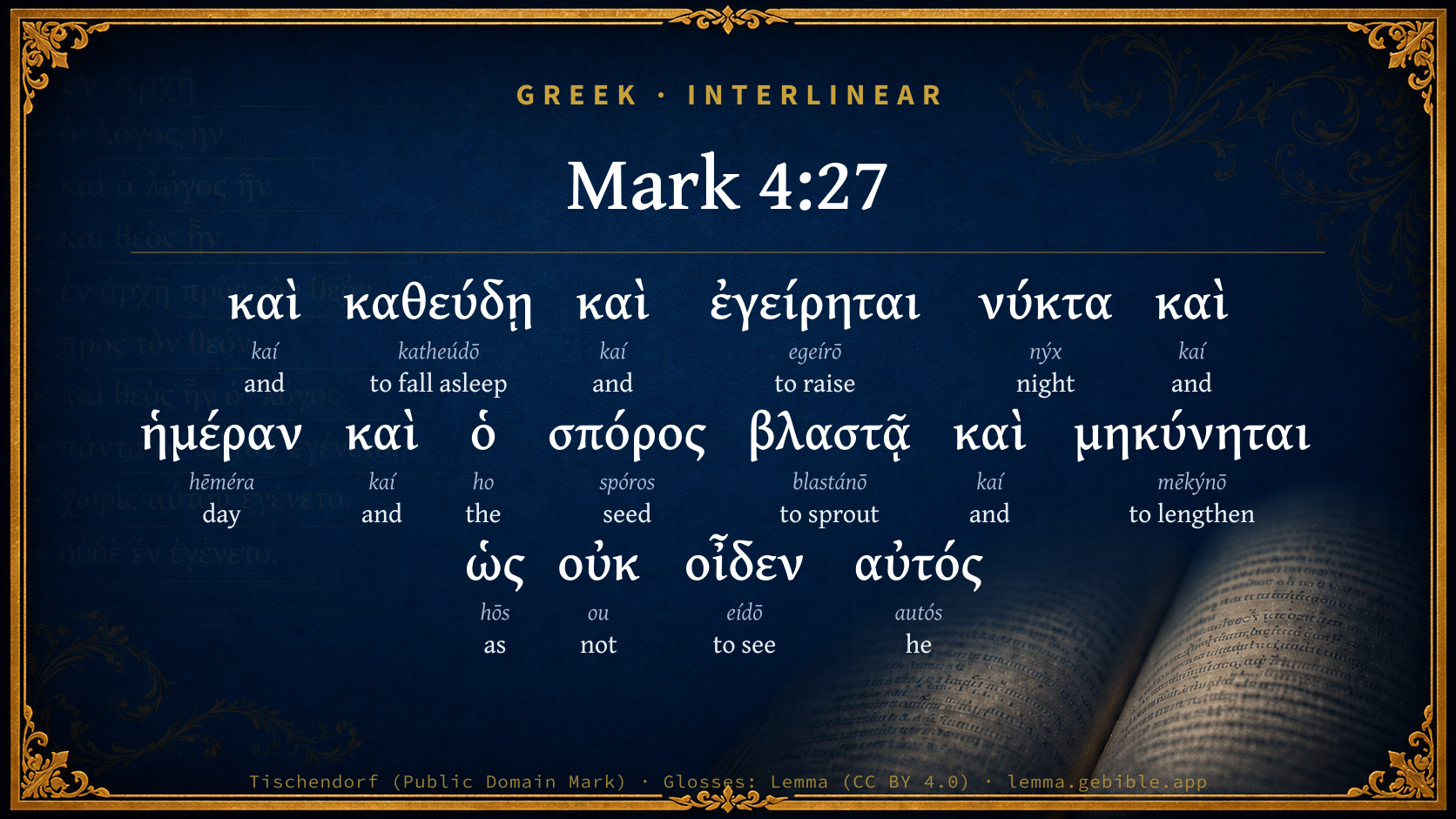
Greek (Tischendorf 8th ed.) Mark 4:27 appears in the Greek New Testament. The text above is from the Tischendorf 8th edition. Each word links to its Strong’s number and a concise gloss. Click any word for its full Thayer’s Greek Lexicon entry.
Download image
Cite this verse

Mark 4:27 (World English Bible). Public Domain. Lemma interlinear Bible study tool, https://lemma.gebible.app/v/mark/4/27.

Show BibTeX & RIS
BibTeX
RIS
English Translation
and should sleep and rise night and day, and the seed should spring up and grow, he doesn't know how.
World English Bible · Public Domain
Highlights
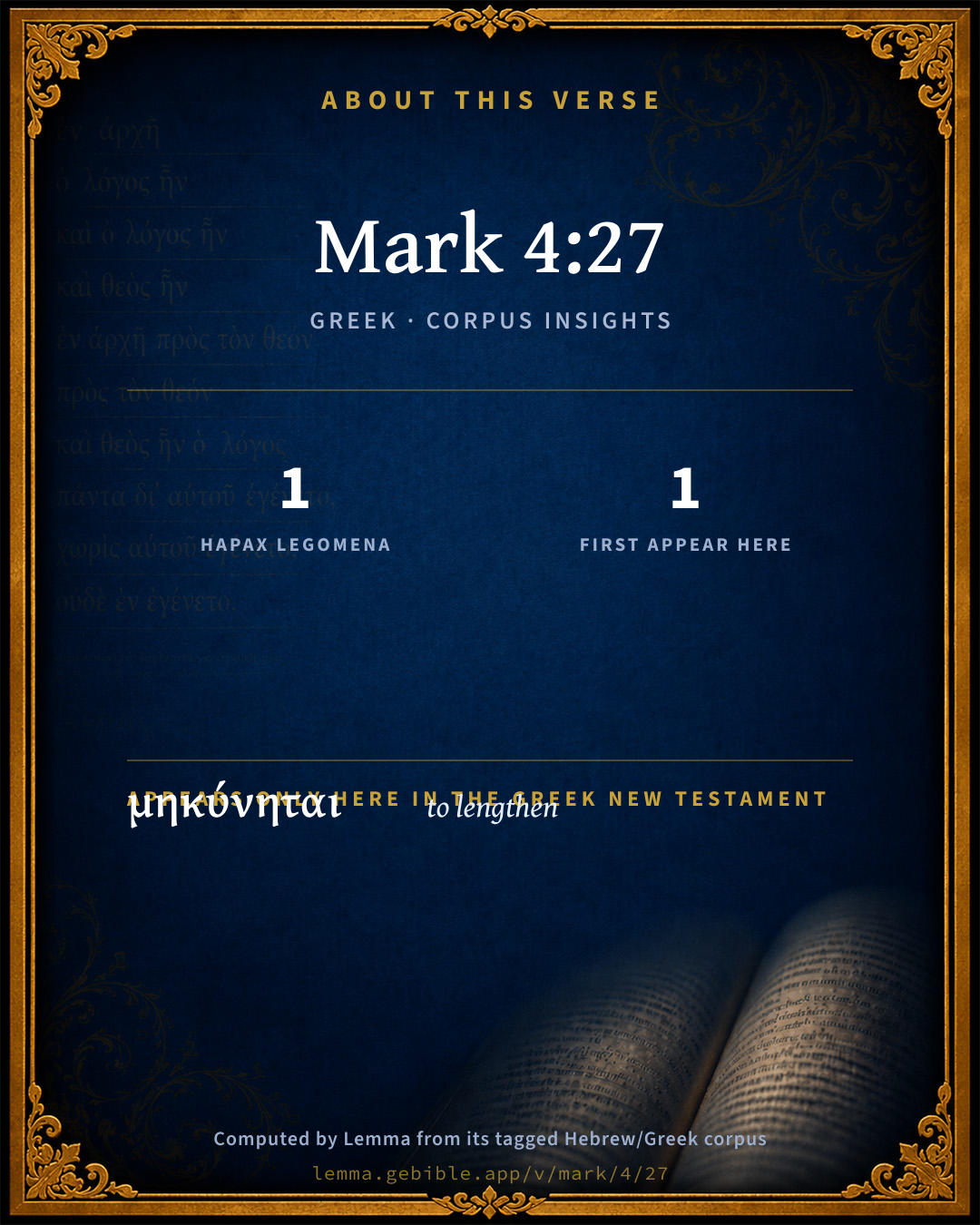
  • 1 hapax legomenon — only here in the Greek New Testament
  • 1 first appearance in the Greek New Testament
Full analysis ↓
Download a study sheet

One document with this verse’s original text, its word-by-word gloss line, the meaning frame, cross-references with their text, attributed commentary, and full source and license credits — printable, and it pastes into notes with its structure intact.

This verse Autodidact and up

Study sheet (.html) Plain text (.txt)

A passage Seminary Student

Up to 50 verses in one chapter. A passage sheet keeps up to 6 commentary sources and 12 cross-references per verse, in the order this page ranks them, and says so on the sheet whenever that leaves anything out. Ask for a single verse and you get the Autodidact verse sheet above.

Everything on this page stays free to read, with no account — the sheet is a download of what is already on screen, not access to it.

Want to remove ads? Support Godless Engineer
Compare translations 3

The same verse in 3 English versions, stacked beneath the original-language interlinear above. Click any original word for its lexicon entry.

Each is an independent rendering of the whole verse — the interlinear is not word-aligned to these translations.

Highlighted words mark where these versions differ — a whole-verse word diff, not a word-by-word alignment.

  • World English Bible Public Domain
    and should sleep and rise night and day, and the seed should spring up and grow, he doesn't know how.
  • King James Version Public Domain
    And should sleep, and rise night and day, and the seed should spring and grow up, he knoweth not how.
  • unfoldingWord Literal Text CC BY-SA 4.0
    and he sleeps and gets up, night and day, and the seed sprouts and grows—how, he himself does not know.

unfoldingWord Literal Text — © unfoldingWord, licensed CC BY-SA 4.0. Word-aligned USFM3 via Door43 (git.door43.org/unfoldingWord/en_ult).

Versions to compare (up to 4)

3 of 4 selected

Show all 19 translations

Every available English version of this verse, each an independent rendering of the whole verse.

  • World English Bible Public Domain
    and should sleep and rise night and day, and the seed should spring up and grow, he doesn't know how.
  • Berean Standard Bible Public Domain
    Night and day he sleeps and wakes, and the seed sprouts and grows, though he knows not how.
  • Majority Standard Bible Public Domain
    Night and day he sleeps and wakes, and the seed sprouts and grows, though he knows not how.
  • King James Version Public Domain
    And should sleep, and rise night and day, and the seed should spring and grow up, he knoweth not how.
  • American Standard Version (1901) Public Domain
    and should sleep and rise night and day, and the seed should spring up and grow, he knoweth not how.
  • Revised Version (1885) Public Domain
    and should sleep and rise night and day, and the seed should spring up and grow, he knoweth not how.
  • Geneva Bible (1599) Public Domain
    And shoulde sleepe, and rise vp night and day, and the seede should spring and growe vp, he not knowing howe.
  • Douay-Rheims (1899) Public Domain
    And should sleep, and rise, night and day, and the seed should spring, and grow up whilst he knoweth not.
  • Young's Literal Translation Public Domain
    and may sleep, and may rise night and day, and the seed spring up and grow, he hath not known how;
  • Literal Standard Version CC BY-SA 4.0
    and may sleep, and may rise night and day, and the seed springs up and grows, he has not known how;
  • Unlocked Literal Bible CC BY-SA 4.0
    He sleeps at night and gets up by day, and the seed sprouts and grows, though he does not know how.
  • unfoldingWord Literal Text CC BY-SA 4.0
    and he sleeps and gets up, night and day, and the seed sprouts and grows—how, he himself does not know.
  • Darby Bible Public Domain
    and should sleep and rise up night and day, and the seed should sprout and grow, he does not know how.
  • World Messianic Bible Public Domain
    and should sleep and rise night and day, and the seed should spring up and grow, though he doesn’t know how.
  • Webster's Bible Public Domain
    And should sleep, and rise night and day, and the seed should spring and grow up, he knoweth not how.
  • Free Bible Version CC BY-SA 4.0
    “He goes to bed and gets up, day after day, but the man has no knowledge of how the seeds sprout and grow.
  • Bible in Basic English Public Domain
    And went to sleep and got up, night and day, and the seed came to growth, though he had no idea how.
  • Text-Critical English NT CC BY 4.0
    He sleeps and rises night and day, and the seed sprouts and grows; he does not know how.
  • Tyndale New Testament (1534) Public Domain
    and shulde slepe and ryse vp night and daye: and the seede shuld springe and growe vp he not ware.

Literal Standard Version (2020), Covenant Press — licensed CC BY-SA 4.0. Text via the HelloAO Bible API (eBible.org). Unlocked Literal Bible (unfoldingWord) — licensed CC BY-SA 4.0. Text via the HelloAO Bible API (eBible.org). unfoldingWord Literal Text — © unfoldingWord, licensed CC BY-SA 4.0. Word-aligned USFM3 via Door43 (git.door43.org/unfoldingWord/en_ult). Free Bible Version, Dr. Jonathan Gallagher — licensed CC BY-SA 4.0. Text via the HelloAO Bible API (eBible.org).

Word by word

More ways to search: Search by grammar → Find every occurrence → Compare this word →

Practice this passage: Drill this verse → Learn its vocabulary →

μηκύνηται
mēkýnō
G3373
“to lengthen”
Verb, Present, Passive, Subjunctive, 3rd person, Singular
Part of Speech
Verb
Tense
Present
Voice
Passive
Mood
Subjunctive
Person
3rd person
Number
Singular
Full Thayer's Definition

Origin: from G3372

TDNT: None

1. to make long, to lengthen 2. in the Bible twice of plants, to cause to grow, increase
  1. καὶ kaí G2532 “and” Conjunction
  2. καθεύδῃ katheúdō G2518 “to fall asleep” Verb, Present, Active, Subjunctive, 3rd person, Singular
  3. καὶ kaí G2532 “and” Conjunction
  4. ἐγείρηται egeírō G1453 “to raise” Verb, Present, Passive, Subjunctive, 3rd person, Singular
  5. νύκτα nýx G3571 “night” Noun, Accusative, Singular, Feminine
  6. καὶ kaí G2532 “and” Conjunction
  7. ἡμέραν hēméra G2250 “day” Noun, Accusative, Singular, Feminine
  8. καὶ kaí G2532 “and” Conjunction
  9. ὁ ho G3588 “the” Article, Nominative, Singular, Masculine
  10. σπόρος spóros G4703 “seed” Noun, Nominative, Singular, Masculine
  11. βλαστᾷ blastánō G985 “to sprout” Verb, Present, Active, Subjunctive, 3rd person, Singular
  12. καὶ kaí G2532 “and” Conjunction
  13. ὡς hōs G5613 “as” Adverb
  14. οὐκ ou G3756 “not” Particle, Negative
  15. οἶδεν eídō G1492 “to see” Verb, Perfect, Active, Indicative, 3rd person, Singular
  16. αὐτός autós G846 “he” Personal pronoun, Nominative, Singular, Masculine

About this verse

These counts appear in no published source. They are computed here, from the morphology-tagged text and Lemma’s own curated glosses. What Lemma adds →

17
words
13
distinct lemmas
Gospels
section

Notable vocabulary

1 hapax legomenon — a word that appears only here in the entire Greek New Testament:

  • μηκύνηται to lengthen G3373

First appearance in Scripture

This word makes its first canonical appearance in the Greek New Testament here:

  • μηκύνηται to lengthen G3373

Shared distinctive vocabulary

βλαστᾷ to sprout G985 occurs in 4 verses of the Greek New Testament. Also found in:

Repetition

A word recurs within this verse:

Cross-references

6

Topical passages linked to Mark 4:27 in the Treasury of Scripture Knowledge — connected by theme and wording, ordered by reader-vote popularity; previews shown in the World English Bible.

  • Ecclesiastes 11:5 As you don't know what is the way of the wind, Nor how the bones grow in the womb of her who is with child; Even so you don't know the work of God who does all.
  • 2 Thessalonians 1:3 We are bound to always give thanks to God for you, brothers, even as it is appropriate, because your faith grows exceedingly, and the love of each and every one of you towards one another abounds;
  • Ecclesiastes 8:17 then I saw all the work of God, that man can't find out the work that is done under the sun, because however much a man labors to seek it out, yet he won't find it. Yes even though a wise man thinks he can comprehend it, he won't be able to find it.
  • 1 Corinthians 15:37–38 That which you sow, you don't sow the body that will be, but a bare grain, maybe of wheat, or of some other kind.
  • John 3:7–8 Don't marvel that I said to you, 'You must be born anew.'
  • 2 Peter 3:18 But grow in the grace and knowledge of our Lord and Savior Jesus Christ. To him be the glory both now and forever. Amen.

Cross-references courtesy of OpenBible.info (CC BY 4.0).

Commentary

Notes on Mark 4:27 from classic Christian and Jewish commentators (each source and its license shown beneath its notes). The classic Christian expositions comment on the surrounding passage and are grouped to its opening verse, so a note may address several verses; the Jewish commentaries on the Tanakh (Rashi and others) are per-verse, so they appear only where the commentator wrote on this verse.

Lemma curates 59 commentaries, every one of them public domain or Creative Commons licensed, each selected and text-cleaned for this edition rather than reprinted as found. About our sources →

Bengel's Gnomon

Johann Albrecht Bengel

Mar 4:27. Καθεύδῃ καὶ ἐγείρηται, should sleep and rise) With these two verbs are connected by Chiasmus [See Append.] the nouns night and day [sleep referring to night; rise, to day]. Moreover, sometimes night is wont to be put before day, as in Genesis 1 [The evening and the morning were the first day, Mar 4:5].—οὐκ οἶδεν αὐτὸς, he knoweth not himself) After the safeguards of grace have been conferred on men, God leaves them in some measure to themselves. Yet this clause may be made to refer to the believing man himself; and then, of its own accord, in Mar 4:28, is opposed to man’s care, not to the cultivation of the earth.

Bengel's Gnomon of the New Testament — English translation (T&T Clark, Edinburgh, 1860) — public domain. Text from a community e-Sword module.

Expositor's Greek Testament

ed. W. Robertson Nicoll

Mar 4:27 . καθεύδῃ … ἡμέραν , sleep and rise night and day, suggestive of the monotonous life of a man who has nothing particular to do beyond waiting patiently for the result of what he has already done (seed sown). The presents express a habit, while βάλῃ , Mar 4:26 , expresses an act, done once for all. βλαστᾷ (the reading in [22] [23] [24] , etc., as if from βλαστάω ) may be either indicative or subjunctive, the former if we adopt the reading μηκύνεται ( [25] [26] ., etc.) = and the seed sprouts and lengthens. ὡς οὐκ οἶδεν αὐτός , how knoweth not (nor careth) he, perfectly indifferent to the rationale of growth; the fact enough for him.

[22] Codex Vaticanus (sæc. iv.), published in photographic facsimile in 1889 under the care of the Abbate Cozza-Luzi.

[23] Codex Bezae

[24] Codex Regius--eighth century, represents an ancient text, and is often in agreement with א and B.

[25] Codex Vaticanus (sæc. iv.), published in photographic facsimile in 1889 under the care of the Abbate Cozza-Luzi.

[26] Codex Bezae

The Expositor's Greek Testament, edited by W. Robertson Nicoll (1897–1910) — public domain. Text from a community e-Sword module.

Geneva Bible (1599)

Geneva Bible translators

It is the part of the ministers, to labor the ground with all diligence, and commend the success to God: for that mighty working whereby the seed cometh to blade and ear, is secret and only known by the fruit.

That is, when he hath done sowing, should pass the time both day and night, nothing doubting, but that the seed would spring which groweth both day and night.

Geneva Bible (1599) marginal notes — public domain. Text via Bolls.life.

Adam Clarke's Commentary

Verse 27. And should sleep and rise night and day] That is, he should sleep by night, and rise by day; for so the words are obviously to be understood.

He knoweth not how.] How a plant grows is a mystery in nature, which the wisest philosopher in the universe cannot fully explain.

Adam Clarke's Commentary on the Bible (1810–1826) — public domain. Text from a community e-Sword/MySword module.

Ellicott's Commentary for English Readers

(27) And should sleep, and rise.—So it was in the world’s history. Men knew not the greatness of the new force that had been brought into action. Philosophers and statesmen ignored it. Even the very preachers of the new faith, the “sowers” of the parable, were hardly conscious of the enormous revolution which they were working. So it is in the individual life. The seemingly chance word, the new truth that flashes on the soul as a revelation, the old words now for the first time apprehended in their true force, these prove to be the seeds of a new growth in the soul.

A Bible Commentary for English Readers, edited by Charles John Ellicott (1878–1897) — public domain. Text from a community e-Sword module.

The Cambridge Bible for Schools and Colleges

gen. ed. J. J. S. Perowne

27. spring and grow up] We need not inquire too minutely who the Sower is, though primarily it refers to the Lord Himself. It is the property of the seed which is intended to engage our attention, the secret energy of its own, the principle of life and growth within itself, whereby it springs up and grows.

The Cambridge Bible for Schools and Colleges (gen. ed. J. J. S. Perowne; Cambridge University Press, 1878–1918) — public domain. Text from a community e-Sword module.

John Gill's Exposition

But when it is sown, it groweth up,.... So the Gospel, when it was preached, it spread notwithstanding all the opposition made against it by, the Jews and Gentiles: there was no stopping it; though the Jewish sanhedrim charged the apostles to speak no more in the name of Jesus, they regarded them not; though Herod stretched forth his hands against the church, and killed one apostle, and put another in prison, yet "the word of God grew and multiplied", Act 12:1, and Gospel churches when set up, whether in Judea, or among the Gentiles, presently had additions made unto them, and "grew up", as holy temples in the Lord: and wherever the grace of God is really implanted, there is a growing in it, and in the knowledge of Christ Jesus:

and becometh greater than all herbs: the Gospel exceeds the traditions of the Jews, and the philosophy of the Gentiles, and any human scheme whatever, in its nature, usefulness, and the largeness of its spread: and the Gospel church state will ere long fill the world, and all nations shall flow unto it; when the Jews shall be converted, and the fulness of the Gentiles shall come, it will be a greater kingdom, than any of the kingdoms of the earth ever were: and the grace of God in the heart, is vastly above nature, and does that which nature can never perform; and which spreads and enlarges, and at last issues in eternal glory:

and shooteth out great branches, so that the fowls of the air may lodge under the shadow of it: by whom are meant, saints; such to whom the Gospel is come in power, and who have the grace of God wrought in their hearts, who are partakers of the heavenly calling: these come where the Gospel is preached, and where gracious souls are met together, even in the several Gospel churches; where they not only come and go, but where they lodge, abide, and continue, under the shadow of the Gospel, and Gospel ordinances, and that with great delight and pleasure; singing songs of praise to God, for his electing and redeeming love, and for calling grace, and for all spiritual blessings, and Gospel privileges: for a larger explanation and illustration of this parable; see Gill on Mat 13:31, Mat 13:32.

John Gill's Exposition of the Whole Bible (1746–1763) — public domain (CC PDM 1.0). Text via the HelloAO Bible API.

Trapp's Complete Commentary

John Trapp

27 And should sleep, and rise night and day, and the seed should spring and grow up, he knoweth not how.

Ver. 27. And should sleep] Ministers must rest secure with the success of their endeavours, having diligently done their duties. The word may work many a year after; as they say of the elephant, that she brings not forth till thirteen years after she hath conceived.

John Trapp, A Commentary or Exposition upon All the Books of the Old and New Testament (1647–1656) — public domain. Text from a community e-Sword module.

Albert Barnes' Notes on the Bible

And should sleep, and rise night and day - Should sleep in the night and rise by day, for so the expression is to be understood. That is, should live in his usual way, without exerting any influence over the growing grain. By this we are not to infer that men are to use no diligence in the obtaining and in the growth of piety; but the illustration shows only that as we cannot tell how grain grows, so we cannot tell the mode in which piety increases in the heart.

He knoweth not how - This is still true. After all the researches of philosophers, no one has been able to tell the way in which grain grows. They can observe one fact after another; they can see the changes; they can see the necessity of rains and suns, of care and shelter, but beyond this they cannot go. So in religion. We can mark the change; we can see the need of prayer, and self-examination, and searching the Scriptures, and the ordinances of religion, but we cannot tell in what way the religious principle is developed and strengthened. As God unseen, yet by the use of proper means, makes the grass to flourish, so God unseen, but by proper means, nourishes the soul, and the plants of piety spring up, and bloom, and bear fruit. Compare the notes at Joh 3:8.

Albert Barnes' Notes on the Bible (1834–1885) — public domain. Text from a community e-Sword/MySword module.

Whedon's Commentary on the Bible

Daniel D. Whedon

27. Should sleep, and rise night and day — That is, who sleep, night, and rise, day. He knoweth not how — He knows what must be done by him in order that the process may take place, but the process itself is a secret to him. The plants grow while he sleeps. But if he were awake, nature nevertheless works in secret before his eyes.

Daniel D. Whedon (gen. ed.), Commentary on the Old and New Testaments (1874–1909) — public domain. Text from a community e-Sword module.

The People's New Testament

B. W. Johnson

27. Should sleep, and rise, etc. While giving the seed sown time to germinate and come forth.

B. W. Johnson's The People's New Testament with Notes (1889–1891) — public domain. Electronic text from the Christian Classics Ethereal Library (CCEL) ThML edition.

Cambridge Greek Testament for Schools and Colleges

27. βλαστᾷ ([787][788][789][790][791][792]) rather than βλαστάνῃ ([793][794][795]2) or βλαστάνει ([796][797][798] 33). μηκύνεται ([799][800][801][802]) rather than μηκύνηται ([803][804][805]2 etc.).

[787] Codex Vaticanus. 4th cent., but perhaps a little later than א. In the Vatican Library almost since its foundation by Pope Nicolas V., and one of its greatest treasures. The whole Gospel, ending at Mar 16:8. Photographic facsimile, 1889.

[788] Codex Ephraemi. 5th cent. A palimpsest: the original writing has been partially rubbed out, and the works of Ephraem the Syrian have been written over it; but a great deal of the original writing has been recovered; of Mark we have Mar 1:17 to Mar 6:31, Mar 8:5 to Mar 12:29, Mar 13:19 to Mar 16:20. In the National Library at Paris.

[789] An asterisk denotes that the word is not found elsewhere in N.T., and such words are included in the index, even if there is no note on them in the commentary.

[790] Codex Bezae. 6th cent. Has a Latin translation (d) side by side with the Greek text, and the two do not quite always agree. Presented by Beza to the University Library of Cambridge in 1581. Remarkable for its frequent divergences from other texts. Contains Mark, except Mar 16:15-20, which has been added by a later hand. Photographic facsimile, 1899.

[791] Codex Regius. 8th cent. An important witness. At Paris. Contains Mar 1:1 to Mar 10:15; Mar 10:30 to Mar 15:1; Mar 15:20 to Mar 16:20, but the shorter ending is inserted between Mar 16:8 and Mar 16:9, showing that the scribe preferred it to the longer one.

[792] Codex Sangallensis. 9th or 10th cent. Contains the Gospels nearly complete, with an interlinear Latin translation. The text of Mark is specially good, agreeing often with CL. At St Gall.

[793] Codex Sinaiticus. 4th cent. Discovered by Tischendorf in 1859 at the Monastery of St Katharine on Mount Sinai. Now at St Petersburg. The whole Gospel, ending at Mar 16:8. Photographic facsimile, 1911.

[794] Codex Alexandrinus. 5th cent. Brought by Cyril Lucar, Patriarch of Constantinople, from Alexandria, and afterwards presented by him to King Charles I. in 1628. In the British Museum. The whole Gospel. Photographic facsimile, 1879.

[795] Codex Ephraemi. 5th cent. A palimpsest: the original writing has been partially rubbed out, and the works of Ephraem the Syrian have been written over it; but a great deal of the original writing has been recovered; of Mark we have Mar 1:17 to Mar 6:31, Mar 8:5 to Mar 12:29, Mar 13:19 to Mar 16:20. In the National Library at Paris.

[796] Codex Basiliensis. 8th cent. At Basle.

[797] Codex Boreelianus. Once in the possession of John Boreel. 9th cent. At Utrecht. Contains Mk 1–41; Mar 2:8-23; Mar 3:5 to Mar 11:6; Mar 11:27 to Mar 14:54; Mar 15:6-39; Mar 16:19-20.

[798] Codex Seidelianus II. 9th or 10th cent. Contains Mar 1:1-31; Mar 2:4 to Mar 15:43; Mar 16:14-20.

[799] Codex Vaticanus. 4th cent., but perhaps a little later than א. In the Vatican Library almost since its foundation by Pope Nicolas V., and one of its greatest treasures. The whole Gospel, ending at Mar 16:8. Photographic facsimile, 1889.

[800] Codex Bezae. 6th cent. Has a Latin translation (d) side by side with the Greek text, and the two do not quite always agree. Presented by Beza to the University Library of Cambridge in 1581. Remarkable for its frequent divergences from other texts. Contains Mark, except Mar 16:15-20, which has been added by a later hand. Photographic facsimile, 1899.

[801] Codex Seidelianus II. 9th or 10th cent. Contains Mar 1:1-31; Mar 2:4 to Mar 15:43; Mar 16:14-20.

[802] Codex Rossanensis. 6th cent. Mar 16:14-20 is missing.

[803] Codex Sinaiticus. 4th cent. Discovered by Tischendorf in 1859 at the Monastery of St Katharine on Mount Sinai. Now at St Petersburg. The whole Gospel, ending at Mar 16:8. Photographic facsimile, 1911.

[804] Codex Alexandrinus. 5th cent. Brought by Cyril Lucar, Patriarch of Constantinople, from Alexandria, and afterwards presented by him to King Charles I. in 1628. In the British Museum. The whole Gospel. Photographic facsimile, 1879.

[805] Codex Ephraemi. 5th cent. A palimpsest: the original writing has been partially rubbed out, and the works of Ephraem the Syrian have been written over it; but a great deal of the original writing has been recovered; of Mark we have Mar 1:17 to Mar 6:31, Mar 8:5 to Mar 12:29, Mar 13:19 to Mar 16:20. In the National Library at Paris.

27. νύκτα καὶ ἡμέραν. Acc. of duration of time, as in Luk 2:37; Act 20:31; Act 26:7. We say both “night and day” and “day and night.” So also in Greek; “night and day” is more common in N.T., “day and night” in O.T. The order seems to make no difference of meaning, but here νύκτα καὶ ἡμέραν follows the order of καθεύδῃ καὶ ἐγείρηται, should go on sleeping and rising night and day. The husbandman, having sown his seed, goes on with other occupations, and the seed works on without him.

καὶ ὁ σπόρος βλαστᾷ καὶ μηκύνεται. See crit. note. This is an independent constr., showing that the development of the seed is now independent of the sower. Βλαστᾷ may be either indic. or subj., and some texts, followed by A.V. and R.V., have μηκύνηται, to make the original constr. run on; but the evidence for μηκύνεται is decisive. And the seed goes on springing and growing up. Μηκύνω occurs thrice in LXX. and here only in N.T.

ὡς οὐκ οἶδεν αὐτός. In a way not known to him, with emphasis on “him.” This does not mean that he takes no care of it; but he cannot do what soil and moisture do, and he does not understand the mysteries of growth. Some make ὡς temporal, dum nescit ille (Vulg.); then we might render, “without his knowing”; but the other is better, quomodo ipse nescit (Beza). Erasmus takes αὐτός of the seed, Bengel of God!

Cambridge Greek Testament for Schools and Colleges (Cambridge University Press, 1896; 21 vols, various authors incl. Carr, Maclear, Plummer, Farrar, Lumby, Moule, M. R. James, Simcox) — public domain. Text from a community e-Sword module.

Alford’s Greek Testament

Henry Alford

27. καθ. κ. ἐγ.] i.e. employs himself otherwise—goes about his ordinary occupations. The seed sown in the heart is in its growth dependent on other causes than mere human anxiety and watchfulness:—on a mysterious power implanted by God in the seed and the soil combined, the working of which is hidden from human eye. Beware of the mistake of Erasmus, who takes ὁ σπόρος as the subject of all the verbs in this verse.

Henry Alford, The Greek Testament (1849–1861) — public domain. Text from a community e-Sword module.

International Critical Commentary

27. καθεύδῃ κ. ἐγείρηται νύκτα κ. ἡμέραν—sleeps and wakes during night and day. The acc. differs from the gen. in such designations of time by denoting duration, instead of periods of time at which the action occurs. The statement connects the two verbs, instead of separating them, and putting each with its appropriate time. βλαστᾷ καὶ μηκύνηται1—sprouts and grows. ὡς οὐκ οἶδεν αὐτός—αὐτός is emphatic; how, he knows not. This does not exclude the processes of cultivation, but refers to the power of growth in the plant itself, beyond the reach or knowledge of the sower.

International Critical Commentary — older volumes (1896–1929), various authors — public domain. Text from a community e-Sword module.

Vincent's Word Studies in the New Testament

Marvin R. Vincent

Grow [μηκυνηται] . Lit., lengthen; be extended by the seed lengthening out into blade and stalk.

He knoweth not how (wJv oujk oiden aujtov). The Greek order is very lively : how knoweth not he.

Marvin R. Vincent, Word Studies in the New Testament (1887–1900) — public domain. Text from a community e-Sword/MySword module.

Lesson kit

Teaching starters — assembled from the data on this page, not authored interpretation. Every prompt links to the verse data it draws on. Edit before teaching.

Mark, in the Gospels, opens this verse with 17 words (13 distinct Greek lemmas). Its most distinctive word is mēkýnō (“to lengthen”). A historical commentator’s framing appears above. Read the whole chapter for the surrounding context.

Discussion questions

  1. What does “to lengthen” (mēkýnō) contribute to the verse as a whole?
  2. This verse holds 1 word here found nowhere else in the Greek New Testament. What might the rare word draw attention to?
  3. The word “to lengthen” first appears here in Scripture. What is being introduced at this debut?
  4. Matthew 13:26 shares the word «to sprout» with this verse. How do the two illuminate each other?
  5. “and” occurs 5× in this one verse. What is the effect of the repetition?
  6. These translations render this verse differently; the difference is in the English rendering, not the original. What questions does that raise?
  7. Reading how Bengel's Gnomon and Expositor's Greek Testament read this verse, where do the two commentators agree and where do they part?

Things to notice

  • 1 word in this verse appears nowhere else in the Greek New Testament.
  • 1 word makes its first canonical appearance in Scripture here.
  • These translations choose different wording for 15 words in this verse.
  • “and” occurs 5× in this single verse.
  • 13 distinct Greek lemmas span 17 words in this verse.

Reading settings

Reading text

Shown beneath each verse's original-language words.

Old Testament
Old Testament edition

Read the OT as the Masoretic Hebrew (MT) or the Greek Septuagint (LXX).

English shown for the Greek Septuagint (in the Hebrew ↔ Greek comparison).

Comparing translations? Open the Compare panel on any verse page to stack up to four side by side.