
Matthew 24:29

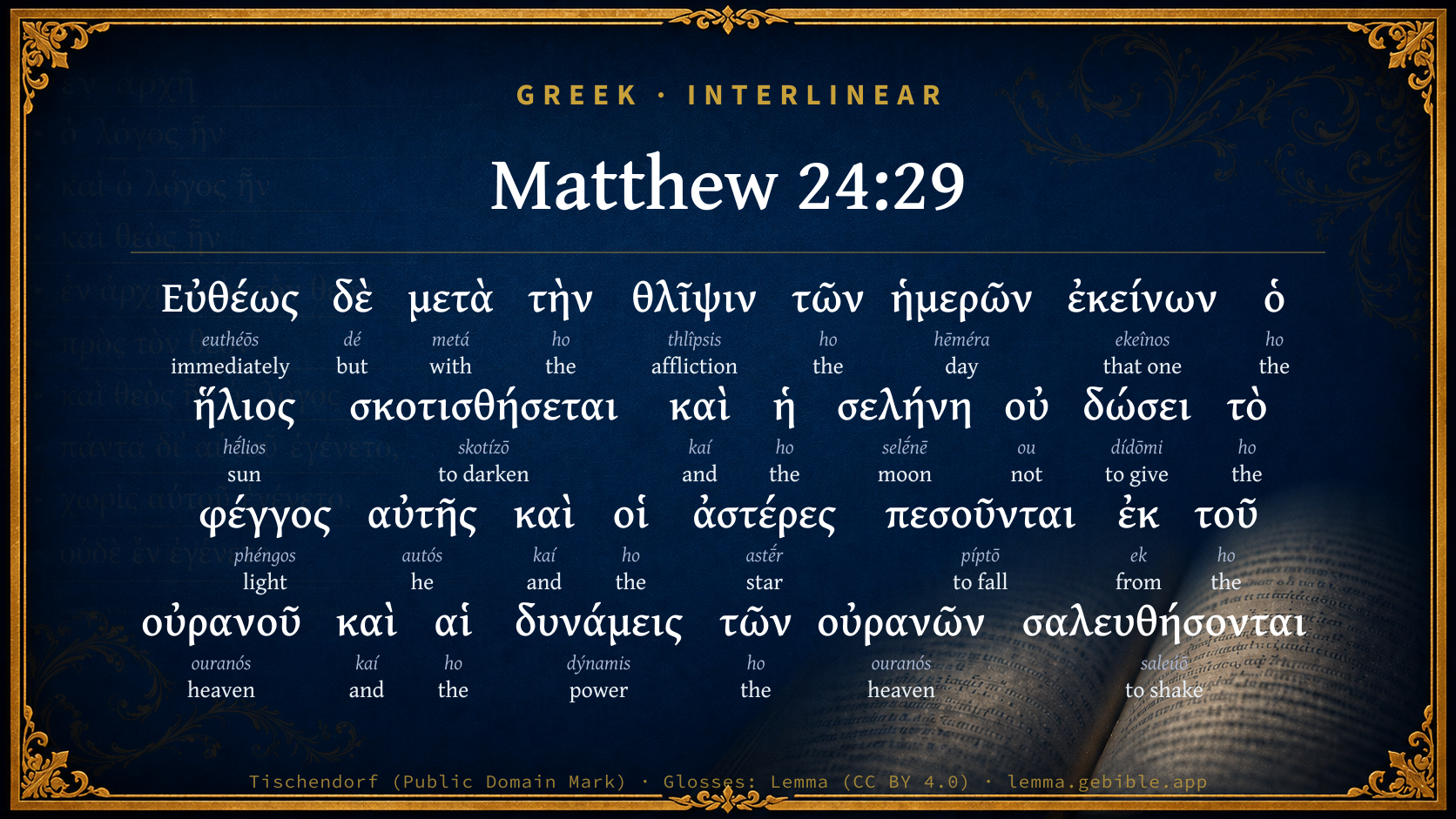
Greek (Tischendorf 8th ed.) Matthew 24:29 appears in the Greek New Testament. The text above is from the Tischendorf 8th edition. Each word links to its Strong’s number and a concise gloss. Click any word for its full Thayer’s Greek Lexicon entry.
Download image
Cite this verse

Matthew 24:29 (World English Bible). Public Domain. Lemma interlinear Bible study tool, https://lemma.gebible.app/v/matthew/24/29.

Show BibTeX & RIS
BibTeX
RIS
English Translation
But immediately after the oppression of those days, the sun will be darkened, the moon will not give its light, the stars will fall from the sky, and the powers of the heavens will be shaken;
World English Bible · Public Domain
Highlights
  • 3 first appearances in the Greek New Testament
Full analysis ↓
Download a study sheet

One document with this verse’s original text, its word-by-word gloss line, the meaning frame, cross-references with their text, attributed commentary, and full source and license credits — printable, and it pastes into notes with its structure intact.

This verse Autodidact and up

Study sheet (.html) Plain text (.txt)

A passage Seminary Student

Up to 50 verses in one chapter. A passage sheet keeps up to 6 commentary sources and 12 cross-references per verse, in the order this page ranks them, and says so on the sheet whenever that leaves anything out. Ask for a single verse and you get the Autodidact verse sheet above.

Everything on this page stays free to read, with no account — the sheet is a download of what is already on screen, not access to it.

Want to remove ads? Support Godless Engineer
Compare translations 3

The same verse in 3 English versions, stacked beneath the original-language interlinear above. Click any original word for its lexicon entry.

Each is an independent rendering of the whole verse — the interlinear is not word-aligned to these translations.

Highlighted words mark where these versions differ — a whole-verse word diff, not a word-by-word alignment.

  • World English Bible Public Domain
    But immediately after the oppression of those days, the sun will be darkened, the moon will not give its light, the stars will fall from the sky, and the powers of the heavens will be shaken;
  • King James Version Public Domain
    Immediately after the tribulation of those days shall the sun be darkened, and the moon shall not give her light, and the stars shall fall from heaven, and the powers of the heavens shall be shaken:
  • unfoldingWord Literal Text CC BY-SA 4.0
    But immediately after the tribulation of those days the sun will be darkened, and the moon will not give its light, and the stars will fall from heaven, and the powers of the heavens will be shaken.

unfoldingWord Literal Text — © unfoldingWord, licensed CC BY-SA 4.0. Word-aligned USFM3 via Door43 (git.door43.org/unfoldingWord/en_ult).

Versions to compare (up to 4)

3 of 4 selected

Show all 19 translations

Every available English version of this verse, each an independent rendering of the whole verse.

  • World English Bible Public Domain
    But immediately after the oppression of those days, the sun will be darkened, the moon will not give its light, the stars will fall from the sky, and the powers of the heavens will be shaken;
  • Berean Standard Bible Public Domain
    Immediately after the tribulation of those days: ‘The sun will be darkened, and the moon will not give its light; the stars will fall from the sky, and the powers of the heavens will be shaken.’
  • Majority Standard Bible Public Domain
    Immediately after the tribulation of those days: ‘The sun will be darkened, and the moon will not give its light; the stars will fall from the sky, and the powers of the heavens will be shaken.’
  • King James Version Public Domain
    Immediately after the tribulation of those days shall the sun be darkened, and the moon shall not give her light, and the stars shall fall from heaven, and the powers of the heavens shall be shaken:
  • American Standard Version (1901) Public Domain
    But immediately after the tribulation of those days the sun shall be darkened, and the moon shall not give her light, and the stars shall fall from heaven, and the powers of the heavens shall be shaken:
  • Revised Version (1885) Public Domain
    But immediately, after the tribulation of those days, the sun shall be darkened, and the moon shall not give her light, and the stars shall fall from heaven, and the powers of the heavens shall be shaken:
  • Geneva Bible (1599) Public Domain
    And immediatly after ye tribulations of those dayes, shall the sunne be darkened, and the moone shall not giue her light, and the starres shall fal from heauen, and ye powers of heaue shalbe shake.
  • Douay-Rheims (1899) Public Domain
    And immediately after the tribulation of those days, the sun shall be darkened and the moon shall not give her light, and the stars shall fall from heaven, and the powers of heaven shall be moved:
  • Young's Literal Translation Public Domain
    `And immediately after the tribulation of those days, the sun shall be darkened, and the moon shall not give her light, and the stars shall fall from the heaven, and the powers of the heavens shall be shaken;
  • Literal Standard Version CC BY-SA 4.0
    And immediately after the tribulation of those days, the sun will be darkened, and the moon will not give her light, and the stars will fall from the sky, and the powers of the heavens will be shaken;
  • Unlocked Literal Bible CC BY-SA 4.0
    But immediately after the tribulation of those days the sun will be darkened, the moon will not give its light, the stars will fall from the sky, and the powers of the heavens will be shaken.
  • unfoldingWord Literal Text CC BY-SA 4.0
    But immediately after the tribulation of those days the sun will be darkened, and the moon will not give its light, and the stars will fall from heaven, and the powers of the heavens will be shaken.
  • Darby Bible Public Domain
    But immediately after the tribulation of those days the sun shall be darkened, and the moon not give her light, and the stars shall fall from heaven, and the powers of the heavens shall be shaken.
  • World Messianic Bible Public Domain
    “But immediately after the suffering of those days, the sun will be darkened, the moon will not give its light, the stars will fall from the sky, and the powers of the heavens will be shaken;
  • Webster's Bible Public Domain
    Immediately after the tribulation of those days, shall the sun be darkened, and the moon shall not give her light, and the stars shall fall from heaven, and the powers of the heavens shall be shaken:
  • Free Bible Version CC BY-SA 4.0
    But right after those days of persecution the sun will be darkened, the moon will not shine, the stars will fall from heaven, and the powers of heaven will be shaken.
  • Bible in Basic English Public Domain
    But straight away, after the trouble of those days, the sun will be made dark and the moon will not give her light and the stars will come down from heaven and the powers of heaven will be moved:
  • Text-Critical English NT CC BY 4.0
    “But immediately after the tribulation of those days, the sun will be darkened, and the moon will not give its light. The stars will fall from heaven, and the powers of the heavens will be shaken.
  • Tyndale New Testament (1534) Public Domain
    Immediatly after the tribulacios of those dayes shall the sunne be derkened: and the mone shall not geve hir light and the starre shall fall from heven and the powers of heven shall move.

Literal Standard Version (2020), Covenant Press — licensed CC BY-SA 4.0. Text via the HelloAO Bible API (eBible.org). Unlocked Literal Bible (unfoldingWord) — licensed CC BY-SA 4.0. Text via the HelloAO Bible API (eBible.org). unfoldingWord Literal Text — © unfoldingWord, licensed CC BY-SA 4.0. Word-aligned USFM3 via Door43 (git.door43.org/unfoldingWord/en_ult). Free Bible Version, Dr. Jonathan Gallagher — licensed CC BY-SA 4.0. Text via the HelloAO Bible API (eBible.org).

Word by word

More ways to search: Search by grammar → Find every occurrence → Compare this word →

Practice this passage: Drill this verse → Learn its vocabulary →

φέγγος
phéngos
G5338
“light”
Noun, Accusative, Singular, Neuter
Part of Speech
Noun
Case
Accusative
Number
Singular
Gender
Neuter
Full Thayer's Definition

Origin: probably akin to the base of G5457 [cf G5350 ]

TDNT: None

1. light a. of the moon b. of a candle or lamp 2. the bright sunshine, the beam of light
  1. Εὐθέως euthéōs G2112 “immediately” Adverb
  2. δὲ dé G1161 “but” Conjunction
  3. μετὰ metá G3326 “with” Preposition
  4. τὴν ho G3588 “the” Article, Accusative, Singular, Feminine
  5. θλῖψιν thlîpsis G2347 “affliction” Noun, Accusative, Singular, Feminine
  6. τῶν ho G3588 “the” Article, Genitive, Plural, Feminine
  7. ἡμερῶν hēméra G2250 “day” Noun, Genitive, Plural, Feminine
  8. ἐκείνων ekeînos G1565 “that one” Demonstrative pronoun, Genitive, Plural, Feminine
  9. ὁ ho G3588 “the” Article, Nominative, Singular, Masculine
  10. ἥλιος hḗlios G2246 “sun” Noun, Nominative, Singular, Masculine
  11. σκοτισθήσεται skotízō G4654 “to darken” Verb, Future, Passive, Indicative, 3rd person, Singular
  12. καὶ kaí G2532 “and” Conjunction
  13. ἡ ho G3588 “the” Article, Nominative, Singular, Feminine
  14. σελήνη selḗnē G4582 “moon” Noun, Nominative, Singular, Feminine
  15. οὐ ou G3756 “not” Particle, Negative
  16. δώσει dídōmi G1325 “to give” Verb, Future, Active, Indicative, 3rd person, Singular
  17. τὸ ho G3588 “the” Article, Accusative, Singular, Neuter
  18. αὐτῆς autós G846 “he” Personal pronoun, Genitive, Singular, Feminine
  19. καὶ kaí G2532 “and” Conjunction
  20. οἱ ho G3588 “the” Article, Nominative, Plural, Masculine
  21. ἀστέρες astḗr G792 “star” Noun, Nominative, Plural, Masculine
  22. πεσοῦνται píptō G4098 “to fall” Verb, Future, Middle or Passive deponent, Indicative, 3rd person, Plural
  23. ἐκ ek G1537 “from” Preposition
  24. τοῦ ho G3588 “the” Article, Genitive, Singular, Masculine
  25. οὐρανοῦ ouranós G3772 “heaven” Noun, Genitive, Singular, Masculine
  26. καὶ kaí G2532 “and” Conjunction
  27. αἱ ho G3588 “the” Article, Nominative, Plural, Feminine
  28. δυνάμεις dýnamis G1411 “power” Noun, Nominative, Plural, Feminine
  29. τῶν ho G3588 “the” Article, Genitive, Plural, Masculine
  30. οὐρανῶν ouranós G3772 “heaven” Noun, Genitive, Plural, Masculine
  31. σαλευθήσονται saleúō G4531 “to shake” Verb, Future, Passive, Indicative, 3rd person, Plural

About this verse

These counts appear in no published source. They are computed here, from the morphology-tagged text and Lemma’s own curated glosses. What Lemma adds →

32
words
21
distinct lemmas
Gospels
section

Notable vocabulary

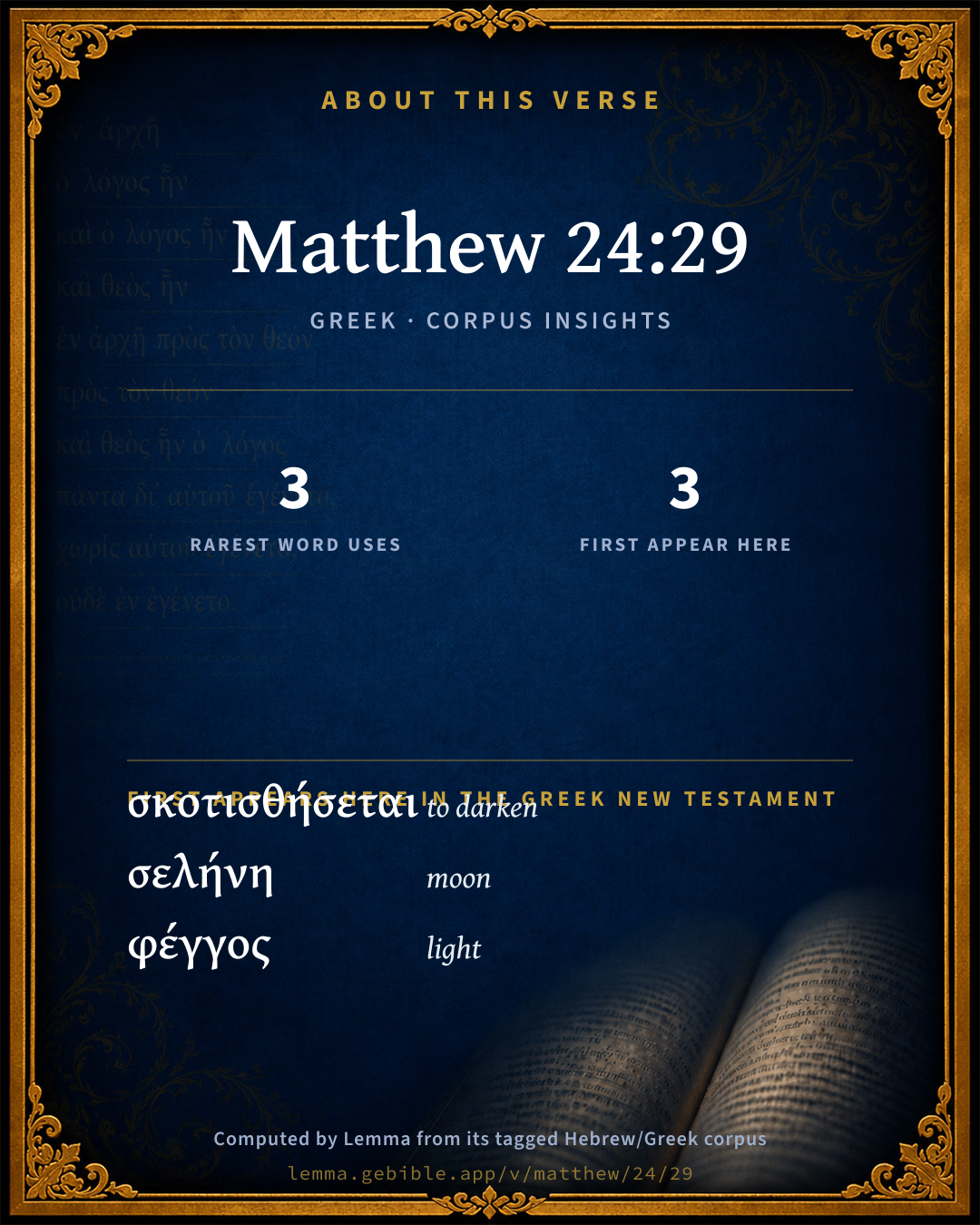
The rarest word here is φέγγος light G5338 — appearing just 3 times in the whole Greek New Testament.

First appearance in Scripture

These words make their first canonical appearance in the Greek New Testament here:

  • σκοτισθήσεται to darken G4654
  • σελήνη moon G4582
  • φέγγος light G5338

Shared distinctive vocabulary

φέγγος light G5338 occurs in 3 verses of the Greek New Testament. Also found in:
Repetition

Words recur within this verse:

  • οὐρανοῦ heaven G3772 ×2
  • τὴν the G3588 ×9
  • καὶ and G2532 ×3

Cross-references

19

Topical passages linked to Matthew 24:29 in the Treasury of Scripture Knowledge — connected by theme and wording, ordered by reader-vote popularity; previews shown in the World English Bible.

  • Amos 8:9 "It will happen in that day," says the Lord Yahweh, "That I will cause the sun to go down at noon, And I will darken the earth in the clear day.
  • Joel 3:15 The sun and the moon are darkened, And the stars withdraw their shining."
  • Isaiah 13:10 For the stars of the sky and the constellations of it shall not give their light; the sun shall be darkened in its going forth, and the moon shall not cause its light to shine.
  • Isaiah 24:23 Then the moon shall be confounded, and the sun ashamed; for Yahweh of Hosts will reign on Mount Zion, and in Jerusalem; and before his elders shall be glory.
  • Mark 13:24–25 But in those days, after that oppression, the sun will be darkened, the moon will not give its light,
  • Acts 2:19–20 I will show wonders in the sky above, And signs on the earth beneath; Blood, and fire, and billows of smoke.
  • Joel 2:30–31 I will show wonders in the heavens and in the earth: Blood, fire, and pillars of smoke.
  • Revelation 6:12–17 I saw when he opened the sixth seal, and there was a great earthquake. The sun became black as sackcloth made of hair, and the whole moon became as blood.
  • Isaiah 34:4 All the host of the sky shall be dissolved, and the heavens shall be rolled together as a scroll; and all their host shall fade away, as the leaf fades from off the vine, and as a fading [leaf] from the fig tree.
  • 2 Peter 3:10 But the day of the Lord will come as a thief in the night; in which the heavens will pass away with a great noise, and the elements will be dissolved with fervent heat, and the earth and the works that are in it will be burned up.
  • Joel 2:10 The earth quakes before them. The heavens tremble. The sun and the moon are darkened, And the stars withdraw their shining.
  • Zephaniah 1:14–15 The great day of Yahweh is near. It is near, and hurries greatly, the voice of the day of Yahweh. The mighty man cries there bitterly.
  • Luke 21:25–26 There will be signs in the sun, moon, and stars; and on the earth anxiety of nations, in perplexity for the roaring of the sea and the waves;
  • Revelation 8:12 The fourth angel sounded, and one third of the sun was struck, and one third of the moon, and one third of the stars; so that one third of them would be darkened, and the day wouldn't shine for one third of it, and the night in the same way.
  • Amos 5:20 Will the day of Yahweh not be darkness, and not light? Even very dark, and no brightness in it?
  • Jeremiah 4:23–28 I saw the earth, and, behold, it was waste and void; and the heavens, and they had no light.
  • Ezekiel 32:7–8 When I shall extinguish you, I will cover the heavens, and make the stars of it dark; I will cover the sun with a cloud, and the moon shall not give its light.
  • Daniel 7:11–12 I saw at that time because of the voice of the great words which the horn spoke; I saw even until the animal was slain, and its body destroyed, and it was given to be burned with fire.
  • Matthew 24:21 for then there will be great oppression, such as has not been from the beginning of the world until now, no, nor ever will be.

Cross-references courtesy of OpenBible.info (CC BY 4.0).

Commentary

Notes on Matthew 24:29 from classic Christian and Jewish commentators (each source and its license shown beneath its notes). The classic Christian expositions comment on the surrounding passage and are grouped to its opening verse, so a note may address several verses; the Jewish commentaries on the Tanakh (Rashi and others) are per-verse, so they appear only where the commentator wrote on this verse.

Lemma curates 59 commentaries, every one of them public domain or Creative Commons licensed, each selected and text-cleaned for this edition rather than reprinted as found. About our sources →

The Biblical Illustrator

Joseph S. Exell

Mat_24:29-34

Immediately after the tribulation of these days shall the sun be darkened.

The manifestation of Christ in judgment

I. There will be a manifestation of Christ in truth and unmistakable reality. Till the moment of His coming, it will be possible to deceive. False prophets were the bane of the old dispensation; false Christs are the bane of the new. Then He will stand before men as the true Messiah. I am the truth will be condemnation for millions in that day.

II. Christ will be manifested in universality. At present He is here and there as men carry the message. His coming then shall be like the lightning flash, which penetrates everywhere, awfully beautiful, irresistibly destructive, and fearfully silent.

III. The awful, majesty in which He will appear. This is set forth in the appalling changes that will come over the material heavens.

IV. Christ will be manifested as in search of his own. The Son of Man is come to seek and to save that which was lost, not secretly as before; but His angels shall conspicuously gather together the dead. (E. T. Marshall.)

The sign of the Son of Man

The Jews, with carnal spirit, were continually saying to Jesus, Master, we would see a sign from Thee. They were refused. But to His people He does give signs-distinct, striking, and unmistakable-signs which constitute at once the seal and epitome of the truths for which they stand.

I. The sign of Christs humiliation. This shall be a sign unto you etc. (Luk_2:12). A most disappointing sign this must have been to the shepherds, if they shared the current expectation of a regal and triumphant Messiah. A sign of exquisite tenderness and attractiveness to us.

II. The sign of Christs glory. Our Lord, in answer to the question of the disciples, What shall be the sign of Thy coming, etc., sketches a solemn prophetic picture of the events that are to precede it-the apostasies, and wars, and famines, and tribulations-and then finishes with this as the final omen, And then shall appear the sign of the Son of Man in the heavens. Vast conjecture and speculation have been awakened as to the nature of this sign. The many descriptions of Christs coming given in Scripture agree in one particular, that He comes in clouds. Examine this sign, and seek to interpret it … As in the sign of Christs first coming there were marks of glory accompanying the marks of humiliation, so in the sign of His second coming there will be marks of His humiliation accompanying the marks of His glory. Both signs are true, they shine on the pages of prophecy as we read, like the dazzling lenses of a revolving lighthouse, first one and then the other; now the glory and now the humiliation; now the suffering and now the conquest. The one has been fulfilled. Glory, then, in the accomplishment of the one. Watch for the appearing of the other. What I say-unto you I say unto all-Watch. (A. J. Gordon.)

The last congregation

I. The persons of whom that assembly will be composed.

II. The process by which that assembly will be collected.

III. The manner in which that assembly will be arranged. Only two classes will be recognized. The last division of the assembly will be public and visible. How momentous the events which that division has created and displayed!

IV. The decision which on it will be pronounced. The principles by which the decision will be guided. The consequences which the decision will involve. (J. Parsons.)

Tokens of perdition

I. Vicious habits.

II. A resort to infidelity or universalism to relieve the mind from presentiments of a judgment to come.

III. A false hope and a false profession.

IV. The approach of age without religion.

V. Carnal security.

VI. Satisfaction with worldly good.

VII. A loose and presumptuous confidence in Gods mercy.

VIII. Increasing hardness of heart.

IX. Neglect of prayer and the means of grace.

X. The rejection of many calls. How many of these marks of death do you find upon yourself? (E. Griffin, D. D.)

The kingdom comes in crises of judgment

The kingdom of God is within you, but the crises of judgment are periodical and outward. The kingdom is within the individual the kingdom of habit, which eludes observation; silently formed day by day, growing as seed grows in the earth, full of slow, secret developments; the kingdom of impressions received-no change on the face showing the inner working; the kingdom of life discipline-lessons quietly, privately learned-experiences which only you know of laid to heart-memories hoarded; the kingdom of prayer, aspiration, spiritual communion, into which you can enter alone, none knowing how or when you pray-the Divine Host coming in silently, without observation. It comes also, this spiritual kingdom, to nations, without observation; slowly beneath its invisible sway slavery disappears; the place of woman is secured; human law brought into nearer affinity with Divine law; the brotherhood of man gradually acknowledged, in theory, at least; even the horror of war alleviated. Thus slowly, without observation, do the kingdoms of the world tend to become the kingdoms of our God and of His Christ. But, oh, how much remains to be done! Philosophers talk of the military barbarous phase giving place to the industrial phase in civilization, and we enter the Inventions Exhibition, 1885-that late product of the nineteenth century-and the first things which meet our gaze are certain awful cannons and war implements for the destruction of human life, and the unfaternal torture of human beings. Cold steel, gunpowder, and the big battalions have it all their own way in a world which laughs at arbitration, sneers at right, and still swears by Christ. And now see how the judgment crises of this kingdom within work themselves out, and are as startling and as terrible as any appearance of the Son of Man in the clouds, surrounded by His angelic heralds of judgment. Every time the measure of a nations iniquity is full, there comes such a judgment crisis. It came to Jerusalem when the armies of Vespasian, in the year 70, trampled out the heartless and effete ecclesiastical system of the old Judaism. It came to Rome when the unparalleled corruption of the Caesars had spread to the provinces, and in due time the empire went to pieces, under the weakness of its head, and was broken up to be re-constituted in the Christian nations of modern Europe. It came to England when the Reformation stamped the authority of the Pope out of the kingdom. It came again when huge popular oppression and political wrong nerved the people to strike for justice in the execution of an English king. It came to France after centuries of organized selfishness and robbery of the poor by the rich, in the French Revolution and Reign of Terror, 1793. It came again with the overthrow of an adventurer, who in our time rose to power by treachery and massacre, and wielded the sceptre of France for more than twenty years until the judgment fell upon him at Sedan and hurled him from the throne. People were taken in by Napoleon III. and the glitter of his empire. They thought that he at all events had outdone Providence. But neither he nor any one else can do that. One Frenchman at least saw clear-stood firm for the permanence of spiritual principle, and waited for the kingdom of God which cometh not with observation. That was Victor Hugo. Nothing could induce him to enter France whilst Antichrist was on the throne. The day after Sedan he presented himself at the ticket-office in Brussels, and left that night for Paris. (H. R. Haweis, M. A.)

The Biblical Illustrator, edited by Joseph S. Exell (c. 1880s–1900s) — public domain. Text from a community e-Sword module.

Joseph Benson's Commentary

Mat 24:29. Immediately after, &c. — We are now come to the last act of this dismal tragedy, the destruction of Jerusalem, and the final dissolution of the Jewish polity in church and state, which our Lord, for several reasons, might not think fit to declare nakedly and plainly, and therefore chose to clothe his discourse in figurative language. Commentators, indeed, have generally understood this, and what follows, of the end of the world, and of Christ’s coming to judgment: but the words, immediately after the tribulation of those days, show evidently that he is not speaking of any distant event, but of something immediately consequent upon the tribulation before mentioned, and that must be the destruction of the temple and city of Jerusalem, and the abolition of the Jewish polity, civil and religious. It is true, his figures are very strong, but not stronger than those used by the ancient prophets upon similar occasions. The Prophet Isaiah speaks in the same manner of the destruction of Babylon, Isa 13:10, The stars of heaven and the constellations thereof shall not give their light; the sun shall be darkened in his going forth, and the moon shall not cause her light to shine. The Prophet Ezekiel describes in similar terms the destruction coming on Egypt, Eze 32:7-8. When I shall put thee out I will cover the heaven, and make the stars thereof dark; I will cover the sun with a cloud, and the moon shall not give her light. The Prophet Daniel also uses similar language, when speaking of the slaughter of the Jews by the little horn, meaning probably Antiochus Epiphanes: And it waxed great even unto the host of heaven; and cast down some of the host and of the stars to the ground, and stamped upon them. And lastly, God, by Joel, foretelling this very same destruction of Jerusalem, Joe 2:30-31, says, I will show wonders in heaven and in the earth, blood, and fire, and pillars of smoke. The sun shall be turned into darkness, and the moon into blood. So that great commotions and revolutions upon earth are often represented by commotions and changes in the heavens.

Joseph Benson's Commentary on the Old and New Testaments (1811–1818) — public domain. Text from a community e-Sword module.

The Preacher's Complete Homiletical Commentary

Joseph S. Exell (gen. ed.)

CRITICAL NOTES

Mat_24:29. Immediately.—But immediately (R.V.). A prophecy resembles a landscape painting, which marks distinctly the houses, paths, and bridges in the foreground, but brings together, into a narrow space, the distant valleys and mountains, though they are really far apart (Bengel). Sun … moon … stars … powers.—The solar light of Christ’s truth shall be dimmed, the lunar orb of the church shall be obscured by heresy and unbelief, and some who once shone brightly as stars in the firmament of the church shall fall from their place (Wordsworth). Our Lord speaks here in language as essentially apocalyptic as that of the Revelation of St. John (Rev_8:12), and it lies in the very nature of such language that it precludes a literal interpretation. The words are better left in their dim and terrible vagueness (Plumptre).

Mat_24:30. The sign of the Son of man.—Some say a visible cross; others the presence of the Son of man Himself (Dan_7:13). Lange says, “It is the shining glory of the manifestation in general as distinct from the personal manifestation itself.” Whatever it shall be “when it appears, its import will be instantly recognised by the faithful” (Carr).

Mat_24:31. A great sound of a trumpet.—Omit “sound” on high MS. authority, translate: with a great trumpet. The image would be suggestive to the Jews, who were called together in the camp by silver trumpets (Num_10:2 fol.). Moreover, the great festivals, the commencement of the year, and other celebrations, were announced by trumpets (Carr).

MAIN HOMILETICS OF THE PARAGRAPH.—Mat_24:29-31

A wider ending.—“After the tribulation of those days” there ariseth another. This seems to signify that that other tribulation shall be of a different kind. The description which follows carries out that idea. The “appearing” or “coming” of which it speaks is to be unlike that spoken of before in two cardinal ways. Unlike, first, in regard to the signs which precede it. Unlike, secondly, in regard to the effects which follow it up.

I. The signs which precede.—This is true, on the one hand, in regard to the place of their appearance. The sign spoken of in the former case, was a sign upon earth—something standing where it ought not in the temple on earth (Mat_24:15). All the signs spoken of in this case are connected with “heaven.” The one, therefore, had to do only with the “place of God’s feet” (Isa_60:13). The others were concerned with what He speaks of as His “throne” (Act_7:49). Also, these latter “signs” are to be connected with all that is specially great in the heavens—the “sun” that gives us our days; the “moon” by which we measure our seasons; the “stars” which guide us at night. Also, once more, in these signs, these glories are shown us with all their glory gone, as it were. The sun is shorn of its brightness, the moon is deprived of its beauty; the stars are losing their place. Everything in heaven, in a word, which had previously spoken to men of stability and rule (Psa_119:89-91), shall then be speaking of disorder and ruin. There was even greater difference, on the other hand, in regard to the significance of these signs. The “abomination of desolation in the Holy Place” (Mat_24:15), meant very much—even the presence of that which was detestable instead of that which was acceptable, and of that which destroyed instead of that which protected and blessed. But the “sign of the Son of man in heaven” (Mat_24:30), must mean very much more. More in the way of direction—it points to that great One Himself, who is to be the Judge of mankind (Joh_5:22; Act_17:31, etc.). More in the way of distinction—it is so connected with that great One as nothing else had previously been, and so is to be seen by all, and also understood by all, as “the sign” of Himself. Its nature now, in a word, it is difficult to surmise. Its significance then, it will be impossible either to overrate or to miss. Evidently, therefore, in regard to this “coming,” we are, on all these accounts, in a far higher atmosphere than in that contemplated before.

II. The effects which follow.—These are such as to correspond in every way to the comparative greatness of the signs. In the way, first, of extent. The sign in the temple was a sign to one people and creed; only therefore, to those, and not, even so, to them all. These other signs, being signs in “heaven,” are signs to mankind; and all, therefore, who belong to mankind, are affected thereby. “All the tribes of the earth,” and not one tribe only, know of them now (Mat_24:30). In the way, next, of emotion. All are “mourning” (ibid.); and mourning openly, so the description implies, as though “cutting” themselves in their sorrow. In the way, after that, of manifestation. The Lord Himself (cf. 1Th_4:16)—the face and form of the evident Representative of the whole of mankind—in those “clouds” which are the “dust of His feet” (Nah_1:3), and with every accompaniment that tells of greatness and majesty—shall be seen then by all eyes (Mat_24:30). In the way, finally, of division. Up till then, the good fish and the bad, the tares and the wheat, the believers and the hypocrites, will be more or less mingled, if not in God’s sight, in the eyes of mankind (2Ti_3:16-17). From that time, when this Judge of all is thus manifested, that condition of things is no more. Now the “angels” go forth with another “trumpet” than that of the gospel. Now where those other messengers had gone previously to bear “witness” (Mat_24:14) these come to divide. And that, moreover, as also those others previously, in all parts of the world (Mat_24:31). In a word, universal separation—total separation—final separation—is the last “effect” that follows these “signs.” And the last argument, therefore, that goes to prove this “ending” to be the ending of all.

In all this we see much ground, on the one hand, for comfort and hope. When “the end” comes, we see, plainly, what an end it will be! How clear its tokens! How wide its influence! How penetrating its power! How total its changes! How abiding its issues! “Behold, I make all things new!” What hope can be better than this, if that which is “old” be as described in this chapter? See before Mat_24:1-14.

Much ground, on the other hand, for patience and modesty. For patience. Those who have such a future before them can well afford to wait. In this sense, as well as others, “he that believeth shall not make haste.” For modesty—in not attempting to forecast all that shall follow the end. The very glory of the prospect before us prevents us from foreseeing it clearly. Who can possibly imagine what is to be when “all” things are made “new”? Will it not most likely be different from anything ever dreamed of before? And none the less desirable, but all the more so, on that very account?

HOMILIES ON THE VERSES

Mat_24:30. Christ’s glorious appearing at the end of the world.—Consider:—

I. What the glory is in which the Lord Jesus Christ will appear at the end of the world.—

1. In His own glory, as Mediator, which He entered into when He ascended, as the reward of His sufferings and death (Eph_1:20-23). In His own glory, as Judge of all, unto whom they must bow, and from whom they must receive their final doom (Php_2:10-11).

2. In the glory of His Father.—That is, in the glory of the Godhead. His Father and He are one, and so their glory is one. This glory was veiled in His humiliation, by His human nature.

3. In the glory of all the mighty angels.—(Mat_25:31). The whole court of heaven shall attend upon the Judge of the world, that they may be present with Him at this great act.

II. Some things which evidence the greatness of this glory in which Jesus Christ will come.—You may form some idea of it, from some preceding appearances upon lesser occasions. How great was the glory He appeared in when He gave the law upon Mount Sinai (Exo_19:16-18)! When He was transfigured! When He appeared to Paul on His way to Damascus!

III. Why the Lord Jesus will come the second time in so great glory.—

1. As a recompense to Him for His abasement.

2. To beget a great reverence and awe in all who are to be judged by Him.

3. That all the world may see it, and His people thereby be made glad with exceeding joy (1Pe_4:13), and that His enemies may see what they have lost by being shut out from the sight and enjoyment of this glory.

4. That He may carry home His saints as His bride with greater state and solemnity, unto His Father’s house, where He hath prepared mansions for them.—Anon.

The Preacher's Complete Homiletical Commentary (gen. ed. Joseph S. Exell; Funk & Wagnalls, c. 1892) — public domain (pre-1929). A full-Bible homiletical/sermon-outline anthology covering 65 of 66 books (2 John is absent from the source module). Text from a community e-Sword module.

Tyndale Open Study Notes

Tyndale Open Resources

24:29-31 These sayings form the climax of the discourse and answer the second of the disciples’ initial questions (see 24:3). Some take 24:29-31 to refer to God’s judgment on the Jewish people in AD 70, using apocalyptic images and metaphors to describe it. Others see a reference to the second coming of Christ at the end of history.

24:29 the sun will be darkened . . . will be shaken: This phenomenon can be taken literally, as befitting the climactic self-disclosure of God’s Son, or metaphorically, as for a cosmically significant event (see Acts 2:17-21; Heb 12:26-27; 2 Pet 3:10; Rev 6:12-13). Similar apocalyptic language is used frequently in the Old Testament for describing political disasters and the collapse of a government as cosmic judgments from God (e.g., Isa 13:9-16; Ezek 32:1-10; Joel 2:1-17; Amos 8:7-10).

Tyndale Open Study Notes — © Tyndale Open Resources, licensed CC BY-SA 4.0. Text via the HelloAO Bible API.

Bengel's Gnomon

Johann Albrecht Bengel

Mat 24:29. Εὐθέως δὲ μετὰ τὴν θλίψιν τῶν ἡμερῶν ἐκείνων, κ.τ.λ., but immediately after the affliction of those days, etc.) There are four things to be observed in this passage. (1) Our Lord speaks of the sun being literally darkened, etc. And this phrase frequently occurs in the prophets, concerning the destruction of a nation, and in such cases has a much more literal force than is generally supposed, for where there is a great destruction of men, the beholders of the sun are reduced to a small number; but much more in the present passage has it a literal force, for the whole of our Lord’s language on this occasion is strictly literal; therefore this verse must be also understood literally. (2) The tribulation indicated will be that of the Jewish people, and that for one generation, (3) It is not said, after that tribulation, nor after those days, but after the tribulation of those days, as in Mar 13:24.—ἐν ἐκείναις ταῖς ἡμέραις μετὰ τὴν θλίψιν ἐκείνην, in those days, after that tribulation. The term, “those days,” refers to Mat 24:22; Mat 24:19; and it is indicated that the tribulation will not be long, but brief in duration; Mat 24:21-22; Mat 24:34. (4) The expression, εὐθέως, quickly (cito), implies a very short delay, since οὔπω, not yet (Mat 24:6) i.e., οὐκ εὐθέως, not quickly (Luk 21:9), is said of the short delay which must precede that tribulation; nay, the passage already cited from St Mark excludes delay altogether. The Engl. Vers. has “immediately.” You will say, it is a great leap from the destruction of Jerusalem to the end of the world, which is represented as coming quickly after it. I reply—A prophecy resembles a landscape painting, which marks distinctly the houses, paths, and bridges in the foreground, but brings together, into a narrow space, the distant valleys and mountains, though they are really far apart. Thus should they who study a prophecy look on the future to which the prophecy refers. And the eyes of the disciples, who had combined in their question the end of the temple and of the world, are left somewhat veiled (for it was not yet the time for knowing; see Mat 24:36), from which cause, imitating our Lord’s language, they with universal consent declared that the end was near at hand. In their progress, however, both prophecy and contemplation (prospectus)[1051] more and more explain things further distant. In which manner also we ought to interpret what is obscure by what is clear, not what is clear by what is obscure, and to venerate in its dark sayings that Divine wisdom which always sees all things, but does not reveal all things at once. Afterwards it was revealed that Antichrist should come before the end of the world; and again Paul joined these two rather nearly together, until the Apocalypse also placed an interval of a thousand years between them. The advent of our Lord, however, actually took place (as far as its commencement was concerned; see Gnomon on Joh 21:22) after the destruction of Jerusalem, and presently, too, inasmuch as no intermediate event was to be mentioned in the present passage; cf. Gnomon on ch. Mat 3:1. The particle ἑυθεως (quickly or immediately) refers to this advent, not absolutely to the darkening of the sun and moon, for that accords with the extent of our Lord’s meaning; so that the meaning is “soon after the tribulation of those days, it will come to pass that the sun shall be darkened,” etc. A similar connection of an adverb[1052] with a verb occurs in Gen 2:17; in the day on which thou shalt eat thereof, it will come to pass that thou shalt die the death; see also Gnomon on ch. Mat 26:64, and Luk 1:48. The expression may also be referred to the mode of speech, so as to mean after that affliction (which the plan of this discourse, and the point of view from which this time is regarded, permit to be subjoined immediately, provided it be indicated that the other things will intervene) the sun shall be darkened, etc. It frequently occurs that adverbs, as in this passage, εὐθεώς, immediately, do not qualify the thing itself, but the language in which it is expressed. Thus, in Mar 7:9, the adverb ΚΑΛῶς, well, and the verb ἀθετεῖτε, ye abolish [Engl. Vers., ye reject], are joined with [a part of] the verb to say [viz. it may be said that], understood: thus, too, in Heb 1:6, the adverb πάλιν, again, is joined with the verb ΛΈΓΕΙ, He saith. In fine, St Luke (Luk 21:24-25) separates the signs in the sun, etc. [from that tribulation] by a greater interval. Some explain εὐθέως as denoting, not the shortness of the interval, but the suddenness of the event after long intervening periods. We must, however, keep to our first interpretation, so indeed that the particle εὐθέως be understood to comprehend the whole space between the destruction of Jerusalem by Titus and the end of the world. On such passages there rests, as St Antony used to term it, a prophetical cloudlet. It was not yet the fit time for revealing the whole series of events from the destruction of Jerusalem down to the end of the world. The following is a paraphrase of our Lord’s words, “Concerning those things which will happen after the tribulation of those days of the destruction of Jerusalem, THE NEAREST EVENT which at present it suits My condition to mention, and your capacity to expect, is this, that the sun will be darkened,” etc. Furthermore, it does not follow from this that the expression, ΜΕΤᾺ ΤΑῦΤΑ, after these things, should be understood loosely in Rev 4:1. Where quickness is presupposed from Rev 1:1. Such formulæ are to be understood according to the analogy of the passages where they occur.—ὁ ἥλιος σκοτισθήσεται, the sun shall be darkened) This must be taken literally, of a calamity different from those which have been described before. In the Old Testament, such expressions are used metaphorically, the figure being derived from that which will literally happen at the end of the world.—Ἡ ΣΕΛΉΝΗ Οὐ ΔΏΣΕΙ ΤῸ ΦΈΓΓΟς ΑὐΤῆς, the moon shall not give her light) sc. as she is wont to do both when filling and waning. According to the course of nature, the sun and moon are eclipsed at different times: then, however, they will both be eclipsed at once.—ἀπὸ τοῦ οὐπανοῦ, from heaven) It is not said upon the earth; cf. in Mar 13:25.—ἐκπίπτοντες, falling out. They shall be as though they were not, sc. without light.—ΔΥΝΆΜΕΙς, powers) sc. those firm interchained and subtle powers of heaven[1053] (distinct from the stars) which are accustomed to influence the earth. They are thus denominated by Matthew, Mark, and Luke.—σαλευθήσονται, shall be shaken) an appropriate metaphor from the waves of the sea.[1054]

[1051] Looking further forward, as in the landscape already alluded to, wherein at first sight all the parts might seem projected into the one plane. But the eye, which has gradually come to discern perspective, and to substitute, by the judgment, causes for the visible effects, learns to look further, and to separate by wide distances the foreground and background of the picture.—ED.

[1052] Sc. בְּיו̇ם on the day that.—(I. B.)

[1053] Pro 8:27.—E. B.

[1054] Rev 6:14.—E. B.

Bengel's Gnomon of the New Testament — English translation (T&T Clark, Edinburgh, 1860) — public domain. Text from a community e-Sword module.

Meyer's Critical & Exegetical Commentary

Heinrich August Wilhelm Meyer

Mat_24:29. Here follows the second portion of the reply of Jesus, in which He intimates what events, following at once on the destruction of Jerusalem, are immediately to precede His second coming (Mat_24:29-33); mentioning at the same time, that however near and certain this latter may be, yet the day and hour of its occurrence cannot be determined, and that it will break unexpectedly upon the world (Mat_24:34-41); this should certainly awaken men to watchfulness and preparedness (Mat_24:42-51), to which end the two parables, Mat_25:1-30, are intended to contribute. The discourse then concludes with a description of the final judgment over which the coming one is to preside (Mat_25:31-46).

εὐθέως δὲ μετὰ τ. θλίψιν τῶν ἡμερ. ἐκ.] but immediately after the distress of those days, immediately after the last (τὸ τέλος) of the series of Messianic woes described from Mat_24:15 onwards, and the first of which is to be coincident with the destruction of the temple. For τῶν ἡμερ. ἐκείνων, comp. Mat_24:19; Mat_24:22; and for θλίψιν, Mat_24:21. Ebrards explanation of this passage falls to the ground with his erroneous interpretation of Mat_24:23-24, that explanation being as follows: immediately after the unhappy condition of the church (Mat_24:23-28), a condition which is to continue after the destruction of Jerusalem,it being assumed that the εὐθέως involves the meaning: nullis aliis intercedentibus indiciis. It may be observed generally, that a whole host of strange and fanciful interpretations have been given here, in consequence of its having been assumed that Jesus could not possibly have intended to say that His second advent was to follow immediately upon the destruction of Jerusalem. This assumption, however, is contrary to all exegetical rule, considering that Jesus repeatedly makes reference elsewhere (see also Mat_24:34) to His second coming as an event that is near at hand. Among those interpretations may also be classed that of Schott (following such earlier expositors as Hammond and others, who had already taken εὐθέως in the sense of suddenly), who says that Matthew had written פִּתְאֹם, subito, but that the translator (like the Sept. in the case of Job_5:3) had rendered the expression minus accurate by εὐθέως. This is certainly a wonderful supposition, for the simple reason that the פתאם itself would be a wonderful expression to use if an interval of a thousand years was to intervene. Bengel has contributed to promote this view by his observation that: Nondum erat tempus revelandi totam seriem rerum futurarum a vastatione Hieros. usque ad consummationem seculi, and by his paraphrase of the passage: De iis, quae post pressuram dierum illorum, delendae urbis Jerusalem, evenient proximum, quod in praesenti pro mea conditione commemorandum et pro vestra capacitate expectandum venit, hoc est, quod sol obscurabitur, etc. Many others, as Wetstein, for example, have been enabled to dispense with gratuitous assumptions of this sort by understanding Mat_24:29 ff. to refer to the destruction of Jerusalem, which is supposed to be described therein in the language of prophetic imagery (Kuinoel), and they so understand the verse in spite of the destruction already introduced at Mat_24:15. In this, however, they escape Scylla only to be drawn into Charybdis, and are compelled to have recourse to expedients of a still more hazardous kind in order to explain away the literal advent,[18] which is depicted in language as clear as it is sublime. And yet E. J. Meyer again interprets Mat_24:29-34 of the destruction of Jerusalem, and in such a way as to make it appear that the prediction regarding the final advent is not introduced till Mat_24:35. But this view is at once precluded by the fact that in Mat_24:35 ὁ οὐρανὸς κ. ἡ γῆ παρελεύσεται cannot be regarded as the leading idea, the theme of what follows, but only as a subsidiary thought (v. 18) by way of background for the words οἱ δὲ λόγοι μου οὐ μὴ παρέλθ. immediately after (observe, Christ does not say οἱ γὰρ λόγοι, κ.τ.λ., but οἱ δὲ λόγοι, κ.τ.λ.). Hoelemann, Cremer, Auberlen are right in their interpretation of εὐθέως, but wrong in regarding the time of the culmination of the heathen poweran idea imported from Luk_21:24as antecedent to the period indicated by εὐθέως. Just as there are those who seek to dispose of the historical difficulty connected with εὐθέως by twisting the sense of what precedes, and by an importation from Luk_21:24, so Dorner seeks to dispose of it by twisting the sense of what comes after.

ὁ ἥλιος σκοτισθ., κ.τ.λ.] Description of the great catastrophe in the heavens which is to precede the second advent of the Messiah. According to Dorner, our passage is intended as a prophetical delineation of the fall of heathenism, which would follow immediately upon the overthrow of Judaism; and, accordingly, he sees in the mention of the sun, moon, and stars an allusion to the nature-worship of the heathen world, an idea, however, which is refuted at once by Mat_24:34; see E. J. Meyer, p. 125 ff.; Bleek, p. 356; Hofmann, p. 636; Gess, p. 136. Ewald correctly interprets: While the whole world is being convulsed (Mat_24:29, after Joe_3:3 f.; Isa_34:4; Isa_24:21), the heaven-sent Messiah appears in His glory (according to Dan_7:13) to judge, etc.

οἱ ἀστέρες πεσοῦνται, κ.τ.λ.] Comp. Isa_34:4. To be understood literally, but not as illustrative of sad times (Hengstenberg on the Revelation; Gerlach, letzte Dinge, p. 102); and yet not in the sense of falling-stars (Fritzsche, Kuinoel), but as meaning: the whole of the stars together. Similarly in the passage in Isaiah just referred to, in accordance with the ancient idea that heaven was a firmament in which the stars were set for the purpose of giving light to the earth (Gen_1:14). The falling of the stars (which is not to be diluted, with Bengel, Paulus, Schott, Olshausen, Baumgarten-Crusius, Cremer, following the Greek Fathers, so as to mean a mere obscuration) to the earthwhich, in accordance with the cosmical views of the time, is the plain and natural sense of εἰς τὴν γῆν (see Rev_6:13)is, no doubt, impossible as an actual fact, but it need not surprise us to see such an idea introduced into a prophetic picture so grandly poetical as this is,a picture which it is scarcely fair to measure by the astronomical conceptions of our own day.

αἱ δυνάμεις τῶν οὐρανῶν σαλευθ.] is usually explained of the starry hosts (Isa_34:4; Isa_40:26; Psa_33:6; Deu_4:19; 2Ki_17:16, etc.), which, coming as it does after οἱ ἀστέρες πεσοῦνται, would introduce a tautological feature into the picture. The words should therefore be taken in a general sense: the powers of the heavens (the powers which uphold the heavens, which stretch them out, and produce the phenomena which take place in them, etc.) will be so shaken as to lose their usual stability. Comp. Job_26:11. The interpretation of Olshausen, who follows Jerome, Chrysostom, Euthymius Zigabenus, in supposing that the trembling in the world of angels is referred to (Luk_2:13), is inconsistent not merely with σαλευθής., but also with the whole connection which refers to the domain of physical things. For the plural τῶν οὐρανῶν, comp. Sir_16:16.

This convulsion in the heavens, previous to the Messiahs descent therefrom, is not as yet to be regarded as the end of the world, but only as a prelude to it; the earth is not destroyed as yet by the celestial commotion referred to (Mat_24:30). The poetical character of the picture does not justify us in regarding the thing so vividly depicted as also belonging merely to the domain of poetry,all the less that, in the present case, it is not political revolutions (Isa_13:10; Isa_34:4; Eze_32:7 f.; Joe_3:3 f.) that are in view, but the new birth of the world, and the establishment of the Messiahs kingdom.

[18] Comp. the Old Testament prophecies respecting the day of the coming of Jehovah, Isa_13:9 ff; Isa_34:4; Isa_24:21; Jer_4:23 f.; Eze_32:7 f.; Hag_2:6 f.; Joe_2:10; Joe_3:3 f., Mat_3:15; Zep_1:15; Hag_2:21; Zec_14:6, etc., and the passages from Rabbinical writers in Bertholdt, Christol. § 12; Gfrörer, Gesch. d. Urchrist. I. 2, pp. 195 ff., 219 ff.

Meyer — Critical and Exegetical Commentary on the New Testament — English translation by Peter Christie, edited by Frederick Crombie (T&T Clark, 1880) — public domain. Text from a community e-Sword module.

Expositor's Greek Testament

ed. W. Robertson Nicoll

Mat 24:29-31 . The coming of the Son of Man (Mar 13:24-27 , Luk 21:25-28 ). Thus far the eschatological discourse has been found to bear on the predicted tragic end of Jerusalem. At this point the παρουσία , which, according to the evangelist, was one of the subjects on which the disciples desired information, becomes the theme of discourse. What is said thereon is so perplexing as to tempt a modern expositor to wish it had not been there, or to have recourse to critical expedients to eliminate it from the text. But nothing would be gained by that unless we got rid, at the same time, of other sayings of kindred character ascribed to Jesus in the Gospels. And there seems to be no reason to doubt that some such utterance would form a part of the eschatological discourse, even if the disciples did not ask instruction on the subject. The revelation as to the last days of Israel naturally led up to it, and the best clue to the meaning of the Parusia-logion may be to regard it as a pendant to that revelation.

Mat 24:29 . εὐθέως . Each evangelist expresses himself here in his own way, Lk. most obviously adapting his words to suit the fact of a delayed parusia . Mt.’s word naturally means: immediately, following close on the events going before, the thlipsis of Jerusalem. One of the ways by which those to whom εὐθέως is a stumbling block strive to evade the difficulty is to look on it as an inaccurate translation by the Greek Matthew of פִתְאֹם , supposed to be in Hebrew original. So Schott, Comm. Ex. Dog. ὁ ἥλιος … σαλευθήσονται : a description in stock prophetic phrases (Isa 13:9 ; Isa 34:4 , Joe 3:15 , etc.) of what seems to be a general collapse of the physical universe. Is that really what is meant? I doubt it. It seems to me that in true prophetic Oriental style the colossal imagery of the physical universe is used to describe the political and social consequences of the great Jewish catastrophe: national ruin, breaking up of religious institutions and social order. The physical stands for the social, the shaking of heaven for the shaking of earth (Hag 2:6 ); or in the prophetic imagination the two are indissolubly blended: stars, thrones, city walls, temples, effete religions tumbling down into one vast mass of ruin. If this be the meaning εὐθέως is to be strictly taken. θέγγος , applicable to both sun and moon, but oftener applied to the moon or stars; φῶς oftenest to the sun, but also to the moon. Vide Trench, Syn. , p. 163.

The Expositor's Greek Testament, edited by W. Robertson Nicoll (1897–1910) — public domain. Text from a community e-Sword module.

Geneva Bible (1599)

Geneva Bible translators

Everlasting damnation shall be the end of the security of the wicked, and everlasting bliss, of the miseries of the godly.

Geneva Bible (1599) marginal notes — public domain. Text via Bolls.life.

Adam Clarke's Commentary

Verse 29. Immediately after the tribulation, c.] Commentators generally understand this, and what follows, of the end of the world and Christ's coming to judgment: but the word immediately shows that our Lord is not speaking of any distant event, but of something immediately consequent on calamities already predicted: and that must be the destruction of Jerusalem. "The Jewish heaven shall perish, and the sun and moon of its glory and happiness shall be darkened-brought to nothing. The sun is the religion of the Church the moon is the government of the state; and the stars are the judges and doctors of both. Compare Isa 13:10; Eze 32:7-8, c." Lightfoot.

In the prophetic language, great commotions upon earth are often represented under the notion of commotions and changes in the heavens:-

The fall of Babylon is represented by the stars and constellations of heaven withdrawing their light, and the sun and moon being darkened. See Isa 13:9-10.

The destruction of Egypt, by the heaven being covered, the sun enveloped with a cloud, and the moon withholding her light. Eze 32:7-8.

The destruction of the Jews by Antiochus Epiphanes is represented by casting down some of the host of heaven, and the stars to the ground. See Da 8:10.

And this very destruction of Jerusalem is represented by the Prophet Joel, Joe 2:30-31, by showing wonders in heaven and in earth - darkening the sun, and turning the moon into blood. This general mode of describing these judgments leaves no room to doubt the propriety of its application in the present case.

The falling of stars, i.e. those meteors which are called falling stars by the common people, was deemed an omen of evil times. The heathens have marked this: -

Saepe etiam stellas, vento impendente videbis

Praecipites coelo labi, noctisque per umbram

Flammarum longos a tergo albescere tractus.

VIRG. Geor. i. ver. 365.

And oft before tempestuous winds arise

The seeming stars fall headlong from the skies,

And, shooting through the darkness, gild the night

With sweeping glories, and long trails of light.

Dryden.

Again the same poet thus sings: -

SOL tibi signa dabit: solem quis dicere falsum

Audeat? Ille etiam coecos instare tumultus

Saepe monet: fraudemque et operta tumescere bella

Ille etiam extincto miseratus Caesare Romam,

Cum caput obscura nitidum ferrugine texit,

Impiaque aeternam timuerunt saecula noctem.

Ibid. ver. 462.

The sun reveals the secrets of the sky,

And who dares give the source of light the lie?

The change of empires often he declares,

Fierce tumults, hidden treasons, open wars.

He first the fate of Caesar did foretell,

And pitied Rome, when Rome in Caesar fell:

In iron clouds concealed the public light,

And impious mortals found eternal night.

Dryden.

Adam Clarke's Commentary on the Bible (1810–1826) — public domain. Text from a community e-Sword/MySword module.

Ellicott's Commentary for English Readers

(29) Immediately after the tribulation of those days.—From this point onwards the prophecy takes a wider range, and passes beyond the narrow limits of the destruction of Jerusalem to the final coming of the Son of Man, and the one is represented as following “immediately” on the other. No other meaning could have been found in the words when they were first heard or read. The “days” of this verse are those which were shortened “for the elect’s sake” (Mat_24:22). The “tribulation” can be none other than that of Mat_24:21, which was emphatically connected with the flight of men from the beleaguered city. The language of St. Mark, “in those days, after that tribulation,” followed by a description of the second Advent identical in substance with St. Matthew’s, brings the two events, if possible, into yet closer juxtaposition. How are we to explain the fact that already more than eighteen centuries have rolled away, and “the promise of His coming” still tarries? It is a partial answer to the question to say that God’s measurements of time are not as man’s, and that with Him “a thousand years are as one day” (2Pe_3:8); that there is that in God which answers to the modification of a purpose in man, and now postpones, now hastens, the unfolding of His plan. But that which may seem the boldest answer is also (in the judgment of the present writer) that which seems the truest and most reverential. Of that “day and hour” knew no man, “not even the Son” (Mar_13:32), “but the Father only” (Mat_24:36); and therefore He, as truly man, and as having, therefore, vouchsafed to accept the limitations of knowledge incident to man’s nature, speaks of the two events as poets and prophets speak of the far-off future. As men gazing from a distance see the glittering heights of two snow crowned mountains apparently in close proximity, and take no account of the vast tract, it may be of very many miles, which lies between them; so it was that those whose thoughts must have been mainly moulded on this prediction, the Apostles and their immediate disciples, though they were too conscious of their ignorance Of “the times and the seasons” to fix the day or year, lived and died in the expectation that it was not far off, and that they might, by prayer and acts, hasten its coming (2Pe_3:12). (See Note on Mat_24:36.)

Shall the sun be darkened.—The words reproduce the imagery in which Isaiah had described the day of the Lord’s judgment upon Babylon (Isa_13:10), and may naturally receive the same symbolic interpretation. Our Lord speaks here in language as essentially apocalyptic as that of the Revelation of St. John (Rev_8:12), and it lies in the very nature of such language that it precludes a literal interpretation. Even the common speech of men describes a time of tribulation as one in which “the skies are dark” and “the sun of a nation’s glory sets in gloom;” and the language of Isaiah, of St. John, and of our Lord, is but the expansion of that familiar parable. Sun, moon, and stars may represent, as many have thought, kingly power, and the spiritual influence of which the Church of Christ is the embodiment, and the illuminating power of those who “shine as lights in the world” (Php_2:15), but even this interpretation is, it may be, over-precise and technical, and the words are better left in their dim and terrible vagueness.

The powers of the heavens.—These are, it will be noted, distinguished from the “stars,” and may be taken as the apocalyptic expression for the laws or “forces” by which moon and stars are kept in their appointed courses. The phrase is found elsewhere only in the parallel passages in St. Mark and St. Luke.

A Bible Commentary for English Readers, edited by Charles John Ellicott (1878–1897) — public domain. Text from a community e-Sword module.

The Cambridge Bible for Schools and Colleges

gen. ed. J. J. S. Perowne

29. Immediately after the tribulation of those days] i. e. the tribulation which shall precede the second advent of Christ.

shall the sun be darkened, and the moon shall not give her light] Such figurative language is frequent with the Hebrew prophets; it implies (1) the perplexity and confusion of a sudden revolution, a great change; the very sources of light become darkness. Cp. Isa_13:10, “For the stars of heaven and the constellations thereof shall not give their light: the sun shall be darkened in his going forth, and the moon shall not cause her light to shine;” and (2) the darkness of distress as Eze_32:7-8, “All the bright lights of heaven will I make dark over thee, and set darkness upon thy land, saith the Lord God.”

The Cambridge Bible for Schools and Colleges (gen. ed. J. J. S. Perowne; Cambridge University Press, 1878–1918) — public domain. Text from a community e-Sword module.

John Gill's Exposition

Not the sound of the great trumpet, mentioned in the following verse; nor the clouds of heaven in this; nor the sign of the cross appearing in the air, as it is said to do in the times of Constantine: not the former; for though to blow a trumpet is sometimes to give a sign, and is an alarm; and the feast which the Jews call the day of blowing the trumpets, Num 29:1 is, by the Septuagint, rendered , "the day of signification"; yet this sign is not said to be sounded, but to appear, or to be seen, which does not agree with the sounding of a trumpet: much less can this design the last trumpet at the day of judgment, since of that the text does not speak; and, for the same reason, the clouds cannot be meant in which Christ will come to judgment, nor are clouds in themselves any sign of it: nor the latter, of which there is no hint in the word of God, nor any reason to expect it, nor any foundation for it; nor is any miraculous star intended, such as appeared at Christ's first coming, but the son of man himself: just as circumcision is called the sign of circumcision, Rom 4:11 and Christ is sometimes called a sign, Luk 2:34 as is his resurrection from the dead, Mat 12:39 and here the glory and majesty in which he shall come: and it may be observed, that the other evangelists make no mention of the sign, only speak of the son of man, Mar 13:26 and he shall appear, not in person, but in the power of his wrath and vengeance, on the Jewish nation which will be a full sign and proof of his being come: for the sense is, that when the above calamities shall be upon the civil state of that people, and there will be such changes in their ecclesiastical state it will be as clear a point, that Christ is come in the flesh, and that he is also come in his vengeance on that nation, for their rejection and crucifixion him, as if they had seen him appear in person in the heavens. They had been always seeking a sign, and were continually asking one of him; and now they will have a sign with a witness; as they had accordingly,

And then shall the tribes of the earth, or land,

mourn; that is, the land of Judea; for other lands, and countries, were not usually divided into tribes, as that was; neither were they affected with the calamities and desolations of it, and the vengeance of the son of man upon it; at least not so as to mourn on that account, but rather were glad and rejoiced:

and they shall see the son of man coming in the clouds of heaven, with power and great glory. The Arabic version reads it, "ye shall see", as is expressed by Christ, in Mat 26:64. Where the high priest, chief priests, Scribes, and elders, and the whole sanhedrim of the Jews are spoken to: and as the same persons, namely, the Jews, are meant here as there; so the same coming of the son of man is intended; not his coming at the last day to judgment; though that will be in the clouds of heaven, and with great power and glory; but his coming to bring on, and give the finishing stroke to the destruction of that people, which was a dark and cloudy dispensation to them: and when they felt the power of his arm, might, if not blind and stupid to the last degree, see the glory of his person, that he was more than a mere man, and no other than the Son of God, whom they had despised, rejected, and crucified; and who came to set up his kingdom and glory in a more visible and peculiar manner, among the Gentiles.

John Gill's Exposition of the Whole Bible (1746–1763) — public domain (CC PDM 1.0). Text via the HelloAO Bible API.

Trapp's Complete Commentary

John Trapp

29 Immediately after the tribulation of those days shall the sun be darkened, and the moon shall not give her light, and the stars shall fall from heaven, and the powers of the heavens shall be shaken:

Ver. 29. Immediately after the tribulation of those days] After that the mystery of iniquity hath wrought effectually, and is come to an upshot: after that Antichrist hath had his full forth, as they say, and hath completed his sin, Christ shall suddenly come, as it were out of an engine.

Shall the sun be darkened, &c.] Stupendous eclipses shall precede the Lord’s coming, and other strange events both in heaven, earth, and sea, as Luke hath it. The frame of this whole universe shall shake, as houses give great cracks when ready to fall. See 2Pe 3:10, and seek no further.

John Trapp, A Commentary or Exposition upon All the Books of the Old and New Testament (1647–1656) — public domain. Text from a community e-Sword module.

Albert Barnes' Notes on the Bible

Immediately after the tribulation of those days - That is, immediately after these tribulations, events will occur that “may be properly represented” by the darkening of the sun and moon, and by the stars falling from heaven. The word rendered “immediately” - εὐθέως eutheōs - means, properly, “straightway, immediately,” Mat 8:3; Mat 13:5; Mar 1:31; Act 12:10; then “shortly,” 3Jo 1:14. This is the meaning here. Such events would “shortly” or “soon” occur In the fulfillment of the predictions they would be “the next in order,” and would occur “before long.” The term here requires us to admit that, in order to the fulfillment of the prophecy, it can be shown, or it actually happened, that things “did” soon occur “after the tribulation of those days” which would be “properly represented or described” by the images which the Saviour employs. It is not necessary to show that there could not have been “a more remote” reference to events lying far in the future, in which there would be a more complete fulfillment or “filling up” of the meaning of the words (compare the notes at Mat 1:22-23); but it is necessary that there should have been events which would be “properly expressed” by the language which the Saviour uses, or which would have been in some proper sense “fulfilled,” even if there had not been reference to more remote events. It will be seen in the exposition that this was actually the case, and that therefore there was a propriety in saying that these events would occur “immediately” - that is, “soon, or the next in order.” Compare the notes at Rev 1:1.

Shall the sun be darkened ... - The images used here are not to be taken literally. They are often employed by the sacred writers to denote “any great calamities.” As the darkening of the sun and moon, and the falling of the stars, would be an inexpressible calamity, so any great catastrophe - any overturning of kingdoms or cities, or dethroning of kings and princes is represented by the darkening of the sun and moon, and by some terrible convulsion in the elements. Thus the destruction of Babylon is foretold in similar terms Isa 13:10, and of Tyre Isa 24:23. The slaughter in Bozrah and Idumea is predicted in the same language, Isa 34:4. See also Isa 50:3; Isa 60:19-20; Eze 32:7; Joe 3:15. To the description in Matthew, Luke has added Luk 21:25-26, “And upon the earth distress of nations, with perplexity; the sea and the waves roaring; people’s hearts failing them for fear, and for looking after those things which are coming on the earth.” All these are figures of great and terrible calamities. The roaring of the waves of the sea denotes great tumult and affliction among the people. “Perplexity” means doubt, anxiety; not knowing what to do to escape. “Men’s hearts should fail them for fear,” or by reason of fear. Their fears would be so great as to take away their courage and strength.

Albert Barnes' Notes on the Bible (1834–1885) — public domain. Text from a community e-Sword/MySword module.

Haydock's Catholic Bible Commentary

The sun shall be darkened, &c. These seem to be the dreadful signs that shall forerun the day of judgment. --- The stars shall fall, not literally, but shall give no light. (Witham) --- According to St. Augustine, by the sun is meant Jesus Christ; by the mood, the Church, which will appear as involved in darkness.

George Leo Haydock (1774–1849), Haydock's Catholic Family Bible and Commentary, 1859 edition — public domain. Excludes Psalms (Douay-Rheims chapter numbering differs from Protestant) and Deuterocanonical books (Catholic canon only).

Matthew Poole's English Annotations

Mark saith, Mar 13:24,25. In those days, after that tribulation, the sun shall be darkened, and the moon shall not give her light, and the stars of heaven shall fall, and the powers that are in heaven shall be shaken.

Luke saith, Luk 21:25,26 And there shall be signs in the sun, and in the moon, and in the stars; and upon the earth distress of nations, with perplexity; the sea and the waves roaring; men’s hearts failing them for fear, and for looking after those things which are combing on the earth: for the powers of heaven shall be shaken.

Interpreters are much divided in the sense of these words, whether they should be interpreted,

1. Of Christ’s coming to the last judgment, and the signs of that; or,

2. Concerning the destruction of Jerusalem.

Those who interpret it of the destruction of Jerusalem have the context to guide them, as also the reports of historians, of strange prodigies seen in the air and earth, before the taking of it; likewise the word immediately after, & c. But I am more inclinable to interpret them of the last judgment, and to think that our Saviour is now passed to satisfy the disciples about their other question, concerning the end of the world; for although Christ’s coming may sometimes signify that remarkable act of his providence in the destruction of his enemies, yet the next verses speaking of his coming with great power and glory, and of his coming with his angels, and with the sound of a trumpet, and gathering his elect from the four winds, the phrases are so like the phrases by which the Scripture expresses Christ’s coming to the last judgment, 1Co 15:52; 1Th 4:16, and Christ speaking to his disciples asking of him as well about that as the destruction of Jerusalem, I should rather interpret this verse with reference to the last judgment, than the destruction of Jerusalem before spoken of, or at least that these signs should be understood common both to the one and the other, as divers of the other signs mentioned in this chapter are. Some think that the darkening of the sun and the moon here, the falling of the stars, and the shaking of the powers of heaven, are to be taken metaphorically, as signifying the great change there should be in the ecclesiastical and civil state of the Jews; and it is true that such kind of expressions do often in Scripture so signify, Isa 13:10; 24:23; Eze 32:7; Joe 2:31. But without doubt the literal sense is not to be excluded, whether we understand the text of the destruction of Jerusalem, or of his coming to his last judgment; for as historians tell of great prodigies seen before the former, so the apostle confirms us that there will be such things seen before the day of judgment, 2Pe 3:10,12.

Matthew Poole's English Annotations on the Holy Bible (1683–1685) — public domain. Text from a community e-Sword/MySword module.

Whedon's Commentary on the Bible

Daniel D. Whedon

29-31. We have obviously here a picture of the visible phenomena of the heavens, etc., at the visible appearance of Christ to judgment. As this whole passage has been allegorically interpreted, not only by Universalist commentators, but, what is much to be regretted, by many orthodox, we remark:

First. This entire passage (29-31) is evidently the fore part, of which Mat_25:31-46 is the after part. Printed together, they are one continued narrative. They are both of a piece. They are one picture of one transaction, to be encased in the same frame. If either is figurative both are figurative. If either is literal both are literal. See more fully, comment on Mat_25:31-46.

Secondly. This passage (29-31) embraces some six particular events: 1.

The visible firmamental convulsions; 2. The sign of Christ’s coming; 3. The visible Judges 4. The consequent wailing of the tribes of the earth; 5. The angels with the trumpet sound; 6. The gathering of the elect. None of these things took place at the destruction of Jerusalem, nor any literal events worthy to be described in these terms.

Thirdly. The contenders for a figurative interpretation quote instances of similar language, as they think, used in the Old Testament figuratively, as Isa_13:9; Eze_32:7. But these passages are very poor parallels indeed; they simply describe an obscuration of the heavens, such as takes place when smoke or vapour fills the concave, as at an earthquake, or conflagration of a great city. Such passages present at best but the first of the above six particulars. In fact, they are far from filling out that. These false parallels describe an obscuration of the heavens; the present passage, a sensible convulsion of earth and heaven, with an outline of specific and peculiar events. Let any one study the clear specific import of the last five of the six particulars, (of which the first is a comparatively unimportant prelude,) and say whether anything in the supposed parallels quoted from the prophets at all meets this case. These five particulars are plainly an organic part with Mat_25:31-46.

Fourthly. The suddenness of the event described in this passage is the entire point illustrated by 36-51. The suddenness of the judgment advent is one of the points frequently asserted in the New Testament. But the destruction of Jerusalem was not a sudden, but a very slow, long foreseen, well forewarned event. There was no suddenness or surprise about it. The war slowly approached; the city was gradually surrounded with an overpowering force; post after post was painfully taken, and there was no particular day on which the downfall could be dated. We might lay it down as a canon of interpretation, that whatever expresses slow and protracted process is to be applied to the destruction; but whatever expresses the sudden and the unforewarned is to be applied to the advent.

Fifthly. Some commentators defend the allegorical interpretation by finding here what they call a double sense. Both great events they think are described in the same language. Now we admit that prophecy does sometimes describe one event in terms that allusively picture another event. But the language ought in such case, when reduced to literality, not to express falsehood. Now if this passage describes the destruction of Jerusalem, it does contradict the truth of history. It describes it as a sudden incalculable event. History contradicts such prophecy.

Sixthly. If this passage be figurative, where do we find a literal description of the judgment day? If this be poetry, where is the prose of the matter? What passage describes or announces that event which may not be with equal propriety reduced to figure? This may not be an argument to the truth of the case; but it is an argument to the consistency of interpreters who believe in a judgment day, and yet reduce its strongest proof-text to a mysticism.

Seventhly. We have shown in our note on Mat_24:21 that the term tribulation covers the entire period of Jewish downfall. But the firmamental phenomena were after that tribulation, and were no part of it, and had no connection with it, except to be some time subsequent to it. For Mark says that those phenomena take place “in those days which are after that tribulation.” They do not commence until a while after the tribulation has passed away. See note on Mar_13:24-27. This I take to be demonstration.

The sun be darkened — These firmamental appearances are optically pictured as seen by the eye of the human spectator. These phenomena are visible previous to the sign of the Judge, which is described in the next verse. As that great event is to be attended by the conflagration and renovation of the earth, (2 Peter 3, and Revelation 20,) so the organic convulsions and exhalations of the globe will darken the skies. To the eye of the spectator on the rocking earth the stars shall, optically, fall from heaven; and the ocular firmamental fixtures or powers of the heavens shall be shaken. The real motion is upon the earth; the apparent motion in the apparent firmament.

Daniel D. Whedon (gen. ed.), Commentary on the Old and New Testaments (1874–1909) — public domain. Text from a community e-Sword module.

The Pulpit Commentary

Immediately (euyewv de , but immediately) after the tribulation of those days. The particle must not be disregarded, as it implies a caution with respect to the parousia. The Lord proceeds to announce some details of the final advent. Taking the tribulation to be the single fact of the ruin of Jerusalem, with its accompanying horrors, some have explained the Lord"s word "immediately after" by the foreshortening process of prophecy, which makes the distant future seem close to the obtruding present, or by the consideration that in God"s view time does not exist: "One day is with the Lord as a thousand years, and a thousand years as one day". (2Pe_3:8) But the truth is, the tribulation (ver. 21) only began with the fall of Jerusalem; that was its first and partial fulfilment; and, am St. Luke implies, (Luk_21:23, Luk_21:24) it has been going on ever since, and is not yet finished. The punishment of the Jews is still proceeding, Jerusalem is still trodden down by the Gentiles, wrath still lies upon the people, they are still dispersed over the world, and have been and are more or leas persecuted in many countries. This state of things is to continue "till the times of the Gentiles be fulfilled;" it is, then, "immediately after" this that the signs announced by the Lord shall be seen. He is, as we said above (see on ver. 4), purposely indefinite, that the Church may learn to wait and watch for the return of the Saviour and Judge. This state of expectation is to be its normal condition. It had its effect on the primitive Church before she Jewish catastrophe. St. Peter (Act_3:19-21) tells of the times of refreshing, when Jesus shall come, as possibly close at hand; St. Paul more than once speaks in the same strain, (1Co_1:7 Php_1:6, etc.) though he warns his converts not to omit ordinary duties in immediate expectation of the end; (2Th_2:2) St. James (Jam_5:9) tells of the Judge standing before the door. And since then often has this belief cropped up at various stages of the world"s history, showing that Christ"s warning has sunk deep into Christian hearts, and produced the temper of mind which he purposed to raise. Shall the sun be darkened, etc. There is no valid reason why the physical phenomena mentioned in this verso are not to be taken literally, even if we see also in them a spiritual significance. It is only reasonable to expect that the end of this world should be accompanied by stupendous changes in the realm of nature. The sun was miraculously darkened when Jesus hung on the cross. What wonder if similar catastrophes signal his coming to judgment? The apostle"s words point to a literal fulfilment. (2Pe_3:10, 2Pe_3:12) Our Lord"s prediction echoes announcements often found in the Old Testament, which are not always to be considered metaphorical. (see Isa_13:10 Eze_32:7 Joe_2:30, 31 3:15, 16 Amo_8:9) Anticipations of some of these terrible latter day signs occurred at Jerusalem, according to Josephus. ("Bell. Jud:," 6:5:3, 4) Darkened... not give light. This is in accordance with Hebrew parallelism. The next clause is constructed in the same way. Fall from heaven. The Lord may be speaking of the apparent effect of these convulsions of nature, in accordance with popular ideas, as we talk of the sun rising and setting; or he may thus term the obscuration or extinction of the light of the stars. The powers of the heavens mean probably the heavenly bodies independent of the solar system, called elsewhere "the host of heaven"; (Deu_4:19 etc.) or the phrase may signify (though the parallelism would not beso perfect) the forces and laws which control these bodies. An interruption in the action of these powers would occasion the most awful catastrophes. (see Hag_1:3, which makes a similar announcement) We must notice the spiritual application of this prediction, as it has obtained a wide acceptance. The words are sometimes taken in a bad sense. The sun is Satan, or Lucifer, who fell as lightning from heaven; (Luk_10:18) "the powers of the heavens" are the hosts of the prince of the power of the air, "the spiritual wickednesses in high places;" the stars are all that exalt themselves, who shall be consumed and vanish at the brightness of the cross. But more generally the luminaries are explained in a good sense. The sun is Christ or his truth, which shall be obscured in the last days; the moon is the Church, darkened by heresy and unbelief, and borrowing no light from its sun; the stars are they who once were foremost in the faith, but now shall fall from their steadfastness, or be unable to diffuse light, owing to the gross darkness and mistiness of those evil days.

Vers. 29-51. The end of the world.

I ITS CIRCUMSTANCES.

1. The heavens. The Lord had been glancing onwards into the future. There would be wrath upon the chosen people; it would last long; they would be led away captive into all nations. Jerusalem would be trodden down of the Gentiles; it would lie desolate long even "until the times of the Gentiles be fulfilled". (Luk_21:23, Luk_21:24) The tribulation of those days is not yet ended; still Jerusalem is lying waste; still her children are scattered. Again and again the tribulation has seemed to come to its climax, and men have looked for the coming of the Lord. Christ would have his Church ever live in the attitude of expectation, as men that wait for their lord. But the end is not yet it cometh immediately after that long tribulation. Then "shall the sun be darkened, the moon shall not give her light, the stars shall fall from heaven." Words like these were used by the Hebrew prophets as symbolical of the fall of earthly empires of Babylon, of Edom, of Egypt. (Isa_13:10 Isa_34:4 Eze_32:7) The Prophet Joel, (Joe_2:30, Joe_2:31) in a passage quoted by St. Peter, (Act_2:19, Act_2:20) describes the like portents as ushering in "the great and terrible day of the Lord." St. John saw similar wonders, in vision, at the opening of the sixth seal, (Rev_6:12, Rev_6:13) when "the great day of his wrath wag come." We must receive the Lord"s words with reverent awe, as foretelling the terrors of that tremendous day, when "the heavens being on fire shall be dissolved, and the elements shall melt with fervent heat." It is the grand, lofty language of prophecy; we need not attempt to bring the details down to the lower plane of science. Our part is rather to listen to the warning of St. Peter, "Seeing then that all these things shall be dissolved, what manner of persons ought ye to be in all holy conversation and godliness?

2. The sign. The Jews had more than once asked for a sign from heaven; the Lord would not give it. Now his apostles had inquired, "What shall be the sign of thy coming?" He does not define it. But such a sign, he tells us, there will be: "Then shall appear the sign of the Son of man in heaven." What that sign will be we know not certainly, it will be visible to all the world: "Then shall all the tribes of the earth mourn." It will be a sight awful exceedingly to the wicked; welcome, above all other visions, to the eye of faith. "Then look up, and lift up your heads, for your redemption draweth nigh." It may well be, as very many have thought, a cross of dazzling splendour the cross that is life to the believer, death to the sinner; the cross in which alone the followers of the Lord may glory. That cross, it may be, glittering high above, will be the token of his coming; then all kindreds of the earth shall wail, some, perhaps, even then with the godly sorrow of repentance, (Zec_12:10-12) some with the wailing of despair and terror; for "they shall see the Son of man coming in the clouds of heaven, with power and great glory." Every eye shall see him then they that love him as the very life of their souls, and they that have pierced him with their sins, and crucified the Lord afresh. What strange, wonderful words for him to utter, who then sat upon the Mount of Olives, rejected and despised by the leading men of his nation, with suffering and ignominious death in immediate prospect!

3. The angels. "He shall send forth his angels." They are his, for the Father had said, "Let all the angels of God worship him"; (Heb_1:6) they are his, for he himself is God. He shall send them with a great sound of a trumpet the trump of God. The voice of the trumpet at Mount Sinai was exceeding loud, so that all the people that were in the camp trembled. How much louder and more awful shall be that trumpet call which shall wake the dead, and summon quick and dead alike before the throne! The angels, the messengers of the Son of man, shall gather together his elect. The angels are his; the elect are his; they are Christ"s, bought with his precious blood; his, for the Father who chose them and by his choice made them "elect according to the foreknowledge of God the Father," hath given them to the only begotten Son; they are his; none can pluck them out of his hand. His angels shall gather them together from the four winds from one end of heaven to the other. Not one of them shall be lost wherever they may be, in the remotest corners of the earth, or lying in long forgotten graves the angels shall gather them together, from the cottage and from the palace, from the crowded city and the desolate wilderness, from below the green sods of the churchyard and from the fathomless depths of the sea; the angels shall bring every one of God"s elect safe to the Lord who loved them and died for them, whom they believed in, and loved and trusted even unto death.

II THE TIME.

1. The parable of the fig tree. The disciples had asked, "When shall these things be? and what shall be the sign of thy coming, and of the end of the world?" The Lord had spoken of the fall of Jerusalem and of the great day; he had told them of the abomination of desolation which should be the warning of the one, and of the sign of the Son of man which should announce the other. He now proceeds to the question of time; again he speaks first of the nearer end, the end of the temple and the holy city; then of the end of all things. He sat on the Mount of Olives; he pointed, it may be, to a fig tree then putting forth its leaves; those buds, those tender leaflets, were the earnest of approaching summer. So, the Lord said, "when ye shall see all these things the signs which he had mentioned, know that it is near, even at the doors." They would see it, some of them; for that generation would not pass till all these things were fulfilled all these things, that is, of which the Lord had spoken but just before in the temple: "Verily I say unto you, all these things shall come upon this generation"; (Mat_23:36) all those things of which the disciples had asked him, "Tell us, when shall these things be? the destruction of the temple, the ruin of Jerusalem, the scattering of the people of Israel. It was hard for Jews to realize; Jerusalem was all the world to them; their attachment to Jerusalem was more than patriotism it was a religion to them. Jerusalem was the centre of their worship; the temple was the centre of Jerusalem, the house of God, the dwelling place, in ancient times, of his manifested glory. They regarded that glorious building with a national pride, with a deep religions interest, with a passionate love, which, perhaps, has had no parallel in the history of the world. They had watched the progress of Herod"s restoration (or rather rebuilding), not without some feelings of suspicion, but yet with intense delight and enthusiasm. And now they heard that those goodly stones which they so much admired were all to be thrown down; there would not be left one stone upon another. It was like a death blow to them like the very end of the world strange and almost incredible in its terrible awfulness. But it was true; it was surely coming; "Heaven and earth shall pass away," said the Lord, "but my words shall not pass away." Mark the calm confidence of the assertion. Only a Divine Person could so speak; such words in the mouth of any human teacher would be presumptuous and intolerable; but Christ was meek and lowly in heart, for he is "King of kings, and Lord of lords.

2. The last day. The end of Jerusalem was soon to come, in the lifetime of some who then stood around the Lord; the end of the world was not yet. "Of that day and hour knoweth no man, no, not the angels of heaven, neither the Son, but the Father only." It is not for us to know the times or the seasons, which the Father hath put in his own power. That knowledge is hidden in the counsels of God; we may not presume to search into it. It is not given to the blessed angels, not even to the Son in his human nature, as he himself tells us. (Mar_13:32) The finite and the infinite met in the one Person of Christ human limitations on the one side; on the other the power, knowledge, and wisdom of God. The relations between those two natures are wholly beyond our comprehension; we cannot by any intellectual effort picture to ourselves the manner of their union how the one affected the other. It is enough to know that the Lord, in his great love for us, condescended to submit to the conditions of our humanity; and one of those conditions was this, that on the human side of his Person he knew not, as we know not, the day, the hour, of his own second advent. Strange that men should have ever ventured to think that knowledge within their reach. It is bidden from us, for our good. It is God"s will that we should live looking always for the judgment. What he wills is best for us. He willeth that all men should be saved; it is not his will that we should know the hour of the Lord"s coming, or the hour of our own death; his will is best.

3. The hour will be unknown to the end. Noah was in the world a preacher of righteousness; God bad warned him of the coming judgment. Then the long suffering of God waited while the ark was a-preparing. All through that time Noah, we must suppose, was preaching, reproving, bearing witness of the wrath to come; but men heeded him not. For many years the huge structure of the ark was a standing warning to those who lived around. But they were immersed in the ordinary pursuits of life in its business, pleasures, sins. They found no time to listen to the preacher"s voice; it may be they mocked him, as the men of Sodom afterwards mocked the one righteous man who dwelt among them. They were eating and drinking, marrying and giving in marriage, until the day that Noah entered into the ark. They saw him enter with his family and the great host of living creatures; they must have known something of the meaning of his conduct. But still they heeded not; they acted as though they knew nothing; they did not repent, they did not flee for their lives. And after seven days the Flood came and swept them all away. So shall it be at the time of the end: God"s servants will preach, as Noah preached then; they will prepare to meet their God, as Noah then prepared. The world wilt be heedless still, absorbed in earthly things, unchanged, unthinking. Upon such idle thoughtless lives the coming of the Lord shall flash in awful suddenness.

4. It will cause strange separations. Two men shall be in the field; one is taken and one is left. Two women shall be grinding at the mill; one is taken and one is left. They are engaged in the like occupation, alike ignorant of the nearness of the judgment. Suddenly he cometh; one is taken and one is left. One is taken to be with Christ in the eternal blessedness; one is left to the awful judgment. They had seemed alike to the eyes of men; but God knoweth the secrets of the hearts. One had served him in the inner worship of the spirit, in sincerity, and faith, and holy love, and deep humility; the other had been worldly and selfish, his prayers had been but lip service, his worship but hypocrisy. That day will make strange revelations; it will tear away the mask of the hypocrites, it will show the holiness and the true nobility of the humble self-denying Christian, it wilt make an eternal separation between the godly and the ungodly, the saved and the lost.

III THE SAVIOUR"S WARNINGS.

1. The need of watchfulness. The Lord urges this upon us strongly. He repeats it again and again. The warning is for all people and for all times: "What I say unto you I say unto all, Watch." His apostles re-echo the Saviour"s words, "Let us not sleep, as do others; but let us watch and be sober." The name Gregory, borne by so many holy men, witnesses to the deep impression which this solemn warning made on the minds of early Christians. The duty is one of paramount obligation; for the night is far spent, the day is at hand. This present life is night compared with the full burst of the resurrection day. The Christian must not slumber, pleasing himself with the shadowy dreams of earthly glories; he must keep vigil, watching always; for the day is at hand, the effulgent sunshine of the true life. "Therefore watch," saith the Lord: "for ye know not what hour your Lord doth come.

2. The thief in the night. The thief comes stealthily in the dead of the night, when men are least expecting danger. Had they known the hour, they would have watched. "The day of the Lord so cometh as a thief in the night; in Such an hour as ye think not the Son of man cometh." The Lord"s words sank very deeply into the minds of the apostles: witness the frequent repetition of the illustration. (1Th_5:2 2Pe_3:10 Rev_3:3 and Rev_16:15) "Therefore be ye also ready." The Lord"s earnest admonitions should bring home to our hearts the momentous importance, momentous above the power of language to express, of watching for his coming. Very blessed are those who know him now as a most loving Friend, a most gracious Saviour; and, alas! very intense must be the misery of those who neglect his solemn warnings, living without watchfulness, without prayer; who must, unless they repent, know him for the first time as an awful Judge, when he cometh suddenly upon the careless slumberers, as the thief cometh in the dead of night.

IV THE PARABLE OF THE SERVANTS.

1. The faithful and wise servant. According to St. Luke, (Luk_12:42) where the parable occurs in another connection, it was a question of St. Peter"s which gave occasion to it, "Lord, speakest thou this parable unto us, or even to all?" It is plainly addressed in the first instance to the apostles, and to those who, in the providence of God, have been called to the like office and ministry. But it embraces in the range of its application all Christian men who have been placed in any position of trust, and have the power of influencing others for good. The Lord asks, "Who is the faithful and wise servant?" He answers his own question. It is he who feels and recognizes the duties rather than the advantages of his position. He has been set over a portion of the Lord"s household. He knows the reason. It is not for his own enjoyment or profit, but that he should give them meat in due season. He must be a faithful dispenser of the Word of God and of his holy sacraments; and that in all humility and self-distrust, in the Name of the Father, and of the Son, and of the Holy Ghost. He must take heed to the flock over which the Holy Ghost hath made him overseer, to feed the Church of God, which he hath purchased with his own blood. And this he must do in constant watchfulness, looking always unto Jesus, waiting for the appearing of the Lord. "Blessed is that servant, whom his Lord when he cometh shall find so doing blessed exceedingly above all that heart can conceive of rapture and of gladness; for thus saith the Lord, "He shall make him ruler over all his goods." He shall exalt him to the highest place in his kingdom. The highest places in heaven are not like those of earth; one man"s exaltation does not exclude others. "To him that overcometh will I give to sit with me in my throne." That highest promise is for all who overcome; there is room for all faithful Christians in the throne of Christ. "Wherefore we labour filotimoumeya , we are ambitious that, whether present or absent, we may be accepted of him." This is the high ambition of the faithful Christian.

2. The evil servant. Alas! not all are watchful. Some who have been left in charge of the Lord"s household think only of themselves. They say in their hearts, "My Lord delayeth his coming." They care nothing for their Lord"s household, nothing for their fellow servants. They think only of their present ease and comfort, nothing of the awful future. They are hard, proud, tyrannical; they carry themselves as "lords over God"s heritage." They are selfish, sensual, self-indulgent, absorbed in their own pleasures, their own emoluments. The doom of such, unless by God"s mercy they repent, is dreadful exceedingly. "The Lord of that servant shall come in a day when he looketh not for him." Then shall come the tremendous sentence shadowed forth in a most frightful form of punishment; but more fearful even than that frightful punishment, for it points to an eternal doom: "He shall appoint him his portion with the hypocrites: there shall be weeping and gnashing of teeth.

LESSONS.

1. Let us mourn in true repentance now, that we mourn not in that day when the sign of the Son of man shall appear in heaven.

2. One is taken, one is left. Most awful words! "Watch ye therefore.

3. He cometh suddenly. None can know the hour of his coming; therefore watch always.

4. Blessed are the watchful; miserable exceedingly must the careless be. Therefore let us watch.

Vers. 29-31. The signs of the heavens.

The earlier verses of this chapter set forth principally the signs from the earth. The "tribulation" referred to here is that consequent upon the siege of Jerusalem in the first place, and in an extended sense may be viewed as continued through the whole period of the dispersion of the Jews.

I THE SIGN OF THE SON OF MAN IS PRECEDED BY REVOLUTIONS.

1. These are described under the figure of the shaking of the powers of the heavens.

(1) The mechanical heavens bear rule over the physical earth. They are therefore made emblems of government, whether political or religious or both. The shaking of the heavens imports the removal of such governments. (see Isa_13:10 Isa_24:23 Isa_34:4 Jer_4:23 Eze_32:7, 8 Dan_8:10 Joe_2:10, Joe_2:30, 31 3:15 Amo_8:9, Amo_8:10)

(2) The sun is the symbol of the supreme power in the state, and of monarchy in particular. The darkening of the sun imports the humiliation, if not extinction, of the supreme civil rulers.

(3) The moon is the emblem of the ecclesiastical system, Anciently, the times and ceremonies of the Church were measured and ordered by the revolutions and changes of the moon. As the true Church, like the moon, borrows its light from the Sun, viz. "of righteousness," so have spurious religious systems borrowed theirs from civil rulers. The moon eclipsed represents a dispensational change in the true Church, and confusion to the false Churches.

(4) Stars represent particular rulers, as princes and leaders in the state; and "angels" or ministers in the Church. The stars leaving their orbits and falling obviously imports the effects of revolution upon he leaders of religious corporations.

2. Trace now the fulfilment of the prophecy.

(1) The Jewish system literally collapsed "immediately after the tribulation" of the days of the destruction of Jerusalem. The Romans took away their "nation." They also took away their "place," or temple. And the destruction of the temple involved the abolition of the Levitical system, of which the temple was the very centre. Thus the sun, moon, and stars of that people came to grief together.

(2) The prophecy had a further fulfilment in the calamities, revolutions, and ultimate overthrow of the Roman empire. We find the same figures applied in the Apocalypse, first to the overthrow of the pagan powers of the empire by Constantine; and next, to the subversion of the empire itself by the northern invaders. (see Rev_6:12 Rev_8:12) The application of the word "immediately" in reference to these events will not surprise when we take into account the character of prophetic language, and the vast range of time to which it is applied.

(3) The final installments of fulfilment will take place when the antichristian powers, civil and ecclesiastical, shall come into judgment. This event will come "immediately after the tribulation" upon the Jews comes to its end in their restoration to their land and covenants.

(4) Who can say whether this prophecy may not also have a literal accomplishment in the mechanical heavens themselves? There is a remarkable relation between astronomical and political changes.

3. In all commotions Christ will be merciful to his people. "And he shall send forth his angels with a great sound of a trumpet," etc. (ver. 31).

(1) These words may be applied to the calling of the Gentiles. They are said to come from the "four winds" or "comers of the earth". (cf. Mat_8:11, 12 Luk_13:28, Luk_13:29) God"s message comes as the sound of a trumpet. (cf. Nu 10 Isa_58:1 Jer_6:17 Eze_33:3, 6 Rom_10:18)

(2) They may be applied to the gathering of the Jews. They are still in a sense God"s "elect." They are destined to be gathered out of all the nations into which God has driven them in his anger. The angels with the trumpet will be God"s messengers in gathering them. (cf. Dan_8:10 Est_8:16 Jer_15:9 Amo_8:9)

(3) They may be applied to the gathering together of the elect of God, who shall be called forth from their graves "by the voice of the archangel, and the trump of God". (cf. Exo_19:13, 16 Lev_25:9 1Th_4:16 1Co_15:52)

II THE "SIGN OF THE SON OF MAN IN HEAVEN," AND THE "COMING OF THE SON OF MAN IN THE CLOUDS OF HEAVEN," ARE THE SAME.

1. This was the sign for which the sceptics clamoured.

(1) The Jewish rulers were offended at the mean appearance of Jesus. "The carpenter"s Son!" "Of Nazareth!" "Have any of the rulers believed?" Pride has a natural antipathy to humility. But the pride of all false glorying must be stained.

(2) They overlooked, or refused to see, that Messiah was to come in this very quality of humiliation. The "Root out of a dry ground!". (see Isa_52:14 Isa_53:2, 3 Psa_22:6 Mar_9:2) The antitype of "David in all his afflictions." So of the "prophets and righteous men" who suffered for righteousness" sake.

(3) The rulers had refused the "signs which Jesus did," most unreasonably accounting them insufficient. Men are not now sceptics for lack of cogent evidence. Unbelief is of the "evil heart". (cf. Psa_14:1 Heb_3:12)

(4) The sign from heaven, for which they clamoured, was that of the Prophet Daniel. (cf. Dan_7:13 Mat_16:1) That sign was not intended for this generation. The sign from the earth that of the Prophet Jonah, was to be given to them. (see Mat_12:38-40)

2. They will receive it to their confusion.

(1) Confounded by their pride, they missed the event of the first advent of Messiah. Yet by that very pride which blinded them they were urged to fulfil the prophecies which they failed to see. So God makes the perversity of scepticism to praise him.

(2) They confounded the time of the second advent. They looked for Messiah as a King when they should have looked for him as a Priest. Here also their pride confused them.

(3) How will that pride be confounded when they shall see the very blessed Person whom they had rejected and crucified, "coming in the clouds, of heaven, with power and great glory"! As the "sign of the Prophet Jonah" was Jonah, so the "sign of the Son of man" is the Son of man. In the cloud, viz. of the Shechinah, Jesus went into heaven, and in the same cloud will he return. (see Act_1:9-11)

(4) Sooner or later, all sinners will "mourn." Those who have not mourned in contrition will "wail" in despair. (cf. ver. 30; Rev_1:7) The cloud of the Presence was a pillar support, viz. in union, of vapour and fire. As judgment came from that Presence in the water which destroyed the old world, so from the fire of the cloud will come forth those flames which will consume in the judgment to come. J.A.M.

Sky signs.

The figurative character of this verse is apparent. It does not describe actual events. It belongs to astrological rather than to astronomical associations. There is no literal interpretation of these words possible. Isaiah uses similar symbols in prophesying the Divine judgments on Babylon, (Isa_13:10) and we may reasonably think that such a scriptural passage suggested our Lord"s statement. "Even the common speech of men describes a time of tribulation as one in which "the skies are dark," and the "sun of a nation"s glory sets in gloom. The verse is plainly poetical and pictorial, but what it pictures is the series of terrible civil calamities and commotions and distresses which attended the Roman siege of Jerusalem. It is not necessary to suppose any allusion to a future breaking up of the framework of the earth in the last times. Of that no man really knows; and no precise description has been or could be given.

I SKY SIGNS THAT TEACH GOD"S WORKING IN THE WORLD. Men might be disposed, even those disciples might be disposed, to look upon the events of the siege of Jerusalem as just ordinary national incidents. Jesus therefore used figures in relation to them which lifted them to a higher plane, and made the disciples think about them, discern their relation to the whole course of God"s dealing with his ancient people, and trace his direct working in them. All the events connected with the history of the Jewish nation are designedly revelational; and it is their revelational value which disciples must be helped to discern. But when once we see that this is true for the Jewish nation, we begin to see that it is true for all nations. Men make much now of the "philosophy of history." They never can read history aright until they begin to study the "religion of history.

Wars, migrations, changing dynasties, are not understood till they are seen to be "sky signs.

II SKY SIGNS THAT TEACH GOD"S REDEMPTIVE PURPOSE FOR THE WORLD. Christ"s way of referring to the overthrow of organized Judaism by the destruction of the sacred city fitted that historical fact into the Divine redemptive plan. It was the removing of the scaffolding, that the complete building might come into view. It was the withdrawal of dependence on material forms, in order that the spiritual reality might fully occupy men"s minds and hearts. R.T.

The Pulpit Commentary (1880–1919), ed. H.D.M. Spence-Jones & Joseph S. Exell — public domain. Text from a community e-Sword module.

John Wesley's Explanatory Notes

Immediately after the tribulation of those days - Here our Lord begins to speak of his last coming. But he speaks not so much in the language of man as of God, with whom a thousand years are as one day, one moment. Many of the primitive Christians not observing this, thought he would come immediately, in the common sense of the word: a mistake which St. Paul labours to remove, in his Second Epistle to the Thessalonians. The powers of the heavens - Probably the influences of the heavenly bodies. Mark xiii, 24; Luke xxi, 25.

John Wesley, Explanatory Notes Upon the Whole Bible (1754–1765) — public domain. Text via the GEBible commentary corpus.

Kretzmann's Popular Commentary

Paul E. Kretzmann

The signs of the Last Day:

v. 29. Immediately after the tribulation of those days shall the sun be darkened, and the moon shall not give her light, and the stars shall fall from heaven, and the powers of the heavens shall be shaken.

v. 30. And then shall appear the sign of the Son of Man in heaven; and then shall all the tribes of the earth mourn, and they shall see the Son of Man coming in the clouds of heaven with power and great glory.

v. 31. And He shall send His angels with a great sound of a trumpet, and they shall gather together His elect from the four winds, from one end of heaven to the other.

The entire passage is intensely vivid. Note: A striking feature of prophetic utterances in general is the absence of the element of time according to human standards. Events that may be years and centuries apart are connected as though they would take place in one continuous action. The eternal God, who inspires prophecy, is not subject to time. Whatever happens, takes place before Him in one great Now. Another significant fact: Jesus connects the prophecies concerning Jerusalem and concerning the final judgment in such a way that they almost overlap. The judgment upon Jerusalem is not only a type of the last, great Judgment Day, but the judgment of the world has, in a way, begun with the fall of Jerusalem. —There are solemn lessons contained in this chapter. When the day which is destined to be the last day of this world dawns, most unusual and terrible signs will appear. The sun will be darkened, the moon will lose her splendor, the stars wall fall from the sky, the powers which control the heavens will be agitated, all the laws of nature will be overthrown. No ordinary eclipses, shooting stars, meteors here, that are merely acting in accordance with nature’s laws; here is chaos, here is the subverting of all the powers that have held the universe in its accustomed path. The same Creator that formed the heavens and. framed the laws which regulate the great machinery of creation will at that time recall the laws, and deal with the universe according to His further plan and will. And then, amid the uproar of the elements and the quaking of the heavens, the great sign, the Son of Man Himself, will appear in the sky, clothed with His eternal power and majesty. The former despised Nazarene, the Son of Man in His humiliation, will show that His claims of supernatural endowments were only too well founded. Then all the tribes, all the nations of the earth, shall wail and lament, as the Judge comes in the clouds of the sky, with power and much glory. And there will be the sound of a mighty trumpet, and the angels will be sent out as His messengers to collect those that are His own in faith. From the four winds and corners of the earth, from every people and tongue and nation, they will come together at the great call.

Paul E. Kretzmann, Popular Commentary of the Bible (1921–1924) — public domain. Text from a community e-Sword module.

Burkitt's Expository Notes on the New Testament

William Burkitt

Our Saviour goes on in figurative expressions to set forth the calamities that should befall the Jewish nation, immediately after the destruction of Jerusalem: The sun shall be darkened: that is, all their glory and excellency shall be eclipsed, all their wealth and prosperity shall be laid waste; the whole government, civil and ecclesiastical, destroyed; and such marks of misery found upon them, as never were seen upon a people.

By the sign of the Son of man, the papists will have understood the sign of the cross. Others understand it of those prodigies which were seen a little before the destruction of Jerusalem, which Josephus mentions; as, namely, a comet in the form of a sword hanging over the city for a year together; a light in the temple and about the altar, seen at midnight for half an hour; a cow, led by the priest to be sacrificed, calved a lamb; a voice heard in the temple, saying Abeamus hinc, "Let us go hence."

Learn hence, God premonishes before he punishes; he warns a people of destruction often, before he destroys them once.

William Burkitt's Expository Notes on the New Testament (1700–1703) — public domain. Text from a community e-Sword module.

McGarvey & Pendleton's Commentaries

J. W. McGarvey

J. W. McGarvey's The Fourfold Gospel [CXIV. The Second Coming of Christ].

CXIV. THE SECOND COMING OF CHRIST. aMATT. XXIV. 29-51; bMARK XIII. 24-37; cLUKE XXI. 25-36.

b24 But in those days, aimmediately after the bthat atribulation of those days. [Since the coming of Christ did not follow close upon the destruction of Jerusalem, the word "immediately" used by Matthew is somewhat puzzling. There are, however, three ways in which it may be explained: 1. That Jesus reckons the time after his own divine, and not after our human, fashion. Viewing the word in this light, the passage at 2Pe_3:4-9 may almost be regarded as an inspired comment with reference to this passage. 2. The terrible judgment upon Jerusalem and the corresponding terror of the judgment day have between them no intervening season of judgment in any way worthy to be compared to either of them. The two periods, therefore, stand with regard to each other in immediate connection. 3. The tribulation which came upon the Jewish people merely began with the destruction of Jerusalem, other woes followed at once, and, coming down through all the centuries of wandering and dispersion, they were yet unfulfilled and incomplete. See Deu_28:58-68] the sun shall be darkened, and the moon shall not give her light, and the stars shall fall { bshall be falling from heaven, aand the powers of [629] { bthat are in the heavens shall be shaken. [The language is that of the ancient prophets. See Amo_8:9, Joe_2:30, Joe_2:31, Eze_32:7, Eze_32:8. Compare also Rev_6:12-14. Some regard the language as metaphorical, indicating the eclipse of nations and the downfall of rulers, but there are many similar passages of Scripture which constrain us to regard the language here as literal rather than figurative. See 2Pe_3:10, Heb_1:12, Rev_20:11.] c25 And there shall be signs in sun and moon and stars; and upon the earth distress of nations, in perplexity for the roaring of the sea and the billows [We can conceive of nothing which would produce greater mental distress or perplexity than changes in the position or condition of the heavenly bodies. Such changes will be followed by corresponding commotions on our planet, as, for instance, great tidal waves and vast agitation in the ocean]; 26 men fainting for fear, and for expectation of the things which are coming on the world: for the powers of the heavens shall be shaken. a30 and then shall appear the sign of the Son of man in heaven [The coming and the sign are the same thing. The word "sign" is used in connection with the coming of Christ to indicate that the nature of the coming (that is, the manner of its manifestations) will be fully commensurate with the importance of the event. His first coming in the manger was not so]: and then shall all the tribes of the earth mourn [The coming will occasion universal mourning in the unprepared, and apparently the majority of people will be in that condition. The term "all" is not, however, to be construed as including all individuals-- 1Th_4:15-17], b26 And then shall they see the Son of man coming in aon the clouds cin a cloud aof heaven bwith great power aand great glory. b27 And then shall he send forth the ahis angels with a great sound of a trumpet, and they shall gather together his elect from the four winds, from one of heaven to the other. bfrom the uttermost part of the earth to the uttermost part of heaven. [To the Jews the trumpet would naturally be [630] associated with the assembling of the people, for silver trumpets were used to call Israel together ( Num_10:1-4, Exo_19:13, Exo_19:16, Exo_19:19, Psa_81:3-5). We are not told why angels are used on this occasion, but they appear to be employed in all the great operations of Providence ( Mat_13:41). The phrases "four winds," etc., indicate that the angelic search shall extend over the entire globe. The language is that which was then used when one desired to indicate the whole earth. It is based upon the idea which then prevailed that the earth is flat, and that it extends outward in one vast plain until it meets and is circumscribed by the overarching heavens.] c28 But when these things begin to come to pass, look up, and lift up your heads; because your redemption draweth nigh. [The preliminary death-throes of this present physical universe, which will strike terror to the souls of those who have limited themselves to material hopes, will be to the Christian a reassuring sign, since he looks for a new heaven and a new earth.] 29 And he spake to them a parable: a32 Now from the fig tree learn her parable: when her branch is now become tender, and putteth forth its leaves, ye know that the summer is nigh; cBehold the fig tree, and all the trees: 30 when they now shoot forth, ye see it and know of your own selves that the summer is now nigh. 31 Even so ye also, when ye see aall cthese things coming to pass, know ye that the kingdom of God is nigh. aknow ye that he is nigh, even at the doors. [As the change of the season in the natural world has its preliminary signs, so the change of conditions in the spiritual realm has its premonitory symptoms. When men see the symptoms which Jesus has described, they will recognize that changes are coming as to the nature of which they can only guess. But the Christian is informed that these changes indicate the coming of the Son of God--a change from a worse to a better season.] 34 Verily I say unto you, This generation shall not pass away, buntil all things be accomplished. [Commentators differ widely as to the import of these words. Godet is so perplexed by them that he thinks [631] they refer to the destruction of Jerusalem, and have been misplaced by the Evangelist. Cook straddles the difficulty by giving a dual significance to all that our Lord has said concerning his coming, so that our Lord in one narrative speaks figuratively of a coming in the power of his kingdom before, during, and right after the destruction of Jerusalem, and literally of his final coming at the end of the world. But this perplexing expression under this theory refers exclusively to the figurative and not to the literal sense of the passage. The simplest solution of the matter is to take the word "generation" to mean the Jewish family or race--and the word does mean race or family-- Luk_16:8. Thus interpreted, the passage becomes a prophecy that the Jewish people shall be preserved as such until the coming of Christ. The marvelous and almost miraculous preservation of the racial individuality of the Jews, though dispersed among all nations, might well become the subject of prophecy, especially when Jesus had just spoken of an event which threatened their very extermination.] 31 Heaven and earth shall pass away: but my words shall not pass away. [The disciples had regarded the temple as so permanent that they found it hard to conceive that Christ's words could be fulfilled with regard to it; but he assures them that his predictions and prophecies are the stable and imperishable things. That even the more permanent structure of the heavens is not so abiding as his utterances.] a36 But of that day and bor that hour knoweth no one, not even the angels in aof heaven, neither the Son, bbut the Father. aonly. [These words indicate the profound secrecy in which God has concealed the hour of judgment. It is concealed from all people, that each generation may live in expectation of its fulfillment, and we are to watch for the signs, though we may not fully know the times. They also indicate that either by reason of his assumption of our human nature, or by a voluntary act on his part, the knowledge of Jesus became in some respects circumscribed. They also suggest that it is not only idle, but also presumptuous, for men to strive to find out by mathematical calculation and expositions of [632] prophecy that which the Son of God did not know.] 37 And as i were the days of Noah, so shall be the coming of the Son of man. 38 For as in those days which were before the flood they were eating and drinking, marrying and giving in marriage, until the day that Noah entered into the ark, 39 and they knew not until the flood came, and took them all away; so shall be the coming of the Son of man. [See Psa_1:5, Mal_3:2.] b33 Take ye heed, watch and pray: for ye know not when the time is. 34 It is as when a man, sojourning in another country, having left his house, and given authority to his servants, to each one his work, commanded also the porter to watch. [Under the figure of the householder and the thief, Jesus appealed to the sense of danger. Under the figure of the servant he appealed to the sense of duty, and under this figure of the porter he appealed to the sense of loyalty. The porter's desire to honor his lord was to make him so vigilant that he would open the door at once upon his lord's appearing.] 35 Watch therefore: for ye know not when the lord of the house cometh, whether at even, or at midnight, or at cockcrowing, or in the morning [The night was then divided into four watches. See p. 322. Jesus may here refer either to the duration of the world or to the life of the individual. He divides either period into four sections, in accordance with the night watches which were so fully associated with watchfulness]; 36; lest coming suddenly he find you sleeping. 37 And what I say unto you I say unto all, Watch. [This warning message was not for the apostles alone, but for all disciples.]

[FFG 629-634]

J. W. McGarvey (with Philip Y. Pendleton), Commentaries on the New Testament (The Fourfold Gospel, 1914; Acts; and the epistles) — public domain. Text from a community e-Sword/MySword module.

The People's New Testament

B. W. Johnson

29. Immediately after the tribulation of those days. The first question, When shall these things be? has now been answered. Here begins the answer to the second, concerning the coming of the Lord. For other passages on the second coming, see 1 Thess. 2:19; 3:13; 4:15; 5:23; 2 Thess. 2:1, 8, 9; 1 Cor. 15:23; Jas. 5:7; 2 Peter 1:16; 3:12; 1 John 2:28. “Immediately” after the destruction of Jerusalem (the tribulation) the series of events begins that leads to the coming of Christ. The sun shall be darkened. I take what follows to be symbolical, as is usual for prophecy, rather than literal. Christ is “the Sun of Righteousness.” After the destruction of Jerusalem, the causes began to work that led to the great apostasy of the church and produced “the Dark Ages” of the church. The moon shall not give her light. The moon shines by reflected light of the sun and if it is darkened so will be the moon. So, too, the church shines by the light of Christ. When Christ's light was darkened by taking the Bible from the people the church give forth little light during the long night of the Middle Ages. The stars shall fall. Stars represent great teachers of the church, apostles and evangelists. See Rev. 1:20. When the apostles were dethroned by the Romish apostasy, “the stars fell from heaven,” figuratively. Other stars, great church lights who apostatized, fell from heaven in another sense.

B. W. Johnson's The People's New Testament with Notes (1889–1891) — public domain. Electronic text from the Christian Classics Ethereal Library (CCEL) ThML edition.

unfoldingWord translationNotes

Door43 World Missions Community

immediately after the tribulation of those days the sun

"as soon as the tribulation of those days has finished, the sun"

the tribulation of those days

"that time of suffering"

the sun will be darkened

This can be stated in active form. AT: "God will make the sun dark" (See: Active or Passive)

the powers of the heavens will be shaken

This can be stated in active form. AT: "God will shake things in the sky and above the sky" (See: Active or Passive)

translationWords

tribulation

day

unfoldingWord translationNotes — © Distant Shores Media and the Door43 World Missions Community, licensed CC BY-SA 4.0. Source: git.door43.org/Door43/en_tn.

Cambridge Greek Testament for Schools and Colleges

29. ὁ ἥλιος σκοτισθήσεται κ.τ.λ. Such figurative language is frequent with the Hebrew prophets; it implies (1) the perplexity and confusion of a sudden revolution, a great change; the very sources of light become darkness. Cp. Isa 13:10, ‘For the stars of heaven and the constellations thereof shall not give their light: the sun shall be darkened in his going forth, and the moon shall not cause her light to shine;’ and (2) the darkness of distress as Eze 32:7-8, ‘All the bright lights of heaven will I make dark over thee, and set darkness upon thy land, saith the Lord God.’ Cp. also Joe 2:28-32 quoted Act 2:19-20.

Cambridge Greek Testament for Schools and Colleges (Cambridge University Press, 1896; 21 vols, various authors incl. Carr, Maclear, Plummer, Farrar, Lumby, Moule, M. R. James, Simcox) — public domain. Text from a community e-Sword module.

Alford’s Greek Testament

Henry Alford

29. εὐθέως] All the difficulty which this word has been supposed to involve has arisen from confounding the partial fulfilment of the prophecy with its ultimate one. The important insertion in Luke (21:23, 24) shews us that the θλῖψις includes ὀργὴ τῷ λαῷ τούτῳ, which is yet being inflicted: and the treading down of Jerusalem by the Gentiles, still going on (see note there): and immediately after that tribulation which shall happen when the cup of Gentile iniquity is full, and when the Gospel shall have been preached in all the world for a witness, and rejected by the Gentiles, (πληρωθῶσιν καιροὶ ἐθνῶν,) shall the coming of the Lord Himself happen. On the indefiniteness of this assigned period in the prophecy, see note on ver. 3. (The expression in Mark is equally indicative of a considerable interval; ἐν ἐκείναις ταῖς ἡμέραις μετὰ τὴν θλῖψιν ἐκείνην.) The fact of His coming and its attendant circumstances being known to Him, but the exact time unknown, He speaks without regard to the interval, which would be employed in His waiting till all things are put under His feet: see Rev 1:1; Rev 22:6-20.

In what follows, from this verse, the Lord speaks mainly and directly of His great second coming. Traces there are (as e.g. in the literal meaning of ver. 34) of slight and indirect allusions to the destruction of Jerusalem;—as there were in the former part to the great events of which that is a foreshadowing:—but no direct mention. The contents of the rest of the chapter may be set forth as follows: (ver. 29) signs which shall immediately precede (ver. 30) the coming of the Lord to judgment, and (ver. 31) to bring salvation to His elect. The certainty of the event, and its intimate connexion with its premonitory signs (vv. 32, 33); the endurance (ver. 34) of the Jewish people till the end—even till Heaven and Earth (ver. 35) pass away. But (ver. 36) of the day and hour none knoweth. Its suddenness (vv. 37-39) and decisiveness (vv. 40, 41),—and exhortation (vv. 42-44) to be ready for it. A parable setting forth the blessedness of the watching, and misery of the neglectful servant (vv. 45-end), and forming a point of transition to the parables in the next chapter.

ὁ ἥλιος σκοτ.] The darkening of the material lights of this world is used in prophecy as a type of the occurrence of trouble and danger in the fabric of human societies, Isa 5:30; Isa 13:10; Isa 34:4: Jer 4:28: Eze 32:7, Eze 32:8: Amo 8:9, Amo 8:10: Mic 3:6. But the type is not only in the words of the prophecy, but also in the events themselves. Such prophecies are to be understood literally, and indeed without such understanding would lose their truth and significance. The physical signs shall happen (see Joe 2:31: Hag 2:6, Hag 2:21, compared with Heb 12:26, Heb 12:27) as accompaniments and intensifications of the awful state of things which the description typifies. The Sun of this world and the church (Mal 4:2: Luk 1:78: Joh 1:9: Eph 5:14: 2Pe 1:19) is the Lord Jesus—the Light is the Knowledge of Him. The moon—human knowledge and science, of which it is said (Psa 36:9), ‘In thy light shall we see light:’ reflected from, and drinking the beams of, the Light of Christ. The stars—see Dan 8:10—are the leaders and teachers of the Church. The Knowledge of God shall be obscured—the Truth nigh put out—worldly wisdom darkened—the Church system demolished, and her teachers cast down. And all this in the midst of the fearful signs here (and in Luke, vv. 25, 26, more at large) recounted: not setting aside, but accompanying, their literal fulfilment.

αἱ δυν. τ. οὐρ.] not the stars, just mentioned;—nor the angels, spoken of by and by, ver. 31: but most probably the greater heavenly bodies, which rule the day and night, Gen 1:16, and are there also distinguished from the ἀστέρες,—the λαμπροὶ δυνασταί of Æsch. Agam. init. See notes on 2Pe 3:10-12, where the stars seem to be included in τὰ στοιχεῖα. Typically, the influences which rule human society, which make the political weather fair or foul, bright or dark; and encourage the fruits of peace, or inflict the blight and desolation of war.

Henry Alford, The Greek Testament (1849–1861) — public domain. Text from a community e-Sword module.

International Critical Commentary

(M) 29. And immediately after the tribulation of those days the sun shall be darkened, and the moon shall not give her light, and the stars shall all from the heaven, and the powers of the heavens shall be shaken.] Mk. has: “But in those days after that tribulation the sun shall be darkened, and the moon shall not give her light, and the stars shall be falling from the heaven, and the powers which are in the heavens shall be shaken.” Such signs are symbolical of any great manifestation of Jehovah’s power. Cf. Isa 13:10 at the fall of Babylon, “The stars of heaven and the constellations thereof shall not give their light, the sun shall be darkened in his going forth, and the moon shall not cause her light to shine”; 34:4 at the destruction of Edom, “All the host of heaven shall be dissolved, and the heavens shall be rolled together like a scroll”; Eze 32:7-8 at the desolation of Egypt, “I will cover the heaven, and make the stars thereof dark; I will cover the sun with a cloud, and the moon shall not give her light.” In the Apocalyptic literature such portents are to recur in the last evil time. Cf. Joe 2:31 “The sun shall be turned into darkness, and the moon into blood”; 3:15 “The sun and the moon are darkened, and the stars withdraw their shining”; 2 Est 5:4 “The sun shall suddenly shine forth in the night, and the moon in the day”; Enoch 80:4 “And the moon will alter her order, and not appear at the (appointed) time”; Ass. Mos 10:5 “And the horns of the sun will be broken, and he will be turned into darkness; and the moon will not give her light, and will be turned wholly into blood.” Mt. inserts εὐθέως. He has not, like Lk., definitely interpreted the βδέλυγμα of Mar_14 with reference to the last siege of Jerusalem. But nevertheless it remains probable that by his ἑστὸς ἐν τόπῳ ἁγίῳ he tacitly alludes to something that was to happen in the temple during the final invasion of Palestine by the Roman armies. By inserting εὐθέως in v. 29 he signifies his understanding that the παρουσία of the Son of Man was to take place at no great length of time after the fall of Jerusalem. Cf. ταχύ, Rev 22:20.

International Critical Commentary — older volumes (1896–1929), various authors — public domain. Text from a community e-Sword module.

Lesson kit

Teaching starters — assembled from the data on this page, not authored interpretation. Every prompt links to the verse data it draws on. Edit before teaching.

Matthew, in the Gospels, opens this verse with 32 words (21 distinct Greek lemmas). Its most distinctive word is phéngos (“light”). A historical commentator’s framing appears above. Read the whole chapter for the surrounding context.

Discussion questions

  1. The word phéngos carries the sense “light.” How does it shape the verse?
  2. 3 words make their first appearance in Scripture here. What does this debut establish?
  3. How does Mark 13:24, which shares the word «light», read alongside this verse?
  4. What does the repetition of “heaven” (2× in this one verse) do in this verse?
  5. The translations on this page render this verse differently — a whole-verse word diff, not a word-by-word alignment. What might account for the different wordings?
  6. Compare how The Biblical Illustrator and Joseph Benson's Commentary read this verse. Where do they agree or differ?

Things to notice

  • 3 words make their first canonical appearance in Scripture here.
  • These translations choose different wording for 6 words in this verse.
  • “heaven” occurs 2× in this single verse.
  • 21 distinct Greek lemmas span 32 words in this verse.

Reading settings

Reading text

Shown beneath each verse's original-language words.

Old Testament
Old Testament edition

Read the OT as the Masoretic Hebrew (MT) or the Greek Septuagint (LXX).

English shown for the Greek Septuagint (in the Hebrew ↔ Greek comparison).

Comparing translations? Open the Compare panel on any verse page to stack up to four side by side.