
Mark 1:7

Greek (Tischendorf 8th ed.) Mark 1:7 appears in the Greek New Testament. The text above is from the Tischendorf 8th edition. Each word links to its Strong’s number and a concise gloss. Click any word for its full Thayer’s Greek Lexicon entry.
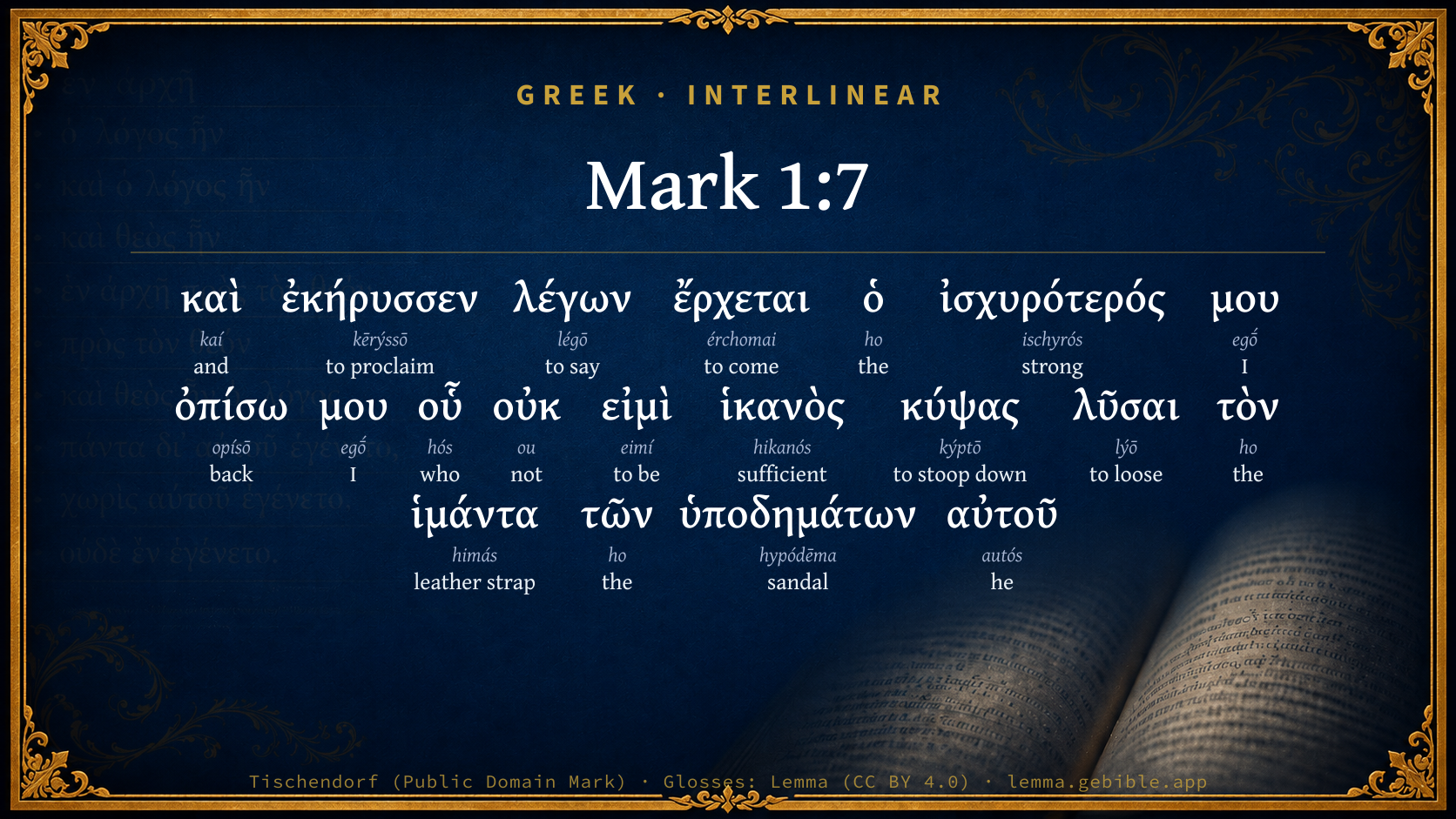
Download image
Cite this verse

Mark 1:7 (World English Bible). Public Domain. Lemma interlinear Bible study tool, https://lemma.gebible.app/v/mark/1/7.

Show BibTeX & RIS
BibTeX
RIS
English Translation
He preached, saying, "After me comes he who is mightier than I, the thong of whose sandals I am not worthy to stoop down and loosen.
World English Bible · Public Domain
Highlights
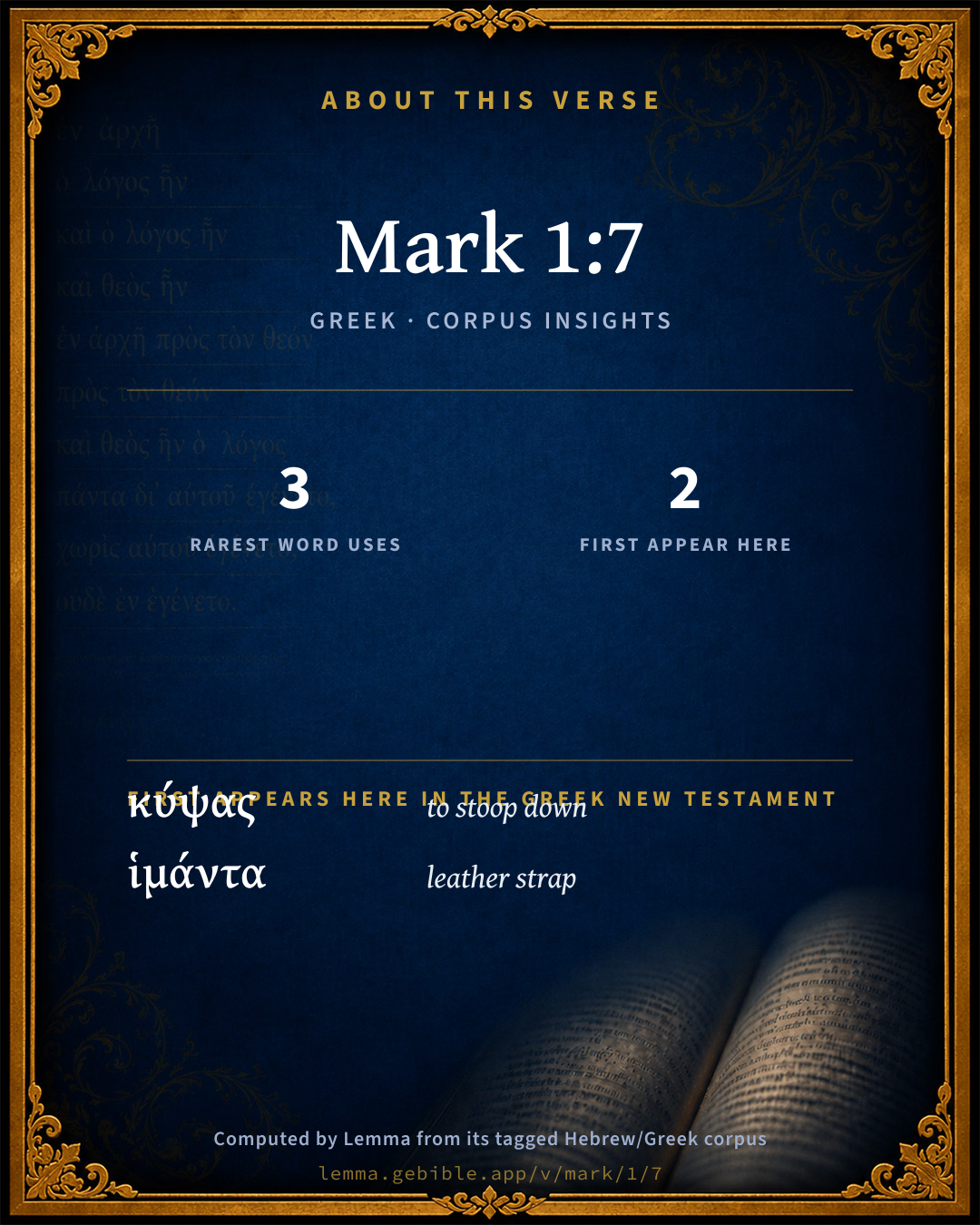
  • 2 first appearances in the Greek New Testament
Full analysis ↓
Download a study sheet

One document with this verse’s original text, its word-by-word gloss line, the meaning frame, cross-references with their text, attributed commentary, and full source and license credits — printable, and it pastes into notes with its structure intact.

This verse Autodidact and up

Study sheet (.html) Plain text (.txt)

A passage Seminary Student

Up to 50 verses in one chapter. A passage sheet keeps up to 6 commentary sources and 12 cross-references per verse, in the order this page ranks them, and says so on the sheet whenever that leaves anything out. Ask for a single verse and you get the Autodidact verse sheet above.

Everything on this page stays free to read, with no account — the sheet is a download of what is already on screen, not access to it.

Want to remove ads? Support Godless Engineer
Compare translations 3

The same verse in 3 English versions, stacked beneath the original-language interlinear above. Click any original word for its lexicon entry.

Each is an independent rendering of the whole verse — the interlinear is not word-aligned to these translations.

Highlighted words mark where these versions differ — a whole-verse word diff, not a word-by-word alignment.

  • World English Bible Public Domain
    He preached, saying, "After me comes he who is mightier than I, the thong of whose sandals I am not worthy to stoop down and loosen.
  • King James Version Public Domain
    And preached, saying, There cometh one mightier than I after me, the latchet of whose shoes I am not worthy to stoop down and unloose.
  • unfoldingWord Literal Text CC BY-SA 4.0
    And he was proclaiming, saying, “One more powerful than I is coming after me, of whom I am not worthy, stooping down, to untie the strap of his sandals.

unfoldingWord Literal Text — © unfoldingWord, licensed CC BY-SA 4.0. Word-aligned USFM3 via Door43 (git.door43.org/unfoldingWord/en_ult).

Versions to compare (up to 4)

3 of 4 selected

Show all 19 translations

Every available English version of this verse, each an independent rendering of the whole verse.

  • World English Bible Public Domain
    He preached, saying, "After me comes he who is mightier than I, the thong of whose sandals I am not worthy to stoop down and loosen.
  • Berean Standard Bible Public Domain
    And he began to proclaim: “After me will come One more powerful than I, the straps of whose sandals I am not worthy to stoop down and untie.
  • Majority Standard Bible Public Domain
    And he proclaimed: “After me will come One more powerful than I, the straps of whose sandals I am not worthy to stoop down and untie.
  • King James Version Public Domain
    And preached, saying, There cometh one mightier than I after me, the latchet of whose shoes I am not worthy to stoop down and unloose.
  • American Standard Version (1901) Public Domain
    And he preached, saying, There cometh after me he that is mightier than I, the latchet of whose shoes I am not worthy to stoop down and unloose.
  • Revised Version (1885) Public Domain
    And he preached, saying, There cometh after me he that is mightier than I, the latchet of whose shoes I am not worthy to stoop down and unloose.
  • Geneva Bible (1599) Public Domain
    And preached, saying, A stronger then I commeth after me, whose shoes latchet I am not worthy to stoupe downe, and vnloose.
  • Douay-Rheims (1899) Public Domain
    And he preached, saying: There cometh after me one mightier than I, the latchet of whose shoes I am not worthy to stoop down and loose.
  • Young's Literal Translation Public Domain
    and he proclaimed, saying, `He doth come -- who is mightier than I -- after me, of whom I am not worthy -- having stooped down -- to loose the latchet of his sandals;
  • Literal Standard Version CC BY-SA 4.0
    and he proclaimed, saying, “He comes—who is mightier than I—after me, of whom I am not worthy—having stooped down—to loose the strap of His sandals;
  • Unlocked Literal Bible CC BY-SA 4.0
    He proclaimed, “One will come after me who is more powerful than I; the strap of his sandals I am not worthy to stoop down and untie.
  • unfoldingWord Literal Text CC BY-SA 4.0
    And he was proclaiming, saying, “One more powerful than I is coming after me, of whom I am not worthy, stooping down, to untie the strap of his sandals.
  • Darby Bible Public Domain
    And he preached, saying, There comes he that is mightier than I after me, the thong of whose sandals I am not fit to stoop down and unloose.
  • World Messianic Bible Public Domain
    He preached, saying, “After me comes he who is mightier than I, the strap of whose sandals I am not worthy to stoop down and loosen.
  • Webster's Bible Public Domain
    And preached, saying, There cometh after me one mightier than I, the latchet of whose shoes I am not worthy to stoop down and unloose.
  • Free Bible Version CC BY-SA 4.0
    This is what he had to say: “After me someone is coming who is greater than I am. I'm not worthy to bend down and untie his sandals.
  • Bible in Basic English Public Domain
    And he said to them all, There is one coming after me who is greater than I, whose shoes I am not good enough to undo.
  • Text-Critical English NT CC BY 4.0
    He proclaimed, “After me comes one who is mightier than I, the strap of whose sandals I am not worthy to stoop down and untie.
  • Tyndale New Testament (1534) Public Domain
    and preached sayinge: a stronger then I commeth after me whose shue latchet I am not worthy to stoupe doune and vnlose.

Literal Standard Version (2020), Covenant Press — licensed CC BY-SA 4.0. Text via the HelloAO Bible API (eBible.org). Unlocked Literal Bible (unfoldingWord) — licensed CC BY-SA 4.0. Text via the HelloAO Bible API (eBible.org). unfoldingWord Literal Text — © unfoldingWord, licensed CC BY-SA 4.0. Word-aligned USFM3 via Door43 (git.door43.org/unfoldingWord/en_ult). Free Bible Version, Dr. Jonathan Gallagher — licensed CC BY-SA 4.0. Text via the HelloAO Bible API (eBible.org).

Word by word

More ways to search: Search by grammar → Find every occurrence → Compare this word →

Practice this passage: Drill this verse → Learn its vocabulary →

κύψας
kýptō
G2955
“to stoop down”
Verb, Aorist, Active, Participle, Nominative, Singular, Masculine
Part of Speech
Verb
Tense
Aorist
Voice
Active
Mood
Participle
Case
Nominative
Number
Singular
Gender
Masculine
Full Thayer's Definition

Origin: probably from the base of G2949

TDNT: None

1. to stoop down, bend forward, to bow the head
  1. καὶ kaí G2532 “and” Conjunction
  2. ἐκήρυσσεν kērýssō G2784 “to proclaim” Verb, Imperfect, Active, Indicative, 3rd person, Singular
  3. λέγων légō G3004 “to say” Verb, Present, Active, Participle, Nominative, Singular, Masculine
  4. ἔρχεται érchomai G2064 “to come” Verb, Present, Middle or Passive deponent, Indicative, 3rd person, Singular
  5. ὁ ho G3588 “the” Article, Nominative, Singular, Masculine
  6. ἰσχυρότερός ischyrós G2478 “strong” Adjective, Nominative, Singular, Masculine, Comparative
  7. μου egṓ G1473 “I” Personal pronoun, 1st person, Genitive, Singular
  8. ὀπίσω opísō G3694 “back” Adverb
  9. μου egṓ G1473 “I” Personal pronoun, 1st person, Genitive, Singular
  10. οὗ hós G3739 “who” Relative pronoun, Genitive, Singular, Masculine
  11. οὐκ ou G3756 “not” Particle, Negative
  12. εἰμὶ eimí G1510 “to be” Verb, Present, Active, Indicative, 1st person, Singular
  13. ἱκανὸς hikanós G2425 “sufficient” Adjective, Nominative, Singular, Masculine
  14. λῦσαι lýō G3089 “to loose” Verb, Aorist, Active, Infinitive
  15. τὸν ho G3588 “the” Article, Accusative, Singular, Masculine
  16. ἱμάντα himás G2438 “leather strap” Noun, Accusative, Singular, Masculine
  17. τῶν ho G3588 “the” Article, Genitive, Plural, Neuter
  18. ὑποδημάτων hypódēma G5266 “sandal” Noun, Genitive, Plural, Neuter
  19. αὐτοῦ autós G846 “he” Personal pronoun, Genitive, Singular, Masculine

About this verse

These counts appear in no published source. They are computed here, from the morphology-tagged text and Lemma’s own curated glosses. What Lemma adds →

20
words
17
distinct lemmas
Gospels
section

Notable vocabulary

The rarest word here is κύψας to stoop down G2955 — appearing just 3 times in the whole Greek New Testament.

First appearance in Scripture

These words make their first canonical appearance in the Greek New Testament here:

  • κύψας to stoop down G2955
  • ἱμάντα leather strap G2438

Shared distinctive vocabulary

κύψας to stoop down G2955 occurs in 3 verses of the Greek New Testament. Also found in:
Repetition

Words recur within this verse:

Cross-references

7

Topical passages linked to Mark 1:7 in the Treasury of Scripture Knowledge — connected by theme and wording, ordered by reader-vote popularity; previews shown in the World English Bible.

  • Acts 13:25 As John was fulfilling his course, he said, 'What do you suppose that I am? I am not he. But behold, one comes after me the sandals of whose feet I am not worthy to untie.'
  • Luke 3:16 John answered them all, "I indeed baptize you with water, but he comes who is mightier than I, the latchet of whose sandals I am not worthy to loosen. He will baptize you in the Holy Spirit and fire,
  • John 1:27 He is the one who comes after me, who is preferred before me, whose sandal strap I'm not worthy to loosen."
  • Matthew 3:11 I indeed baptize you in water for repentance, but he who comes after me is mightier than I, whose shoes I am not worthy to carry. He will baptize you in the Holy Spirit.
  • Luke 7:6–7 Jesus went with them. When he was now not far from the house, the centurion sent friends to him, saying to him, "Lord, don't trouble yourself, for I am not worthy for you to come under my roof.
  • John 3:28–31 You yourselves testify that I said, 'I am not the Christ,' but, 'I have been sent before him.'
  • Matthew 3:14 But John would have hindered him, saying, "I need to be baptized by you, and you come to me?"

Cross-references courtesy of OpenBible.info (CC BY 4.0).

Commentary

Notes on Mark 1:7 from classic Christian and Jewish commentators (each source and its license shown beneath its notes). The classic Christian expositions comment on the surrounding passage and are grouped to its opening verse, so a note may address several verses; the Jewish commentaries on the Tanakh (Rashi and others) are per-verse, so they appear only where the commentator wrote on this verse.

Lemma curates 59 commentaries, every one of them public domain or Creative Commons licensed, each selected and text-cleaned for this edition rather than reprinted as found. About our sources →

The Biblical Illustrator

Joseph S. Exell

Mar_1:7

There cometh one mightier than I after me.

Christ mightier than the Baptist

This not then apparent. As the two met on the banks of the Jordan it appeared the reverse: John the embodiment of matured strength; mighty in word, wondrously successful; the great man of the epoch. Jesus had given no evidence of greatness. But things are not what they seem. Jesus is mightier than John.

I. In His person. The power of God.

II. In His preaching. Neither in manner nor matter did John astonish as Christ did. Christs words were spirit and life.

III. In his works. John did no miracle.

IV. In the permanence of His ministry. We hear the last of Johns disciples in Act_19:1-7. Christs disciples are an ever-increasing belly today.

V. In His death. Christs death really began His ministry: Johns closed his.

VI. In His power over the human heart. John could only move its fears while he was here; Christ can win its love and devotion now that He has gone. (Anon.)

Unloosing Eastern sandals

The custom of loosing the sandals from off the feet of an Eastern worshipper was ancient and indispensable. It is also commonly observed in visits to great men. The sandals, or slippers, are pulled off at the door, and either left there or given to a servant to bear. The person to bear them was an inferior domestic, or attendant upon a man of high rank, to take care of and to return them to him again. This was the work of servants among the Jews, and it was reckoned so servile that it was thought too mean for a scholar or disciple to do. The Jews say: All services which a servant does for a master, a disciple does for his master, except unloosing his shoes. John thought it was too great an honour for him to do that for Christ, which was thought too mean for a disciple to do for a wise man. (Burder.)

The Baptists humility

The highest buildings have the lowest foundations. As the roots of a tree descend so the branches ascend. The lower the ebb the higher the tide. Those upon the mountains see only the fog beneath them, whilst those in deep pits see the stars above them. The most fruitful branches bow the lowest. The best trees refused to be king, but the bramble affected it (Jdg_9:1-57). (Trapp.)

Retiring with humility in favour of another

He retired with dignity and ease, and with a glowing tribute to our Lords Divinity. He had the instinct of the true teacher. That one who would not rather see his disciple surpass him in memorable service for humanity is far too small for his position. Michael Angelos monument in the Westminster Abbey of Florence is magnificent, and attracts all eyes; but his humble teacher lies beneath a slab of the church floor, and the very name is worn by the feet of worshippers during the centuries. Who will complain that the two are misplaced? The teacher did his work well, and shines too in the fame of the master. But the disciple had what the master never had. So He who had been baptized by John, possessed what John did not have, and the beauty of Johns ministry lay in a recognition of this fact. He knew as well how to close his life as he had known how to begin it. (Amer. Sunday School Times.)

Shoestrings; humble service

This is what John understood, and what you must understand, that it is an honour to be permitted to do the humblest work for Jesus Christ. If when the queen was riding through our streets, with soldiers before her and soldiers behind, and crowds of people all along the way, you stood there with a little bunch of flowers in your hand and offered them to her, and she took them and thanked you with a smile, I fancy you would be very proud because the queen had been pleased to accept your little service. It was so John the Baptist felt: he felt that there were great, strong angels who would have reckoned it an honour to be allowed to untie the Lords shoe latchets, and while the Lord could have such pure servants as these, he felt that he was unworthy the honour. (J. R. Howat.)

The Biblical Illustrator, edited by Joseph S. Exell (c. 1880s–1900s) — public domain. Text from a community e-Sword module.

Godbey's Commentary on the New Testament

William B. Godbey

CHAPTER 5

THE BAPTISM WHICH JESUS GIVES CONTRASTED WITH THAT OF JOHN

Mat 3:2; Mar 1:7-8; Luk 3:16. “I indeed baptize you with water unto repentance; but the One coming after me is more powerful than I, whose sandals I am unworthy to carry; He will baptize you with the Holy Ghost and fire.” John and all other authentic preachers of the gospel administer the symbolic baptism with water, not only in this way sealing the covenant of repentance, but beautifully typifying the real baptism which Jesus gives with the Holy Ghost. Whereas, Matthew and Mark give us here the statement en hudati, the dative of instrumentality, showing up the fact that John used the water in an instrumental way, Luke simply says men hudati baptizo humas — i.e., “I indeed baptize you with water” — omitting the preposition en, as you see, confirming the fact that hudati is the dative of instrumentality, clearly and unequivocally involving the conclusion that John handled the water instead of the people. This preposition en in this passage — used by Matthew and Mark and omitted by Luke — has several meanings, among which “in” and “with” are most prominent. God forbid that any one should think I want to encourage controversy in a matter so small and unessential as the quantity of water and the manner of its application! You read the Word of the Lord, and be sure you satisfy your conscience. (1Pe 3:21.) We also have, in certain localities, a controversy involving the fire phase of our Savior’s baptism. Here, with the inspired Greek under my eye, I see that Matthew and Luke give us, “He will baptize you with the Holy Ghost and fire,” while Mark omits the fire altogether, simply stating, “He will baptize you with the Holy Ghost,” clearly involving the conclusion that the fire normally inheres in the Holy Spirit — i.e., is inseparable from Him: “God is a consuming fire.” (Heb 12:18.) You know the Holy Ghost is none other than very and eternal God; therefore, when you receive the Holy Ghost, you receive the baptism of fire:

“For He is like a refiner’s fire, and like fuller’s soap.” (Mal 3:2.)

Thus, fire and soap being the great purifiers, are here associated, denotative of that wonderful purification which the Holy Spirit always executes when you receive Him into your hearts. The teaching of a fiery baptism, separate and distinct from that of the Holy Spirit, antagonizes Eph 4:3, where Paul certifies that there is one, and only one, baptism in the gracious economy, the fire not being a separate and distinct baptism, but a concomitant of the Spirit; while the ordinance with water is not intrinsically a baptism, but symbolically typifies the real baptism of the Holy Spirit administered by our Savior. In connection with these facts, it is pertinent to consider 2Ti 1:6 :

“On account of which cause, I remind thee to revive and refire the gracious gift of God which is in thee for the laying on of my hands.”

The English word here, “stir up,” is anazopurein, which is a compound from ana, re; zao, life; pur, fire. Hence you see that the plain meaning of this triple Greek compound is “revive” and “refire.” We receive spiritual life in regeneration, but frequently need reviving, and will till this mortal puts on immortality.

We receive the fire of the Holy Ghost in sanctification, which should be revived and renewed, ever and anon, throughout our pilgrimage. You take food to revive your physical life, as otherwise it would evanesce, and you would die. You frequently put on fuel, stir up, and renew the fire, as otherwise it would go out, and you would freeze out in the North-pole atmosphere of this wintry world. Let us not get wise above what is written; but take the plain Word of the Lord in every Case, and you will keep out of these tangles, in which Satan is so fond of perplexing the people of God. There is no danger of getting too much life and too much fire if you get it from God. Man has fox-fire, the devil has hell-fire, and God has heavenly-fire. The Holy Ghost is God. If you seek a baptismal fire separate from the Spirit, you open the door for men and devils to deceive you with their “strange fire,” for which Nadab and Abihu, the sons of Aaron, fell dead when they offered it to the Lord. So beware, lest you offer strange fire to the Lord, and fall dead spiritually, as we seriously fear some are doing. If you seek any blessing separate from God, you run headlong into fanaticism. Feel perfectly free to get revived and fired all you possibly can, but get it all from God, remembering, amid all that God says, there is but one baptism. (Eph 5:4.)

William B. Godbey, Commentary on the New Testament (1896–1900) — public domain. Text from a community e-Sword module.

The Expositor's Bible

CHAPTER 1:7-11 (Mar_1:7-11)

AT THE JORDAN

"And he preached, saying, There cometh after me He that is mightier than I, the latchet of whose shoes I am not worthy to stoop down and unloose. I baptized you with water; but He shall baptize you with the Holy Ghost. And it came to pass in those days, that Jesus came from Nazareth of Galilee, and was baptized of John in the Jordan. And straightway coming up out of the water, He saw the heavens rent asunder, and the Spirit as a dove descending upon Him: and a voice came out of the heavens, Thou art My Beloved Son, in Thee I am well pleased." Mar_1:7-11 (R.V.)

IT was when all men mused in their hearts whether John was the Christ or no, that he announced the coming of a Stronger One. By thus promptly silencing a whisper, so honorable to himself, he showed how strong he really was, and how unselfish "a friend of the Bridegroom." Nor was this the vague humility of phrase which is content to be lowly in general, so long as no specified individual stands higher. His word is definite, and accepts much for himself. "The Stronger One than I cometh," and it is in presence of the might of Jesus (whom yet this fiery reformer called a Lamb), that he feels himself unworthy to bend to the dust and unbind the latchets or laces of His shoe.

So then, though asceticism be sometimes good, it is consciously not the highest nor the most effective goodness. Perhaps it is the most impressive. Without a miracle, the preaching of John shook the nation as widely as that of Jesus melted it, and prepared men's hearts for His. A king consulted and feared him. And when the Pharisees were at open feud with Jesus, they feared to be stoned if they should pronounce John's baptism to be of men.

Yet is there weakness lurking even in the very quality which gives asceticism its power. That stern seclusion from an evil world, that peremptory denial of its charms, why are they so impressive? Because they set an example to those who are hard beset, of the one way of escape, the cutting off of the hand and foot, the plucking out of the eye. And our Lord enjoins such mutilation of the life upon those whom its gifts betray. Yet is it as the halt and maimed that such men enter into life. The ascetic is a man who needs to sternly repress and deny his impulses, who is conscious of traitors within his breast that may revolt if the enemy be suffered to approach too near.

It is harder to be a holy friend of publicans and sinners, a witness for God while eating and drinking with these, than to remain in the desert undefiled. It is greater to convert a sinful woman in familiar converse by the well, than to shake trembling multitudes by threats of the fire for the chaff and the axe for the barren tree. And John confesses this. In the supreme moment of his life, he added his own confession to that of all his nation. This rugged ascetic had need to be baptized of Him who came eating and drinking.

Nay, he taught that all his work was but superficial, a baptism with water to reach the surface of men's life, to check, at the most, exaction and violence and neglect of the wants of others, while the Greater One should baptize with the Holy Ghost, should pierce the depths of human nature, and thoroughly purge His floor.

Nothing could refute more clearly than our three narratives, the skeptical notion that Jesus yielded for awhile to the dominating influence of the Baptist. Only from the Gospels can we at all connect the two. And what we read here is, that before Jesus came, John expected his Superior; that when they met, John declared his own need to be baptized of Him, that he, nevertheless, submitted to the will of Jesus, and thereupon heard a voice from the heavens which must forever have destroyed all notion of equality; that afterwards he only saw Jesus at a distance, and made a confession which transferred two of his disciples to our Lord.

The criticism which transforms our Lord's part in these events to that of a pupil is far more willful than would be tolerated in dealing with any other record. And it too palpably springs from the need to find some human inspiration for the Word of God, some candle from which the Sun of Righteousness took fire, if one would escape the confession that He is not of this world.

But here we meet a deeper question: Not why Jesus accepted baptism from an inferior, but why, being sinless, He sought for a baptism of repentance. How is this act consistent with absolute and stainless purity?

Now it sometimes lightens a difficulty to find that it is not occasional nor accidental, but wrought deep into the plan of a consistent work. And the Gospels are consistent in representing the innocence of Jesus as refusing immunity from the consequences of guilt. He was circumcised, and His mother then paid the offering commanded by the law, although both these actions spoke of defilement. In submitting to the likeness of sinful flesh He submitted to its conditions. He was present at feasts in which national confessions led up to sacrifice, and the sacrificial blood was sprinkled to make atonement for the children of Israel, because of all their sins. When He tasted death itself, which passed upon all men, for that all have sinned, He carried out to the utmost the same stern rule to which at His baptism He consciously submitted. Nor will any theory of His atonement suffice, which is content with believing that His humiliations and sufferings, though inevitable, were only collateral results of contact with our fallen race. Baptism was avoidable, and that without any compromise of His influence, since the Pharisees refused it with impunity, and John would fain have exempted Him. Here at least He was not "entangled in the machinery," but deliberately turned the wheels upon Himself. And this is the more impressive because, in another aspect of affairs, He claimed to be out of the reach of ceremonial defilement, and touched without reluctance disease, leprosy and the dead.

Humiliating and penal consequences of sin, to these He bowed His head. Yet to a confession of personal taint, never. And all the accounts agree that He never was less conscience-stricken than when He shared the baptism of repentance. St. Matthew implies, what St. Luke plainly declares, that He did not come to baptism along with the crowds of penitents, but separately. And at the point where all others made confession, in the hour when even the Baptist, although filled with the Holy Ghost from his mother's womb, had need to be baptized, He only felt the propriety, the fitness of fulfilling all righteousness. That mighty task was not even a yoke to Him, it was an instinct like that of beauty to an artist, it was what became Him.

St. Mark omits even this evidence of sinlessness. His energetic method is like that of a great commander, who seizes at all costs the vital point upon the battle field. He constantly omits what is subordinate (although very conscious of the power of graphic details), when by so doing he can force the central thought upon the mind. Here he concentrates our attention upon the witness from above, upon the rending asunder of the heavens which unfold all their heights over a bended head, upon the visible descent of the Holy Spirit in His fullness, upon the voice from the heavens which pealed through the souls of these two peerless worshippers, and proclaimed that He who had gone down to the baptismal flood was no sinner to be forgiven, but the beloved Son of God, in whom He is well pleased.

That is our Evangelist's answer to all misunderstanding of the rite, and it is enough.

How do men think of heaven? Perhaps only as a remote point in space, where flames a material and solid structure into which it is the highest bliss to enter. A place there must be to which the Body of our Lord ascended and whither He shall yet lead home His followers in spiritual bodies to be with Him where He is. If, however, only this be heaven, we should hold that in the revolutions of the solar system it hung just then vertically above the Jordan, a few fathoms or miles aloft. But we also believe in a spiritual city, in which the pillars are living saints, an all-embracing blessedness and rapture and depth of revelation, where into holy mortals in their highest moments have been "caught up," a heaven whose angels ascend and descend upon the Son of man. In this hour of highest consecration, these heavens were thrown open -- rent asunder-- for the gaze of our Lord and of the Baptist. They were opened again when the first martyr died. And we read that what eye hath not seen nor ear heard nor heart conceived of the preparation of God for them that love Him, He hath already revealed to them by His Spirit. To others there is only cloud or "the infinite azure," as to the crowd by the Jordan and the murderers of Stephen.

Now it is to be observed that we never read of Jesus being caught up into heaven for a space, like St. Paul or St. John. What we read is, that while on earth the Son of man is in Heaven (Joh_3:13), [1] for heaven is the manifestation of God, whose truest glory was revealed in the grace and truth of Jesus.

Along with this revelation, the Holy Spirit was manifested wondrously. His appearance, indeed, is quite unlike what it was to others. At Pentecost He became visible, but since each disciple received only a portion, "according to his several ability," his fitting symbol was "tongues parting asunder like as of fire." He came as an element powerful and pervasive, not as a Personality bestowed in all His vital force on any one.

So, too, the phrase which John used, when predicting that Jesus should baptize with the Holy Ghost, slightly though it differs from what is here, implies [2] that only a portion is to be given, not the fullness. And the angel who foretold to Zacharias that John himself should be filled with the Holy Ghost, conveyed the same limitation in his words. John received all that he was able to receive: he was filled. But how should mortal capacity exhaust the fullness of Deity? And Who is this, upon Whom, while John is but an awestricken beholder, the Spirit of God descends in all completeness, a living organic unity, like a dove? Only the Infinite is capable of receiving such a gift, and this is He in Whom dwelleth all the fullness of the Godhead bodily. No wonder then that "in bodily form" as a dove, the Spirit of God descended upon Him alone. Henceforward He became the great Dispenser, and "the Spirit emanated from Him as perfume from the rose when it has opened."

At the same time was heard a Voice from heaven. And the bearing of this passage upon the Trinity becomes clear, when we combine the manifestation of the Spirit in living Personality, and the Divine Voice, not from the Dove but from the heavens, with the announcement that Jesus is not merely beloved and well-pleasing, but a Son, and in this high sense the only Son, since the words are literally "Thou art the Son of Me, the beloved." And yet He is to bring many sons unto glory.

Is it consistent with due reverence to believe that this voice conveyed a message to our Lord Himself? Even so liberal a critic as Neander has denied this. But if we grasp the meaning of what we believe, that He upon taking flesh "emptied Himself," that He increased in wisdom during His youth, and that there was a day and hour which to the end of life He knew not, we need not suppose that His infancy was so unchildlike as the realization of His mysterious and awful Personality would make it. There must then have been a period when His perfect human development rose up into what Renan calls (more accurately than he knows) identification of Himself with the object of His devotion, carried to the utmost limit. Nor is this period quite undiscoverable, for when it arrived it would seem highly unnatural to postpone His public ministry further. Now this reasonable inference is entirely supported by the narrative. St. Matthew indeed regards the event from the Baptist's point of vision. But St. Mark and St. Luke are agreed that to Jesus Himself it was also said, "Thou are My beloved Son." Now this is not the way to teach us that the testimony came only to John. And how solemn a thought is this, that the full certitude of His destiny expanded before the eyes of Jesus, just when He lifted them from those baptismal waters in which He stooped so low.

[1] (Cf. The admiral note in Archdeacon Watkins' "Commentary on John")

[2] By the absence of the article in the Greek.

William Robertson Nicoll, ed., The Expositor's Bible (London: Hodder & Stoughton, 1887–1910) — public domain. 65 of 66 books (1 Corinthians is not separately keyed, as that volume carries no machine-parseable verse references); section-level commentary keyed to the opening verse. Introductory and overview sections not keyed to a specific passage are excluded.

Tyndale Open Study Notes

Tyndale Open Resources

1:7 Someone is coming: John knew that he was preparing for the Messiah’s coming, but he did not yet know that Jesus was he (cp. Luke 7:18-23).

Tyndale Open Study Notes — © Tyndale Open Resources, licensed CC BY-SA 4.0. Text via the HelloAO Bible API.

Bengel's Gnomon

Johann Albrecht Bengel

Mar 1:7. Ἔρχεται, there cometh) immediately, and even now present.—ὁ ἰσχυρότερος) that One, who is mightier. The One Christ is greater than John, yea, infinitely greater.—λῦσαι τὸν ἱμάντα, to unloose the latchet) We usually make fast our shoes with buckles, the ancients with thongs or strings. John seems by this proverbial saying, perhaps unconsciously, to make allusion to the baptism of Jesus, so as to express this meaning: I am not worthy to unloose His shoe-strings, much less to impart baptism to Him. For the shoes also, as well as the garments, used to be taken off, when a person was to be baptized.

Bengel's Gnomon of the New Testament — English translation (T&T Clark, Edinburgh, 1860) — public domain. Text from a community e-Sword module.

Expositor's Greek Testament

ed. W. Robertson Nicoll

Mar 1:7 . καὶ ἐκήρυσσεν , introducing a special and very important part of his kerygma: inter alia he kept saying anxious to prevent men from forming a wrong impression of his position. This is what makes mention of his ministry relevant in the evangelic record. λῦσαι τὸν ἱμάντα , to loose the latchet of, instead of τὰ ὑποδ . βαστάσαι ; a stronger expression of subordination, practically the same idea.

The Expositor's Greek Testament, edited by W. Robertson Nicoll (1897–1910) — public domain. Text from a community e-Sword module.

Geneva Bible (1599)

Geneva Bible translators

The Evangelist his meaning was to express the condition of the basest servant.

John and all ministers cast their eyes upon Christ the Lord.

Geneva Bible (1599) marginal notes — public domain. Text via Bolls.life.

Adam Clarke's Commentary

Verse 7. The latchet of whose shoes] The shoe of the ancients was properly only a sole tied round the foot and ankle with strings or thongs. See Clarke on Mt 3:11.

Adam Clarke's Commentary on the Bible (1810–1826) — public domain. Text from a community e-Sword/MySword module.

Ellicott's Commentary for English Readers

(7) There cometh one mightier than I.—See Note on Mat_3:11; but note the slight difference—not, as there, “whose shoes I am not worthy to bear,” but “the latchet of whose shoes I am not worthy to stoop down and unloose.” Latchet,” a word now obsolete, was the “thong” or “lace” with which shoes or sandals were fastened. To stoop down and loosen the sandals was commonly the act of the servant who afterwards carried them, but it expressed more vividly what we should call the menial character of the office, and therefore, we may believe, was chosen by St. Mark. (See Introduction.)

A Bible Commentary for English Readers, edited by Charles John Ellicott (1878–1897) — public domain. Text from a community e-Sword module.

The Cambridge Bible for Schools and Colleges

gen. ed. J. J. S. Perowne

7. cometh] present tense. With prophetic foresight the Baptist sees Him already come and in the midst.

latchet] diminutive of latch, like the Fr. lacet dim. of lace, comes from the Latin laqueus = a “noose,” and means anything that catches. We now only apply latch to the catch of a door or gate. We speak of a “shoe-lace,” and “lace” is radically the same word. Here it denotes the thong or fastening by which the sandal was fastened to the foot; comp. Gen_14:23; Isa_5:27. The office of bearing and unfastening the sandals of great personages fell to the meanest slaves.

to stoop down] This expression is peculiar to St Mark. It is the first of those minute details which we shall find in such abundance in his Gospel.

The Cambridge Bible for Schools and Colleges (gen. ed. J. J. S. Perowne; Cambridge University Press, 1878–1918) — public domain. Text from a community e-Sword module.

John Gill's Exposition

And preached, saying, there cometh one mightier than I after me,.... From whence it appears, that John was a preacher of Jesus Christ; of the dignity of his person, the excellency of his office, and the nature and importance of his work:

the latchet of whose shoes I am not worthy to stoop down and unloose; expressing the great veneration he had for him, and the great sense he had of his own unworthiness, to be concerned in the lowest and meanest service of life for him; and that he was far from being worthy of the high honour done him, to be his messenger and forerunner; See Gill on Mat 3:11.

John Gill's Exposition of the Whole Bible (1746–1763) — public domain (CC PDM 1.0). Text via the HelloAO Bible API.

Trapp's Complete Commentary

John Trapp

7 And preached, saying, There cometh one mightier than I after me, the latchet of whose shoes I am not worthy to stoop down and unloose.

Ver. 7. I am not worthy] So Jacob cried out of old. So the centurion, Mat 8:5-13. So the prodigal, Luk 15:11-32. So Peter, Luk 5:8. So Augustine, Domine, non sum dignus quem tu diligas, I am not worthy of thy love, Lord.

John Trapp, A Commentary or Exposition upon All the Books of the Old and New Testament (1647–1656) — public domain. Text from a community e-Sword module.

Haydock's Catholic Bible Commentary

One mightier than I. The precursor [St. John the Baptist] does not yet openly declare our Lord to be the Son of God, but only one mightier than himself. The Jews were not prepared to receive his coming; he therefore wisely led them by degrees to the knowledge of what divine Providence had designed them; he yet secretly assures them that he is the Son of God. I have baptized you with water, but he shall baptize you with the Holy Ghost. Not it is evident that none but God can bestow upon man the grace of the Holy Ghost. (Ven. Bede)

George Leo Haydock (1774–1849), Haydock's Catholic Family Bible and Commentary, 1859 edition — public domain. Excludes Psalms (Douay-Rheims chapter numbering differs from Protestant) and Deuterocanonical books (Catholic canon only).

Matthew Poole's English Annotations

We had the same, with very little difference in the phrase in Matthew. See Poole on "Mat 3:11".

Matthew Poole's English Annotations on the Holy Bible (1683–1685) — public domain. Text from a community e-Sword/MySword module.

Whedon's Commentary on the Bible

Daniel D. Whedon

7. The latchet — The word latchet signifies a fastener of some kind. It is allied to the latch of a door, to the word lock; and is derived from the Latin ligo, to fasten. It here signifies a shoe-string. In Matthew the phrase is, “whose shoes I am not worthy to bear.” Perhaps John, on different occasions, used both expressions.

Daniel D. Whedon (gen. ed.), Commentary on the Old and New Testaments (1874–1909) — public domain. Text from a community e-Sword module.

The Pulpit Commentary

The latchet of whose shoes I am not worthy to stoop down and unloose. This was the menial office of the slave, whose business it was to take off? and put on the shoes of his master, stooping down with all humility and respect for this purpose. Thus John confessed that he was the servant of Christ, and that Christ was his Lord. In a mystical sense the shoes denote the humanity of Christ, which by its union with the Word became of the highest dignity and majesty. St. Bernard says, "The majesty of the Word was shod with the sandal of our humanity."

The Pulpit Commentary (1880–1919), ed. H.D.M. Spence-Jones & Joseph S. Exell — public domain. Text from a community e-Sword module.

John Wesley's Explanatory Notes

The latchet of whose shoes I am not worthy to unloose - That is, to do him the very meanest service.

John Wesley, Explanatory Notes Upon the Whole Bible (1754–1765) — public domain. Text via the GEBible commentary corpus.

Burkitt's Expository Notes on the New Testament

William Burkitt

Observe here, 1. The high opinion that the Baptist had of Christ. He is mightier than I; that is, a Person of greater dignity and excellency by far than myself: whence may be gathered, that though Christ was Man, he was not mere man, but more than man: even very God, equal with his Father; for John Baptist was the greatest of them that were born of woman, Mat 11:11 yet, says he, Christ is mightier and greater than I. How so, but in regard to the dignity of his person, being both God and Man in two distinct natures and one person.

Observe, 2. The humble and low estimation that the Baptist had of himself; His shoe latchet I am not worthy to unloose: a proverbial speech, implying that he was unworthy to do the basest and meanest service for Christ. O how well doth humility of mind, an humble apprehension, a low esteem and opinion of themselves and their own gifts and abilities, become the messengers and ministers of Christ! John was a man of eminent abilities, yet of exemplary humility; he thought himself unworthy to unloose Christ’s shoe, or do the meanest office for him.

William Burkitt's Expository Notes on the New Testament (1700–1703) — public domain. Text from a community e-Sword module.

The People's New Testament

B. W. Johnson

7, 8. There cometh one after me. See note on Matt. 3:11.

Shall baptize you with the Holy Ghost. See note on Matt. 3:11.

B. W. Johnson's The People's New Testament with Notes (1889–1891) — public domain. Electronic text from the Christian Classics Ethereal Library (CCEL) ThML edition.

unfoldingWord translationNotes

Door43 World Missions Community

He proclaimed

"John proclaimed"

the strap of his sandals I am not worthy to stoop down and untie

John is comparing himself to a servant to show how great Jesus is. AT: "I am not even worthy to do the lowly task of removing his shoes" (See: Metaphor)

the strap of his sandals

At the time Jesus was on earth, people often wore sandals that were made of leather and tied to their feet with leather straps.

stoop down

"bend down"

but he will baptize you with the Holy Spirit

This metaphor compares John's baptism with water to the future baptism with the Holy Spirit. This means John's baptism only symbolically cleanses people of their sins. The baptism by the Holy Spirit will truly cleanse people of their sins. If possible, use the same word for "baptize" here as you used for John's baptism to keep the comparison between the two. (See: Metaphor)

translationWords

preach

worthy

baptize

Holy Spirit

unfoldingWord translationNotes — © Distant Shores Media and the Door43 World Missions Community, licensed CC BY-SA 4.0. Source: git.door43.org/Door43/en_tn.

Cambridge Greek Testament for Schools and Colleges

7. ἐκήρυσσεν. Mk alone has this imperf. of continued action, which fits on well to ἦν ἐνδεδ. κ. ἔσθων. Mt., Lk. and Jn have aorists of other verbs. By some John was believed to be the Messiah, and this compelled him to be more explicit about his relation to the Messiah.

ἱκανός. It is clear from Mat 8:8 and Luk 7:6 that this = ἄξιος (Joh 1:27); the thong (Act 22:25) of whose sandals I am not fit to, etc. Note the characteristically graphic fulness of κύψας λῦσαι, where the aor. may mean that he was unworthy to render even once the humble service which a slave rendered often to his master. Mt. speaks of the sandals being carried, a custom common in Palestine, but unknown to Mk’s Roman readers. With the superfluous αὐτοῦ comp. Mar 7:25 and οὗ ἀρᾶς τὸ στόμα αὐτοῦ γέμει (Ps. 9:28), μακάριος ἀνὴρ οὖ ἐστὶν ἡ ἀντίλημψις αὐτοῦ παρἀ σοῦ Κύριε (Psa 83:6). The pleonasm is a Hebraism. Blass, § 50. 4; J. H. Moulton, Gr. of N.T. Grk, p. 95.

Cambridge Greek Testament for Schools and Colleges (Cambridge University Press, 1896; 21 vols, various authors incl. Carr, Maclear, Plummer, Farrar, Lumby, Moule, M. R. James, Simcox) — public domain. Text from a community e-Sword module.

Alford’s Greek Testament

Henry Alford

7. κύψας λῦσαι.…] The expression is common to Mark, Luke, and John (1:27). It amounts to the same as bearing the shoes—for he who did the last would necessarily be also employed in loosing and taking off the sandal. But the variety is itself indicative of the independence of Matt. and Mark of one another. John used the two expressions at different times, and our witnesses have reported both. κύψας is added by Mark, who, as we shall find, is more minute in circumstantial detail than the other Evangelists.

Henry Alford, The Greek Testament (1849–1861) — public domain. Text from a community e-Sword module.

International Critical Commentary

7. ἐκήρυσσε—he was proclaiming. The translation preached is especially out of place here, since what follows is not the general subject of the Baptist’s preaching, but only that particular announcement of the coming of the Messiah which has led the writer to say that the proclamation by John in the wilderness was the beginning of the good news about Jesus Christ. He was making proclamation by virtue of his office as κήρυξ, the herald of the Messianic King. The whole work of the Baptist in this Gospel is treated as this ἀρχὴ εὐαγγελίου, a peculiarity which is obscured in our version.

ἐκήρυσσε continues the impfs. ἦν ἐνδεδυμένος and ἔσθων, denoting John’s habit of life and speech in the wilderness.

ὁ ἰσχυρότερός μου3—he that is mightier than I (RV.). This description of the coming one is common to all the Synoptics, but in Mt. and Lk. it is introduced between the statement of John’s baptism and that of Jesus’ baptism in such a way as to show more distinctly than in Mk.’s account that in these different baptisms is contained the point of the ἰσχυρότερος. Jesus is mightier than John by reason of his baptizing in the Holy Spirit. Mk.’s order shows this also, but not so distinctly. ὀπίσω μου—after me.1 οὗ οὐκ εἰμὶ ἱκανὸς—of whom I am not fit. … This is a rhetorical statement of John’s depreciation of himself by the side of the coming one. He was not fit to tie his shoes.

ἱκανός denotes any kind of sufficiency or fitness. Fit is a good translation in this case.

ἱμάντα τ. ὑποδημάτων—the thong of the sandals. The sandals protected the soles only, and were bound to the feet by a thong. κύψας.—This apparently superfluous addition about stooping serves to heighten the impression of the menial character of the act.

International Critical Commentary — older volumes (1896–1929), various authors — public domain. Text from a community e-Sword module.

Vincent's Word Studies in the New Testament

Marvin R. Vincent

To stoop down

A detail peculiar to Mark.

And unloose

Compare to bear; Mat 3:11.

Marvin R. Vincent, Word Studies in the New Testament (1887–1900) — public domain. Text from a community e-Sword/MySword module.

Lesson kit

Teaching starters — assembled from the data on this page, not authored interpretation. Every prompt links to the verse data it draws on. Edit before teaching.

Mark, in the Gospels, opens this verse with 20 words (17 distinct Greek lemmas). Its most distinctive word is kýptō (“to stoop down”). A historical commentator’s framing appears above. Read the whole chapter for the surrounding context.

Discussion questions

  1. What does “to stoop down” (kýptō) contribute to the verse as a whole?
  2. 2 words make their first appearance in Scripture here. What does this debut establish?
  3. How does John 8:6, which shares the word «to stoop down», read alongside this verse?
  4. What does the repetition of “the” (3× in this one verse) do in this verse?
  5. The translations on this page render this verse differently — a whole-verse word diff, not a word-by-word alignment. What might account for the different wordings?
  6. Compare how The Biblical Illustrator and Godbey's Commentary on the New Testament read this verse. Where do they agree or differ?

Things to notice

  • 2 words make their first canonical appearance in Scripture here.
  • These translations choose different wording for 23 words in this verse.
  • “the” occurs 3× in this single verse.
  • 17 distinct Greek lemmas span 20 words in this verse.

Reading settings

Reading text

Shown beneath each verse's original-language words.

Old Testament
Old Testament edition

Read the OT as the Masoretic Hebrew (MT) or the Greek Septuagint (LXX).

English shown for the Greek Septuagint (in the Hebrew ↔ Greek comparison).

Comparing translations? Open the Compare panel on any verse page to stack up to four side by side.