
Matthew 15:23

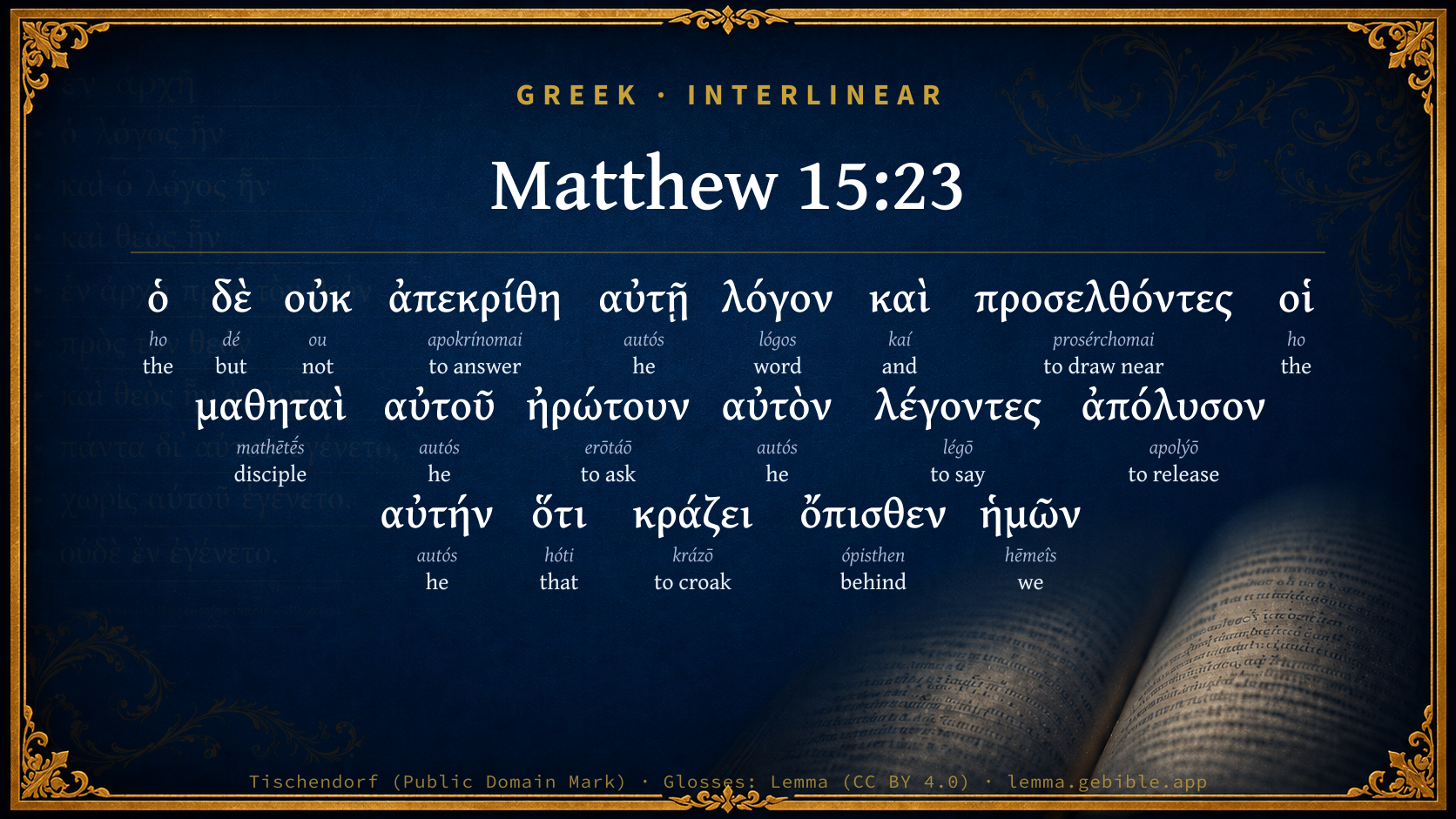
Greek (Tischendorf 8th ed.) Matthew 15:23 appears in the Greek New Testament. The text above is from the Tischendorf 8th edition. Each word links to its Strong’s number and a concise gloss. Click any word for its full Thayer’s Greek Lexicon entry.
Download image
Cite this verse

Matthew 15:23 (World English Bible). Public Domain. Lemma interlinear Bible study tool, https://lemma.gebible.app/v/matthew/15/23.

Show BibTeX & RIS
BibTeX
RIS
English Translation
But he answered her not a word. His disciples came and begged him, saying, "Send her away; for she cries after us."
World English Bible · Public Domain
Highlights
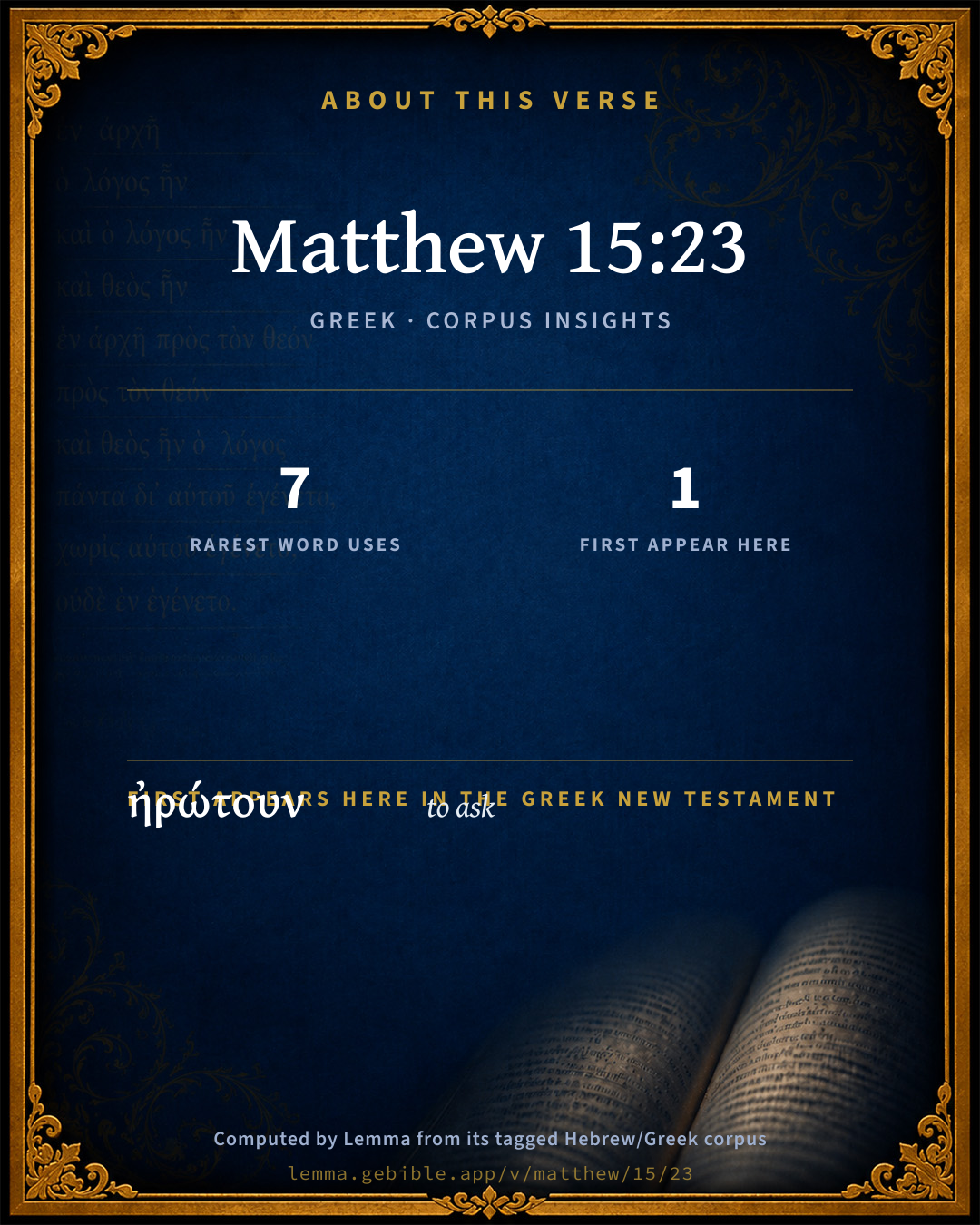
  • 1 first appearance in the Greek New Testament
Full analysis ↓
Download a study sheet

One document with this verse’s original text, its word-by-word gloss line, the meaning frame, cross-references with their text, attributed commentary, and full source and license credits — printable, and it pastes into notes with its structure intact.

This verse Autodidact and up

Study sheet (.html) Plain text (.txt)

A passage Seminary Student

Up to 50 verses in one chapter. A passage sheet keeps up to 6 commentary sources and 12 cross-references per verse, in the order this page ranks them, and says so on the sheet whenever that leaves anything out. Ask for a single verse and you get the Autodidact verse sheet above.

Everything on this page stays free to read, with no account — the sheet is a download of what is already on screen, not access to it.

Want to remove ads? Support Godless Engineer
Compare translations 3

The same verse in 3 English versions, stacked beneath the original-language interlinear above. Click any original word for its lexicon entry.

Each is an independent rendering of the whole verse — the interlinear is not word-aligned to these translations.

Highlighted words mark where these versions differ — a whole-verse word diff, not a word-by-word alignment.

  • World English Bible Public Domain
    But he answered her not a word. His disciples came and begged him, saying, "Send her away; for she cries after us."
  • King James Version Public Domain
    But he answered her not a word. And his disciples came and besought him, saying, Send her away; for she crieth after us.
  • unfoldingWord Literal Text CC BY-SA 4.0
    But he did not answer her a word. And having approached, his disciples were begging him, saying, “Send her away, for she is crying out after us.”

unfoldingWord Literal Text — © unfoldingWord, licensed CC BY-SA 4.0. Word-aligned USFM3 via Door43 (git.door43.org/unfoldingWord/en_ult).

Versions to compare (up to 4)

3 of 4 selected

Show all 19 translations

Every available English version of this verse, each an independent rendering of the whole verse.

  • World English Bible Public Domain
    But he answered her not a word. His disciples came and begged him, saying, "Send her away; for she cries after us."
  • Berean Standard Bible Public Domain
    But Jesus did not answer a word. So His disciples came and urged Him, “Send her away, for she keeps crying out after us.”
  • Majority Standard Bible Public Domain
    But Jesus did not answer a word. So His disciples came and urged Him, “Send her away, for she keeps crying out after us.”
  • King James Version Public Domain
    But he answered her not a word. And his disciples came and besought him, saying, Send her away; for she crieth after us.
  • American Standard Version (1901) Public Domain
    But he answered her not a word. And his disciples came and besought him, saying, Send her away; for she crieth after us.
  • Revised Version (1885) Public Domain
    But he answered her not a word. And his disciples came and besought him, saying, Send her away; for she crieth after us.
  • Geneva Bible (1599) Public Domain
    But hee answered her not a worde. Then came to him his disciples, and besought him, saying, Sende her away, for she crieth after vs.
  • Douay-Rheims (1899) Public Domain
    Who answered her not a word. And his disciples came and besought him, saying: Send her away, for she crieth after us:
  • Young's Literal Translation Public Domain
    And he did not answer her a word; and his disciples having come to him, were asking him, saying -- `Let her away, because she crieth after us;'
  • Literal Standard Version CC BY-SA 4.0
    And He did not answer her a word; and His disciples having come to Him, were asking Him, saying, “Let her away, because she cries after us”;
  • Unlocked Literal Bible CC BY-SA 4.0
    But Jesus answered her not a word. His disciples came and begged him, saying, “Send her away, for she is shouting after us.”
  • unfoldingWord Literal Text CC BY-SA 4.0
    But he did not answer her a word. And having approached, his disciples were begging him, saying, “Send her away, for she is crying out after us.”
  • Darby Bible Public Domain
    But he did not answer her a word. And his disciples came to [him] and asked him, saying, Dismiss her, for she cries after us.
  • World Messianic Bible Public Domain
    But he answered her not a word. His disciples came and begged him, saying, “Send her away; for she cries after us.”
  • Webster's Bible Public Domain
    But he answered her not a word. And his disciples came and besought him, saying, Send her away; for she crieth after us.
  • Free Bible Version CC BY-SA 4.0
    But Jesus didn't reply at all. His disciples came to him and told him, “Tell her to stop following us. All her shouting is really annoying!”
  • Bible in Basic English Public Domain
    But he gave her no answer. And his disciples came and said to him, Send her away, for she is crying after us.
  • Text-Critical English NT CC BY 4.0
    But he did not respond to her at all. So his disciples came to him and urged him, “Send her away, for she is crying out after us.”
  • Tyndale New Testament (1534) Public Domain
    And he gave her never a worde to answer. Then came to him his disciples and besought him sayinge: sende her awaye for she foloweth vs cryinge.

Literal Standard Version (2020), Covenant Press — licensed CC BY-SA 4.0. Text via the HelloAO Bible API (eBible.org). Unlocked Literal Bible (unfoldingWord) — licensed CC BY-SA 4.0. Text via the HelloAO Bible API (eBible.org). unfoldingWord Literal Text — © unfoldingWord, licensed CC BY-SA 4.0. Word-aligned USFM3 via Door43 (git.door43.org/unfoldingWord/en_ult). Free Bible Version, Dr. Jonathan Gallagher — licensed CC BY-SA 4.0. Text via the HelloAO Bible API (eBible.org).

Word by word

More ways to search: Search by grammar → Find every occurrence → Compare this word →

Practice this passage: Drill this verse → Learn its vocabulary →

ὄπισθεν
ópisthen
G3693
“behind”
Adverb
Part of Speech
Adverb
Full Thayer's Definition

Origin: from opis (regard, from G3700 ) with enclitic of source

TDNT: 09:49,7

1. from behind, on the back, behind, after
  1. ὁ ho G3588 “the” Article, Nominative, Singular, Masculine
  2. δὲ dé G1161 “but” Conjunction
  3. οὐκ ou G3756 “not” Particle, Negative
  4. ἀπεκρίθη apokrínomai G611 “to answer” Verb, Aorist, Middle deponent, Indicative, 3rd person, Singular
  5. αὐτῇ autós G846 “he” Personal pronoun, Dative, Singular, Feminine
  6. λόγον lógos G3056 “word” Noun, Accusative, Singular, Masculine
  7. καὶ kaí G2532 “and” Conjunction
  8. προσελθόντες prosérchomai G4334 “to draw near” Verb, Aorist, Active, Participle, Nominative, Plural, Masculine
  9. οἱ ho G3588 “the” Article, Nominative, Plural, Masculine
  10. μαθηταὶ mathētḗs G3101 “disciple” Noun, Nominative, Plural, Masculine
  11. αὐτοῦ autós G846 “he” Personal pronoun, Genitive, Singular, Masculine
  12. ἠρώτουν erōtáō G2065 “to ask” Verb, Imperfect, Active, Indicative, 3rd person, Plural
  13. αὐτὸν autós G846 “he” Personal pronoun, Accusative, Singular, Masculine
  14. λέγοντες légō G3004 “to say” Verb, Present, Active, Participle, Nominative, Plural, Masculine
  15. ἀπόλυσον apolýō G630 “to release” Verb, Aorist, Active, Imperative, 2nd person, Singular
  16. αὐτήν autós G846 “he” Personal pronoun, Accusative, Singular, Feminine
  17. ὅτι hóti G3754 “that” Conjunction
  18. κράζει krázō G2896 “to croak” Verb, Present, Active, Indicative, 3rd person, Singular
  19. ἡμῶν hēmeîs G2249 “we” Personal pronoun, 1st person, Genitive, Plural

About this verse

These counts appear in no published source. They are computed here, from the morphology-tagged text and Lemma’s own curated glosses. What Lemma adds →

20
words
16
distinct lemmas
Gospels
section

Notable vocabulary

The rarest word here is ὄπισθεν behind G3693 — appearing just 7 times in the whole Greek New Testament.

First appearance in Scripture

This word makes its first canonical appearance in the Greek New Testament here:

  • ἠρώτουν to ask G2065

Shared distinctive vocabulary

ὄπισθεν behind G3693 occurs in 7 verses of the Greek New Testament. Also found in:
Repetition

Words recur within this verse:

Cross-references

6

Topical passages linked to Matthew 15:23 in the Treasury of Scripture Knowledge — connected by theme and wording, ordered by reader-vote popularity; previews shown in the World English Bible.

  • Matthew 14:15 When evening had come, his disciples came to him, saying, "This place is deserted, and the hour is already late. Send the multitudes away, that they may go into the villages, and buy themselves food."
  • Genesis 42:7 Joseph saw his brothers, and he recognized them, but acted like a stranger to them, and spoke roughly with them. He said to them, "Where did you come from?" They said, "From the land of Canaan to buy food."
  • Psalms 28:1 To you, Yahweh, I call. My rock, don't be deaf to me; Lest, if you are silent to me, I would become like those who go down into the pit.
  • Lamentations 3:8 Yes, when I cry, and call for help, he shuts out my prayer.
  • Mark 10:47–48 When he heard that it was Jesus the Nazarene, he began to cry out, and say, "Jesus, you son of David, have mercy on me!"
  • Deuteronomy 8:2 You shall remember all the way which Yahweh your God has led you these forty years in the wilderness, that he might humble you, to prove you, to know what was in your heart, whether you would keep his commandments, or not.

Cross-references courtesy of OpenBible.info (CC BY 4.0).

Commentary

Notes on Matthew 15:23 from classic Christian and Jewish commentators (each source and its license shown beneath its notes). The classic Christian expositions comment on the surrounding passage and are grouped to its opening verse, so a note may address several verses; the Jewish commentaries on the Tanakh (Rashi and others) are per-verse, so they appear only where the commentator wrote on this verse.

Lemma curates 59 commentaries, every one of them public domain or Creative Commons licensed, each selected and text-cleaned for this edition rather than reprinted as found. About our sources →

Tyndale Open Study Notes

Tyndale Open Resources

15:23 no reply: Jesus’ silence was a test of the woman’s faith (15:28; cp. 8:24; 14:16).

Tyndale Open Study Notes — © Tyndale Open Resources, licensed CC BY-SA 4.0. Text via the HelloAO Bible API.

Bengel's Gnomon

Johann Albrecht Bengel

Mat 15:23. Δὲ, but) It was fitting that this declaration, and as it were protestation of the unworthiness of the heathen, should precede the declaration of individual worthiness for which it prepared the way: nor did our Lord grant help so much to the prayers of the Canaanitess alone, as to those of the Canaanitess and the disciples together.—οὐκ ἀπεκρὶθη—λόγον, answered not—a word) Thus the LXX. in Isa 36:21; 1Ch 21:12.—ἀπόλυσον, dismiss) An instance of metonymy of the consequent for the antecedent: i.e. Help as you are wont, cf. Mat 15:24; for our Lord was not wont to dismiss those who called upon Him for aid without according it.—κράζει, cries out) We may suppose that the disciples feared the judgment of men, and made their petition to our Lord, both for their own sake, lest her crying out should produce annoyance, and for the sake of the woman herself.

Bengel's Gnomon of the New Testament — English translation (T&T Clark, Edinburgh, 1860) — public domain. Text from a community e-Sword module.

Meyer's Critical & Exegetical Commentary

Heinrich August Wilhelm Meyer

Mat_15:23. At first a silent indication, and then an express intimation of His disinclination to favour her.

ἀπόλυσον αὐτήν] send her away, that is, with her request granted. Bengel says well: Sic solebat Jesus dimittere.

Thus they begged Jesus; very frequently in the New Testament (in Matthew, only on this occasion; in Mark, only in Mat_7:26; in Luke and John, very often; in Paul, only in Php_4:3; 1Th_4:1; 1Th_5:12; 2Th_2:1), and contrary to classical usage, though according to the LXX. (= שָׁאַל, see Schleusner, Thes. II. p. 529). ἐρωτάω is used in the sense of to beg, to request. It is not so with regard to ἐπερωτάω. See note on Mat_16:1.

ὅτι κράζει, κ.τ.λ.] so importunate is she.

Meyer — Critical and Exegetical Commentary on the New Testament — English translation by Peter Christie, edited by Frederick Crombie (T&T Clark, 1880) — public domain. Text from a community e-Sword module.

Expositor's Greek Testament

ed. W. Robertson Nicoll

Mat 15:23 . ὁ δὲ οὐκ ἀπ .: a new style of behaviour on the part of Jesus. The rôle of indifference would cost Him an effort. ἠρώτων ( ουν W. and H [93] as if contracted from ἐρωτέω ), besought; in classics the verb means to inquire. In N. T. the two senses are combined after analogy of שָׁאַל . The disciples were probably surprised at their Master’s unusual behaviour; a reason for it would not occur to them. They change places with the Master here, the larger-hearted appearing by comparison the narrow-hearted. ἀπόλυσον , get rid of her by granting her request. ὅτι κράζει : they were moved not so much by pity as by dread of a sensation. There was far more sympathy (though hidden) in Christ’s heart than in theirs. Deep natures are often misjudged, and shallow men praised at their expense.

[93] Westcott and Hort.

The Expositor's Greek Testament, edited by W. Robertson Nicoll (1897–1910) — public domain. Text from a community e-Sword module.

Geneva Bible (1599)

Geneva Bible translators

In that that Christ doth sometimes as it were stop his ears against the prayers of his Saints, he doeth it for his glory and our profit.

Geneva Bible (1599) marginal notes — public domain. Text via Bolls.life.

Jamieson, Fausset & Brown

Robert Jamieson, A. R. Fausset & David Brown

THE WOMAN OF CANAAN AND HER DAUGHTER. (Mat 15:21-28)

But he answered her not a word. And his disciples came and besought him, saying, Send her away; for she crieth after us--(Also see on Mar 7:26.)

Jamieson, Fausset & Brown — Commentary Critical and Explanatory on the Whole Bible (1871) — public domain (CC PDM 1.0). Text via the HelloAO Bible API.

Adam Clarke's Commentary

Verse 23. He answered her not a word.] Seemed to take time to consider her request, and to give her the opportunity of exercising her faith, and manifesting her fervour.

Adam Clarke's Commentary on the Bible (1810–1826) — public domain. Text from a community e-Sword/MySword module.

Ellicott's Commentary for English Readers

(23) He answered her not a word.—Two alternative views present themselves as to our Lord’s action in this matter. That which has found favour with nearly all ancient and most modern interpreters assumes that from the first He had purposed to comply with her request, and spoke as He did only to test and manifest her faith. Men have been unwilling to recognise the possibility of a change of purpose in the human nature of our Lord which they, unconsciously heretical, confused with the divine, and have preferred to fall back on the supposition of a simulated harshness. The truer and more reverential course, I venture to think, is to accept the impression which, apart from any à priori theory, the facts seem naturally to make, and to see, in what passed, the prevailing power of prayer working on the sympathy of Christ, and leading Him to pass beyond the ordinary limits of His appointed work. On this assumption, it is our work to trace, with all reverence, the successive stages of the process. And first, even the silence is significant, and implies a conflict. It would have been easy to dismiss her with a word. But the tenderness which He felt towards this sufferer, as towards others, forbade that course, and yet the sense of the normal limitation of His work forbade the other. Silence was the natural outcome of the equilibrium of these conflicting motives.

Send her away; for she crieth after us.—The disciples were clearly unable to enter into either of the two feelings which were thus contending for the mastery. Their words, as interpreted by our Lord’s answer, were, in some sense, a plea in favour of the woman. They wished Him to grant what she asked for, and so to dismiss her. And yet we feel that their words were far harsher than their Master’s silence. They wanted only to be rid of her presence, which had followed them from the streets into the house, to be freed from the loud eager cries which vexed them.

A Bible Commentary for English Readers, edited by Charles John Ellicott (1878–1897) — public domain. Text from a community e-Sword module.

The Cambridge Bible for Schools and Colleges

gen. ed. J. J. S. Perowne

23. answered her not a word] Jesus, by this refusal, tries the woman’s faith, that he may purify and deepen it. Her request must be won by earnest prayer, “lest the light winning should make light the prize.”

Observe that Christ first refuses by silence, then by express words.

Send her away] By granting what she asks, by yielding, like the unjust judge, to her importunity.

The Cambridge Bible for Schools and Colleges (gen. ed. J. J. S. Perowne; Cambridge University Press, 1878–1918) — public domain. Text from a community e-Sword module.

John Gill's Exposition

But he answered her not a word,.... Not that he did not hear her, or that he despised either her person or petition, or that he was not moved with it; but to continue her importunity, and try her faith, and make it manifest: for like reasons the Lord does not always, and immediately, answer the requests of his people. This giving her no answer, either that he would, or would not help her, carried in it a tacit repulse of her, and a denial of assistance to her; and it seems as if she did for a while desist from her application to him, and betook herself to his disciples to plead with him for her:

and his disciples came; to the house where he was; who, it seems by this, had been elsewhere;

and besought him, saying, send her away; not in any shape, with any sort of answer, without curing her daughter, or without a promise of a cure; no, they desired she might be dismissed, with a grant of her request, to her entire satisfaction, as appears from Christ's answer: the reason they give is,

for she crieth after us; not only because she was troublesome to them, was importunate with them, and would take no denial from them: she followed them wherever they went; there was no getting rid of her: but also, because her case was so moving, was delivered in such an affecting manner, and her cries were piercing, that they could not bear them; and therefore entreat him, that he would relieve, and dismiss her.

John Gill's Exposition of the Whole Bible (1746–1763) — public domain (CC PDM 1.0). Text via the HelloAO Bible API.

Trapp's Complete Commentary

John Trapp

23 But he answered her not a word. And his disciples came and besought him, saying, Send her away; for she crieth after us.

Ver. 23. But he answered her not] Tacet ore, sed loquitur ei spirit, ut fortius clamet, saith an interpreter. Christ answereth her not with his mouth, but speaketh unto her by that sweet and secret voice of his Spirit, to cry louder. No man prays heartily but he hath so much comfort, at least, that he will come again to God, who secretly supports his suppliants, and by that peace inconceivable guards their hearts and minds that they pray and faint not (φρουρησει), Php 4:7.

Send her away, for she cries] Men may be tired out with incessant suits, as the unjust judge was, and as these disciples were weary to hear the poor woman’s outcries, repeating the same request over and over. Give her, therefore, say they, either an alms or an answer, that she may be silenced, and we eased. But it is otherwise with God, the more often we come to him the better welcome; the louder we cry, the sooner we are heard; and the often repetition of the self-same petition, till we put the Lord out of countenance, put him (as you would say) to the blush, and even leave a blot in his face, as the Greek word signifies, Luk 18:5; (υπωπαιζη), this is the best melody we can make him. He looks out of the casements of heaven on purpose to hear it.

John Trapp, A Commentary or Exposition upon All the Books of the Old and New Testament (1647–1656) — public domain. Text from a community e-Sword module.

Haydock's Catholic Bible Commentary

He answered her not. It must not be supposed that our Saviour refused to hear the woman through any contempt, but only to shew that his mission was in the first instance to the Jews; or to induce her to ask with greater earnestness, so as to deserve more ample assistance. (Denis the Carthusian)

George Leo Haydock (1774–1849), Haydock's Catholic Family Bible and Commentary, 1859 edition — public domain. Excludes Psalms (Douay-Rheims chapter numbering differs from Protestant) and Deuterocanonical books (Catholic canon only).

Whedon's Commentary on the Bible

Daniel D. Whedon

23. He answered her not a word — The order of his mission is limited to the house of Israel. There is indeed misery in plenty in heathendom; and though for them he will make atonement before he returns to his Father, yet his miracles and his preaching belong to Israel. Not a word — He said no unkind word. He did not repel her. He simply kept upon his way to pass her, as he must the great mass of the world lying in sin and misery. Send her away — They mean (though they are very careless in saying it) that he shall dismiss her by performing her request. But they would have our Lord merciful to her in order to get rid of her.

Crieth after us — Here in this foreign land, this woman is making us ridiculous by screaming at our heels! Besides, the disciples know that the very reason of being in that remote locality is to escape dangerous notoriety. Alas! how do men despise the excitement with which they do not sympathize! Many cannot endure the excitement of prayer, who are fond of the excitement of carousal.

Daniel D. Whedon (gen. ed.), Commentary on the Old and New Testaments (1874–1909) — public domain. Text from a community e-Sword module.

The Pulpit Commentary

Answered her not a word. The woman made no specific request; she had not brought the sufferer with her, and entreated Christ to exorcise the evil influence; she did not urge him to go to her house, and by his gracious presence work a cure. Simply she tells her affliction, and lets the woeful tale plead for itself. But there was no response. The Merciful is obdurate; the Physician withholds his aid; in the face of misery, to the voice of entreaty, the Lord is silent. It is the discipline of love; he acts as though he hears not, that he may bring forth perseverance and faith. Send her away. There is some doubt concerning the feeling of the apostles in thus addressing Christ. Did they wish him to grant her virtual petition or not? On the one hand, it is urged that they were thoroughly annoyed at her importunity. They had sought for quiet" and privacy, and now this woman was bringing a crowd around them, and occasioning the very notoriety which they wished to avoid. Their Jewish prejudices, too, were aroused by this appeal from a Canaanite; they could not endure the idea that favour should be extended to this Gentile of an abhorred race; hence they desire Christ to dismiss her at once, give her a decided rejection. On the other hand, the answer of Christ to their request leads to another explanation, as if he understood them to be asking him to grant her prayer. And this is undoubtedly what they did want, though they did not presume to prescribe the manner or to beg for a miracle. They range themselves on the woman"s side, not from any genuine compassion, but from mere selfishness. The ground of their appeal is, She crieth after us. The appeal had been first made in the open street, and the Canaanite had followed them, as they moved, continuing her piteous cry, and thus attracting attention to them and defeating their hope of retirement and rest. So they, for their own peace and comfort, ask Christ to grant the prayer of this obstinate suppliant: "Give her what she wants, and have done with her."

The Pulpit Commentary (1880–1919), ed. H.D.M. Spence-Jones & Joseph S. Exell — public domain. Text from a community e-Sword module.

John Wesley's Explanatory Notes

He answered her not a word - He sometimes tries our faith in like manner.

John Wesley, Explanatory Notes Upon the Whole Bible (1754–1765) — public domain. Text via the GEBible commentary corpus.

Kretzmann's Popular Commentary

Paul E. Kretzmann

Jesus makes a trial of her faith:

v. 23. But He answered her not a word. And His disciples came and besought Him, saying, Send her away, for she crieth after us.

v. 24. But He answered and said, I am not sent but unto the lost sheep of the house of Israel.

Christ’s Sphere of Activity in his Prophetic Office

A good many unprejudiced, believing Bible-readers have struggled with a feeling of offended surprise at the words of Christ to the woman of Canaan: "I am not sent but to the lost sheep of the house of Israel," Mat 15:24. It may seem strange, also, that Christ commands His disciples: "Go not into the way of the Gentiles, and into any city of the Samaritans enter ye not," Mat 10:5-6. It is a matter of record, furthermore, that Jesus spent His ministry within the boundaries of Palestine, touching the adjacent heathen countries only by way of passing through quickly, as in the story told above.

Over against these facts there seems to stand the testimony of the prophets, whose predictions as to the sphere of Christ’s activity are such as to cause one to feel that the entire earth is Christ’s sphere of personal effort. The prophet says: "I will also give Thee for a light to the Gentiles," Isa 49:6. "And the Gentiles shall come to thy light, and kings to the brightness of thy rising," Isa 60:3. "He will teach us of His ways," Isa 2:3. "The nations shall be blessed in Him, and in Him shall they glory," Jer 4:2. "All nations whom Thou hast made shall worship before Thee," Psa 86:9.

The contradiction is only apparent, however. St. Paul rightly says: "Is He the God of the Jews only? Is He not also of the Gentiles? Yes, of the Gentiles also," Rom 3:29. The solution is easy if we remember two points. In the first place, Christ, in the case of the woman of Canaan, speaks of His own personal work. So far as His person was concerned. His ministry was limited to His countrymen, the Jews. In the second place, His instructions to His disciples indicate that it was God’s will that the work of the new covenant should begin at Jerusalem, Luk 24:47. Throughout the New Testament this fact, that God wanted to make the people of His choice the recipients of the Gospel-message first among all nations, stands out very strongly.

But the work was not to be confined to the people of Judea or Palestine, Luk 24:47; Act 1:8. Jesus Himself gave evidence of that. The first persons to give Him homage from outside of Bethlehem were the Magi from the East, Gentiles, by all accounts, Mat 2:1-12. He Himself praised the faith of the centurion of Capernaum, Mat 8:10. He converted the woman of Samaria and many of her townspeople, Joh 4:1-54. He was overcome by the faith of the Syrophoenician woman, Mat 15:28. He predicted the coming of the Gentiles into the fold. Mat 8:11; Luk 13:29. He, finally, gave to His disciples the great command to go into all the world and preach the Gospel to every creature. Mat 28:19; Mar 16:15. All of which goes to show that God wanted His work to be carried out in an orderly way, according to a preconceived plan.

"Now He, the Light of the world, is indeed come for the salvation of the whole world, but for the establishment of the kingdom of light and life by the preaching of the Gospel and by the working of miracles, wherein the coming of the kingdom of heaven is indicated, He is sent only to the lost sheep of the house of Israel, a minister of the circumcision for the truth of God, to confirm the promises made unto the fathers, Rom 15:8, in order that the Shepherd of Israel might become the Shepherd of all nations in mercy. Salvation is of the Jews, Joh 4:22, and Simeon’s prophecy of the Savior of all people and of the Light of the Gentiles, to the glory of the people of Israel, must be fulfilled, Luk 2:32. He says indeed: ’Other sheep I have, which are not of this fold; them also must I bring’; but the Prophet of Galilee would not be a teacher of the Gentiles, but the voice of His calling should issue only through the mouths of the apostles, after He had completed the redemption of the world, in order that all the dispersed that by faith in Him would become children of God, might be brought together, Joh 11:52."

Paul E. Kretzmann, Popular Commentary of the Bible (1921–1924) — public domain. Text from a community e-Sword module.

Burkitt's Expository Notes on the New Testament

William Burkitt

Strange! That a miserable supplicant should cry and sue, whilst the God of mercy is speechless. What! is the fountain of mercy dried up? O Saviour! we have oft found cause to wonder at thy words, but never till now at thy silence.

Learn hence, that Christ doth sometimes delay to return an answer to a well qualified prayer. Sometimes his people do not pray earnestly enough; sometimes they pray too earnestly, for some outward and temporal mercy; sometimes the mercy they pray for is not good for them, or it may be it is not yet good for them. Let us not then judge of God’s hearing prayer by his present answer.

William Burkitt's Expository Notes on the New Testament (1700–1703) — public domain. Text from a community e-Sword module.

The People's New Testament

B. W. Johnson

23. He answered her not a word. He neither repelled her, nor made a favorable answer. There were reasons for hesitation, given in verse 24, on which see the comment, but there is no doubt that it was his purpose to have mercy. He delayed in order to bring out a great lesson.

B. W. Johnson's The People's New Testament with Notes (1889–1891) — public domain. Electronic text from the Christian Classics Ethereal Library (CCEL) ThML edition.

Cambridge Greek Testament for Schools and Colleges

23. οὐκ ἀπεκρίθη αὐτῇ λόγον. Jesus, by this refusal, tries the woman’s faith, that He may purify and deepen it. Her request must be won by earnest prayer, ‘lest the light winning should make light the prize.’

Observe that Christ first refuses by silence, then by express words.

ἠρώτουν. For the form cp. νικοῦντι, Rev 2:7. the reading of Lachmann and Tischendorf (ed. 7); and see Winer, p. 104, note 3.

ἀπόλυσον αὐτήν. By granting what she asks, by yielding, like the unjust judge, to her importunity.

Cambridge Greek Testament for Schools and Colleges (Cambridge University Press, 1896; 21 vols, various authors incl. Carr, Maclear, Plummer, Farrar, Lumby, Moule, M. R. James, Simcox) — public domain. Text from a community e-Sword module.

Alford’s Greek Testament

Henry Alford

23.] The reason alleged by the disciples must be coupled with our Lord’s unwillingness to be known, stated by Mark (7:24), and means, ‘she will draw the attention of all upon us.’ The word ἀπόλυσον does not necessarily imply granting her request, nor the contrary; but simply dismiss her, leaving the method to our Lord Himself.

Henry Alford, The Greek Testament (1849–1861) — public domain. Text from a community e-Sword module.

Vincent's Word Studies in the New Testament

Marvin R. Vincent

Send her away. With here request granted; for, as Bengel exquisitely remarks, "Thus Christ was accustomed to send away."

Marvin R. Vincent, Word Studies in the New Testament (1887–1900) — public domain. Text from a community e-Sword/MySword module.

Lesson kit

Teaching starters — assembled from the data on this page, not authored interpretation. Every prompt links to the verse data it draws on. Edit before teaching.

Matthew, in the Gospels, opens this verse with 20 words (16 distinct Greek lemmas). Its most distinctive word is ópisthen (“behind”). A historical commentator’s framing appears above. Read the whole chapter for the surrounding context.

Discussion questions

  1. What does “behind” (ópisthen) contribute to the verse as a whole?
  2. This is the first place “to ask” appears in Scripture (first appears here). What does its debut here establish?
  3. How does Matthew 9:20, which shares the word «behind», read alongside this verse?
  4. What does the repetition of “he” (4× in this one verse) do in this verse?
  5. These translations render this verse differently; the difference is in the English rendering, not the original. What questions does that raise?
  6. Compare how Tyndale Open Study Notes and Bengel's Gnomon read this verse. Where do they agree or differ?

Things to notice

  • 1 word makes its first canonical appearance in Scripture here.
  • These translations choose different wording for 13 words in this verse.
  • “he” occurs 4× in this single verse.
  • 16 distinct Greek lemmas span 20 words in this verse.

Reading settings

Reading text

Shown beneath each verse's original-language words.

Old Testament
Old Testament edition

Read the OT as the Masoretic Hebrew (MT) or the Greek Septuagint (LXX).

English shown for the Greek Septuagint (in the Hebrew ↔ Greek comparison).

Comparing translations? Open the Compare panel on any verse page to stack up to four side by side.