
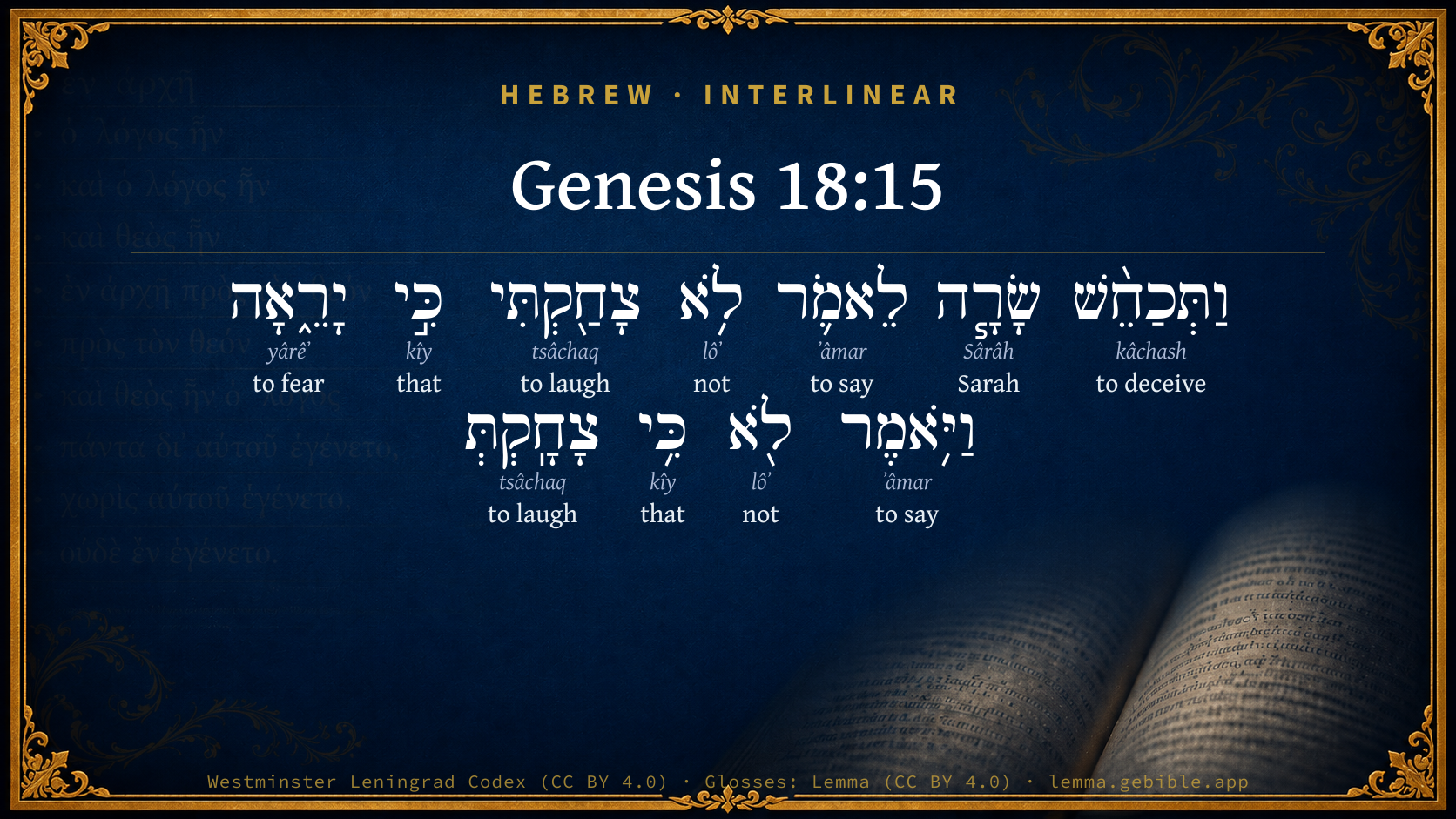
Genesis 18:15

Hebrew (Westminster Leningrad Codex) Genesis 18:15 appears in the Hebrew Old Testament. The text above is from the Westminster Leningrad Codex. Each word links to its Strong’s number, a concise gloss, and parsing drawn from the Open Scriptures Hebrew Bible morphology. Click any word for its full Brown-Driver-Briggs (BDB) entry.
Download image
Cite this verse

Genesis 18:15 (World English Bible). Public Domain. Lemma interlinear Bible study tool, https://lemma.gebible.app/v/genesis/18/15.

Show BibTeX & RIS
BibTeX
RIS
English Translation
Then Sarah denied, saying, "I didn't laugh," for she was afraid." He said, "No, but you did laugh."
World English Bible · Public Domain
Highlights
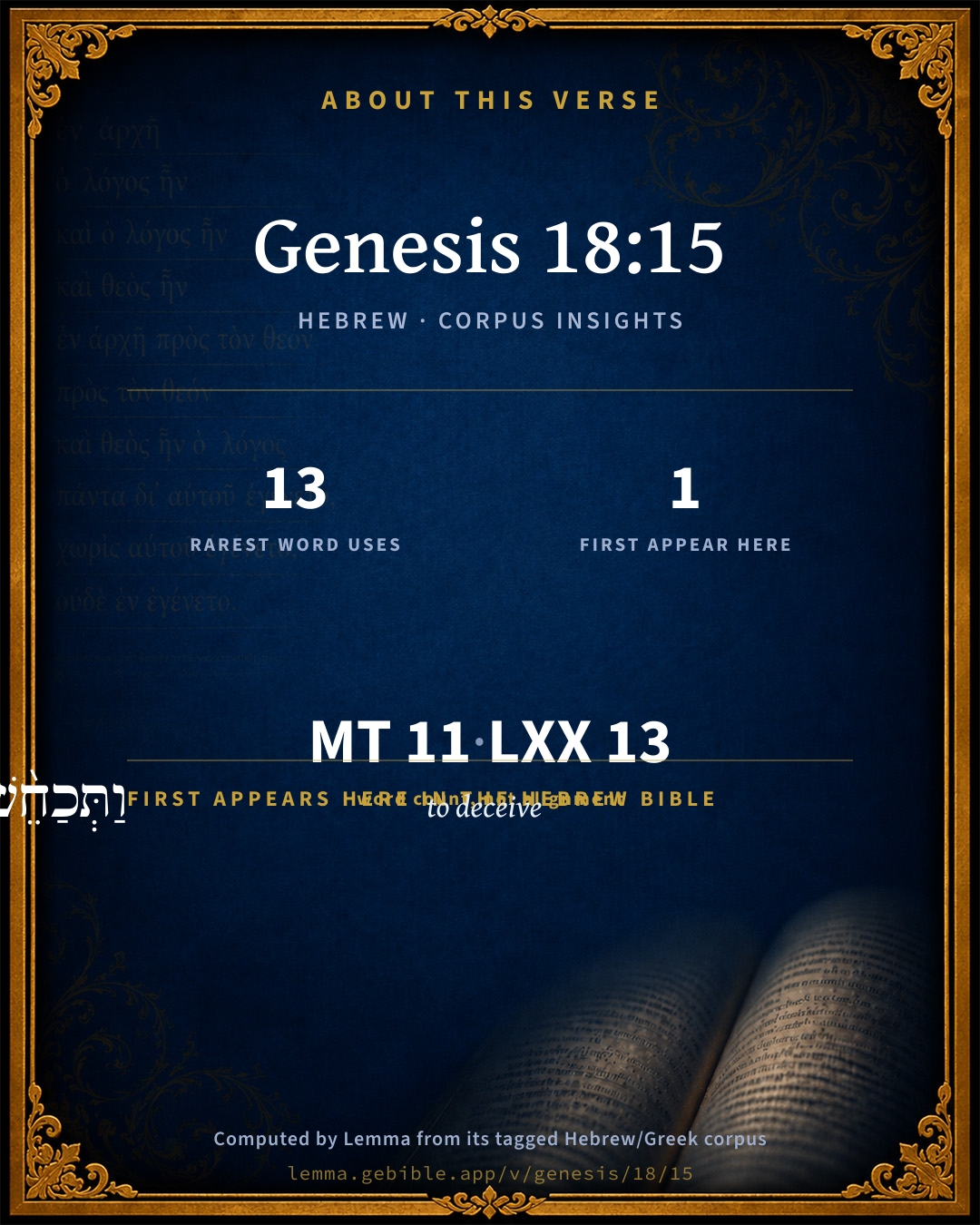
  • 1 first appearance in the Hebrew Bible
Full analysis ↓
Download a study sheet

One document with this verse’s original text, its word-by-word gloss line, the meaning frame, cross-references with their text, attributed commentary, and full source and license credits — printable, and it pastes into notes with its structure intact.

This verse Autodidact and up

Study sheet (.html) Plain text (.txt)

A passage Seminary Student

Up to 50 verses in one chapter. A passage sheet keeps up to 6 commentary sources and 12 cross-references per verse, in the order this page ranks them, and says so on the sheet whenever that leaves anything out. Ask for a single verse and you get the Autodidact verse sheet above.

Everything on this page stays free to read, with no account — the sheet is a download of what is already on screen, not access to it.

Want to remove ads? Support Godless Engineer
Compare translations 3

The same verse in 3 English versions, stacked beneath the original-language interlinear above. Click any original word for its lexicon entry.

Each is an independent rendering of the whole verse — the interlinear is not word-aligned to these translations.

Highlighted words mark where these versions differ — a whole-verse word diff, not a word-by-word alignment.

  • World English Bible Public Domain
    Then Sarah denied, saying, "I didn't laugh," for she was afraid." He said, "No, but you did laugh."
  • King James Version Public Domain
    Then Sarah denied, saying, I laughed not; for she was afraid. And he said, Nay; but thou didst laugh.
  • unfoldingWord Literal Text CC BY-SA 4.0
    But Sarah denied it by saying, “I did not laugh,” because she was afraid. But he said, “No, but you did laugh.” Abraham Intercedes with Yahweh for the City of Sodom 18:16-33

unfoldingWord Literal Text — © unfoldingWord, licensed CC BY-SA 4.0. Word-aligned USFM3 via Door43 (git.door43.org/unfoldingWord/en_ult).

Versions to compare (up to 4)

3 of 4 selected

Show all 18 translations

Every available English version of this verse, each an independent rendering of the whole verse.

  • World English Bible Public Domain
    Then Sarah denied, saying, "I didn't laugh," for she was afraid." He said, "No, but you did laugh."
  • Berean Standard Bible Public Domain
    But Sarah was afraid, so she denied it and said, “I did not laugh.” “No,” replied the LORD, “but you did laugh.”
  • Majority Standard Bible Public Domain
    But Sarah was afraid, so she denied it and said, “I did not laugh.” “No,” replied the LORD, “but you did laugh.”
  • King James Version Public Domain
    Then Sarah denied, saying, I laughed not; for she was afraid. And he said, Nay; but thou didst laugh.
  • American Standard Version (1901) Public Domain
    Then Sarah denied, saying, I laughed not; for she was afraid. And he said, Nay; but thou didst laugh.
  • Revised Version (1885) Public Domain
    Then Sarah denied, saying, I laughed not; for she was afraid. And he said, Nay; but thou didst laugh.
  • Geneva Bible (1599) Public Domain
    But Sarah denied, saying, I laughed not: for she was afraide. And he said, It is not so: for thou laughedst.
  • Douay-Rheims (1899) Public Domain
    Is there any thing hard to God? according to appointment I will return to thee at this same time, life accompanying, and Sara shall have a son.
  • Young's Literal Translation Public Domain
    And Sarah denieth, saying, `I did not laugh;' for she hath been afraid; and He saith, `Nay, but thou didst laugh.'
  • Literal Standard Version CC BY-SA 4.0
    And Sarah denies, saying, “I did not laugh”; for she has been afraid; and He says, “No, but you did laugh.”
  • Unlocked Literal Bible CC BY-SA 4.0
    Then Sarah denied it and said, “I did not laugh,” for she was afraid. He replied, “No, you did laugh.”
  • unfoldingWord Literal Text CC BY-SA 4.0
    But Sarah denied it by saying, “I did not laugh,” because she was afraid. But he said, “No, but you did laugh.” Abraham Intercedes with Yahweh for the City of Sodom 18:16-33
  • Darby Bible Public Domain
    And Sarah denied, saying, I did not laugh; for she was afraid. And he said, No; but thou didst laugh.
  • World Messianic Bible Public Domain
    Then Sarah denied it, saying, “I didn’t laugh,” for she was afraid. He said, “No, but you did laugh.”
  • Webster's Bible Public Domain
    Then Sarah denied, saying, I laughed not; for she was afraid. And he said, Nay; but thou didst laugh.
  • Free Bible Version CC BY-SA 4.0
    Sarah denied it because she was afraid, claiming, “I didn't laugh.” “Yes, you did laugh,” the Lord replied.
  • Bible in Basic English Public Domain
    Then Sarah said, I was not laughing; for she was full of fear. And he said, No, but you were laughing.
  • JPS Tanakh (1917) Public Domain
    Then Sarah denied, saying: 'I laughed not'; for she was afraid. And He said: 'Nay; but thou didst laugh.'

Literal Standard Version (2020), Covenant Press — licensed CC BY-SA 4.0. Text via the HelloAO Bible API (eBible.org). Unlocked Literal Bible (unfoldingWord) — licensed CC BY-SA 4.0. Text via the HelloAO Bible API (eBible.org). unfoldingWord Literal Text — © unfoldingWord, licensed CC BY-SA 4.0. Word-aligned USFM3 via Door43 (git.door43.org/unfoldingWord/en_ult). Free Bible Version, Dr. Jonathan Gallagher — licensed CC BY-SA 4.0. Text via the HelloAO Bible API (eBible.org).

Word by word

More ways to search: Search by grammar → Find every occurrence → Compare this word →

Practice this passage: Drill this verse → Learn its vocabulary →

About this verse

These counts appear in no published source. They are computed here, from the morphology-tagged text and Lemma’s own curated glosses. What Lemma adds →

11
words
7
distinct lemmas
Pentateuch
section

Notable vocabulary

The rarest word here is צָחַ֖קְתִּי to laugh H6711 — appearing just 13 times in the whole Hebrew Bible.

First appearance in Scripture

This word makes its first canonical appearance in the Hebrew Bible here:

  • וַתְּכַחֵ֨שׁ to deceive H3584

Shared distinctive vocabulary

צָחַ֖קְתִּי to laugh H6711 occurs in 12 verses of the Hebrew Bible. Also found in:

Grammatical profile

  • 6 verbs
  • 1 noun
  • 2 conjunctions
  • 2 particles

Verb forms

  • וַתְּכַחֵ֨שׁ Piel · Sequential Imperfect
  • לֵאמֹ֛ר Qal · Infinitive Construct
  • צָחַ֖קְתִּי Qal · Perfect
  • יָרֵ֑אָה Qal · Perfect
  • וַיֹּ֥אמֶר Qal · Sequential Imperfect
  • צָחָֽקְתְּ Qal · Perfect

Repetition

Words recur within this verse — often emphatic in Hebrew:

  • לֵאמֹ֛ר to say H559 ×2
  • צָחַ֖קְתִּי to laugh H6711 ×2
  • לֹ֥א not H3808 ×2
  • כִּ֣י that H3588 ×2

Hebrew & Septuagint length

In English translation the verse runs 18 words from the Hebrew and 22 from the Septuagint (LXX English) — closely comparable.

A rough comparison of the two English renderings, which tokenize alike — not a word-level alignment.

Word counts can differ between the Hebrew and the Greek without any difference in meaning — e.g. the Hebrew direct-object marker אֵת has no separate Greek word, and Greek often adds the article ὁ.

In the original languages it is 11 Hebrew tokens and 13 Greek tokens — but the two are counted differently (Hebrew bundles its prefixes and suffixes into one token; the Greek is in lemma form), so that isn’t a like-for-like length.

Cross-references

14

Topical passages linked to Genesis 18:15 in the Treasury of Scripture Knowledge — connected by theme and wording, ordered by reader-vote popularity; previews shown in the World English Bible.

  • Proverbs 28:13 He who conceals his sins doesn't prosper, But whoever confesses and renounces them finds mercy.
  • 1 John 1:8 If we say that we have no sin, we deceive ourselves, and the truth is not in us.
  • Psalms 44:21 Won't God search this out? For he knows the secrets of the heart.
  • Ephesians 4:23 and that you be renewed in the spirit of your mind,
  • Genesis 4:9 Yahweh said to Cain, "Where is Abel, your brother?" He said, "I don't know. Am I my brother's keeper?"
  • Genesis 12:13 Please say that you are my sister, that it may be well with me for your sake, and that my soul may live because of you."
  • Job 2:10 But he said to her, "You speak as one of the foolish women would speak. What? Shall we receive good at the hand of God, and shall we not receive evil?" In all this Job didn't sin with his lips.
  • Proverbs 12:19 Truth's lips will be established forever, But a lying tongue is only momentary.
  • Mark 2:8 Immediately Jesus, perceiving in his spirit that they so reasoned within themselves, said to them, "Why do you reason these things in your hearts?
  • John 2:25 and because he didn't need for anyone to testify concerning man; for he himself knew what was in man.
  • John 18:17 Then the maid who kept the door said to Peter, "Are you also one of this man's disciples?" He said, "I am not."
  • John 18:25–27 Now Simon Peter was standing and warming himself. They said therefore to him, "You aren't also one of his disciples, are you?" He denied it, and said, "I am not."
  • Romans 3:19 Now we know that whatever things the law says, it speaks to those who are under the law, that every mouth may be closed, and all the world may be brought under the judgment of God.
  • Colossians 3:9 Don't lie to one another, seeing that you have put off the old man with his doings,

Cross-references courtesy of OpenBible.info (CC BY 4.0).

Hebrew and Greek witnesses Masoretic Hebrew ↔ Greek Septuagint

The same verse in the two great witnesses to the Old Testament, shown verse-for-verse.

These are two independent witnesses, not word-aligned to each other, and the Septuagint is shown in lemma (dictionary) form.

Hebrew Genesis 18:15 Masoretic · Westminster Leningrad Codex

וַתְּכַחֵ֨שׁ שָׂרָ֧ה לֵאמֹ֛ר לֹ֥א צָחַ֖קְתִּי כִּ֣י יָרֵ֑אָה וַיֹּ֥אמֶר לֹ֖א כִּ֥י צָחָֽקְתְּ

Then Sarah denied, saying, "I didn't laugh," for she was afraid." He said, "No, but you did laugh."

World English Bible · Public Domain

Greek LXX Genesis 18:15 Septuagint · lemma form

ἀρνέομαι δέ σαρρα λέγω οὐ γελάω φοβέω γάρ καί εἶπον οὐ ἀλλά γελάω

But Sarrha denied, saying, I did not laugh, for she was afraid. And he said to her, Nay, but you did laugh.

LXX2012 (modern English Septuagint) · Public Domain

Hebrew: Westminster Leningrad Codex (CC BY 4.0). Greek: Septuagint (public domain); English from LXX2012 (modern English Septuagint) (Public Domain). How the Septuagint differs from the Hebrew →

Targum (Aramaic paraphrase)

2

The Targum is the ancient Jewish Aramaic paraphrase of the Hebrew Scriptures — an interpretive translation, not the Hebrew text itself. Onkelos (literal) and Pseudo-Jonathan (expansive) render the Torah, and Jonathan the Prophets. Coverage is partial: where no permissively-licensed English translation exists for a verse, only the Aramaic is shown. This is verse-level text, not a word-by-word alignment to the Hebrew.

  1. Targum Onkelos Torah (Genesis–Deuteronomy)
    וְכַדִּיבַת שָׂרָה לְמֵימָר לָא חַיֵּכִית אֲרֵי דְחֵלַת וַאֲמַר לָא בְּרַם חַיָּכְתְּ

    (no public-domain English translation for this verse)

    Targum Onkelos — Aramaic: “Onkelos Genesis” (public domain); “Onkelos Exodus” (public domain); “Onkelos Leviticus” (public domain); “Onkelos Numbers” (public domain); “Onkelos Deuteronomy” (public domain). English: “Sefaria Community Translation” (CC0 1.0 (public-domain dedication)); “J.W. Etheridge. The Targums of Onkelos and Jonathan Ben Uzziel on the Pentateuch. London: Longmans, Green, 1862” (public domain). Text via Sefaria.

  2. Targum Pseudo-Jonathan Torah (Genesis–Deuteronomy)
    וְכַּפְרַת שָרָה לְמֵימַר לָא תָּמִהִית אֲרוּם דְחִילַת וְאָמַר מַלְאָכָא לָא תְדַחֲלוּן אֲרוּם בְּקוּשְׁטָא גָחַכְתְּ

    And Sarah denied and said, I wondered not; for she was afraid. And the Angel said, Fear not: yet in truth thou didst laugh.

    Targum Pseudo-Jonathan — Aramaic: “Targum Jonathan on Genesis” (public domain); “Targum Jonathan on Exodus” (public domain); “Targum Jonathan on Leviticus” (public domain); “Targum Jonathan on Numbers” (public domain); “Targum Jonathan on Deuteronomy” (public domain). English: “The Targum of Jonathan ben Uzziel, trans. J. W. Etheridge, London, 1862” (public domain). Text via Sefaria.

Commentary

Notes on Genesis 18:15 from classic Christian and Jewish commentators (each source and its license shown beneath its notes). The classic Christian expositions comment on the surrounding passage and are grouped to its opening verse, so a note may address several verses; the Jewish commentaries on the Tanakh (Rashi and others) are per-verse, so they appear only where the commentator wrote on this verse.

Lemma curates 59 commentaries, every one of them public domain or Creative Commons licensed, each selected and text-cleaned for this edition rather than reprinted as found. About our sources →

Trapp's Complete Commentary

John Trapp

Gen 18:15 Then Sarah denied, saying, I laughed not; for she was afraid. And he said, Nay; but thou didst laugh.

Ver. 15. I laughed not: for she was afraid.] And well she might; for as everybody hath its shadow, so hath every sin its fear. Her sin she saw was detected, and her conscience she felt was troubled; hence her fear.

Nay, but thou didst laugh.] A lie must be roundly reproved, and the truth asserted. She laughed but within herself, but as good she might have laughed out aloud; for God searcheth the heart. "I pray thee, O Lord, was not this my saying, when I was in my country? {Jon 4:2} No, Jonah, it was not thy saying, it was only thy thinking: but that is all one before him who understandeth thy thoughts afar off". {Psa 139:2}

John Trapp, A Commentary or Exposition upon All the Books of the Old and New Testament (1647–1656) — public domain. Text from a community e-Sword module.

Geneva Bible (1599)

Geneva Bible translators

Hebrew, No.

Geneva Bible (1599) marginal notes — public domain. Text via Bolls.life.

John Calvin's Commentaries

15. Then Sarah denied. Another sin of Sarah’s was, that she endeavored to cover and hide her laughter by a falsehood. Yet this excuse did not proceed from obstinate wickedness, according to the manner in which hypocrites are wont to snatch at subterfuges, so that they remain like themselves, even to the end. Sarah’s feelings were of a different kind; for while she repents of her own folly, she is yet so terrified, as to deny that she had done, what she now perceives to be displeasing to God. Whence we infer, how great is the corruption of our nature, which causes even the fear of God, — the highest of all virtues, — to degenerate into a fault. Moreover, we must observe whence that fear, of which Moses makes mention, suddenly entered the mind of Sarah; namely, from the consideration that God had detected her secret sin. We see, therefore, how the majesty of God, when it is seriously felt by us, shakes us out of our insensibility. We are more especially constrained to feel thus, when God ascends his tribunal, and brings our sins to light.

Nay; but thou didst laugh. The angel does not contend in a multiplicity of words, but directly refutes her false denial of the fact. We may hence learn, that we gain no advantage by tergiversation, when the Lord reproves us, because he will immediately dispatch our case with a single word. Therefore, we must beware lest we imitate the petulance of those who mock God with false pretences, and at length rush into gross contempt of Him. However he may seem to leave us unnoticed for a time, yet he will fulminate against us with that terrible voice, ‘It is not as you pretend.’ In short, it is not enough that the judgment of God should be reverenced, unless we also confess our sins ingenuously and without shifts or evasions. For a double condemnation awaits those who, from a desire to escape the judgment of God, retake themselves to the refuge of dissimulation. We must, therefore bring a sincere confession, that, as persons openly condemned, we may obtain pardon. But seeing that God was contented with giving a friendly reprehension, and that he did not more severely punish the double offense of Sarah; we hence perceive with what tender indulgence he sometimes regards his own people. Zacharias was more severely treated, who was struck dumb for nine months. (Luke 1:9.) But it is not for us to prescribe a perpetual law to God; who, as he generally binds his own people to repentance by punishments, often sees it good to humble them sufficiently, without inflicting any chastisement. In Sarah, truly, he gives a singular instance of his compassion; because he freely forgives her all, and still chooses that she should remain the mother of the Church. In the meantime, we must observe, how much better it is that we should be brought before him as guilty, and that like convicted persons we should be silent, than that we should delight ourselves in sin, as a great part of the world is accustomed to do.

John Calvin's Commentaries (1540-1563) — public domain. Text from the Calvin Translation Society English edition (1840s-50s) via the Christian Classics Ethereal Library (ccel.org). Calvin's coverage is partial (roughly two-thirds of the Bible); uncommented books and verses are honest gaps, never fabricated. The 19th-century editor's footnotes and remarks are omitted so the notes are faithfully Calvin's own voice.

Ellicott's Commentary for English Readers

(15) Sarah denied.—With strange inconsistency Sarah knows that the speaker is Divine, and that He perceived the thoughts that passed “within herself” in the retirement of the tent, and yet denies; but it was the inconsistency of fright. Struck with terror at the thought that she had ridiculed the promise of Jehovah, she offers no excuse, but takes refuge, as frightened people are apt to do, in falsehood. Gently reproved, the result was the building-up of her faith, just as Mary’s doubt was removed and her faith perfected by the angel’s words (Luk_1:34-37).

A Bible Commentary for English Readers, edited by Charles John Ellicott (1878–1897) — public domain. Text from a community e-Sword module.

The Cambridge Bible for Schools and Colleges

gen. ed. J. J. S. Perowne

15. I laughed not] Sarah apparently emerges, in confusion and fear, to deny the guest’s statement. This occasions the fourth repetition of the word “laugh” in these four verses, by the short reply, “Nay, but thou didst laugh.”

The Cambridge Bible for Schools and Colleges (gen. ed. J. J. S. Perowne; Cambridge University Press, 1878–1918) — public domain. Text from a community e-Sword module.

John Gill's Exposition

Then Sarah denied, saying, I laughed not,.... Some render the words, "Sarah lied" (z); and indeed it was no other than a lie, to say she did not laugh when she did; which she might be tempted to say in her confusion, partly because the back of the speaker was to her, and he could not see her, and partly because it was inward, and very little at least discoverable in her countenance:

for she was afraid; of the reproof of her husband; and of the charge of ill manners to a stranger; and especially as she had reason to believe that it was the Lord himself that had spoken these words, and therefore could gladly have excused herself, and wiped off the reproach:

and he said, nay, but thou didst laugh; it is not true what thou sayest, for thou didst certainly laugh; this he knew, being the omniscient God, notwithstanding, as he appeared as a man, his back was to her, and though her laughter was more internal than external.

(z) "mentita est", Drusius.

John Gill's Exposition of the Whole Bible (1746–1763) — public domain (CC PDM 1.0). Text via the HelloAO Bible API.

Haydock's Catholic Bible Commentary

Afraid; which does not entirely clear her of sin: for though she might innocently laugh, if she thought the person who spoke was only a man, yet she ought not to have told an untruth; and if she reflected, that he had disclosed what she supposed no one knew, and thereby manifested his superiority over man, her denial was still more inexcusable. But she was taken, as it were, by surprise; and therefore the Lord reproves her very gently. (Haydock)

George Leo Haydock (1774–1849), Haydock's Catholic Family Bible and Commentary, 1859 edition — public domain. Excludes Psalms (Douay-Rheims chapter numbering differs from Protestant) and Deuterocanonical books (Catholic canon only).

Matthew Poole's English Annotations

Sarah denied, from the sense of guilt, and the discovery of her shame, and the expectation of a sharp rebuke, both from this person, and from her husband.

Matthew Poole's English Annotations on the Holy Bible (1683–1685) — public domain. Text from a community e-Sword/MySword module.

Whedon's Commentary on the Bible

Daniel D. Whedon

15. She was afraid — The direct response to her thoughts, the searching words, the implied rebuke, the evidence from the words that the speaker was Jehovah, all this filled her with a sudden amazement and terror, and under the fear of the moment she denied, saying, I laughed not — The denial was immediately silenced by the answer, Nay, but thou didst laugh; and we may well believe that doubt was changed to faith, and Sarah also believed the promise, and, as Kurtz observes, was “thus rendered capable to become the mother of the promised seed.”

Daniel D. Whedon (gen. ed.), Commentary on the Old and New Testaments (1874–1909) — public domain. Text from a community e-Sword module.

The Pulpit Commentary

Then Sarah (who had overheard the conversation, and the charge preferred against her, and who probably now appeared before the stranger) denied, saying, I laughed not. Sarah s conduct will admit of no other explanation than that which the sacred narrative itself gives. For she was afraid. The knowledge that her secret thoughts had been deciphered must have kindled in her breast the suspicion that her visitor was none other than Jehovah. With this a sense of guilt would immediately assail her conscience for having cherished even a moment any doubt of the Divine word. In the consequent confusion of soul she tries what ever seems to be the first impulse of detected transgressions, viz., deception (cf. Gen_3:12, Gen_3:13) And he said, Nay; but thou didst laugh. With a directness similar to that which he employed in dealing with the first culprits in the garden, not contending in a multiplicity of words, but solemnly announcing that what she said was false. The silence of Sarah was an evidence of her conviction; her subsequent conception was a proof of her repentance anti forgiveness.

The Pulpit Commentary (1880–1919), ed. H.D.M. Spence-Jones & Joseph S. Exell — public domain. Text from a community e-Sword module.

Rashi

Rabbi Shlomo Yitzchaki (Rashi)

כי יראה וגו' כי צחקת FOR SHE WAS AFRAID… BUT THOU DIDST LAUGH — The first כי is used in the sense of “because”, giving a reason for the former statement—Sarah denied … because she was afraid; the second כי is used in the meaning of “but” — “and He said, ‘It is not as you say that you did not laugh, but thou didst laugh’.” For our Rabbis say (Rosh Hashanah 3a) that the word כי has four meanings: “if”, “perhaps”, “but”, “because”.

Rashi on the Tanakh — English translations: “The Judaica Press complete Tanach with Rashi, translated by A. J. Rosenberg” (CC BY 4.0); “Pentateuch with Rashi's commentary by M. Rosenbaum and A.M. Silbermann, 1929-1934” (public domain); “The Metsudah Tanach series, Lakewood, N.J” (CC BY 4.0); and “The Book of Joshua, Metsudah Publications, 1997” (CC BY 4.0). Text via Sefaria.

Ramban (Nachmanides)

Rabbi Moshe ben Nachman (Ramban / Nachmanides)

AND SARAH DENIED, SAYING. I wonder about the righteous prophetess: How did she deny that which G-d had said to the prophet, and also, why did she not believe in the words of G-d’s angels?The answer appears to me to be that these angels who appeared as men came to Abraham, and he, in his wisdom, recognized them. They announced to him, “I will certainly return unto thee, and Sarah shall have a son.” And Sarah heard it, but she did not know that they were angels of the Supreme One, as was the case with the wife of Manoah. It is even possible that she did not see them at all. Therefore she laughed within herself in derision, just [as the word “laugh” is used in the verse]: He that sitteth in heaven laugheth, the Eternal hath them in derision. For joyous laughter is [expressed in Hebrew as originating] in the mouth — Then was our mouth filled with laughter, 126:2. — but laughter originating in the heart is not spoken of as joyous. Now the Holy One, blessed be He, accused her before Abraham as to why the matter appeared to her to be impossible. It was fitting for her to believe, or she should have said, “Amen, G-d do so!” Now Abraham said to her, “Why did you laugh? Is anything too hard for the Eternal?” He did not explain to her that G-d had revealed her secret to him. And she, because of Abraham’s fear of G-d, denied it for she thought that Abraham had said so through recognition of the expressions on her face or because she had kept quiet and gave no expression of praise and thanksgiving or joy. And he said to her, Nay, but thou didst laugh. Then she understood that it was told to him in a prophecy, and so she remained quiet and did not answer a word.It is proper that we also say that Abraham had not revealed to her what had originally been told to him: Indeed, Sarah, thy wife shall bear thee a son. Perhaps he waited until G-d would send her the announcement on the following day for he knew that the Eternal G-d will do nothing, but He revealed His counsel unto His servants the prophets. It may be that due to his great diligence in fulfilling commandments, he was occupied with his circumcision and the circumcision of the many people in his house. Afterward, on account of his weakness, he sat at the doorway of the tent, and the angels came before he had told her anything.

Ramban (Nachmanides) on the Tanakh — English translation: “Commentary on the Torah by Ramban (Nachmanides). Translated and annotated by Charles B. Chavel. New York, Shilo Pub. House, 1971-1976” (CC BY 4.0). Text via Sefaria.

Radak

Rabbi David Kimhi (Radak)

ותכחש...כי יראה, seeing that she was afraid she denied having laughed;

!ויאמר לא, not as you say, for you truly did laugh.

Radak on the Tanakh — English translations: “Sefaria Community Translation” (CC0 1.0 (public-domain dedication)); “Eliyahu Munk, HaChut Hameshulash” (CC BY 4.0); “Rabbi Mike Feuer, Jerusalem Anthology” (CC BY 4.0); and “R. David Kimhi on the first book of Psalms, Translated by R.G. Finch, London, 1919” (public domain). Text via Sefaria.

Lesson kit

Teaching starters — assembled from the data on this page, not authored interpretation. Every prompt links to the verse data it draws on. Edit before teaching.

Genesis, in the Pentateuch, opens this verse with 11 words (7 distinct Hebrew lemmas). Its most distinctive word is tsâchaq (“to laugh”). A historical commentator’s framing appears above. Read the whole chapter for the surrounding context.

Discussion questions

  1. The word tsâchaq carries the sense “to laugh.” How does it shape the verse?
  2. This is the first place “to deceive” appears in Scripture (first appears here). What does its debut here establish?
  3. How does Genesis 17:17, which shares the word «to laugh», read alongside this verse?
  4. What does the repetition of “to say” (2× in this one verse) do in this verse?
  5. The translations on this page render this verse differently — a whole-verse word diff, not a word-by-word alignment. What might account for the different wordings?
  6. «וַתְּכַחֵ֨שׁ» is a Piel Sequential Imperfect verb. How does that grammatical form shape the action described?
  7. Compare how Trapp's Complete Commentary and Geneva Bible (1599) read this verse. Where do they agree or differ?

Things to notice

Reading settings

Reading text

Shown beneath each verse's original-language words.

Old Testament
Old Testament edition

Read the OT as the Masoretic Hebrew (MT) or the Greek Septuagint (LXX).

English shown for the Greek Septuagint (in the Hebrew ↔ Greek comparison).

Comparing translations? Open the Compare panel on any verse page to stack up to four side by side.