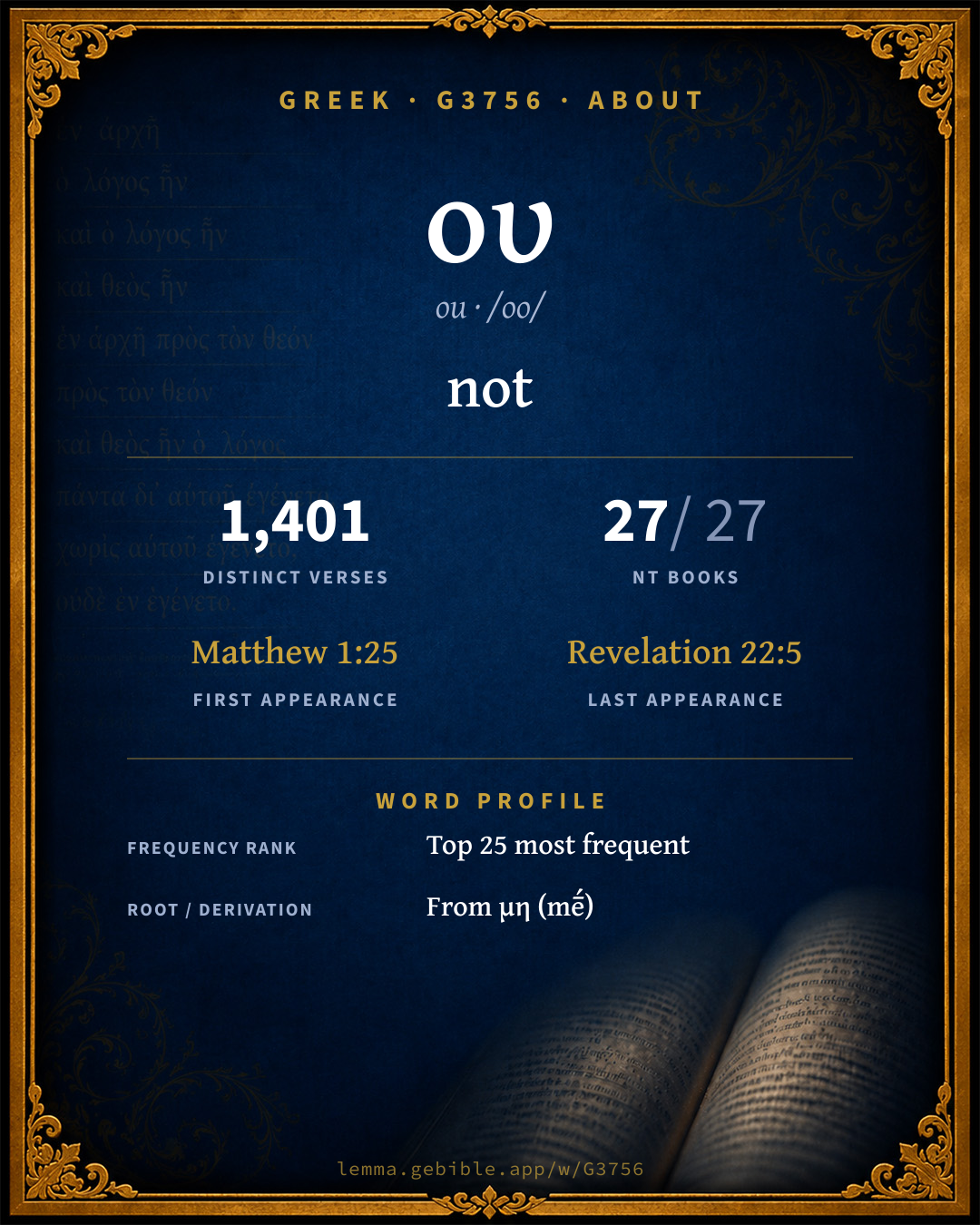
οὐ
not
Full lexicon entry — Thayer's Greek Lexicon
From Thayer's Greek Lexicon
Where this word appears
Grammar key — what these labels mean
Part of speech
- Particle
- A short, often untranslatable function word adding nuance or connection.
Degree
- Negative
- Marks a negative form.
Every verse where G3756 appears in the Book of 1 Corinthians — 114 distinct verses. Click any verse to open its interlinear word-by-word view. Verse text shown in the World English Bible for context — . Each verse’s Greek form is shown with its reference; the English is not keyword-highlighted, since the data carries no word-level English alignment. Use “Compare translations” on any verse to read it across multiple English versions. This concordance covers the Greek New Testament; Septuagint (Greek Old Testament) occurrences of this word are not indexed here.
1 Corinthians
- 1 Corinthians 1:16 οὐκ ptcl neg (I also baptized the household of Stephanas; besides them, I don't know whether I baptized any other.)
- 1 Corinthians 1:17 οὐ οὐκ ptcl neg ptcl neg For Christ sent me not to baptize, but to preach the Gospel--not in wisdom of words, so that the cross of Christ wouldn't be made void.
- 1 Corinthians 1:21 οὐκ ptcl neg For seeing that in the wisdom of God, the world through its wisdom didn't know God, it was God's good pleasure through the foolishness of the preaching to save those who believe.
- 1 Corinthians 1:26 οὐ οὐ οὐ ptcl neg ptcl neg ptcl neg For you see your calling, brothers, that not many are wise according to the flesh, not many mighty, and not many noble;
- 1 Corinthians 2:1 οὐ ptcl neg When I came to you, brothers, I didn't come with excellence of speech or of wisdom, proclaiming to you the testimony of God.
- 1 Corinthians 2:2 οὐ ptcl neg For I determined not to know anything among you, except Jesus Christ, and him crucified.
- 1 Corinthians 2:4 οὐκ ptcl neg My speech and my preaching were not in persuasive words of human wisdom, but in demonstration of the Spirit and of power,
- 1 Corinthians 2:6 οὐ ptcl neg We speak wisdom, however, among those who are full grown; yet a wisdom not of this world, nor of the rulers of this world, who are coming to nothing.
- 1 Corinthians 2:8 οὐκ ptcl neg which none of the rulers of this world has known. For had they known it, they wouldn't have crucified the Lord of glory.
- 1 Corinthians 2:9 οὐκ οὐκ οὐκ ptcl neg ptcl neg ptcl neg But as it is written, "Things which an eye didn't see, and an ear didn't hear, Which didn't enter into the heart of man, These God has prepared for those who love him."
- 1 Corinthians 2:12 οὐ ptcl neg But we received, not the spirit of the world, but the Spirit which is from God, that we might know the things that were freely given to us by God.
- 1 Corinthians 2:13 οὐκ ptcl neg Which things also we speak, not in words which man's wisdom teaches, but which the Holy Spirit teaches, comparing spiritual things with spiritual things.
- 1 Corinthians 2:14 οὐ οὐ ptcl neg ptcl neg Now the natural man doesn't receive the things of God's Spirit, for they are foolishness to him, and he can't know them, because they are spiritually discerned.
- 1 Corinthians 3:1 οὐκ ptcl neg Brothers, I couldn't speak to you as to spiritual, but as to fleshly, as to babies in Christ.
- 1 Corinthians 3:2 οὐ ptcl neg I fed you with milk, not with meat; for you weren't yet ready. Indeed, not even now are you ready,
- 1 Corinthians 3:4 οὐκ ptcl neg For when one says, "I follow Paul," and another, "I follow Apollos," aren't you fleshly?
- 1 Corinthians 3:16 Οὐκ ptcl neg Don't you know that you are a temple of God, and that God's Spirit lives in you?
- 1 Corinthians 4:4 οὐκ ptcl neg For I know nothing against myself. Yet I am not justified by this, but he who judges me is the Lord.
- 1 Corinthians 4:7 οὐκ ptcl neg For who makes you different? And what do you have that you didn't receive? But if you did receive it, why do you boast as if you had not received it?
- 1 Corinthians 4:14 Οὐκ ptcl neg I don't write these things to shame you, but to admonish you as my beloved children.
- 1 Corinthians 4:15 οὐ ptcl neg For though you have ten thousand tutors in Christ, yet not many fathers. For in Christ Jesus, I became your father through the Gospel.
- 1 Corinthians 4:19 οὐ ptcl neg But I will come to you shortly, if the Lord is willing. And I will know, not the word of those who are puffed up, but the power.
- 1 Corinthians 4:20 οὐ ptcl neg For the Kingdom of God is not in word, but in power.
- 1 Corinthians 5:6 Οὐ οὐκ ptcl neg ptcl neg Your boasting is not good. Don't you know that a little yeast leavens the whole lump?
- 1 Corinthians 5:10 οὐ ptcl neg yet not at all meaning with the sexual sinners of this world, or with the covetous and extortioners, or with idolaters; for then you would have to leave the world.
- 1 Corinthians 6:2 οὐκ ptcl neg Don't you know that the saints will judge the world? And if the world is judged by you, are you unworthy to judge the smallest matters?
- 1 Corinthians 6:3 οὐκ ptcl neg Don't you know that we will judge angels? How much more, things that pertain to this life?
- 1 Corinthians 6:5 οὐκ ptcl neg I say this to move you to shame. Isn't there even one wise man among you who would be able to decide between his brothers?
- 1 Corinthians 6:9 οὐκ οὐ ptcl neg ptcl neg Or don't you know that the unrighteous will not inherit the Kingdom of God? Don't be deceived. Neither the sexually immoral, nor idolaters, nor adulterers, nor male prostitutes, nor homosexuals,
- 1 Corinthians 6:10 οὐ οὐ οὐχ ptcl neg ptcl neg ptcl neg nor thieves, nor covetous, nor drunkards, nor slanderers, nor extortioners, will inherit the Kingdom of God.
- 1 Corinthians 6:12 οὐ οὐκ ptcl neg ptcl neg "All things are lawful for me," but not all things are expedient. "All things are lawful for me," but I will not be brought under the power of anything.
- 1 Corinthians 6:13 οὐ ptcl neg "Foods for the belly, and the belly for foods," but God will bring to nothing both it and them. But the body is not for sexual immorality, but for the Lord; and the Lord for the body.
- 1 Corinthians 6:15 οὐκ ptcl neg Don't you know that your bodies are members of Christ? Shall I then take the members of Christ, and make them members of a prostitute? May it never be!
- 1 Corinthians 6:16 οὐκ ptcl neg Or don't you know that he who is joined to a prostitute is one body? For, "The two," says he, "will become one flesh."
- 1 Corinthians 6:19 οὐκ οὐκ ptcl neg ptcl neg Or don't you know that your body is a temple of the Holy Spirit which is in you, which you have from God? You are not your own,
- 1 Corinthians 7:4 οὐκ οὐκ ptcl neg ptcl neg The wife doesn't have authority over her own body, but the husband. Likewise also the husband doesn't have authority over his own body, but the wife.
- 1 Corinthians 7:6 οὐ ptcl neg But this I say by way of concession, not of commandment.
- 1 Corinthians 7:9 οὐκ ptcl neg But if they don't have self-control, let them marry. For it's better to marry than to burn.
- 1 Corinthians 7:10 οὐκ ptcl neg But to the married I command--not I, but the Lord--that the wife not leave her husband
- 1 Corinthians 7:12 οὐχ ptcl neg But to the rest I--not the Lord--say, if any brother has an unbelieving wife, and she is content to live with him, let him not leave her.
- 1 Corinthians 7:15 οὐ ptcl neg Yet if the unbeliever departs, let there be separation. The brother or the sister is not under bondage in such cases, but God has called us in peace.
- 1 Corinthians 7:25 οὐκ ptcl neg Now concerning virgins, I have no commandment from the Lord, but I give my judgment as one who has obtained mercy from the Lord to be trustworthy.
- 1 Corinthians 7:28 οὐχ οὐχ ptcl neg ptcl neg But if you marry, you have not sinned. If a virgin marries, she has not sinned. Yet such will have oppression in the flesh, and I want to spare you.
- 1 Corinthians 7:35 οὐχ ptcl neg This I say for your own profit; not that I may ensnare you, but for that which is appropriate, and that you may attend to the Lord without distraction.
- 1 Corinthians 7:36 οὐχ ptcl neg But if any man thinks that he is behaving inappropriately toward his virgin, if she is past the flower of her age, and if need so requires, let him do what he desires. He doesn't sin. Let them marry.
- 1 Corinthians 8:7 οὐκ ptcl neg However, that knowledge isn't in all men. But some, with consciousness of the idol until now, eat as of a thing sacrificed to an idol, and their conscience, being weak, is defiled.
- 1 Corinthians 8:8 οὐ ptcl neg But food will not commend us to God. For neither, if we don't eat, are we the worse; nor, if we eat, are we the better.
- 1 Corinthians 8:13 οὐ ptcl neg Therefore, if food causes my brother to stumble, I will eat no meat forevermore, that I don't cause my brother to stumble.
- 1 Corinthians 9:1 Οὐκ οὐκ οὐ ptcl neg ptcl neg ptcl neg Am I not free? Am I not an apostle? Haven't I seen Jesus Christ, our Lord? Aren't you my work in the Lord?
- 1 Corinthians 9:2 οὐκ ptcl neg If to others I am not an apostle, yet at least I am to you; for you are the seal of my apostleship in the Lord.
- 1 Corinthians 9:4 οὐκ ptcl neg Have we no right to eat and to drink?
- 1 Corinthians 9:5 οὐκ ptcl neg Have we no right to take along a wife who is a believer, even as the rest of the apostles, and the brothers of the Lord, and Cephas?
- 1 Corinthians 9:6 οὐκ ptcl neg Or have only Barnabas and I no right to not work?
- 1 Corinthians 9:7 οὐκ οὐκ ptcl neg ptcl neg What soldier ever serves at his own expense? Who plants a vineyard, and doesn't eat of its fruit? Or who feeds a flock, and doesn't drink from the flock's milk?
- 1 Corinthians 9:8 οὐ ptcl neg Do I speak these things according to the ways of men? Or doesn't the law also say the same thing?
- 1 Corinthians 9:9 οὐ ptcl neg For it is written in the law of Moses, "You shall not muzzle an ox while it treads out the grain." Is it for the oxen that God cares,
- 1 Corinthians 9:12 οὐ οὐκ ptcl neg ptcl neg If others partake of this right over you, don't we yet more? Nevertheless we did not use this right, but we bear all things, that we may cause no hindrance to the Gospel of Christ.
- 1 Corinthians 9:13 οὐκ ptcl neg Don't you know that those who serve around sacred things eat from the things of the temple, and those who wait on the altar have their portion with the altar?
- 1 Corinthians 9:15 οὐ οὐκ ptcl neg ptcl neg But I have used none of these things, and I don't write these things that it may be done so in my case; for I would rather die, than that anyone should make my boasting void.
- 1 Corinthians 9:16 οὐκ ptcl neg For if I preach the Gospel, I have nothing to boast about; for necessity is laid on me; but woe is to me, if I don't preach the Gospel.
- 1 Corinthians 9:24 οὐκ ptcl neg Don't you know that those who run in a race all run, but one receives the prize? Run like that, that you may win.
- 1 Corinthians 9:26 οὐκ οὐκ ptcl neg ptcl neg I therefore run like that, as not uncertainly. I fight like that, as not beating the air,
- 1 Corinthians 10:1 Οὐ ptcl neg Now I would not have you ignorant, brothers, that our fathers were all under the cloud, and all passed through the sea;
- 1 Corinthians 10:5 οὐκ ptcl neg However with most of them, God was not well pleased, for they were overthrown in the wilderness.
- 1 Corinthians 10:13 οὐκ οὐκ ptcl neg ptcl neg No temptation has taken you except what is common to man. God is faithful, who will not allow you to be tempted above what you are able, but will with the temptation also make the way of escape, that you may be able to endure it.
- 1 Corinthians 10:18 οὐχ ptcl neg Consider Israel after the flesh. Don't those who eat the sacrifices have communion with the altar?
- 1 Corinthians 10:20 οὐ οὐ ptcl neg ptcl neg But I say that the things which the Gentiles sacrifice, they sacrifice to demons, and not to God, and I don't desire that you would have communion with demons.
- 1 Corinthians 10:21 οὐ οὐ ptcl neg ptcl neg You can't both drink the cup of the Lord and the cup of demons. You can't both partake of the table of the Lord, and of the table of demons.
- 1 Corinthians 10:23 οὐ οὐ ptcl neg ptcl neg "All things are lawful for me," but not all things are profitable. "All things are lawful for me," but not all things build up.
- 1 Corinthians 11:6 οὐ ptcl neg For if a woman is not covered, let her also be shorn. But if it is shameful for a woman to be shorn or shaved, let her be covered.
- 1 Corinthians 11:7 οὐκ ptcl neg For a man indeed ought not to have his head covered, because he is the image and glory of God, but the woman is the glory of the man.
- 1 Corinthians 11:8 οὐ ptcl neg For man is not from woman, but woman from man;
- 1 Corinthians 11:9 οὐκ ptcl neg for neither was man created for the woman, but woman for the man.
- 1 Corinthians 11:16 οὐκ ptcl neg But if any man seems to be contentious, we have no such custom, neither do God's assemblies.
- 1 Corinthians 11:17 οὐκ οὐκ ptcl neg ptcl neg But in giving you this command, I don't praise you, that you come together not for the better but for the worse.
- 1 Corinthians 11:20 οὐκ ptcl neg When therefore you assemble yourselves together, it is not possible to eat the Lord's supper.
- 1 Corinthians 11:22 οὐκ οὐκ ptcl neg ptcl neg What, don't you have houses to eat and to drink in? Or do you despise God's assembly, and put them to shame who don't have? What shall I tell you? Shall I praise you? In this I don't praise you.
- 1 Corinthians 11:31 οὐκ ptcl neg For if we discerned ourselves, we wouldn't be judged.
- 1 Corinthians 12:1 οὐ ptcl neg Now concerning spiritual things, brothers, I don't want you to be ignorant.
- 1 Corinthians 12:14 οὐκ ptcl neg For the body is not one member, but many.
- 1 Corinthians 12:15 οὐκ οὐκ οὐ οὐκ ptcl neg ptcl neg ptcl neg ptcl neg If the foot would say, "Because I'm not the hand, I'm not part of the body," it is not therefore not part of the body.
- 1 Corinthians 12:16 οὐκ οὐκ οὐ οὐκ ptcl neg ptcl neg ptcl neg ptcl neg If the ear would say, "Because I'm not the eye, I'm not part of the body," it's not therefore not part of the body.
- 1 Corinthians 12:21 οὐ οὐκ οὐκ ptcl neg ptcl neg ptcl neg The eye can't tell the hand, "I have no need for you," or again the head to the feet, "I have no need for you."
- 1 Corinthians 12:24 οὐ ptcl neg whereas our presentable parts have no such need. But God composed the body together, giving more abundant honor to the inferior part,
- 1 Corinthians 13:4 οὐ οὐ οὐ ptcl neg ptcl neg ptcl neg Love is patient and is kind; love doesn't envy. Love doesn't brag, is not proud,
- 1 Corinthians 13:5 οὐκ οὐ οὐ οὐ ptcl neg ptcl neg ptcl neg ptcl neg doesn't behave itself inappropriately, doesn't seek its own way, is not provoked, takes no account of evil;
- 1 Corinthians 13:6 οὐ ptcl neg doesn't rejoice in unrighteousness, but rejoices with the truth;
- 1 Corinthians 14:2 οὐκ ptcl neg For he who speaks in another language speaks not to men, but to God; for no one understands; but in the Spirit he speaks mysteries.
- 1 Corinthians 14:16 οὐκ ptcl neg Otherwise if you bless with the spirit, how will he who fills the place of the unlearned say the "Amen" at your giving of thanks, seeing he doesn't know what you say?
- 1 Corinthians 14:17 οὐκ ptcl neg For you most assuredly give thanks well, but the other person is not built up.
- 1 Corinthians 14:22 οὐ οὐ ptcl neg ptcl neg Therefore other languages are for a sign, not to those who believe, but to the unbelieving; but prophesying is for a sign, not to the unbelieving, but to those who believe.
- 1 Corinthians 14:23 οὐκ ptcl neg If therefore the whole assembly is assembled together and all speak with other languages, and unlearned or unbelieving people come in, won't they say that you are crazy?
- 1 Corinthians 14:33 οὐ ptcl neg for God is not a God of confusion, but of peace. As in all the assemblies of the saints,
- 1 Corinthians 14:34 οὐ ptcl neg let your wives keep silent in the assemblies, for it has not been permitted for them to speak; but let them be in subjection, as the law also says.
- 1 Corinthians 15:9 οὐκ ptcl neg For I am the least of the apostles, who is not worthy to be called an apostle, because I persecuted the assembly of God.
- 1 Corinthians 15:10 οὐ οὐκ ptcl neg ptcl neg But by the grace of God I am what I am. His grace which was bestowed on me was not futile, but I worked more than all of them; yet not I, but the grace of God which was with me.
- 1 Corinthians 15:12 οὐκ ptcl neg Now if Christ is preached, that he has been raised from the dead, how do some among you say that there is no resurrection of the dead?
- 1 Corinthians 15:13 οὐκ ptcl neg But if there is no resurrection of the dead, neither has Christ been raised.
- 1 Corinthians 15:14 οὐκ ptcl neg If Christ has not been raised, then our preaching is in vain, and your faith also is in vain.
- 1 Corinthians 15:15 οὐκ οὐκ ptcl neg ptcl neg Yes, we are found false witnesses of God, because we testified about God that he raised up Christ, whom he didn't raise up, if it is so that the dead are not raised.
- 1 Corinthians 15:16 οὐκ ptcl neg For if the dead aren't raised, neither has Christ been raised.
- 1 Corinthians 15:17 οὐκ ptcl neg If Christ has not been raised, your faith is vain; you are still in your sins.
- 1 Corinthians 15:29 οὐκ ptcl neg Or else what will they do who are baptized for the dead? If the dead aren't raised at all, why then are they baptized for the dead?
- 1 Corinthians 15:32 οὐκ ptcl neg If I fought with animals at Ephesus for human purposes, what does it profit me? If the dead are not raised, then "let us eat and drink, for tomorrow we die."
- 1 Corinthians 15:36 οὐ ptcl neg You foolish one, that which you yourself sow is not made alive unless it dies.
- 1 Corinthians 15:37 οὐ ptcl neg That which you sow, you don't sow the body that will be, but a bare grain, maybe of wheat, or of some other kind.
- 1 Corinthians 15:39 οὐ ptcl neg All flesh is not the same flesh, but there is one flesh of men, another flesh of animals, another of fish, and another of birds.
- 1 Corinthians 15:46 οὐ ptcl neg However that which is spiritual isn't first, but that which is natural, then that which is spiritual.
- 1 Corinthians 15:50 οὐ ptcl neg Now I say this, brothers, that flesh and blood can't inherit the Kingdom of God; neither does corruption inherit incorruption.
- 1 Corinthians 15:51 οὐ ptcl neg Behold, I tell you a mystery. We will not all sleep, but we will all be changed,
- 1 Corinthians 15:58 οὐκ ptcl neg Therefore, my beloved brothers, be steadfast, immovable, always abounding in the Lord's work, because you know that your labor is not in vain in the Lord.
- 1 Corinthians 16:7 οὐ ptcl neg For I do not wish to see you now in passing, but I hope to stay a while with you, if the Lord permits.
- 1 Corinthians 16:12 οὐκ ptcl neg Now concerning Apollos, the brother, I strongly urged him to come to you with the brothers; and it was not at all his desire to come now; but he will come when he has an opportunity.
- 1 Corinthians 16:22 οὐ ptcl neg If any man doesn't love the Lord Jesus Christ, let him be accursed. Come, Lord!
About this entry
At a glance — auto-summarized from this page’s data, not written by a person. Every figure links to its source below. This summary describes the numbers; it doesn’t interpret them.
“not” is the headline sense of the Greek word ου (ou). First canonically at Matthew 1:25, it enters the text early. It appears 1,401 verses across 27 books of the Greek New Testament, among its most common vocabulary. Related forms include μη, μηδαμως and μηδε. The sections below give every sense, occurrence, and version rendering.
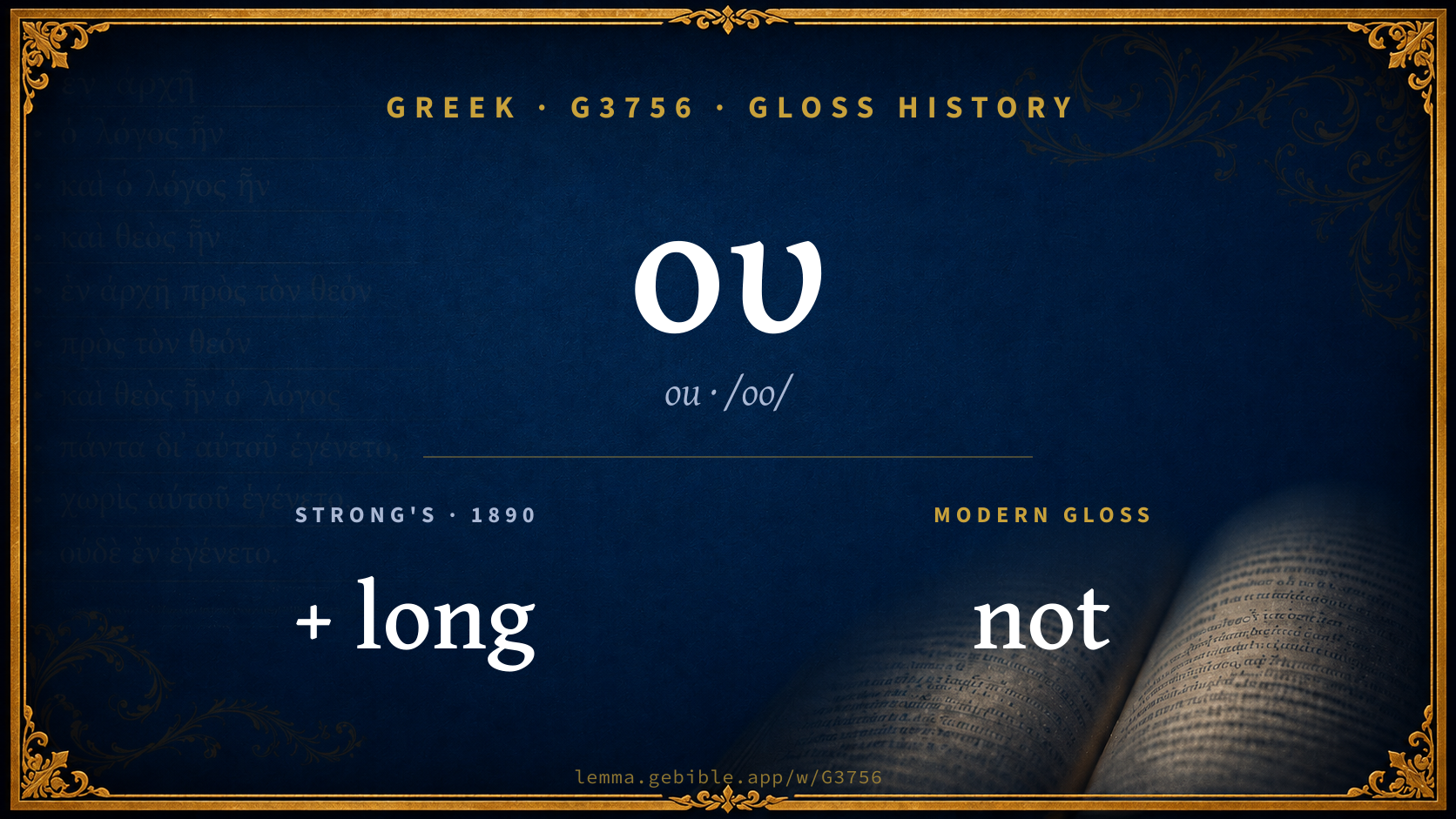
Gloss history
Strong's 1890 vs modern scholarship
About this word
Strong's G3756 catalogs a Greek word from the Greek New Testament.
These counts are not copied from any lexicon or concordance. They are computed here, from the morphology-tagged Greek New Testament. What Lemma adds →
- 1,401
- distinct verses
- The word appears in 1,401 distinct verses.
- 27 / 27
- NT books
- The word appears in 27 of 27 New Testament books.
- #11
- by frequency
- Top 25 most frequent Greek words (rank 11 of 5,347 Greek words by occurrence).
View all 1,401 occurrences in the concordance →
By section of the New Testament
By traditional corpus
Conventional, traditional groupings — biblical authorship is debated, so this is a traditional corpus grouping, not an authorship claim. Some books belong to more than one corpus (Luke is in both the Gospels and the Lukan corpus, and so on), so these shares overlap and need not total 100%. Each figure is a share of the word’s 1,401 distinct verses.
- Gospels 686 verses · 49%
- Pauline corpus 404 verses · 29%
- Johannine 348 verses · 25%
- Lukan (Luke–Acts) 256 verses · 18%
- General (Catholic) Epistles 92 verses · 7%
- Hebrews 62 verses · 4%
- Revelation 54 verses · 4%
How translations render this word
Counts come from each version’s own published word-to-Strong’s tagging or interlinear alignment — an approximate guide to how each version renders this word, not a word-level alignment the data otherwise carries. Because each total is that version’s own tagged count, the per-version totals vary from one another and need not match the appearance or distinct-verse counts above. These counts may also differ from a printed concordance because Lemma counts each distinctly tagged rendering and does not collapse phrase taggings into a single head-word total. This is a fixed set of word-tagged versions (KJV, ASV, BSB, ULT) and does not change with the reading translation you choose elsewhere. Each version’s license is shown beside its name below (and on Sources).
- King James Version: Not 1,159×, No 138×, Cannot 27×
- American Standard Version: Not 1,108×, No 165×, Is not 19×
- Berean Standard Bible: Not 365×, No 123×, Does not 26×
- unfoldingWord Literal Text: Not 1,367×, No 92×, Certainly not 89×
King James Version Public Domain
Renders G3756 across 1,506 tagged occurrences — most commonly:
Plus other, less common renderings. Plus 47 renderings that appear only once — usually multi-word phrases or single function words the recovered tagging swept in, not distinct renderings. Not rendered by a distinct English word in 31 further occurrences.
American Standard Version Public Domain
Renders G3756 across 1,534 tagged occurrences — most commonly:
Plus other, less common renderings. Plus 89 renderings that appear only once — usually multi-word phrases or single function words the recovered tagging swept in, not distinct renderings. Not rendered by a distinct English word in 1 further occurrence.
Berean Standard Bible Public Domain
Renders G3756 across 705 tagged occurrences — most commonly:
Plus other, less common renderings. Plus 46 renderings that appear only once — usually multi-word phrases or single function words the recovered tagging swept in, not distinct renderings. Not rendered by a distinct English word in 128 further occurrences.
unfoldingWord Literal Text CC BY-SA 4.0
Renders G3756 across 1,635 tagged occurrences — most commonly:
Plus other, less common renderings. Plus 21 renderings that appear only once — usually multi-word phrases or single function words the recovered tagging swept in, not distinct renderings.
Senses in Thayer's
The 1 sense Thayer's distinguishes for this word, in lexicon order (not ranked by frequency or importance). The full entry — with sub-senses — is in the Lexicon Entry tab.
- no, not; in direct questions expecting an affirmative answer
Word origin
Derived from μη (mḗ) (G3361) — not.
Also οὐκ ouk ook used before a vowel and οὐχ ouch ookh before an aspirate. A primary word; the absolutely negative (compare G3361 ) adverb; no or not : - + long nay neither never no (X man) none [can-] not + nothing + special un ([-worthy]) when + without + yet but. See also G3364 G3372 .
— Strong’s Exhaustive Concordance (1890), public domain.
Forms in the corpus
The 8 distinct written forms G3756 takes in the Greek New Testament, most frequent first — each parse links to that case’s occurrences in the concordance.
| Form | Parsing | Example | Uses |
|---|---|---|---|
| οὐκ ouk | Particle, Negative | Matthew 1:25 | 828 |
| οὐ ou | Particle, Negative | Matthew 5:14 | 660 |
| οὐχ ouch | Particle, Negative | Matthew 6:26 | 104 |
| οὔ oú | Particle, Negative | Matthew 5:37 | 14 |
| Οὐ Ou | Particle, Negative | Matthew 7:21 | 11 |
| Οὐκ Ouk | Particle, Negative | Matthew 10:24 | 4 |
| οὒ où | Particle, Negative | Matthew 5:37 | 3 |
| Οὐχ Ouch | Particle, Negative | Romans 9:6 | 2 |
Same root — word family
Other Thayer's entries built from the same root as G3756, grouped by Strong’s listed origin. These share a root / origin per the lexicon — not necessarily a shared meaning. Each links to that word’s own entry.
Derives from
Shares the same root
- μηδαμως mēdamōs G3365 by no means
- μηδε mēdé G3366 and not
- μηδεις mēdeís G3367 no one
- μηκετι mēkéti G3371 no longer
- μη ουκ mḕ ouk G3378 not ever
- μηποτε mḗpote G3379 lest
- μηπω mḗpō G3380 not yet
- μηπως mḗpōs G3381 lest
- μητε mḗte G3383 nor
- μητι mḗti G3385 whether
- μητις mḗtis G3387 let no one
Derived from this word
- μη mḗ G3361 not
- ου μη ou mḗ G3364 by no means
- ουδε oudé G3761 neither
- ουκετι oukéti G3765 no longer
- ουκουν oukoûn G3766 not therefore
- ουπω oúpō G3768 not yet
- ουτε oúte G3777 neither
- ουχι ouchí G3780 not at all
Compare all same-root words → Showing 4 of 20 — not the complete family. They share a root, not necessarily a meaning.
Septuagint usage
The same Greek word ου appears 5,233 times in the Greek Old Testament (Septuagint), across 4,158 verses in 38 books.
- 5,233
- LXX occurrences
- Tagged occurrences of this Greek word in the Septuagint.
- 4,158
- verses
- Distinct Septuagint verses containing this word.
- 38 / 39
- OT books
- The word appears in 38 of the 39 Old Testament books.
Sample Septuagint occurrences
- Genesis 2:5 οὐ
- Exodus 1:8 οὐ
- Leviticus 1:17 οὐ
- Numbers 1:47 οὐ
- Deuteronomy 1:9 οὐ
- Joshua 1:5 οὐ
- Judges 1:18 οὐ
- Ruth 2:7 οὐ
- 1 Samuel 1:2 οὐ
- 2 Samuel 1:10 οὐ
- 1 Kings 1:1 οὐ
- 2 Kings 1:4 οὐ
Septuagint occurrences (same lexeme)
Every verse where the same Strong’s number (G3756) appears in the Greek Septuagint — showing the first 50 of 4,158. Verse text shown in the World English Bible for context; the Greek form is the matched word — the English is not keyword-highlighted.
- Genesis 2:5 οὐ No plant of the field was yet in the earth, and no herb of the field had yet sprung up; for Yahweh God had not caused it to rain on the earth. There was not a man to till the ground,
- Genesis 2:17 οὐ but of the tree of the knowledge of good and evil, you shall not eat of it: for in the day that you eat of it you will surely die."
- Genesis 2:18 οὐ Yahweh God said, "It is not good that the man should be alone; I will make him a helper suitable for him."
- Genesis 2:20 οὐ The man gave names to all cattle, and to the birds of the sky, and to every animal of the field; but for man there was not found a helper suitable for him.
- Genesis 2:25 οὐ They were both naked, the man and his wife, and were not ashamed.
- Genesis 3:1 οὐ Now the serpent was more subtle than any animal of the field which Yahweh God had made. He said to the woman, "Yes, has God said, 'You shall not eat of any tree of the garden?'"
- Genesis 3:3 οὐ but of the fruit of the tree which is in the midst of the garden, God has said, 'You shall not eat of it, neither shall you touch it, lest you die.'"
- Genesis 3:4 οὐ The serpent said to the woman, "You won't surely die,
- Genesis 4:5 οὐ but he didn't respect Cain and his offering. Cain was very angry, and the expression on his face fell.
- Genesis 4:7 οὐ If you do well, will it not be lifted up? If you don't do well, sin crouches at the door. Its desire is for you, but you are to rule over it."
- Genesis 4:9 οὐ Yahweh said to Cain, "Where is Abel, your brother?" He said, "I don't know. Am I my brother's keeper?"
- Genesis 4:12 οὐ From now on, when you till the ground, it won't yield its strength to you. You shall be a fugitive and a wanderer in the earth."
- Genesis 4:15 οὐ Yahweh said to him, "Therefore whoever slays Cain, vengeance will be taken on him sevenfold." Yahweh appointed a sign for Cain, lest any finding him should strike him.
- Genesis 5:24 οὐ Enoch walked with God, and he was not, for God took him.
- Genesis 6:3 οὐ Yahweh said, "My Spirit will not strive with man forever, because he also is flesh; yet will his days be one hundred twenty years."
- Genesis 8:7 οὐ and he sent forth a raven. It went back and forth, until the waters were dried up from off the earth.
- Genesis 8:9 οὐ but the dove found no place to rest her foot, and she returned to him into the ark; for the waters were on the surface of the whole earth. He put forth his hand, and took her, and brought her to him into the ark.
- Genesis 8:12 οὐ He stayed yet another seven days, and sent forth the dove; and she didn't return to him any more.
- Genesis 8:21 οὐ Yahweh smelled the sweet savor. Yahweh said in his heart, "I will not again curse the ground any more for man's sake, because the imagination of man's heart is evil from his youth; neither will I ever again strike everything living, as I have done.
- Genesis 8:22 οὐ While the earth remains, seed time and harvest, and cold and heat, and summer and winter, and day and night shall not cease."
- Genesis 9:4 οὐ But flesh with the life of it, the blood of it, you shall not eat.
- Genesis 9:11 οὐ I will establish my covenant with you; neither will all flesh be cut off any more by the waters of the flood; neither will there any more be a flood to destroy the earth."
- Genesis 9:15 οὐ and I will remember my covenant, which is between me and you and every living creature of all flesh, and the waters will no more become a flood to destroy all flesh.
- Genesis 9:23 οὐ Shem and Japheth took a garment, and laid it on both their shoulders, went in backwards, and covered the nakedness of their father. Their faces were backwards, and they didn't see their father's nakedness.
- Genesis 11:6 οὐ Yahweh said, "Behold, they are one people, and they have all one language; and this is what they begin to do. Now nothing will be withheld from them, which they intend to do.
- Genesis 11:30 οὐ Sarai was barren. She had no child.
- Genesis 12:18 οὐ Pharaoh called Abram, and said, "What is this that you have done to me? Why didn't you tell me that she was your wife?
- Genesis 13:6 οὐ The land was not able to bear them, that they might live together: for their substance was great, so that they could not live together.
- Genesis 13:9 οὐ Isn't the whole land before you? Please separate yourself from me. If you go to the left hand, then I will go to the right. Or if you go to the right hand, then I will go to the left."
- Genesis 15:3 οὐ Abram said, "Behold, to me you have given no seed: and, behold, one born in my house is my heir."
- Genesis 15:4 οὐ Behold, the word of Yahweh came to him, saying, "This man will not be your heir, but he who will come forth out of your own body will be your heir."
- Genesis 15:10 οὐ He took him all these, and divided them in the middle, and laid each half opposite the other; but he didn't divide the birds.
- Genesis 15:13 οὐ He said to Abram, "Know for sure that your seed will live as foreigners in a land that is not theirs, and will serve them. They will afflict them four hundred years.
- Genesis 16:1 οὐ Now Sarai, Abram's wife, bore him no children. She had a handmaid, an Egyptian, whose name was Hagar.
- Genesis 16:10 οὐ The angel of Yahweh said to her, "I will greatly multiply your seed, that they will not be numbered for multitude."
- Genesis 17:5 οὐ Neither will your name any more be called Abram, but your name will be Abraham; for the father of a multitude of nations have I made you.
- Genesis 17:12 οὐ He who is eight days old will be circumcised among you, every male throughout your generations, he who is born in the house, or bought with money of any foreigner who is not of your seed.
- Genesis 17:14 οὐ The uncircumcised male who is not circumcised in the flesh of his foreskin, that soul shall be cut off from his people. He has broken my covenant."
- Genesis 17:15 οὐ God said to Abraham, "As for Sarai your wife, you shall not call her name Sarai, but her name will be Sarah.
- Genesis 18:15 οὐ Then Sarah denied, saying, "I didn't laugh," for she was afraid." He said, "No, but you did laugh."
- Genesis 18:24 οὐ What if there are fifty righteous within the city? Will you consume and not spare the place for the fifty righteous who are therein?
- Genesis 18:25 οὐ Be it far from you to do things like that, to kill the righteous with the wicked, that so the righteous should be as the wicked. May that be far from you. Shouldn't the Judge of all the earth do right?"
- Genesis 18:28 οὐ What if there will lack five of the fifty righteous? Will you destroy all the city for lack of five?" He said, "I will not destroy it, if I find forty-five there."
- Genesis 18:29 οὐ He spoke to him yet again, and said, "What if there are forty found there?" He said, "I will not do it for the forty's sake."
- Genesis 18:30 οὐ He said, "Oh don't let the Lord be angry, and I will speak. What if there are thirty found there?" He said, "I will not do it, if I find thirty there."
- Genesis 18:31 οὐ He said, "See now, I have taken it on myself to speak to the Lord. What if there are twenty found there?" He said, "I will not destroy it for the twenty's sake."
- Genesis 18:32 οὐ He said, "Oh don't let the Lord be angry, and I will speak yet but this once. What if ten are found there?" He said, "I will not destroy it for the ten's sake."
- Genesis 19:2 οὐ and he said, "See now, my lords, please turn aside into your servant's house, stay all night, wash your feet, and you will rise up early, and go on your way." They said, "No, but we will stay in the street all night."
- Genesis 19:8 οὐ See now, I have two virgin daughters. Please let me bring them out to you, and do you to them as is good in your eyes. Only don't do anything to these men, because they have come under the shadow of my roof."
- Genesis 19:19 οὐ See now, your servant has found favor in your sight, and you have magnified your loving kindness, which you have shown to me in saving my life. I can't escape to the mountain, lest evil overtake me, and I die.
These are occurrences of the same Greek lexeme (G3756) in the Septuagint — not a translation of any one Hebrew word. The store carries no word-level Hebrew↔Greek alignment, so no Hebrew original is asserted here. Counts come from the recovered LXX Strong's tagging — high-frequency vocabulary is well covered, while rare or late forms may be untagged — so they reflect tagged occurrences and may slightly undercount.