
Matthew 3:11

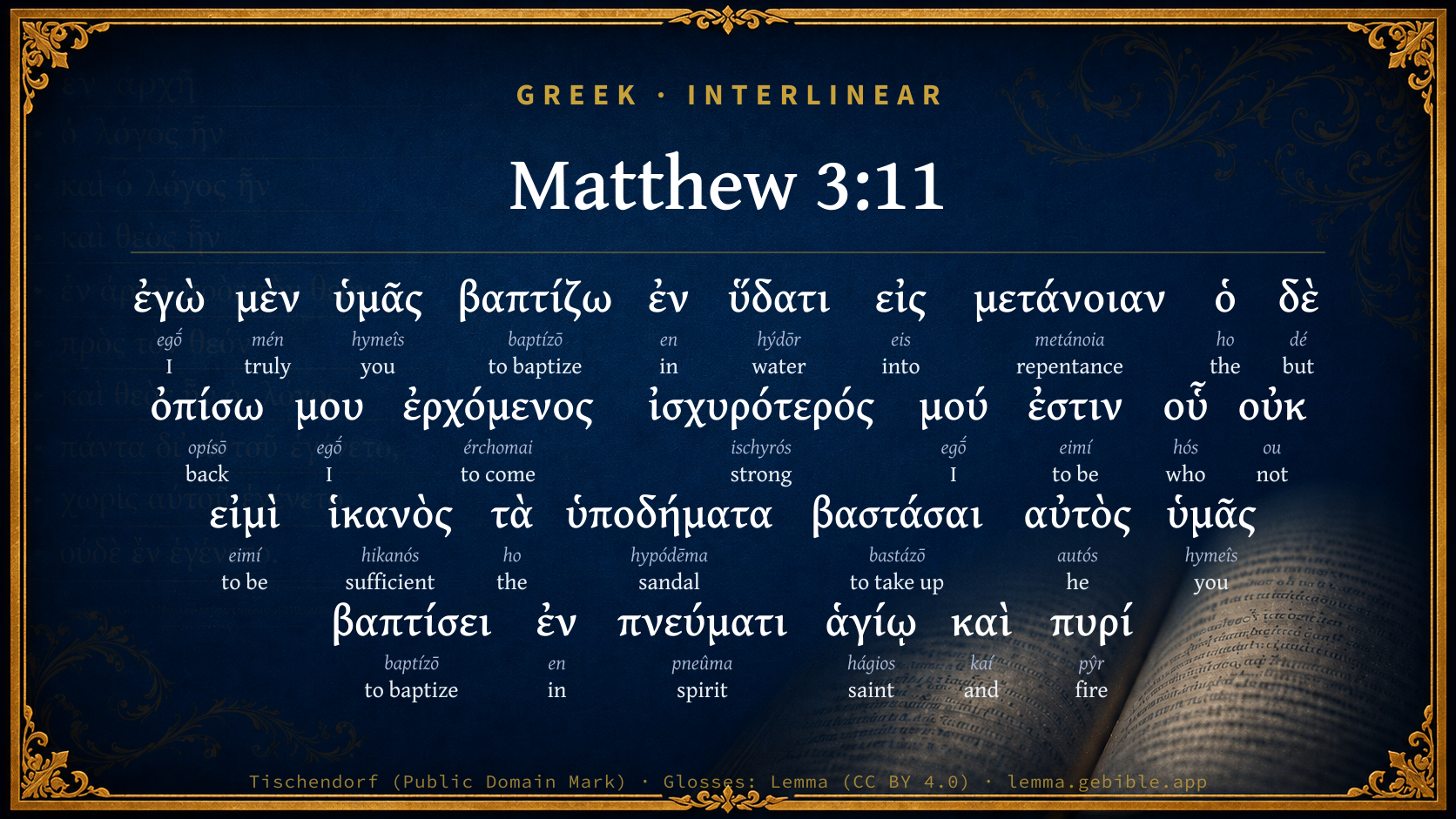
Greek (Tischendorf 8th ed.) Matthew 3:11 appears in the Greek New Testament. The text above is from the Tischendorf 8th edition. Each word links to its Strong’s number and a concise gloss. Click any word for its full Thayer’s Greek Lexicon entry.
Download image
Cite this verse

Matthew 3:11 (World English Bible). Public Domain. Lemma interlinear Bible study tool, https://lemma.gebible.app/v/matthew/3/11.

Show BibTeX & RIS
BibTeX
RIS
English Translation
I indeed baptize you in water for repentance, but he who comes after me is mightier than I, whose shoes I am not worthy to carry. He will baptize you in the Holy Spirit.
World English Bible · Public Domain
Highlights
  • 7 first appearances in the Greek New Testament
Full analysis ↓
Download a study sheet

One document with this verse’s original text, its word-by-word gloss line, the meaning frame, cross-references with their text, attributed commentary, and full source and license credits — printable, and it pastes into notes with its structure intact.

This verse Autodidact and up

Study sheet (.html) Plain text (.txt)

A passage Seminary Student

Up to 50 verses in one chapter. A passage sheet keeps up to 6 commentary sources and 12 cross-references per verse, in the order this page ranks them, and says so on the sheet whenever that leaves anything out. Ask for a single verse and you get the Autodidact verse sheet above.

Everything on this page stays free to read, with no account — the sheet is a download of what is already on screen, not access to it.

Want to remove ads? Support Godless Engineer
Compare translations 3

The same verse in 3 English versions, stacked beneath the original-language interlinear above. Click any original word for its lexicon entry.

Each is an independent rendering of the whole verse — the interlinear is not word-aligned to these translations.

Highlighted words mark where these versions differ — a whole-verse word diff, not a word-by-word alignment.

  • World English Bible Public Domain
    I indeed baptize you in water for repentance, but he who comes after me is mightier than I, whose shoes I am not worthy to carry. He will baptize you in the Holy Spirit.
  • King James Version Public Domain
    I indeed baptize you with water unto repentance: but he that cometh after me is mightier than I, whose shoes I am not worthy to bear: he shall baptize you with the Holy Ghost, and with fire:
  • unfoldingWord Literal Text CC BY-SA 4.0
    I indeed baptize you with water for repentance. But the one coming after me is more powerful than I, of whom I am not worthy to carry away his sandals. He will baptize you with the Holy Spirit and with fire,

unfoldingWord Literal Text — © unfoldingWord, licensed CC BY-SA 4.0. Word-aligned USFM3 via Door43 (git.door43.org/unfoldingWord/en_ult).

Versions to compare (up to 4)

3 of 4 selected

Show all 19 translations

Every available English version of this verse, each an independent rendering of the whole verse.

  • World English Bible Public Domain
    I indeed baptize you in water for repentance, but he who comes after me is mightier than I, whose shoes I am not worthy to carry. He will baptize you in the Holy Spirit.
  • Berean Standard Bible Public Domain
    I baptize you with water for repentance, but after me will come One more powerful than I, whose sandals I am not worthy to carry. He will baptize you with the Holy Spirit and with fire.
  • Majority Standard Bible Public Domain
    I baptize you with water for repentance, but after me will come One more powerful than I, whose sandals I am not worthy to carry. He will baptize you with the Holy Spirit.
  • King James Version Public Domain
    I indeed baptize you with water unto repentance: but he that cometh after me is mightier than I, whose shoes I am not worthy to bear: he shall baptize you with the Holy Ghost, and with fire:
  • American Standard Version (1901) Public Domain
    I indeed baptize you in water unto repentance: but he that cometh after me is mightier than I, whose shoes I am not worthy to bear: he shall baptize you in the Holy Spirit and `in' fire:
  • Revised Version (1885) Public Domain
    I indeed baptize you with water unto repentance: but he that cometh after me is mightier than I, whose shoes I am not worthy to bear: he shall baptize you with the Holy Ghost and with fire:
  • Geneva Bible (1599) Public Domain
    In deede I baptize you with water to amendment of life, but he that commeth after me, is mightier then I, whose shoes I am not worthie to beare: hee will baptize you with the holy Ghost, and with fire.
  • Douay-Rheims (1899) Public Domain
    I indeed baptize you in the water unto penance, but he that shall come after me, is mightier than I, whose shoes I am not worthy to bear; he shall baptize you in the Holy Ghost and fire.
  • Young's Literal Translation Public Domain
    `I indeed do baptize you with water to reformation, but he who after me is coming is mightier than I, of whom I am not worthy to bear the sandals, he shall baptize you with the Holy Spirit and with fire,
  • Literal Standard Version CC BY-SA 4.0
    I indeed immerse you in water for conversion, but He who is coming after me is mightier than I, of whom I am not worthy to carry the sandals, He will immerse you in the Holy Spirit and fire,
  • Unlocked Literal Bible CC BY-SA 4.0
    I baptize you with water for repentance. But he who comes after me is mightier than I, and I am not worthy even to carry his sandals. He will baptize you with the Holy Spirit and with fire.
  • unfoldingWord Literal Text CC BY-SA 4.0
    I indeed baptize you with water for repentance. But the one coming after me is more powerful than I, of whom I am not worthy to carry away his sandals. He will baptize you with the Holy Spirit and with fire,
  • Darby Bible Public Domain
    *I* indeed baptise you with water to repentance, but he that comes after me is mightier than I, whose sandals I am not fit to bear; *he* shall baptise you with [the] Holy Spirit and fire;
  • World Messianic Bible Public Domain
    “I indeed immerse you in water for repentance, but he who comes after me is mightier than I, whose sandals I am not worthy to carry. He will immerse you in the Holy Spirit.
  • Webster's Bible Public Domain
    I indeed baptize you with water to repentance: but he that cometh after me is mightier than I, whose shoes I am not worthy to bear: he shall baptize you with the Holy Spirit, and with fire:
  • Free Bible Version CC BY-SA 4.0
    Yes, I baptize you in water to show repentance, but after me is coming one who is greater than I am. I'm not worthy even to remove his sandals. He will baptize you with the Holy Spirit and with fire.
  • Bible in Basic English Public Domain
    Truly, I give baptism with water to those of you whose hearts are changed; but he who comes after me is greater than I, whose shoes I am not good enough to take up: he will give you baptism with the Holy Spirit and with fire:
  • Text-Critical English NT CC BY 4.0
    “I baptize you with water for repentance, but he who is coming after me is mightier than I, whose sandals I am not worthy to carry. He will baptize you with the Holy Spirit.
  • Tyndale New Testament (1534) Public Domain
    I baptise you in water in toke of repentaunce: but he that cometh after me is myghtier then I whose shues I am not worthy to beare. He shall baptise you with the holy gost and with fyre:

Literal Standard Version (2020), Covenant Press — licensed CC BY-SA 4.0. Text via the HelloAO Bible API (eBible.org). Unlocked Literal Bible (unfoldingWord) — licensed CC BY-SA 4.0. Text via the HelloAO Bible API (eBible.org). unfoldingWord Literal Text — © unfoldingWord, licensed CC BY-SA 4.0. Word-aligned USFM3 via Door43 (git.door43.org/unfoldingWord/en_ult). Free Bible Version, Dr. Jonathan Gallagher — licensed CC BY-SA 4.0. Text via the HelloAO Bible API (eBible.org).

Word by word

More ways to search: Search by grammar → Find every occurrence → Compare this word →

Practice this passage: Drill this verse → Learn its vocabulary →

ὑποδήματα
hypódēma
G5266
“sandal”
Noun, Accusative, Plural, Neuter
Part of Speech
Noun
Case
Accusative
Number
Plural
Gender
Neuter
Full Thayer's Definition

Origin: from G5265

TDNT: 10:10,7

1. what is bound under, a sandal, a sole fastened to the foot with thongs
  1. ἐγὼ egṓ G1473 “I” Personal pronoun, 1st person, Nominative, Singular
  2. μὲν mén G3303 “truly” Particle
  3. ὑμᾶς hymeîs G5210 “you” Personal pronoun, 2nd person, Accusative, Plural
  4. βαπτίζω baptízō G907 “to baptize” Verb, Present, Active, Indicative, 1st person, Singular
  5. ἐν en G1722 “in” Preposition
  6. ὕδατι hýdōr G5204 “water” Noun, Dative, Singular, Neuter
  7. εἰς eis G1519 “into” Preposition
  8. μετάνοιαν metánoia G3341 “repentance” Noun, Accusative, Singular, Feminine
  9. ὁ ho G3588 “the” Article, Nominative, Singular, Masculine
  10. δὲ dé G1161 “but” Conjunction
  11. ὀπίσω opísō G3694 “back” Adverb
  12. μου egṓ G1473 “I” Personal pronoun, 1st person, Genitive, Singular
  13. ἐρχόμενος érchomai G2064 “to come” Verb, Present, Middle or Passive deponent, Participle, Nominative, Singular, Masculine
  14. ἰσχυρότερός ischyrós G2478 “strong” Adjective, Nominative, Singular, Masculine, Comparative
  15. μού egṓ G1473 “I” Personal pronoun, 1st person, Genitive, Singular
  16. ἐστιν eimí G1510 “to be” Verb, Present, Active, Indicative, 3rd person, Singular
  17. οὗ hós G3739 “who” Relative pronoun, Genitive, Singular, Masculine
  18. οὐκ ou G3756 “not” Particle, Negative
  19. εἰμὶ eimí G1510 “to be” Verb, Present, Active, Indicative, 1st person, Singular
  20. ἱκανὸς hikanós G2425 “sufficient” Adjective, Nominative, Singular, Masculine
  21. τὰ ho G3588 “the” Article, Accusative, Plural, Neuter
  22. βαστάσαι bastázō G941 “to take up” Verb, Aorist, Active, Infinitive
  23. αὐτὸς autós G846 “he” Personal pronoun, Nominative, Singular, Masculine
  24. ὑμᾶς hymeîs G5210 “you” Personal pronoun, 2nd person, Accusative, Plural
  25. βαπτίσει baptízō G907 “to baptize” Verb, Future, Active, Indicative, 3rd person, Singular
  26. ἐν en G1722 “in” Preposition
  27. πνεύματι pneûma G4151 “spirit” Noun, Dative, Singular, Neuter
  28. ἁγίῳ hágios G40 “saint” Adjective, Dative, Singular, Neuter
  29. καὶ kaí G2532 “and” Conjunction
  30. πυρί pŷr G4442 “fire” Noun, Dative, Singular, Neuter

About this verse

These counts appear in no published source. They are computed here, from the morphology-tagged text and Lemma’s own curated glosses. What Lemma adds →

31
words
24
distinct lemmas
Gospels
section

Notable vocabulary

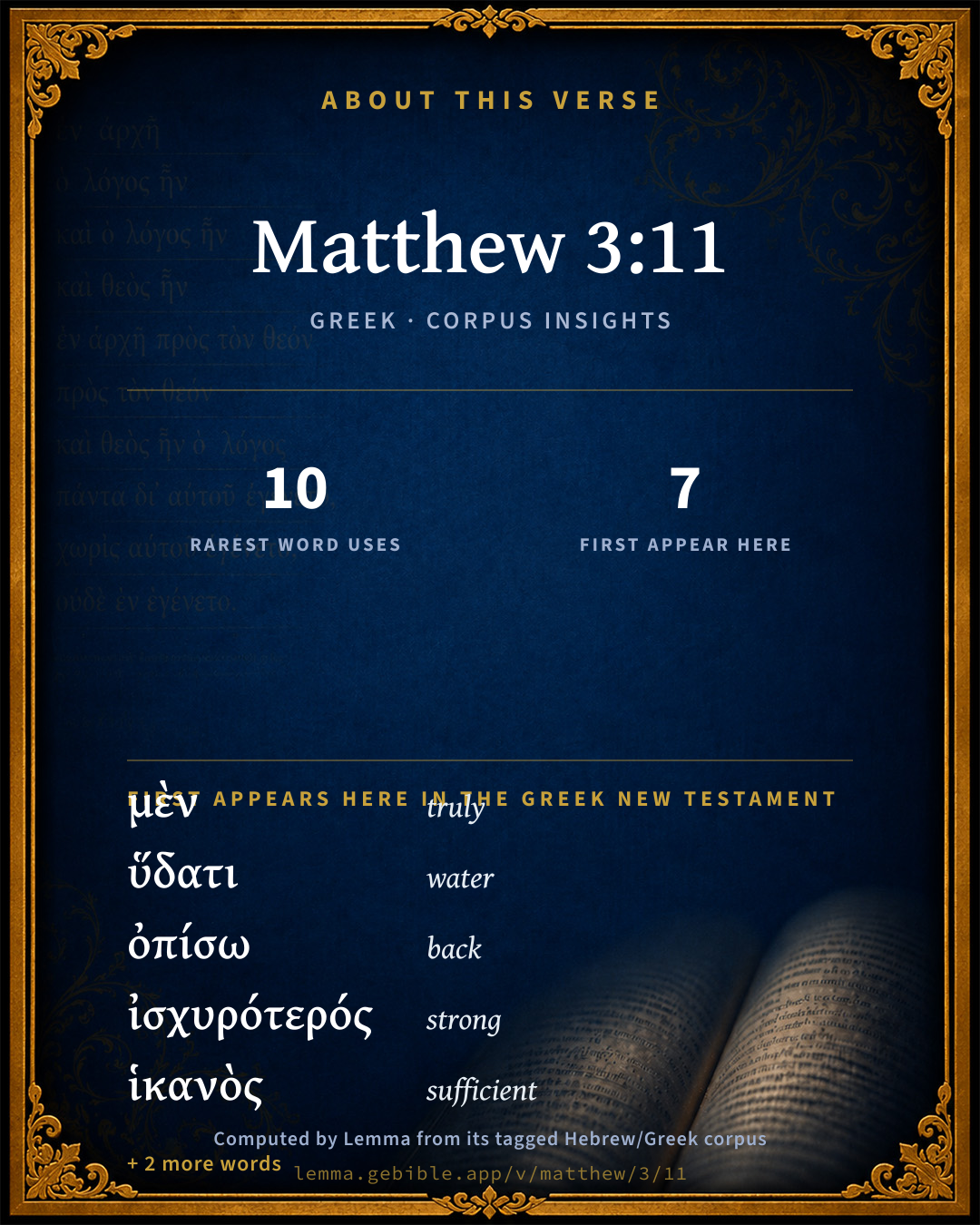
The rarest word here is ὑποδήματα sandal G5266 — appearing just 10 times in the whole Greek New Testament.

First appearance in Scripture

These words make their first canonical appearance in the Greek New Testament here:

  • μὲν truly G3303
  • ὕδατι water G5204
  • ὀπίσω back G3694
  • ἰσχυρότερός strong G2478
  • ἱκανὸς sufficient G2425
  • ὑποδήματα sandal G5266
  • βαστάσαι to take up G941

Shared distinctive vocabulary

ὑποδήματα sandal G5266 occurs in 10 verses of the Greek New Testament. Also found in:
Repetition

Words recur within this verse:

  • βαπτίζω to baptize G907 ×2
  • ἐστιν to be G1510 ×2
  • ἐγὼ I G1473 ×3
  • ὑμᾶς you G5210 ×2
  • ἐν in G1722 ×2
  • ὁ the G3588 ×2

Cross-references

27

Topical passages linked to Matthew 3:11 in the Treasury of Scripture Knowledge — connected by theme and wording, ordered by reader-vote popularity; previews shown in the World English Bible.

  • Isaiah 4:4 when the Lord shall have washed away the filth of the daughters of Zion, and shall have purged the blood of Jerusalem from its midst, by the spirit of justice, and by the spirit of burning.
  • Luke 3:16 John answered them all, "I indeed baptize you with water, but he comes who is mightier than I, the latchet of whose sandals I am not worthy to loosen. He will baptize you in the Holy Spirit and fire,
  • Acts 1:5 For John indeed baptized in water, but you will be baptized in the Holy Spirit not many days from now."
  • Zechariah 13:9 I will bring the third part into the fire, And will refine them as silver is refined, And will test them like gold is tested. They will call on my name, and I will hear them. I will say, 'It is my people;' And they will say, 'Yahweh is my God.'"
  • Malachi 3:2–4 "But who can endure the day of his coming? And who will stand when he appears? For he is like a refiner's fire, and like launderer's soap;
  • Acts 2:2–4 Suddenly there came from the sky a sound like the rushing of a mighty wind, and it filled all the house where they were sitting.
  • Mark 1:7–8 He preached, saying, "After me comes he who is mightier than I, the thong of whose sandals I am not worthy to stoop down and loosen.
  • Titus 3:5 not by works of righteousness, which we did ourselves, but according to his mercy, he saved us, through the washing of regeneration and renewing by the Holy Spirit,
  • Acts 11:15–16 As I began to speak, the Holy Spirit fell on them, even as on us at the beginning.
  • John 1:33–34 I didn't recognize him, but he who sent me to baptize in water, he said to me, 'On whomever you will see the Spirit descending, and remaining on him, the same is he who baptizes in the Holy Spirit.'
  • 1 Corinthians 12:13 For in one Spirit we were all baptized into one body, whether Jews or Greeks, whether bond or free; and were all given to drink into one Spirit.
  • John 1:26–27 John answered them, "I baptize in water, but among you stands one whom you don't know.
  • Matthew 3:6 They were baptized by him in the Jordan, confessing their sins.
  • Luke 1:17 He will go before him in the spirit and power of Elijah, 'to turn the hearts of the fathers to the children,' and the disobedient to the wisdom of the just; to make ready a people prepared for the Lord."
  • Acts 19:4 Paul said, "John indeed baptized with the baptism of repentance, saying to the people that they should believe in the one who would come after him, that is, in Jesus."
  • Mark 1:4 John came baptizing in the wilderness and preaching the baptism of repentance for forgiveness of sins.
  • John 1:30 This is he of whom I said, 'After me comes a man who is preferred before me, for he was before me.'
  • Isaiah 59:20–21 A Redeemer will come to Zion, and to those who turn from disobedience in Jacob, says Yahweh.
  • John 3:23–36 John also was baptizing in Enon near Salim, because there was much water there. They came, and were baptized.
  • Galatians 3:27–28 For as many of you as were baptized into Christ have put on Christ.
  • Ephesians 3:8 To me, the very least of all saints, was this grace given, to preach to the Gentiles the unsearchable riches of Christ,
  • Isaiah 44:3 For I will pour water on him who is thirsty, and streams on the dry ground; I will pour my Spirit on your seed, and my blessing on your offspring:
  • Luke 3:3 He came into all the region around the Jordan, preaching the baptism of repentance for remission of sins.
  • Luke 7:6–7 Jesus went with them. When he was now not far from the house, the centurion sent friends to him, saying to him, "Lord, don't trouble yourself, for I am not worthy for you to come under my roof.
  • John 1:15 John testified about him. He cried out, saying, "This was he of whom I said, 'He who comes after me has surpassed me, for he was before me.'"
  • Acts 13:24–25 before his coming, when John had first preached the baptism of repentance to Israel.
  • 1 Peter 5:5 Likewise, you younger ones, be subject to the elder. Yes, all of you gird yourselves with humility, to subject yourselves to one another; for "God resists the proud, but gives grace to the humble."

Cross-references courtesy of OpenBible.info (CC BY 4.0).

Commentary

Notes on Matthew 3:11 from classic Christian and Jewish commentators (each source and its license shown beneath its notes). The classic Christian expositions comment on the surrounding passage and are grouped to its opening verse, so a note may address several verses; the Jewish commentaries on the Tanakh (Rashi and others) are per-verse, so they appear only where the commentator wrote on this verse.

Lemma curates 59 commentaries, every one of them public domain or Creative Commons licensed, each selected and text-cleaned for this edition rather than reprinted as found. About our sources →

The Biblical Illustrator

Joseph S. Exell

Mat_3:11

And with fire.

The fiery baptism

I. The Holy Ghost is fire. Baptism with the Holy Ghost is not one thing and baptism with fire another, but the former is the reality of which the latter is the symbol.

II. Christ plunges us into this fire. What a grand ideals conveyed by the metaphor of the completeness of the contact with the Spirit of God into which we are brought! How it represents all our being as flooded into that transforming power. Christs personal agency in effecting this saturating of mans coldness with the fire from God.

III. The fiery baptism quickens and cleanses.

1. Fire gives warmth. It comes to kindle in mens souls a blaze of enthusiastic Divine love, melting all the icy hardness of the heart, etc. For a Christian to be cold is sin. Marked absence of this spirit of burning in the Christian Church.

2. This baptism gives cleansing by warmth. Fire purifies. The Spirit produces holiness in heart and character. All other cleansing is superficial. The alternative for every man is to be baptized in fire or to be consumed by it. (Dr. MacLaren.)

The Baptism of the Spirit

I. The nature of the promised baptism. Johns baptism was introductory and transitory-Christs was to be spiritual, quickening, searching. Analogy between water in the natural world and the Spirits influence in the moral world. The baptism of the spirit includes all other blessings (Luk_11:13, with Mat_7:11).

II. The plenitude of the promise. A baptism, repletion, falness, etc. Like torrents of rain poured on the thirsty earth (Eze_34:26; Joe_2:28; Hos_14:5; Mal_3:10). On the day of Pentecost there was the baptism of the Holy Ghost. What abundant communications of Divine influence we should expect!

III. The need of the promised baptism.

1. In the time of John.

2. In our time-now. The low and languid piety of many. The comparatively small success of the various agencies for the conversion of sinners. Church agencies can only be spiritually useful as they are charged with Divine force. Have you received this baptism? Ye must be born again. (A. Tucker.)

Baptism with the Holy Ghost and with fire.

Johns baptism was outward washing merely, significant, but no inward grace. It was only a symbol. Christs would be the same in outward appearance, as water was employed, but there shall be an inward reality, a living, glorious, inward grace in His baptism. When was the Baptists prediction fulfilled? Though Christ never baptized with His own hands, yet it is He who baptizeth when His authorized ministers baptize. Theirs are the hands, but His the grace. Like Elijah, they pour the water on the sacrifice, but He gives the fire. It refers to Pentecost, cloven tongues. It is important to realize the double aspects in the gifts of God. The Holy Ghost would be in every heart a Spirit of fire-fire for death or life, to purify or to destroy. Gods presence in mans heart is His greatest gift; how truly it may be called a fire l It separates good from evil. It purifies. It tests. Our duty in life is to cherish and obey this awful fiery Spirit. To burn in the spirit, to have a glowing zeal for God. The spark is blown into a flame by prayer. (G. Moberly, D. C. L.)

The influence of fire

(1) softens;

(2) purifies;

(3) sanctifies;

(4) is a solace.

The Holy Spirit is a Comforter through

(1) grief;

(2) sorrow;

(3) tribulation;

(4) poverty. (H. T. Day.)

I. The nature and importance of this baptism.

II. The character and dignity of the person who baptizes. Not a mere man-the Son of God. He dispenses this blessing as the fruit of His mediation.

III. The persons who may partake of this baptism (Luk_3:1-38.).

IV. On what tenets, or in what way they may have it conferred. Repentance towards God. Faith in Christ.

1. Consider the necessity of this baptism, etc.

2. If you have received it, Quench not the Spirit, etc. (Joseph Benson.)

The fiery baptism continuous

To all, sooner or later, Christ comes to baptize them with fire. But do not think that the baptism of fire comes once for all to a man in some terrible affliction, some one awful conviction of his own sinfulness and nothingness. No; with many-and those, perhaps, the best people-it goes on month after month, and year after year. By secret trials, chastenings which none but they and God can understand, the Lord is cleansing them from their secret faults, and making them to understand wisdom secretly; burning out of them the chaff of self-will and self-conceit and vanity, and leaving only the pure gold of righteousness. (Charles Kingsley.)

The kindling, warmth, and effect of the fiery influence

The manner in which the Holy Spirit enters the heart resembles the manner in which fire is kindled. This manner is not always uniform. Sometimes a spark lies smothered for a while, and only after a long interval bursts out and begins to burn. So with the Holy Spirit. The spark may have reached the heart, and may remain theres hut the deceitfulness of worldly cares or pleasures, or the remains of unsubdued sin, stifle it, till at length some providential circumstance occurs which fans the spark into a flame. Another effect of fire is, to communicate its warmth to all that come within its reach. And such is also, the effect of the Holy Spirit upon the soul. The heart of man is by nature cold-cold towards God, and cold towards his fellow-creatures. Not so the man whose heart has been touched by the Holy Spirit. I shall only carry this comparison one step further. We all understand the effect of fire in restoring comfort to the body. We approach closer to it when we have been made uneasy through the chilling influence of cold, and the genial feelings of health and warmth revive within us. So, likewise, the Holy Spirit cheers the heart and re-animates the languid feelings; gives new life to the zeal and piety, which, without it, would sicken and decay. (J. B. Sumner, M. A.)

The fiery influence sometimes gentle

But there is also a fire that, like the genial heat in some greenhouse, makes even the barren tree glow with blossom, and bends its branches with precious fruit. (Dr. Maclaren.)

The fiery influence purifying.

Did you ever see a blast-furnace? How long would it take a man, think you, with hammer and chisel, or by chemical means, to get the bits of ore out from the stony matrix? But fling them into the great cylinder, and pile the fire, and let the strong draught roar through the burning mass, and by evening you can run off a glowing stream of pure and fluid metal, from which all the dross and rubbish is parted, which has been charmed out of all its sullen hardness, and will take the shape of any mould into which you like to run it. The fire has conquered, has melted, has purified. So with us. Love shed abroad in our hearts by the Holy Ghost given unto us, love that answers to Christs, love that is fixed upon Him who is pure and separate from sinners, will purify us and sever us from our sins. Nothing else will. All other cleansing is superficial, like the water of Johns baptism. Moralities and the externals of religion will wash away the foulness which lies on the surface, but stains that have sunk deep into the very substance of the soul, and have dyed every thread in warp and woof to its centre, are not to be got rid of so. (Dr. Maclaren.)

The analogy between these two baptisms

1. They are both sudden. Whitefield was once preaching on Blackheath, and a man and his wife coming from market saw the crowd, and went up to hear. Whitefield was saying something about what happened eighteen hundred years ago, and the man said to his wife: Come, Mary, we will not stop any longer. He is talking about something that took place more than eighteen hundred years ago. Whats that to us? But they were fascinated. The truth of God came to their hearts. When they were home, they took down the Bible and said: Is it possible that these old truths have been here so long, and we have not known it? Ah! it was in the flash of Gods Spirit on Blackheath that they were saved-the Spirit coming mightily, and suddenly, and overwhelmingly upon them. So it was that Gods Spirit came to Andrew Fuller, and James Harvey, and the Earl of Rochester, and Bishop Latimer-suddenly.

2. They were both irresistible. Notwithstanding all our boasted machinery and organization for putting out fires, the efforts that were made did not repulse the flames last December one single instant. There was a great sound of fire-trumpets, and brave men walking on hot walls; but the flames were baulked not an instant. So it has been with the Holy Spirit moving through the hearts of this people. There have been men here who have sworn that the religion of Jesus Christ should never come into their households; they and their children kneel now at the same altar.

3. They are both consuming. Did you ever see any more thorough work than was done by that fire last December? The strongest beams turned to ashes. The iron cracked, curled up, destroyed. So the Holy Ghost has been a consuming fire amid the sins and habits of those who despise God.

4. They were both melting. If you examined the bars, and bolts, and plumbing work of the Tabernacle, after it went down, you know it was a melting process. The things that seemed to have no relation to each other adjoined-flowed together. So it has been with the Spirit of God, melting down all asperities and unbrotherliness. Heart has flowed out towards heart.

5. The fiery influence qualifying for work.

If God baptized us with fire, it is because He means to fit us for hot and, tremendous work. (Dr. Talmage.)

The Biblical Illustrator, edited by Joseph S. Exell (c. 1880s–1900s) — public domain. Text from a community e-Sword module.

Joseph Benson's Commentary

Mat 3:11. I indeed baptize you with water — I call you to repentance: and admit the penitent to the baptism of water, as a sign and token of their being washed from their past sins, and of their engaging to walk henceforward in newness of life. He answers the question put to him, Joh 1:19; Joh 1:25, by the priests and Levites sent from Jerusalem. But he that cometh after me — That succeeds me in preaching and baptizing, is mightier than I — Is endued with unspeakably greater authority and power; Whose shoes I am not worthy to bear — That is, for whom I am unworthy to perform the humblest office of menial service: He shall baptize you with the Holy Ghost and with fire — He shall not only administer the outward element, or sign, to his disciples, but the thing signified thereby, viz., the gifts and graces of the Holy Spirit, which, in their operations and effects, are like fire, enlightening, quickening, and purifying men’s souls, and kindling therein pious and devout affections; inflaming their hearts with love to God and all mankind, and with a degree of zeal for his glory and the salvation of sinners which all the waters of difficulty and danger, of persecution and tribulation, which they may be called to pass through, shall not be able to quench. And this baptism he will communicate in so abundant a measure, that you shall seem to be overflowed therewith. Now this promise was fulfilled, even with a visible appearance, as of fire, on the day of pentecost; and it is fulfilled without that appearance to this day, with respect to all that believe in Christ with a faith that worketh by love.

Joseph Benson's Commentary on the Old and New Testaments (1811–1818) — public domain. Text from a community e-Sword module.

Tyndale Open Study Notes

Tyndale Open Resources

3:11 who is greater than I am: Despite his popularity and growing following, John had a clear sense of his role as subordinate to the Messiah. • I’m not worthy even to be his slave: In Jewish culture, to remove and carry someone’s sandals, even those of a rabbi, was too lowly a task even for the rabbi’s disciple. It was a job reserved for slaves. • with the Holy Spirit and with fire: This happened at Pentecost (see Joel 2:28-29; Acts 2:1-47); the ministry of Jesus, empowered by the Holy Spirit (see Matt 12:28; Luke 4:14), may also be included. Fire may refer to purification (Zech 13:9) or judgment (Mal 4:1; see Isa 1:25; 4:4; Mal 3:2-3). It is a “Spirit-and-fire baptism”; the Messiah puts into effect what John could only prepare—thoroughgoing judgment and purification.

Tyndale Open Study Notes — © Tyndale Open Resources, licensed CC BY-SA 4.0. Text via the HelloAO Bible API.

Bengel's Gnomon

Johann Albrecht Bengel

Mat 3:11. ὑμᾶς, you) John, therefore, did not exclude the Pharisees from baptism.—ἐν ὕδατι, in water) The conclusion of the verse corresponds with this part of it. John, however, depreciates not so much his baptism as himself. And again, in this place alone, is that fire mentioned in contradistinction to water, whereas the Holy Spirit is mentioned in every case.—εἰς μετανόιαν, for repentance) This portion of the verse corresponds with Mat 3:12.—δὲ, but) The contrast does not apply only to those who confer, but to those also who receive baptism (See Act 1:5, but ye shall be baptized with the Holy Ghost), and also to the different times.—ὀπίσω μου, after me) It was fitting that John should be born a little before the Messiah.—ἐρχομένος, that cometh) sc. immediately; see Mat 3:13.—ἰσχυρότερός μου, mightier than I) One whom you ought to fear and to worship, rather than me, who am feeble. John teaches, both here and in Mat 3:12, that his power is not great; whereas that of Christ, as God, is infinite.[127] He does not say directly, “Messiah cometh after me,” but expresses it by a paraphrase more obscurely, and yet more augustly. John, moreover, said this at the time when he possessed the greatest power; see Act 13:25.—Βαστάσαι, to bear) As a servant bears the shoes, which his master has either called for, or commanded to be taken away.—Cf. Psa 60:8.—Αὐτος, He) Believe on Him: see Act 19:4.—ὑμᾶς, you) sc. as many as shall receive Him.—βαπτίσει, shall baptize) i.e. abundantly impart; see Tit 3:6; Act 2:3-4; Act 2:17; Act 10:44; and shall thereby show Himself the mightier. The Holy Spirit and fire have the greatest power.—ἐν, κ.τ.λ., in, etc.) This was the difference between John and Christ; see Joh 1:33.—Πνεύματι Ἁγίῳ, the Holy Ghost) See Gnomon on Luk 3:16.—καὶ πυρὶ, and with fire) St Luke has these words, though St Mark has not: even, therefore, were the reading doubtful in St Matthew, there would be no danger;[128] it is certain, however, that he also wrote καὶ πυρὶ. The Holy Spirit, with which Christ baptizes, has a fiery power, and that fiery power was manifested to the eyes of men; see Act 2:3.

[127] A power, which there is no one who shall not experience, either exercised for salvation, or else in terrible vengeance.—Vers. Germ.

[128] Orig. 4, 131e, 132c, Iren. 321, Cypr. Hil. Vulg. have καὶ πυρί. It is only some more recent uncial MSS. (ESV in Tischend. Gr. Test.) and Syr. of Jerus., which have omitted the words.—ED.

Bengel's Gnomon of the New Testament — English translation (T&T Clark, Edinburgh, 1860) — public domain. Text from a community e-Sword module.

Meyer's Critical & Exegetical Commentary

Heinrich August Wilhelm Meyer

Mat_3:11. Yet it is not I who will determine the admission or the exclusion, but He who is greater than I. In Luk_3:16 there is a special reason assigned for this discourse, in keeping with the use of a more developed tradition on the part of the later redactor.

εἰς μετάνοιαν] denotes the telic reference of the baptism (comp. Mat_28:19), which imposes an obligation to μετάνοια. To the characteristic ἐν ὕδατι εἰς μετάνοιαν stands opposed the higher characteristic ἐν πνευματι ἁγίῳ κ. πυρί, the two elements of which together antithetically correspond to that baptism by water unto repentance; see subsequently.

ἐν is, agreeably to the conception of βαπτίζω (immersion), not to be taken as instrumental, but as in, in the meaning of the element, in which immersion takes place. Mar_1:5; 1Co_10:2; 2Ki_5:14; Polyb. v. 47. 2 : βαπτιζόμενοι ἐν τοῖς τέλμασι; Hom. Od. ix. 392.

ὁ δὲ ὀπίσω μου ἐρχόμενος] that is, the Messiah. His coming as such is always brought forward with great emphasis in Mark and Luke. The present here also denotes the near and definite beginning of the future.

ἰσχυρότ. μου ἐστίν] In what special relation he is more powerful is stated afterwards by αὐτὸς ὑμᾶς βαπτίσει, κ.τ.λ.

οὗ οὐκ εἰμί, κ.τ.λ.] In comparison with Him, I am too humble to be fitted to be one of His lowest slaves. To bear the sandals of their masters (βαστάσαι), that is, to bring and take them away, as well as to fasten them on or take them off (the latter in Mark and Luke), was amongst the Jews, Greeks, and Romans the business of slaves of the lowest rank. See Wetstein, Rosenmüller, Morgenl. in loc.; comp. Talmud, Kiddusch. xxii. 2.

αὐτός] He and no other, Mat_1:21.

ὑμᾶς] was spoken indeed to the Pharisees and Sadducees; but it is not these only who are meant, but the people of Israel in general, who were represented to the eye of the prophet in them, and in the multitude who were present.

ἐν πν. ἁγ. κ. πυρί] in the Holy Spirit, those who have repented; in fire (by which that of Gehenna is meant), the unrepentant. Both are figuratively designated as βαπτίζειν, in so far as both are the two opposite sides of the Messianic lustration, by which the one are sprinkled with the Holy Ghost (Act_1:5), the others with hell-fire, as persons baptized are with water. It is explained as referring to the fire of everlasting punishment, after Origen and several Fathers, by Kuinoel, Schott (Opusc. II. p. 198), Fritzsche, Neander, de Wette, Paulus, Ammon, B. Crusius, Arnoldi, Hofmann, Bleek, Keim, Volkmar, Hengstenberg, Weber, vom Zorne Gottes, p. 219 f.; Gess, Christi Vers. u. Werk, I. p. 310. But, after Chrysostom and most Catholic expositors, others (Erasmus, Beza, Calvin, Clericus, Wetstein, Storr, Eichhorn, Kauffer, Olshausen, Glöckler, Kuhn, Ewald) understand it of the fire of the Holy Spirit, which inflames and purifies the spirits of men. Comp. Isa_4:4. These and other explanations, which take πυρί as not referring to the punishments of Gehenna, are refuted by Johns own decisive explanation in Mat_3:12 : τὸ δὲ ἄχυρον κατακαύσει πυρὶ ἀσβέστῳ. It is wrong, accordingly, to refer the πυρί to the fiery tongues in Acts 2. (Euth. Zigabenus, Maldonatus, Elsner, Er. Schmid, Bengel, Ebrard). The omission of καὶ πυρί is much too weakly attested to delete it, with Matthaei and Rinck, Lucubr. crit. p. 248. See Griesbach, Comm. crit. p. 25 f.

Meyer — Critical and Exegetical Commentary on the New Testament — English translation by Peter Christie, edited by Frederick Crombie (T&T Clark, 1880) — public domain. Text from a community e-Sword module.

Expositor's Greek Testament

ed. W. Robertson Nicoll

Mat 3:11-12 . John defines his relation to the Messiah (Mar 1:7-8 ; Luk 3:15-17 ). This prophetic word would come late in the day when the Baptist’s fame was at its height, and men began to think it possible he might be the Christ (Luk 3:15 ). His answer to inquiries plainly expressed or hinted was unhesitating. No, not the Christ, there is a Coming One. He will be here soon. I have my place, important in its own way, but quite secondary and subordinate. John frankly accepts the position of herald and forerunner, assigned to him in Mat 3:3 by the citation of the prophetic oracle as descriptive of his ministry. ἐγὼ μὲν , etc. ἐγὼ emphatic, but with the emphasis of subordination. My function is to baptise with water , symbolic of repentance. ὁ δὲ ό . μ . ἐρχόμενος . He who is just coming (present participle). How did John know the Messiah was just coming? It was an inference from his judgment on the moral condition of the time. Messiah was needed; His work was ready for Him; the nation was ripe for judgment . Judgment observe, for that was the function uppermost in his mind in connection with the Messianic advent. These two verses give us John’s idea of the Christ, based not on personal knowledge, but on religious preconceptions. It differs widely from the reality. John can have known little of Jesus on the outer side, but he knew less of His spirit. We cannot understand his words unless we grasp this fact. Note the attributes he ascribes to the Coming One. The main one is strength ἰσχυρότερος fully unfolded in the sequel. Along with strength goes dignity οὗ οὐκ εἰμὶ , etc. He is so great, august a personage, I am not fit to be His slave, carrying to and from Him, for and after use, His sandals (a slave’s office in Judaea, Greece and Rome). An Oriental magnificent exaggeration. αὐτὸς ὑμᾶς βαπτίσει : returns to the Power of Messiah, as revealed in His work, which is described as a baptism, the better to bring out the contrast between Him and His humble forerunner. ἐν πνεύματι ἁγίῳ καὶ πυρί . Notable here are the words, ἐν πνεύματι ἁγίῳ . They must be interpreted in harmony with John’s standpoint, not from what Jesus proved to be, or in the light of St. Paul’s teaching on the Holy Spirit as the immanent source of sanctification. The whole baptism of the Messiah, as John conceives it, is a baptism of judgment. It has been generally supposed that the Holy Spirit here represents the grace of Christ, and the fire His judicial function; not a few holding that even the fire is gracious as purifying. I think that the grace of the Christ is not here at all. The πνεῦμα ἅγιον is a stormy wind of judgment; holy, as sweeping away all that is light and worthless in the nation (which, after the O. T. manner, is conceived of as the subject of Messiah’s action, rather than the individual). The fire destroys what the wind leaves. John, with his wild prophetic imagination, thinks of three elements as representing the functions of himself and of Messiah: water, wind, fire . He baptises with water, in the running stream of Jordan, to emblem the only way of escape, amendment. Messiah will baptise with wind and fire, sweeping away and consuming the impenitent, leaving behind only the righteous. Possibly John had in mind the prophetic word, “our iniquities, like the wind, have taken us away,” Isa 64:6 ; or, as Furrer, who I find also takes πνεῦμα in the sense of “wind,” suggests, the “wind of God,” spoken of in Isa 40:7 : the strong east wind which blights the grass ( Zeitschrift für Missionskunde und Religionswissenschaft , 1890). Carr, Cambridge G. T. , inclines to the same view, and refers to Isa 41:16 : “Thou shalt fan them, and the wind shall carry them away”. Vide also Isa 4:4 .

The Expositor's Greek Testament, edited by W. Robertson Nicoll (1897–1910) — public domain. Text from a community e-Sword module.

Geneva Bible (1599)

Geneva Bible translators

We may neither dwell upon the signs which God hath ordained as means to lead us unto our salvation, neither upon them: but we must climb up to the matter itself, that is to say, to Christ, who inwardly worketh that effectually, which is outwardly signified unto us.

The outward sign putteth us in mind of this, that we must change our lives and become better, assuring us as by a seal, that we are engrafted into Christ; whereby our old man dieth and the new man riseth up, Rom. 6:4.

Geneva Bible (1599) marginal notes — public domain. Text via Bolls.life.

Jamieson, Fausset & Brown

Robert Jamieson, A. R. Fausset & David Brown

I indeed baptize you with water unto repentance--(See on Mat 3:6);

but he that cometh after me is mightier than I--In Mark and Luke this is more emphatic--"But there cometh the Mightier than I" (Mar 1:7; Luk 3:16).

whose shoes--sandals.

I am not worthy to bear--The sandals were tied and untied, and borne about by the meanest servants.

he shall baptize you--the emphatic "He": "He it is," to the exclusion of all others, "that shall baptize you."

with the Holy Ghost--"So far from entertaining such a thought as laying claim to the honors of Messiahship, the meanest services I can render to that "Mightier than I that is coming after me" are too high an honor for me; I am but the servant, but the Master is coming; I administer but the outward symbol of purification; His it is, as His sole prerogative, to dispense the inward reality. Beautiful spirit, distinguishing this servant of Christ throughout!

and with fire--To take this as a distinct baptism from that of the Spirit--a baptism of the impenitent with hell-fire--is exceedingly unnatural. Yet this was the view of ORIGEN among the Fathers; and among moderns, of NEANDER, MEYER, DE WETTE, and LANGE. Nor is it much better to refer it to the fire of the great day, by which the earth and the works that are therein shall be burned up. Clearly, as we think, it is but the fiery character of the Spirit's operations upon the soul-searching, consuming, refining, sublimating--as nearly all good interpreters understand the words. And thus, in two successive clauses, the two most familiar emblems--water and fire--are employed to set forth the same purifying operations of the Holy Ghost upon the soul.

Jamieson, Fausset & Brown — Commentary Critical and Explanatory on the Whole Bible (1871) — public domain (CC PDM 1.0). Text via the HelloAO Bible API.

Adam Clarke's Commentary

Verse 11. But he that cometh after me] Or, I coming after me, who is now on his way, and will shortly make his appearance. Jesus Christ began his ministry when he was thirty years of age, Lu 3:23, which was the age appointed by the law, Nu 4:3. John the Baptist was born about six months before Christ; and, as he began his public ministry when thirty years of age, then this coming after refers to six months after the commencement of John's public preaching, at which time Christ entered upon his.

Whose shoes I am not worthy to bear] This saying is expressive of the most profound humility and reverence. To put on, take off, and carry the shoes of their masters, was, not only among the Jews, but also among the Greeks and Romans, the work of the vilest slaves. This is amply proved by Kypke, from Arrian, Plutarch, and the Babylonian Talmud.

With the Holy Ghost, and with fire] That the influences of the Spirit of God are here designed, needs but little proof. Christ's religion was to be a spiritual religion, and was to have its seat in the heart. Outward precepts, however well they might describe, could not produce inward spirituality. This was the province of the Spirit of God, and of it alone; therefore he is represented here under the similitude of fire, because he was to illuminate and invigorate the soul, penetrate every part, and assimilate the whole to the image of the God of glory. See on Joh 3:5.

With fire] καιπυρι. This is wanting in E. S. (two MSS. one of the ninth, the other of the tenth century) eight others, and many Evangelistaria, and in some versions and printed editions; but it is found in the parallel place, Lu 3:16, and in the most authentic MSS. and versions. It was probably the different interpretations given of it by the fathers that caused some transcribers to leave it out of their copies.

The baptism of fire has been differently understood among the primitive fathers. Some say, it means the tribulations, crosses, and afflictions, which believers in Christ are called to pass through. Hence the author of the Opus Imperfectum, on Matthew, says, that there are three sorts of baptism,

1. that of water;

2. that of the Holy Ghost; and,

3. that of tribulations and afflictions, represented under the notion of fire.

He observes farther, that our blessed Lord went through these three baptisms:

1. That of water, he received from the hands of John.

2. That of the Holy Spirit he received from the Father. And,

3. That of fire, he had in his contest with Satan in the desert.

St. Chrysostom says; it means the superabundant graces of the Spirit. Basil and Theophilus explain it of the fire of hell. Cyril, Jerome, and others, understand by it the descent of the Holy Spirit, on the day of pentecost.

Hilary says, it means a fire that the righteous must pass through in the day of judgment, to purify them from such defilements as necessarily cleaved to them here, and with which they could not be admitted into glory.

Ambrose says, this baptism shall be administered at the gate of paradise, by John Baptist; and he thinks that this is what is meant by the flaming sword, Ge 3:24.

Origen and Lactantius conceive it to be a river of fire, at the gate of heaven, something similar to the Phlegethon of the heathens; but they observe, that when the righteous come to pass over, the liquid flames shall divide, and give them a free passage: that Christ shall stand on the brink of it, and receive through the flames all those, and none but those, who have received in this world the baptism of water in his name: and that this baptism is for those who, having received the faith of Christ, have not, in every respect, lived conformably to it; for, though they laid the good foundation, yet they built hay, straw, and stubble upon it, and this work of theirs must be tried, and destroyed by this fire. This, they think, is St. Paul's meaning, 1Co 3:13-15. If any man build on this foundation (viz. Jesus Christ) gold, silver, precious stones, wood, hay, stubble; every man's work shall be made manifest: and the fire shall try every man's work, of what sort it is. - If any man's work be burnt, he shall suffer loss: but he himself shall be saved; yet so as BY FIRE. From this fire, understood in this way, the fathers of the following ages, and the schoolmen, formed the famous and lucrative doctrine of PURGATORY. Some in the primitive Church thought that fire should be, in some way or other, joined to the water in baptism; and it is supposed that they administered it by causing the person to pass between two fires, or to leap through the flame; or by having a torch, or lighted candle, present. Thus have those called Doctors of the Church trifled. The exposition which I have given, I believe to be the only genuine one.

Adam Clarke's Commentary on the Bible (1810–1826) — public domain. Text from a community e-Sword/MySword module.

Ellicott's Commentary for English Readers

(11) With water unto repentance.—The “I” is emphasized, as also the baptism with water, as contrasted with that which was to follow. The result of John’s baptism, even for those who received it faithfully, did not go beyond the change of character and life implied in “repentance.” The higher powers of the unseen world were to be manifested afterwards.

He that cometh after me.—The words as spoken by the Baptist could only refer to the expected Christ, the Lord, whose way he had been sent to prepare.

Mightier.—i.e., as the words that follow show, stronger both to save and to punish; at once the Deliverer and the Judge.

Whose shoes I am not worthy to bear.—In Luk_3:16 we have the yet stronger expression, “The latchet (or thong) of whose shoes I am not worthy to unloose.” Among Jews, Greeks, and Romans alike, this office, that of untying and carrying the shoes of the master of the house or of a guest, was the well-known function of the lowest slave of the household. When our Lord washed the disciples’ feet (Joh_13:4-5), He was taking upon Himself a like menial task which, of course, actually involved the other. The remembrance of the Baptist’s words may in part account for St. Peter’s indignant refusal to accept such services.

He shall baptize you with the Holy Ghost, and with fire.—As heard and understood at the time, the baptism with the Holy Ghost would imply that the souls thus baptised would be plunged, as it were, in that creative and informing Spirit which was the source of life and holiness and wisdom. The baptism “with fire” would convey, in its turn, the thought of a power at once destroying evil and purifying good; not, in any case, without the suffering that attends the contact of the sinner’s soul with the “consuming fire” of the holiness of God, yet for those who had received the earlier baptism, and what it was meant to convey, consuming only what was evil, and leaving that which was precious brighter than before. The appearance of the “tongues like as of fire” that accompanied the gift of the Spirit on the day of Pentecost was an outward visible sign, an extension of the symbolism, rather than the actual fulfilment of the promise.

A Bible Commentary for English Readers, edited by Charles John Ellicott (1878–1897) — public domain. Text from a community e-Sword module.

The Cambridge Bible for Schools and Colleges

gen. ed. J. J. S. Perowne

11. unto repentance] i. e. to be a symbol of the changed life.

whose shoes I am not worthy to bear] The work of the meanest slaves. John, great prophet as he was, with influence sufficient to make even Herod tremble for his throne, is unworthy to be the meanest slave of the Stronger One—the Son of God.

with the Holy Ghost] Lit. in the Holy Ghost. This preposition is used in Greek and especially in Hellenistic Greek to signify the instrument, but it also expresses the surrounding influence or element in which an act takes place. With water=in water; with the Holy Ghost=surrounded by, influenced by the Holy Ghost.

The matured Christian conception of the Holy Ghost would not be present to the mind of John. Some of his disciples at Ephesus said to Paul “we have not so much as heard whether there be any Holy Ghost.” Act_19:2.

fire] This metaphor implies: (1) Purification, (2) Fiery zeal or enthusiasm, (3) Enlightenment; all which are gifts of the Holy Spirit. In the ancient hymn by Robert II. of France the third point is brought out:

“Et emitte cælitus

Lucis tuæ radium

Veni lumen cordium.”

The Cambridge Bible for Schools and Colleges (gen. ed. J. J. S. Perowne; Cambridge University Press, 1878–1918) — public domain. Text from a community e-Sword module.

John Gill's Exposition

I indeed baptize you with water,.... These words, at first view, look as if they were a continuation of John's discourse with the Pharisees and Sadducees, and as though he had baptized them; whereas by comparing them with what the other Evangelists relate, see Mar 1:5 they are spoken to the people, who, confessing their sins, had been baptized by him; to whom he gives an account of the ordinance of water baptism, of which he was the administrator, in what manner, and on what account he performed it:

I indeed baptize you; or, as Mark says, "I have baptized you"; I have authority from God so to do; my commission reaches thus far, and no farther; I can administer, and have administered the outward ordinance to you; but the inward grace and increase of it, together with the ordinary and extraordinary gifts of the Spirit, I cannot confer. I can, and do baptize, upon a profession of repentance, and I can threaten impenitent sinners with divine vengeance; but I cannot bestow the grace of repentance on any, nor punish for impenitence, either here or hereafter; these things are out of my power, and belong to another person hereafter named: all that I do, and pretend to do, is to baptize

with water, or rather in water, as should be rendered. Our version seems to be calculated in favour of pouring, or sprinkling water upon, or application of it to the person baptized, in opposition to immersion in it; whereas the "preposition" is not instrumental, but local, and denotes the place, the river Jordan, and the element of water there, in which John was baptizing: and this he did

unto repentance, or "at", or upon "repentance": for so may be rendered, as it is in Mat 12:41 for the meaning is not that John baptized them, in order to bring them to repentance; since he required repentance and fruits meet for it, previous to baptism; but that he had baptized them upon the foot of their repentance; and so the learned Grotius observes, that the phrase may be very aptly explained thus: "I baptize you upon the `profession' of repentance which ye make." John gives a hint of the person whose forerunner he was, and of his superior excellency to him: he indeed first speaks of him as one behind him, not in nature or dignity, but in order of time as man;

but he that comes after me. John was born before Jesus, and began his ministry before he did; he was his harbinger; Jesus was now coming after him to Jordan from Galilee, to be baptized by him, and then enter on his public ministry: but though he came after him in this sense, he was not beneath, but above him in character; which he freely declares, saying,

is mightier than I; not only as he is the mighty God, and so infinitely mightier than he; but in his office and ministry, which was exercised with greater power and authority, and attended with mighty works and miracles, and was followed with the extraordinary gifts of the Spirit. Not to mention the mighty work of redemption performed by him; the resurrection of his own body from the dead; and his exaltation in human nature, above all power, might, and dominion. The Baptist was so sensible of the inequality between them, and of his unworthiness to be mentioned with him, that he seems at a loss almost to express his distance from him; and therefore signifies it by his being unfit to perform one of the most servile offices to him,

whose shoes I am not worthy to bear; or as the other Evangelists relate it, "whose shoelatchet I am not worthy to unloose"; which amounts to the same sense, since shoes are unloosed in order to be taken from, or carried before, or after a person; which to do was the work of servants among the Jews. In the Talmud (e) it is asked,

"What is the manner of possessing of servants? or what is their service? He buckles his (master's) shoes; he "unlooses his shoes", and "carries them before him to the bath."''

Or, as is elsewhere (f) said,

"he unlooses his shoes, or carries after him his vessels (whatever he wants) to the bath; he unclothes him, he washes him, he anoints him, he rubs him, he clothes him, he buckles his shoes, and lifts him up.''

This was such a servile work, that it was thought too mean for a scholar or a disciple to do; for it is (g) said,

"all services which a servant does for his master, a disciple does for his master, , "except unloosing his shoes".''

The gloss on it says, "he that sees it, will say, he is a "Canaanitish servant":''

for only a Canaanitish, not an Hebrew servant (h), might be employed in, or obliged to such work; for it was reckoned not only, mean and servile, but even base and reproachful. It is one of their (i) canons;

"if thy brother is become poor, and is sold unto thee, thou shalt not make him do the work of a servant; that is, , any reproachful work; such as to buckle his shoes, or unloose them, or carry his instruments (or necessaries) after him to the bath.''

Now John thought himself unworthy; it was too great an honour for him to do that for Christ, which was thought too mean for a disciple to do for a wise man, and too scandalous for an Hebrew servant to do for his master, to whom he was sold; which shows the great humility of John, and the high opinion he had of Christ. It has been controverted whether Christ wore shoes or not; Jerom affirmed that he did not: but it seems from hence that he did; nor were the Jews used to walk barefoot, but on certain occasions. The Baptist points at the peculiar work of this great person, in which he greatly exceeds anything done by him;

he shall baptize you with the Holy Ghost, and with fire; referring, either to the extraordinary gifts of the Spirit, to be bestowed on the disciples on the day of Pentecost, of which the cloven tongues, like as of fire, which appeared unto them, and sat upon them, were the symbols; which was an instance of the great power and grace of Christ, and of his exaltation at the Father's right hand. Or rather, this phrase is expressive of the awful judgments which should be inflicted by him on the Jewish nation; when he by his Spirit should "reprove" them for the sin of rejecting him; and when he should appear as a "refiner's fire", and as "fuller's soap"; when "the day of the Lord" should "burn as an oven"; when he should "purge the blood of Jerusalem", his own blood, and the blood of the Apostles and Prophets shed in it, "from the midst thereof, by the spirit of judgment, and by the spirit of burning"; the same with "the Holy Ghost and fire" here, or the fire of the Holy Ghost, or the holy Spirit of fire; and is the same with "the wrath to come", and with what is threatened in the context: the unfruitful trees shall be cut down, and cast into the fire", and the "chaff" shall be burnt with unquenchable fire". And as this sense best agrees with the context, it may the rather be thought to be genuine; since John is speaking not to the disciples of Christ, who were not yet called, and who only on the day of Pentecost were baptized with the Holy Ghost and fire, in the other sense of this phrase; but to the people of the Jews, some of whom had been baptized by him; and others were asking him questions, others gazing upon him, and wondering what manner of person he was; and multitudes of them continued obdurate and impenitent under his ministry, whom he threatens severely in the context. Add to all this, that the phrase of dipping or baptizing in fire seems to be used in this sense by the Jewish writers. In the Talmud (k) one puts the question, In what does he (God,) dip? You will say in water, as it is written, "who hath measured the waters in the hollow of his hand?" Another replies, , "he dips in fire"; as it is written, "for behold the Lord will come with fire". What is the meaning of , "baptism in fire?" He answers, according to the mind of Rabbah, the root of "dipping in the fire", is what is written; "all that abideth not the fire, ye shall make go" through the water. Dipping in the fire of the law, is a phrase used by the Jews (l). The phrases of "dipping, and washing in fire", are also used by Greek (m) authors.

(e) T. Hieros. Kiddushin, fol. 59. 4. Maimon. & T. Bartenora in Misu. Kiddushin, c. 1. sect. 3. (f) T. Bab. Kiddushin, fol. 22. 2. Maimon. Hilch. Mechirah, c. 2. sect. 2. (g) T. Bab. Cetubot, fol. 96. 1. Maimon. Talmud Torn, c. 5. sect. 8. (h) Maimon. Hilch. Abadim, c. 1. sect. 7. (i) Moses Kotzensis Mitzvot Torah, precept. neg. 176. (k) T. Bab. Sanhedrim, fol. 39. 1. (l) Tzeror Hammor. fol. 104. 4. & 142. 3. & 170. 1. (m) Moschi Idyll. 1. Philostrat, Vit. Apollon, l. 3. c. 5.

John Gill's Exposition of the Whole Bible (1746–1763) — public domain (CC PDM 1.0). Text via the HelloAO Bible API.

Trapp's Complete Commentary

John Trapp

11 I indeed baptize you with water unto repentance: but he that cometh after me is mightier than I, whose shoes I am not worthy to bear: he shall baptize you with the Holy Ghost, and with fire:

Ver. 11. I indeed baptize you with water to repentance] There is a twofold baptism, Heb 6:2, the doctrine of baptisms (βαπρισμων), viz. Fluminis et flaminis, external and internal, the putting away of the pollution of the flesh, and the answer of a good conscience (purged from dead works) to God-ward. When these two meet, when men are baptized with water to repentance, then baptism saveth (σωζει), 1Pe 3:21; that is, it effectually assureth salvation, whensoever by the Spirit and faith the baptized comes to be united to Christ, and to feel the love of God shed abroad in his soul, whereby is wrought in him a spirit of repentance, a grief for sin, as it is an offence against God. And hereupon St Peter saith, "Baptism saveth," in the present tense, implying that it is of permanent and perpetual use; effectual to save and seal up the promises, whensoever we repent. From which happy time, baptism, once received, remains a fountain always open for sin and for uncleanness, to those that mourn over him that bled over them; a laver of regeneration, a washing of the Spirit, who poureth clean water upon them, ridding and rinsing them from all their sins, past, present, and future, Zec 12:10; Zec 13:1; Eze 36:25. Provided that they stand to the covenant and order of baptism, in a continual renovation of faith and repentance, as occasion shall be offered. This doctrine of baptisms (now cleared by divines) various of the ancient doctors understood not, which disheartened Piscator from spending much time upon them. {a}

He that cometh after me] Whose harbinger and herald I am, whose prodromus and paranymph, friend and forerunner, I am, as the morning star foreruns the sun, with whose light it shineth.

Is mightier than I] And will easily outshine me: "he must increase, but I must decrease;" and this is the complement of my joy, Joh 3:29-30. To rejoice in the good parts of others, though it eclipseth thy light, and that from the heart, this is indeed to be able to do more than others; this is to excel others in any excellence whatsoever, if this be wanting.

Whose shoes I am not worthy to bear] Christ thought John worthy to lay his hand on his holy head in baptism, who thinks not himself worthy to lay his hand under Christ’s feet. The more fit any man is for whatsoever vocation, the less he thinks himself. "Who am I?" said Moses, when he was to be sent to Egypt; whereas none in all the world was comparably fit for that embassy. Not only in innumerable other things am I utterly unskilful, saith St Augustine, but even in the Holy Scriptures themselves (my proper profession), the greatest part of my knowledge is the least part of mine ignorance. {b} I, in my little cell, saith Jerome, with the rest of the monks my fellow sinners, dare not determine of great matters. {c} This is all I know, that I know nothing, said Socrates; and Anaxarchus went further, and said, that he knew not that neither, that it was nothing that he knew. {d} This is the utmost of my wisdom, said David Chytraeus, that I see myself to be without all wisdom. And if I would at any time delight myself in a fool, saith Seneca, I need not seek far: I have myself to turn to. {e} Thus the heaviest ears of grain stoop most towards the ground; boughs, the more laden they are, the more low they hang; and the more direct the sun is over us, the less is our shadow. So the more true worth is in any man, the less self-conceitedness; and the lower a man is in his own eyes, the higher he is in God’s. Surely John Baptist lost nothing by his humility and modesty here, for our Saviour extols him to the multitude Mat 11:7-11; and there are those who doubt not to affirm (where they have it I know not) that for his humility on earth he is dignified with that place in heaven from whence Lucifer fell. Sure it is, that "he that humbleth himself shall be exalted." If men reckon us as we set ourselves ( Tanti eris aliis, quanti tibi fueris), God values us according to our abasements. The Church was black in her own eyes, fair in Christ’s, Son 1:5-15.

With the Holy Ghost, and with fire] That is, with that fiery Holy Ghost, εν δια δυοιν, that spirit of judgment and of burning, wherewith the "filth of the daughters of Zion is washed away," Isa 4:4; that they may escape that unquenchable fire mentioned in the verse next following. This fire of the spirit must be fetched from heaven, Lumen de lumine, light from the light from the Father of lights, who giveth his Spirit to those who ask it; Hinc baptismus dicitur φωτισμος. It must be a coat from his altar, which when you have once gotten, your heart must be the hearth to uphold it; your hands, the tongs to build it; God’s ordinances, the fuel to feed it; the priest’s lips, the bellows to blow it up into a flame: so shall we find it (according to the nature of fire): 1. To enlighten us, as the least spark of fire lightens itself at least, and may be seen in the greatest darkness. 2. To enliven and revive us; for "whatsoever is of the Spirit is spirit," Joh 3:6, that is, nimble and active, full of life and motion. A bladder is a dull lumpish thing, so is a bullet; but put wind into the one, and fire to the other in a gun, and they will flee far. Fire is the most active of all other elements, as having much form, little matter; and therefore the Latins call a dull dronish man a fireless man, which God cannot abide. {f} "What thou doest, do quickly," said our Saviour to Judas; so odious to him is dullness in any business. Baruch, full of the spirit, repaired the wall of Jerusalem earnestly, Neh 3:20. Se accendit, he burst out into heat, and so finished his part in shorter time. "I press toward the mark," saith Paul, διωκω, I persecute it, Php 3:14. Never was he so mad in persecuting the saints, Act 26:11, as after his conversion he was judged to be the other way, 2Co 5:13; as Lucan says of Caesar:-

" In omnia praeceps,

Nil actum credens, dum quid superesset agendum."

In all things first, never to trust the action while the matter remains to be completed. 3. To assimilate: as fire turns fuel into the same property with itself; so doth the Spirit inform the mind, conform the will, reform the life, transform the whole man more and more into the likeness of the heavenly Pattern; it spiritualizeth and transubstantializeth us, as it were, into the same image from glory to glory, {2Co 3:18} as the sun (that fire of the world) by often beating with its beams upon the pearl makes it radiant and orient, bright and beautiful like itself. 4. To elevate and carry the heart heavenward, as fire naturally aspireth, Job 5:7; and the spark fleeth upwards, to kindle our sacrifices, and make us heavenly minded; to break out at length, though for a while it lie under the weight of sin, that doth so easily beset us, Heb 12:1; as fire may lie puffing and blowing under green wood, as almost smothered. {g} 5. To purify us (as fire doth metals) from "our dross, and to take away all our tin," Isa 1:25; 1Co 9:11. For he is "like a refiner’s fire, and like fuller’s soap," Mal 3:2, whereby we are purified by "obeying the truth, unto unfeigned love of the brethren," 1Pe 1:22. 6. And that is the last property of the Holy Ghost and of fire (that I now insist upon), Congregat homogenea, segregat heterogenea: it unites them to saints, and separates them from sinners, for "what communion hath light with darkness?" 2Co 6:14. It maketh division from those of a man’s house, if not of his heart; and yet causeth union with Gentile, Barbarian, Scythian, if truly Christian, Col 3:2. Oh, get this fire from heaven: so shall you glorify God, {Mat 5:16} and be able to dwell with devouring fire (which hypocrites cannot do, Isa 33:14), get warmth of life and comfort to yourselves, give light and heat to others, walk surely, as Israel did by the conduct of the pillar of fire, and safely, as walled with a defence of fire, Zec 2:5. And if any man shall hurt such, "fire shall proceed out of their mouths to devour them," Rev 11:5. So that a man had better anger all the witches in the world than one of those that are "baptized with the Holy Ghost and with fire," &c., especially if they be much mortified Christians, such as in whom his fiery spirit hath done with the body of sin, as the king of Moab did with the king of Edom, {Amo 2:1} burnt his bones into lime.

{a} A patrum lectione, postquam nonnullos evolvisset D. Piscator, sibi temperavit: aususque fuit dicere, Vix ullum patrum usum et efficaciam baptismi recte intellexisse.

{b} Non solum in aliis innumerabilibus rebus multa me latent, &c. Epist. 119.

{c} Ego in parvo tuguriolo, cum monachis, i.e. cum compeccatoribus meis, de magnis statuere non audeo. Epist. ad August. cxii. 5.

{d} Anaxarchus praedicabat se ne id quidem nescire, quod nihil sciret. Tusc. 3.

{e} Si quando fatuo delectari volo non longe mihi quaerendum est, me video. Seneca. Quod si ex parte aliquid didicerim, tamen in comparatione latitudinis intellectus, profecto nihil me intellexisse intelligo. Baldus.

{f} Segnis quasi seignis, id est, frigidus, ignavus. Tardis mentibus virtus non facile committitus. Cic.

{g} The least spark of fire will endeavour to rise above the air: so the Spirit.

John Trapp, A Commentary or Exposition upon All the Books of the Old and New Testament (1647–1656) — public domain. Text from a community e-Sword module.

Albert Barnes' Notes on the Bible

Whose shoes I am not worthy to bear - The word translated here as “shoes” has a signification different from what it has in our language. At first, in order to keep the feet from the sharp stones or the burning sand, small pieces of wood were fastened to the soles of the feet, called “sandals.” Leather, or skins of beasts dressed, afterward were used. The foot was not covered at all, but the sandal, or piece of leather or wood, was bound by thongs. The people put off these when they enter a house, and put them on when they leave it. To unloose and bind on sandals, on such occasions, was formerly the business of the lowest servants. The expression in this place, therefore, denotes great humility, and John says that he was nor worthy to be the servant of him who should come after him.

Shall baptize you - Shall send upon you the Holy Spirit. The Spirit of God is frequently represented as being poured out upon his people, Pro 1:23; Isa 44:3; Joe 2:28-29; Act 2:17-18. The baptism of the Holy Spirit is the same, therefore, as the sending of his influences to convert, purify, and guide the soul.

The Holy Ghost - The third person of the adorable Trinity, whose office it is to enlighten, renew, sanctify, and comfort the soul He was promised by the Saviour to convince of sin, Joh 16:8; to enlighten or teach the disciples, Joh 14:26; Joh 16:13; to comfort them in the absence of the Savior, Joh 14:18; Joh 16:7; to change the heart. Tit 3:5. To be baptized with the Holy Spirit means that the Messiah would send upon the world a far more powerful and mighty influence than had attended the preaching of John. Many more would be converted. A mighty change would take place. His ministry would not affect the external life only, but the heart. the motives, the soul; and would produce rapid and permanent changes in the lives of people. See Act 2:17-18.

With fire - This expression has been variously understood. Some have supposed that John refers to the afflictions and persecutions with which men would be tried under the Gospel; others, that the word “fire” means judgment or wrath. According to this latter interpretation, the meaning is that he would baptize a portion of mankind - those who were willing to be his followers - with the Holy Spirit, but the rest of mankind - the wicked - with fire; that is, with judgment and wrath. Fire is a symbol of vengeance. See Isa 5:24; Isa 61:2; Isa 66:24. If this is the meaning, as seems to be probable, then John says that the ministry of the Messiah would be far more powerful than his was. It would be more searching and testing; and they who were not suited to abide the test would be cast into eternal fire. Others have supposed, however, that by fire, here, John intends to express the idea that the preaching of the Messiah would be refining, powerful, purifying, as fire is sometimes an emblem of purity, Mal 3:2. It is difficult to ascertain the precise meaning further than that his ministry would be very trying, purifying, searching. Multitudes would be converted; and those who were not true penitents would not be able to abide the trial, and would be driven away.

Albert Barnes' Notes on the Bible (1834–1885) — public domain. Text from a community e-Sword/MySword module.

Haydock's Catholic Bible Commentary

My baptism is only calculated to lead you to a penitential life, and not to give you true justice; but he who comes after me, is stronger than I, and whose shoes I am not worthy to carry: (it was customary with the attendant slave to carry a change of shoes for his master) he will baptize you in the Holy Ghost, and in the fire of his divine charity, which he will infuse into your hearts, to purify you from all your sins. (Bible de Vence) --- Here St. John tacitly insinuates the divinity of Jesus Christ. He acknowledges his unworthiness, and it is this his humility that makes him the more acceptable to God, "I ought to be baptized by thee, and comest thou to me?" (Tirinus) --- Whose shoes I am not worthy to carry. In St. Mark, (chap. i. 7.) and in St. Luke, (iii. 21.) we read, the latchet of whose shoes . . . I am not worthy to untie. The sense is the same, and St. John might use both these expression. His meaning is, that he was not worthy to do him the least, or the lowest service. --- He shall baptize you in, or with the Holy Ghost, i.e. by his baptism, he will give you the remission of your sins, and the graces of the Holy Ghost, signified also by fire, which may allude to the coming of the Holy Ghost at Pentecost, in the shape of fiery tongues. (Witham)

George Leo Haydock (1774–1849), Haydock's Catholic Family Bible and Commentary, 1859 edition — public domain. Excludes Psalms (Douay-Rheims chapter numbering differs from Protestant) and Deuterocanonical books (Catholic canon only).

Matthew Poole's English Annotations

I am not the Christ, Mar 1:8; Luk 3:15,16; Joh 1:15,26, I am but the messenger and forerunner of Christ, sent before him to baptize men with the baptism of water, in testimony of their repentance; but there is one immediately coming after me, who is infinitely to be preferred before me, so much, that I am not worthy to carry his shoes, or unloose his shoe latchet. He shall baptize men with another kind of baptism, the baptism of the Holy Ghost and fire.

With the Holy Ghost, inwardly washing away their sins with his blood, and sanctifying their hearts: the Holy Ghost working in their hearts like fire, purging out their lusts and corruptions, warming and inflaming their hearts with the sense of his love, and kindling in them all spiritual habits. Or, with the Holy Ghost, as in the days of Pentecost, there appearing to them cloven tongues like as of fire, as Act 2:3; thus the term fire is made exegetical of the term the Holy Ghost. Or, with the Holy Ghost, and with fire; changing and renewing the hearts of those that believe in him, by the operation of the Holy Ghost, and consuming and destroying others, that will not believe, as with fire.

Matthew Poole's English Annotations on the Holy Bible (1683–1685) — public domain. Text from a community e-Sword/MySword module.

Whedon's Commentary on the Bible

Daniel D. Whedon

11. He that cometh after me is mightier — This entire speech of John’s is mainly founded on the closing two chapters of the Old Testament, to which we have already referred, where is predicted the day of Christ’s coming, preceded by his harbinger, and attended by all the terrors of searching scrutiny, divine blessing, and fiery judgment. In this expression John alludes to Mal_3:1 : Behold, I will send my messenger and he shall prepare the way before me; and the Jehovah whom ye seek shall suddenly come to his temple. (We may here remark that LORD, in capitals, in the Old Testament, means Jehovah, the incommunicable name of God.) The one to come after John was, indeed, mightier than he, being no other than Jehovah incarnate. Shoes — Whenever a Jew entered a respectable house he left his sandals at the door. Orientals of rank are attended by a servant, who takes them in charge; and this is a very menial duty. But so humble is John the Baptist in comparison with his Lord, that the service which is too disgraceful to be performed for any man by anybody but the lowest servants, is too honorable for him to perform. This menial duty was sometimes performed in reverence by disciples for the rabbi. Baptize you with the Holy Ghost — God’s holy Spirit had been at various times bestowed in sanctifying, regenerating, and miracle-working power under the old dispensation. Since the close of the Old Testament books, miracles had ceased; but Christ came preceded, attended, and succeeded by a stupendous display of divine powers. The baptism of the Holy Spirit in its sanctifying, quickening, and even wonder-working power, was one of these displays. It was even made visible in the memorable season of Pentecost. Acts 2.

This text is the fundamental passage for showing, from the very nature of the rite, what is the true mode of performing baptism. This I have shown at fuller length than is here possible, in my two sermons on The Double Baptism, in the Methodist Episcopal Pulpit. We may here remark:

1. The baptism of the Holy Spirit was not by immersion but affusion. At the Pentecost, where the Spirit baptism was made visible, the tongues of fire descended and sat upon them. When our Lord was baptized the Holy Spirit descended and lighted upon him. On Cornelius and his company it was poured out. So Tit_3:5-6. The washing of regeneration is shed on us. Baptism by the Holy Ghost is always by affusion.

2. If so, then the word baptizo, as a religious rite, does not necessarily or properly signify immersion. It is the descent of the element upon the person, not of the person into the element. For if baptism by the element spirit is affusion, then baptism by the element water is affusion. The meaning of the word is the same whatever be the element.

3. We have here a principle of interpretation. The symbol ought always to conform to and picture its original. Now, spirit baptism is the original of which water baptism is the symbol. If spirit baptism be by affusion, certainly water baptism must also be affusion. Spiritual affusion cannot be symbolized by immersion in water. Hence immersion fundamentally fails to be a picture of the original. It is symbol without a reality, a shadow without a substance.

4. The baptism by fire is a case equally clear. Its process was made visible at the Pentecost, when the fiery tongues sat upon the apostles. Baptismal fire is by affusion; the fire of hell is by immersion. So, Mat_3:10, the fruitless tree is cast into the fire. So, Rev_20:15, cast into the lake of fire.

And with fire — The baptism of spirit and of fire are no doubt different parts or phases of the same process. To understand the difference between the two phases we must reduce the idea of spirit back to its simple idea of a breathing. “He breathed upon them and said, Receive ye the Holy Ghost.” Joh_20:22. Hereby was effected the gentle impartation of holy tempers, consecrating unction, and comforting grace. The baptism of fire, manifested in the fiery tongues at Pentecost, is the severer purgation, burning sin away by sharper agonies, imparting a severer spiritual purity and energy, and qualifying the preacher for the performance of sterner rebuke toward a wicked world.

Daniel D. Whedon (gen. ed.), Commentary on the Old and New Testaments (1874–1909) — public domain. Text from a community e-Sword module.

The Pulpit Commentary

Cf., especially Joh_1:27 Act_13:25; also Act_19:4. After our ver. 10 St. Luke inserts details of the various kinds of fruit that repentance ought to produce, suggested by the questions of different portions of the Baptist"s audience; and then, with an explanatory note that John"s words were due to a misconception having arisen that he was himself the Messiah, he adds what we have in vers. 11, 12. But even if vers. 10-12 were, in fact, not said consecutively, yet their juxtaposition here may be defended by the real connexion between the statements. In ver. 10 John has spoken of the present danger of his audience; he therefore now urges repentance, and that in view of the coming of One who will sift them to the uttermost. With water; in, Revised Version margin (en), and so in the second part of the verse. The thought is not of the instrument by which the baptism is effected, but of the element in which it takes place. "In" suggests more complete submergence of the personality. But he that cometh after me. The expression would recall the thought of" the Coming One a common designation of Messiah. (Mat_11:3 Mat_21:9) Is mightier than I. Not in authority (the next clause), nor in honour, (Joh_1:30) but in inherent strength and power. Whose shoes. Though shoes or boots were usual in the winter, at all events later, and probably also now (cf. Edersheim, "Life," 1:621), yet sandals are doubtless meant. "In the LXX and Josephus sandalion (Mar_6:9 Act_12:8) and upodhma here are used indiscriminately" (Thayer). Worthy. In moral sufficiency (ikanov), and so in the parallels, but (axiov) in moral desert Joh_1:27. To bear; complementary to "loosen" in the parallel passages. The duty of slaves of the lowest rank. The distance of superiority here attributed by John to "him that cometh after me," must be reckoned even greater than it usually is; for most of the slaves then held by Jewish masters would not be Jews, but Gentiles. The thought is, "I am further removed from my successor than the meanest Gentile slave is from his Jewish master." Some have seen in this expression a reference to the practice of disciples carrying the shoes of their teachers (Edersheim, "Life," 1:272), but this can hardly have been general so early. He. The emphasis is made the more evident by the absence of any connecting particle. Shall baptize you. "The transference of the image of baptism to the impartment of the Holy Spirit was prepared by such passages as in Joe_2:28"; (Act_2:17) (Bishop Westcott, on Joh_1:33) comp. also Eze_36:25-27, where the symbol of cleansing by water and the gift of the Holy Spirit are closely connected. With the Holy Ghost, and with fire (en Pneumatiu Agiw kai puri). To the visible John contrasts the invisible, to the symbol of water the reality of the Spirit; adding (here and in the parallel passage in Luke) to this, which forms the main point of the contrast, (cf. Mar_1:8 Joh_1:33) the thought of Mal_3:2, purification as by fire; and, by not placing it under the government,of another preposition (which would have necessitated the conception of it as a distinct element) implying that it is only another aspect of one and the same baptism. It has been questioned, indeed, whether "fire" here refers to the purification of the godly who truly accept the baptism of the Spirit, or to the destruction of the wicked, as in vers. 10, 12. But the thought is one. The Divine presence will in fact, as is recognized by Isaiah, (Isa_33:14 Isa_31:9) be twofold in its working, according as it is yielded to or the reverse. It burns away sin out of the godly, and it consumes the ungodly if they cleave to their sin.

The two baptisms.

John here contrasts himself and his work with Christ and the work of Christ. We cannot but be struck with the humility and the discernment of the Baptist. Thus he reveals himself as true to his mission; he is but the forerunner, preparing the way of the Lord.

I THE CONTRAST BETWEEN THE ADMINISTRATORS. John was regarded as the great prophet of his day; yet he considered himself to be infinitely inferior to the coming Christ. Wherein were the great differences between the Baptist and Jesus Christ?

1. In character. John was a holy man, but still a sinner. Christ was faultless, quite pure, and supreme in all goodness. Thus he was and is far above the best of men, as the stars are above the highest mountains; in comparison with the stars the distinction between mountain and plain sinks into insignificance.

2. In power. John was a strong and gifted man, yet how little could he do for the reformation of Israel, for the redemption of the world? He is but the labourer digging out the foundation; Christ is the Master-Builder who raises the great temple.

3. In office. John is the prophet, the messenger of God. Christ is the King. His office is regal, and his honour is the highest.

4. Its nature. John is but a man, though the greatest man of his day; Jesus is the very Son of God. This may not have been known to the Baptist, but an instinctive foreshadowing of the great mystery may have touched him with an awed perception of the wonderful greatness of the Coming One.

II THE CONTRAST BETWEEN THE SACRAMENTS.

1. The water-baptism. This baptism of John"s was a token of repentance. It seemed to express the desire of the penitent to wash away his past sin. It was concerned with his guilt and with the need of cleansing it. But it contained no power for the future. It did not regenerate; it did not quicken the dead soul. Thus it must be recognized that repentance by itself is not enough. The penitent still waits for his renewal.

2. The fire-baptism. It might have been thought that the consuming element of fire was better adapted to the ministration of the terrible prophet of the wilderness, while the gentler purifying water would be suitable for the milder methods of the Son of man. Yet the prophecy of the Baptist was fulfilled. We cannot confine his words to the second advent of Christ in judgment. Christ came in his first appearance with flames to burn the evil out of the hearts of men in the consuming power of the Holy Spirit.

For here the fire seems to stand for the Holy Spirit, as it did on the Day of Pentecost, when the Gift came in cloven tongues of fire. When Christ enters the soul he both burns up the old evil and kindles the fire of a new life. All life is fire. Even applied physiologically this idea is true; we only live by burning up our own bodies, and that is why we need food, which is fuel. Christ"s baptism is the gift of the Holy Spirit, and the coming of that Spirit is the lighting of a fire in a man"s heart. Thus it is life. W.F.A.

The twofold baptism.

The author of "Ecce Homo" suggests the distinction between the baptism of John and the baptism of Jesus, which John himself puts in such strong contrast. "Christ was to baptize with a Holy Spirit" and with fire. John felt his own baptism to have something cold and negative about it. It was a renouncing of definite bad practices. The soldier bound himself to refrain from violence; the tax-gatherer, from extortion. But more than this was wanting. It was necessary that an enthusiasm should be kindled. The phrase, "baptize with fire," seems at first sight to contain a mixture of metaphors. Baptism means cleansing, and fire means warmth. How can warmth cleanse? The answer is that moral warmth does cleanse. No heart is pure that is not passionate; no virtue is safe that is not enthusiastic. And such an enthusiastic virtue Christ was to introduce." This suggestion helps us to a more precise view of the distinction between the two baptisms, and the relation of one to the other.

I WATER-BAPTISM IS THE TYPE OF PUTTING OFF SURFACE ACTS OF SIN. Attention should be fixed on the ministry of water. It washes off; it cleanses surfaces. "The result of John"s baptism, even for those who received it faithfully, did not go beyond the change of character and life implied in repentance." Illustrate by the advice given to the different classes who came to John. They were to cease their wrong-doing, to put away their characteristic faults, to wash off their particular sins from the record of their lives. In a similar way Isaiah pleads, "Wash you, make you clean; put away the evil of your doings from before mine eyes; cease to do evil". (Isa_1:16) This is the proper beginning of moral reformation; but it is only a beginning.

II FIRE-BAPTISM IS THE TYPE OF BURNING OUT THE SOUL OF SIN, THE LOVE OF SIN. Fire is a cleanser; it is, indeed, the supreme cleanser, because it searches into the very substance of a thing. So fire is applied to metals. The fire is to "try every man"s work, of what sort it is." Christ is to deal with that spiritual condition out of which the acts of sin come. To put the matter sharply, John only dealt with actions and opinions. Christ deals with feelings, and will; cleansing the very thoughts of the heart. R.T.

The Pulpit Commentary (1880–1919), ed. H.D.M. Spence-Jones & Joseph S. Exell — public domain. Text from a community e-Sword module.

John Wesley's Explanatory Notes

He shall baptize you with the Holy Ghost and with fire - He shall fill you with the Holy Ghost, inflaming your hearts with that fire of love, which many waters cannot quench. And this was done, even with a visible appearance as of fire, on the day of pentecost.

John Wesley, Explanatory Notes Upon the Whole Bible (1754–1765) — public domain. Text via the GEBible commentary corpus.

Kretzmann's Popular Commentary

Paul E. Kretzmann

John’s sermon would have been incomplete without a reference to Him whose way he was sent to prepare:

v. 11. I indeed baptize you with water unto repentance, but He that cometh after me is mightier than I, whose shoes I am not worthy to bear: He shall baptize you with the Holy Ghost and with fire.

His was merely a temporary and a symbolical mission. He was only the forerunner, the herald, and he was fully satisfied with this secondary and subordinate position. His baptism was merely preparatory. By inducing men to repent and by administering the washing of Baptism, he was getting them ready for the understanding of the higher mission of the Messiah. But He who is just coming, who follows immediately after me in point of time, who will shortly make His appearance, is stronger than I; to Him pertains almighty power. And with this power is combined divine dignity. So great, so august, so exalted is His personage that John does not feel himself worthy even to take off His sandals, the work of the lowest slaves in the Orient. The ministry of this man will stand out in wonderful contrast. Himself will baptize you, will give you a peculiar baptism, with the Holy Ghost and with fire. A twofold effect of Christ’s work is here predicted: To those who with penitent hearts accept Him as Savior, He will give the precious boon of the Holy Spirit, with all His glorious gifts and powers, Joh 1:33; Mar 1:8; Act 1:5; but those whose impenitent hearts would reject the purchased salvation He will immerse in fire. They have refused to accept the Spirit with His invigorating and illuminating power, and therefore the omnipotence of His outraged holiness will submerge and devour them.

Paul E. Kretzmann, Popular Commentary of the Bible (1921–1924) — public domain. Text from a community e-Sword module.

Burkitt's Expository Notes on the New Testament

William Burkitt

In these words John declares the excellency of Christ’s person and ministry above his own.

As to his person, he owns that he was not worthy to carry his shoes after him, or to perform the lowest offices of service for him.

And as to his office, he declares that Christ should not baptize as he did, with water, but with the Holy Ghost and with fire; that is, should plentifully pour down of the gifts and graces of the Holy Spirit upon his proselytes, which, like fire, in their operation should purify their hearts from sin, consuming their lusts, and corruptions: but at the same time he has a fiery indignation, and flaming judgments, to destroy and burn up impenitent sinners like combustible stubble.

Where Observe, How Christ is represented by one and the same metaphor of the fire, in a way of comfort to his children, and in a way of terror unto his enemies, he is a fire unto both: He sits in his church as a refiner’s fire; he is amongst his enemies as a consuming fire: a fire for his church to tke comfort in, a fire for his enemies to perish by.

William Burkitt's Expository Notes on the New Testament (1700–1703) — public domain. Text from a community e-Sword module.

The People's New Testament

B. W. Johnson

11. I indeed baptize you with water unto repentance. His baptism was only a water baptism. The King could send the Holy Spirit, and give a mightier baptism, in addition to the outward baptism. Mightier than I. In that he can perform all that I only promise. Whose shoes I am not worthy to bear. The duty of a slave, or one greatly inferior in rank. In the Orient sandals are generally removed on entering a house, and left in charge of a servant, who brings them again when needed. So humble was John, compared with the King, that he was hardly worthy to be his servant. He shall baptize with the Holy Spirit. In order to know what is meant we must refer to the fulfillment. On the day of Pentecost occurred such a baptism, the first so recognized in the New Testament. Then the spirits of the apostles were overwhelmed by the Divine Spirit, so that they spoke as he gave them utterance. It was Christ who “shed forth” the baptism of that occasion. This would be plainer had the Greek en, here rendered “with,” has been rendered “in,” after the word baptize. Of the 2,600 occurrences of en in the Greek New Testament, it is rendered “in” in the Common Version 2,045 times. The American Committee of Revisers in the Revised Version (see margin) so render it in connection with the word baptize, and are doubtless right. These great scholars, mostly learned Pedo-baptists, would say, “Baptize in water,” “Baptize in the Holy Spirit.” And with fire. The term fire is used in verse 10, and there means a destroying agency; it is used again in verse 12 in the same sense; it is used in verse 11, also, the intervening verse, and must be used in exactly the same sense as in the other two verses. It cannot mean a curse in verses 10 and 12, and a blessing in verse 11, without a word of explanation. It is strange, therefore, that all commentators should not agree that the baptism of fire is a baptism of trial and suffering. There were two classes before John. Some would repent and be baptized finally in the Holy Spirit; there were others who would remain impenitent, and be baptized in the awful trials that would come upon Israel. The next verse explains this. John says in it that there is the wheat and the chaff; one shall be gathered into the garner and the other burned.

B. W. Johnson's The People's New Testament with Notes (1889–1891) — public domain. Electronic text from the Christian Classics Ethereal Library (CCEL) ThML edition.

Cambridge Greek Testament for Schools and Colleges

11. ἐν ὕδατι. Either (1) ‘in water,’ the surrounding element is water; or better (2) ‘with water,’ ἐν being used of the instrument as frequently in Hellenistic Greek. Cp. ἐν μαχαιρᾷ ἀπολοῦνται, ch. Mat 26:52. ἐν τίνι αὐτὸ ἀρτύσετε; Mar 9:50. And occasionally in the classical period, as ἐν τόμᾳ σιδάρου, Soph. Tr. 887, ‘by cutting with steel,’ and ἐν κερτομίοις γλώσσαις, Ant. 961, ‘with reviling tongue.’ See Campbell’s Soph. on the last passage. The best supported reading ὕδατι in the parallel passage, Mar 1:8, is in favour of the instrumental sense here, but the other would not be excluded from the mind of a Greek reader.

εἰς, ‘with a view to.’ εἰς with a noun = a final sentence. In order that we may live the changed life.

τὰ ὑποδήματα βαστάσαι. The work of the meanest slaves (a pedibus pueri). John, great prophet as he was, with influence sufficient to make even Herod tremble for his throne, is unworthy to be the meanest slave of the Stronger One—the Son of God.

This figure gives to αὐτὸς its proper force, the ‘Master,’ in contrast with the slave.

ἐν πνεύματι ἁγίῳ. It must be remembered that the matured Christian conception of the Holy Ghost would not be present to the mind of John. Some of his disciples at Ephesus said to St Paul, ‘We have not so much as heard whether there be any Holy Ghost,’ Act 19:2.

πνεῦμα is the Greek representative of Hebr. ruach which meant ‘breath’ or ‘wind.’ This then was the earthly likeness or parable by which the thought of the Holy Spirit was brought home to men. In the O.T. πνεῦμα signifies, (1) Breath (2) Wind (3) Spirit or soul—the invisible and immortal part of a man conceived as breathed into him by God, called πνοὴν ζωῆς, Gen 4:7. (4) The faculty of thought and volition; this is either (α) evil or (β) good, cp. καὶ πνεῦμα Κυρίου ἀπέστη ἀπὸ Σαούλ, καὶ ἔπνιγεν αὐτὸν πνεῦμα πονηρὸν παρὰ Κυρίου. (5) The highest spiritual intelligence; the faculty of insight. (6) The divine Personal Spirit. Of these meanings classical Greek hardly includes more than (1) and (2), but cp. Soph. Œd. Col. 612, where πνεῦμα = ‘feeling,’ and the beautiful cognate expression ἠνεμόεν φρόνημα, ‘wind-swift thought,’ Ant. 354. In the N.T. the sense of ‘wind’ has nearly passed away, except in immediate connection with the figurative application, as Joh 3:8, τὸ πνεῦμα ὅπου θέλει πνεῖ, κ.τ.λ., but the thought of the wind is never quite lost sight of in the derived meaning, and the verbs used in connection with the various senses of πνεῦμα often recall the original sense of the word; nor could any natural phenomenon more strikingly illustrate the manifestations of the Holy Spirit than the viewless, searching, all-penetrating force of wind, or than the breath of man, which is the essence of life and of speech. In a sense the Holy Spirit not only gives but is the highest life of the soul, and the divine prophetic breath. (Act 4:25.)

It may be further noted that as ruach, the Hebr. equivalent for πνεῦμα, was the only generic term for ‘wind,’ the figurative or parabolic sense would be more vividly present to the Jew than to the Greek, whose language possesses other words for ‘wind,’ e.g. ἄνεμος is often used in the LXX. to translate ruach in this sense.

In the Latin ‘spiritus’ the thought of ‘breathing’ would be retained throughout the derived senses, but not that of ‘wind.’ In English the thought of the Spirit of God and the thought of the movement of air or of breath are kept separate as far as language goes. It is therefore needful to recall the original image. For the literal meaning of a word is often a parable through which the knowledge of the unseen is approached.

πυρί. This metaphor implies: (1) Purification, (2) Fiery zeal or enthusiasm, (3) Enlightenment; all which are gifts of the Holy Spirit. In the ancient hymn by Robert II. of France the third point is brought out:

“Et emitte cælitus

Lucis tuæ radium

Veni lumen cordium.”

Cambridge Greek Testament for Schools and Colleges (Cambridge University Press, 1896; 21 vols, various authors incl. Carr, Maclear, Plummer, Farrar, Lumby, Moule, M. R. James, Simcox) — public domain. Text from a community e-Sword module.

Alford’s Greek Testament

Henry Alford

11. ἐν ὕδ.] ἐν is not redundant, but signifies the vehicle of baptism, as in ἐν πν. ἁγ. κ. πυρί afterwards.

ἐρχόμενος] The present participle is used of a certain and predetermined future event; “he that is to come.” See on ch. 2:4.

τὰ ὑποδ. βαστάσαι] Lightfoot (from Maimonides) shews that it was the token of a slave having become his master’s property, to loose his shoe, to tie the same, or to carry the necessary articles for him to the bath. The expressions therefore in all the Gospels amount to the same.

ἐν πν. ἁγ. κ. πυρί] This was literally fulfilled at the day of Pentecost: but Origen and others refer the words to the baptism of the righteous by the Holy Spirit, and of the wicked by fire. I have no doubt that this (which I am surprised to see upheld by Neander, De Wette, and Meyer) is a mistake in the present case, though apparently (to the superficial reader) borne out by ver. 12. The double symbolic reference of fire, elsewhere found, e.g. Mar 9:50, as purifying the good and consuming the evil, though illustrated by these verses, is hardly to be pressed into the interpretation of πυρί in this verse, the prophecy here being solely of that higher and more perfect baptism to which that of John was a mere introduction. To separate off πν. ἁγίῳ as belonging to one set of persons, and πυρί as belonging to another, when both are united in ὑμᾶς, is in the last degree harsh, besides introducing confusion into the whole. The members of comparison in this verse are strictly parallel to one another: the baptism by water, the end of which is μετάνοια, a mere transition state, a note of preparation,—and the baptism by the Holy Ghost and fire, the end of which is (ver. 12) sanctification, the entire aim and purpose of man’s creation and renewal. So Chrys.: τῇ ἐπεξηγήσει τοῦ πυρὸς πάλιν τὸ σφοδρὸν καὶ ἀκάθεκτον τῆς χάριτος ἐνδεικνύμενος. Thus the official superiority of the Redeemer (which is all that our Evangelist here deals with) is fully brought out. The superiority of nature and pre-existence is reserved for the fuller and more dogmatic account in Joh_1.

Henry Alford, The Greek Testament (1849–1861) — public domain. Text from a community e-Sword module.

International Critical Commentary

11. I indeed baptize you with water to repentance. But He who comes after me is mightier than I, whose sandals I am not worthy to carry. He shall baptize you with the Holy Spirit, and with fire.] Mk. has these four clauses in the order 2, 3, 1, 4. Lk. agrees with Mt.—ἐγὼ μὲν ὑμᾶς βαπτίζω] Mk. has the aor. ἐβάπτισα, which is due to Semitic influence.—ἐν ὔδατι] For the instrumental ἐν, cf. Blass, 116 f. Mk. has the simple dative.—εἰς μετάνοιαν] with a view to repentance, i.e. the baptism denoted that those who submitted to it repented of their sins and wished to be cleansed from them. It symbolised both a present and future state of repentance. Mt. adds these words by way of compensation for the βάπτισμα μετανοίας which he has omitted from Mk v. 4. For the prepositional use of ὀπίσω, cf. Blass, p. 129.—τὰ ὑποδήματα βαστάσαι] Mk. has κύψας λῦσαι τὸν ἱμάντα τῶν ὑποδημάτων αὐτοῦ. To carry the sandals after his master is the duty of a slave.—αὐτός] Cf. Blass, p. 164: ἐν πνεύματι ἁγίῳ. Baptism with water and baptism with the Holy Spirit need not be regarded as antithetical and exclusive. The former symbolised repentance. But repentance anticipates the gift of righteousness. Baptism with the Holy Spirit conveys this righteousness. The former is preparatory, the latter final. The Messiah was Himself to be endowed with the Spirit; cf. Isa 11:2, Enoch 49:3, 62:2, Ps.-Sol. 17:42 ὁ θεὸς κατειργάσατο αὐτὸν δυνατὸν ἐν πνεύματι ἁγίῳ, and so able to transmit it to other people. Cf. Test. Lev_18Lev_18, Juda 24. But if His work should in one direction be a work of transmission of righteousness, in another it would be one of judgement. He should baptize with fire καὶ πυρί. Not in Mk. The words are interpreted in the next verse. The fire is that of judgment upon sinners.

(X)

11. πνεύματι ἀγίῳ καὶ πυρί] S1 has “with fire and with the Holy Spirit.” Om. καὶ πυρί, E S V al. But the words are essential to the context.

International Critical Commentary — older volumes (1896–1929), various authors — public domain. Text from a community e-Sword module.

Vincent's Word Studies in the New Testament

Marvin R. Vincent

To bear. Compare to unloose, Mr 1:7. John puts himself in the position of the meanest of servants. To bear the sandals of their masters, that is, to bring and take them away, as well as to fasten or to take them off, was, among the Jews, Greeks, and Romans, the business of slaves of the lowest rank.

Marvin R. Vincent, Word Studies in the New Testament (1887–1900) — public domain. Text from a community e-Sword/MySword module.

Lesson kit

Teaching starters — assembled from the data on this page, not authored interpretation. Every prompt links to the verse data it draws on. Edit before teaching.

Matthew, in the Gospels, opens this verse with 31 words (24 distinct Greek lemmas). Its most distinctive word is hypódēma (“sandal”). A historical commentator’s framing appears above. Read the whole chapter for the surrounding context.

Discussion questions

  1. How does “sandal” (hypódēma) shape what this verse is saying?
  2. 7 words make their first appearance in Scripture here. What does this debut establish?
  3. How does Matthew 10:10, which shares the word «sandal», read alongside this verse?
  4. What does the repetition of “to baptize” (2× in this one verse) do in this verse?
  5. These translations render this verse differently. What is at stake in choosing one wording over another?
  6. Compare how The Biblical Illustrator and Joseph Benson's Commentary read this verse. Where do they agree or differ?

Things to notice

  • 7 words make their first canonical appearance in Scripture here.
  • These translations choose different wording for 20 words in this verse.
  • “to baptize” occurs 2× in this single verse.
  • 24 distinct Greek lemmas span 31 words in this verse.

Reading settings

Reading text

Shown beneath each verse's original-language words.

Old Testament
Old Testament edition

Read the OT as the Masoretic Hebrew (MT) or the Greek Septuagint (LXX).

English shown for the Greek Septuagint (in the Hebrew ↔ Greek comparison).

Comparing translations? Open the Compare panel on any verse page to stack up to four side by side.