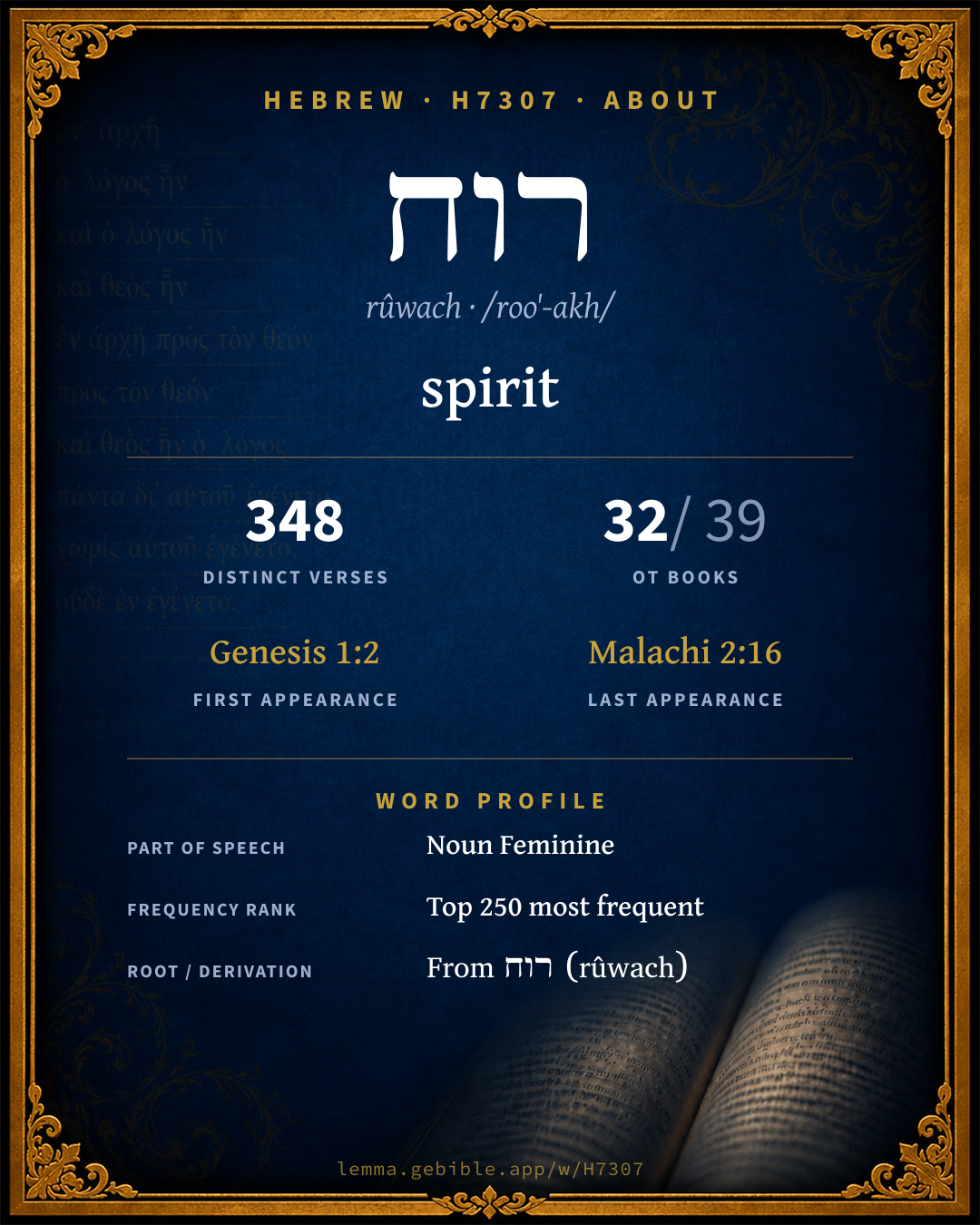
רוּחַ
spirit
also: wind, breath, mind fuller range ↓
Full lexicon entry — Brown-Driver-Briggs (BDB)
From Brown-Driver-Briggs (BDB)
Where this word appears
See every Construct-state word in the Hebrew Bible →
Grammar key — what these labels mean
Part of speech
- Noun
- A naming word — a person, place, thing, or idea.
Noun type
- Common
- A common noun — a general class of person, place, or thing (“king,” “city,” “water”), not a specific name.
State
- Absolute
- The independent form of a noun, not bound to a following word.
- Construct
- A noun bound to a following noun in a possessive / “of” relationship (the construct chain).
Gender
- Both
- Attested as both masculine and feminine.
Number
- Singular
- One.
- Plural
- More than one (in Hebrew, generally three or more).
Grammatical forms
- Noun, Common, Both, Singular, Construct 203 times (54%)
- Noun, Common, Both, Singular, Absolute 162 times (43%)
- Noun, Common, Both, Plural, Absolute 9 times (2%)
- Noun, Common, Both, Plural, Construct 4 times (1%)
Parsed forms decoded from the imported morphology (morphhb / Westminster Leningrad Codex — WLC text public domain, morphhb tagging CC BY 4.0), counted across 378 parsed occurrences — not distinct verses.
Page 1 of 2 — showing verses 1–200 of 348 distinct verses where H7307 appears, across 32 books. Click any verse to open its interlinear word-by-word view. Verse text shown in the World English Bible for context — . Each verse’s Hebrew form is shown with its reference; the English is not keyword-highlighted, since the data carries no word-level English alignment. Use “Compare translations” on any verse to read it across multiple English versions. This concordance covers the Hebrew Bible; Septuagint (Greek Old Testament) occurrences are not indexed here.
Genesis 11 verses
- Genesis 1:2 וְ/ר֣וּחַ conj + n c bs cs Now the earth was formless and empty. Darkness was on the surface of the deep. God's Spirit was hovering over the surface of the waters.
- Genesis 3:8 לְ/ר֣וּחַ prep + n c bs cs They heard the voice of Yahweh God walking in the garden in the cool of the day, and the man and his wife hid themselves from the presence of Yahweh God among the trees of the garden.
- Genesis 6:3 רוּחִ֤/י n c bs cs + sfx pers 1cs Yahweh said, "My Spirit will not strive with man forever, because he also is flesh; yet will his days be one hundred twenty years."
- Genesis 6:17 ר֣וּחַ n c bs cs I, even, I do bring the flood of waters on this earth, to destroy all flesh having the breath of life from under the sky. Everything that is in the earth will die.
- Genesis 7:15 ר֥וּחַ n c bs cs They went to Noah into the ark, by pairs of all flesh with the breath of life in them.
- Genesis 7:22 ר֨וּחַ n c bs All in whose nostrils was the breath of the spirit of life, of all that was on the dry land, died.
- Genesis 8:1 ר֨וּחַ֙ n c bs God remembered Noah, all the animals, and all the cattle that were with him in the ark; and God made a wind to pass over the earth. The waters subsided.
- Genesis 26:35 ר֑וּחַ n c bs They grieved Isaac and Rebekah's spirits.
- Genesis 41:8 רוּח֔/וֹ n c bs cs + sfx pers 3ms It happened in the morning that his spirit was troubled, and he sent and called for all the magicians of Egypt, and all the wise men of it. Pharaoh told them his dream, but there was no one who could interpret them to Pharaoh.
- Genesis 41:38 ר֥וּחַ n c bs cs Pharaoh said to his servants, "Can we find such a one as this, a man in whom is the Spirit of God?"
- Genesis 45:27 ר֖וּחַ n c bs cs They told him all the words of Joseph, which he had said to them. When he saw the wagons which Joseph had sent to carry him, the spirit of Jacob, their father, revived.
Exodus 10 verses
- Exodus 6:9 ר֔וּחַ n c bs Moses spoke so to the children of Israel, but they didn't listen to Moses for anguish of spirit, and for cruel bondage.
- Exodus 10:13 ר֥וּחַ וְ/ר֨וּחַ֙ n c bs cs conj + n c bs cs Moses stretched forth his rod over the land of Egypt, and Yahweh brought an east wind on the land all that day, and all the night; and when it was morning, the east wind brought the locusts.
- Exodus 10:19 רֽוּחַ n c bs cs Yahweh turned an exceeding strong west wind, which took up the locusts, and drove them into the Red Sea. There remained not one locust in all the borders of Egypt.
- Exodus 14:21 בְּ/ר֨וּחַ prep + n c bs cs Moses stretched out his hand over the sea, and Yahweh caused the sea to go back by a strong east wind all the night, and made the sea dry land, and the waters were divided.
- Exodus 15:8 וּ/בְ/ר֤וּחַ conj + prep + n c bs cs With the blast of your nostrils the waters were piled up. The floods stood upright as a heap. The deeps were congealed in the heart of the sea.
- Exodus 15:10 בְ/רוּחֲ/ךָ֖ prep + n c bs cs + sfx pers 2ms You blew with your wind. The sea covered them. They sank like lead in the mighty waters.
- Exodus 28:3 ר֣וּחַ n c bs cs You shall speak to all who are wise-hearted, whom I have filled with the spirit of wisdom, that they make Aaron's garments to sanctify him, that he may minister to me in the priest's office.
- Exodus 31:3 ר֣וּחַ n c bs cs and I have filled him with the Spirit of God, in wisdom, and in understanding, and in knowledge, and in all manner of workmanship,
- Exodus 35:21 רוּח֜/וֹ n c bs cs + sfx pers 3ms They came, everyone whose heart stirred him up, and everyone whom his spirit made willing, and brought Yahweh's offering, for the work of the tent of meeting, and for all of its service, and for the holy garments.
- Exodus 35:31 ר֣וּחַ n c bs cs He has filled him with the Spirit of God, in wisdom, in understanding, in knowledge, and in all manner of workmanship;
Numbers 12 verses
- Numbers 5:14 רֽוּחַ רֽוּחַ n c bs cs n c bs cs and the spirit of jealousy comes on him, and he is jealous of his wife, and she is defiled: or if the spirit of jealousy comes on him, and he is jealous of his wife, and she isn't defiled:
- Numbers 5:30 ר֥וּחַ n c bs cs or when the spirit of jealousy comes on a man, and he is jealous of his wife; then he shall set the woman before Yahweh, and the priest shall execute on her all this law.
- Numbers 11:17 הָ/ר֛וּחַ ptcl def.art + n c bs I will come down and talk with you there: and I will take of the Spirit which is on you, and will put it on them; and they shall bear the burden of the people with you, that you not bear it yourself alone.
- Numbers 11:25 הָ/ר֨וּחַ֙ הָ/ר֔וּחַ ptcl def.art + n c bs ptcl def.art + n c bs Yahweh came down in the cloud, and spoke to him, and took of the Spirit that was on him, and put it on the seventy elders: and it happened that when the Spirit rested on them, they prophesied, but they did so no more.
- Numbers 11:26 הָ/ר֗וּחַ ptcl def.art + n c bs But there remained two men in the camp, the name of the one was Eldad, and the name of the other Medad: and the Spirit rested on them; and they were of those who were written, but had not gone out to the Tent; and they prophesied in the camp.
- Numbers 11:29 רוּח֖/וֹ n c bs cs + sfx pers 3ms Moses said to him, Are you jealous for my sake? would that all Yahweh's people were prophets, that Yahweh would put his Spirit on them!
- Numbers 11:31 וְ/ר֜וּחַ conj + n c bs There went forth a wind from Yahweh, and brought quails from the sea, and let them fall by the camp, about a day's journey on this side, and a day's journey on the other side, round about the camp, and about two cubits above the surface of the earth.
- Numbers 14:24 ר֤וּחַ n c bs but my servant Caleb, because he had another spirit with him, and has followed me fully, him will I bring into the land into which he went; and his seed shall possess it.
- Numbers 16:22 הָ/רוּחֹ֖ת ptcl def.art + n c bp They fell on their faces, and said, God, the God of the spirits of all flesh, shall one man sin, and will you be angry with all the congregation?
- Numbers 24:2 ר֥וּחַ n c bs cs Balaam lifted up his eyes, and he saw Israel dwelling according to their tribes; and the Spirit of God came on him.
- Numbers 27:16 הָ/רוּחֹ֖ת ptcl def.art + n c bp Let Yahweh, the God of the spirits of all flesh, appoint a man over the congregation,
- Numbers 27:18 ר֣וּחַ n c bs Yahweh said to Moses, Take Joshua the son of Nun, a man in whom is the Spirit, and lay your hand on him;
Deuteronomy 2 verses
- Deuteronomy 2:30 רוּח֗/וֹ n c bs cs + sfx pers 3ms But Sihon king of Heshbon would not let us pass by him; for Yahweh your God hardened his spirit, and made his heart obstinate, that he might deliver him into your hand, as at this day.
- Deuteronomy 34:9 ר֣וּחַ n c bs cs Joshua the son of Nun was full of the spirit of wisdom; for Moses had laid his hands on him: and the children of Israel listened to him, and did as Yahweh commanded Moses.
Joshua 2 verses
- Joshua 2:11 ר֛וּחַ n c bs As soon as we had heard it, our hearts did melt, neither did there remain any more spirit in any man, because of you: for Yahweh your God, he is God in heaven above, and on earth beneath.
- Joshua 5:1 ר֔וּחַ n c bs It happened, when all the kings of the Amorites, who were beyond the Jordan westward, and all the kings of the Canaanites, who were by the sea, heard how that Yahweh had dried up the waters of the Jordan from before the children of Israel, until we were passed over, that their heart melted, neither was there spirit in them any more, because of the children of Israel.
Judges 10 verses
- Judges 3:10 רֽוּחַ n c bs cs The Spirit of Yahweh came on him, and he judged Israel; and he went out to war, and Yahweh delivered Cushan Rishathaim king of Mesopotamia into his hand: and his hand prevailed against Cushan Rishathaim.
- Judges 6:34 וְ/ר֣וּחַ conj + n c bs cs But the Spirit of Yahweh came on Gideon; and he blew a trumpet; and Abiezer was gathered together after him.
- Judges 8:3 רוּחָ/ם֙ n c bs cs + sfx pers 3mp God has delivered into your hand the princes of Midian, Oreb and Zeeb: and what was I able to do in comparison with you? Then their anger was abated toward him, when he had said that.
- Judges 9:23 ר֣וּחַ n c bs God sent an evil spirit between Abimelech and the men of Shechem; and the men of Shechem dealt treacherously with Abimelech:
- Judges 11:29 ר֣וּחַ n c bs cs Then the Spirit of Yahweh came on Jephthah, and he passed over Gilead and Manasseh, and passed over Mizpeh of Gilead, and from Mizpeh of Gilead he passed over to the children of Ammon.
- Judges 13:25 ר֣וּחַ n c bs cs The Spirit of Yahweh began to move him in Mahaneh-dan, between Zorah and Eshtaol.
- Judges 14:6 ר֣וּחַ n c bs cs The Spirit of Yahweh came mightily on him, and he tore him as he would have torn a kid; and he had nothing in his hand: but he didn't tell his father or his mother what he had done.
- Judges 14:19 ר֣וּחַ n c bs cs The Spirit of Yahweh came mightily on him, and he went down to Ashkelon, and struck thirty men of them, and took their spoil, and gave the changes [of clothing] to those who declared the riddle. His anger was kindled, and he went up to his father's house.
- Judges 15:14 ר֣וּחַ n c bs cs When he came to Lehi, the Philistines shouted as they met him: and the Spirit of Yahweh came mightily on him, and the ropes that were on his arms became as flax that was burnt with fire, and his bands dropped from off his hands.
- Judges 15:19 רוּח֖/וֹ n c bs cs + sfx pers 3ms But God split the hollow place that is in Lehi, and water came out of it. When he had drunk, his spirit came again, and he revived: therefore the name of it was called En Hakkore, which is in Lehi, to this day.
1 Samuel 14 verses
- 1 Samuel 1:15 ר֨וּחַ֙ n c bs Hannah answered, No, my lord, I am a woman of a sorrowful spirit: I have drunk neither wine nor strong drink, but I poured out my soul before Yahweh.
- 1 Samuel 10:6 ר֣וּחַ n c bs cs and the Spirit of Yahweh will come mightily on you, and you shall prophesy with them, and shall be turned into another man.
- 1 Samuel 10:10 ר֣וּחַ n c bs cs When they came there to the hill, behold, a band of prophets met him; and the Spirit of God came mightily on him, and he prophesied among them.
- 1 Samuel 11:6 רֽוּחַ n c bs cs The Spirit of God came mightily on Saul when he heard those words, and his anger was kindled greatly.
- 1 Samuel 16:13 רֽוּחַ n c bs cs Then Samuel took the horn of oil, and anointed him in the midst of his brothers: and the Spirit of Yahweh came mightily on David from that day forward. So Samuel rose up, and went to Ramah.
- 1 Samuel 16:14 וְ/ר֧וּחַ רֽוּחַ conj + n c bs cs n c bs Now the Spirit of Yahweh departed from Saul, and an evil spirit from Yahweh troubled him.
- 1 Samuel 16:15 רֽוּחַ n c bs cs Saul's servants said to him, See now, an evil spirit from God troubles you.
- 1 Samuel 16:16 רֽוּחַ n c bs cs Let our lord now command your servants who are before you, to seek out a man who is a skillful player on the harp: and it shall happen, when the evil spirit from God is on you, that he shall play with his hand, and you shall be well.
- 1 Samuel 16:23 רֽוּחַ ר֥וּחַ n c bs cs n c bs cs It happened, when the [evil] spirit from God was on Saul, that David took the harp, and played with his hand: so Saul was refreshed, and was well, and the evil spirit departed from him.
- 1 Samuel 18:10 רוּחַ֩ n c bs cs It happened on the next day, that an evil spirit from God came mightily on Saul, and he prophesied in the midst of the house: and David played with his hand, as he did day by day. Saul had his spear in his hand;
- 1 Samuel 19:9 ר֨וּחַ n c bs cs An evil spirit from Yahweh was on Saul, as he sat in his house with his spear in his hand; and David was playing with his hand.
- 1 Samuel 19:20 ר֣וּחַ n c bs cs Saul sent messengers to take David: and when they saw the company of the prophets prophesying, and Samuel standing as head over them, the Spirit of God came on the messengers of Saul, and they also prophesied.
- 1 Samuel 19:23 ר֣וּחַ n c bs cs He went there to Naioth in Ramah: and the Spirit of God came on him also, and he went on, and prophesied, until he came to Naioth in Ramah.
- 1 Samuel 30:12 רוּח֖/וֹ n c bs cs + sfx pers 3ms They gave him a piece of a cake of figs, and two clusters of raisins: and when he had eaten, his spirit came again to him; for he had eaten no bread, nor drunk any water, three days and three nights.
2 Samuel 3 verses
- 2 Samuel 22:11 רֽוּחַ n c bs He rode on a cherub, and did fly; Yes, he was seen on the wings of the wind.
- 2 Samuel 22:16 ר֥וּחַ n c bs cs Then the channels of the sea appeared, The foundations of the world were laid bare, By the rebuke of Yahweh, At the blast of the breath of his nostrils.
- 2 Samuel 23:2 ר֥וּחַ n c bs cs The Spirit of Yahweh spoke by me, His word was on my tongue.
1 Kings 9 verses
- 1 Kings 10:5 רֽוּחַ n c bs and the food of his table, and the sitting of his servants, and the attendance of his ministers, and their clothing, and his cup bearers, and his ascent by which he went up to the house of Yahweh; there was no more spirit in her.
- 1 Kings 18:12 וְ/ר֨וּחַ conj + n c bs cs It will happen, as soon as I am gone from you, that the Spirit of Yahweh will carry you I don't know where; and so when I come and tell Ahab, and he can't find you, he will kill me: but I your servant fear Yahweh from my youth.
- 1 Kings 18:45 וְ/ר֔וּחַ conj + n c bs It happened in a little while, that the sky grew black with clouds and wind, and there was a great rain. Ahab rode, and went to Jezreel:
- 1 Kings 19:11 וְ/ר֣וּחַ בָ/ר֖וּחַ הָ/ר֨וּחַ conj + n c bs prep det + n c bs ptcl def.art + n c bs He said, Go forth, and stand on the mountain before Yahweh. Behold, Yahweh passed by, and a great and strong wind tore the mountains, and broke in pieces the rocks before Yahweh; but Yahweh was not in the wind: and after the wind an earthquake; but Yahweh was not in the earthquake:
- 1 Kings 21:5 רוּחֲ/ךָ֣ n c bs cs + sfx pers 2ms But Jezebel his wife came to him, and said to him, Why is your spirit so sad, that you eat no bread?
- 1 Kings 22:21 הָ/ר֗וּחַ ptcl def.art + n c bs There came forth a spirit, and stood before Yahweh, and said, I will entice him.
- 1 Kings 22:22 ר֣וּחַ n c bs cs Yahweh said to him, 'How?' He said, 'I will go forth, and will be a lying spirit in the mouth of all his prophets.' He said, 'You shall entice him, and shall prevail also: go forth, and do so.'
- 1 Kings 22:23 ר֣וּחַ n c bs cs Now therefore, behold, Yahweh has put a lying spirit in the mouth of all these your prophets; and Yahweh has spoken evil concerning you.
- 1 Kings 22:24 רֽוּחַ n c bs cs Then Zedekiah the son of Chenaanah came near, and struck Micaiah on the cheek, and said, Which way went the Spirit of Yahweh from me to speak to you?
2 Kings 5 verses
- 2 Kings 2:9 בְּ/רוּחֲ/ךָ֖ prep + n c bs cs + sfx pers 2ms It happened, when they had gone over, that Elijah said to Elisha, Ask what I shall do for you, before I am taken from you. Elisha said, please let a double portion of your spirit be on me.
- 2 Kings 2:15 ר֥וּחַ n c bs cs When the sons of the prophets who were at Jericho over against him saw him, they said, The spirit of Elijah does rest on Elisha. They came to meet him, and bowed themselves to the ground before him.
- 2 Kings 2:16 ר֣וּחַ n c bs cs They said to him, See now, there are with your servants fifty strong men; let them go, we pray you, and seek your master, lest the Spirit of Yahweh has taken him up, and cast him on some mountain, or into some valley. He said, You shall not send.
- 2 Kings 3:17 ר֨וּחַ֙ n c bs For thus says Yahweh, You shall not see wind, neither shall you see rain; yet that valley shall be filled with water, and you shall drink, both you and your cattle and your animals.
- 2 Kings 19:7 ר֔וּחַ n c bs Behold, I will put a spirit in him, and he shall hear news, and shall return to his own land; and I will cause him to fall by the sword in his own land.
1 Chronicles 4 verses
- 1 Chronicles 5:26 ר֣וּחַ ר֨וּחַ֙ n c bs cs n c bs cs The God of Israel stirred up the spirit of Pul king of Assyria, and the spirit of Tilgath Pilneser king of Assyria, and he carried them away, even the Reubenites, and the Gadites, and the half-tribe of Manasseh, and brought them to Halah, and Habor, and Hara, and to the river of Gozan, to this day.
- 1 Chronicles 9:24 רוּח֔וֹת n c bp On the four sides were the porters, toward the east, west, north, and south.
- 1 Chronicles 12:18 וְ/ר֣וּחַ conj + n c bs Then the Spirit came on Amasai, who was chief of the thirty, [and he said], "We are yours, David, and on your side, you son of Jesse: peace, peace be to you, and peace be to your helpers; for your God helps you." Then David received them, and made them captains of the band.
- 1 Chronicles 28:12 בָ/ר֨וּחַ֙ prep det + n c bs and the pattern of all that he had by the Spirit, for the courts of the house of Yahweh, and for all the surrounding rooms, for the treasuries of the house of God, and for the treasuries of the dedicated things;
2 Chronicles 10 verses
- 2 Chronicles 9:4 רֽוּחַ n c bs and the food of his table, and the sitting of his servants, and the attendance of his ministers, and their clothing, his cup bearers also, and their clothing, and his ascent by which he went up to the house of Yahweh; there was no more spirit in her.
- 2 Chronicles 15:1 ר֥וּחַ n c bs cs The Spirit of God came on Azariah the son of Oded:
- 2 Chronicles 18:20 הָ/ר֗וּחַ ptcl def.art + n c bs There came forth a spirit, and stood before Yahweh, and said, I will entice him. Yahweh said to him, 'How?'
- 2 Chronicles 18:21 לְ/ר֣וּחַ prep + n c bs cs He said, 'I will go forth, and will be a lying spirit in the mouth of all his prophets.' He said, 'You shall entice him, and shall prevail also: go forth, and do so.'
- 2 Chronicles 18:22 ר֣וּחַ n c bs cs Now therefore, behold, Yahweh has put a lying spirit in the mouth of these your prophets; and Yahweh has spoken evil concerning you.
- 2 Chronicles 18:23 רֽוּחַ n c bs cs Then Zedekiah the son of Chenaanah came near, and struck Micaiah on the cheek, and said, Which way went the Spirit of Yahweh from me to speak to you?
- 2 Chronicles 20:14 ר֣וּחַ n c bs cs Then on Jahaziel the son of Zechariah, the son of Benaiah, the son of Jeiel, the son of Mattaniah, the Levite, of the sons of Asaph, came the Spirit of Yahweh in the midst of the assembly;
- 2 Chronicles 21:16 ר֤וּחַ n c bs cs Yahweh stirred up against Jehoram the spirit of the Philistines, and of the Arabians who are beside the Ethiopians:
- 2 Chronicles 24:20 וְ/ר֣וּחַ conj + n c bs cs The Spirit of God came on Zechariah the son of Jehoiada the priest; and he stood above the people, and said to them, Thus says God, Why disobey you the commandments of Yahweh, so that you can't prosper? because you have forsaken Yahweh, he has also forsaken you.
- 2 Chronicles 36:22 ר֨וּחַ֙ n c bs cs Now in the first year of Cyrus king of Persia, that the word of Yahweh by the mouth of Jeremiah might be accomplished, Yahweh stirred up the spirit of Cyrus king of Persia, so that he made a proclamation throughout all his kingdom, and [put it] also in writing, saying,
Ezra 2 verses
- Ezra 1:1 ר֨וּחַ֙ n c bs cs Now in the first year of Cyrus king of Persia, that the word of Yahweh by the mouth of Jeremiah might be accomplished, Yahweh stirred up the spirit of Cyrus king of Persia, so that he made a proclamation throughout all his kingdom, and [put it] also in writing, saying,
- Ezra 1:5 רוּח֔/וֹ n c bs cs + sfx pers 3ms Then rose up the heads of fathers' [houses] of Judah and Benjamin, and the priests, and the Levites, even all whose spirit God had stirred to go up to build the house of Yahweh which is in Jerusalem.
Nehemiah 2 verses
- Nehemiah 9:20 וְ/רוּחֲ/ךָ֨ conj + n c bs cs + sfx pers 2ms You gave also your good Spirit to instruct them, and didn't withhold your manna from their mouth, and gave them water for their thirst.
- Nehemiah 9:30 בְּ/רוּחֲ/ךָ֛ prep + n c bs cs + sfx pers 2ms Yet many years did you bear with them, and testified against them by your Spirit through your prophets: yet would they not give ear: therefore gave you them into the hand of the peoples of the lands.
Job 31 verses
- Job 1:19 ר֨וּחַ n c bs and, behold, there came a great wind from the wilderness, and struck the four corners of the house, and it fell on the young men, and they are dead. I alone have escaped to tell you."
- Job 4:9 וּ/מֵ/ר֖וּחַ conj + prep + n c bs cs By the breath of God they perish, By the blast of his anger are they consumed.
- Job 4:15 וְ֭/רוּחַ conj + n c bs Then a spirit passed before my face; The hair of my flesh stood up.
- Job 6:4 רוּחִ֑/י n c bs cs + sfx pers 1cs For the arrows of the Almighty are within me, My spirit drinks up their poison. The terrors of God set themselves in array against me.
- Job 6:26 וּ֝/לְ/ר֗וּחַ conj + prep + n c bs Do you intend to reprove words, Seeing that the speeches of one who is desperate are as wind?
- Job 7:7 ר֣וּחַ n c bs Oh remember that my life is a breath. My eye shall no more see good.
- Job 7:11 רוּחִ֑/י n c bs cs + sfx pers 1cs "Therefore I will not keep silent. I will speak in the anguish of my spirit. I will complain in the bitterness of my soul.
- Job 8:2 וְ/ר֥וּחַ conj + n c bs "How long will you speak these things? Shall the words of your mouth be a mighty wind?
- Job 9:18 רוּחִ֑/י n c bs cs + sfx pers 1cs He will not allow me to take my breath, But fills me with bitterness.
- Job 10:12 רוּחִֽ/י n c bs cs + sfx pers 1cs You have granted me life and loving kindness. Your visitation has preserved my spirit.
- Job 12:10 וְ֝/ר֗וּחַ conj + n c bs cs In whose hand is the life of every living thing, The breath of all mankind?
- Job 15:2 ר֑וּחַ n c bs "Should a wise man answer with vain knowledge, And fill himself with the east wind?
- Job 15:13 רוּחֶ֑/ךָ n c bs cs + sfx pers 2ms That you turn your spirit against God, And let such words go out of your mouth?
- Job 15:30 בְּ/ר֣וּחַ prep + n c bs cs He shall not depart out of darkness; The flame shall dry up his branches, By the breath of God's mouth shall he go away.
- Job 16:3 ר֑וּחַ n c bs Shall vain words have an end? Or what provokes you that you answer?
- Job 17:1 רוּחִ֣/י n c bs cs + sfx pers 1cs "My spirit is consumed, my days are extinct, And the grave is ready for me.
- Job 19:17 ר֭וּחִֽ/י n c bs cs + sfx pers 1cs My breath is offensive to my wife. I am loathsome to the children of my own mother.
- Job 20:3 וְ֝/ר֗וּחַ conj + n c bs I have heard the reproof which puts me to shame; The spirit of my understanding answers me.
- Job 21:4 רוּחִֽ/י n c bs cs + sfx pers 1cs As for me, is my complaint to man? Why shouldn't I be impatient?
- Job 21:18 ר֑וּחַ n c bs That they are as stubble before the wind, As chaff that the storm carries away?
- Job 26:13 בְּ֭/רוּח/וֹ prep + n c bs cs + sfx pers 3ms By his Spirit the heavens are garnished. His hand has pierced the swift serpent.
- Job 27:3 וְ/ר֖וּחַ conj + n c bs cs (For the length of my life is still in me, And the spirit of God is in my nostrils);
- Job 28:25 לָ/ר֣וּחַ prep det + n c bs He establishes the force of the wind; Yes, he measures out the waters by measure.
- Job 30:15 כָּ֭/רוּחַ prep det + n c bs Terrors are turned on me. They chase my honor as the wind. My welfare has passed away as a cloud.
- Job 30:22 ר֭וּחַ n c bs You lift me up to the wind, and drive me with it. You dissolve me in the storm.
- Job 32:8 רֽוּחַ n c bs But there is a spirit in man, And the breath of the Almighty gives them understanding.
- Job 32:18 ר֣וּחַ n c bs cs For I am full of words. The spirit within me constrains me.
- Job 33:4 רֽוּחַ n c bs cs The Spirit of God has made me, And the breath of the Almighty gives me life.
- Job 34:14 רוּח֥/וֹ n c bs cs + sfx pers 3ms If he set his heart on himself, If he gathered to himself his spirit and his breath;
- Job 37:21 וְ/ר֥וּחַ conj + n c bs Now men don't see the light which is bright in the skies, But the wind passes, and clears them.
- Job 41:16 וְ֝/ר֗וּחַ conj + n c bs One is so near to another, That no air can come between them.
Psalms 39 verses
- Psalms 1:4 רֽוּחַ n c bs The wicked are not so, But are like the chaff which the wind drives away.
- Psalms 11:6 וְ/ר֥וּחַ conj + n c bs cs On the wicked he will rain blazing coals; Fire, sulfur, and scorching wind shall be the portion of their cup.
- Psalms 18:10 רֽוּחַ n c bs He rode on a cherub, and flew. Yes, he soared on the wings of the wind.
- Psalms 18:15 ר֣וּחַ n c bs cs Then the channels of waters appeared, The foundations of the world were laid bare at your rebuke, Yahweh, At the blast of the breath of your nostrils.
- Psalms 18:42 ר֑וּחַ n c bs Then I beat them small as the dust before the wind. I cast them out as the mire of the streets.
- Psalms 31:5 ר֫וּחִ֥/י n c bs cs + sfx pers 1cs Into your hand I commend my spirit. You redeem me, Yahweh, God of truth.
- Psalms 32:2 בְּ/רוּח֣/וֹ prep + n c bs cs + sfx pers 3ms Blessed is the man to whom Yahweh doesn't impute iniquity, In whose spirit there is no deceit.
- Psalms 33:6 וּ/בְ/ר֥וּחַ conj + prep + n c bs cs By Yahweh's word the heavens were made; All their host by the breath of his mouth.
- Psalms 34:18 ר֥וּחַ n c bs Yahweh is near to those who have a broken heart, And saves those who have a crushed spirit.
- Psalms 35:5 ר֑וּחַ n c bs Let them be as chaff before the wind, Yahweh's angel driving them on.
- Psalms 48:7 בְּ/ר֥וּחַ prep + n c bs cs With the east wind, you break the ships of Tarshish.
- Psalms 51:10 וְ/ר֥וּחַ conj + n c bs Create in me a clean heart, O God. Renew a right spirit within me.
- Psalms 51:11 וְ/ר֥וּחַ conj + n c bs cs Don't throw me from your presence, And don't take your holy Spirit from me.
- Psalms 51:12 וְ/ר֖וּחַ conj + n c bs Restore to me the joy of your salvation. Uphold me with a willing spirit.
- Psalms 51:17 ר֪וּחַ n c bs cs The sacrifices of God are a broken spirit. A broken and contrite heart, O God, you will not despise.
- Psalms 55:8 מֵ/ר֖וּחַ prep + n c bs "I would hurry to a shelter from the stormy wind and tempest."
- Psalms 76:12 ר֣וּחַ n c bs cs He will cut off the spirit of princes. He is feared by the kings of the earth.
- Psalms 77:3 רוּחִ֣/י n c bs cs + sfx pers 1cs I remember God, and I groan. I complain, and my spirit is overwhelmed. Selah.
- Psalms 77:6 רוּחִֽ/י n c bs cs + sfx pers 1cs I remember my song in the night. I consider in my own heart; My spirit diligently inquires:
- Psalms 78:8 רוּחֽ/וֹ n c bs cs + sfx pers 3ms And might not be as their fathers, A stubborn and rebellious generation, A generation that didn't make their hearts loyal, Whose spirit was not steadfast with God.
- Psalms 78:39 ר֥וּחַ n c bs He remembered that they were but flesh, A wind that passes away, and doesn't come again.
- Psalms 83:13 רֽוּחַ n c bs My God, make them like tumbleweed; Like chaff before the wind.
- Psalms 103:16 ר֣וּחַ n c bs For the wind passes over it, and it is gone. Its place remembers it no more.
- Psalms 104:3 רֽוּחַ n c bs He lays the beams of his chambers in the waters. He makes the clouds his chariot. He walks on the wings of the wind.
- Psalms 104:4 רוּח֑וֹת n c bp He makes his messengers winds; His servants flames of fire.
- Psalms 104:29 ר֭וּחָ/ם n c bs cs + sfx pers 3mp You hide your face: they are troubled; You take away their breath: they die, and return to the dust.
- Psalms 104:30 ר֭וּחֲ/ךָ n c bs cs + sfx pers 2ms You send forth your Spirit: they are created. You renew the face of the ground.
- Psalms 106:33 רוּח֑/וֹ n c bs cs + sfx pers 3ms Because they were rebellious against his spirit, He spoke rashly with his lips.
- Psalms 107:25 ר֣וּחַ n c bs cs For he commands, and raises the stormy wind, Which lifts up its waves.
- Psalms 135:7 ר֝וּחַ n c bs Who causes the clouds to rise from the ends of the earth; Who makes lightnings with the rain; Who brings forth the wind out of his treasuries;
- Psalms 135:17 ר֥וּחַ n c bs They have ears, but they can't hear; Neither is there any breath in their mouths.
- Psalms 139:7 מֵ/רוּחֶ֑/ךָ prep + n c bs cs + sfx pers 2ms Where could I go from your Spirit? Or where could I flee from your presence?
- Psalms 142:3 רוּחִ֗/י n c bs cs + sfx pers 1cs When my spirit was overwhelmed within me, You knew my path. In the way in which I walk, They have hidden a snare for me.
- Psalms 143:4 רוּחִ֑/י n c bs cs + sfx pers 1cs Therefore my spirit is overwhelmed within me. My heart within me is desolate.
- Psalms 143:7 ר֫וּחִ֥/י n c bs cs + sfx pers 1cs Hurry to answer me, Yahweh. My spirit fails. Don't hide your face from me, So that I don't become like those who go down into the pit.
- Psalms 143:10 רוּחֲ/ךָ֥ n c bs cs + sfx pers 2ms Teach me to do your will, For you are my God. Your Spirit is good. Lead me in the land of uprightness.
- Psalms 146:4 ר֭וּח/וֹ n c bs cs + sfx pers 3ms His spirit departs, and he returns to the earth. In that very day, his thoughts perish.
- Psalms 147:18 ר֝וּח֗/וֹ n c bs cs + sfx pers 3ms He sends out his word, and melts them. He causes his wind to blow, and the waters flow.
- Psalms 148:8 ר֥וּחַ n c bs cs Lightning and hail, snow and clouds; Stormy wind, fulfilling his word;
Proverbs 20 verses
- Proverbs 1:23 רוּחִ֑/י n c bs cs + sfx pers 1cs Turn at my reproof. Behold, I will pour out my spirit on you. I will make known my words to you.
- Proverbs 11:13 ר֝֗וּחַ n c bs One who brings gossip betrays a confidence, But one who is of a trustworthy spirit is one who keeps a secret.
- Proverbs 11:29 ר֑וּחַ n c bs He who troubles his own house shall inherit the wind. The foolish shall be servant to the wise of heart.
- Proverbs 14:29 ר֝֗וּחַ n c bs He who is slow to anger has great understanding, But he who has a quick temper displays folly.
- Proverbs 15:4 בְּ/רֽוּחַ prep + n c bs A gentle tongue is a tree of life, But deceit in it crushes the spirit.
- Proverbs 15:13 ר֣וּחַ n c bs A glad heart makes a cheerful face; But an aching heart breaks the spirit.
- Proverbs 16:2 רוּח֣וֹת n c bp All the ways of a man are clean in his own eyes; But Yahweh weighs the motives.
- Proverbs 16:18 רֽוּחַ n c bs Pride goes before destruction, And a haughty spirit before a fall.
- Proverbs 16:19 ר֭וּחַ n c bs It is better to be of a lowly spirit with the poor, Than to divide the plunder with the proud.
- Proverbs 16:32 בְּ֝/רוּח֗/וֹ prep + n c bs cs + sfx pers 3ms One who is slow to anger is better than the mighty; One who rules his spirit, than he who takes a city.
- Proverbs 17:22 וְ/ר֥וּחַ conj + n c bs A cheerful heart makes good medicine, But a crushed spirit dries up the bones.
- Proverbs 17:27 ר֝֗וּחַ n c bs He who spares his words has knowledge. He who is even tempered is a man of understanding.
- Proverbs 18:14 רֽוּחַ וְ/ר֥וּחַ n c bs cs conj + n c bs A man's spirit will sustain him in sickness, But a crushed spirit, who can bear?
- Proverbs 25:14 וְ֭/רוּחַ conj + n c bs As clouds and wind without rain, So is he who boasts of gifts deceptively.
- Proverbs 25:23 ר֣וּחַ n c bs cs The north wind brings forth rain: So a backbiting tongue brings an angry face.
- Proverbs 25:28 לְ/רוּחֽ/וֹ prep + n c bs cs + sfx pers 3ms Like a city that is broken down and without walls Is a man whose spirit is without restraint.
- Proverbs 27:16 ר֑וּחַ n c bs Restraining her is like restraining the wind, Or like grasping oil in his right hand.
- Proverbs 29:11 ר֭וּח/וֹ n c bs cs + sfx pers 3ms A fool vents all of his anger, But a wise man brings himself under control.
- Proverbs 29:23 ר֝֗וּחַ n c bs A man's pride brings him low, But one of lowly spirit gains honor.
- Proverbs 30:4 ר֨וּחַ n c bs Who has ascended up into heaven, and descended? Who has gathered the wind in his fists? Who has bound the waters in his garment? Who has established all the ends of the earth? What is his name, and what is his son's name, if you know?
Ecclesiastes 20 verses
- Ecclesiastes 1:6 הָ/ר֔וּחַ הָ/רֽוּחַ ptcl def.art + n c bs ptcl def.art + n c bs The wind goes toward the south, and turns around to the north. It turns around continually as it goes, and the wind returns again to its courses.
- Ecclesiastes 1:14 רֽוּחַ n c bs I have seen all the works that are done under the sun; and, behold, all is vanity and a chasing after wind.
- Ecclesiastes 1:17 רֽוּחַ n c bs I applied my heart to know wisdom, and to know madness and folly. I perceived that this also was a chasing after wind.
- Ecclesiastes 2:11 ר֔וּחַ n c bs Then I looked at all the works that my hands had worked, and at the labor that I had labored to do; and, behold, all was vanity and a chasing after wind, and there was no profit under the sun.
- Ecclesiastes 2:17 רֽוּחַ n c bs So I hated life, because the work that is worked under the sun was grievous to me; for all is vanity and a chasing after wind.
- Ecclesiastes 2:26 רֽוּחַ n c bs For to the man who pleases him, God gives wisdom, knowledge, and joy; but to the sinner he gives travail, to gather and to heap up, that he may give to him who pleases God. This also is vanity and a chasing after wind.
- Ecclesiastes 3:19 וְ/ר֥וּחַ conj + n c bs For that which happens to the sons of men happens to animals. Even one thing happens to them. As the one dies, so the other dies. Yes, they have all one breath; and man has no advantage over the animals: for all is vanity.
- Ecclesiastes 3:21 ר֚וּחַ וְ/ר֨וּחַ֙ n c bs cs conj + n c bs cs Who knows the spirit of man, whether it goes upward, and the spirit of the animal, whether it goes downward to the earth?"
- Ecclesiastes 4:4 רֽוּחַ n c bs Then I saw all the labor and achievement that is the envy of a man's neighbor. This also is vanity and a striving after wind.
- Ecclesiastes 4:6 רֽוּחַ n c bs Better is a handful, with quietness, than two handfuls with labor and chasing after wind.
- Ecclesiastes 4:16 רֽוּחַ n c bs There was no end of all the people, even of all them over whom he was--yet those who come after shall not rejoice in him. Surely this also is vanity and a chasing after wind.
- Ecclesiastes 5:16 לָ/רֽוּחַ prep det + n c bs This also is a grievous evil, that in all points as he came, so shall he go. And what profit does he have who labors for the wind?
- Ecclesiastes 6:9 רֽוּחַ n c bs Better is the sight of the eyes than the wandering of the desire. This also is vanity and a chasing after wind.
- Ecclesiastes 7:8 ר֖וּחַ רֽוּחַ n c bs n c bs Better is the end of a thing than its beginning. The patient in spirit is better than the proud in spirit.
About this entry
At a glance — auto-summarized from this page’s data, not written by a person. Every figure links to its source below. This summary describes the numbers; it doesn’t interpret them.
רוח — transliterated rûwach — is a Hebrew noun carrying the sense “spirit.” It also covers “wind”, “breath”, and “mind”, alongside “spirit” — see its full sense range. With 348 verses in 32 books, it is a common word in the Hebrew Bible. It first appears in Genesis 1:2. From the same root come רוח, רוח and רחת. See the sense tree, 348-verse concordance, and the renderings breakdown below.
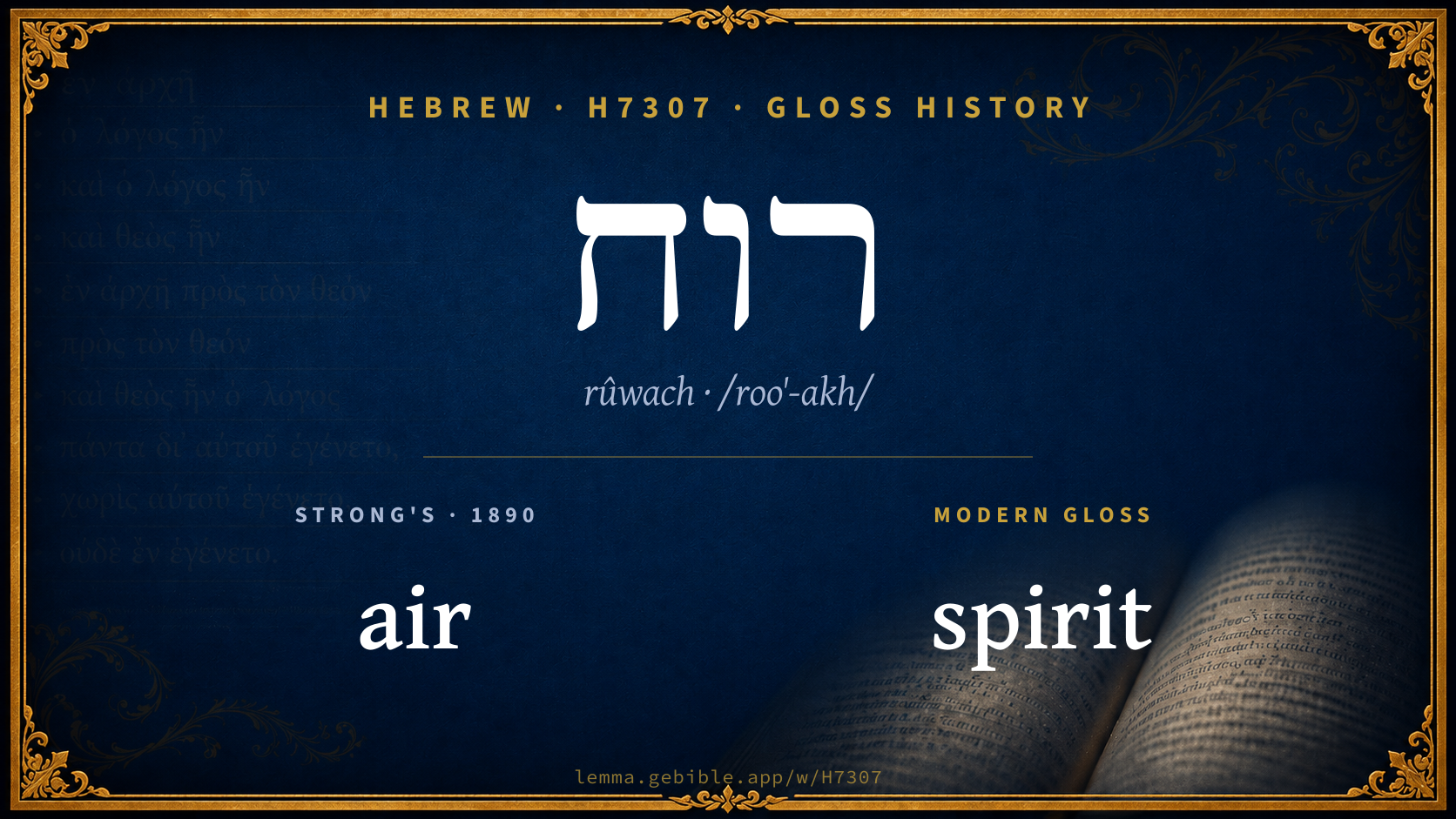
Gloss history
Strong's 1890 vs modern scholarship
About this word
Strong's H7307 catalogs a Hebrew word from the Hebrew Old Testament.
These counts are not copied from any lexicon or concordance. They are computed here, from the morphology-tagged Hebrew Old Testament. What Lemma adds →
- 348
- distinct verses
- The word appears in 348 distinct verses.
- 32 / 39
- OT books
- The word appears in 32 of 39 Old Testament books.
- #131
- by frequency
- Top 250 most frequent Hebrew words (rank 131 of 8,640 Hebrew words by occurrence).
View all 348 occurrences in the concordance →
By section of the Old Testament
By traditional corpus
Conventional, traditional groupings — biblical authorship is debated, so this is a traditional corpus grouping, not an authorship claim. Each share is this word’s portion of its verses in that division of the Hebrew canon. Each figure is a share of the word’s 348 distinct verses.
- Prophets (Nevi'im) 180 verses · 52%
- Writings (Ketuvim) 133 verses · 38%
- Torah (Pentateuch) 35 verses · 10%
How translations render this word
Counts come from each version’s own published word-to-Strong’s tagging or interlinear alignment — an approximate guide to how each version renders this word, not a word-level alignment the data otherwise carries. Because each total is that version’s own tagged count, the per-version totals vary from one another and need not match the appearance or distinct-verse counts above. These counts may also differ from a printed concordance because Lemma counts each distinctly tagged rendering and does not collapse phrase taggings into a single head-word total. This is a fixed set of word-tagged versions (KJV, ASV, BSB, ULT) and does not change with the reading translation you choose elsewhere. Each version’s license is shown beside its name below (and on Sources).
- King James Version: Spirit 187×, Wind 72×, Breath 19×
- American Standard Version: Spirit 152×, Wind 68×, Breath 18×
- Berean Standard Bible: Spirit 181×, Wind 80×, Breath 30×
- unfoldingWord Literal Text: Spirit 133×, Wind 75×, Spirit of 70×
King James Version Public Domain
Renders H7307 across 377 tagged occurrences — most commonly:
Plus 67 renderings that appear only once — usually multi-word phrases or single function words the recovered tagging swept in, not distinct renderings. Not rendered by a distinct English word in 1 further occurrence.
American Standard Version Public Domain
Renders H7307 across 376 tagged occurrences — most commonly:
Plus other, less common renderings. Plus 78 renderings that appear only once — usually multi-word phrases or single function words the recovered tagging swept in, not distinct renderings.
Berean Standard Bible Public Domain
Renders H7307 across 368 tagged occurrences — most commonly:
Plus other, less common renderings. Plus 31 renderings that appear only once — usually multi-word phrases or single function words the recovered tagging swept in, not distinct renderings. Not rendered by a distinct English word in 9 further occurrences.
unfoldingWord Literal Text CC BY-SA 4.0
Renders H7307 across 410 tagged occurrences — most commonly:
Plus other, less common renderings. Plus 27 renderings that appear only once — usually multi-word phrases or single function words the recovered tagging swept in, not distinct renderings.
40 senses and sub-senses in the full BDB
What do BDB’s symbols mean?
BDB uses these scholarly abbreviations:
| Symbol | Meaning |
|---|---|
| 𝔊 | the Septuagint (the ancient Greek translation, LXX) |
| 𝔙 | the Vulgate (the Latin translation) |
| 𝔖 | the Syriac version (the Peshitta) |
| 𝔗 | the Targum (the Aramaic translation) |
| ψ | the Psalms |
| √ | root (the underlying root or stem) |
| ‖ | parallel passage (a synonymous or contrasted parallel) |
| † | the dagger: every passage where the word occurs is cited |
The 40 senses and sub-senses the full Brown-Driver-Briggs lexicon distinguishes for this word, in lexicon order (not ranked by frequency), with BDB’s own verbatim wording and sub-sense lettering. Shown in Hebrew script with BDB’s own scholarly abbreviations. The condensed entry is in the Lexicon Entry tab. See also the Forms in the corpus table below.
- 1. breath of mouth or nostrils (33 times):
- a. רוּחַ פִּיו Jb 15:30 breath of his mouth, cf. 19:17; רוּחַ אַפֵּינוּ La 4:20 (fig. of king), of idols לֹא רוּחַ בָּם Je 10:14 = 51:17, Hb 2:19 ψ 135:17; cf. Jb. 9:18 e.g. Job 15:30
- b. as mere breath: cf. 2 e. דִּבְרֵי־רוּחַ Jb 16:3 i.e. windy words; לְרוּחַ אִמְרֵי נוֹאָשׁ Jb 6:26, הַנְּבִיאִים יִהְיוּ לְרוּחַ Je 5:13. e.g. Job 16:3
- c. as word of command: (1) of God: בְּרוּחַ פִּיו כָּל־ (נעשׂו) צְבָאָם ψ 33:6, cf. Is 34:16 (‖ פֶּה); (2) of Messianic king: בְּרוּחַ שְׂפָתָיו יָמִית רָשָׁע Is 11:4. e.g. Psalms 33:6
- d. as hard breathing through the nostrils in anger: (1) of God: מֵרוּחַ אַפּוֹ יִכְלוּ Jb 4:9 Ex 15:8 (poem), 2 S 22:16 = ψ 18:16, Is 30:28; 59:19; (2) of man: רוּחַ עָרִיצִים Is 25:4. e.g. Job 4:9
- e. as sign and symbol of life: רוּחַ חַוִּים breath of life Gn 6:17; 7:15 (P); נִשְׁמַת רוּחַ חַיִּים בְּאַפָּיו Gn 7:22 (P); Ez 37:5, cf. v 6, 8, 9(×3), 10, 14 (breath or spirit), Ec 3:19. e.g. Genesis 6:17
- 2. wind (117 times):
- a. wind of heaven: Gn 8:1 (P) Ex 15:10 (E) Nu 11:31 (J) 1 K 18:45 +, Je 10:13, thence 51:16 ψ 135:7; רוּחַ י׳ Ho 13:15 Is 40:7, cf. Jb 26:13 (Di Bu); †רוּחַ (ה)קָדִים east wind Ex 10:13(×2); 14:21 (J) ψ 48:8 Je 18:17 Ez 17:10; 19:12; 27:26 Jon 4:8; †ר׳ צָפוֹן north wind Pr 25:23; †ר׳ יָם sea wind (west wind) Ex 10:19 (J); †ר׳ הַיּוֹם day wind, evening wind Gn 3:8 (J; cf. Ct 2:17; 4:6); †אַרְבַּע רוּחוֹת four winds Je 49:36 Ez 37:9 (quarters?) Dn 8:8; 11:4 (fig. quarters; cf. b), Zc 2:10; 6:5; רוּחַ סְעָרָה storm wind ψ 107:25; 148:8 Ez 1:4 (ר׳ סְעָרוֹת), 13:11, 13; רוּחַ סֹעָה rushing wind ψ 55:9 (read poss. סערה Hup); בַּעְיָם רוּחוֹ Is 11:15 (read בְּעֹצֶם ר׳, v. עֲיָם, עֹצֶם), etc.; wind personif.: כַּנְפֵי רוּחַ 2 S 22:11 = ψ 18:11, 104:3, cf. Ho 4:19 ψ 104:4. e.g. Genesis 8:1
- b. quarter (of wind), side: רוּחַ הַקָּדִים Ez 42:16 east side; רוּחַ הַצָּפוֹן v 17 north side; רוּחַ הַדָּרוֹם v 18 south side; רוּחַ הַיָּם v 19 west side; אַרְבַּע רוּחוֹת v 20 1 Ch 9:24 four sides; ר֑וּחָה Je 52:23 on the sides. e.g. Ezekiel 42:16
- c. breath of air: שָׁאֲפוּ רוּחַ כַּתַּנִּים Je 14:6; רוּחַ לֹא יָבֹא בֵינֵיהֶם Jb 41:8. e.g. Jeremiah 14:6
- d. air, gas, from womb (dub.); כְּמוֹ יָלַדְנוּ רוּחַ Is 26:18 (Di, e); רוּחֲכֶם אֵשׁ תֹּאכַלְכֶם (RV breath) Is 33:11 (Du, 3 c). e.g. Isaiah 26:18
- e. vain, empty thing: רוּחַ חַיְּי֑ Jb 7:7 my life is wind; דַּעַת רוּחַ 15:2; רוּחַ וָתֹהוּ נִסְכֵּיהֶם Is 41:29; רְעוּת רוּחַ striving for wind Ec 1:14; 2:11, 17, 26; 4:4, 6; 6:9; cf. 1:17; 4:16; 5:15 Ho 12:2 ψ 78:39. e.g. Job 7:7
- 3. spirit, as breathing quickly in animation, agitation = temper, disposition (76 times; so, distinctively, as compared with נֶפֶשׁ and לֵבָב):
- a. spirit, animation, vivacity, vigour: לֹא הָיָה בָהּ עוֹד רוּחַ 1 K 10:5 = 2 Ch 9:4; מַה־זֶּה רוּחֲךָ סָרָה 1 K 21:5; וַתְּחִי רוּחַ Gn 45:27 (E); וַתָּשָׁב רוּחוֹ Ju 15:19; 1 S 30:12. e.g. 1 Kings 10:5
- b. courage: לֹא הָיָה בָם עוֹד ר׳ Jos 5:1; יִבְצֹר ר׳ נְגִידִים ψ 76:13; וְנָֽבְקָה ר׳ מִצְרַיִם Is 19:3; תתעטּף רוּחִי ψ 77:4; 142:4; 143:4; עוֹד ר׳ לֹא קָמָה Jos 2:11; ר׳ אִישׁ יְכַלְכֵּל מַחֲלֵהוּ Pr 18:14. e.g. Joshua 5:1
- c. temper, especially anger: רוּחָ רָעָה בֵּין וגו׳ Ju 9:23; אָז רָֽפְתָה רוּחָם 8:3; משֵׁל בְּרוּחוֹ Pr 16:32, cf. 25:28; 29:11; Jb 15:13; הֵנִיחוּ אֶת־רוּחִי Zc 6:8; Ec 7:9; 10:4. e.g. Judges 9:23
- d. impatience or patience: קֹצֶר רוּחַ Ex 6:9 (P) impatience, hastiness of temper, cf. (of י׳) Mi 2:7; קְצַר־רוּחַ Pr 14:29 (‖ אֶרֶךְ אַפַּיִם); הֱצִיקַתְנִי רוּחַ בִּטְנִי Jb 32:18 (Du breath; Di Bu divine spirit, cf. v 8); אִם מַדּוּעַ לֹא־תִקְצַר רוּחִי Jb 21:4; הֲקָצַר רוּחַ י׳ Mi 2:7; אֶרֶךְ ר׳ Ec 7:8. e.g. Exodus 6:9
- e. spirit, disposition, as troubled, bitter, or discontented; וַתִּפָּעֶם רוּח(י) (his) spirit was troubled Gn 41:8 (E) Dn 2:3, cf. v 1; מֹרַת רוּחַ Gn 26:35 (P) bitterness of spirit; עֲצוּבַת ר׳ Is 54:6, cf. Ez 3:14; Jb 6:4. e.g. Genesis 41:8
- f. as crushed: וְכִהֲתָה כָל־רוּחַ Ez 21:12, cf. Is 61:3; Pr 15:4, 13; 17:22; 18:14 ψ 143:7. e.g. Ezekiel 21:12
- g. disposition of various kinds, often unaccountable and uncontrollable impulse: הֵעִיר אֶת־רוּחַ 1 Ch 5:26(×2;) 2 Ch 21:16; 36:22; Ezr 1:1, 5; Je 51:11; Hg 1:14(×3); הִנְנִי ן(וֹ)תֵן בּוֹ רוּחַ 2 K 19:7 = Is 37:7; Nu 14:24 (J; v. עִם 4 b), Mal 2:15(×2), 16; Dt 2:30; רוּחַ קִנְאָה jealous disposition Nu 5:14(×2), 30 (P); רוּחַ זְנוּנִים Ho 4:12; 5:4; רוּחַ עִוְעִים Is 19:14; רוּחַ מִשְׁפָּט 28:6; אִישׁ אֲשֶׁר רוּחַ אֱלֹהִים בּוֹ (administrative) Gn 41:38 (E); קַר רוּחַ אִישׁ תְּבוּנָה Pr 17:27. e.g. 1 Chronicles 5:26
- h. prophetic spirit: יְהוֹשֻׁעַ אִישׁ אֲשֶׁר־ רוּחַ בּוֹ Nu 27:18 (P; or g, as Gn 41:38); רוּחַ אֵלִיָּהוּ עַל־אֱלִישָׁע 2 K 2:15, cf. v 9; רוּחַ תַּרְדֵּמָה spirit of deep sleep (ecstatic, cf. Gn 2:21; 15:12, but Di al. g, as Is 19:14) Is 29:10; Mi 2:11; רוּחַ הַטֻּמְאָה Zc 13:2 (of lying proph.), cf. Ez 13:3. e.g. Numbers 27:18
- 4. spirit of the living, breathing being, dwelling in the בָּשָׂר of men and animals, ‖ נֶפֶשׁ (25 times):
- a. gift and creation of God: יֹצֵר רוּחַ אָדָם בְּקִרְבּוֹ Zc 12:1; רוּחַ אֱלוֹהַּ בְּאַפִּי Jb 27:3, cf. Is 42:5. e.g. Zechariah 12:1
- b. God preserves it: פְּקֻדָּֽתְךָ שָֽׁמְרָה רוּחִי Jb 10:12, cf. 12:10; אֱלֹהֵי הָרוּחֹת לְכָל בָּשָׂ֑ר Nu 16:22; 27:16 (P); תֹּכֵן רוּחוֹת Pr 16:2. e.g. Job 10:12
- c. it is therefore God’s spirit: Gn 6:3 (J; v. דִּין ad fin.). e.g. Genesis 6:3
- d. it departs at death: ψ 78:39 (Dr a wind that passeth away 2 e); חַיֵּי רוּחִי Is 38:16 (Di principle of life), ψ 146:4; especially 104:29, 30; Jb 17:1; 34:14 (cf. v 15), Is 57:16; Ec 8:8(×2) (wind Wild); אֵינְךָ יוֹדֵעַ מַה־דֶּרֶךְ הָרוּחַ Ec 11:5, cf. 3:21; over ag. הָרוּחַ תָּשׁוּב אֶל־הָאֱלֹהִים אֲשֶׁר נְתָנָהּ 12:7; בְּיָֽדְךָ אַפְקִיד רוּחִי ψ 31:6. e.g. Psalms 78:39
- e. disembodied being (dub., Di Du breath of wind): וְרוּחַ עַל־פָּנַי יַחֲלֹף Jb 4:15. e.g. Job 4:15
- 5. spirit as seat of emotion = נֶפֶשׁ:
- a. desire (poss. 3 g), Is 26:9 (‖ נֶפֶשׁ). e.g. Isaiah 26:9
- b. sorrow, trouble (prob. 3 e), Jb 7:11 (‖ נֶפֶשׁ).—1 S 1:15 v. קָשֶׁה. e.g. Job 7:11
- 6. occasionally (and late) = seat or organ of mental acts, ‖ לֵב, or synon. with it: רוּחַ חָכְמָה Ex 28:3; Dt 34:9 (both P; prob. 3 g); תֹּעֵי רוּחַ Is 29:24, cf. Jb 20:3 (Hi Bu Du wind of Job’s words), ψ 77:7 (𝔊 Sym 𝔖 Jer troubled disposition); רוּחַ יהוה Is 40:13; come into mind Ez 11:5, 20:32 (cf. לֵב Is 65:17; Je 3:16 +); 1 Ch 28:12. e.g. Exodus 28:3
- 7. rarely of the will; also = לֵב: רוּחַ נָכוֹן ψ 51:12 (= לֵב נָכוֹן 57:8(×2) +); רוּחַ נְדִיבָה v 14; נָֽדְבָה רוּחוֹ Ex 35:21 (P; cf. נְדִיב לֵב Ex 35:5, 22 (P) 2 Ch 29:31). e.g. Psalms 51:12
- 8. רוּחַ especially of moral character; also = לֵב: רוחֵ חֲדָשָׁה Ez 11:19; 18:31; 36:26; רוּחִו v 27 Is 59:21 (רוּחִי, ‖ דְּבָרַי; but prob. prophetic spirit 9 b); לֵב חָדָשׁ Ez 18:31; 36:26; נְכֵה רוּחַ Is 66:2; דַּכְּאֵי רוּחַ ψ 34:19 (cf. לֵב נִדְכָּאִים Is 57:15); מִשֵּׁבֶר רוּחַ Is 65:14 (cf. 3 f); רוּחַ נִשְׁבָּרָה ψ 51:19; (‖ לֵב נִשְׁבָּר, cf. נִשְׁבְּרֵי לֵב 34:19 Is 61:1); ψ 32:2; Pr 11:13; 16:18 ψ 78:8 Ec 7:8 (cf. גְּבַהּ לֵב Pr 16:5); שְׁפַל רוּחַ Pr 16:19; 29:23; Is 57:15; רוּחַ שְׁפָלִים v 15 (cf. 3 f). e.g. Ezekiel 11:19
- 9. spirit of God (94 times; not D or Je or any Deut. writer; conception of its activity in inspiring prophecy prob. discredited from abuse by false prophets, v. נביא, נבא):
- a. as inspiring ecstatic state of prophecy, Nu 11:17, 25(×2), 26, 29 (J), 1 S 10:6, 10 (cf. v 5), 19:20, 23; as inciting to deeds of frenzy, in the ecstatic state; hence conceived as ר׳ אֱלֹהִים רָעָה 1 S 16:15(×2), 16, = ר׳ רָעָה מֵאֵת י׳ v 14 = צלח ר׳ א׳ רָעָה 18:10 (other narrative) = ר׳ י׳ רָעָה 19:9; ר׳ א׳ 16:23 = רוּחַ הָרָעָה v 23, cf. הָרוּחַ 1 K 22:21 = ר׳ שֶׁקֶר v 22, 23 = 2 Ch 18:20, 21, 22 = רוּחַ י׳ 1 K 22:24 = 2 Ch 18:23; cf. also (in earlier prophets) אִישׁ הָרוּחַ, i.e. one possessed by the spirit in the ecstatic state, ‖ הַנָּבִיא Ho 9:7; רוּחַ י׳ Mi 3:8 (‖ כֹּחַ) is prob. gloss. (We Now); וְלֹא רוּחִי Is 30:1; רוּחַ dealing with Ezek.: Ez 2:2; 3:12, 14, 24; 8:3; 11:1, 5, 24 (Co gloss.), 37:1; 43:5 (all implying ecstatic state of vision), cf. Elijah 1 K 18:12; 2 K 2:16. e.g. Numbers 11:17
- b. spirit as impelling proph. to utter instruction or warning (higher and later conception): transition prob. Nu 24:2; 2 S 23:2; 1 Ch 12:18; elsewhere in Ch.: 2 Ch 15:1; 20:14; 24:20; distinctly in Is 11:2, 48:16, cf. 61:1; so of ancient prophets, Zc 7:12 Ne 9:30, cf., of future prophetic gift, Jo 3:1, 2. e.g. Numbers 24:2
- c. imparting warlike energy, and executive and administrative power: (1) to שֹׁפְטִים, מושִׁיעִים, מְלָכִים, of ancient Isr.: וַתְּהִי רוּחַ י׳ על Ju 3:10; 11:29, cf. 6:34; 13:25; 14:6, 19; 15:14; 1 S 11:6; 16:13, 14; so also עַד יֵעָרֶה עָלֵינוּ רוּחַ מִמָּרוֹם Is 32:15; (2) resting upon Messianic king: Is 11:2(×3); upon servant of י׳, 42:1. e.g. Judges 3:10
- d. late, as endowing men with various gifts: technical skill Ex 31:3; 35:31 (P); understanding Jb 32:8 (‖ נִשְׁמַת שַׁדַּי); poured out by divine wisdom Pr 1:23. e.g. Exodus 31:3
- e. as energy of life: רוּחַ אֱלֹהִים מְרַחֶפֶת עַל־פְּנֵי הַמָּ֑יִם Gn 1:2 (P); רוּחַ אֵל עָשָׂ֑תְנִי Jb 33:4 (‖ נִשְׁמַת שַׁדַּי); as vital power, opp. בָּשָׂר: Is 31:3; in cherubic chariot: Ez 1:12, cf. v 20, 21; 10:17; reviving Israel Ez 39:29; Zc 12:10; Is 44:3. e.g. Genesis 1:2
- f. = ancient angel of the presence and later Shekina: ר׳ קָדְשׁוֹ Is 63:10, 11 = ר׳ י׳ v 14 (= מַלְאַךְ פָּנָיו v 9), cf. ψ 106:33; so also ר׳ קָדְשְׁךָ ψ 51:13 (in national prayer), cf. Ne 9:20 ψ 143:10; proph. of restoration conceive of the divine spirit as standing in their midst and about to fulfil all divine promises: רוּחִי עֹמֶדֶת בְּתוֹכֲכֶם Hg 2:5; Zc 4:6; this conception culminates in רוּחַ = divine Presence, and as such omnipresent, ψ 139:7 (‖ פָּנֶיךָ; cf. v 8). e.g. Isaiah 63:10
Senses from the full Brown-Driver-Briggs lexicon (Brown, Driver, Briggs; Oxford 1906 — public domain), digitized via Sefaria, supplemented by the OpenScriptures HebrewLexicon (CC BY 4.0). Full attribution on Sources.
Word origin
n.f. Gn 41:8 (less often m. Nu 11:31) breath, wind, spirit;—abs. ר׳ Gn 8:1 +, ר֑וּחָה Je 52:23; cstr. רוּחַ Gn 6:17 +; sf. רוּחִי v 3 +, רוּחֲךָ ψ 104:30 +, etc.; pl. רוּחוֹת v 4 +, רֻחוֹת Je 49:36, רוּחֹת Nu 16:22; 26:16 (v. Brרוה in OT, JBL xix (1900), 132 ff., full statement of all passages);—
— Brown-Driver-Briggs (Oxford 1906, public domain), digitized via Sefaria, supplemented by the OpenScriptures HebrewLexicon (CC BY 4.0). See Sources.
Derived from רוח (rûwach) (H7306) — to smell.
Jastrow Dictionary
A second Hebrew/Aramaic lexicon for comparison, covering Aramaic and post-biblical (Talmudic, Targumic, Midrashic) usage that the biblical-Hebrew BDB does not. Matched by lemma rather than by Strong’s number, so a lemma may carry more than one Jastrow headword (shown separately below), and the entries cover usage well beyond the Bible.
רְוַוח
- 1. to be wide, extend; to be easy; ר׳ ל־ to feel relieved. Targ. Job XXXII, 20.—[Targ. Ps. XXIII, 5 רויחא Ms., ed. Lag. רווחא, v. רְוִיתָא.]—Snh. 7ᵃ כיון דר׳ ר׳, v. בִּדְקָא. Ḥull. 8ᵃ בית … מִירְוַוח ר׳ the cut widens, i.e. the parts cut through go apart, and are not affected by the heat of the knife. B. Bath. 90ᵇ תרעא דר׳ ר׳ when the market becomes easy (prices fall), it remains so (for the rest of the year). Taan. 23ᵇ אמינא … ר׳ עלמא וכ׳ (Ms. M. דוו, corr. acc.) I thought, as it has been raining, the world is at ease (prices will come down). Keth. 80ᵇ, v. רַוְוחָא. B. Bath. 167ᵃ (suspecting an erasure in a document) מ"ט רְוִיחַ ליה עלמא להאי וי"ו why has this Vav so much space?, opp. דחוק; a. fr.—Y. Sabb. XX, end, 17ᵈ נפל ביתיה על מאן דרויח עליה his house fell in over him who felt at ease (?), v. צְנִינִים.—[
- 2. to make room. Targ. Is. XLIX, 20 רְוַח לי (prob. to be read: רַוַּח Pa.; h. text גְּשָׁה.]
- 1. to widen, make room; give comfort. Targ. Prov. XVIII, 16 (h. text ירחיב).—Part. pass. מְרַוַּוח; f. מְרַוְּוחָא; pl. מרַוְּוחִין; מְרַוְּוחָן, מְרַוְּח׳. Targ. Jer. XXII, 14.—
- 2. (denom. of רוּחַ) to inspire.—Part. pass. as ab. Targ. Y. Deut. XXXII, 24 [read:] מְרַוְּוחֵי רוּחִין בישין possessed by evil spirits.
- 1. to make room, widen; to relieve. Targ. Y. Gen. XXVI, 22. Targ. Lam. III, 56 לאַרְוָוחוּתְנִי (verbal noun); a. e.—Sabb. 151ᵇ האי כוחלא … מַרְוַוח (or מְרַוַּוח Pa.) stibium widens (improves the eye-sight) up to forty years of age, מכאן … אַרְוָחֵי לא מרווח after that … it preserves the eye-sight, but does not improve it; a. e.—Part. pass. מַרְוַוח open; vacant. Targ. II Chr. XXIII, 15. Targ. I Sam. XX, 25; 27 (h. text ויִפָּקֵד).
- 2. to make profit, gain. Y. Ned. V, end, 39ᵇ חד בר נש נדר דלא מַרְוַוח (not מרווחא) a man made a vow that he would make no profit (in business). Ib. [read:] א"ל מאי אשבעת א"ל דלא מַרְוַוחְנָא he asked him, what didst thou swear (not to do)? Said he, that I will make no profit (v. Asheri to Gitt. 35ᵇ).
- 3. to cause to profit. B. Mets. 73ᵃ bot. אנא נטרנא … ומרווחנא להו בכמה I wait for them (give them time to move) until Iyar, and thus I benefit them greatly; a. e.—Part. pass. מַרְוַוח. Ber. 56ᵃ מ׳ עסקך thy business will be profitable, opp. פסיד.
- a) אתר׳ ל־ to be relieved; to be better. Targ. I Sam. VI, 3. Ib. XVI, 23; a. e.—b) to be blessed (with issue, with increase of wealth). Targ. Gen. XX, 17. Targ. Y. ib. XXII, 20. Ib. XXV, 21. Ib. XXVI, 31.
רָוַח
- , v. sub רווח.
רוּחַ I
- to smell, v. רִיחַ.
רוּחַ II
- 1. wind, air; direction, side. Ex. R. s. 1522 שלשה בריות … המים והר׳ וכ׳ three creations preceded the formation of the world: water, air, and fire; הר׳ הרה וכ׳ the air (spirit) conceived and gave birth to wisdom. B. Mets. 107ᵇ הכל בר׳ all (diseases) are caused by the air. Ḥag. 12ᵃ עשרה … ר׳ ומים וכ׳ ten things were created on the first day: heaven …, air and water &c. Ib. 12ᵇ הרים בר׳ the mountains are sustained by the air, ר׳ בסערה the air by the wind-storm.—Ber. 31ᵃ יכול … לכל ר׳ שירצה you may think a man may pray facing any direction he may desire. B. Bath. 22ᵇ מר׳ אחת from one side. Ib. II, 9 לכל ר׳ עושה וכ׳ one may erect a tannery on any side of the town except the western. Ib. 25ᵇ ר׳ דרומית the southern wind. Kil. V, 5; a. v. fr.—Pl. רוּחוֹת. Ab. III, 17 שאפי׳ כל הר׳ וכ׳ even if all the winds were to come and blow at them &c. Kil. III, 1 בארבע ר׳ הערוגה on the four sides of the bed. Y. ib. VI, end, 30ᶜ מגופף מארבע רוּחוֹתָיו enclosed on its four sides. Pes. 94ᵃ לארבע ר׳ העולם he may turn towards any of the four directions of the world; a. v. fr.
- 2. mind, disposition, spirit. Ab. III, 10, v. נוּחַ h. Y. Peah I, 15ᶜ bot., a. e., v. הֲנָחָה. Ab. IV, 7, v. גַּס III. Ib. V, 19 ר׳ נמוכה a lowly spirit; a. v. fr.
- 3. spirit, soul. Gen. R. s. 7, end נפש חיה זה רוּחוֹ של וכ׳ ‘a living soul’ (Gen. II, 19), this means the soul of Adam. Gen. R. s. 2 ורוח אלהים זו רוחו וכ׳ ‘and the spirit of God’ (Gen. I, 2), this means the soul of the king Messiah; a. v. fr.—Esp. ר׳ הקדש (abbr. רוה"ק) the holy spirit, prophetic inspiration, intuition. Ab. Zar. 20ᵇ קדושה … רוה"ק sanctity (of life) leads to prophetic inspiration. Meg. 7ᵃ אסתר ברוה"ק וכ׳ the Book of Esther was composed in a spirit of prophecy. Yoma 9ᵇ משמתו … נסתלקה רוה"ק וכ׳ with the death of the last prophets, Haggai …, the prophetic spirit was withdrawn from Israel. Ber. 10ᵃ חזאי לי ברוה"ק וכ׳ I saw in a prophetic vision that unworthy children would go forth &c.; a. v. fr.—Snḥ. 65ᵇ, a. fr. ר׳ טומאה unholy inspiration (augury &c.). e.g. Genesis 2:19
- 4. (evil) spirit, demon. Pes. 112ᵃ ר׳ רעה (סכנת) the danger threatening from an evil spirit; a. fr.—ר׳ צרדה, ר׳ צרעת, ר׳ תזזית &c., v. respective determinants.—Pl. רוּחוֹת, רוּחִין. Gen. R. s. 20 ר׳ הזכרים male demons; ר׳ נקבות female demons. Erub. 18ᵇ הוליד ר׳ ושדין וכ׳ begot spirits and demons &c.; a. fr.
רִיחַ
- (b. h.) to breathe, waft, blow.—Denom. רוּחַ.
- to scent, smell. Gen. R. s. 34 הלך וַהֲרִיחָהּ (not וריחה) he went and smelled of it. Ib. (ref. to Gen. VIII, 21) ה׳ ריחו של אברהם וכ׳ he smelled the savor of Abraham, our father, rising from the fiery furnace (foresaw the self-sacrifice of Abraham); ה׳ דורו של שמד he smelled the savor of the generation of persecution (foresaw their martyrdom). Snh. 11ᵃ ה׳ ריח שום he perceived the smell of garlic. Zeb. 62ᵃ הֵרִיחוּ ריח קטרת they smelled the savor of frankincense (at the place where the Temple had stood). Nidd. 58ᵇ כל המוללו מֵרִיחַ בו whoever crushes it, smells its odor. Snh. 109ᵃ לערב באין ומְרִיחִין אותו וכ׳ in the evening they came and scented it (the balsam) like a dog. Yoma VIII, 4 עוברה שהֵרִיחָה וכ׳ a woman with child that smelled (a dish on the Day of Atonement, and has a morbid desire for it) must be given to eat, until she feels restored. B. Bath. 146ᵃ bot. ריח צנון אני מריח בגליל I smell a radish in Galilee (have a strong appetite for a Galilean radish); a. fr. e.g. Genesis 8:21
A Dictionary of the Targumim, the Talmud Babli and Yerushalmi, and the Midrashic Literature (Marcus Jastrow; London, Luzac, 1903) — Public Domain. Digitized via Sefaria. Digitized via Sefaria. Full attribution on Sources.
Forms in the corpus
The 123 distinct written forms H7307 takes in the Hebrew Bible, most frequent first — each parse links to that state’s occurrences in the concordance. Hebrew forms include their vowel points and cantillation, so a single lemma takes many written forms.
The 60 most common forms are shown; 63 rarer forms follow in the full concordance.
Same root — word family
Other BDB entries built from the same root as H7307, grouped by Strong’s listed origin. These share a root / origin per the lexicon — not necessarily a shared meaning. Each links to that word’s own entry.
Derives from
Shares the same root
Derived from this word
Compare all same-root words → Showing 4 of 6 — not the complete family. They share a root, not necessarily a meaning.
Septuagint verse parallels
This word appears in 335 verses that also exist in the Greek Old Testament (Septuagint), out of the 348 Hebrew verses it occurs in. You can read those verses in Greek by switching the Old Testament edition to the Septuagint.
Read these verses in the Septuagint
- Genesis 1:2
- Exodus 6:9
- Numbers 5:14
- Deuteronomy 2:30
- Joshua 2:11
- Judges 3:10
- 1 Samuel 1:15
- 2 Samuel 22:11
- 1 Kings 10:5
- 2 Kings 2:9
- 1 Chronicles 5:26
- 2 Chronicles 9:4
This is a verse-level parallel only — the same verses exist in both the Hebrew and Greek Old Testaments. No word-level Hebrew↔Greek correspondence is claimed: the data carries no such alignment, so no Greek word is shown as this Hebrew word’s translation. Coverage is not total — the Septuagint omits the deuterocanon and renumbers the Psalms, so some Hebrew verses have no direct Greek parallel.