
Proverbs 25:23

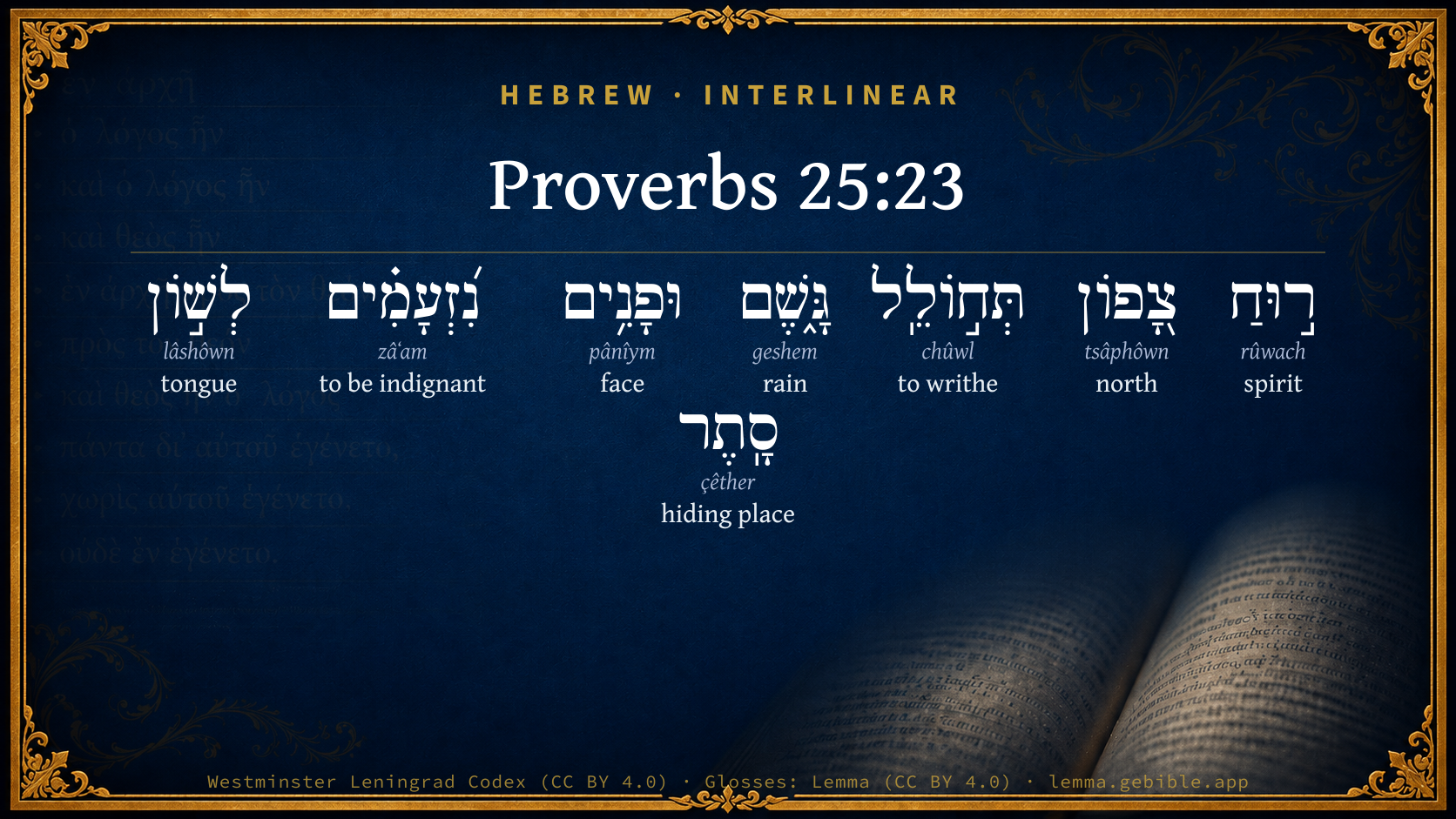
Hebrew (Westminster Leningrad Codex) Proverbs 25:23 appears in the Hebrew Old Testament. The text above is from the Westminster Leningrad Codex. Each word links to its Strong’s number, a concise gloss, and parsing drawn from the Open Scriptures Hebrew Bible morphology. Click any word for its full Brown-Driver-Briggs (BDB) entry.
Download image
Cite this verse

Proverbs 25:23 (World English Bible). Public Domain. Lemma interlinear Bible study tool, https://lemma.gebible.app/v/proverbs/25/23.

Show BibTeX & RIS
BibTeX
RIS
English Translation
The north wind brings forth rain: So a backbiting tongue brings an angry face.
World English Bible · Public Domain
Download a study sheet

One document with this verse’s original text, its word-by-word gloss line, the meaning frame, cross-references with their text, attributed commentary, and full source and license credits — printable, and it pastes into notes with its structure intact.

This verse Autodidact and up

Study sheet (.html) Plain text (.txt)

A passage Seminary Student

Up to 50 verses in one chapter. A passage sheet keeps up to 6 commentary sources and 12 cross-references per verse, in the order this page ranks them, and says so on the sheet whenever that leaves anything out. Ask for a single verse and you get the Autodidact verse sheet above.

Everything on this page stays free to read, with no account — the sheet is a download of what is already on screen, not access to it.

Want to remove ads? Support Godless Engineer
Compare translations 3

The same verse in 3 English versions, stacked beneath the original-language interlinear above. Click any original word for its lexicon entry.

Each is an independent rendering of the whole verse — the interlinear is not word-aligned to these translations.

Highlighted words mark where these versions differ — a whole-verse word diff, not a word-by-word alignment.

  • World English Bible Public Domain
    The north wind brings forth rain: So a backbiting tongue brings an angry face.
  • King James Version Public Domain
    The north wind driveth away rain: so doth an angry countenance a backbiting tongue.
  • unfoldingWord Literal Text CC BY-SA 4.0
    The wind of the north brings forth rain, and indignant faces, a tongue of secrecy.

unfoldingWord Literal Text — © unfoldingWord, licensed CC BY-SA 4.0. Word-aligned USFM3 via Door43 (git.door43.org/unfoldingWord/en_ult).

Versions to compare (up to 4)

3 of 4 selected

Show all 18 translations

Every available English version of this verse, each an independent rendering of the whole verse.

  • World English Bible Public Domain
    The north wind brings forth rain: So a backbiting tongue brings an angry face.
  • Berean Standard Bible Public Domain
    As the north wind brings forth rain, so a backbiting tongue brings angry looks.
  • Majority Standard Bible Public Domain
    As the north wind brings forth rain, so a backbiting tongue brings angry looks.
  • King James Version Public Domain
    The north wind driveth away rain: so doth an angry countenance a backbiting tongue.
  • American Standard Version (1901) Public Domain
    The north wind bringeth forth rain: So doth a backbiting tongue an angry countenance.
  • Revised Version (1885) Public Domain
    The north wind bringeth forth rain: so doth a backbiting tongue an angry countenance.
  • Geneva Bible (1599) Public Domain
    As the Northwinde driueth away the raine, so doeth an angry countenance the slandering tongue.
  • Douay-Rheims (1899) Public Domain
    The north wind driveth away rain, as doth a sad countenance a backbiting tongue.
  • Young's Literal Translation Public Domain
    A north wind bringeth forth rain, And a secret tongue -- indignant faces.
  • Literal Standard Version CC BY-SA 4.0
    A north wind brings forth rain, || And a secret tongue—indignant faces.
  • Unlocked Literal Bible CC BY-SA 4.0
    As surely as the north wind brings rain, so a tongue that tells secrets will result in angry faces.
  • unfoldingWord Literal Text CC BY-SA 4.0
    The wind of the north brings forth rain, and indignant faces, a tongue of secrecy.
  • Darby Bible Public Domain
    The north wind bringeth forth rain, and the angry countenance a backbiting tongue.
  • World Messianic Bible Public Domain
    The north wind produces rain; so a backbiting tongue brings an angry face.
  • Webster's Bible Public Domain
    The north wind driveth away rain: so doth an angry countenance a backbiting tongue.
  • Free Bible Version CC BY-SA 4.0
    In the same way that the north wind brings rain, slandering people makes them angry.
  • Bible in Basic English Public Domain
    As the north wind gives birth to rain, so is an angry face caused by a tongue saying evil secretly.
  • JPS Tanakh (1917) Public Domain
    The north wind bringeth forth rain, and a backbiting tongue an angry countenance.

Literal Standard Version (2020), Covenant Press — licensed CC BY-SA 4.0. Text via the HelloAO Bible API (eBible.org). Unlocked Literal Bible (unfoldingWord) — licensed CC BY-SA 4.0. Text via the HelloAO Bible API (eBible.org). unfoldingWord Literal Text — © unfoldingWord, licensed CC BY-SA 4.0. Word-aligned USFM3 via Door43 (git.door43.org/unfoldingWord/en_ult). Free Bible Version, Dr. Jonathan Gallagher — licensed CC BY-SA 4.0. Text via the HelloAO Bible API (eBible.org).

Word by word

More ways to search: Search by grammar → Find every occurrence → Compare this word →

Practice this passage: Drill this verse → Learn its vocabulary →

נִ֝זְעָמִ֗ים
zâʻam
H2194
“being indignant”
Verb, Niphal, Participle Active, Masculine, Plural, Absolute
Part of Speech
Verb
Stem
Niphal
Form
Participle Active
Gender
Masculine
Number
Plural
State
Absolute
Full BDB Definition

Origin: a primitive root

TWOT: 568

to denounce, express indignation, be indignant - (Qal) - to have indignation, be indignant, be angrily indignant, be defiant - to be abhorrent - to express indignation in speech, denounce, curse - (Niphal) to show indignation, show anger
  1. ר֣וּחַ rûwach H7307 “spirit of” Noun, Common, Both, Singular, Construct
  2. צָ֭פוֹן tsâphôwn H6828 “north” Noun, Common, Feminine, Singular, Absolute
  3. תְּח֣וֹלֵֽל chûwl H2342 “to writhe” Verb, Polel, Imperfect, 3rd Person, Feminine, Singular
  4. גָּ֑שֶׁם geshem H1653 “rain” Noun, Common, Masculine, Singular, Absolute
  5. וּפָנִ֥ים pânîym H6440 “and · face(s)” Conjunction + Noun, Common, Both, Plural, Absolute
  6. לְשׁ֣וֹן lâshôwn H3956 “tongue of” Noun, Common, Both, Singular, Construct
  7. סָֽתֶר çêther H5643 “hiding place” Noun, Common, Masculine, Singular, Absolute

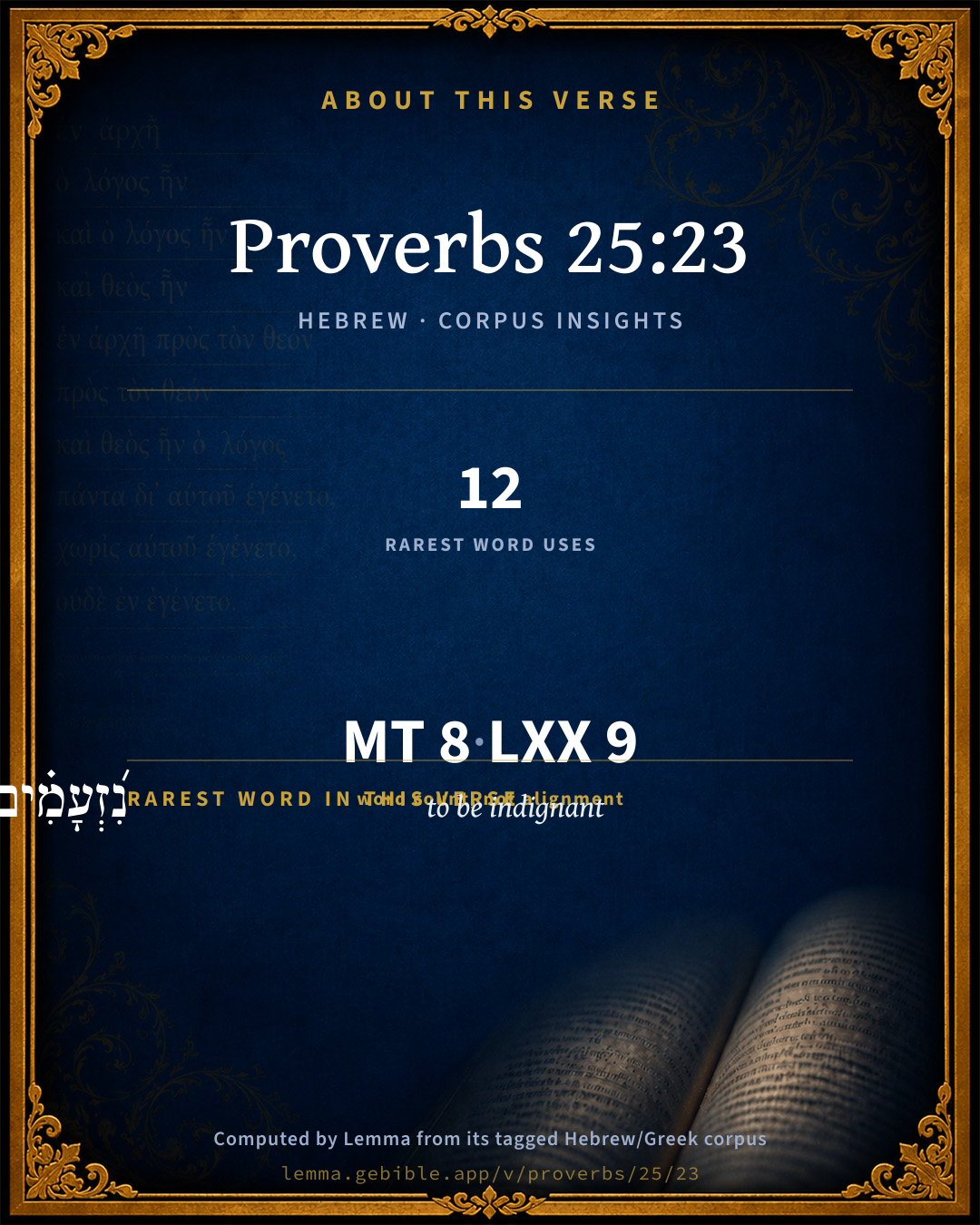
About this verse

These counts appear in no published source. They are computed here, from the morphology-tagged text and Lemma’s own curated glosses. What Lemma adds →

8
words
8
distinct lemmas
Wisdom
section

Notable vocabulary

The rarest word here is נִ֝זְעָמִ֗ים to be indignant H2194 — appearing just 12 times in the whole Hebrew Bible.

Shared distinctive vocabulary

נִ֝זְעָמִ֗ים to be indignant H2194 occurs in 11 verses of the Hebrew Bible. Also found in:

Grammatical profile

  • 2 verbs
  • 6 nouns

Verb forms

  • תְּח֣וֹלֵֽל Polel · Imperfect
  • נִ֝זְעָמִ֗ים Niphal · Participle Active

Hebrew & Septuagint length

In English translation the verse runs 14 words from the Hebrew and 12 from the Septuagint (LXX English) — closely comparable.

A rough comparison of the two English renderings, which tokenize alike — not a word-level alignment.

Word counts can differ between the Hebrew and the Greek without any difference in meaning — e.g. the Hebrew direct-object marker אֵת has no separate Greek word, and Greek often adds the article ὁ.

In the original languages it is 8 Hebrew tokens and 9 Greek tokens — but the two are counted differently (Hebrew bundles its prefixes and suffixes into one token; the Greek is in lemma form), so that isn’t a like-for-like length.

Cross-references

6

Topical passages linked to Proverbs 25:23 in the Treasury of Scripture Knowledge — connected by theme and wording, ordered by reader-vote popularity; previews shown in the World English Bible.

  • Job 37:22 Out of the north comes golden splendor; With God is awesome majesty.
  • Psalms 15:3 He who doesn't slander with his tongue, Nor does evil to his friend, Nor casts slurs against his fellow man;
  • Proverbs 26:20 For lack of wood a fire goes out; Without gossip, a quarrel dies down.
  • Romans 1:30 backbiters, hateful to God, insolent, haughty, boastful, inventors of evil things, disobedient to parents,
  • 2 Corinthians 12:20 For I am afraid that by any means, when I come, I might find you not the way I want to, and that I might be found by you as you don't desire; that by any means there would be strife, jealousy, outbursts of anger, factions, slander, whisperings, proud thoughts, riots;
  • Psalms 101:5 I will silence whoever secretly slanders his neighbor. I won't tolerate one who is haughty and conceited.

Cross-references courtesy of OpenBible.info (CC BY 4.0).

Hebrew and Greek witnesses Masoretic Hebrew ↔ Greek Septuagint

The same verse in the two great witnesses to the Old Testament, shown verse-for-verse.

These are two independent witnesses, not word-aligned to each other, and the Septuagint is shown in lemma (dictionary) form.

Hebrew Proverbs 25:23 Masoretic · Westminster Leningrad Codex

ר֣וּחַ צָ֭פוֹן תְּח֣וֹלֵֽל גָּ֑שֶׁם וּפָנִ֥ים נִ֝זְעָמִ֗ים לְשׁ֣וֹן סָֽתֶר

The north wind brings forth rain: So a backbiting tongue brings an angry face.

World English Bible · Public Domain

Greek LXX Proverbs 25:23 Septuagint · lemma form

ἄνεμος βορέας ἐκἐγείρω νέφος πρόσωπον δέ ἀναιδής γλῶσσα ἐρεθίζω

The north wind raises clouds; so an impudent face provokes the tongue.

LXX2012 (modern English Septuagint) · Public Domain

On this verse, Keil & Delitzsch discusses the Septuagint’s reading. Read the note in Commentary ↓

Hebrew: Westminster Leningrad Codex (CC BY 4.0). Greek: Septuagint (public domain); English from LXX2012 (modern English Septuagint) (Public Domain). How the Septuagint differs from the Hebrew →

Commentary

Notes on Proverbs 25:23 from classic Christian and Jewish commentators (each source and its license shown beneath its notes). The classic Christian expositions comment on the surrounding passage and are grouped to its opening verse, so a note may address several verses; the Jewish commentaries on the Tanakh (Rashi and others) are per-verse, so they appear only where the commentator wrote on this verse.

Lemma curates 59 commentaries, every one of them public domain or Creative Commons licensed, each selected and text-cleaned for this edition rather than reprinted as found. About our sources →

Trapp's Complete Commentary

John Trapp

Pro 25:23 The north wind driveth away rain: so [doth] an angry countenance a backbiting tongue.

Ver. 23. The north wind drives away rain.] Hence Homer calls it αιθρηγενουτην, the fair weather maker, and Jerome the air’s besom. There is a southerly wind that attracts clouds and engenders rain. {a}

So doth an angry countenance, a backbiting tongue.] The ready way to be rid of tale bearers is to browbeat them; for like whelps, if we stroke them they leap upon us and defile us with fawning; but give them a rap and they are gone; so here. Carry, therefore, in this case, a severe rebuke in thy countenance, as God doth {Psa 80:16} Be not a resetter to these privy thieves, a receptacle for these mures nominis, as one calls them; the tale hearer is as blameworthy as the tale bearer, and he that "loves" a lie as he that "makes" it {Rev 22:15 Psa 15:3 Rom 1:31}

{a} Caecias nubes attrahit.

John Trapp, A Commentary or Exposition upon All the Books of the Old and New Testament (1647–1656) — public domain. Text from a community e-Sword module.

The Biblical Illustrator

Joseph S. Exell

Pro_25:23

The north wind driveth away rain: so doth an angry countenance a backbiting tongue.

Righteous anger

The marginal reading, which is, The north wind bringeth forth rain: so doth a backbiting tongue an angry countenance, gives quite the opposite sense. In Arabia the north wind blew over a long tract of dry land, and therefore usually brought dry weather (Job_27:21); but in Judea the north wind, including all the winds between the north and north-west, blew from the Mediterranean Sea, and therefore commonly brought rain. Accepting the marginal version, the idea is, that as the north wind brings forth rain, a backbiting tongue brings forth an angry countenance. But our version, which we think equally faithful to the original, gives an idea equally good and important; it is, that an expression of displeasure in the listener will silence the tongue of the backbiter. The anger referred to here is a righteous anger; its object is legitimate, its expression is natural, its influence is useful.

I. Its object is legitimate. It is directed against a backbiting tongue. A backbiter is a clandestine traducer of character. His speech goes to damage anothers reputation behind his back. He does it sometimes by telling truth as well as falsehood. A man need not tell lies to be a backbiter; he can do it by parading damaging facts, and such damaging facts may be found in the chapters of every mans life. He does it sometimes un-maliciously. He may be prompted by vanity; he may disparage another in order to set himself off to better advantage. He may do it from greed: his object may be to rob the subject of his talk of some share of his patronage and support.

II. Its expression is natural. An angry countenance. The countenance is a fuller, more faithful, and forceful revealer of the soul than the tongue. An admiring look has often won hearts which no words could enlist. A courageous look in the leaders of campaigns wakes the invincible in battalions. A reproving look has broken hearts, as Christs broke the heart of Peter. An angry look, not a mere peevish, petulant look, but a look of right down honest anger, directed to a backbiter, would send him in mute confusion from your presence.

III. Its influence is useful. The north wind driveth away rain, so doth an angry countenance a backbiting tongue. (Homilist.)

The Biblical Illustrator, edited by Joseph S. Exell (c. 1880s–1900s) — public domain. Text from a community e-Sword module.

Joseph Benson's Commentary

Pro 25:23. The north wind, &c. — “As the sharpness of the north wind scatters clouds, and drives away rain, so a severe countenance, full of indignation against him that traduces his neighbour, not only gives a check, but puts a stop to his slanderous tongue; which would not tell such lies if they were not greedily received.” So Bishop Patrick, who justly observes, however, that the verse will admit of a quite contrary sense; as, indeed, the reader may see by the margin, where he finds a translation of the words very different from that in the text, but more agreeable to the Hebrew original, and countenanced by most of the ancient interpreters. Thus the Chaldee renders the first clause, The north wind, משׂנא, concipit, conceives, or produces, rain: and the Seventy, ανεμος βορεας εξεγειρει νεφη, the north wind raises clouds. Undoubtedly the north wind brings clouds and rain in some climates, and if, as some assert, it generally does so in Judea, as according to Aristotle it does in those parts of Africa which border on the Mediterranean sea, this interpretation ought certainly to be preferred. Either of them, however, shows the odious disposition and character of backbiters; and that they ought to be discountenanced and frowned upon by all that love their fellow-creatures, and wish peace to be promoted among men.

Joseph Benson's Commentary on the Old and New Testaments (1811–1818) — public domain. Text from a community e-Sword module.

The Preacher's Complete Homiletical Commentary

Joseph S. Exell (gen. ed.)

CRITICAL NOTES.—

Pro_25:23. Driveth away. Rather “Brings forward the rain-clouds.” Most modern commentators adopt this rendering of the verb, and read the latter phrase to suit the metaphor—“So a secret or slanderous tongue, a troubled countenance.”

MAIN HOMILETICS OF Pro_25:23

THE WAY TO TREAT A BACKBITER

It will be seen from a reference to the Critical Notes, that nearly all modern commentators render this verse quite differently from the common version, and so reverse the meaning. It will, however, bear the common rendering. “I confess,” says Wardlaw, “that if the word will bear it at all, our version seems decidedly preferable. There is something tame, commonplace, and of little practical consequence—hardly worth forming the subject of a proverb—in saying that as the north wind brings rain, ‘a backbiting tongue’ brings anger. But the verse as it stands in our translation inculcates a most important lesson.” We therefore take the proverb as we find it in our Bible, as setting forth—

I. An unrighteous action producing a righteous emotion. We have before had brought before us in this book the peculiar iniquity of backbiting and its evil results (see page 274). The special unrighteousness of the act lies, of course, in the fact that the person who is the subject of it, being absent and ignorant of the charge brought against him, has no opportunity of defending himself. A feeling of indignation against such an act, and an expression of it in the countenance, is therefore demanded from every lover of truth and justice. He who will calmly listen to a tale of slander and show no tokens of disapproval, makes himself a partaker of the sin. But it is impossible for a righteous man to act thus. When a putrid body is presented to our bodily senses, if we are healthy men we experience a feeling of revulsion which we cannot conceal. And so if a man is morally healthy he must experience and reveal a strong dislike to the backbiting tongue.

II. The unrighteous action overpowered by the righteous emotion. When the heavy rain-clouds which overspread the sky are dispersed and driven away by the wind, they show themselves to be the weaker of the two contending forces. And so when the backbiting tongue is silenced by the look of righteous indignation, it gives proof that, however strong the workings of evil are, the power of goodness is stronger. Those who set their faces against this or any other vice, may always draw encouragement from the fact that there is a reprover within the breast of the wrong-doer, which in spite of all efforts to stifle it, seconds the reprover from without—wherever the conscience is at all awake, it says Amen to a faithful rebuke, whether administered by word or look. And so it is that a countenance upon which is written righteous anger is so potent a check to a backbiting tongue.

OUTLINES AND SUGGESTIVE COMMENTS

It is a great encouragement to talebearers, to observe that their wicked stories are heard with attention. If a man looks upon them with a cheerful countenance, and listens to their tales, and makes them welcome to his table, they naturally conclude that the person to whom they speak has as bad a heart as themselves, and they will not fail to bring him new stories of the like kind, as soon as they have got an opportunity to learn or to make them. But if the receiver of stolen goods is a sharer with the thief in his guilt, and if any man that encourages another in evil partakes in his sin, then he that hears the backbiter with complacency is little better than himself, and would probably follow the same trade if he had the same talents for it. We cannot, therefore, clear ourselves from the sin of backbiting, unless we refuse to receive a bad report of our neighbour, and testify our displeasure, by all proper methods, at the base conduct of the assassins that would murder in the dark the good-name of their fellow-creatures. When the murderers of Isbosheth brought their master’s head to David, judging from their own disposition that it would be an acceptable present to him, he treated them in such a manner that no man ever sent another present of the like kind to him.—Lawson.

There is a place for anger as well as for love. As in nature, a gloomy tempest serves some beneficial purposes for which calm sunshine has no faculty; so in morals, a frown on an honest man’s brow is in its own place, as needful and useful as the sweetest smile that kindness ever kindled on the human countenance … We don’t want a fretful passionate man; and if we did, we could find one without searching long or going far. We want neither a man of wrath nor a man of indiscriminating, unvarying softness. We want something with two sides; that is, a solid real character. Let us have a man who loves good and hates evil, and who, in place and time convenient, can make either emotion manifest upon his countenance. The frown of anger is the shade that lies under love and brings out its beauty.—Arnot.

For Homiletics on Pro_25:24, see on chap. Pro_21:9, page 613.

The Preacher's Complete Homiletical Commentary (gen. ed. Joseph S. Exell; Funk & Wagnalls, c. 1892) — public domain (pre-1929). A full-Bible homiletical/sermon-outline anthology covering 65 of 66 books (2 John is absent from the source module). Text from a community e-Sword module.

Keil & Delitzsch

C. F. Keil & F. Delitzsch

The next group of proverbs extends from Pro 25:23 to Pro 25:28.

23 Wind from the north produceth rain;

And a secret tongue a troubled countenance.

The north is called צפון, from צפן, to conceal, from the firmament darkening itself for a longer time, and more easily, like the old Persian apâkhtara, as (so it appears) the starless, and, like aquilo, the north wind, as bringing forward the black clouds. But properly the "fathers of rain" are, in Syria, the west and the south-west; and so little can צפון here mean the pure north wind, that Jerome, who knew from his own experience the changes of weather in Palestine, helps himself, after Symmachus (διαλύει βροχήν), with a quid pro quo out of the difficulty: ventus aquilo dissipat pluvias; the Jewish interpreters (Aben Ezra, Joseph Kimchi, and Meri) also thus explain, for they connect together תחולל, in the meaning תמנע, with the unintelligible חלילה (far be it!). But צפון may also, perhaps like ζόφος (Deutsch. Morgenl. Zeitsch. xxi. 600f.), standing not without connection therewith, denote the northwest; and probably the proverb emphasized the northern direction of the compass, because, according to the intention of the similitude, he seeks to designate such rain as is associated with raw, icy-cold weather, as the north wind (Pro 27:16, lxx, Sir. 43:20) brings along with it. The names of the winds are gen. fem., e.g., Isa 43:6. תּחולל (Aquila, ὠδίνει; cf. Pro 8:24, ὠδινήθην) has in Codd., e.g., the Jaman., the tone on the penult., and with Tsere Metheg (Thorath Emeth, p. 21) serving as העמדה. So also the Arab. nataj is used of the wind, as helping the birth of the rain-clouds. Manifestly פנים נזעמים, countenances manifesting extreme displeasure (vid., the Kal זעם, Pro 24:24), are compared to rain. With justice Hitzig renders פנים, as e.g., Joh 2:6, in the plur. sense; because, for the influence which the tongue slandering in secret (Psa 101:5) has on the slandered, the "sorrowful countenance" would not be so characteristic as for the influence which it exercises on the mutual relationships of men: the secret babbler, the confidential communication throwing suspicion, now on this one and now on that one, behind their backs, excites men against one another, so that one shows to another a countenance in which deep displeasure and suspicion express themselves.

Keil & Delitzsch — Biblical Commentary on the Old Testament (1861–1891) — public domain (CC PDM 1.0). Text via the HelloAO Bible API. (Old Testament only.)

Matthew Henry's Commentary

Here see, 1. How we must discourage sin and witness against it, and particularly the sin of slandering and backbiting; we must frown upon it, and, by giving it an angry countenance, endeavour to put it out of countenance. Slanders would not be so readily spoken as they are if they were not readily heard; but good manners would silence the slanderer if he saw that his tales displeased the company. We should show ourselves uneasy if we heard a dear friend, whom we value, evil-spoken of; the same dislike we should show of evil-speaking in general. If we cannot otherwise reprove, we may do it by our looks. 2. The good effect which this might probably have; who knows but it may silence and drive away a backbiting tongue? Sin, if it be countenanced, becomes daring, but, if it receive any check, it is so conscious of its own shame that it becomes cowardly, and this sin in particular, for many abuse those they speak of only in hopes to curry favour with those they speak to.

Matthew Henry's Commentary on the Whole Bible (1708–1710) — public domain (CC PDM 1.0). Text via the HelloAO Bible API.

Jamieson, Fausset & Brown

Robert Jamieson, A. R. Fausset & David Brown

Better, "As the north wind bringeth forth (Psa 90:2) or produces rain, so does a concealed or slandering tongue produce anger."

Jamieson, Fausset & Brown — Commentary Critical and Explanatory on the Whole Bible (1871) — public domain (CC PDM 1.0). Text via the HelloAO Bible API.

Adam Clarke's Commentary

Verse 23. The north wind driveth away rain] The margin has, "The north wind bringeth forth rain." It is said that the "north wind brings forth rain at Jerusalem, because it brings with it the vapours arising from the sea that lies north of it." The marginal is the true reading; and is supported by the Chaldee, Syriac, and Septuagint; but the Arabic reads south wind.

A backbiting tongue] A hidden tongue.

Adam Clarke's Commentary on the Bible (1810–1826) — public domain. Text from a community e-Sword/MySword module.

Ellicott's Commentary for English Readers

(23) The north wind driveth away rain.—The marginal rendering is probably more correct: “The north wind bringeth forth rain;” but as this seems to be opposed to Job_37:22, it has been thought that the north-west, which is a rainy wind, must be intended here.

So doth an angry countenance a backbiting tongue.—Rather, So doth a backbiting tongue (bring forth, or cause) troubled faces.

A Bible Commentary for English Readers, edited by Charles John Ellicott (1878–1897) — public domain. Text from a community e-Sword module.

The Cambridge Bible for Schools and Colleges

gen. ed. J. J. S. Perowne

23. driveth away] Rather, bringeth forth, A.V. marg., R.V. text. The rendering of A.V. text follows the Vulg., dissipat pluvias, and is apparently supported by Job_37:22 : “Fair weather,” or “golden brightness, cometh out of the north,” a phenomenon which is there attributed to the action of the wind blowing from that quarter (see Pro_25:21 and note in this Series). But by “north” may perhaps here be meant “north-west.” (“Intelligendus ille ventus qui inter aquilonem et occasum flat, Thrascias sive Caurus, qui a Seneca in Hippol. 25:1130 imbrifer dicitur,” Rosenm.) The comparison thus becomes clear and forcible: The north wind bringeth forth rain. The secret action of the wind covers the heaven with clouds, so doth (adopting R.V. in preference to A.V.) a backbiting tongue an angry countenance; its secret malignity is sure to be discovered and to clothe the countenance of its victim with dark anger.

The Cambridge Bible for Schools and Colleges (gen. ed. J. J. S. Perowne; Cambridge University Press, 1878–1918) — public domain. Text from a community e-Sword module.

John Gill's Exposition

The north wind driveth away rain,.... So the geographer (w) says, the swift north wind drives away the moist clouds; which usually come from the opposite quarter, the south. The word used has the signification of conceiving, and begetting, and bringing forth; hence some (x) render it to a different sense, and so the Targum,

"the north wind bringeth forth rain;''

and in this sense Gersom interprets it, and says,

"the north wind produces rain in Jerusalem, because it brings there the vapours that ascend from the sea, which lies north unto it;''

and the philosopher (y) says, that in the northern parts of the world the south wind produces rain; and in the southern parts the north wind produces it, as in Judea. But in Job 37:22, fair, fine, golden, serene, "weather", is said to "come out of the north"; agreeably to which, the north wind is by Homer (z) called the producer of serene weather; and by Virgil (a) "clarus aquilo", i.e. what makes serene. The Arabic version reads it, "the south wind"; and that does bring rain, and, as that version has it, excites the clouds. But the first reading and sense of the words seem best (b), and agree with what follows:

so doth an angry countenance a backbiting tongue; drives it away, discourages and silences it. When a man puts on a stern countenance, a frowning and angry look, on such who bring him slanderous reports and idle tales of their neighbours, and reproach and backbite them, it checks them, and puts a stop to their practices; whereas listening to them, and especially with an air of pleasure, encourages them in them; were there not so many that take pleasure in hearing those talebearers and backbiters, were they more roughly dealt with, as the blustering north wind does with the rain, there would not be so much of this evil practised.

(w) Dionysii Perieg. v. 532. (x) "parturiet", Montanus; "gignit", Junius & Tremellius; "parturit", Schultens. (y) Aristot. Metaphysic. l. 2. (z) Iliad. 19. v. 358. Odyss. 5. v. 295. (a) Georgic. l. 1. prope finem. (b) "Ventorum frigidissimi quos a septentrione diximus spirare, et reliquos compescunt, et nubes abigunt", Plin. Nat. Hist. l. 2. c. 47.

John Gill's Exposition of the Whole Bible (1746–1763) — public domain (CC PDM 1.0). Text via the HelloAO Bible API.

Albert Barnes' Notes on the Bible

The marginal reading is far more accurate and gives a better sense. The northwest wind in Palestine commonly brings rain, and this was probably in the thought of the writer.

Albert Barnes' Notes on the Bible (1834–1885) — public domain. Text from a community e-Sword/MySword module.

Haydock's Catholic Bible Commentary

Rain; (Symmachus; Protestants) or marginal note, "bringeth forth rain." (Haydock) --- But St. Jerome, who live in the country, knew that this wind was rather dry; and therefore he has abandoned the Septuagint, raiseth the clouds," Job xxxvii. 9., Joel ii. 20., and Ecclesiasticus xviii. 23. The countries north of Palestine were not calculated to produce vapours and rain, which came rather from the south. (Calmet) --- Tongue. If the hearers would shew their displeasure, detractors would soon be reduced to silence. (St. Jerome, ad. Rust.) (St. Bernard)

George Leo Haydock (1774–1849), Haydock's Catholic Family Bible and Commentary, 1859 edition — public domain. Excludes Psalms (Douay-Rheims chapter numbering differs from Protestant) and Deuterocanonical books (Catholic canon only).

Matthew Poole's English Annotations

An angry countenance in the hearer, who by his countenance showeth his dislike of such persons and practices.

A backbiting tongue, Heb. a secret tongue, which privily slandereth his neighbour, as it is expressed, Psa 101:5, and as the manner of backbiters is. But this verse is otherwise rendered in the margin, and by divers others, the north wind bringeth forth (as this verb properly and most frequently signifies, and as it is rendered by all the ancient interpreters, and by many others) rain (which it doth in Judea, because the sea lies northward as well as westward from it, as also in Africa, as Aristotle observes, though it drive away rain in countries of another situation):

so doth a backbiting tongue (cause)

an angry countenance; it causeth much anger and mischief; both to the person slandered, and to the slanderer, and to other persons who may be concerned with or for either of them, as is manifest from common experience.

Matthew Poole's English Annotations on the Holy Bible (1683–1685) — public domain. Text from a community e-Sword/MySword module.

Whedon's Commentary on the Bible

Daniel D. Whedon

23. The north wind — The north, or, rather, northwest wind is said to bring rain at Jerusalem, because it brings up vapours from the Mediterranean Sea. Luk_12:54.

Driveth away — The marginal reading is, “bringeth forth,” which is generally preferred as being more consonant with the etymology, better supported by the Versions, and more consonant to the fact.

Angry countenance a backbiting tongue — Many interpreters transpose the sentence and read thus: The north wind brings forth rain, and a covert tongue an angry countenance. (Conant and others.) This meaning is not beyond doubt. צפון, (tsaphon,) north, means hidden, concealed. The north was the dark, unknown quarter, as compared to the sunny south. This may have given the proverb more point to the Hebrews than it has for us. A wind from the hidden part produces a shower: a concealed (sly, slanderous) tongue, sorry faces.

Daniel D. Whedon (gen. ed.), Commentary on the Old and New Testaments (1874–1909) — public domain. Text from a community e-Sword module.

The Pulpit Commentary

The north wind driveth away rain. So St. Jerome (Ventus Aquilo dissipat pluvias), Symmachus, Aben Ezra, and others. The north wind is called by the natives of Palestine "the heavenly," from the bright effect which it produces in the sky. "By means of the north wind cometh he (the sun) forth as gold". (Job_37:22) But the verb here used (lwj) means "to bring forth, produce"; (Psa_90:2) hence the Revised Version rightly renders, "The north wind bringeth forth rain." This is quite true if "north wind" be taken as equivalent to "wind from the dark quarter" (Umbreit), like zofov in Greek; and, in fact, the northwest wind in Palestine does bring rain. Septuagint, "The north wind arouseth (exegeirei ) clouds." So doth an angry countenance a backbiting, tongue. Carrying on the interpretation intended by the Authorized Version, this clause means that an angry leer will check a slanderer and incline him to hold his peace from prudential motives. But with the rendering given above, "bringeth forth," another explanation is involved, viz. "So does a secret, slandering tongue cause a troubled countenance." When a man discovers that a secret slanderer is working against him, he shows it by his gloomy and angry look, as the sky is dark with clouds when a storm is threatened. "Countenance" is plural in the Hebrew, denoting, as Hitzig points out, that the calumniator does not affect one person only, but occasions trouble far and wide, destroys friendly relations between many, excites suspicion and enmity in various quarters Septuagint, "An impudent countenance provokes the tongue.

Vers. 23-28. Moral invectives.

I AGAINST SLANDER. (Ver. 23) Here is a striking picture. Gunning and slanderous habits beget a dark and gloomy expression on the brow; as a homely German proverb says, "He makes a face like three days" rainy weather." The countenance, rightly read, is the mirror of the soul. Without the candid soul the brow cannot be clear and open. If we look into the mirror, we may see the condemnation which nature (that is, God) stamps upon our evil and unholy moods.

II AGAINST CONTENTIOUSNESS. (Ver. 24) Better solitude than the presence of the quarrelsome in the home. A wife is either the husband"s most satisfying delight or the cruetlest thorn in his side.

III UNHOLY COWARDICE. (Ver. 26) Faint heartedness springs from need of genuine faith. To see the chief struck down in battle dismays the band. "He is gone from the mountain, he is lost to the forest, Like a summer-dried fountain, when our need was the sorest!

And if the good man is a fountain of help and encouragement by his example, how does the drying up of such a spring the failure to assert the truth and confront the gainsayer dismay and paralyze those who look on!

IV EXCESS IN SPECULATIVE THOUGHT. (Ver. 27) There may be too much of any good thing, even of the pursuit of knowledge. It is too much when it disturbs the health; as a common proverb of the Germans says, "To know everything gives the headache." It is too much when it disturbs the moral balance and unfits for society. We must know when to leave the heights of speculation and nestle in the lowly vale of faith.

V WANT OF SELF-CONTROL. (Ver. 28) It is like an undefended city or one in ruins. How weak is it to be able to endure nothing, to deem it a mark of strength to resist every provocation and injury! Let us learn, after Christ"s example, to be abused without being angry; to give soft words and hard arguments; and to cultivate self-control in matters of small moment, in preparation for those of greater. For "if we have run with the footmen, and they have wearied us, how shall we contend with horses? J.

The Pulpit Commentary (1880–1919), ed. H.D.M. Spence-Jones & Joseph S. Exell — public domain. Text from a community e-Sword module.

Bridges on Proverbs

Charles Bridges

23 The north wind driveth away rain: so doth an angry countenance a backbiting tongue. {The north wind bringeth forth rain: so doth a backbiting tongue an angry countenance, margin.†a}

Who should tolerate the backbiter? He is a pest in society;†1 in the circle of friendship;†2 in the church of God.†3 Neither his plausible garb, nor the good company who give him the hearing, can hide his real character. If the north wind driveth away the rain, let an angry countenance frown him from our presence. If it brings the rain, let the very sight of him bring a rebuke of holy indignation. This is to "be angry, and not sin."†4 Indeed not to be angry here, would be to sin. Holy anger is a property in God.†5 It was manifested in the humanity of Jesus.†6 When God’s name was dishonored, "the meekest man upon earth waxed hot"†7 in anger, even while his heart was melting in love to the rebels. (Exo 32:30-32 .) And should not we feel this, when the backbiting tongue breaks his law of love, dear to him as his own Godhead? And yet rare indeed is the exception — alas! — even with Christians, when the faults of others, real or imagined, do not occupy the conversation: or at least, when some lowering of the absent, or some ridicule of their infirmities, is not admitted!

This tongue wounds four at one stroke — the backbiter himself, the object of his attack, the hearer, and the name of God. All involves the Christian professor in the fearful guilt of "offending the little ones." (Mat 18:6 .) For how can the weak and inexperienced but be stumbled at so inconsistent an exhibition of the gospel of love?

But if he be rather welcomed than repelled, is not the willing listener thus partaker of his sin? Flee this deadly pest. Keep thine ears, as well as thy mouth, from the poison. Let thine angry countenance drive away either the slander from him, or the slanderer from thee. Where remonstrance cannot be given, a marked displeasure of countenance is often an effective rebuke to the shameless offender.†8

Footnotes:

†a Many valuable critics, after the LXX, prefer the marginal to the received reading. The ordinary meaning of the Hebrew word is to produce or bring forth, Pro 8:24 . And yet Compare Job 37:22 . Homer also speaks of the north wind bringing fine weather — Il. O. 170. The meaning however is the same with either rendering.

†1 Pro 26:20.

†2 Pro 16:28.

†3 2Co 12:20 .

†4 Eph 4:26. ’You know,’ said Philip Henry — ’what an angry countenance doth; and we may sometimes give a reproof by our looks, when we have not opportunity of giving it otherwise.’ See his Life.

†5 Deu 9:8. Psa 7:11 . Nah 1:2 .

†6 Mar 3:5; Mar 8:33 .

†7 Exo 32:19, with Num 12:3 .

†8 Augustine’s biographer mentions of him, that these two lines were written in his dining room —

’Quisquis amat dictis absentum rodere vitam,

Hanc mensam vetitam noverit esse sibi.’

It is added, that he said to a bishop, indulging this habit at his table, ’Either I will blot out these verses on the wall, or begone from my table.’ Bishop Burnet, in his Essay on Queen Mary, mentions her effectual rebuke of calumny. If any indulged it in her presence, she would ask, if they had read Archbishop Tillotson’s Sermon on Evil Speaking, or give them other pointed reproof. — See the fine description, Sir 28:13-20 .

Charles Bridges, An Exposition of the Book of Proverbs (1846) — public domain. Text from a community e-Sword module.

unfoldingWord translationNotes

Door43 World Missions Community

the north wind

In Israel, wind from the north often brought rain. Translators are free to substitute different kinds of wind for the same effect, for example, "a cold wind."

a tongue that tells secrets

Some versions read "someone who tells secrets."

result in angry faces

The face is a synecdoche for the person. AT: "makes other people so angry you can see it in their faces" (See: Synecdoche)

a corner of the roof

Houses in those days had flat roofs. Ancient Israelites spent much time on their roofs, where it was often cooler than inside the house, and sometimes people would build a shelter large enough for a person to sleep in on one corner of the roof. (See: Assumed Knowledge and Implicit Information)

a quarreling wife

a wife who often argues or complains

translationWords

life

unfoldingWord translationNotes — © Distant Shores Media and the Door43 World Missions Community, licensed CC BY-SA 4.0. Source: git.door43.org/Door43/en_tn.

Rashi

Rabbi Shlomo Yitzchaki (Rashi)

As the north wind begets rain It begets and creates the rain.

an angry countenance A backbiting tongue begets [an angry countenance]. Slander causes the countenance of the Holy One, blessed be He, to be angry, and this is the comparison [of the interpretation] of the verse. [The bracketed words do not appear in the Salonica edition, which seems more correct than our edition.] The north wind is accustomed to beget rain and a backbiting tongue is accustomed to [beget] an angry countenance.

Rashi on the Tanakh — English translations: “The Judaica Press complete Tanach with Rashi, translated by A. J. Rosenberg” (CC BY 4.0); “Pentateuch with Rashi's commentary by M. Rosenbaum and A.M. Silbermann, 1929-1934” (public domain); “The Metsudah Tanach series, Lakewood, N.J” (CC BY 4.0); and “The Book of Joshua, Metsudah Publications, 1997” (CC BY 4.0). Text via Sefaria.

Lesson kit

Teaching starters — assembled from the data on this page, not authored interpretation. Every prompt links to the verse data it draws on. Edit before teaching.

Proverbs, in the Wisdom, opens this verse with 8 words (8 distinct Hebrew lemmas). Its most distinctive word is zâʻam (“to be indignant”). A historical commentator’s framing appears above. Read the whole chapter for the surrounding context.

Discussion questions

  1. What does “to be indignant” (zâʻam) contribute to the verse as a whole?
  2. How does Numbers 23:7, which shares the word «to be indignant», read alongside this verse?
  3. These translations render this verse differently. What is at stake in choosing one wording over another?
  4. «תְּח֣וֹלֵֽל» is a Polel Imperfect verb. How does that grammatical form shape the action described?
  5. Compare how Trapp's Complete Commentary and The Biblical Illustrator read this verse. Where do they agree or differ?

Things to notice

Reading settings

Reading text

Shown beneath each verse's original-language words.

Old Testament
Old Testament edition

Read the OT as the Masoretic Hebrew (MT) or the Greek Septuagint (LXX).

English shown for the Greek Septuagint (in the Hebrew ↔ Greek comparison).

Comparing translations? Open the Compare panel on any verse page to stack up to four side by side.