
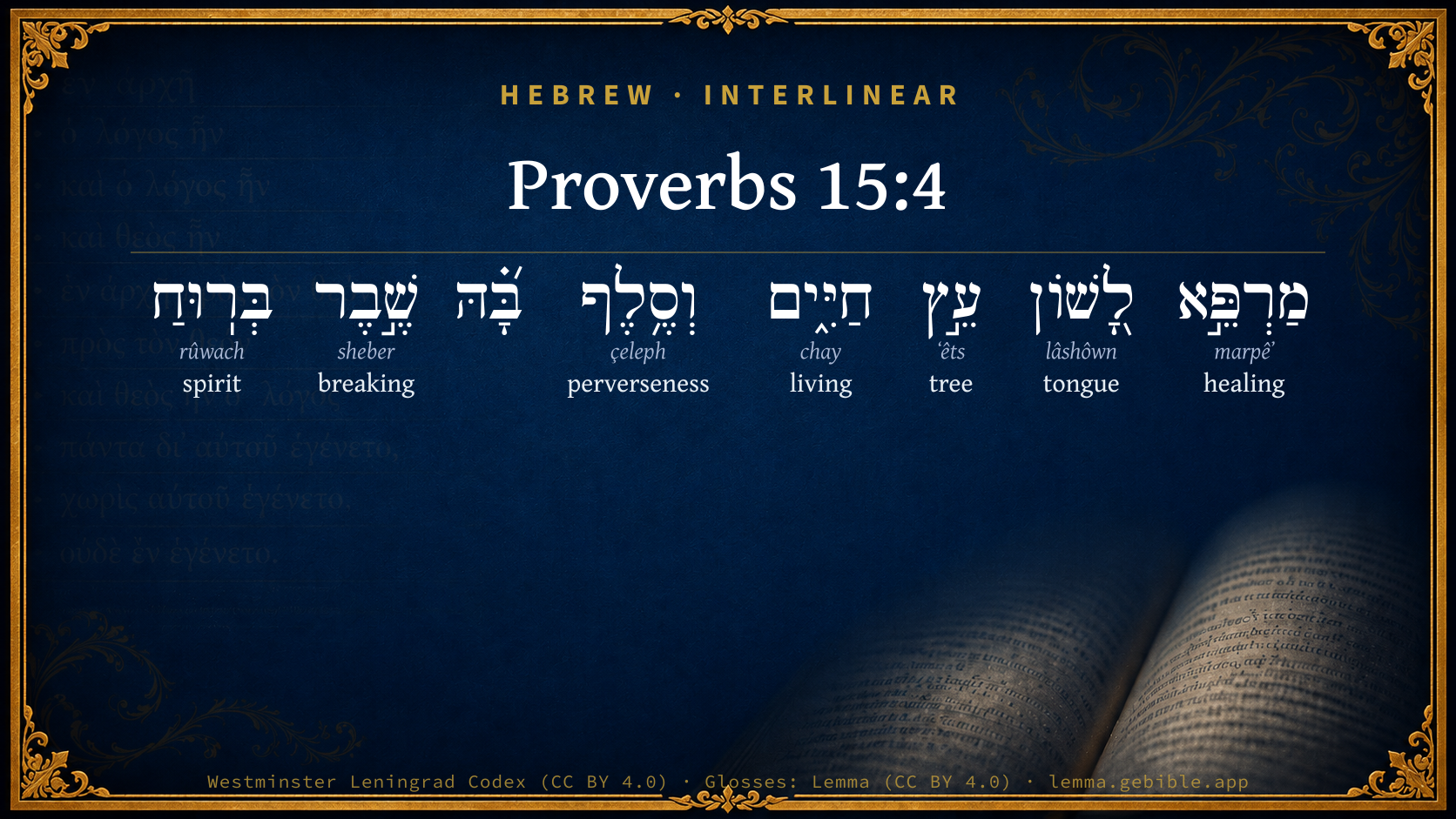
Proverbs 15:4

Hebrew (Westminster Leningrad Codex) Proverbs 15:4 appears in the Hebrew Old Testament. The text above is from the Westminster Leningrad Codex. Each word links to its Strong’s number, a concise gloss, and parsing drawn from the Open Scriptures Hebrew Bible morphology. Click any word for its full Brown-Driver-Briggs (BDB) entry.
Download image
Cite this verse

Proverbs 15:4 (World English Bible). Public Domain. Lemma interlinear Bible study tool, https://lemma.gebible.app/v/proverbs/15/4.

Show BibTeX & RIS
BibTeX
RIS
English Translation
A gentle tongue is a tree of life, But deceit in it crushes the spirit.
World English Bible · Public Domain
Download a study sheet

One document with this verse’s original text, its word-by-word gloss line, the meaning frame, cross-references with their text, attributed commentary, and full source and license credits — printable, and it pastes into notes with its structure intact.

This verse Autodidact and up

Study sheet (.html) Plain text (.txt)

A passage Seminary Student

Up to 50 verses in one chapter. A passage sheet keeps up to 6 commentary sources and 12 cross-references per verse, in the order this page ranks them, and says so on the sheet whenever that leaves anything out. Ask for a single verse and you get the Autodidact verse sheet above.

Everything on this page stays free to read, with no account — the sheet is a download of what is already on screen, not access to it.

Want to remove ads? Support Godless Engineer
Compare translations 3

The same verse in 3 English versions, stacked beneath the original-language interlinear above. Click any original word for its lexicon entry.

Each is an independent rendering of the whole verse — the interlinear is not word-aligned to these translations.

Highlighted words mark where these versions differ — a whole-verse word diff, not a word-by-word alignment.

  • World English Bible Public Domain
    A gentle tongue is a tree of life, But deceit in it crushes the spirit.
  • King James Version Public Domain
    A wholesome tongue is a tree of life: but perverseness therein is a breach in the spirit.
  • unfoldingWord Literal Text CC BY-SA 4.0
    A healing tongue a tree of life, but crookedness in it a breaking in the spirit.

unfoldingWord Literal Text — © unfoldingWord, licensed CC BY-SA 4.0. Word-aligned USFM3 via Door43 (git.door43.org/unfoldingWord/en_ult).

Versions to compare (up to 4)

3 of 4 selected

Show all 18 translations

Every available English version of this verse, each an independent rendering of the whole verse.

  • World English Bible Public Domain
    A gentle tongue is a tree of life, But deceit in it crushes the spirit.
  • Berean Standard Bible Public Domain
    A soothing tongue is a tree of life, but a perverse tongue crushes the spirit.
  • Majority Standard Bible Public Domain
    A soothing tongue is a tree of life, but a perverse tongue crushes the spirit.
  • King James Version Public Domain
    A wholesome tongue is a tree of life: but perverseness therein is a breach in the spirit.
  • American Standard Version (1901) Public Domain
    A gentle tongue is a tree of life; But perverseness therein is a breaking of the spirit.
  • Revised Version (1885) Public Domain
    A wholesome tongue is a tree of life: but perverseness therein is a breaking of the spirit.
  • Geneva Bible (1599) Public Domain
    A wholesome tongue is as a tree of life: but the frowardnes therof is the breaking of ye minde.
  • Douay-Rheims (1899) Public Domain
    A peaceable tongue is a tree of life: but that which is immoderate, shall crush the spirit.
  • Young's Literal Translation Public Domain
    A healed tongue `is' a tree of life, And perverseness in it -- a breach in the spirit.
  • Literal Standard Version CC BY-SA 4.0
    A healed tongue [is] a tree of life, || And perverseness in it—a breach in the spirit.
  • Unlocked Literal Bible CC BY-SA 4.0
    A healing tongue is a tree of life, but a deceitful tongue crushes the spirit.
  • unfoldingWord Literal Text CC BY-SA 4.0
    A healing tongue a tree of life, but crookedness in it a breaking in the spirit.
  • Darby Bible Public Domain
    Gentleness of tongue is a tree of life; but crookedness therein is a breaking of the spirit.
  • World Messianic Bible Public Domain
    A gentle tongue is a tree of life, but deceit in it crushes the spirit.
  • Webster's Bible Public Domain
    A wholesome tongue is a tree of life: but perverseness in it is a breach in the spirit.
  • Free Bible Version CC BY-SA 4.0
    Gentle words are a source of life, but telling lies does a lot of damage.
  • Bible in Basic English Public Domain
    A comforting tongue is a tree of life, but a twisted tongue is a crushing of the spirit.
  • JPS Tanakh (1917) Public Domain
    A soothing tongue is a tree of life; but perverseness therein is a wound to the spirit.

Literal Standard Version (2020), Covenant Press — licensed CC BY-SA 4.0. Text via the HelloAO Bible API (eBible.org). Unlocked Literal Bible (unfoldingWord) — licensed CC BY-SA 4.0. Text via the HelloAO Bible API (eBible.org). unfoldingWord Literal Text — © unfoldingWord, licensed CC BY-SA 4.0. Word-aligned USFM3 via Door43 (git.door43.org/unfoldingWord/en_ult). Free Bible Version, Dr. Jonathan Gallagher — licensed CC BY-SA 4.0. Text via the HelloAO Bible API (eBible.org).

Word by word

More ways to search: Search by grammar → Find every occurrence → Compare this word →

Practice this passage: Drill this verse → Learn its vocabulary →

About this verse

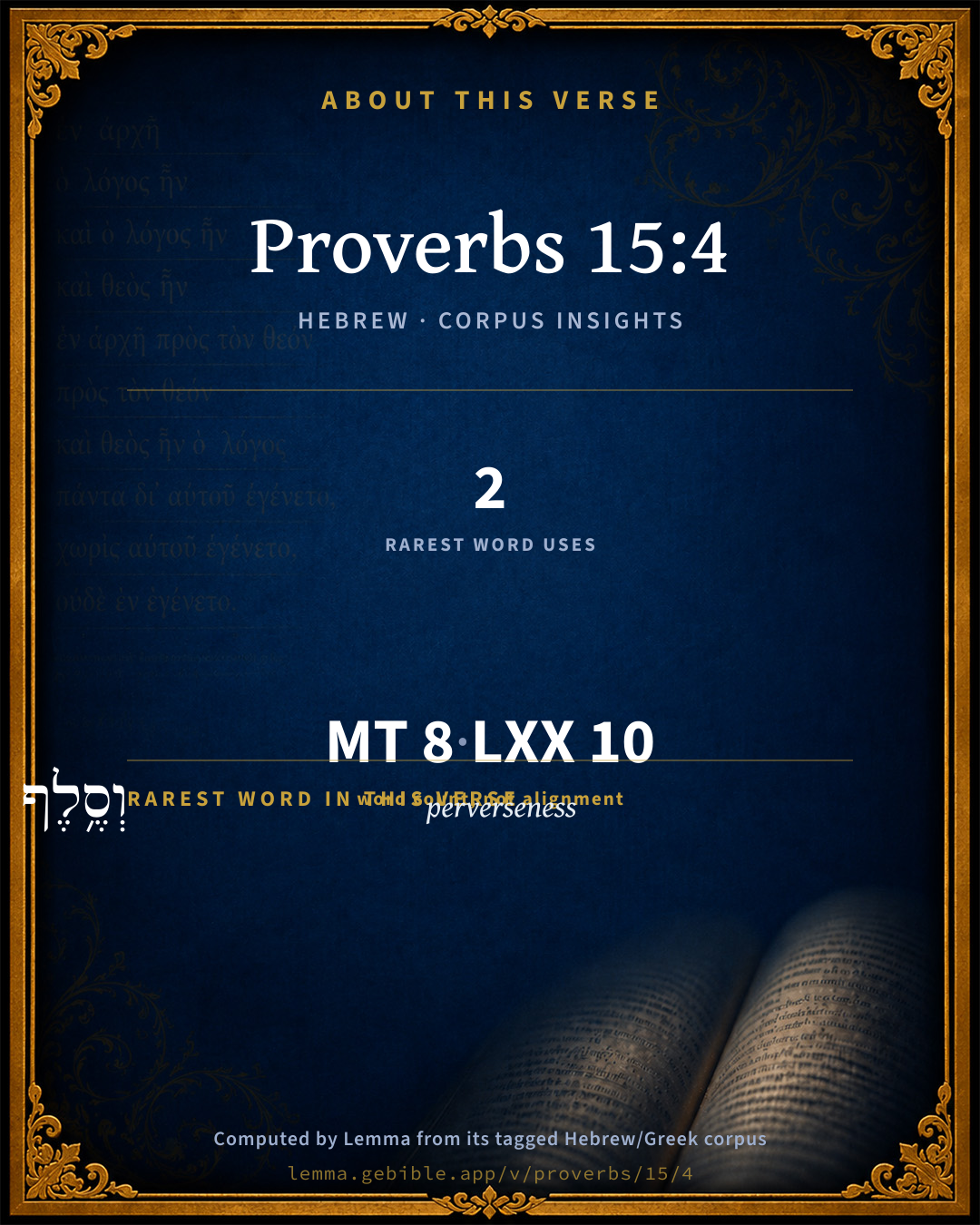
These counts appear in no published source. They are computed here, from the morphology-tagged text and Lemma’s own curated glosses. What Lemma adds →

8
words
7
distinct lemmas
Wisdom
section

Notable vocabulary

The rarest word here is וְסֶ֥לֶף perverseness H5558 — appearing just 2 times in the whole Hebrew Bible.

Shared distinctive vocabulary

וְסֶ֥לֶף perverseness H5558 occurs in 2 verses of the Hebrew Bible. Also found in:

Grammatical profile

  • 7 nouns
  • 1 preposition

Hebrew & Septuagint length

In English translation the verse runs 15 words from the Hebrew and 18 from the Septuagint (LXX English) — closely comparable.

A rough comparison of the two English renderings, which tokenize alike — not a word-level alignment.

Word counts can differ between the Hebrew and the Greek without any difference in meaning — e.g. the Hebrew direct-object marker אֵת has no separate Greek word, and Greek often adds the article ὁ.

In the original languages it is 8 Hebrew tokens and 10 Greek tokens — but the two are counted differently (Hebrew bundles its prefixes and suffixes into one token; the Greek is in lemma form), so that isn’t a like-for-like length.

Cross-references

12

Topical passages linked to Proverbs 15:4 in the Treasury of Scripture Knowledge — connected by theme and wording, ordered by reader-vote popularity; previews shown in the World English Bible.

  • Proverbs 16:24 Pleasant words are a honeycomb, Sweet to the soul, and health to the bones.
  • Proverbs 12:18 There is one who speaks rashly like the piercing of a sword, But the tongue of the wise heals.
  • Proverbs 18:8 The words of a gossip are like dainty morsels: They go down into a person's innermost parts.
  • Proverbs 3:18 She is a tree of life to those who lay hold of her. Happy is everyone who retains her.
  • Malachi 4:2 But to you who fear my name shall the sun of righteousness arise with healing in its wings. You will go out, and leap like calves of the stall.
  • Proverbs 18:14 A man's spirit will sustain him in sickness, But a crushed spirit, who can bear?
  • Revelation 2:7 He who has an ear, let him hear what the Spirit says to the assemblies. To him who overcomes I will give to eat of the tree of life, which is in the Paradise of my God.
  • Psalms 52:2–4 Your tongue plots destruction, Like a sharp razor, working deceitfully.
  • Psalms 109:22 For I am poor and needy. My heart is wounded within me.
  • Proverbs 26:22 The words of a whisperer are as dainty morsels, They go down into the innermost parts.
  • Genesis 3:22–24 Yahweh God said, "Behold, the man has become like one of us, knowing good and evil. Now, lest he put forth his hand, and also take of the tree of life, and eat, and live forever..."
  • 1 Timothy 6:3 If anyone teaches a different doctrine, and doesn't consent to sound words, the words of our Lord Jesus Christ, and to the doctrine which is according to godliness,

Cross-references courtesy of OpenBible.info (CC BY 4.0).

Hebrew and Greek witnesses Masoretic Hebrew ↔ Greek Septuagint

The same verse in the two great witnesses to the Old Testament, shown verse-for-verse.

These are two independent witnesses, not word-aligned to each other, and the Septuagint is shown in lemma (dictionary) form.

Hebrew Proverbs 15:4 Masoretic · Westminster Leningrad Codex

מַרְפֵּ֣א לָ֭שׁוֹן עֵ֣ץ חַיִּ֑ים וְסֶ֥לֶף בָּ֝֗הּ שֶׁ֣בֶר בְּרֽוּחַ

A gentle tongue is a tree of life, But deceit in it crushes the spirit.

World English Bible · Public Domain

Greek LXX Proverbs 15:4 Septuagint · lemma form

ἴασις γλῶσσα δένδρον ζωή ὁ δέ συντηρέω αὐτός πίμπλημι πνεῦμα

The wholesome tongue is a tree of life, and he that keeps it shall be filled with understanding.

LXX2012 (modern English Septuagint) · Public Domain

On this verse, The Cambridge Bible for Schools and Colleges discusses the Septuagint’s reading. Read the note in Commentary ↓

Hebrew: Westminster Leningrad Codex (CC BY 4.0). Greek: Septuagint (public domain); English from LXX2012 (modern English Septuagint) (Public Domain). How the Septuagint differs from the Hebrew →

Commentary

Notes on Proverbs 15:4 from classic Christian and Jewish commentators (each source and its license shown beneath its notes). The classic Christian expositions comment on the surrounding passage and are grouped to its opening verse, so a note may address several verses; the Jewish commentaries on the Tanakh (Rashi and others) are per-verse, so they appear only where the commentator wrote on this verse.

Lemma curates 59 commentaries, every one of them public domain or Creative Commons licensed, each selected and text-cleaned for this edition rather than reprinted as found. About our sources →

Trapp's Complete Commentary

John Trapp

Pro 15:4 A wholesome tongue [is] a tree of life: but perverseness therein [is] a breach in the spirit.

Ver. 4. A wholesome tongue is a tree of life.] As uttering words that have a healing property in them, pure, precious, and profitable; not unlike that tree of life in the midst of God’s garden, that would have given immortality to the eaters. See August. de Civit. Dei, lib. xv. cap. 20.

But perverseness therein is a breach of the spirit.] That is, in the conscience, which it goreth and gasheth; and in the heart, which it defileth and disposeth to further evil: it leaveth both a sting and a stain in a man’s own soul; besides the much mischief that it doeth to the spirits and manners of other men that are corrupted by it. God’s Spirit also is not a little grieved and vexed, when the godly man suddenly falls (as sometimes he doth), into bitter words, clamours, and evil speakings: these are even as smoke to the eyes, and make the Spirit of God ready to loathe and leave his lodging, as the apostle intimates, Eph 4:30-31. There are those who translate the text, But the mischievousness of it is as a breach made by the wind; and set this sense upon it, As a blustering wind, which throws down trees and houses, doth much harm; so a violent and venomous tongue, causing troubles and calamities, is very pernicious and hurtful. {Job 8:2} Pray we therefore with David "Deliver me, Lord, from a lying lip, and a deceitful tongue." {Psa 120:2}

John Trapp, A Commentary or Exposition upon All the Books of the Old and New Testament (1647–1656) — public domain. Text from a community e-Sword module.

Matthew Henry's Commentary

Note, 1. A good tongue is healing, healing to wounded consciences by comforting them, to sin-sick souls by convincing them, to peace and love when it is broken by accommodating differences, compromising matters in variance, and reconciling parties at variance; this is the healing of the tongue, which is a tree of life, the leaves of which have a sanative virtue, Rev 22:2. He that knows how to discourse will make the place he lives in a paradise. 2. An evil tongue is wounding (perverseness, passion, falsehood, and filthiness there, are a breach in the spirit); it wounds the conscience of the evil speaker, and occasions either guilt or grief to the hearers, and both are to be reckoned breaches in the spirit. Hard words indeed break no bones, but many a heart has been broken by them.

Matthew Henry's Commentary on the Whole Bible (1708–1710) — public domain (CC PDM 1.0). Text via the HelloAO Bible API.

Jamieson, Fausset & Brown

Robert Jamieson, A. R. Fausset & David Brown

A wholesome tongue--(Compare Margin), pacifying and soothing language.

tree of life-- (Pro 3:18; Pro 11:30).

perverseness therein--cross, ill-natured language.

breach . . . spirit--(compare Isa 65:14, Hebrew), grieves, instead of appeasing.

Jamieson, Fausset & Brown — Commentary Critical and Explanatory on the Whole Bible (1871) — public domain (CC PDM 1.0). Text via the HelloAO Bible API.

Adam Clarke's Commentary

Verse 4. A wholesome tongue is a tree of life] Here again is an allusion to the paradisiacal tree, עץ חיים ets chaiyim, "the tree of lives."

Adam Clarke's Commentary on the Bible (1810–1826) — public domain. Text from a community e-Sword/MySword module.

Ellicott's Commentary for English Readers

(4) A wholesome tongue.—One which heals and soothes by its gentleness and judicious words. (Comp. Pro_12:18.)

A tree of life.—Comp. Pro_3:18; Pro_11:30.

Perverseness.—Distortion of the truth. (Comp. Pro_11:3.)

A breach in the spirit—i.e., deeply wounds another’s spirit.

A Bible Commentary for English Readers, edited by Charles John Ellicott (1878–1897) — public domain. Text from a community e-Sword module.

The Cambridge Bible for Schools and Colleges

gen. ed. J. J. S. Perowne

4. wholesome] See Pro_14:30, where the same Heb. word is rendered sound, and note there, and comp. ὑγιαίνοντες λόγοι, 1Ti_6:3; 2Ti_1:13, and λόγος ὑγιής, Tit_2:8. R.V. marg. gives, the healing of (caused by) the tongue. So ἴασις γλώσσης, LXX.; lingua placabilis, Vulg.

a breach in] Better, a breaking of, R.V.

The Cambridge Bible for Schools and Colleges (gen. ed. J. J. S. Perowne; Cambridge University Press, 1878–1918) — public domain. Text from a community e-Sword module.

John Gill's Exposition

A wholesome tongue is a tree of life,.... A tongue that delivers out salutary instructions, wholesome advice and counsel; a "healing tongue" (w), as it may be rendered, which pacifies contending parties, and heals the divisions between them; to have the benefit of such a man's company and conversation is like being in paradise. Such is the tongue of a Gospel minister, which delivers out the wholesome words of our Lord Jesus Christ; sound speech and doctrines, which cannot be condemned; healing truths to wounded consciences, such as peace, pardon, righteousness, and atonement by the blood of Christ. These are the means of quickening dead sinners, reviving and comforting distressed ones, and show the way of eternal life unto them;

but perverseness therein is a breach in the spirit; impure, unchaste, unsavoury, and corrupt language, does mischief to the spirits of men; evil communications corrupt the heart and manners, defile the soul and the conversation; these and unsound doctrines eat as a canker; and as they make the heart of God's people sad, whom he would not have made sad; so they bring distress and despair into the spirits of others, and make sad wounds and breaches there, which are never healed, and that both in the spirits of speakers and hearers; for damnable heresies bring swift destruction on the propagators of them, and them that receive them.

(w) "sanans", so some in Vatablus.

John Gill's Exposition of the Whole Bible (1746–1763) — public domain (CC PDM 1.0). Text via the HelloAO Bible API.

Albert Barnes' Notes on the Bible

A wholesome tongue - literally, as in the margin, the same word as “sound” in Pro 14:30 (see the note). A more literal rendering would be soundness of speech.

Tree of life - Compare Pro 3:18 note.

Breach in the spirit - With the sense of vexation (compare Isa 65:14).

Albert Barnes' Notes on the Bible (1834–1885) — public domain. Text from a community e-Sword/MySword module.

Haydock's Catholic Bible Commentary

Life. This comparison was become proverbial for something very excellent. Immoderate. Hebrew, "perverse." (Calmet) --- Evil discourse kills the souls both of those who speak, and of those who pay attention to it. (Haydock)

George Leo Haydock (1774–1849), Haydock's Catholic Family Bible and Commentary, 1859 edition — public domain. Excludes Psalms (Douay-Rheims chapter numbering differs from Protestant) and Deuterocanonical books (Catholic canon only).

Matthew Poole's English Annotations

A wholesome tongue, which uttereth sound, and comfortable, and useful counsels, is a tree of life; is greatly useful to preserve the present life, and to promote the spiritual and eternal life, both of the speaker and hearers.

Perverseness therein, all sorts of false or corrupt speeches,

is a breach in the spirit; disturbs and wounds, and ofttimes corrupts and destroys, the spirits or souls, both of the speaker and hearers.

Matthew Poole's English Annotations on the Holy Bible (1683–1685) — public domain. Text from a community e-Sword/MySword module.

Whedon's Commentary on the Bible

Daniel D. Whedon

4. A wholesome (or healing) tongue — Or, mildness or quietness of tongue; that is, a gentle and quiet manner of speaking.

Is a tree of life — A favourite figure in this book. (See Gen_2:9; Rev_2:7; Rev_22:2; Rev_22:14; Pro_3:18; Pro_11:30; Pro_13:12.) It is a source of life and health:

heals differences, makes peace, comforts the distressed, and spreads a thousand blessings around.

But perverseness therein — Or, transgression; some render slipperiness.

Is a breach in the spirit — A breaking or hurt of the spirit. In Isa_65:14 this is rendered vexation of spirit. Such a tongue makes great mischief. A good tongue is healing; a bad tongue is wounding.

Daniel D. Whedon (gen. ed.), Commentary on the Old and New Testaments (1874–1909) — public domain. Text from a community e-Sword module.

The Pulpit Commentary

A wholesome tongue is a tree of life; a tongue that brings healing, that soothes by its words. Septuagint, "the healing of the tongue." But the Vulgate rendering is better, lingua placabilis, "the gentle, mild tongue". (see on Pro_14:30) Speech from such a source refreshes and vivifies all who come under its influence, like the wholesome fruit of a prolific tree. (comp. Pro_3:18 Pro_11:30) Quchv nosoushv esti farmakon logov. "The sick soul by a healing word is cured.

But perverseness therein in the tongueis a breach in the spirit. The perverseness intended must be falsehood, perversion of the truth. This is ruin and vexation (Isa_65:14, where the same word is used) in the spirit, both in the liar himself, whose higher nature is thus terribly marred and spoiled, and in the case of his neighbour, who is injured by his slander and falsehood to the, very core. The LXX, with a different reading, translates, "But he who keepeth it the tongue shall be filled with the spirit."

The Pulpit Commentary (1880–1919), ed. H.D.M. Spence-Jones & Joseph S. Exell — public domain. Text from a community e-Sword module.

John Wesley's Explanatory Notes

Wholesome - Which utters sound and useful counsels. Tree of life - Is greatly useful to preserve the present life, and to promote the spiritual and eternal life, both of the speaker and hearers. Perverseness - False or corrupt speeches. A breach - Disturbs and wounds the spirits, both of the speaker and hearers.

John Wesley, Explanatory Notes Upon the Whole Bible (1754–1765) — public domain. Text via the GEBible commentary corpus.

Bridges on Proverbs

Charles Bridges

Wisdom is finely portrayed as a tree of life. (Pro 3:18 .) So is also the genial influence of the righteous (Pro 11:30 ) — here the fruitfulness of this "little member." A high image of what it ought to be; not negative, not harmless, but wholesome. As the salt, cast into the spring, cleansed the bitter waters (2Ki 2:21 ); so when there is grace in the heart, there will be healing in the tongue. (Pro 12:18 .) "The speech will be with grace, seasoned with salt." (Col 4:6 .) Large indeed is the sphere, and abundant the blessing. When employed in soothing the afflicted, calming the troubled waters with words of peace, it creates a paradise around. It is not like ’the thorny bush, pricking and hurting those that are about us, but a fruitful tree — a tree of life.’†1

But if the gracious tongue be healing, the evil tongue is wounding. The meekest of men felt perverseness a breach in the spirit. (Num 16:8-15 .) The tongue of Job’s friends broke "the bruised reed," which needed to be bound up. (Job 13:1-5 .) Even our Beloved Lord, who never shrunk from external evil, keenly felt the piercing edge of this sword to his inmost soul. (Psa 69:19-20 .) May "grace be poured upon my lips," as upon my Divine Master’s (Psa 45:2 ), so that it may be a wholesome tongue, full of blessing and of good fruits! ’Everlasting benediction be upon that tongue, which spake, as no other ever did, or could speak, pardon, peace, and comfort to lost mankind! This was the tree of life, whose leaves were for the healing of the nations.’†2

Footnotes:

†1 Leighton’s Exposition of the Ninth Commandment, vol. iv.

†2 Bishop Horn’s Sermon on the Tree of Life.

Charles Bridges, An Exposition of the Book of Proverbs (1846) — public domain. Text from a community e-Sword module.

Kretzmann's Popular Commentary

Paul E. Kretzmann

v. 4. A wholesome tongue, literally, "gentleness of tongue," is a tree of life, that is, a person who, in true humility, uses gentle, pacifying, soothing speech will do his share toward a better appreciation and use of life, will cause people with whom he comes into contact to enjoy it more properly; but perverseness therein, that is, transgression with the tongue, its abuse for the purpose of stirring up contention, is a breach in the spirit, it wounds the spirit of men, it causes heartache and grief.

Paul E. Kretzmann, Popular Commentary of the Bible (1921–1924) — public domain. Text from a community e-Sword module.

Rashi

Rabbi Shlomo Yitzchaki (Rashi)

but if there is perverseness in it, it causes destruction by wind When one is perverse with his tongue, it will ultimately bring upon him destruction that comes from the east wind, which is prepared to mete out retribution upon the wicked, as it is stated (Ex. 14:21): “with a strong east wind”; (Jer. 18: 17): “Like an east wind I will scatter them”; and (Ps. 48:8): “With an east wind, You break the ships of Tarshish.”

Rashi on the Tanakh — English translations: “The Judaica Press complete Tanach with Rashi, translated by A. J. Rosenberg” (CC BY 4.0); “Pentateuch with Rashi's commentary by M. Rosenbaum and A.M. Silbermann, 1929-1934” (public domain); “The Metsudah Tanach series, Lakewood, N.J” (CC BY 4.0); and “The Book of Joshua, Metsudah Publications, 1997” (CC BY 4.0). Text via Sefaria.

Lesson kit

Teaching starters — assembled from the data on this page, not authored interpretation. Every prompt links to the verse data it draws on. Edit before teaching.

Proverbs, in the Wisdom, opens this verse with 8 words (7 distinct Hebrew lemmas). Its most distinctive word is çeleph (“perverseness”). A historical commentator’s framing appears above. Read the whole chapter for the surrounding context.

Discussion questions

  1. The word çeleph carries the sense “perverseness.” How does it shape the verse?
  2. How does Proverbs 11:3, which shares the word «perverseness», read alongside this verse?
  3. The translations on this page render this verse differently — a whole-verse word diff, not a word-by-word alignment. What might account for the different wordings?
  4. Compare how Trapp's Complete Commentary and Matthew Henry's Commentary read this verse. Where do they agree or differ?

Things to notice

Reading settings

Reading text

Shown beneath each verse's original-language words.

Old Testament
Old Testament edition

Read the OT as the Masoretic Hebrew (MT) or the Greek Septuagint (LXX).

English shown for the Greek Septuagint (in the Hebrew ↔ Greek comparison).

Comparing translations? Open the Compare panel on any verse page to stack up to four side by side.