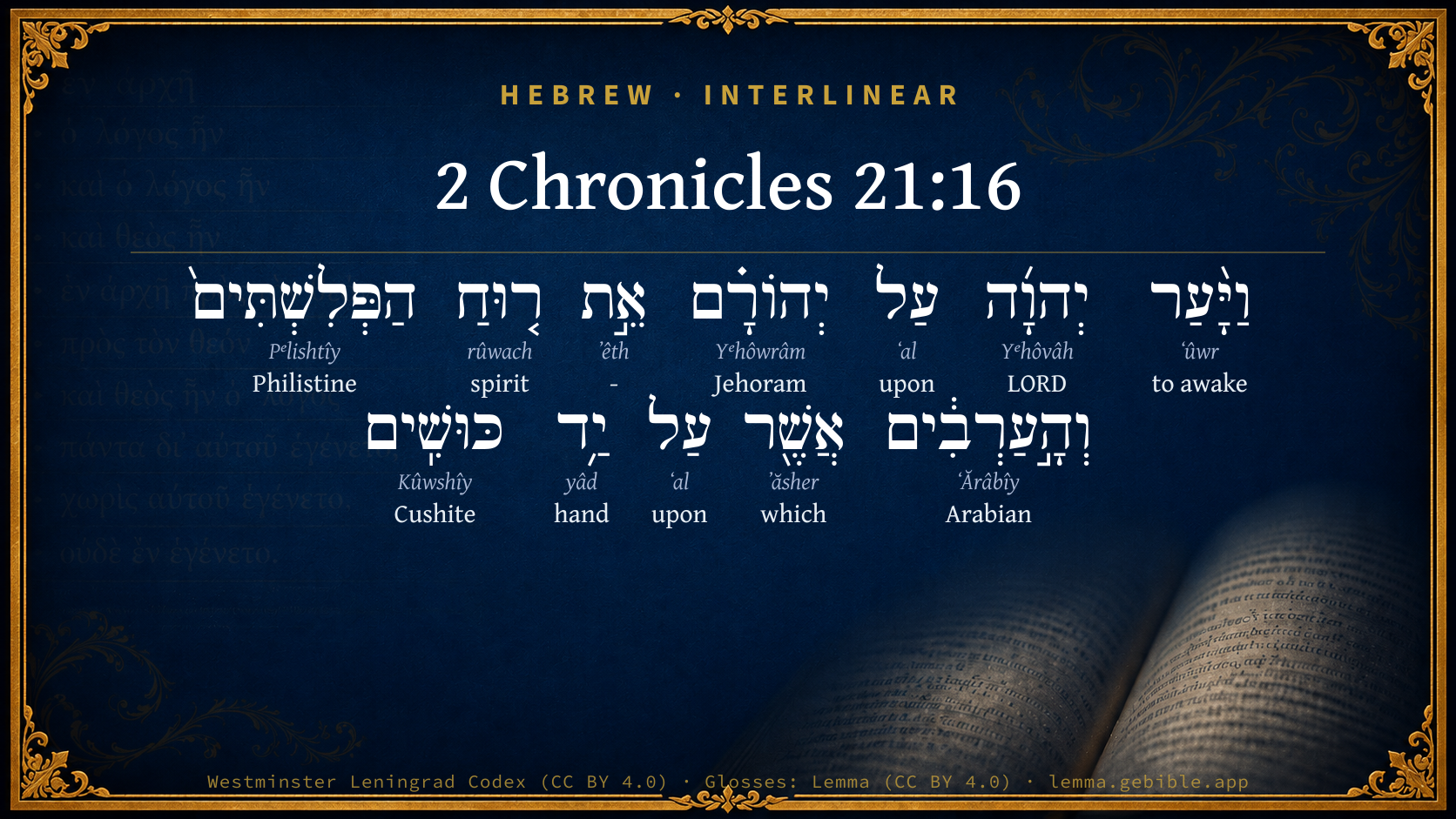
2 Chronicles 21:16

Hebrew (Westminster Leningrad Codex) 2 Chronicles 21:16 appears in the Hebrew Old Testament. The text above is from the Westminster Leningrad Codex. Each word links to its Strong’s number, a concise gloss, and parsing drawn from the Open Scriptures Hebrew Bible morphology. Click any word for its full Brown-Driver-Briggs (BDB) entry.
Download image
Cite this verse

2 Chronicles 21:16 (World English Bible). Public Domain. Lemma interlinear Bible study tool, https://lemma.gebible.app/v/2-chronicles/21/16.

Show BibTeX & RIS
BibTeX
RIS
English Translation
Yahweh stirred up against Jehoram the spirit of the Philistines, and of the Arabians who are beside the Ethiopians:
World English Bible · Public Domain
Download a study sheet

One document with this verse’s original text, its word-by-word gloss line, the meaning frame, cross-references with their text, attributed commentary, and full source and license credits — printable, and it pastes into notes with its structure intact.

This verse Autodidact and up

Study sheet (.html) Plain text (.txt)

A passage Seminary Student

Up to 50 verses in one chapter. A passage sheet keeps up to 6 commentary sources and 12 cross-references per verse, in the order this page ranks them, and says so on the sheet whenever that leaves anything out. Ask for a single verse and you get the Autodidact verse sheet above.

Everything on this page stays free to read, with no account — the sheet is a download of what is already on screen, not access to it.

Want to remove ads? Support Godless Engineer
Compare translations 3

The same verse in 3 English versions, stacked beneath the original-language interlinear above. Click any original word for its lexicon entry.

Each is an independent rendering of the whole verse — the interlinear is not word-aligned to these translations.

Highlighted words mark where these versions differ — a whole-verse word diff, not a word-by-word alignment.

  • World English Bible Public Domain
    Yahweh stirred up against Jehoram the spirit of the Philistines, and of the Arabians who are beside the Ethiopians:
  • King James Version Public Domain
    Moreover the LORD stirred up against Jehoram the spirit of the Philistines, and of the Arabians, that were near the Ethiopians:
  • unfoldingWord Literal Text CC BY-SA 4.0
    And Yahweh stirred up against Jehoram the spirit of the Philistines and the Arabians who were at the hand of the Cushites.

unfoldingWord Literal Text — © unfoldingWord, licensed CC BY-SA 4.0. Word-aligned USFM3 via Door43 (git.door43.org/unfoldingWord/en_ult).

Versions to compare (up to 4)

3 of 4 selected

Show all 18 translations

Every available English version of this verse, each an independent rendering of the whole verse.

  • World English Bible Public Domain
    Yahweh stirred up against Jehoram the spirit of the Philistines, and of the Arabians who are beside the Ethiopians:
  • Berean Standard Bible Public Domain
    Then the LORD stirred against Jehoram the spirit of the Philistines and Arabs who lived near the Cushites.
  • Majority Standard Bible Public Domain
    Then the LORD stirred against Jehoram the spirit of the Philistines and Arabs who lived near the Cushites.
  • King James Version Public Domain
    Moreover the LORD stirred up against Jehoram the spirit of the Philistines, and of the Arabians, that were near the Ethiopians:
  • American Standard Version (1901) Public Domain
    And Jehovah stirred up against Jehoram the spirit of the Philistines, and of the Arabians that are beside the Ethiopians:
  • Revised Version (1885) Public Domain
    And the LORD stirred up against Jehoram the spirit of the Philistines, and of the Arabians which are beside the Ethiopians:
  • Geneva Bible (1599) Public Domain
    So the Lord stirred vp against Iehoram the spirite of the Philistims, and the Arabians that were beside the Ethiopians.
  • Douay-Rheims (1899) Public Domain
    And the Lord stirred up against Joram the spirit of the Philistines, and of the Arabians, who border on the Ethiopians.
  • Young's Literal Translation Public Domain
    And Jehovah waketh up against Jehoram the spirit of the Philistines, and of the Arabians, who `are' beside the Cushim,
  • Literal Standard Version CC BY-SA 4.0
    And YHWH wakes up against Jehoram the spirit of the Philistines and of the Arabians, who [are] beside the Cushim,
  • Unlocked Literal Bible CC BY-SA 4.0
    Yahweh stirred up against Jehoram the spirit of the Philistines and of the Arabians who were near the Cushites.
  • unfoldingWord Literal Text CC BY-SA 4.0
    And Yahweh stirred up against Jehoram the spirit of the Philistines and the Arabians who were at the hand of the Cushites.
  • Darby Bible Public Domain
    And Jehovah stirred up against Jehoram the spirit of the Philistines, and of the Arabians, who [are] near the Ethiopians;
  • World Messianic Bible Public Domain
    The LORD stirred up against Jehoram the spirit of the Philistines and of the Arabians who are beside the Ethiopians;
  • Webster's Bible Public Domain
    Moreover, the LORD stirred up against Jehoram the spirit of the Philistines, and of the Arabians, that were near the Cushites.
  • Free Bible Version CC BY-SA 4.0
    The Lord stirred up the hostility of the Philistines and of the Arabians (who live near the Ethiopians) against Jehoram.
  • Bible in Basic English Public Domain
    Then the Philistines and the Arabians, who are by Ethiopia, were moved by the Lord to make war on Jehoram;
  • JPS Tanakh (1917) Public Domain
    And the LORD stirred up against Jehoram the spirit of the Philistines, and of the Arabians that are beside the Ethiopians;

Literal Standard Version (2020), Covenant Press — licensed CC BY-SA 4.0. Text via the HelloAO Bible API (eBible.org). Unlocked Literal Bible (unfoldingWord) — licensed CC BY-SA 4.0. Text via the HelloAO Bible API (eBible.org). unfoldingWord Literal Text — © unfoldingWord, licensed CC BY-SA 4.0. Word-aligned USFM3 via Door43 (git.door43.org/unfoldingWord/en_ult). Free Bible Version, Dr. Jonathan Gallagher — licensed CC BY-SA 4.0. Text via the HelloAO Bible API (eBible.org).

Word by word

More ways to search: Search by grammar → Find every occurrence → Compare this word →

Practice this passage: Drill this verse → Learn its vocabulary →

וְהָ֣עַרְבִ֔ים
ʻĂrâbîy
H6163
“and · the · Arabians”
Conjunction + Particle, Definite Article + Noun, Gentilic, Masculine, Plural, Absolute
Part of Speech
Conjunction + Particle + Noun
Type
Gentilic
Gender
Masculine
Number
Plural
State
Absolute
Full BDB Definition

Origin: from H6152

TWOT: None

Arabian = see Arabia " mixed" - an inhabitant of Arabia - steppe-dweller
  1. וַיָּ֨עַר ʻûwr H5782 “and · to awake” Conjunction + Verb, Hiphil, Sequential Imperfect, 3rd Person, Masculine, Singular
  2. יְהוָ֜ה Yᵉhôvâh H3068 “LORD” Noun, Proper
  3. עַל ʻal H5921 “upon” Preposition
  4. יְהוֹרָ֗ם Yᵉhôwrâm H3088 “Jehoram” Noun, Proper
  5. אֵ֣ת ʼêth H853 “-” Particle, Direct Object
  6. ר֤וּחַ rûwach H7307 “spirit of” Noun, Common, Both, Singular, Construct
  7. הַפְּלִשְׁתִּים֙ Pᵉlishtîy H6430 “the · Philistines” Particle, Definite Article + Noun, Gentilic, Masculine, Plural, Absolute
  8. אֲשֶׁ֖ר ʼăsher H834 “which” Particle, Relative
  9. עַל ʻal H5921 “upon” Preposition
  10. יַ֥ד yâd H3027 “hand of” Noun, Common, Both, Singular, Construct
  11. כּוּשִֽׁים Kûwshîy H3569 “Cushites” Noun, Gentilic, Masculine, Plural, Absolute

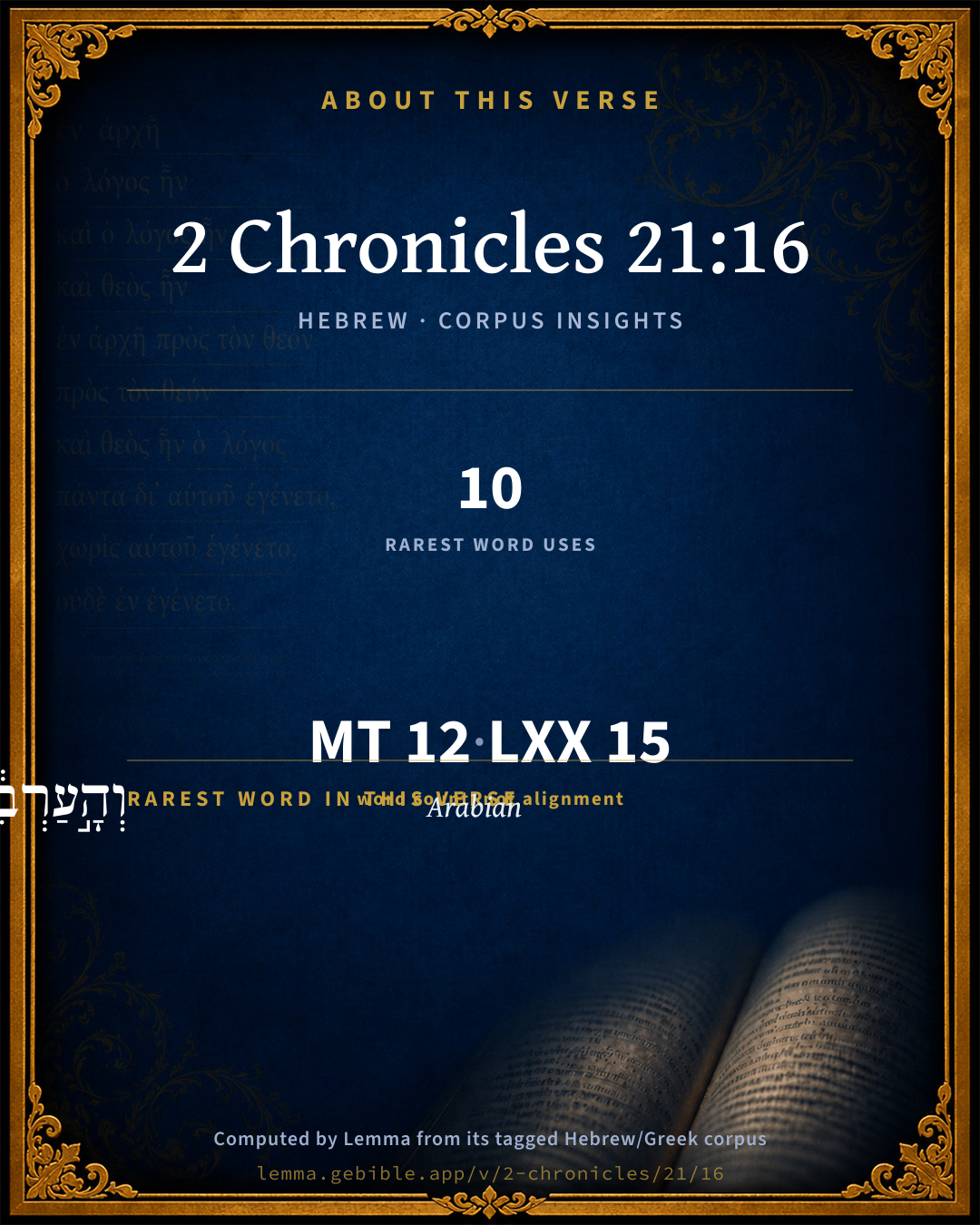
About this verse

These counts appear in no published source. They are computed here, from the morphology-tagged text and Lemma’s own curated glosses. What Lemma adds →

12
words
11
distinct lemmas
Historical
section

Notable vocabulary

The rarest word here is וְהָ֣עַרְבִ֔ים Arabian H6163 — appearing just 10 times in the whole Hebrew Bible.

Shared distinctive vocabulary

וְהָ֣עַרְבִ֔ים Arabian H6163 occurs in 9 verses of the Hebrew Bible. Also found in:

Grammatical profile

  • 1 verb
  • 7 nouns
  • 2 prepositions
  • 2 particles

Verb forms

  • וַיָּ֨עַר Hiphil · Sequential Imperfect

Repetition

A word recurs within this verse — often emphatic in Hebrew:

Hebrew & Septuagint length

In English translation the verse runs 19 words from the Hebrew and 19 from the Septuagint (LXX English) — the same length.

A rough comparison of the two English renderings, which tokenize alike — not a word-level alignment.

Word counts can differ between the Hebrew and the Greek without any difference in meaning — e.g. the Hebrew direct-object marker אֵת has no separate Greek word, and Greek often adds the article ὁ.

In the original languages it is 12 Hebrew tokens and 15 Greek tokens — but the two are counted differently (Hebrew bundles its prefixes and suffixes into one token; the Greek is in lemma form), so that isn’t a like-for-like length.

Cross-references

14

Topical passages linked to 2 Chronicles 21:16 in the Treasury of Scripture Knowledge — connected by theme and wording, ordered by reader-vote popularity; previews shown in the World English Bible.

  • 2 Chronicles 17:11 Some of the Philistines brought Jehoshaphat presents, and silver for tribute; the Arabians also brought him flocks, seven thousand and seven hundred rams, and seven thousand and seven hundred male goats.
  • 1 Kings 11:14 Yahweh raised up an adversary to Solomon, Hadad the Edomite: he was of the king's seed in Edom.
  • 1 Kings 11:23 God raised up [another] adversary to him, Rezon the son of Eliada, who had fled from his lord Hadadezer king of Zobah.
  • 2 Chronicles 22:1 The inhabitants of Jerusalem made Ahaziah his youngest son king in his place; for the band of men who came with the Arabians to the camp had slain all the eldest. So Ahaziah the son of Jehoram king of Judah reigned.
  • 2 Chronicles 33:11 Therefore Yahweh brought on them the captains of the host of the king of Assyria, who took Manasseh in chains, and bound him with fetters, and carried him to Babylon.
  • 1 Samuel 26:19 Now therefore, please let my lord the king hear the words of his servant. If it be Yahweh that has stirred you up against me, let him accept an offering: but if it be the children of men, cursed be they before Yahweh: for they have driven me out this day that I shouldn't cling to Yahweh's inheritance, saying, Go, serve other gods.
  • 2 Samuel 24:1 Again the anger of Yahweh was kindled against Israel, and he moved David against them, saying, Go, number Israel and Judah.
  • 1 Kings 11:11 Therefore Yahweh said to Solomon, Because this is done of you, and you have not kept my covenant and my statutes, which I have commanded you, I will surely tear the kingdom from you, and will give it to your servant.
  • 2 Chronicles 26:7 God helped him against the Philistines, and against the Arabians who lived in Gur Baal, and the Meunim.
  • Ezra 1:1 Now in the first year of Cyrus king of Persia, that the word of Yahweh by the mouth of Jeremiah might be accomplished, Yahweh stirred up the spirit of Cyrus king of Persia, so that he made a proclamation throughout all his kingdom, and [put it] also in writing, saying,
  • Ezra 1:5 Then rose up the heads of fathers' [houses] of Judah and Benjamin, and the priests, and the Levites, even all whose spirit God had stirred to go up to build the house of Yahweh which is in Jerusalem.
  • Isaiah 10:5–6 Ho Assyrian, the rod of my anger, the staff in whose hand is my indignation!
  • Isaiah 45:5–7 I am Yahweh, and there is none else; besides me there is no God. I will gird you, though you have not known me;
  • Amos 3:6 Does the trumpet alarm sound in a city, Without the people being afraid? Does evil happen to a city, And Yahweh hasn't done it?

Cross-references courtesy of OpenBible.info (CC BY 4.0).

Hebrew and Greek witnesses Masoretic Hebrew ↔ Greek Septuagint

The same verse in the two great witnesses to the Old Testament, shown verse-for-verse.

These are two independent witnesses, not word-aligned to each other, and the Septuagint is shown in lemma (dictionary) form.

Hebrew 2 Chronicles 21:16 Masoretic · Westminster Leningrad Codex

וַיָּ֨עַר יְהוָ֜ה עַל יְהוֹרָ֗ם אֵ֣ת ר֤וּחַ הַפְּלִשְׁתִּים֙ וְהָ֣עַרְבִ֔ים אֲשֶׁ֖ר עַל יַ֥ד כּוּשִֽׁים

Yahweh stirred up against Jehoram the spirit of the Philistines, and of the Arabians who are beside the Ethiopians:

World English Bible · Public Domain

Greek LXX 2 Chronicles 21:16 Septuagint · lemma form

καί ἐπιἀγείρω κύριος ἐπί ιωραμ ὁ ἀλλόφυλος καί ὁ ἄραψ καί ὁ ὅμορος ὁ αἰθίοψ

So the Lord stirred up the Philistines against Joram, and the Arabians, and those who bordered on the Aethiopians:

LXX2012 (modern English Septuagint) · Public Domain

On this verse, Ellicott's Commentary for English Readers discusses the Septuagint’s reading. Read the note in Commentary ↓

Hebrew: Westminster Leningrad Codex (CC BY 4.0). Greek: Septuagint (public domain); English from LXX2012 (modern English Septuagint) (Public Domain). How the Septuagint differs from the Hebrew →

Commentary

Notes on 2 Chronicles 21:16 from classic Christian and Jewish commentators (each source and its license shown beneath its notes). The classic Christian expositions comment on the surrounding passage and are grouped to its opening verse, so a note may address several verses; the Jewish commentaries on the Tanakh (Rashi and others) are per-verse, so they appear only where the commentator wrote on this verse.

Lemma curates 59 commentaries, every one of them public domain or Creative Commons licensed, each selected and text-cleaned for this edition rather than reprinted as found. About our sources →

Trapp's Complete Commentary

John Trapp

2Ch 21:16 Moreover the LORD stirred up against Jehoram the spirit of the Philistines, and of the Arabians, that [were] near the Ethiopians:

Ver. 16. Moreover the Lord stirred up.] And so fulfilled all that Elijah had foretold: why is he not then better believed? If some astrologer had once or twice prognosticated, and it proved true, he should be much cried up and credited. And shall not God’s prophets be so? "Believe the prophets, and ye shall prosper." But many believe them no otherwise than they do the predictions of an almanac, if so much.

And of the Arabians.] The inhabitants of Arabia Felix and Petraea. These were instigated, likely, by the Edomites, whom Jehoram sought to reduce, but could not.

John Trapp, A Commentary or Exposition upon All the Books of the Old and New Testament (1647–1656) — public domain. Text from a community e-Sword module.

Joseph Benson's Commentary

2Ch 21:16. The Lord stirred up against Jehoram the spirit of the Philistines — A people who had been fully subdued and dispirited; but whose spirits and courage God now raised, that they might do his work. And of the Arabians, that were near the Ethiopians — Hebrew, near the Cushites, that is, the Ethiopians properly so called, for they were parted only by the Red sea; or rather a people in Arabia, frequently mentioned in Scripture, and so called either for their likeness in colour and complexion to the Ethiopians, or because one of these tribes was a colony from the other.

Joseph Benson's Commentary on the Old and New Testaments (1811–1818) — public domain. Text from a community e-Sword module.

Tyndale Open Study Notes

Tyndale Open Resources

21:16-17 Jehoram’s inability to resist the initial revolts of Edom and Libnah (21:8-10) encouraged other attacks on Judah, this time by the Philistines and the Arabs. Once again, the royal line was nearly destroyed.

Tyndale Open Study Notes — © Tyndale Open Resources, licensed CC BY-SA 4.0. Text via the HelloAO Bible API.

Geneva Bible (1599)

Geneva Bible translators

There were other Arabians in Africa Southward toward Egypt.

Geneva Bible (1599) marginal notes — public domain. Text via Bolls.life.

Adam Clarke's Commentary

Verse 16. The Philistines, and - the Arabians] We have no other account of this war. Though it was a predatory war, yet it appears to have been completely ruinous and destructive. What a general curse fell upon this bad king; in his body, soul, substance, family, and government!

Adam Clarke's Commentary on the Bible (1810–1826) — public domain. Text from a community e-Sword/MySword module.

Ellicott's Commentary for English Readers

(16) Moreover.—And, here equivalent to so.

The Lord stirred up against Jehoram.—Isa_13:17. The phrase, “stirred up the spirit”—i.e., the will—of a man to an undertaking, is found in Jer_51:11; Hag_1:14 (Comp. 1Ch_5:26; Ezr_1:1.)

The Philistines, and of the Arabians.—These are mentioned together elsewhere as enemies of Judah. (See 2Ch_26:7; 2Ch_17:11; Jer_25:20.) The invasion of the Philistines and Arabians accords with Joe_3:4-6, and is certainly historical (Thenius on 2Ki_8:23-24).

That were near the Ethiopians.—Literally, At the hand of (i.e., beside) the Cushites. Some tribes. of southern Arabia. There were Cushite settlements on both sides of the Red Sea. LXX., well: τοὺς Ἄραβας καὶ τοὺς ὁμόρους τῶν Αἰθιόπων; Vulg., “qui confines sunt Aethiopum.”

A Bible Commentary for English Readers, edited by Charles John Ellicott (1878–1897) — public domain. Text from a community e-Sword module.

The Cambridge Bible for Schools and Colleges

gen. ed. J. J. S. Perowne

16, 17 (no parallel in Kings). The Invasion of the Philistines and Arabians

16. Moreover] R.V. And.

stirred up … the spirit] Cp. 2Ch_36:22 and 1Ch_5:26.

that were near the Ethiopians] Render, which are beside the Cushites; cp. R.V. and 2Ch_14:9 (note).

The Cambridge Bible for Schools and Colleges (gen. ed. J. J. S. Perowne; Cambridge University Press, 1878–1918) — public domain. Text from a community e-Sword module.

John Gill's Exposition

After all this the Lord smote him in his bowels with an incurable disease. What it was is not agreed upon; some take it be an "hernia", or rupture; others, the falling of the "anus", or a fistula in it; others, the colic, or iliac passion; but generally it is thought to be a dysentery, or bloody flux; the Targum is,"the Word of the Lord broke him.''

After all this the Lord smote him in his bowels with an incurable disease. What it was is not agreed upon; some take it be an "hernia", or rupture; others, the falling of the "anus", or a fistula in it; others, the colic, or iliac passion; but generally it is thought to be a dysentery, or bloody flux; the Targum is,"the Word of the Lord broke him.''

2 Chronicles 21:19

ch2 21:19

ch2 21:19

ch2 21:19And it came to pass that in process of time, after the end of two years,.... So long he was afflicted and tortured with the above disease:

his bowels fell out by reason of his sickness; either in like manner as Judas's did, Act 1:18 or as in the manner the bowels of Arius are said to do, while sitting on the seat of the vault (a); or perhaps only what was contained in the bowels is meant, if it was the colic:

so he died of sore diseases; he seems to have had a complication of them, and these very painful and distressing:

and the people made no burning for him, like the burnings of his fathers; as they did for his grandfather Asa, Ch2 16:14, they did not burn spices or odoriferous wood, as the Targum; though his body, because of the stench of it, needed it, as Jarchi observes.

(a) Sozomen. Eccl. Hist. l. 2. c. 29, 30.

John Gill's Exposition of the Whole Bible (1746–1763) — public domain (CC PDM 1.0). Text via the HelloAO Bible API.

Albert Barnes' Notes on the Bible

The Arabians, that were near the Ethiopians - Probably Joktanian Arabs from the neighborhood of the Cushites. Southern Arabia was originally occupied by Cushites, or Ethiopians Gen 10:7, whose descendants still exist in a remnant of the Himyaritic Arabs.

Albert Barnes' Notes on the Bible (1834–1885) — public domain. Text from a community e-Sword/MySword module.

Haydock's Catholic Bible Commentary

Philistines; who, it seems, had been obedient since the days of David. --- Ethiopians, who lay west of the Arabians, from the Red Sea to the lower Egypt and the Nile, (C.) bordering on Madian. There was another Ethiopia to the south of Egypt. M.

George Leo Haydock (1774–1849), Haydock's Catholic Family Bible and Commentary, 1859 edition — public domain. Excludes Psalms (Douay-Rheims chapter numbering differs from Protestant) and Deuterocanonical books (Catholic canon only).

Matthew Poole's English Annotations

The Philistines; a people fully subdued and dispirited; but God now raiseth their spirits and courage to do his work.

Near the Ethiopians, Heb. near the Cushites, i.e. either the Ethiopians, from whom they were parted only by the Red Sea, each dwelling upon the opposite shores of it; or rather, a people in Arabia, frequently mentioned in Scripture, and so called, either for their likeness in colour and complexion to the Ethiopians properly so called, or because the one of these people were a colony of the other. But the Ethiopians above Egypt were far enough from these other Arabians, being separated from them by the Red Sea.

Matthew Poole's English Annotations on the Holy Bible (1683–1685) — public domain. Text from a community e-Sword/MySword module.

Whedon's Commentary on the Bible

Daniel D. Whedon

16. The Philistines, and… Arabians — These nations had been tributary to Jehoshaphat, (2Ch_17:11,) but under his wicked son they revolted, and Jehovah used them as his rod of anger to punish Jehoram, as he had foretold. 2Ch_21:14. “Southern Arabia was originally occupied by Cushites, or Ethiopians, (Gen_10:7,) whose descendants still exist in the modern Mahra, a remnant of the Himyaritic Arabs. ‘The Arabians that were near the Ethiopians’ were probably Joktanean Arabs from the neighbourhood of these Cushites.” — Rawlinson.

Daniel D. Whedon (gen. ed.), Commentary on the Old and New Testaments (1874–1909) — public domain. Text from a community e-Sword module.

The Pulpit Commentary

The moreover of this verse is simply the conjunction "and;" it is not the m of ver. 11, for instance. Our Authorized Version "moreover" obscures the purport of the verse. Better the simple "and," as in the Revised Version. The Lord stirred up. Reference may again be made to 2Ch_17:10-12. The things then gained are now being lost. The Arabians near the Ethiopians. The Ethiopians, i.e. Cushites, fully fifteen centuries before the date of those original treatises from which the writers of Kings and Chronicles respectively borrowed their materials, or some of them, are recorded both genealogically and geographically in Gen_10:6-8. They had their location very early in the south of Arabia, as also to the south of Egypt, speaking generally, with the Red Sea on the east, the Libyan desert on the west, and Abyssinia on the south, whilst Syene marked conspicuously a site on the line of the northern bounds between them and Egypt (Eze_29:9-11; Isa_18:1, Isa_18:2; Zep_3:10) They are almost invariably connected with Africa, from whence it is now that stress is laid upon those of them to whom the Arabians, on the other side of the Red Sea, were contiguous.

The Pulpit Commentary (1880–1919), ed. H.D.M. Spence-Jones & Joseph S. Exell — public domain. Text from a community e-Sword module.

John Wesley's Explanatory Notes

Philistines - A people fully subdued and dispirited: but God now raises their spirits and courage to do his work. Ethiopians - A people in Arabia, so called, either for their likeness in complexion to the Ethiopians, or because the one of these people were a colony of the other.

John Wesley, Explanatory Notes Upon the Whole Bible (1754–1765) — public domain. Text via the GEBible commentary corpus.

unfoldingWord translationNotes

Door43 World Missions Community

stirred up against Jehoram the spirit of the Philistines and of the Arabians

Stirring the spirit is a metonym for making someone want to act. Here "spirit" is singular and refers to the Philistines as a group and to the Arabians as a group. AT: "provoked against Jehoram the Philistines and the Arabians" (See: Metonymy)

against Jehoram

Here Jehoram refers to Jehoram and the people of Judah that he ruled. AT: "against Jehoram and the people of Judah" (See: Synecdoche)

the spirit of the Philistines and of the Arabians who were near the Cushites

The Philistines and the Arabians were two different nations. The Arabians lived southeast of Judah near the Cushites, and the Philistines lived west of Judah. These nations were stirred up separately. This can be made explicit. AT: "the spirit of the Philistines and the spirit of the Arabians who were near the Cushites" (See: Assumed Knowledge and Implicit Information)

No son was left to him except Jehoahaz, his youngest son

"They took away all of his sons except Jehoahaz, his youngest son" or "The only son they left to him was Jehoahaz, his youngest son"

Jehoahaz, his youngest son

This same son is called "Ahaziah" in 2 Chronicles 22:01.

translationWords

spirit

Philistines

Arabia

Ethiopia

unfoldingWord translationNotes — © Distant Shores Media and the Door43 World Missions Community, licensed CC BY-SA 4.0. Source: git.door43.org/Door43/en_tn.

Lesson kit

Teaching starters — assembled from the data on this page, not authored interpretation. Every prompt links to the verse data it draws on. Edit before teaching.

2 Chronicles, in the Historical, opens this verse with 12 words (11 distinct Hebrew lemmas). Its most distinctive word is ʻĂrâbîy (“Arabian”). A historical commentator’s framing appears above. Read the whole chapter for the surrounding context.

Discussion questions

  1. The word ʻĂrâbîy carries the sense “Arabian.” How does it shape the verse?
  2. 2 Chronicles 17:11 shares the word «Arabian» with this verse. How do the two illuminate each other?
  3. “upon” occurs 2× in this one verse. What is the effect of the repetition?
  4. These translations render this verse differently; the difference is in the English rendering, not the original. What questions does that raise?
  5. The verb «וַיָּ֨עַר» is Hiphil Sequential Imperfect. How does its form color the action?
  6. Reading how Trapp's Complete Commentary and Joseph Benson's Commentary read this verse, where do the two commentators agree and where do they part?

Things to notice

Reading settings

Reading text

Shown beneath each verse's original-language words.

Old Testament
Old Testament edition

Read the OT as the Masoretic Hebrew (MT) or the Greek Septuagint (LXX).

English shown for the Greek Septuagint (in the Hebrew ↔ Greek comparison).

Comparing translations? Open the Compare panel on any verse page to stack up to four side by side.