
Exodus 10:13

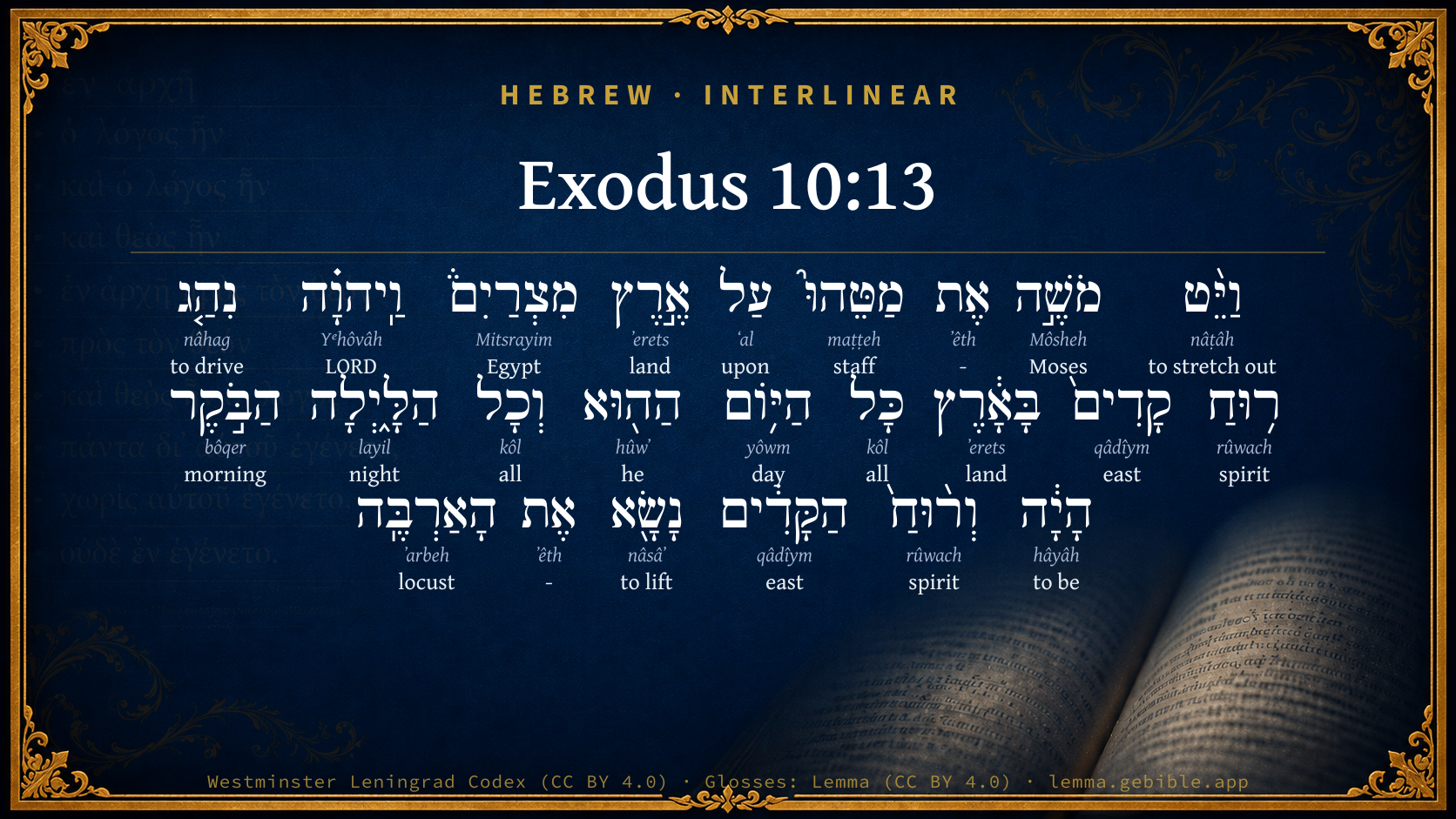
Hebrew (Westminster Leningrad Codex) Exodus 10:13 appears in the Hebrew Old Testament. The text above is from the Westminster Leningrad Codex. Each word links to its Strong’s number, a concise gloss, and parsing drawn from the Open Scriptures Hebrew Bible morphology. Click any word for its full Brown-Driver-Briggs (BDB) entry.
Download image
Cite this verse

Exodus 10:13 (World English Bible). Public Domain. Lemma interlinear Bible study tool, https://lemma.gebible.app/v/exodus/10/13.

Show BibTeX & RIS
BibTeX
RIS
English Translation
Moses stretched forth his rod over the land of Egypt, and Yahweh brought an east wind on the land all that day, and all the night; and when it was morning, the east wind brought the locusts.
World English Bible · Public Domain
Download a study sheet

One document with this verse’s original text, its word-by-word gloss line, the meaning frame, cross-references with their text, attributed commentary, and full source and license credits — printable, and it pastes into notes with its structure intact.

This verse Autodidact and up

Study sheet (.html) Plain text (.txt)

A passage Seminary Student

Up to 50 verses in one chapter. A passage sheet keeps up to 6 commentary sources and 12 cross-references per verse, in the order this page ranks them, and says so on the sheet whenever that leaves anything out. Ask for a single verse and you get the Autodidact verse sheet above.

Everything on this page stays free to read, with no account — the sheet is a download of what is already on screen, not access to it.

Want to remove ads? Support Godless Engineer
Compare translations 3

The same verse in 3 English versions, stacked beneath the original-language interlinear above. Click any original word for its lexicon entry.

Each is an independent rendering of the whole verse — the interlinear is not word-aligned to these translations.

Highlighted words mark where these versions differ — a whole-verse word diff, not a word-by-word alignment.

  • World English Bible Public Domain
    Moses stretched forth his rod over the land of Egypt, and Yahweh brought an east wind on the land all that day, and all the night; and when it was morning, the east wind brought the locusts.
  • King James Version Public Domain
    And Moses stretched forth his rod over the land of Egypt, and the LORD brought an east wind upon the land all that day, and all that night; and when it was morning, the east wind brought the locusts.
  • unfoldingWord Literal Text CC BY-SA 4.0
    And Moses reached out his staff over the land of Egypt, and Yahweh drove an east wind over the land all that day and all night. The morning was, and the east wind had brought the locust.

unfoldingWord Literal Text — © unfoldingWord, licensed CC BY-SA 4.0. Word-aligned USFM3 via Door43 (git.door43.org/unfoldingWord/en_ult).

Versions to compare (up to 4)

3 of 4 selected

Show all 18 translations

Every available English version of this verse, each an independent rendering of the whole verse.

  • World English Bible Public Domain
    Moses stretched forth his rod over the land of Egypt, and Yahweh brought an east wind on the land all that day, and all the night; and when it was morning, the east wind brought the locusts.
  • Berean Standard Bible Public Domain
    So Moses stretched out his staff over the land of Egypt, and throughout that day and night the LORD sent an east wind across the land. By morning the east wind had brought the locusts.
  • Majority Standard Bible Public Domain
    So Moses stretched out his staff over the land of Egypt, and throughout that day and night the LORD sent an east wind across the land. By morning the east wind had brought the locusts.
  • King James Version Public Domain
    And Moses stretched forth his rod over the land of Egypt, and the LORD brought an east wind upon the land all that day, and all that night; and when it was morning, the east wind brought the locusts.
  • American Standard Version (1901) Public Domain
    And Moses stretched forth his rod over the land of Egypt, and Jehovah brought an east wind upon the land all that day, and all the night; and when it was morning, the east wind brought the locusts.
  • Revised Version (1885) Public Domain
    And Moses stretched forth his rod over the land of Egypt, and the LORD brought an east wind upon the land all that day, and all the night; and when it was morning, the east wind brought the locusts.
  • Geneva Bible (1599) Public Domain
    Then Moses stretched foorth his rod vpon the lande of Egypt: and the Lord brought an East winde vpon the land all that day, and al that night: and in the morning the East wind brought the grashoppers.
  • Douay-Rheims (1899) Public Domain
    And Moses stretched forth his rod upon the land of Egypt: and the Lord brought a burning wind all that day, and night: and when it was morning, the burning wind raised the locusts:
  • Young's Literal Translation Public Domain
    And Moses stretcheth out his rod against the land of Egypt, and Jehovah hath led an east wind over the land all that day, and all the night; the morning hath been, and the east wind hath lifted up the locust.
  • Literal Standard Version CC BY-SA 4.0
    And Moses stretches out his rod against the land of Egypt, and YHWH has led an east wind over the land all that day, and all the night; the morning has been, and the east wind has lifted up the locust.
  • Unlocked Literal Bible CC BY-SA 4.0
    Moses reached out with his staff over the land of Egypt, and Yahweh brought an east wind over the land all that day and night. When it was morning, the east wind had brought the locusts.
  • unfoldingWord Literal Text CC BY-SA 4.0
    And Moses reached out his staff over the land of Egypt, and Yahweh drove an east wind over the land all that day and all night. The morning was, and the east wind had brought the locust.
  • Darby Bible Public Domain
    And Moses stretched out his staff over the land of Egypt, and Jehovah brought an east wind on the land all that day and all that night. When it was morning, the east wind brought the locusts.
  • World Messianic Bible Public Domain
    Moses stretched out his rod over the land of Egypt, and the LORD brought an east wind on the land all that day, and all night; and when it was morning, the east wind brought the locusts.
  • Webster's Bible Public Domain
    And Moses stretched forth his rod over the land of Egypt, and the LORD brought an east wind upon the land all that day, and all that night: and when it was morning, the east wind brought the locusts.
  • Free Bible Version CC BY-SA 4.0
    Moses held out his staff over Egypt, and all through that day and night the Lord sent an east wind blowing over the land. By the time morning came the east wind had brought in the locusts.
  • Bible in Basic English Public Domain
    And Moses' rod was stretched out over the land of Egypt, and the Lord sent an east wind over the land all that day and all the night; and in the morning the locusts came up with the east wind.
  • JPS Tanakh (1917) Public Domain
    And Moses stretched forth his rod over the land of Egypt, and the LORD brought an east wind upon the land all that day, and all the night; and when it was morning, the east wind brought the locusts.

Literal Standard Version (2020), Covenant Press — licensed CC BY-SA 4.0. Text via the HelloAO Bible API (eBible.org). Unlocked Literal Bible (unfoldingWord) — licensed CC BY-SA 4.0. Text via the HelloAO Bible API (eBible.org). unfoldingWord Literal Text — © unfoldingWord, licensed CC BY-SA 4.0. Word-aligned USFM3 via Door43 (git.door43.org/unfoldingWord/en_ult). Free Bible Version, Dr. Jonathan Gallagher — licensed CC BY-SA 4.0. Text via the HelloAO Bible API (eBible.org).

Word by word

More ways to search: Search by grammar → Find every occurrence → Compare this word →

Practice this passage: Drill this verse → Learn its vocabulary →

הָאַרְבֶּֽה
ʼarbeh
H697
“the · locust”
Particle, Definite Article + Noun, Common, Masculine, Singular, Absolute
Part of Speech
Particle + Noun
Type
Common
Gender
Masculine
Number
Singular
State
Absolute
Full BDB Definition

Origin: from H7235

TWOT: 2103a

a kind of locust, locust swarm (collective) - (CLBL) - sudden disappearance (figuratively) - insignificance (figuratively) - activity (figuratively)
  1. וַיֵּ֨ט nâṭâh H5186 “and · to stretch out” Conjunction + Verb, Qal, Sequential Imperfect, 3rd Person, Masculine, Singular
  2. מֹשֶׁ֣ה Môsheh H4872 “Moses” Noun, Proper
  3. אֶת ʼêth H853 “-” Particle, Direct Object
  4. מַטֵּהוּ֮ maṭṭeh H4294 “staff · his” Noun, Common, Masculine, Singular, Construct + Suffix, Personal, 3rd Person, Masculine, Singular
  5. עַל ʻal H5921 “upon” Preposition
  6. אֶ֣רֶץ ʼerets H776 “land of” Noun, Common, Both, Singular, Construct
  7. מִצְרַיִם֒ Mitsrayim H4714 “Egypt” Noun, Proper
  8. וַֽיהוָ֗ה Yᵉhôvâh H3068 “and · LORD” Conjunction + Noun, Proper
  9. נִהַ֤ג nâhag H5090 “to drive” Verb, Piel, Perfect, 3rd Person, Masculine, Singular
  10. ר֥וּחַ rûwach H7307 “spirit of” Noun, Common, Both, Singular, Construct
  11. קָדִים֙ qâdîym H6921 “east” Noun, Common, Masculine, Singular, Absolute
  12. בָּאָ֔רֶץ ʼerets H776 “in/at the · land” Preposition, Determined + Noun, Common, Both, Singular, Absolute
  13. כָּל kôl H3605 “all of” Noun, Common, Masculine, Singular, Construct
  14. הַיּ֥וֹם yôwm H3117 “the · day” Particle, Definite Article + Noun, Common, Masculine, Singular, Absolute
  15. הַה֖וּא hûwʼ H1931 “the · he” Particle, Definite Article + Pronoun, Personal, 3rd Person, Masculine, Singular
  16. וְכָל kôl H3605 “and · all of” Conjunction + Noun, Common, Masculine, Singular, Construct
  17. הַלָּ֑יְלָה layil H3915 “the · night” Particle, Definite Article + Noun, Common, Masculine, Singular, Absolute
  18. הַבֹּ֣קֶר bôqer H1242 “the · morning” Particle, Definite Article + Noun, Common, Masculine, Singular, Absolute
  19. הָיָ֔ה hâyâh H1961 “to be” Verb, Qal, Perfect, 3rd Person, Masculine, Singular
  20. וְר֨וּחַ֙ rûwach H7307 “and · spirit of” Conjunction + Noun, Common, Both, Singular, Construct
  21. הַקָּדִ֔ים qâdîym H6921 “the · east” Particle, Definite Article + Noun, Common, Masculine, Singular, Absolute
  22. נָשָׂ֖א nâsâʼ H5375 “to lift” Verb, Qal, Perfect, 3rd Person, Masculine, Singular
  23. אֶת ʼêth H853 “-” Particle, Direct Object

About this verse

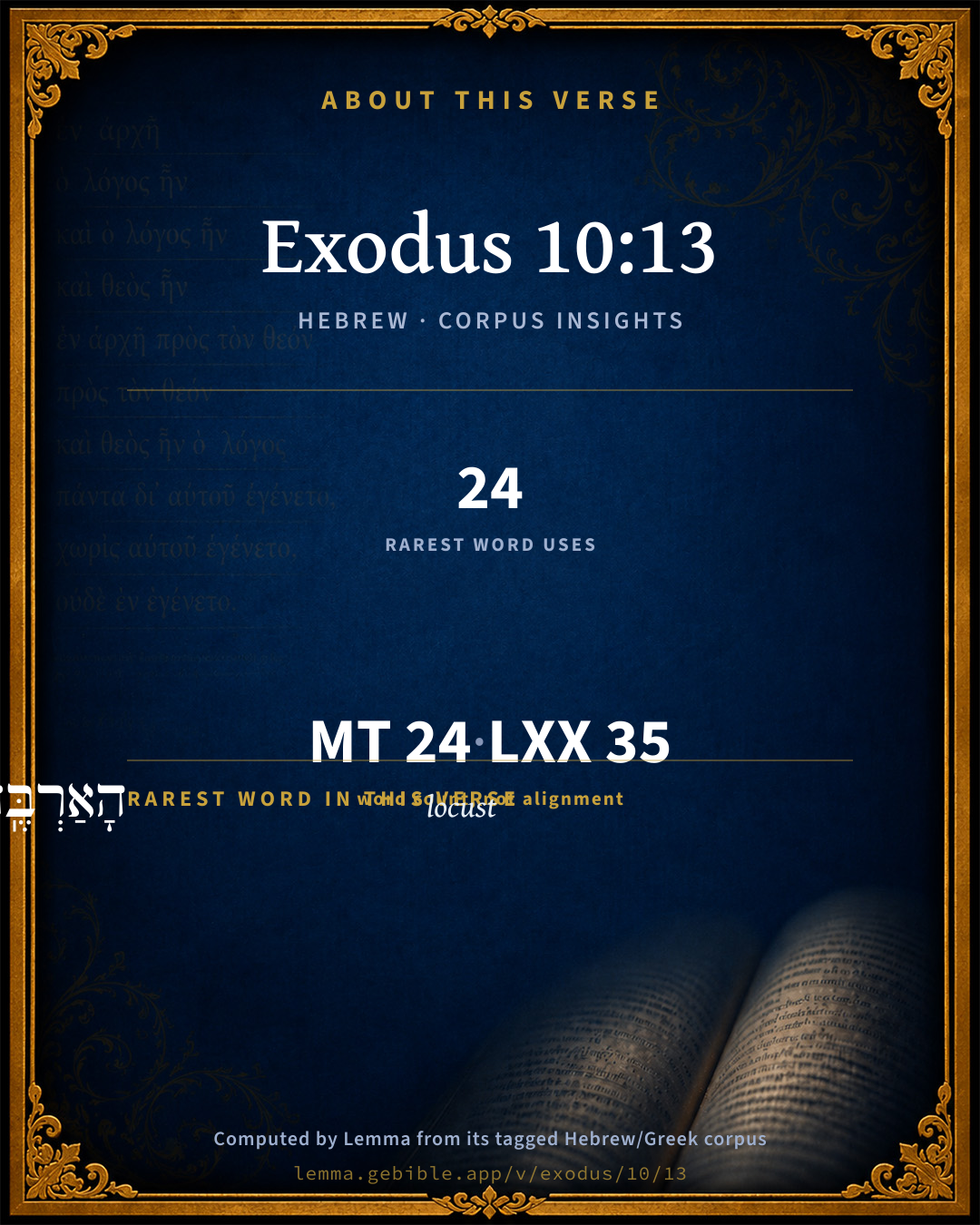
These counts appear in no published source. They are computed here, from the morphology-tagged text and Lemma’s own curated glosses. What Lemma adds →

24
words
19
distinct lemmas
Pentateuch
section

Notable vocabulary

The rarest word here is הָאַרְבֶּֽה locust H697 — appearing just 24 times in the whole Hebrew Bible.

Shared distinctive vocabulary

הָאַרְבֶּֽה locust H697 occurs in 21 verses of the Hebrew Bible. Also found in:

Grammatical profile

  • 4 verbs
  • 16 nouns
  • 1 pronoun
  • 1 preposition
  • 2 particles

Verb forms

  • וַיֵּ֨ט Qal · Sequential Imperfect
  • נִהַ֤ג Piel · Perfect
  • הָיָ֔ה Qal · Perfect
  • נָשָׂ֖א Qal · Perfect

Repetition

Words recur within this verse — often emphatic in Hebrew:

  • אֶ֣רֶץ land H776 ×2
  • ר֥וּחַ spirit H7307 ×2
  • קָדִים֙ east H6921 ×2
  • כָּל all H3605 ×2

Hebrew & Septuagint length

In English translation the verse runs 37 words from the Hebrew and 36 from the Septuagint (LXX English) — closely comparable.

A rough comparison of the two English renderings, which tokenize alike — not a word-level alignment.

Word counts can differ between the Hebrew and the Greek without any difference in meaning — e.g. the Hebrew direct-object marker אֵת has no separate Greek word, and Greek often adds the article ὁ.

In the original languages it is 24 Hebrew tokens and 35 Greek tokens — but the two are counted differently (Hebrew bundles its prefixes and suffixes into one token; the Greek is in lemma form), so that isn’t a like-for-like length.

Cross-references

9

Topical passages linked to Exodus 10:13 in the Treasury of Scripture Knowledge — connected by theme and wording, ordered by reader-vote popularity; previews shown in the World English Bible.

  • Genesis 41:6 Behold, seven heads of grain, thin and blasted with the east wind, sprung up after them.
  • Exodus 14:21 Moses stretched out his hand over the sea, and Yahweh caused the sea to go back by a strong east wind all the night, and made the sea dry land, and the waters were divided.
  • Psalms 78:26 He caused the east wind to blow in the sky. By his power he guided the south wind.
  • Psalms 105:34 He spoke, and the locusts came, And the grasshoppers, without number,
  • Psalms 107:25–28 For he commands, and raises the stormy wind, Which lifts up its waves.
  • Psalms 148:8 Lightning and hail, snow and clouds; Stormy wind, fulfilling his word;
  • Jonah 1:4 But Yahweh sent out a great wind on the sea, and there was a mighty tempest on the sea, so that the ship was likely to break up.
  • Jonah 4:8 It happened, when the sun arose, that God prepared a sultry east wind; and the sun beat on Jonah's head, so that he fainted, and requested for himself that he might die, and said, "It is better for me to die than to live."
  • Matthew 8:27 The men marveled, saying, "What kind of man is this, that even the wind and the sea obey him?"

Cross-references courtesy of OpenBible.info (CC BY 4.0).

Hebrew and Greek witnesses Masoretic Hebrew ↔ Greek Septuagint

The same verse in the two great witnesses to the Old Testament, shown verse-for-verse.

These are two independent witnesses, not word-aligned to each other, and the Septuagint is shown in lemma (dictionary) form.

Hebrew Exodus 10:13 Masoretic · Westminster Leningrad Codex

וַיֵּ֨ט מֹשֶׁ֣ה אֶת מַטֵּהוּ֮ עַל אֶ֣רֶץ מִצְרַיִם֒ וַֽיהוָ֗ה נִהַ֤ג ר֥וּחַ קָדִים֙ בָּאָ֔רֶץ כָּל הַיּ֥וֹם הַה֖וּא וְכָל הַלָּ֑יְלָה הַבֹּ֣קֶר הָיָ֔ה וְר֨וּחַ֙ הַקָּדִ֔ים נָשָׂ֖א אֶת הָאַרְבֶּֽה

Moses stretched forth his rod over the land of Egypt, and Yahweh brought an east wind on the land all that day, and all the night; and when it was morning, the east wind brought the locusts.

World English Bible · Public Domain

Greek LXX Exodus 10:13 Septuagint · lemma form

καί ἐπιαἴρω μωυσῆς ὁ ῥάβδος εἰς ὁ οὐρανός καί κύριος ἐπιἄγω ἄνεμος νότος ἐπί ὁ γῆ ὅλος ὁ ἡμέρα ἐκεῖνος καί ὅλος ὁ νύξ ὁ πρωΐ γίγνομαι καί ὁ ἄνεμος ὁ νότος ἀναλαμβάνω ὁ ἀκρίς

And Moses lifted up his rod towards heaven, and the Lord brought a south wind upon the earth, all that day and all that night: the morning dawned, and the south wind brought up the locusts,

LXX2012 (modern English Septuagint) · Public Domain

On this verse, Ellicott's Commentary for English Readers discusses the Septuagint’s reading. Read the note in Commentary ↓

Hebrew: Westminster Leningrad Codex (CC BY 4.0). Greek: Septuagint (public domain); English from LXX2012 (modern English Septuagint) (Public Domain). How the Septuagint differs from the Hebrew →

Targum (Aramaic paraphrase)

2

The Targum is the ancient Jewish Aramaic paraphrase of the Hebrew Scriptures — an interpretive translation, not the Hebrew text itself. Onkelos (literal) and Pseudo-Jonathan (expansive) render the Torah, and Jonathan the Prophets. Coverage is partial: where no permissively-licensed English translation exists for a verse, only the Aramaic is shown. This is verse-level text, not a word-by-word alignment to the Hebrew.

  1. Targum Onkelos Torah (Genesis–Deuteronomy)
    וַאֲרֵים משֶׁה יָת חֻטְרֵהּ עַל אַרְעָא דְמִצְרַיִם וַיְיָ דַבַּר רוּחַ קִדוּמָא בְּאַרְעָא כָּל יוֹמָא הַהוּא וְכָל לֵילְיָא צַפְרָא הֲוָה וְרוּחַ קִדוּמָא נְטַּל יָת גוֹבָא:

    (no public-domain English translation for this verse)

    Targum Onkelos — Aramaic: “Onkelos Genesis” (public domain); “Onkelos Exodus” (public domain); “Onkelos Leviticus” (public domain); “Onkelos Numbers” (public domain); “Onkelos Deuteronomy” (public domain). English: “Sefaria Community Translation” (CC0 1.0 (public-domain dedication)); “J.W. Etheridge. The Targums of Onkelos and Jonathan Ben Uzziel on the Pentateuch. London: Longmans, Green, 1862” (public domain). Text via Sefaria.

  2. Targum Pseudo-Jonathan Torah (Genesis–Deuteronomy)
    וַאֲרֵים משֶׁה יַת חוּטְרֵיהּ עַל אַרְעָא דְמִצְרָיִם וַיְיָ דְבַר רוּחַ קִידוּמָא בְּאַרְעָא כָּל יוֹמָא הַהוּא וְכָל לֵילְיָא צַפְרָא הֲוָה וְרוּחַ קִידוּמָא נָטַל יַת גּוֹבָא

    And Mosheh lifted up his rod over the land of Mizraim, and the Lord brought an east wind upon the country all that day and all the night; and in the morning the east wind bare the locust.

    Targum Pseudo-Jonathan — Aramaic: “Targum Jonathan on Genesis” (public domain); “Targum Jonathan on Exodus” (public domain); “Targum Jonathan on Leviticus” (public domain); “Targum Jonathan on Numbers” (public domain); “Targum Jonathan on Deuteronomy” (public domain). English: “The Targum of Jonathan ben Uzziel, trans. J. W. Etheridge, London, 1862” (public domain). Text via Sefaria.

Commentary

Notes on Exodus 10:13 from classic Christian and Jewish commentators (each source and its license shown beneath its notes). The classic Christian expositions comment on the surrounding passage and are grouped to its opening verse, so a note may address several verses; the Jewish commentaries on the Tanakh (Rashi and others) are per-verse, so they appear only where the commentator wrote on this verse.

Lemma curates 59 commentaries, every one of them public domain or Creative Commons licensed, each selected and text-cleaned for this edition rather than reprinted as found. About our sources →

Trapp's Complete Commentary

John Trapp

Exo 10:13 And Moses stretched forth his rod over the land of Egypt, and the LORD brought an east wind upon the land all that day, and all [that] night; [and] when it was morning, the east wind brought the locusts.

Ver. 13. An east wind.] The proper and ordinary office whereof is to purge the air.

John Trapp, A Commentary or Exposition upon All the Books of the Old and New Testament (1647–1656) — public domain. Text from a community e-Sword module.

Joseph Benson's Commentary

Exo 10:13. The east wind brought the locusts — From Arabia, where they are in great numbers: and God miraculously increased them. The locusts are usually conveyed by the wind. In the year 1527 great troops of locusts were brought by a strong wind out of Turkey into Poland, which country they wasted; and in 1536 a wind from the Euxine Sea brought such vast numbers into Podolia, that, for many miles round, they destroyed every thing. And “in the year 1650, a cloud of locusts was seen to enter Russia in three different places; and from thence they spread themselves over Poland and Lithuania, in such astonishing multitudes that the air was darkened, and the earth covered with their numbers. In some places they were seen lying dead, heaped upon each other to the depth of four feet; in others they covered the surface like a black cloth; the trees bent with their weight, and the damage which the country sustained exceeded computation.” — Encycl. Brit., vol. 8. p. 162, 3d edit.

Joseph Benson's Commentary on the Old and New Testaments (1811–1818) — public domain. Text from a community e-Sword module.

Tyndale Open Study Notes

Tyndale Open Resources

10:13-15 The miraculous nature of the locust plague was indicated by its timing (when Moses raised his staff) and by its extent and intensity (from one end of the country to the other, and there has never been another one like it).

10:13 an east wind: The grasshopper swarms came from the Arabian Desert, across the Red Sea to the east.

Tyndale Open Study Notes — © Tyndale Open Resources, licensed CC BY-SA 4.0. Text via the HelloAO Bible API.

Geneva Bible (1599)

Geneva Bible translators

The eighth plague.

Geneva Bible (1599) marginal notes — public domain. Text via Bolls.life.

Jamieson, Fausset & Brown

Robert Jamieson, A. R. Fausset & David Brown

the Lord brought an east wind--The rod of Moses was again raised, and the locusts came. They are natives of the desert and are only brought by an east wind into Egypt, where they sometimes come in sun-obscuring clouds, destroying in a few days every green blade in the track they traverse. Man, with all his contrivances, can do nothing to protect himself from the overwhelming invasion. Egypt has often suffered from locusts. But the plague that followed the wave of the miraculous rod was altogether unexampled. Pharaoh, fearing irretrievable ruin to his country, sent in haste for Moses, and confessing his sin, implored the intercession of Moses, who entreated the Lord, and a "mighty strong west wind took away the locusts."

Jamieson, Fausset & Brown — Commentary Critical and Explanatory on the Whole Bible (1871) — public domain (CC PDM 1.0). Text via the HelloAO Bible API.

Adam Clarke's Commentary

Verse 13. The Lord brought an east wind] As locusts abounded in those countries, and particularly in AEthiopia, and more especially at this time of the year, God had no need to create new swarms for this purpose; all that was requisite was to cause such a wind to blow as would bring those which already existed over the land of Egypt. The miracle in this business was the bringing the locusts at the appointed time, and causing the proper wind to blow for that purpose; and then taking them away after a similar manner.

Adam Clarke's Commentary on the Bible (1810–1826) — public domain. Text from a community e-Sword/MySword module.

Ellicott's Commentary for English Readers

(13) An east wind.—The LXX. translate by νότον, “a south wind,” probably because locusts most commonly enter Egypt from the south, being bred in Nubia or Abyssinia; but the Hebrew (ruakh kddim) is undoubtedly an east wind; and modern travellers tell us that this is a quarter from which locusts arrive in Egypt occasionally (Denon, Voyages en Egypte, p. 286). In such cases they are bred in Northern Arabia.

A Bible Commentary for English Readers, edited by Charles John Ellicott (1878–1897) — public domain. Text from a community e-Sword module.

John Gill's Exposition

And Moses stretched forth his rod over the land of Egypt,.... His hand, with his rod in it:

and the Lord brought an east wind upon the land, all that day and all that night; all that day after he had been driven from Pharaoh, and after he had stretched out his hand with his rod in it over Egypt, which was the seventh of the month Abib, and all the night following. This Jehovah did, who holds the winds in his fist, and brings them out of his treasures, whose will they obey, and whose word they fulfil:

and when it was morning; the morrow was come, Exo 10:4 the eighth day of the month Abib:

the east wind brought the locusts; it was usual for these creatures to be taken up and carried with the wind, and brought into countries, as Pliny (g) and other writers attest. In the year 1527, a strong wind brought vast troops of locusts out of Turkey into Poland, which did much mischief; and in the year 1536 a wind from the Euxine Pontus brought such vast numbers of them into Podolia, as that for twenty miles round they devoured everything (h). The word here used commonly signifies the east wind, and so the Jewish writers unanimously interpret it; and if those locusts were brought from the Red sea, into which they were carried, it must be by an east wind, since the Red sea was east of Egypt; but the Septuagint version renders it the "south wind", and which is approved of by De Dieu on the place, and by Bochart (i); and the latter supposes these locusts were brought by a south wind out of Ethiopia, which lay to the south of Egypt, and where in the spring of the year, as it now was, were usually great numbers of locusts, and where were a people that lived upon them, as Diodorus Siculus (k) and Strabo (l) relate; who both say that at the vernal equinox, or in the spring, the west and southwest winds blowing strongly brought locusts into those parts; and the south wind being warm might contribute to the production, cherishing, and increasing of these creatures, and which are sometimes brought by a south wind. Dr. Shaw says (m), the locusts he saw in Barbary, An. 1724 and 1725, were much bigger than our common grasshoppers, and had brown spotted wings, with legs and bodies of a bright yellow; their first appearance was toward the latter end of March, the wind having been for some time from the south.

(g) Nat. Hist. l. 11. c. 29. (h) Frantzii Hist. Animal. Sacr. par. 5. c. 4. p. 794. (i) Hierozoic. par. 2. l. 1. c. 15. col. 101, 102, & l. 4. c. 3. col. 463. Vid. Jablonski de Terra Goshen, Dissertat. 5. sect. 5. (k) Bibliothec, l. 3. p. 162. (l) Geograph. l. 16. p. 531. (m) Travels, p. 187. Edit. 2.

John Gill's Exposition of the Whole Bible (1746–1763) — public domain (CC PDM 1.0). Text via the HelloAO Bible API.

Albert Barnes' Notes on the Bible

An east wind - See Exo 10:4. Moses is careful to record the natural and usual cause of the evil, portentous as it was both in extent and in connection with its denouncement.

Albert Barnes' Notes on the Bible (1834–1885) — public domain. Text from a community e-Sword/MySword module.

Haydock's Catholic Bible Commentary

Wind from "the south," (Septuagint) or "east," (Kadim) or perhaps blowing from the south-east. (Bonfrere) The locusts would come from Ethiopia, or from Arabia, in both which countries they abound. (Ludolf, &c.) They lay their eggs in autumn, and hatch in spring. Frequently they devastate one country after another. They are very large in the East, and sometimes will fasten upon the heads of serpents, and destroy them, as they did on this occasion the Egyptians, Wisdom xvi. 9. --- In Cyrene, bordering upon Egypt, it is requisite to encounter these creatures thrice in the year. (Calmet) (See Leviticus xi. 22.)

George Leo Haydock (1774–1849), Haydock's Catholic Family Bible and Commentary, 1859 edition — public domain. Excludes Psalms (Douay-Rheims chapter numbering differs from Protestant) and Deuterocanonical books (Catholic canon only).

Matthew Poole's English Annotations

Over the land; over divers parts of the land, shaking his rod towards the several quarters of it. An east wind in those parts is a most violent and pernicious wind, Exo 14:21; Num 11:31, and a dry wind, and therefore fit for the engendering of those creatures. This wind brought them from Arabia, where they are in great numbers, as we have seen, Exo 10:12, though God miraculously increased their numbers, and their power of doing mischief.

Matthew Poole's English Annotations on the Holy Bible (1683–1685) — public domain. Text from a community e-Sword/MySword module.

Whedon's Commentary on the Bible

Daniel D. Whedon

13. An east wind — All travellers relate that the wind brings the locusts, but an east wind would have brought them from Arabia across the Red Sea, while the locusts usually come to Egypt from the south or southwest. But Denon (quoted by Knobel) describes a locust cloud which he witnessed coming from the east, producing great havoc in Egypt, and then driven back by a west wind, precisely like the one here mentioned.

Niebuhr describes swarms of locusts coming upon Egypt in December and January, and Lepsius and Tischendorf describe them in March, closely corresponding to the time of this narrative as it is fixed by Exo_9:31-32. After the dreadful destruction by the hail this locust plague must have been fearfully calamitous. This was foreseen by Pharaoh’s counsellors, who looked upon a locust visitation as the destruction of Egypt.

Daniel D. Whedon (gen. ed.), Commentary on the Old and New Testaments (1874–1909) — public domain. Text from a community e-Sword module.

The Pulpit Commentary

The Lord brought an east wind. Locusts generally come with a wind; and, indeed, cannot fly far without one. An east wind would in this case have brought them from northern Arabia, which is a tract where they are often bred in large numbers. Denon, the French traveller, notes that an enormous cloud of locusts which invaded Egypt during his stay, came from the east. All that day. The rest of the day on which Moses and Aaron had had their interview with the Pharaoh.

The Pulpit Commentary (1880–1919), ed. H.D.M. Spence-Jones & Joseph S. Exell — public domain. Text from a community e-Sword module.

John Wesley's Explanatory Notes

The east-wind brought the locusts - From Arabia, where they are in great numbers: And God miraculously increased them.

John Wesley, Explanatory Notes Upon the Whole Bible (1754–1765) — public domain. Text via the GEBible commentary corpus.

Rashi

Rabbi Shlomo Yitzchaki (Rashi)

ורוח הקדים THE EAST WIND — It was an east wind that brought the locusts because that came (blew) from the direction opposite to it (to Egypt), since Egypt was in the south-west, relative to Palestine, as it is explained in another place (Numbers 34:3).

Rashi on the Tanakh — English translations: “The Judaica Press complete Tanach with Rashi, translated by A. J. Rosenberg” (CC BY 4.0); “Pentateuch with Rashi's commentary by M. Rosenbaum and A.M. Silbermann, 1929-1934” (public domain); “The Metsudah Tanach series, Lakewood, N.J” (CC BY 4.0); and “The Book of Joshua, Metsudah Publications, 1997” (CC BY 4.0). Text via Sefaria.

Lesson kit

Teaching starters — assembled from the data on this page, not authored interpretation. Every prompt links to the verse data it draws on. Edit before teaching.

Exodus, in the Pentateuch, opens this verse with 24 words (19 distinct Hebrew lemmas). Its most distinctive word is ʼarbeh (“locust”). A historical commentator’s framing appears above. Read the whole chapter for the surrounding context.

Discussion questions

  1. How does “locust” (ʼarbeh) shape what this verse is saying?
  2. How does Exodus 10:4, which shares the word «locust», read alongside this verse?
  3. What does the repetition of “land” (2× in this one verse) do in this verse?
  4. The translations on this page render this verse differently — a whole-verse word diff, not a word-by-word alignment. What might account for the different wordings?
  5. «וַיֵּ֨ט» is a Qal Sequential Imperfect verb. How does that grammatical form shape the action described?
  6. Compare how Trapp's Complete Commentary and Joseph Benson's Commentary read this verse. Where do they agree or differ?

Things to notice

Reading settings

Reading text

Shown beneath each verse's original-language words.

Old Testament
Old Testament edition

Read the OT as the Masoretic Hebrew (MT) or the Greek Septuagint (LXX).

English shown for the Greek Septuagint (in the Hebrew ↔ Greek comparison).

Comparing translations? Open the Compare panel on any verse page to stack up to four side by side.