
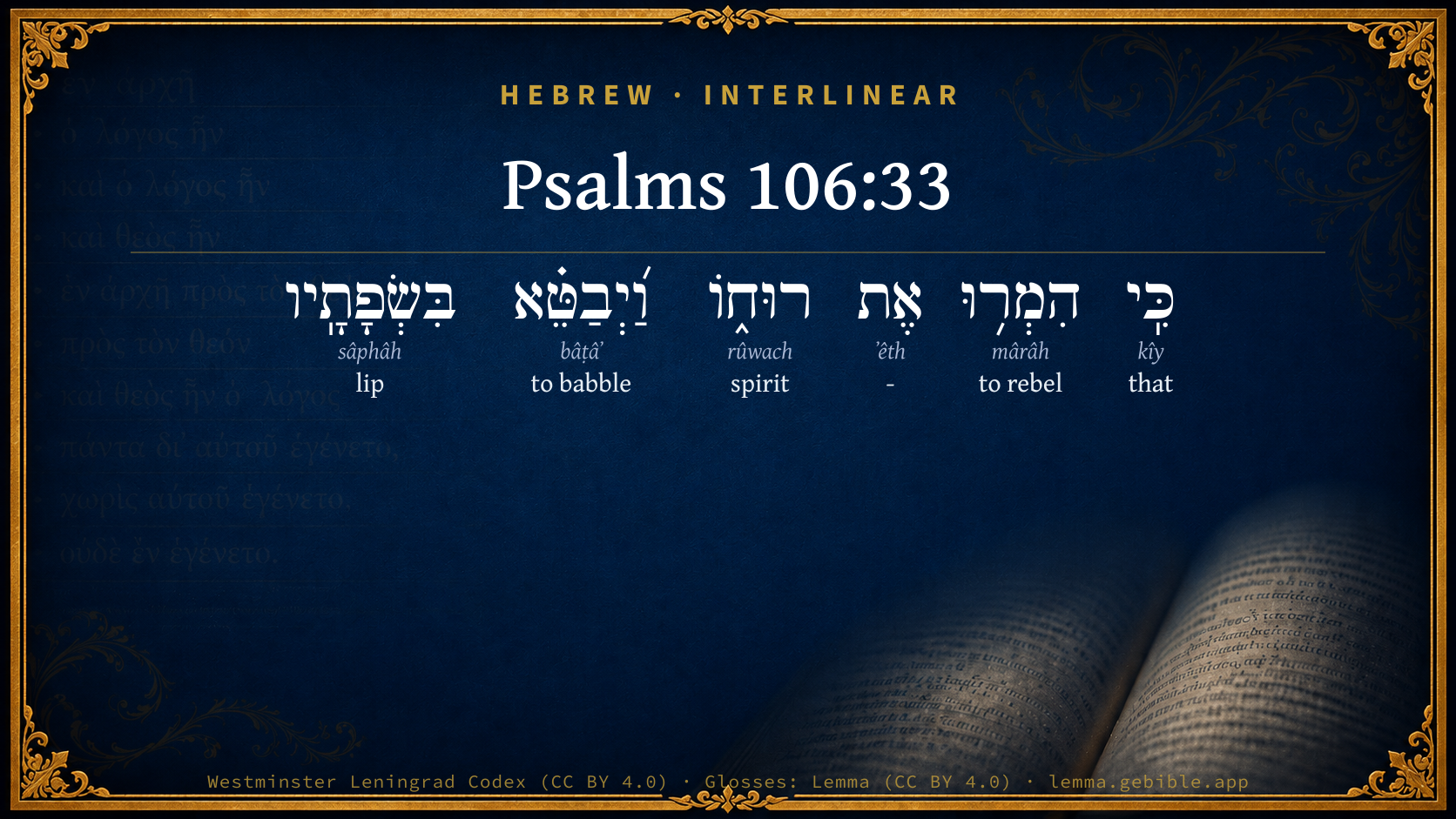
Psalms 106:33

Hebrew (Westminster Leningrad Codex) Psalms 106:33 appears in the Hebrew Old Testament. The text above is from the Westminster Leningrad Codex. Each word links to its Strong’s number, a concise gloss, and parsing drawn from the Open Scriptures Hebrew Bible morphology. Click any word for its full Brown-Driver-Briggs (BDB) entry.
Download image
Cite this verse

Psalms 106:33 (World English Bible). Public Domain. Lemma interlinear Bible study tool, https://lemma.gebible.app/v/psalms/106/33.

Show BibTeX & RIS
BibTeX
RIS
English Translation
Because they were rebellious against his spirit, He spoke rashly with his lips.
World English Bible · Public Domain
Download a study sheet

One document with this verse’s original text, its word-by-word gloss line, the meaning frame, cross-references with their text, attributed commentary, and full source and license credits — printable, and it pastes into notes with its structure intact.

This verse Autodidact and up

Study sheet (.html) Plain text (.txt)

A passage Seminary Student

Up to 50 verses in one chapter. A passage sheet keeps up to 6 commentary sources and 12 cross-references per verse, in the order this page ranks them, and says so on the sheet whenever that leaves anything out. Ask for a single verse and you get the Autodidact verse sheet above.

Everything on this page stays free to read, with no account — the sheet is a download of what is already on screen, not access to it.

Want to remove ads? Support Godless Engineer
Compare translations 3

The same verse in 3 English versions, stacked beneath the original-language interlinear above. Click any original word for its lexicon entry.

Each is an independent rendering of the whole verse — the interlinear is not word-aligned to these translations.

Highlighted words mark where these versions differ — a whole-verse word diff, not a word-by-word alignment.

  • World English Bible Public Domain
    Because they were rebellious against his spirit, He spoke rashly with his lips.
  • King James Version Public Domain
    Because they provoked his spirit, so that he spake unadvisedly with his lips.
  • unfoldingWord Literal Text CC BY-SA 4.0
    For they rebelled against his spirit, and he spoke rashly with his lips.

unfoldingWord Literal Text — © unfoldingWord, licensed CC BY-SA 4.0. Word-aligned USFM3 via Door43 (git.door43.org/unfoldingWord/en_ult).

Versions to compare (up to 4)

3 of 4 selected

Show all 18 translations

Every available English version of this verse, each an independent rendering of the whole verse.

  • World English Bible Public Domain
    Because they were rebellious against his spirit, He spoke rashly with his lips.
  • Berean Standard Bible Public Domain
    For they rebelled against His Spirit, and Moses spoke rashly with his lips.
  • Majority Standard Bible Public Domain
    For they rebelled against His Spirit, and Moses spoke rashly with his lips.
  • King James Version Public Domain
    Because they provoked his spirit, so that he spake unadvisedly with his lips.
  • American Standard Version (1901) Public Domain
    Because they were rebellious against his spirit, And he spake unadvisedly with his lips.
  • Revised Version (1885) Public Domain
    Because they were rebellious against his spirit, and he spake unadvisedly with his lips.
  • Geneva Bible (1599) Public Domain
    Because they vexed his spirite, so that hee spake vnaduisedly with his lippes.
  • Douay-Rheims (1899) Public Domain
    because they exasperated his spirit. And he distinguished with his lips.
  • Young's Literal Translation Public Domain
    For they have provoked his spirit, And he speaketh wrongfully with his lips.
  • Literal Standard Version CC BY-SA 4.0
    For they have provoked his spirit, || And he speaks wrongfully with his lips.
  • Unlocked Literal Bible CC BY-SA 4.0
    They made Moses bitter, and he spoke rashly.
  • unfoldingWord Literal Text CC BY-SA 4.0
    For they rebelled against his spirit, and he spoke rashly with his lips.
  • Darby Bible Public Domain
    For they provoked his spirit, so that he spoke unadvisedly with his lips.
  • World Messianic Bible Public Domain
    because they were rebellious against his spirit, he spoke rashly with his lips.
  • Webster's Bible Public Domain
    Because they provoked his spirit, so that he spoke unadvisedly with his lips.
  • Free Bible Version CC BY-SA 4.0
    They upset him so much that he spoke without thinking in the heat of the moment.
  • Bible in Basic English Public Domain
    For they made his spirit bitter, and he said unwise things.
  • JPS Tanakh (1917) Public Domain
    For they embittered his spirit, and he spoke rashly with his lips.

Literal Standard Version (2020), Covenant Press — licensed CC BY-SA 4.0. Text via the HelloAO Bible API (eBible.org). Unlocked Literal Bible (unfoldingWord) — licensed CC BY-SA 4.0. Text via the HelloAO Bible API (eBible.org). unfoldingWord Literal Text — © unfoldingWord, licensed CC BY-SA 4.0. Word-aligned USFM3 via Door43 (git.door43.org/unfoldingWord/en_ult). Free Bible Version, Dr. Jonathan Gallagher — licensed CC BY-SA 4.0. Text via the HelloAO Bible API (eBible.org).

Word by word

More ways to search: Search by grammar → Find every occurrence → Compare this word →

Practice this passage: Drill this verse → Learn its vocabulary →

About this verse

These counts appear in no published source. They are computed here, from the morphology-tagged text and Lemma’s own curated glosses. What Lemma adds →

6
words
6
distinct lemmas
Wisdom
section

Notable vocabulary

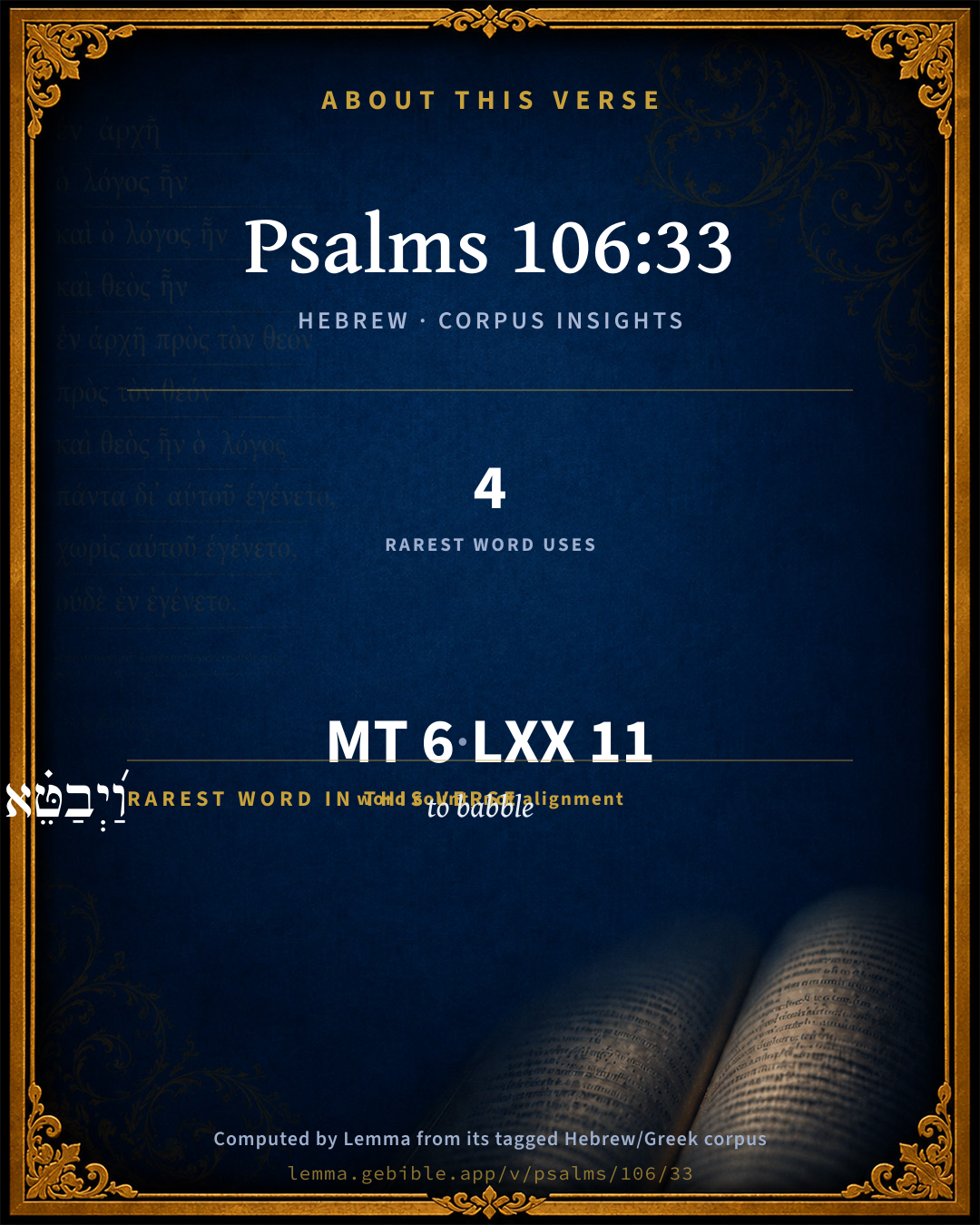
The rarest word here is וַ֝יְבַטֵּ֗א to babble H981 — appearing just 4 times in the whole Hebrew Bible.

Shared distinctive vocabulary

וַ֝יְבַטֵּ֗א to babble H981 occurs in 3 verses of the Hebrew Bible. Also found in:

Grammatical profile

  • 2 verbs
  • 2 nouns
  • 1 conjunction
  • 1 particle

Verb forms

  • הִמְר֥וּ Hiphil · Perfect
  • וַ֝יְבַטֵּ֗א Piel · Sequential Imperfect

Hebrew & Septuagint length

In English translation the verse runs 13 words from the Hebrew and 12 from the Septuagint (LXX English) — closely comparable.

A rough comparison of the two English renderings, which tokenize alike — not a word-level alignment.

Word counts can differ between the Hebrew and the Greek without any difference in meaning — e.g. the Hebrew direct-object marker אֵת has no separate Greek word, and Greek often adds the article ὁ.

In the original languages it is 6 Hebrew tokens and 11 Greek tokens — but the two are counted differently (Hebrew bundles its prefixes and suffixes into one token; the Greek is in lemma form), so that isn’t a like-for-like length.

Cross-references

12

Topical passages linked to Psalms 106:33 in the Treasury of Scripture Knowledge — connected by theme and wording, ordered by reader-vote popularity; previews shown in the World English Bible.

  • Numbers 20:10–11 Moses and Aaron gathered the assembly together before the rock, and he said to them, Hear now, you rebels; shall we bring you forth water out of this rock?
  • Psalms 39:1 I said, "I will watch my ways, so that I don't sin with my tongue. I will keep my mouth with a bridle while the wicked is before me."
  • Psalms 78:40 How often they rebelled against him in the wilderness, And grieved him in the desert!
  • Psalms 107:11 Because they rebelled against the words of God, And condemned the counsel of the Most High.
  • James 3:2 For in many things we all stumble. If anyone doesn't stumble in word, the same is a perfect man, able to bridle the whole body also.
  • Job 2:10 But he said to her, "You speak as one of the foolish women would speak. What? Shall we receive good at the hand of God, and shall we not receive evil?" In all this Job didn't sin with his lips.
  • Psalms 141:3 Set a watch, Yahweh, before my mouth. Keep the door of my lips.
  • Genesis 30:1 When Rachel saw that she bore Jacob no children, Rachel envied her sister. She said to Jacob, "Give me children, or else I will die."
  • Genesis 35:16–18 They traveled from Bethel. There was still some distance to come to Ephrath, and Rachel travailed. She had hard labor.
  • Job 38:2 "Who is this who darkens counsel By words without knowledge?
  • Job 40:4–5 "Behold, I am of small account. What shall I answer you? I lay my hand on my mouth.
  • Job 42:7–8 It was so, that after Yahweh had spoken these words to Job, Yahweh said to Eliphaz the Temanite, "My wrath is kindled against you, and against your two friends; for you have not spoken of me the thing that is right, as my servant Job has.

Cross-references courtesy of OpenBible.info (CC BY 4.0).

Hebrew and Greek witnesses Masoretic Hebrew ↔ Greek Septuagint

The same verse in the two great witnesses to the Old Testament, shown verse-for-verse.

You’re reading Greek Psalm 105 (Hebrew Psalm 106). The Septuagint counts the superscription, so verse numbers can differ from the Hebrew — chapter-level alignment, not verse-by-verse. Numbering follows Rahlfs.

These are two independent witnesses, not word-aligned to each other, and the Septuagint is shown in lemma (dictionary) form.

Hebrew Psalms 106:33 Masoretic · Westminster Leningrad Codex

כִּֽי הִמְר֥וּ אֶת רוּח֑וֹ וַ֝יְבַטֵּ֗א בִּשְׂפָתָֽיו

Because they were rebellious against his spirit, He spoke rashly with his lips.

World English Bible · Public Domain

Greek LXX Greek Psalm 105:33 Septuagint · lemma form

ὅτι παραπικραίνω ὁ πνεῦμα αὐτός καί διαστέλλω ἐν ὁ χεῖλος αὐτός

for they provoked his spirit, and he spoke unadvisedly with his lips.

LXX2012 (modern English Septuagint) · Public Domain

On this verse, Ellicott's Commentary for English Readers discusses the Septuagint’s reading. Read the note in Commentary ↓

Hebrew: Westminster Leningrad Codex (CC BY 4.0). Greek: Septuagint (public domain); English from LXX2012 (modern English Septuagint) (Public Domain). How the Septuagint differs from the Hebrew →

Commentary

Notes on Psalms 106:33 from classic Christian and Jewish commentators (each source and its license shown beneath its notes). The classic Christian expositions comment on the surrounding passage and are grouped to its opening verse, so a note may address several verses; the Jewish commentaries on the Tanakh (Rashi and others) are per-verse, so they appear only where the commentator wrote on this verse.

Lemma curates 59 commentaries, every one of them public domain or Creative Commons licensed, each selected and text-cleaned for this edition rather than reprinted as found. About our sources →

The Cambridge Bible for Schools and Colleges

gen. ed. J. J. S. Perowne

33. Because they were rebellious against his spirit,

And he spake rashly with his lips.

The cause of Jehovah’s anger and Moses’ punishment was the rebellion of the Israelites against the guidance of God’s spirit, and the rash utterance of Moses which was its consequence. Moses’ speech “Hear now, ye rebels! out of this cliff must we fetch you water?” and his striking the rock when he was commanded to speak to it, indicates that his sin consisted in impatience and want of faith.

The usage of the verb and the parallel of Isa_63:10 are decisive in favour of taking his spirit to mean God’s spirit not Moses’ spirit: and though the term rebellion is applied to the conduct of Moses and Aaron in Num_20:24, they were rebellious must here refer to the Israelites and not to them, as Aaron has not been mentioned. Psa_106:33 a will thus be parallel to Psa_106:32 a, and 33 b to 32 b.

The Cambridge Bible for Schools and Colleges (gen. ed. J. J. S. Perowne; Cambridge University Press, 1878–1918) — public domain. Text from a community e-Sword module.

Trapp's Complete Commentary

John Trapp

Psa 106:33 Because they provoked his spirit, so that he spake unadvisedly with his lips.

Ver. 33. Because they provoked his spirit] So that he was in a pelt to the grieving of God’s good Spirit within him, Eph 4:30-31. O tantaene animis coelestibus irae?

So that he spake unadvisedly] Some render it only, he spake, or he pronounced; he should not have spoken at all to the people, as having no order from God so to do in that transaction, but only to the rock. Whereas he not only smote the rock, and smote it twice, but spake to the people, and spake rashly, or idly (the Greek word βαττολογεω is thought to come from the Hebrew Bata here used), yea, bitterly, calling them rebels, and falling foul upon them with distrustful interrogations and misimplications, Et perperam locutus est. Contra charitas, ου περπερευεται, 1Co 13:4. This is called rebellion, Num 20:10-11; Num 20:24, and severely punished in God’s favourite Moses.

John Trapp, A Commentary or Exposition upon All the Books of the Old and New Testament (1647–1656) — public domain. Text from a community e-Sword module.

J. A. Alexander on Psalms

Joseph Addison Alexander

33. (Psa 106:33) For they resisted his spirit, and he spoke unadvisedly with his lips. His spirit may grammatically signify either that of God or that of Moses. The latest writers are in favour of the first construction, which is not without analogies in other parts of Scripture (Isa 63:10, Eph 4:30), but the other seems entitled to the preference in this connection, because the first clause then contains the ground or reason of the other. It was because the mind of Moses was excited by their opposition, that he spake unadvisedly with his lips. The last verb is one used in the law to denote a precipitate inconsiderate engagement, Lev 5:4.

Joseph Addison Alexander, The Psalms Translated and Explained (1850) — public domain. Text from a community e-Sword module.

Adam Clarke's Commentary

Verse 33. They provoked his spirit] המרו himru, from מרה marah, to rebel: they brought it into a rebellious state; he was soured and irritated, and was off his guard.

So that he spake unadvisedly with his lips.] For this sentence we have only these two words in the Hebrew, ויבטא בשפתיו vayebatte bisephathaiv, he stuttered or stammered with his lips, indicating that he was transported with anger. See the notes on Nu 20:10-12.

Adam Clarke's Commentary on the Bible (1810–1826) — public domain. Text from a community e-Sword/MySword module.

John Calvin's Commentaries

33. For they grieved his spirit The verb מרה, marah, properly signifies to vex or irritate, but as it is here put in what the Hebrews call the Hiphil conjugation, some are of opinion that it is to be understood passively, to denote that it was the people who were the occasion of the rebellion; which interpretation does not appear to me to be very objectionable. I cannot, however, agree with those who would have the particle את, eth, to be a sign of what is denominated the dative case, as if Moses might be said to have rebelled against the Spirit of God. Had he done so, then assuredly the prophet would not have spoken so severely of the sin and folly into which he had inadvertently fallen. The meaning which I have already given answers very well, That the prime movers of the rebellion must have committed a very heinous offense, seeing that Moses, who had been pushed on by the impetuosity of the people to sin, was so severely dealt with by God. But while the prophet informs us that Moses was punished on the people’s account, he is not to be understood as saying that he was altogether blameless. For even admitting that his spirit was ruffled in consequence of the tumult of the people, this ought to have made him the more careful to continue steadfast in his adherence to the Law of God. He adds, that he spoke with his lips; and this I take to refer to Moses, there being no ground for the conjecture that it refers to the punishment which God expressly denounced against Moses. It is more likely that these words were intended by the prophet to express how greatly the spirit of Moses was agitated when he openly murmured against God. The prophet, therefore, informs us that the submissive and gentle spirit of Moses was fanned, as it were, into a breeze by the perverseness of the people, so that even he spake un-advisedly, saying, “Can God give you water out of the rock?” (Numbers 20:10) For such was the indignation which he felt burning within him, that he could not calmly wait for the commandment of God to smite the rock.

John Calvin's Commentaries (1540-1563) — public domain. Text from the Calvin Translation Society English edition (1840s-50s) via the Christian Classics Ethereal Library (ccel.org). Calvin's coverage is partial (roughly two-thirds of the Bible); uncommented books and verses are honest gaps, never fabricated. The 19th-century editor's footnotes and remarks are omitted so the notes are faithfully Calvin's own voice.

Ellicott's Commentary for English Readers

(33) They provoked his spirit.—The natural interpretation is to take this of Moses’ spirit. So LXX. and Vulg., “they embittered his spirit.” The usage of the phrase is, however, in favour of referring the words to the temper of the people towards God,” they rebelled against His spirit.”

Spake unadvisedly.—Compare the same verb with the same addition, “with the lips,” in Lev_5:4. This interpretation of the fault of Moses is partial. A comparison of all the historical narratives shows that it was rather for a momentary lapse into the despairing spirit of the people, than for addressing them as rebels, that Moses was excluded from the Promised Land.

A Bible Commentary for English Readers, edited by Charles John Ellicott (1878–1897) — public domain. Text from a community e-Sword module.

John Gill's Exposition

Because they provoked his spirit;.... Though he was a very meek man, meeker than any upon the face of the earth, Num 12:2, yet, being greatly provoked, let fall some passionate and undue expressions: and this was not only his sin, but the fault of those also that provoked him, and with this view it is mentioned. The Targum is,

"for they rebelled against his Holy Spirit;''

the Holy Spirit of God, as in Isa 63:10. Jarchi interprets it of Moses and Aaron provoking the Spirit of God; which sense is mentioned, by Aben Ezra and Kimchi; though they seem to prefer the former, and which seems best. Some interpret it of the Israelites, that they caused Moses and Aaron to provoke his Spirit.

So that he spake unadvisedly with his lips; that is, Moses spake,

saying, Hear now, ye rebels, must we, or "can we",

fetch you water out of this rock? Which words were spoken in an angry passionate way, calling them rebels, and expressing diffidence about getting water out of the rock; which was the thing that was so displeasing to God, because they did not believe him to sanctify him in the eyes of the children of Israel, Num 25:10. Jarchi, as before, understands this of God, of his speaking, pronouncing, and declaring, that Moses and Aaron should not bring the congregation into the land of Canaan, Num 25:18, and so the word "unadvisedly" may be left out, and only read, "he spake with his lips"; but the other sense is to be preferred.

John Gill's Exposition of the Whole Bible (1746–1763) — public domain (CC PDM 1.0). Text via the HelloAO Bible API.

Albert Barnes' Notes on the Bible

Because they provoked his spirit - literally, “They made his spirit bitter,” or they embittered his soul. They threw him off his guard, so that instead of manifesting the meekness and gentleness which so eminently characterized him in general (see Num 12:3), he gave way to expressions of anger. See Num 20:10.

So that he spake unadvisedly with his lips - Passionately; in a severe, harsh, and threatening manner. He did not bear with them as he should have done; he did not refer to God, to his power, and to his goodness as he should have done; he spake as if the whole thing depended on him and Aaron: “Hear now, ye rebels; must we fetch you water out of this rock?” The word rendered “spake unadvisedly” - בטא bâṭâ' - means properly to “babble;” and then, to talk idly, or unadvisedly; to utter that which has no meaning, or an improper meaning. Let us not harshly blame Moses, until we are placed in circumstances similar to his, and see how we would ourselves act. Who is there that would not have been provoked as he was, or even to a greater degree? If there are any such, let them “cast the first stone.”

Albert Barnes' Notes on the Bible (1834–1885) — public domain. Text from a community e-Sword/MySword module.

Matthew Poole's English Annotations

He spake unadvisedly: so this word is thought to signify, Lev 5:4; Pro 12:18. Or, he spake, as the word commonly signifies. Not that it was in itself a sin to speak, but because he spake when he should have been silent; or he spake to the people, when God commanded him only to speak to the rock, Num 20:8-10; or, he spake, to wit, the provocation of his spirit, or such words as were agreeable to it, and might be expected from it. He mentions not here what Moses spake, because that was fully known from the history, and because he would throw a veil over Moses’s infirmity, and rather imply than express his fault.

Matthew Poole's English Annotations on the Holy Bible (1683–1685) — public domain. Text from a community e-Sword/MySword module.

The Treasury of David

Charles H. Spurgeon

Ver. 33. Because they provoked his spirit, so that he spake unadvisedly with his lips. Which seems a small sin compared with that of others, but then it was the sin of Moses, the Lord's chosen servant, who had seen and known so much of the Lord, and therefore it could not be passed by. He did not speak blasphemously, or falsely, but only hastily and without care; but this is a serious fault in a lawgiver, and especially in one who speaks for God. This passage is to our mind one of the most terrible in the Bible. Truly we serve a jealous God. Yet he is not a hard master, or austere; we must not think so, but we must then rather be jealous of ourselves, and watch that we live the more carefully, and speak the more advisedly, because we serve such a Lord. We ought also to be very careful how we treat the ministers of the gospel, lest by provoking their spirit we should drive them into any unseemly behaviour which should bring upon them the chastisement of the Lord. Little do a murmuring, quarrelsome people dream of the perils in which they involve their pastors by their untoward behaviour.

Ver. 33. They provoked his spirit. As Abraham was distinguished for his faith, so was Moses for his meekness; for Scripture has declared that he was "very meek, above all the men which were on the face of the earth", Nu 12:3. Yet, judging from facts recorded of him, we should be inclined to suppose that he was by nature remarkable for sensitiveness and hastiness of temperthat was his one besetting infirmity. Such appears to have been evinced when he slew the Egyptian; when he twice smote the rock in the wilderness; and on that occasion when he was "punished", as the psalmist says, "because they provoked his spirit, so that he spake unadvisedly with his lips", and when he broke the two tables of stone. Something of the same kind appears to have been the case with our own Hooker, whose biographer attributes to him such singular meekness, while his private writings indicate a temper keenly alive and sensitive to the sense of wrong. Isaac Williams.

Ver. 33. They provoked his spirit. In a dispensation itself mainly gracious, and foreshadowing one which would be grace altogether, it was of prime importance that the mediating men should be merciful and gracious, long suffering, and slow to anger. And sure they were in marvellous manner...

Brimming, over with instruction as is this passage, we must leave it with a few remarks.

1. How careful preachers of the gospel and expounders of Scripture should be not to give an erroneous impression of God's mind or message. The mental acumen is rare, but the right spirit is rarer. But what is the right spirit? A loving spirit, a gentle spirit, a faithful spirit, a meek and weaned spirit, a spirit which says, "Speak, Lord, for thy servant heareth", and a spirit which adds, "All that the Lord giveth me, that will I speak", that excellent spirit which is only imparted by the good Spirit of God. For if He withdraw, even a Moses ceases to be meek, and ceasing to be meek, even a Moses becomes a bad divine and an erroneous teacher, striking the rock that has been already stricken once for all, and preaching glad tidings gruffly. He who gives the living water does not grudge it; but sometimes, instead of "Ho! every one that thirsteth", the preacher says, "Hear now, ye rebels; must we fetch you water out of this rock?" and makes the very invitation repulsive.

2. When any one has run long and run well, how sad it is to stumble within a few steps of the goal! If Moses had an earthly wish, it was to see Israel safe in their inheritance, and his wish was all but consummated. Faith and patience had held out well nigh forty years, and in a few months more the Jordan would be crossed and the work would be finished. And who can tell but this very nearness of the prize helped to create something of a presumptuous confidence? The blood of Moses was hot to begin with, and he was not the meekest of men when he smote the Egyptian and hid him in the sand. But he had got a good lesson in ruling his spirit, and betwixt the long sojourn with Jethro and the self discipline needful in the charge of this multitude, he might fancy that he had now his foot on the neck of this enemy: when lo! the sin revives and Moses dies.

Blessed is the man that feareth alway! Blessed is the man who, although years have passed without an attempt at burglary, still bars his doors and sees his windows fastened! Blessed is the man who, although a generation has gone since the last eruption, forbears to build on the volcanic soil and dreads fires which have smouldered for fourscore years! Blessed is the man who, even when the high seas are crossed and the land is made, still keeps an outlook! Blessed is the man who, even on the confines of Canaan, takes heed of the evil heart, lest, with a promise of entering in, he should come short through unbelief!

Ver. 33. They provoked his spirit, etc. Angry he certainly was; and when, reverting to a former miracle, the Most High directed him to take the wonder staffhis rod of many miracles and at the head of the congregation "speak to the rock", and it would "give forth its water", in the heat and agitation of his spirit he failed to implement implicitly the Divine command. Instead of speaking to the rock he spoke to the people, and his harangue was no longer in the language calm and dignified of the lawgiver, but had a certain tone of petulance and egotism. "Hear now, ye rebels, must wemust I and Aaron, not must Jehovahfetch you water out of this rock?" And instead of simply speaking to it, he raised the rod and dealt it two successive strokes, just as if the rock were sharing the general perversity, and would no more than the people obey its Creator's bidding. He was angry, and he sinned. He sinned and was severely punished. Water flowed sufficient for the whole camp and the cattle, clear, cool, and eagerly gushing, enough for all the million; but at the same moment that its unmerited bounty burst on you, ye rebels, "a cup of wrath was put into the hand of Moses." (Van Oosterzee.) To you, ye murmurers, there came forth living water; to your venerable leaders the cup of God's anger.

"The Lord spoke unto Moses and Aaron, Because ye believed me not, to sanctify me in the eyes of the children of Israel, therefore ye shall not bring this congregation into the land which I have given them." Nu 20:12. James Hamilton.

Ver. 33. He spake unadvisedly with his lips. The Lord desires him to address the rock, but Moses speaks to Israel. God wishes him to speak a word to the inanimate stone, and Moses strikes it twice. God still is willing that the people shall remain as his inheritance, but Moses evidently treats them with ill will and much offensiveness. God wishes to relieve, and give refreshing to the people in their thirst, and Moses is selected to cooperate with him in all such joy; but mark how, on this very day, a deep discord between God's inclination and the mind of Moses shows itself. God is inclined to grant forgiveness, Moses inclines to punishment; before, the very opposite seemed to prevail. God is forbearing, Moses, filled with bitterness; God seeks to glorify his grace, with Moses, self, not God, comes into prominence. "Must we", not, "must the Lord", but "must we fetch you water out of this rock?" We see now, in this prophet, strong at other times, the first plain indications of decay and weariness. He has grown tired (and truly it should not seem strange, for which of us could have sustained a struggle such as his for half the time?) of carrying these stubborn children any longer now. This man, so truly great, has never for an instant hitherto forgotten his own dignity in presence of all Israel; but now, he is no longer master of himself. J.J. Van Oosterzee.

Ver. 33. He spake unadvisedly. A gracious person may be surprised and fall suddenly among thieves that lurk behind the bushes. Nay, very holy men, unless wonderful wary, may be quickly tripped up by sudden questions and unexpected emergencies. Who knows the subtilty of sin, and the deceitfulness of his own heart? Take heed of answering quickly, and send up sudden ejaculations to heaven before you reply to a weighty and doubtful motion. Samuel Lee.

Ver. 33.

1. What it is so to speak unadvisedly.

2. What is the great cause of it"they provoked his spirit."

3. What the results may be.

Psalms 106:34*

Charles H. Spurgeon's The Treasury of David (1869–1885) — public domain. Psalms only. Text from a community e-Sword/MySword module.

Whedon's Commentary on the Bible

Daniel D. Whedon

33. They provoked his spirit—That is, they provoked Moses’s spirit, to whom the suffix pronoun must be understood to refer. Here was the first step in Moses’s sin. His meekness gave way to anger.

Spake unadvisedly—The word rendered “spake,” means thoughtless, hasty, rash speaking, as in rashly or inconsiderately pronouncing an oath, (Lev_5:4,) and stands opposed to “the tongue of the wise,” Pro_12:18. For Moses’s speech, see Num_20:10. It was against the spirit and dignity of his office, and hence an unworthy representation of the mind and character of God. In the loss of his calm trust in God, (Num_20:12,) he lost, for the moment, his self-control, and failed both of reverent speech and accurate obedience, and the name of God was not sanctified before the people. Num_27:14; Deu_32:51. For this fault Moses was prohibited entering Canaan. Deu_3:24-26

Daniel D. Whedon (gen. ed.), Commentary on the Old and New Testaments (1874–1909) — public domain. Text from a community e-Sword module.

The Pulpit Commentary

Because they provoked his spirit, so that he spake unadvisedly with his lips. One man"s sin often leads to another"s, but does not necessitate it. The people "provoked Muses" spirit" by their murmurs and reproaches. (Num_20:3-5) Moses, being provoked, made his rash utterance. (Num_20:10) He was vexed, impatient, carried away by a gust of passion, and made the unfitting speech, "Hear now, ye rebels; must we fetch you water out of the rock?" speaking as if the power were his own.

The Pulpit Commentary (1880–1919), ed. H.D.M. Spence-Jones & Joseph S. Exell — public domain. Text from a community e-Sword module.

Rashi

Rabbi Shlomo Yitzchaki (Rashi)

For they rebelled Moses and Aaron.

against His spirit with (Num. 20:10) “Hear now, you rebels!”

and He uttered with His lips an oath (Num. 20:12): “Therefore you shall not bring this community, etc.”

Rashi on the Tanakh — English translations: “The Judaica Press complete Tanach with Rashi, translated by A. J. Rosenberg” (CC BY 4.0); “Pentateuch with Rashi's commentary by M. Rosenbaum and A.M. Silbermann, 1929-1934” (public domain); “The Metsudah Tanach series, Lakewood, N.J” (CC BY 4.0); and “The Book of Joshua, Metsudah Publications, 1997” (CC BY 4.0). Text via Sefaria.

Lesson kit

Teaching starters — assembled from the data on this page, not authored interpretation. Every prompt links to the verse data it draws on. Edit before teaching.

Psalms, in the Wisdom, opens this verse with 6 words (6 distinct Hebrew lemmas). Its most distinctive word is bâṭâʼ (“to babble”). A historical commentator’s framing appears above. Read the whole chapter for the surrounding context.

Discussion questions

  1. The word bâṭâʼ carries the sense “to babble.” How does it shape the verse?
  2. How does Leviticus 5:4, which shares the word «to babble», read alongside this verse?
  3. These translations render this verse differently. What is at stake in choosing one wording over another?
  4. «הִמְר֥וּ» is a Hiphil Perfect verb. How does that grammatical form shape the action described?
  5. Compare how The Cambridge Bible for Schools and Colleges and Trapp's Complete Commentary read this verse. Where do they agree or differ?

Things to notice

Reading settings

Reading text

Shown beneath each verse's original-language words.

Old Testament
Old Testament edition

Read the OT as the Masoretic Hebrew (MT) or the Greek Septuagint (LXX).

English shown for the Greek Septuagint (in the Hebrew ↔ Greek comparison).

Comparing translations? Open the Compare panel on any verse page to stack up to four side by side.