Exodus 31:3

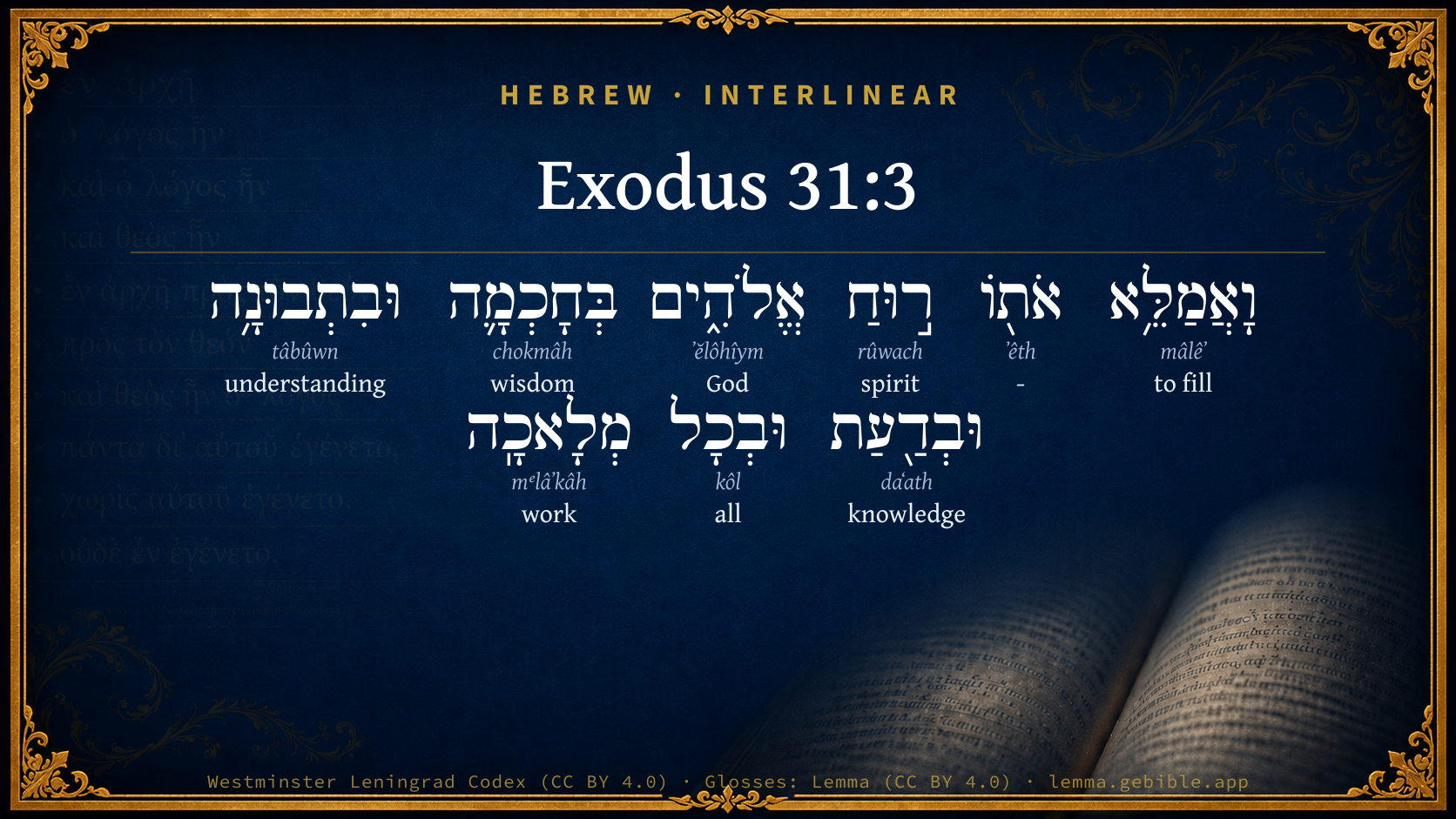
Hebrew (Westminster Leningrad Codex) Exodus 31:3 appears in the Hebrew Old Testament. The text above is from the Westminster Leningrad Codex. Each word links to its Strong’s number, a concise gloss, and parsing drawn from the Open Scriptures Hebrew Bible morphology. Click any word for its full Brown-Driver-Briggs (BDB) entry.
Download image
Cite this verse

Exodus 31:3 (World English Bible). Public Domain. Lemma interlinear Bible study tool, https://lemma.gebible.app/v/exodus/31/3.

Show BibTeX & RIS
BibTeX
RIS
English Translation
and I have filled him with the Spirit of God, in wisdom, and in understanding, and in knowledge, and in all manner of workmanship,
World English Bible · Public Domain
Highlights
  • 1 first appearance in the Hebrew Bible
Full analysis ↓
Download a study sheet

One document with this verse’s original text, its word-by-word gloss line, the meaning frame, cross-references with their text, attributed commentary, and full source and license credits — printable, and it pastes into notes with its structure intact.

This verse Autodidact and up

Study sheet (.html) Plain text (.txt)

A passage Seminary Student

Up to 50 verses in one chapter. A passage sheet keeps up to 6 commentary sources and 12 cross-references per verse, in the order this page ranks them, and says so on the sheet whenever that leaves anything out. Ask for a single verse and you get the Autodidact verse sheet above.

Everything on this page stays free to read, with no account — the sheet is a download of what is already on screen, not access to it.

Want to remove ads? Support Godless Engineer
Compare translations 3

The same verse in 3 English versions, stacked beneath the original-language interlinear above. Click any original word for its lexicon entry.

Each is an independent rendering of the whole verse — the interlinear is not word-aligned to these translations.

Highlighted words mark where these versions differ — a whole-verse word diff, not a word-by-word alignment.

  • World English Bible Public Domain
    and I have filled him with the Spirit of God, in wisdom, and in understanding, and in knowledge, and in all manner of workmanship,
  • King James Version Public Domain
    And I have filled him with the spirit of God, in wisdom, and in understanding, and in knowledge, and in all manner of workmanship,
  • unfoldingWord Literal Text CC BY-SA 4.0
    And I have filled him with the Spirit of God, with skill and with understanding and with knowledge and with all kinds of craftsmanship

unfoldingWord Literal Text — © unfoldingWord, licensed CC BY-SA 4.0. Word-aligned USFM3 via Door43 (git.door43.org/unfoldingWord/en_ult).

Versions to compare (up to 4)

3 of 4 selected

Show all 18 translations

Every available English version of this verse, each an independent rendering of the whole verse.

  • World English Bible Public Domain
    and I have filled him with the Spirit of God, in wisdom, and in understanding, and in knowledge, and in all manner of workmanship,
  • Berean Standard Bible Public Domain
    And I have filled him with the Spirit of God, with skill, ability, and knowledge in all kinds of craftsmanship,
  • Majority Standard Bible Public Domain
    And I have filled him with the Spirit of God, with skill, ability, and knowledge in all kinds of craftsmanship,
  • King James Version Public Domain
    And I have filled him with the spirit of God, in wisdom, and in understanding, and in knowledge, and in all manner of workmanship,
  • American Standard Version (1901) Public Domain
    and I have filled him with the Spirit of God, in wisdom, and in understanding, and in knowledge, and in all manner of workmanship,
  • Revised Version (1885) Public Domain
    and I have filled him with the spirit of God, in wisdom, and in understanding, and in knowledge, and in all manner of workmanship,
  • Geneva Bible (1599) Public Domain
    Whom I haue filled with the Spirit of God, in wisedome, and in vnderstanding and in knowledge and in all workmanship:
  • Douay-Rheims (1899) Public Domain
    And I have filled him with the spirit of God, with wisdom and understanding, and knowledge in all manner of work.
  • Young's Literal Translation Public Domain
    and I fill him `with' the Spirit of God, in wisdom, and in understanding, and in knowledge, and in all work,
  • Literal Standard Version CC BY-SA 4.0
    and I fill him [with] the Spirit of God, in wisdom, and in understanding, and in knowledge, and in all work,
  • Unlocked Literal Bible CC BY-SA 4.0
    I have filled Bezalel with my Spirit, to give him wisdom, understanding, and knowledge, for all kinds of craftsmanship,
  • unfoldingWord Literal Text CC BY-SA 4.0
    And I have filled him with the Spirit of God, with skill and with understanding and with knowledge and with all kinds of craftsmanship
  • Darby Bible Public Domain
    and have filled him with the spirit of God, in wisdom, and in understanding, and in knowledge, and in every work,
  • World Messianic Bible Public Domain
    I have filled him with the Spirit of God, in wisdom, and in understanding, and in knowledge, and in all kinds of workmanship,
  • Webster's Bible Public Domain
    And I have filled him with the spirit of God, in wisdom, and in understanding, and in knowledge, and in all manner of workmanship,
  • Free Bible Version CC BY-SA 4.0
    I have filled him with the Spirit of God giving him ability, creativity, and expertise in all kinds of craftsmanship.
  • Bible in Basic English Public Domain
    And I have given him the spirit of God and made him wise and full of knowledge and expert in every sort of handwork,
  • JPS Tanakh (1917) Public Domain
    and I have filled him with the spirit of God, in wisdom, and in understanding, and in knowledge, and in all manner of workmanship,

Literal Standard Version (2020), Covenant Press — licensed CC BY-SA 4.0. Text via the HelloAO Bible API (eBible.org). Unlocked Literal Bible (unfoldingWord) — licensed CC BY-SA 4.0. Text via the HelloAO Bible API (eBible.org). unfoldingWord Literal Text — © unfoldingWord, licensed CC BY-SA 4.0. Word-aligned USFM3 via Door43 (git.door43.org/unfoldingWord/en_ult). Free Bible Version, Dr. Jonathan Gallagher — licensed CC BY-SA 4.0. Text via the HelloAO Bible API (eBible.org).

Word by word

More ways to search: Search by grammar → Find every occurrence → Compare this word →

Practice this passage: Drill this verse → Learn its vocabulary →

וּבִתְבוּנָ֥ה
tâbûwn
H8394
“and · in/at · understanding”
Conjunction + Preposition + Noun, Common, Feminine, Singular, Absolute
Part of Speech
Conjunction + Preposition + Noun
Type
Common
Gender
Feminine
Number
Singular
State
Absolute
Full BDB Definition

Origin: from H995

TWOT: 239c

understanding, intelligence - the act of understanding - skill - the faculty of understanding - intelligence, understanding, insight - the object of knowledge - teacher (personification)
  1. וָאֲמַלֵּ֥א mâlêʼ H4390 “and · to fill” Conjunction + Verb, Piel, Sequential Imperfect, 1st Person, Common, Singular
  2. אֹת֖וֹ ʼêth H853 “- · him” Particle, Direct Object + Suffix, Personal, 3rd Person, Masculine, Singular
  3. ר֣וּחַ rûwach H7307 “spirit of” Noun, Common, Both, Singular, Construct
  4. אֱלֹהִ֑ים ʼĕlôhîym H430 “God(s)” Noun, Common, Masculine, Plural, Absolute
  5. בְּחָכְמָ֛ה chokmâh H2451 “in/at · wisdom” Preposition + Noun, Common, Feminine, Singular, Absolute
  6. וּבְדַ֖עַת daʻath H1847 “and · in/at · knowledge” Conjunction + Preposition + Noun, Common, Feminine, Singular, Absolute
  7. וּבְכָל kôl H3605 “and · in/at · all of” Conjunction + Preposition + Noun, Common, Masculine, Singular, Construct
  8. מְלָאכָֽה mᵉlâʼkâh H4399 “work” Noun, Common, Feminine, Singular, Absolute

About this verse

These counts appear in no published source. They are computed here, from the morphology-tagged text and Lemma’s own curated glosses. What Lemma adds →

9
words
9
distinct lemmas
Pentateuch
section

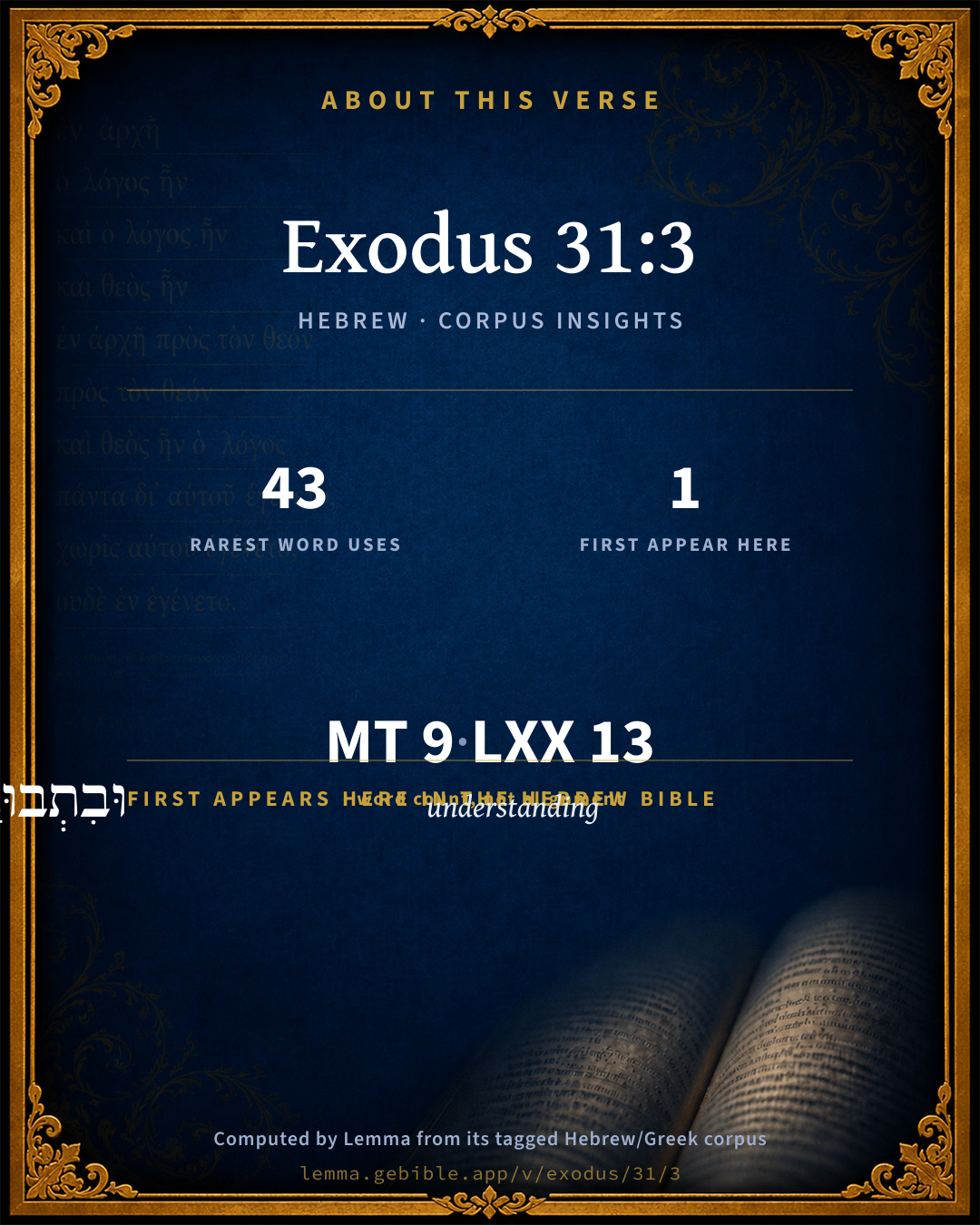
First appearance in Scripture

This word makes its first canonical appearance in the Hebrew Bible here:

  • וּבִתְבוּנָ֥ה understanding H8394

Shared distinctive vocabulary

וּבִתְבוּנָ֥ה understanding H8394 occurs in 42 verses of the Hebrew Bible. Also found in:

Grammatical profile

  • 1 verb
  • 7 nouns
  • 1 particle

Verb forms

  • וָאֲמַלֵּ֥א Piel · Sequential Imperfect

Hebrew & Septuagint length

In English translation the verse runs 24 words from the Hebrew and 20 from the Septuagint (LXX English) — closely comparable.

A rough comparison of the two English renderings, which tokenize alike — not a word-level alignment.

Word counts can differ between the Hebrew and the Greek without any difference in meaning — e.g. the Hebrew direct-object marker אֵת has no separate Greek word, and Greek often adds the article ὁ.

In the original languages it is 9 Hebrew tokens and 13 Greek tokens — but the two are counted differently (Hebrew bundles its prefixes and suffixes into one token; the Greek is in lemma form), so that isn’t a like-for-like length.

Cross-references

6

Topical passages linked to Exodus 31:3 in the Treasury of Scripture Knowledge — connected by theme and wording, ordered by reader-vote popularity; previews shown in the World English Bible.

  • Exodus 35:31 He has filled him with the Spirit of God, in wisdom, in understanding, in knowledge, and in all manner of workmanship;
  • Isaiah 28:26 For his God does instruct him aright, [and] does teach him.
  • 1 Kings 7:14 He was the son of a widow of the tribe of Naphtali, and his father was a man of Tyre, a worker in brass; and he was filled with wisdom and understanding and skill, to work all works in brass. He came to king Solomon, and performed all his work.
  • 1 Corinthians 12:4–11 Now there are various kinds of gifts, but the same Spirit.
  • Isaiah 28:6 and a spirit of justice to him who sits in judgment, and strength to those who turn back the battle at the gate.
  • 1 Kings 3:9 Give your servant therefore an understanding heart to judge your people, that I may discern between good and evil; for who is able to judge this your great people?

Cross-references courtesy of OpenBible.info (CC BY 4.0).

Hebrew and Greek witnesses Masoretic Hebrew ↔ Greek Septuagint

The same verse in the two great witnesses to the Old Testament, shown verse-for-verse.

These are two independent witnesses, not word-aligned to each other, and the Septuagint is shown in lemma (dictionary) form.

Hebrew Exodus 31:3 Masoretic · Westminster Leningrad Codex

וָאֲמַלֵּ֥א אֹת֖וֹ ר֣וּחַ אֱלֹהִ֑ים בְּחָכְמָ֛ה וּבִתְבוּנָ֥ה וּבְדַ֖עַת וּבְכָל מְלָאכָֽה

and I have filled him with the Spirit of God, in wisdom, and in understanding, and in knowledge, and in all manner of workmanship,

World English Bible · Public Domain

Greek LXX Exodus 31:3 Septuagint · lemma form

καί ἐνπίμπλημι αὐτός πνεῦμα θεῖος σοφία καί σύνεσις καί ἐπιστήμη ἐν πᾶς ἔργον

And I have filled him with a divine spirit of wisdom, and understanding, and knowledge, to invent in every work,

LXX2012 (modern English Septuagint) · Public Domain

Hebrew: Westminster Leningrad Codex (CC BY 4.0). Greek: Septuagint (public domain); English from LXX2012 (modern English Septuagint) (Public Domain). How the Septuagint differs from the Hebrew →

Targum (Aramaic paraphrase)

2

The Targum is the ancient Jewish Aramaic paraphrase of the Hebrew Scriptures — an interpretive translation, not the Hebrew text itself. Onkelos (literal) and Pseudo-Jonathan (expansive) render the Torah, and Jonathan the Prophets. Coverage is partial: where no permissively-licensed English translation exists for a verse, only the Aramaic is shown. This is verse-level text, not a word-by-word alignment to the Hebrew.

  1. Targum Onkelos Torah (Genesis–Deuteronomy)
    וְאַשְׁלֵמִית עִמֵהּ רוּחַ מִן קֳדָם יְיָ בְּחָכְמְתָא וּבְסוּכְלְתָנוּ וּבְמַדַע וּבְכָל עִבִידָא:

    (no public-domain English translation for this verse)

    Targum Onkelos — Aramaic: “Onkelos Genesis” (public domain); “Onkelos Exodus” (public domain); “Onkelos Leviticus” (public domain); “Onkelos Numbers” (public domain); “Onkelos Deuteronomy” (public domain). English: “Sefaria Community Translation” (CC0 1.0 (public-domain dedication)); “J.W. Etheridge. The Targums of Onkelos and Jonathan Ben Uzziel on the Pentateuch. London: Longmans, Green, 1862” (public domain). Text via Sefaria.

  2. Targum Pseudo-Jonathan Torah (Genesis–Deuteronomy)
    וְאַשְׁלֵמִית עִמֵּיהּ רוּחַ קוּדְשָׁא מִן קֳדָם יְיָ בְּחָכְמָתָא בְּסוּכְלְתָנוּ וּבְמַנְדְּעָא וּבְכָל עִיבִידְתָּא

    and have fulfilled him with the Spirit of holiness from before the Lord, in wisdom and in intelligence, in knowledge, and in all workmanship;

    Targum Pseudo-Jonathan — Aramaic: “Targum Jonathan on Genesis” (public domain); “Targum Jonathan on Exodus” (public domain); “Targum Jonathan on Leviticus” (public domain); “Targum Jonathan on Numbers” (public domain); “Targum Jonathan on Deuteronomy” (public domain). English: “The Targum of Jonathan ben Uzziel, trans. J. W. Etheridge, London, 1862” (public domain). Text via Sefaria.

Commentary

Notes on Exodus 31:3 from classic Christian and Jewish commentators (each source and its license shown beneath its notes). The classic Christian expositions comment on the surrounding passage and are grouped to its opening verse, so a note may address several verses; the Jewish commentaries on the Tanakh (Rashi and others) are per-verse, so they appear only where the commentator wrote on this verse.

Lemma curates 59 commentaries, every one of them public domain or Creative Commons licensed, each selected and text-cleaned for this edition rather than reprinted as found. About our sources →

Trapp's Complete Commentary

John Trapp

Exo 31:3 And I have filled him with the spirit of God, in wisdom, and in understanding, and in knowledge, and in all manner of workmanship,

Ver. 3. And I have filled him.] God gifts whomsoever he calls to any employment.

John Trapp, A Commentary or Exposition upon All the Books of the Old and New Testament (1647–1656) — public domain. Text from a community e-Sword module.

Joseph Benson's Commentary

Exo 31:3. And I have filled him with the Spirit of God — And, Exo 31:6, In the hearts of all that are wise-hearted I have put wisdom. Skill in common employments is the gift of God; it is he that puts even this wisdom into the inward parts, Job 38:36. He teacheth the husbandman discretion, Isa 28:26; and the tradesman too, and he must have the praise of it. Although it is probable that the arts were carried to a great height at this period in Egypt; yet, considering the state of slavery in which the Israelites had been held there, and the hard labour to which they had been compelled, it is not to be supposed that many of them had made any proficiency therein, or were qualified for such curious workmanship as had been prescribed. But that God who often chooses the weak things of the world to confound the wise; who took the apostles from their fishing-boats, and from other low occupations, and enabled them to speak fluently and correctly in the languages of all nations to which they were sent to preach; endued the persons here mentioned with the skill requisite for the work to which they were appointed. A late commentator remarks here, “Neither Moses nor Aaron, nor any of Aaron’s sons, were appointed to this service; the honour already conferred must suffice for them, and if they attended to their proper work, they would find that also sufficient. Nor were Moses’s sons appointed; for it was the Lord’s will that his disinterestedness and divine legation should appear illustrious in the obscurity of his posterity.”

Joseph Benson's Commentary on the Old and New Testaments (1811–1818) — public domain. Text from a community e-Sword module.

Tyndale Open Study Notes

Tyndale Open Resources

31:3 I have filled him with the Spirit of God: This is one of the earliest references to being filled with the Spirit as an expression of divine empowerment for activities that are clearly beyond normal human abilities (see also Gen 41:38; Num 11:17; Judg 6:34; 14:19; 1 Sam 10:6; 16:13; Joel 2:28-29; Mic 3:8).

Tyndale Open Study Notes — © Tyndale Open Resources, licensed CC BY-SA 4.0. Text via the HelloAO Bible API.

Geneva Bible (1599)

Geneva Bible translators

This showeth that handicrafts are the gifts of God’s spirit, and therefore ought to be esteemed.

Geneva Bible (1599) marginal notes — public domain. Text via Bolls.life.

Jamieson, Fausset & Brown

Robert Jamieson, A. R. Fausset & David Brown

I have filled him with the spirit of God--It is probable that he was naturally endowed with a mechanical genius, and had acquired in Egypt great knowledge and skill in the useful, as well as liberal, arts so as to be a first-class artisan, competent to take charge of both the plain and ornamental work, which the building of the sacred edifice required. When God has any special work to be accomplished, He always raises up instruments capable of doing it; and it is likely that He had given to the son of Uri that strong natural aptitude and those opportunities of gaining mechanical skill, with an ultimate view to this responsible office. Notwithstanding that his grand duty was to conform with scrupulous fidelity to the pattern furnished, there was still plenty of room for inventive talent and tasteful exactness in the execution; and his natural and acquired gifts were enlarged and invigorated for the important work.

Jamieson, Fausset & Brown — Commentary Critical and Explanatory on the Whole Bible (1871) — public domain (CC PDM 1.0). Text via the HelloAO Bible API.

Adam Clarke's Commentary

Verse 3. I have filled him with the spirit of God] See Clarke on Ex 28:3.

In wisdom] חכמה, chochmah, from חכם chacham, to be wise, skilful, or prudent, denoting the compass of mind and strength of capacity necessary to form a wise man: hence our word wisdom, the power of judging what is wise or best to be done; from the Saxon, [Anglo-Saxon], to teach, to advise, and [Anglo-Saxon], to judge; hence [Anglo-Saxon], the doom or judgment of the well taught, wise, or prudent man.

Understanding] תבונה tebunah, from בן ban or bun, to separate, distinguish, discern; capacity to comprehend the different parts of a work, how to connect, arrange, c., in order to make a complete whole.

Knowledge] דעת daath, denoting particular acquaintance with a person or thing practical, experimental knowledge.

Adam Clarke's Commentary on the Bible (1810–1826) — public domain. Text from a community e-Sword/MySword module.

Ellicott's Commentary for English Readers

(3-4) I have filled him with the spirit of God . . . to devise cunning works.—“Every good gift and every perfect gift (intellectual power no less than others) is from above, and cometh down from the Father of lights” (Jas_1:17). Artistic ability is a Divine gift, a very precious gift, best employed in God’s direct service, and always to be employed in subordination to His will, as an improving, elevating, and refining—not as a corrupting—influence.

In wisdom, and in understanding, and in knowledge.—By “wisdom” is probably meant the power to invent and originate artistic forms; by “understanding,” the ability to appreciate artistic suggestions received from others; by “knowledge,” acquaintance with the methods and processes of art. Bezaleel was to possess all these gifts.

In all manner of workmanship.—He was also to possess that wonderful dexterity of hand on which the power of artistic execution mainly depends.

A Bible Commentary for English Readers, edited by Charles John Ellicott (1878–1897) — public domain. Text from a community e-Sword module.

The Cambridge Bible for Schools and Colleges

gen. ed. J. J. S. Perowne

3. the spirit of God] Regarded in the OT. as the source of any exceptional power or activity of man, as well as of supernatural spiritual gifts: see e.g. (in different connexions) Gen_41:38, Num_11:17, Deu_34:9 (of administrative capacity), Jdg_3:10, 1Sa_11:6; 1Sa_16:13, Mic_3:8, Isa_11:2; Isa_42:1; Isa_61:1; and cf. the writer’s Genesis, p. 4; DB. ii. 403a: here, of exceptional artistic capacity.

in] i.e. displaying itself in.

wisdom] of artistic skill, as v. 6, Exo_28:3.

The Cambridge Bible for Schools and Colleges (gen. ed. J. J. S. Perowne; Cambridge University Press, 1878–1918) — public domain. Text from a community e-Sword module.

John Gill's Exposition

And I have filled him with the Spirit of God,.... Not with the special graces of the Spirit, or with spiritual gifts fitting for spiritual service in the knowledge of spiritual things, and the instruction of men in them, though, no doubt, he might have them; but with the gifts of ingenuity and skill in manual arts, and mechanical operations, as follows:

in wisdom, and in understanding, and in all manner of workmanship; these explain what is meant by the Spirit of God he was filled with; namely, with a sufficient measure of natural wisdom, knowledge, and understanding in all sorts of workmanship hereafter mentioned, to qualify him for his office as a director therein; that is, he had such a share of knowledge of what was to be wrought, such wisdom and understanding in the ingenious and curious manner of working them, that though he did not work with his own hands, yet could teach, guide, and direct others how to do them: and this was not an ordinary but an extraordinary gift of knowledge of these things; nor was it owing to a fruitful invention, nor to long study and contrivance; but it was by the immediate inspiration of the Spirit of God, which was necessary at this time, the Israelites being now in a general state of ignorance of all ingenious arts and sciences, having lived so many years in a state of servitude, and scarce knew anything but making of bricks: and it may be observed, that God never calls any to any work or service of his but he qualifies for it: in all this Bezaleel was a type of Christ, who was filled with the Holy Spirit without measure; and on whom rested the spirit of wisdom and of counsel, and in whom are hid all the treasures of wisdom and knowledge; and who, as God's righteous and faithful servant as Mediator, dealt wisely and prudently in all his administrations.

John Gill's Exposition of the Whole Bible (1746–1763) — public domain (CC PDM 1.0). Text via the HelloAO Bible API.

Haydock's Catholic Bible Commentary

Spirit. "God, our master, causeth our genius to shew itself." (Seneca, Ben. iv. 4.)

George Leo Haydock (1774–1849), Haydock's Catholic Family Bible and Commentary, 1859 edition — public domain. Excludes Psalms (Douay-Rheims chapter numbering differs from Protestant) and Deuterocanonical books (Catholic canon only).

Matthew Poole's English Annotations

I have filled him with the spirit of God, which was now necessary, because the Israelites in Egypt wanted ingenious education to learn these things, and therefore needed inspiration.

In wisdom, or, with wisdom, the following clauses being explicatory of the former, showing what gifts of the Spirit God had filled him with, to wit, wisdom, &c.

Matthew Poole's English Annotations on the Holy Bible (1683–1685) — public domain. Text from a community e-Sword/MySword module.

Whedon's Commentary on the Bible

Daniel D. Whedon

3. Filled him with the spirit of God — There is no need of explaining this as equivalent merely to the phrase “a divine spirit,” or translating “a spirit of God.” The Holy Spirit of God is intended, which quickened all Bezaleel’s mental faculties, and enriched him with such a degree of wisdom, understanding, and knowledge that he was recognized as divinely gifted with the required qualifications for all manner of workmanship which the construction and erection of the tabernacle called for.

Daniel D. Whedon (gen. ed.), Commentary on the Old and New Testaments (1874–1909) — public domain. Text from a community e-Sword module.

The Pulpit Commentary

The Spirit of God. There is no article in the Hebrew, any more than in Gen_1:1; and some would therefore translate "a Divine Spirit"; but no change is needed. Ruakh elohim contains in itself the idea of singularity, since God has but one Spirit. The Holy Spirit is the medium of communication whereby God the Father bestows all gifts upon us. In wisdom, and in understanding, and in knowledge. By the first of these terms is meant the power to invent and originate; by the second ability to receive and appreciate directions and suggestions; by the third, such information as is acquired by experience and acquaintance with facts. Bezaleel was to have all these, and, in addition, was to be wise in all manner of workmanship; i.e. to possess manual dexterity, the power of artistic execution.

Vers. 3-6. Artistic excellence.

I ITS FOUNDATION A NATURAL GIFT. God singled out from the mass of the people such as were "wise hearted." A natural foundation was necessary for his spirit to work upon. It is generally allowed, in the case of a poet, that nascitur, non fit." But the same is true of all art-genius. Every artist, be he poet, painter, sculptor, musician, or mere designer of furniture, requires to have a something implanted within him from the first, out of which his artistic power is to grow, and without which he could never attain to excellence. Bezaleel and Aholiab were such persons. They were men of natural genius, with a special aptitude for the task to which they were set.

II THE NATURAL GIFT MAY BE LARGELY INCREASED AND IMPROVED BY GRACE. There is a natural affinity between artistic excellence and spirituality. God, who gives artistic power originally for wise and good purposes, will, if men use the power worthily, augment it by the direct action of his Spirit on their intellects. Those poets, painters, etc., who have been good men, have found their artistic ability improve with time. Those who have lived evil lives have found it deteriorate. The spirit of devotion gave to the school of Angelico, Francis, and Perugino, its wonderful power and intensity. Milton"s religious ardour sublimised his poetry. The best art has always had a religious purpose, and derived much of its excellence from its association with religion. Men who regard their gifts as a trust, and exercise them in the fear of God, find constantly that their conceptions grow in grandeur and dignity, while their execution becomes more and more happy. The spirit of God fills them with wisdom, and understanding, and knowledge, and even with "all manner of workmanship.

III ON THE OTHER HAND, THE NATURAL GIFT MAY BE PERVERTED TO EVIL, AND BECOME A CURSE BOTH TO ITS POSSESSOR AND OTHERS. There is no intellectual power which is not liable to misuse. Artistic excellence is perhaps more liable to it than most others. If it is divorced from moral goodness, and made a mere instrument of self-glorification, it becomes debased at once. And the decline is easy from bad to worse. Facilis descensus Averni." There are few things which have worked greater evil in the world than high artistic genius combined with moral depravity. A whole generation may be utterly corrupted by a single sensualistic poet. Sculpture and painting have less influence; yet still a sensualistic school of either may have a most deleterious effect upon the morals of an age. It is of the greatest importance that such a perversion of artistic genius should not take place. It should be impressed on all that their artistic powers are the gift of God, to be accounted for just as much as other gifts; to be used, as all gifts are to be used, to his honour; to be made to subserve the ends for which his kingdom has been established upon earth the advance of holiness, the general elevation, refinement and spiritualisation of mankind, and the special purifying to himself of a peculiar people, zealous of good works.

The Pulpit Commentary (1880–1919), ed. H.D.M. Spence-Jones & Joseph S. Exell — public domain. Text from a community e-Sword module.

John Wesley's Explanatory Notes

And I have filled him with the spirit of God; and ver. 6. In the hearts of all that are wise-hearted I have put wisdom. Skill in common employments is the gift of God; It is he that puts even this wisdom into the inward parts, Job xxxviii, 36. He teacheth the husbandman discretion, Isaiah xxviii, 26, and the tradesman too, and he must have the praise of it.

John Wesley, Explanatory Notes Upon the Whole Bible (1754–1765) — public domain. Text via the GEBible commentary corpus.

unfoldingWord translationNotes

Door43 World Missions Community

General Information:

Yahweh continues speaking to Moses.

I have filled Bezalel with my Spirit

Yahweh speaks of giving Bezalel his Spirit as if Bezalel were a container and God's Spirit were a liquid. AT: "I have given my Spirit to Bezalel" (See: Metaphor)

for all kinds of craftsmanship

The abstract noun "craftsmanship" can be translated as "making crafts" or "making things." AT: "for making all kinds of crafts" or "so that he can make all kinds of things" (See: Abstract Nouns)

translationWords

filled with the Holy Spirit

wise

know

gold

silver

bronze

unfoldingWord translationNotes — © Distant Shores Media and the Door43 World Missions Community, licensed CC BY-SA 4.0. Source: git.door43.org/Door43/en_tn.

Rashi

Rabbi Shlomo Yitzchaki (Rashi)

חכמה WISDOM is what a person hears from others and learns (makes his own).

תבונה UNDERSTANDING is understanding a matter by one’s own intelligence deducing it from the things one has already learned.

דעת means holy inspiration.

Rashi on the Tanakh — English translations: “The Judaica Press complete Tanach with Rashi, translated by A. J. Rosenberg” (CC BY 4.0); “Pentateuch with Rashi's commentary by M. Rosenbaum and A.M. Silbermann, 1929-1934” (public domain); “The Metsudah Tanach series, Lakewood, N.J” (CC BY 4.0); and “The Book of Joshua, Metsudah Publications, 1997” (CC BY 4.0). Text via Sefaria.

Lesson kit

Teaching starters — assembled from the data on this page, not authored interpretation. Every prompt links to the verse data it draws on. Edit before teaching.

Exodus, in the Pentateuch, opens this verse with 9 words (9 distinct Hebrew lemmas). Its most distinctive word is tâbûwn (“understanding”). A historical commentator’s framing appears above. Read the whole chapter for the surrounding context.

Discussion questions

  1. What does “understanding” (tâbûwn) contribute to the verse as a whole?
  2. This is the first place “understanding” appears in Scripture (first appears here). What does its debut here establish?
  3. How does Exodus 35:31, which shares the word «understanding», read alongside this verse?
  4. The translations on this page render this verse differently — a whole-verse word diff, not a word-by-word alignment. What might account for the different wordings?
  5. «וָאֲמַלֵּ֥א» is a Piel Sequential Imperfect verb. How does that grammatical form shape the action described?
  6. Compare how Trapp's Complete Commentary and Joseph Benson's Commentary read this verse. Where do they agree or differ?

Things to notice

Reading settings

Reading text

Shown beneath each verse's original-language words.

Old Testament
Old Testament edition

Read the OT as the Masoretic Hebrew (MT) or the Greek Septuagint (LXX).

English shown for the Greek Septuagint (in the Hebrew ↔ Greek comparison).

Comparing translations? Open the Compare panel on any verse page to stack up to four side by side.