
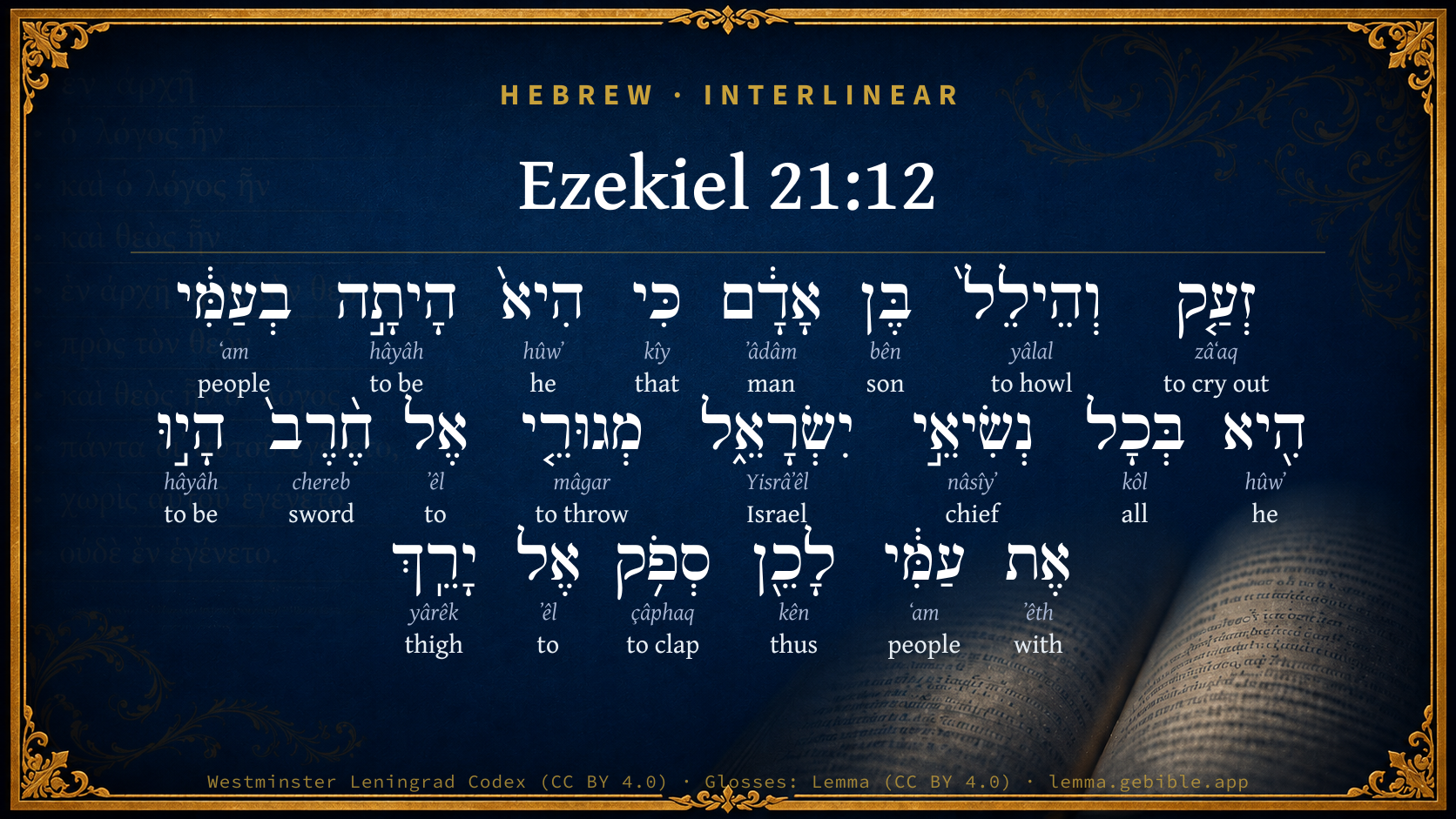
Ezekiel 21:12

Hebrew (Westminster Leningrad Codex) Ezekiel 21:12 appears in the Hebrew Old Testament. The text above is from the Westminster Leningrad Codex. Each word links to its Strong’s number, a concise gloss, and parsing drawn from the Open Scriptures Hebrew Bible morphology. Click any word for its full Brown-Driver-Briggs (BDB) entry.
Download image
Cite this verse

Ezekiel 21:12 (World English Bible). Public Domain. Lemma interlinear Bible study tool, https://lemma.gebible.app/v/ezekiel/21/12.

Show BibTeX & RIS
BibTeX
RIS
English Translation
Cry and wail, son of man; for it is on my people, it is on all the princes of Israel: they are delivered over to the sword with my people; strike therefore on your thigh.
World English Bible · Public Domain
Download a study sheet

One document with this verse’s original text, its word-by-word gloss line, the meaning frame, cross-references with their text, attributed commentary, and full source and license credits — printable, and it pastes into notes with its structure intact.

This verse Autodidact and up

Study sheet (.html) Plain text (.txt)

A passage Seminary Student

Up to 50 verses in one chapter. A passage sheet keeps up to 6 commentary sources and 12 cross-references per verse, in the order this page ranks them, and says so on the sheet whenever that leaves anything out. Ask for a single verse and you get the Autodidact verse sheet above.

Everything on this page stays free to read, with no account — the sheet is a download of what is already on screen, not access to it.

Want to remove ads? Support Godless Engineer
Compare translations 3

The same verse in 3 English versions, stacked beneath the original-language interlinear above. Click any original word for its lexicon entry.

Each is an independent rendering of the whole verse — the interlinear is not word-aligned to these translations.

Highlighted words mark where these versions differ — a whole-verse word diff, not a word-by-word alignment.

  • World English Bible Public Domain
    Cry and wail, son of man; for it is on my people, it is on all the princes of Israel: they are delivered over to the sword with my people; strike therefore on your thigh.
  • King James Version Public Domain
    Cry and howl, son of man: for it shall be upon my people, it shall be upon all the princes of Israel: terrors by reason of the sword shall be upon my people: smite therefore upon thy thigh.
  • unfoldingWord Literal Text CC BY-SA 4.0
    Call for help and lament, son of man! For that sword has come against my people! It is against all the leaders of Israel. They are thrown against the sword with my people. Therefore, slap your thigh!

unfoldingWord Literal Text — © unfoldingWord, licensed CC BY-SA 4.0. Word-aligned USFM3 via Door43 (git.door43.org/unfoldingWord/en_ult).

Versions to compare (up to 4)

3 of 4 selected

Show all 18 translations

Every available English version of this verse, each an independent rendering of the whole verse.

  • World English Bible Public Domain
    Cry and wail, son of man; for it is on my people, it is on all the princes of Israel: they are delivered over to the sword with my people; strike therefore on your thigh.
  • Berean Standard Bible Public Domain
    Cry out and wail, O son of man, for the sword is wielded against My people; it is against all the princes of Israel! They are tossed to the sword with My people; therefore strike your thigh.
  • Majority Standard Bible Public Domain
    Cry out and wail, O son of man, for the sword is wielded against My people; it is against all the princes of Israel! They are tossed to the sword with My people; therefore strike your thigh.
  • King James Version Public Domain
    Cry and howl, son of man: for it shall be upon my people, it shall be upon all the princes of Israel: terrors by reason of the sword shall be upon my people: smite therefore upon thy thigh.
  • American Standard Version (1901) Public Domain
    Cry and wail, son of man; for it is upon my people, it is upon all the princes of Israel: they are delivered over to the sword with my people; smite therefore upon thy thigh.
  • Revised Version (1885) Public Domain
    Cry and howl, son of man: for it is upon my people, it is upon all the princes of Israel: they are delivered over to the sword with my people: smite therefore upon thy thigh.
  • Geneva Bible (1599) Public Domain
    Cry, and houle, sonne of man: for this shall come to my people, and it shall come vnto all the princes of Israel: the terrours of the sword shall be vpon my people: smite therefore vpon thy thigh.
  • Douay-Rheims (1899) Public Domain
    Cry, and howl, 0 son of man, for this sword is upon my people, it is upon all the princes of Israel, that are fled: they are delivered up to the sword with my people, strike therefore upon thy thigh,
  • Young's Literal Translation Public Domain
    Cry and howl, son of man, For it hath been among My people, It `is' among all the princes of Israel, Cast unto the sword have been My people. Therefore strike on thy thigh,
  • Literal Standard Version CC BY-SA 4.0
    Cry and howl, son of man, || For it has been among My people, || It [is] among all the princes of Israel, || My people have been cast to the sword. Therefore strike on your thigh,
  • Unlocked Literal Bible CC BY-SA 4.0
    Call for help and lament, son of man! For that sword has come against my people! It is against all the leaders of Israel. They are thrown against the sword with my people. Therefore, slap your thigh!
  • unfoldingWord Literal Text CC BY-SA 4.0
    Call for help and lament, son of man! For that sword has come against my people! It is against all the leaders of Israel. They are thrown against the sword with my people. Therefore, slap your thigh!
  • Darby Bible Public Domain
    Cry and howl, son of man; for it shall be against my people, it shall be against all the princes of Israel: they are given up to the sword along with my people: smite therefore upon the thigh.
  • World Messianic Bible Public Domain
    Cry and wail, son of man; for it is on my people. It is on all the princes of Israel. They are delivered over to the sword with my people. Therefore beat your thigh.
  • Webster's Bible Public Domain
    Cry and howl, son of man: for it shall be upon my people, it shall be upon all the princes of Israel: terrors by reason of the sword shall be upon my people: smite therefore upon thy thigh.
  • Free Bible Version CC BY-SA 4.0
    Weep and wail, son of man, and slap your thigh in grief, for the sword is going to be used to attack my people, to attack all the leaders of Israel! They will be thrown away, killed by the sword along with my people.
  • Bible in Basic English Public Domain
    Give loud cries and make sounds of grief, O son of man: for it has come on my people, it has come on all the rulers of Israel: fear of the sword has come on my people: for this cause give signs of grief.
  • JPS Tanakh (1917) Public Domain
    (21-17) Cry and wail, son of man; for it is upon My people, it is upon all the princes of Israel; they are thrust down to the sword with My people; smite therefore upon thy thigh.

Literal Standard Version (2020), Covenant Press — licensed CC BY-SA 4.0. Text via the HelloAO Bible API (eBible.org). Unlocked Literal Bible (unfoldingWord) — licensed CC BY-SA 4.0. Text via the HelloAO Bible API (eBible.org). unfoldingWord Literal Text — © unfoldingWord, licensed CC BY-SA 4.0. Word-aligned USFM3 via Door43 (git.door43.org/unfoldingWord/en_ult). Free Bible Version, Dr. Jonathan Gallagher — licensed CC BY-SA 4.0. Text via the HelloAO Bible API (eBible.org).

Word by word

More ways to search: Search by grammar → Find every occurrence → Compare this word →

Practice this passage: Drill this verse → Learn its vocabulary →

מְגוּרֵ֤י
mâgar
H4048
“thrown”
Verb, Qal, Participle Passive, Masculine, Plural, Construct
Part of Speech
Verb
Stem
Qal
Form
Participle Passive
Gender
Masculine
Number
Plural
State
Construct
Full BDB Definition

Origin: a primitive root

TWOT: 1145

to throw, cast, toss - (Qal) to be thrown - (Piel) to hurl
  1. זְעַ֤ק zâʻaq H2199 “cry out” Verb, Qal, Imperative, 2nd Person, Masculine, Singular
  2. וְהֵילֵל֙ yâlal H3213 “and · howl” Conjunction + Verb, Hiphil, Imperative, 2nd Person, Masculine, Singular
  3. בֶּן bên H1121 “son of” Noun, Common, Masculine, Singular, Construct
  4. אָדָ֔ם ʼâdâm H120 “man” Noun, Common, Masculine, Singular, Absolute
  5. כִּי kîy H3588 “that” Conjunction
  6. הִיא֙ hûwʼ H1931 “he” Pronoun, Personal, 3rd Person, Feminine, Singular
  7. הָיתָ֣ה hâyâh H1961 “to be” Verb, Qal, Perfect, 3rd Person, Feminine, Singular
  8. בְעַמִּ֔י ʻam H5971 “in/at · people · my” Preposition + Noun, Common, Masculine, Singular, Construct + Suffix, Personal, 1st Person, Common, Singular
  9. הִ֖יא hûwʼ H1931 “he” Pronoun, Personal, 3rd Person, Feminine, Singular
  10. בְּכָל kôl H3605 “in/at · all of” Preposition + Noun, Common, Masculine, Singular, Construct
  11. נְשִׂיאֵ֣י nâsîyʼ H5387 “chiefs of” Noun, Common, Masculine, Plural, Construct
  12. יִשְׂרָאֵ֑ל Yisrâʼêl H3478 “Israel” Noun, Proper
  13. אֶל ʼêl H413 “to” Preposition
  14. חֶ֨רֶב֙ chereb H2719 “sword” Noun, Common, Feminine, Singular, Absolute
  15. הָי֣וּ hâyâh H1961 “to be” Verb, Qal, Perfect, 3rd Person, Common, Plural
  16. אֶת ʼêth H854 “with” Preposition
  17. עַמִּ֔י ʻam H5971 “people · my” Noun, Common, Masculine, Singular, Construct + Suffix, Personal, 1st Person, Common, Singular
  18. לָכֵ֖ן kên H3651 “to/for · thus” Preposition + Adverb
  19. סְפֹ֥ק çâphaq H5606 “clap” Verb, Qal, Imperative, 2nd Person, Masculine, Singular
  20. אֶל ʼêl H413 “to” Preposition
  21. יָרֵֽךְ yârêk H3409 “thigh” Noun, Common, Feminine, Singular, Absolute

About this verse

These counts appear in no published source. They are computed here, from the morphology-tagged text and Lemma’s own curated glosses. What Lemma adds →

22
words
18
distinct lemmas
Prophets
section

Notable vocabulary

The rarest word here is מְגוּרֵ֤י to throw H4048 — appearing just 2 times in the whole Hebrew Bible.

Shared distinctive vocabulary

מְגוּרֵ֤י to throw H4048 occurs in 2 verses of the Hebrew Bible. Also found in:

Grammatical profile

  • 6 verbs
  • 9 nouns
  • 2 pronouns
  • 3 prepositions
  • 1 conjunction
  • 1 adverb

Verb forms

  • זְעַ֤ק Qal · Imperative
  • וְהֵילֵל֙ Hiphil · Imperative
  • הָיתָ֣ה Qal · Perfect
  • מְגוּרֵ֤י Qal · Participle Passive
  • הָי֣וּ Qal · Perfect
  • סְפֹ֥ק Qal · Imperative

Repetition

Words recur within this verse — often emphatic in Hebrew:

  • הָיתָ֣ה to be H1961 ×2
  • בְעַמִּ֔י people H5971 ×2
  • הִיא֙ he H1931 ×2
  • אֶל to H413 ×2

Hebrew & Septuagint length

In English translation the verse runs 35 words from the Hebrew and 48 from the Septuagint (LXX English) — closely comparable.

A rough comparison of the two English renderings, which tokenize alike — not a word-level alignment.

Word counts can differ between the Hebrew and the Greek without any difference in meaning — e.g. the Hebrew direct-object marker אֵת has no separate Greek word, and Greek often adds the article ὁ.

Cross-references

10

Topical passages linked to Ezekiel 21:12 in the Treasury of Scripture Knowledge — connected by theme and wording, ordered by reader-vote popularity; previews shown in the World English Bible.

  • Ezekiel 21:6 Sigh therefore, you son of man; with the breaking of your loins and with bitterness shall you sigh before their eyes.
  • Joel 1:13 Put on sackcloth and mourn, you priests! Wail, you ministers of the altar. Come, lie all night in sackcloth, you ministers of my God, For the meal offering and the drink offering are withheld from your God's house.
  • Jeremiah 25:34 Wail, you shepherds, and cry; and wallow [in ashes], you principal of the flock; for the days of your slaughter and of your dispersions are fully come, and you shall fall like a goodly vessel.
  • Jeremiah 31:12 They shall come and sing in the height of Zion, and shall flow to the goodness of Yahweh, to the grain, and to the new wine, and to the oil, and to the young of the flock and of the herd: and their soul shall be as a watered garden; and they shall not sorrow any more at all.
  • Jeremiah 31:19 Surely after that I was turned, I repented; and after that I was instructed, I struck on my thigh: I was ashamed, yes, even confounded, because I did bear the reproach of my youth.
  • Ezekiel 6:11 Thus says the Lord Yahweh: Smite with your hand, and stamp with your foot, and say, Alas! because of all the evil abominations of the house of Israel; for they shall fall by the sword, by the famine, and by the pestilence.
  • Ezekiel 9:8 It happened, while they were smiting, and I was left, that I fell on my face, and cried, and said, Ah Lord Yahweh! will you destroy all the residue of Israel in your pouring out of your wrath on Jerusalem?
  • Ezekiel 21:14 You therefore, son of man, prophesy, and strike your hands together; and let the sword be doubled the third time, the sword of the deadly wounded: it is the sword of the great one who is deadly wounded, which enters into their chambers.
  • Ezekiel 30:2 Son of man, prophesy, and say, Thus says the Lord Yahweh: Wail, Alas for the day!
  • Micah 1:8 For this I will lament and wail; I will go stripped and naked; I will howl like the jackals, And moan like the daughters of owls.

Cross-references courtesy of OpenBible.info (CC BY 4.0).

Hebrew and Greek witnesses Masoretic Hebrew ↔ Greek Septuagint

The same verse in the two great witnesses to the Old Testament, shown verse-for-verse.

These are two independent witnesses, not word-aligned to each other, and the Septuagint is shown in lemma (dictionary) form.

Hebrew Ezekiel 21:12 Masoretic · Westminster Leningrad Codex

זְעַ֤ק וְהֵילֵל֙ בֶּן אָדָ֔ם כִּי הִיא֙ הָיתָ֣ה בְעַמִּ֔י הִ֖יא בְּכָל נְשִׂיאֵ֣י יִשְׂרָאֵ֑ל מְגוּרֵ֤י אֶל חֶ֨רֶב֙ הָי֣וּ אֶת עַמִּ֔י לָכֵ֖ן סְפֹ֥ק אֶל יָרֵֽךְ

Cry and wail, son of man; for it is on my people, it is on all the princes of Israel: they are delivered over to the sword with my people; strike therefore on your thigh.

World English Bible · Public Domain

Greek LXX Ezekiel 21:12 Septuagint · lemma form

καί εἰμί ἐάν εἶπον πρός σύ ἕνεκα τίς σύ στενάζω καί εἶπον ἐπί ὁ ἀγγελία διότι ἔρχομαι καί θραύω πᾶς καρδία καί πᾶς χείρ παραλύω καί ἐκψύχω πᾶς σάρξ καί πᾶς πνεῦμα καί πᾶς μηρός μολύνω ὑγρασία ἰδού ἔρχομαι καί εἰμί λέγω κύριος κύριος

Cry out and howl, son of man: for this sword is come upon my people, this sword is come upon all the princes of Israel: they shall be as strangers: judgment with the sword is come upon my people: therefore clap your hands, for sentence has been passed:

LXX2012 (modern English Septuagint) · Public Domain

Hebrew: Westminster Leningrad Codex (CC BY 4.0). Greek: Septuagint (public domain); English from LXX2012 (modern English Septuagint) (Public Domain). How the Septuagint differs from the Hebrew →

Targum (Aramaic paraphrase)

1

The Targum is the ancient Jewish Aramaic paraphrase of the Hebrew Scriptures — an interpretive translation, not the Hebrew text itself. Onkelos (literal) and Pseudo-Jonathan (expansive) render the Torah, and Jonathan the Prophets. Coverage is partial: where no permissively-licensed English translation exists for a verse, only the Aramaic is shown. This is verse-level text, not a word-by-word alignment to the Hebrew.

  1. Targum Jonathan Prophets (Joshua–Malachi)
    וִיהֵי אֲרֵי יֵמְרוּן לָךְ עַל מָה אַתְּ מִתְאַנַח וְתֵימַר עַל בְּסוֹרְתָא אֲרֵי אַתְיָא וְיִתְמְסֵי כָּל לֵב וְיִתְרַשְׁלָן כָּל יְדֵין וְתֶעֱמֵי כָל רוּחַ וְכָל רְכוּבַיָא יִתְאַשְׁדָן מַיָא הָא אַתְיָא וְתִתְקַיֵם אֲמַר יְיָ אֱלֹהִים:

    (no public-domain English translation for this verse)

    Targum Jonathan — Aramaic: “Mikraot Gedolot” (public domain). English: “Sefaria Community Translation” (CC0 1.0 (public-domain dedication)); “London "Chaldee Paraphrase," 1871” (public domain). Text via Sefaria.

Commentary

Notes on Ezekiel 21:12 from classic Christian and Jewish commentators (each source and its license shown beneath its notes). The classic Christian expositions comment on the surrounding passage and are grouped to its opening verse, so a note may address several verses; the Jewish commentaries on the Tanakh (Rashi and others) are per-verse, so they appear only where the commentator wrote on this verse.

Lemma curates 59 commentaries, every one of them public domain or Creative Commons licensed, each selected and text-cleaned for this edition rather than reprinted as found. About our sources →

Trapp's Complete Commentary

John Trapp

Eze 21:12 Cry and howl, son of man: for it shall be upon my people, it [shall be] upon all the princes of Israel: terrors by reason of the sword shall be upon my people: smite therefore upon [thy] thigh.

Ver. 12. Cry and howl, son of man.] While others make mirth, {as Eze 21:10} and are insolent against God. Mourners shall be marked, {Eze 9:4} comforted. {Isa 57:18}

Smite therefore upon thy thigh.] See on Jer 31:19.

John Trapp, A Commentary or Exposition upon All the Books of the Old and New Testament (1647–1656) — public domain. Text from a community e-Sword module.

Joseph Benson's Commentary

Eze 21:12-13. Cry and howl, son of man — As a mark of the vehemence of thy grief. For it shall be upon my people — Namely, the devouring sword; upon all the princes of Israel — Both princes and people shall be involved in one common destruction. Smite therefore upon thy thigh —

Use all the outward expressions of grief and mourning. Because it is a trial — As all great calamities are often styled: see the margin.

And what if the sword contemn even the rod? — Namely, the sceptre and royal family. The Hebrew, שׁבשׂ מאסת ומה אם נם, it seems, should rather be rendered, And what if even the rod, or sceptre, contemn? — That is, if the king and kingdom of Judah despise this trial. It shall be no more, saith the Lord — Both shall be destroyed, and be no more. The word rendered rod here, is continually put in Scripture for governor, or government; a rod, staff, or sceptre, being the usual signs of government. God, therefore, here foretels, that if the sceptre of Judah should despise, or not profit by, the correction or punishment brought upon it by the instrumentality of Nebuchadnezzar, it should be entirely broken, and be no more; which came to pass accordingly. The royal family was not amended by this severe judgment, and therefore was laid aside. “The sceptre here only means the kingly power in the house of David, and not that supreme authority which Jacob foretold should not forsake Judah till the coming of the Messiah.”

Joseph Benson's Commentary on the Old and New Testaments (1811–1818) — public domain. Text from a community e-Sword module.

Tyndale Open Study Notes

Tyndale Open Resources

21:12 cry out and wail: Ezekiel would represent the people’s response to the judgment.

Tyndale Open Study Notes — © Tyndale Open Resources, licensed CC BY-SA 4.0. Text via the HelloAO Bible API.

Geneva Bible (1599)

Geneva Bible translators

Read Jer. 31:19.

Geneva Bible (1599) marginal notes — public domain. Text via Bolls.life.

Jamieson, Fausset & Brown

Robert Jamieson, A. R. Fausset & David Brown

terrors by reason of the sword, &c.--rather, "they (the princes of Israel) are delivered up to the sword together with My people" [GLASSIUS].

smite . . . upon . . . thigh--a mark of grief (Jer 31:19).

Jamieson, Fausset & Brown — Commentary Critical and Explanatory on the Whole Bible (1871) — public domain (CC PDM 1.0). Text via the HelloAO Bible API.

Adam Clarke's Commentary

Verse 12. Smite - upon thy thigh.] See on Jer 31:19. So HOMER, Il. xv. ver. 113: -

Ὡς εφατ'· αυταρ Αρης θαλερω πεπληγετο μηρω

Χερσι καταπρηνεσσ,ολοφυρομενος δε προσηυδα.

"She spake; and, with expanded arms his thighs

Smiting, thus sorrowful the god exclaimed."

COWPER.

Adam Clarke's Commentary on the Bible (1810–1826) — public domain. Text from a community e-Sword/MySword module.

Ellicott's Commentary for English Readers

(12) Smite therefore upon thy thigh.—A mark of extreme grief, see Jer_31:19. The connection of Eze_21:11-12 with the objection in Eze_21:10 is this: you think there is security for you in the promise to Judah; do not deceive yourselves, but prepare for sorrow and desolation.

A Bible Commentary for English Readers, edited by Charles John Ellicott (1878–1897) — public domain. Text from a community e-Sword module.

The Cambridge Bible for Schools and Colleges

gen. ed. J. J. S. Perowne

12. terrors … the sword] With R. V. they (the princes) are delivered over to the sword with my people.

smite upon thy thigh] A gesture implying despair or the sense of a terrible and irreparable evil happening, Jer_31:19.

The Cambridge Bible for Schools and Colleges (gen. ed. J. J. S. Perowne; Cambridge University Press, 1878–1918) — public domain. Text from a community e-Sword module.

John Gill's Exposition

Thou, therefore, son of man, prophesy, and smite thine hands together,.... As being in the greatest agony for what is coming upon thy people: or "strike hand to hand" (y); clap them together, as encouraging the enemy with his drawn, sharp, and glittering sword, to make use of it, and do execution with it:

and let the sword be doubled the third time; some think this has reference to the three captivities of Jehoiakim, Jeconiah, and Zedekiah: others to the threefold calamity in Zedekiah's time; the first, the taking of him; the second, the taking of the city; the third, the carrying captive the residue along with Gedaliah: or to the three times the Chaldeans came against Jerusalem, after this prophecy; first with Nebuchadnezzar, in the eleventh year of Zedekiah, and took him and the city; then with Nebuzaradan, in the nineteenth year of Nebuchadnezzar, and burnt the city and temple; and again in the twenty third of Nebuchadnezzar, and carried away the remnant of the people, Jer 52:5,

the sword of the slain: by which many should be slain:

it is the sword of the great men that are slain: of the sons of the kings, and of the princes and nobles of the land:

which entereth into their privy chambers; where they should endeavour to hide themselves from it, but in vain, none should escape; their privy chambers could not secrete nor secure them: or "which remains with them"; as that which is laid up, and reserved in a privy chamber, as De Dieu, from the use of the word in the Ethiopic language, renders it.

(y) "percute manum ad manum", Pagninus, Polanus; "volum ad volam"; Montanus; "feri manum ad manum", Starckius.

John Gill's Exposition of the Whole Bible (1746–1763) — public domain (CC PDM 1.0). Text via the HelloAO Bible API.

Haydock's Catholic Bible Commentary

Fled, with Sedecias, by night. --- Thigh, in surprise and grief, ver. 17.

George Leo Haydock (1774–1849), Haydock's Catholic Family Bible and Commentary, 1859 edition — public domain. Excludes Psalms (Douay-Rheims chapter numbering differs from Protestant) and Deuterocanonical books (Catholic canon only).

Matthew Poole's English Annotations

Cry, as one in great distress; nay, how unseemly soever it may appear, howl, that they may by this know what sorrows are coming on them, and how they, like wild beasts taken in the toils and girts, shall howl. For the devouring sword of Babylon shall certainly be upon all, high and low.

Terrors; surrounding terrors, out of which no way to escape.

The sword; that sword God will draw against them.

Smite upon thy thigh, in token of thy sense of what they must suffer, and to presignify what their sorrows shall be, when they must express them by signs, because too great for words.

Matthew Poole's English Annotations on the Holy Bible (1683–1685) — public domain. Text from a community e-Sword/MySword module.

Whedon's Commentary on the Bible

Daniel D. Whedon

12. Terrors by reason of the sword — Rather, they [the princes of Israel] with my people are delivered unto the sword.

Smite therefore upon thy thigh — A gesture naturally expressing either antagonism or despair. Perhaps implying here “the sense of a terrible and irreparable evil happening.” (Compare Jer_31:19.)

Daniel D. Whedon (gen. ed.), Commentary on the Old and New Testaments (1874–1909) — public domain. Text from a community e-Sword module.

The Pulpit Commentary

Terrors by reason of the sword; better, as in the Revised Version and margin of the Authorized Version, They (the princes of Judah, corresponding to the "rod" of ver. 10) are delivered over to the sword with my people. At this stage, in contemplating the destruction alike of princes and of people, the prophet is bidden to make his gestures of lamentation yet more expressive, "crying, howling, smiting on his thigh". (Jer_31:19)

The Pulpit Commentary (1880–1919), ed. H.D.M. Spence-Jones & Joseph S. Exell — public domain. Text from a community e-Sword module.

John Wesley's Explanatory Notes

It - The devouring sword. Upon thy thigh - In token of thy sense of what they must suffer.

John Wesley, Explanatory Notes Upon the Whole Bible (1754–1765) — public domain. Text via the GEBible commentary corpus.

unfoldingWord translationNotes

Door43 World Missions Community

Connecting Statement:

Yahweh continues to describe the sword of Yahweh which is a metaphor for the enemy army that Yahweh will use to attack Jerusalem. (See: Metaphor)

that sword has come against my people! It is against all

This speaks of Yahweh's sword attacking his people as if the sword itself were the attacker. AT: "I will use my sword to kill my people! I will bring it against all" (See: Personification)

They are thrown against the sword with my people

This speaks of the leaders of Israel being killed with a sword as if they are thrown against the sword. AT: "They are killed with the sword along with my people" or "The sword will kill them along with my people" (See: Metaphor)

slap your thigh

In Ezekiel's culture, slapping one's thigh was a sign of grief. Some other translation use the gesture of beating one's breast which is a sign of grief in many cultures. AT: "beat your chests" (See: Symbolic Action)

but what if the scepter does not last?

This rhetorical question is used to make the audience think about what could happen. This question can be written as a statement. AT: "and it will be very frightening if the sword destroys the scepter." or "but it will be very frightening if the king cannot resist it." (See: Rhetorical Question)

the scepter

Here the king of Judah is represented by his scepter. AT: "the king" (See: Metonymy)

does not last

This is an idiom. AT: "cannot resist" or "is destroyed" (See: Idiom)

translationWords

lament

Son of Man

people of God

trial

scepter

unfoldingWord translationNotes — © Distant Shores Media and the Door43 World Missions Community, licensed CC BY-SA 4.0. Source: git.door43.org/Door43/en_tn.

Lesson kit

Teaching starters — assembled from the data on this page, not authored interpretation. Every prompt links to the verse data it draws on. Edit before teaching.

Ezekiel, in the Prophets, opens this verse with 22 words (18 distinct Hebrew lemmas). Its most distinctive word is mâgar (“to throw”). A historical commentator’s framing appears above. Read the whole chapter for the surrounding context.

Discussion questions

  1. How does “to throw” (mâgar) shape what this verse is saying?
  2. How does Psalms 89:44, which shares the word «to throw», read alongside this verse?
  3. What does the repetition of “to be” (2× in this one verse) do in this verse?
  4. The translations on this page render this verse differently — a whole-verse word diff, not a word-by-word alignment. What might account for the different wordings?
  5. «זְעַ֤ק» is a Qal Imperative verb. How does that grammatical form shape the action described?
  6. Compare how Trapp's Complete Commentary and Joseph Benson's Commentary read this verse. Where do they agree or differ?

Things to notice

Reading settings

Reading text

Shown beneath each verse's original-language words.

Old Testament
Old Testament edition

Read the OT as the Masoretic Hebrew (MT) or the Greek Septuagint (LXX).

English shown for the Greek Septuagint (in the Hebrew ↔ Greek comparison).

Comparing translations? Open the Compare panel on any verse page to stack up to four side by side.