2 Chronicles 24:20

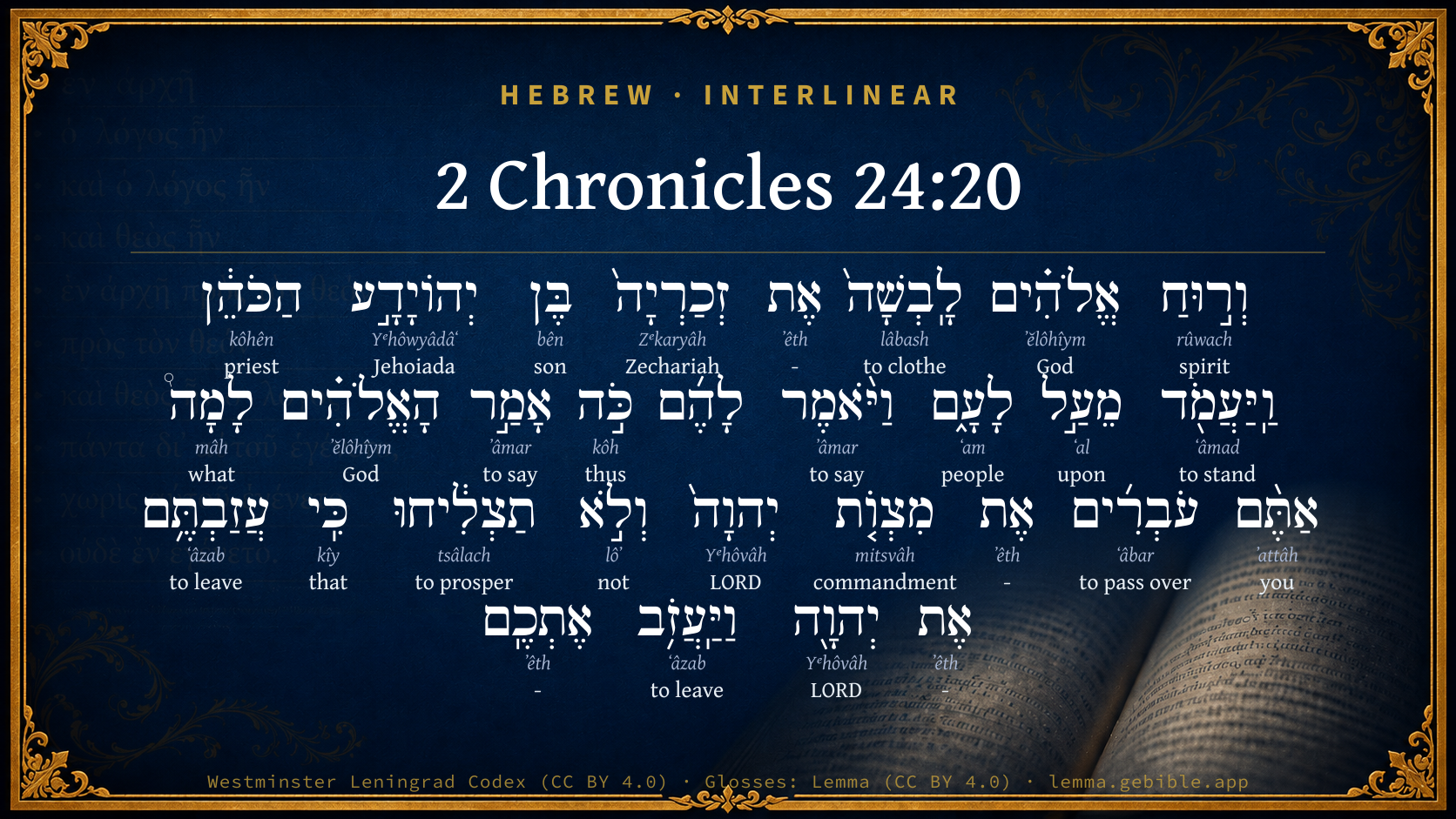
Hebrew (Westminster Leningrad Codex) 2 Chronicles 24:20 appears in the Hebrew Old Testament. The text above is from the Westminster Leningrad Codex. Each word links to its Strong’s number, a concise gloss, and parsing drawn from the Open Scriptures Hebrew Bible morphology. Click any word for its full Brown-Driver-Briggs (BDB) entry.
Download image
Cite this verse

2 Chronicles 24:20 (World English Bible). Public Domain. Lemma interlinear Bible study tool, https://lemma.gebible.app/v/2-chronicles/24/20.

Show BibTeX & RIS
BibTeX
RIS
English Translation
The Spirit of God came on Zechariah the son of Jehoiada the priest; and he stood above the people, and said to them, Thus says God, Why disobey you the commandments of Yahweh, so that you can't prosper? because you have forsaken Yahweh, he has also forsaken you.
World English Bible · Public Domain
Download a study sheet

One document with this verse’s original text, its word-by-word gloss line, the meaning frame, cross-references with their text, attributed commentary, and full source and license credits — printable, and it pastes into notes with its structure intact.

This verse Autodidact and up

Study sheet (.html) Plain text (.txt)

A passage Seminary Student

Up to 50 verses in one chapter. A passage sheet keeps up to 6 commentary sources and 12 cross-references per verse, in the order this page ranks them, and says so on the sheet whenever that leaves anything out. Ask for a single verse and you get the Autodidact verse sheet above.

Everything on this page stays free to read, with no account — the sheet is a download of what is already on screen, not access to it.

Want to remove ads? Support Godless Engineer
Compare translations 3

The same verse in 3 English versions, stacked beneath the original-language interlinear above. Click any original word for its lexicon entry.

Each is an independent rendering of the whole verse — the interlinear is not word-aligned to these translations.

Highlighted words mark where these versions differ — a whole-verse word diff, not a word-by-word alignment.

  • World English Bible Public Domain
    The Spirit of God came on Zechariah the son of Jehoiada the priest; and he stood above the people, and said to them, Thus says God, Why disobey you the commandments of Yahweh, so that you can't prosper? because you have forsaken Yahweh, he has also forsaken you.
  • King James Version Public Domain
    And the Spirit of God came upon Zechariah the son of Jehoiada the priest, which stood above the people, and said unto them, Thus saith God, Why transgress ye the commandments of the LORD, that ye cannot prosper? because ye have forsaken the LORD, he hath also forsaken you.
  • unfoldingWord Literal Text CC BY-SA 4.0
    And the Spirit of God clothed Zechariah the son of Jehoiada the priest. And he stood above the people, and he said to them, “Thus says God: Why are you passing over the commands of Yahweh, and you do not prosper? Because you all abandoned Yahweh, then he has abandoned you all.”

unfoldingWord Literal Text — © unfoldingWord, licensed CC BY-SA 4.0. Word-aligned USFM3 via Door43 (git.door43.org/unfoldingWord/en_ult).

Versions to compare (up to 4)

3 of 4 selected

Show all 18 translations

Every available English version of this verse, each an independent rendering of the whole verse.

  • World English Bible Public Domain
    The Spirit of God came on Zechariah the son of Jehoiada the priest; and he stood above the people, and said to them, Thus says God, Why disobey you the commandments of Yahweh, so that you can't prosper? because you have forsaken Yahweh, he has also forsaken you.
  • Berean Standard Bible Public Domain
    Then the Spirit of God came upon Zechariah son of Jehoiada the priest, who stood up before the people and said to them, “This is what God says: ‘Why do you transgress the commandments of the LORD so that you cannot prosper? Because you have forsaken the LORD, He has forsaken you.’”
  • Majority Standard Bible Public Domain
    Then the Spirit of God came upon Zechariah son of Jehoiada the priest, who stood up before the people and said to them, “This is what God says: ‘Why do you transgress the commandments of the LORD so that you cannot prosper? Because you have forsaken the LORD, He has forsaken you.’”
  • King James Version Public Domain
    And the Spirit of God came upon Zechariah the son of Jehoiada the priest, which stood above the people, and said unto them, Thus saith God, Why transgress ye the commandments of the LORD, that ye cannot prosper? because ye have forsaken the LORD, he hath also forsaken you.
  • American Standard Version (1901) Public Domain
    And the Spirit of God came upon Zechariah the son of Jehoiada the priest; and he stood above the people, and said unto them, Thus saith God, Why transgress ye the commandments of Jehovah, so that ye cannot prosper? because ye have forsaken Jehovah, he hath also forsaken you.
  • Revised Version (1885) Public Domain
    And the spirit of God came upon Zechariah the son of Jehoiada the priest; and he stood above the people, and said unto them, Thus saith God, Why transgress ye the commandments of the LORD, that ye cannot prosper? because ye have forsaken the LORD, he hath also forsaken you.
  • Geneva Bible (1599) Public Domain
    And the Spirit of God came vpon Zechariah the sonne of Iehoiada the Priest, which stoode aboue the people, and sayde vnto them, Thus sayth God, Why transgresse ye the commandements of the Lord? surely ye shall not prosper: because ye haue forsaken the Lord, he also hath forsaken you.
  • Douay-Rheims (1899) Public Domain
    The spirit of God then came upon Zacharias the son of Joiada the priest, and he stood in the sight of the people, and said to them: Thus saith the Lord God: Why transgress you the commandment of the Lord which will not be for your good, and have forsaken the Lord, to make him forsake you?
  • Young's Literal Translation Public Domain
    and the Spirit of God hath clothed Zechariah son of Jehoiada the priest, and he standeth over-against the people, and saith to them, `Thus said God, Why are ye transgressing the commands of Jehovah, and prosper not? because ye have forsaken Jehovah -- He doth forsake you.'
  • Literal Standard Version CC BY-SA 4.0
    and the Spirit of God has clothed Zechariah son of Jehoiada the priest, and he stands above the people, and says to them, “Thus said God: Why are you transgressing the commands of YHWH, and do not prosper? Because you have forsaken YHWH, He forsakes you.”
  • Unlocked Literal Bible CC BY-SA 4.0
    The Spirit of God came on Zechariah son of Jehoiada, the priest; Zechariah stood above the people and said to them, “God says this: Why do you transgress the commandments of Yahweh, so that you cannot prosper? Since you have forsaken Yahweh, he has also forsaken you.”
  • unfoldingWord Literal Text CC BY-SA 4.0
    And the Spirit of God clothed Zechariah the son of Jehoiada the priest. And he stood above the people, and he said to them, “Thus says God: Why are you passing over the commands of Yahweh, and you do not prosper? Because you all abandoned Yahweh, then he has abandoned you all.”
  • Darby Bible Public Domain
    And the Spirit of God came upon Zechariah the son of Jehoiada the priest; and he stood up above the people and said unto them, Thus saith God: Wherefore do ye transgress the commandments of Jehovah? And ye cannot prosper; for ye have forsaken Jehovah, and he hath forsaken you.
  • World Messianic Bible Public Domain
    The Spirit of God came on Zechariah the son of Jehoiada the priest; and he stood above the people, and said to them, “God says, ‘Why do you disobey the LORD’s commandments, so that you can’t prosper? Because you have forsaken the LORD, he has also forsaken you.’”
  • Webster's Bible Public Domain
    And the Spirit of God came upon Zechariah the son of Jehoiada the priest, who stood above the people, and said to them, Thus saith God, Why transgress ye the commandments of the LORD, that ye cannot prosper? because ye have forsaken the LORD, he hath also forsaken you.
  • Free Bible Version CC BY-SA 4.0
    Then the Spirit of God came to Zechariah, son of Jehoiada the priest. He stood before the people and told them, “This is what God says: ‘Why do you break the Lord's commandments so that you cannot be successful? Since you have abandoned the Lord, he has abandoned you.’”
  • Bible in Basic English Public Domain
    Then the spirit of God came on Zechariah, the son of Jehoiada the priest, and, getting up before the people, he said to them, God has said, Why do you go against the orders of the Lord, so that everything goes badly for you? because you have given up the Lord, he has given you up.
  • JPS Tanakh (1917) Public Domain
    And the spirit of God clothed Zechariah the son of Jehoiada the priest; and he stood above the people, and said unto them: 'Thus saith God: Why transgress ye the commandments of the LORD, that ye cannot prosper? because ye have forsaken the LORD, He hath also forsaken you.'

Literal Standard Version (2020), Covenant Press — licensed CC BY-SA 4.0. Text via the HelloAO Bible API (eBible.org). Unlocked Literal Bible (unfoldingWord) — licensed CC BY-SA 4.0. Text via the HelloAO Bible API (eBible.org). unfoldingWord Literal Text — © unfoldingWord, licensed CC BY-SA 4.0. Word-aligned USFM3 via Door43 (git.door43.org/unfoldingWord/en_ult). Free Bible Version, Dr. Jonathan Gallagher — licensed CC BY-SA 4.0. Text via the HelloAO Bible API (eBible.org).

Word by word

More ways to search: Search by grammar → Find every occurrence → Compare this word →

Practice this passage: Drill this verse → Learn its vocabulary →

זְכַרְיָה֙
Zᵉkaryâh
H2148
“Zechariah”
Noun, Proper
Part of Speech
Noun
Type
Proper
Full BDB Definition

Origin: from H2142 and H3050

TWOT: None

Zechariah = "Jehovah remembers" - 11th in order of the minor prophets; a priest, son of Berechiah and grandson of Iddo, who, along with Haggai, directed the rebuilding of the temple in the days of Zerubbabel - king of Israel, son of Jeroboam II - son of Meshelemiah of Shelemiah, a Korhite, and keeper of the north gate of the tabernacle of the congregation - one of the sons of Jehiel - a Levite of the second order in the temple band in the time of David - one of the princes of Judah in the reign of Jehoshaphat - son of the high priest Jehoiada, in the reign of Joash king of Judah, who was stoned in the court of the temple - a Kohathite Levite in the reign of Josiah - the leader of the sons of Pharosh who returned with Ezra - son of Bebai - one of the chiefs of the people whom Ezra summoned in council at the river Ahava; stood at Ezra's left hand when Ezra expounded the law to the people - one of the family of Elam who had married a foreign wife after the captivity - ancestor of Athaiah or Uthai - a Shilonite, descendant of Perez, grandfather of Athaiah - a priest, son of Pashur - the representative of the priestly family of Iddo in the days of Joiakim the son of Jeshua; possibly the same as 1 above - one of the priests, son of Jonathan, who blew with the trumpets at the dedication of the city wall by Ezra and Nehemiah - a chief of the Reubenites at the time of the captivity by Tiglath-pileser - one of the priests who accompanied the ark from the house of Obed-edom - son of Isshiah of Jesiah, a Kohathite Levite descended from Uzziel - 4th son of Hosah, of the children of Merari - a Manassite, father of Iddo - father of Jahaziel. He prophesied in the spirit - one of the sons of Jehoshaphat - a prophet in the reign of Uzziah, who appears to have acted as the king's counsellor, but of whom nothing is known - father of Abijah or Abi, Hezekiah's mother - one of the family of Asaph in the reign of Hezekiah - one of the rulers of the temple in the reign of Josiah - son of Jeberechiah who was taken by the prophet Isaiah as one of the 'faithful witnesses to record' when he wrote concerning Maher-shalal-hash-baz

  1. וְר֣וּחַ rûwach H7307 “and · spirit of” Conjunction + Noun, Common, Both, Singular, Construct
  2. אֱלֹהִ֗ים ʼĕlôhîym H430 “God(s)” Noun, Common, Masculine, Plural, Absolute
  3. לָֽבְשָׁה֙ lâbash H3847 “to clothe” Verb, Qal, Perfect, 3rd Person, Feminine, Singular
  4. אֶת ʼêth H853 “-” Particle, Direct Object
  5. בֶּן bên H1121 “son of” Noun, Common, Masculine, Singular, Construct
  6. יְהוֹיָדָ֣ע Yᵉhôwyâdâʻ H3077 “Jehoiada” Noun, Proper
  7. הַכֹּהֵ֔ן kôhên H3548 “the · priest” Particle, Definite Article + Noun, Common, Masculine, Singular, Absolute
  8. וַֽיַּעֲמֹ֖ד ʻâmad H5975 “and · to stand” Conjunction + Verb, Qal, Sequential Imperfect, 3rd Person, Masculine, Singular
  9. מֵעַ֣ל ʻal H5921 “from · upon” Preposition + Preposition
  10. לָעָ֑ם ʻam H5971 “to/for the · people” Preposition, Determined + Noun, Common, Masculine, Singular, Absolute
  11. וַיֹּ֨אמֶר ʼâmar H559 “and · to say” Conjunction + Verb, Qal, Sequential Imperfect, 3rd Person, Masculine, Singular
  12. כֹּ֣ה kôh H3541 “thus” Adverb
  13. אָמַ֣ר ʼâmar H559 “to say” Verb, Qal, Perfect, 3rd Person, Masculine, Singular
  14. הָאֱלֹהִ֗ים ʼĕlôhîym H430 “the · God(s)” Particle, Definite Article + Noun, Common, Masculine, Plural, Absolute
  15. לָמָה֩ mâh H4100 “to/for · what” Preposition + Particle, Interrogative
  16. אַתֶּ֨ם ʼattâh H859 “you” Pronoun, Personal, 2nd Person, Masculine, Plural
  17. עֹבְרִ֜ים ʻâbar H5674 “passing over” Verb, Qal, Participle Active, Masculine, Plural, Absolute
  18. אֶת ʼêth H853 “-” Particle, Direct Object
  19. מִצְוֺ֤ת mitsvâh H4687 “commandments of” Noun, Common, Feminine, Plural, Construct
  20. יְהוָה֙ Yᵉhôvâh H3068 “LORD” Noun, Proper
  21. וְלֹ֣א lôʼ H3808 “and · not” Conjunction + Particle, Negative
  22. תַצְלִ֔יחוּ tsâlach H6743 “to prosper” Verb, Hiphil, Imperfect, 2nd Person, Masculine, Plural
  23. כִּֽי kîy H3588 “that” Conjunction
  24. עֲזַבְתֶּ֥ם ʻâzab H5800 “to leave” Verb, Qal, Perfect, 2nd Person, Masculine, Plural
  25. אֶת ʼêth H853 “-” Particle, Direct Object
  26. יְהוָ֖ה Yᵉhôvâh H3068 “LORD” Noun, Proper
  27. וַיַּֽעֲזֹ֥ב ʻâzab H5800 “and · to leave” Conjunction + Verb, Qal, Sequential Imperfect, 3rd Person, Masculine, Singular
  28. אֶתְכֶֽם ʼêth H853 “- · you” Particle, Direct Object + Suffix, Personal, 2nd Person, Masculine, Plural

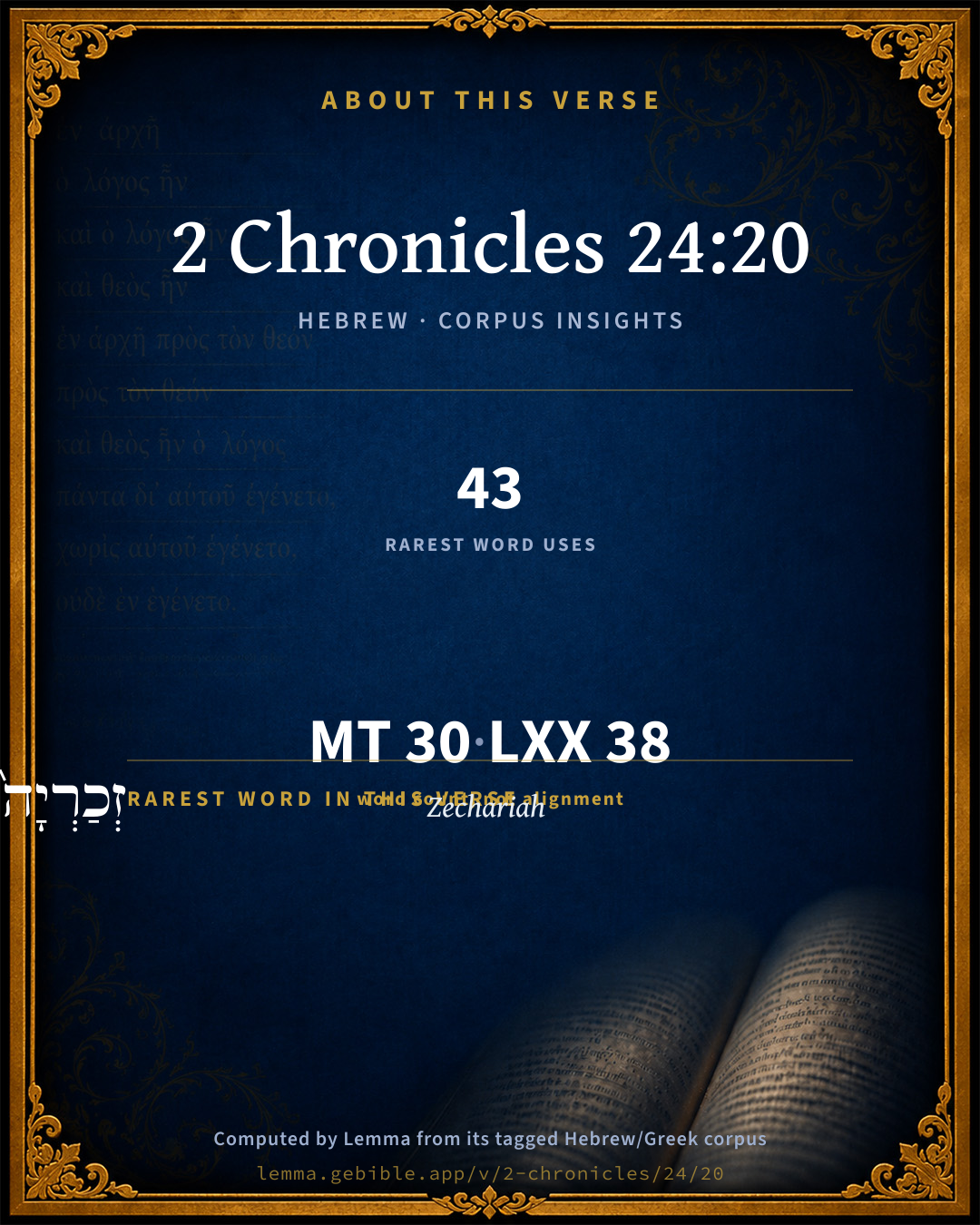
About this verse

These counts appear in no published source. They are computed here, from the morphology-tagged text and Lemma’s own curated glosses. What Lemma adds →

30
words
22
distinct lemmas
Historical
section

Shared distinctive vocabulary

זְכַרְיָה֙ Zechariah H2148 occurs in 43 verses of the Hebrew Bible. Also found in:

Grammatical profile

  • 8 verbs
  • 11 nouns
  • 1 pronoun
  • 2 prepositions
  • 1 conjunction
  • 1 adverb
  • 6 particles

Verb forms

  • לָֽבְשָׁה֙ Qal · Perfect
  • וַֽיַּעֲמֹ֖ד Qal · Sequential Imperfect
  • וַיֹּ֨אמֶר Qal · Sequential Imperfect
  • אָמַ֣ר Qal · Perfect
  • עֹבְרִ֜ים Qal · Participle Active
  • תַצְלִ֔יחוּ Hiphil · Imperfect
  • עֲזַבְתֶּ֥ם Qal · Perfect
  • וַיַּֽעֲזֹ֥ב Qal · Sequential Imperfect

Repetition

Words recur within this verse — often emphatic in Hebrew:

  • אֱלֹהִ֗ים God H430 ×2
  • וַיֹּ֨אמֶר to say H559 ×2
  • יְהוָה֙ LORD H3068 ×2
  • עֲזַבְתֶּ֥ם to leave H5800 ×2

Hebrew & Septuagint length

In English translation the verse runs 48 words from the Hebrew and 52 from the Septuagint (LXX English) — closely comparable.

A rough comparison of the two English renderings, which tokenize alike — not a word-level alignment.

Word counts can differ between the Hebrew and the Greek without any difference in meaning — e.g. the Hebrew direct-object marker אֵת has no separate Greek word, and Greek often adds the article ὁ.

In the original languages it is 30 Hebrew tokens and 38 Greek tokens — but the two are counted differently (Hebrew bundles its prefixes and suffixes into one token; the Greek is in lemma form), so that isn’t a like-for-like length.

Cross-references

16

Topical passages linked to 2 Chronicles 24:20 in the Treasury of Scripture Knowledge — connected by theme and wording, ordered by reader-vote popularity; previews shown in the World English Bible.

  • Numbers 14:41 Moses said, Why now do you disobey the commandment of Yahweh, seeing it shall not prosper?
  • Jeremiah 5:25 Your iniquities have turned away these things, and your sins have withheld good from you.
  • 2 Chronicles 15:1–2 The Spirit of God came on Azariah the son of Oded:
  • 2 Chronicles 20:14 Then on Jahaziel the son of Zechariah, the son of Benaiah, the son of Jeiel, the son of Mattaniah, the Levite, of the sons of Asaph, came the Spirit of Yahweh in the midst of the assembly;
  • 1 Chronicles 12:18 Then the Spirit came on Amasai, who was chief of the thirty, [and he said], "We are yours, David, and on your side, you son of Jesse: peace, peace be to you, and peace be to your helpers; for your God helps you." Then David received them, and made them captains of the band.
  • Matthew 23:35 that on you may come all the righteous blood shed on the earth, from the blood of righteous Abel to the blood of Zachariah son of Barachiah, whom you killed between the sanctuary and the altar.
  • Deuteronomy 29:25–26 Then men shall say, Because they forsook the covenant of Yahweh, the God of their fathers, which he made with them when he brought them forth out of the land of Egypt,
  • Judges 6:34 But the Spirit of Yahweh came on Gideon; and he blew a trumpet; and Abiezer was gathered together after him.
  • 1 Samuel 13:13–14 Samuel said to Saul, You have done foolishly; you have not kept the commandment of Yahweh your God, which he commanded you: for now would Yahweh have established your kingdom on Israel forever.
  • 2 Samuel 12:9–10 Why have you despised the word of Yahweh, to do that which is evil in his sight? You have struck Uriah the Hittite with the sword, and have taken his wife to be your wife, and have slain him with the sword of the children of Ammon.
  • 1 Chronicles 28:9 You, Solomon my son, know the God of your father, and serve him with a perfect heart and with a willing mind; for Yahweh searches all hearts, and understands all the imaginations of the thoughts: if you seek him, he will be found of you; but if you forsake him, he will cast you off forever.
  • 2 Chronicles 23:11 Then they brought out the king's son, and put the crown on him, and [gave him] the testimony, and made him king: and Jehoiada and his sons anointed him; and they said, [Long] live the king.
  • Jeremiah 2:19 Your own wickedness shall correct you, and your backsliding shall reprove you: know therefore and see that it is an evil thing and a bitter, that you have forsaken Yahweh your God, and that my fear is not in you, says the Lord, Yahweh of Hosts.
  • Jeremiah 4:18 Your way and your doings have procured these things to you; this is your wickedness; for it is bitter, for it reaches to your heart.
  • Jeremiah 5:19 It shall happen, when you shall say, Why has Yahweh our God done all these things to us? then shall you say to them, Like as you have forsaken me, and served foreign gods in your land, so shall you serve strangers in a land that is not yours.
  • Zechariah 7:11–14 But they refused to listen, and turned their backs, and stopped their ears, that they might not hear.

Cross-references courtesy of OpenBible.info (CC BY 4.0).

Hebrew and Greek witnesses Masoretic Hebrew ↔ Greek Septuagint

The same verse in the two great witnesses to the Old Testament, shown verse-for-verse.

These are two independent witnesses, not word-aligned to each other, and the Septuagint is shown in lemma (dictionary) form.

Hebrew 2 Chronicles 24:20 Masoretic · Westminster Leningrad Codex

וְר֣וּחַ אֱלֹהִ֗ים לָֽבְשָׁה֙ אֶת זְכַרְיָה֙ בֶּן יְהוֹיָדָ֣ע הַכֹּהֵ֔ן וַֽיַּעֲמֹ֖ד מֵעַ֣ל לָעָ֑ם וַיֹּ֨אמֶר לָהֶ֜ם כֹּ֣ה אָמַ֣ר הָאֱלֹהִ֗ים לָמָה֩ אַתֶּ֨ם עֹבְרִ֜ים אֶת מִצְוֺ֤ת יְהוָה֙ וְלֹ֣א תַצְלִ֔יחוּ כִּֽי עֲזַבְתֶּ֥ם אֶת יְהוָ֖ה וַיַּֽעֲזֹ֥ב אֶתְכֶֽם

The Spirit of God came on Zechariah the son of Jehoiada the priest; and he stood above the people, and said to them, Thus says God, Why disobey you the commandments of Yahweh, so that you can't prosper? because you have forsaken Yahweh, he has also forsaken you.

World English Bible · Public Domain

Greek LXX 2 Chronicles 24:20 Septuagint · lemma form

καί πνεῦμα θεός ἐνδύω ὁ αζαριας ὁ ὁ ιωδαε ὁ ἱερεύς καί ἀναἵστημι ἐπάνω ὁ λαός καί εἶπον ὅδε λέγω κύριος τίς παραπορεύομαι ὁ ἐντολή κύριος καί οὐ εὐοδόω ὅτι ἐν καταλείπω ὁ κύριος καί ἐν καταλείπω σύ

And the Spirit of God came upon Azarias the son of Jodae the priest, and he stood up above the people, and said, Thus says the Lord, Why do you⌃ transgress the commandments of the Lord? so shall you⌃ not prosper; for you⌃ have forsaken the Lord, and he will forsake you.

LXX2012 (modern English Septuagint) · Public Domain

Hebrew: Westminster Leningrad Codex (CC BY 4.0). Greek: Septuagint (public domain); English from LXX2012 (modern English Septuagint) (Public Domain). How the Septuagint differs from the Hebrew →

Commentary

Notes on 2 Chronicles 24:20 from classic Christian and Jewish commentators (each source and its license shown beneath its notes). The classic Christian expositions comment on the surrounding passage and are grouped to its opening verse, so a note may address several verses; the Jewish commentaries on the Tanakh (Rashi and others) are per-verse, so they appear only where the commentator wrote on this verse.

Lemma curates 59 commentaries, every one of them public domain or Creative Commons licensed, each selected and text-cleaned for this edition rather than reprinted as found. About our sources →

Trapp's Complete Commentary

John Trapp

2Ch 24:20 And the Spirit of God came upon Zechariah the son of Jehoiada the priest, which stood above the people, and said unto them, Thus saith God, Why transgress ye the commandments of the LORD, that ye cannot prosper? because ye have forsaken the LORD, he hath also forsaken you.

Ver. 20. Zechariah the son of Jehoiada.] Called, say some, elsewhere Barachias, that is, the blessed of the Lord; which title he might have given him, as Jedediah was to Solomon, for honour’s sake.

Which stood above the people.] And earnestly inveighed against the evil manners of king, princes, and people, who thereupon taxed him as a traitor, likely, and a trumpet of rebellion, as the Papists did Luther, and gave him his passport out of the world.

John Trapp, A Commentary or Exposition upon All the Books of the Old and New Testament (1647–1656) — public domain. Text from a community e-Sword module.

Joseph Benson's Commentary

2Ch 24:20. The Spirit of God came upon Zechariah, who stood above the people — He was moved by the Holy Spirit to address the people publicly, and to reprove them for their idolatries, and their departure from the worship of God, which that he might do, so as to be heard by all, he stood upon a high place, where they might both see and hear him, and from thence both testified against their sin, and warned them of the consequences of it. And said, Why transgress ye, &c. — It is remarkable, that, though he spake by the spirit of prophecy, yet he only applied the general prediction of Moses, Deu 31:16-17, unto the present time; that they might all learn to pay a greater regard to Moses, and to make themselves better acquainted with his law; unto which, if they had attended, they would have easily discerned who were true prophets and who were false. Because ye have forsaken the Lord, he also hath forsaken you — This, it is likely, he spake with great vehemence, and even enlarged upon the subject so long, that it raised their indignation.

Joseph Benson's Commentary on the Old and New Testaments (1811–1818) — public domain. Text from a community e-Sword module.

Tyndale Open Study Notes

Tyndale Open Resources

24:20-22 Jehoiada had scrupulously preserved the courtyard of the Lord’s Temple from bloodshed and the dynasty of David from extinction. Yet ironically, Zechariah his son was murdered in the very place and by the very king, Joash, who was protected during the coup. Jesus made reference to this murder when he was criticizing the religious leaders (Matt 23:35; Luke 11:51). • “May the Lord . . . avenge my death!” This prayer for vengeance was similar to those that King David himself had prayed against the injustices done to him by Saul (cp. Pss 5:10; 7:9; 9:19-20; 28:4; 56:7; 139:19; see also “Prayers for Vengeance” Theme Note).

Tyndale Open Study Notes — © Tyndale Open Resources, licensed CC BY-SA 4.0. Text via the HelloAO Bible API.

Geneva Bible (1599)

Geneva Bible translators

In a place above the people, to the intent that he might be heard.

Geneva Bible (1599) marginal notes — public domain. Text via Bolls.life.

Jamieson, Fausset & Brown

Robert Jamieson, A. R. Fausset & David Brown

the Spirit of God came upon Zechariah the son of Jehoiada--probably a younger son, for his name does not occur in the list of Aaron's successors (1Ch. 6:4-47).

stood above the people--Being of the priestly order, he spoke from the inner court, which was considerably higher than that of the people.

and said unto them, Thus saith God, Why transgress ye the commandments of the Lord, that ye cannot prosper, &c.--His near relationship to the king might have created a feeling of delicacy and reluctance to interfere; but at length he, too, was prompted by an irresistible impulse to protest against the prevailing impiety. The bold freedom and energy of [Zechariah's] remonstrance, as well as his denunciation of the national calamities that would certainly follow, were most unpalatable to the king; while they so roused the fierce passions of the multitude that a band of miscreants, at the secret instigation of Joash, stoned him to death. This deed of violence involved complicated criminality on the part of the king. It was a horrid outrage on a prophet of the Lord--base ingratitude to a family who had preserved his life--atrocious treatment of a true Hebrew patriot--an illegal and unrighteous exercise of his power and authority as a king.

Jamieson, Fausset & Brown — Commentary Critical and Explanatory on the Whole Bible (1871) — public domain (CC PDM 1.0). Text via the HelloAO Bible API.

Adam Clarke's Commentary

Verse 20. And the Spirit of God came upon Zechariah] "When he saw the transgression of the king and of the people, burning incense to an idol in the house of the sanctuary of the Lord, on the day of expiation; and preventing the priests of the Lord from offering the burnt-offerings, sacrifices, daily oblations, and services, as written in the book of the law of Moses; he stood above the people, and said." - Targum.

Adam Clarke's Commentary on the Bible (1810–1826) — public domain. Text from a community e-Sword/MySword module.

Ellicott's Commentary for English Readers

(20) And the Spirit of God came upon.—Literally, clothed, invested. (See Note on 1Ch_12:18.)

Zechariah the son of Jehoiada the priest.—“The priest,” i.e., the high priest, is an epithet of Jehoiada, not of Zechariah.

Which stood above the people.—Probably on the steps of the inner court of the Temple, facing the people who were assembled in the outer court.

Why transgress.—Wherefore are ye transgressing?

That ye cannot prosper.—Literally, and will not prosper.

Because ye have forsaken . . .—Rather, for ye have forsaken the Lord, and He hath forsaken you. (Comp. the similar language ascribed to the prophets Shemaiah and Azariah ben Oded, 2Ch_12:5; 2Ch_15:2).

A Bible Commentary for English Readers, edited by Charles John Ellicott (1878–1897) — public domain. Text from a community e-Sword module.

The Cambridge Bible for Schools and Colleges

gen. ed. J. J. S. Perowne

20. came upon] Heb. “clothed itself with”; cp. Jdg_6:34; 1Ch_12:18.

stood above the people] Cp. Jer_36:10 (Baruch reads Jeremiah’s words from the window of an upper chamber to the people assembled in the court below); Neh_8:4 (Ezra reads the Law from a pulpit of wood).

they conspired against him] Perhaps the proceedings were the same as in the case of Naboth (1Ki_21:9-10), viz., a mock trial and a formal execution (“at the commandment of the king”).

in the court] An aggravation of the murder; cp. 2Ch_23:14. The altar of burnt-offering stood in the court (cp. 2Ch_8:12) and the execution (Luk_11:51) took place between this altar and the Temple itself.

20–22 (no parallel in 2 Kin.). The Martyrdom of Zechariah

This martyrdom is referred to by our Lord in Luk_11:51, “from the blood of Abel unto the blood of Zachariah who perished between the altar and the house,” i.e. “the temple” (cp. Mat_23:35). As Chronicles is reckoned last in the Jewish Canon, “From Abel to Zachariah” practically includes the whole Old Testament. In the text of Matt. Zachariah is called “son of Barachiah” by a confusion with Zechariah the contemporary of Haggai.

The Cambridge Bible for Schools and Colleges (gen. ed. J. J. S. Perowne; Cambridge University Press, 1878–1918) — public domain. Text from a community e-Sword module.

John Gill's Exposition

Thus Joash the king remembered not the kindness which Jehoiada his father had done to him,.... In preserving him in his infancy, and nourishing him; in settling him on the throne, and assisting him with his advice and counsel:

but slew his son; who also assisted at his coronation, and with his father and brethren anointed him king, as is probable, Ch2 23:11,

and when he died, he said, the Lord look upon it, and requite it; meaning his blood; this he said, not from a private spirit of revenge, but with a view to the glory of divine justice, and which he delivered not as a wish, or by way of imprecation, that so it might be, but as a prophecy that so it would be.

John Gill's Exposition of the Whole Bible (1746–1763) — public domain (CC PDM 1.0). Text via the HelloAO Bible API.

Albert Barnes' Notes on the Bible

Stood above the people - Zechariah, the high priest, took up an elevated position, perhaps on the steps of the inner court, which was elevated above the outer court, where the people would be.

Albert Barnes' Notes on the Bible (1834–1885) — public domain. Text from a community e-Sword/MySword module.

Haydock's Catholic Bible Commentary

CHAPTER XXIV.

Priest, refers to Zacharias. Sept. "Azarias." H. --- It is not certain whether this was the person whom Jesus Christ speaks, (Matthew xxiii. 35.; C.) as S. Jerom believes; (Matthew xxiii. 35.) or our Saviour alludes to one of the minor prophets, (T.) or to the father of John the Baptist. Baronius) H. --- Sight. Heb. "above," perhaps on the steps between the two courts. C. --- To make. Heb. "therefore hath he forsaken you."

George Leo Haydock (1774–1849), Haydock's Catholic Family Bible and Commentary, 1859 edition — public domain. Excludes Psalms (Douay-Rheims chapter numbering differs from Protestant) and Deuterocanonical books (Catholic canon only).

Matthew Poole's English Annotations

Above the people; in a higher place, that his voice and message might be the better heard.

Matthew Poole's English Annotations on the Holy Bible (1683–1685) — public domain. Text from a community e-Sword/MySword module.

Whedon's Commentary on the Bible

Daniel D. Whedon

20. Zechariah the son of Jehoiada — The son and successor of the aged priest nobly stood above the people, (that is, took a bold and elevated position before them,) and rebuked their evil ways, and so became a martyr. The memory of this dark crime became fixed in Jewish tradition, and according to the Talmud, the martyrs’ blood continued to bubble, like blood yet warm, upon the pavement of the court, until the temple was destroyed by Nebuzaradan, who, it is said, slew eighty thousand young priests to avenge the blood of Zechariah. This legend shows what a hold the martyrdom of the high priest took upon the Jewish mind. The “Zacharias, son of Barachias,” to whom our Lord referred, is to be identified with this Zechariah. See Mat_23:35, note. His blood, crying from the ground like that of Abel, was heard yet in Messiah’s day, as if repeating, “The Lord look upon it, and require it.” 2Ch_24:22.

The writer proceeds to show that Joash and his people were speedily punished for their sins by the Syrian invasion, and the king himself soon after fell by the hand of assassins. The remainder of the chapter is to be compared with 2Ki_12:17-21. One writer supplements the other, though both accounts are brief. The difference in the names of the conspirators (2Ch_24:26) is doubtless owing to a corruption of the text.

Daniel D. Whedon (gen. ed.), Commentary on the Old and New Testaments (1874–1909) — public domain. Text from a community e-Sword module.

The Pulpit Commentary

Came upon; margin, clothed; Revised Version margin, clothed itself with. (1Ch_12:18) Compare the beautiful expression of Rev_1:10, I was in the Spirit;" it was not merely that the Spirit deigned to visit St. John in Patmos, but so possessed him that he was in the Spirit. The son of Jehoiada; i.e. very possibly grandson of Jehoiada (Jehoiada"s great age the rather countenancing this interpretation) and son of Barachias". (Mat_23:35) That ye cannot prosper. The Hebrew text says, "and ye will not prosper." This clause may read all the more forcibly if kept under the dominance of the why of the former, reminding us of such appeals as "Why will ye die?" etc. (2Ch_15:2 De 18, throughout) Reading these two clauses in the preterite or present tense will make them neither less forcible nor less correct, so indicating that they, the princes and the nation, were already beginning to eat the fruit of their ways, and "rumours of war," if not war itself, were on them.

The Pulpit Commentary (1880–1919), ed. H.D.M. Spence-Jones & Joseph S. Exell — public domain. Text from a community e-Sword module.

John Wesley's Explanatory Notes

Who stood - The people were assembled in the court of the temple, which they had not quite forsook, when Zechariah stood up in some of the desks that were in the court of the priests, and plainly told them their sin, and the consequences of it.

John Wesley, Explanatory Notes Upon the Whole Bible (1754–1765) — public domain. Text via the GEBible commentary corpus.

unfoldingWord translationNotes

Door43 World Missions Community

The Spirit of God came on Zechariah

This is an idiom which means that the Spirit of God influenced Zechariah and enabled him to prophesy. See how you translated a similar phrase in 2 Chronicles 15:1. (See: Idiom)

Zechariah son of Jehoiada

This was not the same man as Zechariah son of Berechiah who wrote the Book of Zechariah.

Why do you transgress the commandments of Yahweh, so that you cannot prosper?

Zechariah asked this rhetorical question to rebuke the people. It can be translated as a statement. AT: "You are transgressing the commandments of Yahweh, so that is why you cannot prosper." (See: Rhetorical Question)

ignored the kindness that Jehoiada, Zechariah's father, had done to him

Joash did not pay attention to the way that Jehoiada, Zechariah's father, had been kind to Joash.

call you to account

"make you pay for the wrong you have done"

translationWords

Holy Spirit

transgress

command

forsake

stone

court

Joash

unfoldingWord translationNotes — © Distant Shores Media and the Door43 World Missions Community, licensed CC BY-SA 4.0. Source: git.door43.org/Door43/en_tn.

Rashi

Rabbi Shlomo Yitzchaki (Rashi)

above the people Higher than the people, in order to make his voice heard. In Lamentations Rabbah (Proem 23), it is interpreted as meaning that he relied on himself; he was a prince higher than all the people, a prophet and a priest, and it was Yom Kippur, and he was the king’s son-in-law, and he was not afraid to say the prophecy. Concerning this incident, it was stated (Lam. 2:20): “shall priest and prophet be slain in the Sanctuary of the Lord?”

Rashi on the Tanakh — English translations: “The Judaica Press complete Tanach with Rashi, translated by A. J. Rosenberg” (CC BY 4.0); “Pentateuch with Rashi's commentary by M. Rosenbaum and A.M. Silbermann, 1929-1934” (public domain); “The Metsudah Tanach series, Lakewood, N.J” (CC BY 4.0); and “The Book of Joshua, Metsudah Publications, 1997” (CC BY 4.0). Text via Sefaria.

Lesson kit

Teaching starters — assembled from the data on this page, not authored interpretation. Every prompt links to the verse data it draws on. Edit before teaching.

2 Chronicles, in the Historical, opens this verse with 30 words (22 distinct Hebrew lemmas). Its most distinctive word is Zᵉkaryâh (“Zechariah”). A historical commentator’s framing appears above. Read the whole chapter for the surrounding context.

Discussion questions

  1. What does “Zechariah” (Zᵉkaryâh) contribute to the verse as a whole?
  2. 2 Kings 14:29 shares the word «Zechariah» with this verse. How do the two illuminate each other?
  3. “God” occurs 2× in this one verse. What is the effect of the repetition?
  4. The translations on this page render this verse differently — a whole-verse word diff, not a word-by-word alignment. What might account for the different wordings?
  5. The verb «לָֽבְשָׁה֙» is Qal Perfect. How does its form color the action?
  6. Reading how Trapp's Complete Commentary and Joseph Benson's Commentary read this verse, where do the two commentators agree and where do they part?

Things to notice

Reading settings

Reading text

Shown beneath each verse's original-language words.

Old Testament
Old Testament edition

Read the OT as the Masoretic Hebrew (MT) or the Greek Septuagint (LXX).

English shown for the Greek Septuagint (in the Hebrew ↔ Greek comparison).

Comparing translations? Open the Compare panel on any verse page to stack up to four side by side.