
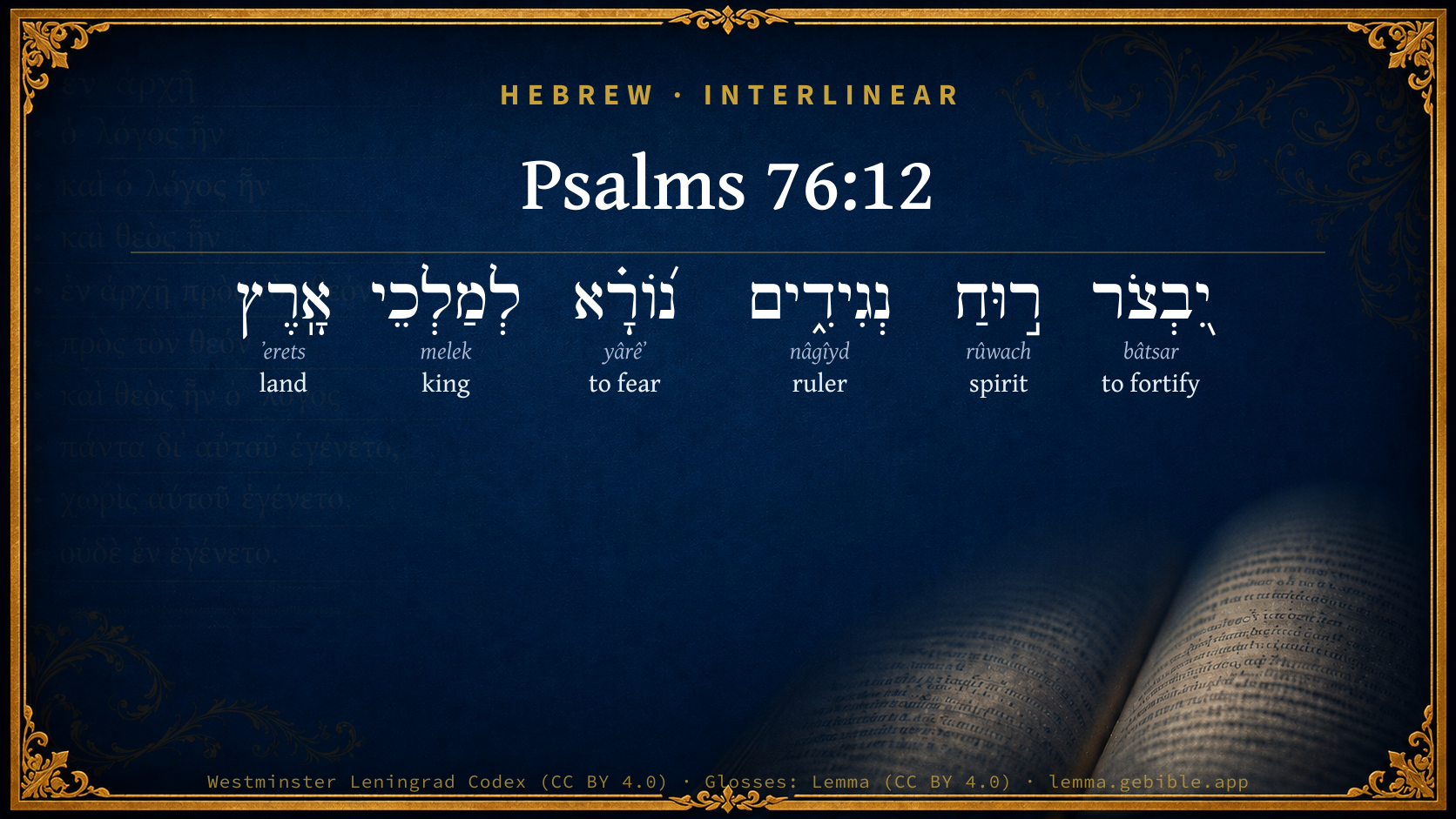
Psalms 76:12

Hebrew (Westminster Leningrad Codex) Psalms 76:12 appears in the Hebrew Old Testament. The text above is from the Westminster Leningrad Codex. Each word links to its Strong’s number, a concise gloss, and parsing drawn from the Open Scriptures Hebrew Bible morphology. Click any word for its full Brown-Driver-Briggs (BDB) entry.
Download image
Cite this verse

Psalms 76:12 (World English Bible). Public Domain. Lemma interlinear Bible study tool, https://lemma.gebible.app/v/psalms/76/12.

Show BibTeX & RIS
BibTeX
RIS
English Translation
He will cut off the spirit of princes. He is feared by the kings of the earth.
World English Bible · Public Domain
Download a study sheet

One document with this verse’s original text, its word-by-word gloss line, the meaning frame, cross-references with their text, attributed commentary, and full source and license credits — printable, and it pastes into notes with its structure intact.

This verse Autodidact and up

Study sheet (.html) Plain text (.txt)

A passage Seminary Student

Up to 50 verses in one chapter. A passage sheet keeps up to 6 commentary sources and 12 cross-references per verse, in the order this page ranks them, and says so on the sheet whenever that leaves anything out. Ask for a single verse and you get the Autodidact verse sheet above.

Everything on this page stays free to read, with no account — the sheet is a download of what is already on screen, not access to it.

Want to remove ads? Support Godless Engineer
Compare translations 3

The same verse in 3 English versions, stacked beneath the original-language interlinear above. Click any original word for its lexicon entry.

Each is an independent rendering of the whole verse — the interlinear is not word-aligned to these translations.

Highlighted words mark where these versions differ — a whole-verse word diff, not a word-by-word alignment.

  • World English Bible Public Domain
    He will cut off the spirit of princes. He is feared by the kings of the earth.
  • King James Version Public Domain
    He shall cut off the spirit of princes: he is terrible to the kings of the earth.
  • unfoldingWord Literal Text CC BY-SA 4.0
    He cuts off the spirit of princes; he is to be feared by the kings of the earth.

unfoldingWord Literal Text — © unfoldingWord, licensed CC BY-SA 4.0. Word-aligned USFM3 via Door43 (git.door43.org/unfoldingWord/en_ult).

Versions to compare (up to 4)

3 of 4 selected

Show all 18 translations

Every available English version of this verse, each an independent rendering of the whole verse.

  • World English Bible Public Domain
    He will cut off the spirit of princes. He is feared by the kings of the earth.
  • Berean Standard Bible Public Domain
    He breaks the spirits of princes; He is feared by the kings of the earth.
  • Majority Standard Bible Public Domain
    He breaks the spirits of princes; He is feared by the kings of the earth.
  • King James Version Public Domain
    He shall cut off the spirit of princes: he is terrible to the kings of the earth.
  • American Standard Version (1901) Public Domain
    He will cut off the spirit of princes: He is terrible to the kings of the earth. Psalm 77 For the Chief Musician; after the manner of Jeduthan. A Psalm of Asaph.
  • Revised Version (1885) Public Domain
    He shall cut off the spirit of princes: he is terrible to the kings of the earth.
  • Geneva Bible (1599) Public Domain
    He shall cut off the spirit of princes: he is terrible to the Kings of the earth.
  • Douay-Rheims (1899) Public Domain
    Vow ye, and pay to the Lord your God: all you that are round about him bring presents. To him that is terrible,
  • Young's Literal Translation Public Domain
    He doth gather the spirit of leaders, Fearful to the kings of earth!
  • Literal Standard Version CC BY-SA 4.0
    He gathers the spirit of leaders, || Fearful to the kings of earth!
  • Unlocked Literal Bible CC BY-SA 4.0
    He cuts off the spirit of the princes; he is feared by the kings of the earth.
  • unfoldingWord Literal Text CC BY-SA 4.0
    He cuts off the spirit of princes; he is to be feared by the kings of the earth.
  • Darby Bible Public Domain
    He cutteth off the spirit of princes; [he] is terrible to the kings of the earth.
  • World Messianic Bible Public Domain
    He will cut off the spirit of princes. He is feared by the kings of the earth.
  • Webster's Bible Public Domain
    \\76:11\\Vow, and pay to the LORD your God: let all that are about him bring presents to him that ought to be feared.
  • Free Bible Version CC BY-SA 4.0
    For he humbles proud leaders; he terrifies the kings of the earth.
  • Bible in Basic English Public Domain
    He puts an end to the wrath of rulers; he is feared by the kings of the earth.
  • JPS Tanakh (1917) Public Domain
    (76-13) He minisheth the spirit of princes; He is terrible to the kings of the earth.

Literal Standard Version (2020), Covenant Press — licensed CC BY-SA 4.0. Text via the HelloAO Bible API (eBible.org). Unlocked Literal Bible (unfoldingWord) — licensed CC BY-SA 4.0. Text via the HelloAO Bible API (eBible.org). unfoldingWord Literal Text — © unfoldingWord, licensed CC BY-SA 4.0. Word-aligned USFM3 via Door43 (git.door43.org/unfoldingWord/en_ult). Free Bible Version, Dr. Jonathan Gallagher — licensed CC BY-SA 4.0. Text via the HelloAO Bible API (eBible.org).

Word by word

More ways to search: Search by grammar → Find every occurrence → Compare this word →

Practice this passage: Drill this verse → Learn its vocabulary →

About this verse

These counts appear in no published source. They are computed here, from the morphology-tagged text and Lemma’s own curated glosses. What Lemma adds →

6
words
6
distinct lemmas
Wisdom
section

Shared distinctive vocabulary

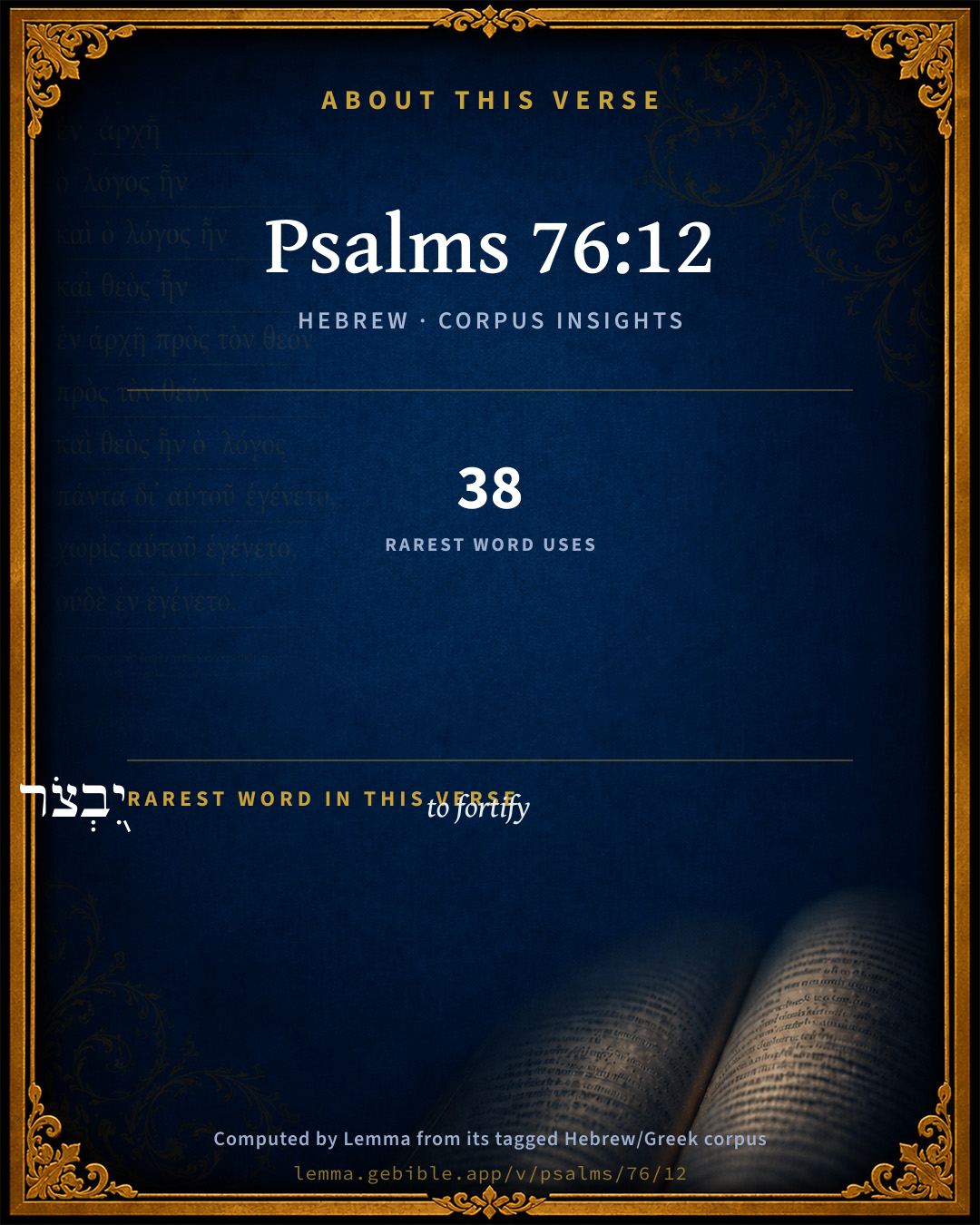
יִ֭בְצֹר to fortify H1219 occurs in 38 verses of the Hebrew Bible. Also found in:

Grammatical profile

  • 2 verbs
  • 4 nouns

Verb forms

  • יִ֭בְצֹר Qal · Imperfect
  • נ֝וֹרָ֗א Niphal · Participle Active

Hebrew & Septuagint length

In English translation the verse runs 17 words from the Hebrew and 19 from the Septuagint (LXX English) — closely comparable.

A rough comparison of the two English renderings, which tokenize alike — not a word-level alignment.

Word counts can differ between the Hebrew and the Greek without any difference in meaning — e.g. the Hebrew direct-object marker אֵת has no separate Greek word, and Greek often adds the article ὁ.

Cross-references

13

Topical passages linked to Psalms 76:12 in the Treasury of Scripture Knowledge — connected by theme and wording, ordered by reader-vote popularity; previews shown in the World English Bible.

  • Zephaniah 3:6 I have cut off nations. Their battlements are desolate. I have made their streets waste, so that no one passes by. Their cities are destroyed, so that there is no man, so that there is no inhabitant.
  • 2 Chronicles 32:21 Yahweh sent an angel, who cut off all the mighty men of valor, and the leaders and captains, in the camp of the king of Assyria. So he returned with shame of face to his own land. When he was come into the house of his god, those who came forth from his own bowels killed him there with the sword.
  • Psalms 68:12 "Kings of armies flee! They flee!" She who waits at home divides the spoil,
  • Isaiah 13:6–8 Wail; for the day of Yahweh is at hand; as destruction from the Almighty shall it come.
  • Psalms 2:5 Then he will speak to them in his anger, And terrify them in his wrath:
  • Psalms 2:10 Now therefore be wise, you kings. Be instructed, you judges of the earth.
  • Psalms 47:2 For Yahweh Most High is awesome. He is a great King over all the earth.
  • Psalms 48:4–6 For, behold, the kings assembled themselves, They passed by together.
  • Isaiah 24:21 It shall happen in that day, that Yahweh will punish the host of the high ones on high, and the kings of the earth on the earth.
  • Joshua 5:1 It happened, when all the kings of the Amorites, who were beyond the Jordan westward, and all the kings of the Canaanites, who were by the sea, heard how that Yahweh had dried up the waters of the Jordan from before the children of Israel, until we were passed over, that their heart melted, neither was there spirit in them any more, because of the children of Israel.
  • Psalms 68:35 You are awesome, God, in your sanctuaries. The God of Israel gives strength and power to his people. Praise be to God!
  • Revelation 6:15 The kings of the earth, the princes, the commanding officers, the rich, the strong, and every slave and free person, hid themselves in the caves and in the rocks of the mountains.
  • Revelation 19:17–21 I saw an angel standing in the sun. He cried with a loud voice, saying to all the birds that fly in the sky, "Come! Be gathered together to the great supper of God,

Cross-references courtesy of OpenBible.info (CC BY 4.0).

Hebrew and Greek witnesses Masoretic Hebrew ↔ Greek Septuagint

The same verse in the two great witnesses to the Old Testament, shown verse-for-verse.

You’re reading Greek Psalm 75 (Hebrew Psalm 76). The Septuagint counts the superscription, so verse numbers can differ from the Hebrew — chapter-level alignment, not verse-by-verse. Numbering follows Rahlfs.

These are two independent witnesses, not word-aligned to each other, and the Septuagint is shown in lemma (dictionary) form.

Hebrew Psalms 76:12 Masoretic · Westminster Leningrad Codex

יִ֭בְצֹר ר֣וּחַ נְגִידִ֑ים נ֝וֹרָ֗א לְמַלְכֵי אָֽרֶץ

He will cut off the spirit of princes. He is feared by the kings of the earth.

World English Bible · Public Domain

Greek LXX Greek Psalm 75:12 Septuagint · lemma form

εὔχομαι καί ἀποδίδωμι κύριος ὁ θεός σύ πᾶς ὁ κύκλος αὐτός φέρω δῶρον

and that takes away the spirits of princes; to him that is terrible among the kings of the earth.

LXX2012 (modern English Septuagint) · Public Domain

Hebrew: Westminster Leningrad Codex (CC BY 4.0). Greek: Septuagint (public domain); English from LXX2012 (modern English Septuagint) (Public Domain). How the Septuagint differs from the Hebrew →

Commentary

Notes on Psalms 76:12 from classic Christian and Jewish commentators (each source and its license shown beneath its notes). The classic Christian expositions comment on the surrounding passage and are grouped to its opening verse, so a note may address several verses; the Jewish commentaries on the Tanakh (Rashi and others) are per-verse, so they appear only where the commentator wrote on this verse.

Lemma curates 59 commentaries, every one of them public domain or Creative Commons licensed, each selected and text-cleaned for this edition rather than reprinted as found. About our sources →

Trapp's Complete Commentary

John Trapp

Psa 76:12 He shall cut off the spirit of princes: [he is] terrible to the kings of the earth.

Ver. 12. He shall cut off the spirit of princes] Vindemiabit, he shall slip them off as one would do a bunch of grapes, or a flower between one’s fingers; easily, suddenly, as he dealt by Sennacherib’s princes, Auferet de vita, ut de vite botros.

He is terrible to kings] Enemies to his Church, as most kings are.

John Trapp, A Commentary or Exposition upon All the Books of the Old and New Testament (1647–1656) — public domain. Text from a community e-Sword module.

Joseph Benson's Commentary

Psa 76:12. He shall cut off — Dr. Waterland reads, bring down, and Dr. Horne, restrain, the spirit of princes — Their pride and elation of mind, such as was that of the king of Assyria, before he was forced to return with shame of face to his own land. Or their courage; he can dispirit those that are most daring, and make them heartless; for he is, or will be, terrible to the kings of the earth — And sooner or later, if they be not so wise as to submit themselves to him, he will force them to call in vain to rocks and mountains to fall on them, and hide them from his wrath, Rev 6:15. The original word, however, יבצר, jibtzar, is borrowed from gathering the vintage, and signifies literally, He shall cut off their spirit, that is their breath and life, as men do their grapes in the time of vintage, namely, suddenly, violently, and irresistibly, as he did the Assyrian army. This is all they shall get by opposing him. Since, then, there is no contending with him, it is as much the wisdom, as it is the duty, of all, even of captains and generals of armies, of princes and kings, to submit to him, and make their peace with him. Reader, let this be thy care.

Joseph Benson's Commentary on the Old and New Testaments (1811–1818) — public domain. Text from a community e-Sword module.

J. A. Alexander on Psalms

Joseph Addison Alexander

13. (Psa 76:12). He cuts off the spirit of princes; he is feared (or to be feared) by the kings of earth. The first verb is specially applied to the pruning or cutting of vines. See Jer 6:9; Jer 25:30; Jer 49:9, and compare Rev 14:18-19. Its future form includes a potential sense. He can do it when he will, and he will do it when he sees occasion. Spirit or breath is here put for the life or vital principle, to cut which is to kill. He who possesses this alarming power is or ought to be an object of religious fear, not only to ordinary men, or to certain great men in particular, but to all the kings of the earth. Compare Mat 10:28, Luk 12:5. These expressions shew that the historical occasion of the psalm was not an event of merely local interest, but a great historical and national catastrophe, such as the blow inflicted on the power of Assyria by the sudden destruction of Sennacherib's host.

Joseph Addison Alexander, The Psalms Translated and Explained (1850) — public domain. Text from a community e-Sword module.

Geneva Bible (1599)

Geneva Bible translators

The Hebrew word signifieth to vintage, or gather grapes: meaning, that he shall make the counsels and enterprises of wicked tyrants foolish and vain.

Geneva Bible (1599) marginal notes — public domain. Text via Bolls.life.

Adam Clarke's Commentary

Verse 12. He shall cut off the spirit of princes] Even in the midst of their conquests, he can fill them with terror and dismay, or cut them off in their career of victory.

He is terrible to the kings of the earth.] "He is the only Ruler of princes;" to him they must account. And a terrible account most of them will have to give to the great God; especially those who, instigated by the desire of dominion, have, in the lust of conquest which it generates, laid countries waste by fire and sword, making widows and orphans without number, and extending the empire of desolation and death.

Thus all are under his dominion, and are accountable to him. Even those whom man cannot bring to justice, God will; and to judge them is one grand use of a final judgment day.

ANALYSIS OF THE SEVENTY-SIXTH PSALM

In this Psalm there are three parts: -

I. The Prerogative of Judah and Israel, Ps 76:1-2.

II. A narration of God's majesty in the Church, Ps 76:3-11.

III. An exhortation to worship and serve God.

I. The prerogatives of the Jews above all other nations.

1. God was known among them: "In Judah is God known."

2. His name was great in Israel. Illustrious for his manifold deliverances.

3. At Salem was his tabernacle, - his seat of worship, his peculiar presence.

4. His dwelling in Zion, - his constant habitation.

II. A narration of God's power and majesty.

He was glorious among good men; more glorious than the mountains of prey - kingdoms acquired by violence, murder, and robbery.

And this glory was manifest in the following particulars: -

1. They who came to spoil were spoiled, Ps 76:5.

2. They were slain: "They have slept their sleep," Ps 76:5.

3. They could make no head against their destroyer, though they were both numerous and strong: "None of the men of might have found their hands," Ps 76:5.

The cause of their consternation: -

1. The rebuke of God, Ps 76:6.

2. He was terrible: "None could stand in his sight," Ps 76:7.

3. He was determinate: "Judgment was heard from heaven," Ps 76:8. Sennacherib and his host were destroyed.

The effects produced by this were,

1. Praise from the wicked: "They shall acknowledge this as the hand of God." Ps 76:10.

2. Victory; though they rally, and return again to the battle, they shall be routed: "The remainder of wrath shalt thou restrain," Ps 76:10. See the notes.

III. He exhorts all to praise him: - 1. "Vow, and pay." 2. "Fear and submit to him," Ps 76:11.

This exhortation he founds on the following REASONS: -

1. "He shall cut off the spirit of princes;" take away from tyrants their prudence and courage.

2. "He is terrible to the kings of the earth." They also shall know that he is God.

Adam Clarke's Commentary on the Bible (1810–1826) — public domain. Text from a community e-Sword/MySword module.

John Calvin's Commentaries

12. He will cut off the spirit of princes. As the Hebrew word בצר, batsar, occasionally signifies to strengthen, some think it should be so translated in this passage. But as in the two clauses of the verse the same sentiment is repeated, I have no doubt that by the first clause is meant that understanding and wisdom are taken away from princes; and that by the second, God is represented in general as terrible to them, because he will cast them down headlong from their loftiness. As the first thing necessary to conduct an enterprise to a prosperous issue is to possess sound foresight, in which the people of God are often deficient from the great perplexity in which they are involved in the midst of their distresses, while, on the other hand, the ungodly are too sharp-sighted in their crafty schemes; it is here declared that it is in the power of God to deprive of understanding, and to inflict blindness on those who seem to surpass others in acuteness and ingenuity. The majority of princes being enemies to the Church of God, it is expressly affirmed, that He is sufficiently terrible to subdue all the kings of the earth. When it is said, that their spirit is cut off, or taken away from them, it is to be limited to tyrants and robbers whom God infatuates, because he sees that they apply all their ingenuity and counsels to do mischief.

John Calvin's Commentaries (1540-1563) — public domain. Text from the Calvin Translation Society English edition (1840s-50s) via the Christian Classics Ethereal Library (ccel.org). Calvin's coverage is partial (roughly two-thirds of the Bible); uncommented books and verses are honest gaps, never fabricated. The 19th-century editor's footnotes and remarks are omitted so the notes are faithfully Calvin's own voice.

Ellicott's Commentary for English Readers

(12) He shall cut off . . .—Literally, lop off, as a vinedresser prunes a vine. For the image see Joe_3:13; Isa_18:5; Rev_14:17 seq.

Spirit—i.e., the life.

A Bible Commentary for English Readers, edited by Charles John Ellicott (1878–1897) — public domain. Text from a community e-Sword module.

The Cambridge Bible for Schools and Colleges

gen. ed. J. J. S. Perowne

12. He shall cut off] Cp. the simile in Isa_18:4-5, describing how Jehovah will destroy the plans of the Assyrians just as they are coming to maturity: and Rev_14:18-19.

the spirit of princes] Their pride and fury. Cp. Isa_33:11.

the kings of the earth] Cp. Psa_48:4.

The Cambridge Bible for Schools and Colleges (gen. ed. J. J. S. Perowne; Cambridge University Press, 1878–1918) — public domain. Text from a community e-Sword module.

John Gill's Exposition

He shall cut off the spirit of princes,.... The pride of their spirits, as the Targum, humble their proud spirits, and bring them down; or dispirit them, take away their courage from them, upon which they flee apace to rocks and mountains to cover them; or confound them, blast their schemes, and carry their counsel headlong, and even take away their breath, or life; which he can as easily do as a man can cut off a bunch of grapes from the vine, as the word (g) here used signifies; the destruction of the wicked is expressed by cutting down the vine of the earth, and casting it into the winepress of God's wrath, Rev 14:17,

he is terrible to the kings of the earth; as he was to the king of Assyria, when he sent his angel, and destroyed his army; and as he has been to others in all ages; so he will be to the kings of the earth that have committed fornication with the whore of Rome, who will be in the utmost panic at the time of her destruction, Rev 18:9, and who will themselves be overcome by the Lamb, Rev 16:14. The Targum is, he is to be feared above all the kings of the earth.

(g) "qui vindemiat", Junius & Tremellius, Piscator; "succidet nempe, ut vindemiator racemos", Vatablus, so Ainsworth.

Next: Psalms Chapter 77

John Gill's Exposition of the Whole Bible (1746–1763) — public domain (CC PDM 1.0). Text via the HelloAO Bible API.

Albert Barnes' Notes on the Bible

He shall cut off the spirit of princes - That is, He will cut down their pride; he will break them down. Luther renders it, “He shall take away the wrath of princes.” The allusion is to what he had done as celebrated in this psalm. He had shown that he could rebuke the pride and self-confidence of kings, and could bring them low at his feet.

He is terrible to the kings of the earth - When they are arrayed against him.

(1) they are wholly under his control.

(2) he can defeat their plans.

(3) he can check them when he pleases.

(4) he can, and will, make their plans - even their wrath - the means of promoting or carrying out his own purposes.

(5) he will allow them to proceed no further in their plans of evil than he can make subservient to the furtherance of his own.

(6) he can cut down the most mighty of them at his pleasure, and destroy them forever.

Albert Barnes' Notes on the Bible (1834–1885) — public domain. Text from a community e-Sword/MySword module.

Matthew Poole's English Annotations

Cut off; as men do their grapes in time of vintage, as the Hebrew verb implies, to wit, suddenly, violently, and irresistibly. This is all which they shall get by opposing him, and therefore it is their wisdom to bring presents to him.

The spirit of princes; either,

1 Their courage. Or rather,

2. Their breath and life, as he did in the Assyrian army.

Matthew Poole's English Annotations on the Holy Bible (1683–1685) — public domain. Text from a community e-Sword/MySword module.

The Treasury of David

Charles H. Spurgeon

Ver. 12. He shall cut off the spirit of princes. Their courage, skill, and life are in his hands, and he can remove them as a gardener cuts off a slip from a plant. None are great in his hand. Caesars and Napoleons fall under his power as the boughs of the tree beneath the woodman's axe.

He is terrible to the kings of the earth. While they are terrible to others, he is terrible to them. If they oppose themselves to his people, he will make short work of them; they shall perish before the terror of his arm, "for the Lord is a man of war, the Lord is his name." Rejoice before him all ye who adore the God of Jacob.

Whole Psalm. No Psalm has a greater right to follow Psalm 75 than this, which is inscribed To the Precentor, with accompaniment of stringed instruments (vid. iv. 1), a Psalm by Asaph, a song. Similar expressions (God of Jacob, Ps 75:10 77:7; saints, wicked of the earth, Ps 75:9 76:10), and the same impress throughout speak in favour of unity of authorship. In other respects too, they form a pair: Psalm 75 prepares the way for the divine deed of judgments as imminent, which Psalm 76 celebrates as having taken place. Franz Delitzsch.

Ver. 12. Cut off. He deals with princes as men deal with a vine. An axe is too strong for a cluster of grapes, or a sprig of a vine; it easily cuts them off: so God by a judgment easily cuts off the spirit of princes; they are not able to stand against the least judgments of God: when he puts strength into worms, or any other creature they fall. William Greenhill, in a Sermon, entitled, "The Axe at the Root."

Ver. 12. The Lord cuts off the spirit of princes; the word is, he slips off, as one should slip off a flower between one's fingers, or as one should slip off a bunch of grapes from a vine, so soon is it done. How great uncertainty have many great ones, by their miserable experience, found in their outward glory and worldly felicity! What a change hath a little time made in all their honours, riches, and delights! That victorious emperor Henry the Fourth, who had fought fifty-two pitched battles, fell to that poverty before he died, that he was forced to petition to be a prebend in the church of Spier, to maintain him in his old age. And Procopius reports of King Gillimer, who was a potent king of the Vandals, who was so low brought, as to intreat his friends to send him a sponge, a loaf of bread, and a harp; a sponge to dry up his tears, a loaf of bread to maintain his life, and a harp to solace himself in his misery. Philip de Comines reports of a Duke of Exeter, who though he had married Edward the Fourth's sister, yet he saw him in the Low Countries begging barefoot. Bellisarius, the chief man living in his time, having his eyes put out, was led at last in a string, crying, "give a halfpenny to Bellisarius." Jeremiah Burroughs.

None.

Charles H. Spurgeon's The Treasury of David (1869–1885) — public domain. Psalms only. Text from a community e-Sword/MySword module.

Whedon's Commentary on the Bible

Daniel D. Whedon

12. Cut off the spirit of princes—The breath of princes, as in Job_9:18; Psa_104:29. Or, the spirit of princes may be taken for the ambition, haughtiness, pride, of princes. “God puts an end to the defiant, arrogant bearing of the tyrants of the earth, and becomes at last the feared of all the kings of the earth.”—Delitzsch.

Daniel D. Whedon (gen. ed.), Commentary on the Old and New Testaments (1874–1909) — public domain. Text from a community e-Sword module.

The Pulpit Commentary

He shall cut off the spirit of princes. "The spirit" seems here to mean "the life." God cuts off princes in their prime as a gardener cuts off bunches of grapes. (comp. Isa_18:5) He is terrible to the kings of the earth. Not "princes" only but "kings also are cut off in their prime when God pleases. Sennacherib"s untimely death (2Ki_19:37) followed not many years after the destruction of his host, in which there must have been many "princes."

The Pulpit Commentary (1880–1919), ed. H.D.M. Spence-Jones & Joseph S. Exell — public domain. Text from a community e-Sword module.

John Wesley's Explanatory Notes

Cut off - As men do their grapes in time of vintage; so the Hebrew verb implies. The spirit - Their breath and life, as he did in the Assyrian army.

John Wesley, Explanatory Notes Upon the Whole Bible (1754–1765) — public domain. Text via the GEBible commentary corpus.

Rashi

Rabbi Shlomo Yitzchaki (Rashi)

Vow and pay your vows.

all those around Him who hear of this salvation, and so they did, as it is stated (Isa. 19:18): “there will be five cities in the land of Egypt speaking the language of Canaan and swearing to the Lord of Hosts.”

will bring a gift to Him Who is to be feared Why? Because at the time of His desire...

Rashi on the Tanakh — English translations: “The Judaica Press complete Tanach with Rashi, translated by A. J. Rosenberg” (CC BY 4.0); “Pentateuch with Rashi's commentary by M. Rosenbaum and A.M. Silbermann, 1929-1934” (public domain); “The Metsudah Tanach series, Lakewood, N.J” (CC BY 4.0); and “The Book of Joshua, Metsudah Publications, 1997” (CC BY 4.0). Text via Sefaria.

Lesson kit

Teaching starters — assembled from the data on this page, not authored interpretation. Every prompt links to the verse data it draws on. Edit before teaching.

Psalms, in the Wisdom, opens this verse with 6 words (6 distinct Hebrew lemmas). Its most distinctive word is bâtsar (“to fortify”). A historical commentator’s framing appears above. Read the whole chapter for the surrounding context.

Discussion questions

  1. How does “to fortify” (bâtsar) shape what this verse is saying?
  2. Genesis 11:6 shares the word «to fortify» with this verse. How do the two illuminate each other?
  3. These translations render this verse differently. What is at stake in choosing one wording over another?
  4. The verb «יִ֭בְצֹר» is Qal Imperfect. How does its form color the action?
  5. Reading how Trapp's Complete Commentary and Joseph Benson's Commentary read this verse, where do the two commentators agree and where do they part?

Things to notice

Reading settings

Reading text

Shown beneath each verse's original-language words.

Old Testament
Old Testament edition

Read the OT as the Masoretic Hebrew (MT) or the Greek Septuagint (LXX).

English shown for the Greek Septuagint (in the Hebrew ↔ Greek comparison).

Comparing translations? Open the Compare panel on any verse page to stack up to four side by side.