
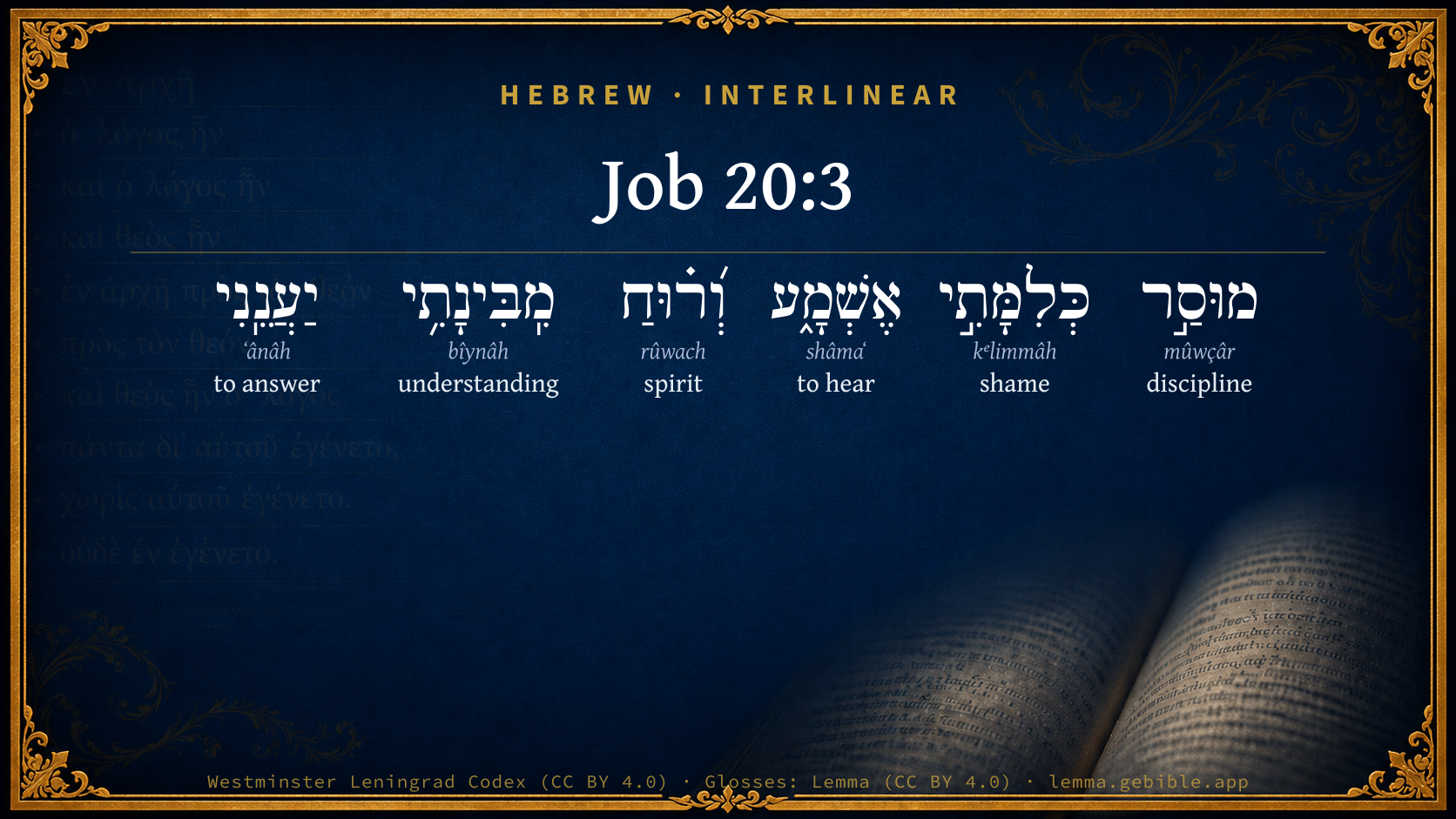
Job 20:3

Hebrew (Westminster Leningrad Codex) Job 20:3 appears in the Hebrew Old Testament. The text above is from the Westminster Leningrad Codex. Each word links to its Strong’s number, a concise gloss, and parsing drawn from the Open Scriptures Hebrew Bible morphology. Click any word for its full Brown-Driver-Briggs (BDB) entry.
Download image
Cite this verse

Job 20:3 (World English Bible). Public Domain. Lemma interlinear Bible study tool, https://lemma.gebible.app/v/job/20/3.

Show BibTeX & RIS
BibTeX
RIS
English Translation
I have heard the reproof which puts me to shame; The spirit of my understanding answers me.
World English Bible · Public Domain
Highlights
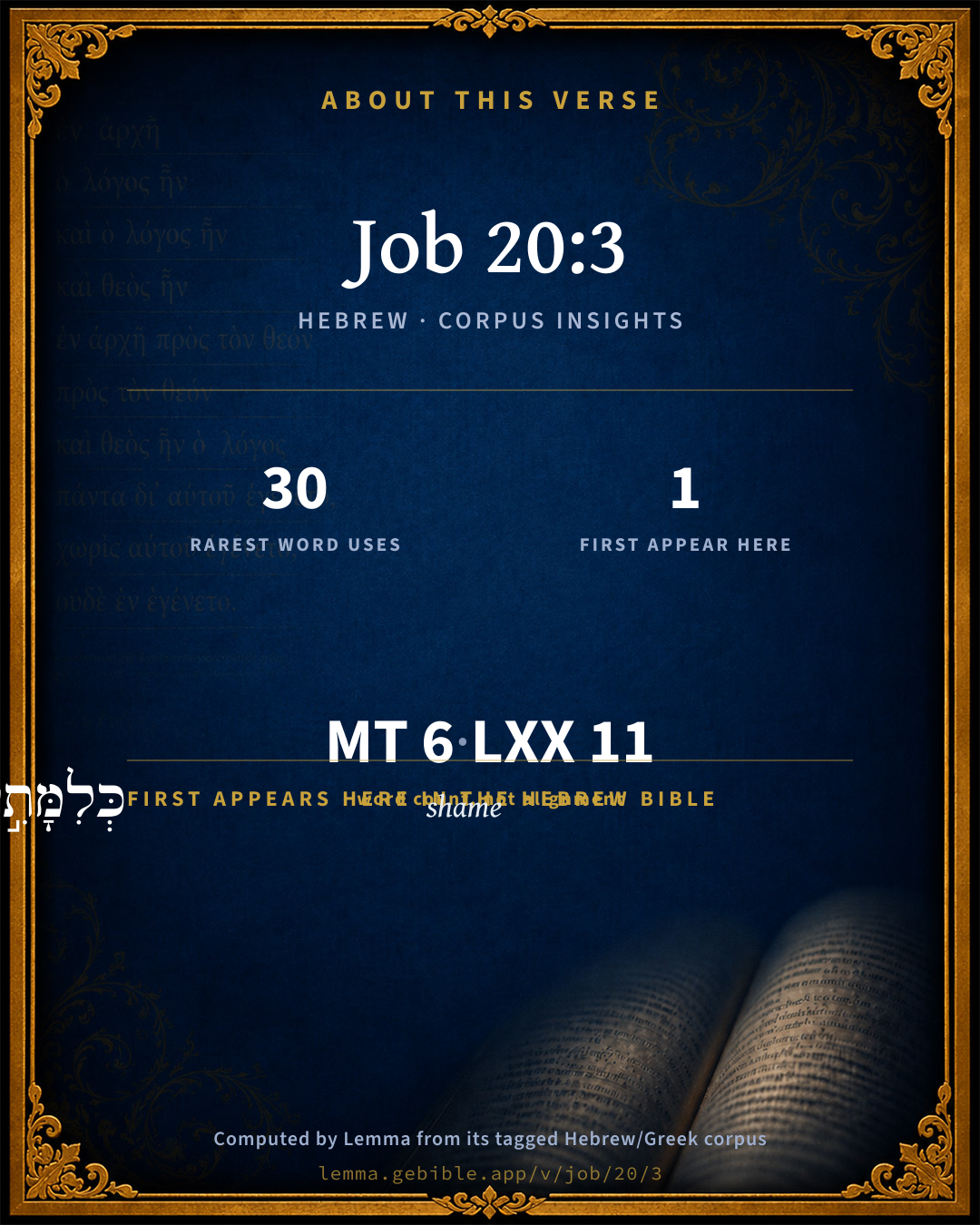
  • 1 first appearance in the Hebrew Bible
Full analysis ↓
Download a study sheet

One document with this verse’s original text, its word-by-word gloss line, the meaning frame, cross-references with their text, attributed commentary, and full source and license credits — printable, and it pastes into notes with its structure intact.

This verse Autodidact and up

Study sheet (.html) Plain text (.txt)

A passage Seminary Student

Up to 50 verses in one chapter. A passage sheet keeps up to 6 commentary sources and 12 cross-references per verse, in the order this page ranks them, and says so on the sheet whenever that leaves anything out. Ask for a single verse and you get the Autodidact verse sheet above.

Everything on this page stays free to read, with no account — the sheet is a download of what is already on screen, not access to it.

Want to remove ads? Support Godless Engineer
Compare translations 3

The same verse in 3 English versions, stacked beneath the original-language interlinear above. Click any original word for its lexicon entry.

Each is an independent rendering of the whole verse — the interlinear is not word-aligned to these translations.

Highlighted words mark where these versions differ — a whole-verse word diff, not a word-by-word alignment.

  • World English Bible Public Domain
    I have heard the reproof which puts me to shame; The spirit of my understanding answers me.
  • King James Version Public Domain
    I have heard the check of my reproach, and the spirit of my understanding causeth me to answer.
  • unfoldingWord Literal Text CC BY-SA 4.0
    I hear a rebuke of dishonor to me, but a spirit from my understanding answers me.

unfoldingWord Literal Text — © unfoldingWord, licensed CC BY-SA 4.0. Word-aligned USFM3 via Door43 (git.door43.org/unfoldingWord/en_ult).

Versions to compare (up to 4)

3 of 4 selected

Show all 18 translations

Every available English version of this verse, each an independent rendering of the whole verse.

  • World English Bible Public Domain
    I have heard the reproof which puts me to shame; The spirit of my understanding answers me.
  • Berean Standard Bible Public Domain
    I have heard a rebuke that insults me, and my understanding prompts a reply.
  • Majority Standard Bible Public Domain
    I have heard a rebuke that insults me, and my understanding prompts a reply.
  • King James Version Public Domain
    I have heard the check of my reproach, and the spirit of my understanding causeth me to answer.
  • American Standard Version (1901) Public Domain
    I have heard the reproof which putteth me to shame; And the spirit of my understanding answereth me.
  • Revised Version (1885) Public Domain
    I have heard the reproof which putteth me to shame, and the spirit of my understanding answereth me.
  • Geneva Bible (1599) Public Domain
    I haue heard the correction of my reproch: therefore the spirite of mine vnderstanding causeth me to answere.
  • Douay-Rheims (1899) Public Domain
    The doctrine with which thou reprovest me, I will hear, and the spirit of my understanding shall answer for me.
  • Young's Literal Translation Public Domain
    The chastisement of my shame I hear, And the spirit of mine understanding Doth cause me to answer:
  • Literal Standard Version CC BY-SA 4.0
    I hear the discipline of my shame, || And the spirit of my understanding causes me to answer:
  • Unlocked Literal Bible CC BY-SA 4.0
    I hear a rebuke that dishonors me, but a spirit from my understanding answers me.
  • unfoldingWord Literal Text CC BY-SA 4.0
    I hear a rebuke of dishonor to me, but a spirit from my understanding answers me.
  • Darby Bible Public Domain
    I hear a reproof putting me to shame; and [my] spirit answereth me by mine understanding.
  • World Messianic Bible Public Domain
    I have heard the reproof which puts me to shame. The spirit of my understanding answers me.
  • Webster's Bible Public Domain
    I have heard the check of my reproach, and the spirit of my understanding causeth me to answer.
  • Free Bible Version CC BY-SA 4.0
    What I hear you say insults me, but I know how to reply to you!
  • Bible in Basic English Public Domain
    I have to give ear to arguments which put me to shame, and your answers to me are wind without wisdom.
  • JPS Tanakh (1917) Public Domain
    I have heard the reproof which putteth me to shame, but out of my understanding my spirit answereth me.

Literal Standard Version (2020), Covenant Press — licensed CC BY-SA 4.0. Text via the HelloAO Bible API (eBible.org). Unlocked Literal Bible (unfoldingWord) — licensed CC BY-SA 4.0. Text via the HelloAO Bible API (eBible.org). unfoldingWord Literal Text — © unfoldingWord, licensed CC BY-SA 4.0. Word-aligned USFM3 via Door43 (git.door43.org/unfoldingWord/en_ult). Free Bible Version, Dr. Jonathan Gallagher — licensed CC BY-SA 4.0. Text via the HelloAO Bible API (eBible.org).

Word by word

More ways to search: Search by grammar → Find every occurrence → Compare this word →

Practice this passage: Drill this verse → Learn its vocabulary →

About this verse

These counts appear in no published source. They are computed here, from the morphology-tagged text and Lemma’s own curated glosses. What Lemma adds →

6
words
6
distinct lemmas
Wisdom
section

First appearance in Scripture

This word makes its first canonical appearance in the Hebrew Bible here:

  • כְּלִמָּתִ֣י shame H3639

Shared distinctive vocabulary

כְּלִמָּתִ֣י shame H3639 occurs in 29 verses of the Hebrew Bible. Also found in:

Grammatical profile

  • 2 verbs
  • 4 nouns

Verb forms

  • אֶשְׁמָ֑ע Qal · Imperfect
  • יַעֲנֵֽנִי Qal · Imperfect

Hebrew & Septuagint length

In English translation the verse runs 17 words from the Hebrew and 14 from the Septuagint (LXX English) — closely comparable.

A rough comparison of the two English renderings, which tokenize alike — not a word-level alignment.

Word counts can differ between the Hebrew and the Greek without any difference in meaning — e.g. the Hebrew direct-object marker אֵת has no separate Greek word, and Greek often adds the article ὁ.

In the original languages it is 6 Hebrew tokens and 11 Greek tokens — but the two are counted differently (Hebrew bundles its prefixes and suffixes into one token; the Greek is in lemma form), so that isn’t a like-for-like length.

Cross-references

7

Topical passages linked to Job 20:3 in the Treasury of Scripture Knowledge — connected by theme and wording, ordered by reader-vote popularity; previews shown in the World English Bible.

  • Job 33:3 My words shall utter the uprightness of my heart; That which my lips know they shall speak sincerely.
  • Job 19:3 You have reproached me ten times. You aren't ashamed that you attack me.
  • Job 19:29 Be afraid of the sword, For wrath brings the punishments of the sword, That you may know there is a judgment."
  • Job 20:2 "Therefore do my thoughts give answer to me, Even by reason of my haste that is in me.
  • Job 27:11 I will teach you about the hand of God. That which is with the Almighty will I not conceal.
  • Psalms 49:3 My mouth will speak words of wisdom. My heart shall utter understanding.
  • Psalms 78:2–5 I will open my mouth in a parable. I will utter dark sayings of old,

Cross-references courtesy of OpenBible.info (CC BY 4.0).

Hebrew and Greek witnesses Masoretic Hebrew ↔ Greek Septuagint

The same verse in the two great witnesses to the Old Testament, shown verse-for-verse.

These are two independent witnesses, not word-aligned to each other, and the Septuagint is shown in lemma (dictionary) form.

Hebrew Job 20:3 Masoretic · Westminster Leningrad Codex

מוּסַ֣ר כְּלִמָּתִ֣י אֶשְׁמָ֑ע וְ֝ר֗וּחַ מִֽבִּינָתִ֥י יַעֲנֵֽנִי

I have heard the reproof which puts me to shame; The spirit of my understanding answers me.

World English Bible · Public Domain

Greek LXX Job 20:3 Septuagint · lemma form

παιδεία ἐντροπή ἐγώ ἀκούω καί πνεῦμα ἐκ ὁ σύνεσις ἀποκρίνω ἐγώ

I will hear my shameful reproach; and the spirit of my understanding answers me.

LXX2012 (modern English Septuagint) · Public Domain

Hebrew: Westminster Leningrad Codex (CC BY 4.0). Greek: Septuagint (public domain); English from LXX2012 (modern English Septuagint) (Public Domain). How the Septuagint differs from the Hebrew →

Commentary

Notes on Job 20:3 from classic Christian and Jewish commentators (each source and its license shown beneath its notes). The classic Christian expositions comment on the surrounding passage and are grouped to its opening verse, so a note may address several verses; the Jewish commentaries on the Tanakh (Rashi and others) are per-verse, so they appear only where the commentator wrote on this verse.

Lemma curates 59 commentaries, every one of them public domain or Creative Commons licensed, each selected and text-cleaned for this edition rather than reprinted as found. About our sources →

Trapp's Complete Commentary

John Trapp

Job 20:3 I have heard the check of my reproach, and the spirit of my understanding causeth me to answer.

Ver. 3. I have heard the check of my reproach] Zophar conceived himself disgraced as well as menaced by Job; and this kindled him. Some are of so testy a nature, saith one, so skittish and unquiet humour, that a little offensive breath, a disgraceful word, blows them up into a rage that will not be laid down, without revenge, or reparation of their credits. Job’s reproofs were by this man construed for reproaches; and what was spoken to them all he applied to himself. It appeareth that he was sick of a Noli me tangere, when being touched so gently, nettle like, he stingeth him who handled him.

And the spirit of my understanding causeth me to answer] This I shall do with reason and understanding, not with passion and recrimination. Spiritus Dei nec mendax, nec mordax; meekness of wisdom is a fruit of God’s Spirit; by the which, and not by his reasonable soul only, Zophar seemeth to himself to be carried on. And surely they are holy truths all along that he uttereth, but wrested and misapplied as to Job, whom he will needs have to be wicked. Interim observemus, saith Lavater, Meanwhile let us observe that these things, sc. the state and portion of the wicked, the greatness and suddenness of their punishments, is therefore by God’s appointment so oft propounded and pressed in this whole book (whereof this is almost the sole argument), that we might be right in that point; fear to offend, and not fret at the wicked man’s prosperity, which is but momentary. The Tigurines translate this clause thus, Tametsi me conscientia hic consolabitur, Albeit herein my conscience shall comfort me.

John Trapp, A Commentary or Exposition upon All the Books of the Old and New Testament (1647–1656) — public domain. Text from a community e-Sword module.

Joseph Benson's Commentary

Job 20:3. I have heard — Or, Shall I hear? Namely, with patience, and without a reply? Who can endure it? The check of my reproach — That is, thy shameful and opprobrious reproofs of us, as if we, and all thy friends, were void of all humanity and natural affection toward thee, and were haters and persecutors of thee; and as if we were guilty of very heinous crimes, and might expect God’s vengeance upon us. And the spirit of my understanding — That is, my soul or mind, causeth me to answer — Constraineth me to speak. Or, the words רוח מבינתי, ruach mibbinathi, may be rendered, my spirit, or mind, because of my understanding, that is, out of, or because of, that certain knowledge which I have of this matter from consideration and experience. I speak not from passion, but from certain knowledge.

Joseph Benson's Commentary on the Old and New Testaments (1811–1818) — public domain. Text from a community e-Sword module.

Geneva Bible (1599)

Geneva Bible translators

He declareth that two things moved him to speak: to wit, because Job seemed to touch him, and because he thought he had knowledge sufficient to confute him.

Geneva Bible (1599) marginal notes — public domain. Text via Bolls.life.

Jamieson, Fausset & Brown

Robert Jamieson, A. R. Fausset & David Brown

check of my reproach--that is, the castigation intended as a reproach (literally, "shame") to me.

spirit of . . . understanding--my rational spirit; answering to "calm thoughts" (Job 20:2). In spite of thy reproach urging me to "hastiness." I will answer in calm reason.

Jamieson, Fausset & Brown — Commentary Critical and Explanatory on the Whole Bible (1871) — public domain (CC PDM 1.0). Text via the HelloAO Bible API.

Adam Clarke's Commentary

Verse 3. I have heard the check of my reproach] Some suppose that Zophar quotes the words of Job, and that some words should be supplied to indicate this meaning; e.g., "I have heard (sayest thou) the check or charge of my reproach?" Or it may refer to what Job says of Zophar and his companions, Job 19:2; Job 19:3: How long will ye vex may soul-these ten times have ye reproached me. Zophar therefore assumes his old ground, and retracts nothing of what he had said. Like many of his own complexion in the present day, he was determined to believe that his judgment was infallible, and that he could not err.

Adam Clarke's Commentary on the Bible (1810–1826) — public domain. Text from a community e-Sword/MySword module.

Ellicott's Commentary for English Readers

(3) I have heard the check of my reproach.—Rather, I have heard, or, I hear the reproof of my shame: that is, a reproof that puts me to shame, or is intended to do so.

The spirit of my understanding causeth me to answer.—Or, more literally, Out of my understanding my spirit answereth me, or causeth me to answer. He professes to be moved by an impulse within, which he cannot but obey.

A Bible Commentary for English Readers, edited by Charles John Ellicott (1878–1897) — public domain. Text from a community e-Sword module.

John Gill's Exposition

I have heard the check of my reproach,.... He took it that Job had reproached him and his friends, by representing them as hardhearted men, and persecuting him wrongly in a violent manner; and he had observed the "check" or reproof given for it, by bidding them beware of the sword, and lest the punishment of it should be inflicted on them; and if that should not be the case, yet there was a righteous judgment they could not escape. Now Zophar heard this, but could not hear it with patience; be could not bear that he and his friends should be insulted, as he thought, in this manner; and therefore it was he was in such baste to return an answer; though some (d) think he here pretends to a divine oracle, like that which Eliphaz makes mention of in the beginning of this dispute, Job 4:12, &c. which he had from God, and from which he had heard the "correction of his reproach" (e), or a full confutation of the thing Job had reproached him with; and being thus divinely furnished, he thought it his duty to deliver it:

and the spirit of my understanding causeth me to answer; or his rational spirit, his natural understanding, furnished him at once with an answer; he had such a clear insight into the controversy on foot, and such a full view of it, that he thought himself capable of speaking very particularly to the matter in hand, and to the conviction and confusion of Job; nay, his conscience, or the spirit of his conscience, as Mr. Broughton renders it, not only readily dictated to him what he should say, but obliged him to it; though some think he meant the Holy Spirit of God, by which he would be thought to be inspired; that he "out of his understanding" (f), enlightened by him, caused him to answer, or would answer for him, or supply him with matter sufficient to qualify him for it; and this he might observe to Job, in order to raise his attention to what he was about to say.

(d) Schmidt. (e) "correctionem ignominiae meae", Pagninus, Montanus; so Schmidt, Michaelis. (f) "ex intelligentia mea", Junius & Tremellius, Piscator, Mercerus, Drusius, Schmidt, Michaelis.

John Gill's Exposition of the Whole Bible (1746–1763) — public domain (CC PDM 1.0). Text via the HelloAO Bible API.

Albert Barnes' Notes on the Bible

I have heard the check of my reproach - I have heard your violent and severe language reproaching us. Probably he refers to what Job had said in the close of his speech Job 19:29, that they had occasion to dread the wrath of God, and that they might anticipate heavy judgments as the result of their opinions. Or it may be, as Schultens supposes, that he refers to what Job said in Job 19:2, and the rebuke that he had administered there. Or possibly, and still more probably, I think, he may refer to what Job had said in reply to the former speech of Zophar Job 12:2, where he tauntingly says that “they were the people, and that wisdom would die with them.” The Hebrew literally is, “the correction of my shame” (כלמה מוּסר mûsâr kelı̂mmâh), “the correction of my shame.” that is, the castigation or rebuke which tends to cover me with ignominy. The sense is, “you have accused me of that which is ignominious and shameful, and under the impetuous feelings caused by such a charge I cannot refrain from replying.”

And the spirit of my understanding - Meaning, perhaps, “the emotion of his mind.” The word “mind” or “soul” would better express the idea than the word “understanding;” and the word “spirit” here seems to be used in the sense of violent or agitating emotions - perhaps in allusion to the primary signification of the word (רוּח rûach), “mind.”

Albert Barnes' Notes on the Bible (1834–1885) — public domain. Text from a community e-Sword/MySword module.

Matthew Poole's English Annotations

I have heard from thy mouth. Or, Shall I hear, to wit, with patience, and without a reply? Who can endure it?

The check of my reproach, i.e. thy shameful and opprobrious reproofs of us, as if we and all thy friends were void of all humanity and natural affection towards them, and were haters, and cruel persecutors, and even devourers, of thee, Job 19:19,22; and as if we were guilty of most heinous crimes, and might expect God’s vengeance upon us.

The spirit, i.e. my soul or mind.

Of my understanding, or, because of (for so the Hebrew mem oft signifies)

my understanding i.e. out of, or because of, that certain knowledge which I have of this matter from study and experience; I have not spoken, and I shall not speak, out of ignorance, or prejudice, or passion and rage against Job, as he asperseth us, but only what I evidently know, and yet hope that I can and shall convince thee of.

Causeth me to answer, i.e. forceth me to speak. Or, answereth for me, i.e. either vindicates me against thy calumnies, or suggesteth an answer to me.

Matthew Poole's English Annotations on the Holy Bible (1683–1685) — public domain. Text from a community e-Sword/MySword module.

Whedon's Commentary on the Bible

Daniel D. Whedon

3. The check of my reproach — Literally, chiding of my shame, that is, the chiding which tends to his shame — a similar phrase to that of “the chastisement of our peace,” Isa_53:5 — the chastisement that produces our peace. My shameful rebuke must I hear.

Of my understanding — From or out of. Zophar prides himself upon representing “the individual reason, as Bildad represents the collective traditional wisdom of the race.” — Evans.

Daniel D. Whedon (gen. ed.), Commentary on the Old and New Testaments (1874–1909) — public domain. Text from a community e-Sword module.

The Pulpit Commentary

I have heard the check of my reproach; or, the reproof which putteth me to shame (Revised Version). Some suppose an allusion to Job_19:2, Job_19:3; but it is better to regard Zophar as enraged by vers. 28, 29 of Job 19. And the spirit of my understanding causeth me to answer. This claim is not quite consistent with the acknowledgment of hastiness in ver. 2. But it is no unusual thing for an impetuous and hasty man to declare that he speaks from the dictates of pure dispassionate reason.

The Pulpit Commentary (1880–1919), ed. H.D.M. Spence-Jones & Joseph S. Exell — public domain. Text from a community e-Sword module.

John Wesley's Explanatory Notes

The check - Thy opprobrious reproofs of us. Understanding - I speak, not from passion, but certain knowledge.

John Wesley, Explanatory Notes Upon the Whole Bible (1754–1765) — public domain. Text via the GEBible commentary corpus.

Lesson kit

Teaching starters — assembled from the data on this page, not authored interpretation. Every prompt links to the verse data it draws on. Edit before teaching.

Job, in the Wisdom, opens this verse with 6 words (6 distinct Hebrew lemmas). Its most distinctive word is kᵉlimmâh (“shame”). A historical commentator’s framing appears above. Read the whole chapter for the surrounding context.

Discussion questions

  1. What does “shame” (kᵉlimmâh) contribute to the verse as a whole?
  2. The word “shame” first appears here in Scripture. What is being introduced at this debut?
  3. Psalms 4:2 shares the word «shame» with this verse. How do the two illuminate each other?
  4. These translations render this verse differently; the difference is in the English rendering, not the original. What questions does that raise?
  5. The verb «אֶשְׁמָ֑ע» is Qal Imperfect. How does its form color the action?
  6. Reading how Trapp's Complete Commentary and Joseph Benson's Commentary read this verse, where do the two commentators agree and where do they part?

Things to notice

Reading settings

Reading text

Shown beneath each verse's original-language words.

Old Testament
Old Testament edition

Read the OT as the Masoretic Hebrew (MT) or the Greek Septuagint (LXX).

English shown for the Greek Septuagint (in the Hebrew ↔ Greek comparison).

Comparing translations? Open the Compare panel on any verse page to stack up to four side by side.